Are humans a cancer on the planet? A physician argues that civilization is truly carcinogenic

Salon

Are humans a cancer on the planet? A physician argues that civilization is truly carcinogenic

Troy Farah – August 5, 2023

Aerial View City in the US; Cancer Cell Photo illustration by Salon/Getty Images

Humans have existed on this planet for a relatively short time, yet we’ve had a major impact on it, dramatically altering its biodiversity and shifting its global climate in only a few centuries. The burning of fossil fuels has cooked the globe so much that ecosystems are threatening to fall completely out of balance, which could accelerate the ongoing mass extinctions caused by our predilection for exploiting nature.

There’s a very distinct possibility we could trigger our own extinction or, at the very least, greatly reduce our population while completely altering the way we currently live. Little things like going outside during daylight hours or growing food in the dirt could become relics of the past, along with birds, insects, whales and many other species. War, famine, pestilence and death — that dreaded equine quartet — threaten to topple our dominance on this planet. We are destroying our own home, sawing off the very branch we rest on.

Those who refute this reality, or climate change deniers, misinterpret the same sets of data showing a clear anthropological cause as being part of the “natural” cycle of the planet. Things are warming, they argue, and that is normal. Only, it really isn’t normal.

Climatologists and scientists have been sounding the alarm for decades: Global temperatures and planetary homeostasis are spiraling out of control, and we’re to blame. The climate crisis is no longer a hypothetical future. It’s the tangible present, and the evidence is clear in every grueling heatwavenot-so-uncommon “freak” storm and raging wildfire.

On the opposite extreme is a vocal minority, the accelerationists and nihilists who accept that humanity is overwhelmingly destructive to nature, but argue our extinction would be a welcome relief. I received many such comments on social media after interviewing Peter Ward, a paleontologist and professor at the University of Washington, about his “Medea hypothesis,” a theory that life is not a benevolent force and often causes its own extermination. Many species in Earth’s history became so successful that they wiped themselves out — and we could do the same.

In response to that article, many readers said something such as, “Humans are a virus and should be eradicated.” Obviously, inducing human extinction is an outcome for which only a very cynical personality would advocate. But what about the first part of that statement? Are humans really like a virus, a pathogen, a cancer?

Dr. Warren Hern, a Colorado-based physician and author of the new book “Homo Ecophagus: A Deep Diagnosis to Save the Earth,” argues that human civilization indeed has many similarities with cancer. This isn’t a metaphor, but rather a literal diagnosis — and it can be addressed in the same way that an actual cancer diagnosis can be the first step to treatment.

Salon recently spoke with Hern about his new book, which acts partially as a memoir, textbook, dire diagnosis and poetic ode to a disintegrating planet, discussing the implications for such an urgent prognosis, a new name for the human species that reflects our true nature and how we can still fix this crisis.

This interview has been condensed and lightly edited for clarity.

My opinion is that humans are part of nature — we are not separate from it. After I came across your book, I began asking myself, “Are humans really a cancer on the planet?” I thought, “Aren’t we part of this whole ecosystem?” I initially set out to disprove what you’re saying, but the argument you make is so extremely convincing. I know from your writing that when you were first conceptualizing the notion that humans are a cancer on the planet, it was very unpopular. But now it seems like this idea has earned some mainstream acceptance. Is that true?

This is a fundamental scientific and philosophical question. And, first of all, I agree with you that we are part of nature. We evolved in a natural ecosystem, and we have obviously very intimate close ties with other species, other animals. Humans are unique in that they have culture, although we’re learning that other animals have certain levels of culture also, like whales. So, we are really not unique in that sense, but we have a different and higher level of culture that allows us to dominate other species and ecosystems.

These are cultural adaptations that allow us to survive, but they have become malignant maladaptations because they are now threatening our survival and millions of other species. We have essentially made a decision at this point as a species to go extinct. That’s what we’re doing — we’re eliminating our biosphere and our planetary support system. Consciously or not, and I think mostly unconsciously.

When I first came onto this in the late ’60s, I was horrified. It’s not an analogy; nobody ever died from an analogy. It’s a diagnosis, and that’s different. The diagnosis is the same as the hypothesis. The guy comes into the emergency room with a sore belly, and he has right lower quadrant pain. Your diagnosis is appendicitis until proven otherwise. But that’s a hypothesis because he might have some other disease, or if it’s a woman, they might have an ovarian cyst.

I work with the idea from Karl Popper that science is not advanced by proving anything, but by disproving false hypotheses. The purpose of a hypothesis is to explain reality and predict events. This hypothesis [humans as a cancer] explains what we see going on in reality around us —  and has for a long time —  and it predicts what is going to happen. And that means the prognosis, in medical terms, for cancer is death. The cancer continues until the host organism dies.

The difference between us and a cancer — the only difference — is we can think, and we can decide not to be a cancer. If the diagnosis is correct, things will continue until we are extinct. The biosphere can’t go extinct; it can’t die, but we can alter it to the point that we can no longer survive. And that will take out millions of other organisms. Clearly, plenty of organisms are going to survive that process. They might even be more intelligent than us. I don’t know.

That’s sort of the general picture. And whether people accept this or want to even listen to it is another thing. For example, in the book, I talk about the guy who took over the anthropology section at AAAS [American Association for the Advancement of Science] back in the early ’90s. He didn’t like this idea, and he wanted them to drop it from the schedule because his wife had cancer and he was very offended by it. I told him, “Well, I’m really sorry that your wife has cancer, and I certainly hope she recovers. This doesn’t have anything to do with your wife’s cancer.”

I hope people can see that because it’s such a good diagnosis. I mean, it really does fit the bill. You look at maps of cities and tumors, and you can see how they kind of grow similarly. But the similarities don’t end there.

The basic premise is that humans have the capacity of developing culture, and that has millions of manifestations, everything from language and speech and mathematics to constructing shelters, building weapons and having medical care to keep us alive. These adaptations have allowed us to go from a few separate species of skinny primates wandering around in Africa a couple of million years ago to being the dominant ecological force on the planet to the point we’re changing the entire global ecosystem.

These cultural adaptations have now become maladaptive. They do not have survival value. And they are, in fact, malignant maladaptations because they’re increasing in a way that cancer increases. So, this means that the human species now has all of the major characteristics of a malignant process. When I was in medical school, we had four of them that were identified: rapid, uncontrolled growth; invasion and destruction of adjacent normal tissues — in this case, ecosystems; metastasis, which means distant colonization; and dedifferentiation, which you see very well in the patterns of cities.

That’s only one example. We now have 10 or 15 other new characteristics of cancer, and the human species fits all of them. And so the disturbing thing about this? If you have any two of the first four characteristics of cancer, it’s cancer until proven otherwise. And cancer does not stop until the host organism has ceased to function, which for our purposes is the biosphere.

Now, I have given the book the name “Homo Ecophagus.” That is my new name for the human species, which currently has the scientific name of Homo sapiens sapiens, or wise, wise man, which makes us the most misnamed species on the planet. Homo ecophagus means the man who devours the ecosystem — and that’s what we are doing.

We are in the process of converting all plant, animal, organic and inorganic material on the planet into human biomass and its adaptive adjuncts or support systems. The evidence for that is all around us.

So, that’s the basic idea in a nutshell, and then the rest of the book is simply manifestations of this malignancy and an explanation of the analysis. And so, the next question is: Can we do anything about this? Should we do something about this? It’s very hard under the circumstances, for example, to think about Vladimir Putin sitting down with Zelensky if they can fix the ecosystem in Ukraine.

Right, it’s a very, very difficult problem. It’s the biggest problem our society faces right now. Literally, nothing else matters if we don’t address this problem.

That’s the point: It’s an existential crisis. Yes.

I have to say that it seems like we’re not going to solve this problem. I don’t want to be negative and despair that we’re all simply going to die from climate change. I recently made a move across the country from California to Illinois. Everywhere you go, you get that dedifferentiation that you speak of, where everything looks the same. Every freeway has the same strip malls. You see all these people in these giant pickup and semi trucks and all this overconsumption. I just don’t see people giving it up. I just don’t see it happening. Not fast enough, at least.

This is what I call the “ecophasic imperative.” Robert Ardrey, a brilliant anthropologist, about 40 or 50 years ago wrote a number of outstanding books. One is called “The Territorial Imperative,” which is about how humans have an imperative need to have and expand their territories.

One of the most lurid manifestations of what we have right now is Donald Trump. Another one is Putin and the war on Ukraine, but humans have been doing this forever. And now our malignant melanoma patients have been put in a position where we are devouring the Earth. We are devouring the ecosystem. We have an imperative to do that. Look at the open pit mines that we have of various kinds. The whole alternative energy programs depend on destroying certain ecosystems to get the rare metals that we need to do that stuff.

I do not want to be negative, either. I’m basically an optimistic and positive person. I’ve been my whole life. The Intergovernmental Panel on Climate Change gives us a list of horribles, and it gets more horrible every year. But what’s the underlying dynamic? I say this is a malignant process going on for hundreds of thousands of years.

This is not new. When the Australian Aborigines arrived on the continent of Australia, they started changing the ecosystem in very dramatic ways, and a lot of species went extinct. My colleague here at the University of Colorado, Giff Miller, has been one of the people showing that it happened in North America. It happened in the Pacific Islands. It happens every place. Humans have made other species extinct wherever they show up.

Of course, it takes individual actions. The obvious side to that is people can make changes in their lives. I’m in Boulder, Colo, for example, where they have a lot of recycling going on, and people are very conscious of that. But, at the same time, you have China putting in a coal-fired power generation plant every week. So, it’s very hard to see how all these individual actions can really have that effect that we want.

Do you have hope for the future, or maybe feel despair about everything? I often get a little bit paralyzed and feel like there’s no point to anything, like we’re all just going to go off the cliff. I’m hoping something will change, that something will shift on a major level, that we’ll all kind of come together on this issue. But I feel like I’ve been waiting for that moment for years.

It’s hard to know how to answer your question when you ask me, “Is there hope?” One of my main answers — which is true — is that young people like you give me hope, people who are looking at this stuff and thinking about it and figuring out what to do. When I look at the current political scene in the United States, it’s very hard to be optimistic because we have a violent fascist movement that occupies the attention of at least a third, if not more, of the population, supporting a man who is a sociopathic criminal.

I think that we make the decisions about these situations — the environment and our survival — through our political process. I want to be optimistic. Let me just share a little example of something with you. A week ago, I went to New Mexico to attend a special memorial service for Dave Foreman.

Dave Foreman started the organization Earth First! with a couple other people. He was what we call a radical environmentalist, and he was associated with Edward Abbey, who wrote “The Monkey Wrench Gang.” And part of their idea was you throw a monkey wrench into this process to stop it. OK, very romantic idea. Very exciting, but how much did they accomplish with that?

The meeting was held in a campground outside of Los Alamos, and we were a scruffy-looking bunch of backpackers and tree huggers. I felt right at home with these wonderful people, who were some of the hardcore environmentalists of this country, and people who really, really were dedicated, spent their lives working on protecting the environment. We’ve been talking about people with advanced degrees, with PhDs in ecology and biology, wolf conservation, I don’t know what else.

They were an impressive bunch of people. I enjoyed meeting them, and I participated in this meeting. I admire Dave, who was a friend of mine. And I have his books, and they’re worth reading. OK, this is a highly energetic, wonderful, dedicated, altruistic group in this country. What’s been happening since they started Earth First!? Things are a lot worse than they were.

And it’s very hard to see how that has really influenced the broad scale of things, even though they’ve had a lot of very specific local victories. More people need to understand that we are in an impending extinction crisis for ourselves and for the rest of the ecosystem and other species. We are destroying the planet as we speak — as rapidly as possible — and that must stop. We must find ways to do things differently, and that’s going to make big changes in our lives.

Read more about climate change:
Ahead of Ohio abortion vote, Republicans try to change the rules

BBC News

Ahead of Ohio abortion vote, Republicans try to change the rules

Holly Honderich – in Washington – August 5, 2023

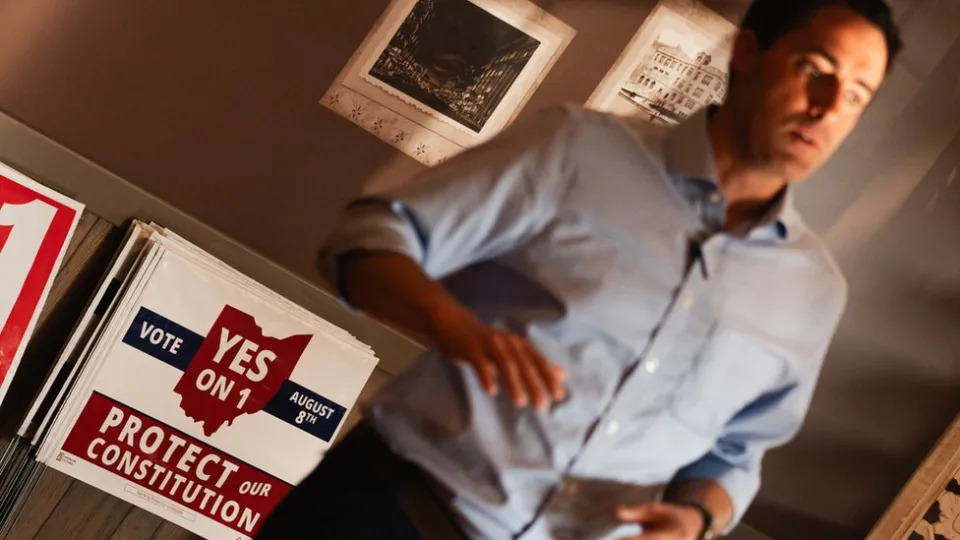
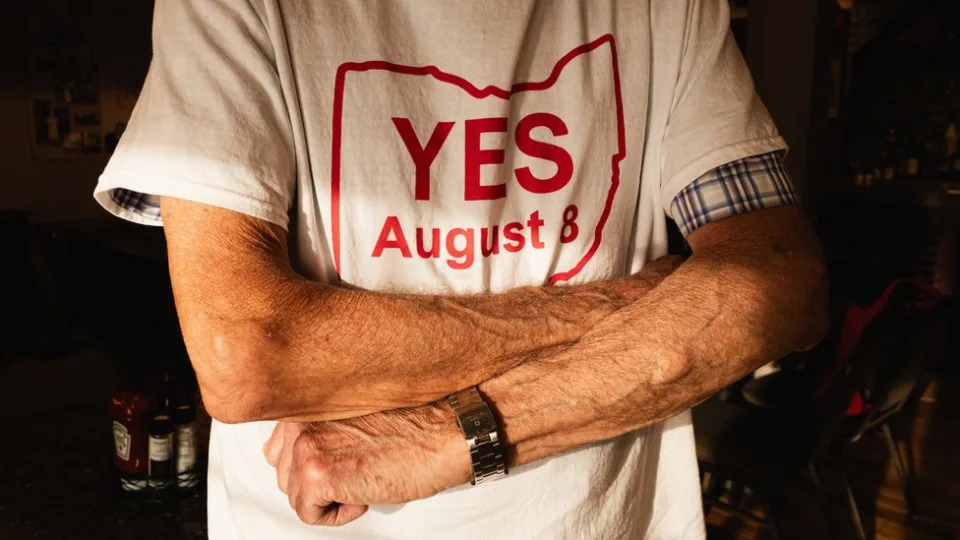
A Republican wears a shirt supporting Issue 1
An upcoming referendum in Ohio has become a proxy fight for abortion

A pro-abortion referendum looked poised to win in the conservative state of Ohio this November. Now, Republican state legislators are accused of moving the goalposts.

Last summer, just like every summer for the past 22 years, Michael Curtin spent his days on the assorted baseball fields of central Ohio, acting as umpire for high school and college games.

Mr Curtin, retired after a 38-year career in journalism and another four in state politics, loves the game. But this summer, Mr Curtin’s umpire equipment has been neglected, shoved somewhere in the basement of his Columbus home so he could focus on the rules of Ohio politics instead.

“I’m not doing one game,” he said. “And I miss it. But this fight’s too important to lose.”

The fight in question is over Issue 1, a deceivingly dull and procedural-sounding referendum on the minimum threshold required to pass constitutional amendments.

The premise is simple: voters will decide on 8 August whether that threshold should remain at 50% plus one, or be raised to 60%.

But Ohio’s vote has become a proxy war over abortion, one of the many state-wide battles that have broken out since the US Supreme Court rescinded the nationwide right to abortion last June.

That’s because Issue 1 is not the only referendum looming. In November, Ohioans will vote on another constitutional amendment, one that would protect abortion access up until foetal viability, around 24 weeks of pregnancy.

The proponents of issue 1 claim that Tuesday’s vote is simply to protect the state’s constitution from outside influence.

But its opponents – a diverse coalition featuring political wonks like Mr Curtin, a retired Supreme Court judge and all of Ohio’s past living governors – have called foul. They claim Issue 1 is a backhanded attempt to change the rules mid-game, raising the voter threshold just in time to thwart the abortion vote.

“Look, everybody knows what’s going on here. Everybody knows,” Mr Curtin said. “This was just bad faith.”

Frank LaRose talks to Republican voters
Issue 1 has been championed by Ohio’s secretary of state Frank LaRose

Since Roe v Wade was overturned last June, the country’s abortion fight has increasingly played out in state ballot initiatives. There have been six so far, each one a win for abortion rights.

If Ohio’s vote is passed, it will be the most sweeping affirmation of reproductive rights in a state controlled by a firm Republican majority, said Mary Ziegler, a law professor at the University of California, Davis and a leading authority on the US abortion debate. “It will confirm that there’s some sort of consensus around abortion rights, even in conservative states.”

And according to recent surveys, if all Ohioans were to show up for the vote now, abortion would win. The constitutional amendment is supported by 58% of Ohioans, with 32% opposed, according to a July poll from USA Today and Suffolk University.

But if Issue 1 is passed first, and the threshold is raised to 60%, the abortion rights amendment may be finished.

“They [anti-abortion campaigners] very clearly looked at this and said: we cannot win if we don’t change the rules,” said Kellie Copeland, executive director of Pro-Choice Ohio.

Issue 1 has had the full-throated support of Ohio’s chief election official, secretary of state Frank LaRose.

“To allow a bare majority of 50% plus one to change the very ground rules that the state operates on is just not good public policy,” he told the BBC.

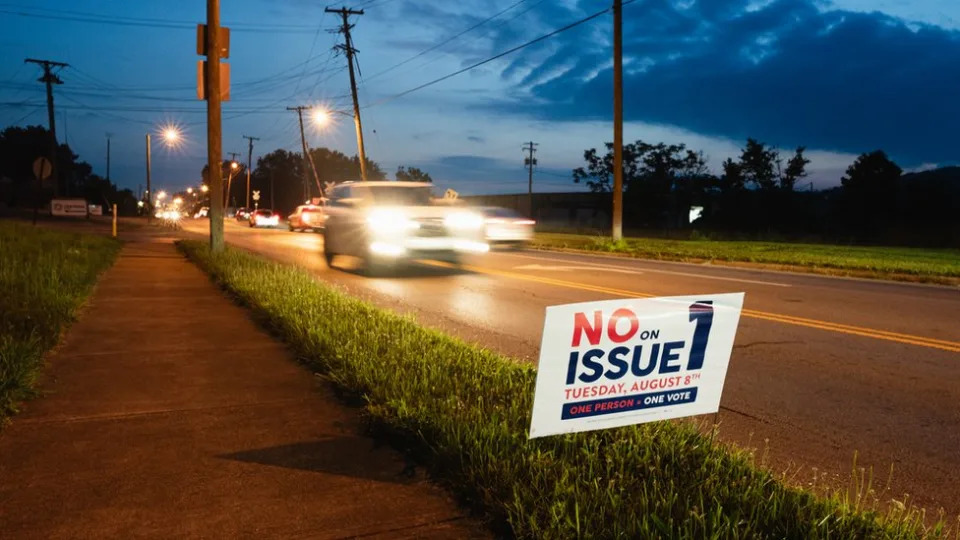
A sign in Ohio against Issue 1
Issue 1’s opponents include all four of the state’s living former governors

Mr LaRose, 44, is a veteran of the US Special Forces and now an enthusiastic envoy for the Republican Party, crisscrossing the state for more than 65 pro-Issue 1 events. He is charming, conservative and politically ambitious. In November – at the same time the abortion referendum is held – Mr LaRose will be on the ballot for the US Senate.

In public, Mr LaRose has kept the focus squarely on the constitution. But at a fundraising dinner in May, Mr LaRose made explicit the importance of Issue 1 for the anti-abortion movement.

“I’m pro-life. I think many of you are as well,” Mr LaRose said, in a video recorded by Scanner Media. “This is 100% about keeping a radical pro-abortion amendment out of our constitution. The left wants to jam it in there this coming November.”

In an interview with the BBC, Mr LaRose acknowledged that the “looming abortion amendment” helped bring the Issue 1 vote forward. “But that’s not the only reason,” he said.

To his opponents, Mr LaRose had been caught saying the quiet part out loud.

“There’s an old standard that our grandparents taught us that bears repeating: if you want any credibility in life… never deny the obvious,” Mr Curtin said. “Here is Mr LaRose denying the obvious.”

There have been other accusations of hypocrisy. Earlier this year, Republicans passed a law eliminating nearly all August elections, citing their high cost and low turnout. Then, in an apparent u-turn, they put Issue 1 on the calendar for 8 August.

Even some of Mr LaRose’s fellow Republicans have spoken out against Issue 1.

“You’re talking about changing a part of the Ohio constitution that has been in effect for well over 100 years,” said former Ohio Governor Bob Taft, a Republican. “And it’s worked, it’s worked well, the system is not broken.”

In the 111 years since Ohio first granted voters the power to introduce citizen-led amendments, just 19 of 71 proposed measures have passed. Ohio’s current policy requiring a simple majority is in line with most of the 17 US states that allow citizen-initiated amendments. And in 2015, Ohioans added a new restriction, passing an amendment that prohibited anyone from changing the constitution for their own financial benefit.

“This is an elaborate scheme to suppress the vote of Ohioans… It’s unconscionable,” said former Ohio Supreme Court Chief Justice Maureen O’Connor, also a Republican.

Whatever Mr LaRose’s motivations, Issue 1 has been embraced by Ohio’s anti-abortion lobby. Mike Gonidakis, president of Ohio Right to Life, said he “led efforts” to get signatures from state politicians to put the measure on the ballot.

“In speaking with Frank LaRose I said ‘now’s our time to do this’,” he told the BBC.

Mr Gonidakis, like Mr LaRose, rejected criticism that Issue 1 was underhanded. “It’s not changing the goalposts if Ohioans weigh in and vote on it,” he said.

Experts said they see Ohio’s Issue 1 as part of a broader tactic employed by anti-abortion advocates to circumvent public opinion in service of their ultimate goal, outlawing abortion entirely – a goal that is unsupported by most Americans.

“They think if voters had a straight up and down decision on abortion it wouldn’t go their way, so they’re trying to do what they can to prevent that from happening,” said the University of California’s Ms Ziegler.

As a result, anti-abortion leaders and their Republican allies have found paths around popular support – either relying on the court system or on politicians willing to promote abortion policy regardless of voters’ wishes.

These manoeuvres are possible, Ms Ziegler said, because in so many cases Republican politicians fear the anti-abortion lobby more than their own constituents.

And the strategy suits the movement’s internal logic, in which banning abortion is seen as the worthiest cause.

“There’s a sense in which winning is more important than democracy,” she said.

Democrats are drastically over-performing in 2023’s special elections. Is it a clue for Biden vs. Trump?

Good Morning America

Democrats are drastically over-performing in 2023’s special elections. Is it a clue for Biden vs. Trump?

Tal Axelrod – August 5, 2023

Trump mounted $40 million in legal fees: Sources

ABC News’ senior congressional correspondent Rachel Scott reports on what some Republicans are saying about the new charges against former President Donald Trump.

Looking ahead to 2024, Democrats concede some cause for concern — including President Joe Biden’s anemic approval rating and early polls forecasting a repeat race against former President Donald Trump in which Biden either ties or trails, due in part to a notable chunk of undecided voters and apprehension over Biden’s age and acuity, which he has repeatedly dismissed.

But Democrats also say that based on 2023 so far, they see plenty of reason for optimism about their chances with voters.

An analysis from FiveThirtyEight found that in 38 special elections held so far this year, Democrats have outperformed the partisan lean — or the relative liberal or conservative history — of the areas where the races were held by an average of 10%, both romping in parts of the country that typically support the party while cutting down on GOP margins in red cities and counties, too.

For instance, the Democratic candidate in a Wisconsin State Assembly special election last month lost by just 7 points in an area where Republicans have a 22-point edge and where Trump beat Biden by almost 17 points in 2020.

In a New Hampshire special election in May for a state House seat, the Democrat won by 43 points, far beyond the party’s estimated 23-point edge in the district.

MORE: Where abortion stands in each state a year since the overturning of Roe v. Wade

The data from FiveThirtyEight does not include regularly scheduled off-year elections, including the Wisconsin Supreme Court race earlier this year in which the liberal candidate, now-Justice Janet Protasiewicz, won by 11 points — in a state famous for its wafer-thin election margins.

“I think when you when you look at things like this, one special election doesn’t mean much on its own. But when you start to see real consistency, it can certainly become predictive of the next election cycle,” said Ben Nuckels, a Wisconsin Democratic strategist who consulted on Protasiewicz’s campaign.

For comparison, according to FiveThirtyEight, Democrats outperformed the weighted partisan lean by about 4% in special elections held between the 2018 midterms and the 2020 elections, when Biden won the White House by 4.5% but Democrats underperformed in House races.

Conversations with eight Democratic and Republican operatives in swing states show some repeated explanations for this success: the public’s general support for abortion access after the Supreme Court reversed the national guarantee for the procedure last year along with angst and anger over Trump’s comeback bid, given how divisive he remains — two factors which might even overcompensate for Biden’s sagging approval ratings.

“Republicans have not had a good election night since before the Supreme Court overturned Roe v. Wade. And, honestly, it seems like post-Roe Republicans couldn’t find their groove even if a DJ played their favorite song on repeat,” Nuckels said. “So I think Democrats are in a very good position here going forward.”

PHOTO: In this undated file photo, the US Capitol building is shown in Washington, D.C. (STOCK IMAGE/Getty Images)

Special and off-year elections are not perfect predictors of major election cycles. Now-Virginia Gov. Glenn Youngkin, a Republican, earned a surprise victory in 2021 — before Democrats’ surprisingly strong performance in the 2022 midterms.

However, similar elections held in 2017 and 2019 did precede Democratic successes in 2018 and 2020.

“I think what we’re seeing is that the Dobbs decision has fundamentally rewired our politics, and almost every other measure than actual votes cast has yet to figure out how to bake that in. And so, whether you’re talking about traditional approval ratings, whether you’re talking about polling, the ground has shifted,” said Wisconsin Democratic strategist Joe Zepecki.

“Almost all of these elections keep ending up different than what you would have expected — in the same direction. And so, that, to me, suggests that there’s some stickiness to this,” he added. “And the only thing that might change it is clarity on this issue, something like a federal codification of [abortion rights]. And you and I both know we’re not going to see that between now and next November.”

Republican operatives also sounded some alarm, telling ABC News the trend cannot be ignored.

“If you’re looking at this plus-22 [pro-GOP] seat and you want to know why this guy won by a lot smaller percentage than what you would have thought … it’s because this issue is still there. Republicans still have to figure out how to address the abortion issue,” said Wisconsin GOP strategist Brandon Scholz.

“I think you have to be very concerned.”

Other Republicans pointed to the current lack of party unity over Trump — amid the 2024 primary — to help explain the special election results.

“You could probably make a connection a little bit to the presidential race, that there’s a lot of candidates in right now. There’s the Trump folks and folks that are backing somebody else, and the party’s not united nationally around one candidate right now, or at least not completely. Sometimes that affects turnout and funding and stuff like that,” said GOP consultant Josh Novotney, who is based in Pennsylvania, where Democrats flipped the state House in special elections earlier this year.

Other conservatives cautioned against taking too much away from how the 2023 results could predict who wins next year.

PHOTO: FILE - Pro-abortion and anti-abortion demonstrators protest outside the U.S. Supreme Court in Washington, May 3, 2022. (Evelyn Hockstein/Reuters, FILE)
PHOTO: FILE – Pro-abortion and anti-abortion demonstrators protest outside the U.S. Supreme Court in Washington, May 3, 2022. (Evelyn Hockstein/Reuters, FILE)

Special elections are notorious for funky turnouts, sometimes relying on only the most motivated groups and with other voters at times even unaware they’re happening at all, especially in an odd-numbered year. On top of that, less money is often spent on special elections rather than regularly scheduled races, impacting the outreach campaigns can do to win over voters.

“I am someone who, over the years, has always cautioned about reading too much into specials, regardless of whether they help your cause or hurt your cause,” said veteran Pennsylvania GOP strategist Chris Nicholas.

However, whether or not this year’s special elections are forecasts of next year’s results, strategists on both sides of the aisle expected the Democratic drumbeat over abortion and Trump to continue.

“They thought it could juice their turnout, and they were they were successful in that regard. And they weren’t subtle about it at all. They’re just like, ‘We know this is a hot-button issue for us, and we’re gonna keep milking it till it runs dry.’ I think you’ll see that a lot in the fall and next year as well,” Nicholas said, referencing one special election in Pennsylvania earlier this year.

Democrats who spoke to ABC News were torn over whether the trend is strong enough to last until November 2024, with some pumping the brakes and others appearing more bullish.

“I think it’s less of a tea leaf and maybe an inspiration, that if Democrats are able to control the narrative in these races, where they’re able to talk to voters about the stakes around abortion and then also contrast the Republicans’ focus on the culture war with the real kitchen table issues that a lot of these Democratic candidates are also focusing on — that there’s a path to be able to both motivate more Democrats to turn out and win the swing voters,” said Pennsylvania Democratic strategist J.J. Abbott.

Zepecki, another Democrat, said that “the rules have been rewritten, we don’t know what they are.”

“We’re using old benchmarks to try to forecast going forward. And I think what we need to look at is less of the noise and more of signal,” he said. “Right now, the noise is [what] you see on cable news, and it’s people tweeting all day. The signal, what we should be looking for, are election results. That’s what ultimately is telling the story.”

Outside of 2023’s special elections, Democrats still face a range of high-profile regular races this year that are expected to be competitive — including for Virginia’s entire state Legislature and governorships in Kentucky and Louisiana.

Susan Stancill, the chair of the Democratic Party in Washington County, Va., said she has “a lot” of confidence after this year’s special election results, including in rural counties like hers where Democrats aren’t winning but are cutting down Republicans’ margins.

“We have five constitutional and party candidates on our ballot, and then an additional four school board candidates, and I’m optimistic we’re gonna run the table,” she said. “And you might tell me I’m crazy. But ask me in November.”

‘Morning Joe’ Skewers Lindsey Graham for Saying Judge in Jan. 6 Indictment ‘Hates Trump’: ‘So Embarrassing’

The Wrap

‘Morning Joe’ Skewers Lindsey Graham for Saying Judge in Jan. 6 Indictment ‘Hates Trump’: ‘So Embarrassing’

Dessi Gomez – August 4, 2023

“Morning Joe” co-hosts Joe Scarborough and Mika Brzezinski slammed Republican Sen. Lindsey Graham for his words about former President Donald Trump’s latest indictment as well as the judge involved and the broader judicial system of the United States.

“It is so disgusting. Lindsey knows better. He obviously knows better, but he’s slandering the judge. He’s attacking the jury system and it’s very interesting. The judge, who’s gonna actually be overseeing the case, was unanimously confirmed by the Senate in 2013 by a vote of 95 to zero,” Scarborough said. “She was unanimously confirmed by the Senate. It’s just like the Republicans used to defend the FBI. They were the ones defending the FBI against attacks from progressives. The second the FBI actually investigated Donald Trump… well, suddenly they hate the FBI. Suddenly they hate the military. They hate military leaders. They slander the chairman of the Joint Chiefs. We can go on and on.”

Graham appeared on Fox News after Trump was arraigned Thursday.

“Any conviction in DC against Donald Trump is not legitimate. So they’re charging him with the crime of taking bad legal advice. That’s what this is about. They’re trying to criminalize the attorney-client relationship,” Graham said. “They’re trying to criminalize exercising of the First Amendment. The judge in this case hates Trump. You could convict Trump of kidnapping Lindbergh’s baby in DC. You need to have a change of venue. We need a new judge and we need to win in 2024 to stop this crazy crap.”

Brzezinski called the senator’s words “so embarrassing.”

“Lindsey Graham’s attacking the jury, we know and they know, the bedrock, the bedrock of our judicial system. ‘We the People,’ that’s how Madison had it set up. Our former party, from Election Day 2020 through January the 6th, trashed American democracy, told Americans and the world you can’t trust fair and free elections if our side doesn’t win,” Scarborough added. “Fox News paid like close to a billion dollars for the lies that they spread about the election and they’re gonna probably have to pay close to another billion dollars. We turn the page. What lesson is learned from that? Absolutely nothing. Because now they’re trashing the judicial system, which I would say is, it’s Madison’s crown jewel. It’s the great leveler of Madisonian democracy. But now they’re trashing that again, for Donald Trump.”

Scarborough then turned to Charlie Sykes, an American political commentator, to ask if he agreed with what Atlantic staff writer Anne Applebaum tweeted on X Thursday.

“If the Republican Party responds to the Trump indictment solely by attacking courts and judges, and if its leaders continue to work to de-legitimize the legal system, I am not sure how we recover.”

Feeling Mortgage-Rate Envy? You’re Not Alone.

THe New York Times

Feeling Mortgage-Rate Envy? You’re Not Alone.

Ronda Kaysen – August 4, 2023

With interest rates climbing, a new form of one-upmanship is making the rounds: the mortgage-rate humble brag. (Getty Images)

At a rooftop party on a steamy July night in Philadelphia, the margarita machine was churning, the seafood boil was hearty, and the conversation turned to the default of the upwardly mobile: real estate.

Almost anyone shopping for a home in the 2020s knows the script by now: Someone mentions their recent home purchase, a tale undoubtedly rich with drama, stress and suspense. Guests, well schooled in the volatility of the housing market, lean in for the follow-up: When did you buy?

The response to that key question “is normally followed by an ‘Oooh,’” said Evan Barker, 36, a lawyer who attended the party and has participated in enough of these exchanges to know that the “Oooh” means one of two things: You either got the interest rate of a lifetime, or you squarely did not.

Fortunately for Barker, he falls into the former category. He and his wife, Laura Gallagher, 36, bought their first house in Bryn Mawr, Pennsylvania, in the early spring of 2020, weeks before home prices began their fastest ascent in U.S. history, as mortgage rates plummeted to historic lows. In January 2021, the 30-year mortgage rate bottomed out at 2.65%, a few months before Barker and Gallagher refinanced, besting the national average with a rate of 2.375%.

So it’s no wonder that Barker spent the evening enjoying the banter almost as much as the stunning City Center rooftop views. He knew his lines for this dialogue. He had spent months fine-tuning his delivery, usually waiting for someone else to toss out an enviable interest rate before he topped it.

“I throw the humblebrag in,” he said. “Hey! Best financial decision of my life was pure luck. It’s just that simple.”

While most of the guests spent the conversation one-upping each other, the person who stood out to Barker was the one who had bought recently, at a substantially higher interest rate than everyone else. “They shocked us with some of their payment info,” he said.

American homeowners now stand on two sides of a divide. On one side are those who had the good fortune to buy or refinance between 2020 and early 2022, and now enjoy notably low monthly interest payments on their principal. On the other side: everyone else.

These prospective and recent homebuyers are watching their purchasing power diminish as home prices hold steady amid rising rates. In mid July, the 30-year mortgage rate hovered just under 7%, after reaching a high of 7.08% in October. The last time rates exceeded 7% was in 2002 — more than 20 years ago.

The contrast creates ideal conditions for ribbing from the winners and resentment from the losers. Homeowners and buyers say the sparring has been happening among friends at parties, with colleagues at the office, and on social media, where it plays out as memes that are smug, shocked or hopeless, depending on where you fall on the spectrum.

“There is almost a cross-generational envy,” said Övül Sezer, an assistant professor of management and organizations at Cornell University, who studies humblebragging.

Flaunting wealth and good fortune is nothing new. But Americans, for the most part, avoid sharing specifics about money. Sure, you’ll plaster news about your promotion on Facebook and on the platform formerly known as Twitter, but you’ll probably keep mum about the salary package that comes with it. When it comes to real estate, the attitude is no different. A gleeful homeowner may gloat about vanquishing the competition in a bidding war, but they won’t mention the sale price, or their monthly payments.

In comes the interest rate, serving as the ideal proxy. Share your mortgage rate and you can showcase your financial prowess without revealing how much money you spent (or how much you have). It almost feels humble. Almost.

“When we brag, we signal our competence,” Sezer said — telling the world, in this case, that we’re savvy consumers. “Yet we also know that bragging is kind of bad, so humblebragging is this seemingly sweet spot. It allows us to both brag, but also look humble.”

Few people are fooled.

“It’s like a talking point. We get it, we know, yes, yes — everybody has 2.6%, you’re all so smart, thanks for informing me,” said Ike Wachuku, 34, a software engineer in Baltimore, who will not be getting a 2.6% interest rate if he and his wife ever manage to find a new house. “People are rubbing your face in it.”

Consumers have little control over what mortgage rate they get, aside from maintaining a solid credit rating. Mortgage rates have been rising in response to the Federal Reserve’s continued efforts to wrestle inflation under control. So timing, not skill, dictates the rate — and timing is a byproduct of luck.

As it happens, luck isn’t entirely random. The pandemic exacerbated inequalities that existed before 2020. For many wealthier Americans, the pandemic was a financial boon. They kept their jobs, were able to work remotely, enjoyed bonuses and raises, and had cash on hand when interest rates plummeted to keep the economy afloat. They were the ones best positioned to pluck up homes, driving up prices. The people who spent 2020 and 2021 struggling through job losses, illnesses or other financial hardships likely missed out on the moment, and are now the ones enduring the hard consequences of rampant inflation.

The interest rate cut “was this free handout to people who didn’t really need it,” said Daryl Fairweather, the chief economist at Redfin. For everyone else, “that door closed as soon as people started to get back on their feet.”

Or as Sharon Reshef, who last month bought a $400,000 one-bedroom apartment in Washington D.C., put it: “It’s really hard to plan your life around macroeconomics.”

That hasn’t stopped some of her slightly older colleagues in Sen. Kirsten Gillibrand’s office from teasing her about her 6.625% interest rate.

“It’s just a gentle ribbing,” said Reshef, 30, the research director for the senator from New York, who now spends half of her take-home pay on her mortgage. “But as long as we’re here, I will say that not a lot of people in my cohort own property, especially as a single person. Regardless of the interest rate, I have that one up on them. I can definitely brag.”

In hindsight, Scott Decker, 35, wishes he had been ready to leave Brooklyn for the suburbs in 2021, when many of his friends were leaving. Instead, he and his wife, Maureen Decker, bought a home in Montclair, New Jersey, the following year. Now, when he drives his son to preschool, passing the stately homes on picturesque, tree-lined streets, he plays a tortured game.

“I’m like, ‘I wonder what this house sold for?’ And, ‘We could have gotten this house two years ago if we had wanted it,’” he said. “I’m definitely always thinking about that and always a little jealous.”

Decker, who leads strategic media planning for a tech company, “definitely overpaid” for the four-bedroom house that he and Decker bought for $1.1 million, 40% over the list price. They also took out an adjustable-rate mortgage, with a rate that is fixed at 4.15% until 2030, when it adjusts based on the current rates. “I’m terrified at what I may be forced to change to in the future,” he said.

The Deckers are friendly with another Montclair couple who own a bigger house, but because their interest rate is lower, their monthly payments are about the same. “Every time we go to their house, I’m like, ‘Man, this is unfair,’” Decker said.

Talk to anyone who managed to buy a home in 2020 or 2021, and they will probably tell you the competition was fierce and the experience miserable. But buyers today face similar, if not tougher, conditions. Inventory is anemic, partly because homeowners do not want to part with their low interest rates. So far, a scant 1% of American homes have traded hands this year, the lowest rate in a decade, according to a July report from Redfin.

Of course, things could be worse. In 1981, mortgage rates peaked at a jaw-dropping 18.53%. Still, the average home price in the second quarter of 1981 was $84,300 — even adjusted for inflation, that’s about $287,020, which is far less than the average price of $495,100 in the second quarter of 2023.

But people who remember the days of double-digit interest rates are often quick to remind younger generations that they, too, walked to school uphill both ways in the snow.

“The fate, the gods, determine when you enter that phase of your life and what is happening in the market,” said Allen J. Palmer, 85, who is retired from IBM and bought his house in what is now Silicon Valley, in California, in 1977 for $95,000 (or $480,686 in today’s dollars), with an 8.5% mortgage interest rate. The first year he and his wife spent in that house, they couldn’t afford to fly home to Milwaukee for the holidays.

Young buyers “don’t understand that this is the way it is,” he said. “They probably don’t remember that their parents struggled to pay” the mortgage, too.

On a recent TikTok video, Barbara Corcoran, the 74-year-old real estate mogul, arranged fresh flowers as she chided hesitant buyers for their reluctance to get back into the market — a common refrain among real estate agents, who insist that there is no time like the present to buy a house.

“Pick your poison: high interest rates now, which aren’t so high, or super-high prices once they come down,” Corcoran said, her hand grazing a fern frond. “Your choice.”

Decker, in Montclair, knows which choice he thinks buyers should make. Recently, he was standing at the bar of a local barbecue restaurant and overheard another patron who seemed overconfident about a recent lowball offer he had made on a house in town. Decker had lost enough bidding wars to know how this story would end, and considered schooling him on his grim prospects. Maybe he would lean across the bar, he thought, and say, “Don’t even bother, man, cool your heels somewhere else.” But he hesitated.

“It did make me feel a little good,” he said, “and certainly thankful that I have a place to live and I’m not dealing with that right now.”

Instead of offering unsolicited advice, he ordered a Pabst Blue Ribbon and a shot of Jameson, and walked back to the patio to sit down and enjoy the evening with his family in their new town.

DeSantis just another anti-government bomb thrower: DeSantis says he’d slash federal bureaucratic jobs on his first day as president: ‘We are going to start slitting throats’

Insider

DeSantis says he’d slash federal bureaucratic jobs on his first day as president: ‘We are going to start slitting throats’

Madison Hall  – August 3, 2023

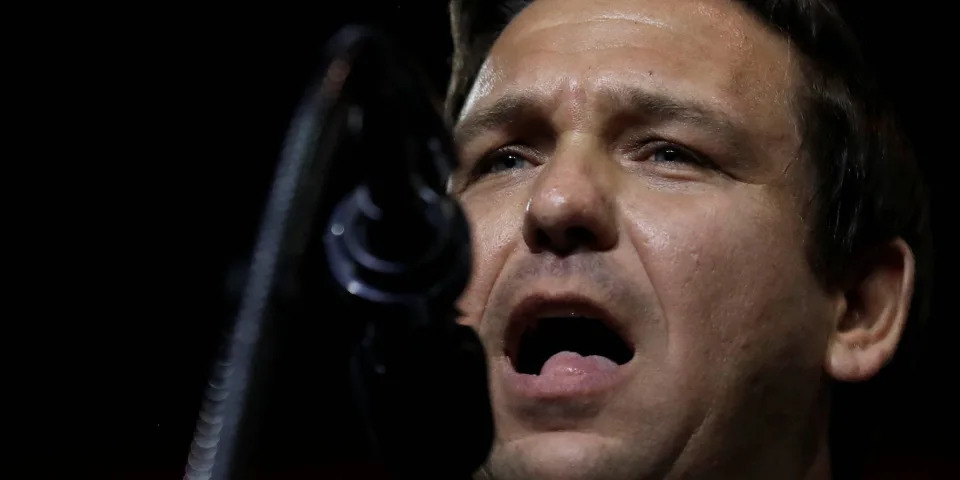
Ron DeSantis
Republican Florida governor candidate Ron DeSantis speaks during a Make America Great Again Rally at the Florida State Fairgrounds in Tampa, Florida, U.S., July 31, 2018.Carlos Barria/Reuters
  • Ron DeSantis railed against the US for having too many federal bureaucrats at a recent campaign stop.
  • “We are going to start slitting throats on day one,” he said.
  • DeSantis has previously said he’d eliminate the IRS and other agencies if elected.

GOP Florida Gov. Ron DeSantis continued on his tirade against federal bureaucrats while speaking on the campaign trail Wednesday.

“We are going to start slitting throats on day one,” DeSantis said about federal bureaucrats, leading to some dissatisfaction among the crowd at the campaign stop in New Hampshire, according to New Hampshire Public Radio.

Wednesday wasn’t the first time DeSantis said he’d slash government agencies if elected to the White House. In June, he said he wanted to get rid of the Internal Revenue Service, the Department of Commerce, the Department of Energy, and the Department of Education.

And in July, DeSantis reiterated his plans while speaking to Maria Bartiromo on Fox News.

“You also have to bring this administrative state to heel, the bureaucracy in Washington is totally out of control,” DeSantis said. “It is exerting power that is not therefore under the Constitution, and we need a President to come in and really, really clean house and I will do that on day one.

The president of the American Federation of Government Employees, a labor union that represents more than 650,000 federal workers, said in a statement that DeSantis’ comments were “disgusting, disgraceful, and disqualifying.”

“These public servants deserve respect and commendation from our nation’s leaders,” said Everett Kelley. “No federal employee should face death threats from anyone, least of all from someone seeking to lead the U.S. government. Governor DeSantis must retract his irresponsible statement.”

In a recent New York Times survey, DeSantis finished second among currently declared Republican presidential candidates, trailing behind former President Donald Trump by 37 percentage points. The same survey found that likely Republican voters much prefer a presidential candidate who thinks the “government should stay out of deciding what corporations can support” rather than one who promises “to fight corporations that promote ‘woke’ left ideology,” as DeSantis has pledged to do time and time again.

DeSantis does have time to claw back supporters in the GOP primary race: he qualified for and has said he’ll attend the first Republican presidential debate on August 23.. And in an effort to get more eyes on his campaign, DeSantis just accepted an offer to debate California Gov. Gavin Newsom (who’s not running for president).

Is there any way to shift the bizarre Republican conviction that only Trump will save them?

Los Angeles Times – Opinion

Column: Is there any way to shift the bizarre Republican conviction that only Trump will save them?

Jonah Goldberg – August 1, 2023

Former President Donald Trump greets supporters as he arrives at New Orleans International Airport in New Orleans, Tuesday, July 25, 2023. (AP Photo/Gerald Herbert)
Former President Donald Trump greets supporters as he arrives at New Orleans International Airport on Tuesday. (Gerald Herbert / Associated Press)

“They’re not indicting me, they’re indicting you. I just happen to be standing in the way,” Donald Trump declared (again) in the wake of a new updated federal indictment connected to the classified documents case.

The claim is as effective as it is stupid. The federal government is not, in fact, prosecuting the average Trump supporter for mishandling documents or obstructing justice (save for two Trump aides who allegedly helped him mishandle documents and obstruct justice).

But the idea that Trump is a populist sword-and-shield against the “establishment,” “Deep State,” or “elites” has ensorcelled large swaths of the GOP base, which is at least partly why he’s got a massive lead over his opponents. In the latest New York Times/Siena College poll asking potential Republican primary voters which candidate they would most likely vote for, Trump is at 54%, a 37-point lead over his closest challenger, Florida Gov. Ron DeSantis.

Among his core supporters, about 37% of the party according to a breakdown of the poll by the New York Times’ Nate Cohn, literally nobody thinks he committed any crimes and 94% think the party needs to rally around him against these presumably bogus charges.

Read more: Goldberg: Why July is the cruelest month for GOP presidential candidates — unless they’re Donald Trump

Cohn notes that no primary candidate with a lead of at least 20 points at this stage of the race has ever failed to get their party’s nomination.

This alone undermines the MAGA base’s argument for supporting Trump. If the Republican establishment forces were as powerful as Trump and his voters think, they’d be able to do something about it. If the Deep State were half as formidable as they think, Trump would never have been president in the first place.

But large segments of the GOP suffer from the delusion that they are victims of the ruling classes and that the woke left is running everything — or will — if Trump doesn’t stop them.

Even in states with Republican governors and legislative supermajorities, like Tennessee, a certain paranoia that the left could take over at any moment dominates politics. As one GOP state legislator recently said on a leaked conference call, “The left wants Tennessee so bad because if they get us, the Southeast falls and it’s ‘game over’ for the republic.”

Read more: Column: Republicans wanted Clinton prosecuted for her emails. And now they defend Trump?

Of course, if these left-wing overlords were as fearsome as all that, the GOP would not be in total control of the Volunteer State in the first place. Similarly, if the “RINO” establishment were in charge, Trump wouldn’t be the runaway front-runner.

This is the paradox of Republican politics today. The populists run or at least dominate the party but they derive their power and intensity from the bizarre conviction that they’re powerless victims — and that only Trump can save them.

The delusion is vexing but it also points to the only way to prevent Trump from getting the Republican nomination. The last decade has shown that the only kingmakers in American politics are precisely who they’re supposed to be: the voters. In 2008 Hillary Clinton proved that big money and establishment backing weren’t enough in the face of a popular opponent. Jeb Bush proved the same thing in 2016.

Much of the left and right have convinced themselves that American democracy has been hijacked, to one extent or another, by powerful special interests, billionaire donors, the Deep State, hegemonic party establishments and/or the media. And yet, time and again, the string-pullers have proved to be ordinary people.

Trump will be the nominee unless enough Republican voters either change their minds or consolidate around a challenger. And that remains possible.

Read more: Opinion: If Trump is indicted for Jan. 6, there’s more than enough evidence to convict him

Cohn is right that it’s unprecedented for a front-runner to lose with such a lead. But Trump is an unprecedented candidate. A former president with multiple criminal indictments despised by a quarter of his party almost as much as he’s loved by a third of it. You could argue he’s running with an incumbent president’s lead, but for an incumbent president, his lead would be disastrously narrow.

Throughout most of 2003, former Vermont Gov. Howard Dean was seen as the unstoppable, inevitable, Democratic nominee. “Dean has wrapped up the Democratic nomination for president of the United States,” the widely respected analyst Stuart Rothenberg declared (with some minor hedging), in November 2003. By December, Dean was nearly 20 points ahead of his nearest rivals. The next month he was crushed in the Iowa caucuses, as voters started paying attention and changed their minds. Dean didn’t score a single win outside of Vermont.

For those desperate for a Republican nominee other than Trump, hoping voters will change their minds seems scary. But that’s democracy for you.

Trump doesn’t care if he destroys the GOP, he’s desperate to stay out of prison: Donald Trump threatens House Republicans to impeach Biden or risk losing their jobs

USA Today

‘Get out’: Donald Trump threatens House Republicans to impeach Biden or risk losing their jobs

Ken Tran, USA TODAY – August 1, 2023

WASHINGTON — House Republicans have been talking a lot about impeaching President Joe Biden over what they allege is his improper involvement in his family’s business dealings.

But with a long to-do list when lawmakers return to Washington after August recess, for now, it’s all talk.

Former President Donald Trump however, is pressuring GOP lawmakers to put action behind their words and begin the impeachment process against Biden − or face electoral consequences.

“Any Republican that doesn’t act on Democratic fraud should be immediately primaried and get out,” Trump told supporters at a campaign rally Saturday in Erie, Pennsylvania. “We got a lot of good, tough Republicans around. People are going to run against them and people are going to win.”

House Speaker Kevin McCarthy, R-Calif., has repeatedly dismissed the notion he is facing pressure from the former president to go after Biden, calling an impeachment inquiry an appropriate course of action.

“If (the Biden administration) does not provide the information we need, then we would go to an impeachment inquiry,” McCarthy said at a press conference last week, referencing House Republicans’ various investigations into whether Biden benefitted from Hunter Biden’s foreign business dealings.

‘They’re trying to deflect’: Democrats link GOP push to impeach Biden to Trump indictments

Former U.S. President Donald Trump gestures as he enters the Erie Insurance Arena for a political rally while campaigning for the GOP nomination in the 2024 election on July 29, 2023 in Erie, Pennsylvania.
Republican lawmaker: Impeachment is walking ‘the plank’

McCarthy and other GOP lawmakers are finding themselves in a political bind over Trump’s comments. House Republicans only have roughly three weeks when they come back to Washington in September to approve must-pass spending bills, and an impeachment inquiry could take up valuable time needed to avoid a government shutdown.

There are also multiple House Republicans representing districts that Biden won in the 2020 presidential election. Proceeding with an impeachment inquiry could put those vulnerable GOP lawmakers in a politically fraught position heading into the 2024 election, something House GOP leaders want to avoid considering their razor-thin five seat majority.

Rep. Nancy Mace, R-S.C., warned that impeachment could force vulnerable members to “walk the plank.”

“Every time we walk the plank we are putting moderate members, members that won Biden districts, we are putting those seats at risk for 2024. We are putting the majority at risk,” Mace said on “Fox News Sunday.”

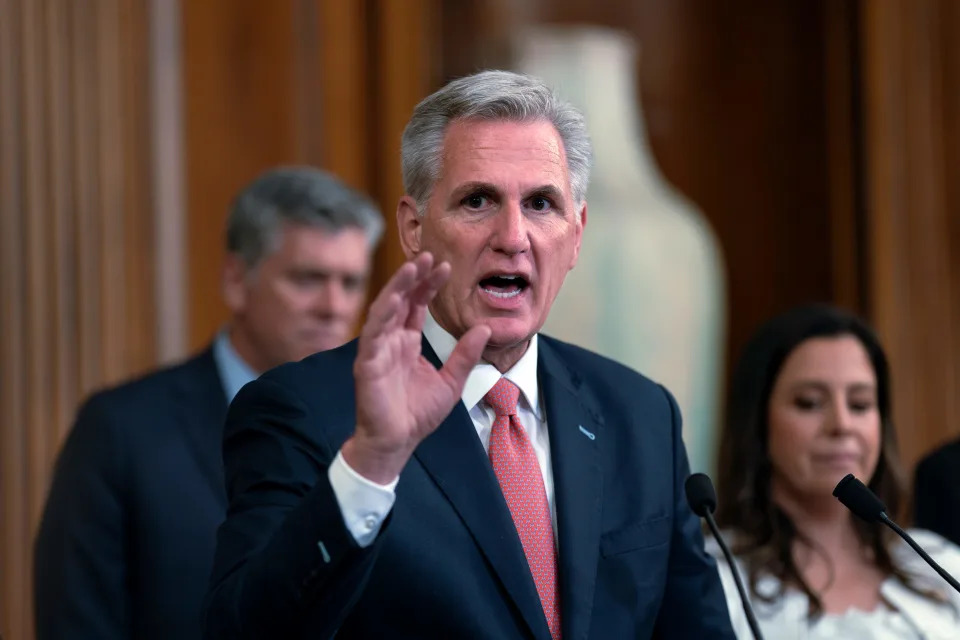
Speaker of the House Kevin McCarthy, R-Calif., holds a news conference as the House prepares to leave for its August recess, at the Capitol in Washington, Thursday, July 27, 2023.
Trump urges GOP lawmakers to fight back for him

Trump’s attempts to pressure House Republicans to impeach Biden comes as he faces a multitude of legal troubles, including a possible indictment for his attempts to overturn the 2020 election.

In the face of those legal woes, Trump has accused Biden and the Department of Justice of targeting him because he is the current frontrunner in the 2024 Republican presidential primary. As a result, Trump has implored GOP lawmakers to fight back on his behalf.

“They impeach me, they indict me,” Trump said at his rally in Erie. “And the Republicans just don’t fight the way … they’re supposed to fight.”

GOP leaders are also facing pressure from their right flank in the conference, with members from the ultra-conservative House Freedom Caucus calling to impeach the president.

“I don’t know how anyone, any objective reasonable person couldn’t come to the conclusion that this appears to be impeachment worthy,” Rep. Bob Good, R-Va., a member of the Freedom Caucus said last week, reiterating unsubstantiated claims that Biden was involved as vice president in his son’s business dealings.

Related: Meet Devon Archer, Hunter Biden’s former business associate answering questions in Congress

House Freedom Caucus Chair Scott Perry, R-Pa., left, and Rep. Bob Good, R-Va., clasp hands before denouncing the fiscal year 2024 appropriations process and so-called "woke" spending by Democrats and President Joe Biden, at the Capitol in Washington, Tuesday, July 25, 2023.
House Freedom Caucus Chair Scott Perry, R-Pa., left, and Rep. Bob Good, R-Va., clasp hands before denouncing the fiscal year 2024 appropriations process and so-called “woke” spending by Democrats and President Joe Biden, at the Capitol in Washington, Tuesday, July 25, 2023.
House Republicans walk fine line between investigations and impeachment

Stuck in between the former president’s warnings and the upcoming 2024 elections, GOP lawmakers are struggling between continuing to investigate Biden or swiftly moving to impeach the president.

“We’re working through the process, our constitutional duty to have oversight over the executive branch,” Rep. Kevin Hern, R-Okla., chair of the Republican Study Committee, told reporters last week.

Hern said Republicans are thoroughly investigating whether the president had connections to Hunter Biden’s business dealings and said Democrats “jumped to conclusions” when they impeached Trump.

“The Speaker has said that there may be an impeachment inquiry. That is not impeachment. That is Congress continuing its responsibilities to look into the issues that have been raised,” said Rep. Mike Lawler, R-N.Y., who represents a district Biden won in 2020.

“It’s just an ability to get more information,” House Majority Leader Steve Scalise, R-La., said at a press conference last week, saying an inquiry is “not in of itself an impeachment.”

Rep. Mike Lawler, R-N.Y., listens as Rep. Veronica Escobar, D-Texas, and Rep. Maria Salazar, R-Fla., speak during a press conference on immigration outside the U.S. Capitol Building on May 23, 2023 in Washington, DC.

‘It’s a crisis’: Maternal health care disappears for millions

Politico

‘It’s a crisis’: Maternal health care disappears for millions

Alice Miranda Ollstein and Megan Messerly – August 1, 2023

Rogelio V. Solis/AP Photo

Access to maternal health care is evaporating in much of the country, as hospitals close and obstetricians become harder to find for millions of pregnant people.

New data from the nonpartisan health advocacy group March of Dimes shows that the U.S. — which already has the worst maternal mortality rate among developed nations — saw a 4 percent decline in hospitals with labor and delivery services between 2019 and 2020.

But the raw figure masks the inequities playing out across the country, according to the report. Alabama and Wyoming lost nearly one-quarter of their birthing hospitals in that time period, while Idaho, Indiana and West Virginia lost roughly 10 percent.

“It’s a crisis,” said Stacey Brayboy, the senior vice president of public policy and government affairs at March of Dimes. “Women are struggling to access care, and that’s before and during and after their pregnancies, and we’ve seen an increase in terms of maternal and infant deaths.”

Access to care is also likely to worsen in the coming years, according to several public health experts, as obstetrics units struggle to stay financially afloat, more people become uninsured and new anti-abortion laws limit the number of physicians willing to practice in several states.

Nationally, about 5.6 million women live in counties with no access to maternity care, according to March of Dimes. Far more, 32 million, are at risk of poor health outcomes because of a lack of care options nearby. March of Dimes considers more than a third of all U.S. counties maternal care deserts, with no access to reproductive health services. States with large rural populations — Alaska, Nebraska, North Dakota, Oklahoma and South Dakota — are especially prone to shortages.

The scarcity of maternal health care is particularly acute in areas with higher instances of underlying health problems that are risk factors for maternal mortality — such as hypertension and diabetes — and where states have not expanded Medicaid, leaving hundreds of thousands uninsured.

The declining access to maternal care is one reason maternal mortality rates in the U.S are so high and rising, Brayboy said.

In 2021, roughly 33 people died for every 100,000 live births in the U.S., according to the CDC, up 40 percent from 2020. That’s roughly 10 times the mortality rate of other industrialized nations such as Spain, Germany, Australia or Japan. The maternal mortality rate for non-Hispanic Black people was 69.9, two-and-a-half times the rate of non-Hispanic whites, according to the CDC.

The report relies on data from 2020 and 2021 — before the Supreme Court overturned Roe v. Wade — and the full impact of state abortion bans on maternal care has yet to be documented. But Tuesday’s report reveals most states that have restricted abortion access since then, or where the procedure remains in limbo pending a court ruling, have seen access to obstetric care decline in recent years.

“Abortion providers, OB-GYNs, nurse practitioners are being pushed out of certain parts of the country that do have these restrictive abortion laws. That’s having a spillover effect for those that want to continue their pregnancies,” said Jamila Taylor, president and CEO of the National WIC Association.

There isn’t, however, a clean red state-blue state divide in the data. A few states with near-total abortion bans saw an improvement in access to birthing hospitals in recent years — including Arkansas, North Dakota and Mississippi — and a few states where abortion remains legal saw access worsen, including California, Maryland, and Washington state.

The situation is particularly dire in Alabama, where the number of hospitals with labor and delivery services decreased by 24 percent between 2019 and 2020, and where many more could soon go out of business. The Alabama Hospital Association warned earlier this year that half of the state’s remaining hospitals are “operating in the red,” and are “likely on a collision course with disaster.”

“Many of them are just teetering on the edge, almost not able to cover payroll,” Farrell Turner, the president of the Alabama Rural Health Association, said in an interview. “There are at least seven more, according to my calculations, that are at very high risk of closing before the year is out.”

One factor fueling the obstetric unit closures across the country is the financial mismatch facing hospitals — maternal care is expensive to provide and reimbursements are low, particularly from Medicaid, which pays for more than 40 percent of births. That’s a particular challenge for rural hospitals, which have a higher proportion of patients on government-run health insurance than their urban counterparts.

March of Dimes found that nearly a third of women in Alabama already have no birthing hospital within a 30-minute drive and for some residents, the nearest hospital is more than 70 minutes away — factors the group said raised the risk for “maternal morbidity and adverse infant outcomes, such as stillbirth and NICU admission.” More than a third of the state is considered a maternal care desert, and more than 18 percent of people giving birth received inadequate prenatal care or none at all.

“People have to drive quite some distance in order to deliver, and to obtain prenatal care leading up to that time,” Turner said. “And many folks either lack transportation or can’t afford the gas to get to the care they need. There are some telehealth options out there, but a lot of people lack access to broadband, so the uptake and implementation has been slow.”

The problem is similar in Wyoming, where five of the state’s 23 counties are maternity care deserts and more than 15 percent of residents have no hospital with labor and delivery services within 30 minutes. The state’s vastness poses particular challenges to accessing care, with people living in counties with the highest travel times spending nearly 90 minutes on average to reach the nearest hospital with obstetric care.

Abortion remains legal in Wyoming because a judge temporarily blocked the state’s new pill ban in June, and the state’s trigger ban remains enjoined. But Dr. Giovannina Anthony, an OB-GYN in Jackson, Wyo., said those laws are already affecting access to maternal health care.

“Abortion bans just create one more deterrent to anyone who might want to practice obstetrics and gynecology in Wyoming,” Anthony said.

Even in North Carolina, which has fewer maternity care deserts than the national average, access to obstetric care is headed in the wrong direction. The number of hospitals with labor and delivery services in the state decreased by 1.9 percent between 2019 and 2020, and the March of Dimes report found that 13.4 percent of people in North Carolina had no birthing hospital within 30 minutes.

“These rural communities where the maternity care deserts are, these individuals tend to be sicker. They can have chronic hypertension. They can have diabetes,” said Karen Sheffield-Abdullah, a certified nurse-midwife who has a doctorate in nursing from the University of North Carolina at Chapel Hill. “These are individuals who are coming in with what we call these comorbidities, and yet there aren’t providers for an hour away? Absolutely maternal morbidity and mortality goes up.”

Sheffield-Abdullah said access to maternity care in the state is likely to worsen because of a new law banning abortion after the first trimester.

“If we look at the most recent ban, getting more restrictive in the types of care that we provide to perinatal individuals is not going to improve our outcomes,” she said. “It only makes it more difficult for minoritized populations to get the care that they need.”

Hospitals are also struggling to recruit and retain OB-GYNs and other maternal health providers. Two Idaho hospitals, for example, shut down their labor and delivery services earlier this year, citing staffing woes exacerbated by the state’s near-total abortion ban, which went into effect last summer.

Dr. Stacy Seyb, a maternal fetal medicine specialist who has practiced for 23 years in Idaho, told POLITICO that two of his colleagues have left the state in the last few months, with several more also considering a move, and applications for medical residencies have plummeted.

“It’s hurting our ability to find doctors for a state that’s already severely underserved,” he said of the state’s abortion ban, which threatens medical providers with felony charges if they perform an abortion or help someone obtain one. “It’s hard to take care of patients while looking over your shoulder. So residents and young doctors are saying: ‘Why would I go there and deal with that?’”

Idaho saw a 12.5 percent decrease in the number of birthing hospitals in the state between 2019 and 2020, and nearly 30 percent of the state is considered a maternal health desert, according to March of Dimes. More than 27 percent of counties have both a high rate of chronic health conditions and high rate of preterm births.

Idaho providers fear the situation will further deteriorate now that abortion is banned in the state, but warn the public might remain in the dark because officials dissolved the state’s maternal mortality review committee in July.

“It’s scary for sure,” said Dr. Kylie Cooper, a former leader of the state’s chapter of the American College of Obstetricians and Gynecologists who left Idaho after the abortion ban went into effect. “Most states have the ability to track data and trends for why people are dying in pregnancy and post-partum, but now I don’t know how that will be tracked at all in Idaho.”

Trump indictment: 3 bombshells from the latest charges undercut his ‘rigged’ election claims

Yahoo! News

Trump indictment: 3 bombshells from the latest charges undercut his ‘rigged’ election claims

 
David Knowles, Senior Editor – August 1, 2023

The 45-page Justice Department indictment of former President Donald Trump released Tuesday contains multiple bombshells, including quotes attributed to him that show he knew his statements about the 2020 election results were false.

Trump and six unnamed co-conspirators were charged by special counsel Jack Smith for their efforts to overturn the election and block the peaceful transfer of power following his loss to Joe Biden. Those efforts came to a head on Jan. 6, 2021, when Trump’s supporters descended on Washington and laid siege to the U.S. Capitol in an attempt to block the Electoral College certification of the election.

Donald Trump
Trump at the “Stop the Steal” rally in Washington, Jan. 6, 2021. (Jacquelyn Martin/AP)
‘Just say that the election was corrupt and leave the rest to me’

On Dec. 27, 2020, Trump called the then-acting Attorney General Jeffery Rosen and the then-acting Deputy Attorney General Richard Donoghue and “raised multiple false claims” about the election, according to the indictment.

“When the Acting Attorney General told the Defendant that the Justice Department could not and would not change the outcome of the election, the Defendant responded, ‘Just say that the election was corrupt and leave the rest to me and the Republican congressmen,’” the indictment states.

‘You’re too honest’
Mike Pence
Vice President Mike Pence finishes the work of the Electoral College after a mob loyal to Donald Trump stormed the Capitol in Washington and disrupted the process. (J. Scott Applewhite/AP)

According to the indictment, on Jan. 1, 2021, Trump called Pence to berate him for not going along with a plan to have him reject the certification of the Electoral College vote showing Joe Biden had won the election.

“The Vice President responded that he thought there was no constitutional basis for such authority and that it was improper,” the indictment states. “In response, the Defendant [Trump] told the Vice President, ‘you’re too honest.’”

‘Beamed down from the mothership’

By that time Trump had been told multiple times that his claims of fraud could not be backed up with actual evidence.

“As early as mid-November, for instance, the Senior Campaign Advisor had informed the Defendant that his claims of a large number of dead voters in Georgia were untrue,” the indictment reads.

In an email, that campaign adviser lamented, “you can see why we’re 0-32 on our [court] cases. I’ll obviously help on all fronts, but it’s tough to own any of this when it’s all just conspiracy shit beamed down from the mothership.”

While Trump again portrayed the charges against him as part of a series of “un-American witch hunts,” his former vice president issued a strikingly different assessment.

“Today’s indictment serves as an important reminder: Anyone who puts himself over the Constitution should never be President of the United States,” Pence said in a statement.