Here’s Exactly How Much House Republicans’ Israel Bill Would Cost
Ellie Quinlan Houghtaling – November 1, 2023
The House GOP’s quest to trade $14.3 billion in IRS cuts for $14.3 billion in emergency aid to Israel has an updated price tag, and surprise, surprise: It’s much steeper than it anticipated.
Instead of decreasing the deficit, the multibillion-dollar slash to the IRS proposed by newly minted House Speaker Mike Johnson would actually cost the government more than $26 billion in lost revenue by 2033, according to a Congressional Budget Office report issued Wednesday. The result would add nearly $12.5 billion to the national deficit over the next 10 years, the CBO predicted.
Some officials estimate that the true number could be even higher.
IRS Commissioner Daniel Werfel believes the damages may be more to the tune of $90 billion in lost revenue over the next decade and that the cuts would reduce the government’s ability to audit large corporations and the wealthy, reported The Washington Post.
“All of those funds go to increased scrutiny on tax evasion going on at the highest wealth, and that is millionaires and billionaires and large corporations and large complex corporations,” Werfel told the Post. “When you reduce those audits, you reduce the amount of money that we can collect and return to the Treasury for other priorities.”
Ultimately, Republicans’ plan to “offset” funding for Israel with cuts to the IRS would backfire quite badly.
At stake is an already-approved $80 billion expansion to the IRS that is projected to cut the deficit by more than $100 billion by way of improved tax collections, operations support, free filing for taxpayers, an office of tax policy, and tax court. The Congressional Budget Office has repeatedly warned that cutting IRS funding will encourage tax cheating and increase the deficit, though that didn’t stop Johnson from attempting to chip some money off the arrangement.
“If you put this to the American people, and they weigh the two needs, I think they are going to say standing with Israel and protecting the innocent is in our national interest, and a more immediate need than IRS agents,” Johnson told Fox News on Tuesday.
‘Morning Joe’ Torches ‘Gross’ Mike Johnson for Picking Fight With Biden Over Israel Funding (Video)
Natalie Korach – October 31, 2023
MSNBC’s “Morning Joe” slammed new Speaker of the House Mike Johnson for “setting up a clash over how to approve the aid to Israel,” as his first move in the role.
Co-host Mika Brzezinski summarized Johnson’s latest move as House Speaker as taking “the bipartisan goodwill of providing aid for Israel and launching a fight with President Biden over his signature achievement while setting up a collision course with the Senate.”
The aid package for Israel released by House Republicans yesterday includes $14.3 billion in emergency funding, however, there’s a catch.
“The bill rescinds that same amount of IRS funding from the Inflation Reduction Act,” said Brzezinski. “The act is the major climate, health care, and tax law that President Biden signed into law last year.”
Brzezinski noted that the bill also excludes aid for Ukraine, “despite President Biden’s request for aid to both.”
“If the bill passes the Republican-controlled House, the IRS provisions are all but guaranteed to be rejected by the Democratic-led Senate and the White House,” continued Brzezinski. “Setting up a clash over how to approve the aid to Israel and of course, leaving Ukraine out.”
“Well, of course leaving Ukraine out,” co-host Joe Scarborough chimed in. “I mean, it’s a great start.”
“Remarkable how tone-deaf my former party is. They are actually putting billionaires between the protection of Israel and the United States Congress,” said Scarborough.
The “Morning Joe” co-host claimed “They’re taking the money that was passed and they’re gutting the IRS’s ability to go after billionaire tax cheats. And they think that’s the solution.”
“We got this Mike Johnson guy who was part of a Congress that spent more money and drove us deeper into debt over a four-year period than any Congress in the history of the United States of America,” said Scarborough.
“And now suddenly he won’t even help Jews protect themselves,” he continued. “It is so gross and making it even grosser, he says, here’s what we’re gonna do: We will protect the Jews if you protect the billionaires.”
Scarborough said he’s “never truly heard of a dumber plan to start a speakership than to put Jews’ lives in danger so you can protect billionaire tax cheats.”
Hamas built a massive tunnel network in Gaza. Here’s how Israeli ‘weasel’ forces will fight it
Rick Jervis, USA TODAY – October 30, 2023
As Israeli troops push deeper into Gaza in retaliation for the Oct. 7 Hamas attacks, the ground attack won’t look quite like the door-to-door skirmishes seen in Fallujah, Mosul and other past urban clashes.
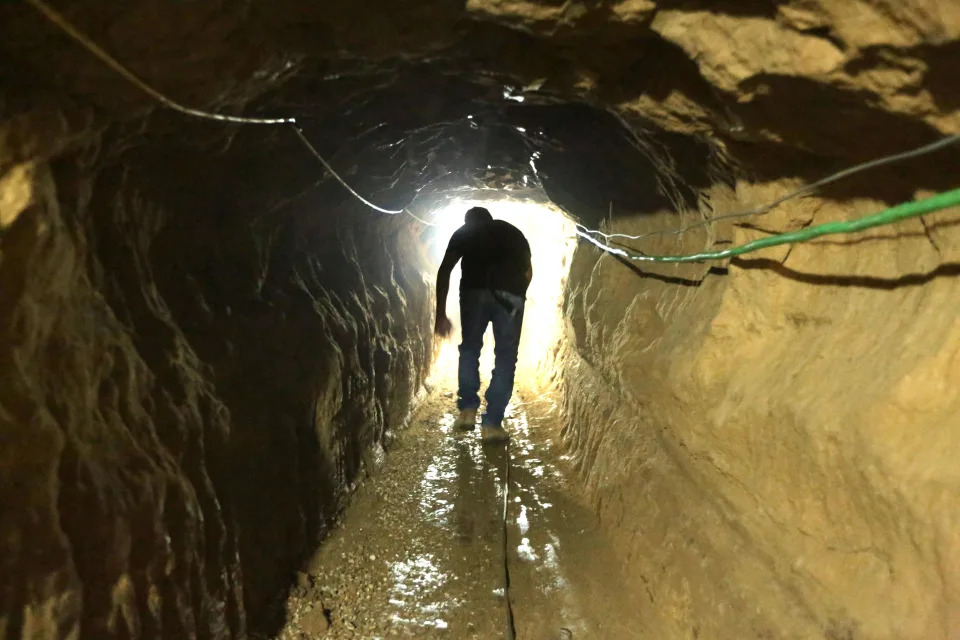
Instead, it will happen largely out of sight and underground, deep in a warren of connecting tunnels that Hamas has been digging and lining with concrete for more than a decade. The battle to control and destroy this subterranean labyrinth, estimated at more than 300 miles, will be a key strategy for the Israeli military, according to military analysts and experts – and will make the incursion into Gaza unlike any past urban conflict.
For these “de-tunneling” operations, specialized units code-named Samur – Hebrew for “weasel” – expect to squeeze through the narrow passages and find rocket assembly lines, stores of small arms and mortars and, deeper still, Hamas’ leaders’ lodging and headquarters – much of it probably booby-trapped with homemade bombs. They may also be searching for some of the more than 200 hostages taken from Israel who may be hidden in those same tunnels.
“It’s going to be an undertaking like nothing the (Israeli military) has ever done,” said retired U.S. Army Lt. Gen. Mark Schwartz, who ran U.S. security coordination with both Israel and the Palestinian Authority from 2019 to 2021. “And frankly unlike anything we’ve ever done.”
A Palestinian man walks from the Egyptian side of the border in a repaired bombed smuggling tunnel linking the Gaza Strip to Egypt, in Rafah, in this file photo from 2012.
After the Hamas attacks, which killed 1,400 people, Israel unleashed a bombing campaign that has killed more than 8,000 people, most of them civilians, according to the Hamas-run health ministry. Israeli officials have said they are targeting Hamas operatives and infrastructure. The response by Israeli ground troops, now underway by degrees, will bring the next phase of the fight – including the fight for the tunnels.
The Biden administration has sent some of its most seasoned insurgency experts from the war in Iraq and against the Islamic state to advise the Israelis, including three-star Marine Corps Gen. James Glynn, who commanded troops in Fallujah during the Iraq War. In the second battle for Fallujah in November 2004, more than 10,000 U.S. troops went house-to-house clearing the city of 3,000 insurgents in what became the bloodiest battle of the war. Nearly 100 U.S. troops and 2,000 insurgents were killed.
The fight in Gaza may bear some similarities to operations in Fallujah, or in Mosul, where U.S.-backed Iraqi forces flushed Islamic state fighters out of a tunnel network in 2014.
But in Gaza, Israeli forces face more formidable infrastructure and more challenging geography.
Hamas’ tunnel system is more advanced, and its fighters are better trained, more disciplined and better equipped than the Islamic state fighters, said Eitan Shamir, director of the Begin-Sadat Center for Strategic Studies at Bar-Ilan University in Tel Aviv, Israel.
“It’s a major challenge,” Shamir said. “This is a very messy affair.”
And in Gaza – hemmed in by Israel, Egypt and the Mediterranean Sea, which gives civilians nowhere to flee – a ground war is uniquely challenging, said Seth Jones, a military analyst at the Washington-based Center for Strategic and International Studies.
“The intricate nature of the tunnel complex in a densely packed urban environment that is entirely fenced in makes this a fundamentally different – and in many ways more difficult – environment than what U.S. forces had to face in cities like Fallujah or Mosul,” he said. “The possibility of civilian casualties is much greater in Gaza.”
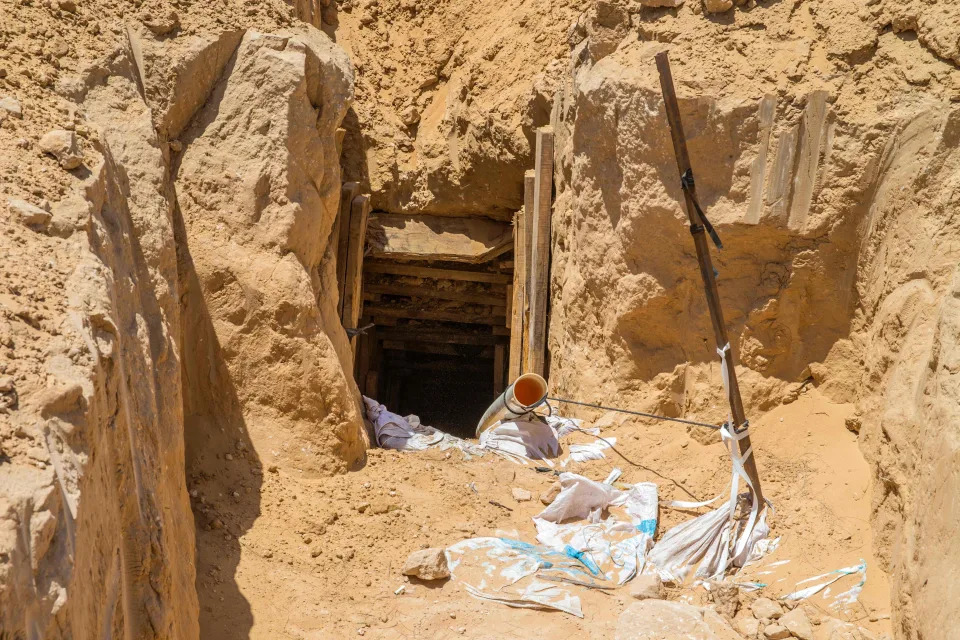
A picture taken on May 6, 2016, from the Israeli side along the border between Israel and the Gaza Strip shows the exit of an alleged offensive tunnel leading into Israel.
Palestinians have excavated tunnels under Gaza for decades, initially mostly to smuggle people and goods between Gaza and Egypt, according to testimony to the United Nations by Israeli researcher Eado Hecht. Israel and Egypt have tightly controlled their borders to Gaza, creating a virtual blockade on the territory.
In time, three types of tunnels emerged, according to Hecht: In addition to tunnels into Egypt in the south, there are tunnels that cross the border of Gaza into Israel and tunnels that crisscross under Gaza and can be used as command posts, storage facilities and positions to launch mortars or rockets.
The tunnels have become so elaborate and extensive – Hamas leaders claimed in 2021 they stretched for 311 miles, or nearly half the length of the New York City subway system – that the Israeli military dubbed it the “Gaza Metro,” according to a report this month by the Congressional Research Service. Experts believe some tunnels drop as far as 200 feet – roughly the equivalent of a 20-story building, or a typical airport control tower, underground.
Over the years, the U.S. has lent its expertise – and money – to help Israel locate and destroy the tunnels and develop technologies to combat them. Since 2016, Congress has appropriated $320 million in Defense Department funding for U.S.-Israel collaboration on “detecting, mapping and neutralizing underground tunnels” in response to the cross-border tunnels built by Hamas, according to the CRS report. In 2021, crews completed an underground concrete barrier with anti-tunnel sensors along the entire 40-mile Israel-Gaza border.
The tunnels have fueled Israeli-Hamas violence before. In 2006, Hamas operatives used a tunnel to launch a surprise attack on Israeli forces and kidnap one of its soldiers, Gilad Shalit, who was held captive for five years before being traded for more than 1,000 prisoners in Israeli jails.
The 2014 conflict between Israel and Hamas led to the discovery of 36 cross-border tunnels, most of which were destroyed, Hecht said.
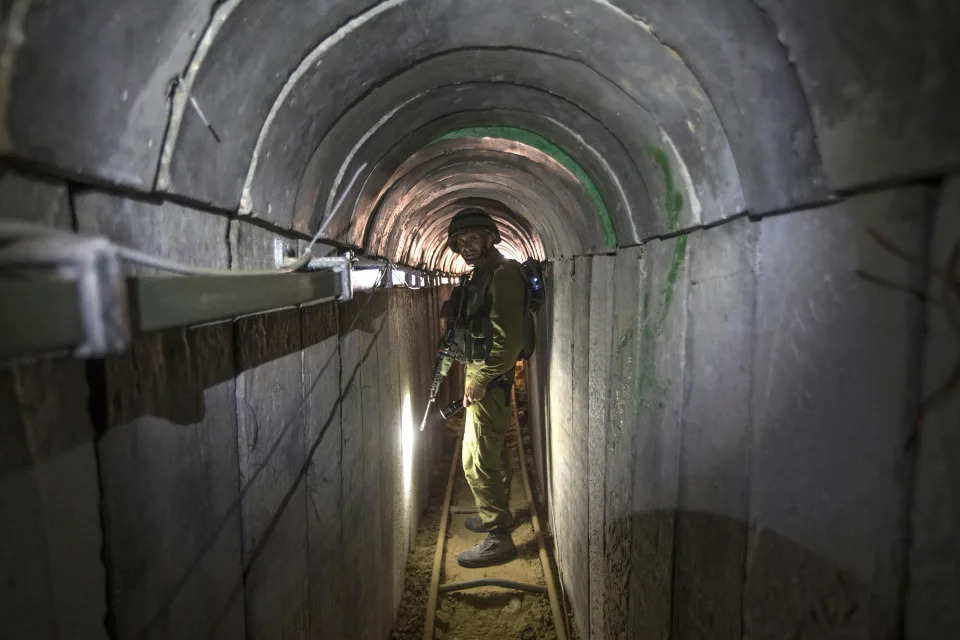
An Israeli army officer gives journalists a tour of a tunnel allegedly used by Palestinian militants for cross-border attacks at the Israel-Gaza border, in this file photo from 2014.
This time, a key challenge will be finding and rescuing the more than 200 hostages held by Hamas, including 12 Americans.
Yocheved Lifshitz, 85, a hostage taken in the Oct. 7 raid and released by Hamas last week, described to reporters how she was taken through a “huge network” of underground tunnels that looked like a “spiderweb.”
She said hostages were made to walk for two to three hours in the tunnels, gathered and ate in a large hall and slept on mattresses in different rooms. “They told us they believe in the Quran and would not harm us,” she said. “They would give us the same conditions as they have in the tunnels.”
Israeli Prime Minister Benjamin Netanyahu said Saturday that the military has opened a “second stage” in the war against Hamas by sending ground forces into Gaza and expanding attacks from the ground, air and sea.
Among the ground troops in the next phase of the war, experts told USA TODAY, will be specialized units trained to enter, clear and destroy the tunnels.
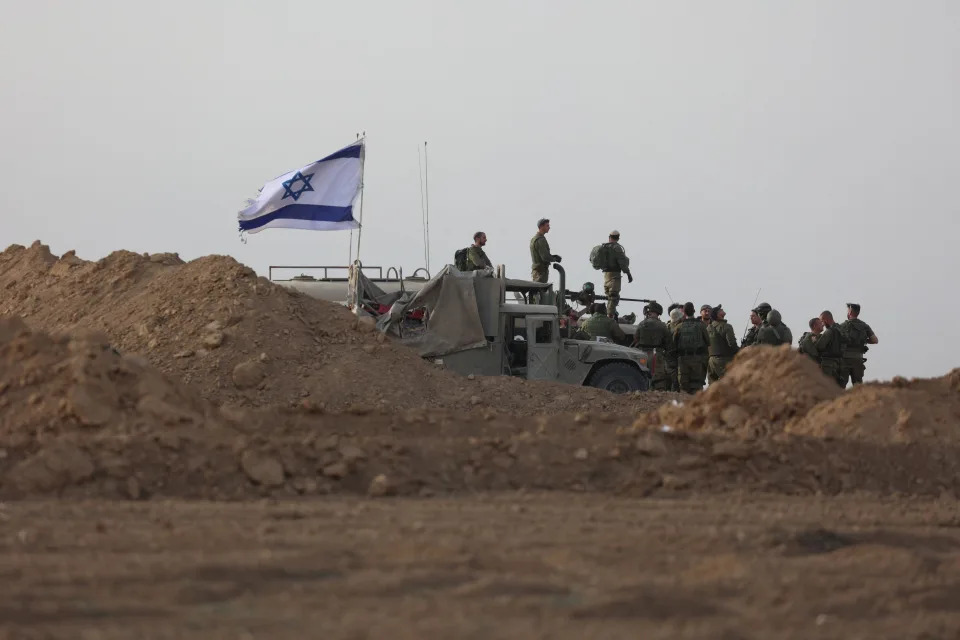
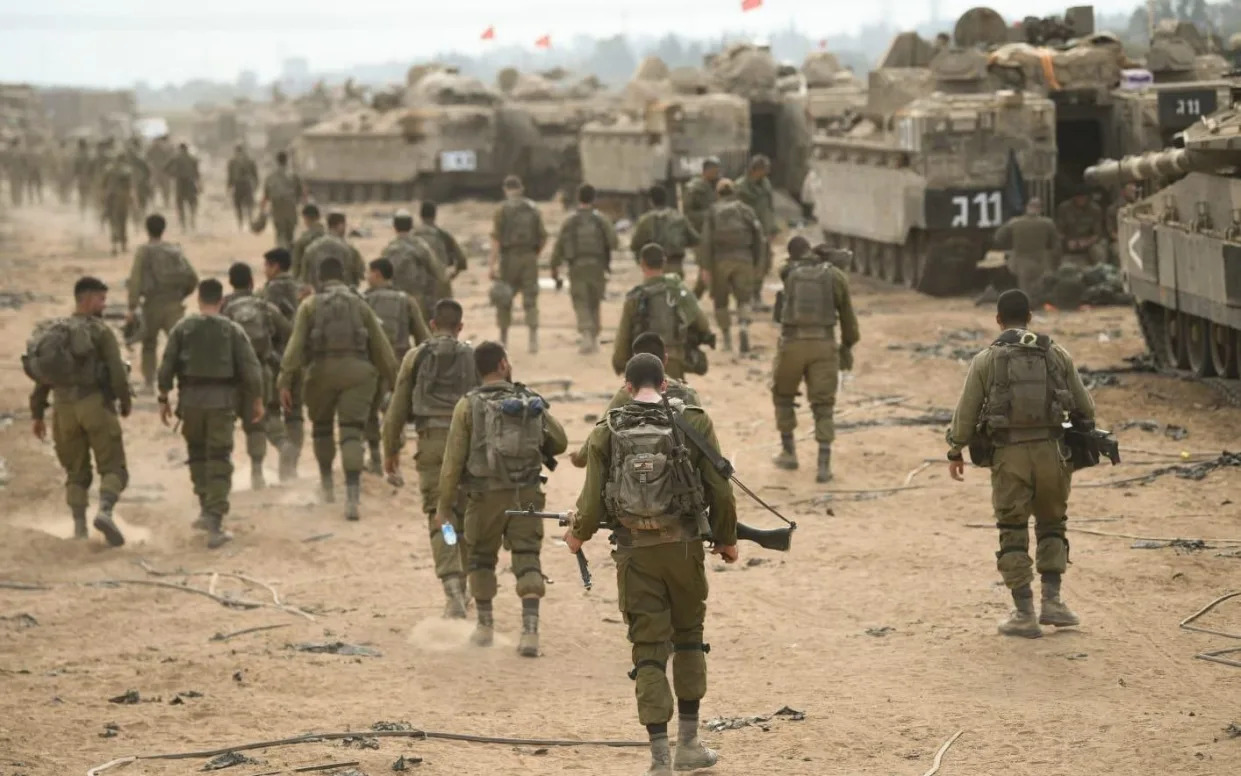
Israeli troops gather near the border with Gaza before entering on Oct. 29, 2023.
Since the 2014 Israeli-Hamas conflict, Israel has been gathering intelligence and training troops on how to find and destroy the passageways, said Shamir of Bar-Ilan University. At the center of the effort is a highly secretive laboratory – known simply as “the lab” – where scientists from different fields meet to try to learn tunnel locations and dream up technologies that could penetrate them.
Remote-controlled robots have been developed to enter and search the tunnels. Israeli engineers also have developed technology that uses acoustic or seismic sensors and software to detect digging, similar to the science used by oil and gas companies to detect oil reserves, according to the Congressional Research Service.
Because some tunnels are so deep and are concrete-lined, they can survive heavy bombing, Shamir said. Hamas fighters are thought to have enough provisions to live several months in the subterranean labyrinth, he said.
As Israeli forces rumble into the dense urban quarters of Gaza City, Hamas fighters will use the tunnels to launch surprise attacks on Israeli troops, then melt away underground again and pop up in another location, Shamir said. They’ll also use snipers, improvised explosive devices – or IEDs – and bomb-dropping drones.
Shamir said he believed Israel’s initial incursion into Gaza is more of a tactic to try to pressure Hamas into a negotiated release of the prisoners. As the military moves into denser urban areas and begins destroying tunnels, it becomes exponentially harder to rescue them, he said.
“Everyone understands the chances then are small,” Shamir said.
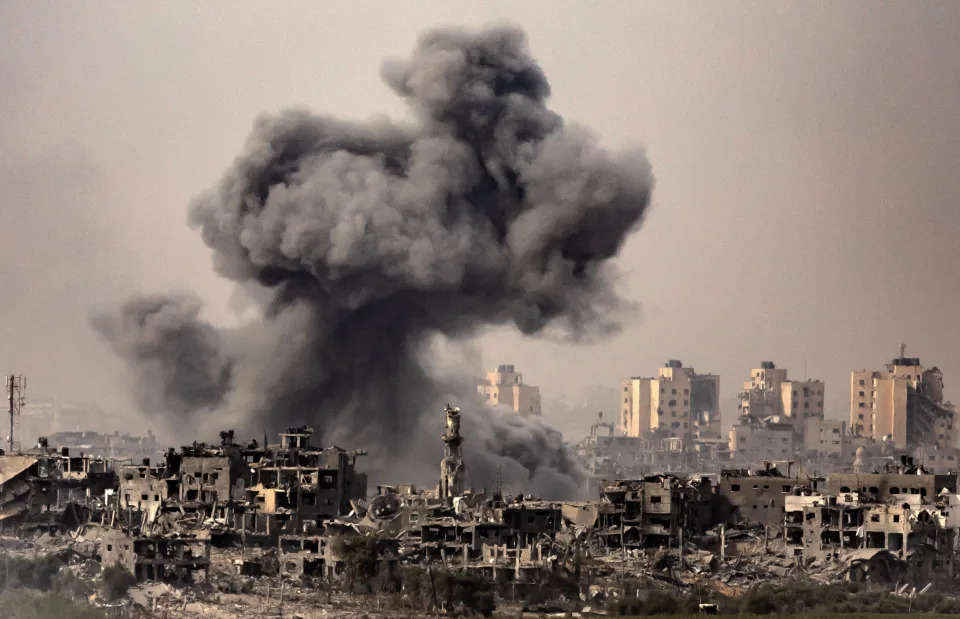
A black cloud of smoke rises from the Gaza Strip amid the ongoing battles between Israel and the Palestinian group Hamas, seen from the Israeli border with Gaza on Oct. 29, 2023.
The task of neutralizing the tunnel advantage will fall to the Yahalom, the special forces unit of the Combat Engineering Corps, who have been training in tunnel combat. A subunit of the Yahalom, the Samur, or “weasel” operators, will enter the tunnels and try to disarm or destroy the passages and look for hostages.
In recent years, the Israeli military has doubled the number of soldiers in Yahalom, expanding its focus to include subterranean fighting, according to the Israel Defense Forces website.
“The main challenge of underground warfare is that the enemy has no above-ground signature,” the website quotes a Yahalom commander as saying. “The fact that the enemy is hidden and collecting intelligence is complicated and difficult.”
Though Israeli forces may not know the precise entrance of every tunnel, they’ve been monitoring for years where cement-mixing trucks in Gaza have been deployed to give them an idea, Edward Luttwak, an Israeli strategist and historian, wrote in an essay this month.
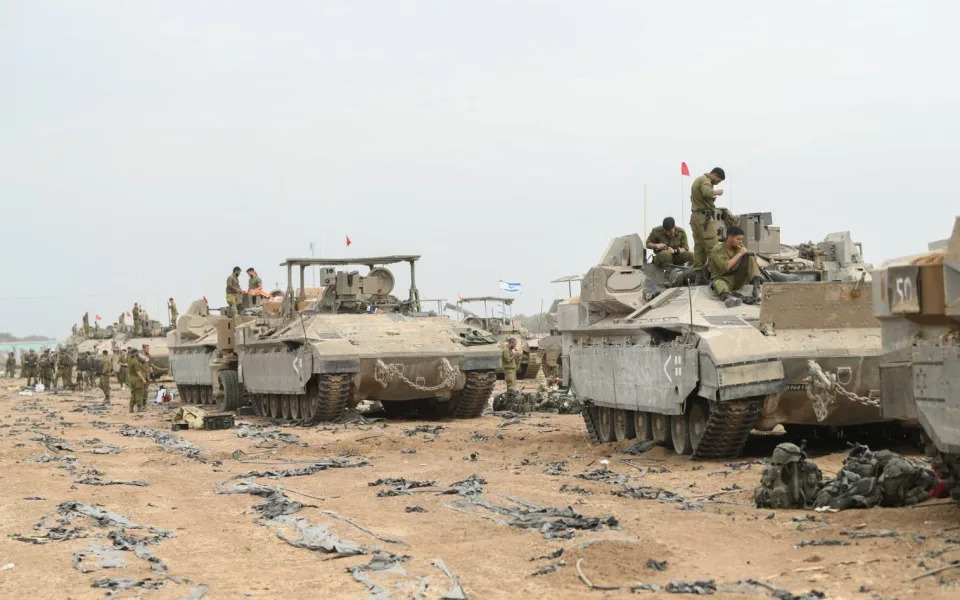
Israeli tunnel specialists will be ferried by 70-ton Namer infantry combat vehicles, considered some of the most heavily armored vehicles in the world, he wrote. As they reach suspected tunnel sites, several Namers will form a perimeter – “an improvised fortress” – protecting the combat engineers.
“In 2014, the last time Israeli troops fought in Gaza, most were riding thinly armored M.113s, which were easily penetrated by RPG anti-tank rockets, with some 60 soldiers killed and hundreds wounded,” Luttwak wrote. “Not this time.”
Schwartz, who coordinated training with Israeli and Palestinian Authority security forces, witnessed some of the tunnel training in Israel. The Israeli military re-created what they believe the Gazan tunnels look like and sent soldiers through the maze to test weaponry and tactics, as well as unmanned vehicles and robotics.
“They know what they’re going to experience,” Schwartz said. “But the magnitude of what they’re going to deal with compared with what they’ve done in the past is very different.”
Hamas ambushes Israel from tunnels near Gaza border
Danielle Sheridan – October 29, 2023
IDF ground activity in the Gaza Strip
Israeli troops clashed with Hamas for the first time since the ground offensive began in an ambush from its network of tunnels in northern Gaza.
The Israel Defense Forces (IDF) killed several terrorists after spotting them “exiting the shaft of a tunnel in the Gaza Strip” near the Erez Crossing that was stormed on Oct 7.
Israel later said it believed the militants were attempting to cross the border into Israel for another surprise attack.
Hamas said its militants clashed with Israeli troops as they entered the northwest Gaza Strip, using small arms and anti-tank missiles against the armoured convoy.
Tanks have moved across the border
Guided by troops on the ground Israeli aircraft also struck two Hamas staging posts, killing several Hamas members, the IDF claimed.
Israel intensified its war with Gaza over the weekend, sending in troops and tanks on Friday night as part of a ground operation aimed at destroying Hamas.
But it stopped short of a full invasion of its forces massing on the Gaza border.https://cf-particle-html.eip.telegraph.co.uk/63d27584-172c-4312-bbc6-2e6a01c01203.html?direct=true&id=63d27584-172c-4312-bbc6-2e6a01c01203&truncated=false&expandable=false
Rear Admiral Daniel Hagari, the Israeli military spokesman, said on Sunday that movement into Gaza would be a “gradual expansion”.
He said: “We will do everything we can from the air, sea and land to ensure the safety of our forces and achieve the goals of the war.”
Analysts have speculated that Israel’s preference for a low-intensity ground offensive betrays concerns about hostages held in Gaza and threats from Arab proxies linked to Hamas.
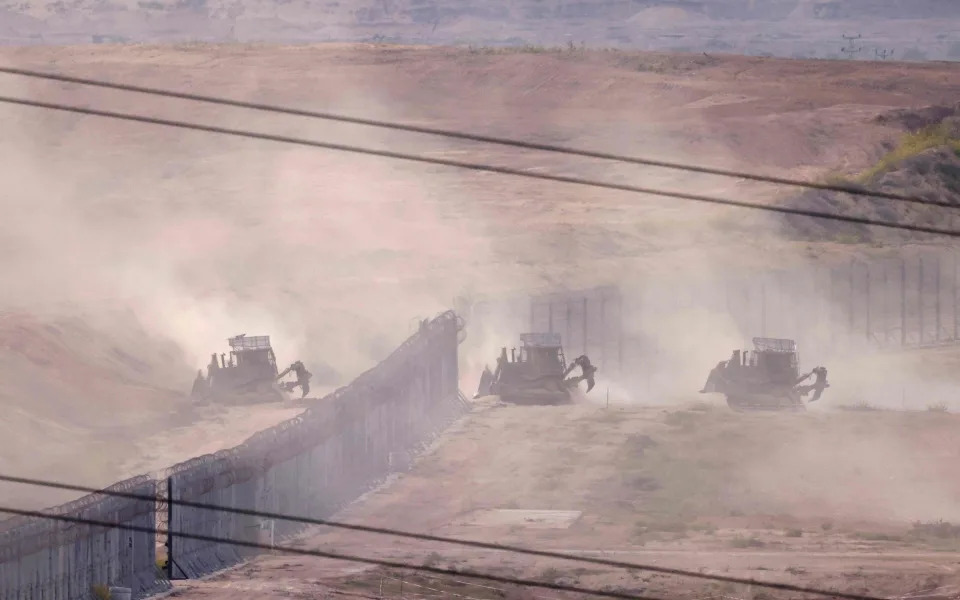
Israeli army buldozers crossing the border into Gaza, on October 29, 2023 – MENAHEM KAHANA
As pressure has mounted on Israel to slow the offensive in order to negotiate the release of hostages, its defence minister Yoav Gallant spoke to families of captives on Sunday.
In an attempt to reassure them, he said: “The ground move is intertwined with the effort to return the kidnapped and is intended, among other things, to increase the chance of returning our people. If there is no military pressure on Hamas, nothing will progress.”
He added: “I have two goals: to return the abductees and win the war, the return of the abductees and locating the missing is a task of utmost importance.”
The ground assault resulted in an almost total communications blackout in the coastal enclave.
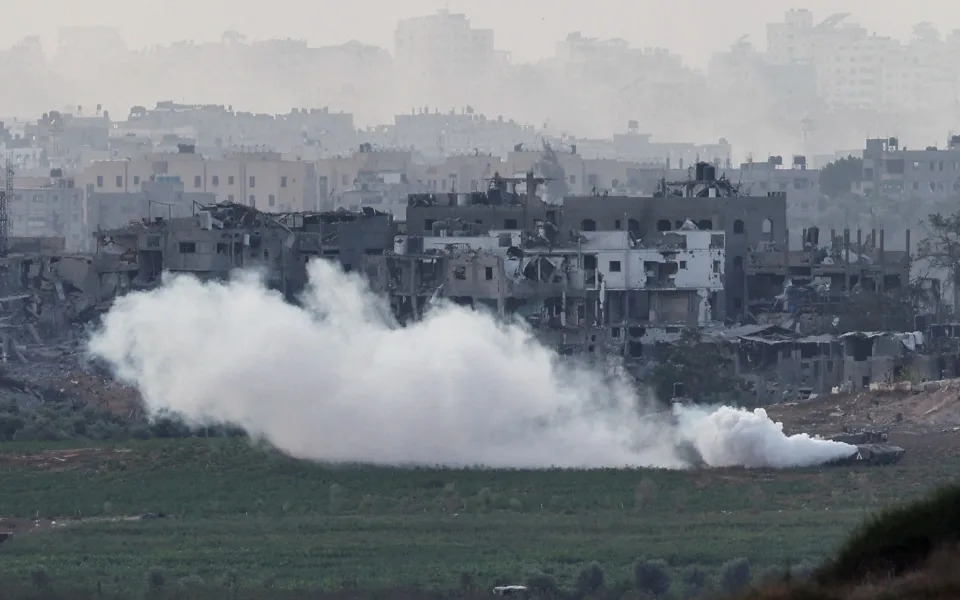
An Israeli tank manoeuvres inside the Gaza Strip, as seen from the Israel border – EVELYN HOCKSTEIN
Meanwhile, as clashes on the Lebanese border escalate, Rear Admiral Hagari said the IDF responded to the fire from Lebanon toward the northern border by striking military targets, infrastructure and posts belonging to Hezbollah overnight.
Hezbollah added that the drone was hit near Khiam, about three miles from the border, and was seen falling into Israeli territory.
Capability to shoot down a drone
Two security sources in Lebanon said it was the first time Hezbollah had announced downing an Israeli drone.
Mohanad Hage Ali, of the Carnegie Middle East Center, said: “They have insinuated they have this capability but it is the first time they declare they have this kind of capability to shoot down a drone.”
The United Nations’ Lebanon peacekeeping force Unifil said one of its members was injured after shells hit its base near the village of Houla on the Lebanese-Israeli border on Saturday.
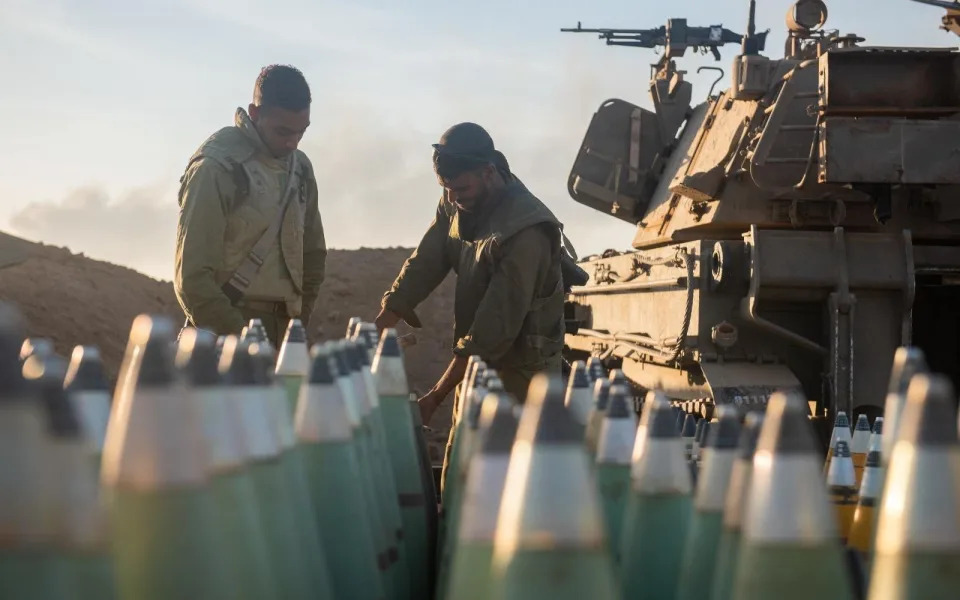
IDF soldiers with munitions
The clashes with Hamas in northern Gaza are thought to be the first in which militants have emerged from tunnels, but is likely to become a theme of the ground assault.
The Erez Crossing, which was built in 2005 when Israel withdrew its settlers and soldiers from Gaza, was at the time considered a symbol of passage between Israel and Gaza.
The IDF accused Hamas of having deliberately built tunnels next to the crossing, which was formerly used by Gazans to enter Israel for work or medical treatment, in order to “attack the humanitarian crossing and harm everyone in the area”.
Hamas spent two decades building a labyrinthine network of underground tunnels which makes a central part of its defences.https://cf-particle-html.eip.telegraph.co.uk/5bf20ca6-3f78-4b5f-97ec-f32a757dcfed.html?direct=true&id=5bf20ca6-3f78-4b5f-97ec-f32a757dcfed&truncated=false&expandable=falsehttps://cf-particle-html.eip.telegraph.co.uk/7a13177e-311d-4b5a-bc79-7786c96a919a.html?direct=true&id=7a13177e-311d-4b5a-bc79-7786c96a919a&truncated=false&expandable=false
Israel says the tunnels have entrances hidden beneath schools, mosques and houses and are said to be 300 miles long with lighting, electricity and rail tracks for transport.
Accused of psychological games
After Sunday’s clashes, Rear Adm Hagari said: “We killed the terrorists that were on the security fence, who were trying to infiltrate and were trying to attack Israel.”
Mr Gallant accused Hamas on Sunday of playing “psychological games” over hostages after it offered to free all captives in exchange for Palestinian prisoners in Israeli jails.
“The stories published by Hamas are part of their psychological games. Hamas is cynically using those who are dear to us – they understand the pain and the pressure,” he told relatives of some of the 230 hostages.https://cf-particle-html.eip.telegraph.co.uk/f0dff9cd-562a-4bcf-a740-6bd2c38091d9.html?direct=true&id=f0dff9cd-562a-4bcf-a740-6bd2c38091d9&truncated=false&expandable=false
On Saturday, Hamas’s leader in Gaza, Yahya Sinwar, said the group was ready for an “immediate” prisoner swap with Israel.
Mr Gallant said: “They seek the collapse of Israeli society from within and are using the hostages in a brutal manner.
“The military operation is intended, among other things, to increase the chance of returning our people.”
Ezzedine al-Qassam Brigades, the armed wing of Hamas, has said that about 50 hostages have been killed in Israeli strikes, a claim that could not be independently verify.
So far the group has released four hostages.
Those confirmed to be held captive rose to 239 on Sunday.
These are the elite special force units Israel could send into Gaza to clear Hamas’ labyrinth of tunnels and rescue hostages
Nathan Rennolds – October 29, 2023
Israel has sent elite troops into Gaza as its ground invasion of the territory ramps up.
Herzi Halevi, chief of the general staff of the Israel Defense Forces, said its “best soldiers” were in action.
They will be tasked with clearing the Hamas’ labyrinth of tunnels and rescuing over 200 hostages.
Israel has indicated that it had sent elite troops into Gaza as it intensifies its ground operations against Hamas following the October 7 terrorist attacks.
Herzi Halevi, the chief of the general staff of the Israel Defense Forces (IDF), said in an update posted to X, formerly Twitter, that the IDF’s “best soldiers and commanders” were now taking part in the offensive in Gaza.
Halevi said that Israel had entered the next stage of the war as it set about its goal of “dismantling Hamas, securing our borders, and the supreme effort to return the hostages home.”
Here are the special forces units that could see action in Gaza.
Yahalom Unit
One squad that will be crucial in how Israel fares in underground warfare is the Yahalom Unit, which specializes in “locating and destroying” underground and hidden tunnels as well as carrying out sabotage missions, according to the IDF’s website.
Israeli Prime Minister Benjamin Netanyahu recently visited Yahalom fighters, who are known as “weasels,” telling them: “I rely on you. The people of Israel rely on you,” Reuters reported.
Sayeret Matkal
Another important unit will be Sayeret Matkal, Israel’s “field intelligence-gathering unit.”
It carries out intelligence operations behind enemy lines, and, crucially, it conducts hostage recovery missions.
Modeled on the British SAS, it has a storied history, seeing action in the Yom Kippur War and both the First and Second Lebanon Wars. In the latter, it led “raids deep inside Lebanon,” per the IDF.
It is best known for its role in the 1976 Entebbe airport raid in Uganda, when its commandos saved 100 Israelis from Palestinian hijackers.
Shayetet 13
Shayetet 13 is a marine commando unit involved in ground, maritime, and airborne missions.
Its role encompasses attacking enemy marine infrastructure and intelligence.
The unit has already seen action in the conflict with Hamas, with footagereportedly showing it retaking a military post on the Gaza border following Hamas’ attacks.
Shaldag is one of the IDF’s “most elite” squads. It’s tasked with performing many classified operations that are not public knowledge.
Video footage posted by the IDF on YouTube on October 25 appeared to show soldiers from the unit taking out Hamas militants and rescuing people in Kibbutz Be’eri.
The Duvdevan Unit specializes in working in “densely populated civilian areas,” which could prove crucial in Gaza, where a population of more than 2 million people live in a strip of land that’s around 25 miles long and around just eight miles wide at the widest point.
Its forces go undercover among local Arab populations, according to the IDF.
One of its highly-trained specialists, Sgt. First Class Itai Bausi, 22, fought Hamas fighters with his bare hands at Supernova desert party on October 7, before he was killed, said witnesses, per The Times of Israel.
Egoz Unit
Egoz was specifically created to tackle the threat of the Iran-backed Lebanese militant group Hezbollah, which Israel has been increasingly battling over the last few weeks.
Despite this, the unit now works across any region using guerrilla warfare, but it maintains a special focus on northern Israel.
Maglan Unit
Another unit that operates in enemy-held territory, Maglan’s role is to destroy “specific targets” and build intelligence. It was initially formed in 1986 as an anti-tank warfare unit, per the IDF.
Three soldiers from the unit were killed in southern Israel during the October 7 terrorist attacks, The Times of Israel reported.
Oketz Unit
Solider and dog from the IDF’s Oketz (“Sting” in Hebrew) is the IDF’s canine unit.Israeli Special Forces/Facebook
The unit was created in 1974 to combat a rise in terrorist attacks on Israel, the IDF says.
Israel’s ground offensive
Israel began its ground offensive on Saturday following an increased wave of airstrikes on the territory — the heaviest bombardment of the conflict so far.
Its military also dropped leaflets across Gaza City, telling people living there to evacuate.
“To the residents of the Gaza Strip: The Gaza governorate (Gaza City) has become a battlefield. Shelters in northern Gaza and Gaza governorate are not safe,” read one leaflet in Arabic, per The Telegraph.
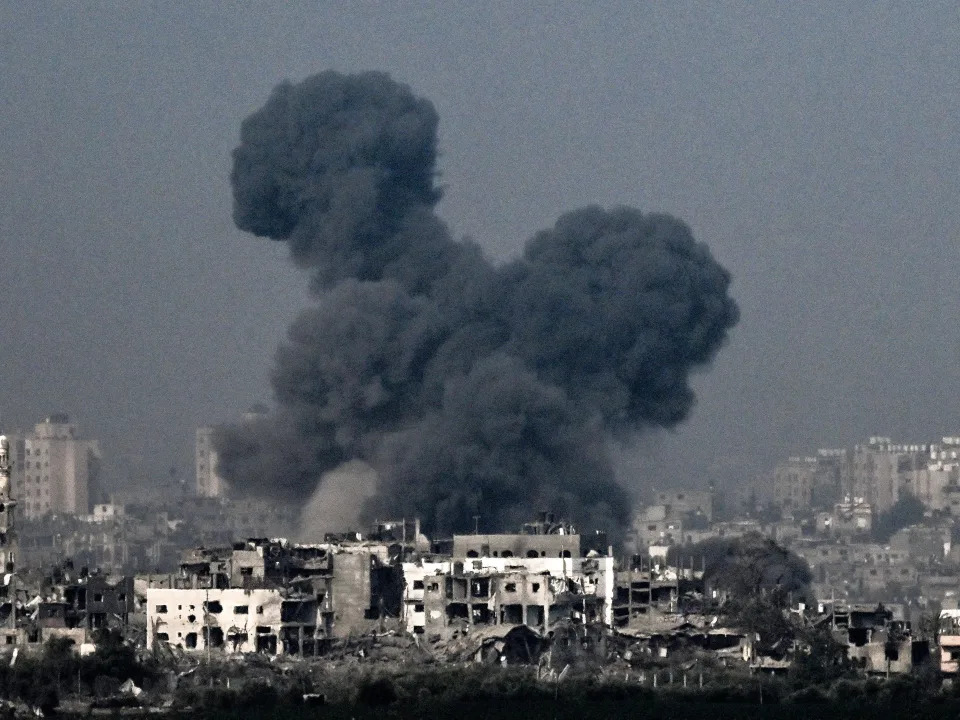
An explosion seen from the southern Israeli city of Sderot.ARIS MESSINIS/AFP via Getty Images
Israel has repeatedly claimed that Hamas militants utilize civilian buildings as bases and storage areas, while also building tunnel complexes beneath them to faciliate their operations and transport equipment.
The key to the offensive for Israel will be clearing this “spider’s web” of tunnels that lie beneath the territory, say the IDF.
IDF spokesperson Jonathan Conricus said earlier this month that Hamas had built “a network of tunnels from Gaza City and under Gaza City” down to Khan Yunis and Rafah, turning the strip into “one layer for civilians and then another layer for Hamas.”
“These aren’t bunkers for the Gazan civilians to have access to when Israel is striking. It’s only for Hamas and other terrorists so that they can continue to fire rockets at Israel, to plan operations, to launch terrorists into Israel,” he added.
‘Waiting to get punched in the face’
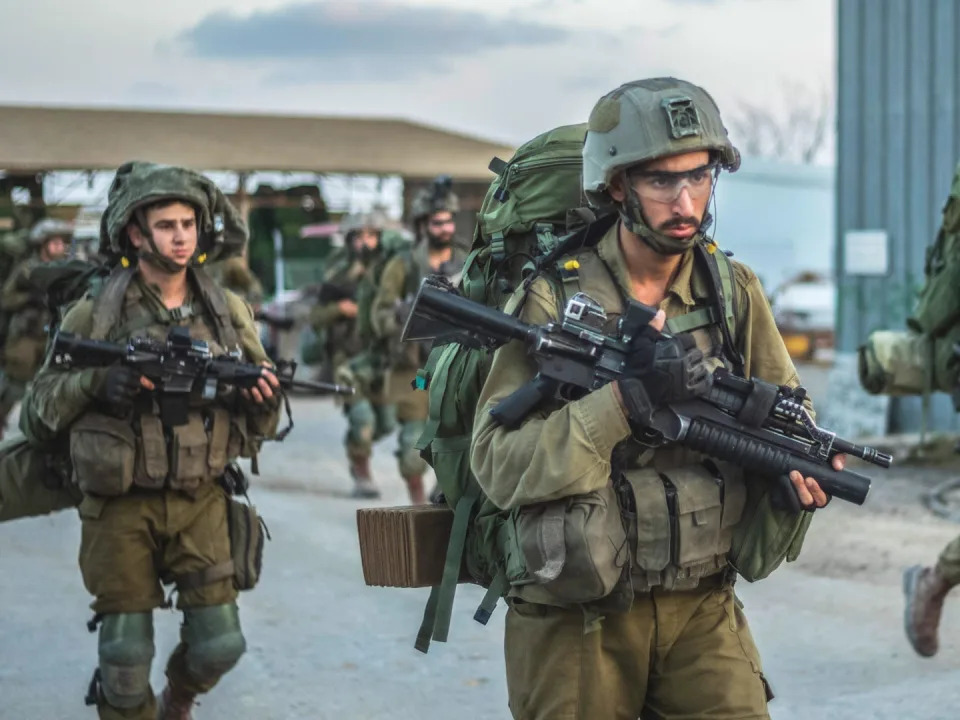
Israeli soldiers march toward a possible ground fight with Hamas in GazaIlia Yefimovich/dpa
Fighting in the densely populated streets of Gaza and in Hamas’ labyrinth of tunnels could help level the playing field between the two sides, however, as it may diminish the impact of some of the Israeli forces’ technological advantages, The Associated Press reported.
“I usually say it’s like walking down the street waiting to get punched in the face,” John Spencer, a former US Army major and the chair of Urban Warfare Studies at the Modern War Institute at West Point, said, per The AP.
In such situations, those defending “had time to think about where they are going to be and there’s millions of hidden locations they can be in. They get to choose the time of the engagement — you can’t see them but they can see you,” he added.
More than 1,400 Israelis have died since Hamas’ October 7 terrorist attacks, and over 200 Israelis were taken hostage and abducted to Gaza. Gaza’s Health Ministry said the Palestinian death toll is now over 8,000, as a result of Israel’s relentless bombing of the enclave, The AP reported.
Sen. Kyrsten Sinema voted to limit background check reporting hours before Maine shootings
Laura Gersony, Arizona Republic – October 28, 2023
An Army reservist, who has reportedly shown symptoms of mental health issues in recent months, allegedly shot and killed 18 people Wednesday in Lewiston, Maine.
Earlier that day, the U.S. Senate voted to approve a Republican-led amendment that would limit the Department of Veterans Affairs’ ability to relay information about some veterans, including those with certain mental health issues, to an FBI database used for gun background checks.
Sen. Kyrsten Sinema, I-Ariz., was one of only five non-Republican senators to vote in favor of the measure.
According to the bill’s sponsor, the VA is required to report people to the FBI’s criminal background check system whenever a fiduciary is appointed to help the person manage their VA benefits.
The Senate-approved amendment would prohibit the VA from relaying that information to the database, unless a judge rules that the person poses a danger to themselves or others.
A spokesperson for Sinema defended her vote, noting that the amendment would not change federal requirements for background checks, and is geared toward limiting the VA’s role in determining whether a person is mentally fit to own a gun.
“Kyrsten voted to ensure a judge — not a bureaucrat at the VA — was responsible to determine whether a veteran was a danger to themselves or others, just as judges make that determination for civilians,” the spokesperson wrote.
Research suggests that most mass murders are not committed by severely mentally ill people, and that people with mental illness are more likely to be victims of violent crime than perpetrators of it.
The suspect in the mass shooting, Robert Card, was committed to a mental health facility for two weeks over the summer because he was “hearing voices” and threatening to shoot up a military base in Saco, Maine, severalnews outlets have reported.
It is not immediately clear whether the amendment would have applied directly to Card. Jaclyn Schildkraut, a gun policy expert with the Rockefeller Institute of Government, noted that only certain specific criteria in federal law limit people’s right to have a gun, such as a person being deemed, as the law puts it, a “mental defective” or being committed to a mental institution, rather than going to one voluntarily.
A VA spokesperson said they could not say for sure whether Card fell into those categories and said that Card used VA education benefits in 2004, but he has not used or applied for any VA benefits since.
“Effectively it is too early to determine whether this bill would have any relevance to the Maine shooting as there are just a lot of unknowns,” wrote Schildkraut, the gun policy expert, in an email to the Arizona Republic.
Asked on Friday about Sinema’s vote, Rep. Ruben Gallego, D-Ariz., who is running for the Senate seat she currently holds, said that he would have voted against the measure.
“Our criminal background system is very important. It’s one of the few things that does work to stop people that shouldn’t be owning weapons (from) buying weapons. And anything that diminishes that, I think, is not going to keep Americans safe,” Gallego said Friday at a news conference on another topic.
‘We were living our best lives’: This 32-year-old says he had more financial freedom working at Chili’s in 2012 than he does now with a much higher income — here’s why
Sabina Wex – October 28, 2023
‘We were living our best lives’: This 32-year-old says he had more financial freedom working at Chili’s in 2012 than he does now with a much higher income — here’s why
While it’s not hard to get a millennial to indulge in some nostalgia for the 2010s — the decade many of their cohort entered adulthood and the workforce — what’s got them reminiscing about their younger years lately may come as a surprise.
Although many were fresh out of college, still figuring things out and living on minimum wage, they’d likely hesitate to characterize their past selves as “young, dumb and broke.” But not necessarily because they remember themselves as wise and mature.
As Mordecai Nuccio explains in a recent TikTok, he feels like he had more disposable income back in 2012 compared to now — an assertion that’s been making the rounds on TikTok.
“We were making minimum wage, but we were living our best lives,” Nuccio, a 32-year-old photographer, says about his time living on minimum wage working as a food runner at Chili’s.
He adds that a big part of his current financial stress is thanks to his increased credit card and student loan debts. Even though he makes more money and lives in a double-income household with his fiancé, he feels more squeezed.
Here’s how do you get back to living your best life now that you should have more cash flow.
Tackle debt
Back in 2012, Nuccio says he had “minimal” credit card debt. But that’s changed as his expenses have increased — and he’s got his student loans to think of too.
While expenses tend to increase as you age and take on more responsibilities, making more often translates into spending more. Millennials love splurging on experiences, but that can quickly wander into risky spending habit territory.
Living on borrowed money can get expensive once you start to factor in interest but it can be overwhelming to get out of that vicious cycle. If you’ve racked up a couple of balances, one way to start picking away at your debt in a manageable way is to use the “debt avalanche method,”. Here’s how it works: you pay off your highest interest loan debt first, and only make minimum payments on all your other debts.
Once you’ve paid off the highest interest loan, you move on to the next highest interest debt, and so on — until, voila, all your debt has disappeared.
Up until fairly recently, student loan payments were suspended. But their return means that borrowers like Nuccio need to figure out how to fit these payments back into their monthly expenses.
Unfortunately, 28% of student loan borrowers say they’ll need to take on additional debt to maintain their household payments and repay their student debt, according to a recent Achieve survey.
When you’re robbing Paul to pay Peter, things can get messy. But consolidating your debts can make this a little easier. If you have private student loans and credit card debt, you might consider refinancing your loan.
Even though it means taking on another loan, if you’re able to find an offer at a lower rate than your current accounts, you’ll save yourself plenty in interest over the life of the loan. Plus, by pooling your debts, you’ll only have to worry about making a single monthly payment, which will hopefully make your life a little easier.
Lower your cost of living
Nuccio mentions that he lived in Tampa, Florida in 2012 when he worked at Chili’s, but has since moved to New York City to pursue photography. Though this may have been a good move for his career, it’s bad news for his debt.
Though Nuccio doesn’t explicitly say which borough he lives in, New York’s Manhattan is the most expensive city in the U.S., according to the Council for Community and Economic Research’s (CCER) most recent data. Though several Florida media outlets report Tampa is the Sunshine State’s most expensive city, it still doesn’t rank on the CCER’s list of priciest cities across the country.
So part of your plan to pay back your debt may need to include your locale. If you live in an expensive city like New York, it’ll likely take you longer to pay off your debt than a cheaper city like Tampa.
Editorial: Donald Trump’s attorneys abandon their client for the truth and the law
New York Daily News Editorial Board – October 26, 2023
John Bazemore/Pool/AFP/GETTY IMAGES NORTH AMERICA/TNS
Roy Cohn, the evil, crooked, disbarred New York lawyer, who mentored a young Donald Trump and taught him many of the nasty ways to bully, cheat and lie, was loyal to his client, but he still would absolutely sell out Trump to save himself from prison.
The moral, for an immoral man, is that a lawyer who engages in a crime with a client has no protection from prosecution.
And so many of Trump’s other attorneys have been lining up to rat out the rat in chief, as we saw vividly Tuesday, first with a morning guilty plea by lawyer Jenna Ellis before an Atlanta judge in the Georgia election interference criminal case. The afternoon saw disbarred New York lawyer Michael Cohen, Trump’s one-time fixer, spilling the beans before a Manhattan judge in state Attorney General Tish James’ civil case over Trump’s fake valuation of his holdings.
Ellis’ plea, in the wide-ranging conspiracy indictment against Trump et al brought by Fulton County District Attorney Fani Willis, was the third by a Trump lawyer in that case. Last week, Sidney Powell switched sides and then so did Ken Chesebro.
Powell and Chesebro are also two of the six unnamed co-conspirators in Special Counsel Jack Smith’s federal indictment of Trump brought in Washington. Ellis was evidently too small a fish for Smith.
A very big fish is Mark Meadows. He is no lawyer, but as Trump’s White House chief of staff was the top of the food chain during those nightmare years. Meadows has cut his own deal with Smith to testify, ABC News reported Tuesday. Tellingly, Meadows is not one of the half dozen co-conspirators and can provide a road map to Smith.
Trump trusted his lawyers, going back 50 years when Cohn was first retained after the Nixon Department of Justice accused the Trump family real estate business of illegally discriminating against minority renters of their apartments. The charges were true, but Cohn concocted a phony suit against DOJ. Misusing the legal system was Cohn’s specialty and Trump learned well.
Trump trusted Cohen to do his dirty work, like arranging the $130,000 hush money payment to Stormy Daniels, which landed Cohen in trouble. After he was convicted of federal felonies and disbarred in 2019 — by the same Manhattan appellate court that disbarred Cohn two months before he died in 1986 — Cohen told Congress about Trump’s false bookkeeping before Cohen reported to prison.
Manhattan District Attorney Cy Vance was listening to Cohen’s testimony and started a criminal probe. In 2022, new DA Alvin Bragg wrongly dropped the prosecution, but Tish James picked it up on the civil side.
Trump has already been found guilty. The ongoing trial downtown will establish the size of his financial penalty. The four pending criminal cases (by Willis, Smith and the document case by Smith and the hush-money payments by Bragg) could put Trump in prison.
There’s another New York lawyer, whose law license has been suspended by that same appellate court, Rudy Giuliani. He is Smith’s co-conspirator No. 1 and also a target of Willis. It was U.S. Attorney Giuliani who helped bring down Cohn in 1986 by forcing him to pay $7 million in taxes, interest and penalties for nearly three decades of stiffing the IRS.
What is Hamas, and what’s happening in Israel and Gaza?
BBC – October 26, 2023
Hamas gunmen launched an unprecedented attack on Israel from the Gaza Strip on 7 October, killing more than 1,400 people and taking more than 220 hostages.
Gaza’s Hamas-run health ministry says more than 7,000 people have been killed in the territory since Israel launched retaliatory air strikes, and a ground offensive is expected.
What is happening in the Gaza Strip?
Hospitals in Gaza are admitting emergency cases only as fuel runs out, according to the World Health Organization.
The UN’s agency for Palestinian refugees, Unrwa, say is has significantly reduced its operations because it has almost exhausted its fuel reserves.
Small quantities of fuel retrieved from existing reserves are being used to maintain the water supply in the south of Gaza. However, they will run out soon.
An Israel Defense Forces (IDF) spokesman said Gaza still had fuel but “Hamas prefers to have all of the fuel for its warfighting capabilities, leaving civilians without it”.
However, these have provided only a fraction of the needs of people in Gaza. Unrwa called it “a drop in the ocean of overwhelming needs”. About 500 lorries were allowed into Gaza every day before the start of the war.
An estimated 1.4 million people in Gaza have been displaced, according to the UN.
Hundreds of thousands moved from the north of the territory to the south, after being told by the Israeli military to leave for their own safety.
The WHO has also warned that it is “almost impossible” for patients in hospitals in northern Gaza to be evacuated.
Map showing route of evacuation in Gaza
The southern city of Khan Younis, normally home to 400,000 people, has seen its population increase to about 1.2 million. Many families are sharing homes, or sleeping in tents.
However, Israel has continued to carry out strikes on what it says are Hamas military targets in southern Gaza.
The UN’s regional humanitarian chief has said: “Nowhere is safe in Gaza.”
US Secretary of State Antony Blinken has suggested a temporary ceasefire to allow more aid to enter Gaza, and and EU leaders are also expected to call for one.
Israeli Prime Minister Benjamin Netanyahu said on Wednesday: “We have set two goals for this war: to eliminate Hamas by destroying its military and governing abilities, and to do everything possible to bring our captives home.”
“All Hamas terrorists are dead men walking – above ground, below ground, outside Gaza.”
Mr Netanyahu said Israel would launch a ground incursion, but did not detail when it would start.
On Thursday morning, the IDF said it had carried out a “targeted raid” on defensive positions in northern Gaza with tanks and armoured bulldozers. It said this was “part of preparations for the next stages of combat”.
Israeli forces have carried at least two other raids into Gaza since the conflict started. In one, on 22 October, one soldier was killed and three were injured.
The IDF has massed tens of thousands of soldiers along the territory’s perimeter fence, along with tanks and artillery. It has activated some 300,000 reservists, alongside its standing force of 160,000.
Hamas is thought to have about 25,000 people in its military wing, the Izzedine al-Qassam Brigades.
Graphic based on 2021 Israeli military map showing destroyed sections of Hamas’s “Gaza Metro” tunnel system
Hamas has previously claimed the tunnels stretch for 500km (310 miles). Many have entrances hidden within houses, mosques, schools and other public buildings.
Israel’s troops are likely to avoid going into tunnels unless they have to, instead using explosives to destroy them.
A major challenge for the Israeli troops will be close-quarters fighting in densely populated urban areas. It is thought that Hamas will lay booby traps and improvised explosive devices at entry points such as doorways, and along narrow streets.
Hamas is a Palestinian group which has ruled the Gaza Strip since 2007. The group is sworn to Israel’s destruction and wants to replace it with an Islamic state.
Hamas has fought several wars with Israel since it took power. It has fired – or allowed other groups to fire – thousands of rockets into Israel, and has carried out other deadly attacks.
In response, Israel has repeatedly attacked Hamas with air strikes. In 2008 and 2014, it also sent troops into Gaza.
Together with Egypt, Israel has blockaded the Gaza Strip since 2007 for what it describes as security reasons.
Hamas – or in some cases its military wing, the Izzedine al-Qassam Brigades – has been designated a terrorist group by Israel, the United States, the European Union and the UK, as well as other powers.
Iran backs the group, providing it with funding, weapons and training.
Hamas killed families in their homes in the kibbutz of Kfar Aza
On 7 October, hundreds of Hamas gunmen crossed from the Gaza Strip into southern Israel by breaking through the heavily-fortified perimeter fence, landing by sea, and using paragliders.
The gunmen killed 1,400 people, most of them civilians, in a series of raids on military posts, kibbutzim and a music festival, and took hostages back into Gaza.
It came at a time of soaring Israeli-Palestinian tensions.
This year has been the deadliest on record for Palestinians who live in the Israeli-occupied West Bank, which could have motivated Hamas to strike Israel.
Hamas might also have been seeking to score a significant propaganda victory to boost its popularity among ordinary Palestinians.
The capture of Israeli hostages is thought to be designed to pressure Israel to free some of the estimated 4,500 Palestinians held in Israeli prisons.
The Israeli military believes 224 people are still being held in Gaza.
The Hamas tunnel city beneath Gaza – a hidden frontline for Israel
Jonathan Saul and Stephen Farrell – October 26, 2023
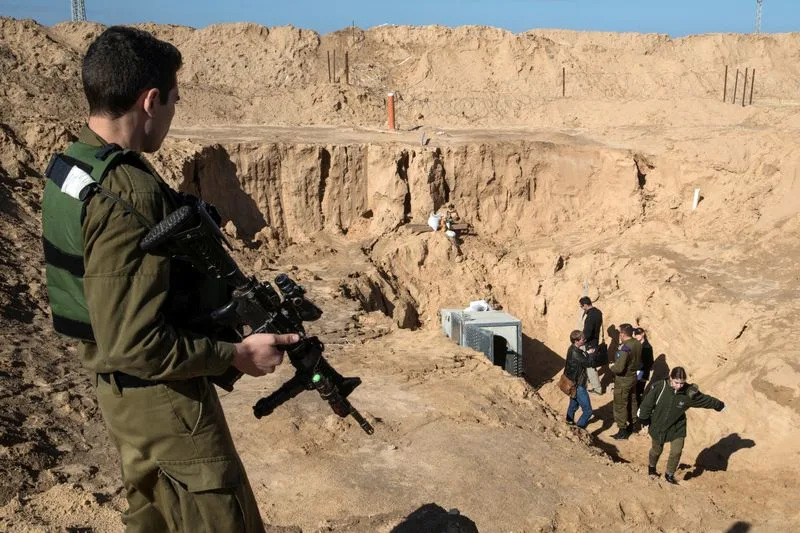
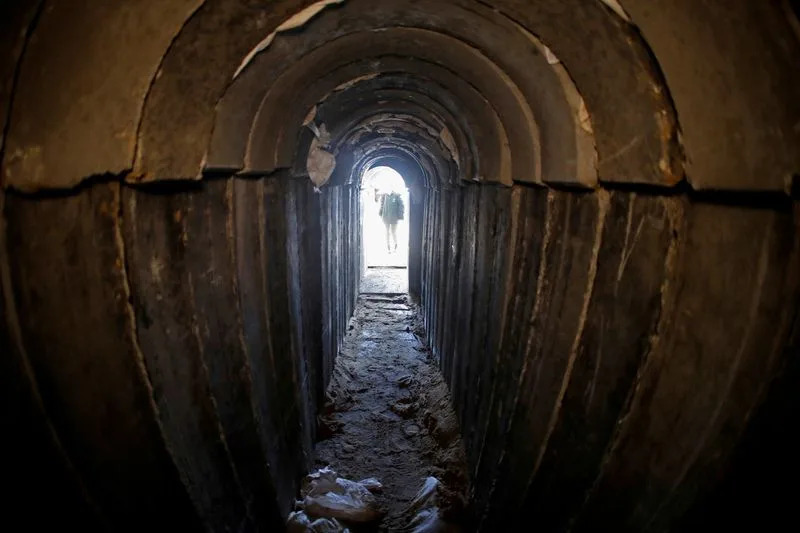
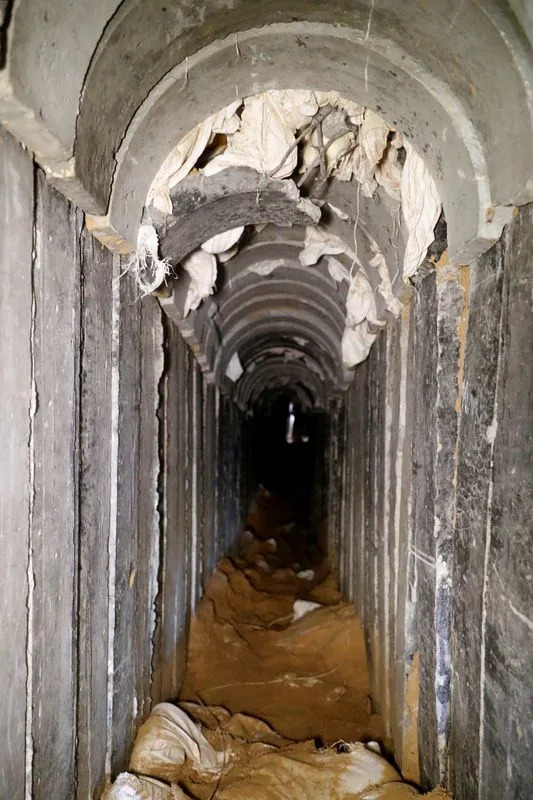
An Israeli soldier keeps guard next to an entrance to what the Israeli military say is a cross-border attack tunnel dug from Gaza to Israel, on the Israeli side of the Gaza Strip border near KissufimA general view shows the interiors of what the Israeli military say is a cross-border attack tunnel dug from Gaza to Israel, on the Israeli side of the Gaza Strip border near KissufimA general view shows the interiors of what the Israeli military say is a cross-border attack tunnel dug from Gaza to Israel, on the Israeli side of the Gaza Strip border near Kissufim
JERUSALEM/LONDON (Reuters) – What lies in wait for Israeli ground troops in Gaza, security sources say, is a Hamas tunnel network hundreds of kilometres long and up to 80 metres deep, described by one freed hostage as “a spider’s web” and by one expert as the “Viet Cong times 10”.
The Palestinian Islamist group has different kinds of tunnels running beneath the sandy 360-sq-km coastal strip and its borders – including attack, smuggling, storage and operational burrows, Western and Middle East sources familiar with the matter said.
The United States believes Israel’s special forces will face an unprecedented challenge having to battle Hamas militants while trying to avoid killing hostages held below ground, a U.S. official said.
U.S. Defense Secretary Lloyd Austin noted that Iraq’s nine-month-long battle to retake the city of Mosul from Islamic State might prove to have been easier than what awaits the Israelis – likely to be “a lot of IEDs (improvised explosive devices), a lot of booby traps, and just a really grinding activity”.
Even though Israel has invested heavily in tunnel detection – including a sensor-equipped underground barrier it called an “iron wall” – Hamas is still thought to have working tunnels to the outside world.
After the last round of hostilities in 2021, Hamas’s leader in Gaza, Yehya Al-Sinwar, said: “They started saying they destroyed 100kms of Hamas tunnels. I am telling you, the tunnels we have in the Gaza Strip exceed 500kms. Even if their narrative is true, they only destroyed 20% of the tunnels.”
HOSTAGE WITNESS
There has been no corroboration of the comment by Sinwar, who is thought to be hiding underground ahead of an expected Israeli ground offensive.
But the estimate of hundreds of kilometres is widely accepted by security analysts, even though the blockaded coastal strip is only 40km (25 miles) long.
With Israel in full control of Gaza’s air and sea access and 59km of its 72km land borders – with Egypt 13km to the south – tunnels provide one of the few ways for Hamas to bring in weapons, equipment and people.
While it and other Palestinian groups are secretive about their networks, recently released Israeli hostage, 85-year-old Yocheved Lifshitz, said: “It looked like a spider’s web, many, many tunnels,” adding: “We walked kilometres under the ground.”
Hamas believes that with Israel’s overwhelming aerial and armoured military superiority, tunnels are a way to cut some of those advantages by forcing Israel’s soldiers to move underground in cramped spaces the Hamas fighters know well.
An Israeli military spokesperson said on Thursday: “I won’t elaborate on the number of kilometres of tunnels but it is a high number, built under schools and residential areas.”
Urging the United Nations Security Council to intervene, Palestinian President Mahmoud Abbas has called for an immediate cessation of “aggression” on Gaza and moves toward “a political solution instead of military and security solutions”.
UNDERGROUND CITY
Israeli security sources say Israel’s heavy aerial bombardments have caused little damage to the tunnel infrastructure with Hamas naval commandos able to launch a seaborne attack targeting coastal communities near Gaza this week.
“Although we have been attacking massively for days and days, the (Hamas) leadership is pretty much intact, as is the ability to command and control, the ability even to try and launch counter attacks,” said Amir Avivi, a former brigadier general whose senior positions in the Israeli military included deputy commander of the Gaza division, tasked with tackling tunnels.
“There is a whole city all over Gaza underneath with depths of 40-50 metres. There are bunkers and headquarters and storage and of course they are connected to more than a thousand rocket launching positions.”
Other sources estimated depths of up to 80 metres.
One Western security source said: “They run for miles. They are made of concrete and very well made. Think of the Viet Cong times 10. They have had years and lots of money with which to work with.”
Another security source, from one of Israel’s neighbouring countries, said Hamas’s tunnels from Egypt remain active.
“The supply chain is still intact these days. The network involved in facilitating co-ordination are some Egyptian military officers. It is unclear if there is knowledge of this by the Egyptian army,” he said.
A small number of narrower, deep, smuggling tunnels were still operating until recently between Egypt and Gaza, according to two security sources and a trader in the Egyptian city of El Arish, but they had slowed to a near-halt since the Israel-Hamas war started.
Egyptian officials did not immediately respond to a request for comment. On Wednesday, Egyptian President Abdel Fattah al-Sisi said while inspecting military units in Suez that the army’s role was to secure Egyptian borders.
LONG GAME
Hamas was created in Gaza in 1987 and is thought to have begun digging tunnels in the mid-1990s, when Israel granted Yasser Arafat’s Palestine Liberation Organization some degree of self-rule in Gaza.
The tunnel network is a key reason why Hamas is stronger in Gaza than in the Israeli-occupied West Bank, where Israel’s settlements, military bases and monitoring devices make it harder to get anything in from Jordan.
Tunneling became easier in 2005 when Israel pulled its soldiers and settlers out of Gaza, and when Hamas won power in a 2006 election.
Shortly afterwards Hamas’s military wing, the Izz el-Deen al-Qassam Brigades, captured Gilad Shalit and killed two other Israeli soldiers after burrowing 600 metres to raid the Kerem Shalom base on the Gaza border.
A year later Hamas launched a military strike against Arafat’s forces in Gaza using tunnel-mounted attacks.
Although the military tunnels remained off-limits to outside eyes, during that era Gaza smugglers would show off their scarcely concealed commercial tunnels under the Rafah border.
These were around three feet (one metre) wide and used winch motors to haul goods along the sandy tunnel floors in hollowed-out petrol barrels.
One Rafah tunnel operator, Abu Qusay, said a half-mile tunnel took three to six months to dig and could yield profits of up to $100,000 a day. The most profitable item was bullets, bought for $1 each in Egypt and fetching more than $6 in Gaza. Kalashnikov rifles, he said, cost $800 in Egypt and sold for twice that.
In 2007 the military wing is thought to have brought its commander Mohammed Deif into Gaza through a tunnel from Egypt. Deif was the mastermind behind Hamas’s deadly Oct. 7 attack into Israel, which killed 1,400 people and hostages were taken.
TUNNEL HUNTING
Professor Joel Roskin, a geomorphologist and geologist with Israel’s Bar-Ilan University said it was difficult to map the tunnel network accurately from the surface or space, adding highly classified information was essential for 3D mapping and imagery visualization.
Among the elite units tasked with going underground is Yahalom, specialist commandos from Israel’s Combat Engineering Corps known as the “weasels”, who specialise in finding, clearing and destroying the tunnels.
Earlier this week Israeli Prime Minister Benjamin Netanyahu visited Yahalom fighters, telling them: “I rely on you, the people of Israel rely on you.”
Israeli sources said what awaits them is formidable and they faced an enemy that has regrouped and learned from previous Israeli operations in 2014 and 2021.
“There are going to be a lot of booby traps. They have thermobaric weapons that they didn’t have in 2021, which are more lethal. And I believe they acquired a lot of anti-tank weapon systems that are going to try to hit our APCs (armoured personnel carriers), tanks,” said Amnon Sofrin, a former brigadier general and former commander of the Combat Intelligence Corps.
Sofrin, who was also previously head of the intelligence directorate with Israel’s Mossad spy agency, said Hamas would also be trying to kidnap soldiers.
Daphne Richemond-Barak, professor at Israel’s Reichman University and author of the book Underground Warfare, said the conflicts in Syria and Iraq had changed the situation.
“What the IDF (Israeli military) is likely to face inside the tunnels is also all of the experience and all of the knowledge that has been gained by groups like ISIS (Islamic State) and has been … passed on to Hamas.”
(Reporting by Jonathan Saul in Jerusalem and Stephen Farrell in London, additional reporting by Phil Stewart in Washington, Nafisa Eltahir and Ahmed Mohamed Hassan in Cairo; Editing by Janet Lawrence)