A New Trump Administration Will ‘Come After’ the Media, Says Kash Patel

Donald Trump, who has already promised to use the Justice Department to “go after” his political adversaries, is expected to install Mr. Patel in a senior role if he returns to power.

By Jonathan Swan, Maggie Haberman and Charlie Savage December 5, 2023

Kash Patel stands holding a microphone in his right hand and gesturing with his left hand.
“We are going to come after the people in the media who lied about American citizens,” said Kash Patel, who served on the National Security Council during former President Donald J. Trump’s administration. Credit…Haiyun Jiang/The New York Times

A confidant of Donald J. Trump who is likely to serve in a senior national security role in any new Trump administration threatened on Tuesday to target journalists for prosecution if the former president regains the White House.

The confidant, Kash Patel, who served as Mr. Trump’s counterterrorism adviser on the National Security Council and also as chief of staff to the acting secretary of defense, made the remarks on a podcast hosted by Stephen K. Bannon, Mr. Trump’s former strategist, during a discussion about a potential second Trump presidency beginning in 2025.

“We will go out and find the conspirators, not just in government but in the media,” Mr. Patel said. “Yes, we’re going to come after the people in the media who lied about American citizens, who helped Joe Biden rig presidential elections — we’re going to come after you. Whether it’s criminally or civilly, we’ll figure that out.” He added: “We’re actually going to use the Constitution to prosecute them for crimes they said we have always been guilty of but never have.”

Earlier in the interview, when asked by Mr. Bannon whether a new administration would “deliver the goods” to “get rolling on prosecutions” early in a second term, Mr. Patel noted that the Trump team had a “bench” of “all-America patriots,” but he said he did not want to name any names “so the radical left-wing media can terrorize them.”

A spokeswoman for Mr. Patel, Erica Knight, pointed out that in the same conversation with Mr. Bannon, Mr. Patel said they would “follow the facts and the law.” She also sent The New York Times a statement from Mr. Patel, reading, “When President Trump takes office in 2025, we will prosecute anyone that broke the law and end the weaponized, two tier system of justice.”

But Mr. Trump, who is facing 91 felony charges in four separate cases, has already promised to use the Justice Department to “go after” his political adversaries — signaling that a second Trump term would build on the ways it opened investigations into his enemies during his first term and fully abandon the post-Watergate norm of Justice Department independence.

“I will appoint a real special prosecutor to go after the most corrupt president in the history of the United States of America, Joe Biden, and the entire Biden crime family,” Mr. Trump said in June.

Mr. Patel was a relatively unknown Capitol Hill staffer in the early days of the Trump administration, in 2017, but he became an aggressive defender of Mr. Trump against the investigation into whether the president’s 2016 campaign conspired with Russians to affect the outcome. Over the next four years, he rose to become one of Mr. Trump’s most trusted aides and among the most powerful national security officials in the federal government.

In late 2020, Mr. Trump trusted Mr. Patel to such a degree that he asked for him to be installed as a deputy director of either the C.I.A. or the F.B.I. Mr. Trump jettisoned this plan only after senior officials, including the former C.I.A. director Gina Haspel and former Attorney General William P. Barr, argued forcefully against the move. Mr. Barr wrote in his memoir that he told Mark Meadows, then the chief of staff, that having Mr. Patel become deputy F.B.I. director would only happen “over my dead body.”

Over the past three years, since leaving government, Mr. Patel has capitalized on his fame as a Trump insider. He has sold “Kash” merchandise on an online store and wrote a children’s book about the Russia investigation in which a “King Donald” is persecuted by a wicked “Hillary Queenton.” The story’s hero is a wizard named “Kash” who exposes a conspiracy to tear down King Donald. Mr. Trump declared that he wanted to “put this amazing book in every school in America.”

Mr. Patel himself has filed defamation suits against The New York Times, CNN and Politico. And since leaving government he has set up a fund-raising entity to “fight the deep state” and finance lawsuits on behalf of the “everyday Americans” who he says have been “defamed” by what he calls “the fake news mafia.”

Mr. Patel’s threats against the news media echo warnings from Mr. Trump himself.

In a Truth Social post in September, the former president wrote: “I say up front, openly, and proudly, that when I WIN the Presidency of the United States, they and others of the LameStream Media will be thoroughly scrutinized for their knowingly dishonest and corrupt coverage of people, things, and events.” He added: “Why should NBC, or any other of the corrupt & dishonest media companies be entitled to use the very valuable Airwaves of the USA, FREE?”

In the same post, Mr. Trump wrote that “Comcast, with its one-side and vicious coverage by NBC NEWS, and in particular MSNBC,” should be “investigated for its ‘Country Threatening Treason.’”

Earlier this year, Mr. Trump recorded a video for his campaign website in which he promised that in a second term he would bring the Federal Communications Commission, which regulates broadcast licenses, “back under presidential authority as the Constitution demands.”

A spokesman for Mr. Trump, Steven Cheung, was asked if the former president disavowed Mr. Patel’s comments. Mr. Cheung did not answer the question directly, instead referring to a recent public statement from Mr. Trump’s top two campaign advisers that read, “Any personnel lists, policy agendas, or government plans published anywhere are merely suggestions. Likewise, all 2024 campaign policy announcements will be made by President Trump or members of his campaign team. Policy recommendations from external allies are just that — recommendations.”

Mr. Patel is among a small number of former senior national security officials from Mr. Trump’s first term who have stayed close to him. He was appointed by Mr. Trump in June 2022 to be one of his representatives to interact with the National Archives, whose officials had spent months the previous year trying to retrieve reams of presidential records that left the White House when Mr. Trump did, including classified material.

Mr. Patel told Breitbart News during an interview in 2022 that he had been on hand when Mr. Trump declassified documents before leaving office.

That interview attracted interest from federal investigators, who in May 2022 had subpoenaed any remaining classified documents that he hadn’t turned over. Three months later, the F.B.I. executed a search warrant to locate additional classified material at Mr. Trump’s Palm Beach club, Mar-a-Lago. Mr. Trump’s office claimed shortly after the search of the club that he had a standing order in place as president by which materials that left the Oval Office for the White House residence were considered declassified.

Several former senior officials, including former Vice President Mike Pence, said they knew of no such order.

Despite Mr. Trump’s obsession with news coverage and his need to stay in the headlines dating back to the 1980s, he has grown increasingly threatening toward the press throughout his life and particularly since his political campaigns began in 2015.

He has talked about changing libel laws to make it easier to sue over coverage. He repeatedly encouraged crowds at his rallies to antagonize the reporters gathered at the back covering the events. Once in office, he began referring to the press in public as “the enemy of the people,” language often used by despots globally to justify anti-press crackdowns.

He was obsessed with leaks. He wanted aides to interfere with the merger between AT&T and CNN, which covered him rigorously. And he told advisers he wanted officials to obtain phone records of a journalist covering him, a request that apparently was never fulfilled.

But Mr. Trump is suggesting there will be results next time.

“They are a true threat to Democracy and are, in fact, THE ENEMY OF THE PEOPLE!” Mr. Trump wrote in September on Truth Social. “The Fake News Media should pay a big price for what they have done to our once great Country!”

“Chilling moment”: Liz Cheney says she secretly listened to phone call revealing Trump’s Jan. 6 plot

Salon

“Chilling moment”: Liz Cheney says she secretly listened to phone call revealing Trump’s Jan. 6 plot

Gabriella Ferrigine – December 5, 2023

Liz Cheney Gary Gershoff/Getty Images

Former Rep. Liz Cheney, R-Wyo., in her upcoming book “Oath and Honor,” disclosed the moment she learned of former President Donald Trump‘s plot to paint his loss of the 2020 presidential election as fraudulent, calling it “a very dangerous and chilling moment.” MSNBC’s Rachel Maddow read an excerpt from the book, detailing a phone call made two days before the deadly Capitol attacks in which the former president’s legal team allegedly discussed the fake elector scheme. Cheney, who noted that Trump’s attorneys were unaware that she was listening in on the call, also observed that former Vice President Mike Pence was acting in cooperation with the plans at that time.

“Listening to them describe how these fake electors were going to be used and the fact that they anticipated that Vice President Pence was gonna use them to refuse to count the legitimate electors was certainly a moment of intense concern,” Cheney wrote, also noting that she fled to the House parliamentarian after the call concluded to try and halt the plan. “It was very clear that there were not a lot of good answers to that,” Cheney added. The former legislator observed that Pence “ultimately of course did his duty bravely,” writing that she soon learned he was also speaking to the Senate parliamentarian. Pence would also eventually testify before a grand jury investigating Trump’s attempts to overturn the 2020 election.

Ex-Flunkies Steve Bannon and Kash Patel Warn Trump Is Serious About Revenge

Daily Beast

Ex-Flunkies Steve Bannon and Kash Patel Warn Trump Is Serious About Revenge

AJ McDougall – December 5, 2023

Anna Moneymaker/Getty Images

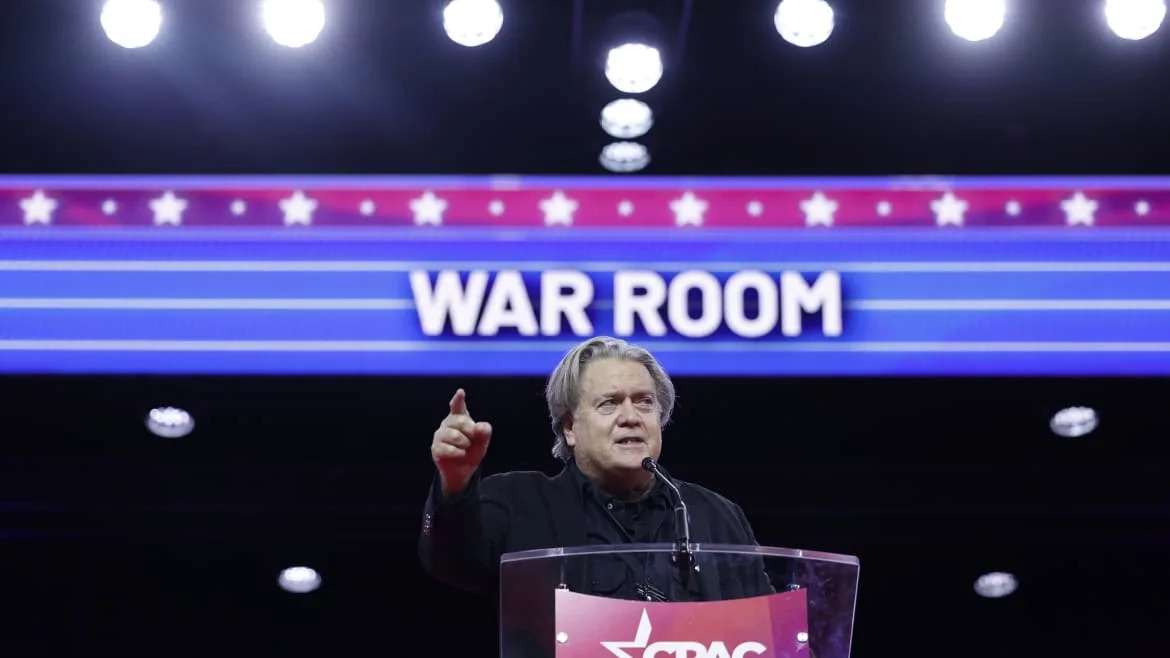
Kash Patel promised Steve Bannon, a fellow member of the former Trump adviser club, that the former president means to deliver on the vengeance he has vowed to exact should he win re-election to the White House next year. While hosting Patel on his War Room podcast Tuesday, Bannon asked if he felt “highly confident” that a fresh Trump administration could quickly “get rolling on prosecutions.” Patel, who held a number of national security roles in the Trump administration, replied that they already had “the bench for it.” Without naming said members of the bench, Patel continued, “We will go out and find the conspirators, not just in government but in the media… We’re going to come after you—whether it’s criminal or civilly, we’ll figure that out. But yeah, we’re putting you all on notice and Steve, this is why they hate us. This is why we’re tyrannical.” During the episode, Bannon issued his own warning. “And I want the Morning Joe producers that watch us,” he said, addressing the MSNBC staffers directly, “and all the producers that watch us—this is just not rhetoric. We’re absolutely dead serious.”

Trump doesn’t sound like somebody trying to get elected

Yahoo! Finance

Trump doesn’t sound like somebody trying to get elected

Rick Newman, Senior Columnist – December 5, 2023

Donald Trump promises more of the same if he wins the 2024 presidential election — more of the protectionism that defined his first presidential term, more dismantling of government, more slashing and burning of the system that many Trump supporters think is rigged against them.

But he may be misreading what voters want. Trump found surprise success in 2016 with his populist, America-first agenda, but voters didn’t love all of it. Plus, the electorate has changed since Trump first won the White House.

Trump, for instance, said recently that he still wants to repeal and replace Obamacare, the 2010 health reform law President Obama signed that extended health insurance to 40 million Americans. “Obamacare sucks!!!” Trump wrote recently on his social media site, Truth Social, vowing to replace it with something better.

In 2016, most Americans agreed with Trump that Obamacare, aka the Affordable Care Act (ACA), was a bummer. But not anymore. Public approval of the ACA has grown from around 40% in 2016 to nearly 60% in 2023, according to polling by KFF.

Republicans, who uniformly opposed the law when in passed in 2010, warned of socialized medicine, soaring costs, and other dire developments. Big surprise: That was hyperbole.

There were, in fact, some problems at the outset. But Republicans who vowed to repeal it couldn’t get the votes in 2017, even though they controlled both chambers of Congress and the White House. After Joe Biden took office in 2021, he signed legislation and issued new regulations to patch up the ACA, which is now embedded in the US healthcare system, much as Medicare and Medicaid took root after Congress created them in 1965.

Repealing the ACA would cause hardship well beyond blue states and districts. The state with the most ACA enrollees is Florida, which leans red and which Trump won in 2016 and 2020.

Voters in the six swing states likely to determine the 2024 outcome — Arizona, Georgia, Michigan, Nevada, Pennsylvania, and Wisconsin — would be among those affected if a second-term Trump repealed the ACA. Biden won all of those states in 2020 by a combined 312,000 votes. Around 3.2 million people in those six states get health coverage through the ACA. The data doesn’t reveal how many of those 3.2 million people are swing voters who could tip the election one way or the other, but some of them certainly are.

Georgia is a stark example of the risk Trump faces by threatening, once again, to kill the ACA. Nearly 850,000 Georgians get coverage through the ACA. Biden won the state in 2020 by less than 12,000 votes. So whatever portion of those 850,000 are not die-hard Trumpers would have a new incentive to vote for Biden.

Former President Donald Trump speaks during a Commit to Caucus rally, Saturday, Dec. 2, 2023, in Ankeny, Iowa. (AP Photo/Matthew Putney)
Former President Donald Trump speaks during a Commit to Caucus rally, Saturday, Dec. 2, 2023, in Ankeny, Iowa. (Matthew Putney/AP Photo) (ASSOCIATED PRESS)

Trump also wants to impose a new tax of 10% on virtually all imports to the United States. That’s a political head-scratcher. Trump already tried something like that the first time around when he slapped tariffs on steel and aluminum imports and about half of all goods coming to the United States from China. Many economists slammed the tariffs as a foolish idea likely to raise costs for Americans, kill jobs, and undermine growth. The Tax Foundation estimates the tariffs amounted to an $80 billion tax hike during Trump’s term. Voters soundly disapproved of the tariffs and Trump’s overall trade war.

Trump’s across-the-board 10% tariff would be costlier, with the Tax Foundation estimating it would add $300 billion per year to consumer costs — at a time when voters’ biggest economic concern is inflation. Vowing to raise taxes is not a normal campaign promise, so maybe it’s possible Trump actually believes his own gobbledygook about foreign producers paying the tariff, which is patently untrue. At any rate, any politician threatening to raise costs for consumers is giving his political opponents a gift, and Biden is sure to attack that one as the 2024 election heats up.

Trump also has some explaining to do about his fight with labor unions and his trash talk relating to auto workers. In September, when unionized workers at Ford, General Motors, and Stellantis went on strike, Trump criticized Shawn Fain, president of the United Auto Workers (UAW) union, saying “auto workers are being sold down the river by their leadership.” Then he went to Michigan to give a speech at a non-union plant whose workers weren’t on strike, where he said “the workers of our country … are getting screwed.”

Fain and the UAW ended up negotiating a four-year raise of at least 25% for workers at the Detroit Three, which promptly led to wage hikes at many nonunion auto plants. Biden played the strike well, expressing solidarity with striking workers, touting his lifelong support for unions, and even showing up at a picket line. Trump’s campaign website, by contrast, still features a video in which Trump says, “What’s happening to our auto workers is an absolute disgrace. Auto workers are getting totally ripped off by Crooked Joe Biden.” Doesn’t seem that way, but hey, maybe Trump is playing three-dimensional chess.

Why a Second Trump Presidency May Be More Radical Than His First

Why a Second Trump Presidency May Be More Radical Than His First

Charlie Savage, Jonathan Swan and Maggie Haberman – December 4, 2023

Donald J. Trump, wearing a blue suit and pointing to his right.
The extreme policy plans and ideas of Donald J. Trump and his advisers would have a greater prospect of becoming reality if he were to win a second term. Credit…Doug Mills/The New York Times

Donald Trump has long exhibited authoritarian impulses, but his policy operation is now more sophisticated, and the buffers to check him are weaker.

In the spring of 1989, the Chinese Communist Party used tanks and troops to crush a pro-democracy protest in Beijing’s Tiananmen Square. Most of the West, across traditional partisan lines, was aghast at the crackdown that killed at least hundreds of student activists. But one prominent American was impressed.

“When the students poured into Tiananmen Square, the Chinese government almost blew it,” Donald J. Trump said in an interview with Playboy magazine the year after the massacre. “Then they were vicious, they were horrible, but they put it down with strength. That shows you the power of strength. Our country is right now perceived as weak.”

It was a throwaway line in a wide-ranging interview, delivered to a journalist profiling a 43-year-old celebrity businessman who was not then a player in national politics or world affairs. But in light of what Mr. Trump has gone on to become, his exaltation of the ruthless crushing of democratic protesters is steeped in foreshadowing.

Mr. Trump’s violent and authoritarian rhetoric on the 2024 campaign trail has attracted growing alarm and comparisons to historical fascist dictators and contemporary populist strongmen. In recent weeks, he has dehumanized his adversaries as “vermin” who must be “rooted out,” declared that immigrants are “poisoning the blood of our country,” encouraged the shooting of shoplifters and suggested that the former chairman of the Joint Chiefs of Staff, Mark Milley, deserved to be executed for treason.

As he runs for president again facing four criminal prosecutions, Mr. Trump may seem more angry, desperate and dangerous to American-style democracy than in his first term. But the throughline that emerges is far more long-running: He has glorified political violence and spoken admiringly of autocrats for decades.

A row of people, mostly in suits, in front of a blue backdrop and behind a lectern at a news conference.
Fani Willis, the district attorney in Fulton County, Ga., brought one of the sets of indictments that Mr. Trump faces. Credit…Kenny Holston/The New York Times

As a presidential candidate in July 2016, he praised the former Iraqi dictator Saddam Hussein as having been “so good” at killing terrorists. Months after being inaugurated, he told the strongman leader of the Philippines, Rodrigo Duterte, that his brutal campaign of thousands of extrajudicial killings in the name of fighting drugs was “an unbelievable job.” And throughout his four years in the Oval Office, Mr. Trump blew through boundaries and violated democratic norms.

What would be different in a second Trump administration is not so much his character as his surroundings. Forces that somewhat contained his autocratic tendencies in his first term — staff members who saw their job as sometimes restraining him, a few congressional Republicans episodically willing to criticize or oppose him, a partisan balance on the Supreme Court that occasionally ruled against him — would all be weaker.

As a result, Mr. Trump’s and his advisers’ more extreme policy plans and ideas for a second term would have a greater prospect of becoming reality.

To be sure, some of what Mr. Trump and his allies are planning is in line with what any standard-issue Republican president would most likely do. For example, Mr. Trump would very likely roll back many of President Biden’s policies to curb carbon emissions and hasten the transition to electric cars. Such a reversal of various rules and policies would significantly weaken environmental protections, but much of the changes reflect routine and longstanding conservative skepticism of environmental regulations.

Other parts of Mr. Trump’s agenda, however, are aberrational. No U.S. president before him had toyed with withdrawing from NATO, the United States’ military alliance with Western democracies. He has said he would fundamentally re-evaluate “NATO’s purpose and NATO’s mission” in a second term.

He has said he would order the military to attack drug cartels in Mexico, which would violate international law unless its government consented. It most likely would not.

He would also use the military on domestic soil. While it is generally illegal to use troops for domestic law enforcement, the Insurrection Act allows exceptions. After some demonstrations against police violence in 2020 became riots, Mr. Trump had an order drafted to use troops to crack down on protesters in Washington, D.C., but didn’t sign it. He suggested at a rally in Iowa this year that he intends to unilaterally send troops into Democratic-run cities to enforce public order in general.

“You look at any Democrat-run state, and it’s just not the same — it doesn’t work,” Mr. Trump told the crowd, calling cities like New York, Chicago, Los Angeles and San Francisco crime dens. “We cannot let it happen any longer. And one of the other things I’ll do — because you’re supposed to not be involved in that, you just have to be asked by the governor or the mayor to come in — the next time, I’m not waiting.”

Mr. Trump’s plans to purge undocumented immigrants include sweeping raids, huge detention camps, deportations on the scale of millions per year, stopping asylum, trying to end birthright citizenship for babies born on U.S. soil to undocumented parents and invoking the Insurrection Act near the southern border to also use troops as immigration agents.

A line of people, some carrying bags, walking through an airport.
Mr. Trump has sweeping plans to deal with undocumented immigrants. Credit…Verónica G. Cárdenas for The New York Times

Mr. Trump would seek to expand presidential power in myriad ways — concentrating greater authority over the executive branch in the White House, ending the independence of agencies Congress set up to operate outside of presidential control and reducing civil service protections to make it easier to fire and replace tens of thousands of government workers.

More than anything else, Mr. Trump’s vow to use the Justice Department to wreak vengeance against his adversaries is a naked challenge to democratic values. Building on how he tried to get prosecutors to go after his enemies while in office, it would end the post-Watergate norm of investigative independence from White House political control.

In all these efforts, Mr. Trump would be backed in a second term by a well-funded outside infrastructure. In 2016, conservative think tanks were bastions of George W. Bush-style Republicanism. But new ones run by Trump administration veterans have sprung up, and the venerable Heritage Foundation has refashioned itself to stay in step with Trumpism.

A coalition has been drawing up America First-style policy plans, nicknamed Project 2025. (Mr. Trump’s campaign has expressed appreciation but said only plans announced by him or his campaign count.) While some proposals under development in such places would advance longstanding Republican megadonor goals, such as curbing regulations on businesses, others are more tuned to Mr. Trump’s personal interests.

The Center for Renewing America, for example, has published a paper titled “The U.S. Justice Department Is Not Independent.” The paper was written by Jeffrey Clark, whom Mr. Trump nearly made acting attorney general to aid his attempt to subvert the election and is facing criminal charges in Georgia in connection with that effort.

Asked for comment, a spokesman for Mr. Trump did not address specifics but instead criticized The New York Times while calling Mr. Trump “strong on crime.”

Even running in 2016, Mr. Trump flouted democratic norms.

He falsely portrayed his loss in the Iowa caucuses as fraud and suggested he would treat the results of the general election as legitimate only if he won. He threatened to imprison Hillary Clinton, smeared Mexican immigrants as rapists and promised to bar Muslims from entering the United States. He offered to pay the legal bills of any supporters who beat up protesters at his rallies and stoked hatred against reporters covering his events.

In office, Mr. Trump refused to divest from his businesses, and people courting his favor booked expensive blocks of rooms in his hotels. Despite an anti-nepotism law, he gave White House jobs to his daughter and son-in-law. He used emergency power to spend more on a border wall than Congress authorized. His lawyers floated a pardon at his campaign chairman, whom Mr. Trump praised for not “flipping” as prosecutors tried unsuccessfully to get him to cooperate as a witness in the Russia inquiry; Mr. Trump later did pardon him.

A woman in a white dress with a red floral pattern and a man in a dark suit and white shirt exiting an airplane.
Mr. Trump’s daughter Ivanka Trump and son-in-law, Jared Kushner, received White House posts despite an anti-nepotism law. Credit…Al Drago for The New York Times

But some of the most potentially serious of his violations of norms fell short of fruition.

Mr. Trump pressured the Justice Department to prosecute his adversaries. The Justice Department opened several criminal investigations, from the scrutiny of former Secretary of State John Kerry and of the former F.B.I. director James B. Comey Jr. to the attempt by a special counsel, John Durham, to find a basis to charge Obama-era national security officials or Mrs. Clinton with crimes connected to the origins of the Russia investigation. But to Mr. Trump’s fury, prosecutors decided against bringing such charges.

And neither effort for which he was impeached succeeded. Mr. Trump tried to coerce Ukraine into opening a criminal investigation into Mr. Biden by withholding military aid, but it did not cooperate. Mr. Trump sought to subvert his 2020 election loss and stoked the Capitol riot, but Vice President Mike Pence and congressional majorities rejected his attempt to stay in power.

There is reason to believe various obstacles and bulwarks that limited Mr. Trump in his first term would be absent in a second one.

Some of what Mr. Trump tried to do was thwarted by incompetence and dysfunction among his initial team. But over four years, those who stayed with him learned to wield power more effectively. After courts blocked his first, haphazardly crafted travel ban, for example, his team developed a version that the Supreme Court allowed to take effect.

Four years of his appointments created an entrenched Republican supermajority on the Supreme Court that most likely would now side with him on some cases that he lost, such as the 5-to-4 decision in June 2020 that blocked him from ending a program that shields from deportation certain undocumented people who had been brought as children and grew up as Americans.

Republicans in Congress were often partners and enablers — working with him to confirm judges and cut corporate taxes, while performing scant oversight. But a few key congressional Republicans occasionally denounced his rhetoric or checked his more disruptive proposals.

In 2017, then-Senator Bob Corker rebuked Mr. Trump for making reckless threats toward North Korea on Twitter, and then-Senator John McCain provided the decisive vote against Mr. Trump’s push to rescind, with no replacement plan, a law that makes health insurance coverage widely available.

It is likely that Republicans in Congress would be even more pliable in any second Trump term. The party has become more inured to and even enthusiastic about Mr. Trump’s willingness to cross lines. And Mr. Trump has worn down, outlasted, intimidated into submission or driven out leading Republican lawmakers who have independent standing and demonstrated occasional willingness to oppose him.

Mr. McCain, who was the 2008 G.O.P. presidential nominee, died in 2018. Former Representative Liz Cheney, who voted to impeach Mr. Trump for inciting the Jan. 6, 2021, riot and helped lead the committee that investigated those events, lost her seat to a pro-Trump primary challenger. Senator Mitt Romney, the 2012 Republican presidential nominee and the only G.O.P. senator who voted to convict Mr. Trump at his first impeachment trial, is retiring.

A row of people on a wooden dais, with American flags and a large screen behind them.
Representative Liz Cheney, center right, helped lead the investigation of the Jan. 6, 2021, attack on the Capitol and later lost a primary challenge to a pro-Trump candidate. Credit…Doug Mills/The New York Times

Fear of violence by Trump supporters also enforces control. In recent books, both Mr. Romney and Ms. Cheney said that Republican colleagues, whom they did not name, told them they wanted to vote against Mr. Trump in the Jan. 6-related impeachment proceedings but did not do so out of fear for their and their families’ safety.

Perhaps the most important check on Mr. Trump’s presidency was internal administration resistance to some of his more extreme demands. A parade of his own former high-level appointees has since warned that he is unfit to be president, including a former White House chief of staff, John F. Kelly; former defense secretaries Jim Mattis and Mark T. Esper; the former national security adviser John R. Bolton; former Attorney General William P. Barr; and others.

Mr. Trump in turn has denounced them all as weak, stupid and disloyal. He has privately told those close to him that his biggest mistakes concerned the people he appointed, in particular his choices for attorney general. The advisers who have stuck with him are determined that if he wins a new term, there will be no officials who intentionally stymie his agenda.

In addition to developing policy papers, the coalition of think tanks run by people aligned with Mr. Trump has been compiling a database of thousands of vetted potential recruits to hand to a transition team if he wins the election. Similar efforts are underway by former senior Trump administration officials to prepare to stock the government with lawyers likely to find ways to bless radical White House ideas rather than raising legal objections.

Such staffing efforts would build on a shift in his final year as president. In 2020, Mr. Trump replaced advisers who had sought to check him and installed a young aide, John McEntee, to root out further officials deemed insufficiently loyal.

Depending on Senate elections, confirming particularly contentious nominees to important positions might be challenging. But another norm violation Mr. Trump gradually developed was making aggressive use of his power to temporarily fill vacancies with “acting” heads for positions that are supposed to undergo Senate confirmation.

In 2020, for example, Mr. Trump made Richard Grenell — a combative Trump ally and former ambassador to Germany — acting director of national intelligence. Two prior Trump-era intelligence leaders had angered Mr. Trump by defending an assessment that Russia had covertly tried to help his 2016 campaign and by informing Democratic leaders it was doing so again in 2020. Mr. Grenell instead won Mr. Trump’s praise by using the role to declassify sensitive materials that Republicans used to portray the Russia investigation as suspicious.

A man in a blue suit and white shirt at a lectern, in front of numerous American flags.
Richard Grenell was one of the acting heads named by Mr. Trump for positions that are supposed to undergo Senate confirmation. He became acting director of national intelligence. Credit…Pete Marovich for The New York Times

After Mr. Trump left office, there were many proposals to codify into law democratic norms he violated. Ideas included tightening limits on presidents’ use of emergency powers, requiring disclosure of their taxes, giving teeth to a constitutional ban on outside payments and making it harder to abuse their pardon power and authority over prosecutors.

In December 2021, when Democrats still controlled the House, it passed many such proposals as the Protecting Our Democracy Act. Every Republican but one — then-Representative Adam Kinzinger, who was retiring after having voted to impeach Mr. Trump after the Jan. 6 riot — voted against the bill, which died in the Senate.

The debate on the House floor largely played out on a premise that reduced its urgency: Mr. Trump was gone. Democrats argued for viewing the reforms as being about future presidents, while Republicans dismissed it as an unnecessary swipe at Mr. Trump.

“Donald Trump is — unfortunately — no longer president,” said Representative Rick Crawford, Republican of Arkansas. “Time to stop living in the past.”

Charlie Savage writes about national security and legal policy. An individual winner of the Pulitzer Prize for his reporting about presidential power, he is also the author of the books “Takeover” and “Power Wars.”

Jonathan Swan is a political reporter who focuses on campaigns and Congress. As a reporter for Axios, he won an Emmy Award for his 2020 interview of then-President Donald J. Trump, and the White House Correspondents’ Association’s Aldo Beckman Award for “overall excellence in White House coverage” in 2022. 

Maggie Haberman is a senior political correspondent and the author of “Confidence Man: The Making of Donald Trump and the Breaking of America.” She was part of a team that won a Pulitzer Prize in 2018 for reporting on President Trump’s advisers and their connections to Russia. 

Trump’s revenge? GOP braces for daily blasts from ‘orange Jesus’

Politico

Trump’s revenge? GOP braces for daily blasts from ‘orange Jesus’

Burgess Everett, Olivia Beavers and Meridith McGraw – December 4, 2023

Eric Gay/AP

Congressional Republicans are steeling themselves for a return to daily life with Donald Trump — which means constant, uncomfortable questions about his erratic policy whims and political attacks.

With Trump far ahead of the GOP primary pack and leading President Joe Biden in some polls, Republicans are getting a preview of future shellshock akin to their experiences in 2016 and his presidency. It’s likely to continue for the next 11 months. And perhaps four more years after that.

Trump’s recent call to replace the Affordable Care Act is triggering a particularly unwelcome sense of deja vu within the GOP. Even as many Senate Republicans steered away from Trump over the past couple years, now they’re increasingly resigned to another general election that could inundate them with the former president’s often fact-averse and hyperbolic statements.

But Hill Republicans are girding to treat Trump the third-time nominee the same way they did Trump the neophyte candidate and then president. They’re distancing themselves and downplaying his remarks, which touch on policy stresses like his urge to end Obamacare and political grievances like his vow to come down “hard” on MSNBC for its unfavorable coverage.

“He is almost a stream of consciousness,” said Sen. Bill Cassidy (R-La.), one of only three Senate Republicans who will remain in office after voting to convict Trump in his second impeachment trial — the other four have either already left or plan to next year. It’s “analogous to when every day he would tweet,” Cassidy added, “and 99 percent of the time it never came to anything.”

Even so, Trump’s return threatens to spark the same clashes with the Hill GOP that took a heavy political toll on the party, perhaps to an even stronger degree than his first term. Some potential flashpoints are evident in his agenda: Trump is likely to tap nominees who rankle Senate Republican leaders and pursue a polarizing bid to reshape the civil service into a less independent force.

Other sources of tension will be political. Trump could try to force an ouster of Senate Minority Leader Mitch McConnell, if the Kentucky Republican even tries to keep the top job under another Trump presidency. House Republicans could see their own leadership shakeup if Trump is elected, since the former president has the power to purge a leader he dislikes.

“One thing I’m pretty certain of is that the leadership is all up in the air. And I don’t think any of them survive after this term,” said Rep. Max Miller (R-Ohio), a Trump ally who recently began airing public criticisms of Speaker Mike Johnson.

Trump’s first four years as president were a time of nearly constant tension within the establishment GOP, which wanted another nominee in 2016 but gradually fell in line behind him. Those stresses boiled over after the violent riot of Jan. 6, 2021, with many Republicans savaging Trump for stoking the Capitol insurrection and 17 Republicans in both chambers opposing him at his second impeachment trial.

Most of those 17 Republicans will be gone from Congress by the end of 2024. Those who will remain are slowly resurrecting a familiar dynamic: pushing aside worries that he’ll lose again to Biden and minimizing his online screeds and less palatable policy proposals.

“I’m under no illusions what that would be like,” said Sen. John Cornyn (R-Texas), who served as the GOP whip during Trump’s first two years as president and voted to acquit Trump. “If it’s Biden and Trump, I’m gonna be supporting Trump. But that’s obviously not without its challenges.”

The retiring Sen. Mitt Romney (R-Utah), who voted to convict Trump at two impeachment trials, put it more bluntly. He recalled meeting with a health secretary during Trump’s administration to delve into the president’s policies: “They had nothing. No proposal, no outlines, no principles.”

“He says a lot of stuff that he has no intention of actually doing,” Romney said of Trump. “At some point, you stop getting worried about what he says and recognize: We’ll see what he does.”

Trump is paying little heed to how Republicans on Capitol Hill are reacting to his candidacy or plans for a second term. While only 13 of the 49 Republican senators have endorsed Trump, he has racked up over 80 House GOP endorsements and the list is expected to grow. In a statement, Trump spokesperson Steven Cheung said the former president’s “second term will be one for the ages” and attacked Biden.

Even for those who liked Trump’s policies during his term, his related slew of controversies is an inescapable part of the deal.

“We have a lot of people on our side that utilize Donald Trump for their political benefit,” Rep. Kelly Armstrong (R-N.D.) said, people who “get really tired of answering questions about Donald Trump. And I don’t think that’s fair to the president. You don’t get the good without … the whole package.”

Another House-Senate GOP split is also likely to emerge if Trump continues steaming toward the nomination. Senate Republicans can win back the majority next year even if he loses the presidential election, given their red-leaning map.

But in the House, Republicans’ future is more deeply intertwined with the vacillations of the mercurial ex-president. And many of Trump’s House GOP critics don’t even want to entertain the idea of trying to govern alongside him; in interviews, some simply shook their heads and furrowed their brows in feigned fatigue.

“Shit, yeah,” Rep. David Joyce (R-Ohio) replied when asked whether his colleagues are worried about clashing with Trump. “The orange Jesus?” he added with a laugh.

Trump’s allies argued that his second term would be smoother than the first, notwithstanding the reality of his chaotic exit from office and subsequent indictments.

Rep. Andy Biggs (R-Ariz.), an influential voice on the House’s right flank, said Trump has “learned that there are people who [he] can trust and can’t trust.”

Miller, a former Trump aide, said that the presidential frontrunner would look more closely to “allies like me who are moderately pragmatic, that are all in on the America First agenda,” than more unpredictable conservatives like the eight (including Biggs) who voted to oust former Speaker Kevin McCarthy. He dismissed those Trump allies as “the freak shows within our party.”

Trump’s team is confident of their broader relationships in the House and predicted GOP senators would fall in line behind pro-Trump colleagues like Sens. J.D. Vance of Ohio and Rick Scott of Florida. Indeed, Johnson has endorsed Trump for president and recently met with him at Mar-a-Lago on the sidelines of a political fundraiser at Trump’s club. The two men, who have a good relationship since Johnson’s days on the Judiciary Committee during Trump’s first impeachment, had a friendly conversation and smiled for a photo together.

Johnson also supported Trump’s efforts to overturn the election, as did most House Republicans. Most Senate Republicans, on the other hand, did not — which could mean more static toward McConnell and his allies should Trump reclaim the White House.

A Trump adviser laughed off a question about McConnell’s relationship with Trump, arguing “there’s not much that Trump hasn’t said on that himself.”

McConnell’s office declined to comment for this story. He’s made zero effort to rejuvenate his partnership with Trump, which crumbled after Jan. 6.

Sen. Kevin Cramer (R-N.D.) argued that McConnell and Trump could still rekindle their partnership, “remembering that there’s pre-election and then there’s post-election. Things change after people become elected.”

Another Republican close to Trump’s campaign specifically mentioned Senate Minority Whip John Thune (R-S.D.), whose reelection Trump threatened to oppose, as a potential target of future ire. (Thune won his race handily in 2022.)

In an interview, Thune acknowledged that Trump was in a strong position but said he likes what he’s hearing from former South Carolina Gov. Nikki Haley’s presidential campaign. Thune advised fellow Republicans to “be prepared to respond to similar types of ideas and proposals and statements in the future” from Trump as the primary accelerates.

Other Republicans who served during the first Trump presidency are reluctant to make any predictions about the future — beyond expecting the unexpected.

Still, Rep. Mike Simpson (R-Idaho) said plenty in the GOP dread Trump’s return to the political spotlight but “everybody is being more private about it.”

“I wouldn’t expect him to be different,” Simpson said, adding that many colleagues worry about “four years of revenge … we just have to wait and see.”

Texas is about to follow Arizona through the immigration gates of hell

AZ Central – The Arizona Republic – Opinion

Texas is about to follow Arizona through the immigration gates of hell

Phil Boas, Arizona Republic – December 4, 2023

To say the U.S.-Mexico border is in chaos is to actually understate the problem.

Some 2.5 million migrants have been encountered trying to illegally cross the border in fiscal 2023, topping the record of the year before.

As quickly as the state of Texas can put up razor wire to stop the influx, the federal government is cutting it down.

Democratic governors and big-city mayors in Illinois, New York and Massachusetts have screamed at the Democratic White House to get control as migrants flood their social services.

Even Jesse Jackson — yes, Jesse Jackson — is scolding the feds for failing to secure the U.S.-Mexico line.

“Laws need to be enforced at the border,” the long-time civil rights leader said, as reported by Politico on Thursday.

Texas mimics Arizona’s immigration law

Today in Arizona, U.S. Customs and Border Protection will temporarily close their crossing at Lukeville to free up agents to help manage the rising level of migrant encounters between ports of entry, reports Arizona Republic writer José Ignacio Castañeda Perez.

But the real madness comes from Texas, where Gov. Greg Abbott is poised to walk through the gates of hell by signing a bill that looks very much like Arizona’s notorious Senate Bill 1070, signed into law in 2010.

Texas Senate Bill 4 would make it a misdemeanor for a person from a foreign nation to illegally enter or attempt to enter Texas at a location other than a lawful port of entry.

“If a police officer has probable cause to believe a person crossed the Rio Grande, that person could be charged with a Class B misdemeanor, which carries a punishment of up to six months in jail, Texas Tribune reporter Uriel J. García explained.

“If the person has been previously convicted of entering Texas illegally under SB 4, the charge could be increased to a second-degree felony, which carries a punishment of two to 20 years in prison.”

Those convicted of the law would then be returned to a port of entry and ordered to return to Mexico. If they refuse, they could face a felony charge, Garcia explained.

Arizona Republicans argued this before

Tell me where you’ve heard this before:

SB 4 merely follows federal immigration law, the bill’s sponsor in the Texas House, Republican David Spiller, said.

That was the reigning argument when Arizona Republicans passed and signed into law SB 1070, meant to shrink the size of Arizona’s undocumented immigrant population through aggressive state enforcement of the federal law.

In time, much of that Arizona law was gutted by the federal court.

Spiller argues that SB 4 is significantly different than Arizona’s controversial law in that it would focus exclusively on people who have recently crossed the U.S.-Mexico border illegally into Texas, not the undocumented who have been living illegally in Texas for years.

The opponents of SB 4 are lining up to legally challenge the State of Texas if and when the bill becomes law. And they are not appreciating the distinctions Texas makes from Arizona’s beleaguered SB 1070.

“(This is) one of the country’s most radical anti-immigrant laws — EVER,” the ACLU of Texas said. “If Gov. Abbott signs #SB4 into law, we’ll sue.”

“Senate Bill 4 is the broadest, most invasive piece of legislation to ever potentially challenge the very nature of our federal and state power,” said Texas state Rep. Victoria Neave Criado, a Dallas Democrat and chair of the Mexican American Legislative Caucus.

“The power to enforce immigration is unquestionably, exclusively a federal power.”

The biggest problem with Arizona’s SB 1070

The problem with Arizona’s SB 1070 was that it opened fissures between the white and Latino communities in a border state where the Latino population is a significant and growing part of the community.

No matter how many assurances Arizona Republicans offered that SB 1070 would not target legal citizens, Latino citizens and their allies were unconvinced.

They saw SB 1070 as a target on the back of every person with brown complexion. Feelings were raw. And many Latino citizens talked about leaving the state.

Then-President Barack Obama stood with then Mexican President Felipe Calderón to oppose Arizona’s law.

“In the United States of America, no law-abiding person — be they an American citizen, a legal immigrant, or a visitor or tourist from Mexico — should ever be subject to suspicion simply because of what they look like.”

The times have changed on immigration

Already, the office of Mexico Foreign Minister has said in a statement that the proposed Texas law “categorically rejects any measure that allows state or local authorities to detain and return nationals or foreigners to Mexican territory.”

Good luck trying to send detained migrants back to Mexico, immigration experts tell the Texas Tribune. Mexico is under no obligation to receive those people.

“In fiscal year 2023, about 83% of the 1 million immigrants encountered by Border Patrol on the Texas-Mexico border were not Mexican citizens,” the news organization reported. “Many are coming from Central and South America, Asia or Eastern European countries.”

Without a doubt the earth is shifting on immigration.

During the 2010s when SB 1070 made Arizona a national flash point, you did not hear the howls of Democrats worried about unchecked immigration.

Democratic cities were lining up to boycott Arizona, along with national conventions and arts and entertainment, including Kanye West and Rage Against the Machine.

The real damage was eroded trust

But the boycotts never did real damage to Arizona. The real damage was the erosion of trust between Latinos and the majority white population.

Much of the white business establishment had begun to see this too late and tried to fend it off, but the damage was done. I remember this newspaper entertaining a delegation of some of the most distinguished Latinos in our state speaking to us with real anguish and fear.

The federal court would dispense with much of the law, and it was never enforced. But both parties would work for a decade to avoid the wrenching emotions of that time.

Gallego is proof: Border politics have reached a tipping point

For a decade after, Arizona’s GOP-dominated Legislature and governor’s office steered cleared of similar iron-fist immigration measures.

Many of the politicians who pushed SB 1070 would eventually be driven from office, and the author of the bill, Russell Pearce, would see his gambit to follow SB 1070 with roughly a half-dozen follow-up bills unravel.

Working behind the scenes to help Arizona’s moderate Republican lawmakers dismantle those follow-up Pearce bills was a retired judge of some note — former U.S. Supreme Court Justice Sandra Day O’Connor.

Learn from us, Texas. Don’t go there

Texas Republicans, like Arizona Republicans, aren’t likely to care about what Mexican officials think about our state immigration laws. They can thump sand.

They’re not likely to flinch at rock bands canceling concerts, or California cities boycotting them.

But they will feel the sting of their fellow Arizonans and Texans — Latinos who are their friends, colleagues, neighbors and family members — who feel betrayed by laws that no matter how you write them are likely to distinguish by race.

The Texas governor would be wise to learn from Arizona and its encounter with the abyss.

So far, President Joe Biden and his immigration officials have not commented on the Texas bill.

They may be waiting for the Texas governor to generously take from the White House the lightning rod that is illegal immigration.

Phil Boas is an editorial columnist.

The Average American Household Is A Millionaire With A Net Worth Of $1.06 Million, Why Do People Feel So Broke?

Benzinga

If The Average American Household Is A Millionaire With A Net Worth Of $1.06 Million, Why Do People Feel So Broke?

Jeannine Mancini – December 4, 2023

The Federal Reserve’s 2022 consumer finance survey unveils a striking picture of American prosperity, revealing that the mean net worth of the average household has ascended to $1.06 million, a 23% from $868,000 in 2019. This statistic, while impressive, masks a more nuanced and unequal economic landscape.

Despite the seemingly thriving financial status of American households, the reality is more complex, particularly for the middle class. The COVID-19 pandemic, which drastically impacted economic activities, didn’t halt the growth in family finances, particularly in net worth. Between 2019 and 2022, real median family income modestly grew by 3%, while the real mean family income saw a more significant 15% increase. These gains were predominantly enjoyed by the higher income brackets, amplifying existing income inequalities.

The period witnessed a 37% surge in real median net worth and a 23% rise in real mean net worth, marking the largest three-year increase in the history of the modern Survey of Consumer Finances. Yet, this aggregate growth masks the unequal distribution of wealth gains. Homeownership, often a key component of net worth, rose slightly to 66.1%, with the median net housing value jumping from $139,100 in 2019 to $201,000 in 2022. The growth in housing values contributed significantly to net worth increases but also exacerbated housing affordability issues, as median home values soared to more than 4.6 times the median family income.

Inequality is further highlighted in retirement plan participation and stock market investments. While over two-thirds of working-age families participated in retirement plans, the increases in account balances were mainly seen in families in the upper half of the income distribution. Similarly, stock market participation grew across all income groups, but the gains were substantially higher for those between the 50th and 90th percentiles.

report by USAFacts using Federal Reserve data underscores this disparity. The top 1% of households in America hold 26% of U.S. wealth. The wealth inequality becomes starkly evident when comparing asset distribution across income quintiles. The top 20% of earners hold over four times as much wealth as the fourth 20%, with the top 1% alone possessing more than half the wealth of the entire top 20%. The greatest asset disparity lies in stocks and mutual fund shares, where the top 1% has more in these investments than the rest of the top 20% combined. This disparity continues down the income quintiles, with the middle class having significantly less in stock wealth.

Mortgage debt burdens the middle class the most. For the middle 60% of earners, mortgage debt represents a larger percentage of their net worth compared to the top 1%. This burden reflects the challenges faced by the middle class in growing their wealth relative to higher earners.

Inflation and other economic pressures have led 64% of Americans to live paycheck to paycheck, struggling to cover day-to-day expenses. Many households are unable to cover a $400 unexpected expense, highlighting the lack of emergency funds for unforeseen circumstances.

Economic uncertainty has contributed to the continuous growth of consumer debt, adding to the financial strain on many Americans. The burden of student loan debt remains a significant issue, especially as payments resumed after the pandemic. Credit card debt, often with high interest rates, contributes to financial stress for many Americans.

The average length of car loans has also increased, indicating that Americans are taking longer to pay off vehicle purchases, adding to their financial burdens.

These factors, when combined with the skewed distribution of wealth and income highlighted in the Federal Reserve’s data, explain why many Americans may not feel the prosperity suggested by the average household net worth figure. Despite the overall increase in net worth, issues like debt, insufficient savings and the disproportionate growth of wealth among higher earners contribute to the feeling of financial strain among many.

The growing gap between the average American household’s perceived wealth and actual financial difficulties underscores the importance of financial advisers. This is especially true for the newly affluent earning between $150,000 and $250,000 a year, a group that might not usually seek financial advice. Financial advisers offer crucial insights and strategies to manage present financial challenges and prepare for potential asset growth. Their guidance ensures effective navigation through financial complexities, aiding households in aligning their financial realities with their goals and expectations.

‘We do not have insurance. We have an insurance bill’: Condos hit with 563% rate increase

USA Today

‘We do not have insurance. We have an insurance bill’: Condos hit with 563% rate increase

Mark Harper, USA TODAY – December 2, 2023

Marbella Condominiums Association board members (from left) Tom Baker, Jim Smith and Rob Lasch stand outside their beachside home, where property insurance has increased more than 500% since two hurricanes caused damage to the structure's back patio and pool in 2022.
Marbella Condominiums Association board members (from left) Tom Baker, Jim Smith and Rob Lasch stand outside their beachside home, where property insurance has increased more than 500% since two hurricanes caused damage to the structure’s back patio and pool in 2022.

DAYTONA BEACH SHORES, Florida – Tom Baker lives in a retirement dream building: A spacious three-bedroom beachside condo with unobstructed morning sunrises, waves marking the time and the soft sand of comfort.

The retired Marine and Army veteran and his wife Joan moved here from the Tampa Bay area. She had a Daytona Beach timeshare they regularly visited. Ten years ago they moved to their retirement home: a fourth-story condo on the Atlantic Ocean.

“I absolutely love Daytona Beach,” he said. “I absolutely love where I live, and I love this building.”

Daytona Beach Shores condo owner Tom Baker sent a six-page memo to all of Florida's senators and representatives, seeking help to rein in property insurance costs. He said one of the 160 legislators, Sen. Jason Pizzo, D-Sunny Isles Beach, responded to him.
Daytona Beach Shores condo owner Tom Baker sent a six-page memo to all of Florida’s senators and representatives, seeking help to rein in property insurance costs. He said one of the 160 legislators, Sen. Jason Pizzo, D-Sunny Isles Beach, responded to him.

So why does he seem so angry? Two words: Property insurance.

For Baker and many other Florida condo owners, the very concept of insurance – to ease worries during times of distress – seems lost, especially after the 2021 collapse of the Champlain Towers South in Surfside and the two-punch combo of the 2022 hurricane season: Ian and Nicole.

The latter storms just over a year ago pounded a seawall outside the Marbella Condominiums, then destroyed a pool and deck area. And the Surfside disaster, which killed 98 people, shined a light on structural safety, delayed maintenance and the need for the state to enact more strict regulations to prevent future collapses.

As bad as all of that was, for Baker, the real disaster arrived in December 2022: the property insurance bill for Marbella, where he serves on the condo association’s board.

For the 24-unit building, property insurance jumped from $40,534 for 2022 to nearly $269,000 – a 563% increase. And Rob Lasch, another Marbella board member, said he’s expecting another increase when the policy offer arrives, which could be any day now.

And the increase came in spite of a history of Marbella, which was built in 2007, never having filed a claim, Lasch and Baker said. There was no claim filed for the $2 million damage on the condo’s ocean-facing deck.

“Nothing got paid out for the damage outside because it was the seawall, and nobody was insuring the seawalls,” Lasch said.

So Marbella residents are getting hit hard on both sides of the hurricane. They’re having to come up with the full amount to fix the damage, while also bearing the burden of increased rates.

Baker said his wife wants to move, leaving him to contemplate simply not buying property insurance for the building – something his fellow board members don’t support because it violates Florida law and would leave the board members personally exposed to lawsuits.

“In a minute, I wouldn’t pay another dime in property insurance, because it is illegal, it is immoral, and it’s wrong. You can’t justify this payment. This is out-and-out stealing. Theft,” he said. “And excuse me for being passionate. I am pissed.”

Other condo owners also see exponential rate hikes

Marbella isn’t alone. Many condo associations across the state have said they, too, have faced astronomical property insurance rate hikes.

Right next door, the 109-unit Grand Coquina Condo went from paying $207,000 for property insurance in 2022 to $680,000 for 2023, a 228% increase, said Jeff Sussman, the association’s treasurer.

That amounted to a $2,331 additional assessment per unit this year, while Sussman projects another assessment of between $3,000 and $6,000 per unit will be required in 2024.

The Grand Coquina Condominiums, 3333 S. Atlantic Ave., in Daytona Beach Shores, saw a 228% increase in property insurance rates in 2023, despite the fact that its insurer denied a water damage claim. The condo association is fighting that determination.

Grand Coquina filed a claim seeking reimbursement for water damage its board members contend was caused by wind during the storms. The claim was denied, said Marro Porcelli, president of the Grand Coquina Condo Association Inc.

Grand Coquina hired an attorney and a structural engineer to challenge the denial. Board members expect they will receive a settlement offer.

“There’s a lot of fight left in us,” Porcelli said. “We’re not giving in to the criminals.”

Marbella is relatively new, built 15 years ago under strict building codes. As a result, it stands on 42 pylons that are 40 feet long and reach down to the hard core beneath the sand, Smith said.

In other words, residents there are confident if the building itself could withstand Ian and Nicole, it’s unlikely to crumble anytime soon.

And Smith said the deductible for any disaster is $1 million.

That leads Baker to question what the insurance is actually covering.

‘We don’t have insurance. We have an insurance bill’

“If a tornado came across this building and ripped the roof completely off, our deductible is more than the repair. If an atomic bomb goes off downtown, and blows this building down, we don’t collect because of the war clause,” Baker said.

The Marbella Condominium Association, 3343 S. Atlantic Ave., in Daytona Beach Shores, was hit with a huge insurance increase last year and faces another increase, even while property insurance did not cover some $2 million in damage caused by Tropical Storms Ian and Nicole.

“There is no way this building can collect,” he said. “This is a concrete building with sprinklers. You couldn’t burn the damn thing down if you built a bonfire inside. We do not have insurance. We have an insurance bill.”

Baker has written to all 160 state lawmakers as well as 15 news organizations about the plight of condo owners. He went to Tallahassee during this year’s session.

“I learned something a long time ago in the military,” he said. “If you make a complaint, have a suggestion on how to fix it, OK?”

He’s proposed dropping the requirement that condos purchase insurance. And he’s also talked about condos finding a way to self-insure.

Mostly, Baker said his pleas have been ignored.

Baker met with Rep. Tom Leek, R-Ormond Beach, who was receptive to at least one of his ideas. The office of Sen. Jason Pizzo, D-Sunny Isle Beach, responded to a packet of information Baker mailed to all lawmakers. But otherwise, he’s heard nothing.

Baker said he’s most disappointed in Sen. Tom Wright, R-New Smyrna Beach, who represents Daytona Beach Shores.

“For one year, I’ve been trying to get an appointment with Sen. Wright,” Baker said. “I even went to his office. He walked right past me. He didn’t extend me the courtesy of shaking my hand.”

Wright did not respond to a request for comment.

Leek, whose district includes Daytona Beach Shores, likes at least one of Baker’s ideas.

Is self-insuring a good idea?

“We are actively finding ways to help the Florida consumer, and allowing condominium associations to self-insure is a good idea. In fact, measures that increase competition in the insurance market and drive more carriers into Florida will benefit consumers,” he wrote.

Mark Friedlander, Florida spokesman for the Insurance Information Institute, said Florida has long had a complicated relationship with property insurance, and it got more challenging with the Surfside collapse and the hurricanes of 2022.

Many of the insurers that offer condo coverage started to pull back from the Florida market due to increased risk at the older coastal properties, Friedlander said in an email.

“The insurers that remained enhanced their underwriting criteria. This began the trend of significant premium increases for master association coverage,” he said.  “Insured losses incurred from substantial property damage generated by hurricanes Ian and Nicole last year further impacted the availability and cost of master condo insurance,” Friedlander wrote.

In addition to “master policy costs” shared among all condo unit owners, individual condo owners living in high-risk properties are seeing their condo unit policy premiums increase substantially – 50% to 100% on average, he added.

Over the past two years, the Florida Legislature has passed a flurry of changes with the goal of resolving the property insurance crisis, so far to no avail.

Some of those measures include tweaking regulations related to Citizens Property Insurance Corp, the state-run insurer of last resort, authorizing actions to be taken by the Florida Office of Insurance Regulation, and cracking down on bad-faith claims.

In an early November special session, lawmakers allocated $181.5 million to the My Safe Florida Home Program, which provides homeowners a wind-mitigation survey and grant funds to make homes more sturdy.

Leek said he’s confident that what lawmakers have been doing has been done is working.

Rep. Tom Leek, R-Ormond Beach, speaks during a Volusia County Legislative Delegation meeting in DeLand in October. Leek, the House budget chair, says lawmakers are working to resolve Florida's property insurance crisis.
Rep. Tom Leek, R-Ormond Beach, speaks during a Volusia County Legislative Delegation meeting in DeLand in October. Leek, the House budget chair, says lawmakers are working to resolve Florida’s property insurance crisis.

“The Legislature’s insurance reforms are taking hold,” Leek wrote in response to questions. “New carriers are entering the Florida insurance market for the first time in years. Just this month, a new carrier entered the Florida condo association insurance market.

“It’s happening and it does take time, and we will continue to work to provide a climate of competition and choice,” he wrote.

Friedlander also referenced the new carrier as a positive sign: “Last week, Florida’s insurance regulator announced that a new insurer, the Condo Owners Reciprocal Exchange, will be entering the state’s market in 2024 and provide master condo policy coverage to associations. We hope this will be a first step toward stabilizing the market for this coverage.”

Condo owners socked with $64,000 in assessments

As a result of both sides of the property insurance problem – high rates and being awarded no claims for the damage, Marbella condo owners have each paid approximately $64,000 in HOA fees and assessments in 2023, said board President Jim Smith.

Tom Baker, a member of the Marbella Condominium Association Board, has been writing lawmakers, trying to get them to help stop property insurance rates from skyrocketing.

Baker acknowledges beachside condo owners – particularly those who have thus far been able to absorb the high insurance bills and the assessments to pay for damages – probably don’t attract much sympathy in Florida.

“Now us rich son-of-a-bitches, pardon me, we can manage somehow and get away with it,” he said.

But other condo owners have had their retirement dreams dashed, moving because of the high costs, while an exodus awaits if the problem isn’t contained, association board members say.

They appreciate what Baker has done to raise awareness of the problem.

“He’s taken this on, and he’s very passionate about it,” said Jim Smith, the Marbella Condo Association Board president.

Baker said: “People who moved down here on fixed incomes and bought themselves their final place now find themselves with an impossible bill.”

Some Republicans sound alarm after Trump revives focus on Obamacare

CNN

Some Republicans sound alarm after Trump revives focus on Obamacare

Kristen Holmes, Alayna Treene and Kate Sullivan – November 30, 2023

Go Nakamura/Reuters

Former President Donald Trump’s renewed focus on repealing and replacing the Affordable Care Act, known colloquially as Obamacare, has alarmed some Republicans scarred by the GOP’s failure to deliver on promises to dismantle the law and who view the issue as a political loser with the American people.

Many on Trump’s team said they were surprised by the former president’s recent declaration on his social media website Truth Social that replacing Obamacare would be a priority of his administration, as Obamacare had not been a focal issue in ongoing policy conversations and the campaign has not yet drafted any kind of health care policy alternative. One Trump adviser told CNN the post came “completely came out of nowhere,” and said the team “has not been talking to him about health care.”

Some Trump advisers who spoke with CNN also conceded that calling for the termination of a health care law that provides millions of Americans coverage and is largely viewed favorably by the public is a political loser going into 2024. Republicans have tried and failed for years to implement substantial changes to Obamacare and the party has largely abandoned efforts to campaign on the issue.

The resurrection of the health care battle has given Democrats fresh political ammo, and the Biden campaign quickly seized on Trump’s threats. The campaign held a press call with former House Speaker Nancy Pelosi and North Carolina Democratic Gov. Roy Cooper, whose state will become the 40th to expand Medicaid on Friday, to respond to Trump’s comments. The campaign also on Thursday released an ad focused on health care and prescription drug costs, attempting to draw a sharp contrast with Trump. The ad – which features a pediatric nurse who calls Trump’s health care policies “troubling” – will run in media markets in seven states that will be key to Biden’s 2024 electoral map.

“There are very few issues where Republicans are at a greater disadvantage then health care. The Biden campaign desperately wants the election to be about health care and abortion. If the election is about those two issues in 2024, then Democrats will have a great night in November,” Ken Spain, a GOP consultant and former communications director for the National Republican Congressional Committee, told CNN.

“The concern that Republicans have always had about Trump is his lack of discipline. The question is, is this really an issue he intends to campaign and formulate a strategy around, or is this just another lapse in discipline?” Spain added.

Health care “was a loser in 2018 and it’s a loser now,” one Trump-aligned Republican operative told CNN, referencing the 2018 midterm elections that ushered in a Democratic majority in the House of Representatives.

Trump’s health care legacy while in office is viewed by many Republicans as lackluster at best. His failure to fulfill his core campaign promise of repealing and replacing Obamacare – even with a GOP monopoly on power in Washington – was an early blow to Trump, who had painted himself as the ultimate dealmaker.

“Talk about the border,” the operative said. “Talk about the economy. Talk about no more foreign wars. Don’t talk about health care.”

Advisers to Trump said the catalyst for the former president’s posts was a recent article written by the Wall Street Journal editorial board that raised concerns that patients are seeing higher costs because insurers are using work arounds to an Affordable Care Act rule. Trump included a portion of the op-ed in his initial post on the issue.

The topic had also recently been brought up to Trump during a Mar-a-Lago meeting with Jeff Colyer, the former governor of Kansas. The two discussed health care policy over lunch, a Trump adviser told CNN.

Trump’s online pronouncements about replacing the law with his own belied the fact that his campaign has not settled on health care plan.

The campaign’s in-house policy team, led by advisers Vince Haley and Ross Worthington, has been drafting aggressive proposals for a potential second Trump term, but the campaign has not been actively working on a health care proposal, the Trump adviser told CNN. The team first started floating ideas for an alternative to Obamacare in recent days — but only after Trump started posting about it online.

One person familiar with the campaign’s process said it was likely that Trump’s team would also review health care proposals put forward by outside advocacy groups, including Project 2025, a partnership of groups organized by the conservative think tank the Heritage Foundation. But this person stressed the proposals by the outside groups are merely suggestions and that the campaign would look at a range of ideas before putting forward its own unique proposal.

“The campaign is not going to adopt a position that’s suicidal,” this person said, acknowledging how politically fraught the issue can be. “But it is equally suicidal not to recognize the American people’s profound cry for health care reform.”

Like many of the policy proposals Trump’s current team is drafting for a potential second term, there are also serious concerns about how the former president could successfully enact them if reelected, acknowledging the necessary obstacles Congress and the courts could pose to a new health care agenda.

Trump bringing health care back to the forefront has also reignited talk of his failure to repeal and replace Obamacare in 2017.

Members of Trump’s orbit have long blamed that failure on the late Sen. John McCain of Arizona, who famously voted that year against repealing the ACA with a dramatic “thumbs down” on the Senate floor, tanking the Trump administration’s efforts.

And despite Trump’s promises to release a health care plan that could replace Obamacare, Trump left office in 2020 without having produced one. Just weeks before the 2020 presidential election, Trump issued an executive order pledging to protect Americans with preexisting conditions, but the plan fell far short of a comprehensive proposal.

CNN’s Betsy Klein and Tami Luhby contributed to this story.