US eyes weapons stockpiles as concern grows about supporting both Ukraine and Israel’s wars
Oren Liebermann and Natasha Bertrand – October 11, 2023
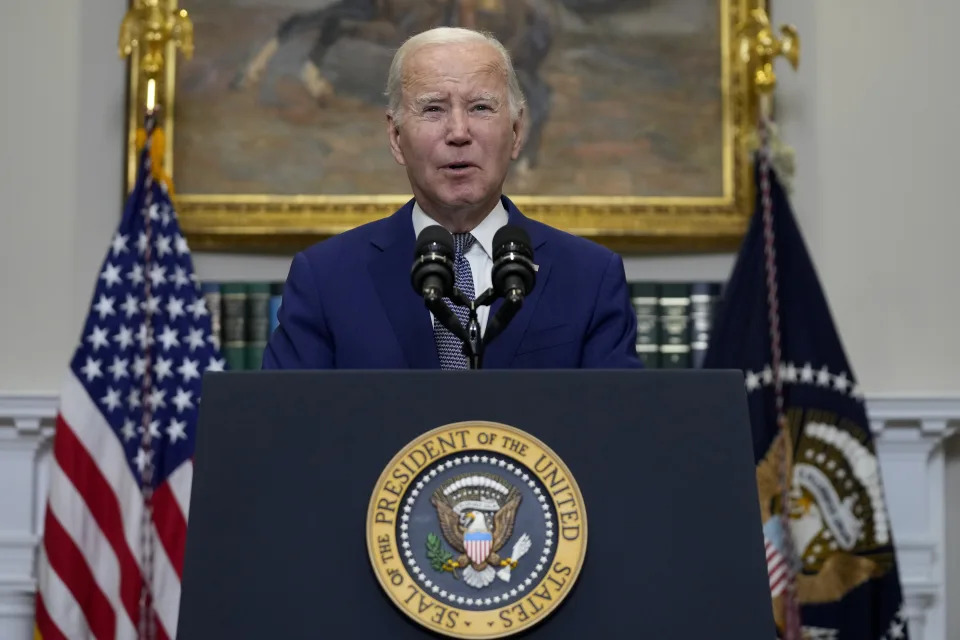
Alex Brandon/AP
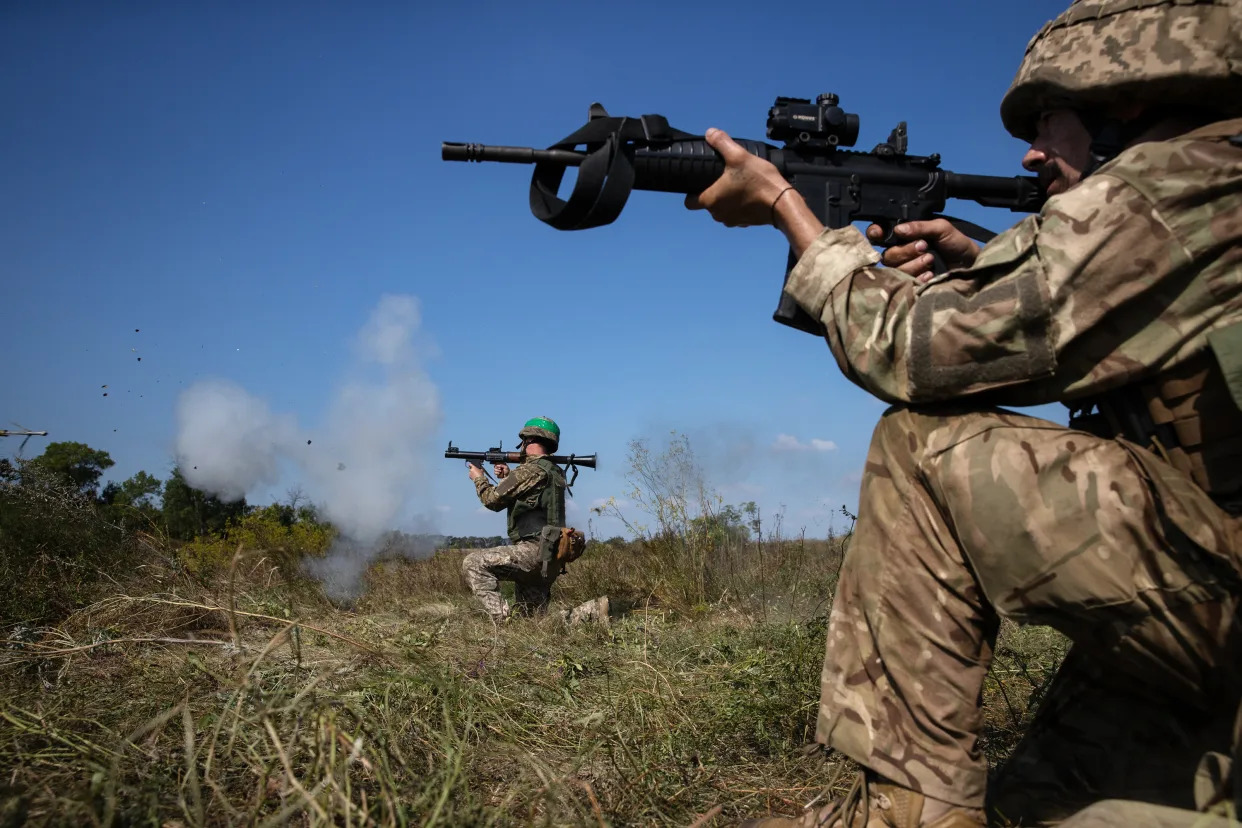
Concern is growing within the Pentagon over the potential need to stretch its increasingly scarce ammunition stockpiles to support Ukraine and Israel in two separate wars, according to multiple US defense officials.
At the moment Ukraine and Israel require different weapons: Ukraine wants massive amounts of artillery ammunition while Israel has requested precision guided aerial munitions and Iron Dome interceptors.
But if Israel launches a ground incursion into Gaza, the Israeli military will create a new and entirely unexpected demand for 155mm artillery ammunition and other weapons at a time when the US and its allies and partners have been stretched thin from more than 18 months of fighting in Ukraine.
Israel has its own capable industrial base and produces many of its own advanced weapons, but a prolonged ground campaign could drain the country’s stockpiles, officials said. The Pentagon’s Joint Staff and Transportation Command have been working around the clock since Hamas launched its war on Israel last weekend to identify extra stores of munitions around the world and how to move them to Israel quickly, officials said.
On Monday, a senior defense official said the Pentagon is contacting US arms manufacturers to speed up existing Israeli orders for military equipment that may have been considered less urgent just days ago. For months, the US has been working to expand its own defense industrial base to supply Ukraine and replenish US and western stockpiles, but those efforts are still ongoing.
Defense Secretary Lloyd Austin defended the ability of the US to support both Ukraine and Israel, as the US announced another $200 million in security assistance for Kyiv, including artillery ammunition.
“We can do both and we will do both,” said Austin on Tuesday at a press conference in Brussels, when asked whether the US can support both Israel and Ukraine militarily. “We’re going to do what’s necessary to help our allies and partners, and we’re going to also do what’s necessary to make sure that we maintain the capability to protect our interests and defend our country.”
Israel front and center at Ukraine meeting
The possibility of a ground invasion and the demands it may place on the US industrial base come as Austin and the Chairman of the Joint Chiefs of Staff Gen. CQ Brown are in Belgium for a meeting of the contact group, an organization of about 50 countries, including Israel, that has come together to supply Ukraine.
The sudden ferocity of fighting in Gaza will put Israel front and center at the meeting, officials said, with one describing it as “the most important contact group we’ve ever had.”
In 2014, Prime Minister Benjamin Netanyahu urgently requested ammunition for tanks and other equipment as Israel’s last ground incursion into Gaza dragged on. The request was immediately approved by former President Barack Obama, and the equipment was pulled from US reserve stockpiles in Israel.
That stockpile is not as robust as it once was, however. The US moved hundreds of thousands of munitions out of its reserves in Israel earlier this year as the US and its allies were searching the world for ammunition to provide to Ukraine, prompting concerns among Defense Department officials and crystallizing the challenges the US faces as it grapples with two wars abroad, according to a source familiar with discussions.
Ukraine is using thousands of artillery shells as it tries to retake territory occupied by Russia – far more than Israel would use in a ground incursion into Gaza – but US and western stockpiles have been diminished by the need to supply Ukraine. Netanyahu vowed to carry out a “prolonged” campaign against Gaza, one that could put extant US stockpiles under more pressure than they already face.
Defense officials are also anxious about the dysfunction in Congress and whether lawmakers will approve additional funding for US support to Israel and Ukraine.
“One thing that is really important in terms of the munitions in particular and our ability to support both potentially the Israelis and the Ukrainians simultaneously is additional funding from Congress to be able to increase our capacity, in terms of our capacity to expand production and then to also pay for the munitions themselves,” Army Secretary Christine Wormuth told reporters on Monday.
A senior defense official said on Monday that the US is “surging support” to Israel, including air defense and munitions, and is working with the US defense industry to expedite the shipment of pending Israeli orders for military equipment.
The official said that the administration currently has the resources, authorities and funding it needs to continue its support for Israel, but said officials need Congress to ensure that additional funds will be available to respond to crises and contingencies as and when they arise.
National Security Council spokesperson John Kirby said on Wednesday that “we’re certainly running out of runway” to support both Ukraine and Israel with the current appropriations.
“The sooner that there’s a speaker of the house, obviously, the more comfortable we’ll all be in terms of being able to support Israel and Ukraine right now,” Kirby told reporters. “Because of existing appropriations and existing authorities, we’ve been okay. But that’s not going to last forever. I think in the immediate term, right now, we can continue to support – with the authorities in the appropriations we have – Israel and Ukraine. But you know, we’re certainly running out of runway.”
Are terrorists trying to cross the U.S. southern border? Here are the facts.
Camilo Montoya-Galvez – October 11, 2023
Washington — Concerns about whether known or suspected terrorists are exploiting the migration crisis along the U.S.-Mexico border to enter the country have intensified following the brutal terrorist attacks carried out by Hamas in Israel over the weekend.
Republican lawmakers, GOP White House hopefuls and conservative media figures have argued that the Biden administration’s border policies have given terrorists an easier way to enter the U.S. and harm Americans. On Monday, former President Donald Trump claimed that the “same people” who killed or abducted more than 1,000 civilians in Israel are coming across the southern border separating the U.S. and Mexico, offering no evidence to support his assertion.
There has been a marked increase in Border Patrol apprehensions of individuals with matches on the U.S. terror watchlist over the past two years. But they represent a tiny fraction of all migrants processed along the southern border. Such incidents are more common along the U.S.-Canada border, and not all those on the watchlist are suspected terrorists.
Still, there are valid concerns about whether the U.S. has sufficient tools to ensure it detains all national security threats, including those entering the country clandestinely.
“Are terrorists flooding across the border? Probably not,” said Theresa Cardinal Brown, a former Department of Homeland Security official under Presidents George W. Bush and Barack Obama. “But at the same time, it is true that the large number of people arriving does have national security implications.”
Here’s what we know about this issue, based on government data, reports and policy:
A spike in terror watchlist hits along the U.S.-Mexico border
When Border Patrol apprehends individuals, it is supposed to run criminal and national security screenings on them. The process includes checking names against the Terrorist Screening Data Set, or TSDS, an FBI system that tracks known or suspected terrorists as well as their affiliates.
Border Patrol apprehensions of individuals on the FBI’s terrorism watchlist have increased sharply in recent years as the number of overall crossings recorded by the agency along the U.S.-Mexico border has soared to record levels.
In fiscal year 2023, Border Patrol reported apprehending 151 migrants with positive terrorism watchlist matches who entered the U.S. illegally along the southern border, an all-time high for the region that eclipsed the previous record of 98 set in fiscal year 2022, government figures show. In fiscal year 2021, the agency reported just 15 such apprehensions.
When including those processed at official ports of entry, there were 227 terror database hits with individuals processed along the southern border in fiscal year 2023.
Josh Hawley Offers World’s Most Offensive Idea for How to Help Israel
Edith Olmsted – October 10, 2023
Republican Senator Josh Hawley is offering the world’s most hairbrained pitch on how to help Israel: simply redirect funds from Ukraine to Israel instead.
Hawley posted to X, formerly known as Twitter, on Monday saying, “Israel is facing an existential threat,” using the tragedy there to further his own political agenda of defunding U.S. aid to Ukraine.
Fighting broke out on Saturday when Hamas launched a deadly surprise attack on Israel, killing over 900 Israelis. The Israeli government has responded by declaring a total siege of Gaza, home to two million Palestinians and what has been described as the world’s largest open-air prison. About 770 Palestinians have already been killed in retribution, and the death toll is expected to keep rising.
On Monday, Senator Mitch McConnell was among several bipartisan lawmakers who pushed for a spending package that would link aid for Israel with support for Ukraine and Taiwan. The hope is to convince Ukraine aid skeptics, like Hawley, to continue supporting the country as support diminishes in the GOP-controlled House. On both sides of the aisle, the deaths of Palestinians and Israelis have already become a political tool.
Meanwhile, some are saying that it’s not clear that Israel requires immediate U.S. funding. Congressional aides have said that Israel already has the resources to wage a weeks-long campaign of violence in Gaza and use its Iron Dome system to defend itself, and can then tap into more than $5 billion made available by Pentagon drawdown authority.
What Ukrainian Soldiers Really Think of Trump and the GOP
Ben Makuch – October 9, 2033
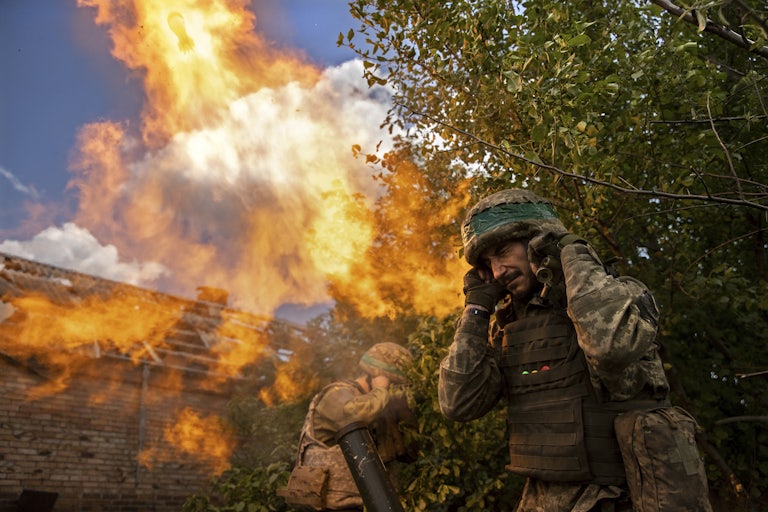
Two Ukrainian soldiers fire a mortar in Bakhmut, where some of the fiercest fighting of the war has taken place. TYLER HICKS/THE NEW YORK TIMES/REDUX
For starters: “Donald Trump is a fucking asshole.”
“Donald Trump is a fucking asshole,” said Anatolii, a soldier in the Ukrainian Territorial Defense Forces. The leaves are changing, and it’s a chilly fall day in Bilopillya, a village in the Sumy region where you can see Russia a few kilometers away. “That’s what I think of him.”
His brigade defends flat farmland that wouldn’t be out of place in a Tolstoy novel—except the endless, rolling scene, laced with crops and thickets of trees, is heavily mined and pockmarked with artillery blasts.
The question of who will become U.S. president in 2024 is far from his mind. Anatolii is one of a few soldiers in his brigade, made up of other locals, who defend the Ukrainian border with Russia. On any given day, he deals with barrages of artillery, Grad rockets, the pings of gunfire, and the occasional missile, one of which took out a local school in March.
“The problem is, they never give us enough weapons,” he told me in an almost exasperated tone about U.S. and NATO arms transfers. “If he comes back and what? Give us none again?” Many in the Ukrainian military and government already feel that they are not receiving enough military aid. The stakes of the nascent Republican primary, which has been defined by isolationist rhetoric, are potentially dire.
Back in Kyiv, sitting in a hipster bistro near the banks of the Dnipro River, I find it tough to remember that, less than 48 hours ago, a swarm of Iranian-designed Shahed drones were shot down overhead, the debris landing near baroque architecture and cobblestoned streets.
I’m in a casual conversation with a Ukrainian official in the upper brass of Kyiv’s military effort. The war, he and his colleagues believe, is far from over. The need for continued support from the West is vital.
“For now, it’s going to be the same, then up and down,” he said to me, referring to the kinetic energy of a conflict that has grinded to mostly a standstill as Ukraine’s counteroffensive crawls on in the east. “But in Donbas, there is always going to be crazy shelling and missiles all day long.”
Spilling in and out of the American news cycle, the war in Ukraine has settled into its moodier, teenage era: One moment you might be sipping coffee on a sunny, cloudless day in the picturesque capital city, safely sitting on a cushioned seat; the next, it could be raining missiles in the distance, with air sirens singing for you to get into a shelter.
The consensus among Ukrainians is that the duration of the fight is indefinite, with no peace deal in sight. Stateside, the question of what to do about a war that has settled into a stalemate has become one of the most divisive issues in the ongoing Republican primary. Trump, the front-runner, has long complained that the war is too expensive, and that he could simply end it if reelected; his copycats, Vivek Ramaswamy and Ron DeSantis, have largely followed his lead. The party’s establishment wing, all languishing in the single digits, has backed continued financial and tactical support for the war effort.
Whatever path the immediate future of the war takes, recent chatter from the GOP primary has U.S. and, especially, Ukrainian intelligence and military figures theorizing about what the future of the conflict might be should Republicans retake the presidency.
The main concern? The $44 billion worth of weaponry (and counting) that has been essential to Ukrainians’ ability to stall Russian advances and carry out some of their own.
There isn’t yet any level of overt panic about what the future holds. But there is a sense of vigilance and preparation for the worst-case scenario.
One American ex-Marine, a foreign volunteer who trains Ukrainian soldiers in combat, told me that the Ukrainian officers he schools in places like the Donetsk region are well aware of what a Republican president could mean for the war effort.
“Anyone on the front lines who reads English-language media and follows either U.S. elections or news around the funding is aware that Republicans potentially want to pull the plug,” he said, keeping his anonymity in order to protect against possible Russian reprisals. “They know that 2024 is potentially a big, big problem, and they have objectives to hit in the counteroffensive to make sure they’re comfortable in case Trump wins, then stops the weapons transfers.”
But, oppositely, the same Ukrainian official at the bistro shares the uncanny confidence in American resolve that his president, Volodymyr Zelenskiy, expressed to The Economist in September. Shrugging off a question about the possible consequences of Trump returning to power, Zelenskiy insisted that a President Trump would “never” take an action supporting Vladimir Putin: “That isn’t what strong Americans do.”
“I think Trump would keep giving us the weapons,” the Ukrainian official told me flatly, explaining that the consequences of withdrawing support would be so profound that they make it unlikely for any leader—even one as vociferously isolationist as Trump—to fully pull out.
“They have already given so much money and weapons for our war, if [the Republicans] take over and Ukraine turns into a disaster, they would be responsible for that, just like [President Joe Biden was] in Afghanistan,” he said, referencing America’s disastrous summer 2021 withdrawal, which started the current president’s slide in the polls.
So far, the Department of Defense has unleashed a torrent of weapons transfers to Ukraine that have proved essential in the fight against a Kremlin war machine that is vastly better armed and manned. Everything from Javelin anti-tank missile systems, to the infamous Stingers used by the mujahedin during the Afghan-Soviet war, to F-16 fighter jets and M1 Abrams tanks has been promised in increasingly bolder Pentagon and allied packages.
It isn’t just national Republicans who have begun to question the scale of support for the war—skepticism is growing in otherNATO countries as well.
“Everywhere some politicians are using Ukraine to make support for their cause,” said one senior Ukrainian officer with knowledge of war planning. “The American people must know it is much cheaper for us to fight than for you to fight.”
To him, the conflict is already a quagmire for Russia on par with that of the Afghan-Soviet war. But ending aid could quickly reverse that. The same soldier, almost doubting himself, was frank and saw the pitfalls of a Republican win.
“Of course, our fighting costs a lot of money, and we know there are no security guarantees if Trump wins.”
It is possible, however, that opinion on Ukraine will shift as the Republican primary progresses and the candidates continue to appear at monthly debates—especially since Trump, the most prominent voice against U.S. support for Ukraine, has thus far declined to participate. Still, Trump’s prominence and level of support could draw even more Republicans to question the war.
A growing number of Republican voters oppose further aid to Ukraine, and there’s good reason to believe that figure will rise as the primary process and the accompanying debates drag on.
Perhaps the most extremist take on Ukraine in the primary comes from the oft-arrogant Ramaswamy, who has made the outlandish demand not only for the dismantling of the FBI, but also for granting Russia Ukrainian territory. The pharma-businessman has gone so far as to label the Biden administration’s current posture “disastrous” and has declared that military resources for Ukraine should be redirected “to prevent the invasion of our own southern border” with Mexico.
But a Republican president might not be catastrophic for the Ukrainian war effort. Lucas Webber, cofounder of the Militant Wire research network, concurred. “It is unlikely, even if Trump truly means what he says, that he would be able to shift America’s Ukraine policy in any meaningful way,” Webber told The New Republic over email. “The U.S. political elite and security establishment consensus on Ukraine will leave Trump very little room to maneuver, as seen during his first term. Moreover, it is also highly improbable that either Ukraine or Russia would accept anything remotely resembling the territorial status quo on the battlefield.”
There have been efforts to push back, however. Former Vice President Mike Pence has made support for Ukraine a major campaign issue that he’s used to hammer his rivals, particularly DeSantis, whom he has attacked for minimizing the conflict.
“I know that some in this debate have called the war in Ukraine a ‘territorial dispute,’” said Pence, directly quoting comments the Florida governor made in March 2023.
“It’s not; it was a Russian invasion, an unprovoked Russian invasion. And I believe the United States of America needs to continue to provide the courageous soldiers in Ukraine with the resources they need to repel that Russian invasion and restore their territorial integrity.”
Even if the Republicans commit to a total withdrawal of aid to Ukraine, it is possible that contingencies will be put in place should Biden know his presidency will be coming to an end. If Biden loses in 2024, weapons could be sent over right before the Republicans take the White House.
Whatever position on the war the eventual Republican presidential candidate takes, there is no denying one simple fact: If Ukraine loses to the despotic Putin regime, it not only would bolster autocrats around the world (or perhaps even herald the renormalization of imperial conquest) but also would undoubtedly weaken the West.
But if Biden can hold out, perhaps all the fears surrounding an end to the arms flow to Ukraine will be for naught. NATO and the EU want to continue thinking of themselves as global leaders, both militarily and economically. The loss of Ukraine after so much was spent to save it would be the crack in their castle that countries like China and its allies will see as a further sign of the decline of the West.
“Trump is not coming back,” Anatolii said to me at the end of a long week manning checkpoints. “I don’t think so.”
For the fate of Ukraine, he’d better hope he’s right.
Ben Makuch is a national security reporter and former correspondent for VICE News Tonight. His reporting has taken him to the Middle East, Pakistan, Russia, and Ukraine, where he has covered the war since 2016. He hosted the 2022 podcast American Terror, about far-right extremism in the United States.
Russian rouble briefly returns to ‘laughing stock’ level that prompted emergency interest rate hikes last time
Prarthana Prakash – October 3, 2023
Getty Images
The Russian rouble hit the skids after Russia’s invasion of Ukraine last February. Initially, the government took a hands-off approach to deal with the rollercoaster ride of exchange rates. Instead, they boasted about the nation’s economic resilience in the face of sanctions and shrinking exports. But come August, they had to step in as the rouble nosedived to a 16-month low, worth less than a penny.
A déjà vu moment played out on a recent Tuesday, with the rouble teetering just below the 100-mark against the U.S. dollar—a critical benchmark for Russia’s currency. Although the rouble managed a modest comeback, this embarrassing stumble highlighted its shaky footing and raised concerns of further depreciation.
The rouble’s value has taken a beating this year, shedding almost 30% of its worth against the greenback since January.
A number of things may have influenced the drop in exchange rates—from foreign currency outflows and declining trade activity to Russia’s waning current account surplus.
But some factors may still be working to Russia’s advantage, such as its budget.
The falling value of the rouble means more of the Russian currency for every dollar earned through the trade of oil or other products. This, in turn, has given the Kremlin more money to pour into the military or social schemes, for instance, to help offset the impact of sanctions.
Despite the seeming upside of a weak ruble and the Kremlin’s swift actions to stem any negative effects from it, the Russian currency’s value is not out of the woods yet.
The August slump
When the rouble weakened to more than 100 to the U.S. dollar in August, the Bank of Russia called an “extraordinary meeting”, subsequently hiking interest rates by 350 basis points to 12%. The bank also said it would halt foreign currency purchases on the domestic market until the end of the year in an effort to stabilize its financial markets.
Russia’s state media and senior officials were also rattled by the rouble’s tumble into three-digit territory. Vladimir Solovyov, a popular TV person in Russia and President Vladimir Putin’s ally, said the country had become a laughing stock, pointing to how dire the situation had gotten.
Putin’s economic advisor, Maxim Oreshkin, told state-owned news outlet TASS that “loose monetary policy” was causing the drop in the rouble’s exchange rate and exacerbating inflation.
“A weak ruble complicates the structural restructuring of the economy and negatively affects the real incomes of the population. A strong ruble is in the interests of the Russian economy,” Oreshkin said according to the translation of an August op-ed in TASS.
In September, the central bank once against raised rates to 13% to tackle the falling rouble value and stubborn inflation, which was at 5.33% at the time. Further rate hikes are expected in the next central bank meeting later this month.
The rouble has wavered a lot since 2022—shortly after Russia’s invasion of Ukraine it hit an all-time low of 120 roubles to the U.S. dollar, but by last June, the currency had recovered to nearly 50 roubles to the dollar when oil and gas prices soared.
“This level (100) is not a technical resistance, it’s an important psychological barrier,” said Russian investment group Alor Broker’s Alexei Antonov told Reuters. “For now, everything speaks in favour of the rouble continuing to get cheaper.”
The rouble’s current weakness could be temporary, but the Russian government faces pressures on its finances and more prolonged effects of a weaker currency. Plunging export volumes continue to weigh on the economy, as the current account surplus shrank 86% year-on-year to just $25.6 billion in January-August. Elevated consumer prices along with a depreciated rouble make it harder for the average Russian to afford basic goods.
As Moscow struggles to keep its currency strong while navigating other macroeconomic challenges, experts suggest that a drop in the rouble’s exchange rate is not quite an economic crisis, although it does ring alarm bells for the government.
“This is the closest we came to a real economic problem since the start of the war,” Janis Kluge, an expert in the Russian economy at the German Institute for International and Security Affairs told the Associated Press in August following the rouble’s drop to a 16-month low. “In Russia, the exchange rate is always seen as the most important indicator of the health of the economy.”
Ukraine confident of broad support as EU ministers convene in Kyiv
Olena Harmash – October 2, 2023
KYIV (Reuters) -EU foreign ministers expressed support for Ukraine during a meeting in Kyiv on Monday, their first in a non-member country, after a pro-Russian candidate won an election in Slovakia and the U.S. Congress left Ukraine war aid out of its spending bill.
Kyiv brushed off concerns that support for its war effort was fading on both sides of the Atlantic, especially in the United States where Congress excluded aid to Ukraine from an emergency bill to prevent a government shutdown.
“We don’t feel that the U.S. support has been shattered … because the United States understands that what is at stake in Ukraine is much bigger than just Ukraine,” Ukrainian Foreign Minister Dmytro Kuleba told reporters as he greeted the EU foreign policy chief, Josep Borrell.
The omission of Ukraine from the U.S. spending bill sent pro-Kyiv officials scrambling to find the best way to secure approval for further assistance on top of the $113 billion in security, economic and humanitarian aid the U.S. has provided since Russia invaded in February 2022.
Leaders in the Senate, narrowly controlled by President Joe Biden’s fellow Democrats, promised to take up legislation in the coming weeks on continued support. But in the Republican-led House of Representatives, Speaker Kevin McCarthy said he wanted more information from the Biden administration.
White House spokesperson Karine Jean-Pierre urged Congress to act quickly.
As for the election victory of pro-Russian Slovak former Prime Minister Robert Fico, Kuleba said a new leader would still have to form a coalition and it was “too early to judge” the impact on politics there.
Monday’s meeting in Kyiv was touted by Borrell as an historic first for the EU but it comes at an awkward time for the Western countries backing Kyiv.
With summer drawing to a close, Ukraine’s counteroffensive has failed to produce the victories that Kyiv’s allies had hoped to see before mud clogs the treads of donated tanks.
Ukrainian President Volodymyr Zelenskiy, quoted by his website, said he was sure “Ukraine and the entire free world are capable of winning this confrontation. But our victory depends directly on our cooperation with you.”
Borrell told a news briefing with Kuleba the EU remained united in its support for Ukraine. He had proposed an EU spending package for Kyiv of up to 5 billion euros ($5.25 billion) for 2024 which he hoped to have agreed by then.
Kuleba said it would help Ukraine and the EU to have clarity on the judicial aspects of transferring Russian assets frozen in the West to help fund Ukraine’s reconstruction.
PREPARING FOR WINTER
German Foreign Minister Annalena Baerbock sought help to prepare Ukraine for winter, including air defence and energy supplies, after Russia bombed energy installations last year.
“Last winter, we saw the brutal way in which the Russian president is waging this war,” Baerbock said. “We must prevent this together with everything we have, as far as possible.”
Moscow touted the congressional vote in the United States as a sign of increasing division in the West, although the Kremlin said it expected Washington to continue its support for Kyiv.
The omission of aid for Ukraine was “temporary”, Kremlin spokesperson Dmitry Peskov said.
“But we have repeatedly said before that according to our forecasts fatigue from this conflict, fatigue from the completely absurd sponsorship of the Kyiv regime, will grow in various countries, including the United States,” he said.
Support for Kyiv has been mixed in the “Global South”, prompting Kuleba to make visits to different countries, particularly in Africa.
Mexican President Andres Manuel Lopez Obrador criticised as “irrational” U.S. military aid to Ukraine and urged Washington to devote more resources to helping Latin American countries.
“…How much have they destined for the Ukraine war? 30 to 50 billion dollars for the war,” he told reporters. “Which is the most irrational thing you can have. And damaging.”
In Western countries, elections are looming, above all next year in the United States where former President Donald Trump is leading the Republican field in his bid to return to the White House. Several right-wing Trump supporters in Congress have called for a halt to Ukraine aid.
Although most Republican lawmakers still support Kyiv, House speaker McCarthy was forced to rely on Democrats to pass the measure to keep the government open and might need them again to support any bill to fund Ukraine. Right wingers have threatened to try to remove him.
Kuleba said Ukraine had “a very in-depth discussion with both parts of the Congress – Republicans and Democrats”, and expected aid to continue.
In Europe, pro-Russian former prime minister Fico won the most votes in the Slovak election and will get a chance to form a government. His campaign had called for “not a single round” of ammunition from Slovakia’s reserves to be sent to Ukraine.
“We are not changing that we are prepared to help Ukraine in a humanitarian way,” Fico told a news conference. “We are prepared to help with the reconstruction of the state but you know our opinion on arming Ukraine.”
Fico was given two weeks to form a government. To do so, he would have to establish a coalition with at least one other party that does not publicly share his position on Ukraine.
Slovakia, a NATO state bordering Ukraine, has taken in refugees. Its outgoing government, has provided a major supply of weapons, notably being among the first to send fighter jets.
($1 = 0.9530 euros)
(Additional reporting by Benoit Van Overstraeten, Charlotte Van Campenhout, Jan Lopatka, Jason Hovet and Reuters bureaux; Writing by Peter Graff and Ron Popeski; Editing by Jon Boyle and Stephen Coates)
Republican blockade of Ukraine aid and Slovakia’s election play into Putin’s hands
Analysis by Stephen Collinson, CNN – October 2, 2023
Tom Brenner for The Washington Post/Getty Images
Republicans opposed to the US funding Ukraine’s lifeline against Russia scored their first major success when House Speaker Kevin McCarthy didn’t include a $6 billion request for aid in a stopgap bill that averted a government shutdown.
The result, which left President Joe Biden demanding swift action to fulfill Kyiv’s needs, made for a good weekend for Russian President Vladimir Putin. But it left Ukrainian President Volodymyr Zelensky with plenty more to worry about after shifts elsewhere in global politics played into Moscow’s push to outlast the West in Russia’s war in Ukraine. Biden suggested he had a “deal” with McCarthy on moving assistance for Ukraine in a separate measure, but the Republican speaker’s office declined to confirm any such agreement.
Drama in the US coincided with another development this weekend that will cause concern in Ukraine. In neighboring Slovakia, former pro-Russia Prime Minister Robert Fico’s populist party won parliamentary elections. Fico anchored his campaign on his anti-US rhetoric, vows to stop sending weapons to Ukraine and a pledge to thwart Kyiv’s NATO ambitions.
Blows to Ukraine in the US and Slovakia came on top of its spat over grain exports with Poland – one of Kyiv’s earliest and most staunch allies – which led Warsaw to warn it could stop arms shipments to its neighbor.
Each of these developments stresses a rising danger for Ukraine – that the arms and aid it needs to sustain its fight against Russia’s onslaught are increasingly getting dragged into the bitter politics of national elections in the West.
Any sign of weakening resolve for arming Ukraine among Western leaders and legislatures is an added incentive for Putin to try to extend the conflict into a war of attrition in the hope that Western publics will tire of the fight and that leaders like ex-President Donald Trump might win power next year and ditch Kyiv.
The headlines are alarming for Ukraine. And while the realities of international politics suggest that time is not yet running out for the remarkable pipeline of arms and aid that fueled its heroic resistance to Russia’s onslaught, the political ground could be shifting and augur serious long-term concerns for Kyiv.
A potential propaganda coup for Putin
In Slovakia, Fico’s SMER party won Saturday’s parliamentary elections in a swing of the political pendulum back toward the populism and nationalism that delivered Trump, Brexit and gains by far-right parties in France and Germany in recent years. In the glow of victory, Fico warned, “Slovakia and people in Slovakia have bigger problems than Ukraine,” and added he would push for peace talks.
Slovakia, a member of NATO, was previously a vocal ally of Ukraine, and a turn against its neighbor would hand Putin valuable propaganda openings. Yet on its own, Slovakia has no power to push negotiations to start. In any case, there’s no sign Ukraine is ready to talk as its offensive grinds on, or that Putin has any political or strategic motivations to do so either. And Fico has to worry about his own coalition-building before he starts deciding Ukraine policy.
And a Slovakian halt to arms shipments is unlikely to tilt the battlefield toward Russia. It did send Kyiv old Soviet MiG jets and other equipment for which it was compensated by the European Union. But its contributions are dwarfed by those of larger European powers and the United States.
A threat to block Ukraine’s entry into NATO sounds alarming. But the NATO summit this year showed that there is no prospect of Kyiv joining the Western alliance soon anyhow. And even before the Slovakian election, getting all alliance members to back its eventual membership was already a struggle. Turkey, for instance, is still blocking the accession of Sweden, a far less controversial new member of the self-defense club.
Slovakia might be home to many voters sympathetic to Moscow given its decades as part of the former Czechoslovakia in the Warsaw Pact under the iron grip of the Soviet Union. But as a NATO member, it is still dependent on the group – and, ultimately, the US – for its defense. And its economy is reliant on its European Union membership. This gives the West substantial leverage in Bratislava.
Geopolitical realities may also be decisive in Poland’s dispute with Ukraine. Many analysts believe temperatures will cool after a tense election later this month. Poland’s antipathy to Russia and desire to prevent it from winning a victory in Ukraine are borne out of decades of bitter political history unlikely to be diluted by shifting political winds. And its posture is also critical to its rising importance to the United States as one of Washington’s most important European allies.
The GOP tide against Ukraine gathers strength
Zelensky’s visit to Washington to shore up Ukraine aid last month looks prescient. But after a wild week, it’s clear that future tranches of US assistance will be far harder for the Biden administration to drive through Congress.
McCarthy, whose speakership is wobbling, pushed through a stopgap spending bill to keep the government open through mid-November, without $6 billion in Ukraine funding the Senate hoped to add to the package – which in itself represented only about a quarter of Biden’s latest Ukraine aid request. The move will not immediately imperil Ukraine on the battlefield, but a longer delay could have serious consequences. And politically, it could embolden Putin and fuel doubts about US staying power in the war among allied European leaders who are standing firm but also need to manage public opinion.
Some of Ukraine’s loudest supporters in Congress were deeply disappointed. “Putin is celebrating,” Democratic Rep. Mike Quigley of Illinois told CNN. “I don’t see how the dynamics change in 45 days.” The co-chair of the Congressional Ukraine Caucus was the only House Democrat to vote against the stopgap measure.
House Republican rebels, some of whom are threatening to topple McCarthy after he used Democratic votes to temporarily keep the government open at current spending levels, are largely opposed to more aid for Ukraine. They include Rep. Matt Gaetz of Florida and pro-Trump Georgia Rep. Marjorie Taylor Greene, who wrote on social media Saturday that “Joe Biden treats Ukraine as the 51st state” after previously warning that more funds for Kyiv would be “blood money.”
Ukraine refused to panic over the interruption to its latest injection of aid in a multi-billion-dollar initiative on which its war effort largely depends, at least in its current scale. Foreign Minister Dmytro Kuleba said his country is working with the US Congress on the issue.
“We do not feel that US support has been shattered, because the US understands that what is at stake in Ukraine is much bigger than just Ukraine. It’s about the stability and predictability of the world, and therefore I believe that we will be able to find the necessary solutions,” Kuleba said.
The danger for Zelensky is that such rhetoric solidifies into a sense among voters that American interests and Ukraine’s interests are opposite. At Republican campaign events, voters often voice antipathy to sending billions of dollars to Ukraine, and polls show rising public skepticism.
Still, for now, there is a bipartisan Washington majority in favor of Ukraine aid, although the chaos in the GOP raises questions about how it will be delivered. Biden on Sunday seemed to indicate he had a deal with McCarthy on moving the funds in a separate bill, although the speaker may be too weak to deliver on any promises. “I fully expect the speaker to keep his commitment to secure the passage and support needed to help Ukraine as they defend themselves against aggression and brutality,” the president said.
McCarthy suggested that a framework that also sends more money to secure the southern US border might open the way for Ukraine funds. “They’re not going to get some package if the border is not secure,” the speaker said on CBS’ “Face the Nation” on Sunday. “I support being able to make sure Ukraine has the weapons that they need. But I firmly support the border first. So we’ve got to find a way that we can do this together.”
But if McCarthy is toppled and replaced by a more radical speaker, Ukraine could run out of luck.
Longer term, the US elections in November 2024 are critical. Trump, the Republican front-runner, has vowed to end the war in 24 hours if elected president, presumably on terms that would favor Putin, whom he has called a “genius” and before whom he has often genuflected.
And Ukraine’s would not be the only future on the line. A second Trump term could pose an existential threat to NATO and the entire post-World War II and Cold War concept of the West.
Putin’s Next Target: U.S. Support for Ukraine, Officials Say
Julian E. Barnes – October 2, 2023
WASHINGTON — Russia’s strategy to win the war in Ukraine is to outlast the West.
But how does President Vladimir Putin plan to do that?
U.S. officials said they are convinced that Putin intends to try to end U.S. and European support for Ukraine by using his spy agencies to push propaganda supporting pro-Russian political parties and by stoking conspiracy theories with new technologies.
The Russia disinformation aims to increase support for candidates opposing Ukraine aid with the ultimate goal of stopping international military assistance to Ukraine.
Russia has been frustrated that the United States and Europe have largely remained united on continued military and economic support for Ukraine, U.S. officials said.
That military aid has kept Ukraine in the fight, put Russia’s original goals of taking Kyiv, the capital, and Odesa out of reach and even halted its more modest objective to control all of the Donbas region, in eastern Ukraine.
But Putin believes he can influence American politics to weaken support for Ukraine and potentially restore his battlefield advantage, U.S. officials said.
Putin, the officials said, appears to be closely watching U.S. political debates over Ukraine assistance. Republican opposition to sending more money to Ukraine forced congressional leaders to pass a stopgap spending bill Saturday that did not include additional aid for the country.
Moscow is also likely to try to boost pro-Russian candidates in Europe, seeing potential fertile ground with recent results. A pro-Russian candidate won Slovakia’s parliamentary elections Sunday. In addition to national elections, Russia could seek to influence the European parliamentary vote next year, officials said.
Russia has long used its intelligence services to influence democratic politics around the world.
U.S. intelligence assessments in 2017 and 2021 concluded that Russia had tried to influence elections in favor of Donald Trump. In 2016, Russia hacked and leaked Democratic National Committee emails that hurt Hillary Rodham Clinton’s campaign and pushed divisive messages on social media. In 2020, Russia sought to spread information denigrating Joe Biden — but many Republicans in Congress argued Russia’s goal was to intensify political fights, not to support Trump.
For the 2024 presidential election, U.S. intelligence agencies believe the stakes for Putin are even higher.
Biden has sent billions of dollars of aid to Ukraine and pledged that the United States and its allies would support the country for “as long as it takes.” Trump, far ahead in the polls for the Republican nomination, has said supporting Ukraine is not a vital U.S. interest.
Russia, according to U.S. officials, is constantly running information operations aimed at denigrating NATO and U.S. policies and is likely to ramp up efforts in the months to come. The U.S. officials spoke on the condition their names not be reported so they could discuss sensitive intelligence.
The ultimate goal of Russia would be to help undermine candidates who support Ukraine and to change U.S. policy. Some U.S. officials doubt Russia would be able to do that.
But even if Moscow cannot influence the final election result, Russians may believe they can stir up enough debate over Ukraine aid that a future Congress could find it more difficult to pass additional support, U.S. officials said.
Beth Sanner, a former senior intelligence official, says artificial intelligence and other new technologies will change how Russia conducts influence campaigns. Russia is also likely to conduct influence laundering efforts, sending messages to the American public through allies inside nominally independent organizations, according to a recent declassified analysis.
“Russia will not give up on disinformation campaigns,” Sanner said. “But we don’t know what it is going to look like. We should assume the Russians are getting smarter.”
It is easy to overstate Russia’s ability to influence U.S. politics. Some American officials and social media executives have questioned how effective Russia’s troll farms and influence operations were in 2016, as opposed to hack and dump operations targeting Clinton’s emails.
And the media landscape has shifted dramatically since then. U.S. and European consumers are more skeptical of what they see on social media. Russian state television, a source of Kremlin narratives, has been pushed off Google’s YouTube. Meta, the parent company of Facebook, has bolstered its search for disinformation and de-emphasized news on its platforms.
But for every development making life harder for Russia’s online trolls, there are trends pushing in the opposite direction. The X platform, formerly known as Twitter, has dismantled teams that were hunting for election interference efforts. And the most influential platform among young people is now TikTok, a Chinese company. China has been stepping up its own influence operations, modeled after Moscow’s operations.
U.S. intelligence agencies have warned that several countries are seeking to influence American politics. In 2020, intelligence agencies outlined an Iranian scheme to influence voting in Florida. Cuba also conducted low-level intelligence operations, and Venezuela had the intent, but not the capabilities, to influence the vote.
But Russia is better than any other country at combining state media, private troll farms and intelligence service operations to attack in the digital space, U.S. officials said.
And it has continued to refine its efforts. Many of the disinformation experts who once worked for the Internet Research Agency, the Russian troll farm active in American elections in 2016 and 2018, have migrated to new firms or joined Russian military intelligence. And the internet, one U.S. official said, is the one place Russia will never run out of ammunition.
Shifting the debate in Europe and America is so important to Putin that if those influence operations fail to gain traction, Russia could decide to escalate.
U.S. officials say that escalation could include additional financial support for pro-Russian political parties in Europe or even covert operations in Europe aimed at weakening support for the war in Ukraine.
As a result, underestimating Russia’s ability to conduct influence operations would be a mistake, U.S. officials said.
Russian disinformation that falsely claimed America had bioweapons labs in Ukraine continues to reverberate around the world, for example.
Russia used the accusations to justify its invasion of Ukraine and has repeatedly requested United Nations’ investigations of its false claims. But far-right groups, including QAnon, have picked up, expanded and amplified the Russian bioweapons accusations.
In a world divided by polarized politics, conspiracy theories and disinformation have proved more resilient than ever.
Biden says there’s ‘not much time’ to keep aid flowing to Ukraine and Congress must ‘stop the games’
Kevin Freking and Colleen Long – October 1, 2023
President Joe Biden speaks in the Roosevelt Room of the White House, Sunday, Oct. 1, 2023, in Washington. (AP Photo/Manuel Balce Ceneta)
WASHINGTON (AP) — President Joe Biden said Sunday that American aid to Ukraine will keep flowing for now as he sought to reassure allies of continued U.S. financial support for the war effort. But time is running out, the president said in a warning to Congress.
“We cannot under any circumstances allow America’s support for Ukraine to be interrupted,” Biden said in remarks from the Roosevelt Room after Congress averted a government shutdown by passing a short-term funding package late Saturday that dropped assistance for Ukraine in the battle against Russia.
“We have time, not much time, and there’s an overwhelming sense of urgency,” he said, noting that the funding bill lasts only until mid-November. Biden urged Congress to negotiate an aid package as soon as possible.
“The vast majority of both parties — Democrats and Republicans, Senate and House — support helping Ukraine and the brutal aggression that is being thrust upon them by Russia,” Biden said. “Stop playing games, get this done.’’
But many lawmakers acknowledge that winning approval for Ukraine assistance in Congress is growing more difficult as the war grinds on. Republican resistance to the aid has been gaining momentum and the next steps are ahead, given the resistance from the hard-right flank.
While Senate Majority Leader Chuck Schumer, D-N.Y., has begun a process to potentially consider legislation providing additional Ukraine aid, House Speaker Kevin McCarthy, R-Calif., faces a more difficult task in keeping the commitment he made over the objections of nearly half of his GOP majority.
He told CBS’ “Face on the Nation” that he supported “being able to make sure Ukraine has the weapons that they need,” but that his priority was security at the U.S.-Mexico border.
“I firmly support the border first,” he said. “So we’ve got to find a way that we can do this together.”
By omitting additional Ukraine aid from the measure to keep the government running, McCarthy closed the door on a Senate package that would have funneled $6 billion to Ukraine, roughly one-third of what has been requested by the White House. Both the House and Senate overwhelmingly approved the stopgap measure, with members of both parties abandoning the increased aid in favor of avoiding a costly government shutdown.
Now Biden is working to reassure U.S. allies that more money will be there for Ukraine.
“Look at me,” he said turning his face to the cameras at the White House. “We’re going to get it done. I can’t believe those who voted for supporting Ukraine — overwhelming majority in the House and Senate, Democrat and Republican — will for pure political reasons let more people die needlessly in Ukraine.”
Foreign allies, though, were concerned. European Union foreign policy chief Josep Borrell said Sunday from Kyiv that he believed it wouldn’t be the last word, but he noted the EU’s continued substantial financial support for Ukraine and a new proposal on the table.
“I have a hope that this will not be definitive decision and Ukraine will continue having the support of the U.S.,” he said.
The latest actions in Congress signal a gradual shift in the unwavering support that the United States has so far pledged Ukraine in its fight against Russia, and it is one of the clearest examples yet of the Republican Party’s movement toward a more isolationist stance. The exclusion of the money for Ukraine came little more than a week after lawmakers met in the Capitol with Ukrainian President Volodymyr Zelenskyy. He sought to assure them that his military was winning the war, but stressed that additional assistance would be crucial.
After that visit, Schumer said that one sentence summed up Zelenskyy’s message in his meeting with the Senate: “‘If we don’t get the aid, we will lose the war,” Schumer said.
McCarthy, pressured by his right flank, has gone from saying “no blank checks” for Ukraine, with the focus being on accountability, to describing the Senate’s approach as putting “Ukraine in front of America.”
The next funding deadline, which comes during the U.S.-hosted meeting in San Francisco of Asia-Pacific Economic Cooperation leaders, is likely to become a debate over border funding in exchange for additional Ukraine aid.
This was the scenario that Mitch McConnell, the Senate Republican leader who has championed Ukraine aid, was trying to avoid back in summer when he urged the White House team not to tangle the issue in the government shutdown debate, according to people familiar with his previously undisclosed conversations with the administration who spoke on condition of anonymity to discuss the private talks. Now, all sides are blaming the other for the failure, straining to devise a path forward.
Voting in the House this past week pointed to the potential trouble ahead. Nearly half of House Republicans voted to strip $300 million from a defense spending bill to train Ukrainian soldiers and purchase weapons. The money later was approved separately, but opponents of Ukraine support celebrated their growing numbers.
The U.S. has approved four rounds of aid to Ukraine in response to Russia’s invasion, totaling about $113 billion, with some of that money going toward replenishment of U.S. military equipment that was sent to the front lines. In August, Biden called on Congress to provide for an additional $24 billion.
AP Congressional Correspondent Lisa Mascaro and Associated Press writers Stephen Groves and Mary Clare Jalonick in Washington and Susie Blann in London contributed to this report.
There have always been two Americas. One based in religious zeal, mythology, and inequality; and one grounded in rule of the people and the pursuit of equality. This next election may determine which one prevails.
I.
The Crisis Upon Us
America is at a crossroads.
A country that once stood as the global symbol of democracy has been teetering on the brink of authoritarianism.
How did this happen? Is the fall of democracy in the United States inevitable? And if not, how can we reclaim our democratic principles?
This crisis in American democracy crept up on many of us. For generations of Americans, grainy news footage from World War II showing row upon row of Nazi soldiers goose-stepping in military parades tricked us into thinking that the Adolf Hitlers of the world arrive at the head of giant armies. So long as we didn’t see tanks in our streets, we imagined that democracy was secure. But in fact, Hitler’s rise to absolute power began with his consolidation of political influence to win 36.8 percent of the vote in 1932, which he parlayed into a deal to become German chancellor. The absolute dictatorship came afterward.
Democracies die more often through the ballot box than at gunpoint.
But why would voters give away their power to autocrats who inevitably destroy their livelihoods and sometimes execute their neighbors?
In the aftermath of World War II, scholars invested a great deal of energy in trying to explain how, in the 1930s, ordinary Germans whose constitution was one of the most democratic in the world had been persuaded to stand behind a fascist government whose policies led to the destruction of cities, made millions homeless, and created such a shortage of food that Germans were eking by on less than 1,500 calories a day. That government also ultimately murdered six million Jews and millions more Slavs, Roma, sexual minorities, disabled individuals, and dissenters.
Social scientists noted that the economic and political instability in Germany after World War I was crucial for Hitler’s rise. But it took writers, philosophers, and historians to explain how authoritarians like Hitler harnessed societal instability into their own service.
The key to the rise of authoritarians, they explained, is their use of language and false history.
Authoritarians rise when economic, social, political, or religious change makes members of a formerly powerful group feel as if they have been left behind. Their frustration makes them vulnerable to leaders who promise to make them dominant again. A strongman downplays the real conditions that have created their problems and tells them that the only reason they have been dispossessed is that enemies have cheated them of power.
Such leaders undermine existing power structures, and as they collapse, people previously apathetic about politics turn into activists, not necessarily expecting a better life, but seeing themselves as heroes reclaiming the country. Leaders don’t try to persuade people to support real solutions, but instead reinforce their followers’ fantasy self-image and organize them into a mass movement. Once people internalize their leader’s propaganda, it doesn’t matter when pieces of it are proven to be lies, because it has become central to their identity.
As a strongman becomes more and more destructive, followers’ loyalty only increases. Having begun to treat their perceived enemies badly, they need to believe their victims deserve it. Turning against the leader who inspired such behavior would mean admitting they had been wrong and that they, not their enemies, are evil. This, they cannot do.
Having forged a dedicated following, a strongman warps history to galvanize his base into an authoritarian movement. He insists that his policies—which opponents loathe—simply follow established natural or religious rules his enemies have abandoned. Those rules portray society as based in hierarchies, rather than equality, and make the strongman’s followers better than their opponents. Following those “traditional” rules creates a clear path for a nation and can only lead to a good outcome. Failing to follow them will lead to terrible consequences.
Those studying the rise of authoritarianism after World War II believed these patterns were universal. Yet scholars in the United States noted that while countries around the world were falling to authoritarianism in the 1930s, the United States, sailing between the siren songs of fascism on the one side and communism on the other, had somehow avoided destruction.
This was no small thing. The United States was as rocked as any country by economic trouble and the collapse of authority it revealed and, in the 1930s, it had its own strong fascist movement with prominent spokespeople. Things had gone so far that in February 1939, in honor of President George Washington’s birthday, Nazis held a rally at New York City’s Madison Square Garden. More than twenty thousand people showed up for the “true Americanism” event, held on a stage that featured a huge portrait of Washington in his Continental Army uniform flanked by swastikas.
And yet, just two years later, Americans went to war against fascism. Within six years the United States was leading the defense of democracy around the world, never perfectly—indeed, often quite badly—but it had rejected authoritarianism in favor of the idea that all people are created equal.
Scholars studying the U.S. suggested that Americans were somehow different from those who had fallen to authoritarianism. They were too practical, too moderate, to embrace political extremes. They liked life in the middle.
II.
The Two Warring Visions of Society
It was a lovely thought, but it wasn’t true.
America took a different course in the 1930s not because Americans were immune to authoritarianism, but because they rallied around the language of human self-determination embodied in the Declaration of Independence.
They chose to root the United States not in an imagined heroic past, but in the country’s real history: the constant struggle of all Americans, from all races, ethnicities, genders, and abilities, to make the belief that we are all created equal and that we have a right to have a say in our democracy come true. People in the United States had never lost sight of the promise of democracy because marginalized people had kept it in the forefront of the national experience. From the very first days of the new nation, minorities and women had consistently, persistently, and bravely insisted on their right to equality before the law and to a say in their government.
In the 1930s their insistence translated into a defense of democracy around the world. President Franklin Delano Roosevelt clearly and repeatedly spelled out the difference between a society based on the idea that all people are equal and a society based on the idea that some people are better than others and have a right to rule.
Americans chose a free future by choosing a principled past. But they could have chosen differently.
In the 1930s the struggle between equality and inequality took shape as a fight between democracy and fascism. But while fascism was a newly articulated ideology in that era, the thinking on which it was based—that some people are better than others—had deep roots in the United States. From the nation’s beginning, the Founders’ embrace of equality depended on keeping women, Black Americans, and other people of color unequal.
That paradox had in it the potential for the rhetoric that authoritarians use, and in the past, those determined to undermine democracy have indeed gone down that road. Whenever it looked as if marginalized people might get an equal voice, designing political leaders told white men that their own rights were under attack. Soon, they warned, minorities and women would take over and push them aside.
Elite enslavers had done this in the 1850s and had come close to taking over the country. “We do not agree with the authors of the Declaration of Independence, that governments ‘derive their just powers from the consent of the governed,’” enslaver George Fitzhugh of Virginia wrote in 1857. “All governments must originate in force, and be continued by force.” There were 18,000 people in his county and only 1,200 could vote, he said, “but we twelve hundred … never asked and never intend to ask the consent of the sixteen thousand eight hundred whom we govern.”
During the Civil War, the majority of Americans worked to defeat the enslavers’ new definition of the United States. But the thinking behind the Confederacy—that people are inherently unequal and some should rule the rest—persisted.
During the Civil War, the majority of Americans worked to defeat the enslavers’ new definition of the United States. Their victory on the battlefields made them think they had made sure that “government of the people, by the people, for the people, shall not perish from the earth.”
But the thinking behind the Confederacy—that people are inherently unequal and some should rule the rest—persisted.
That thinking has once again brought us to a crisis. In the years after 1980, a political minority took over Congress, the state legislatures, the courts, and the Electoral College, and by 2016 the Economist Intelligence Unit had downgraded the U.S. from a “full democracy” to a “flawed democracy.” By 2021, warnings had become more dire. Freedom House, a nonprofit that charts the health of democracies internationally, “urgently” called for reforms after a decade in which “US democracy has declined significantly.”
The election and then the presidency of Donald Trump hastened that decline. When the nation’s rising oligarchy met a budding authoritarian, the Republican Party embraced the opportunity to abandon democracy with surprising ease. In the four years of Trump’s presidency, his base began to look much like the one post–World War II scholars had identified: previously apathetic citizens turned into a movement based in heroic personal identity. Trump discarded the idea of equality before the law and scoffed at the notion that Americans had the right to choose their government. He and his followers embraced the false past of the Confederates and insisted they were simply trying to follow the nation’s traditional principles. Eventually, they tried to overturn the results of the 2020 presidential election to stay in power. And even after Trump had tried to undermine the principle of self-government on which the United States was founded, his followers stayed loyal.
Those justifying their embrace of authoritarianism as the future of government in the twenty-first century say that democracy is obsolete. Some argue that popular government responds too slowly to the rapid pace of the modern world and that strong countries need a leader who can make fast decisions without trying to create a consensus among the people.
Critics of liberal democracy say that its focus on individual rights undermines the traditional values that hold societies together, values like religion and ethnic or racial similarities. Religious extremists have tried to tie their destruction of democracy into our history by insisting that the Founders believed that citizens must be virtuous, and that religion alone can create virtue. By this line of thought, imposing religious values on our country is exactly what the Founders intended.
I don’t buy it.
The concept that humans have the right to determine their own fate remains as true today as it was when the Founders put that statement into the Declaration of Independence, a statement so radical that even they did not understand its full implications. It is as true today as it was when FDR and the United States stood firm on it. With today’s increasingly connected global world, that concept is even more important now than it was when our Founders declared that no one had an inherent right to rule over anyone else, that we are all created equal, and that we have a right to consent to our government.
III.
Reclaiming Our Country
When Americans elected Democratic President Joe Biden in 2020, he made it clear that he intended to defend American democracy from rising authoritarianism. Throughout his campaign, he focused on bringing people in the center-right and center-left together, just as scholars of authoritarianism have called for. Biden ignored Trump and pledged to work with Republicans who believe in “the rule of law and not the rule of a single man.”
On January 6, 2022, the one-year anniversary of the attack on the U.S. Capitol and on the right of Americans to choose their leaders, Biden explicitly defended traditional American values.
“Those who stormed this Capitol and those who instigated and incited and those who called on them to do so” acted “not in service of America, but rather in service of one man” who “has created and spread a web of lies about the 2020 election … because he values power over principle, because he sees his own interests as more important than his country’s interests and America’s interests, and because his bruised ego matters more to him than our democracy or our Constitution,” Biden told the American people. He urged Americans not to succumb to autocracy, but to come together to defend our democracy, “to keep the promise of America alive,” and to protect what we stand for: “the right to vote, the right to govern ourselves, the right to determine our own destiny.”
Once sworn into office, Biden set out to demonstrate that the government could work for ordinary people. In his first two years in office, with a slender majority in the House of Representatives and a Senate split 50–50, the Democrats managed to pass historic legislation that echoed that of FDR and LBJ, shoring up the economy, rebuilding the country’s infrastructure, and investing in the future, trying to bring the disaffected Americans who had given up on democracy back into the fold. Biden’s domestic program expanded liberalism to meet the civil rights demands of our time just as Abraham Lincoln, Theodore Roosevelt, FDR, and LBJ had each expanded liberalism to meet the challenges of westward expansion, industrialization, globalization, and anti-colonialism.
Biden knew that defending democracy at home meant strengthening it internationally. In his first speech to the State Department, on February 4, 2021, he emphasized that once again, “America’s most cherished democratic values” would be at the center of American diplomacy: “defending freedom, championing opportunity, upholding universal rights, respecting the rule of law, and treating every person with dignity.”
The power of that defense became clear in February 2022, when Vladimir Putin launched a new invasion of Ukraine. Putin was stymied by Ukraine’s soldiers, who had trained hard in the eight years since the first Russian invasion, and by an international community that refused to recognize Russia’s land grab, imposed strict and coordinated sanctions, and provided Ukraine with money, intelligence, and weapons. This community stood together in no small part thanks to Biden and Secretary of State Antony J. Blinken, and the strength in that cooperation discredited the argument that autocracy was more efficient and powerful than democracy.
But despite the emerging defense of democracy, Trumpism did not die. Trump and his loyalists continued to insist he had won the 2020 election, while extremists like newly elected Georgia Representative Marjorie Taylor Greene, who has endorsed the idea that some Democratic politicians should be executed, told a right-wing newspaper that there was no difference between establishment Republicans and Democrats. She said she was eager to bring more action-oriented people like her to Congress to help Trump with his plan, “whenever he comes out with [it].”
Establishment leaders swung behind the Trump faction, especially after June 2022, when the Supreme Court, packed by then–Senate Majority Leader Mitch McConnell with three extremist judges, ignored the precedent they had promised to respect and overturned the 1973 Roe v. Wade decision legalizing abortion.
Republican leaders went on to challenge many of the court decisions protecting the liberal consensus government in place since the 1930s. If the Fourteenth Amendment did not protect abortion, the other civil rights it protected were on the table, including gay marriage, the right to contraception, and perhaps even desegregation. Also on the table was the government regulation of business.
Meanwhile, Trump’s political star had begun to fall as his legal and financial troubles mounted in the years after the election. But he had radicalized the Republican Party, and Republican governors competed to pick up his voters. Unlike Trump in 2016, though, they made no pretense of embracing the Reagan Republican ideology of free markets: Florida Governor Ron DeSantis, for instance, openly used the power of his office to reward political friends and punish those he perceived as his enemies and to manufacture anti-immigrant and anti-LGBTQ sentiment, much as Putin and Viktor Orbán had done before him. Right-wing thinkers began to argue openly that democracy and its values—equality before the law, separation of church and state, an independent press, academic freedom, and free markets—have undermined the human virtue of the past and must be stamped out.
Crucially, those efforts depended on maintaining the right-wing myth that American history was rooted in a pure past that their opponents were destroying. Early in Biden’s term, Republican operatives manufactured outrage over the alleged teaching of critical race theory in public schools. That legal theory, designed to explain why the laws of the 1960s hadn’t created the equality they promised, was an upper-level law school elective that had never actually been taught in public schools. Republican-dominated legislatures passed laws forbidding teachers from teaching “CRT” or any lesson suggesting that the American system might ever have had systemic inequalities, or even lessons that might make some people—by which they meant white people—uncomfortable. Hand in hand with that censorship went a surge in book banning from the public schools and from some public libraries, with most of the banned books written by or about Black or LGBTQ people.
A history that looks back to a mythologized past as the country’s perfect time is a key tool of authoritarians. It allows them to characterize anyone who opposes them as an enemy of the country’s great destiny.
But the true history of American democracy is that it is never finished. It is the story of people who have honored the idea that a nation can be based not in land or religion or race or hierarchies, but rather in the concept of human equality.
But the true history of American democracy is that it is never finished. It is the story of people who have honored the idea that a nation can be based not in land or religion or race or hierarchies, but rather in the concept of human equality. That commitment, along with its corollary—that we have a right to consent to our government, which in turn should act in our interest—has brought us our powerful history of people working and sacrificing to bring those principles to life. Reclaiming our history of noble struggle reworks the polarizing language that has done us such disservice while it undermines the ideology of authoritarianism.
In 1776, with all their limitations, the Founders proposed that it was possible to create a nation based not in religion or race or hierarchies of wealth or tradition, but in the rule of law. It was possible, at least in principle, they thought, to bring widely different peoples together in a system in which every person was equal before the law and entitled to a voice in government. They set out to show that it could be done.
That theory was never unchallenged. In the 1850s, a reactionary and wealthy minority tried to get rid of it altogether, insisting that true “democracy” centered power in the state governments that they controlled.
But that story didn’t end as the elite enslavers wished.
Men like Abraham Lincoln recognized that such a struggle was not just about who got elected to the White House. It was the story of humanity, “the eternal struggle between these two principles—right and wrong—throughout the world.” Lincoln made it clear that those who wanted the right to self-determination had always had to struggle—and would always have to struggle—against those who wanted power. “The one is the common right of humanity and the other the divine right of kings. It is the same principle in whatever shape it develops itself,” he said. “No matter in what shape it comes, whether from the mouth of a king who seeks to bestride the people of his own nation and live by the fruit of their labor, or from one race of men as an apology for enslaving another race, it is the same tyrannical principle.”
When Lincoln said those words in 1858, it was not at all clear his vision would prevail. But he had hope because, after decades in which they had not noticed what the powerful were doing to destroy democracy, Americans had woken up. They realized that the very nature of America was under attack. They were divided among themselves, and at first they didn’t really know how to fight back, but ordinary people quickly came to pitch in however they could, using the tools they had. “We rose each fighting, grasping whatever he could first reach—a scythe—a pitchfork—a chopping axe, or a butcher’s cleaver,” Lincoln recalled. Once awake, they found the strength of their majority.
In Lincoln’s era, democracy appeared to have won. But the Americans of Lincoln’s time did not root out the hierarchical strand of our history, leaving it there for other rising autocrats in the future to exploit with their rhetoric and the fears of their followers.
So far, the hopes of our Founders have never been proven fully right. And yet they have not been proven entirely wrong.
Once again, we are at a time of testing.
How it comes out rests, as it always has, in our own hands.
This excerpt has been edited for length and clarity.
Heather Cox Richardson is professor of history at Boston College and an expert on American political and economic history. The author of seven books, she also writes “Letters From an American,” a daily chronicle of American politics.



 Two Ukrainian soldiers fire a mortar in Bakhmut, where some of the fiercest fighting of the war has taken place. TYLER HICKS/THE NEW YORK TIMES/REDUX