Putin Critic Alexei Navalny Has Gone Missing From Prison
Nikki McCann Ramirez – December 11, 2023
Allies of Alexei Navalny say the imprisoned Russian opposition leader has been missing for days.
On Monday, Navalny’s spokesperson Kira Yarmysh wrote on X, formerly Twitter, that “the lawyers tried to get to IK-6 and IK-7 — two [prison] colonies in the Vladimir region where Alexey
[Navalny] might be. They have just been informed simultaneously in both colonies that he is not there. We still don’t know where Alexey is.”
Yarmysh added in a separate post that Russian authorities had refused to disclose where Navalny had been transferred.
Last year, Navalny was sentenced to nine years in prison on what are widely regarded as fabricated charges of corruption intended to silence his criticism of Russian President Vladimir Putin. In August, an additional 19 years were added to his sentence. Prior to his imprisonment, Navalny survived at least two documented assassination attempts, once in 2017, and again in 2020.
This is a breaking news story and will be updated.
‘Putin is vulnerable’: Navalny camp to tap voter concerns on war and economy
Mark Trevelyan – December 11, 2023
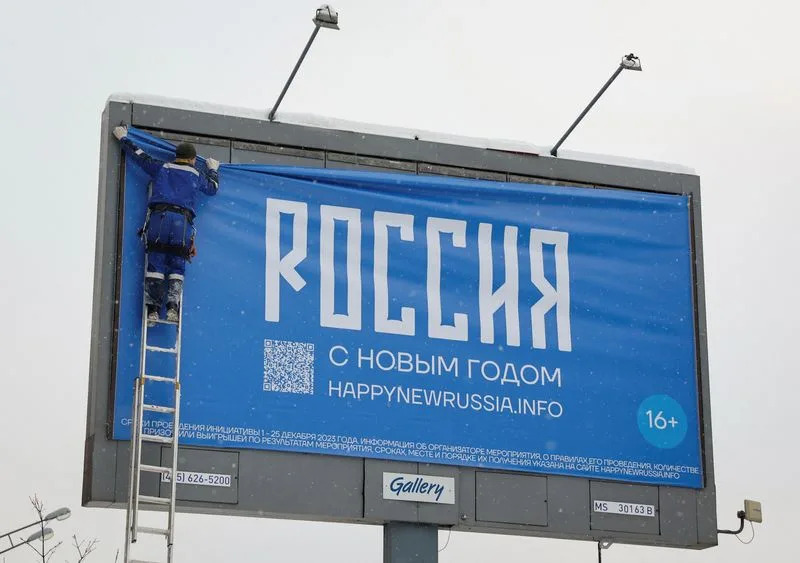
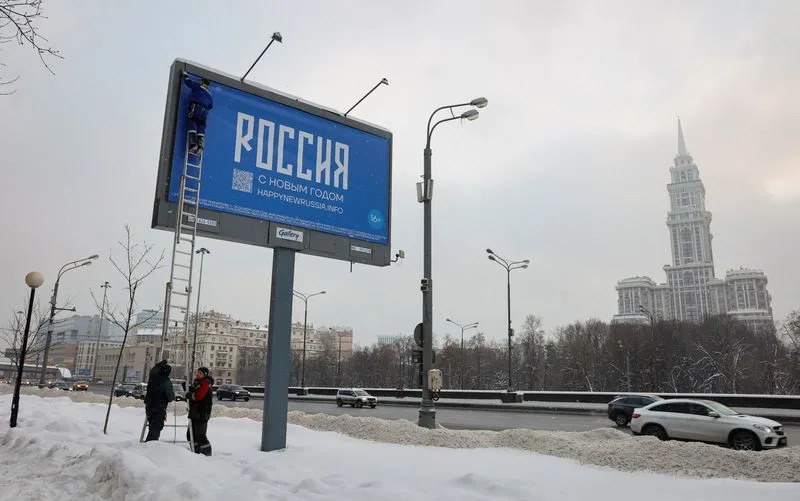
A view shows a billboard in Moscow
LONDON (Reuters) -With his hands on all the levers of power in Russia, Vladimir Putin cannot be beaten in a presidential election, top aides to jailed opposition leader Alexei Navalny say.
But they see the 100-day campaign as a chance to expose him as vulnerable on the issues that most matter to Russians: the war in Ukraine and the state of the economy.
Putin declared his candidacy for another six-year term last Friday and there is no serious rival to challenge him, with Navalny serving more than 30 years in prison and other critics also jailed or in exile. On Monday Navalny’s supporters said he had been moved from his previous penal colony and his current whereabouts were unclear.
With the Kremlin in full control of state media and able to decide who can and cannot run, the Navalny camp says this is not a real election. But it sees the campaign window as a rare opportunity to draw Russians into a political conversation and convince them that Russia’s main problems are of Putin’s making.
“Of course it’s impossible to beat Putin in the ‘elections’,” Navalny aide Leonid Volkov told Reuters. “The aim of our campaign is to change the political agenda in Russia.”
During an election campaign when people are focused on politics and expecting promises and solutions, it will be harder for the Kremlin to avoid difficult topics, he said.
“Putin is vulnerable because he does not have answers today to the questions that really worry people. These are the questions of an exit strategy for the war – when and how it should end and when the soldiers will return home – and the questions of destitution, poverty, corruption, financial credits and all the rest.”
The Kremlin says Putin will win another six-year term because he commands overwhelming support across Russian society, with opinion poll ratings of around 80%.
So far only three people have declared their intention to run against him. Two are low-profile figures, Boris Nadezhdin and Yekaterina Duntsova, who may struggle to gather the 300,000 signatures required to run. The third, nationalist Igor Girkin, is in jail awaiting trial on a charge of inciting extremist activity.
Other possible candidates who have yet to declare include Communist leader Gennady Zyuganov and liberal Grigory Yavlinsky, both political veterans and serial election losers.
‘NOT PUTIN’
Undaunted, the Navalny camp has launched its campaign by simply urging Russians to vote against the incumbent.
“We don’t have our own candidate. We had a candidate, Navalny, and they refused to register him, tried to kill him and put him in prison. Now we have, so to speak, a collective candidate ‘against Putin’,” said Lyubov Sobol, a close Navalny associate who, like Volkov, is on an official list of “terrorists and extremists” and is now based outside Russia.
Navalny’s supporters cast him as a Russian version of South Africa’s Nelson Mandela who will one day be freed from jail to lead the country.
Russian authorities view Navalny and his supporters as extremists with links to Western intelligence agencies intent on trying to destabilise Russia. Putin has warned the West that any meddling inside Russia will be considered an act of aggression.
The opposition is seeking volunteers from among the hundreds of thousands of people who have fled Russia since the start of the war and asking them to cold-call voters – ideally as many as 100 each, Sobol said in a telephone interview.
Many people would be scared and put the phone down, but others could be persuaded to talk, she said.
On its website NePutin (NotPutin).org, the Navalny team also calls for volunteers to spread videos and campaign messages online, and to stick up leaflets and scrawl graffiti in the streets – what Sobol described as “partisan” tactics.
“Putin’s task is to make sure these elections go as smoothly and calmly as possible, without any strain on the nerves. Our task is the opposite,” she said.
Within hours of parliament announcing the March 17 election last week, the Navalny camp had fired its first campaign shot. It posted photos on social media of giant blue billboards it had placed in major cities, with an innocent-looking new year greeting to Russians. Underneath was a QR code leading to the NotPutin website.
The stunt showed the ingenuity of Navalny’s tech-savvy team. But the impact was brief, as authorities took down the billboards and blocked access to the site.
‘POINTS OF TENSION’
The opposition has struggled in the past to present a united front between the Navalny camp and other prominent Putin opponents such as former oil tycoon Mikhail Khodorkovsky and former world chess champion Garry Kasparov.
Volkov denied any split, saying all of them were appealing to the same audience.
But from outside Russia, they face a huge task to mobilise people in a country where nearly 20,000 have been detained since Moscow’s February 2022 invasion for protesting against the war in Ukraine.
Sobol said opposition polling showed many people were dissatisfied with Putin but were afraid to speak out. She said it was precisely the degree of repression in Russia that showed that the authorities are worried.
“We on the side of the opposition must create more points of tension for him,” she said. “We must make problems for him and his regime, and agitate, put out counter-propaganda and tell the truth.”
(Reporting by Mark Trevelyan. Editing by Jane Merriman and Gareth Jones)
If you haven’t heard much about Russia’s war in Ukraine lately, it’s not because no news is good news. In fact, the war in Ukraine may be tipping in exactly the direction Russian President Vladimir Putin wants.
Ukraine failed to make major breakthroughs in its much-touted 2023 offensive, intended to break Russian lines in eastern and southern Ukraine and push Russian forces back toward the Crimean peninsula. Billions of dollars’ worth of American and European military hardware arrived too late, giving Russian forces months to build stout defenses Ukraine proved unable to penetrate, except for small breakthroughs. Exhaustion and winter mud have now effectively ended that offensive.
Isolationist Republicans who now control the US House of Representatives have so far scotched $61 billion in additional aid President Biden wants for Ukraine, and some weaponry designated for Ukraine is now instead headed to Israel as it wages war with the Hamas terrorist group. Nobody’s going soft in Russia, however, where Putin is boosting defense spending from 4% of GDP to 10%.
Despite devastating losses, Russia’s posture in Ukraine is getting stronger, with some analysts saying it is Ukraine that now needs to shift to defense. “Russia will be materially advantaged in 2024,” military analyst Michael Kofman of the Carnegie Endowment for International Peace said on a recent podcast. “If the West just assumes it’s a stalemate and can reduce its commitment to Ukraine, Russian advantages will compound because Russia doesn’t accept the stalemate.”
A slim majority of Americans still support robust US aid for Ukraine, but opposition has grown during the last six months. Most Republicans now say the United States is doing too much for Ukraine, while only 44% of Independents and 14% of Democrats feel that way. A chief complaint among Ukraine objectors is that President Biden should be focusing more on homegrown problems such as inflation and the influx of undocumented migrants.
Plus, the stakes in Ukraine could be far higher than many Americans appreciate. If Putin reverses his losses in Ukraine and ends up victorious, it would validate his view that the West doesn’t have the stomach for an ugly, drawn-out war, even if its own troops aren’t involved. Putin has ambitions beyond Ukraine, and if the West gives up on Ukraine it could meet Putin in Poland or the Baltic states, all members of the NATO military alliance.
Ambitions beyond Ukraine: Russian President Vladimir Putin (Sputnik/Valery Sharifulin/Pool via REUTERS) (Sputnik Photo Agency / reuters)
Also watching closely is Chinese President Xi Jinping, who has ordered his nation’s military to be capable of invading and conquering Taiwan by 2027. A key factor in Xi’s decision to invade will undoubtedly be his estimate of US and allied resolve in their vows to help defend the breakaway democratic island. If the US-led alliance fails Ukraine, it would be rational for Xi to conclude they’d bail on Taiwan, too. And a Chinese invasion of Taiwan would be an economic earthquake that makes Putin’s energy war, waged in parallel with his military war in Ukraine, seem tame.
Ukraine isn’t losing. Early in the war, it repelled invading Russia forces from northern Ukraine, and later in 2022, from key strongholds in the northeast and southeast. Ingenious naval drones have chased Russian warships away from Ukraine’s Black Sea ports and allowed the export of grain and other products, an astonishing feat for a country that basically lacks a navy. Russia still controls 18% of the Ukraine, but has gained basically no ground all year.
Two Western assumptions about the war have collapsed, however. The first is that Western training, intelligence, and equipment would tilt the war in Ukraine’s favor. It hasn’t. The second is that Russia would continue the shambolic battlefield performance of the invasion’s early days, when poorly prepared units expecting a cakewalk instead met determined resistance that sent them reeling. But the Russians have learned to plug holes, adapt to Ukrainian innovations, and keep their war machine rumbling along.
Some analysts snickered when Russia made a deal to buy ammunition from hermetic North Korea, but that deal may provide Russia with more artillery shells in 2024 than Ukraine will get from its own allies. That’s a key edge in a war where artillery is one of the most important weapons. Russia showed another weakness by buying relatively low-tech attack drones from Iran. But now Russia is building those drones on its own, by the hundreds, and using them in attempts to overwhelm Ukraine’s air defenses in a likely effort to wreck the country’s energy infrastructure again this winter, as it tried to do last year.
Ukraine pioneered some of the early innovations using armed drones to penetrate enemy lines. But Russia’s state machinery is now cranking out more drones than Ukraine can produce, and using them to deadly effect. As for battle tactics, Russia continues to expend soldiers in appalling human-wave attacks in which commanders seem to treat bodies as receptacles for bullets. There are sporadic protests in Russia of long deployments for troops and other concerns, but nothing approaching mass discontent with the war, suggesting Putin sees no constraint on sacrificing his own troops — another advantage over Ukraine, which husbands its human resources much more carefully.
Meanwhile, some Ukraine backers are beginning to say it’s time for Ukraine and its allies to change strategies.
“Kyiv’s war aims — the expulsion of Russian forces from Ukrainian land and the full restoration of its territorial integrity, including Crimea — remain legally and politically unassailable,” Richard Haass and Charles Kupchan wrote in Foreign Affairs recently. “But strategically they are out of reach, certainly for the near future and quite possibly beyond. [Ukraine’s] near-term priorities need to shift from attempting to liberate more territory to defending and repairing the more than 80 percent of the country that is still under its control.”
Haass and Kupchan argue that Ukraine should dig its own defensive fortifications, similar to Russia’s, and push for an enforceable cease-fire, while letting Russia worry about further territorial gains.
Since Russia invaded in February 2022, the Biden administration has armed Ukraine incrementally, first withholding and then providing key equipment such as armor, air defenses, and missiles that can reach far behind enemy lines. Biden has been careful not to push a nuclear-armed Russia over some perceived red line that would trigger a disproportionate Russian response. Europe has broadly followed the same pattern. But Russia never responded as more and more advanced Western weaponry arrived in Ukraine, prompting complaints that Washington has been too timid, and is not in it to win it.
So, the weapon tease continues. In October, the United States provided Ukraine with a small number of long-range ATACMS missiles capable of reaching Russian targets more than 100 miles away, threatening airfields, headquarters, and other crucial nodes. In the first strike using the new missiles, Ukraine reportedly destroyed more than a dozen Russian helicopters used to strafe Ukraine’s front-line troops. But there has been only one other known ATACMS firing since then. “This is a sign that the Biden Administration never wanted to give them in the first place, and is still strictly limiting what they will give Ukraine,” O’Brien wrote.
The next 12 months are likely to be momentous. Putin faces reelection in March, and while there’s no doubt he’ll win, Putin wants high turnout and a lopsided victory, so he may keep the war on simmer until then. Once the election’s over, Russia seems likely to mount a new mobilization effort to funnel more troops into Ukraine and press its manpower advantage. Sanctions are stifling the Russian economy, yet Russia is still selling plenty of oil, its main source of revenue, and finding most of the components it needs to boost defense production.
Putin also has a keen interest in next year’s US presidential election.
Republican front-runner Donald Trump is broadly viewed as a Putin patsy who would end the war in one day, as he says, by suspending US aid to Ukraine and giving Putin much or all of what he wants. “The event most likely to bring US backing for Ukraine to a juddering halt would be a victory by Donald Trump,” historian Lawrence Freedman of King’s College wrote on Nov. 23. “Putin might assume this to be such a positive possibility that it is one worth waiting for.”
No outcome is preordained.
Ukraine’s allies might yet rally and overcome the war fatigue that seems to settle more easily on allies far from the fighting than on those in the midst of it. In Washington, the new House Speaker, Mike Johnson, says he’s “confident” that Congress will provide more aid for Ukraine, though it may be far less than the $61 billion Biden wants. In Europe, several nations are ramping up weapons production to fill gaps the United States might leave. At some point in 2024, Ukraine seems likely to get Western fighter jets and finally be able to provide consistent air cover for infantry, a condition so fundamental to American military doctrine that the Pentagon would never consider fighting as the Ukrainians have been doing.
The Carnegie Endowment’s Kofman argues that the biggest American shortcoming in Ukraine isn’t some miracle weapon system, but the lack of advisers in-country who can understand how the plucky Ukrainians fight and tailor American aid to that. There’s a good reason Americans aren’t doing that: It conjures the specter of Vietnam, when advisers morphed into combatants and a slippery slope became a mudslide. It would be more fraught still if Americans ended up in direct combat with Russians.
But something needs to change if American resolves means anything, and it may start with America determining if it has that resolve in the first place.
Rick Newman is a senior columnist for Yahoo Finance.
‘Just have 7 or 8’ – Putin calls on Russian women to become baby factories – video
The New Voice of Ukraine – November 29, 2023
Putin did not specify how much money the Russians have to support so many children
Russian society continues to gravitate towards a patriarchal system where women are expected to bear as many children as possible, while men are called upon to sacrifice their lives for their “tsar” in his wars.
One of the primary advocates of this regression in Russia is an FSB agent that currently heads the Russian Orthodox Church (ROC), Vladimir Gundyaev, better known as Kirill.
Among other measures to tackle the demographic crisis and ensure a sufficient number of recruits for the military, he advocates for a complete ban on abortions, and the Russian State Duma is already preparing various restrictions to support this stance.
In turn, Russian dictator Vladimir Putin demands that citizens, despite the hardships prevailing in the country, have “seven or eight children.”
“In many of our nations, thank God, the tradition of a strong, multi-generational family is preserved, where four, five, or more children are raised,” Putin said.
“Let’s remember that in Russian families, our grandmothers and great-grandmothers had seven, eight, or more people. Let’s preserve and revive these wonderful traditions.”
Putin did not specify how such large families should be supported in a country facing significant economic and social challenges.
We’re bringing the voice of Ukraine to the world. Support us with a one-time donation, or become a Patron!
Putin ready to sacrifice his people in Ukraine war, says retired Marine Corps Gen. Jones
The New Voice of Ukraine – November 28, 2023
Russian dictator Putin
Russian President Vladimir Putin is ready to sacrifice his people in the war against Ukraine, but the Russians are not capable of achieving his goals, former NATO supreme allied commander in Europe James L. Jones said in an interview with Radio Liberty on Nov. 26.
“I think one thing that was always clear is that the Russian leader was willing to commit whatever manpower he needed because they outnumber the Ukrainians in terms of population,” Jones said.
The ability of the Russians “to launch a major offensive (by drafting) young men and (throwing) them into the Russian Army, even though they’re fairly poorly trained” cannot be discounted, General Jones argued.
It is clear that the lessons of the first year of the war have taken root in both Russia and Ukraine, as both sides now know each other better – and know where their strengths and weaknesses are, the general said.
“It’s not surprising that both sides are trying to exploit that advantage,” Jones said.
Russia is preparing a ‘loyalty agreement’ requirement for foreigners
Guy Faulconbridge and Lidia Kelly – November 29, 2023
Steam rises from chimneys of a heating power plan over the skyline of central Moscow
MOSCOW (Reuters) -Russia’s interior ministry has prepared draft legislation that would force foreigners to sign a “loyalty agreement” forbidding them from criticising official policy, discrediting Soviet military history, or contravening traditional family values.
Since President Vladimir Putin ordered troops into Ukraine in February 2022, Russia has introduced a slew of tough laws that outlaw discrediting the military, and courts have handed down long jail sentences to opposition activists.
As the 2024 presidential election approaches, Putin has cast the war as part of an existential battle with the West, saying he will defend Russia’s “sacred” civilisation from what he portrays as the West’s decadence.
The TASS state news agency reported on Wednesday that the draft legislation had been prepared by the interior ministry and would force all foreigners entering Russia to sign an agreement that essentially restricts what they can say in public.
A foreigner entering Russia would be prohibited from “interfering with the activities of public authorities of the Russian Federation, discrediting in any form the foreign and domestic state policy of the Russian Federation, public authorities and their officials”, TASS said.
The proposed agreement would include clauses about morality, family, “propaganda about non-traditional sexual relations” and history.
In particular, foreigners would be barred from “distorting the historical truth about the feat of the Soviet people in the defence of the Fatherland and its contribution to the victory over fascism”.
The Soviet Union is estimated to have lost at least 27 million people in World War Two and eventually pushed Nazi forces back to Berlin. Governments loyal to Moscow then took power across swathes of eastern Europe.
It was not clear from Russian media reports which foreigners the draft legislation – if it becomes law – would apply to or what the punishment would be for not adhering to the “agreement” which foreigners would have to sign upon entry to Russia.
The Kremlin declined to comment on the initiative.
‘LOYALTY AGREEMENT’
Opposition activists and foreign diplomats in Moscow have for months been warning that the authorities are toughening their stance on any dissent ahead of the presidential election.
The Kremlin said earlier this month that some measure of censorship was needed as Russian troops were fighting in Ukraine, and cautioned those who wanted to criticise the military to think carefully before they did.
For the draft to become law, it has to be introduced to the State Duma, Russia’s lower house of parliament, and to go through committee review and several readings before being submitted to Putin for signing.
The chairman of the Duma’s CIS Affairs Committee said that the draft law was well advanced and was being worked on by the interior ministry, the government, the presidential administration as well as his committee.
“The draft law on the so-called ‘loyalty agreement’ with migrants entering the Russian Federation is in a high degree of readiness,” Leonid Kalashnikov told Interfax.
Kalashnikov said some details of the proposed law were still to be worked out. The interior ministry did not immediately respond to requests for a comment.
The law has not yet been introduced formally in parliament, according to Reuters searches of the Duma’s database.
Since the start of its war in Ukraine, Russia has imposed a number of restrictions on foreigners from what it calls “unfriendly countries” – meaning those that have imposed sanctions on it over its war in Ukraine.
(Reporting by Lidia Kelly in Melbourne and Guy Faulconbridge in Moscow; Editing by Andrew Osborn and Nick Macfie)
Russia’s Putin, shown alongside Orthodox icon image, warns West against meddling
Guy Faulconbridge – November 28, 2023
Russian President Putin attends a plenary session of the World Russian People’s Council, via video link in Sochi
MOSCOW (Reuters) – President Vladimir Putin, whose picture was shown between two giant images of an ancient Orthodox icon on Tuesday, warned the West ahead of elections in March 2024 that any foreign meddling in Russia would be considered an act of aggression.
Russia’s full-scale invasion of Ukraine in February 2022 has led to the most serious confrontation between Moscow and the West since the 1962 Cuban missile crisis, prompting Putin to pivot towards China.
Since the invasion, Putin has changed the narrative of the war, casting it as an existential battle between sacred Russian civilisation and an arrogant West which he says is in cultural, political and economic decline.
Speaking to the World Russian People’s Council, led by the head of Russia’s Orthodox church, Patriarch Kirill, Putin’s picture was shown on a giant screen beside two copies of an ancient Orthodox icon. Such icons are stylised, often gilded, religious paintings considered sacred in Orthodox churches.
The Russian Orthodox Church is an ardent institutional supporter of Russia’s war in Ukraine, and Putin has espoused its conservatism as part of his vision for Russia’s national identity.
The Kremlin chief said that the West was gripped by racist Russophobia which casts Russians as a people of backward “slaves” and warned that the United States allegedly wanted to dismember and plunder Russia’s vast resources.
Putin, 71, cautioned that Russians themselves should remember the lessons of the 1917 Bolshevik Revolution, the civil war and the 1991 fall of the Soviet Union, which he said had allowed the division of the Russian people.
“I want to underscore: We consider any interference from outside, provocations aimed at causing inter-ethnic or inter-religious conflicts as aggressive acts against our country,” Putin said.
“I want to emphasise again that any attempt to sow inter-ethnic and inter-religious discord, to split our society is a betrayal, a crime against the whole of Russia. We will not allow anyone to divide Russia.”
The West casts Putin as a dictator who has led Russia into an imperial-style land grab that has weakened Russia and forged Ukrainian statehood, while uniting the West and handing NATO a post-Cold War mission.
Putin says that the West is now failing in Ukraine and that its attempt to defeat Russia has also failed.
The Kremlin chief claims Western attempts to isolate Russia with the toughest-ever sanctions imposed on a major economy were evidence for what he believed is historic Western racism against Russians.
The West, which denies it wants to rip Russia apart, has said it wants to help Ukraine defeat Russian forces on the battlefields of Ukraine, eject Russian soldiers and punish Putin for the war.
Putin thanked Russian businessmen for evading the West’s sanctions.
“It was by combining the efforts of the state and business that we thwarted the unprecedented economic aggression of the West: its sanctions blitzkrieg failed,” Putin said.
The presidential election campaign is due to start next month and Putin is expected to run, a step that would ensure at least another six years at the helm for the former KGB spy, who has been in power since 2012, and before that, from 2000 to 2008.
Patriarch Kirill said he would pray for Putin to continue his work for the “benefit” of Russia and its people.
(Reporting by Guy Faulconbridge; Editing by Bernadette Baum)
Putin accuses the West of trying to ‘dismember and plunder’ Russia in a ranting speech
Associated Press – November 28, 2023
Russian President Vladimir Putin listens to VTB Bank Chairman Andrei Kostin during their meeting in Moscow, Russia, Monday, Nov. 27, 2023. (Mikhail Klimentyev, Sputnik, Kremlin Pool Photo via AP) (ASSOCIATED PRESS)
MOSCOW (AP) — Russian President Vladimir Putin on Tuesday, in a ranting speech before a presidential election campaign, cast Moscow’s military action in Ukraine as an existential battle against purported attempts by the West to destroy Russia.
Putin, who has been in power for more than two decades and is the longest-serving Russian leader since Soviet dictator Josef Stalin, is expected to soon declare his intention to seek another six-year term in a presidential election next March.
“We are defending the security and well-being of our people, the highest, historical right to be Russia — a strong, independent power, a country-civilization,” Putin said, accusing the U.S. and its allies of trying to “dismember and plunder” Russia.
Ukraine and its Western allies have condemned the Russian action against Ukraine as an unprovoked act of aggression.
“We are now fighting for the freedom of not only Russia, but the whole world,” Putin said in a speech to participants of a meeting organized by the Russian Orthodox Church.
He denounced what he described as Western “Russophobia,” claiming that “our diversity and unity of cultures, traditions, languages, and ethnic groups simply don’t fit into the logic of Western racists and colonialists, into their cruel scheme of total depersonalization, disunity, suppression and exploitation.”
“If they can’t do it by force, they will try to sow strife,” he said, vowing to block “any outside interference, provocations with the aim of causing interethnic or interreligious conflicts as aggressive actions against our country, as an attempt to once again foment terrorism and extremism in Russia as a tool to fight us.”
Russian authorities have intensified their crackdown on dissent amid the fighting in Ukraine, arresting and imprisoning protesters and activists and silencing independent news outlets.
Putin said that the U.S.-dominated global order has become increasingly decrepit, declaring that “it is our country that is now at the forefront of creating a more equitable world order.”
“And I want to emphasize: without a sovereign, strong Russia, no lasting, stable world order is possible,” he said.
In a Worldwide War of Words, Russia, China and Iran Back Hamas
Steven Lee Myers and Sheera Frenkel – November 3, 2023
Motorists drive past a giant billboard depicting Muslim peoples walking with their national flags towards the Dome of the Rock shrine in Jerusalem, erected in Valiasr Square in the centre of Tehran on October 25, 2023. (Photo by ATTA KENARE / AFP) (Photo by ATTA KENARE/AFP via Getty Images) (ATTA KENARE via Getty Images)
The conflict between Israel and Hamas is fast becoming a world war online.
Iran, Russia and, to a lesser degree, China have used state media and the world’s major social networking platforms to support Hamas and undercut Israel, while denigrating Israel’s principal ally, the United States.
Iran’s proxies in Lebanon, Syria and Iraq have also joined the fight online, along with extremist groups, like al-Qaida and the Islamic State, that were previously at odds with Hamas.
The deluge of online propaganda and disinformation is larger than anything seen before, according to government officials and independent researchers — a reflection of the world’s geopolitical division.
“It is being seen by millions, hundreds of millions of people around the world,” said Rafi Mendelsohn, vice president at Cyabra, a social media intelligence company in Tel Aviv, Israel, “and it’s impacting the war in a way that is probably just as effective as any other tactic on the ground.” Cyabra has documented at least 40,000 bots or inauthentic accounts online since Hamas attacked Israel from the Gaza Strip on Oct. 7.
The content — visceral, emotionally charged, politically slanted and often false — has stoked anger and even violence far beyond Gaza, raising fears that it could inflame a wider conflict. Iran, though it has denied any involvement in the attack by Hamas, has threatened as much, with its foreign minister, Hossein Amir Abdollahian, warning of retaliation on “multiple fronts” if Israeli forces persisted in Gaza.
“It’s just like everyone is involved,” said Moustafa Ayad, executive director for Africa, the Middle East and Asia at the Institute for Strategic Dialogue. The institute, a nonprofit research organization in London, last week detailed influence campaigns by Iran, Russia and China.
The campaigns do not appear to be coordinated, American and other government officials and experts said, though they did not rule out cooperation.
While Iran, Russia and China each have different motivations in backing Hamas over Israel, they have pushed the same themes since the war began. They are not simply providing moral support, the officials and experts said, but also mounting overt and covert information campaigns to amplify one another and expand the global reach of their views across multiple platforms in multiple languages.
The Spanish arm of RT, the global Russian television network, for example, recently reposted a statement by the Iranian president calling the explosion at Al-Ahli Arab Hospital in Gaza on Oct. 17 an Israeli war crime, even though Western intelligence agencies and independent analysts have since said a missile misfired from Gaza was a more likely cause of the blast.
Another Russian overseas news outlet, Sputnik India, quoted a “military expert” saying, without evidence, that the United States provided the bomb that destroyed the hospital. Posts like these have garnered ten of thousands of views.
“We’re in an undeclared information war with authoritarian countries,” James Rubin, the head of the State Department’s Global Engagement Center, said in a recent interview.
From the first hours of its attack, Hamas has employed a broad, sophisticated media strategy, inspired by groups like the Islamic State. Its operatives spread graphic imagery through bot accounts originating in places like Pakistan, sidestepping bans of Hamas on Facebook and X, formerly known as Twitter, according to Cyabra’s researchers.
A profile on X that bore the characteristics of an inauthentic account — @RebelTaha — posted 616 times in the first two days of the conflict, though it had previously featured content mostly about cricket, they said. One post featured a cartoon claiming a double standard in how Palestinian resistance toward Israel was cast as terrorism while Ukraine’s fight against Russia was self-defense.
Officials and experts who track disinformation and extremism have been struck by how quickly and extensively Hamas’ message has spread online. That feat was almost certainly fueled by the emotional intensity of the Israeli-Palestinian issue and by the graphic images of the violence, captured virtually in real time with cameras carried by Hamas gunmen. It was also boosted by extensive networks of bots and, soon afterward, official accounts belonging to governments and state media in Iran, Russia and China — amplified by social media platforms.
In a single day after the conflict began, roughly 1 in 4 accounts on Facebook, Instagram, TikTok and X posting about the conflict appeared to be fake, Cyabra found. In the 24 hours after the blast at Al-Ahli Arab Hospital, more than 1 in 3 accounts posting about it on X were.
The company’s researchers identified six coordinated campaigns on a scale so large, they said, that it suggested the involvement of nations or large nonstate actors.
The Institute for Strategic Dialogue’s report last week singled out Iranian accounts on Facebook and X that “have been spreading particularly harmful content that includes glorification of war crimes and violence against Israeli civilians and encouraging further attacks against Israel.”
Although the country’s supreme leader, Ayatollah Ali Khamenei, denied the country’s involvement in the attack, the accounts have depicted him as the leader of a “Pan-Islamic resistance” to Israel and neocolonial Western powers.
A series of posts on X by a state-affiliated outlet, Tasnim News Agency, said the United States was responsible for “the crimes” and showed a video of wounded Palestinians. On Telegram, accounts have also spread false or unverified content, including one widely debunked account that CNN had faked an attack on a television crew.
Cyabra also identified an online campaign in Arabic on X from Iraq, evidently from Shiite Muslim paramilitary groups supported by Iran, including the movement of Muqtada al-Sadr. A network of accounts posted identical messages and photos, using the hashtag #AmericasponsorIsraelTerrorism. Those posts peaked on Oct. 18 and 19, amassing more than 6,000 engagements, and had the potential to reach 10 million viewers, according to Cyabra.
Israel, which has its own sophisticated information operations, has found itself unexpectedly on the defensive.
“Like its military, Israel’s social media was caught flat-footed and responded days late,” said Ben Decker, the CEO of Memetica, a threat intelligence consulting firm, and a former researcher for The New York Times. “The response, even when it got off the ground, was chaotic.”
Two Israeli government officials, speaking on the condition of anonymity to discuss intelligence matters, said Israel was tracking the bot activity from Iran and other countries. They noted that it was larger than any previous campaign they had seen.
The war has heightened concerns in Washington and other Western capitals that an alliance of authoritarian governments has succeeded in fomenting illiberal, anti-democratic sentiment, especially in Africa, South America and other parts of the world where accusations of American or Western colonialism or dominance find fertile soil.
Russia and China, which have grown increasingly close in recent years, appear intent to exploit the conflict to undermine the United States as much as Israel. The State Department’s Global Engagement Center, which combats state propaganda and disinformation, has in recent weeks detailed extensive campaigns by Russia and China to shape the global information environment to their advantage.
A week before Hamas attacked Israel, the State Department warned in a report that China was employing “deceptive and coercive methods” to sway global opinion behind its worldview. Since the war began, China has portrayed itself as a neutral peacemaker, while its officials have depicted the United States as a craven warmonger that suffered a “strategic failure in the Middle East.”
Accounts of Russian officials and state media have shared that sentiment. Numerous pro-Kremlin accounts on Telegram abruptly shifted after Oct. 7 from content about the war in Ukraine to post exclusively on Israel, including an Arabic-language channel linked to the Wagner Group, the Russian paramilitary force that rebelled against President Vladimir Putin in June.
Putin, who met with Hamas leaders after the war began, described the wars in Ukraine and Israel as part of the same broad struggle against American global dominance. He also claimed, without evidence, that “Western intelligence services” were behind a riot Sunday that targeted Jews at the airport in Dagestan, a predominantly Muslim region in southern Russia.
“They’re in a conflict, a geostrategic competition, with the United States,” said Michael Doran, a former White House and Pentagon official who is now director of the Center for Peace and Security in the Middle East at the Hudson Institute. “And they recognize that when Israel, the U.S.’ primary ally in the Middle East, is wrapped up in a war like this, it weakens the United States.”
House GOP unveils $14.3 billion Israel aid bill that would cut funding to IRS
Caitlin Yilek – October 30, 2023
Washington — House Republicans want to pay for emergency aid to Israel by cutting funding to the IRS, teeing up a collision with the White House and Democratic-controlled Senate over how to support a key U.S. ally.
The House GOP released a $14.3 billion standalone measure on Monday that would pay for aid to Israel by cutting the same amount in funding that was allocated to the IRS under the Inflation Reduction Act, one of President Biden’s signature pieces of legislation.
“We’re going to have pays-for in [the bill],” House Speaker Mike Johnson told Fox News on Monday. “We’re not just going to print money and send it overseas.”
The Republican bill sets up a battle over support for Israel, with Mr. Biden and Democrats in the Senate wanting to pair aid for Israel with tens of billions of dollars in aid to Ukraine, which some House Republicans oppose. The White House asked Congress for a $105 billion aid package two weeks ago, which included $14 billion for Israel and $61 billion related to Ukraine.
Johnson, who supports separating the aid packages, acknowledged that the cuts to the IRS would be unpopular among Democrats, but said he planned to call Senate Majority Leader Chuck Schumer for a “direct” and “thoughtful conversation.”
“I understand their priority is to bulk up the IRS,” Johnson told Fox News. “But I think if you put this to the American people and they weigh the two needs, I think they’re going to say standing with Israel and protecting the innocent over there is in our national interest and is a more immediate need than IRS agents.”
The president signed the Inflation Reduction Act into law in 2022, and it included hundreds of billions of dollars for Democratic priorities related to climate change, health care costs and taxes. It also boosted the IRS’ funding by $80 billion, allowing the agency to hire thousands of agents and revamp decades-old technological systems. Experts said the upgrades and hiring boost were long overdue and would improve the agency’s ability to process tax returns, but the provision was highly unpopular among Republican lawmakers.
When it comes to aid for Ukraine, Johnson has said he wants more accountability for the billions of dollars the U.S. is spending to help repel Russia’s invasion, specifically asking the White House to detail where the money is going and what the end game in the conflict is.
White House press secretary Karine Jean-Pierre called the bill a “nonstarter” and said it would “set an unacceptable precedent that calls our commitment to one of our closest allies into question.”
“Demanding offsets for meeting core national security needs of the United States — like supporting Israel and defending Ukraine from atrocities and Russian imperialism — would be a break with the normal, bipartisan process and could have devastating implications for our safety and alliances in the years ahead,” she said in a statement Monday.
Democratic Rep. Rosa DeLauro of Connecticut, the ranking member on the House Appropriations Committee, said Monday that offsetting emergency aid with cuts to the IRS sets a “dangerous precedent.”
“House Republicans are setting a dangerous precedent by suggesting that protecting national security or responding to natural disasters is contingent upon cuts to other programs,” the Connecticut Democrat said in a statement. “The partisan bill House Republicans introduced stalls our ability to help Israel defend itself and does not include a penny for humanitarian assistance.”
GOP Sen. Susan Collins of Maine, who serves as vice chair of the Senate Appropriations Committee, said Monday she would prefer to pair aid to Ukraine and Israel.
When asked whether she was concerned about offsetting emergency spending with budget cuts, she said, “Right, the question is where does it end?”
The House Rules Committee plans to take up the GOP’s Israel bill on Wednesday.