GOP Budget Cuts Stand to Deal Tremendous Damage to Rural Economies

The New Republic

GOP Budget Cuts Stand to Deal Tremendous Damage to Rural Economies

Grace Segers – March 3, 2025

As congressional Republicans mull ways to slash federal spending while offsetting trillions of dollars in tax breaks, key social safety net programs may be on the chopping block. A massive budget proposal approved in the House last week directs the committees that oversee health care spending to cut $880 billion over the next decade, and the Agriculture Committee to cut $230 billion—a blueprint that Democrats warn will kneecap programs relied upon by low-income Americans, namely Medicaid and the Supplemental Nutrition Assistance Program, or SNAP, also known as food stamps.

Nearly 43 million people receive such program benefits annually. Around 80 percent of SNAP households include a child, an elderly adult, or an adult with a disability. Because of its widespread use, any potential future cuts to SNAP would affect constituents of every ideological leaning, including rural Americans who live in Republican areas.

“SNAP is important everywhere. In every state, in every congressional district, it’s really important for our nation,” said Diane Whitmore Schanzenbach, an economist at Northwestern University who studies policies aimed at alleviating childhood poverty.

Strictly by the numbers, there are more SNAP recipients in metropolitan areas than rural ones; however, rural Americans experience disproportionately high rates of food insecurity and nonmetro areas have higher participation rates in SNAP. A 2022 report by Schanzenbach found that SNAP helped lessen rural childhood poverty, reducing the poverty rate by 2.6 percentage points for children in 2020, a greater impact than for children living in SNAP households in metro areas.

Conducting additional research for this story, and using data from states that provide county-level information, Schanzenbach reported that—by the 2023 definitions of “metro” and “nonmetro” counties—SNAP participation rates were consistently slightly higher in nonmetro counties than in metro ones from 2019 through 2023. In January 2023, for example, the SNAP participation rate in nonmetro counties hovered above 15 percent, compared to roughly 12 percent in metro counties.

Salaam Bhatti, the SNAP director at the Food Research and Action Center, noted that “accessibility and affordability” are two of the greatest challenges facing rural Americans. “Grocery stores and convenience stores are few and far between” in rural areas, said Bhatti, “and that’s if you even have transportation.” Public transportation is either unreliable or nonexistent in many parts of the country. Once a SNAP recipient makes it to the grocery store, their tight budget—program benefits amount to roughly $6.20 per day—makes it difficult to buy the most expensive items at the supermarket, such as fresh produce and meat.

“If any part of that benefit is decreased, then that has a ripple effect across the entire supply chain,” said Bhatti.

Representative Glenn “GT” Thompson, the chair of the House Agriculture Committee, has insisted that he does not want to make cuts to SNAP. This message was repeated by a committee staffer, who said that “neither the chairman nor our conference are interested in cutting SNAP benefits.” According to the Republican committee staffer, Thompson’s priorities for SNAP include cutting down on fraud, tightening work requirements for able-bodied adults without dependents, and reevaluating the Thrifty Food Plan, the method by which SNAP benefits are calculated, which was revised by the Biden administration in 2021.

However, analysis by the left-leaning Center for Budget and Policy Priorities, or CBPP, predicts that changes to the Thrifty Food Plan would amount to future cuts to SNAP benefits for recipients. This same report found that efforts to limit states’ abilities to request waivers for the three-month time limit for able-bodied adults without dependents to seek employment could cut hundreds of thousands of people from the SNAP rolls.

Another recent policy brief by CBPP argued that “rural unemployment is often higher, work can be more variable, and work opportunities are often farther away and harder to reach,” which could make it more difficult to meet those work requirements. (House Republicans note that work requirements can be met through volunteering and job training, in addition to direct employment.)

Tightening requirements would not necessarily decrease the number of hungry people in the country—just the number that actually received benefits. “The way to really reduce spending is to reduce the number of people in the program,” said Jonathan Coppess, director of the Gardner Agriculture Policy Program at the University of Illinois Urbana-Champaign. “That doesn’t mean that people aren’t hungry. It doesn’t mean they’re still not trying to put food on the table and struggling to make ends meet. They just can’t get into the program, or they give up because it’s too onerous.”

Then there is the potential impact that cuts to SNAP could have on the local economy. For example, in West Virginia—where a large percentage of the population lives in a rural area—one in five rural households received SNAP benefits, according to a fact sheet by the Food Research and Action Center. The report also found that SNAP supported more than 2,000 retailers in West Virginia, including grocery stores and farmers markets. In Texas, the state with the largest rural population by numbersone in eight rural households rely on SNAP.

Haley Kottler, who serves as a voter engagement director at the anti-hunger organization Kansas Appleseed, recalled speaking with a grocer in a rural part of Kansas. “I spent around 45 minutes talking to a grocer about how important SNAP is to her community,” said Kottler, adding that “it really highlighted for me how important SNAP is both to folks who need access” and to the producers providing them with food—and benefiting from their business. Kansas is in some ways unique because of limits the state legislature imposed a decade ago restricting access to SNAP; Kottler noted that cuts on the federal level would compound the squeeze felt on the state level.

“The need has always been there, and the need continues to rise,” Kottler said.

Rural communities would also be hit particularly hard by cuts to SNAP because of potential impact on farm producers. Coppess identified three nodes of connection between farmers and SNAP recipients: the political intersection, as major agriculture programs and nutrition benefits are both governed by the massive legislation known as the farm bill; the symbiotic relationship between food consumers and producers, as giving low-income Americans the means to purchase vegetables or meat indirectly helps farmers; and the impact that SNAP recipients and farmers alike have on their local communities.

One report found that, during the recovery period from the Great Recession, SNAP expenditures had a greater impact on rural economies than urban ones, increasing rural output and employment by more than 1 percent between 2009 and 2014.

“Cutting $230 billion from SNAP hurts the farmers who grow our food, the truckers who haul it, the manufacturers that produce its packaging and the grocery stores that sell it,” Representative Angie Craig, the Democratic ranking member of the House Agriculture Committee, said in a statement. “These cuts endanger hundreds of thousands of jobs along a food supply chain that starts in rural America and ends at dinner tables in every community across the country.”

Republicans note that the $230 billion set out in the budget resolution is still a guideline, rather than a directive: Republicans in both the House and the Senate still need to agree on a budget resolution that satisfies both chambers as well as President Donald Trump, and the final numbers of that measure are still to be determined. Senate Republicans passed their own “skinny” budget resolution last week and have expressed serious doubts about the blueprint approved by their colleagues in the House, although the source of those complaints does not necessarily appear to be related to potential cuts to nutrition programs.

Regardless, experts warn that it would be impossible to reduce the cost of SNAP without affecting benefits. “We are going to quickly see that this just can’t all come from waste, fraud, and abuse,” Schanzenbach said. “And so we’re going to cut into muscle, not just fat.”

The Cool Down: Ranchers devastated by side effects of commonly used fertilizer: ‘It’s destroying our lives’
The Hill: Hochul seeks to recruit laid off federal workers with ad in Washington’s Union Station

Trump’s Mass Layoffs Leave Federal Workers Baffled, Angry

TIME

Trump’s Mass Layoffs Leave Federal Workers Baffled, Angry

Nik Popli – February 18, 2025

Protesters demonstrate in support of federal workers outside of the U.S. Department of Health and Human Services on February 14, 2025 in Washington, DC. Organizers held the protest to speak on the Department of Government Efficiency (DOGE) cuts. Credit – Anna Moneymaker–Getty Images

A mid-level probationary worker with the U.S. Department of Agriculture read the letter in disbelief. It was from the USDA’s human resources department explaining he no longer had a job. The letter said the decision had been made “based on your performance.” But it didn’t make sense to him.

“There’s no way to tie me to a specific performance issue because I’m six weeks on the job,” says the employee, who works out of Phoenix and, like others interviewed for this report, spoke with TIME on the condition of anonymity. He says no one had mentioned any issues with his work before receiving the letter.

The USDA employee was among thousands of federal workers across the country hit with layoffs that began on Thursday with little prior notice, targeting probationary workers—those who have been employed by the federal government for less than one or two years and are easier to fire. The Trump Administration has ordered most agencies to let go of nearly all probationary employees who haven’t yet gained civil service protection.

The layoffs have shaken both federal employees and the unions that represent them, prompting widespread condemnation and setting the stage for future legal battles. Many in the federal workforce see the aggressive nature of the cuts as proof that the Trump Administration isn’t just trying to cut costs, but dismantle the federal workforce and reduce its capacity to serve the public.

“I feel like right now the administration is kind of demonizing federal workers,” says a senior IRS agent from New York who was hired in July and “fully expects” to receive a termination notice in the coming days.

The firings are part of a broader push spearheaded by the Trump Administration and the newly-established Department of Government Efficiency (DOGE), an initiative run by billionaire Elon Musk to streamline government operations. Musk has gone so far as to suggest that entire agencies should be “deleted,” likening them to “weeds” in need of eradication. Legal experts and union representatives argue many of DOGE’s actions are not legal.

The letter for the USDA employee, viewed by TIME, cited guidance from the Office of Personnel Management, claiming that probationary employees have “the burden to demonstrate why it is in the public interest for the Government to finalize an appointment to the civil service for this particular individual.” Soon after Trump’s inauguration, the leadership at OPM was replaced with Musk allies.

Elsewhere, thousands of workers were laid off in group calls or via pre-recorded messages, with their government access revoked immediately. Others were told they would be formally fired by emails. The Department of Veterans Affairs, which provides crucial services and benefits to military veterans, laid off more than 1,000 employees on Thursday alone, with VA Secretary Doug Collins claiming that the move would save the department $98 million per year. The vast majority of probationary employees, including those in the VA’s health care system, were exempted from the layoffs.

The abrupt and seemingly callous manner of conducting layoffs has left many workers stunned. One HR manager at the Veterans Health Administration, who has worked for the department for more than two decades, said that he had never witnessed anything like this in all his years of service. “It’s the worst I’ve ever seen,” he says. At a staff meeting on Friday, he says leadership told them they were finding out about the terminations at the same time as the rest of the agency’s staff, and that the decisions were being made by a small group in the Office of Personnel Management backed by DOGE. “We’re paralyzed because we don’t know what’s happening tomorrow,” he adds.

The HR manager noted that he voted for Trump in the last three presidential elections and “will never make that mistake again.”

“If the GOP wants to win someone like me back, they would need to start making changes right now,” he says. “I have not voted for a Democrat in two decades. I will vote Democrat in the midterms and the next presidential race for sure.” Other federal employees who mentioned voting for Trump in the past say they are reconsidering their support for the Republican administration.

The layoffs come soon after a federal judge in Massachusetts allowed the Trump Administration to proceed with an offer for federal employees to leave their jobs with the promise of continuing to be paid through September. That offer expired on Wednesday, Trump officials said. The White House said that 77,000 workers, or around 3% of the civilian workforce, agreed to the buyout.

Jourdain Solis, a 27-year-old fuel compliance officer at the Internal Revenue Service in Fresno, Calif., accepted the buyout earlier this month, feeling it offered more security than staying in a job that didn’t seem like a priority under the new Administration. “I couldn’t guarantee that my program would stick around,” he said. “Taking this offer would have been much better than being laid off and only qualifying for unemployment.”

Solis also acknowledges feeling undervalued by the government with the ongoing rhetoric about job cuts and waste. “Our value as public servants gets questioned all the time,” he says. “So I just really didn’t want to work for a country that doesn’t respect public servants as much as they should.”

But many federal workers declined to take the resignation offer, in part because they were worried about its validity. The buyouts are technically not funded, as Congress hasn’t appropriated funding beyond March 14. “There are too many questions and concerns,” one worker at the Department of Health and Human Services (HHS) told TIME. “It’s a joke,” says the probationary IRS agent. “There’s all kinds of issues with the funding. Nobody trusted it.” Solis admits he still has some questions about the legality of it all but says he’s prepared to take legal action if the government doesn’t follow through with the offer.

The ramifications of the staff reductions go far beyond the individual workers, potentially shifting the government’s relationship with the rest of its workforce. The American Federation of Government Employees (AFGE), which represents many of those dismissed, has vowed to challenge the firings in court, calling them a violation of workers’ rights. “These firings are not about poor performance,” said Everett Kelley, the union’s president. “There is no evidence these employees were anything but dedicated public servants. They are about power. They are about gutting the federal government, silencing workers, and forcing agencies into submission to a radical agenda that prioritizes cronyism over competence.”

As the cuts continue, agencies are bracing for more uncertainty, and federal workers remain on edge. “I can feel it in my interactions with people,” said the former USDA employee. “People are nervous because they don’t know what’s going on with their jobs. And even the senior leadership at most of the agencies doesn’t know what’s going on.”

Some of these workers say they had hoped the changes under the new administration would be gradual. The speed and abrupt nature of it all has left many feeling blindsided.

Federal workers typically have the option to appeal layoffs or suspensions to the Merit Systems Protection Board, a process that involves an initial review by administrative judges before a final decision is made by the board itself. However, many workers fear that these legal avenues may not be enough to protect their rights in the face of an administration determined to impose sweeping changes.

For many, the recent firings are a stark reminder of how quickly the administration is willing to reshape the government, even if it might undermine its effectiveness. Asked about DOGE’s operations, the VA employee said: “They obviously are out of their depth and are struggling desperately to make whatever it is that they are trying to do work,” he adds. “I don’t think they will succeed.”

More in Politics
The Hill: Warnock at National Cathedral: ‘Don’t tell me you reject DEI when you live in a White House built by Black hands’
Associated Press: Mike Pence emerges as one of the few Republicans willing to challenge Trump 2.0
HuffPost: ‘Way Sooner Than You Think’: James Carville Names Key Date Trump May Be Dreading

Tariffs on Canada, Mexico, and China Could Start This Weekend

Reason

Tariffs on Canada, Mexico, and China Could Start This Weekend

Eric Boehm – January 31, 2025

Shipping containers
Photo by Lucas van Oort on Unsplash

Huge new tariffs on goods imported from Canada, China, and Mexico could begin as soon as this weekend.

White House Press Secretary Karoline Leavitt told reporters at a Friday press conference that the Trump administration was prepared to impose a new 25 percent tariff on imports from Canada and Mexico, along with a 10 percent tariff on imports from China. Aside from that statement, Leavitt offered few specifics and the White House has so far not released any further details about the new import taxes.

That leaves many unknowns, such as: Under what authority is President Donald Trump implementing those tariffs? Are there exceptions for certain goods, or are the tariffs being charged on all imports from the three countries? Do those tariffs apply on top of existing import duties—for example, is the new 10 percent tariff on goods from China imposed on top of the tariffs on many Chinese imports that Trump implemented during his first term—or in place of them? Will there be a process for certain companies and industries to seek relief from tariffs for goods that cannot be sourced in the United States, like tequila?

Adding to the confusion: Reuters reported earlier on Friday that those tariffs will be implemented on March 1. Leavitt called that report “false.”

Canada, China, and Mexico are the United States’ three largest trading partners. In 2023, the last full year for which data are available, the U.S. imported $475 billion of goods from Mexico, $426 billion from China, and $418 billion from Canada.

In her remarks to reporters, Leavitt said the new tariffs were being issued in response to the “illegal fentanyl that they have sourced and allowed to distribute into our country.” In an interview with CNBC on Friday, Trump’s trade advisor Peter Navarro also claimed that “fentanyl…that comes from China and Mexico” was the prime motivator for the new import taxes.

This makes very little sense. How will higher taxes on legal imports affect the flow of illegal drugs?

What the tariffs will do is raise prices for American businesses and consumers.

Though much uncertainly remains about how these tariffs will function, a full-fledged 25 percent tariff on goods from Canada and Mexico, plus a 10 percent tariff on all imports from China, would be a tax increase of $111 billion this year and would shrink the U.S. economy by 0.4 percent, according to estimates by the Tax Foundation.

“Several industries would experience severe disruption, including autos, oil & gas, and agriculture,” wrote Erica York, vice president of policy at the Tax Foundation, in a post on X shortly after Leavitt announced the new tariffs.

Auto manufacturers, which rely on supply chains that stretch across the whole of North America—thanks to free trade agreements—figure to be some of the hardest hit. “Steep tariffs on vehicles would not only raise prices north of the border and shock the Mexican auto sector and its workers. They would also cost jobs in the United States,” warned the Peterson Institute for International Economics, in December. “Because of the highly integrated value chains in the North American auto sector, a high share of US-origin parts are embedded in Mexico’s motor vehicle exports. US suppliers of these parts could soon be caught in the crossfire of Trump’s trade war.”

Fruit and vegetable imports from Mexico will be another victim. “If you put tariffs on Mexican fruits and vegetables, there’s no doubt about it, you’ll have inflation in the supermarket and you will have bare shelves,” Lance Jungmeyer, president of the Fresh Produce Association of the Americas, told The Packer, a trade publication, in November. “Consumers will not be happy with that.”

Tariffs on crude oil imports from Canada will likely drive up prices at the gas pump. More than 50 percent of the crude oil imported to the U.S. comes from Canada, and analysts believe tariffs could cause prices to jump by 40 cents or even 70 cents per gallon. If those tariffs spiral into a broader trade war, energy companies are already warning about “volatility in crude oil prices, impacting refineries and downstream fuel markets, especially for gasoline and diesel.”

There are also unanswered questions about how the other countries might respond. “All three governments have promised to answer Mr. Trump’s levies with tariffs of their own on U.S. exports, including Florida orange juice, Tennessee whiskey and Kentucky peanut butter,” The New York Times notes.

Make no mistake, this is a trade war of choice being launched unilaterally by Trump. It is a foolish and self-destructive move, one that (in the case of tariffs on Canada and Mexico, at least) directly violates a trade deal Trump signed during his first term and hailed as “the fairest, most balanced, and beneficial trade agreement we have ever signed into law. It’s the best agreement we’ve ever made.”

Tariffs are not a path to peace or prosperity, and igniting a trade war with America’s three largest trade partners is sure to have negative consequences no one can foresee at the moment.

“Sound fiscal policy and effective incentives to work, save and invest can increase economic growth, but the implementation of broad-based tariffs impedes that growth and in a full-blown trade war would overwhelm it,” warned economists Phil Gramm and Larry Summers, in a powerful op-ed published Friday in The Wall Street Journal. “We therefore urge Congress not to adopt the administration’s proposed tariffs and urge the president not to implement those tariffs by executive order.”

Congress should act immediately to block these tariffs, reassure America’s top trade partners and other allies, and revoke much of the president’s authority over trade.

How Trump’s tariffs on Mexico, Canada and China could impact U.S. consumers

Independent

How Trump’s tariffs on Mexico, Canada and China could impact U.S. consumers

Ariana Baio – January 31, 2025

Oil, toys, vegetables and electronics are just some of the items imported to the U.S. from Mexico, Canada and China that could soon cost Americans more under Donald Trump’s proposed tariffs.

Trump announced he will implement a 25 percent tariff on Canada and Mexico for all imported goods. China, meanwhile, will face face an additional 10 percent  tariff. Trump says the additional charges are part of an effort to curtail “crime and drugs” coming into the U.S. and slow the number of illegal border crossings.

Though tariffs are designed to promote domestic production and purchasing by taxing imported goods, the increase in cost typically falls on consumers, not foreign governments. Numerous economic experts have warned that Trump’s tariffs on goods from those three countries could lead to price spikes and inflation – a concern shared by many voters who said they backed Trump.

The U.S. imports a host of goods from Canada, Mexico and China directly as well as supplies for products made in America. Here Here’s what resources, materials or products come from those countries:

Donald Trump has proposed tariffs on China, Mexico and Canada - which provide a host of goods to the U.S. such as toys, lumber and food (AFP via Getty Images)
Donald Trump has proposed tariffs on China, Mexico and Canada – which provide a host of goods to the U.S. such as toys, lumber and food (AFP via Getty Images)
Crude Oil

Canada is the largest supplier of crude oil to the U.S. with more than 3.8 million barrels per day, or 60 percent of U.S. crude oil imports, coming from its northern neighbor.

Although the U.S. produces large quantities of crude oil every day, it makes more economic sense to import it. Crude oil produced in the U.S. is considered “light” compared to the “heavy” oil produced in Canada and the Middle East.

This means the U.S. relies on imports for “heavy” oil. Importing from Canada, which is close by and doesn’t require as much transportation as other countries such as those in the Middle East, makes it more accessible.

Gasoline is made from crude oil and price spikes in oil can lead to more pain at the pump.

Many experts say Trump’s threatened tariffs will lead to price increases (Getty Images)

“A 25% tariff on Canadian oil would have huge impacts to #gasprices in the Great Lakes, Midwest & Rockies, which are major markets where refiners process Canadian oil. You can’t simply process different oil overnight. It would take investments/years. More U.S. supply wouldn’t help,” warned gas price expert Patrick De Haan on X.

De Haan, an industry leader with GasBuddy.com, further warned that oil refineries in the U.S. have shrunken over the last four years – making it harder for the U.S. to increase its production in gasoline.

“Total impact to #gasprices in these areas could be 25-75c/gal, dependent on season and refining factors as well if tariffs go through,” De Haan added.

Motor vehicles and parts

Mexico is the largest exporter of vehicles, vehicle parts and vehicle accessories to the U.S. than any other country making up 27 percent of all imports from Mexico.

Importing auto parts abroad and then assembling them in the U.S. is a cheaper alternative than manufacturing and assembling domestically. Tariffs would increase the cost of most cars, though it’s not clear how much.

Patrick Anderson, chief executive of Anderson Economic Group, a consulting firm in Michigan, told the New York Times: “There is probably not a single assembly plant in Michigan, Ohio, Illinois and Texas that would not immediately be affected by a 25 percent tariff.”

Tariffs “would spell disaster for the U.S. auto industry,” analysts at Bernstein said in a note to investors, according to the Times. But, they added, they doubt Trump will follow through.

“Given the wide-ranging negative implications for industrial production in the U.S., we expect this is unlikely to happen in practice,” the Bernstein analysts said.

Electronic Equipment

More than a quarter of U.S. imports from China fall under the electronic equipment, machinery and products category.

These include items such as television sets, smartphones, monitors, projects and more. All of them could see price increases if tariffs are imposed and passed on to consumers.

Mexico too is also a major producer of electronics not only in the U.S. but across the globe.

“Mexico has over 730 plants manufacturing audio and video, telecommunications, computer equipment, and related parts. It is the largest exporter of flat-screen TVs in the world, the third-largest exporter of computers, and the eighth-largest producer of electronics in the world,” consulting firm IVEMSA, according to PC Mag.

Experts are warning that many of electronics sold in America come from Mexico, Canada and China and could see price increases (AP)
Sugar

Among Mexico’s largest exports to the U.S. are sugar and sweeteners. The U.S. spends more than $700 million importing sugar directly from Mexico.

More than 445,000 metric tons of sugar were imported to U.S. ports from Mexico between October 2023 and September 2024.

Fresh vegetables and fruit

The U.S. spends more than $20 billion annually importing horticultural agricultural products from Canada and Mexico. Tomatoes, avocados, peppers, strawberries, lemons, limes, broccoli, cauliflower and so much more produce is imported into the U.S. from Mexico.

Canada supplies the U.S. with mushrooms, potatoes and more.

All of those items could see price increases with tariffs. That would hit American consumers hard as grocery prices have already risen by about 25 percent since 2020. Many voters used groceries as an example of how inflation impacted their day-to-day lives, so another price increase in food could be devastating to households.

Meat

Beef and beef products are often imported from Canada and Mexico and the amount imported has only risen over the last three years.

An analysis by Third Way found that the average cost of 3lbs of frozen beef in America is $26.67. A 10 percent tariff on all goods, with a 60 percent tariff on goods from China, would lead to a price jump for the same meat to $27.76.

Consumers have already seen grocery prices jump by 25 percent since 2020, but Trump’s proposed tariffs could lead to more price increases (AP)
Toys

China’s third largest export to the U.S. are toys, games and sports requisites because they are cheaper to manufacture overseas.

Though the idea of tariffs is to promote domestic production, the chief executive of Basic Fun, the maker of Fischer-Price and Care Bears, told The New York Post there is “no manufacturing base for toys in the U.S. anymore.”

The same analysis by Third Way estimated the cost of an average board game going from $14.87 to $17.85 under Trump’s tariffs.

Wood, plastics and other materials

All three countries provide the U.S. with an abundance of materials like wood, plastics, iron, textiles and more.

Some companies have already warned that tariffs on materials could lead to a spike increase, even for products assembled in America.

“People generally don’t understand how dependent the global economy is for those kinds of intermediate goods, raw materials, that we sort of take for granted,” Willy Shih, an economist at Harvard Business School, told PackagingDive.com.

“They need to understand where their exposures are,” he said. “A lot of times, it’ll be in surprising areas, because your exposure may be at your supplier level. Your tier two supplier may have exposure to tariffs and you may not know, but the first thing you got to do is understand all that.”

More in Business
Interesting Engineering: XM-30: US Army’s biggest combat overhaul in a century is finally rolling
Business Insider: UPS plunged after saying it would deliver fewer Amazon packages. Its CEO says it’s about ‘taking control of our destiny.’
Good Morning America: These prices could climb within days if Trump slaps tariffs on Canada and Mexico

don the con has egg all over his face: Trump Vowed to ‘Immediately’ Bring Down Egg Prices. His New Press Secretary Says Sudden Spike Is Biden’s Fault

People

Trump Vowed to ‘Immediately’ Bring Down Egg Prices. His New Press Secretary Says Sudden Spike Is Biden’s Fault

White House press secretary Karoline Leavitt is aiming to prevent her boss from falling into the same trap as Biden, whose early presidency was infamously remembered as an expensive era for eggs

Rachel Raposas – January 31, 2025

Celal Gunes/Anadolu via Getty; Getty White House press secretary Karoline Leavitt has been forced to address the sudden rise in egg prices
Celal Gunes/Anadolu via Getty; GettyWhite House press secretary Karoline Leavitt has been forced to address the sudden rise in egg prices
  • Donald Trump made a campaign promise to “immediately bring prices down” on his first day in office. Instead, egg prices have spiked.
  • During her first White House briefing, press secretary Karoline Leavitt blamed former President Joe Biden for hurting the egg supply and driving up costs.
  • Egg prices are expected to continue rising due to a bird flu outbreak, which Biden’s Department of Agriculture tried controlling early on by euthanizing infected chickens.

Egg prices have risen in the short time since President Donald Trump took office — despite his campaign promise to “immediately bring prices down, starting on day one” — leading White House press secretary Karoline Leavitt to begin mounting her boss’s defense.

In her first official White House press briefing on Tuesday, Leavitt, 27, blamed former President Joe Biden for rising costs with “everything” across the country right now — including eggs, which have started to increase in price and demand due to bird flu outbreaks among chicken flocks.

“There’s a lot of reporting out there that’s putting the onus on this White House for the increased cost of eggs,” Leavitt said. “I’d like to point out to each and every one of you that in 2024 when Joe Biden was in the Oval Office — or upstairs in the residence sleeping, I’m not so sure — egg prices increased 65 percent in this country.”

CNN previously noted that, while inflation plagued a significant chunk of Biden’s presidency due to factors like the COVID-19 pandemic and the war in Ukraine, wages in the United States had begun to outpace rising grocery prices in 2024. Any progress made on the cost of eggs was recently thwarted by the bird flu outbreak, which created supply issues and was not a direct fault of either president.

Related: RFK Jr. Says He Won’t Take Away Twinkies if Confirmed as Health Secretary — or Diet Coke, ‘Which My Boss Loves’

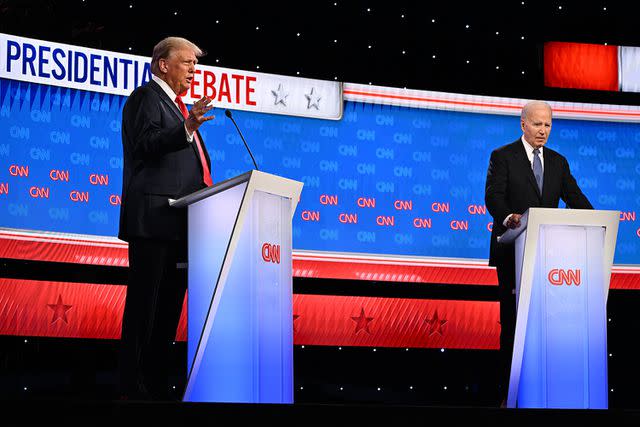
EyePress News/Shutterstock Presidents Donald Trump and Joe Biden debate on June 28, 2024
EyePress News/ShutterstockPresidents Donald Trump and Joe Biden debate on June 28, 2024

During the press conference, Leavitt claimed the spike in egg prices were due to the Biden administration’s “mass killing of more than 100 million chickens, which has led to a lack of chicken supply in this country, therefore a lack of egg supply, which is leading to the shortage.”

However, the “killings” are a standard practice for the Department of Agriculture — which the Trump administration is poised to continue — that’s intended to contain the Highly Pathogenic Avian Influenza, or HPAI, colloquially known as the bird flu.

“There is no treatment for HPAI. The only way to stop the disease is to depopulate all affected and exposed poultry,” the Animal and Plant Health Inspection Service, part of the Department of Agriculture, writes on its website.

Related: Trump Withdraws U.S. from World Health Organization — What Does That Mean?

If chickens are not euthanized, the virus can continue its rapid spread and drive up costs even higher by affecting larger groups.

“Not to be the bearer of bad news, but we’re in this for a while,” Emily Metz, president and CEO of the American Egg Board, previously told CNN of egg shortages. “Until we have time without a detection, unfortunately this very, very tight egg supply is going to continue.”

Related: President Trump Blames DEI for American Airlines Crash, Citing His Own ‘Common Sense’ and Scolding CNN’s Kaitlan Collins

Joe Raedle/Getty Donald Trump on Jan. 27.
Joe Raedle/GettyDonald Trump on Jan. 27.

In the 2024 election, the cost of groceries, gas and other necessary goods was a large force behind how citizens voted — and two thirds of the people who cited basic goods cost as the most important issue for them voted for Trump.

However, many of the policy changes Trump has since began implementing — including a push for increased domestic oil production, decreased Biden-era climate change initiatives and unprecedented tariffs on imported goods — will have either no effect on prices or will affect them adversely, an expert told CNN.

More in Politics
The Hill: White House rescinded funding memo after GOP senators ‘hit the ceiling’
The Hill: Trump initial second-term approval rating among lowest in decades

Trump makes moves to expand his power, sparking chaos and a possible constitutional crisis

Associated Press

Trump makes moves to expand his power, sparking chaos and a possible constitutional crisis

Nicholas Riccardi – January 29, 2025

President Donald Trump arrives to speak at the 2025 House Republican Members Conference Dinner at Trump National Doral Miami in Doral, Fla., Monday, Jan. 27, 2025. (AP Photo/Mark Schiefelbein)

Just a little over a week into his second term, President Donald Trump took steps to maximize his power, sparking chaos and what critics contend is a constitutional crisis as he challenges the separation of powers that have defined American government for more than 200 years.

The new administration’s most provocative move came this week, as it announced it would temporarily halt federal payments to ensure they complied with Trump’s orders barring diversity programs. The technical-sounding directive had enormous immediate impact before it was blocked by a federal judge, potentially pulling trillions of dollars from police departments, domestic violence shelters, nutrition services and disaster relief programs that rely on federal grants. The administration on Wednesday rescinded the order.

Though the Republican administration denied Medicaid was affected, it acknowledged the online portal allowing states to file for reimbursement from the program was shut down for part of Tuesday in what it insisted was an error.

Legal experts noted the president is explicitly forbidden from cutting off spending for programs that Congress has approved. The U.S. Constitution grants Congress the power to appropriate money and requires the executive to pay it out. A 50-year-old law known as the Impoundment Control Act makes that explicit by prohibiting the president from halting payments on grants or other programs approved by Congress.

“The thing that prevents the president from being an absolute monarch is Congress controls the power of the purse strings,” said Josh Chafetz, a law professor at Georgetown University, adding that even a temporary freeze violates the law. “It’s what guarantees there’s a check on the presidency.”

Democrats and other critics said the move was blatantly unconstitutional.

“What happened last night is the most direct assault on the authority of Congress, I believe, in the history of the United States,” Sen. Angus King, an independent from Maine, said Tuesday.

While some Republicans were critical, most were supportive.

“I think he is testing the limits of his power, and I don’t think any of us are surprised by it,” said Sen. Kevin Cramer, a North Dakota Republican who is close with Trump.

At first blush, the Trump administration appeared to be following the correct procedures in identifying potential spending cuts, and the Impoundment Control Act outlines a procedure for how they could become permanent, said Rachel Snyderman, a former official at the Office of Management and Budget who is now at the Bipartisan Policy Center.

Congress must eventually sign off on any cuts the administration wants to make, Snyderman said, though she noted that no president since Bill Clinton, a Democrat, has been successful in getting that done. Congress did not act on $14 billion in impoundment cuts Trump proposed during his prior term, she said.

“We have to see what the next steps are,” Snyderman said.

The attempt to halt grants came after Trump, who during the campaign pledged to be “a dictator on day one,” has taken a number of provocative moves to challenge legal constraints on his power. He fired the inspectors general of his Cabinet agencies without giving Congress the warning required by law, declared that there is an immigrant “invasion” despite low numbers of border crossings, is requiring loyalty pledges from new hires, challenged the constitutional guarantee of birthright citizenship and is moving career staff out of key positions at the Department of Justice to ensure his loyalists control investigations and prosecutions.

On Tuesday evening, the new administration made its latest move, trying to prune the federal workforce by offering pay until the end of September for those who agree to resign by the end of next week.

The Trump actions have all led to a cascade of court challenges contending he has overstepped his constitutional bounds. A federal judge in Seattle has already put on hold Trump’s attempt to revoke birthright citizenship, calling it a blatant violation of the nation’s foundational legal document. On Tuesday, nonprofit groups persuaded a federal judge in Washington to put the administration’s spending freeze order on hold until a fuller hearing on Feb. 3.

Democratic attorneys general also rushed to court to block the order. New Mexico Attorney General Raul Torrez, a Democrat, said the swiftness of the court action against Trump’s spending freeze demonstrates the “carelessness” of the order.

“My hope is that the president, working with Congress, can identify whatever his priorities are and can work through the normal constitutional order that is well established that limits the power of Democratic and Republican presidents,” he said.

The grant freeze — administration officials described it as a “pause” — fit with a long-sought goal of some Trump allies, including his nominee to run the Office of Management and Budget, Russell Vought, to challenge the constitutionality of the Impoundment Control Act. They contend the president, as the person in charge of distributing funds, should be able to have some control over how the money goes out.

Though there’s little doubt the new administration wanted a court fight over its power to control spending, experts agree that this was likely not the way they hoped to present it.

“This is a really sloppy way of doing this,” said Bill Galston, of the Brookings Institution, adding that he thought it was an administration error. “This is just classic Trump. He believes it’s better to be fast and sloppy than slow and precise.”

In her first press conference, Trump’s new press secretary, Karoline Leavitt, on Tuesday urged organizations that need the grants to call the administration and show how their operations are “in line with the president’s agenda.”

“It’s incumbent on this administration to make sure, again, that every penny is accounted for,” Leavitt said.

Republican lawmakers largely took the freeze in stride.

“This isn’t a huge surprise to me,” said Rep. Dusty Johnson of South Dakota during the House Republican retreat at one of the president’s Florida golf resorts. “Clearly, Donald Trump campaigned in no small part on the idea that the Biden administration was putting out a lot of money that was not consistent with Donald Trump’s values.”

But Democrats and others were furious at the move, which seemed designed to undercut congressional authority.

“If President Trump wants to change our nation’s laws, he has the right to ask Congress to change them,” Sen. Bernie Sanders, an independent from Vermont, said in a statement. “He does not have the right to violate the United States Constitution. He is not a king.”

Chafetz, of Georgetown University, said the lack of pushback from Republican members of Congress was especially alarming because the legislative branch is the one whose powers are most at risk in the latest power play.

Even if Trump loses the legal battle, Chafetz said, he and his followers might feel like they’ve won by pushing things to this extreme.

“Damaging the institutions they don’t like,” he said, “seems to be their whole theory of governance.”

Riccardi reported from Denver. Associated Press writers Kevin Freking and Lisa Mascaro in Washington and Morgan Lee in Albuquerque, New Mexico, contributed to this report.

More in Politics
The Hill: Republicans leave Florida frustrated with lack of final plan to pass Trump agenda
The Hill: Buttigieg fires back at Trump after remarks on midair collision: ‘Despicable’

Trump’s First Big Fiasco Triggers Stephen Miller’s Rage—Take Note Dems

The New Republic

Trump’s First Big Fiasco Triggers Stephen Miller’s Rage—Take Note Dems

Greg Sargent – January 29, 2025

Admitting failure is anathema to the authoritarian leader, who is perpetually in danger of being diminished only by those who are resentful of his glory—which is why White House adviser Stephen Miller is frantically searching for scapegoats to blame for the unfolding disaster around President Donald Trump’s massive freeze on federal spending. “Welcome to the first dumb media hoax of 2025,” Miller angrily tweeted on Tuesday night. “Leftwing media outright lied, and some people fell for the hoax.”

What Miller is actually angry about is that the media covered this fiasco aggressively and fairly. Miller insists that the press glossed over the funding pause’s supposed exemption for “aid and benefit programs.” But this is rank misdirection: The funding freeze, which is likely illegal, was indeed confusingly drafted and recklessly rolled out. This is in part what prompted the national outcry over the huge swath of programs that it threatened, Medicaid benefits included—and the media coverage that angered Miller.

All of which carries a lesson for Democrats: This is what it looks like when the opposition stirs and uses its power in a unified way to make a lot of what you might call sheer political noise. That can help set the media agenda, throw Trump and his allies on the defensive, and deliver defeats to Trump that deflate his cultish aura of invincibility.

“This has been a red-alert moment for weeks—but now no one can deny it,” Senator Chris Murphy, the Connecticut Democrat who has argued for an emergency footing against Trump, told me. “For my colleagues that didn’t want to cry wolf, the wolf is literally chomping at our leg right now.”

Until this crisis, the Democratic opposition has mostly been relatively tentative and divided. Democrats were not sufficiently quick, forceful, or unified in denouncing Trump’s illegal purge of inspectors general and his deranged threat to prosecute state officials who don’t comply with mass deportations. Internal party debates suggest that many Democrats believe that Trump’s 2024 victory shows voters don’t care about the dire threat he poses to democracy and constitutional governance, or that defending them against Trump must be reducible to “kitchen table” appeals.

But the funding-freeze fiasco should illustrate that this reading is highly insufficient. An understanding of the moment shaped around the idea that voters are mostly reachable only via economic concerns—however important—fails to provide guidance on how to convey to voters why things like this extraordinary Trumpian power grab actually matter.

Democrats need to think through ways to act collectively, to utilize something akin to a party-wide strategy, precisely because this sort of collective, concerted action has the capacity to alert voters in a different kind of way. It can put them on edge, signaling to them that something is deeply amiss in the threat Trump is posing to the rule of law and constitutional order.

Generally speaking, some Democrats have several objections to this kind of approach. One is that voters don’t care about anything that doesn’t directly impact them and that warnings about the Trump threat make them look unfocused on people’s material concerns. Another is that if Democrats do this too often, voters will stop believing there’s real cause for alarm.

The funding-freeze fiasco got around the first objection for Democrats because it did have vast material implications, potentially harming millions of people. But Democrats shouldn’t take the wrong lesson from this. A big reason this became a huge story was also that it represented a wildly audacious grab for quasi-dictatorial power. Democratic alarms about this dimension of the story surely helped prompt wall-to-wall coverage. Democrats can learn from that.

Faiz Shakir, a progressive dark-horse candidate for Democratic National Committee chair, suggests another way around the first objection—that Democrats can seize on Trump’s abuses of power in a way that does appeal to the working class. The party, he argues, can enlist elected officials and influencers with working-class credibility to explain that those abuses should matter, not just to working-class voters’ bottom lines but, critically, because his degenerate public conduct should disgust them as well. He says Democrats can argue: “The way he is acting is a betrayal of working-class values and your working-class interests.”

Shakir also suggests an intriguing way for the party to act in concert. As chair, he’d aggressively encourage as many elected officials as possible to use the video-recording studio at the DNC in moments like these, getting them to record short takes on why voters should care about them, then push the content out on social media.*

Shakir said he sees a model in Murphy, who regularly serves up short, hyper-timely videos that use phrases like “Let me tell you why this matters.”

https://twitter.com/i/status/1884297054136021224

The goal, Shakir said, would be to provide Democrats with research and recording infrastructure enabling elected officials to find their own voices and flood information spaces with civic knowledge. This also would give Democrats who want to stick to a “kitchen table” approach a way to shape their own warnings around that.

Minnesota Democratic Party Chair Ken Martin, a leading DNC chair candidate, agrees that speed and unity are paramount. “We can’t be waiting several days to organize a response to each of these things from Trump—we have to move quick,” Martin said, adding that the “larger party apparatus” should all be “singing from the same sheet of music.”

The second objection to a concerted approach—that it risks a “cry wolf” effect—is also seriously flawed. It’s already clear some Democrats are using this to avoid hard fights, for instance in hints about “working with” Elon Musk or Robert F. Kennedy Jr., who each pose serious threats to bedrock ideals of public service. Also, if Democrats bestow bipartisan legitimacy on Trumpian moves like appointing those two walking civic basket cases, it complicates sounding the alarm in even more grave situations.

“It is hard for us to argue that our democracy is falling if we’re helping to confirm all of his nominees,” Murphy told me.

Taking too much of an à la carte approach to Trump’s abuses of power also risks squandering leverage. Democratic strategist Jesse Lee notes that the party’s lawmakers could consider a unified, future-oriented approach to abuses like the funding freeze. “The fight is real and here,” Lee said, arguing that Democrats can “make it clear” to GOP leaders that “they will get no Dem votes bailing them out while this power grab is in place.” (On Wednesday, the Trump administration rescinded the funding pause, strengthening the case for an aggressive opposition.)

Nobody denies that the Democratic Party is a big, sprawling, highly varied organism with elected officials facing a huge spectrum of different political imperatives. Of course there will be variation in how they approach each Trumpian abuse. But as Brian Beutler puts it, the answer to this cannot be to “lodge passing complaints about Trump’s abuses of power, but turn every conversation back to the cost of groceries.” This incoherently implies that the abuses themselves are not serious on their own terms.

How to corral Democrats who don’t want to sound warnings in particular situations is not easy to solve. But some of the ideas above are a start. And regardless, at a minimum, we need clearer signs that party leaders, at the highest levels, are seriously thinking through how to act concertedly in ways that clearly signal to voters that we’re in a civic emergency, and will argue to wayward Democrats that this is in their interests as well.

“People will not take us seriously if we don’t do our jobs every day like we’re in the middle of a constitutional crisis,” Murphy told me. “Today, everybody understands that he’s trying to seize power for corrupt purposes. But tomorrow, we have to start acting with purpose to stop what he’s doing.” If you doubt the efficacy of this, Stephen Miller’s anger confirms it as clearly as anyone could want.

This article is about a breaking news story and has been updated. It has also been edited to include mention of the DNC’s existing recording studio.

Trump administration rescinds funding freeze. States pledge to proceed with lawsuits

Statesman Journal

Trump administration rescinds funding freeze. States pledge to proceed with lawsuits

Anastasia Mason, Salem Statesman Journal – January 29, 2025

(This story has been updated with new information.)

The Trump administration rescinded a federal grant freeze on Wednesday that Oregon leaders said caused confusion and chaos.

White House press secretary Karoline Leavitt said Trump’s other executive orders on federal funding issued since Inauguration Day will “remain in full force and effect and will be rigorously implemented by all agencies and departments.”

Oregon joined 22 other states and Washington, D.C. in filing a new suit, Attorney General Dan Rayfield announced Tuesday afternoon. The states’ request for a preliminary injunction will be considered Wednesday afternoon in Rhode Island.

Leavitt said the administration’s rescission “should effectively end the court case and allow the government to focus on enforcing the President’s orders on controlling federal spending.”

However, Jenny Hansson, spokesperson for Rayfield’s office, said “everything is still on. We’re suing to stop these actions, and given the chaos of recent days we don’t trust the administration when it says it’s going to stop these actions.  Also, as a legal matter, voluntarily ceasing conduct doesn’t moot out a lawsuit.”

The states intend to seek “permanent injunctive and declaratory relief, to ensure that their residents are protected against the damage and chaos that would be caused by the funding freeze,” Rayfield’s office said in a press release.

A federal judge issued a temporary halt Tuesday afternoon on the Trump administration’s efforts to pause some federal funding.

Disbursement of federal grants and loans to Oregon were scheduled to stop at 5 p.m. Tuesday and remain paused for review, as directed by the Trump administration.

U.S. District Judge Loren AliKhan ordered the Trump administration not to halt grant funding until at least Feb. 3, when another hearing will be held on the dispute.

The judge said her temporary ruling was intended to “maintain the status quo.” It does not block the Trump administration from freezing funding to new programs, or require it to restart funding that has already ended.

The announcement of the pause order led to “chaos and uncertainty” and impacted the state’s federal reimbursement portals for programs such as Medicaid and Head Start, said Gov. Tina Kotek, who urged Oregonians to continue using the services as usual.

“This does not impact you today. This is about how money is coming back to the state to pay for the services that you’re using, but do not delay care,” Kotek said during a joint press conference with Rayfield.

“There is complete confusion right now from the Trump administration about what they’re doing and what it means for Americans across the country,” the governor said.

Oregon Gov. Tina Kotek and Attorney General Dan Rayfield speak during a press conference about President Donald Trump's order pausing federal funding.
Oregon Gov. Tina Kotek and Attorney General Dan Rayfield speak during a press conference about President Donald Trump’s order pausing federal funding.

Rayfield said: “What we’re hearing from the White House is not what we’re experiencing on the ground.”

In a statement earlier Tuesday Rayfield said he was “deeply concerned” by the pause and “will explore any and all legal actions to challenge this harmful order from President Trump.” He said the DOJ’s child support portal also was affected.

Last week, Oregon joined suit with three other states against an executive order by President Donald Trump that would end birthright citizenship. A judge issued a temporary pause on the order.

U.S. Rep. Andrea Salinas, D-Oregon, condemned the pause, saying, “if the president gets his way, children and seniors will go hungry, parents will pay more for child care, small businesses won’t be able to meet payroll, veterans will lose access to housing and health care, and rural communities won’t get the relief they need to prepare for and recover from wildfires and other disasters.”

Sen. Jeff Merkley, D-Oregon, criticized what he called a “cruel order” saying it was “blatantly unconstitutional.”

“The president is not a king, and the laws Congress passes are not suggestions,” Merkley, a ranking member of the Senate Budget Committee, said in a statement. “This cruel order will force schools, hospitals, food banks, and other community organizations to stop offering vital services. The list goes on and one thing is remarkably clear: President Trump’s Great Betrayal of working families knows no limit.”

Memo directing federal agencies to pause federal financial assistance

The White House Office of Management and Budget issued a memo Monday directing federal agencies to “temporarily pause all activities related to obligation or disbursement of all federal financial assistance,” Reuters reported.

The purpose of the pause is so agencies can “review agency programs and determine the best uses of the funding for those programs consistent with the law and the President’s priorities,” the memorandum reads.

The memo pointed to a legal definition of federal financial assistance, which includes grants, cooperative agreements, surplus donations, loans and interest subsidies. It exempts assistance received directly by individuals, including Medicare and Social Security benefits.

In a post on X, U.S. Sen. Ron Wyden, D-Oregon, reported issues with Medicaid access.

“My staff has confirmed reports that Medicaid portals are down in all 50 states following last night’s federal funding freeze. This is a blatant attempt to rip away health insurance from millions of Americans overnight and will get people killed,” the post said.

Asked whether Medicaid was cut off as part of OMB’s funding pause and whether there was a guarantee that individuals on Medicaid would not be affected, White House spokesperson Karoline Leavitt said: “I’ll check back on that and get back to you.”

“This is not a blanket pause on federal assistance and grant programs from the Trump administration,” Leavitt said during a briefing Tuesday. “The reason for this is to ensure that every penny that is going out the door is not conflicting with the executive orders and actions that this president has taken.”

Ways and Means co-Chair Sen. Kate Lieber, D-Beaverton, issued a statement that said: “We have a long history of partnering with the federal government to the betterment of all Oregonians and it is unconscionable for the current administration to play politics with people’s lives.”

“The use of Federal resources to advance Marxist equity, transgenderism, and green new deal social engineering policies is a waste of taxpayer dollars that does not improve the day-to-day lives of those we serve,” the memo says.

The memo refers to an executive order Trump signed on Jan. 20, which ordered department and agency heads to “immediately pause” new programs and disbursements of development assistance to foreign countries. The Department of State announced the pause on Sunday.

On the domestic side, the federal government issues grants for everything from road building to scientific research.

It was unclear which categories would be affected. While the directive is broad, including all federal financial assistance, the memo also includes a caveat that the pause can only affect federal assistance “to the extent permissible under applicable law.”

USA TODAY and Reuters contributed to this report.

More in Politics
The Hill: Senate Republicans urge Trump to sanction ICC after failed legislation push
The Hill: Republicans advance Trump OMB nominee as Democrats boycott vote
The Hill: Trump to federal workers: Return to office ‘or be terminated’

Chef José Andrés responds to President Trump’s ‘dismissal’ weeks after earning Presidential Medal of Freedom

Good Morning America

Chef José Andrés responds to President Trump’s ‘dismissal’ weeks after earning Presidential Medal of Freedom

Kelly McCarthy – January 21, 2025

Humanitarian and chef José Andrés spoke out Tuesday after President Donald Trump claimed he had “fired” Andrés from the President’s Council on Sports, Fitness & Nutrition shortly after being sworn in for his second term.

Andrés served as co-chair of the federal advisory committee for two years, having been appointed to the position on March 23, 2022.

Trump posted what he called a “Official Notice of Dismissal” on social media early Tuesday morning, stating that his office would be “identifying and removing over a thousand Presidential Appointees from the previous Administration, who are not aligned with our vision to Make America Great Again.”

“Let this serve as Official Notice of Dismissal for these 4 individuals, with many more, coming soon: Jose Andres from the President’s Council on Sports, Fitness and Nutrition, Mark Milley from the National Infrastructure Advisory Council, Brian Hook from the Wilson Center for Scholars, and Keisha Lance Bottoms from the President’s Export Council — YOU’RE FIRED!” he wrote.

Andrés responded in his own social media post later on Tuesday morning, stating that he had already submitted his resignation earlier in the month, at the conclusion of his two year term.

“I submitted my resignation last week…my 2 year term was already up 🤷‍♂️😅,” the James Beard Award winner wrote on X.

He continued, “I was honored to serve as co-chair of the President’s Council on Sports, Fitness, and Nutrition. My fellow council members – unpaid volunteers like me – were hardworking, talented people who inspired me every day. I’m proud of what we accomplished on behalf of the American people…like a historic partnership between the White House and every major sports league to increase access to sports and health programs for kids.”

Andrés concluded his post by expressing his hope that Trump “exercises his presidential authority so the Council can continue to advocate for fitness and good health for all Americans.”

“These are bipartisan issues…nonpartisan issues,” he wrote. “May God give you the wisdom, Mr. President, to put politics and name calling aside…and instead lift up the everyday people working to bring America together. Let’s build longer tables….”

Less than three weeks ago, the Spanish American chef and World Central Kitchen founder was awarded the Presidential Medal of Freedom, in part due to his work providing relief to “communities affected by natural disasters and conflict around the world,” the White House stated at the time.

PHOTO: President Joe Biden presents the Presidential Medal of Freedom to Chef and head of World Central Kitchen Jose Andres in the East Room of the White House, in Washington, D.C., Jan. 4, 2025. (Ken Cedeno/Reuters)
PHOTO: President Joe Biden presents the Presidential Medal of Freedom to Chef and head of World Central Kitchen Jose Andres in the East Room of the White House, in Washington, D.C., Jan. 4, 2025. (Ken Cedeno/Reuters)More

As he was presented the highest civilian honor in the East Room of the White House, Andrés took a moment to point upward as a way to honor the lives of his WCK colleagues and aid workers killed by Israeli airstrikes in Gaza last year.

Trump has moved quickly to exact ‘retribution.’ More revenge could come: ANALYSIS

ABC News

In a new interview for the latest episode of his “Longer Tables” podcast, Andrés’ longtime friend and esteemed chef Eric Ripert asked while hosting the live taping at the Cayman Cookout about the emotional moment in the White House.

“We lost some friends working with WCK — especially somebody like Zomi [Frankcom], who’s a woman I spent many years working with on many missions and in many emergencies, and this was a way to say, ‘This medal is for you all,'” Andrés said. “It was a very simple way to say you are the ones that deserve this.”

Democratic attorneys general prep for role as last line of defense in Trump era

Oregon Capitol Chronicle

Democratic attorneys general prep for role as last line of defense in Trump era

Ben Botkin – November 18, 2024

Oregon House Speaker Dan Rayfield, D-Corvallis, on stage at the annual Oregon Leadership Summit in Portland on Dec. 11, 2023.

Yahoo is using AI to generate takeaways from this article. This means the info may not always match what’s in the article. Reporting mistakes helps us improve the experience.Generate Key Takeaways

Then-Oregon House Speaker Dan Rayfield, D-Corvallis, on stage at the annual Oregon Leadership Summit in Portland on Dec. 11, 2023. Rayfield, elected Oregon attorney general, will be one of 23 Democratic attorneys general during the next Trump administration. (Michael Romanos/Oregon Capital Chronicle)

After Donald Trump entered the White House in 2017, Democratic attorneys general in the U.S. quickly started conference calls every Tuesday morning to strategize and map out legal steps.

Within weeks, that quickly turned into legal action, when Washington state Attorney General Bob Ferguson launched a lawsuit challenging Trump’s travel ban that barred most people from predominantly Muslim nations from entering the U.S., even if they had valid visas. Oregon Attorney General Ellen Rosenblum joined the lawsuit, which led to a court action that blocked Trump’s executive order within about a week of its passage. 

As Trump prepares for a new term in office, 23 Democratic attorneys general will be a watchdog against any Trump-led initiatives that they believe are unconstitutional, illegal or both. The landscape has changed: Rosenblum is retiring from the role and former Oregon House Speaker Dan Rayfield will become the next attorney general. Ferguson was elected governor of Washington. The two are the last Democratic attorneys general who were in office when Trump started his first term.

In the second Trump term, attorneys general now have a four-year history of court actions that their predecessors took on wide-ranging issues like immigration, health care and the environment. And they often prevailed in court, an outcome that highlights the remarkable power that attorneys general have, through the court system, to unravel executive orders and directives from the most powerful elected leader in the world. 

“We kind of have a track record and a set of expectations of how he has operated in the past,” Rayfield said in an interview with the Capital Chronicle. “The attorneys general are just a check and balance on that power. When he oversteps and pursues, whether it’s discriminatory or unlawful policies, you are that backstop for that.”

Oregon worked closely with Washington and other states during the first Trump term, as Democratic attorneys general collaborated. Ferguson sued the first Trump administration nearly 100 times, losing only three times, the Washington State Standard reported. Oregon joined many of those cases, as did other states.

Among the cases, all with more than a dozen states participating: Oregon sued in 2017, when Trump’s Environmental Protection Agency head delayed a designation of what regions of the country met new ground-level ozone pollution standards. In 2018, Oregon sued to block the federal government from asking people about their citizenship status during the 2020 census. Oregon also joined a lawsuit challenging the Trump administration’s immigration policy of separating children from families that crossed the border of Mexico without documentation. 

During that first Trump administration, there were a lot of things that just came out of the blue. So you have to be ready under those scenarios.

– Oregon Attorney General-elect Dan Rayfield

Rayfield said the legal fight for states to set stricter emissions controls for vehicles than federal standards — opposed by Republican attorneys general — is an example of an issue where he would fight for Oregon’s right to do so. 

Another key issue is reproductive health and preserving access to care, including the abortion medication mifepristone, Rayfield said. 

Attorneys general also serve as a watchdog of federal actions regardless of whether a member of their party is president. For example, Rosenblum and other attorneys general have sued the federal Food & Drug Administration during the Biden administration for its restrictions on mifepristone. 

Rayfield said he understands the fears about what impact a Trump administration will have on immigration. It’s one issue among many that he’ll keep tabs on with his Oregon Department of Justice attorneys. 

“Those concerns are very real and scary in those communities,” he said. “But what I’d like to do is be able to see where Trump begins to move in that direction, and then see how that unfolds.”

At the same time, Rayfield said his role as attorney general is not simply to be a foil to Trump. The role exists regardless of who the president is, he said. 

“You have to be firing on all cylinders,” he said.

That’s because the attorney general does much more than decide when to sue the federal government. Oregon’s attorney general leads the Oregon Department of Justice, which has nearly 1,500 workers statewide and an annual budget of about $406 million. The attorney general defends state agencies from lawsuits and advocates on behalf of residents in areas like consumer protection, help with collecting child support and raising public awareness about scammers. 

Yet Rayfield said it’s important to be ready for the unexpected. 

“During that first Trump administration, there were a lot of things that just came out of the blue,” he said. “So you have to be ready under those scenarios. I think it is a state of really knowing what our values are here in Oregon, and then being ready to partner with other attorneys general to make sure that we’re upholding those values. Because it is a team effort in kind of being that last line of defense.”

It was a lot of tweets. We weren’t really used to a president that personally tweeted, so we had a lot of clues from that and, of course, the executive orders themselves.

– Oregon Attorney General Ellen Rosenblum

 Oregon Attorney General Ellen Rosenblum speaks about House Bill 2005, which bans undetectable firearms, on Monday, Aug. 21, 2023, at a ceremonial bill signing. Rosenblum, who is retiring, co-chaired a national group of Democratic attorneys general during the first Trump term. (Ben Botkin/Oregon Capital Chronicle)
Oregon Attorney General Ellen Rosenblum speaks about House Bill 2005, which bans undetectable firearms, on Monday, Aug. 21, 2023, at a ceremonial bill signing. Rosenblum, who is retiring, co-chaired a national group of Democratic attorneys general during the first Trump term. (Ben Botkin/Oregon Capital Chronicle)More
Rosenblum reflects

For Rosenblum, the early days of monitoring the Trump administration in 2017 quickly showed the need for organization. Rosenblum, who served as co-chair of the Democratic Attorneys General Association during the Trump administration, helped lead those early efforts.

The organization hired a staffer to help track policy changes coming from the White House. And of course, Trump’s prolific tweets — before the social media company now known as X  banned him — offered hints about what was ahead. Current owner Elon Musk, a Trump supporter who the president-elect named as head of a quasi-governmental “Department of Government Efficiency,” restored Trump’s account in 2022, but Trump continues to primarily use his own social media company, Truth Social.

“It was a lot of tweets,” Rosenblum said. “We weren’t really used to a president that personally tweeted, so we had a lot of clues from that and, of course, the executive orders themselves.”

The group realized that to preserve resources, they needed to work together and coordinate on cases. 

“We realized that, ideally, in order to conserve resources and also to address issues that were not specific to our states, but that were harming our own constituents in terms of their rights and their freedoms, that we needed to really step it up and work together,” Rosenblum said. “So we did that on pretty much everything that came our way.”

That helped keep costs down during the four-year Trump term, and Rosenblum said her office never needed to hire outside legal counsel to handle the cases. It also helped to have help from states with better-staffed offices, including Washington, California, New York and Illinois, she said.

The weekly conference calls continued, even after Trump exited office and during the Biden administration. Rosenblum said they were a good way to communicate and collaborate on potential national lawsuits and other issues.

Rosenblum said she expects the office will have a smooth transition through Rayfield. Like Rayfield, she said the role of watchdogging the federal government does not replace an attorney general’s role in pocketbook issues like consumer protection. 

“You definitely don’t stop doing your daily bread and butter work of what being attorney general is, and that’s really important to the people of Oregon,” Rosenblum said. 

MSNBC: Chris Hayes: With executive actions, Trump bets the courts are on his side. That’s a risky gamble.

USA Today: USDA inspector general escorted out of her office after defying White House