New EV tax credit rules mean cars with Chinese materials won’t qualify — but there’s a catch
‘Impracticable-to-trace’ elements like Chinese graphite will be temporarily excluded from EV tax credit rules, a boon for US automakers.
Pras Subramanian, Senior Reporter May 6, 2024
New rules from the Treasury Department will make it harder for vehicles to qualify for the full federal electric vehicle tax credit of $7,500 if key components are sourced from China.
But the rules also offered a two-year reprieve on some materials that are mostly sourced from China.
Late last week Treasury released new rules mandating that manufacturers not use critical materials that originate from a Foreign Entity of Concern (FEOC) — including China, Russia, North Korea, or Iran — by 2025 if they want to receive the full EV tax credit.
The federal government, however, is giving automakers some important leeway in sourcing some rarer materials, like graphite.
“The final regulations also identify certain impracticable-to-trace battery materials,” the Treasury said, adding that “qualified manufacturers may temporarily exclude these battery materials from FEOC due diligence and FEOC compliance determinations until 2027.”
Currently, the Inflation Reduction Act’s (IRA) federal EV credit requires that manufacturers ramp up sourcing of battery “critical materials” such as nickel and cobalt from the US and its trade partners and ensure that battery components are increasingly built in North America.
The White House’s goal with the mandates was to reduce the industry’s reliance on battery materials and components from China.
China’s chokehold over battery mineral production is the main concern for automakers who need to diversify supply chains and for the federal government as it looks to boost domestic production of these minerals. Morgan Stanley estimated that 90% of the EV battery supply chain originates from China, with Chinese companies like CATL and BYD dominating the space.
The “impracticable-to-trace” exemption is a boon for automakers in sourcing low-value and hard-to-trace elements like graphite, which is a critical component of a battery’s anode and comes mainly from China.
The automakers and their main trade group, the Alliance for Automotive Innovation (AAI), cheered the 2027 exemption for non-traceable elements.
“This updated guidance from the Treasury Department is something we recommended. It makes good sense for investment, job creation and consumer EV adoption,” said John Bozzella, AAI president and CEO.
This photo taken on Dec. 8, 2022, shows the graphitization process of cathode materials for lithium-ion batteries at a workshop of a company in Hegang City, northeast China’s Heilongjiang Province. (Photo by Xie Jianfei/Xinhua via Getty Images) (Xinhua News Agency via Getty Images)
Bozzella also noted that the EV tax credit was hard enough to qualify for; only 20% of EVs received the credit, and on top of that, requirements will get harder next year. Currently, only 22 vehicles sold in the US qualify for the tax credit, and only 13 of them qualify for the full $7,500.
A restriction on trace or low-value minerals would have meant even fewer (if not all EVs) would no longer qualify for the credit.
“Imagine an EV that complied with all IRA eligibility requirements but is kicked out of the program because of a trace amount of a critical mineral from an FEOC,” Bozzella said. “That makes no sense — especially when you consider the massive investments automakers and suppliers are making in domestic EV manufacturing.”
Sen. Joe Manchin questions Education Secretary Miguel Cardona during a hearing in Washington, on Tuesday, April 30, 2024. (AP Photo/Susan Walsh) (ASSOCIATED PRESS)
“President Biden’s Inflation Reduction Act has unleashed an investment and manufacturing boom in the United States,” Treasury Secretary Janet Yellen said in a statement.
“I’ve seen firsthand in Tennessee, North Carolina, and Kentucky how ecosystems have developed in communities nationwide to onshore the entire clean vehicle supply chain so the United States can lead in the field of green energy.”
The White House also noted that 15 battery gigafactories have been commissioned in the US since the start of Biden’s term in office.
But critics, like Senator Joe Manchin (D-W.Va.), who helped push IRA legislation through the Senate back in 2022, see this loophole as the White House “breaking the law.”
“With this final rule for the consumer credit, their creation of loopholes in the commercial vehicle credit, and their EPA tailpipe rules, the Administration is effectively endorsing ‘Made in China,'” the Democratic senator from West Virginia said in a statement, adding that the White House is “blatantly breaking the law by implementing a bill that they did not pass.”
Manchin has vowed to lead a Congressional Review Act resolution of disapproval for the IRA’s tax credit implementation, which could lead to the repeal of Treasury’s guidance for untraceable elements.
No issue in U.S. politics is more contentious right now than the situation at America’s southern border.
Since President Biden took office in 2021 and reversed some of former President Donald Trump’s hard-line restrictions, illegal crossings have surged to a record high of more than 2 million per year, on average.
Democrats and other defenders of Biden’s record say the causes are complicated and predate his presidency: foreign violence, economic hardship and cartels that profit from crossings.
Republicans and other Biden critics argue that the president has effectively encouraged migrants to try their luck by using immigration parole at a historic scale and ordering a pause on most U.S. Immigration and Customs Enforcement (ICE) arrests and deportations.
But how could the differences between Biden and Trump reshape U.S. border policy going forward?
November’s election will be the first since 1892 to feature two presidents — one former, one current — competing as the major-party nominees. As a result, this year’s candidates already have extensive White House records to compare and contrast.
Here’s what Biden and Trump have done so far about the border — and what they plan to do next.
Part two in an ongoing series. Read part one: Abortion.
Where they’re coming from
Trump: More than anything else, Trump built his political following on a hard-line approach to immigration.
Starting in 2011, Trump boosted his profile on the right by positioning himself as the leading proponent of the false conspiracy theory that then-President Barack Obama — whose father was from Kenya — wasn’t born in Hawaii as stated on his birth certificate. In 2016, Trump finally admitted that so-called birthers (those who believe Obama isn’t a native-born citizen) were wrong and that “Obama was born in the United States.”
Trump spent much of 2016 vowing to build a physical wall along the border between the U.S. and Mexico — possibly fortified with spikes, electricity and an alligator moat — and make Mexico pay for it.
According to the New York Times, “the idea [of a border wall] was initially suggested by a Trump campaign aide … as a memory aid to prompt the candidate to remember to talk about immigration in his speeches. But it soon became a rallying cry at his events.”
“You know, if it gets a little boring, if I see people starting to sort of, maybe thinking about leaving,” Trump told the Times editorial board, “I just say, ‘We will build the wall!’ And they go nuts.”
Mexican immigrants weren’t the only ones in Trump’s crosshairs. In late 2015, after domestic terrorists Syed Rizwan Farook (a U.S. citizen born in Chicago) and his wife, Tashfeen Malik (a native of Pakistan who’d lived in the U.S. for years), killed 14 people in San Bernardino, Calif., Trump called for “a total and complete shutdown of Muslims entering the United States.”
Around the same time, Trump said he would create a “deportation force” that would expel millions of unauthorized immigrants. “We have at least 11 million people in this country that came in illegally,” he claimed during one primary debate. “They will go out.”
Biden: Biden entered the 2020 Democratic presidential primary under pressure from the left on immigration.
As Obama’s vice president, Biden could claim partial credit for 2012’s Deferred Action for Childhood Arrivals (DACA) program, which shielded from deportation about 700,000 immigrants (known as Dreamers) who were brought to the country as children.
“[Obama’s] title of deporter in chief was earned,” Domingo Garcia, president of the League of United Latin American Citizens, said at the time.
As a result, Biden sought to mend ties to Latino voters by calling Obama’s deportation approach a “big mistake” and pledging to reverse Trump’s border policies — while making DACA permanent and providing a pathway to citizenship for millions of undocumented immigrants.
“We’re going to immediately end Trump’s assault on the dignity of immigrant communities,” Biden said in his acceptance speech at 2020’s “virtual” Democratic National Convention. “We’re going to restore our moral standing in the world and our historic role as a safe haven for refugees and asylum seekers.”
What they’ve done as president
Trump: During his four years in office, Trump issued more than 400 executive actions on immigration.
The changes started almost immediately. On Jan. 27, 2017, Trump signed an order seeking to block travelers from seven majority Muslim countries for 90 days while suspending refugee resettlement and prohibiting Syrian refugees indefinitely. Challenged in court, the administration issued revised travel bans as time went on, removing or adding certain countries.
Trump quickly zeroed in on his signature border wall as well. But Congress refused to meet his funding demands, sparking a lengthy government shutdown. Ultimately, Trump managed to build just 458 miles of barrier along the 1,954-mile U.S.-Mexico border — nearly all of them in areas where older barriers already stood.
Mexico did not pay for any of Trump’s border wall.
Frustrated with the continued crush of illegal border crossings, Trump green-lit a plan in 2018 to separate migrant children from their parents or caregivers at the border and then criminally prosecute the adults. Trump eventually ended his “family separation” policy — but only after images of crying, traumatized kids detained in crowded facilities sparked a national outcry.
Despite Trump’s vow to expel “millions” of immigrants, deportations by ICE officers — who were given broad latitude to go after anyone without legal status — averaged just 80,000 per year during his presidency (significantly lower than the annual rate under Obama).
Why? Trump supporters and critics largely agree that the former president’s strict policies — including narrowing who is eligible for asylum; making it more difficult to qualify for permanent residency or citizenship; rolling back DACA; and forcing Central American asylum seekers to wait in Mexico while their cases are processed — “deterred” some migrants from even trying to cross the border.
But while Trump’s supporters described this as deterrence through strength, Trump’s critics called it deterrence through cruelty.
In March 2020, Trump implemented the emergency health authority known as Title 42, which allowed border officials to rapidly turn away asylum seekers on the grounds of preventing the spread of COVID-19 — without giving them a chance to appeal for U.S. protection.
Biden: Biden vowed to reverse Trump’s immigration policies on “day one” of his administration — and it’s a promise he largely kept.
In early 2021, the new president halted construction of the border wall; ended his predecessor’s travel bans; created a task force to reunify migrant families separated under Trump; reinstated DACA; ended Title 42 expulsions for unaccompanied minors; and ordered a pause on most ICE arrests and deportations, issuing new guidelines directing officers to prioritize national security threats, serious criminals and recent border crossers.
At the same time, Biden warned that without more funding and stronger “guardrails,” such as additional asylum judges, the U.S. could “end up with 2 million people on our border” and “a crisis on our hands that complicates what we’re trying to do.”
“Migrants and asylum seekers absolutely should not believe those in the region peddling the idea that the border will suddenly be fully open to process everyone on day one,” said Susan Rice, Biden’s domestic policy adviser. “It will not.”
Initially, Biden kept Title 42 in place (until May 2023), expelling five times more border crossers than Trump did (in large part because more migrants were trying to cross the border illegally).
As a result, national surveys show that voters are unhappy about the border situation and prefer Republicans to handle it. A February Gallup survey found that nearly 20% of those who disapproved of Biden’s job performance cited “illegal immigration/open borders” as the biggest reason — more than any other issue.
What they want to do next
Trump: More of the same — with the emphasis on more.ADVERTISEMENT
Among the ramped-up policies Trump is reportedly planning, according to the New York Times:
“round[ing] up undocumented people already in the United States on a vast scale and detain[ing] them in sprawling camps while they wait to be expelled”
reviving his Muslim travel ban and his COVID-era Title 42 restrictions on the basis “that migrants carry other infectious diseases like tuberculosis”
and “scour[ing] the country for unauthorized immigrants and deport[ing] people by the millions per year” by redirecting military funds and deploying federal agents, local police officers and National Guard soldiers to help ICE.
In an April interview with Time magazine, Trump confirmed that he is plotting “a massive deportation of people” using “local law enforcement” and the National Guard — and “if they weren’t able to,” he added, “then I’d use [other parts of] the military.”
He also refused to “rule out” detention camps, saying “it’s possible that we’ll do it to an extent.”
His inspiration, he has said, is the “Eisenhower model” — a reference to President Dwight D. Eisenhower’s 1954 campaign, known by the ethnic slur “Operation Wetback,” to round up and expel Mexican immigrants in what amounted to a nationwide “show me your papers” rule.
Trump has also said he would suspend refugee resettlement, revive his “Remain in Mexico” policy and end DACA. He has even left the door open to resuming “zero tolerance” family separations.
Biden: Most Democrats spent 2023 avoiding border politics while privately fretting about how the issue might affect the 2024 election. But the president finally bowed to GOP pressure last fall, agreeing to bipartisan border talks; the hope was that “a deal might take the issue off the table for his reelection campaign,” according to the New York Times.
In January, Senate negotiators actually struck a $20 billion bipartisan deal — a deal that gave the GOP much of what it had asked for, including provisions that would restrict claims for parole, raise the bar for asylum, speed the expulsion of migrants and automatically shutter the border if attempted illegal crossings reach a certain average daily threshold.
But Trump balked — and following his lead, Republicans on Capitol Hill effectively doomed the legislation.
“We can fight about the border — or we can fix it,” Biden said during his State of the Union address. “I’m ready to fix it. Send me the border bill now.”
In lieu of legislation, Biden is also considering using the same section of the federal code behind Trump’s most controversial actions, known as 212(f), to issue a “nuclear” executive order that would unilaterally crack down on migrants’ ability to seek asylum at the border after crossing illegally — but that would also risk legal challenges and left-wing backlash.
“Some are suggesting that I should just go ahead and try it,” Biden said in a recent interview with Univision. “And if I get shut down by the court, I get shut down by the court.”
Voters can’t tell between the arsonist and the fireman
Mark Gongloff, Bloomberg Opinion -The Tribune Content Agency May 02, 2024
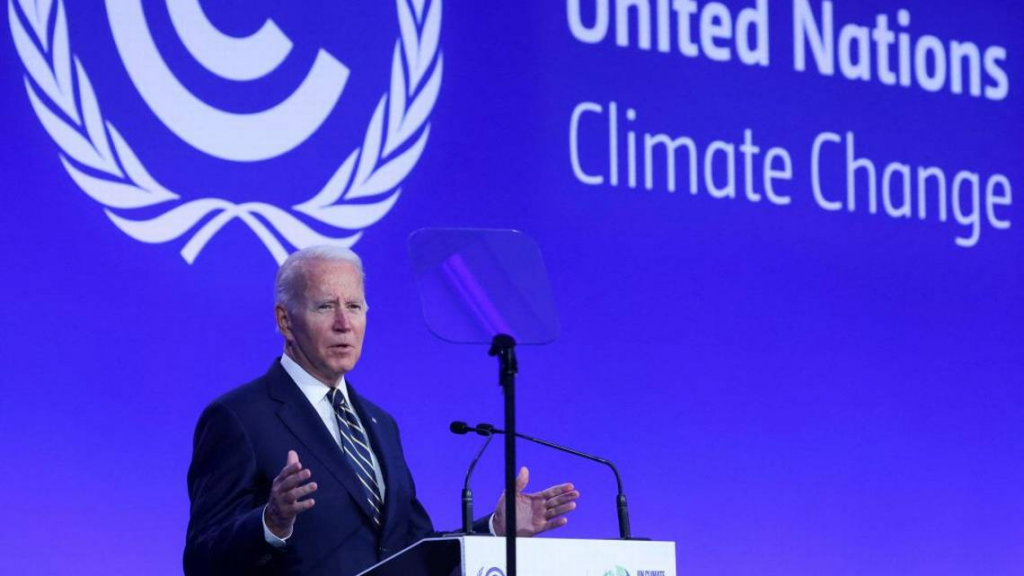
US President Joe Biden presents his national statement as part of the World Leaders’ Summit of the COP26 UN Climate Change Conference in Glasgow, Scotland on Nov. 1, 2021. (Yves Herman/Pool/AFP via Getty Images/TNS) YVES HERMAN/POOL/AFP TNS
If you were shopping for toaster ovens and your choice was between one that posed a 1% chance of setting your house on fire and a competing one that would not only 100% set your house on fire but proudly guaranteed it right on the box, then you would probably go with the 1% model.
U.S. voters face a similar choice this November when it comes to which presidential candidate will set the climate on fire. But they don’t seem to realize how much of a no-brainer that choice truly is.
President Joe Biden may not have a spotless climate record, but he has done much more to ensure a livable environment for future generations than any of his predecessors. Donald Trump, on the other hand, not only has history’s worst climate record, but he has announced, loudly and often, that his second term would be far, far worse.
Voters haven’t received the message, according to poll after poll. The latest is from CBS News, which found that 49% of Americans have heard little or nothing about what Biden has done for the climate. More alarmingly, most Americans think neither Biden’s second-term policies nor Trump’s would make any difference to the climate. That is dangerous nonsense.
The list of what Biden has already done is long and substantial, and it goes beyond the Inflation Reduction Act, easily the biggest climate bill in history. He also passed a bipartisan infrastructure bill and the Chips and Science Act, both with significant investments in the renewable-energy transition. He rejoined the Paris accord to limit long-term warming to 2 degrees Celsius, tightened emissions standards for power plants and cars and limited oil and gas drilling and liquefied natural gas exports. To name just a few things.
Biden has frustrated environmentalists at times with compromises such as approving the Willow drilling project in Alaska and pulling some regulatory punches on emissions and corporate disclosures. But he has done these things mostly in the name of getting reelected – which may sound cynical, until you consider the person who will be elected if Biden is not.
During his first term, Trump ditched the Paris accord and loosened regulatory fetters on the fossil-fuel and other polluting industries at the worst possible moment, just as the global concentration of atmospheric carbon was reaching dangerous levels. A Trump restoration would again come at a key point, just when scientists say the window to avoid the worst effects of a chaotic climate is slamming shut.
And Trump’s advisers are vowing to wreck progress even more aggressively in a second term. The Heritage Foundation’s Project 2025 lays out an agenda for Trump II that includes leaving the Paris accord again; undoing Biden’s efforts to regulate pollution; repealing the IRA or at least neutralizing it by closing the Energy Department loan office; throwing the entire country open to oil and gas exploration; and dismantling the climate-tracking National Oceanographic and Atmospheric Administration. To name just a few things.
A second Trump term would add 4 billion extra tons of carbon to the atmosphere, according to an analysis by Carbon Brief, a nonprofit advocacy group. That’s about two-thirds of what the U.S. produces in an entire year and matches the combined annual emissions of the European Union and Japan. The global clean-energy transition has built up anti-Trump defenses in the past four years, as my Bloomberg Opinion colleague Liam Denning and I have written. But make no mistake about it: A second Trump presidency would be a disaster.
So the whole planet needs Biden to do a much better job of communicating the stark contrast between him and Trump. The first step will be overcoming the mistaken sense among his voting base that he has failed them with his compromises.
“The key voters that put Biden in office in the first place – young people, people of color, women in the suburbs – were very concerned about climate,” Anthony Leiserowitz, director of the Yale Program on Climate Change Communication, told me in an interview. “Some of these same demographics think he’s done nothing or worse because of the Willow decision.”
Seven out of 10 Biden voters in 2020 said climate was important to their vote, according to a Pew Research Center poll. Nearly a fifth of Biden voters consider it their top priority, according to an Economist/YouGov poll. If he wants these voters back at the polls in November, then Biden must convince them early and often that staying home and giving Trump the White House would make all their worst fears come true.
The trick is that Biden may also need to win swing voters, most of whom don’t care as much about the environment and may fear (incorrectly) that there’s a trade-off between fighting global warming and growing the economy. That’s one reason Biden and his advisers spend so much time trumpeting the jobs the IRA and other climate actions create.
The good news is that the politics of this issue have shifted drastically in recent years. As evidence, Biden made his climate promises sharper for the general election campaign than during the Democratic primaries in 2020, Leiserowitz notes. Most Americans now think global warming is real and human-made and support Biden’s policies when they hear about them.
But we can’t wait for the battleship of public opinion to complete its U-turn. We don’t have another four years to waste.
This column does not necessarily reflect the opinion of the editorial board or Bloomberg LP and its owners. Mark Gongloff is a Bloomberg Opinion editor and columnist covering climate change. He previously worked for Fortune.com, the Huffington Post and the Wall Street Journal.
Spring is tornado season in the U.S., but the tornadoes in Nebraska and Iowa were quite a bit farther north and east of what would be typical for tornadoes in late April, when tornado activity is more common in Oklahoma and Texas.
The outbreak did fit another pattern for severe weather events, however, that occur as the atmosphere transitions out of El Niño. And this is exactly what was happening in late April.
I study tornadoes and the conditions under which they form. Here’s how these storm systems develop and what El Niño has to do with it.
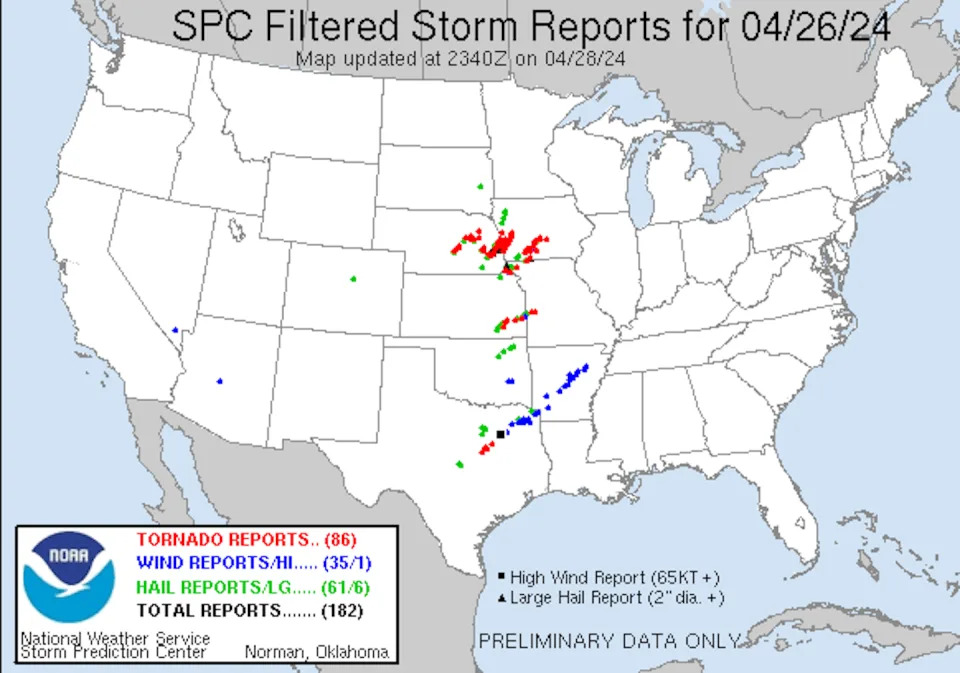
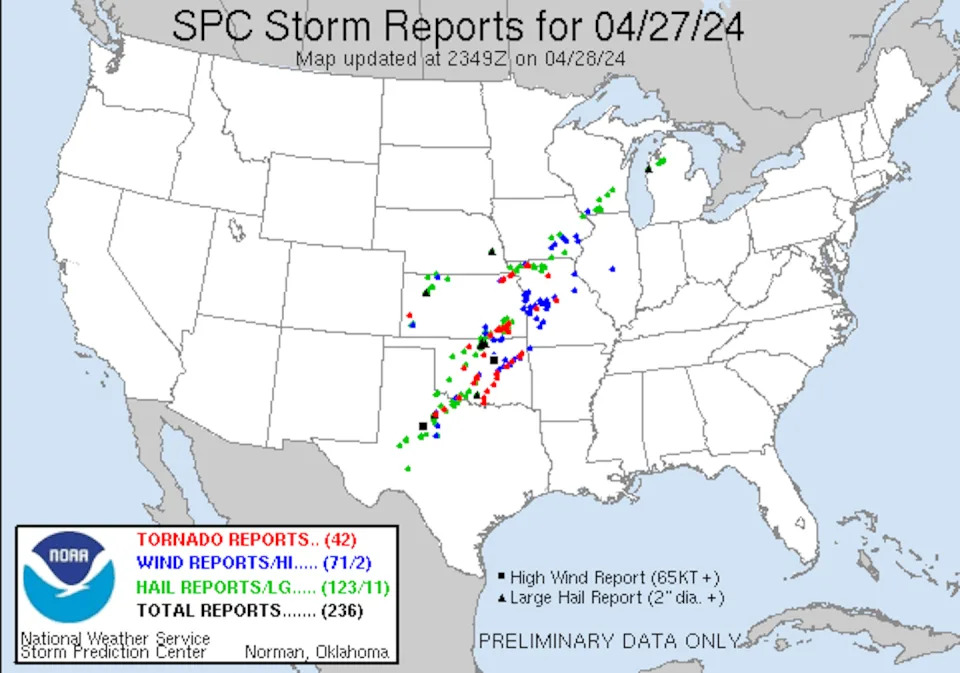
Preliminary reports of tornadoes and hail during severe storms on April 26, 2024, collected by the National Oceanic and Atmospheric Administration’s Storm Prediction Center. NOAAPreliminary reports of tornadoes and hail on April 27, 2024, collected by the Storm Prediction Center. NOAA.
The right conditions for a tornado
Two basic conditions are required to produce the rotating supercell thunderstorms that are capable of generating tornadoes:
Warm moist surface conditions and cold air above.
Winds that change in both speed and direction as you move up in the atmosphere, known as vertical wind shear.
Picture a kid who has a helium balloon at a party and releases it – the balloon floats upward. Like that helium balloon, the warm moist air is less dense than the surrounding colder air, so it rises, accelerating upward. This upward motion releases heat, moisture and energy, and causes thunderstorms to develop.
As with many severe weather outbreaks that occur in the U.S., the atmosphere became primed for storms as warm moist air at the surface was being transported northward from the Gulf of Mexico by a series of surface low-pressure systems.
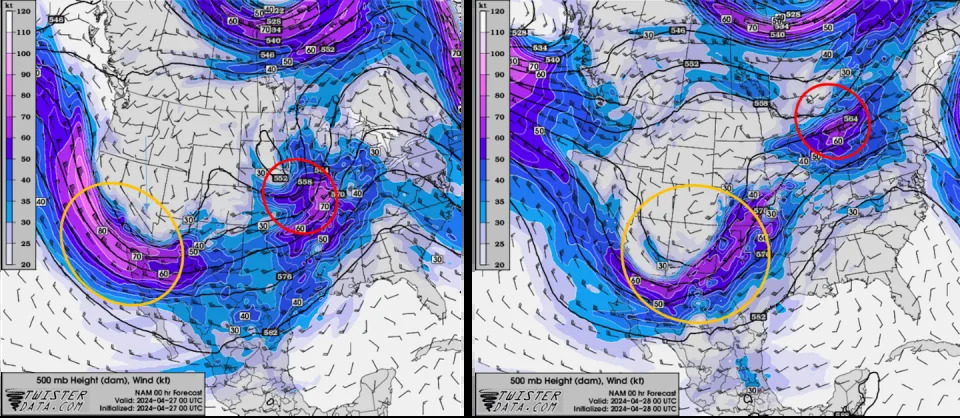
Higher up, about halfway between the ground and where airplanes fly, atmospheric waves within and below the jet stream were transporting cold air through the middle part of the atmosphere. These waves, formally called Rossby waves and commonly referred to as troughs and ridges, also enhanced vertical wind shear.
A small atmospheric wave that moved through the Central Plains and Midwest on April 26, helped trigger the tornadoes in Nebraska and Iowa, including a large, destructive tornado in the suburbs of Omaha, Nebraska, and in the town of Minden, Iowa, about 30 miles away.
The following day, a bigger wave moved through Oklahoma, where tornadoes damaged several small towns that evening.
The two images show the short-wave trough, circled in red, and the longer wave, circled in orange, traveling behind it. On the left is April 26, with the short-wave trough moving through Nebraska. On the right, the longer wave is affecting Oklahoma and Kansas on April 27. TwisterData.com
What was especially important was how close these parameters were to the center of the surface low-pressure system and a warm front that extended just to the east of it. The tornado-producing storms were able to tap into that instability and draw on the strong vertical wind shear generated in the vicinity of the warm front.
Surface temperatures (colors), winds (barbs indicating direction the wind was blowing from), surface pressure (solid black contours) indicating the location of the low pressure system (L), the warm front (red line) and the region of favorable conditions (blue circle) on the evening of April, 26, 2024. Pivotal Weather
When El Niño decays, the atmospheric waves change and can become wavier, so they have a greater amplitude. That tends to enhance conditions needed for tornadoes.
The U.S. often sees more frequent tornadoes when the climate is transitioning out of El Niño. The strong El Niño of 2023-24 was decaying in April 2024, and forecasters expect it to be gone by summer.
Weather experts are getting better at predicting tornado conditions. It is not uncommon now to know days in advance of the actual event that an elevated threat exists. Forecasters have high-resolution weather models that can anticipate storms at an appropriate spatial scale to provide a sense of the likely organization of the storms and come close to the location.
The better we understand these storms’ attributes, the better those forecasts and warnings can become.
This article is republished from The Conversation, a nonprofit, independent news organization bringing you facts and trustworthy analysis to help you make sense of our complex world. It was written by: Jana Lesak Houser, The Ohio State University
An El Niño-less summer is coming. Here’s what that could mean for the US
Mary Gilbert, CNN Meteorologist – April 29, 2024
It may be spring, but it’s not too soon to look ahead to summer weather, especially when El Niño – a player in last year’s especially brutal summer – is rapidly weakening and will all but vanish by the time the season kicks into gear.
El Niño’s disappearing act doesn’t mean relief from the heat. Not when the world is heating up due to human-driven climate change. In fact, forecasters think it could mean the opposite.
What this summer’s weather could look like
El Niño is a natural climate pattern marked by warmer than average ocean temperatures in the equatorial Pacific. When the water gets cooler than average, it’s a La Niña. Either phase can have an effect on weather around the globe.
By June, forecasters expect those ocean temperatures to hover close to normal, marking a so-called neutral phase, before La Niña builds in early summer, according to NOAA’s Climate Prediction Center.
But the strength of El Niño or La Niña’s influence on US weather isn’t uniform and varies greatly based on the strength of the phenomena and the season itself.
The influence of El Niño or La Niña on US weather isn’t as clear-cut in the summer as it is in the winter, especially during a transition between the two phases, said Michelle L’Heureux, a climate scientist with the Climate Prediction Center.
Temperature differences between the tropics and North America are more extreme in the winter, L’Heureux explained. This allows the jet stream to become quite strong and influential, reliably sending storms into certain parts of the US.
In the summer, the difference in temperature between the two regions isn’t as significant and the obvious influence on US weather wanes.
But we can look back at what happened during similar summers to get a glimpse of what could come this summer.
In short: It’s not cool.
The summer of 2016 was one of the hottest on record for the Lower 48. La Niña conditions were in place by midsummer and followed a very strong El Niño winter.
Summer 2020 followed a similar script: La Niña conditions formed midsummer after a weak El Niño winter but still produced one of the hottest summers on record and the most active hurricane season on record.
Then there’s the fact that these climate phenomena are playing out in a warming world, raising the ceiling on the extreme heat potential.
“This obviously isn’t our grandmother’s transition out of El Niño – we’re in a much warmer world so the impacts will be different,” L’Heureux, said. “We’re seeing the consequences of climate change.”
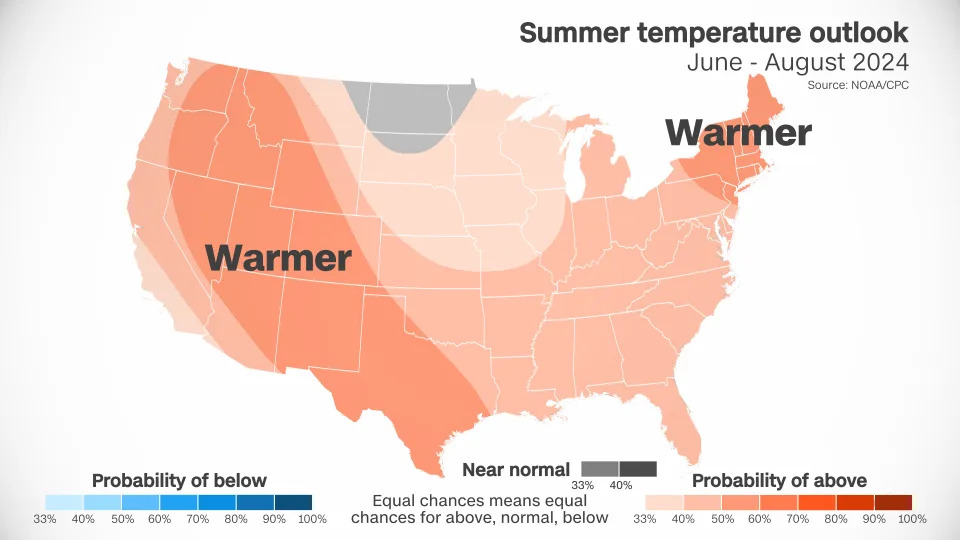
Current summer temperature outlooks for the US are certainly bringing the heat.
CNN Weather
Above-average temperatures are forecast over nearly every square mile of the Lower 48. Only portions of the Dakotas, Minnesota and Montana have an equal chance of encountering near normal, above- or below-normal temperatures.
A huge portion of the West is likely to have warmer conditions than normal. This forecast tracks with decades of climate trends, according to L’Heureux.
Summers have warmed more in the West than in any other region of the US since the early 1990s, according to data from NOAA. Phoenix is a prime example. The city’s average July temperature last year was an unheard-of 102.7 degrees, making it the hottest month on record for any US city. It was also the deadliest year on record for heat in Maricopa County, where Phoenix is located.
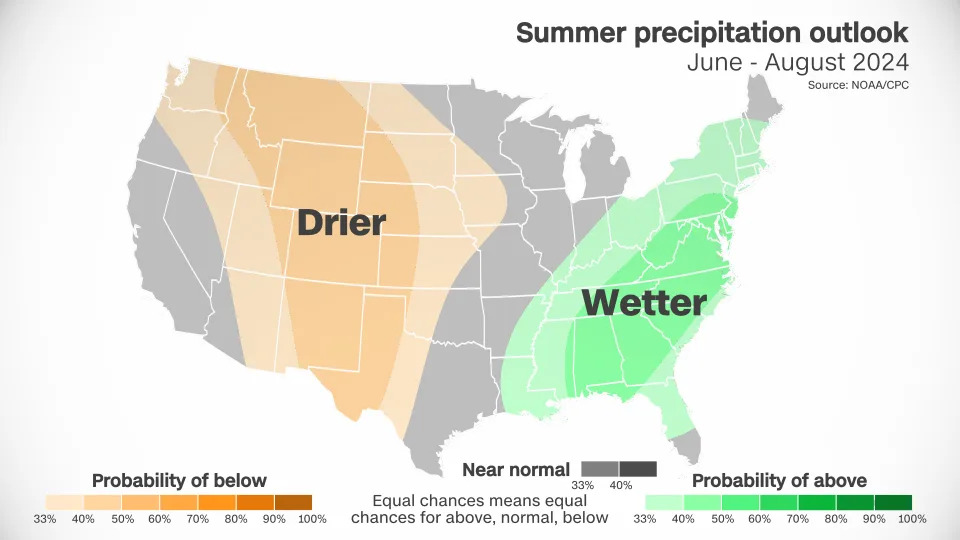
Forecasts also show a worrying precipitation trend for parts of the West.
CNN Weather
Large sections of the West and the central US are likely to be drier than normal. This dryness, combined with above-normal heat, which only amplifies the dryness, could be a recipe for new or worsening drought.
Wetter than normal conditions are in the forecast from the Gulf Coast to the Northeast. Stormy weather could be a consistent companion for much of the East – but whether it comes from typical rain and thunderstorms or tropical activity won’t be known for months.
A warming world generates more fuel for more tropical activity and stronger storms. La Niña tends to produce favorable atmospheric conditions to allow storms to form and hold together in the Atlantic.
“We anticipate a well above-average probability for major hurricanes making landfall along the continental United States coastline and in the Caribbean,” the group said in a news release.
Which foods have the most plastics? You may be surprised
Sandee LaMotte, CNN – April 22, 2024
“How much plastic will you have for dinner, sir? And you, ma’am?” While that may seem like a line from a satirical skit on Saturday Night Live, research is showing it’s much too close to reality.
Ninety percent of animal and vegetable protein samples tested positive for microplastics, teeny polymer fragments that can range from less than 0.2 inch (5 millimeters) down to 1/25,000th of an inch (1 micrometer), according to a February 2024 study. Anything smaller than 1 micrometer is a nanoplastic that must be measured in billionths of a meter.
Even vegetarians can’t escape, according to a 2021 study. If the plastic is small enough, fruits and vegetables can absorb microplastics through their root systems and transfer those chemical bits to the plant’s stems, leaves, seeds and fruit.
Salt can be packed with plastic. A 2023 study found coarse Himalayan pink salt mined from the ground had the most microplastics, followed by black salt and marine salt. Sugar is also “an important route of human exposure to these micropollutants,” according to a 2022 study.
Even tea bags, many of which are made of plastic, can release enormous amounts of plastic. Researchers at McGill University in Quebec, Canada found brewing a single plastic teabag released about 11.6 billion microplastic and 3.1 billion nanoplastic particles into the water.
Rice is also a culprit. A University of Queensland study found that for every 100 grams (1/2 cup) of rice people eat, they consume three to four milligrams of plastic — the number jumps to 13 milligrams per serving for instant rice. (You can reduce plastic contamination by up to 40% by washing rice, researchers said. That also helps reduce arsenic, which can be high in rice.)
Let’s not forget bottled water. One liter of water — the equivalent of two standard-size bottled waters — contained an average of 240,000 plastic particles from seven types of plastics, including nanoplastics, according to a March 2024 study.
“All of those chemicals are used in the manufacturing of plastic, so if a plastic makes its way into us, it’s carrying those chemicals with it,” Sherri “Sam” Mason, director of sustainability at Penn State Behrend in Erie, Pennsylvania, told CNN in a prior interview.
“And because the temperature of the body is higher than the outside, those chemicals are going to migrate out of that plastic and end up in our body,” Mason said.
“Those chemicals can be carried to your liver and your kidney and your brain and even make their way across the placental boundary and end up in an unborn child,” she said.
“There currently is no scientific consensus on the potential health impacts of nano- and microplastic particles. Therefore, media reports based on assumptions and conjecture do nothing more than unnecessarily scare the public,” a spokesperson for the International Bottled Water Association, an industry association, told CNN previously.
All types of proteins contained microplastics
In the February study, which was published in Environmental Research, researchers looked at over a dozen commonly consumed proteins, including beef, breaded and other types of shrimp, chicken breasts and nuggets, pork, seafood, tofu and several plant-based meat alternatives, such as nuggets, plant crumbles similar to ground beef and plant-based fish sticks.
Breaded shrimp contained the most tiny plastics by far, at well over an average of 300 microplastic pieces per serving. Plant-based nuggets came in second, at under 100 pieces per serving, followed by chicken nuggets, pollock fish sticks, minimally processed White Gulf shrimp, fresh caught Key West pink shrimp and a plant-based fish-like stick.
The least contaminated proteins were chicken breasts, followed by pork loin chops and tofu.
After comparing the results to consumer consumption data, researchers estimated the average exposure of American adults to microplastics could range between 11,000 and 29,000 particles a year, with a maximum estimated exposure of 3.8 million microplastics per year.
Fruits and vegetables tested high in plastics
The oceans are filled with plastics, and a number of studies have captured how those are ending up in the seafood we eat. However, fewer studies have looked at vegetables and land animal proteins, such as cattle and hogs, according to an August 2020 study.
The study, published in Environmental Science, found between 52,050 and 233,000 plastic particles under 10 micrometers — each micrometer is about the diameter of a rain drop — in a variety of fruits and vegetables.
Apples and carrots were the most contaminated fruit and vegetable, respectively, with over 100,000 microplastics per gram. The smallest particles were found in carrots, while the largest pieces of plastic were found in lettuce, which was also the least contaminated vegetable.
Plastics are everywhere
There are a staggering number of plastics in the world, today, according to a recent analysis — 16,000 plastic chemicals, with at least 4,200 of those considered to be “highly hazardous” to human health and the environment.
As these chemicals break down in the environment, they can turn into microplastics and then nanoplastics, particles so small science struggled for decades to see them.
A recent study that utilized brand new technology found the number of nanoplastics in three popular brands of water sold in the United States to be in between 110,000 and 370,000 per liter, if not higher. A liter is the equivalent of about two 16 ounce bottled waters. (The authors declined to mention which brands of bottled water they studied.)
Prior research using older technology had identified only about 300 nanoplastics in bottled water, along with bigger microplastics.
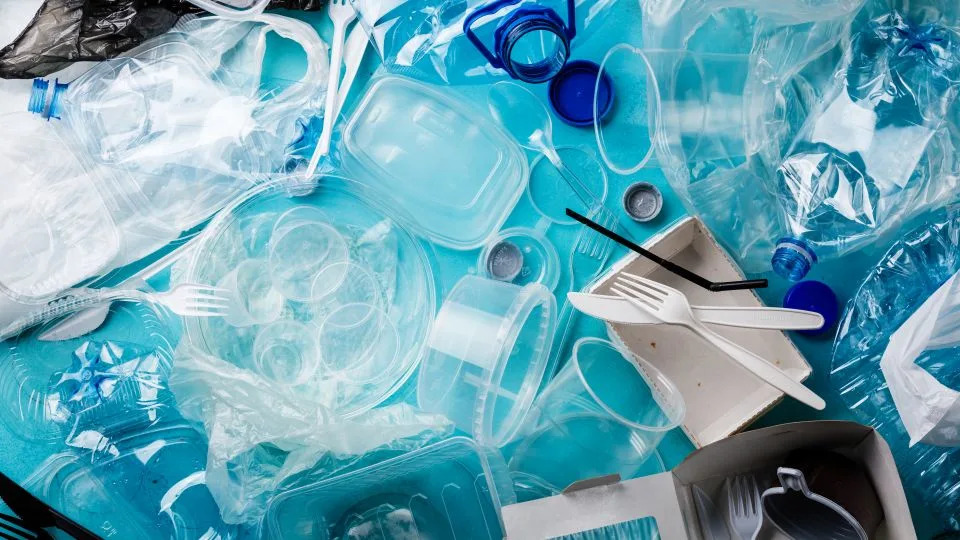
At least 16,000 plastic chemicals exist with least 4,200 of those considered to be “highly hazardous” to human health and the environment, a study found. – Lisovskaya/iStockphoto/Getty Images
Ways to reduce plastic
The levels of contamination found in bottled water reinforce long-held expert advice to drink tap water from glass or stainless steel containers to reduce exposure, Mason said. That advice extends to other foods and drinks packaged in plastic as well, she added.
“People don’t think of plastics as shedding but they do,” she said. “In almost the samewaywe’re constantly shedding skin cells, plastics are constantly shedding little bits that break off, such as when you open that plastic container for your store-bought salad or a cheese that’s wrapped in plastic.”
While science learns more about the plastics we consume, there are things people can do to reduce their exposure, according to experts.
· Try to avoid eating anything that has been stored in a plastic container. Look for food stored in glass, enamel or foil.
· Wear clothing made from natural fabrics and buy consumer products made from natural materials.
· Don’t microwave in plastic. Instead, heat food on the stove or by microwaving in glass.
· If you can, eat as much fresh food as possible, and limit purchase of processed and ultraprocessed foods wrapped in plastic.
Farmers warn food aisles will soon be empty because of crushing conditions: ‘We are not in a good position’
Nick Paschal – April 28, 2024
The United Kingdom is facing dire food shortages, forcing prices to skyrocket, and experts predict this is only the beginning.
What’s happening?
According to a report by The Guardian, extreme weather is wreaking havoc on crops across the region. England experienced more rainfall during the past 18 months than it has over any 18-month period since record-keeping began in 1836.
Because the rain hasn’t stopped, many farmers have been unable to get crops such as potatoes, carrots, and wheat into the ground. “Usually, you get rain but there will be pockets of dry weather for two or three weeks at a time to do the planting. That simply hasn’t happened,” farmer Tom Allen-Stevens told The Guardian.
Farmers have also planted fewer potatoes, opting for less weather-dependent and financially secure crops. At the same time, many of the potatoes that have been planted are rotting in the ground.
“There is a concern that we won’t ever have the volumes [of potatoes] we had in the past in the future,” British Growers Association CEO Jack Ward told The Guardian. “We are not in a good position and it is 100% not sustainable,” Ward added.
Why is it important?
English farmers aren’t alone — people are struggling to grow crops worldwide because of extreme weather.
Dry weather in Brazil and heavy rain in Vietnam have farmers concerned about pepper production. Severe drought in Spain and record-breaking rain and snowfall in California have made it difficult for farmers to cultivate olives for olive oil. El Niño and rising temperatures cut Peru’s blueberry yield in half last year. Everyone’s favorite drinks — coffee, beer, and wine — have all been impacted by extreme weather.
According to an ABC News report, the strain on the agriculture industry will likely continue to cause food prices to soar.
If these were just isolated events, farmers could more easily adapt — bad growing seasons are nothing new. The problem is that rising temperatures are directly linked to the increasing amount of gases such as carbon dioxide and methane in the atmosphere.
Since the start of the Industrial Revolution, humans have burned dirty energy sources such as coal, oil, and gas, which release a significant amount of those gases. Our climate is changing so drastically that the 10 warmest years since 1850 have all occurred in the last decade.
“As climate change worsens, the threat to our food supply chains — both at home and overseas — will grow,” Energy and Climate Intelligence Unit analyst Amber Sawyer told The Guardian.
What can we do about it?
“Fortunately, we know many ways we can make the food system more resilient while reducing food emissions. The biggest opportunity in high-income nations is a reduction in meat consumption and exploration of more plants in our diets,” said Dr. Paul Behrens, an associate professor of environmental change at Leiden University in the Netherlands.
If we replace a quarter of our meat consumption with vegetables, we could cut around 100 million tons of air pollution yearly. It may seem strange to suggest eating more vegetables with the decline in crop production. However, reducing the land and water used for animal agriculture and diverting those resources to growing more produce would drastically help the declining food supply.
Growing our own food is also a great way to reduce our reliance on store-bought produce, and it can save you hundreds of dollars a year at the grocery store.
Drought devastates crops in southern Africa: ‘The grain I have is only enough for the next two months’
Timothy McGill – April 27, 2024
The Africa hunger crisis, exacerbated by a climate change–amplified El Niño, is reaching a critical point. A recent Reuters report paints a grim picture, revealing that southern Africa is grappling with its most severe drought in several years.
What’s happening?
Earth saw a record $63 billion in damages from weather disasters in 2023. Many of those disasters were made worse by El Niño. Reuters cited a study from October last year that “even suggested that climate change may now be as significant a factor in triggering El Niño conditions as natural causes like sun rays.” An El Niño is an unusual warming of the eastern Pacific Ocean along and near the equator.
This year’s extreme drought has devastated crops, and now millions are hungry in southern Africa. World Vision calls it a “severe food crisis” that is “driving millions of people into a heightened risk of hunger and starvation.”
The peak of farming season in southern Africa is from October to March. Several weather disasters have struck the region since the end of 2023’s season. Tropical storm Freddy destroyed homes in Blantyre, the capital of Malawi, on March 14, 2023. This March, tropical storm Filipo brought devastating floods to Maputo, the capital of Mozambique.
Drought is impacting this part of the world, with increasing global temperatures exacerbating the problem. The lack of rainfall has decimated maize crops in southern Africa. An estimated 24 million people are impacted by hunger and malnutrition. The soil is normally suitable for maize farming.
Seventy percent of southern Africa’s maize comes from South Africa. The ongoing drought has led to a 15% drop in the country’s maize production for 2023-24 compared to 2022-23.
“The grain I have is only enough for the next two months. It is going to be hunger from here on,” farmer Mandisireyi Mbirinyu told Reuters.
What is being done?
African countries have been forced to come up with innovative ways to deal with drought. Some of these approaches include reusing rainwater, preserving humidity in fields, and promoting effective and inclusive consultation. The United Nations Sustainable Development Group suggests several ways that communities can end desertification, including “combatting soil erosion and restoring coastal ecosystems, leveraging innovation, technology, partnerships and private finance, and supporting the livelihoods of people displaced by drought.”
US can send fresh weapons to Ukraine ‘within days’
Tony Diver – April 20, 2024
Speaker Mike Johnson talks to reporters after the House voted to approve the aid to Ukraine – J. Scott Applewhite/AP
US weapons could be sent to Ukraine within days, after the House of Representatives voted to approve more than $60 billion (£48.5 billion) in military aid.
Kyiv’s army has resorted to increasingly desperate measures amid dwindling supplies of key missiles and relentless Russian bombardment that has translated into frontline advances.
Some troops have had to rely on civil society donations of items like drones or have started using decoy air defence systems to draw away enemy fire.
The Pentagon has already moved stockpiles of the most-needed arms closer to Ukraine’s borders in anticipation of the bill passing so that they could be sent to Kyiv at short notice.
Joe Biden’s “supplemental” bill on foreign aid funding has been held up for months in Congress amid opposition from Republicans.
Joe Biden’s “supplemental” bill on foreign aid funding has been held up for months – Alex Brandon/AP
On Saturday night the House voted to approve the package, sending it on to the Senate, where it is expected to pass early this week.
Chuck Shumer, the Democrat majority leader in the Senate, has suggested it could be approved as early as Tuesday. Mr Biden has said he will sign the bill as soon as it reaches his desk.
The aid package replenishes a Pentagon budget that can be accessed by Mr Biden through the Presidential Drawdown Authority (PDA), a power used for foreign aid purchases.
It allows the White House to send existing US military stockpiles to another country. More than $40 billion worth of equipment has been sent to Ukraine using this method since the start of the war in February 2022.
Maj Gen Pat Ryder, the Pentagon’s press secretary, said this week that the US had already moved weapons closer to Ukraine in the hope the bill would pass, allowing them to be moved more quickly.
“We have a very robust logistics network that enables us to move material very quickly,” he said. “We can move within days.”
The main aid requests from Ukraine to other allies in recent months have been for air defence missiles to protect the country’s cities from Russian attacks, and shells to use on the front lines in the East.
Ukraine’s front line has been feeling the strain – ANATOLII STEPANOV/AFP
The next package is likely to include ATACMS missiles, which have already been sent in limited quantities to the front line, and Patriot missiles for Ukraine’s air defence systems.
The most recent round of aid, which was drawn from savings in the existing Pentagon budget, included munitions for the High Mobility Artillery Rocket Systems (HIMARS).
The US stores some 155 million howitzer rounds in Europe, and could send them to Ukraine within days.
The global supply of rounds began to fall in recent months after the US budget for Ukraine aid dwindled and European manufacturers were unable to keep up with demand.
William Burns, the director of the CIA, has said that without speedy assistance from the US, Ukraine could lose the war against Russia this year.
Despite initial plans for a spring offensive this year, Ukraine has resorted to defending its existing front lines against Russian troops, without the weapons or personnel to launch a new push into Crimea.
The military draft in Ukraine was this week lowered to include men aged over 25, from its previous level of 27.
As the war in Ukraine has progressed, the US has agreed to send increasingly expensive military systems to Kyiv, including the Abrams tank.
An Abrams tank, which have been provided by the US, in Ukraine – X
Russia has also stepped up its defence procurement since February 2022, and has received drones from Iran and missile technology from China, according to US officials.
The Pentagon hopes that the package approved in the House on Saturday will be enough to meet America’s defence commitments to Ukraine until the presidential election, which will be held in November.
Republican efforts to stall the aid ramped up in recent months amid pressure from Donald Trump, the GOP’s nominee, who has opposed further spending and promised to end the war “in one day” if he wins the election.
Despite Mr Zelensky’s requests for advanced fighter jets from the US, planes are unlikely to be approved from the US.
Last year, Mr Biden approved some F-16 fighter jets to be sent to Ukraine from Denmark, under a rule that allows the US government to determine which countries can use planes that American manufacturers have produced.
The Pentagon has also agreed to train Ukrainian pilots to fly the planes, including at the Morris Air Force Base in Arizona.
Can drinking a blend of oats, water and lime juice help you lose weight? Here’s what nutritionists think about the ‘oatzempic’ trend.
Maxine Yeung – April 10, 2024
Experts say “oatzempic” doesn’t offer a balanced or sustainable approach to weight loss. (Getty Images) (izhairguns via Getty Images)
Weight loss drugs continue to gain in popularity, but not everyone who wants them can afford these medications, leaving some people hunting for more cost-effective alternatives. While natural options may seem promising, their effectiveness can be unpredictable. Berberine, for example, has been labeled “nature’s Ozempic,” though it may help more with managing blood sugar levels than aiding in actual weight loss. Meanwhile, psyllium husk — an inexpensive fiber supplement — is sought-after for its ability to temporarily suppress appetite by promoting a sense of fullness, but it’s important to note that fiber alone does not directly cause weight loss.
More recently, there’s been a viral trend involving the consumption of “oatzempic,” a drink crafted from oats, water and lime juice blended together. Its name cleverly references the prescription diabetes medication Ozempic, which is also well known for its weight loss benefits. This trend has gained lots of attention on platforms like TikTok, with claims suggesting it can help individuals shed as much as 40 pounds in two months.
“The oatzempic trend may seem enticing due to its simplicity and potential for rapid weight loss, but it’s essential to approach it with caution,” Vandana Sheth, registered dietitian nutritionist and author of My Indian Table: Quick & Tasty Vegetarian Recipes, tells Yahoo Life. So what are the downsides — as well as any possible benefits — of oatzempic, and can it really help with weight loss? Here’s what experts have to say.
How do you make oatzempic?
To prepare oatzempic, blend a half cup of raw oats, 1 cup of water and the juice of half a lime together until smooth. Drink it on an empty stomach, aiming for one to two servings a day. If you aren’t a fan of the taste, some people add a dash of cinnamon or honey, though the latter will add some calories and sugar.
Why the lime?
It’s unclear why lime juice is a key ingredient, though many suspect it’s primarily for enhancing the flavor of the drink, which has been described as chalky. Plus, lime juice provides a healthy dose of the antioxidant vitamin C.
Despite what some believe, Sheth clarifies, “there’s a misconception that acidic foods like lime juice can aid in fat burning, which is not supported by scientific evidence.” Dr. Amy Lee, head of nutrition for Nucific, tells Yahoo Life that a stomach’s acidity is greater than that of the fruit anyway.
What are the benefits?
Oatzempic’s benefits have been touted by people on social media trying it out for a 40-day challenge, but its impact on health hasn’t actually been researched. That said, oats alone boast many health advantages: They contain antioxidants and are linked with a reduced risk of cardiovascular disease, lower cholesterol and better blood sugar control. Research also shows potential for oats to help with regulating appetite and maintaining weight.
In just half a cup of oats, there are 5 grams of protein, 4 grams of fiber and a variety of vitamins and minerals. Oats are an excellent source of soluble fiber, particularly beta-glucan, which helps slow digestion, moves food and waste through the gut and promotes regular bowel movements.
Does oatzempic help with weight loss?
Substituting a meal with oatzempic can support weight loss efforts. However, as Julie Pace, functional dietitian and founder of Core Nutrition Health and Wellness, tells Yahoo Life: “It’s important to understand that this weight loss is primarily due to calorie restriction rather than any unique properties of oatzempic’s ingredients.” With just about 150 calories in a half cup of oats, oatzempic is low-calorie. Its fiber content may also promote a feeling of fullness, leading to less overall eating during the day.
Experts advise embracing this trend with caution since oatzempic does not offer a balanced or sustainable approach to weight loss. “Simply substituting high-calorie meals with low-calorie shakes may result in quick weight loss,” Sheth explains, “but without sustainable lifestyle changes, it may lead to health complications and weight regain once regular eating habits resume.”
Lee agrees: “I don’t think it is a long-term solution. Changing just one meal and its composition is a good start, but overall, one has to be mindful of the rest of the day as well.”
What are the downsides?
Pace says that oatzempic “encourages an unhealthy, unsustainable and restrictive approach to weight loss that is not supportive of overall health and well-being. Sustainable weight management involves making gradual, sustainable changes to diet and lifestyle rather than relying on quick fixes or extreme measures.”
Sheth warns that “rapid weight loss through extreme measures can lead to health complications such as nutrient deficiencies, loss of lean muscle tissue, hair loss and hormonal imbalances.” Not only are trends like oatzempic restrictive, especially if done for an extended amount of time, but they also risk promoting disordered eating habits.
While some people recommend using oatzempic as a meal replacement, experts point out it doesn’t contain nearly enough calories, protein or fat to be considered an equal swap. Generally for meals, you want to aim for about 15 to 30 grams of protein and at least twice as many calories as what’s found in a single serving of oatzempic.
“I do see some people adding protein powder and altering it by squeezing in some good oils,” says Lee. However, these additions change the simplicity of oatzempic and resemble more of a balanced breakfast.
Final takeaways
“If one is trying to just feel full in the morning to start their day strong, there are definitely other ways to do so,” says Lee. Instead of drinking oatzempic, aim for a satisfying breakfast of oatmeal, including fruit, seeds (hemp, chia and flax) and nuts (walnuts, almonds) for added protein, fiber and fat. If you prefer the drink version, consider swapping in milk for water or adding nut butter.
Although drinking oatzempic may increase fiber and water intake, experts agree that prioritizing overall health and wellness with sustainable habits is best if weight loss is your goal, and they note that weight loss alone doesn’t always mean improved health.
Maxine Yeung is a dietitian and board-certified health and wellness coach.