EcoWatch
September 30, 2018
You’ll need good footwear.
Chile is launching a huge scenic route through its Patagonian wilderness
You'll need good footwear. via World Economic Forum
Posted by EcoWatch on Sunday, September 30, 2018
Read About The Tarbaby Story under the Category: About the Tarbaby Blog

You’ll need good footwear.
Chile is launching a huge scenic route through its Patagonian wilderness
You'll need good footwear. via World Economic Forum
Posted by EcoWatch on Sunday, September 30, 2018
By Wyatt Massey, Animal Welfare, Food Justice, Health September 27, 2018

Sue George never intended to be an activist. The soft-spoken, retired elementary school teacher was content on her century farm near Lime Springs, a town in the rolling hills of northeast Iowa with a tad under 500 people.
Then, the hog operations moved in.
George lost the need to be “Midwest nice,” she said. “I’m not willing to let our way of life go by the wayside for these people who are coming in and putting all of this manure and all of this pollution into our area. I’m not.”
So George organized her neighbors and created a legal document to protect her farm, and town, from the large-scale hog operations she said are destroying a way of life and polluting the environment.
The state, already leading the nation in pork production, is experiencing a rapid rise in large-scale hog operations. Between 1982 and 2012, the most recent U.S. Department of Agriculture census, total hog production in Iowa rose from 14.3 million a year to 20.5 million. During the same time period, the number of farmers producing hogs dropped from 45,768 to 6,266.
In Howard County, where George lives, 427 hog farms existed in 1982 and just 54 in 2012, according to census data. Those 54 farmers are producing 197,113 hogs a year, or about 3,650 hogs a farmer.
To continue increasing hog production, the remaining farm owners build specially designed facilities to keep the animals indoors where their food and waste can be controlled. People are divided about whether these concentrated animal feeding operations, also known as CAFOs, either are the future of American farming or symbolize profits trumping concerns for rural livelihoods, the environment, and animal welfare. In Iowa, this is more than a mere disagreement about farming techniques. It is a fight over what the Iowa landscape will look like, a fight between rural residents and industrial agriculture.
Large-scale hog operations are prevalent throughout western and central Iowa and have begun moving into the northeast. One CAFO operation expanding into northeast Iowa is Reicks View Farms. George’s group campaigned against the operations moving into her region of Iowa, including Reicks View Farms. (Representatives at Reicks View Farms have not replied to requests for an interview.)
George’s group, founded in early 2017 and called Northeast Iowans for Clean Air and Water, includes farmers, local business owners, and Amish families. Through weekly meetings at homes and farms, conversations over potlucks and on front porches, they organized, advocated, and supported legislation to stop the construction. They placed signs along the highway opposing the new operations. They asked the Department of Natural Resources not to approve the facilities. George testified before the state legislature. She even met with one of the new owners, a man she taught when he was in elementary school.
“We did everything right,” George said. “And it still didn’t work.” The confinements went up and the hogs moved in.
When campaigning state and local government failed, George and dozens of other Iowa families turned to the law instead.
More than 40 families joined George in forming a covenant—a binding legal document in which all the members agree to a set of terms. A local lawyer donated his time to draw up the terms, which stipulated that none of the properties in the covenant—more than 5,500 acres total—would ever house a CAFO or allow a CAFO to spread liquid manure on their land.
CAFO is a catchall term for production facilities housing more than 1,000 animal units, defined by the USDA as the equivalent to 1,000 pounds of animal weight, which is 1,000 beef cattle or 2,500 swine. CAFOs keep animals inside for more than 45 days a year and fall under the Environmental Protection Agency’s Clean Water Act. However, each state regulates the operations differently.
Concentrating animals in one location requires more strict manure management than animals raised on pasture. Large farms produce millions of gallons of manure a year, which is more fecal waste than is produced in some American cities, according to the National Association of Local Boards of Health. The manure in most hog facilities falls through slatted floors into holding tanks. Then it’s hauled off and spread as fertilizer for crops.
Manure from CAFOs can contain E. coli, MRSA, antibiotics, and animal growth hormones. When the manure is not spread properly, these contaminants pollute waterways and private wells, as well as contribute to the rise of antibiotic-resistant bacteria. According to Local Boards of Health group, “states with high concentrations of CAFOs experience on average 20 to 30 serious water quality problems per year as a result of manure management problems.” All CAFO manure lagoons leak, according to the EPA, though certain designs can lower leakage to acceptable levels.
Water quality is a chief concern for members of Northeast Iowans for Clean Air and Water and something the covenant cannot necessarily protect. Some local facilities are near rivers, where manure runs off when a tank leaks or heavy rains fall. The area’s natural hills and karst topography—made up of limestone and especially susceptible to sinkholes—increase the likelihood that improperly applied liquid manure will run into waterways. The area is known for its natural trout streams, too. Trout fishing generates $1.6 billion annual revenue for Iowa and surrounding states. The fish need clean water to reproduce.
Several Lime Springs residents will drink only bottled water. A hog confinement sits a half-mile from Russell Stevenson’s farm, where he has lived and worked for decades. As a member of the covenant, Stevenson is concerned not if his private well will be contaminated, but when, he said. “It is not pig farming,” Stevenson said of CAFOs. “It’s a pig factory, and they ought to be regulated like one.”
Members of the covenant and activists throughout the state say CAFOs should be treated like the factories and corporations they resemble, instead of being given pollution tax exemptions and land zoned for agriculture. The operations can claim they are traditional family farms. John Ikerd, agricultural economics professor at the University of Missouri, said CAFOs are free from many of the environmental and public health regulations other operations generating similar amounts of waste must follow. The EPA’s Clean Water Act only regulates confinements of more than 2,500 hogs. Otherwise, the EPA does not regulate the confinements unless they dump waste directly into a waterway.
If the burden of proof was on the CAFO operator to prove the operation was not a threat to public health, no CAFOs could be built, Ikerd said. “Under the existing regulations, the burden of proof is on the public in general to prove that somebody is going to get sick from a particular CAFO, and that’s very difficult to prove.”
Bill Goetsch has farmed the area since he graduated from high school in the early 1980s. His wells were already contaminated when neighbors approached him about the covenant. A CAFO is a short walk up the valley from his home.
Goetsch said he was already concerned about his water, but now smells are coming down the valley. A study from Iowa State University and the University of Iowa determined air emissions from CAFOs “constitute a public health hazard.” About one in four CAFO workers in the U.S. suffers from a respiratory disease, such as bronchitis and asthma-like symptoms. A study of North Carolina residents found people living near CAFOs faced an increase in the same respiratory diseases suffered by CAFO workers. Lime Springs resident Joann Wangen said her adult children make comments about the smells when they visit her and her husband, Rick. Her guests had to stay inside during a recent Thanksgiving because the smells were so bad, she said.
Many advocates point out failures in the design of the state’s master matrix, which guides the siting of proposed operations. The process awards points depending on the building’s distance from homes, schools, and water sources; the overall point score determines whether a project is approved and where it’s sited. Critics of the current matrix point out how equal points are awarded to CAFO owners for doing things with vastly different implications. For example, proposals that include tree planting or that provide enough space for a truck to turn around in are weighted the same as having an emergency containment area for manure spills. A 2018 study found the DNR approved 97 percent of requested building permits.
Confinements of up to 1,249 hogs—considered a small operation—do not need to create a manure management plan or file a construction permit. Confinements of up to 2,499 hogs do not need a construction permit, either. According to DNR data, 3,745 sites in Iowa have fewer than 2,499 hogs. But the total number is likely much higher than that. A 2017 report using satellite imagery identified more than 5,000 hog and cattle lots in Iowa the DNR did not know about. More than 1,000 of those facilities are believed to require state oversight.
Weak state regulations mean CAFOs can move in wherever they please, members of Northeast Iowans for Clean Air and Water said. They point to an operation being approved on an environmentally sensitive site in Allamakee County. Former Iowa DNR director Chuck Gipp said if a CAFO could be built there, then a CAFO could be built anywhere. The hog facility was approved.
Tyler Bettin, public policy director for the Iowa Pork Producers Association, said the matrix system removes the burden from county supervisors to approve the building of each new operation and allows the DNR to better enforce regulations. “The master matrix continues to be very effective,” he said. “It’s a stair-step approach to regulation, so it requires our larger farms to go above and beyond the minimum requirements.”
George is among the advocates in Iowa wanting to revise the matrix to be more rigorous in assigning points. She’d also like it to give more control to counties and local supervisors, who can account for community desires and unique geographic features, like karst terrain or wetlands.
State Sen. David Johnson is among the political voices calling for stricter CAFO regulation. He helped design the state’s matrix in 2002. Johnson introduced 15 state bills related to CAFOs, such as stopping all CAFO construction until the number of impaired waterways in Iowa drops from 750 to 100 and the matrix is redesigned.
None of the bills Johnson introduced made it out of the agriculture committee.
George’s covenant is intended to fill the gap left by these failed state and federal legislative attempts at increasing regulation of CAFOs. By ensuring that confinements will not be introduced onto designated lands, the covenant is protecting a small area of Howard County.
This fall, the group may look to expand the number of people and properties involved in the covenant. The agreement gives George some freedom from worrying about whether another hog operation will move into her backyard. Creating the covenant took a lot of time and hard work, she said, but it strengthened local connections in ways she did not expect. “We have a common bond between us,” she said. “I feel that we’re a tighter-knit community, and we’re all on the same page.”
Individuals and groups across the state have contacted George about the covenant. She has information ready for them—an example of their covenant, a timeline of their process, and important questions to ask the group.
Iowa isn’t the only state with a growing CAFO presence. Trouble with CAFOs and environmental damages got national attention in 2016 in North Carolina when Hurricane Matthew flooded manure lagoons into waterways and the Atlantic Ocean; Hurricane Florence has flooded manure lagoons again. Similar battles between local communities and CAFO operators are playing out in Kansas,Wisconsin, Michigan, Arkansas, Illinois, and Minnesota. According to the USDA, the United States has more than 45,000 CAFOs.
For many consumers, the farms are out of sight and out of mind. People need to know the price that small communities are being forced to pay to produce these goods, Stevenson said. “It boggles my mind that there are so many people who live in towns and cities and they have no idea what’s going on [on] these farms.”
‘Waste Land’ — 67 Superfund sites across 45 states


In 1980, the U.S. Environmental Projection Agency created the Superfund program to address the catastrophic problem of toxic waste sites. Studying some 400,000 contaminated sites throughout the country, the EPA identified 400 highly hazardous sites in dire shape that were wreaking ecological disaster on a poisoned landscape.
With the support of a Guggenheim Fellowship in 1985, American photographer David T. Hanson traveled to 67 Superfund sites across 45 states that represented a cross section of industries whose practices have decimated the environment. Now, the full series has been published for the first time in Waste Land (Taverner Press, September 2018).
American artists have long documented the landscape as a space of freedom, heroism, and grandeur — but, as Hanson’s work reveals, things have radically changed. Over a year-long period, he visited nuclear weapons plants, nerve gas disposal areas, petrochemical complexes, water contamination sites, wood-processing plants, mines, smelters, landfills, and illicit dumps, creating a series of photographs that expose the transformation of the American landscape by our increasingly industrialized and militarized culture.
Hanson’s aerial photographs survey the scenes of industrial crimes, from waste ponds leaking into local streams and rivers to a dirt road in the woods that companies used for midnight dumping. In the words of sociologist Andrew Ross, “Hanson’s ‘Waste Land’ series is a “stunning documentary of a century of organized state terrorism against the North American land, its species, and its peoples.”
The sites in Hanson’s book are sequenced according to the EPA’s hazard ranking system. Each location is presented in a triptych format, with an aerial photograph by Hanson, a modified U.S. Geological Survey topographic map, and a contemporaneous U.S. Environmental Protection Agency site description detailing the site’s history and hazards, as well as the remedial action taken — or not, as some entries reveal the elaborate legal strategies used to avoid responsibility for both the contamination and the cleanup.
Born and raised in Montana, Hanson is one of the most critically acclaimed photographers of our time. When his photographs of Colstrip, Mont., a coal mining town, were first exhibited by John Szarkowski at the Museum of Modern Art in New York in 1986, the work signaled a shift from the cool modernism of the new topographies and questioned the belief in a “triumphant march of civilization” across the U.S.
Waste Land is Hanson’s third book in a trilogy that began with Colstrip, Montana and Wilderness to Wasteland (Taverner Press, 2010 and 2016), which document some of the most enduring monuments in Western civilization. Rather than iconic sites such as Stonehenge or the Nazca Lines, the most enduring legacy of the U.S. will be the hazardous remains of industry and technology, permanently etched into the land. For example, the radioactive contamination from American plutonium factories will remain deadly for the next 250,000 years — 10,000 generations, which is far longer than homo sapiens have been in existence.
Waste Land is a haunting meditation on a ravaged landscape. Although the photographs were made in the 1980’s, they seem even more relevant today given growing concerns about energy production, environmental degradation, and climate change. In the words of poet Wendell Berry, “[Hanson] has given us the topography of our open wounds.”
Photography by David T. Hanson
This oil-absorbing sponge could revolutionize ocean clean-up.
Scientists at the Argonne National Laboratory invented a reusable super sponge to fix clean oil spills.
Super sponge cleans up oil spills
Scientists at the Argonne National Laboratory invented a reusable super sponge to fix clean oil spills.
Posted by In The Know Innovation on Wednesday, May 2, 2018
September 20, 2018
So exciting! Read more: ecowatch.com/hydrogen-fuel-train
Germany has launched the world’s first hydrogen-powered train
So exciting! Read more: ecowatch.com/hydrogen-fuel-train
Posted by EcoWatch on Thursday, September 20, 2018
Gubernatorial Candidate Scott Wagner Publicly Calls Voter 'Young and Naive' on Climate Change
This GOP candidate called a teen activist 'young and naive' for challenging his claim that climate change is caused by human body heat
Posted by NowThis Election on Tuesday, September 18, 2018
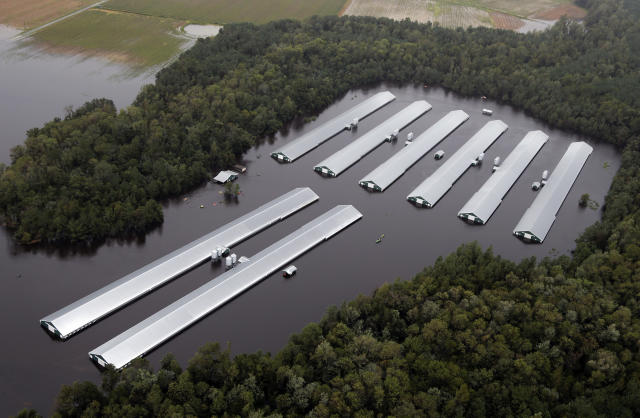
About 1.7 million chickens have been killed in flooding from Florence as rising North Carolina rivers swamped at least 60 farm buildings where the animals were being raised for market, according to a major poultry producer.
Sanderson Farms said Tuesday the losses occurred at independent farms that supply its poultry processing plants. The company said its facilities suffered no major damage, but supply disruptions and flooded roadways had caused shutdowns at some plants.
In addition, about 30 farms near Lumberton have been isolated by flood waters, hampering the delivery of feed to animals. The lack of food could cause additional birds to die if access isn’t restored quickly, the company said.
The N.C. Pork Council says some hogs also may have died when farms flooded, but that mortality figures are not yet available. The pork industry trade group says farmers have been working before and after the storm to move at-risk animals to higher ground. The industry lost about 2,800 hogs during flooding from Hurricane Matthew in 2016.
The Department of Environmental Quality said the earthen dam at one hog lagoon in Duplin County had breached, spilling its contents. Another 25 of the pits containing animal feces and urine have either suffered structural damage, had wastewater levels go over their tops from heavy rains or had been swamped by floodwaters. Large mounds of manure are also typically stored at poultry farms.
Even though the sun shown in parts of the state Tuesday, major flooding is continuing after Florence’s passage and is expected to worsen in some areas. Sixteen North Carolina rivers were at major flood stage Tuesday with an additional three forecast to peak by Thursday.
An environmental threat is also posed by human waste as low-lying municipal sewage plants flood. On Sunday, the Cape Fear Public Utility Authority reported that more than 5 million gallons of partially treated sewage had spilled into the Cape Fear River after power failed at its treatment plant.
The Environmental Protection Agency said Monday that 16 community water treatment facilities in North Carolina are unable to supply drinking water and that seven publicly owned sewage treatment works are non-operational due to the flooding.
Duke Energy is continuing cleanup operations Tuesday following a weekend breach at a coal ash landfill at its L.V. Sutton Power Station near Wilmington.
Duke spokeswoman Paige Sheehan said a full assessment of how much ash escaped from the waterlogged landfill is ongoing. The company initially estimated Saturday that about 2,000 cubic yards (1,530 cubic meters) of ash were displaced, enough to fill about 180 dump trucks.
The coal-fired Sutton plant was retired in 2013 and replaced with a new facility that burns natural gas. The company has been excavating millions of tons of leftover ash from old pits there and removing the waste to a new lined landfill constructed on the property. The gray ash left behind when coal is burned contains toxic heavy metals, including arsenic, lead and mercury.
Photos from the site provided to AP by Cape Fear River Watch, an environmental advocacy group, show cascades of gray-colored water spilling from at least two breaches at the landfill and flowing toward Sutton Lake, the plant’s former cooling pond which is now used for public recreation, including fishing and boating.
Sutton Lake drains into the Cape Fear River. Sheehan said Duke’s assessment is that there was minimal chance any contaminants from the spill had reached the river.
At a different power plant near Goldsboro, three old coal ash dumps capped with soil were inundated by the Neuse River. Duke said they had no indication those dumps at the H.F. Lee Power Plant were leaking ash into the river.
Duke’s handling of ash waste has faced intense scrutiny since a drainage pipe collapsed under a waste pit at an old plant in Eden in 2014, triggering a massive spill that coated 70 miles (110 kilometers) of the Dan River in gray sludge. The utility later agreed to plead guilty to nine Clean Water Act violations and pay $102 million in fines and restitution for illegally discharging pollution from ash dumps at five North Carolina power plants. It plans to close all its ash dumps by 2029.
In South Carolina, workers with electricity provider Santee Cooper erected a temporary dike in hopes of preventing flooding of an old coal ash dump at the demolished Grainger Generating Station near Conway. The dump is adjacent to the Waccamaw River, which is expected to crest at nearly 20 feet (6 meters) this weekend. That’s nine feet above flood stage and would set a new record height.
By Heather Gehlert, Food Justice, Urban Ag September 12, 2018

As the food movement gains strength and farm-to-fork practices become increasingly popular, many cities across the United States are investing in urban agriculture, both to attract tourists and to improve community health. For example, in Detroit, which The Washington Post has dubbed a “food mecca,” advocates are using urban farms and community gardens to help ease food insecurity. And, in Boston, legislation to make urban farming easier has contributed to the city’s reputation as a “haven for organic food” and helped make local produce more available to low-income residents.
Yet few places have been more vocal in their efforts to expand urban agriculture as Sacramento, California. In fact, if you Google “farm to fork,” the top result will take you to a website about Sacramento’s initiatives to support local food.
“Farm-to-Fork isn’t a passing fad or a marketing slogan in the Sacramento region—it’s the way we live,” the website explains, noting that the area’s ideal climate, ability to grow food year-round, and 1.5 million acres of active farmland make it an agricultural leader nationally and globally.
Now, as a recent case study from the Berkeley Media Studies Group (a program of the Public Health Institute) shows, advocates are working to expand that narrative. Instead of focusing on primarily on food, they aim to highlight the people who grow and sell it—and to make sure that everyone benefits equally from the area’s bounty.
 Photo courtesy of BMSG.
“Sacramento has branded itself as America’s farm-to-fork capital,” Robyn Krock, project manager at Valley Vision, a regional nonprofit that works to improve the livability of the Sacramento region, said at a recent city council meeting. “But,” she added, “the question that gets repeatedly asked is, ‘are we farm-to-every-fork?’”
Krock is just one of many local advocates who are highly committed to equity. They see urban agriculture not just as a feel-good trend for those with money and time to participate, but as a tool for promoting social justice.
Make no mistake: Krock and many other advocates and policymakers are working to ensure the new narrative is not just lip service, that it is rooted in robust community organizing and policy change. The strategies they have undertaken, supported by an infusion of funds from The California Endowment, have helped coalitions of local advocates transform Sacramento’s urban farming landscape in recent years to better support healthy food programs and access.
“I know that this is important,” Brenda Ruiz, a mother, a chef, and a longtime Sacramento resident who is active in the city’s Slow Food chapter, said at a council meeting when an ordinance that would reduce barriers to participating in urban farming was up for a vote. “It’s important for families to have access to fresh food; it’s important for families to consider their neighborhoods walkable and social areas where they can convene and share stories around a garden space; it’s important for our kids and young people to see this as normal for folks to be growing food and exchanging over that.”
Following strong organizing efforts from advocates, the council approved that ordinance in 2015, making it legal for people to grow and sell produce to consumers directly from their properties and from temporary farm stands as large as 120 square feet. A few months later, the council passed another ordinance offering tax incentives for people to convert vacant lots for agricultural use. And in January 2017, following the city’s lead, Sacramento County passed similar regulations, allowing all residents in urban and suburban areas to legally grow and sell produce, as well as keep bees, chickens, and ducks on small lots.
 The Fremont Community Garden in Sacramento. (Photo CC-licensed by Annie & John)
“If you don’t have food in your bellies, you can’t do anything else, so I look at it as the foundation of society,” said Chanowk Yisrael, whose family runs an urban farm from their home in Sacramento’s South Oak Park neighborhood.
Yisrael and other advocates have been following this foundational approach in their work to make sure that urban ag policies and programs are inclusive, especially for Sacramento residents who live in neighborhoods with less access to fresh, affordable food.
For example, although the city ultimately approved the urban agriculture ordinances, that did not happen without a strong push from local organizers, including through the ordinance language itself. Advocates crafted the language to maximize selling hours and participation—a task that involved rewriting 70-80 pages of zoning code. Although they could have approached the city and asked them to draft an ordinance, that posed some risks.
“[The city’s] first draft is probably going to be more conservative than your goal as an advocate,” said Matt Read, one of the ordinance’s authors. He also noted that the process of drafting and passing policies can help people develop skills in advocating for themselves and their communities. “It’s a really good opportunity for people to learn about local government and the laws that affect the built environment,” he said.
With draft language in hand, advocates then crafted messaging materials, pitched stories to local media, arranged meetings with public officials to get their buy-in, and used a combination of traditional organizing tactics and social media to get a wide range of residents—including immigrant farmers—engaged and willing to testify at council meetings in support of the urban ag ordinances. Advocates delivered 300 signatures in favor of the ordinances and testified about how the policy changes could improve health, equity, and community sustainability, among other issues.
“Right now, barriers such as zoning restrictions and limited land use hinder our communities’ ability to farm and contribute to the local economy,” Sue Vang, who works with Hmong Innovating Politics, a grassroots organization that works with local leaders and underserved communities, especially Hmong and Southeast Asian communities, told the council.
“The urban ag ordinance can help mitigate these barriers and revitalize low-income neighborhoods, provide solutions to blight caused by unmaintained vacant lots, and, most importantly, connect the very diverse—linguistically, racially, ethnically—communities within Sacramento.” Vang also spoke more personally: “It would also give my family the opportunity to sell the produce that my mom grows in her backyard.”
 Broadway Sol Gardens in Sacramento. (Photo courtesy BMSG)
As advocates work to make sure that their policy wins translate into increased participation in urban agriculture, they are simultaneously running youth programs to develop the next generation of advocates and make the future of urban farming more robust, diverse, and inclusive.
These include a variety of after-school programs, school gardens, and the development of a new Urban Agriculture Academy, or core learning trajectory, at Luther Burbank High School, which has a student body that is 97 percent youth of color, according to California Department of Education data. Launched in September 2017, the Academy provides a stronger foundation for students who want to enter an agriculture-related career, gives young entrepreneurs the knowledge and skills they need to set up their own small businesses, and increases opportunities for students of color.
“Culturally, we need diversity for the field to innovate and excel,” said Todd McPherson, who was instrumental in creating the Academy and currently works as its coordinator.
While more work remains in their effort to increase access to healthy food—and region-wide farming changes may halt the growth of farm-to-fork in Sacramento—advocates have made tremendous progress over the past few years. How, then, can other places push for similar changes? Below are a few lessons from those on the ground in Sacramento.
Collaborate. Collaborate. Collaborate. This includes working not only with other advocates but also with city or county officials and with residents, who should be involved as early in the process as possible. “As an organization that was beat down, but not defeated by the recession, I would say the main way that we survived as an organization was by sharing resources and coming together with other organizations to carry out a project,” said Davida Douglas, executive director of Alchemist CDC, a Sacramento-based nonprofit active in the food space. “I think for a lot of projects it’s necessary in terms of sustainability and feasibility.”
 When creating solutions, context matters. Without knowing the history or context of a problem, urban ag advocates risk developing solutions that are ill-informed or short-sighted.
This lesson is especially crucial in regards to race. “Not all [advocates] are aware of structured racialization or institutional racism, and so you end up with unintended consequences,” Yisrael said, referring to zoning restrictions and other policies that have historically fueled segregation and led to the formation of food deserts and “food swamps,” which have an abundance of junk food and a dearth of healthier options, in many low-income neighborhoods and communities of color.
Yisrael recalled an example of advocates opening a farm stand without fully understanding the community space in which they were trying to operate. Although the farm stand offered healthy and affordable food options, it was surrounded by convenience stores like 7-11 and other vendors selling foods like fried chicken, doughnuts, and alcohol. “There was no way we could win that fight,” he said.
Stay focused on the big picture, despite setbacks. Social change can take years or decades. Whether it’s establishing a new farmers’ market or passing a series of ordinances that help remove barriers and reshape people’s ideas about what is possible, McPherson emphasized that these victories speak to “the power of small groups” and show that they can accomplish major feats when they work together and persist in the face of adversity.
More lessons from and details about how Sacramento’s healthy food advocates are working to expand urban agriculture are available in the Berkeley Media Studies Group’s full case study.
By Nikiko Masumoto, Young Farmers Unite September 17, 2018

In 1948, my jiichan (grandfather), Takashi Joe Masumoto, bought the first 40 acres of the Masumoto Family Farm. It was only three years after my entire Japanese-American family had left the Gila River War Relocation Center in Arizona to go back to California, back to the Central Valley. And my jiichan decided that he was going to literally plant roots in a country that did not want him.
To me, that story is an act of resistance and of love. Mine was one of many Japanese-American families that returned to agriculture after unjust incarceration. Through farming, my jiichan dedicated his life and work to love and nurture this earth and soil in the same state and country that had so deeply hurt him and his family. His actions said, “I’m going to turn that around and actually make a place of joy.”
My jiichan was not a bitter man, though I know he experienced rage and anger; he was also a joyous and quiet man. I don’t think he ever verbally said “I love you” to me, but I felt it every day through the peaches that he grew. I lived with my grandparents during the first couple of years I spent working full-time on the farm. Every day, I came in from the fields tired and covered with dust. My jiichan, then in his 80s, would smile as I came in the door and we would join hands for a moment.
That is just part of the ancestral story of our farm. Today, my father and I work together to grow organic peaches, nectarines, and grapes on 80 acres. My familial portal into farming gestures to the fact that no land is devoid of story. We would be wise to listen to the stories of those who are erased, made invisible, or live and work in the margins.
When you think about farming through story, you begin to think about the conversation that began before you were here. I can’t conceptualize my life on our farm with my family without a sense of story. I did not become a farmer because I wanted to be wealthy, or because I had ambitions for fame. I became a farmer because I felt a deep calling toward home—a calling to give my most radical self to a single place.
 I’m often asked what it feels like to be a woman in a field dominated by men (roughly 86 percent of farmers). Similarly, people ask, “What’s it like being queer in the Central Valley?” And, in truth, it’s not easy. In fact, stepping out into the world in my farm clothes and dusty shoes feels a like a small, badass act every day.
While I take pride in my small acts of defiance-by-virtue-of-being, I find understanding my role to be much more powerful when I conceive of it in a lineage of people who have pushed boundaries and forged paths of resistance, always trying to make room for others. All of the women in my Japanese-American family have worked the land, and who knows how many might have been queer. But they weren’t counted in the census as “farmers.”
I had an unusual entry into farming. Studying Gender and Women’s Studies at U.C. Berkeley gave me the tools to see how power structures and ideologies encircle my life. And it prompted me to ask important questions about other people’s experiences. Feminism offers core questions that must be answered if we’re going to change the food and farming world for the better, questions such as: How is power functioning? Who is benefiting? Who is left out? Who is making decisions for whom?
One of my wishes for the future of farming is that we would eventually able to see and name inequities and biases. Any movement or work toward a better food future must place working against xenophobia and racism at its core. Asking about, including, and making room for people of color and immigrants to lead cannot be an afterthought. We will destroy the future of California agriculture if we do not shift these questions to the core of our work.
But seeing and naming problems alone is inadequate, too. We must engage with each other and actually change how we interact, how we structure resources and who is given power. Changing how we interact with one another begins with self-observation: What assumptions do I bring with me, what are my barriers to listening? On our farm, constant energy is put into considering how we approach communicating with the employees.
This means on-going study of language and culture. Many of our workers are most comfortable speaking in Spanish, and so we do our part to study not only vocabulary, but also understand the cultural frames and concepts that are important to support our ability to work together. There is no simple list of things to do; it’s ongoing work. We are also experimenting with different models of structuring our farm work, bringing more voices into decision-making processes.
I have found that difficult conversations and disagreements are served well when two people have seen each other sweat and respect the effort each puts into their work. In many contexts, I might use words like “progressive” to describe myself, but that term is less important to me than actual conversation. My father, with whom I work every day, likes to use the term “sweat equity” to describe this approach to social change.
When we witness each other working, enduring similar work conditions like the dusty fields and the relentless heat of summer—though there are still important and distinguishing structures, privileges, and powers—the fact that we are witnessing each other’s work creates a shared respect. This can become the foundation for conversations about change, policy, and other things more contentious. California’s Central Valley is prime real estate for sweat equity activism.

Photo by Alan Sanchez
My life depends on this work. I’ve staked my future on the bet that we will be able to “right the ship” and build enough shared purpose to see equity as essential to the future of food and farming. The reality for most farmers (of all scales) is that the margins of profit we work for are small compared to other industries. I’ve half-joked that if we had to pitch a business plan for our family farm to the judges on “Shark Tank,” no one would invest. Yet, food is one of the essential parts of life.
As the average age of the American farmer hovers around 60, many in the sustainable agriculture community are worried about the future of farming. These conversations are primarily framed through questions of how to support the next generation of farmers facing inaccessible land prices, changing climatic conditions, and an increasingly difficult market for mid- and small-scale operations to succeed. “Farm succession” is on everyone’s tongues.
The problem with “succession” is its singular linearity, however. Succession implies that farm ownership only moves in one direction and erases the context of land and people. While I do plan to succeed my father at this work when he is no longer farming, it won’t be my land alone. And so the question I ask myself is: What is the verse that I want to offer to the ancestral story of this place?
This is the question I whisper to myself as I get out of bed, exhausted at 4 a.m., and the day’s high temperature is supposed to soar into triple digits; this question compels me to work toward a higher purpose. It shakes me from my ego and points me toward the story of place. With my jiichan’s shovel in my hand, I know I am not working alone, and my vision of the future is about so much more than just my one life. My verse has not fully come into view yet, but I know it is feminist, it is fierce, and it will help us bend toward justice.
Based on comments given during a panel discussion on farm succession hosted by the Center for Urban Education about Sustainable Agriculture (CUESA).
Michael Biesecker , Associated Press September 17, 2018
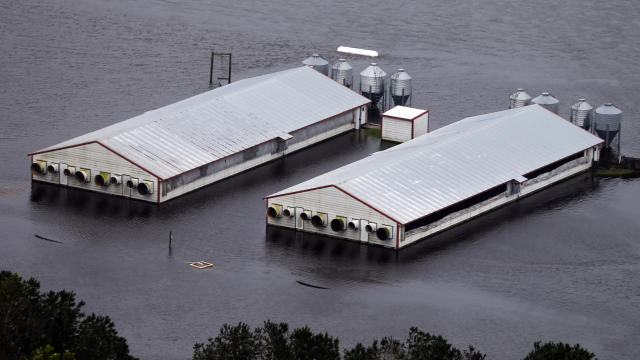
Flooded rivers from Florence’s driving rains have begun to swamp coal ash dumps and low-lying hog farms, raising pollution concerns as the swollen waterways approach their crests Monday.
Duke Energy said the weekend collapse of a coal ash landfill at the mothballed L.V. Sutton Power Station near Wilmington, North Carolina, is an “on-going situation,” with an unknown amount of potentially contaminated storm water flowing into a nearby lake. At a different power plant near Goldsboro, three old coal ash dumps capped with soil were inundated by the Neuse River.
An Associated Press photographer who flew over eastern North Carolina’s Trent River on Sunday saw several flooded hog farms, their long metal buildings ringed by dark water. Such farms typically have large pits filled with hog urine and feces that can cause significant water contamination if breached. State regulators said they hadn’t received any reports of spills so far.
An AP analysis of location data from hog waste disposal permits shows at least 45 active North Carolina farms are located in 100-year and 500-year floodplains.
Federal forecasters predicted several rivers would crest at record or near-record levels by Monday, and high water could linger for days. Officials with the N.C. Park Council, and industry trade group, said farmers had prepared for the storm by lowering water levels in waste ponds and moving animals to higher ground.
At the closed Sutton plant, Duke spokeswoman Paige Sheehan said a full assessment of how much ash escaped from the water-slogged landfill can’t occur until the rain stops. She said there was no indication that any contaminants had reached the nearby Cape Fear River.
The company initially estimated Saturday that about 2,000 cubic yards (1,530 cubic meters) of ash were displaced, enough to fill about 180 dump trucks. Sheehan said the estimate could be revised later.
The coal-fired Sutton plant was retired in 2013 and the company has been excavating millions of tons of ash from old waste pits and removing it to safer lined landfills constructed on the property. The gray ash left behind when coal is burned contains toxic heavy metals, including arsenic, lead and mercury.
Sheehan also said three inactive ash basins at the H.F. Lee Power Station near Goldsboro were under water.
State environmental regulators said they’ve been unable to inspect the Sutton landfill because of flooding.
Duke’s handling of ash waste has faced intense scrutiny since a drainage pipe collapsed under a waste pit at an old plant in Eden in 2014, triggering a massive spill that coated 70 miles (110 kilometers) of the Dan River in gray sludge. The utility later agreed to plead guilty to nine Clean Water Act violations and pay $102 million in fines and restitution for illegally discharging pollution from ash dumps at five North Carolina power plants. It plans to close all its ash dumps by 2029.
Environmentalists have warned for decades that Duke’s coal ash ponds were vulnerable to severe storms, potentially threatening drinking water supplies and public safety.
“Disposing of coal ash close to waterways is hazardous, and Duke Energy compounds the problem by leaving most of its ash in primitive unlined pits filled with water,” said Frank Holleman, a senior attorney at the Southern Environmental Law Center.
He said he hoped “Duke Energy will commit itself to removing its ash from all its unlined waterfront pits and, if it refuses, that the state of North Carolina will require it to remove the ash from these unlined pits.”
Associated Press data journalist Angeliki Kastanis is in Los Angeles and writer Gary D. Robertson contributed from Raleigh.