Oil Plunges Below Zero for First Time in Unprecedented Wipeout

Bloomberg

Oil Plunges Below Zero for First Time in Unprecedented Wipeout
Catherine Ngai, Olivia Raimonde and Alex Longley        April 20, 2020

(Bloomberg) — Of all the wild, unprecedented swings in financial markets since the coronavirus pandemic broke out, none has been more jaw-dropping than Monday’s collapse in a key segment of U.S. oil trading.

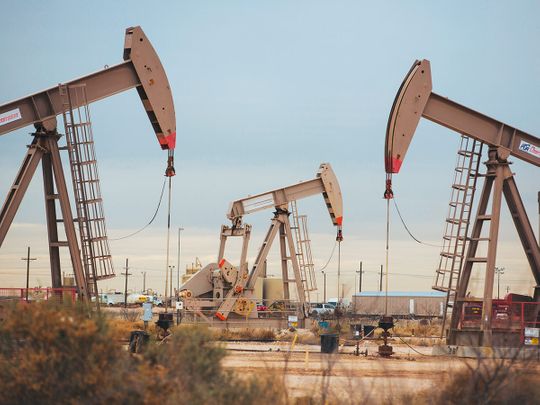
The price on the futures contract for West Texas crude that is due to expire Tuesday fell into negative territory — minus $37.63 a barrel. The reason: with the pandemic bringing the economy to a standstill, there is so much unused oil sloshing around that American energy companies have run out of room to store it. And if there’s no place to put the oil, no one wants a crude contract that is about to come due.

Underscoring just how acute the concern is over the lack of immediate storage space, the price on the futures contract due a month later settled at $20.43 per barrel. That gap between the two contracts is by far the biggest ever.

“The May crude oil contract is going out not with a whimper, but a primal scream,” said Daniel Yergin, a Pulitzer Prize-winning oil historian and vice chairman of IHS Markit Ltd.

“There is little to prevent the physical market from the further acute downside path over the near term,” said Michael Tran, managing director of global energy strategy at RBC Capital Markets. “Refiners are rejecting barrels at a historic pace and with U.S. storage levels sprinting to the brim, market forces will inflict further pain until either we hit rock bottom, or COVID clears, whichever comes first, but it looks like the former.”

Since the start of the year, oil prices have plunged after the compounding impacts of the coronavirus and a breakdown in the original OPEC+ agreement. With no end in sight, and producers around the world continuing to pump, that’s causing a fire-sale among traders who don’t have access to storage.

The extreme move showed just how oversupplied the U.S. oil market has become with industrial and economic activity grinding to a halt as governments around the globe extend shutdowns due to the swift spread of the coronavirus. An unprecedented output deal by OPEC and allied members a week ago to curb supply is proving too little too late in the face a one-third collapse in global demand.

There are signs of weakness everywhere. Even before Monday’s plunge, buyers in Texas were offering as little as $2 a barrel last week for some oil streams. In Asia, bankers are increasingly reluctant to give commodity traders the credit to survive as lenders grow ever more fearful about the risk of a catastrophic default.

In New York, West Texas Intermediate for May delivery dropped as low as negative $40.32 a barrel. It’s far below the lowest level previous seen in continuation monthly data charts since 1946, just after World War II, according to data from the Federal Reserve Bank of St. Louis. Brent declined 8.9% to $25.57 a barrel.

Crude stockpiles at Cushing — America’s key storage hub and delivery point of the West Texas Intermediate contract — have jumped 48% to almost 55 million barrels since the end of February. The hub had working storage capacity of 76 million as of Sept. 30, according to the Energy Information Administration.

Fund Inflow

Despite the weakness in headline prices, retail investors are continuing to plow money back into oil futures. The U.S. Oil Fund ETF saw a record $552 million come in on Friday, taking total inflows last week to $1.6 billion.

The price collapse is reverberating across the oil industry. Crude explorers shut down 13% of the American drilling fleet last week. While production cuts in the country are gaining pace, it isn’t happening quickly enough to avoid storage filling to maximum levels, said Paul Horsnell, head of commodities at Standard Chartered.

”The background psychology right now is just massively bearish,” Michael Lynch, president of Strategic Energy & Economic Research Inc said in a phone interview. “People are concerned that we are going to see so much build up of inventory that it’s going to be very difficult to fix in the near term and there is going to be a lot distressed cargoes on the market. People are trying to get rid of the oil and there are no buyers.”

For more articles like this, please visit us at bloomberg.com

This Solar Panel Just Set a World Record for Efficiency

Popular Mechanics

This Solar Panel Just Set a World Record for Efficiency

Caroline Delbert, Popular Mechanics           
Photo credit: Tvn Phph Prung Sakdi / EyeEm - Getty Images
Photo credit: Tvn Phph Prung Sakdi / EyeEm – Getty Images From Popular Mechanics


  • A new solar panel has reached 47 percent efficiency in the lab and nearly 40 percent in the field.
  • This panel exceeds typical panels by combining six kinds of collectors into one micro-thin surface.
  • Researchers say the same tech could be fine-tuned to reach a full 50 percent efficiency.

A new kind of solar technology has set a world record for the most efficient generation of energy by a solar cell. By stacking six different photo-active layers, the record-setting multi-junction cell has reached nearly 50 percent efficiency in the lab and nearly 40 percent in “single sun” real-life conditions.

There’s a bit of jargon to unpack before we can really understand what a big deal this is. First, a multi-junction cell is just a solar collector cell that uses more than one “junction,” or layer, of solar technology. Because sunlight covers such a wide range of wavelengths, different kinds of receivers are able to pick up different wavelengths of light in order to cover more of the total available spectrum.

Individual types of solar might have efficiency of, say, 8 percent—meaning 92 percent of sunlight is just reflected off like any other surface, but 8 percent is absorbed and collected as energy. (That number is just a math example; most panels are 15 to 18 percent efficient.) By stacking the technologies from six different solar cells, solar researchers can ratchet up that efficiency multiple times over.

The more efficient an overall technology is, the more we can shrink panel size while keeping the same energy production. That can mean panels that are: cheaper for consumers outfitting their homes, smaller, able to be shaped around tiny or complicated surfaces, and able to power a lot more stuff. Imagine if one gallon of paint suddenly covered five times more area, or if one meal could feed five people.

In total, there are 140 layers of the six different solar collector materials. Even so, the entire collecting surface is one-third the thickness of a human hair. The research team used different semiconductors and carefully arranged them to maximize usable surface area through all 140 layers. “Further reduction of the series resistance within this structure could realistically enable efficiencies over 50 [percent],” the researchers say.

The semiconductors are of a type called III-V, which is a family of alloys made by combining elements from periodic table group III with those from group V. In fact, the elements from both III and V groups are primarily known in alloy form.

“Because of the unique properties of the compound III-V semiconductors, they have been the source of a rich world of science, technology and applications,” Sandia National Laboratory said in a 2004 report. “This world has, on the science side, led to 7 Nobel Prizes in Physics; and, on the applications side, led to a roughly US $12B global chip market in 2001, projected to become US $31B in 2006.”

It sounds like III-V’s next Nobel trick could be for revolutionizing solar panel efficiency, with a world record that translates directly into more renewable energy and more energy density during uncertain global times.

Megadrought’ the worst in centuries, study says.

Associated Press

Megadrought’ the worst in centuries, study says.

Associated Press,            
This photo from 2013 shows a bathtub ring marking the high-water line along Black Canyon on Lake Mead. A two-decade-long dry spell is turning into a megadrought in the western United States. (Julie Jacobson/Associated Press)


And about half of this historic drought can be blamed on man-made global warming, according to a study published Thursday in the journal Science.

Researchers focused on a nine-state area from Oregon and Wyoming down through California and New Mexico, plus a sliver of southwestern Montana and parts of northern Mexico. They used thousands of tree rings to compare a drought that started in 2000 and is still going (despite a wet 2019) to four previous megadroughts since the year 800.

Using soil moisture as the key measurement, they found only one other drought that was as big — and was probably slightly bigger. That one began in 1575, just 10 years after St. Augustine, the first European city in the United States, was founded, and it ended before the Pilgrims landed on Plymouth Rock in 1620.

What’s happening now is “a drought bigger than what modern society has seen,” said study lead author A. Park Williams, a bioclimatologist at Columbia University.

Daniel Swain, a UCLA climate scientist who wasn’t involved in the research, called the work important because it provides evidence “that human-caused climate change transformed what might have otherwise been a moderate long-term drought into a severe event comparable to the ‘megadroughts’ of centuries past.”

What’s happening is that a natural but moderate drought is being worsened by temperatures that are 2.9 degrees Fahrenheit (or 1.6 degrees Celsius) hotter than in the past and that suck moisture out of the ground, Williams said.

“We’ve been increasingly drifting into a world that’s getting dryer,” Williams said.

To quantify the role of global warming, researchers used 31 computer models to compare what’s happening now to what would happen in a hypothetical world without the burning of fossil fuels that spews billions of tons of heat-trapping gases. They found that, on average, 47% of the drought could be blamed on human-caused climate change.

There’s debate among scientists over whether this current drought warrants the title “megadrought” because it has lasted only two decades — so far — while others are at least 28 years long.

Climate scientist Clara Deser  at the National Center for Atmospheric Research, who wasn’t part of the study, said that while the research is good, she thinks the deep drought has to last another decade or so to qualify as a “megadrought.”

Williams said he understands the concern and that’s why the study calls it “an emerging megadrought.”

“It’s still going on and it’s 21 years long,” Williams said. “This drought looks like one of the worst ones of the last millennium except for the fact that it hasn’t lasted as long.”

University of Michigan climate scientist Jonathan Overpeck, who studies the Southwestern climate and was not part of the study, calls it “the first observed multidecadal megadrought in recorded U.S. history.”

Although last year was wet, the recent rain and snow was not nearly enough to make up for the deep drought years before, said Williams, who added that past megadroughts have had wet years.

The U.S. drought monitor puts much of Oregon, California, Colorado, Utah and Nevada and good chunks of New Mexico, Arizona and Idaho in abnormally dry, moderate or severe drought conditions. Wyoming is the only state Williams studied that doesn’t have large areas of drought.

This week, water managers warned that the Rio Grande is forecast to have water flows less than half of normal, while New Mexico’s largest reservoir is expected to top out at about one-third of its 30-year average.

This is “what we can expect going forward in a world with continued global warming,” said Stanford University climate scientist Noah Diffenbaugh, who wasn’t part of the study.

‘Megadrought’ emerging in the western US might be worse than any in 1,200 years

USA Today – Science

‘Megadrought’ emerging in the western US might be worse than any in 1,200 years

Doyle Rice, USA TODAY           
'Megadrought' emerging in the western US might be worse than any in 1,200 years
‘Megadrought’ emerging in the western US might be worse than any in 1,200 years


Fueled in part by human-caused climate change, a “megadrought” appears to be emerging in the western U.S., a study published Thursday suggests.

In fact, the nearly-20-year drought is almost as bad or worse than any in the past 1,200 years, scientists say.

Megadroughts – defined as intense droughts that last for decades or longer – once plagued the Desert Southwest. Thanks to global warming, an especially fierce one appears to be coming back:

“We now have enough observations of current drought and tree-ring records of past drought to say that we’re on the same trajectory as the worst prehistoric droughts,” said study lead author A. Park Williams, a bioclimatologist at Columbia University, in a statement. This is “a drought bigger than what modern society has seen.”

Scientists say that about half of this historic drought can be blamed on man-made global warming. Some of the impacts today include shrinking reservoirs and worsening wildfire seasons.

Since temperatures are projected to keep rising, it is likely the drought will continue for the near future – or fade briefly only to return, researchers say.

The study covers an area stretching across nine U.S. states from Oregon and Montana down through California, New Mexico and part of northern Mexico.

Daniel Swain, a UCLA climate scientist who wasn’t part of the study, called the research important because it provides evidence “that human-caused climate change transformed what might have otherwise been a moderate long-term drought into a severe event comparable to the ‘megadroughts’ of centuries past.”

Williams said that “because the background is getting warmer, the dice are increasingly loaded toward longer and more severe droughts. We may get lucky, and natural variability will bring more precipitation for a while.

“But going forward, we’ll need more and more good luck to break out of drought, and less and less bad luck to go back into drought,” he said.

Williams said the region could stay dry for centuries. “That’s not my prediction right now, but it’s possible.”

Naturally occurring western megadroughts have taken place many times before. In fact, most of the USA’s droughts of the past century, even the 1930’s Dust Bowl that forced migrations of Oklahomans and others from the Plains, “were exceeded in severity and duration multiple times by droughts during the preceding 2,000 years,” the National Climate Assessment said.

The difference now, of course, is the western USA is home to more than 70 million people who weren’t here for the previous medieval megadroughts. The implications are far more daunting.

University of Michigan environment dean Jonathan Overpeck, who studies southwestern climate and was not part of the study, calls this drought “the first observed multidecadal megadrought in recorded U.S. history.”

To identify past droughts, scientists studied thousands of tree rings to find out how much – or little – rain fell hundreds of years ago. Scientists used historical data in combination with several computer model simulations to reach their conclusions.

One additional worrisome fact from the study was that the 20th century was the wettest century in the entire 1,200-year record. It was during that time that the population boomed in the western U.S., and that has continued.

“The 20th century gave us an overly optimistic view of how much water is potentially available,” said study co-author Benjamin Cook, a NASA climate scientist, in a statement.

“It goes to show that studies like this are not just about ancient history,” he said. “They’re about problems that are already here.”

The study was published Thursday in the peer-reviewed journal Science.

Contributing: The Associated Press

Growing a Vegetable Garden Might Be Just What You Need During the Coronavirus Crisis

Architectural Digest

Growing a Vegetable Garden Might Be Just What You Need During the Coronavirus Crisis

Stefanie Wal       April 3, 2020

It’s been a few weeks since the COVID-19 pandemic halted the world, forcing us to retreat into our homes and forgo physical social contact—and it doesn’t look like we’ll be freed any time soon. Though grocery stores are open for business, authorities from governors to the Centers for Disease Control and Prevention (CDC) have asked that we minimize our outings into the public world, which got us thinking: what better time to plant your own vegetable garden? Not only could this help you skip the trip to the store once the produce comes in, but it also could provide some much-needed stress relief. We asked some gardening experts for tips and tricks to design a garden and grow produce in your backyard or patio.

Designing a Garden

Before you dive in with your trowel and seeds, you’ll want to spend some time designing your garden’s layout. Start by observing how much sunlight is in your yard or patio. “Consider where the vegetable garden is going. It should go in the sunniest spot, as most vegetables require lots of direct sun,” says landscape designer Kathryn Herman. But don’t fret if you have a little bit of shade. “Some vegetables, like salad greens, can take a small amount of shade,” says landscape designer Deborah Nevins.

When it comes to designing a layout, keep in mind that gardens take work. You’ll need to be out there watering, weeding, and harvesting, so you’ll want to leave areas between your beds where you can tread safely. “We like making the garden beds easy to access, so a three-foot-wide by eight-foot-long bed with space on either side allows circulation to get to both sides,” says Herman. “The space on either side of the bed can be lawn, or it can be gravel, or it can be a paved surface.”

And if you don’t have a full yard, don’t worry—there are plenty of ways to make do with a small space like a patio, a window box, or even a section of your driveway. “Plant in containers or a small raised bed,” says Tara Nolan, author of Gardening Your Front Yard and co-owner of Savvy Gardening. “You just need to make sure the space gets at least six to eight hours of sunlight a day. There are many compact plant varieties that are perfect for small spaces. Look for words like mini, dwarf, or patio on seed packets.”

Close up of basket of fresh vegetables on garden soil. Cool weather crops include carrots and other root veggies. Photo: Getty Images/Aleksander Rubtsov

Choosing What to Plant

There’s quite a variety of produce to choose from for your vegetable garden, and the good news for beginners is that it’s relatively easy to grow the vast majority of them. “Plants are really simple, especially vegetable plants,” says Shelby DeVore, founder of homesteading website Farminence. “There are two main types of vegetable plants that are suitable for first-time gardeners: fruit crops like tomatoes and cucumbers, and vegetative crops that are grown for their leaves, like spinach and lettuce.”

To help you narrow down your selection, consider the size of your garden—and the colors you want to see. “There is a large variety of tomatoes, peppers, eggplants, and lettuces that come in many forms and colors, which can add another level of interest to the garden,” says Herman. “These vegetables are suitable for a smaller bed, while vegetables like squash, cucumbers, and melons require more space to spread out.”

Something else to think about: Some plants grow better during different times of year. “Cool-weather crops like peas; root veggies like beets and carrots; and members of the Brassica genus, like cabbage, kale, and brussels sprouts, can be sown in early spring, while the heat-lovers like tomatoes, melons, and cucumbers are planted after all threat of frost has passed,” says Nolan. “Google your region and the area’s frost-free date, which will help you know when to plant.”

And, of course, grow what you want to eat! “Red Russian kale is one of my personal favorites,” says designer Christopher Spitzmiller. “It’s easy to grow and has nearly flat leaves that are easy to roll up and cut into small coleslaw-like pieces that make a great salad all summer and into the early winter.”

Plants Growing At Vegetable Garden. Make sure to research your region to know when to plant certain seeds. Photo: Getty Images/Ivana Drozdov

Gardening Tips

Follow these tips from our experts and you’ll be on your way to self-grown fresh produce in no time!

1. Consider starting your garden indoors if it’s still cold out

Although it’s just about the right time of year to get outdoors, you can start your garden inside if you’re in a colder climate. “We have lots of seeds started under grow lights in our garage,” says Spitzmiller. “We’ve started all sorts of lettuces, cabbages, and arugula.”

2. Make sure you’re using good soil

When it comes to gardening, it’s crucial to have healthy soil for robust growth. “You have to determine the quality of your soil regarding nitrogen, phosphorus, and potassium, and you need to see if the soil drains well,” says Nevins. And don’t forget fertilizer! “Composted manure can be worked in to help add organic matter into the soil,” says Herman.

3. Check on them daily

Pay attention to your plants, as their physical appearance can alert you to any issues they might have. “Plants that aren’t getting enough water will be droopy, but most people know that,” says DeVore. “They’ll also let you know if they have a disease or nutritional issue. Check the leaves for yellow or brown spots. Wilted, yellow, purple, or curled leaves can be a sign that something is wrong.”

4. Don’t get discouraged

“First-timers should know that even the most experienced gardeners can have issues, and not to be discouraged,” says Nolan. “Sometimes issues like pests, or even excessive rain, can affect crops. The key is to figure out what went wrong and how you can mitigate those circumstances next time.”

Originally Appeared on Architectural Digest

10 Perennials That’ll Add Tons of Color to Your Garden

House Beautiful

10 Perennials That’ll Add Tons of Color to Your Garden

Plant these sun lovers for long-lasting color that returns every year

By Arricca Sansone       March 31, 2020

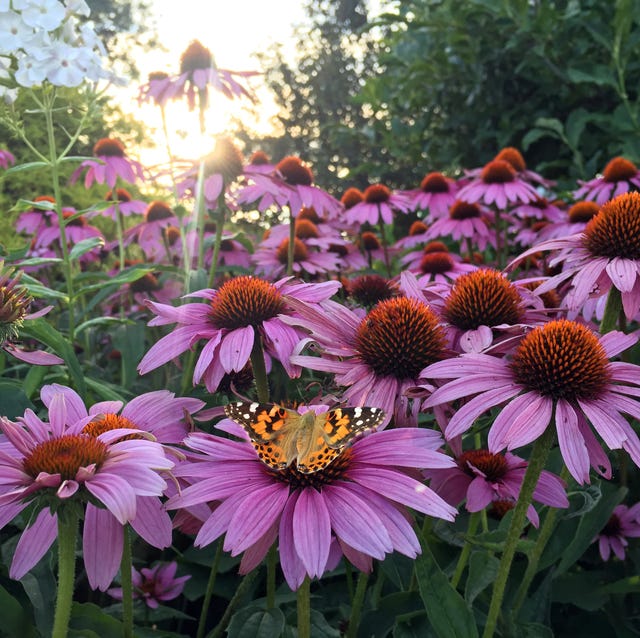
Painted Lady Butterfly resting or collecting pollen nectar from Pink Cone Flowers
CAPPI THOMPSON GETTY IMAGES


Got sun? Perennials that thrive in full sun, considered 6 or more hours per day, provide long-lasting color to gardens or containers on your deck, patio or balcony. Best of all, they come back every year so you’ll get more bang for your buck! For starters, read the plant tag or description to learn if a plant will survive in your USDA Hardiness zone (find yours here). Dig a hole about twice the size of the pot, then set it in the ground or pot at the same level it was in the container. Water thoroughly, and keep an eye on it during dry spells. Even drought-tolerant plants need TLC the first season, so don’t ignore them and let them dry out. Then be patient! Perennials may not look like they’re doing much for the first season or two. In fact, there’s a saying that perennials crawl the first year, walk the second, and take off running the third season in the ground.

Here are a few of our favorite hardy perennials for full sun:

Catmint
Catmint / Catnip, Nepeta racemosa 'Walker's Low' - II
ALPAMAYO PHOTO GETTY IMAGES


Catmint has fuzzy foliage and purple-blue flower spikes that last for several weeks in mid-summer. It has a pleasantly spicy, minty scent when you brush against it. Newer types keep a nice, mounded shape.

Varieties to try: Cat’s Meow, Walker’s Low

Bee Balm
Red Bee Balm Perennial Flower Monardo
BG WALKER GETTY IMAGES


This pollinator favorite comes in shades of pinks, purples, and reds. The fringed, spikey flowers are heat and cold-tolerant and look best planted in huge swaths. New types are more disease-resistant.

Varieties to try: Pardon My Lavender, Leading Lady Plum

Black-eyed Susan
Field of Black-Eyed Susan
NIKKI O’KEEFE IMAGES GETTY IMAGES


They’re sturdy, have a long bloom time, and look like happy, smiling faces. What other reasons do you need to plant this cheery plant? They bloom from mid-summer to fall. Read the tag because some are perennial, while others only last two years (biennial) so they’re treated as annuals and replanted every year.

Varieties to try: American Gold Rush, Indian Summer

False Indigo
False Indigo
DOLE08 GETTY IMAGES


False indigo, also known as baptisia, has beautiful spires of indigo blue, pink, yellow or white flowers, followed by bushy seedpods in the fall. Pollinators of all types love it, too!

Varieties to try: Decadence Cherries Jubilee, Twilight Prairieblues

Daylily
Daylilies
BAUHAUS1000 GETTY IMAGES


Daylilies don’t need coddled, so they’re a good choice if you’re a hands-off kind of gardener. They bloom for just one day (as the name suggests) but in great numbers. In a few years, you’ll have enough to divide them and plant elsewhere in your garden.

Varieties to try: Rainbow Rhythm Nosferatu, Romantic Returns

Sedum
Blooming flowers
XUANYU HAN GETTY IMAGES


With hundreds of varieties in many different forms, sedum has fleshy leaves to help it survive dry spells. Sedum comes in low-growing or creeping types as well as more upright forms, so you’ll find one for every garden setting.

Varieties to try: Lemon Coral, Firecracker

Balloon Flower
Purple balloon flower
CHRIS HACKETT GETTY IMAGES


This adorable perennial has plump, round buds that burst into star-shaped blue flowers. It blooms mid-summer for several weeks.

Varieties to try: Fuji, Astra Pink

Penstemon
Close-up image of the beautiful summer flowering vibrant pink flowers of the Penstemon also known as beardtongues
JACKY PARKER PHOTOGRAPHY GETTY IMAGES


Penstemon, also called beardtongue, has stately upright spikes of deep pink or purple flowers with dark green or burgundy leaves. The pretty foliage is bright and colorful all season long after the tubular-shaped flowers fade.

Varieties to try: Midnight Masquerade, Blackbeard

Coneflower
Close-up image of the vibrant red Echinacea 'Salsa red' also known as Coneflowers
JACKY PARKER PHOTOGRAPHY GETTY IMAGES


With vibrant colors in every shade of the rainbow, coneflowers are reliable performers. They range in height from about 12 to 36 inches tall. Read the plant tag to see how tall each variety gets so you’ll know if it’s best in the back, middle or front of the border.

Varieties: PowWow Wild Berry, Pink Double Delight

10 Speedwell
image
WALLY EBERHART/VISUALS UNLIMITED, INC.GETTY IMAGES


Spikes of deep purple, pink or white flowers cover the low-growing deep green foliage. Speedwell, also called veronica, works well in the front of borders, and bees and butterflies enjoy it, too!

Varieties to try: Blue Sprite, Magic Show Pink Potion

Arricca SanSone has written about health and lifestyle topics for Prevention, Country Living, Woman’s Day, and more.

‘Your wealth or your 401(k) isn’t going to protect you’

Yahoo Finance

‘Your wealth or your 401(k) isn’t going to protect you’: NYU’s Galloway

Julia La Roche, Correspondent Yahoo Finance      March 27, 2020


Scott Galloway, professor of marketing at NYU Stern School of Business, believes we will emerge from COVID-19 pandemic to a “much different” world.

In an interview with Yahoo Finance, Galloway explained that one of the advantages of the human species is its ability to adapt, with the critical question being, “What will we learn?”

“[I’m] hopeful that corona might end up serving, if you will, as a bit of a vaccination itself. And, that is, if you had the virology of corona and the mortality of Ebola, you could have the end of our species. And, this might be an opportunity for us to really battle test our systems, immunize our beliefs, our capital allocation, and our industries such that if and when this happens again — because it’s not if, it’s when — that we’re better prepared for it,” Galloway said.

For starters, the NYU professor expects the U.S. will probably “rethink our priorities in capital allocation.” He pointed out that throughout history, pathogens have resulted in more death of people than violence or war combined. Yet, the budget for the Department of Defense is north of $680 billion, while the CDC’s is only around $12 billion.

A COVID-19 testing tent is setup on a sidewalk in the Brooklyn borough of New York, Friday, March 27, 2020. (AP Photo/John Minchillo)


What’s more, he expects Americans will wake up to the fact that defunding government in critical areas such as climate change or pathogens will have consequences that wealth won’t be able to shield.

“It’s become evident that the virus doesn’t care about your political ideology, or your wealth, or your status. In America, I think we’ve taken cold comfort in believing that we’re all going to be rich and that none of us are ever going to get sick,” he said, later adding, “Your wealth or your 401(k) isn’t going to protect you.”

In terms of the future of business, Galloway believes that new sectors and companies will emerge, from distributed health and telehealthcare to the growth in online education that will disrupt the limited number of enrollment spots on university campuses.

Most importantly, he hopes that people will walk away, recognizing “the greatness in the agency of others.”

“I’d like to think a lot of what we’re taking from this is that viruses have no respect for borders, and what can we learn from our allies, how can we join hands and fight this collectively? Such that again, we realize a comity of man here. And that this supersedes a lot of things we were concerned out before this,” he said.

Julia La Roche is a Correspondent at Yahoo Finance. 

Coronavirus is a fast-forward version of what will happen with climate change

Yahoo – Lifestyle

Coronavirus is a fast-forward version of what will happen with climate change

Ryan Cooper, The Week                       


The United States will shortly become the epicenter of the novel coronavirus pandemic, if it isn’t already. At time of writing some 60,653 American cases have been confirmed, and 784 people have died. It’s going to get much, much worse before it gets better — especially if President Trump goes ahead with his evident plan to open the country back up before the virus is controlled.

It’s very hard to get one’s mind around the scale of the developing calamity. But it also provides an important window into a potential future of unchecked climate change. The coronavirus pandemic is a warp-speed tutorial in what will happen if we don’t get our act together and slash greenhouse gas emissions.

The skyrocketing U.S. number of coronavirus cases and deaths is the direct consequence of President Trump’s previous inattention and delay months ago. By late December it was clear there was a major risk the virus was going to get out of China, yet Trump didn’t set up pre-emptive containment measures. He didn’t set up testing or quarantine facilities, and didn’t even shut down commercial travel from China until January 31, which was almost certainly already too late — and in any case his administration bungled the transportation of 14 infected Americans so badly that they may have seeded several outbreaks on their own.

As a result, the virus has been spreading in the wild in the U.S. since late January or early February, and the entire time Trump has dragged his feet on setting up an all-out response. He was slow to activate the Army Corps of Engineers, slow to get behind economic rescue plans, and slow to take steps to ramp up the production of tests. To this day he refuses to actually invoke the Defense Production Act to secure needed supplies of ventilators and other medical equipment, leading to chaos as states and foreign countries desperately bid against each other for what remains. Now hospitals are starting to be overwhelmed across the country, and the corpses are piling up.

This is what an uncontrolled, exponentially-accelerating crisis looks like on the ground: first slow, then all at once. Past procrastination and dithering means that once the seriousness of what is happening is undeniable, the worst effects can only be mitigated, not avoided.

Climate change is going to be exactly like this, only on a much longer time scale. Decades have passed with greenhouse gas emissions rising steadily, yet so far the carnage has been relatively modest. The sea level keeps inching up, biological systems are increasingly stressed, ordinary weather patterns keep getting more and more odd, and extreme weather disasters keep getting worse and worse, but so far most human societies have not been seriously threatened.

Absent gargantuan efforts across the world to wrench down emissions, in a couple decades that is going to change very fast. Normal weather patterns will simply not happen anymore. Some areas will suffer devastating drought, and others heavy precipitation — and some places, like California, will swing wildly between the two. Sea level rise will begin to swallow cities where hundreds of millions of people live. Extreme weather disasters — floods, tornado outbreaks, hurricanes, dust storms, and so on — will obliterate crops and crush cities around the world. Many biological systems will break completely, and food sources for billions of people will vanish. Hundreds of millions of refugees will stream around the world.

Indeed, there might well be additional outbreaks of pandemic diseases. Ancient pathogens are still alive in the Siberian permafrost, including anthrax, and possibly smallpox. As the permafrost melts, these could break out and infect a human population with no resistance.

All that is exceptionally grim. However, there may be a glimmer of hope in the response to this coronavirus epidemic. Outside of the United States and Brazil, virtually every country has thrown aside traditional political worries and attacked the pandemic with unprecedented speed and aggression. Concerns about national deficits, printing money, or increasing welfare benefits have evaporated in the face of a society-wide threat. Countries are outright nationalizing whole industries at the drop of a hat. Even in the U.S., after a primary season dominated by moronic “how are you going to pay for that?” concerns, Congress is casually debating a $2 trillion economic rescue package.

What we see is that when sufficiently motivated, countries really can transform themselves practically overnight. Whole continents have gone into emergency lockdown with as few people working as possible. Emissions are tanking with little transportation or production happening. The air around cities like Los Angeles is amazingly clear with so few pollution-spewing cars on the road.

A bold, world-wide climate policy would not be like the coronavirus response in the details or objectives, but the scale is about right. We need to radically transform our systems of manufacturing, energy, agriculture, and transportation, and it needs to happen as soon as possible. If we can completely overhaul whole countries in a matter of days to fight off a pandemic, we could do the same thing to forestall disastrous climate change. It’s just a question of political will.

Small Farms Also Struggle as Restaurants Shut Down Due to Coronavirus

Civil Eats

Small Farms Also Struggle as Restaurants Shut Down Due to Coronavirus

With the sudden closure of restaurants around the country, farmers are looking for new ways to feed their communities and stay afloat.


At Norwich Meadows Farm in upstate New York, Zaid Kurdieh and his wife Haifa grow varieties of vegetables coveted by New York City chefs. If this were a normal week, diners would be enjoying their produce at restaurants like Blue HillABC Kitchen, and Gramercy Tavern. Due to the coronavirus outbreak, however those restaurants are closed indefinitely—creating a dire situation for them and others like them. But it’s not just restaurant owners and workers who stand to suffer in the wake of the virus.

While it’s still unclear how all farmers will be economically impacted by the coronavirus, the situation is already affecting small-scale producers who sell into local markets.

“It’s unprecedented. I’ve never seen anything like this,” Kurdieh said, estimating that about 60 percent of his business depends on restaurants, and at this time of year, that number is closer to 75 percent. “We are figuring everything out day by day.”

The fate of farmers’ markets is still uncertain in many places, but COVID-19’s catastrophic effect on restaurants that buy from local growers is now assured. President Trump issued new guidelines on Monday that advised Americans to avoid groups of 10 or more people and called for governors in affected states to close restaurants and bars. Before that, governors in many states across the country had already ordered restaurants closed except for takeout and delivery.

Mayors in cities such as New York, Los Angeles, and Washington, D.C. all issued similar but varying directives. And in places where government officials haven’t stepped in, many restaurants are closing anyway, either out of necessity due to lack of customers or in service of the public interest to slow the spread of the virus.

“We really rely on restaurants,” Joe Schirmer, owner of Dirty Girl Produce, a 40-acre organic farm in Santa Cruz, California told Civil Eats on Monday. “[Those sales are] at zero. It’s totally done. There are no restaurants buying.”

The shuttering of institutions—especially schools—is also affecting small farms. As of March 16, 35 states had closed public schools.

Sky Island Farm's Kate Harwell. (Photo courtesy of Sky Island Farm)

Kate Harwell. (Photo courtesy of Sky Island Farm)

Kate Harwell grows vegetables, fruit, herbs, and flowers at Sky Island Farm in Grays Harbor, Washington, a couple of hours outside of Seattle. She had been structuring her whole season around starting a contract to sell produce to Seattle public schools starting in mid-April.

“We were basically going to be wholesaling a large percentage of what we’re growing to them. That was going to be a big chunk of money,” she said. Seattle schools are now officially closed through April 24, and Harwell hasn’t heard back from her district contact. “I’m sure she’s dealing with a lot right now,” she said.

Given the uncertainty around when schools will reopen, Harwell is now working with the assumption that she has lost that sales channel. Her goal is to make up the income by shifting gears and expanding her community supported agriculture (CSA) program, which she had previously kept small.

After she reopened it and began posting about it on Instagram, including a new offer for home delivery, her membership grew faster than it ever had before. “I got 10 sign-ups just yesterday,” she said.

And she’s not alone. Many farmers are pivoting from restaurant and institutional sales to sell directly to customers who are holed up at home. In New York, Kurdieh is ramping up online sales of his produce through the platform OurHarvest. In the Bay Area, which instituted a “shelter in place” order as of March 17, Schirmer is working on quickly putting together a “box” program with both pick-up and delivery options. (Essential activities including food shopping and medical visits are not restricted by the order.)

One of his oldest restaurant customers, Zuni Café, is helping put together a produce pick-up that will aggregate local food from Dirty Girl Produce and other farms they work with. In an Instagram post on Monday, the restaurant hinted at the initiative. “In the coming days we will be starting a new project that we are hopeful will keep our farmers connected to everyone,” they wrote.

Schirmer said there has been an outpouring of support from the local food community, and that keeping the business afloat will require his team to be extraordinarily nimble. “We’ve got food, we’ve got a crew, we’ve got trucks and infrastructure,” he said. “We’re just changing our business model on the fly.”

Emma Jagoz, small farmer at Moon Valley Farm.

Emma Jagoz. (Photo courtesy of Moon Valley Farm)

Like many East Coast farms, Moon Valley Farm, a favorite supplier for restaurants in Baltimore and Washington, D.C., would typically be gearing up to start its CSAseason in the coming weeks. But farmer Emma Jagoz announced on Saturday that the farm would begin “veggie home delivery,” offering a la carte CSA shares (rather than requiring a seasonal commitment) delivered to customers, starting this week.

Also in Maryland, Beckie Gurley owns the seven-acre organic fruit and vegetable farm Calvert’s Gift Farm with her husband, Jack. She also runs Chesapeake Farm to Table, a platform that has aggregated produce from local growers to sell to restaurants in Baltimore, including Rye Street TavernDylan’s, and Larder.

“Of course [the closures] are going to affect our bottom line,” Gurley said, but the cooperative is in a better position than it would be otherwise, because it already has the capacity to take online orders and offer home delivery. “We’re hoping the word gets out. In order to recoup the lost restaurant business, we hope that we can get these direct sales moving, and people realize we’re out there and how safe and available local food is.”

Gurley has also set up a pick-up point for produce orders in conjunction with a restaurant partner, Well Crafted Kitchen, that is continuing to operate a takeout business.

So far, farmers say the pandemic is not affecting them as much as it would during summer or fall, when most of their revenue generally comes in. But if it continues into peak harvest time, things are going to get much more difficult. “If this was peak season, this would be a disaster,” Kurdieh said. “We don’t know how this is going to turn out, but we’re planning [for summer] just as if it was a normal year, because I don’t know how else to do it.”

Depending on the length of the crisis, without restaurants and institutions, they may have to sell all their food directly to consumers.

“[We’re asking]: ‘How do we feed our communities?’ I think that’s the goal of every small farmer at this point,” Kate Harwell said. “If [global] commerce stops, we have to get our food from somewhere. I think people should absolutely start thinking about their local farmers, and I hope this puts them in a position to support them.”

Fighting Hunger with Community in the Era of Coronavirus

Civil Eats

Fighting Hunger with Community in the Era of Coronavirus

The founder of D.C. Central Kitchen offers a list of ways to feed and care for our neighbors in this time of uncertainty.


Coronavirus is producing a wave of need that will likely overwhelm most local food distribution charities and meal programs. But that doesn’t mean people have to go hungry.

Even before this virus hit, food banks and pantries were struggling to meet the needs of an estimated 37 million Americans who routinely struggle with hunger. Similarly, in many communities there’s a waiting list for Meals on Wheels, the main vehicle through which many home-bound elders access meals. Now, these and other networks are facing an unprecedented trifecta of difficulty.

Charitable donations of food and money—the lifeblood of all nonprofits—will likely be impacted by the economic tailspin caused by the virus. Volunteerism will also decrease, as companies, religious groups, schools, and individuals pull back out of concern for their members’ safety. (In addition, many volunteers are seniors, and they will need to step back from the work for their own safety.) Finally, demand for free and low-cost food will soar, as Americans of all ages, who are impacted by lay-offs, canceled events, and retirement plan losses will turn to charities for help.

We have to admit, as we have with our healthcare system, that our charitable systems aren’t prepared to meet an emergency of this level. So, we need to innovate—and we need to do it fast.

While the federal government weighs its response, and national groups including Feeding America, Meals on Wheels, and others work overtime to keep their networks sourced with food, we should also look at how to support our own communities in this unprecedented movement of anxiety, fear, and need. Here are my suggestions:

Launch an elder grocery support network. Many communities have Facebook or Nextdoor pages dedicated to sharing news. These can be activated to enlist healthy, willing, and able-bodied volunteers to shop and run errands for frightened, health-compromised elders. Physical contact must be limited, but volunteers can leave groceries outside people’s homes and funds can be transferred electronically before or after the supplies are bought. Volunteers can shop later at night to avoid crowds. Volunteers can also make stops at pharmacies or drug stores and elders should be reminded to buy things they might need if they become ill. For example, Gatorade or other forms of electrolytes could be vital. Also ask about pets’ needs.

Start a shared meal program. As you shop for your own supplies, consider buying extra food to prepare meals for neighbors. Rice and beans, soup, chili, and baked pasta are all easy, affordable options. Cost-conscious recipes are easy to find online. Food safety must be a priority. Cook food to a proper temperature, and deliver anything you make within two hours, to avoid contamination. Use disposable bowls and plates if you can, to avoid the need to return containers. If possible, try to use microwave-friendly packaging (avoid tinfoil and styrofoam). Write a note of comfort, and include the time the meal was cooked and any reheating directions.

Fight isolation. For many elders, the pain of loneliness often exceeds that of hunger. Organize your community to check in with people. Walk your neighbors’ dogs, help tend their gardens, or cut some spring flowers to brighten their worlds. You can chat, or drink a glass of wine together by phone or over video, which gives you the ability to communicate eye-to-eye with people. Either way, if you can help lessen the impact of this period of social isolation, it will go a long way.

As my friend Chef José Andrés of World Central Kitchen said recently, “Sometimes the bigger problems we face in humanity have simple solutions. But they don’t happen when we’re in continuous meetings about how to solve them.… Stop talking, stop planning, and start cooking.” I couldn’t agree more.

We’re in the midst of an unprecedented disaster, and we can’t expect charity, or the government to meet the rising need. Nor can we let fear overcome us. Now is the time to fight hunger with community. You can be a local hero who stands up and says, “Let’s do this.” All it takes is determination, compassion, and a working kitchen.