Florida shuts down bay known nationally for its oysters
Brendan Farrington
1 / 3
Exchange Oyster Fishery
FILE – In this April 2, 2015, file photo, Gene Dasher, left, and Frankie Crosby, center, use wire baskets on the end of 14-foot handles to tong oysters while Misty Crosby separates clumps of oysters at Apalachicola Bay, near Eastpoint, Fla. The Florida Fish and Wildlife Conservation will shut down wild oyster harvesting for as long as five years. The Commissioners hope that the pause and $20 million in restoration and monitoring, will restore a portion of the oyster fishery. (AP Photo/Mark Wallheiser, File)
TALLAHASSEE, Fla. (AP) — Because of a dwindling oyster population, a Florida agency voted unanimously Wednesday to shut down oyster harvesting in Apalachicola Bay through the end of 2025, dealing a blow to an area that historically produced 90% of the state’s oysters and 10% of the nation’s.
People in the area are divided between coming up with a long-term plan to save the industry, and allowing it to continue on a limited basis. The Florida Fish and Wildlife Conservation commission did express the hope of reopening the bay before the ban on commercial and recreational harvesting ends if oysters recover sooner.
“If we can get there faster, that’s everyone’s desire,” Commissioner Michael Sole said. “Look, time is money for these people. I understand why we’re saying a five-year time horizon, I just think that should be the outside edge of our closure and we should be driven to doing what we can to make this as fast as possible.”
The state is using a $20 million grant to help restore the bay, which used to support more than 100 families with its abundance of oysters.
“It breaks my heart, man. I’ve watched boats out there my whole life,” said Brandon Martina, who works at Lynn’s Quality Oysters, a bay-front business his family has run since 1971. The business started out as a wholesale oyster-shucking house, but as supplies dwindled, they converted it into a retail seafood shop and restaurant.
But instead of serving Apalachicola oysters, they’re buying them from Texas.
“We went from running tractor-trailer loads to getting maybe eight to 10 bags a day, so we just started doing a hatch shell bar,” he said.
The commission issued an emergency order in July shutting down oyster harvesting on Aug. 1 until it could consider the five-year shutdown. The industry has struggled for years, in large part because of a drain on freshwater flowing into the bay. Atlanta uses the water upstream as a water supply, and as it has drawn more water, it’s affected the salinity level in the bay that helps oysters thrive.
David Barber owns a wholesale and retail oyster and seafood business in nearby Eastpoint. He’s one of less than a handful of wholesalers in a region that used to have dozens, but now he’s selling Texas oysters.
Still, he thinks a five-year closure is going too far, saying the right conditions could help oyster populations spring back quickly.
“They should listen to the people who work the bay, especially some older guys,” Barber said. “I don’t think nobody in the county is against them closing it for a little while to let them repopulate. … If it takes five years, that’s another thing, but they can do it year by year.”
The sweet, salty, plump mollusks are prized well beyond the region, and tourists have flocked to tiny, lost-in-time Apalachicola — population 2,354 and known to locals as Apalach — to enjoy water views at restaurants that served raw, shucked oysters pulled out of the bay that morning.
The once-booming oyster industry is part of the lifeblood of Apalachicola, a town that has had to reinvent itself over the past two centuries. In the 1830s as the cotton industry grew, the town became the third-largest port on the Gulf of Mexico, trailing only New Orleans and Mobile, Alabama.
Cotton made Apalachicola wealthy, but after the Civil War it turned to a new source of wealth: lumber. When lumber faded, it reinvented itself again and prospered on shrimping and oyster harvesting.
As the seafood industry took a hit, Apalachicola turned to tourism and is now known for it’s 19th- and early 20th-century buildings, quaint independent shops, restaurants, bars and easy-going pace.
Still, the oyster industry provides jobs, leaving many to have to look elsewhere for work. For decades, Apalachicola by far led the state in oyster production, but the decline began about three decades ago and the industry nearly collapsed in 2012.
Shannon Hartsfield used to work the waters, but gave it up eight years ago because of shrinking oyster supplies. He now works with university researchers studying the bay and efforts to help it recover.
“It doesn’t need to reopen until it can sustain 100, 150 families instead of just three or four,” Hartsfield said, recalling the days when the industry was booming. “Shoot, all the way down the beach there were oyster houses, and right now there’s only one. David Barber is the only one that’s even got a shucking house in Eastpoint, and there’s only two in Apalach. That’s crazy. Between Apalach and Eastpoint there were probably over 60 processing plants.”
The North Carolina hog industry’s answer to pollution: a $500m pipeline project
Michael Sainato and Chelsea Skojec December 11, 2020
Photograph: Gerry Broome/AP
Elsie Herring of Duplin county, North Carolina, lives in the house her late mother grew up in, but for the past several decades her home has been subjected to pollution from nearby industrial hog farms.
“We have to deal with whether it’s safe to go outside. It’s a terrible thing to open the door and face that waste. It makes you want to throw up. It takes your breath away, it makes your eyes run,” said Herring.
She explained they also deal with constant trucks on the road, hauling pigs, dead and alive, in and out of the area, feed trucks, and the flies and mice that the farms attract.
Eastern North Carolina has about 4,000 pink hued pools of pig feces, urine and blood as a result of the hog industry, where 9m pigs produce over 10bn gallons of waste annually in the state. When the waste lagoons reach capacity, excess waste is sprayed on to nearby fields. In 2000, Smithfield Foods agreed with state officials in North Carolina to finance research to find and install alternatives to the waste lagoons and spraying systems, but none were deemed economically feasible.
But now – instead of implementing safer waste systems – Smithfield Foods is pushing to use the hog waste lagoons to collect, transport and sell the methane gas they produce. That terrifies many local people and environmental activists who see it as seeking to profit from an ecological problem rather than fix it.
“It only lines their pockets. They’re trying to sell it as renewable energy. It’s only renewable if pigs continue to poop, which is why I’m afraid they’re going to push the moratorium on new hog farms, because if you have that great of a demand, you have to supply to meet it,” added Herring.
“They’re not treating the waste, they’re converting it, so how is that hog waste ever clean?”
The North Carolina Department of Environmental Quality is considering the first permit approval for an industrial-scale biogas project in North Carolina, which would cap waste lagoons from industrial pig farms in the state, capturing the methane and transporting it through pipelines to a processing plant.
The product, called biogas, is being proposed by a $500m joint venture between Smithfield Foods and Dominion Energy, Align RNG, as a solution to the hog waste pollution problems plaguing North Carolina, but residents and environmental organizers are raising concerns that the project will worsen the problem.
“The biogas is a false solution,” said Naemma Muhammad, a community organizer and resident of Duplin county. “It doesn’t solve the problems we’ve been dealing with for three decades, which is to get rid of the lagoons and spraying systems so people can breathe and enjoy their property in the way they intended. We don’t need anything to encourage this industry to continue business as usual.”
The Grady Road Project includes trapping methane gas at 19 industrial hog waste sites in Duplin and Sampson counties in North Carolina, where over 30 miles of pipelines will be constructed to a central processing facility and distributed through existing natural gas pipelines. Duplin and Sampson counties are the top-hog producing counties in the US. The project is one of several biogas proposals being pushed by Smithfield and Dominion Energy.
Muhammad noted residents still don’t know where the 30 miles of pipeline will be laid or which waste lagoons will be used for the project, and the pipelines will pose greater risks of spills and leaks to the wetlands and groundwater in the region.
Jets of liquified hog waste shoot from spray guns and on to a field near Wallace, North Carolina.Photograph: Allen G Breed/AP
The methane capturing also produces other pollutants, posing greater risks to nearby communities when waste is sprayed on fields and spills are common, especially during strong storms.
“The process creates excessive concentrations of ammonia by extracting the methane,” said Sherri White-Williamson, the environmental justice policy director of North Carolina Conservation Network. “This is another way for the industry to be able to keep the lagoon sprayfield system in place. This is not a good system and to continue to find ways to justify keeping that system in place makes no sense.”
The waste produced by the industry has a long documented impact on the health, living conditions and pollution of communities near these hog farms, recognized as environmental racism as Black people, Native Americans and Latinos are more likely to live there than white people, according to a 2014 study by researchers at the University of North Carolina at Chapel Hill.
Living in the vicinity of a hog industrial operation has been linked to chronic illnesses such as asthma, anemia, kidney disease, certain cancers and high blood pressure.
“Methane aside, hundreds of other air and water pollutants remain uncaptured and are emitted untreated by the lagoon and sprayfield system to the environment and the communities which surround these facilities,” said Ryke Longest, the co-director of the Environmental Law and Policy Clinic at Duke University.
Will Hendrick, the staff attorney for Waterkeeper Alliance, noted North Carolina’s senate bill 315 passed in 2020 removed environmental standard requirements to pave the way for proposals such as the biogas project, despite other existing and cleaner technologies to produce biogas.
Young hogs at Everette Murphrey Farm in Farmville, North Carolina. Waste from the industry has had a long documented impact on the health of nearby communities.Photograph: Gerry Broome/AP
Those standards called for new or modified permits to address five environmental problems with hog waste, including the elimination of animal waste discharge to surface water and groundwater, and substantially eliminating ammonia, odor, disease transmitting vectors, and nutrient and heavy metal contamination.
“The biggest problem with their biogas proposal is it fails to address those five long known well-documented problems,” said Hendrick. “Now suddenly they have money to invest in waste management technologies, but are conveniently overlooking their commitment to the people of North Carolina.”
The hog industry tried to appeal nuisance lawsuits won by residents in North Carolina over the effects of waste and odors from hog industry farms, and North Carolina legislators passed laws in response to the lawsuits limiting the ability of residents to sue the industry. A federal court recently upheld the verdict, in which a federal judge noted there was ample evidence farming practices persisted despite known harmful effects to neighbors. Herring was a party to that suit.
According to the North Carolina Department of Environmental Quality, a decision on the permit application will be decided within approximately 30 days after the hearing, which will be scheduled after 20 November.
“We care about their health and the health of our environment. That’s why we started this project in the first place, to improve the region’s air quality and protect the climate for future generations,” said a spokesperson for Dominion Energy. They claimed the project will reduce emissions in the area by more than 150,000 metric tons a year.
“We will continue reaching out to make sure everyone’s voice is heard and everyone has the facts. The community has our pledge we’re going to do this the right way.”
Last month, a federal appeals court ruled that it was proper for a jury to award monetary damages to neighbors of a Smithfield Foods controlled hog operation in Bladen County. The neighbors complained that the putrid odor and other adverse impacts adversely affected their rights to use and enjoy their property. In affirming damages are proper, one judge concluded: “It is past time to acknowledge the full harms that the unreformed practices of hog farming are inflicting.”
Twenty years after Smithfield entered a formal agreement with the North Carolina Attorney General to convert its primitive lagoon and sprayfield waste management systems on all company-owned and contract farms to environmentally superior systems that are economically feasible, Smithfield has not converted any.
Smithfield industrial hog facilities continue to store vast amounts of raw hog waste in excavated lagoons and then spray it on to neighboring fields – polluting water and air. For many neighbors, the stench and filth outside their homes is unbearable.
Now, Smithfield is proposing to cover hog lagoons on many of its hog operations, capture methane or biogas, and construct miles of pipelines to convey the gas to a processing facility it proposes to construct in Duplin County in a joint venture with Dominion Energy. The processed gas would be injected into a natural gas pipeline and used as an energy source. While removing emissions of methane that would otherwise contribute to climate change and utilizing it for energy has merit, Smithfield’s approach is dependent on perpetuating the flawed, harmful lagoon and sprayfield waste system.
Flushing millions of gallons of raw hog waste from industrial-scale barns into lagoons and then spraying on nearby fields has had, and continues to have, substantial adverse impacts on the environment and many communities in eastern North Carolina.
Numerous studies have tied the lagoon and sprayfield system to increased nutrient levels that plague our coastal waters, leading to periodic algal blooms and fish kills. Capping lagoons to collect methane will actually increase the amount of nutrients generated from the hog waste, leading to more water quality problems.
It doesn’t have to be this way. In Missouri, Smithfield now touts its “next generation technology” to manage waste that it agreed to install on all of its hog operations there. This wholesale conversion to improved waste management was forced by lawsuits from neighbors and that state’s attorney general. It is operational and profitable on hundreds of Smithfield hog operations in Missouri.
Smithfield’s new waste management technology in Missouri appears to have been enabled by the revenue generated from marketing biogas. In addition to capturing and utilizing methane from the waste, Smithfield’s Missouri hog operations converted to mechanical barn scrapers instead of barn flushing. This reduced the amount of waste laden water and reduced odor from operations by 59 to 87 percent.
Smithfield has requested that North Carolina state agencies approve necessary permits authorizing the proposed biogas project. The pending decision places eastern North Carolina at a significant fork in the road. As Smithfield has requested, the state can allow Smithfield to simply cover lagoons, capture and profit from biogas, and perpetuate the flawed lagoon and sprayfield system.
Or the Attorney General can hold Smithfield to its commitment to use economically feasible and superior waste management systems that substantially eliminate impacts to neighbors and the environment.
Before allowing Smithfield to develop its proposed biogas venture, the Department of Environmental Quality should ensure the company at a minimum employs a complete waste management system that not only taps methane but substantially reduces or eliminates odors, nutrients, and pollution.
It is past time that Smithfield acts responsibly. If it can clean up its act in Missouri, it can do the same in North Carolina.
Derb Carter is director of the Southern Environmental Law Center’s North Carolina offices.
A new study demonstrates the link between birds and happiness. TorriPhoto / Getty Images
A new study reveals that greater birdbiodiversity brings greater joy to people, according to recent findings from the German Center for Integrative Biodiversity Research. In fact, scientists concluded that conservation is just as important for human well-being as financial security.
The study, published in Ecological Economics, focused on European residents, and determined that happiness correlated with a specific number of bird species.
“According to our findings, the happiest Europeans are those who can experience numerous different bird species in their daily life, or who live in near-natural surroundings that are home to many species,” says lead author Joel Methorst, a doctoral researcher at the Senckenberg Biodiversity and Climate Research Center, the iDiv and the Goethe University in Frankfurt.
The authors calculated that being around fourteen additional bird species provided as much satisfaction as earning an additional $150 a month.
For the study, researchers used data from the 2012 “European Quality of Life Survey” to explore the connection between species diversity around homes, towns and cites, and how it relates to satisfaction. More than 26,000 adults from 26 European countries were surveyed.
According to the study authors, birds are some of the best indicators of biological diversity in any given area because they are usually seen or heard in their environments, especially in urban areas. However, more bird species were found near natural green spaces, forested areas and bodies of water.
In the U.S., birding has become a more common and accessible hobby during the pandemic.
Although not new, thousands of amateurs and expert birders participate in Audubon’s long-running annual Christmas Bird Count, a three-week activity to count birds in a specific area for the group’s data compilation.
“Nature conservation therefore not only ensures our material basis of life, but it also constitutes an investment in the well-being of us all,” says Methorst.
Arctic Ocean: climate change is flooding the remote north with light – and new species
Authors
Jorgen Berge, Vice Dean for Research, Arctic and Marine Biology, University of Tromsø
Carlos Duarte, Adjunct Professor of Marine Ecology, King Abdullah University of Science and Technology
Dorte Krause-Jensen, Professor, Marine Ecology, Aarhus University
Karen Filbee-Dexter, Research Fellow in Marine Ecology, Université Laval
Kimberly Howland, Research Scientist/Adjunct University Professor, Université du Québec à Rimouski (UQAR)
Philippe Archambault, Professor & Scientific Director of ArcticNet, Université Laval
Disclosure statement
Jørgen Berge receives funding from the Norwegian Research Council (300333).
Carlos Duarte receives funding from King Abdullah University of Science and Technology and the Independent Research Fund of Denmark.
Dorte Krause-Jensen receives funding from various governmental research funds, such as the Independent Research Fund, Denmark, and private research funds, including the Velux Foundations.
Karen Filbee-Dexter receives funding from ArcticNet, the Norwegian Blue Forest Network, the Australian Research Council, and the Norwegian Research Council (BlueConnect).
Kimberly Howland receives funding from Fisheries and Ocean Canada; Natural Resources Canada and Polar Knowledge Canada.
Philippe Archambault receives funding from ArcticNet.
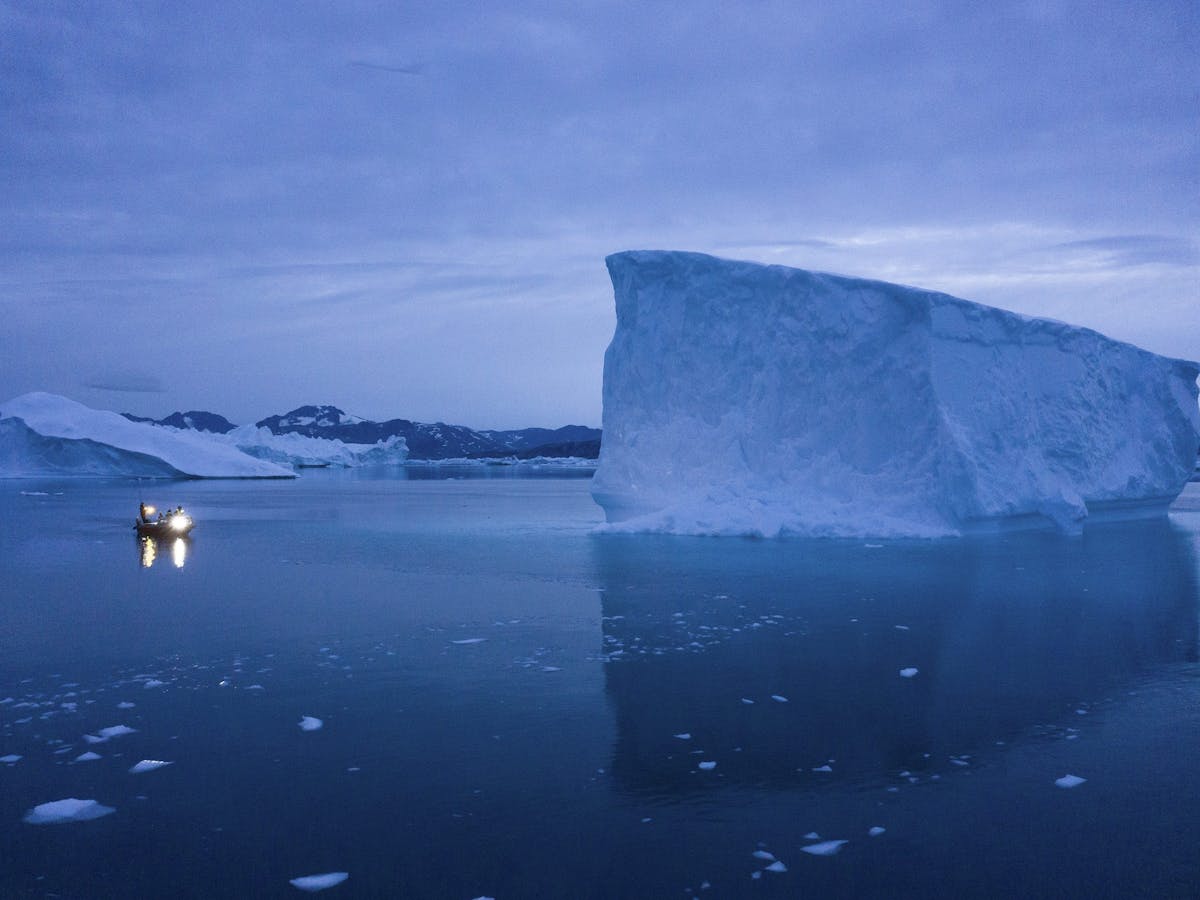
A boat navigates at night next to large icebergs in eastern Greenland. (AP Photo/Felipe Dana)
At just over 14 million square kilometers, the Arctic Ocean is the smallest and shallowest of the world’s oceans. It is also the coldest. An expansive raft of sea ice floats near its center, expanding in the long, cold, dark winter, and contracting in the summer, as the Sun climbs higher in the sky.
Every year, usually in September, the sea ice cover shrinks to its lowest level. The tally in 2020 was a meagre 3.74 million square kilometers, the second-smallest measurement in 42 years, and roughly half of what it was in 1980. Each year, as the climate warms, the Arctic is holding onto less and less ice.
The effects of global warming are being felt around the world, but nowhere on Earth are they as dramatic as they are in the Arctic. The Arctic is warming two to three times faster than any other place on Earth, ushering in far-reaching changes to the Arctic Ocean, its ecosystems and the 4 million people who live in the Arctic.
We bring the expertise of academics to the public.
Some of them are unexpected. The warmer water is pulling some species further north, into higher latitudes. The thinner ice is carrying more people through the Arctic on cruise ships, cargo ships and research vessels. Ice and snow can almost entirely black out the water beneath it, but climate change is allowing more light to flood in.
Artificial light in the polar night
Light is very important in the Arctic. The algae which form the foundation of the Arctic Ocean’s food web convert sunlight into sugar and fat, feeding fish and, ultimately, whales, polar bears and humans.
At high latitudes in the Arctic during the depths of winter, the Sun stays below the horizon for 24 hours. This is called the polar night, and at the North Pole, the year is simply one day lasting six months, followed by one equally long night.
Researchers studying the effects of ice loss deployed moored observatories – anchored instruments with a buoy — in an Arctic fjord in the autumn of 2006, before the fjord froze. When sampling started in the spring of 2007, the moorings had been in place for almost six months, collecting data throughout the long and bitter polar night.
What they detected changed everything.
The polar night can last for weeks and even months in the high Arctic.Michael O. Snyder, Author provided
Life in the dark
At that time, scientists assumed the polar night was utterly uninteresting. A dead period in which life lies dormant and the ecosystem sinks into a dark and frigid standby mode. Not much was expected to come of these measurements, so researchers were surprised when the data showed that life doesn’t pause at all.
Arctic zooplankton — tiny microscopic animals that eat algae — take part in something called diel vertical migration beneath the ice and in the dead of the polar night. Sea creatures in all the oceans of the world do this, migrating to depth during the day to hide from potential predators in the dark, and surfacing at night to feed.
Organisms use light as a cue to do this, so they shouldn’t logically be able to during the polar night. We now understand the polar night to be a riot of ecological activity. The normal rhythms of daily life continue in the gloom. Clams open and close cyclically, seabirds hunt in almost total darkness, ghost shrimps and sea snails gather in kelp forests to reproduce, and deep-water species such as the helmet jellyfish surface when it’s dark enough to stay safe from predators.
For most of the organisms active during this period, the Moon, stars and aurora borealis likely give important cues that guide their behavior, especially in parts of the Arctic not covered by sea ice. But as the Arctic climate warms and human activities in the region ramp up, these natural light sources will in many places be invisible, crowded out by much stronger artificial light.
The northern lights dance in the sky over Tromsø, Norway. Muratart/Shutterstock
Artificial light
Almost a quarter of all land masses are exposed to scattered artificial light at night, as it’s reflected back to the ground from the atmosphere. Few truly dark places remain, and light from cities, coastlines, roads and ships is visible as far as outer space.
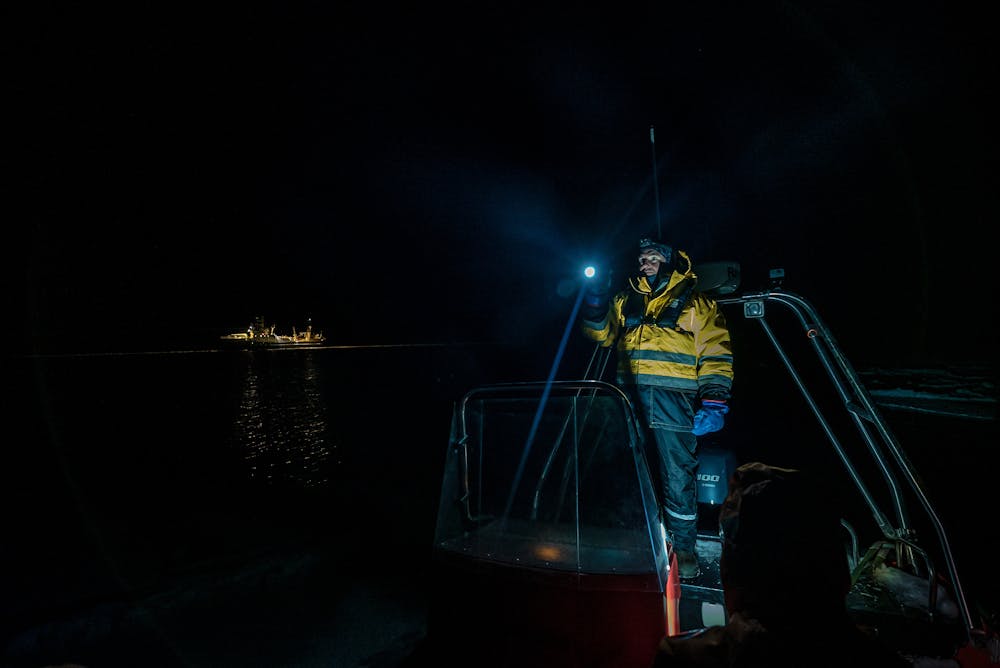
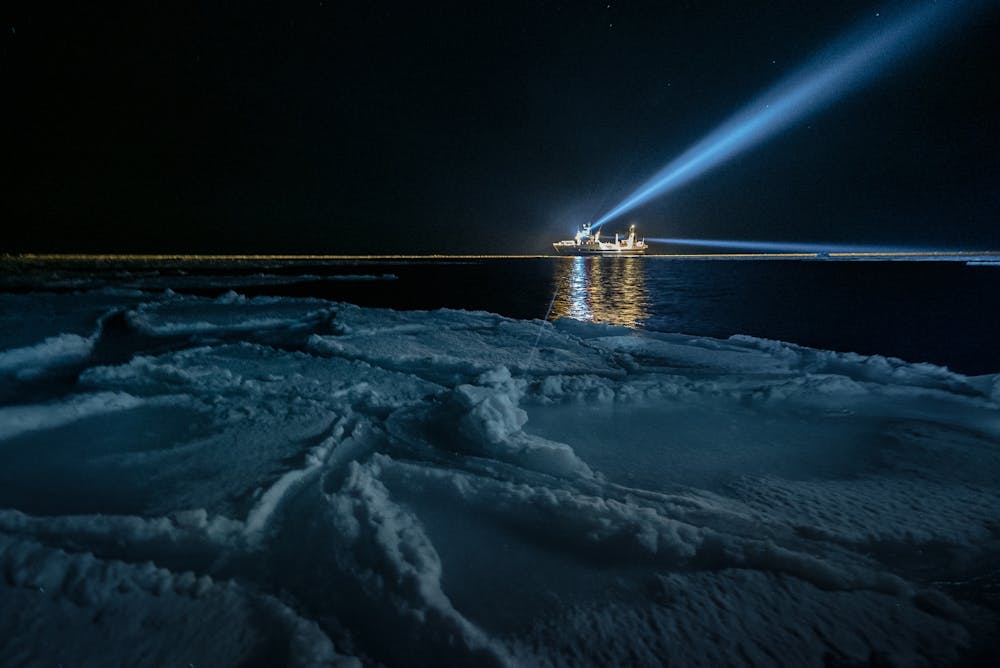
Even in sparsely populated areas of the Arctic, light pollution is noticeable. Shipping routes, oil and gas exploration and fisheries extend into the region as the sea ice retreats, drawing artificial light into the otherwise inky black polar night.
Creatures which have adapted to the polar night over millions of years are now suddenly exposed to artificial light.Michael O. Snyder, Author provided
No organisms have had the opportunity to properly adapt to these changes – evolution works on a much longer timescale. Meanwhile, the harmonic movements of the Earth, Moon and Sun have provided reliable cues to Arctic animals for millennia. Many biological events, such as migration, foraging and breeding are highly attuned to their gentle predictability.
In a recent study carried out in the high Arctic archipelago of Svalbard, between mainland Norway and the north pole, the onboard lights of a research vessel were found to affect fish and zooplankton at least 200 metres down. Disturbed by the sudden intrusion of light, the creatures swirling beneath the surface reacted dramatically, with some swimming towards the beam, and others swimming violently away.
It’s difficult to predict the effect artificial light from ships newly navigating the ice-free Arctic will have on polar night ecosystems that have known darkness for longer than modern humans have existed. How the rapidly growing human presence in the Arctic will affect the ecosystem is concerning, but there are also unpleasant questions for researchers. If much of the information we’ve gathered about the Arctic came from scientists stationed on brightly lit boats, how “natural” is the state of the ecosystem we have reported?
Research in the Arctic could change considerably over the coming years to reduce light pollution.Michael O. Snyder, Author provided
Arctic marine science is about to enter a new era with autonomous and remotely operated platforms, capable of operating without any light, making measurements in complete darkness.
Underwater forests
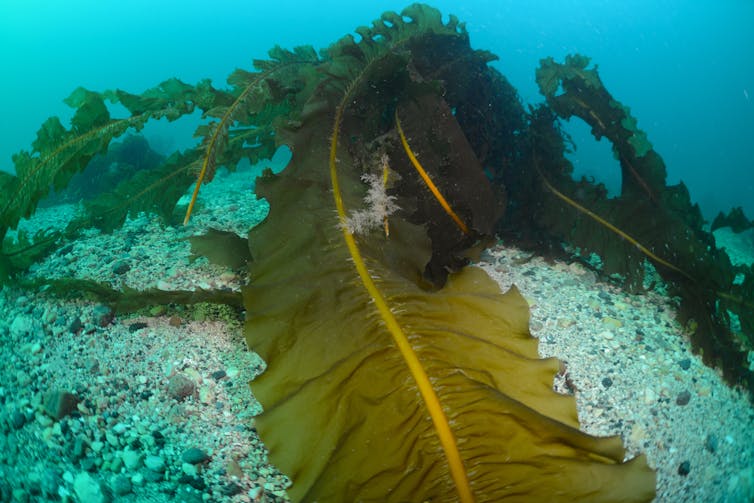
As sea ice retreats from the shores of Greenland, Norway, North America and Russia, periods with open water are getting longer, and more light is reaching the sea floor. Suddenly, coastal ecosystems that have been hidden under ice for 200,000 years are seeing the light of day. This could be very good news for marine plants like kelp – large brown seaweeds that thrive in cold water with enough light and nutrients.
Anchored to the sea floor and floating with the tide and currents, some species of kelp can grow up to 50 meters (175 feet) – about the same height as Nelson’s Column in Trafalgar Square, London. But kelp are typically excluded from the highest latitudes because of the shade cast by sea ice and its scouring effect on the seabed.
Badderlocks, or winged kelp, off the coast of Nunavut in the Canadian Arctic.Ignacio Garrido/ArcticKelp, Author provided
These lush underwater forests are set to grow and thrive as sea ice shrinks. Kelp are not a new arrival to the Arctic though. They were once part of the traditional Greenlandic diet, and polar researchers and explorers observed them along northern coasts more than a century ago.
Some species of kelp may have colonized Arctic coasts after the last ice age, or spread out from small pockets where they’d held on. But most kelp forests in the Arctic are smaller and more restricted to patches in deeper waters, compared to the vast swathes of seaweed that line coasts like California’s in the US.
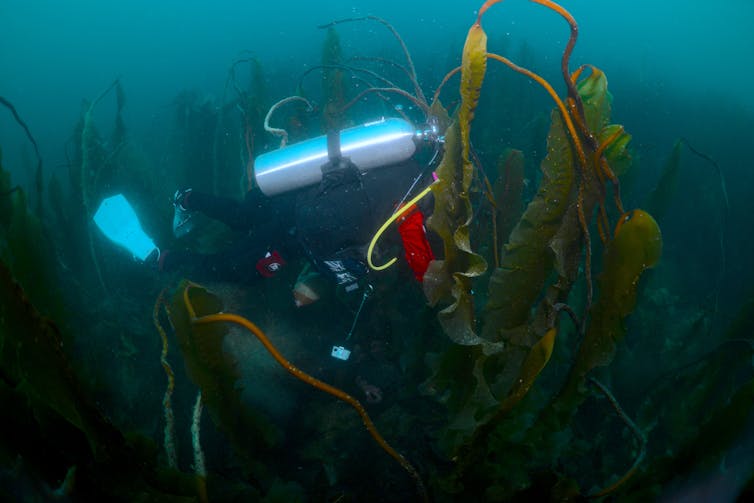
A diver explores a four-metre-high sugar kelp forest off Southampton Island, Canada.Ignacio Garrido/ArcticKelp, Author provided
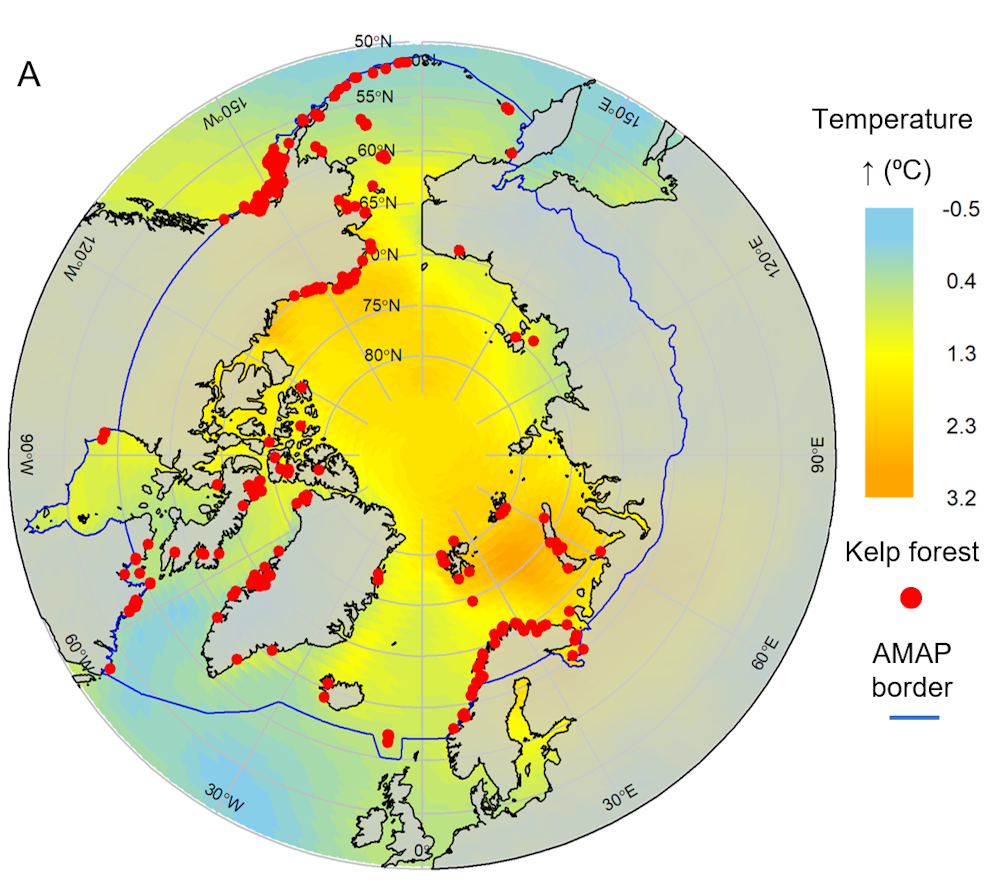
Recent evidence from Norway and Greenland shows kelp forests are already expanding and increasing their ranges poleward, and these ocean plants are expected to get bigger and grow faster as the Arctic warms, creating more nooks for species to live in and around. The full extent of Arctic kelp forests remains largely unseen and uncharted, but modelling can help determine how much they have shifted and grown in the Arctic since the 1950s.
Known locations of kelp forests and global trends in predicted average summer surface temperature increase over next two decades, according to IPCC models. Filbee-Dexter et al. (2018), Author provided
A new carbon sink
Although large seaweeds come in all shapes and sizes, many are remarkably similar to trees, with long, trunk-like but flexible bodies called stipes. The kelp forest canopy is filled with the flat blades like leaves, while holdfasts act like roots by anchoring the seaweed to rocks below.
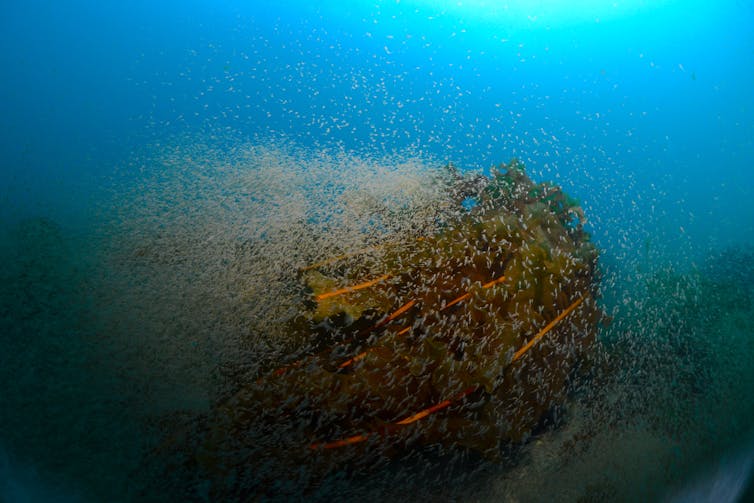
Some types of Arctic kelp can grow over ten meters and form large and complex canopies suspended in the water column, with a shaded and protected understorey. Much like forests on land, these marine forests provide habitats, nursery areas and feeding grounds for many animals and fish, including cod, pollack, crabs, lobsters and sea urchins.
Kelp forests offer lots of nooks and crannies and surfaces to settle on, making them rich in wildlife.Ignacio Garrido/ArcticKelp, Author provided
Kelp are fast growers, storing carbon in their leathery tissue as they do. So what does their expansion in the Arctic mean for the global climate? Like restoring forests on land, growing underwater kelp forests can help to slow climate change by diverting carbon from the atmosphere.
Better yet, some kelp material breaks off and is swept out of shallow coastal waters and into the deep ocean where it’s effectively removed from the Earth’s carbon cycle. Expanding kelp forests along the Earth’s extensive Arctic coasts could become a growing carbon sink that captures the CO₂ humans emit and locks it away in the deep sea.
What’s happening with kelp in the Arctic is fairly unique – these ocean forests are embattled in most other parts of the world. Overall, the global extent of kelp forests is on a downward trend because of ocean heatwaves, pollution, warming temperatures, and outbreaks of grazers like sea urchins.
Unsurprisingly, it’s not all good news. Encroaching kelp forests could push out unique wildlife in the high Arctic. Algae living under the ice will have nowhere to go, and could disappear altogether. More temperate kelp species may replace endemic Arctic kelps such as Laminaria solidungula.
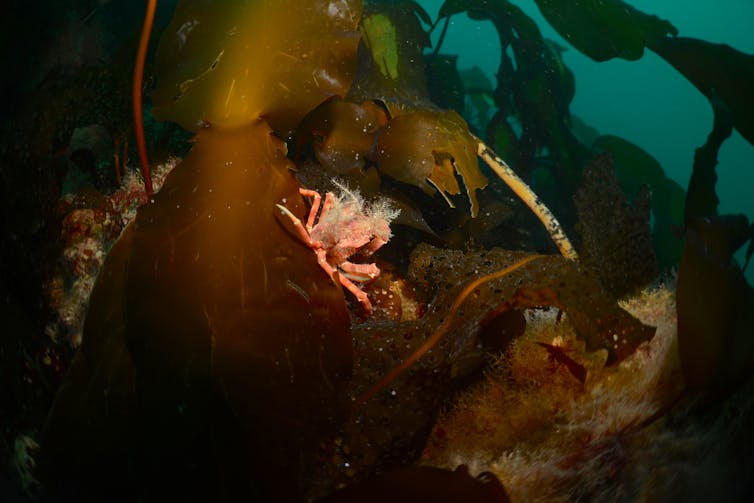
A crab finds refuge on Laminaria solidungula – the only kelp species endemic to the Arctic.Ignacio Garrido/ArcticKelp, Author provided
But kelp are just one set of species among many pushing further and deeper into the region as the ice melts.
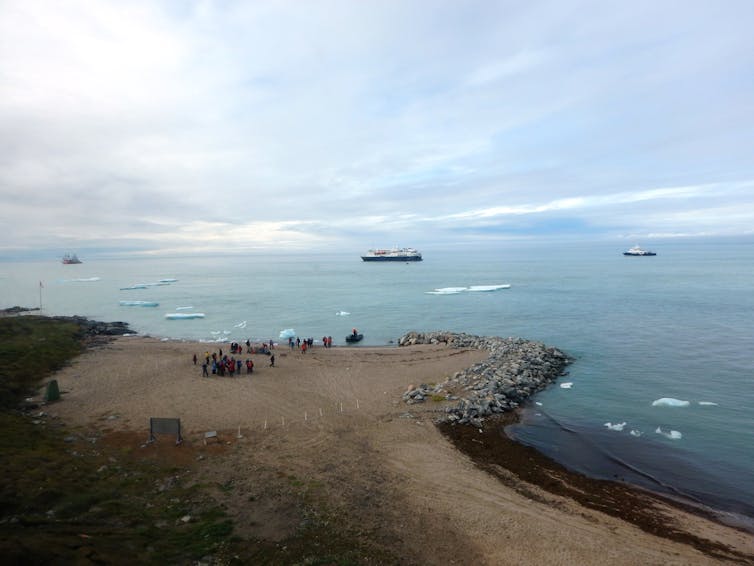
Cruise ships, coast guard vessels, pleasure yachts, research icebreakers, cargo supply ships and rigid inflatable boats full of tourists also glide through the area. Unprecedented warming and declining sea ice has attracted new industries and other activities to the Arctic. Communities like Pond Inlet have seen marine traffic triple in the past two decades.
Passengers from a cruise ship arrive in Pond Inlet, Nunavut.Kimberly Howland, Author provided
These ships come to the Arctic from all over the world, carrying a host of aquatic hitchhikers picked up in Rotterdam, Hamburg, Dunkirk and elsewhere. These species — some too small to see with the naked eye — are hidden in the ballast water pumped into on-board tanks to stabilize the ship. They also stick to the hull and other outer surfaces, called “biofouling.”
Some survive the voyage to the Arctic and are released into the environment when the ballast water is discharged and cargo loaded. Those that maintain their hold on the outer surface may release eggs, sperm or larvae.
Many of these organisms are innocuous, but some may be invasive newcomers that can cause harm. Research in Canada and Norway has already shown non-native invasive species like bay and acorn barnacles can survive ship transits to the Arctic. This raises a risk for Arctic ecosystems given that invasive species are one of the top causes for extinctions worldwide.
Expanded routes
Concern about invasive species extends far beyond the community of Pond Inlet. Around 4 million people live in the Arctic, many of them along the coasts that provide nutrients and critical habitat for a wide array of animals, from Arctic char and ringed seals to polar bear, bowhead whales and millions of migratory birds.
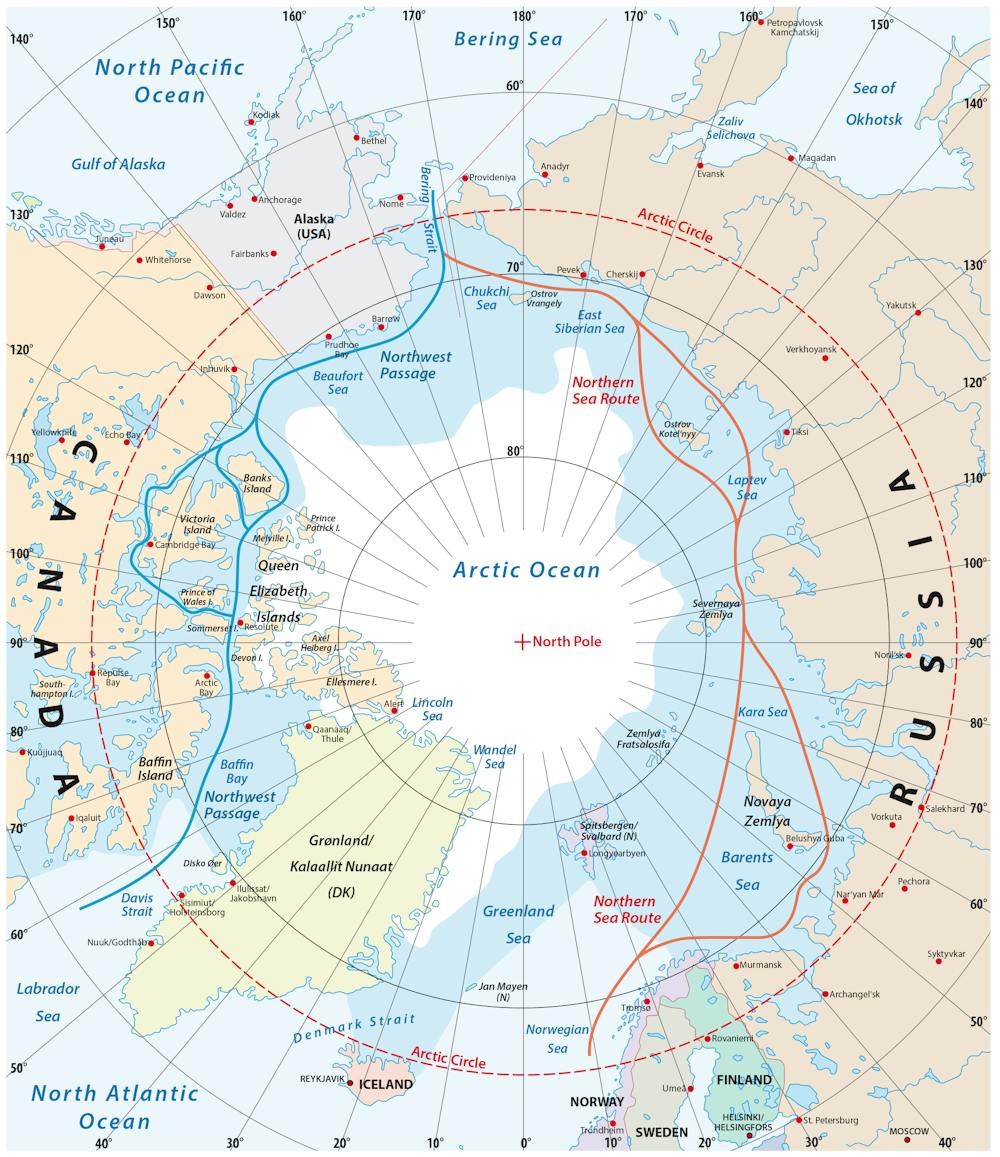
As the Arctic sea ice melts during the summer months, shipping routes are opening up along the Russian coast and through the Northwest Passage. Some say a trans-Arctic route might soon be navigable.Shutterstock
Prevention is the number one way to keep invasive species out of the Arctic. Most ships must treat their ballast water, using chemicals or other processes, and/or exchange it to limit the movement of harmful organisms to new locations. Guidelines also recommend ships use special coatings on the hulls and clean them regularly to prevent biofouling. But these prevention measures are not always reliable, and their efficacy in colder environments is poorly understood.
The next best approach is to detect invaders as soon as possible once they arrive, to improve chances for eradication or suppression. But early detection requires widespread monitoring, which can be challenging in the Arctic. Keeping an eye out for the arrival of a new species can be akin to searching for a needle in a haystack, but northern communities may offer a solution.
Researchers in Norway, Alaska and Canada have found a way to make that search easier by singling out species that have caused harm elsewhere and that could endure Arctic environmental conditions. Nearly two dozen potential invaders show a high chance for taking hold in Arctic Canada.
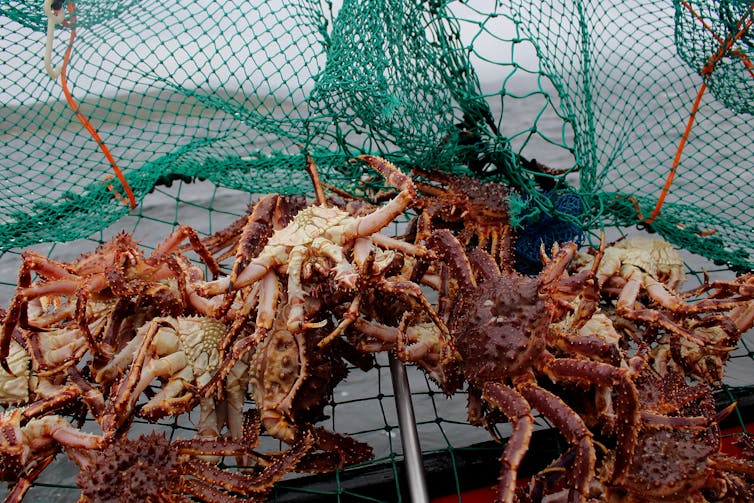
The red king crab was intentionally introduced to the Barents Sea in the 1960s, but is now spreading south along the Norwegian coast.Shutterstock
Among these is the cold-adapted red king crab, native to the Sea of Japan, Bering Sea and North Pacific. It was intentionally introduced to the Barents Sea in the 1960s to establish a fishery and is now spreading south along the Norwegian coast and in the White Sea. It is a large, voracious predator implicated in substantial declines of harvested shellfish, sea urchins and other larger, slow moving bottom species, with a high likelihood of surviving transport in ballast water.
Another is the common periwinkle, which ruthlessly grazes on lush aquatic plants in shoreline habitats, leaving behind bare or encrusted rock. It has also introduced a parasite on the east coast of North America that causes black spot disease in fishes, which stresses adult fishes and makes them unpalatable, kills juveniles and causes intestinal damage to birds and mammals that eat them.
Tracking genetic remnants
New species like these could affect the fish and mammals people hunt and eat, if they were to arrive in Pond Inlet. After just a few years of shipping, a handful of possibly non-native species have already been discovered, including the invasive red-gilled mudworm (Marenzellaria viridis), and a potentially invasive tube dwelling amphipod. Both are known to reach high densities, alter the characteristics of the seafloor sediment and compete with native species.
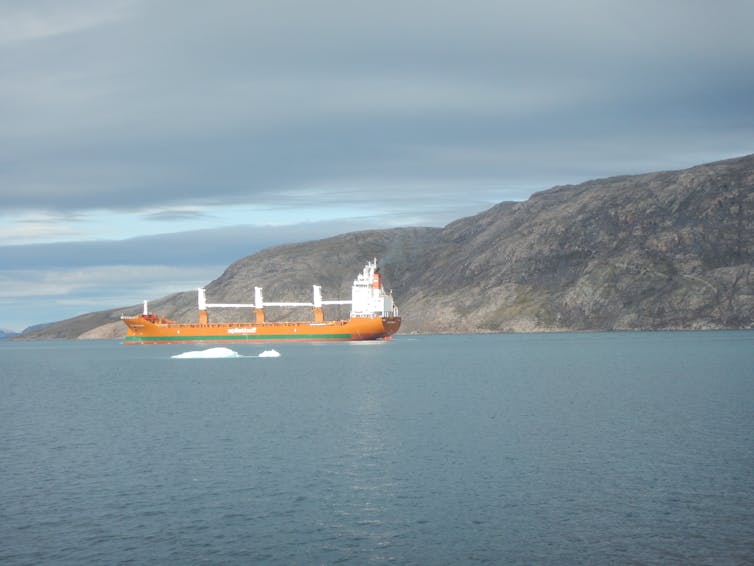
A cargo ship passes through Milne Inlet, Nunavut.Kimberly Howland, Author providedBaffinland, the company that runs the Mary River Mine, is seeking to double its annual output of iron ore. If the expansion proceeds, up to 176 ore carriers will pass through Milne Inlet during the open-water season.
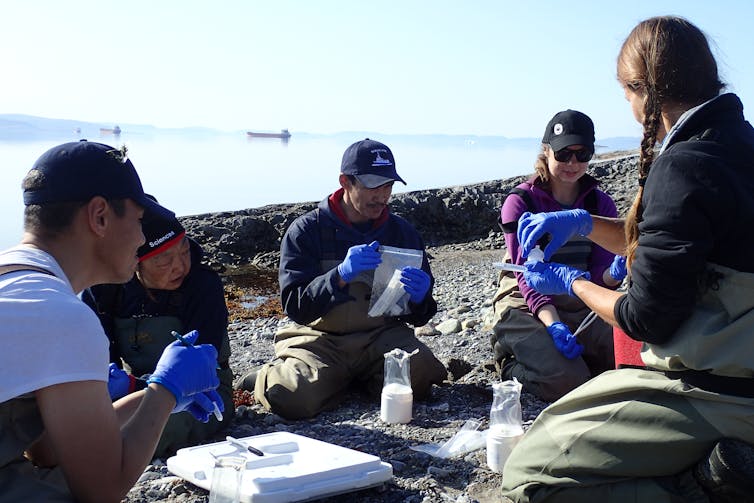
Although the future of Arctic shipping remains uncertain, it’s an upward trend that needs to be watched. In Canada, researchers are working with Indigenous partners in communities with high shipping activity — including Churchill, Manitoba; Pond Inlet and Iqaluit in Nunavut; Salluit, Quebec and Nain, Newfoundland — to establish an invasive species monitoring network. One of the approaches includes collecting water and testing it for genetic remnants shed from scales, faeces, sperm and other biological material.
Members of the 2019 field team from Pond Inlet and Salluit filter eDNA from water samples collected from Milne Inlet.Christopher Mckindsey, Author provided
This environmental DNA (eDNA) is easy to collect and can help detect organisms that might otherwise be difficult to capture or are in low abundance. The technique has also improved baseline knowledge of coastal biodiversity in other areas of high shipping, a fundamental step in detecting future change.
Efforts are underway to expand the network across the Arctic as part of the Arctic Council’s Arctic Invasive Alien Species Strategy to reduce the spread of invasive species.
The Arctic is often called the frontline of the climate crisis, and because of its rapid rate of warming, the region is beset by invasions of all kinds, from new species to new shipping routes. These forces could entirely remake the ocean basin within the lifetimes of people alive today, from frozen, star-lit vistas, populated by unique communities of highly adapted organisms, to something quite different.
The Arctic is changing faster than scientists can document, yet there will be opportunities, such as growing carbon sinks, that could benefit the wildlife and people who live there. Not all changes to our warming world will be wholly negative. In the Arctic, as elsewhere, there are winners and losers.
A note from our editor’s mother
My daughter Beth leads the team of experienced editors working with experts to share fact-based journalism with readers like you. If you read this website, you know what good work they do. So please help them raise up the voices of scholars to drown out the loud voices shouting lies (she was never a shouter growing up). Thank you!
Saskatchewan driller hits ‘gusher’ with ground-breaking geothermal well that offers hope for oil workers
A first for Canada and the world, the well can produce enough electricity to power 3,000 homes
Geoffrey Morgan Nov 27, 2020
DEEP Earth Energy Production Corp.’ site is the deepest horizontal well in Saskatchewan’s history and the first 90° horizontal fluid production for geothermal power generation in the world.PHOTO BY DEEP EARTH ENERGY PRODUCTION CORP.
CALGARY — A small, Saskatoon-based company has drilled and fracked the world’s first 90-degree horizontal well for geothermal power in a potentially landmark move that signals the arrival of a new energy source in Canada and provides fresh opportunities for oil and gas workers to apply their skills in renewable power.
No company in Canada has produced electricity from geothermal heat, but Deep Earth Energy Production Corp. chief executive officer Kirsten Marcia told the Financial Post that there’s a “big, big future for geothermal power in Western Canada,” as demonstrated by the results of the first ever horizontal geothermal well, which is also the deepest horizontal well ever drilled in Saskatchewan.
BMO’s Brian Belski: An ‘unprecedented’ 10-year bull market is coming
“We were looking for a way to explain to people that we drilled a gusher,” said Marcia, a geologist who worked in the mining and petroleum industries before pioneering a geothermal business in Saskatchewan. In the oil and gas world, a “gusher” is an extremely productive well that pumps substantial volumes of oil and gas.
The well is a first for the global geothermal industry
In Canada’s nascent geothermal power industry, Deep’s “gusher” can produce steaming-hot water and brine with a temperature of 127 degrees centigrade at a rate of 100 litres per second. Marcia said those flow rates mean the well will actually be limited by the hardware, such as pump capacity, that are connected to the wellhead. She said the well, called the Border-5HZ well, is capable of producing 3 megawatts of renewable, reliable electricity, enough to power 3,000 homes.
The well will form part of a larger 20MW geothermal power project, which is expected to commence construction in 2023 in southern Saskatchewan close to the U.S. border.
The well is also a first for the global geothermal industry.
DEEP Earth’s Border-5HZ well in Saskatchewan is capable of producing 3 megawatts of renewable, reliable electricity, enough to power 3,000 homes.PHOTO BY DEEP EARTH ENERGY PRODUCTION CORP.
Directional geothermal power wells have been drilled in California, but Marcia said those were drilled at a 75-degree angle, rather than being truly horizontal. Her company’s Border-5HZ well was drilled into the earth at a depth of 3,450 metres before turning at a 90 degree angle and drilling through sedimentary rock along a 2,000-metre lateral route.
“This is a sedimentary geothermal project. There aren’t a lot of them in the world,” Marcia said, noting that most geothermal power projects, including those in world-leading Iceland, drill vertically into volcanic rock formations. “In terms of drilling into a sedimentary basin, you’re drilling into sedimentary units that are like a stack of pancakes.”
Deep is also responsible for the deepest vertical well ever drilled in Saskatchewan, after announcing in Nov. 2018 it had drilled a 3,530-metre well.
Governments in Alberta and Saskatchewan have been revamping regulations for drilling and for power generation in an attempt to stimulate geothermal power investment in their provinces partly because the geothermal industry uses many of the same skills as the existing oil and gas industry.
This week, Alberta MLAs passed legislation that will allow the province’s energy regulator to develop a new framework for geothermal wells to be licensed and drilled in the province. The bill is considered a way to keep oilfield services workers, such as drillers, working as investment in renewable energy is projected to rise in the coming years.
Everything we’re doing is figuratively and literally on the backs of these highly skilled oilfield workers. We couldn’t do this without this expertise in this part of the world
DEEP EARTH ENERGY CEO KIRSTEN MARCIA
While other geothermal wells have been drilled in Canada previously to channel heat directly from the earth, Deep and a handful of other companies are among the first in the country to use the earth’s heat to generate electricity.
In Alberta, Calgary-based oil and gas producer Razor Energy Corp. is working on a geothermal project north of Edmonton that would retrofit existing wells to produce 3MW to 5MW of geothermal power.
Near Fort Nelson, B.C., a natural gas-rich town, a non-profit research association called Geoscience BC is undertaking a feasibility study of the Clark Lake Geothermal project that would repurpose a gas field to produce geothermal power.
Kirsten Marcia, president and CEO of Deep Earth Energy Production Corp.PHOTO BY TROY FLEECE/POSTMEDIA
At Deep, Marcia said it’s very difficult to repurpose existing oil and gas wells to produce geothermal power because the diameters of most existing wells are too narrow for the tubing that geothermal wells need to pump water in a cycle through the earth’s crust.
However, geologists have identified multiple locations in Western Canada to produce geothermal power and use existing oil and gas skills in renewable power production, Marcia said.
Over 100 oilfield workers were on site to drill and hydraulic-fracture her company’s horizontal well in southern Saskatchewan in September and October, including a drilling crew from Houston-based Weatherford International Plc, and a pressure-pumping team from Saskatchewan’s Element Technical Services Inc.
“It’s amazing. Everything we’re doing is figuratively and literally on the backs of these highly skilled oilfield workers. We couldn’t do this without this expertise in this part of the world,” said Marcia.
She added that the project was de-risked in part by funding from the federal government, which committed $25.6 million in funding in January 2019 for the project. All told, the geothermal power project is expected to cost $51 million.
Army Corps of Engineers issues Enbridge permit for $2.6B pipeline across northern Minnesota
The permit is last big hurdle for the construction project, which will be one of largest in recent history for Minnesota.
By Mike Hughlett, Star Tribune November 24, 2020
Two Minnesota regulators granted environmental permits for Enbridge’s Line 3 oil pipeline across northern Minnesota, critical approvals needed for construction to begin soon on the controversial $2.6 billion project, on Thursday, Nov. 12, 2020. (Richard Tsong-Taatarii/Minneapolis Star Tribune/TNS) ORG XMIT: 1826898.
The Corps decision paves the way for Calgary-based Enbridge to begin building the pipeline as early as next month. It will be one of the largest Minnesota construction projects in recent history and is expected to employ 4,000 workers.
“This decision is based on balancing development with protecting the environment,” Col. Karl Jansen, St Paul District commander, said in a statement. “Our decision follows an exhaustive review of the application and the potential impacts associated with the construction of the pipeline within federally protected waters.”
The Corps’ blessing was expected after the Minnesota Pollution Control Agency (MPCA) this month approved related construction permits for the pipeline, a replacement for Enbridge’s current Line 3.
The federal permit, issued by the Army Corps’ St. Paul district, covers construction impacts to myriad water bodies in Minnesota. The pipeline will ferry heavy Canadian oil across northern Minnesota to Enbridge’s terminal in Superior, Wis.
The 340-mile new pipeline will cross 212 streams and will affect more than 700 acres of wetlands in Minnesota — the reason many environmental groups have fought the project throughout the regulatory process.
“Enbridge has now received all remaining federal permits required for replacing Line 3, an essential maintenance project,” the Calgary-based company said in a statement.
The MPCA must still grant a stormwater drainage permit to Enbridge, a more routine approval that’s expected in the coming weeks. Enbridge is also waiting on a final construction authorization from the Minnesota Public Utilities Commission (PUC), which already has approved the project.
“We are prepared to start construction as soon as these are in hand,” Enbridge said.
The Army Corps was waiting for the MPCA to act on the more sweeping pollution permits before making its decision. The MPCA two weeks ago granted water quality permits related to Line 3 construction.
The pipeline has been winding through the Minnesota regulatory process for six years. The PUC, the state’s primary regulator of pipelines, approved the pipeline in February for the second time after a court sent it back to the panel for changes in the project’s environmental impact statement.
Environmental groups and Indian bands opposing Line 3 have already appealed the PUC’s decision to a state appellate court, and petitions to overturn the Corps’ permits may be in the offing, too.
“It’s tragic but it’s not a surprise that the Trump administration would approve these permits regardless of the water quality impacts from the pipeline, and during a time when a pandemic is sweeping across the North Country with workers already here,” Winona LaDuke, head of Indigenous environmental group Honor the Earth, said in a statement. “The tribes and others will surely sue and we will see them in court.”
Environmental groups and some Indian bands have said the pipeline — which follows a new route — will open a new region of pristine waters to the prospect of oil spills, as well as exacerbate climate change by allowing for more oil production.
Enbridge has said the new pipeline is a critical safety enhancement. The current Line 3 is so corroded it’s running at only half capacity. The new pipeline would restore full oil flow.
Jansen said the Army Corps staff consulted all parties on Line 3, working “deliberately and extensively with our federal and state partners, federally recognized tribes, environmental organizations and the applicant.”
Mike Hughlett covers energy and other topics for the Star Tribune, where he has worked since 2010. Before that he was a reporter at newspapers in Chicago, St. Paul, New Orleans and Duluth.
Meet the South Poll cow: the healthier, naturally raised cattle of the future?
Georgie Smith November 25, 2020
Missouri rancher Greg Judy spots a six-month-old South Poll heifer calf in his herd that is a prime example of what he calls a “good doing cow”. A cow that will “do good” on grass alone.
She’s got a “big butt”, Judy says, meaning wide hips that will help her easily bear calves when grown. She sports a shiny, slick red hide that flies avoid landing on; cows stressed from fly bites – Judy has seen hundreds on a single cow – don’t grow well. She has a large “barrel” or gut, meaning enough stomach capacity to store large amounts of grass, which she will convert to energy and will keep her in good health, even during the winter with no extra feed. “This is the kind of heifer you want,” Judy says. “You can build a herd out of those.”
Judy raises cattle in a highly–managed, grass-only system that he believes is better for his cows and the environment. His 300-plus herd is kept together in a dense group, and moved often – Judy moves his cattle twice a day to fresh paddocks – creating a symbiotic relationship between cows and grasslands that soil scientists are finding encourages soil health and rapid grass growth.
But Judy has learned not all cows thrive on grass alone, especially the type of cattle favored by a US ranching industry that has grown largely dependent on feeding cattle grain rations.
In Judy’s system, those “common cows”, as he calls them, looked like they had been starved six months after he put them on a grass-only diet. Instead, Judy found success – after nearly going bankrupt in 1999 trying to raise cattle the conventional way – utilizing intensive, grass-based management with cows that had the “grass genetics” to thrive.
“At the end of the day, the money comes from animals that can excel on a grass diet,” says Judy, referring to the lower costs of raising cattle with a genetic predisposition to thrive on grass, since they don’t require the grain, growth hormones and antibiotics often used in traditional cattle ranching.
It’s a counterintuitive problem, considering cows evolved to eat grass. But today, approximately 97% of US beef cows spend the last four to six months in confined feedlots where they are fed grain rations until slaughter. Before that, they spend most of their lives out on the pasture, but even then some ranchers feed them grain to keep their weight up through winter or during stressful times like calving.
Meanwhile, the grass-only beef market is small, but growing rapidly, according to a report by Stone Barns Center. The intensively managed grazing Judy employs is a supercharged version of traditional cattle-grazing techniques. By moving his cows often, they do not have a chance to damage the grass by eating it too short. Instead, they encourage healthy root development increasing soil health, which some scientists have found allows the soil to capture and store carbon from the atmosphere – a process known as carbon sequestration.
This heavily managed grazing style – also called holistic grazing – is part of a growing worldwide interest in “regenerative agriculture”. By promoting multiple practices that build soil health, regenerative agriculture has been said to improve agricultural lands and ultimately sequester carbon, according to Rattan Lal PhD, an Ohio State University soil scientist and the 2020 World Food Prize winner.
But the growth of regenerative grazing systems has been slow, in part because, as the cattle industry turned to feeding grain, ranchers ended up breeding fewer cows that could thrive on grass alone, says Richard Teague PhD, a range ecologist with the Texas A&M University Agrilife Research center. Ranchers like Judy were put in a pickle, without the cows appropriate for their grass-only systems.
“People wanted to feed corn, [so] they bred huge animals that require very big inputs of corn and also pharmaceuticals,” says Teague. He argues that raising “cattle like that” comes at the expense of the health of consumers – and the health of the soil that nurtures them. “We have to go to animals that we know thrive under good management.”
The traditional ranching industry denies the charge that grass-raised cows are better for the climate than their grain-fed product. In a 2017 study by Oklahoma State University researchers found that grain-fed cattle – with their shorter lifespans – resulted in a 18.5 to 67.5% lower carbon footprint compared with grass-finished beef.
Meanwhile, a 2017 report from the Food, Climate and Research Network challenged the idea that grass-fed beef can be good for the environment at all, saying there was no evidence that grazing cattle helps sequester carbon except under the most ideal conditions.
However, Teague argues, “It’s not the cow, it’s the how.” A 2015 study in Georgia of dairy cows in an intensively grazed system recorded eight tons of carbon sequestered per hectare annually. The intensive livestock grazing systems such as Judy uses are one of the best ways within agricultural systems to sequester carbon, according to Teague. “Under decent management, sequestration exceeds emissions, and the better the grazing management, the more it exceeds it.”
For Judy, it comes down to raising cattle in a system that works with nature instead of against it. But to do that, he also had to find the best cattle to thrive in his environment. For him, that perfect cow is the South Poll.
A relative newcomer to the beef cattle scene, the South Poll is a small-framed, stout, highly fertile red cow, well adapted to hot and humid conditions. It has good mothering instincts that have earned it the nickname the “southern mama cow”. The breed also has a rock star – or at least, country music star – cachet; it was originally developed in the 1990s by Teddy Gentry, the bass player for the country music group Alabama.
Judy is far from alone in his enthusiasm for this up-and-coming breed. In mid-September, South Poll cattle fans from all over the US showed up in Copan, Oklahoma, for the annual South Poll cattle auction. The cows are becoming increasingly popular with grass-focused ranchers – especially in the south-eastern and mid-western US where the cattle are best adapted – according to Ann Demerath, secretary of the South Poll Grass Cattle Association.
Some of the animals purchased at the auction may be cross-bred with other cattle breeds. Ranchers hope to use the South Poll genes to adapt their existing cattle to do better on a grass diet, Judy says. He advises ranchers to start by purchasing the “best South Poll bull you can afford” and breed it to the best females in their existing herd. Then, ranchers should select the best females from that generation and breed those with a South Poll sire – a technique called “line-breeding” that quickly focuses on desirable traits without risking genetic defects.
Judy also advises ranchers to cull – or remove – any animals that don’t fit their standards for health and disposition, even if they “look at you funny”, from their breeding stock. His mantra? “You’ll never have a herd any better than what you are willing to cull for.”
Relentlessly selecting for the best-adapted cows within his own system has allowed Judy to produce South Poll mother cows so well-adapted that they stay healthy through the winter. That means, unlike most ranchers, Judy can give the mothers more time with their calves during the winter, which gives those calves an extra boost of growth and leaves him with a stronger, bigger calf in the spring.
For Judy, that is the goal – a cow that needs nothing but well-managed grass, passing their health and wellbeing on to the next generation.
A destructive legacy: Trump bids for final hack at environmental protections
Oliver Milman
Photograph: Nicholas Kamm/AFP/Getty Images
Donald Trump is using the dying embers of his US presidency to hastily push through a procession of environmental protection rollbacks that critics claim will cement his legacy as an unusually destructive force against the natural world.
Trump has yet to acknowledge his election loss to president-elect Joe Biden but his administration has been busily finishing off a cavalcade of regulatory moves to lock in more oil and gas drilling, loosened protections for wildlife and lax air pollution standards before the Democrat enters the White House on 20 January.
Trump’s interior department is hastily auctioning off drilling rights to America’s last large untouched wilderness, the sprawling Arctic National Wildlife Refuge found in the tundra of northern Alaska. The refuge, home to polar bears, caribou and 200 species of birds, has been off limits to fossil fuel companies for decades but the Trump administration is keen to give out leases to extract the billions of barrels of oil believed to be in the area’s coastal region.
The leases could result in the release of vast quantities of carbon emissions as well as upend the long-held lifestyle of the local Gwich’in tribe, which depends upon the migratory caribou for sustenance. Several major banks, fiercely lobbied by the Gwich’in and conservationists, have refused to finance drilling in the refuge but industry groups have expressed optimism that the area will be carved open.
An airplane flies over caribou on the coastal plain of the Arctic national wildlife refuge in north-east Alaska.Photograph: US Fish and Wildlife Service/AP
The administration is also opening the way for drilling around the Chaco Canyon National Historical Park, considered a sacred area by the native Navajo and Pueblo people who live near the New Mexico site and has targeted a linchpin environmental law, known as the National Environmental Policy Act, to allow more logging and road-building in national forests.
Trump has previously shrunk federally-protected areas as part of an “energy dominance” mantra that the president claims will bolster the US economy.
Meanwhile, safety rules for offshore drilling, put in place after the disastrous 2010 BP oil spill in the Gulf of Mexico, are being watered down. The risks of a catastrophic, unrestrained spill are highest in the Arctic, where retreating sea ice is encouraging some fossil fuel firms to move into a region largely devoid of clean-up and rescue infrastructure.
The Trump administration is is also maintaining air quality standards widely condemned by experts as being insufficient to protect communities from sooty pollution that comes from cars, trucks and heavy industry. Many cities in the US are riven with environmental injustices, where poorer communities of color are routinely placed in proximity of industrial plants, highways and other sources of pollution.
Vehicles drive on the 101 freeway in Los Angeles, California.Photograph: Robyn Beck/AFP/Getty Images
The regulatory rampage extends to creatures from the skies to the prairies to the oceans – fines for people who kill migratory birds are being reviewed while the US Navy has been given latitude to inadvertently harass endangered whales with noise from explosions and speeding vessels during war game exercises along the west coast.
A plan to slash protections for sage grouse across the US west has been finalized, placing the habitat of the once-common bird, about the size of a chicken and known for its flamboyant mating dances, at risk. “These guys are hellbent on turning over the last refuges of the vanishing greater sage grouse to drilling, mining and grazing,” said Michael Saul, a senior attorney at the Center for Biological Diversity. “It’s disgusting, transparent and illegal.”
The Trump administration spent four years assaulting every protection for our air, water, lands, wildlife and climate
Jill Tauber
The actions of the exiting administration will have “extremely damaging environmental consequences”, said Richard Revesz, a professor of environmental law at New York University. “Trump’s counterproductive actions have allowed the climate crisis to intensify and put the health of many Americans, especially in the most vulnerable communities, at risk by ignoring threats from pollution,” he added.
The scorched earth approach of Trump’s final months will further exacerbate a four-year legacy where climate policies have been dismantled, clean air and water rules scaled back and legions of demoralized federal government scientists sidelined or decided to quit.
“The Trump administration spent four years assaulting every protection for our air, water, lands, wildlife and climate,” said Jill Tauber, vice-president of litigation at Earthjustice, a non-profit law organization.
People visit Griffith Observatory on a day rated ‘moderate’ air quality in Los Angeles, California, in June 2019.Photograph: Mario Tama/Getty Images
Leah Donahey, legislative director at the Alaska Wilderness League, added: “No administration has been worse for our environment or our nation’s public health than this one.”
Biden will be able to reverse some of Trump’s actions and has vowed to limit drilling on federal land as well as to rejoin the Paris climate agreement, which the incumbent has removed the US from. Biden has called the climate change an “existential threat” in the wake of a year of fierce wildfires in California and a record number of hurricanes in the Atlantic, but his ambition to pass sweeping climate legislation hinge upon a US senate that, with looming special elections in the state of Georgia, appears likely to remain in Republican control.
Any successful remediation of the rollbacks will also have to survive as flurry of lawsuits, with the US supreme court now titled decisively in a conservative direction. All of this will soak up time during a period where scientists say planet-heating emissions must be cut rapidly to avoid the worst ravages of the climate crisis. “Trump’s legacy on environmental issues will be less about lasting policy changes,” said Revesz, “and more about lost time and missed opportunities.”
But before you get too excited and decide to cut off your natural gas supply, what hasn’t changed is the unreliability of both solar and wind
Licia Corbella Nov 21, 2020
A power-generating wind turbine is reflected in solar panels on March 10, 2010.PHOTO BY REUTERS/THOMAS BOHLEN/FILE.
We all remember the disturbing stories coming out of Europe as little as two years ago called the heat or eat phenomenon. The push towards renewable energy contributed to large spikes in electricity costs that seniors and other people on low incomes in the U.K., in particular, were forced to choose between heating their homes or eating.
Even in Ontario, that province’s push under previous provincial governments to bring in more solar and wind power caused prices to rise so much that it helped lead to the defeat of Kathleen Wynne’s provincial Liberal government.
According to a new report from the University of Calgary, however, that era of high-cost renewable energy is over.
The School of Public Policy report on energy and environmental policy trends, Cheap Renewables Have Arrived, has found that solar and wind power prices have plunged so precipitously that they are now less expensive than efficient natural gas plants.
Recent analysis shows that over the past 10 years, wind costs have fallen by 70 per cent and solar by 90 per cent.
“Perhaps more significantly, the levelized cost of wind and solar — a measure which includes cost to construct and operate power plants — has now reached parity with the marginal cost of efficient natural gas plants,” write co-authors Nick Schumacher, Victoria Goodday, Blake Shaffer and Jennifer Winter.
“This suggests building new renewables is now cheaper than operating existing fossil power plants.”
Shaffer, an energy economist and an assistant professor of economics, says the perception for people who aren’t “electricity nerds” is that solar and wind power is a kind of “boutique power” — costly and niche.
“For many people who are thinking back about five years ago, certainly 10 years ago, and hearing about the cost of solar and wind and, you know, runaway electricity prices in Ontario, we still have that in mind because that’s not long ago,” said Shaffer during a Wednesday interview. “But it’s just changed so dramatically that’s no longer the case. Wind and solar is now cheaper than natural gas.”
Now, before you get too excited and decide to cut off your natural gas supply, what hasn’t changed is the unreliability of both solar and wind. Basically, you only get wind power when the wind blows and solar power when the sun shines.
But Shaffer says with more countries committing to net-zero emissions targets — including Prime Minister Justin Trudeau’s announcement on Thursday that pledged Canada to net-zero greenhouse gas emissions by 2050 — the push will be on to find ways to store this “zero-emission power” to be used when demand is highest — primarily through batteries, which are currently costly and not so green.
“Despite their low costs, wind and solar still have a long way to go before they are the dominant sources of energy,” states the report.
“In 2018, renewables accounted for only 8.5 per cent of total global energy supply. Despite their small share of supply, renewable energy investment growth — 97 per cent of which is in wind and solar — is outpacing any other energy source at 7.6 per cent per year.”
The report points out that even the International Energy Agency’s World Energy Outlook 2020 report — which tends to be highly conservative — declared: “Solar is the new king of electricity.”
Shaffer says the rapid decline in the cost of solar panels was caused by the demand for them in Germany, California and other European countries and particularly now that China has taken the lead on production.
“So, the renewables are now the cheapest in terms of producing electricity, but it still doesn’t give us the on-demand power we want. And so just looking at cost alone isn’t fair. We need to figure out how to turn that raw energy into on-demand power.”
Shaffer notes that just recently TransAlta put in a large Tesla battery to store renewable energy and California and South Australia are doing the same.
He anticipates that natural gas will continue to play an important role in electrification to fill in the valleys caused by the intermittent nature of solar and wind for some time to come.
Solar panels atop the Southland Leisure Centre in Calgary in 2014. At the time, it was the city’s largest solar array.PHOTO BY POSTMEDIA ARCHIVES
In October, Premier Jason Kenney announced a new strategy for Alberta’s massive 300-year supply of natural gas, including net-zero hydrogen exports, something that Shaffer believes will be in high demand in the world.
Indeed, the hydrogen industry is projected to be worth $2.5 trillion by 2050, according to the Hydrogen Council, a global group of corporate executives encouraging investment in the hydrogen economy.
So, are solar and wind the game-changers that replaces oil and gas?
“No, they’re not,” says Shaffer. “It’s not the same scale. But what it is is it’s a great opportunity to replace a lot of generation to reduce emissions at really low to no cost.”
He says Alberta is “blessed with all of these great energy resources, and it just so happens that we also have some of the best wind resources in Canada. You go down to Pincher Creek, you’ll agree with me. We also have the best solar resources in Canada, us and southern Saskatchewan.”
“There’s nowhere cheaper in Canada to build solar and wind than in Alberta.”
The greening of the electrical grid no longer will force people to choose between heating or eating. It will, hopefully, one day soon be about cleaner air and net-zero greenhouse gas emissions at a reasonable cost.



 A boat navigates at night next to large icebergs in eastern Greenland.




 Two Minnesota regulators granted environmental permits for Enbridge’s Line 3 oil pipeline across northern Minnesota, critical approvals needed for construction to begin soon on the controversial $2.6 billion project, on Thursday, Nov. 12, 2020. (Richard Tsong-Taatarii/Minneapolis Star Tribune/TNS) ORG XMIT: 1826898.


