Chicago scrambles to shelter migrants in dangerous cold as Texas’ governor refuses to stop drop-offs
Alisha Ebrahimji, CNN – January 15, 2024
Hoping to halt migrant drop-offs as extreme weather plagues Chicago, Illinois’ Democratic governor warned in a letter Friday to his GOP counterpart in Texas that sending migrants now to the Windy City could cost lives, adding to the already deadly toll of the migrant crisis.
“While action is pending at the federal level, I plead with you for mercy for the thousands of people who are powerless to speak for themselves,” Gov. J.B. Pritzker wrote. “Please, while winter is threatening vulnerable people’s lives, suspend your transports and do not send more people to our state.”
“Your callousness, sending buses and planes full of migrants in this weather, is now life-threatening to every one of the arrivals,” he continued. “Hundreds of children’s and families’ health and survival are at risk due to your actions.”
Instead, however, Gov. Greg Abbott’s administration has doubled down on its mission since 2022 to dispatch migrants north from Texas via bus and plane to cities led by Democrats, including Chicago, New York and Denver, to “provide support to our overrun and overwhelmed border communities,” his spokesperson Andrew Mahaleris told CNN Friday, noting, “Governor Pritzker was all too proud to call Illinois ’the most welcoming state in the nation’ until Governor Abbott began transporting migrants to Chicago.”
Chicago’s wind chill is forecast to plummet by Tuesday morning to 32 below zero – cold so extreme it could cause frostbite on exposed skin in as few as 10 minutes, according to CNN Weather. For those unaccustomed to such bone-chilling cold – including migrants who often arrive with only the clothes on their back – it can be a life-or-death challenge.
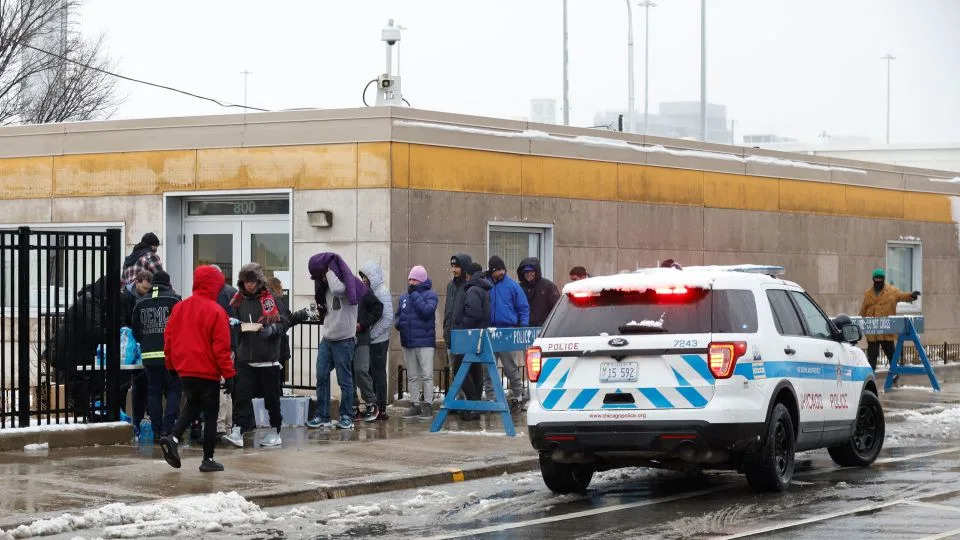
Chicago shelters lately have been so full, incoming migrants were kept at a designated “landing zone,” with minimal access to food and sanitation and only parked Chicago Transit Authority buses for temporary heat.
There had been about 140 migrants on those buses, Democratic Chicago Mayor Brandon Johnson said Friday, down from a high of more than 300, though as of Sunday, there were no longer any migrants awaiting placement in shelters at the landing zone location, according to the city.
As to whether conditions at the landing zone were acceptable, Johnson said, “Look, that’s a good question, you know. It’s certainly not acceptable for the (Texas) governor to send people to the city of Chicago, but we’re meeting the moment.”
Over the last few weeks, mayors of New York, Chicago and Denver have been irked by “rogue buses” from Texas dropping off migrants by the thousands and tried in their own jurisdictions to slow the surge by enacting mandates and requirements for bus operators to coordinate arrivals under the threat of impound, fines and even jail time.
Meanwhile in New York, homeless migrants starting Tuesday will be subject to a new 11 p.m.-to-6 a.m. curfew at four respite centers managed by the city’s Emergency Management Department, a spokesperson for City Hall told CNN on Monday.
Migrants get food Friday outside Chicago’s migrant landing zone. – Kamil Krzaczynski/AFP via Getty Images
In November, Chicago implemented a 60-day shelter stay policy based on migrants’ arrival dates so as not overcrowd the shelter system and to provide asylum-seekers services while they set up long-term housing. But due to the harsh weather, city officials suspended that limit and made some exceptions to the policy, Johnson said Friday.
‘Do his job and secure the border’
As for Abbott’s position, “instead of complaining about migrants sent from Texas, where we are also preparing to experience severe winter weather across the state, Governor Pritzker should call on his party leader to finally do his job and secure the border – something he continues refusing to do,” his spokesperson Mahaleris told CNN in the Friday statement.
“Until President Biden steps up and does his job to secure the border, Texas will continue transporting migrants to sanctuary cities to help our local partners respond to this Biden-made crisis,” he added.
Chicago Transit Authority warming buses sit at the migrant landing zone during extreme, cold temperatures on Friday. – Kamil Krzaczynski/AFP via Getty Images
Over the weekend, the bodies of three migrants – a woman and two children – were recovered by Mexican authorities after they drowned in the Rio Grande in Eagle Pass, Texas, very recently the epicenter of the migrant crisis and an area where state authorities have blocked the US Border Patrol from accessing miles of the US-Mexico divide, officials said.
The Biden administration on Friday complained to the US Supreme Court about the state blocking Border Patrol from a city park along the river and asked the high court to quickly intervene. The state on Saturday told the high court it was “working promptly” to ensure Border Patrol has access to a boat ramp at Shelby Park.
The White House called the recent migrant deaths “tragic” and characterized Abbott’s directives on the border as “political stunts,” Angelo Fernández Hernández, White House assistant press secretary said Sunday.
“While we continue to gather facts about the circumstances of these tragic deaths, one thing is clear: Gov. Abbott’s political stunts are cruel, inhumane, and dangerous. US Border Patrol must have access to the border to enforce our laws,” Fernández Hernández told CNN in a statement.
CNN’s Andy Rose, Rosa Flores, Gloria Pazmino, Whitney Wild and meteorologist Allison Chinchar contributed to this report.
Toy manufacturers’ shift from China is no child’s play
Richa Naidu – January 15, 2024
An undated handout photo of the Aequs toy manufacturing facility in Belgaum
LONDON (Reuters) – Toy makers grappling with surging costs in China are finding no easy options when it comes to shifting production to cheaper centres elsewhere.
Six years ago, monopoly maker Hasbro approached Indian durable goods and aerospace supplier Aequs to sub-contract.
“They said if you can get into toy manufacturing, now we’re looking to shift millions of dollars worth of product from China to India,” Rohit Hegde, Aequs’ head of consumer verticals, told Reuters. “We said: as long as we can get at least about $100 million of business in the next few years, we can definitely invest in it.”
Fast forward to today and Aequs makes dozens of types of toys for Hasbro and others including Spin Master in two 350,000-square-foot facilities in Belgaum, India.
But Hegde and other manufacturers acknowledge that India and other countries cannot match China for efficiency, limiting companies’ efforts to shift to lower cost bases and raising the risk of higher toy prices in future if the bulk of production remains in China.
“We don’t have the port facilities (in India) that China does. We don’t have the road facilities that China does. They have been doing this for the last 30 years, their efficiency levels are much better than ours,” Hedge said.
Still, for toy manufacturers including Hasbro and Barbie doll maker Mattel, the risks of relying on China for most of their production were highlighted during the COVID-19 pandemic, when Chinese ports struggled to export goods and were periodically shut down, leaving shipments stranded.
Soaring labour costs in China had already been driving manufacturers across industries to diversify production geographically.
A report by Rhodium Group last September showed that total announced U.S. and European greenfield investment into India shot up by $65 billion or 400% between 2021 and 2022, while investment into China dropped to less than $20 billion in 2022, from a peak of $120 billion in 2018. Mexico, Vietnam and Malaysia also drew some of this redirected capital.
Yet toymakers are struggling to shift production even as other industries succeed.
As of the first seven months of last year, mainland China still made 79% of toys sold in the United States and Europe, versus 82% in 2019, according to U.S. and European Union import data provided to Reuters by S&P Global Market Intelligence’s trade data service Panjiva.
In comparison, mainland China in 2019 accounted for 35% of U.S. and EU apparel imports. This reduced to just 30% in the year to July 31, with India and Mexico the biggest beneficiaries.
“Is it easy to re-shore away from mainland China? No, it isn’t. That goes double for toys,” S&P Global Market Intelligence’s Chris Rogers said. “It’s more complicated because they’re highly seasonal — you’re asking a partner to sit on inventory for most of the year. Toy makers also have to be doubly rigorous on safety, sourcing and making sure workers are treated well.”
While China’s minimum wage varies from between 1,420 yuan per month to 2,690 yuan per month ($198.52-$376.08), in India unskilled and semi-skilled workers can be secured for between 9,000 Indian rupees and 15,000 Indian rupees a month ($108.04- $180.06), according to central bank estimates.
But setting up to source from other countries can take 18 months if a company is buying product from a contract manufacturer, and up to three years if a firm is building a new factory from scratch, Rogers said.
Toys to be sold in the autumn go into production starting in May and are then stored or shipped.
‘MORE REASONABLE COST’
Hasbro began addressing its outsized dependence on China as an operational risk in its annual report in 2018, while Mattel has reportedly been shifting away from China since 2007, when it had to recall millions of toys tainted with lead paint. Efforts across the industry have ramped up since the pandemic.
Hasbro did not respond to a request for comment, while Mattel declined to comment for this story.
Spiralling Chinese wages are helping push up toy prices. In the UK, for instance, prices rose by about 8% in the first six months of 2022, according to Circana, formerly known as NPD. The risk for consumers is that prices will keep on rising sharply if manufacturers can’t cut costs by moving to cheaper production centres.
Though U.S. duties on Chinese toys are currently negligible, that could also change as some Republican politicians have called for revoking China’s “permanent normal trade relations” status. Such a move could raise the price of toys in the United States by more than a fifth, according to the National Retail Federation.
“We are all looking at derisking China,” said Nic Aldridge, managing director at Bandai UK, the maker of Tamagotchi virtual pets. “Raw materials costs have gone up a lot in China, we’re looking for places where we could get a more reasonable cost.”
Bandai still mostly manufactures in mainland China but some of its products are made in Taiwan, Japan, Vietnam. It is looking at India and Thailand as additional locations, Aldridge said.
MGA Entertainment, maker of LOL Surprise and Bratz dolls, has found infrastructure outside China to be a road-block to diversifying sourcing to countries like India and Vietnam, even as its exports from China last holiday season dropped versus the year before.
India accounted for only 1% of U.S. and EU toy imports over the past five years, according to Panjiva’s data.
“The issue in India is really the gridlock of moving even from one state to another. There are so many crazy regulations,” MGA Entertainment CEO Isaac Larian told Reuters.
“(But) the infrastructure is getting better and better as these countries realize the opportunity they have to take business away from China and they are investing,” he said.
(Reporting by Richa Naidu. Additional reporting by Manoj Kumar and Casey Hall; Editing by Susan Fenton)
Virginia county finds 4,000 misreported 2020 votes, shorting Biden
Julia Mueller – January 15, 2024
Virginia county finds 4,000 misreported 2020 votes, shorting Biden
Election officials in Virginia’s Prince William County have acknowledged roughly 4,000 votes were misreported in former President Trump’s favor during the 2020 presidential election, when President Joe Biden went on to win the state.
A release from the county’s Office of Elections announced Trump incorrectly received 2,327 extra votes, while Biden was shorted 1,648 votes.
The U.S. Senate candidates for the state in both parties received too few votes, and a Republican House candidate who won his race was shorted just less than 300 votes.
“The reporting errors were presumably a consequence of the results tapes not being programmed to a format that was compatible with state reporting requirements. Attempts to correct this issue appear to have created errors,” said Eric Olsen, director of elections for the county.
The errors “did not consistently favor one party or candidate but were likely due to a lack of proper planning, a difficult election environment, and human error,” Olsen added.
Biden ultimately won Virginia by more than 450,000 votes, and the misreporting issues did not meet the 1 percent threshold to trigger a recount, according to the Prince William County office.
The insights about the misreported figures stem from a case involving the county’s former registrar, Michele White, who was charged in 2022 with corrupt conduct, making a false statement and neglect of duty relating to the 2020 election. Those charges have since been dropped, the Associated Press reports.
Olsen, in his statement, stressed that Virginians should have faith in the state’s election systems, and spotlighted that improvements have been made to correct the process for future contests.
“Mistakes are unfortunate but require diligence and innovation to correct. They do not reflect a purposeful attempt to undermine the integrity of the electoral process and the investigation into this matter ended with that conclusion.”
Dallas Congresswoman Jasmine Crockett is going viral – just the way she wants it
Grace Yarrow – January 15, 2024
WASHINGTON — In summer 2021, about 50 Democrats from the Texas House arrived at the nation’s capital — absconding from Austin in a plot to block Republicans from passing a bill that would impose tighter restrictions on voting access.
Buzzing with excitement, the lawmakers took their places in front of reporters, with senior members and leadership moving toward the center to field questions. But Jasmine Crockett — a freshman from Dallas — stepped away from the group to take a call. She held up her phone to film her own live interview with a TV station, the dome of the Capitol building peeking out behind her.
That interview would be one of many that Crockett would take while camped out in Washington to discuss the Democrats’ quorum break, in a move that would raise the little-known lawmaker’s profile as she became an unofficial spokesperson for the dramatic political spectacle.
“There were people in leadership from my understanding that were not a fan of a freshman being a bit of a face of some of this,” Crockett said in an interview with The Texas Tribune.
Nonetheless, she accepted as many interviews as she could fit into her schedule, carrying two phones and a laptop to handle the crush of inquiries she received.
“I did not expect the world to pay attention,” Crockett said.
But she wanted them to.
Crockett, 42, didn’t get into politics to wait her turn. While she says she may have ruffled some feathers among her caucus peers at the time, her decision to grab the spotlight catapulted her career and provided the foundation for her to run for Congress the following year.
Crockett, who was elected to Congress in 2022 after serving one term in the Texas House, is shown in her Washington office Jan. 4, 2023. Credit: Michael A. McCoy for The Texas Tribune
Now a freshman in the U.S. House representing the Dallas-based 30th Congressional District, Crockett is once again finding her voice, seeking out moments to go viral and trying to make a name for herself in a deeper pool filled with bigger fish.
Her unfiltered musings and barbs while in Congress have helped her amass one of the largest social media followings in the Texas delegation, with an online audience of nearly a quarter of a million people on both X and Instagram. Her online reach is bigger than every other Texas Democrat, with the exception of Rep. Joaquin Castro of San Antonio, who has served a decade longer than Crockett has. And she’s been crowdsourcing the name for a new podcast, she’s considering.
Crockett got her first taste of going viral during a September hearing of the House Oversight Committee, which garnered media attention because of the Republican impeachment inquiry into President Joe Biden. Crockett took aim at former President Donald Trump’s mishandling of classified documents, holding up printed photos from his indictment showing boxes of classified documents in the Mar-a-Lago bathroom.
“These are our national secrets, looks like, in the shitter to me,” Crockett said in a clip that was shared on Reddit and Tiktok. One fan edit of the moment set to music, created by a 16-year-old fan, raked in over 8 million views on TikTok.
Crockett spoke about the virality of the moment on CNN, saying younger Democrats are looking for their elected leaders to “push back” against GOP talking points. Actor Mark Hamill, of Luke Skywalker fame, reposted the video on X, supporting Crockett: “Omg is an understatement!”
U.S. Rep. Greg Casar of Austin, another freshman Democrat who sits beside Crockett in the Oversight Committee, said he often struggles to keep a straight face during Crockett’s speeches.
“She can speak so directly to people and bring humor to the table in a way that makes folks want to listen. And that’s what we need right now,” Casar said.
For her online followers, Crockett provides gleeful narration about the unfolding drama within the majority party, such as her updates on X about “SPEAKERGATE,” the fallout from the ousting of former Speaker Kevin McCarthy.
Recently, she’s chronicled on X the expulsion of New York Republican George Santos, who was booted from the House following a searing ethics report detailing misuses of campaign funds. “Maybe a cat fight if Santos spills tea during debate, today,” Crockett posted before the expulsion vote.
Her posts — often interspersed with popcorn or eyeball emojis — are told as though she’s recapping an episode of reality television to a friend: “Welcome to preschool … I mean our prestigious congress (darn autocorrect).”
Rep. Jamie Raskin, D-Maryland, the ranking member on the House Oversight Committee, said that Crockett’s unique voice has proved to be an effective communication tool and that her expertise as an attorney is often on display.
He described her style as a combination of a lawyer’s “sharp analysis and lucid exposition” and a “Texan’s folksy and intimate manner.”
“Always a fighter”
Gwen Crockett said her daughter was a sharp-witted speaker from a young age.
In high school, Crockett participated in speech competitions. While in a production of “Little Shop of Horrors” at Rhodes College, a professor took notice of Crockett’s talent for public speaking and invited her to participate in a mock trial organization, where she first found her legal voice.
“I think that’s when it hit her that she wanted to become a lawyer,” Gwen Crockett said.
While at Rhodes College, Crockett was one of only 18 Black students and received threatening, anonymous racist mail.
“That was the first time that I felt helpless and felt targeted as a Black person,” she said. Crockett was paired with a Black female lawyer to help investigate who was sending the threats in the mail. Crockett now calls that lawyer her “saving grace” and another factor in her decision to pursue a legal career.
Jasmine Crockett studied at the Texas Southern University Thurgood Marshall School of Law and the University of Houston Law Center. After law school, she moved to Texarkana to be a public defender and later opened her own civil rights and criminal defense law firm.
She said her time representing thousands of Texans in court has given her firsthand experience with inequities in the justice system. Adam Bazaldua, a Dallas City Council member, said Crockett is “always a fighter for the most vulnerable.”
Crockett represented thousands of Texans’ cases and handled high-profile lawsuits involving police brutality and other cases involving racial injustice. In 2020, as she campaigned for a seat in the state House, she took on the cases of protesters arrested in the aftermath of the murder of George Floyd in Minneapolis.
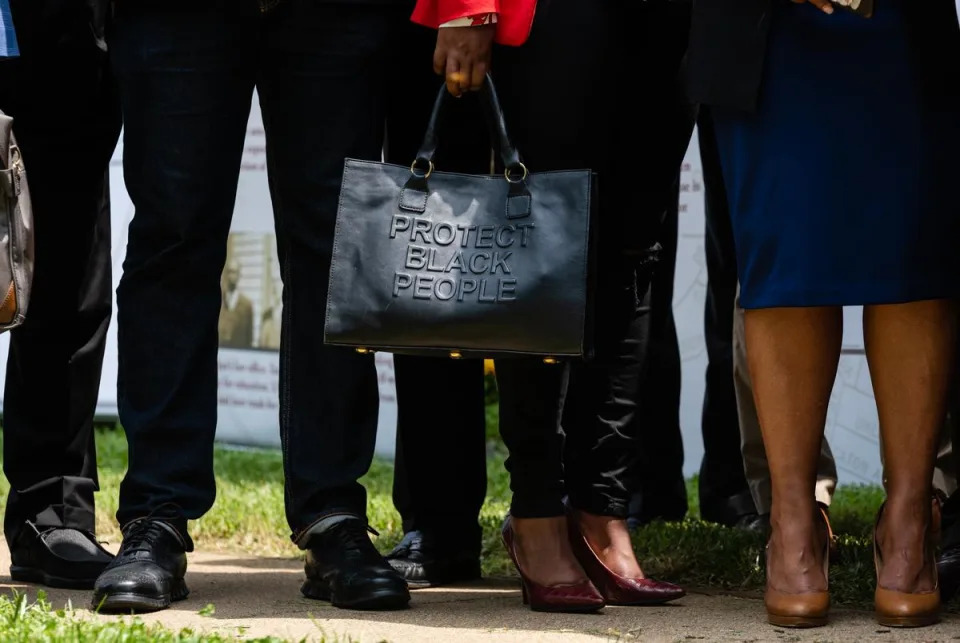
Then-state Rep. Jasmine Crockett, D-Dallas, holds a bag that reads, “Protect Black People” at a joint press conference with the Texas Legislative Black Caucus, the Virginia Legislative Black Caucus, the Legislative Black Caucus of Maryland and the Texas Legislature Democrats in Alexandria, Va. on July 16, 2021. Credit: Eric Lee
Activist Rachel Gonzales wrote Crockett’s phone number on her stomach when she protested an incident of police brutality in Texas outside the state Capitol in Austin.
“I knew that she would be the first person to show up and fight if needed,” Gonzales said.
During those protests, Crockett consistently posted information for constituents on social media, according to her former chief of staff, Karrol Rimal. Receiving hundreds of calls, Crockett organized other attorneys to help advocate for protesters.
“She never loses sight of the people,” Rimal said.
Crockett was elected to the Texas House in 2020, quickly becoming an outspoken figure in the Legislature. During her first legislative session, she filed 75 solo bills and co-authored another 110, three of which became law.
“Many freshmen, they just kind of sit there. They don’t say a whole lot because they’re trying to learn,” said former Texas Rep. Joe Deshotel, D-Beaumont. “But for her, the learning curve was very short. I mean, she jumped right in.”
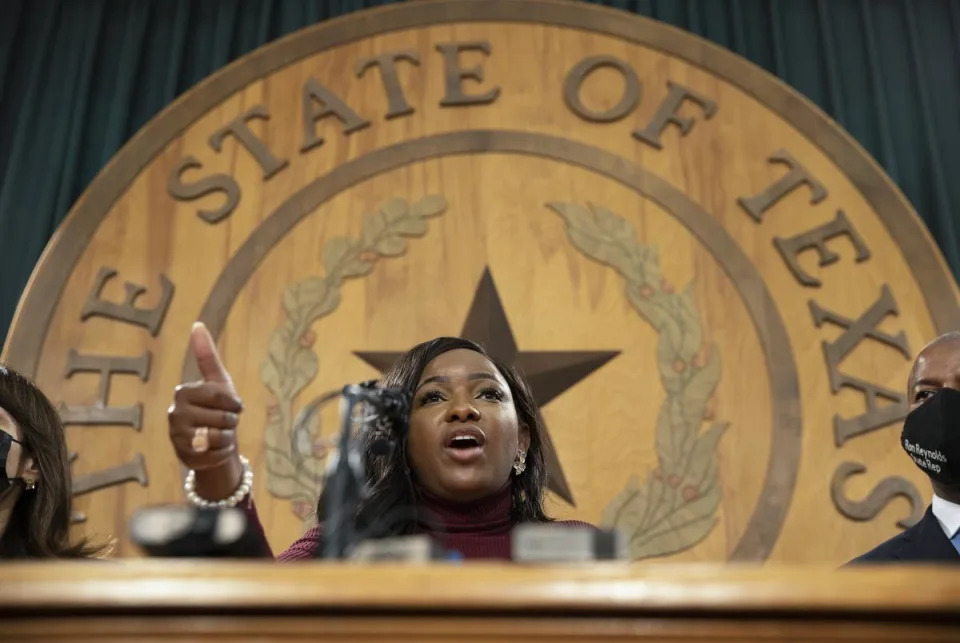
Then-state Rep. Jasmine Crockett, D-Dallas, speaks at a Texas House Progressive Caucus at the Capitol on Sept. 20, 2021. Credit: Eddie Gaspar/The Texas Tribune
Those who worked with Crockett pointed to the quorum break trip as her breakout moment.
“I think there was maybe some jealousy. She got a lot of national attention. She really was a lightning rod,” said state Rep. Ron Reynolds, D-Missouri City, who sat next to Crockett in the state House.
Although the Democrats were ultimately unable to stop the Republican elections bill from becoming law, they boosted the national conversation around voter disenfranchisement.
Crockett touted her leadership in the quorum break when she campaigned for the U.S. House in 2022.
She now represents the seat that recently deceased Democrat Eddie Bernice Johnson had held since 1993. After announcing her retirement, Johnson quickly encouraged Crockett to run.
Crockett said she hoped to carry forward Johnson’s legacy.
“Around 9 am, my predecessor, who hand picked me to succeed her, passed away and all of a sudden, like many of my plans this year, my plan to end on a high note, came crashing down,” Crockett said in a post last Sunday on X where she also said she had just done a media hit on MSNBC. “I appreciate the calls and texts and just pray that she’s resting easy. When I’m feeling a lil lost, I’ll always lean in and see if I can hear your voice, Congresswoman.”
U.S. Rep. Eddie Bernice Johnson, D-Dallas, talks to Jasmine Crockett at Crockett’s election night watch party for a congressional seat in Dallas on May 24, 2022. Credit: Shelby Tauber for The Texas Tribune
“Pragmatic progressive”
Being outspoken and online naturally makes way for comparisons to Rep. Alexandria Ocasio-Cortez, a third-term representative who has attained near-celebrity status as the face of the progressive movement.
But Crockett, unlike Casar of Austin, is not a member of the “Squad,” a well-known group of congressional progressives who regularly garner national media attention and GOP condemnation.
Crockett draws a strong line between herself and those progressives. She says her “pragmatic progressive” policy goals make her more willing to work with the business community, in situations where members of the Squad may be less willing to compromise.
But Crockett said she and Ocasio-Cortez have a common goal of using social media to meet constituents “where they are.”
“I think some of us younger members are trying to better educate voters,” Crockett said.
Though she routinely tussles with the GOP — she called them “assholes” in a September interview and again in December — Crockett also says she knows the importance of finding common ground with colleagues across the aisle.
U.S. Rep. Jasmine Crockett, D-Dallas, walks through the U.S. Capitol on the second day the 118th Congress on Wednesday, Jan. 4, 2023 in Washington, D.C. Credit: Michael A. McCoy for The Texas Tribune
She’s found an unlikely ally in Republican Sen. John Cornyn, who Crockett calls her “best partner” in the Senate. The senior senator has promoted the STRIP Act, a bicameral and bipartisan bill that decriminalizes fentanyl testing strips. The bill is still awaiting committee action.
Cornyn said it was a “no-brainer” to collaborate with Crockett on legislation he said would benefit Texans.
“I think she’s been very approachable,” Cornyn said. “It’s not easy to get things done or bills passed in either of the two houses, especially if you don’t have a dance partner. So I offered to be her dance partner.”
Crockett introduced the companion legislation in the House with Rep. Lance Gooden of Terrell, who Crockett said is a trusted colleague and a dear friend.
“We argue and fight each time we are together, but we also hug and laugh equally as often,” Gooden said in a statement.
Crockett is running for reelection, and has drawn two primary challengers, Jarred Davis and Jrmar “JJ” Jefferson. But she said she has no intentions to stay in Congress long term.
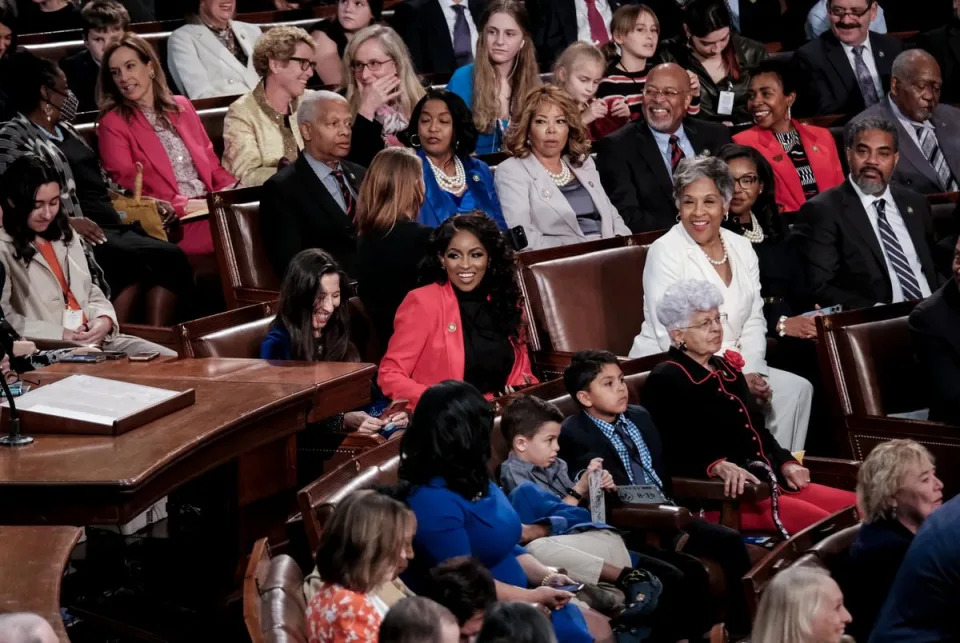
She’ll spend the coming months campaigning both for herself and working to clinch a Democratic majority in the House due to her role as the caucus leadership representative from the freshman class, a fundraising position and an honor bestowed onto her by her freshman colleagues. She’s the first Black woman in that position, which she said adds even more pressure.
U.S. Rep. Jasmine Crockett, D-Dallas, casts her first vote on the House floor on the first day of the 118th Congress on Tuesday, Jan. 3, 2023 in Washington, D.C. Credit: Michael A. McCoy for The Texas Tribune
“I have to make sure this opportunity and door stays open for those that come behind me. Leadership in the Democratic caucus is about money. It’s a money game,” Crockett said.
Olivia Julianna, a 21-year-old Texan with over a million followers on social media, said Crockett’s rhetoric appeals to young people on social media, in contrast with other politicians’ “jargony” or “unattainable” speech.
The Gen Z political activist said Crockett regularly “steals the show” in Congress.
“That’s why people respect her so much, because she says what a lot of people are thinking, but they don’t have the platform to say,” Julianna said.
Disclosure: The University of Houston has been a financial supporter of The Texas Tribune, a nonprofit, nonpartisan news organization that is funded in part by donations from members, foundations and corporate sponsors. Financial supporters play no role in the Tribune’s journalism.
Why the World Is Betting Against American Democracy
Nahal Toosi – January 15, 2024
Liesa Johannssen/AP
When I asked the European ambassador to talk to me about America’s deepening partisan divide, I expected a polite brushoff at best. Foreign diplomats are usually loath to discuss domestic U.S. politics.
Instead, the ambassador unloaded for an hour, warning that America’s poisonous politics are hurting its security, its economy, its friends and its standing as a pillar of democracy and global stability.
The U.S. is a “fat buffalo trying to take a nap” as hungry wolves approach, the envoy mused. “I can hear those Champagne bottle corks popping in Moscow — like it’s Christmas every fucking day.”
As voters cast ballots in the Iowa caucuses Monday, many in the United States see this year’s presidential election as a test of American democracy. But, in a series of conversations with a dozen current and former diplomats, I sensed that to many of our friends abroad, the U.S. is already failing that test.
The diplomats are aghast that so many U.S. leaders let their zeal for partisan politics prevent the basic functions of government. It’s a major topic of conversations at their private dinners and gatherings. Many of those I talked to were granted anonymity to be as candid with me as they are with each other.
For example, one former Arab ambassador who was posted in the U.S. during both Republican and Democratic administrations told me American politics have become so unhealthy that he’d turn down a chance to return.
“I don’t know if in the coming years people will be looking at the United States as a model for democracy,” a second Arab diplomat warned.
Many of these conversations wouldn’t have happened a few months ago. There are rules, traditions and pragmatic concerns that discourage foreign diplomats from commenting on the internal politics of another country, even as they closely watch events such as the Iowa caucuses. (One rare exception: some spoke out on America’s astonishing 2016 election.)
But the contours of this year’s presidential campaign, a Congress that can barely choose a House speaker or keep the government open, and, perhaps above all, the U.S. debate on military aid for Ukraine have led some diplomats to drop their inhibitions. And while they were often hesitant to name one party as the bigger culprit, many of the examples they pointed to involved Republican members of Congress.
As they vented their frustrations, I felt as if I was hearing from a group of people wishing they could stage an intervention for a friend hitting rock bottom. Their concerns don’t stem from mere altruism; they’re worried because America’s state of being affects their countries, too.
“When the United States’ voice is not as strong, is not as balanced, is not as fair as it should be, then a problem is created for the world,” said Ronald Sanders, Antigua and Barbuda’s longtime ambassador in Washington.
Donald Trump’s name came up in my conversations, but not as often as you’d think.
Yes, I was told, a Trump win in 2024 would accelerate America’s polarization — but a Trump loss is unlikely to significantly slow or reverse the structural forces leading many of its politicians to treat compromise as a sin. The likelihood of a closely split House and Senate following the 2024 vote adds to the worries.
The diplomats focused much of their alarm on the U.S. debate over military aid to Ukraine — I was taken aback by how even some whose nations had little connection to Russia’s war raised the topic.
In particular, they criticized the decision to connect the issue of Ukrainian aid and Israeli aid to U.S. border security. Not only did the move tangle a foreign policy issue with a largely domestic one, but border security and immigration also are topics about which the partisan fever runs unusually high, making it harder to get a deal. Immigration issues in particular are a problem many U.S. lawmakers have little incentive to actually solve because it robs them of a rallying cry on the campaign trail.
So now, “Ukraine might not get aid, Israel might not get aid, because of pure polarization politics,” said Francisco Santos Calderón, a former Colombian ambassador to the United States.
Diplomats from many European countries are especially unhappy.
They remember how, when Russia launched its full-scale invasion of Ukraine, many Republicans downplayed concerns about the far-right fringe in their party that questioned what was then solid, bipartisan support. Now, as the debate over the aid unfolds, it seems the far-right is calling the shots.
There’s a growing sense among foreign diplomats that moral or national security arguments — about defending a country unjustly invaded, deterring Russia, preventing a bigger war in Europe and safeguarding democracy — don’t work on the American far-right.
Instead, some are stressing to U.S. lawmakers that funds for Ukraine are largely spent inside the United States, creating jobs and helping rebuild America’s defense industrial base (while having the side benefit of degrading the military of a major U.S. foe).
“If this doesn’t make sense to the politicians, then what will?” the European ambassador asked.
A former Eastern European ambassador to D.C. worried about how some GOP war critics cast the Ukraine crisis as President Joe Biden’s war when “in reality, the consideration should be to the national interests of the United States.”
Foreign diplomats also are watching in alarm as polarizing abortion politics have delayed the promotions of U.S. military officers and threaten to damage PEPFAR, an anti-AIDS program that has saved millions of lives in Africa. That there are questions about America’s commitment to NATO dumbfounds the diplomats I talked to. Then, there are the lengthy delays in Senate confirmations of U.S. ambassadors and other officials — a trend exacerbated by lawmakers from both parties.
“There was always a certain courtesy that the other party gave to let the president appoint a Cabinet. What if these courtesies don’t hold as they don’t seem to hold now?” a former Asian ambassador said. “It is very concerning.”
When Republicans and Democrats strike deals, they love to say it shows the system works. But simply having a fractious, lengthy and seemingly unnecessary debate about a topic of global security can damage the perception of the U.S. as a reliable partner.
“It is right that countries debate their foreign policy stances, but if all foreign policy issues become domestic political theater, it becomes increasingly challenging for America to effectively play its global role on issues that need long-term commitment and U.S. political capital — such as climate change, Chinese authoritarianism, peace in the Middle East and containing Russian gangsterism,” a third European diplomat warned.
The current and former diplomats said their countries are more reluctant to sign deals with Washington because of the partisan divide. There’s worry that a new administration will abandon past agreements purely to appease rowdy electoral bases and not for legitimate national security reasons. The fate of the Iran nuclear deal was one example some mentioned.
“Foreign relations is very much based on trust, and when you know that the person that is in front of you may not be there or might be followed by somebody that feels exactly the opposite way, what is your incentive to do long-term deals?” a former Latin American diplomat asked.
Still, there’s no ambassadorial movement to band together and draw up a petition or a letter urging greater U.S. unity or focus.
The diplomats’ countries don’t always have the same interests. Some have plenty of polarizing politics themselves. In other words, there will be no intervention.
Some of the diplomats stressed they admire America — some attended college here. They acknowledged they don’t have some magical solution to the forces deepening its political polarization, from gerrymandered congressional districts to a fractured media landscape.
They know the U.S. has had polarized moments in the past, from the mid-1800s to the Vietnam War, that affected its foreign policy.
But they’re worried today’s U.S. political divisions could have lasting impact on an increasingly interconnected world.
“The world does not have time for the U.S. to rebound back,” the former Asian ambassador said. “We’ve gone from a unipolar world that we’re familiar with from the 1990s into a multipolar world, but the key pole is still the United States. And if that key pole is not playing the role that we want the U.S. to do, you’ll see alternative forces coming up.”
Russia’s diplomats, meanwhile, are among those delighting in the U.S. chaos (and fanning it). The Eastern European ambassador said the Russians had long warned their counterparts not to trust or rely on Washington.
And now what do they say? “We told you so.”
So the world’s envoys are reconsidering how their governments can deal with this America for many years and presidents to come.
Some predicted that a Republican win in November would mean their countries would have to become more transactional in their relationship with the United States instead of counting on it as a partner who’ll be there no matter what. Embassies already are beefing up their contacts among Republicans in case they win back the White House.
“Most countries will be in defensive positions, because the asymmetry of power between them and the United States is such that there’s little proactively or offensively that you can do to impact that,” said Arturo Sarukhan, a former Mexican ambassador to the United States.
When I asked diplomats what advice they’d offer America’s politicians if they were free to do so, several said the same thing: Find a way to overcome your divisions, at least when it comes to issues that reverberate beyond U.S. borders.
“Please create a consensus and a long-term foreign policy,” said Santos, the former Colombian ambassador. “When you have consensus, you don’t let the internal issues create an international foreign policy crisis.”
Davos: Global crises set to dominate gathering of business leaders
Faisal Islam – Economics editor – January 15, 2024
A woman takes a picture in front of a screen displaying AI-generated artwork
Just a week ago, the expectation about the latest gathering of the World Economic Forum in Davos, Switzerland, was of a line being drawn under three years of pandemic, lockdown and Ukraine war energy shocks.
Inflation is falling, and 2024 was set to be the year that central banks start cutting interest rates, including here in the UK. In three years of different rolling, merging global crises, the world economy has been in the shadow of massive geopolitical shifts.
The events of the past few days shows that the “polycrisis” is far from over.
Perhaps the most telling development has been the ability of the Houthis to use relatively cheap drones and armaments to cause havoc with world trade. Air strikes on the Houthis in Yemen were carried out explicitly to keep the currents of trade and economic recovery flowing through the straits leading to the Suez Canal.
But oil prices jumped on Friday because the risk of a wider confrontation in the region has also gone up. In three months the crisis in Gaza has led to RAF jets attacking targets in Aden. What will be happening three months from now?
As it happens, this sort of fundamental diplomatic challenge is made for the World Economic Forum. Launched in 1971, and held every year in the Alpine ski resort of Davos, the conference puts together the world’s top business people and politicians, as well as key players from charity and academia.
Where else would the Israeli president, Saudi foreign minister and Qatari prime minister be present in the same space at the same time, alongside French President Emmanuel Macron, UK Foreign Secretary David Cameron, US Secretary of State Antony Blinken and Chinese Premier Li Qiang?
Expectations are low surrounding the grim situation in the Middle East, but this is the sort of place where constructive and unexpected conversations can take place discreetly.
There had been a whiff of decay about Davos since the pandemic. G7 leader appearances were getting rarer. Rishi Sunak hasn’t been and isn’t going this week. In a huge year for elections across the globe the US delegation this year is particularly thin. Republicans in particular view the event with some suspicion.
The Republican Party’s Ron DeSantis, a potential presidential candidate, last year called Davos a “threat to freedom” run by China. The Florida governor said any policies emerging from the forum were “dead on arrival” in his state. The view in Davos is that he thought that such rhetoric would play well in the presidential primaries which also start this week.
Ukraine’s President Volodymyr Zelensky is attending, and will be mindful of “Ukraine fatigue” reaching Washington DC and becoming prevalent in developing countries.
Security is always tight at the Davos gathering
For the UK, some in the business community appear ready to go beyond a curious interest in the Labour Party in this election year.
Chancellor Jeremy Hunt and shadow chancellor Rachel Reeves will be competing for the attention of UK business leaders and international investors.
If business investors are worried about Labour’s economic plans, for example for extra investment spending, the World Economic Forum is exactly where it may, or may not surface. I recall then-opposition leader David Cameron’s parade of meetings with world leaders, just before he became prime minister in 2010.
There has been a backlash against some of the corporate do-gooding typical of the event, especially the recent focus by investors on companies’ environmental and social policies.
Put brutally, the world of the past two years has seen massive returns for hydrocarbon extractors, carbon emitters and arms companies.
The optimism will come from a hope that disturbed geopolitics can somehow settle without a further energy shock.
Artificial intelligence will be everywhere, with the ChatGPT-creating Open AI boss Sam Altman being paraded to the world’s business and political leaders by Microsoft, which is now vying with Apple to be the world’s biggest company.
So at the start of a delicate year of disorder and uncertainty in global politics and diplomacy, and question marks about economic recovery from years of such crisis, it is difficult to imagine a better moment for a gathering like the World Economic Forum this week.
The task is to travel towards the light at the end of the tunnel. It will not be easy.
Davos Elite Size Up the Global Risks of Another Trump Presidency
Francine Lacqua – January 15, 2024
(Bloomberg) — Donald Trump is thousands of miles away from the Alpine Swiss town of Davos but talk of his possible return to the White House is on everyone’s lips even before the annual shindig of the global elite has kicked off.
On Monday, in the subzero temperatures of Iowa, he’s set to cement his status as the Republican frontrunner in the first GOP contest of the 2024 election. His crushing lead over rivals appears unsurmountable and polls show Trump and US President Joe Biden facing off and in a dead heat.
Last seen mingling with the Davos crowd in 2020, when he made a dramatic entrance by landing with a squadron of helicopters, Trump is the last US leader to have shown up at the World Economic Forum but has remained a popular topic of conversation for attendees ranging from CEOs, financiers and policymakers.
“You know, we’ve been there before, we survived it, so we’ll see what it means,” BlackRock Inc. Vice Chairman Philipp Hildebrand said in a Bloomberg Television interview. “Certainly from a European perspective, from a kind of globalist, Atlanticist perspective, it’s of course a great concern.”
The former Swiss National Bank president shared the assessment of European Central Bank President Christine Lagarde, who last week said in plain language unusual for a central banker that another term of Trump would clearly be a threat.
Former US Vice President Al Gore, of course, is no stranger to political shocks having come within a whisker of becoming president himself almost a quarter of a century ago. These days he’s better known for being a climate warrior but he shared some caveats about assuming Trump is an inevitability even as the Republican candidate.
“I don’t think that it’s a foregone conclusion,” he told Bloomberg Television in Davos. “I’ve been through the process, I’ve run four national campaigns over the years and seen it from that perspective. I’ve seen a lot of surprises over the years. Something tells me this may be a year of significant surprises. I hope it’s the case because I don’t want to see him re-nominated and re-elected.”
He even issued a warning about not overplaying the importance of the Iowa vote.
“I’m not sure they’re as significant as some believe, he said. “There have been so many examples – last time in 2016 Ted Cruz won the Iowa caucus, and then it mattered not a whit. We’ve seen others win the Iowa caucus on the Republican side and then disappear.”
–With assistance from Laura Millan and Zoe Schneeweiss.
Ukraine says it shot down 2 Russian command and control aircraft in a significant blow to Moscow
Illia Novikov – January 15, 2024
A Russian Beriev A-50 airborne early warning and control plain flies over Red Square during a rehearsal for the Victory Day military parade in Moscow, Russia, on May 7, 2019. Ukraine’s military chief is claiming that the Ukrainian air force has shot down a Russian Beriev A-50 early warning and control plane and an IL-22 command center aircraft. (AP Photo/Alexander Zemlianichenko, Pool, File)Ukrainian President Volodymyr Zelenskyy, center, arrives at Zurich’s Kloten airport, Switzerland, Monday, Jan. 15, 2024. Zelenskyy is in Switzerland to attend the World Economic Forum in Davos starting Tuesday. (Alessandro della Valle/Keystone via AP)A Ukrainian APC fires towards Russian positions near Avdiivka, in the Donetsk region, Ukraine, Friday, April 28, 2023. The United Nations is appealing for $4.2 billion to help people in Ukraine and displaced outside the country this year. It said Monday, Jan. 15, 2024 that people on the front lines have “exhausted their meager resources” and many refugees also are vulnerable. (AP Photo/Libkos, File)Ukrainian President Volodymyr Zelenskyy, left, is accompanied by Switzerland’s Foreign Minister Federal Councillor Ignazio Cassis, after his arrival at Zurich’s Kloten airport, Switzerland, Monday, Jan. 15, 2024. Zelenskyy is in Switzerland to attend the World Economic Forum in Davos starting Tuesday. (Alessandro della Valle/Keystone via AP)
KYIV, Ukraine (AP) — The Ukrainian air force shot down a Russian early warning and control plane that can spot targets up to 650 kilometers (400 miles) away and a key command center aircraft that relays information to troops on the ground in a significant blow for the Kremlin’s forces, Ukraine’s military chief said Monday.
The planes are fundamental tools in helping orchestrate Russian battlefield movements in Ukraine. Shooting them down, if confirmed, would be a landmark feat for Ukraine in the almost two-year war, as fighting along the front line is largely bogged down in trench and artillery warfare.
Russia has largely ensured its air dominance during the war, as Ukraine fights with its fleet of Soviet-era warplanes against Moscow’s more more modern aircraft.
Gen. Valeriy Zaluzhnyi, the commander-in-chief of the Ukrainian armed forces, didn’t say how the two aircraft — a Beriev A-50 and an Il-22 — were brought down, but Ukraine has received sophisticated air defense systems from its Western allies.
Zaluzhnyi also did not say where the interceptions occurred, though he attached a video to his social media post with an airplane tracker showing two targets disappearing above the Azov Sea, which lies between Ukraine and Russia, north of the Crimea Peninsula and the Black Sea.
There was no immediate official comment from Moscow. Russian war bloggers said both planes had come under friendly fire, though they presented no evidence of that. They claimed the Il-22 was damaged but made a successful landing.
The A-50, which is topped with a large radar, typically carries a crew of 15. The Russian air force reportedly has been operating a fleet of nine such aircraft.
A February 2023 drone attack at an airfield in Belarus damaged a parked A-50, but Russian and Belarusian officials described the damage as minor.
The Il-22 is an airborne command post. It oversees military operations and sends radio signals to troops on the front line. The Russian air force reportedly has a dozen such planes.
Ukraine is eager to impress its Western supporters with its ability in deploying the advanced weapons it has received.
Ukrainian President Volodymyr Zelenskyy was due to meet Swiss President Viola Amherd in Bern later Monday before attending the World Economic Forum in Davos on Tuesday.
Ukrainian officials are striving to keep world attention on the war amid concerns that the conflict is slipping down the list of global priorities.
The United Nations appealed Monday for $4.2 billion to help people in Ukraine and displaced outside the country this year.
Martin Griffiths, the U.N.’s humanitarian chief, acknowledged that “the competition for funding is getting greater” because of crises elsewhere, including the Israel-Hamas war in Gaza.
The Kremlin is eager to replenish its weapons stockpiles. It has in recent times turned to Iran and North Korea for supplies.
Pyongyang has likely supplied several types of missiles to Russia to support its war in Ukraine, along with its widely reported shipments of ammunition and shells, the U.S. and its allies have alleged.
Russian and Iranian defense and foreign ministers spoke by phone Monday to discuss bilateral military and military technical cooperation and regional security issues, according to official statements. They noted that the two countries are preparing to sign a landmark cooperation treaty.
Ukraine is also determined to build up its stocks for a protracted conflict and is “dramatically expanding” its domestic manufacturing capacity for military items, a U.S. think tank said.
Ukraine is well-positioned to succeed in its plans to make up for any shortfall in Western-supplied weaponry, the Institute for the Study of War said.
“Ukraine is heavily industrialized, with a highly educated and technically sophisticated population,” the think tank said late Sunday. “It had a massive arms industry during the Soviet period and continued to be a significant arms exporter after independence.”
But turning ideas into action when governments owe an unprecedented $88.1 trillion — equivalent almost to the world’s annual economic output — will be hard.
Public debt exploded during the pandemic and new borrowing this year is likely to break records in several big economies, leaving governments less able to respond to shocks such as financial meltdowns, pandemics or wars.
Even in the absence of a new crisis, soaring debt servicing costs will constrain efforts to tackle climate change and care for aging populations. Public services in many countries are already strained after successive budget cuts.
More worryingly still, as debt burdens grow, governments could find themselves unable to borrow more to service existing obligations and fund basic services adequately.
A government unable to finance its debt “would be forced to implement abrupt and painful” spending cuts or tax hikes, said Michael Saunders, a former member of the Bank of England’s monetary policy committee.
“And such a government may lack the fiscal space to respond to future adverse shocks, preventing fiscal support when it is most needed,” he told CNN.
Saunders, now a senior economic adviser at consultancy Oxford Economics, doesn’t think rich economies are approaching what is roughly equivalent to a personal credit limit and points to sustained investor appetite for government debt. But that’s not to say the limit won’t be tested “10, 20, 30 years from now.”
Testing the limit
The United Kingdom — the world’s sixth-biggest economy — offers a cautionary tale of how badly things can go wrong when investors reject a government’s plan to borrow.
In September 2022, the pound and UK government bonds, or gilts, sold off sharply, partly in response to plans by former Prime Minister Liz Truss to issue more debt in order to pay for tax cuts. Mortgage rates and other borrowing costs soared as investors demanded much higher premiums for owning UK debt.
The Bank of England was ultimately forced to intervene and pledge to buy gilts on “whatever scale is necessary.”
“Were dysfunction in this market to continue or worsen, there would be a material risk to UK financial stability,” Dave Ramsden, a senior official at the central bank, said at the time. “This would lead to … a reduction of the flow of credit to the real economy.”
While central banks can provide temporary emergency support, they cannot finance government deficits in lieu of bond investors.
Just ask crisis-stricken Argentina, where for years the central bank printed pesos to help the country’s spendthrift government continue paying interest on its debt and avoid default. That tactic caused the value of the currency to plummet and prices to rocket. Annual inflation exceeded 211% last month, the highest level in three decades.
A risky year of elections
Government budgets will face renewed scrutiny this year from investors on high alert for politicians tempted to make promises in a bid to win over voters.
Half the world’s population is going to the polls. That swathe of elections means little incentive for belt-tightening among incumbent administrations, while also raising the prospect that incoming leaders will seek to make their mark with new tax and spending plans.
Already, debt is shaping up to be a key issue in this year’s US elections, which will culminate in the presidential election in November. Record levels of public borrowing have become a major point of contention between Republicans and Democrats, aggravating standoffs over the national budget that periodically threaten to starve federal agencies of funds and prevent them from operating.
Mounting debt and political brinksmanship have already taken their toll on America’s credit rating, which typically affects borrowing costs for the government, businesses and households.
Fitch cut its rating on US sovereign debt to AA+ from the top AAA grade last August, citing political polarization as a factor in its decision. Meanwhile, in November, Moody’s warned that it could also remove the United States’ last remaining perfect rating from the big three ratings agencies.
“One of the key elements sustaining a country’s credibility on its ability to repay (debt) is political consensus,” said Raghuram Rajan, a former governor of the Reserve Bank of India.
“It’s not unimaginable that if democracy takes a downturn in the United States, if there is a sense that there will be a political calamity,” the value of US sovereign bonds would fall, he added. And that would increase the government’s borrowing costs.
AI to the rescue?
Even if the worst scenarios are avoided, the increased cost of servicing debt after a recent rapid rise in official interest rates is siphoning ever greater amounts of money away from vital public services — and making it harder to address the climate crisis.
According to reports in UK media, Britain’s main opposition Labour Party has scaled back some of its enormous green spending plans because of concerns about adding to country’s debt burden.
In the current financial year, which ends on April 5, the UK government is expected to spend more on debt interest (£94 billion, or $120 billion) than on either education or defense, according to the Office for Budget Responsibility, a fiscal watchdog.
In the United States, interest costs on a common measure soared to $659 billion in fiscal year 2023, which ended on September 30, according to the Treasury Department. That’s up 39% from the previous year and nearly double what it was in fiscal year 2020.
In 2023 the government spent more to service its debt than it did on each of housing, transport and higher education, according to the Committee for a Responsible Federal Budget, a non-profit.
The surge in advanced economies’ debt that those hefty interest payments partly illustrate coincides with slowing economic growth and a rise in the number of the elderly relative to working-age people. Against that backdrop, it’s unclear how the world will dig itself out of its debt hole.
“What could rescue us relatively painlessly is if we have huge productivity improvements without job losses,” Rajan, now a professor of finance at the University of Chicago Booth School of Business, told CNN, suggesting that artificial intelligence could hold the key.
Biden has forgiven billions in student loans, but his allies say voters aren’t giving him enough credit
Gabe Gutierrez and Ghael Fobes – January 14, 2024
Kent Nishimura
WASHINGTON — More than six months after the U.S. Supreme Court struck down President Joe Biden’s ambitious program to erase $430 billion in student loan debt, the White House has been rolling out smaller, more targeted relief programs that it says have now canceled $132 billion in debt for more than 3.6 million Americans.
At the time of the court’s decision, it appeared that Biden wasn’t going to be make good on one of the biggest promises he made to young voters, who helped propel him into the White House. But as he’s gone about doing the same work more slowly, he seems to be getting little credit from those same voters.
On Friday, the administration said that it’s fast-tracking a key provision of the Saving on a Valuable Education plan — known as SAVE — that was scheduled to take effect this summer. Starting next month, borrowers enrolled in SAVE who took out less than $12,000 in loans and have been paying them back for at least 10 years will get their remaining debt canceled right away. With each additional $1,000 of debt, the window for forgiveness increases by a year. For example, a student who took out $13,000 in loans will now have their debt wiped out if they’ve been paying it back for 11 years, or in 12 years for those who borrowed $14,000 — and so on.
Separately, eligible borrowers don’t need to wait 10 years to get some financial benefit from the SAVE plan, which has a more generous formula for calculating income-based repayments than previous government programs. Most low-income borrowers will pay less. For example, a borrower making $38,000 a year with $25,000 in public student loans would see their payment drop from $134 to $43 a month, according to the Department of Education.
The White House said almost seven million borrowers have signed up for SAVE.
“I won’t back down from using every tool at our disposal to get student loan borrowers the relief they need to reach their dreams,” Biden said in a written statement.
Democrats are trying to motivate younger voters ahead of crucial months of the 2024 presidential campaign. According to an NBC News poll in November, Republican front-runner Donald Trump holds a slight advantage within the margin of error in the survey among voters ages 18 to 34 (46% to 42%) — a reversal from past election results and past NBC News polls.
Biden initially announced his broad student debt relief forgiveness plan in 2022, ahead of the midterm elections. The Supreme Court struck it down the following summer, ruling that a president doesn’t have the authority for such a broad policy under the law.
Since then, the White House has used other tools that no president had ever used to this extent. For example, using anti-fraud and consumer protection regulations, the administration has forgiven $22.5 billion for more than 1.3 million borrowers who claim they were cheated by their schools or that their schools closed.
The administration is now ramping up efforts to communicate that to voters. In South Carolina, some Democratic voters that NBC News spoke with said they were disappointed with the Biden administration — and cited what they perceived as a lack of results on student loan debt forgiveness as one of the reasons.
“I feel like my generation, we were promised that student loans would be erased and that hasn’t happened,” said Nashonda Hunter, 41. “We see how much aid that we’re sending over to foreign countries, and there are so many Americans that are suffering.”
That comment, while anecdotal, reveals some of the challenges that the Biden campaign is facing: ensuring that voters give the president credit for policies he has focused on.
Some Biden staffers have been frustrated that the president’s efforts on student debt relief haven’t gotten more attention. Acknowledging that, last week Rep. Jim Clyburn, D-S.C., introduced Biden at Mother Emanuel AME Church and highlighted the administration’s efforts to revamp loan assistance program for public workers such as teachers, police officers, firefighters and federal and state employees.
“But for some strange reason,” Clyburn said, “we don’t see reports about that.”
Diane Stuckey Bruce, who works at South Carolina State University, said she’d been paying off student loans since 2002 and never missed a payment. But the debt was crushing — and didn’t allow her to buy a home.
Then, in late 2021, she said she had her entire remaining student loan debt — $263,585.35 — forgiven through the program known as Public Service Loan Forgiveness (PSLF).
“I’ll never forget that day for the rest of my life,” she said, calling it a game changer. “It was the biggest blessing I have ever received.”
The White House has touted that it receives notes from constituents thankful for the loan relief.
“I actually sat and cried,” one writer who was worried they’d have to refinance their home to pay off the debt. “I am so relieved and my heart overflows with gratitude.”
Still, while the debt forgiveness programs have been popular on the political left, many Republicans have come out strongly against them and praised the Supreme Court for striking down the administration’s wide-ranging debt forgiveness plan, arguing that it was unfair for people who paid off their debts to have their tax dollars used to subsidize others who didn’t. GOP presidential candidates sounded off on the issue last year.
“Why should a truck driver have to pay for somebody that got a degree in zombie studies?” Florida Gov. Ron DeSantis said at an Iowa event in August. “It doesn’t make sense.”
On Friday, Republican members slammed the White House and the Department of Education for the new debt forgiveness plan that they argue is too expensive.
“President Biden is downright desperate to buy votes before the election — so much so that he green-lights the Department of Education to dump even more kerosene on an already raging student debt fire,” said the Republican chair of the House Education Committee, Virginia Foxx of North Carolina, after Friday’s announcement. “It’s clear that the Biden administration needs a good old-fashioned dose of fiscal common sense — all it knows how to do is spend like a drunken sailor.”