Some Republicans who supported Nikki Haley are still refusing to back Donald Trump
Meg Kinnard and Thomas Beaumont – March 25, 2024
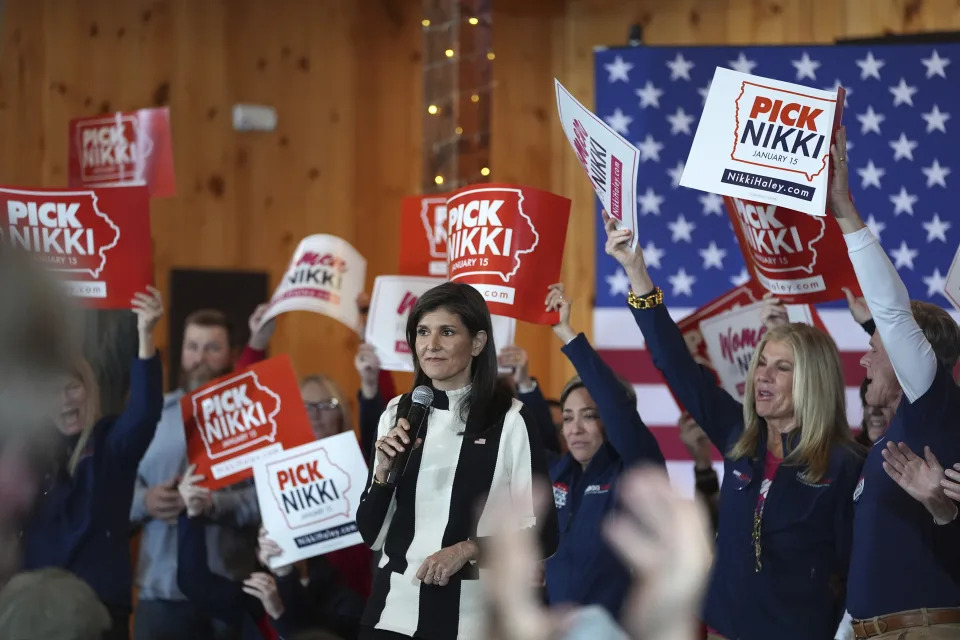
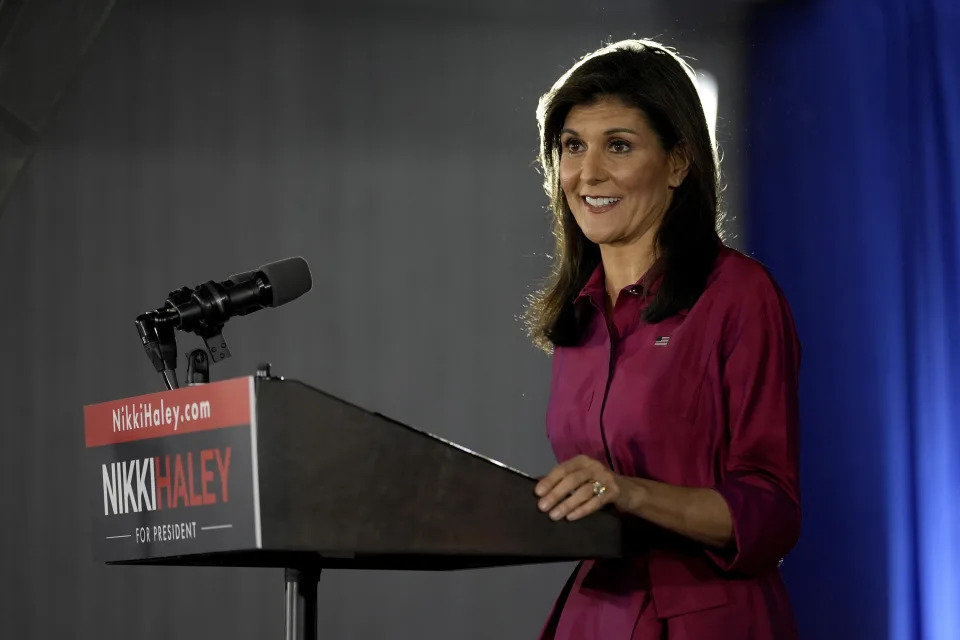
Republican presidential candidate former UN Ambassador Nikki Haley speaks at a campaign event, Jan. 14, 2024, in Adel, Iowa. Haley’s base of voters and donors was never big enough to seriously challenge Donald Trump. But her supporters are still splintered weeks after she dropped out of the GOP primary. If that holds, it could hurt Trump’s general election chances. (AP Photo/Abbie Parr, File)Republican presidential candidate former UN Ambassador Nikki Haley speaks at a caucus night party in West Des Moines, Iowa, Jan. 15, 2024. Haley’s base of voters and donors was never big enough to seriously challenge Donald Trump. But her supporters are still splintered weeks after she dropped out of the GOP primary. If that holds, it could hurt Trump’s general election chances.(AP Photo/Carolyn Kaster, File)
Another Haley primary supporter acknowledges that he was probably always a “closet Trump fan” and will vote for the former president again in November.
The former U.N. ambassador’s base was never big enough to seriously challenge Trump before he clinched a third straight Republican nomination. But in what’s shaping up to be a tight rematch between Trump and Biden, the apparent splintering of Haley’s voters and donors could hurt Trump’s general election chances, particularly in battleground states full of suburban voters who remain dubious of a Trump return to the White House.
For now, interviews with Haley’s supporters suggest they could go in a variety of directions — some backing Trump, some going to Biden and others seeking third-party options or avoiding making a decision about the presidential race yet.
Haley has not spoken publicly since leaving the race and urging Trump to reach out to all Republicans. She has not endorsed Trump and suggested she may not at all.
“She said it’s up to him to earn the support of those who supported her, and he’s got to earn it,” said Eric Tanenblatt, a longtime GOP donor who was Haley’s Georgia campaign’s co-chairman. “Right now, I’m definitely not there. It tells me there are things that are still up in the air among other key Haley donors waiting for a sign.”
The Trump campaign did not respond to a request for comment.
A reluctant return to Trump for some voters
Glenn Swanson caucused for Haley after seeing her campaign in his hometown of Cedar Falls, Iowa. At the time, the retired architect said he was open to a Trump alternative. Now, he’s coming back to the candidate he supported in both 2016 and 2020, despite his concerns about the four felony indictments and other civil cases facing Trump.
“For sure I’m going to vote for Trump,” Swanson said in an interview. “In a sense I was kind of a closet Trump fan all along, but I really wanted to see if somebody else would emerge to get away from some of the drama.”
John Wynstra, a database administrator who attended that same event, had been deciding between Haley and Florida Gov. Ron DeSantis before choosing to caucus for her. Wynstra said he’s strategically supporting Trump and the party’s platform — as a stance primarily against Biden — although he seemingly left the door open to possibly supporting a third-party candidate like Robert F. Kennedy Jr.
“I will vote against Joe Biden and the Democrats,” Wynstra said this week. “If Kennedy were viable and if his positions were palatable, I would consider him.”
In Haley’s home state of South Carolina, high school teacher Michael Burgess said that save an unlikely independent run by Haley or a moderate like former Rep. Liz Cheney, he would be supporting Biden and criticized Trump’s “Make America Great Again” movement.
“I will reluctantly vote Biden,” Burgess said. “We can survive bad policy, but we cannot survive the destruction of the Constitution at the hands of a morally bankrupt dictator lover in Trump who, supported by his congressional MAGA minions, would do just that.”
Her donors say they haven’t heard from Trump camp
Like many who were drawn to Haley, Tanenblatt, who was her Georgia campaign’s co-chairman, became disenchanted with Trump for what he called “inflammatory rhetoric,” chiefly in the wake of the Jan. 6, 2021, attack by his supporters on the Capitol.
But he also says Trump’s opposition to military aid to Ukraine is a fundamental policy difference. Tanenblatt has talked individually with former Haley supporters weighing a role with No Labels, the third-party group that is moving forward with attempting a unity ticket of opposing party presidential and vice-presidential nominees.
By and large, Haley’s donors have paused, with key bundlers noting they have not heard from Trump’s team as well as their reluctance to make any decisions.
“I really think there’s a period of recalibrating for a number of us who were very involved in Nikki’s campaign. This was a calling, something bigger than any one of us,” said Simone Levinson, a Florida-based Haley fundraiser who hosted events for her in New York and Florida.
Those donors could be helpful to Trump were they to come to the former president’s side.
For now, Trump and national Republicans are lagging far behind Biden and national Democrats in fundraising, with Trump’s campaign and allied groups holding $37 million cash on hand at the end of February compared to the $155 million in Democratic coffers.
In one sign of her influence going forward, Haley ended last month with $11.5 million, just days before she suspended her campaign. That’s slightly more than the Republican National Committee at $11.3 million.
Trump pushed away his closest allies – he’s finally paying the price
David Kaufman – March 25, 2024
Trump’s bad behaviour is coming back to bite him – Seth Wenig /AP
When it comes to his personal life, former president Donald Trump is far from wholesome: from the legendary Aspen face-off between his first and second wives in 1989, to the public humiliation Melania endured at the 2016 Republican National Convention in Cleveland, the women in Trump’s life haven’t always had an easy time.
Although Trump paid millions to divorce Ivana and Maples, those sums are nothing compared to the hundreds of millions owed as a result of the myriad civil and criminal trials currently facing the former president. True, the most spectacular of those settlements – the $454 million Trump must begin paying today as part of a fraud settlement in New York – is not directly tied to Trump’s unseemly bad-boy behavior. But like the tens of millions more that are, today’s massive bill, and the possibility that his assets will be seized to cover it, suggest Trump can no longer hide from his history.
Beyond his actual wives, there are ladies like Stormy Daniels and E. Jean Carroll, the former a prostitute reportedly paid $130,000 back in 2016 to keep silent about her alleged relationship with Trump. Nearly eight years later, Daniels is still in the headlines as Trump seeks to have their case delayed or dismissed as his legal team continues to pour over thousands of pages of potential new evidence.
Carroll, meanwhile, was awarded some $83.3 million by a New York jury back in January who found Trump guilty of both disparaging her and denying her allegations of rape nearly two decades earlier. This was on top of the $5 million Carroll was awarded the previous year in a similar proceeding. Trump, of course, has appealed the latter Carroll decision via a $91 million bond earlier this month. The strain of that nearly nine-figure penalty is part of the reason Trump is now scrambling to come up with the far larger half-billion bond he must post later today. The chickens, it seems, are coming home to roost – and Trump is running out of coops to house them.
The financial crises Trump now faces reflect his clear indifference for even the most basic standards of decency. How else to explain Trump’s behavior during Campaign 2016, which kicked off with his derision of Sen. John McCain’s years of brutal captivity during the Vietnam War, continued with his mocking of New York Times reporter Serge Kovaleski – who suffers from a serious joint condition – and concluded with the release of that now infamous “grab ‘em by the pussy” tape weeks before election day in 2016.
The latter example, delivered in raucous ribald tones, is typical of Trump’s self-aggrandising and entitlement. This attitude may well explain the reluctance of his daughter Ivanka and her husband Jared Kushner, both billionaires in their own rights, to bail out Trump with a “very small loan” of $500 million dollars.
The former president needs all the allies he can get in the long, tough battle to November. Even so, he seems determined to push people away, launching barbs at everyone from his niece Mary – whose 2020 family tell-all resulted in him branding her “a mess” on Twitter – to even perhaps his own kids. At an Iowa rally in 2022, Trump bizarrely told the crowd that “some of us have horrible children,” as he spoke about inheritance taxes.
Donald Trump is hardly the only former president with a paper trail of bad behavior behind closed doors – Clinton, Kennedy and the elder Bush also come to mind. But no commander in chief has been so reckless with their disdain for the conventions of domesticity quite like the Donald. It’s not that being a good father and husband are the most important requirements when running a nation, but they’re certainly a solid start.
Ukraine ramps up spending on homemade weapons to help repel Russia
Hanna Arhirova – March 25, 2024
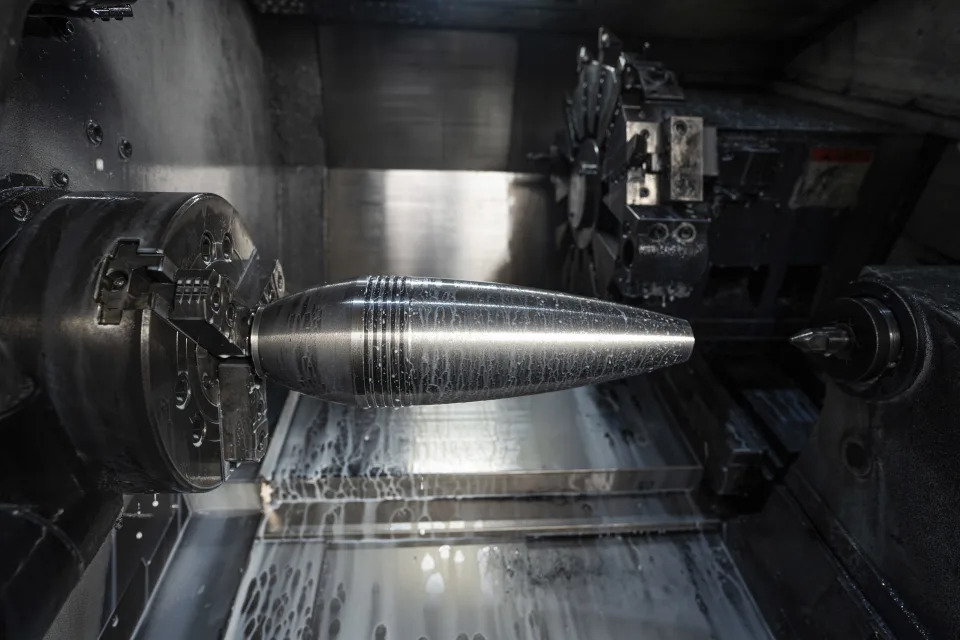
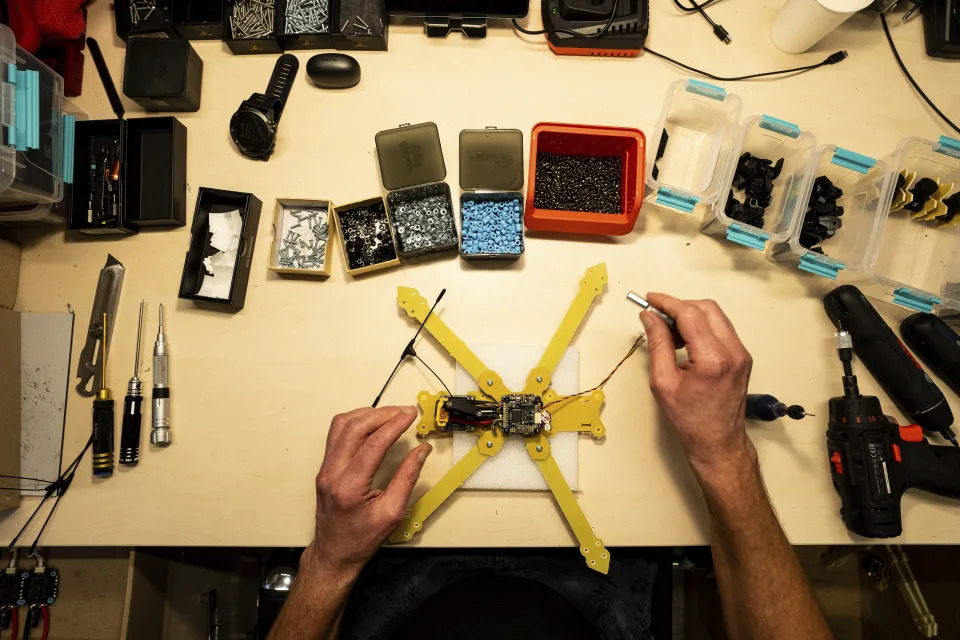
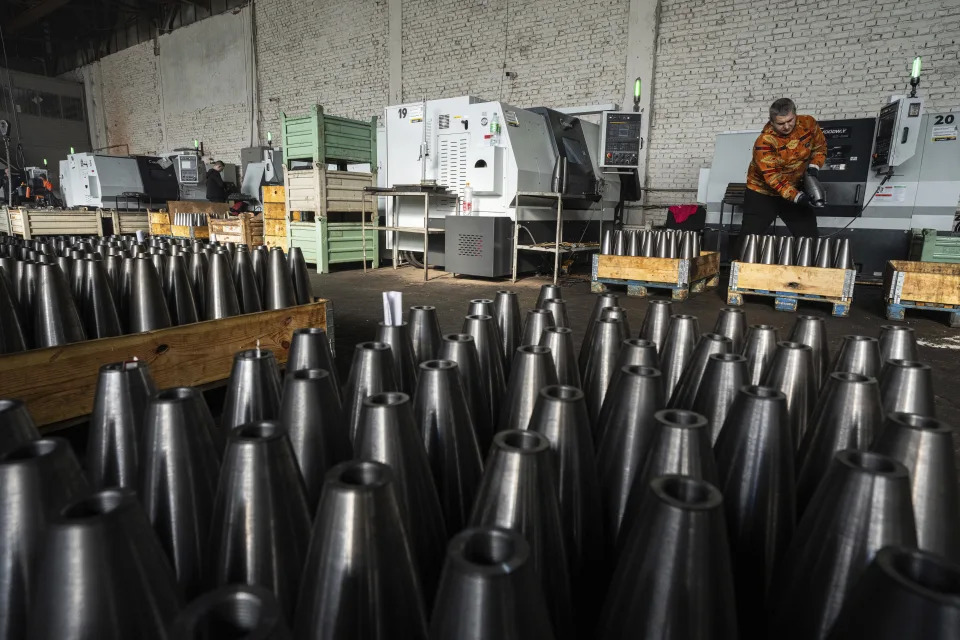
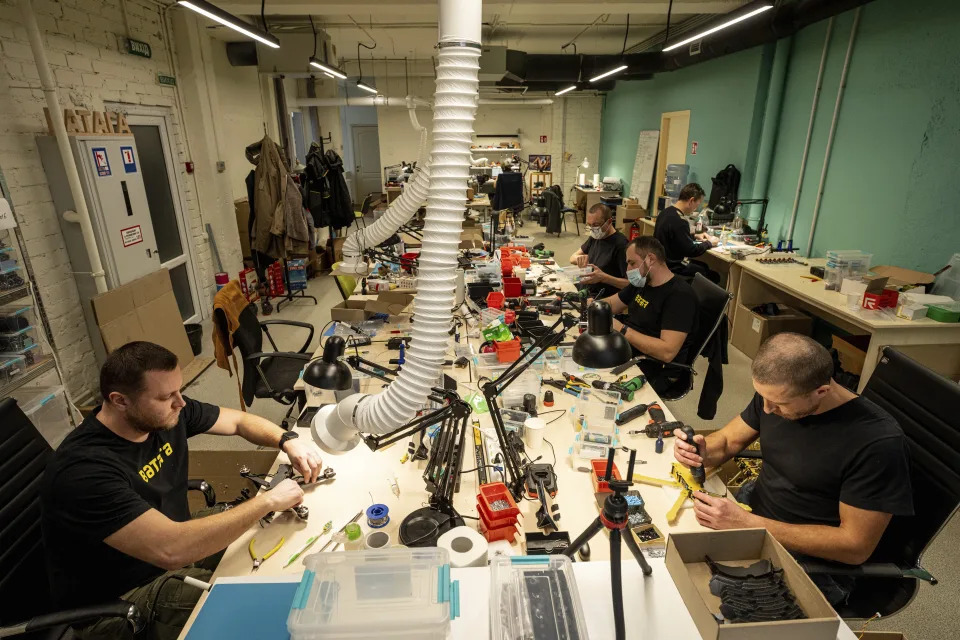
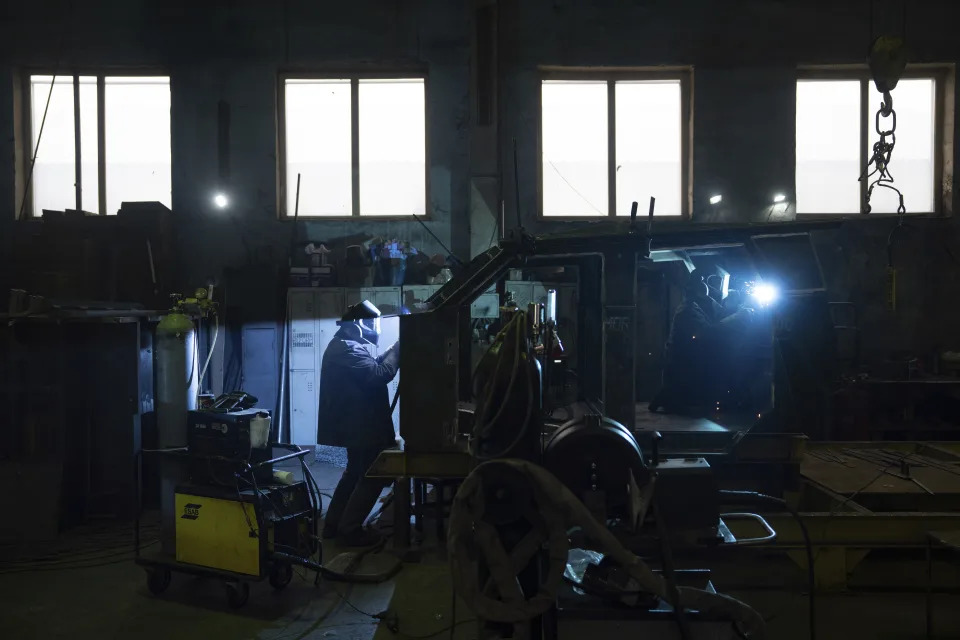
A worker assembles mortar shells at a factory in Ukraine, on Wednesday, January 31, 2024. (AP Photo/Evgeniy Maloletka)A mortar shell on a lathe at a factory in Ukraine, on Wednesday, January 31, 2024. (AP Photo/Evgeniy Maloletka)Workers check 82mm mortars at a factory in Ukraine, on Friday, December 22, 2023. (AP Photo/Evgeniy Maloletka)Workers weld reinforced steel for artillery vehicles at a factory in Ukraine, on Wednesday, January 31, 2024. (AP Photo/Evgeniy Maloletka)An engineer installs components in Kyiv region, Ukraine, on Wednesday, February 7, 2024. (AP Photo/Evgeniy Maloletka)An engineer assembles parts on a combat drone in Kyiv region, Ukraine, on Monday, February 6, 2023. (AP Photo/Evgeniy Maloletka)A worker stores mortar shells at a factory in Ukraine, on Wednesday, January 31, 2024. (AP Photo/Evgeniy Maloletka)Workers moving by crane an armored artillery vehicle hood at a factory in Ukraine, on Wednesday, January 31, 2024. (AP Photo/Evgeniy Maloletka)Armored vehicles are worked on at a factory in Ukraine, on Friday, December 22, 2023. (AP Photo/Evgeniy Maloletka)An engineer assembles an antenna for guiding an exploding drone in Kyiv region, Ukraine, on Saturday, February 10, 2024. (AP Photo/Evgeniy Maloletka)A sea drone cruises on the water during a presentation by Ukraine’s Security Service in Kyiv region, Ukraine, on Tuesday, March 5, 2024. (AP Photo/Evgeniy Maloletka, File)Engineers install components on exploding drones in Kyiv region, Ukraine, on Wednesday, February 7, 2024. (AP Photo/Evgeniy Maloletka)Exploding drones are ready to be shipped to the battlefield in Kyiv region, Ukraine, on Wednesday, February 7, 2024. (AP Photo/Evgeniy Maloletka)A worker walks past artillery vehicles at a factory in Ukraine, on Wednesday, January 31, 2024. (AP Photo/Evgeniy Maloletka)Engineers install antennas on a land drone in Kyiv region, Ukraine, on Wednesday, February 7, 2024. (AP Photo/Evgeniy Maloletka)Workers weld reinforced steel for armored vehicles at a factory in Ukraine, on Friday, December 22, 2023. (AP Photo/Evgeniy Maloletka)
KYIV, Ukraine (AP) — Ukraine needs any edge it can get to repel Russia from its territory. One emerging bright spot is its small but fast-growing defense industry, which the government is flooding with money in hopes that a surge of homemade weapons and ammunition can help turn the tide.
The Ukrainian government budgeted nearly $1.4 billion in 2024 to buy and develop weapons at home — 20 times more than before Russia’s full-scale invasion.
And in another major shift, a huge portion of weapons are now being bought from privately owned factories. They are sprouting up across the country and rapidly taking over an industry that had been dominated by state-owned companies.
A privately owned mortar factory that launched in western Ukraine last year is making roughly 20,000 shells a month. “I feel that we are bringing our country closer to victory,” said Anatolli Kuzmin, the factory’s 64-year-old owner, who used to make farm equipment and fled his home in southern Ukraine after Russia invaded in 2022.
Yet like many aspects of Ukraine’s war apparatus, its defense sector has been constrained by a lack of money and manpower – and, according to executives and generals, too much government red tape. A more robust private sector could help root out inefficiencies and enable factories to churn out weapons and ammunition even faster.
The stakes couldn’t be higher.
Russia controls nearly a quarter of Ukraine and has gained momentum along the 1,000 kilometer (620 mile) front line by showing a willingness to expend large numbers of troops to make even the smallest of advances. Ukrainian troops regularly find themselves outmanned and outgunned, and this has contributed to falling morale.
“You need a mortar not in three years, you need it now, preferably yesterday,” said Taras Chmut, director of the Come Back Alive Foundation, an organization that has raised more than $260 million over the past decade to equip Ukrainian troops with machine guns, armored vehicles and more.
WARTIME ENTREPRENEURS
Kuzmin, the owner of the mortar factory, fled the southern city of Melitopol in 2022 after Russia invaded and seized his factory that mostly made spare parts for farm equipment. He had begun developing a prototype for mortar shells shortly after Russia invaded Ukraine in 2014, when it illegally annexed the Crimean Peninsula.
Kuzmin took over a sprawling warehouse in western Ukraine last winter. His long-term goals include boosting production to 100,000 shells per month and developing engines and explosives for drones.
He is just one of many entrepreneurs transforming Ukraine’s weapons industry, which was dominated by state-owned enterprises after the break-up of the Soviet Union. Today, about 80 percent of the defense industry is in private hands — a mirror image of where things stood a year ago and a stark contrast with Russia’s state-controlled defense industry.
Each newly made projectile is wrapped in craft paper and carefully packed into wooden crates to be shipped to Romania or Bulgaria, where are loaded with explosives. Several weeks later, they’re shipped back and sent to the front.
“Our dream is to establish a plant for explosives,” said Kuzmin, who is seeking a partner to make that happen.
OBSTACLES TO GROWTH
Ukraine’s surge in military spending has occurred against a backdrop of $60 billion in U.S. aid being held up by Congress and with European countries struggling to deliver enough ammunition.
As impressive as Ukraine’s defense sector transformation has been, the country stands no chance of defeating Russia without massive support from the West, said Trevor Taylor, a research fellow at the Royal United Services Institute, a London-based think tank.
“Ukraine is not capable of producing all the munitions that it needs for this fight,” Taylor said. “The hold up of $60 billion of American help is really proving to be a significant hindrance.”
Russia is also pumping more money into its defense industry, whose growth has helped buffer its economy from the full brunt of Western sanctions. The country’s defense minister, Sergei Shoigu, recently boasted of huge increases in the manufacture of tanks, drones and ammunition.
“The entire country has risen and is working for our victory,” he said.
Compared with last year, Ukraine’s output of mortar shells is about 40 times higher and its production of ammunition for artillery has nearly tripled, said Oleksandr Kamyshin, Ukraine’s minister of strategic industries. There has also been a boom in drone startups, with the government committing roughly $1 billion on the technology — on top of its defense budget.
“We now produce in a month what we used to produce in a year,” said Vladislav Belbas, the director general of Ukrainian Armor, which makes a wide array of military vehicles.
For the Ukrainian army’s 28th brigade, which is fighting near Bakhmut, delays in foreign weapon supplies haven’t yet posed any problems for troops “because we are able to cover our need from our own domestic production,” said Major Artem Kholodkevych.
Still, domestic weapons factories face a range of challenges — from keeping up with changing needs of battlefield commanders, to their own vulnerability to long-range Russian missile strikes.
But perhaps the greatest immediate hindrance is a lack of manpower.
Yaroslav Dzera, who manages one of Ukrainian Armor’s factories, said he struggles to recruit and keep qualified workers, not least because many of them have been mobilized to fight.
CUTTING THROUGH RED TAPE
Weapons companies say another roadblock to growth is bureaucracy.
The government has tried to become more efficient since the war began, including by making its process for awarding contracts more transparent. But officials say the country has a long way to go.
Shortly before he was replaced by President Volodymyr Zelenskyy, Ukraine’s former top general, Valerii Zaluzhnyi, highlighted the problem in an essay he wrote for CNN, saying Ukraine’s defense sector remained “hamstrung” by too many regulations and a lack of competition.
In spite of the challenges, one success story has been Ukraine’s drone industry. Ukrainian-made sea drones have proven to be an effective weapon against the Russian fleet in the Black Sea.
There are around 200 companies in Ukraine now focused on drones and output has soared — with 50 times more deliveries in December compared with a year earlier, according to Mykhailo Fedorov, the country’s minister of digital transformation.
Russia’s war in Ukraine is not a standoff over whose got better drones or missiles, said Serhii Pashynskyi, head of the National Association of Ukrainian Defense Industries trade group.
“We have a war of only two resources with Russia — manpower and money,” he said. “And if we learn to use these two basic resources, we will win. If not, we will have big problems.”
___
Associated Press reporter Volodymyr Yurchuk contributed to this report.
NBC News in revolt over Ronna McDaniel hiring. Will the network reverse course?
Stephen Battaglio – March 25, 2024
Then-Republican National Committee Chair Ronna McDaniel speaks before a GOP presidential primary debate hosted by NBC News. (Rebecca Blackwell / Associated Press)
The hosts at NBC News’ cable outlet MSNBC continued to pound away at their parent organization’s decision to hire former Republican National Committee chair Ronna McDaniel as an on-air analyst.
The blowback unfolded throughout the day on the progressive cable news network, presenting a highly unusual situation in which well-known TV personalities went directly to viewers to challenge a decision made by their top managers.
The open rebellion could make it difficult for Comcast-owned NBC News to move forward with any plans to use McDaniel, who resigned from the RNC last month. A representative for NBC News said Monday there was no change in her status. But people familiar with the situation who are not authorized to comment publicly said McDaniel will probably be out before she even begins.
Chuck Todd, the ex-“Meet the Press” moderator, opened the door to the criticism when he appeared on his former program Sunday and blasted the network’s decision to make McDaniel a paid contributor, citing her record of supporting former President Trump’s false claims that the 2020 election was stolen.
MSNBC hosts weighed in on Monday, starting with “Morning Joe” co-hosts Joe Scarborough and Mika Brzezinski saying McDaniel will not be welcome on their daily program, a favorite of politicians and opinion leaders in Washington, D.C., and New York.
“We weren’t asked our opinion of the hiring, but, if we were, we would have strongly objected to it for several reasons.” Scarborough said.
Brzezinski said she hoped NBC News management will reconsider its decision to bring McDaniel aboard.
“Deadline: Washington” anchor Nicolle Wallace praised Todd for his Sunday remarks. “He did something really brave,” Wallace told her viewers. “I talked to him yesterday. I said I’m knitting you a cape.”
Wallace, a former George W. Bush White House communications director who has long been anti-Trump, and Joy Reid both devoted lengthy segments critical of the McDaniel hiring. Reid described McDaniel as “a major peddler of the big lie,” referring to the Trump’s election falsehoods. Reid cited how McDaniel was on Trump’s phone calls to GOP officials in Michigan, urging them not to certify the state’s 2020 election results.
MSNBC host Jen Psaki cited a Liz Cheney tweet that noted how McDaniel once described the Jan. 6 insurrection at the Capitol as “legitimate political discourse.”
“This is about truth versus lies,” Psaki, formerly the Biden White House press secretary, said.
Rachel Maddow, MSNBC’s biggest star, also asked NBC News management to reverse the decision.
“The fact that McDaniel is on the payroll at NBC News — to me that is inexplicable,” Maddow said on her program. “You wouldn’t hire a wise guy, you wouldn’t hire a made man, like a mobster to work in a D.A.’s office.”
Former NBC News executives took to social media to chastise the move as well. Cheryl Gould, a producer and executive at the division for 37 years, wrote an open letter on her Facebook page to Carrie Budoff Brown, the senior vice president of politics for NBC News who was involved in McDaniel’s hiring.
“We all make mistakes,” Gould wrote. “This happens to be a colossal one that unfortunately makes the network, your bosses and yourself look misguided at best, craven at worst.”
NBC has a long history of hiring former government and political officials as contributors to its news operation. Such deals are done to get exclusive access to insider knowledge — and to keep prominent talking heads from appearing on the competition.
In 1977, the network gave Gerald Ford a $1-million deal — brokered by William Morris Agency — to be a commentator and contributor to a series of specials about his presidency.
In the same year the network signed a similar deal to former Secretary of State Henry A. Kissinger. The move prompted a top news executive at the network, Richard Wald, to leave the company in protest, as he believed the deal siphoned resources from journalism projects. Wald also believed Kissinger owed it to the country to appear on NBC for free.
Political figures have segued into TV news commentary and lucrative TV anchor roles ever since.
NBC already has another former RNC chair on its payroll in Michael Steele, a co-host on the MSNBC program “The Weekend.” Psaki headed to MSNBC immediately after her departure from the Biden White House. Wallace worked on John McCain’s 2008 presidential campaign after her time in the George W. Bush administration.
All TV news organizations stock up on paid contributors during election season.
But the internal hostility toward McDaniel is linked to her support of Trump’s denial of the 2020 voting results, disqualifying her as a credible source to many inside the news organization. Before her appearance Sunday on “Meet the Press,” she had never acknowledged that President Biden won the election fairly.
McDaniel attributed her previous defense of Trump’s claims to her role in the RNC and said she can be “a little bit more of myself” now that she is no longer a party official. But she continues to say there were problems with the 2020 vote due to the dependence on mail-in ballots.
In a memo sent Friday to NBC News staff that was provided to the Times, Brown said McDaniel would provide a valuable perspective to the division’s coverage of the 2024 election with Trump as the presumptive Republican presidential nominee.
“It couldn’t be a more important moment to have a voice like Ronna’s on the team,” Brown said. “As we gear up for the longest general election season in recent memory, she will support our leading coverage by providing an insider’s perspective on national politics and on the future of the Republican Party — which she led through some of the most turbulent and challenging moments in political history.”
Rachel Maddow Calls on NBC News to ‘Reverse’ Ronna McDaniel Hire: ‘Acknowledge When You Are Wrong’ | Video
Benjamin Lindsay – March 25, 2024
Rachel Maddow weighed in on NBC News’ hiring of Ronna McDaniel Monday night, calling on the network to “acknowledge when you are wrong” and “reverse” the decision to add the former Republican National Committee chair and Donald Trump ally to their payroll.
“This is a difficult time for us as a country, and I think that means we need to be clear-eyed about the implications of it,” the MSNBC host said.
Maddow’s lengthy segment, as shared to her personal X account, began by reflecting on the longstanding pertinence of the “strongman” in American politics who tells “us that we need a new system of government where everything’s under their control and politics is over.” And that prior to former President and 2024 Republican nominee Donald Trump, none have gained the political traction necessary to infiltrate the democratic system.
Without naming her explicitly at first, the MSNBC host in part blamed McDaniel for paving the way for Trump’s rise to power.
“We’ve had a lot of these guys. But our generation’s version of this guy has gotten a lot farther than all the rest of them. And why is that? He would’ve been as forgotten as all the rest of them had he not been able to attach himself to an institution like the Republican Party,” Maddow explained. “And had the leader of that party in his time not decided that she wouldn’t just abide him, she would help. She would help with the worst of it.”
In the next video, Maddow clarified that despite media reports to the contrary, MSNBC leadership has about-faced its initial support of McDaniel’s hiring and assured staffers since Saturday, following “outrage” from many network colleagues, that the Republican figure would not have a place on the network.
“Our leadership at MSNBC heard us, understood and adjusted course. We were told this weekend in clear terms Ronna McDaniel will not be on our air,” Maddow said. “Ronna McDaniel will not be on MSNBC. And I say that and give you that level of detail because there has been an effort since by other parts of the company to muddy that up in the press and make it seem like that’s not what happened at MSNBC. I can assure you, that is what happened at MSNBC. Ronna McDaniel will not appear on MSNBC, so says our boss since Saturday, and it has never been anything other than clear.”
She added that NBC News’ decision to add McDaniel as commentator was “inexplicable” — like hiring a “mobster” to work for the D.A.’s office or a pickpocket to work as a TSA screener.
“I hope they will reverse their decision,” she said, adding that “it’s not about Democratic Party-Republican Party. It’s not about partisanship. It’s not about right vs. left. It’s not about being a political professional vs. some other kind of person. It’s not about being mean or nice to journalists. It’s not about just being associated with Donald Trump and his time in the Republican Party. It’s not even about lying or not lying. It’s about our system of government and undermining elections and going after democracy as an ongoing project.”
Maddow concluded that “this is a difficult time for us as a country,” and that inevitably “mistakes will be made” in how various powers that be conduct themselves in the face of that hardship.
“But part of our resilience as a democracy is going to be us recognizing when decisions are bad ones and reversing those bad decisions,” she emphasized. “Hearing legitimate criticism, responding to it and correcting course. Not digging in, not blaming others. Take a minute, acknowledge that maybe it wasn’t the right call. It is a sign of strength, not weakness, to acknowledge when you are wrong. It is a sign of strength — and our country needs us to be strong right now.”
Watch clips from the “Rachel Maddow Show” segment in the video above
Our criminal justice system is broken. But Donald Trump isn’t a victim.
Bill Proctor – March 23, 2024
No one is above the rule of law.
That’s the promise of the American justice system – a promise that is tested by former President Donald Trump.
Trump is facing dozens of criminal charges related to election interference and business dealings.
Like clockwork, what follows Trump news is Trump noise. He hurls insults at judges, prosecutors, investigators and their agencies as he pushes back in an ugly, unprecedented fashion to pump up his already angry-at-America base of supporters.
If we faced criminal charges, we know it would not help our defense if we insulted or threatened that very same criminal justice system.
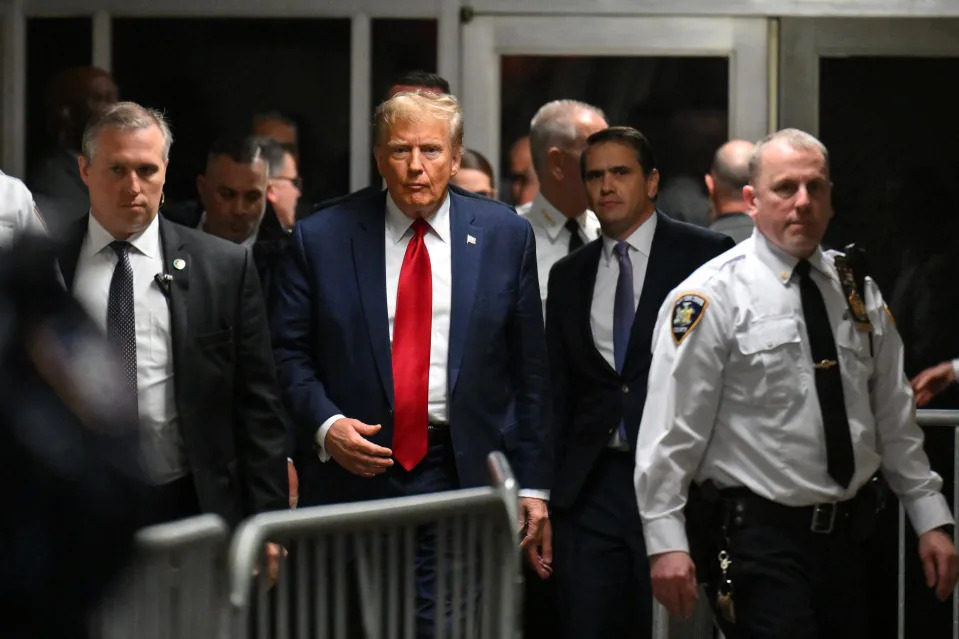
Former President Donald Trump arrives at the criminal court in New York City on Feb. 15, 2024.
Trump isn’t entirely wrong
Yet Trump says that he is the victim of a witch hunt by Democrats and his enemies, that he is suffering like Alexei Navalny, just like Jesus, just like Black people.
It’s a ludicrous assertion.
But he’s not entirely wrong. The legal system is sometimes unfair, but not in the ways Trump suggests – and not to Trump and people like him.
Consider that Trump has bought and will continue to buy the best available defense – with $50 million in legal fees – and what that says about the stark contrast between Trump and those who are struggling and must accept whatever the justice system throws at them.
With money and influence, the usual lawful process can be delayed, compromised or crushed along the way.
Without money and influence, Americans facing criminal charges crimes often lose the game they are forced to play. They’re walking into a meat grinder, almost always represented by struggling, inexperienced court-appointed lawyers without the finances to support a good defense.
There is plenty of evidence that more often than we’d like to think, the truly innocent have gone to prison for crimes they didn’t commit, and not because of politics.
Since 1989, nearly 3,500 Americans have been exonerated, according to the National Registry of Exonerations, after serving more than 31,000 years for crimes they did not commit. Those numbers clearly indicate, and I think most of us would agree, that we have a broken criminal justice system in need of reform.
To understand true legal persecution, look no further than less-privileged Michigan citizens like Temujin Kensu, formerly known as Fredrick Freeman, and Detroit native Ray Gray.
Estimated 25,000 to 30,000 people wrongfully imprisoned
Kensu and Gray are among the estimated 25,000 to 30,000 people condemned to lengthy U.S. prison sentences for crimes there is ample reason to believe they did not commit. The Innocence Project says at least 4% to 6% of the nation’s prison population is factually innocent.
Kensu was convicted in 1987 of murder in Port Huron for the broad-daylight shotgun slaying of 20-year-old Scott Macklem, cut down as he walked away from a classroom building on the campus of St. Clair County Community College.
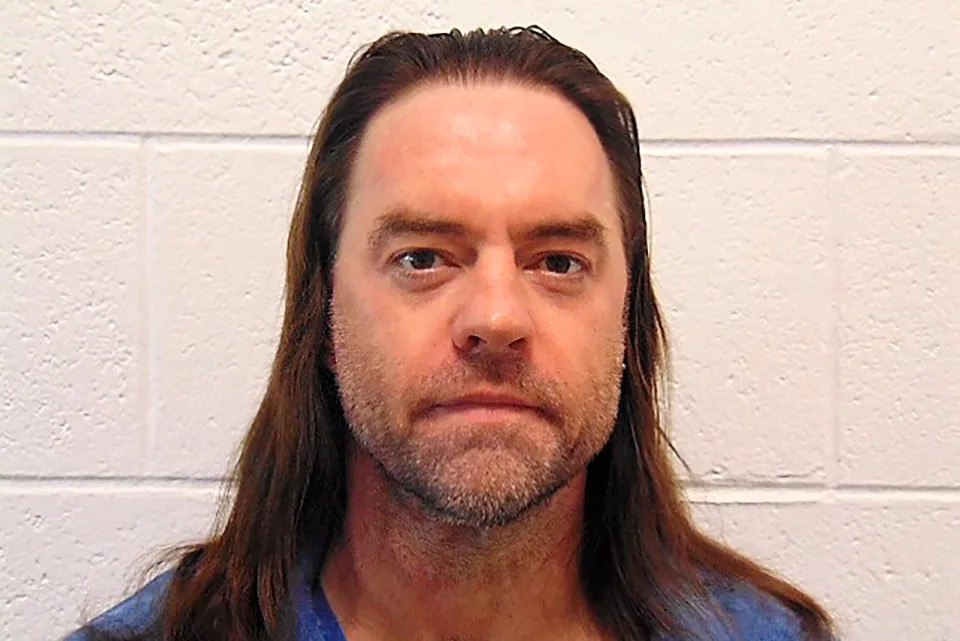
In this Oct. 14, 2018, photo provided by the Michigan Department of Corrections is Temujin Kensu, also known as Fred Freeman.
Several witnesses testified that on the morning of the murder, Kensu was hundreds of miles away. But he was convicted by a jury when the prosecutor, Robert Cleland, presented without any proof a theory that the man with no money, a pregnant girlfriend, no job and living on food stamps chartered a plane to travel 450 miles to commit the murder and return undetected.
When Kensu convinced the federal court that mistakes and harmful acts by the prosecutor, his drug-addicted lawyer and corrupt cops meant he should be released or be granted a new trial, an appeals court decided federal Judge Denise Page Hood’s ruling didn’t count. The Antiterrorism and Effective Death Penalty Act of 1996 time-limited his innocence claim.
At age 60, Kensu remains in prison, very ill and unable to get the governor to commute his sentence.
Raymond Gray spent more than 48 years in state prison in the robbery and murder of a drug dealer, convicted in a bench trial of the 1973 crime based on witness testimony – even though his family and one of the robbery suspects testified that Gray was at home when the crime was committed, styling the hair of one of his barber customers.
Despite police reports of two male perpetrators, one armed with a pistol at the time of the robbery, only Gray was charged and convicted when a judge chose not to believe the testimony of Gray’s relatives.
The Wayne County prosecutor’s office agreed to release Gray only if he pleaded to some element of the crime.
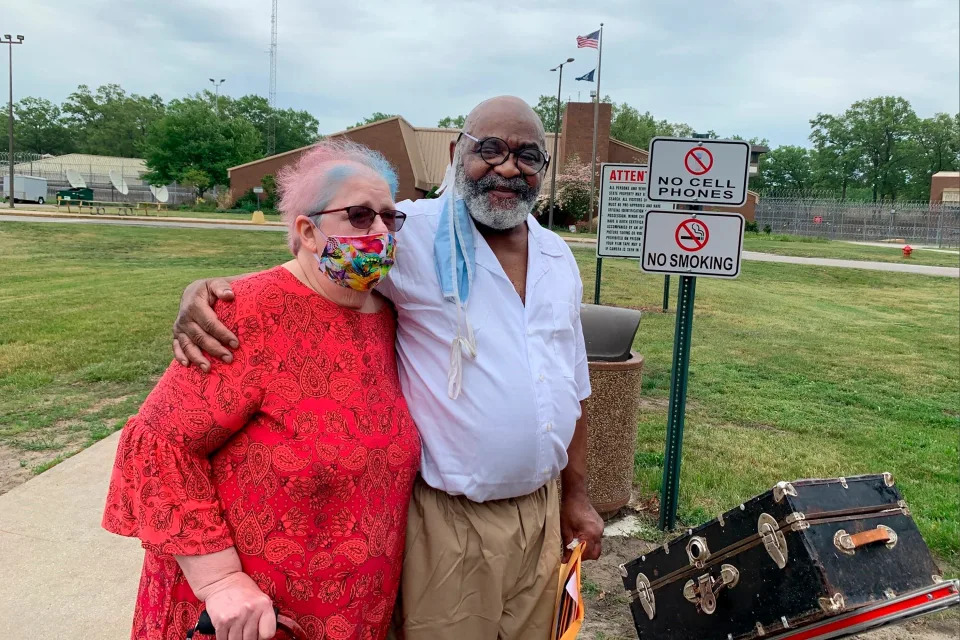
In this photo provided by Bill Proctor, Ray Gray and his wife Barb Gray pose for a photo after he was released from a state prison in Muskegon, Mich., on Tuesday, May 25, 2021. Gray was in prison for 48 years for the fatal shooting of a man in Detroit in 1973. He has long maintained his innocence and provided new evidence in March, 2021. Gray was not exonerated, but prosecutors agreed to drop the conviction in exchange for a no-contest plea to second-degree murder. He was sentenced to time served.More
Wrongfully convicted deserve protection and help
The wrongfully convicted and their families have been awarded billions in compensation for their suffering through judgments or state-mandated payouts. Imagine what the cost to communities would be if the nation recognized and paid damages to all the known victims of the justice system’s shortcomings.
Unjust actions in the criminal justice system have left many wondering why the Constitution didn’t fulfill its promise to them.
Last year, the right-wing majority of Trump’s Supreme Court, led by Justice Clarence Thomas, stacked with a right-wing majority, again slammed the door on innocence claims. Trump is counting on this same Supreme Court to save him from criminal prosecution.
The rule of law claims to grant equal rights and protections to everyone. It’s up to us to make that promise a reality.
Maybe now, as we face the madness of Trump’s bogus claim of unfair treatment, we should consider the real unfairness in our criminal justice system – and enact long-needed reforms and improvements to better protect those of us who aren’t rich and famous from punishment we truly don’t deserve.
Bill Proctor is a private investigator specializing in investigating wrongful convictions with his own firm, which he started after a four-decade career in broadcasting including 33 years as a reporter, producer and anchor in metro Detroit. This column first published in the Detroit Free Press.
Trump’s legal fees are sky high. An elaborate PAC scheme is helping pay them — for now
Erin Mansfield and Zac Anderson – March 24, 2024
A pro-Trump super PAC has been transferring millions of dollars every month to the former president’s fund for paying his ballooning legal bills. The transfers have kept the fund, Save America, afloat as it bled tens of millions of dollars on legal bills in the year since a New York grand jury indicted former President Donald Trump, the first in a wave of criminal indictments and civil judgments against him.
Save America, started days after Trump lost the 2020 election, is a type of fund called a “leadership PAC” that can only accept $5,000 per election cycle from each donor, but has few restrictions on how it spends money. It is being funded by Make America Great Again Inc., or MAGA Inc., a super PAC that started in 2022 and can raise unlimited amounts of money.
In the past, Save America’s highest spending involved audio-visual expenses for Trump’s public appearances, and donations to other groups, including MAGA Inc. But the money Save America spent on legal bills, including to firms that represent him in civil and criminal cases, has skyrocketed in the past two years.
So MAGA Inc. has stepped in to bail out Save America by paying it back. It sent $5 million at the beginning of every month from last July through February to Save America, totaling $40 million, in addition to $12.3 million that MAGA Inc. transferred in May and June, according to records from the Federal Election Commission.
It’s more money than MAGA Inc. has spent on independent expenditures, such as advertisements for Trump and against opponents like South Carolina Gov. Nikki Haley, since it started in 2022. That totaled $50.5 million since the beginning of 2023, compared to $52.3 million in transfers to Save America since May.
“It’s hard for me to think of another example where this has happened,” said Daniel Weiner, the director of elections and government at the Brennan Center for Justice, an advocacy group on democracy law based at New York University.
MAGA Inc. is sending the money to Save America to refund the $60 million it donated to MAGA Inc. in 2022 while it was on a spending spree. It would be illegal for the super PAC to simply donate its unlimited contributions to Save America, which has to follow federal contribution limits.
“This is certainly out of the ordinary,” Weiner said. “It was out of the ordinary for the leadership PAC to make a giant contribution to a super PAC, and now to do this kind of strange refund system, that is also something you would not normally see.”
Legal spending is tied to Trump’s civil, criminal cases
The transfer scheme has not provided a windfall for Save America, even though it raised more than $200 million since its creation. The PAC spent more than $64 million on legal bills through the end of report year 2023. Other money went to candidates during the 2022 election, outside organizations tied to former White House aides, and paying staff, even the former first lady’s fashion designer.
While public records can’t say what, specifically, law firms are being paid to do, records show Save America has paid more than 70 different lawyers and law firms, and many are listed on court paperwork representing Trump in his civil and criminal cases. And one lawyer who represented a Trump aide during the Jan. 6 Committee has said that Save America had an agreement with him. Most recently, three of the four firms that submitted a court document saying he couldn’t pay a $454 million judgment in a fraud case against the Trump Organization — Habba Madaio & Associates LLP, Robert and Robert PLLC, and Continental PLLC — are some of Save America’s highest-paid firms.
“He appears to be spending an incredible amount of campaign finance money on legal expenses that range well beyond what would be considered campaign related,” said Michael Kang, a law professor at Northwestern University. “I doubt, however, that we’ll get to the bottom of all this until much later on.”
Leadership PACs like Save America were designed to help leaders in the House and Senate fund the campaigns of their allies. But there is gray area in the law that the Federal Election Commission has declined to close, making them virtual slush funds that have helped support public officials’ lavish lifestyles.
“I don’t think they were ever intended to be these kinds slush funds that could be used for, essentially the personal benefit of the officeholder sponsoring them,” Weiner said. “I’m not saying that any law has been broken. I think this is sort of a legal gray area.”
PACs hire lawyers regularly, but generally for other purposes. Lawyers often file paperwork with the Federal Election Commission, help candidates get on the ballot in various states, or even help get through a recount.
The Jan. 6 Committee dinged Trump for fundraising for an “Official Election Defense Fund” in the days after the 2020 election, when the fund didn’t exist and instead went to Save America. But Trump has more recently used his legal issues to ask his supporters for money, with the money going to a fundraising vehicle that currently pours into his 2024 campaign and Save America. (Campaign money cannot be used for personal expenses.)
After his March indictment, Trump’s fundraising arm sent out a photoshopped fake mugshot in an email seeking donations. Since Wednesday, Trump’s main fundraising arm has sent messages to supporters saying, “Democrats want to seize my properties,” referring to New York Attorney General Letitia James’ ability to seize his personal assets if he fails to pay the $454 million judgment in the Trump Organization case.
Meanwhile, much of Save America’s money is coming from ordinary people. The fundraising arm brought in $50.5 million in donations smaller than $200 in 2023 alone, the latest information that is available from the Federal Election Commission.
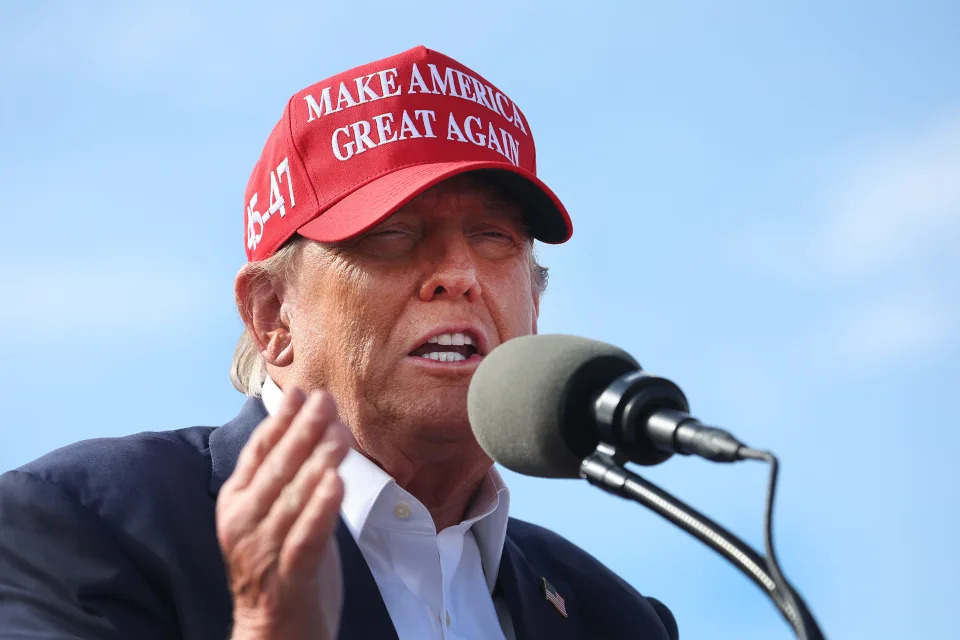
Former President Donald Trump is seen March 16 in Ohio.
Trump’s ‘drain on resources’ keeps him behind Biden
The enormous legal bills have caused Trump to fall behind in 2024 campaign fundraising, both in his own funds and the funds of the Republican National Committee, which is now under pressure to help Trump out of his legal jeopardy.
But the election likely will be decided by a small number of votes, so a significant spending advantage could make a difference and Trump’s legal issues are a “distraction and a drain on resources,” he added.
President Joe Biden’s campaign raised $21.3 million in February and spent $6.3 million, increasing its cash from $56 million at the end of January to $71 million at the end of February. In the same time period, Trump’s campaign collected $10.9 million and spent $7.8 million, increasing its cash from $30.5 million in January to $33.5 million.
The numbers show that Biden’s campaign is sitting on $37.5 million more cash than Trump’s, meaning that if the former president hadn’t spent more than $64 million on legal bills, and had instead put the money in his campaign account, he would have more money in the bank than the current president.
“I think both sides are going to have a lot of money, but if Trump has to divert a lot of his resources to his legal problems that’s money that’s not going to be spent on getting out the vote,” said Conant, who worked on U.S. Sen. Marco Rubio’s presidential campaign in 2016.
The Democratic National Committee, which is helping re-elect Biden, also continues to outpace the Republican National Committee, where Trump loyalists have taken hold. The DNC had $26.5 million in cash at the end of February, compared with $11.3 million for the RNC.
The campaign accounts and party committees provide an incomplete picture of the financial resources available to help the candidates. The fundraising arms both candidates use, who also called joint fundraising committees, are not required to provide an update on their finances until April 15.
Biden’s campaign announced this week that it raised $53 million through its various committees and the Democratic National Committee in February and had $155 million in available cash. Trump’s campaign did not announce joint fundraising committee numbers.
Trump will need a new way to pay legal bills going forward
Going forward, Trump will need a new fundraising scheme to pay his legal bills. That’s because MAGA Inc. can only refund up to $60 million back to Save America. It’s refunded $52.3 million through the end of February. At the current rate, the remaining $7.7 million would run out in mid-April.
MAGA Inc. may have that money. The super PAC saw a fundraising boost in February, when it raised $12.8 million last month, up from $7.4 million in January, and has $25.5 million in available cash. That increase was thanks in part to a $5 million donation from Robert Bigelow, a Las Vegas tycoon who believes aliens can be found on earth.
“You could wonder, ‘Why aren’t they just paying the legal bills from the super PAC?'” said Weiner, from the Brennan Center in New York. “But they must feel for whatever reason that it’s more legally advantageous to pay the bills from the leadership PAC.”
A new fundraising vehicle could come to the rescue. His allies have set up a new joint fundraising committee, called the Trump 47 Committee. It will divvy what it raises it among the Trump campaign, Save America, the Republican National Committee, a PAC called the Presidential Republican Nominee Fund 2024 and Republican committees in 37 states, Guam and the District of Columbia.
Lisa Murkowski, done with Donald Trump, won’t rule out leaving GOP
Manu Raju, CNN – March 24, 2024
Sen. Lisa Murkowski, aghast at Donald Trump’s candidacy and the direction of her party, won’t rule out bolting from the GOP.
The veteran Alaska Republican, one of seven Republicans who voted to convict Trump in his second impeachment trial amid the aftermath of January 6, 2021, is done with the former president and said she “absolutely” would not vote for him.
“I wish that as Republicans, we had … a nominee that I could get behind,” Murkowski told CNN. “I certainly can’t get behind Donald Trump.”
The party’s shift toward Trump has caused Murkowski to consider her future within the GOP. In the interview, she would not say if she would remain a Republican.
Asked if she would become an independent, Murkowski said: “Oh, I think I’m very independent minded.” And she added: “I just regret that our party is seemingly becoming a party of Donald Trump.”
Pressed on if that meant she might become an independent, Murkowski said: “I am navigating my way through some very interesting political times. Let’s just leave it at that.”
Murkowski hasn’t always been on the outs within her party. Appointed in 2002 by her father, Gov. Frank Murkowski, the senator’s politics were in line with the president at the time – George W. Bush – as she maintained a tight relationship with the senior GOP senator from her state, Ted Stevens, who helped build Alaska through federal dollars he funneled back home.
She later found herself at odds with Sen. John McCain’s running mate, the then-Alaska Gov. Sarah Palin, who had been sharply critical of her father. As the tea party rose in 2010, Murkowski was at sharp odds with the insurgent right-wing of her party. She lost a primary in 2010 to Republican Joe Miller, only to later hold on to her seat after she became the second candidate ever to win a write-in campaign for Senate in the general election.
Murkowski skated to reelection in her next two elections, even after voting to convict Trump in 2021, voting against Brett Kavanaugh for the Supreme Court in 2018 and supporting Ketanji Brown Jackson in 2022. She had been targeted by Trump and his allies in 2022 but was backed by Senate GOP Leader Mitch McConnell and his high-spending outside group.
In the 2024 cycle, Murkowski – along with Republican Sen. Susan Collins of Maine – offered a late endorsement of former South Carolina Gov. Nikki Haley, just days before she dropped out of the race.
Now, Murkowski is clear she’s ready to move past Trump. Asked about Trump’s recent comments that Jewish people who vote for Democrats must “hate” their religion, Murkowski said it was an “incredibly wrong and an awful statement.”
And Murkowski pushed back when asked last week about Trump’s other controversial rhetoric, namely that he views January 6 prisoners as “hostages” and “patriots” who should be pardoned.
“I don’t think that it can be defended,” Murkowski said. “What happened on January 6 was … an effort by people who stormed the building in an effort to stop an election certification of an election. It can’t be defended.”
Ukraine war: Two Russian landing ships hit off Crimea, officials say
James Gregory & Paulin Kola – BBC News – March 24, 2024
Kyiv’s mayor has told residents not to leave shelter
Ukraine says it has hit two landing ships, a communications centre and other infrastructure used by Russia’s Black Sea fleet off annexed Crimea.
An announcement by the Ukrainian general staff said the Yamal and Azov ships had been destroyed.
The Russian-installed governor of the port of Sevastopol said 10 Ukrainian missiles had been shot down.
Russia also launched a missile and drone attack on the capital, Kyiv, and the region of Lviv early on Sunday.
In an announcement, Mikhail Razvozhayev, the Russian-appointed mayor of Sevastopol, said damage had been caused to residential buildings and transport infrastructure as a result of the “massive” attack.
He asked residents not to publish information or any images.
UK Defence Secretary Grant Shapps praised the attack on the Russian ships, calling it a “historic moment for Ukraine”.
“In plain English, it means that Putin can no longer exercise safely in the Black Sea, even though the Russian Fleet has operated there since 1783,” Mr Shapps said.
He added that the world “cannot afford” for Ukraine to lose this war, and that the UK’s support for Kyiv in the face of Russian assaults “will remain undimmed”.
The BBC has not been able to verify the Ukrainian claim to have damaged the Russian landing ships, which are used to land troops and equipment straight to shore without the need for a pier or dock.
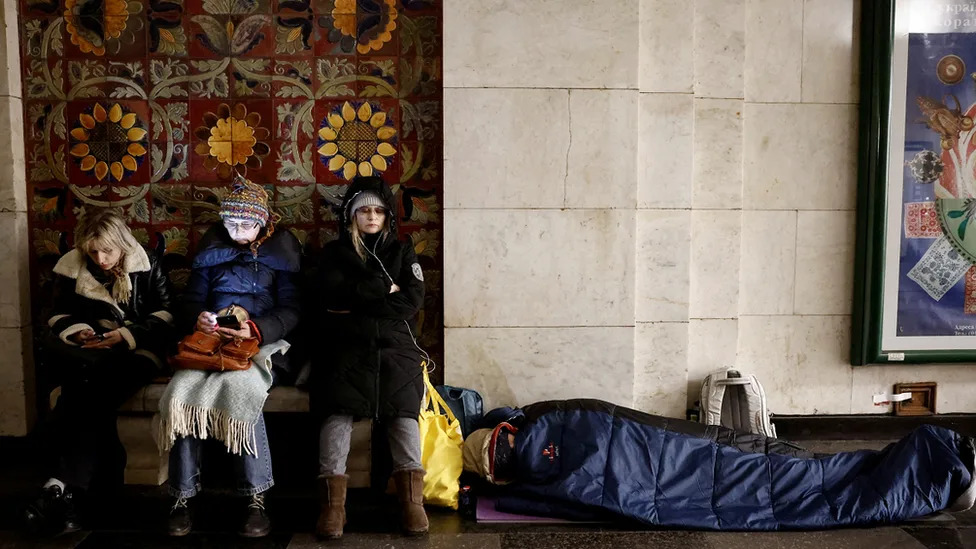
On Sunday morning, Kyiv residents took shelter in metro stations as the attack began at 05:00 (03:00 GMT).
Officials said their defences had shot down 18 Russian missiles and 25 drones there. There was only minor damage.
About 20 Russian missiles and seven drones targeted “critical infrastructure” in the western region of Lviv. No damage has been reported.
One of the cruise missiles entered the airspace of neighbouring Poland, a Nato member, the armed forces announced.
“The object entered Polish space near the town of Oserdow and stayed there for 39 seconds. During the entire flight, it was observed by military radar systems,” the armed forces said in a statement.
“If there was any premise indicating that this object was going in the direction of any targets located in Poland, of course, it would have been shot down and more adequate measures would have been taken,” Defence Minister Wladyslaw Kosiniak-Kamysz said.
Parts of a cruise missile fell on a park in Kyiv
Russia annexed Crimea in 2014 and launched a full-scale invasion of Ukraine in February 2022.
There has been an increase in aerial attacks by both sides in the past few days, even as Russia makes slow progress in taking some territory in the east of the country.
And Ukraine has been hitting targets in Crimea more regularly.
In particular, Ukraine has repeatedly hit the Black Sea fleet – seen as the best of Russia’s navy. Satellite images last year showed many of the Crimea-based warships had left the peninsula for the Russian Black Sea port of Novorossiysk.
Last month, the Russian landing ship Caesar Kunikov was sunk off the coast of Crimea, according to Ukraine’s armed forces.
Its sister ship Novocherkassk was hit while in port in Feodosiya in December last year.
In one of the biggest strikes on the Black Sea fleet, last September Ukraine attacked naval targets and port infrastructure, using as many as 10 missiles and three unmanned boats. It caused a large fire at a Sevastopol shipyard.
Ukraine’s biggest scalp in naval warfare has so far been the sinking of Russia’s flagship Black Sea missile cruiser, the Moskva, in April 2022.
Ukraine has also targeted the Kerch bridge several times, as it is an important resupply route for Russian forces occupying parts of the country’s south.
Kyiv has repeatedly said it plans to retake Crimea and all territories seized by Russia.
Ukraine is critically dependent on weapons supplies from the US and other Western allies to keep fighting Russia – a much bigger military force with an abundance of arms and artillery.
As well as being a platform from which to attack Ukraine, the Black Sea fleet is a major symbol of Russia’s centuries-old military presence in the region.
It was based in Crimea under a leasing deal, even before Russia illegally annexed the peninsula.
President Vladimir Putin has said that Russia had to take control of Crimea to stop it from falling into Western hands.
Location of Russia’s Black Sea fleet HQ in Sevastopol
Trump stares down first derailment of his campaign-to-courthouse strategy
Phil Mattingly and Andrew Seger – March 23, 2024
For days, Donald Trump’s fury over the requirement to secure hundreds of millions of dollars in bond money by Monday has been bubbling behind the scenes and through a steady stream of social media posts.
Friday’s public barrage on his Truth Social platform, which included multiple all-caps posts, highlighted his persistent anger with the judge who handed down the $464 million judgment, the New York attorney general who brought the civil fraud case and Trump’s insistence that it’s all designed to derail his presidential campaign.
The posts, including one sent just before 2 a.m. Friday, contained a mix of invective and claims devoid of fact or evidence. (There is no evidence that the White House has played any role in the case brought by New York Attorney General Letitia James, let alone ordered her to pursue her effort. Nor is there any evidence that Trump, as he claimed, has plans to use any of his own money for his presidential campaign.)
But also embedded in the posts was a reality that has pushed Trump’s company and personal finances to the brink with just two days remaining to land a solution.
Trump, as he himself noted, does have a significant amount of cash, according to a review of his most recent candidate financial disclosure and personal financial statements.
It’s a point he made repeatedly in his deposition and testimony during the New York fraud trial though that diverged from his latest social media claim of having “almost five hundred million dollars in cash.” He consistently pegged the number during legal proceedings at $400 million and, barring any recent and unreported cash infusion, a person familiar with his finances confirmed that remains roughly where his cash holdings stand.
Yet even if the higher-end estimate is accurate, as Trump’s lawyers have made clear in sober, detailed filings, it wouldn’t be enough.
The $464 million decision levied in the verdict, and the bond Trump is scrambling to secure to forestall potential seizure of his properties, would require cash or cash equivalent of roughly $557 million based on industry practice.
And at least some of the money Trump does have is tied up in loan agreements that include terms requiring him to have tens of millions of dollars in cash on hand.
In other words, as the clock ticks toward the Monday deadline, securing a bond of the scale required remains – to quote Trump’s own lawyers – a “practical impossibility.”
A deft strategy
Trump’s deft navigation of – and ability to leverage – his unprecedented collision of the campaign and courthouse has defined the path he bulldozed to once again become the Republican Party’s presumptive presidential nominee.
But it was a filing by New York state lawyers at a county clerk’s office 25 miles north of Trump Tower that demonstrated how perilously close the former president is to a dramatic derailment of that strategy.
The move by James’ office to enter judgments in Westchester County marked a first step toward seizing Trump’s assets should he fail to secure a bond.
Westchester County is home to Trump’s golf course and private estate known as Seven Springs.
The initial action, which state lawyers already took in Manhattan, is just the start to what would be a complex and lengthy process.
It also came as Trump’s lawyers have continued to press to reduce or waive the bond requirement, calling it “patently unreasonable, unjust and unconstitutional,” in a Wednesday filing.
But for Trump, a man who has made his brand and his buildings his central animating feature, the filing that put a target on one of his properties crystalized a moment unlike any other he’s faced in his White House comeback bid.
“I think the whole thing is bullsh*t,” one House Republican, who communicates with Trump’s team said of the order to secure the $464 million bond while waiting for a decision on his appeal. “But it had gotten to the point where it seemed like nothing will ever stick to him, so this has been different.”
In other words, there may be actual consequences.
Enduring GOP support
Over nearly a year, as four indictments and 88 charges piled on, Trump’s poll numbers in the GOP primary tracked a steady climb.
Days when Trump faced charges, or showed up at court to face those charges, consistently ranked among his best fundraising days on the campaign.
That money, in part, has covered Trump’s legal bills so he wouldn’t have to on his own.
The lawyers that money financed have been both unequivocal about their pursuit of dilatory strategies – and have repeatedly succeeded in those efforts.
If, as countless former campaign officials say, presidential candidates’ most valuable asset is their time, Trump’s decision to repeatedly attend court hearings when his presence wasn’t required made clear his view of the incentives. So did the voters.
Trump successfully cut down – with relative ease – the best financed and most politically gifted of his primary challengers. He all but locked up the GOP nomination after just two primary contests as the party largely fell in line behind a candidate under whose tenure it lost the House, the Senate and the White House.
Trump was also the same candidate whom some publicly – and many more privately – had hoped would simply disappear after the January 6, 2021, attack on the US Capitol and the steady stream of revelations that he and his advisers had sought to overturn Joe Biden’s 2020 victory.
People around Trump say they’ve seen no sign of any political damage from his latest legal stress test. National polls continue to show a margin-of-error contest with Biden, and more importantly, surveys in the critical swing states haven’t revealed a tangible shift. New CNN polling conducted by SSRS in two battleground states showed Trump tied with Biden in Pennsylvania at 46% each, and ahead in Michigan, 50% to 42%.
Biden flipped both states from Trump’s column in 2020.
Trump’s campaign apparatus trails Biden’s team significantly in fundraising, but those around Trump are confident that the gap will be closed. The former president, these people say, has been privately working the party’s biggest donors in a way they haven’t seen before.
“The money will be there,” one person told CNN. “He’s never been more focused or effective on that front than he is right now.”
One adviser mused that any pursuit of Trump’s properties would only serve to help the campaign politically, pointing to email and text donation appeals with lines like “Keep your filthy hands off Trump Tower!” as evidence to that effect.
A cash dilemma
Still, the threat Trump currently faces cuts equally to his political and personal core. It’s also one that carries a level of irony.
In a career, and now verdict, beset by a steady stream of questions about his net worth and the value of his substantial real estate assets, Trump does have a significant amount of cash – and a valuable portfolio of properties, which could more than cover the bond amount.
But insurers rarely take real estate as collateral, fearing a complex process and skewed market where any bids on that property would come from entities well aware of the need to sell, Trump’s lawyers said.
One insurer, Chubb, underwrote a $91.63 million bond just two weeks ago in another Trump legal loss – E. Jean Carroll’s defamation case.
Trump’s team had been in discussions with Chubb over a second bond for the fraud case that included a mix of liquid assets and property. In the past week, the insurer informed Trump’s team it could not accept property as collateral.
In total, 30 insurers contacted by Trump’s team declined to pursue the effort to secure a bond. Trump, in a Truth Social posting, alluded to that fact when he noted that it “is not possible for bonding companies to do in such a high amount, before I can even Appeal. That is CRAZY! If I sold assets, and then won the Appeal, the assets would be forever gone.”
There has been a steady stream of rumors about some of Trump’s richest backers stepping in to put up the cash.
But so far there has been no confirmation of concrete requests, let alone movement toward any agreement.
Another potential pathway that Trump allies have discussed opened up Friday when investors approved a merger that made the former president’s media enterprise, Trump Media and Technology Group, a public company. Trump’s holdings in the new company would, on their face, net him billions in stock.
But the availability of that cash from the parent company of Truth Social would be subject to a six month “lockup” period that would hamstring Trump’s ability to sell any shares or use them as collateral. The billions Trump stands to gain exist only on paper – and would be subject to the price fluctuations of the stock when it starts to trade.
Any effort by Trump to get around that lockup period in order to monetize his shares would likely have a direct, and negative, effect on the stock’s price.
Watching his image
Trump has repeatedly dismissed the idea of pursuing bankruptcy, which would freeze the proceedings for what would likely be an extended period of time.
The reasons, advisers say, cut across personal and political concerns.
Trump has been publicly vocal about the deep scars he carries from bankruptcies decades ago.
“It was an experience that I don’t think I want to go through it again,” Trump said in a 1992 interview with Charlie Rose. “You’re really in a position where I think that if you had to do it again, I’m not sure you could. I went through a period of two years that was truly tough.”
Trump is also cognizant of the potential threat it could pose to his carefully crafted image that sits at the heart of his political salience: that of a billionaire business tycoon.
“No chance,” one adviser said of Trump pursuing bankruptcy. “He’d rather have Letitia James show up and try and seize his properties.”
Whether that version of the campaign and courthouse convergence plays out will be made clear in the days ahead.
For now, however, it has become clear as the deadline to secure the bond looms ever closer, that the playbook that has driven Trump’s political comeback has run into hurdles in the form of hundreds of millions of dollars.
That’s a problem the only political opponent who has ever defeated Trump is happy to highlight.
“I know not everyone is feeling the enthusiasm,” Biden joked at a Dallas fundraising reception this week. “Just the other day a defeated-looking man came up to me and said, ‘Mr. President, I have crushing debt, and I’m completely wiped out.’ And I had to look at him and say, ‘Donald, I’m sorry. I can’t help you.’”