New report finds striking parallels between tobacco, gas stove campaigns: ‘This is intentional; it’s by design’
Ben Stern – March 22, 2024
For decades, tobacco companies misled the public about the dangers of their products, engaging in multipronged PR campaigns and spreading disinformation.
Today, nicotine and smoking are widely acknowledged to be addictive, and cigarettes are known to cause cancer. But it took years to expose these truths, all while massive tobacco corporations profited from the harm they caused.
In a striking new report titled “Cooking with Smoke: How the Gas Industry Used Tobacco Tactics to Cover up Harms from Gas Stoves,” the Public Health Law Center has revealed how Big Tobacco’s playbook of deception was also used to convince the public that gas stoves are safe.
The beginning of the gas stove fight
While news coverage on the potential dangers of gas stove pollution has recently picked up, researchers have been trying to sound the alarm since at least the 1970s.
Early studies conducted by the Environmental Protection Agency were primarily focused on investigating the health impacts of nitrogen dioxide (NO2) pollution from gas stoves.
After it was determined that such NO2 exposure could cause or worsen asthma and other respiratory problems, the American Gas Association (AGA), fearing public outcry, began to fund its own research claiming that gas stoves weren’t associated with respiratory issues.
Yet the current scientific consensus is that gas stoves are burdening the public with health issues, specifically our children. One peer-reviewed study from the nonprofit think tank RMI found that more than one in eight cases of childhood asthma in America is associated with a gas stove in the home.
The full health impacts of exposure to gas stove pollution are unfortunately not yet known. Pediatrician Dr. Lisa Patel, the Executive Director of the Medical Society Consortium on Climate and Health, believes it’s critical to learn more about gas stoves’ potential dangers sooner rather than later.
“Because the oil and gas industry has been so successful in pulling the wool over our eyes, suppressing the research, we’re still figuring out which of the pollutants [from stoves] is the ‘worst’ in terms of risk,” Dr. Patel told The Cool Down.
Cooking with smoke
The Public Health Law Center’s new report lays out how eerily similar the disinformation campaigns of the gas and tobacco industries are.
“Cooking with Smoke” describes seven of the deceptive tactics used by both the tobacco and gas industries to mislead the American public.
One such tactic is hiring the same scientists and research labs to provide biased or partial information pointing to desired results — namely, downplaying the health impacts of tobacco products and gas stoves. The AGA has hired the exact same laboratory as the Council for Tobacco Research, a tobacco industry trade group, for its sponsored research.
Last year, a New York Times exposé revealed that not only did the AGA hire a toxicologist to obscure the relationship between gas stoves and health impacts, but that same toxicologist was hired by the cigarette company Philip Morris to provide testimony claiming that Marlboro Lights were “safer for smokers.”
Another strategy utilized by both industries is the marketing of deceptive media to children. As outlined in the report, gas companies have used social media influencers to promote gas stoves to young people. Within the past two years, the gas industry has also sent coloring books to schools, telling children that “natural gas [is] your invisible friend,” as the report noted.
We deserve better
Due to decades of industry disinformation, the health harms caused by gas stoves have largely gone unnoticed or misunderstood by the American public. But just as Big Tobacco couldn’t hide the truth about cigarettes, the gas industry won’t be able to successfully hide the dangers of its stoves from the public forever.
“The gas industry wants us to accept health harms that we don’t have to. This is intentional; it’s by design,” Joelle Lester, Executive Director of the Public Health Law Center, told The Cool Down. “That’s where the gas industry is similar to Big Tobacco. They will continue to resist regulation and restriction to protect their profits.”
Change is coming
Both Lester and Dr. Patel believe that more information about the true health risks of gas stoves will inevitably emerge. When it does, change will follow.
“Jurisdictions will make changes [to transition away from gas stoves],” Lester told The Cool Down, “and once the sky doesn’t fall, and the health benefits can be measured, it will be so powerful.”
And according to Dr. Patel, “in the end, science and wanting to take care of each other will always win out.”
Actions you can take now
For those worried about the impacts of gas stoves, waiting on policy fixes isn’t necessary. The best way for an individual to eliminate the health risks of a gas stove is to replace it with an induction or electric range.
Induction cooktops have already proven to be the superior option in many ways, cooking food more quickly, evenly, efficiently, and safely than gas stoves.
While replacing your gas stove may seem daunting, the federal government, through the Inflation Reduction Act, will offer up to $840 to those who make the switch.
Even renters will be able to take advantage of this point-of-sale rebate by purchasing plug-in induction cooktops.
Some landlords may also be amenable to electrification projects, like installing induction stoves, once they find out how much more energy-efficient the devices are. The nonprofit Rewiring America has an in-depth guide for talking to your landlord about upgrading.
Of course, even with an $840 upfront discount, not every family will be able to make the switch. For those families, many options still exist to protect their respiratory health. Dr. Patel told The Cool Down: “If they can’t get that gas cooktop out, using electric appliances, opening windows, [or] using an overhead vent helps.”
Adam Gopnik’s latest essay for The New Yorker explores how Adolf Hitler was able to rise to power in Nazi Germany—which happened largely because people believed they would be able to control him.
Gopnik tells The New Abnormal co-host Danielle Moodie that the same could be said for Donald Trump leading into the 2024 election.
“You had this character who was regarded as a chaotic clown by everyone around him. The conservative minister of defense called him a psychopath,” he said. “Yet all of those people, the media moguls, the respectable conservatives, ended up aiding and abetting him in every way in his search for power and they did it in a way that is, yes, disconcertingly familiar to us.”
“They all thought they could manage him. They all thought they could control him. They all thought that they could take advantage of his movement for their own ends. And that on the day when it all blew up, because it had to blow up because he was a psychopath and clearly not capable of exercising power, they would be there to inherit,” he said.
Gopnik says that those who propped up Hitler believed they could “control the beast” and that they would “end up the ultimate victors.” However, as history shows, that wasn’t the case.
“Those patterns are frightening to see emerging again and again throughout history.”
It’s rare for a federal judge to appear on a news program for any reason. But to appear on one for the purpose of criticizing a party in an active case was so extraordinary it rendered my colleague, Sarah Isgur, nearly speechless.
“This is a sitting federal judge commenting on a criminal defendant in a pending trial in his district,” she tweeted in reaction to the news. Not a word of that sentence is overtly critical, but it didn’t need to be. Merely describing what had happened conveyed the depth of her astonishment.
If it matters to you, Reggie Walton is a senior judge rather than an active judge, which means he hears cases on a reduced and irregular schedule for the U.S. District Court for the District of Columbia. He isn’t presiding over Donald Trump’s criminal trial in Washington for trying to overturn the 2020 election; Judge Tanya Chutkan is in charge of that. And if you watch the interview he did with Kaitlan Collins, you’ll find that he spoke mainly in generalities about threats to judges instead of focusing on Trump.
But so what?
The context for the CNN segment was Trump’s attempt to intimidate the judge overseeing his upcoming criminal trial over the Stormy Daniels hush-money payoff. Collins made that explicit on social media:
Judge Walton understood that context. He knew, of course, that Trump is a criminal defendant right now not only in his home district but in Florida, Georgia, and New York. He must have recognized that prospective jurors in each of those venues might see the interview and have their views of Trump’s guilt colored by a notable judge’s dim regard for his behavior.
As you may have heard, Trump is also the Republican nominee for president. Even if no jurors end up being influenced by Judge Walton’s interview, some voters very well might be. Federal judges aren’t supposed to be campaigning against candidates for office. So what was he doing on CNN?
Canon 2 of the Code of Conduct for United States Judges urges jurists to “act at all times in a manner that promotes public confidence in the integrity and impartiality of the judiciary.” Canon 5 warns them against engaging in “political activity.” Whether or not Judge Walton’s conduct ran afoul of either is above my pay grade, but the appearance of impropriety was glaring enough for numerous Trump boosters to complain loudly about it online.
How seriously should we take them?
One of my editors described Judge Walton’s appearance as the latest in a series of “broken clock” moments for Trump’s critics. A broken clock is right twice a day, the saying goes; insofar as Trump reflexively whines about corruption and unfairness after every setback he faces, most famously following the 2020 election, he’s a broken clock.
But sometimes, Trump’s antagonists overreach by making special exceptions to institutional norms just for him. When they do, the broken clock appears correct, leading many Americans to wonder whether it’s actually as broken as his critics say.
The reasons for that overreach vary.
Sometimes, the missteps are a matter of earnest gullibility driven by understandable suspicion, as happened when some media outlets published the Steele dossier without affirming the truth of its contents. A special exception from standard journalistic practices was made for Trump because his apologetics for Vladimir Putin are genuinely weird and because he appears amoral by nature to a degree that no U.S. president, Richard Nixon included, has ever been. If any commander-in-chief might plausibly be jungled up with the Kremlin, it’s him.
So a special exception was made. And when it didn’t pan out, the broken clock that’s forever complaining about the media being out to get him seemed correct.
Suppression of the Hunter Biden laptop story by Twitter and Facebook in October 2020 falls into the same bucket. A special exception to platform rules was made because it seemed only too likely that Russia was once again trying to lend Trump a hand in the home stretch of an election. Liberals weren’t about to let that happen with victory within reach; the laptop story was suppressed on the assumption that it was enemy disinformation or, at the very least, the product of hacking.
It wasn’t. The broken clock was right.
Sometimes, it’s personal ambition that causes overreach. Prosecutors keen to make a political name for themselves have always eyed high-profile suspects hungrily, but Trump is a historically juicy target due to the animosity Democrats feel for him and the freakishly high political stakes of a conviction before November. Some of his antagonists have gotten sucked into that and dropped the pretense that they’re dispassionately applying the law, instead playing to the cheap seats. Witness Fulton County District Attorney Fani Willis warning Trump that “the train is coming” for him, the sort of thing you might hear at a pro wrestling event. Or consider New York State Attorney General Letitia James doing the legal equivalent of end zone dancing by posting daily updates online of how much interest Trump owes in the civil judgment against him.
The broken clock says he’s being persecuted by corrupt, hyperpartisan Democratic lawyers for political gain. Sometimes he seems correct. The fact that Willis has gotten sidetracked by a garish ethical scandal of her own making only seems to drive the point home: Why should Donald Trump pay a legal price for his misconduct when those who sit in judgment of him are compromised themselves?
No wonder that Americans’ views of his criminal culpability have changed.
Insofar as Judge Walton’s CNN interview was another “broken clock” moment, though, neither ambition nor gullibility explains it. I think it’s a matter of sincere exasperation. And while that doesn’t excuse it, it does make it relatable.
On some level, this newsletter is a product of the same sentiment. The reality that half the country is comfortable enough with how Trump behaves that they’re willing to entrust the presidency to him again is so shattering and disillusioning that I often retreat into the belief that they simply mustn’t know how bad he is. I’d better tell them! (And tell them, and tell them, and tell them.) Those of us opposed to a second Trump term can rationalize the current polling by speculating that Americans haven’t paid any attention to what Trump has been up to since 2021 and that they’ll snap out of their stupor soon enough. Ignorance, not indifference, is to blame.
Maybe. But it may also be that they do have some sense of what he’s been up to yet have chosen to remain willfully ignorant about the particulars so as not to create any pangs of guilt before they go out and vote for him again. They know the clock is broken, but they don’t care—and don’t care to be reminded of it.
In their heart of hearts, some might even admit that it’s the brokenness that attracts them.
I can’t read Judge Walton’s mind, but I imagine him finding Trump’s intimidation tactics in the New York case—which now include mentioning the judge’s daughter by name—so far beyond the pale that he concluded some extraordinary measure needed to be taken to alert the public. Threats against judges and prosecutors have been commonplace during Trump’s legal travails, yet Republican voters handed him their party’s presidential nomination anyway almost by acclamation. How is that possible? Can it be that they hadn’t heard anything about them when they cast their ballots for him?
They simply mustn’t know how bad he is, Judge Walton might have figured. I’d better tell them—even if telling them, in this case, meant committing a breach of judicial ethics, proving the broken clock correct once again about American institutions ditching their usual rules to go after Trump.
This is all very conflicting for a Never Trumper.
J. Michael Luttig, a conservative and a former judge himself, commended Walton on Friday for speaking up to try to protect the judiciary from Trump’s goonish tactics “because no one whose responsibility it is to do so has had the courage and the will.”
Luttig went on to say that the United States Supreme Court and its counterparts at the state level should be taking the lead on this, but ultimately, he laid the blame where it belongs: “It is the responsibility of the entire nation to protect its courts and judges, its Constitution, its Rule of Law, and America’s Democracy from vicious attack, threat, undermine, and deliberate delegitimization at the hands of anyone so determined.”
That’s correct, but the nation—or half of it, anyway—has chosen to abdicate that responsibility. How far should institutional actors go in bending their own rules to try to pick up the slack and/or spur that wayward half into caring again?
Forced to choose, I prefer Sarah Isgur’s attitude to Luttig’s. If we must defeat Donald Trump in November to prevent him from smashing American norms, but the only way to defeat him is to smash those norms ourselves, then … what is the point, exactly?
What is classically liberal conservatism conserving in that case?
Underlying Luttig’s argument is the sense that democracy no longer works as well as it used to. American institutions could safely follow the ethical guidelines by which they’ve traditionally abided so long as the people themselves were virtuous enough not to reward a comically vulgar demagogue with power. That virtue has now been lost. And so some institutional actors—like courts, prosecutors, and Judge Walton—may feel an earnest duty to try to fill the vacuum by confronting the demagogue themselves, even if that means carving out ethical exceptions to do so.
I understand the impulse. Trust me, I do. But putting a thumb on the scale by ignoring traditional norms amounts to institutions admitting that they no longer trust the people whom they allegedly serve to defend the constitutional order themselves. The “pro-democracy” movement that opposes Trump is actually pretty anti-democratic in that respect.
If all of that doesn’t move you, consider how swing voters might be processing all of these examples of ethical rules being broken by Trump’s critics in law enforcement. The more correct the broken clock appears to be, the more tempted some of those voters will be to conclude that it isn’t really broken at all. In an election that may turn on Americans’ judgments of whether Trump or his political enemies are more incompetent and corrupt, every “broken clock” moment gets him a little closer to victory.
So, no, Judge Walton shouldn’t have done the interview.
But I can scold him only so much.
The vacuum of condemnation described by Luttig is real, after all, and predictably most pronounced on the American right. It’s an ineffable disgrace that Trump continues to try to intimidate law enforcement in the light of day, up to and including digs at their children, and endures scarcely a word of meaningful protest from anyone to the right of Liz Cheney.
That’s partly because many have been physically intimidated themselves. When former Trump White House communications director Anthony Scaramucci was asked recently why more Republicans weren’t speaking out against the former president, he answered bluntly: “They probably don’t like death threats.” Being threatened with harm by Trump’s rabid fans is now a fact of American political life and no one with a modicum of influence in the GOP has the nerve to object to it. So Judge Walton opted to fill the void.
It’s also hard to get indignant about his CNN appearance in light of the cynicism with which Trump apologists routinely yet falsely spin every bit of institutional resistance he encounters as a “broken clock” moment. Jonathan Chait had their number in a piece published Wednesday by New York magazine in which he identified disingenuous abuse of the term “lawfare” by figures across the American right:
The advantage of this catchall term is that it allows Trump’s defenders to ignore the specifics of Trump’s misconduct, or at least to analyze it in a highly selective way. There are indeed a couple instances in which Trump has faced legal challenges that are questionable (the attempt to disqualify him from the ballot based on the 14th Amendment) or downright weak (Alvin Bragg’s indictment over hush-money payments to Stormy Daniels). Conservatives tend to focus obsessively on these cases, and “lawfare” is a permission structure that allows them to use these cases to ignore or discredit the others, where Trump’s behavior is impossible to defend.
It is a similar rhetorical strategy to the way Republicans dismissed the entire Russia scandal as “Russiagate” (or, in Trump’s preferred phrasing, “Russia, Russia, Russia”). The Russia scandal consisted of innumerable strands and accusations, some of which (most famously the Steele dossier) did not pan out. But the sweeping frame allowed Trump’s defenders to ignore the voluminous evidence of guilt. No need to defend Trump pardoning the campaign manager who had a Russian intelligence agent as a partner when you can just denounce Russiagate as a hoax.
That’s correct, and it’s as true of anti-anti-Trump conservative partisans as it is of diehard MAGA populists. Devoting oneself to running political interference for the Republican Party, as both groups do, requires relentlessly muddying the waters between genuine examples of Trump’s enemies behaving irresponsibly and examples of them simply holding him to account for his own irresponsible behavior. It’s the same impulse that motivates bad-faith right-wing analogies between Trump’s 2020 coup attempt and the fact that certain random Democrats questioned the results when he won in 2016.
Ask yourself: How often do Trump apologists in right-wing media attempt to draw ethical distinctions between Fani Willis on the one hand and Special Counsel Jack Smith on the other? How commonly do they distinguish the dubious Stormy Daniels prosecution in Manhattan from the formidable case against him in Florida for concealing classified documents? Their goal in refusing to do so is to convince Republican voters to lump together all accusations of misconduct against Trump, no matter how well substantiated, and dismiss them out of hand en masse as part of the same meritless “witch hunt.” That goal has largely been achieved
Go figure that Judge Walton thought desperate measures were needed to try to puncture the information bubble by using CNN to reach more conciliatory Republican viewers about threats being made to judges and their families.
I understand his decision to appear on the network for another reason, though.
Trump gets to threaten people, to preemptively cast doubt on the legitimacy of the election, to tease violent unrest if he’s convicted of a crime, and to promise “retribution” for his enemies if he’s elected, all with political impunity. As a matter of moral and civic duty, Joe Biden and the leaders of his party must be better.
It’s the right thing to do. But emotionally, it is maddening to have to engage in asymmetrical political warfare with Trump and his most goonish, dishonest enablers.
Judges aren’t supposed to indulge their emotions in public discourse, which is why I’m Team Isgur more so than Team Luttig. But as a matter of common humanity, one can’t help but sympathize with Judge Walton emotionally for not remaining similarly passive as Trump stoops to thuggery toward the law that even a mafia don would eschew. When someone makes a habit of physically intimidating others, a rule-of-law stickler might understandably feel compelled to raise a very mild objection to it publicly rather than take it lying down.
That’s what Walton did. Consider it a matter of self-defense, a principle Republicans normally cherish and exalt. If the American right won’t defend the courts from Trump’s intimidation racket, shouldn’t the courts defend themselves?
They’ve been moved to defend their integrity from Trump’s attacks before, remember, although admittedly not in the thick of an election campaign when he was facing dozens of federal criminal charges.
The “broken clock” problem exemplified by Judge Walton’s interview recurs eternally in liberal societies confronted by illiberal threats because it feels foolish and self-defeating to follow norms designed to protect the rights of authoritarian cretins who wouldn’t extend the same courtesy if the roles were reversed. And when said cretins start crying crocodile tears about ethical rigor amid their usual hosannas to a man who doesn’t understand ethics as a concept except as something suckers believe in to justify their own weakness, it’s downright infuriating.
The illiberal faction will always cynically exploit ethical lapses by the liberal establishment they resent and hope to replace to draw a moral equivalence between that system and their own brand of “might makes right” politics. Having to indulge them while they play that game is, as I say, sincerely maddening—even for a federal judge.
But what’s the alternative? If the only way to stop Trump from becoming president and appointing partisan judges is to have judges quasi-campaign against him on CNN, the great war over normalizing Trumpism is already over. We lost.
I think we lost regardless, even if we resolve to slap Reggie Walton on the wrist. And I think he thinks so too: He wouldn’t have agreed to appear on CNN, I assume, if he didn’t think the hour was late in getting American voters to care about politicians using threats as a pressure tactic. The battle against Trump might be won in November, but Trump has never been the problem in all this. The real problem will remain.
Conservative Judges Sound Alarm: Trump Will Shred Our Justice System
Ellie Quinlan Houghtaling – March 29, 2024
Donald Trump’s attacks on the judges and court staff overseeing his criminal trials have much deeper legal implications than petty fines. Instead, the attacks—and the responding “passivity, acquiescence, and submissiveness by the nation”—are actively undermining the entire judicial system, prominent conservative judges are warning.
In a CNN interview Thursday evening, Republican-appointed federal District Judge Reggie B. Walton felt compelled to announce that Trump’s continued attacks could result in “tyranny.” Just hours later, former Appeals Court Judge J. Michael Luttig, also a conservative, issued his own warning cry, declaring that Trump is responsible for the “dismantling” of the nation’s “system of justice.”
“The Nation is witnessing the determined delegitimization of both its Federal and State judiciaries and the systematic dismantling of its system of justice and Rule of Law by a single man—the former President of the United States,” started Luttig in a multipart thread on X.
“In the months ahead, the former president can only be expected to ramp up his unprecedented efforts to delegitimize the courts of the United States, the nation’s state courts, and America’s system of justice, through his vicious, disgraceful, and unforgivable attacks and threats on the Federal and State Judiciaries and the individual Judges of these courts.”
“Never in American history has any person, let alone a President of the United States, leveled such threatening attacks against the federal and state courts and federal and state judicial officers of the kind the former president has leveled continually now for years.”
Luttig also warned that Trump isn’t accomplishing the task alone. It’s the complicit Supreme Court—and the American people—that are letting Trump get away with it.
“It is the responsibility of the Supreme Court of the United States in the first instance to protect the federal courts, the federal judges, and all participants in the justice system from the reprehensible spectacle of the former president’s inexcusable, threatening attacks, just as it is the responsibility of the respective State Supreme Courts in the first instance to protect their courts and their state judges from the same,” he added. “Ultimately, however, it is the responsibility of the entire nation to protect its courts and judges, its Constitution, its Rule of Law, and America’s Democracy from vicious attack, threat, undermine, and deliberate delegitimization at the hands of anyone so determined.”
Here was Walton’s own dire warning:
Senior Judge Reggie Walton: “We do these jobs because we’re committed to the rule of law & we believe in the rule of law & the rule of law can only function effectively when we have judges who are prepared to carry out their duties without the threat of potential physical harm.” pic.twitter.com/V1GC7LVD2g
‘Humbling, and a bit worrying’: Scientists fail to fully explain record global heat
Hayley Smith – March 27, 2024
The sun sets over Huntington Beach at the end of a hot December day in 2023. (Luis Sinco / Los Angeles Times)
Deadly heat in the Southwest. Hot-tub temperatures in the Atlantic Ocean. Sweltering conditions in Europe, Asia and South America.
That 2023 was Earth’s hottest year on record was in some ways no surprise. For decades, scientists have been sounding the alarm about rapidly rising temperatures driven by humanity’s relentless burning of fossil fuels.
But last year’s sudden spike in global temperatures blew far beyond what statistical climate models had predicted, leading one noted climate scientist to warn that the world may be entering “uncharted territory.”
“It’s humbling, and a bit worrying, to admit that no year has confounded climate scientists’ predictive capabilities more than 2023 has,” wrote Gavin Schmidt, director of NASA’s Goddard Institute for Space Studies, in a recent article in the journal Nature.
Now, he and other researchers are scrambling to explain why 2023 was so anomalously hot. Many theories have been proposed, but “as yet, no combination of them has been able to reconcile our theories with what has happened,” Schmidt wrote.
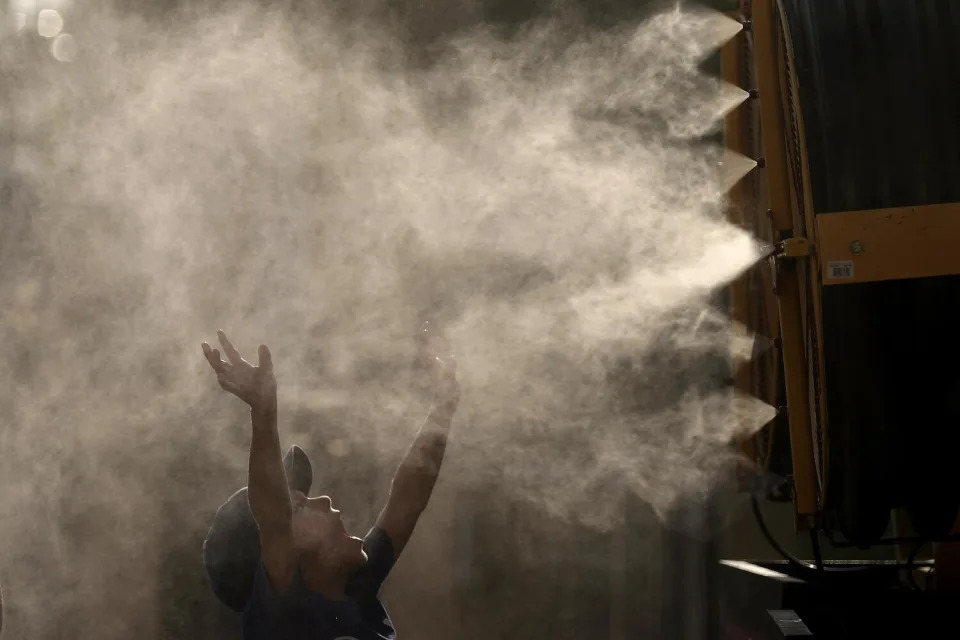
Misters spray water on a young boy at Kauffman Stadium in Kansas City, Mo., as as temperatures approached 100 degrees in June 2023. (Charlie Riedel / Associated Press)
Last year’s global average temperature of 58.96 degrees Fahrenheit was about a third of a degree warmer than the previous hottest year in 2016, and about 2.67 degrees warmer than the late 1800s pre-industrial period against which global warming is measured.
While human-caused climate change and El Niño can account for much of that warming, Schmidt and other experts say the extra three or four tenths of a degree is harder to account for.
Theories for the increase include a 2020 change in aerosol shipping regulations designed to help improve air quality around ports and coastal areas, which may have had the unintended consequence of enabling more sunlight to reach the planet.
The 2022 eruption of the Hunga Tonga-Hunga Ha‘apai volcano also shot millions of tons of water vapor into the stratosphere, which scientists say helped to trap some heat. What’s more, a recent uptick in the 11-year solar cycle may have contributed about a tenth of a degree of additional warning.
But these factors alone cannot explain what’s happening, Schmidt said.
“Even after taking all plausible explanations into account, the divergence between expected and observed annual mean temperatures in 2023 remains about 0.2 °C — roughly the gap between the previous and current annual record,” he wrote in his report.
Heat ripples from hot asphalt in downtown Phoenix in July 2023. (Matt York / Associated Press)
Reached by phone, Schmidt said he thinks one of three things could be going on.
It’s possible that 2023 was a “blip” — a perfect storm of natural variables and Earth cycles lining up to create one freakishly hot year. Should that prove to be the case, “it won’t have huge implications for what we’re going to see in the future, because it would have been just such a rare and unlikely thing that is not going to happen again anytime soon,” he said.
However, he indicated that’s unlikely, as those elements “have never lined up to give us a blip this large.”
Another possibility is that scientists have misunderstood the driving forces of climate change. While greenhouse gases, volcanic eruptions and aerosols are known to affect global temperatures, perhaps the full extent of their effects have been underestimated or miscalibrated. Should that be the case, he said, research and data sets will hopefully catch up soon.
The last explanation he offered is that the system itself is changing — and changing in ways that are faster and less predictable than previously understood.
“That would be worrying because science is really all about taking information from the past, looking at what’s going on, and making predictions about the future,” Schmidt said. “If we can’t really trust the past, then we have no idea what’s going to happen.”
Not everyone agrees with his assessment, however. Michael Mann, a professor in the Department of Earth and Environmental Science at the University of Pennsylvania, said the premise that 2023’s warmth cannot be explained — or that it is inconsistent with model simulations — is “simply wrong.”
“The situation is extremely similar to what we saw during the 2014-2016 period as we transitioned from several years of La Niña conditions to a major El Niño event, and then back to La Niña,” Mann said in an email.
In fact, he said some recent modeling shows the global temperature spike in 2016 was even more of an outlier than that of 2023.
“The plot shows that the surface warming of the planet is proceeding almost precisely as predicted,” Mann said. “And the models show that the warming will continue apace as long as we continue to burn fossil fuels and generate carbon pollution.”
When asked about this interpretation, Schmidt said it’s true that the 2014 to 2016 period was similarly anomalous. But there is a key difference between then and now, he said.
The 2016 temperature spike came on the heels of an El Niño event, with the biggest anomalies in February, March and April of the year following its peak, he said. He noted that similar patterns occurred after previous El Niños in 1998 and 1942.
Conversely, last year’s spike arrived in August, September, October and November — before the peak of El Niño — “and that has never happened before,” Schmidt said. “It never happened in the temperature record that we have. It doesn’t happen in the climate models.”
Alex Hall, a professor of atmospheric and oceanic sciences at UCLA, said he largely agrees with Schmidt’s assessment that the hypothesized factors alone can’t account for the large temperature anomaly experienced in 2023 and early 2024. He likened it to the emergence of megafires, or extreme wildfires, in the last decade, which wasn’t entirely foreseen.
“What we’ve learned is that there’s an aspect of this that isn’t fully predictable — that we don’t fully understand — and that we are tempting fate here a little bit by continuing to interfere with the climate system,” Hall said. “It’s going to do things that we don’t understand, that we don’t anticipate, and those are going to have potentially big impacts.”
Hall said the rapid transition from a persistent La Niña to a strong El Niño last summer likely played a role, as did the change in aerosol regulations.
He also posited that the rapid loss of Antarctic sea ice in 2023 — itself an outcome of the warmer planet and oceans — could have created a kind of feedback loop that contributed to more warming. Ice and snow are reflective, so when they melt, it can result in a darker ocean that absorbs more heat and sunlight. (Antarctic sea ice coverage dropped to a record low in 2023, according to the National Oceanic and Atmospheric Administration.)
“It’s sort of a planetary emergency for us to figure out what’s going on when we see these types of changes,” Hall said. “There should be large teams of people working on it to try to understand it, and we don’t really have those kinds of efforts, so I think there’s lessons, too, for the need for focus on this particular topic.”
Tourists seek shade and water while visiting the Acropolis of Athens during a heat wave in July 2023. (Petros Giannakouris / Associated Press)
While he and other scientists may not agree on just how extraordinary 2023 was — or what was behind its exceptional warmth — they all acknowledged the clear signs of a planet being pushed to its limits.
“I think it’s unfortunate that so much has been made of the El Niño-spiked 2023 global temperatures, where in my view there is nothing surprising, or inconsistent with model predictions, there,” said Mann. “There are much better, scientifically-sound reasons to be concerned about the unfolding climate crisis — particularly the onslaught of devastating weather extremes, heat waves, wildfires, floods, drought, which by some measures are indeed exceeding model predictions.”
Last year was marked by extreme weather events, with more billion-dollar disasters in the United States than any other year, according to NOAA. Among them were the Lahaina wildfire in Hawaii in August; Hurricane Idalia in Florida that same month; and severe flooding in New York in September.
Already this year, January and February have continued the global hot streak, marking nine consecutive months of a record-breaking temperatures.
In his Nature article, Schmidt said the inexplicable elements of the recent warming have revealed an “unprecedented knowledge gap” in today’s climate monitoring, which drives home the need for more nimble data collection that can keep up with the pace of change.
He noted it may take researchers months or even years to unpack all the factors that could have played a part in the sizzling conditions.
“We need answers for why 2023 turned out to be the warmest year in possibly the past 100,000 years,” he wrote. “And we need them quickly.”
Though El Niño is expected to wane this summer, there is still a 45% chance that this year will be warmer than 2023, according to NOAA.
It is a near certainty however that 2024 will rank among the five hottest years on record — so far.
Georgia Republican official and outspoken election denier caught voting illegally 9 times
Josh Meyer, USA TODAY – March 28, 2024
A judge has found Georgia Republican Party official Brian Pritchard guilty of illegally voting nine times over several years. Pritchard has falsely asserted Democrats had stolen the 2020 election through fraud.
Administrative Law Judge Lisa Boggs wrote in her Wednesday decision that Pritchard, the Georgia GOP’s first vice chairman, violated state election laws by voting while on probation for forgery and other felonies, and that his explanations were neither “credible or convincing.”
Pritchard must pay a $5,000 fine and $375.14 in investigative costs incurred by the court. Boggs also ordered that Pritchard “be publicly reprimanded for his conduct” by the State Election Board, which sought the sanctions against him.
On Thursday, Georgia Republican Rep. Marjorie Taylor Greene called on Pritchard to “resign immediately or be removed” from his Georgia GOP position because he “voted ILLEGALLY nine times while serving out his probation for FELONY check forgery.”
“The Republican Party is the party of election integrity,” Greene said on X, formerly Twitter, and “our state party should be the leading voice on securing our elections.”
Forged checks, and claims of a stolen election
Pritchard, a conservative talk show host, has claimed on his FetchYourNews.com show that the 2020 presidential election was fraudulent, echoing claims by former President Donald Trump, who lost in the Peach State and nationwide to Democrat Joe Biden. Trump and 14 co-defendants are currently facing charges of illegally conspiring to overturn the result in Georgia, while four co-defendants have pleaded guilty.
Republican presidential candidate, former U.S. President Donald Trump, gestures while speaking during the 2024 NRB International Christian Media Convention Presidential Forum on February 22, 2024 in Nashville, Tennessee.
Investigations consistently have found no evidence of mass fraud in 2020. But in her 25-page ruling, Boggs found that Pritchard committed voter fraud himself.
Boggs cited certified records from an Allegheny County, Pennsylvania court, which showed Pritchard pleaded guilty in 1996 to felony fraud and theft involving $38,000 in forged checks relating to a construction project and that he was ordered to pay that same amount in restitution. Felons in Georgia lose their right to vote until they complete probation or parole.
Evidence presented in court by two senior officials of the state attorney general’s office indicated Pritchard’s probation had been extended until 2011, but he registered to vote in 2008 and voted in nine elections between then and 2010.
Pritchard testified at an evidentiary hearing in February that he didn’t knowingly commit fraud and that he believed his status as a felon who is ineligible to vote had ended more than two decades ago. He also said he believed his criminal sentence had been converted to a civil judgment, according to a copy of Boggs’ decision.
In an earlier proceeding before the State Election Board, which referred Pritchard’s case to the Georgia attorney general’s office for investigation, his attorney said Pritchard was unaware he was considered a felon when he registered and voted in Georgia.
‘He should have known’
The judge found Pritchard’s explanations to be lacking in credibility, noting that “to accept that the Respondent’s grasp of legal proceedings was so unsophisticated that he did not understand the basic terms of his probation in 1996 … this Court would need to disregard (Pritchard’s) self-described experience as a businessman handling complex projects as well as million-dollar contracts and budgets.”
“Based on the above, and upon careful consideration of the evidence in its totality the Court does not find the explanations credible or convincing,” Boggs wrote. “At the very least, even if the Court accepts he did not know about his felony sentences, the record before this Court demonstrates that he should have known.”
Pritchard’s fine includes $500 for each of the nine times he voted illegally and another $500 for illegally registering to vote in 2008. He can appeal the decision.
Neither Pritchard nor his lawyer, George Weaver Jr. could be reached for immediate comment.
‘I’ve not done anything wrong here’
Pritchard was defiant about his voting record back in December 2022 when he qualified to run in a special election for the state House seat previously held by Speaker David Ralston, who had died the previous month.
“I’ve not done anything wrong here,” Pritchard said at the time, asserting that his sentence had ended long ago and his rights had been restored, the Atlanta Journal Constitution reported. “I guess if you’re apprehending public enemy No. 1, here I am.”
Pritchard has said on his show that the 2020 presidential election was “stolen,” the Atlanta newspaper wrote. It said he also had criticized Republican Gov. Brian Kemp and Republican Attorney General Chris Carr for being “complicit” in Biden’s victory in Georgia.
“I do not believe that 81 million people voted for this guy,” Pritchard said on his show.
Jason Shepherd, a former vice chairman of the Georgia Republican Party, told USA TODAY that the judge’s decision is ironic given Pritchard’s constant claims of election fraud.
Pritchard, he said, “has rapidly risen in the ranks of the Georgia Republican Party and has built a media empire of literally tens of dozens of followers by spouting conspiracy theories about stolen elections and rampant voter fraud from thousands of illegal voters, despite being investigated himself for illegally voting.”
Shephard, who writes the Peach Pundit political column, said the accusations of Pritchard’s voter fraud “have been well known long before he became the second highest officer in the Georgia Republican Party.”
“He should have never been elected and he has now needs to go…and sooner rather than later,” Shephard said. “If (Georgia GOP) Chairman Josh McKoon doesn’t have a resignation by the end of the day, I don’t see how anyone can take the Georgia Republican Party seriously.”
It’s Time to Give Up the Lie We Keep Telling Ourselves About Donald Trump
Susan Matthews – March 28, 2024
If you’re an American news consumer, it’s hard to escape feeling like you’ve been suspended in a state of limbo over the course of the past year or so. The election—it’s coming, but it’s not here yet; well, not quite. Much of America isn’t really paying attention right now, avoiding at all costs the feeling of impending doom inherent to the election rematch no one wants—and I don’t blame them. We all know Trump is coming back to dominate our news feeds again, just as we know that he never really went away, he just finally became possible to turn off for a while. I understand the desire to tune it out, for now, for as long as we can, for just a little bit longer.
But the problem is that Donald Trump, presumptive Republican nominee for president of the United States, is coming back. Just as he battles as hard as he can on every front possible to evade the justice system (though it’s approaching at a rapid clip), and as the Republican Party’s base remains at his beck and call, he is coming back to terrorize America again, which means the Trump show is coming back on, to every television screen near you, no matter what channel you want to tune in to.
The problem is that Season 2—or whatever season we are in at this point—is going to be much worse in so many key ways compared to the last one. The last one had the element of surprise, which kept things shocking for a while in a way that was honestly a bit distracting and roller coaster-y, like when a detective show gives you the cliffhanger just before it streams right through to the next episode. So we all watched and watched because it was ever-present and just a little bit titillating.
But it’s not just that it’s boring this time—even though it is so boring. It is going to be worse this time in the sense that the stakes are higher, the violence is more flagrant, and the way out is harder and harder to see. Nothing—not all of the plaintive and ongoing pleas from us members of the press to remember how awful Trump is and snap out of it—makes this as clear as the documentary Stormy does.
Ahead of Trump’s first criminal trial, now set for April 15 in Manhattan, Stormy happens to be the perfect memory refresher, and not just about all of the horrific things that have happened to Stormy Daniels since she became national news. Watching this documentary brought me right back into hours and hours spent watching White House press conferences, the whole tone immediately recalling the feeling of the chaotic first years of Trump’s presidency, when “the resistance” was only slightly embarrassing as a concept and there was still real solidarity in opposing the president. Oh my god, right, I thought, watching Michael Avenatti’s rise to fame. We were just desperately looking for someone—literally anyone—to save us. For a while, sure, it felt convincing that a brash lawyer who loved the spotlight as much as Donald Trump does might be that person. Oops, it turns out he was embezzling from literally all of his clients. What a twist!
There is a deeper message in Stormy, though, and one that makes it even more understandable why we’ve all wanted to tune out, while simultaneously underscoring the reason why we have to tune back in. As much as the first two-thirds of the documentary are a romp through the hilarity found in a “Make America Horny Again” tour, the documentary takes a turn after showing a few videos from Jan. 6, 2021. It cuts to the more recent past, to the indictment, to Daniels reading through tweets, something she does a lot during the documentary. These later tweets are … a lot worse than what she reads early on. I don’t know exactly what percentage of that can be attributed to how much worse Twitter, aka X, has gotten after Elon Musk’s takeover (certainly some). But the brazenness of the violence is several degrees higher than it was before.
Part of that increase in the violence—and the ho-hum response we’ve all been giving it—feels like it stems from the fact that their guy isn’t in office anymore; it’s much easier to laugh things off from a position of power. And, on the flip side, there’s so much more reckless desperation from the brink of irrelevance, where Trump’s supporters surely found themselves as their hero was indicted again and again. But Jan. 6 also opened doors that legitimately changed what was thought of as normal speech—we’ve spent years since then watching Republicans downplay and minimize what happened, calling the violence freedom, and its perpetrators “political prisoners.” The message stuck. The thugs think they are righteous. That was always Trump’s goal.
The worse reminder in Stormy is of the misogyny that living through Trump being the main event of all of our lives brings with it. This is a chance to rewatch the infamous Access Hollywood tape for the first time in a while. This is a chance to see what it means to be Stormy Daniels, a woman who seems to own her sexuality—and who also is constantly surrounded by men, most of whom seem to be fucking her or fucking her over. This is a woman who insists that what happened between her and Donald Trump wasn’t rape—and then admits later on that the way she felt when Trump cornered her in her hotel room is the way she felt when she was 9 years old being molested by her neighbor, and oh yeah, that trauma probably does have something to do with how she got into porn, if she thinks about it.
The past eight years of being a woman in this country has been to ride the roller coaster from Access Hollywood to #MeToo through the Kavanaugh hearings and eventually into losing Roe. It’s amazing that in the midst of all that, having a president who calls one of his former sexual partners “horseface” still ranks as something to be mad about. But Donald Trump is coming back—and when he does, he will give us something to be mad about every stupid day. And we won’t be able to turn it off, because once again, he’ll be the star of the show.
The surprising reasons why Big Oil may not want a second Trump term
Maxine Joselow, The Washington Post – March 26, 2024
Active pump jacks increase pressure to draw oil toward the surface at the South Belridge Oil Field on February 26, 2022, in unincorporated Kern County, California, approximately 141 miles (227 km) northwest of Los Angeles, California. – From rural areas of the eastern states where modern oil production began to cities in southern California where pumpjacks loom not far from homes, lax regulations and the petroleum industrys boom and busts cycles have left the US pockmarked with perhaps hundreds of thousands of oil wells that are unsealed and haven’t produced in decades. In a first, Washington is making a concerted effort to plug these wells by allocating $4.7 billion in federal infrastructure dollars to plug the wells in an effort to lessen the negative health and environmental impact of the disused wells. (Photo by Robyn BECK / AFP) (Photo by ROBYN BECK/AFP via Getty Images) (ROBYN BECK via Getty Images)More
HOUSTON – As president, Donald Trump vowed to unleash American “energy dominance,” while on the campaign trail, he has summarized his energy policies with the slogan “drill, baby, drill.”
Yet a possible Trump victory in the 2024 election is not delighting oil and gas executives as much as one might expect, according to interviews with several industry leaders at a recent energy conference in Houston.
Fossil fuel firms have found a lot to like in President Biden’s signature climate law, the Inflation Reduction Act, which Trump has vowed to unravel. The law offers lucrative tax credits for companies to capture and store carbon dioxide – subsidies that several oil giants are eager to exploit, even as they pump record amounts of crude oil and post near-record profits.
In addition, Trump has championed an “America First” approach to trade policy that prioritizes steep tariffs on imported goods. The approach could hike the costs of building new pipelines and other energy infrastructure, and it could heighten anxieties about a global trade war.
Still, fossil fuel executives have slammed Biden’s decision to pause approvals of new liquefied natural gas exports. And during the GOP presidential primary, oil barons filled Trump’s campaign coffers far more than those of his competitors.
If a poll were conducted among energy executives about the 2024 election, the results “would be a little more balanced than people might expect,” Alan Armstrong, president and CEO of the gas pipeline company Williams, said in an interview at CERAWeek by S&P Global.
Armstrong said many fossil fuel executives feel the Biden administration has unfairly demonized their industry because of its role in causing climate change. But that’s a personal sentiment, not a professional one, he said.
“If you’re asking people personally, they’re probably tired of being told they’re bad people by the current administration,” Armstrong said. “But from a business objective standpoint, it would be a much more balanced perspective.”
Trump plans to gut the Inflation Reduction Act, including its generous tax credits for clean energy and electric vehicles, should he return to the White House, according to senior campaign officials and advisers to the former president.
Yet several oil industry executives have praised the Inflation Reduction Act – the IRA for short – for helping their companies pursue still-unproven green technologies such as carbon capture and clean hydrogen. The subsidy for carbon capture has especially benefited ExxonMobil, CEO Darren Woods acknowledged at CERAWeek.
“I was very supportive of the IRA – I am very supportive of the IRA – because as legislated the IRA focuses on carbon intensity and in theory is technology-agnostic,” Woods said. “They’re not trying to pick a particular technology.”
Vijay Swarup, Exxon’s senior director of climate strategy and technology, added that the IRA is “getting projects to advance.” Exxon has signed contracts to store the carbon captured from an ammonia plant and a steel plant in Louisiana, as well as a yet-to-be-built hydrogen plant in Texas, Swarup said in an interview.
Of course, Trump could not unilaterally repeal the IRA subsidies. He would need Congress to pass legislation, meaning Republicans would need to maintain control of the House and retake the Senate, in addition to clinching the White House.
In that scenario, Mike Sommers, president and chief executive of the American Petroleum Institute, said the trade group would aggressively lobby against any proposals to scrap green subsidies that have helped the industry.
“I suspect that when there is an attempt to repeal the IRA – and there will be – it will end up looking more like a scalpel-like approach rather than a butcher knife,” Sommers said. “And we’ll advocate for the provisions that we support.”
While in the White House, Trump proclaimed himself a “Tariff Man” – and he has no intention of abandoning that self-appointed title if reelected.
Publicly, Trump has floated the idea of imposing a 10 percent tariff on every good coming into the United States. Privately, he has discussed with advisers the possibility of imposing a flat 60 percent tariff on all Chinese imports, The Washington Post previously reported.
At a rally in Ohio this month, Trump also pledged to slap a 100 percent tariff on Chinese vehicle imports – part of a broader tirade in which he warned of a “bloodbath” for the U.S. auto industry if he is not reelected.
Sommers said such proposals, which are widely viewed as likely to spark a global trade war, carry “risks” for his sector.
“Particularly for the products that are produced here in the United States, we need free trade for these goods to flow,” he said. “I think we are concerned about kind of a retrenchment to a more nationalistic approach on trade policy. So that’s one example of an area where we’re not going to be aligned with a potential President Trump.”
But Dan Eberhart, chief executive of the oil-field services company Canary and a Trump supporter, said he isn’t worried about the former president’s trade policies. He said any adverse impact of tariffs would be canceled out by other pro-fossil-fuel policies, such as more offshore oil and gas lease sales in the Gulf of Mexico.
“In general, I don’t like protectionist policy,” Eberhart said. “But I really think that the Trump administration will be more pro-oil and gas than the Biden administration.”
The Trump campaign did not respond to specific questions for this story. In an emailed statement, spokeswoman Karoline Leavitt said that “on day one, President Trump will unleash American Energy to lower inflation for all Americans, pay down debt, strengthen national security, and establish the United States as the manufacturing superpower of the world.”
The Biden campaign did not immediately respond to a request for comment.
Just three weapons will turn the Ukraine war back around. And the USA is back in the fight
David Axe – March 27, 2024
A Ukrainian artillery piece fires on Russian positions. Artillery, and supplies of artillery shells, have been crucial factors in the Ukrainian fighting – Bulent Kilic/AFP via Getty
Six months after blocking US president Joe Biden’s proposal to spend another $61 billion on aid to Ukraine, Speaker of the House Mike Johnson – who alone can schedule votes in the narrowly Republican-controlled legislative body – seems to have reversed his opposition to Ukraine’s war effort.
With retirements and special elections having reduced his majority to just two votes out of 438, and with a small contingent of far-right Republican extremists refusing to vote on any bill that has bipartisan support, Johnson increasingly relies on Democrats to enact budgets and other legislation.
And that means he answers more to the Democratic agenda than the Republican one. And strong support for Ukraine is a Democratic priority. The US House is on vacation until the first week of April. But once it reconvenes, Johnson will call a vote on fresh aid to Ukraine, according to some of his House colleagues.
With tens of billions of dollars in fresh funding, the US Defence Department could send a lot of weapons to Ukraine – and soon. Some could come straight from existing US stocks, with the new funding paying for newly-built weapons to replenish these stocks. Others could come from new commercial contracts brokered by the Pentagon.
It’s obvious what the priorities should be.
First and foremost, Ukraine needs artillery shells. For the first 18 months of Russia’s wider war on Ukraine, the United States was the main supplier of artillery ammo to Ukrainian batteries. In total, the Americans donated around two million shells. Half came straight from American magazine stockpiles. The other half, America quietly bought from South Korea.
These shells, along with additional ammo from other sources, kept Ukrainian guns blasting away at a rate of around 10,000 rounds a day for much of the war’s first year and a half. That was enough to match Russian batteries once the Russians burned through much of their ammo stockpile in the wider war’s first few weeks.
The Republican funding blockade, and the subsequent run down of US supplied munitions through the end of last year, cut by two-thirds the Ukrainians’ daily allotment of shells. In some of the darkest days of the war in February, as a pair of Russian field armies closed in on the Ukrainian stronghold in the eastern city of Avdiivka, Russian guns were firing five times as many rounds as Ukrainian guns were – and demolishing Ukrainian defence s without fear of return fire.
The US Army has been building a new shell factory in Texas to complement its existing factory in Pennsylvania. Soon, the Army should be capable of producing around 70,000 shells a month – a sixfold increase over its 2022 production rate.
There’s no reason most of the shells can’t go to Ukraine, once there’s funding to pay for each $5,000 round. Combined with shells from the European Union as well as a separate Czech initiative, urgent shipments of shells from the United States could give Ukraine an enduring artillery advantage for the first time in the wider war.
Once the shells are shipping, the Americans can address Ukraine’s second-greatest need: Patriot air-defence batteries and missiles for these batteries. The US-made Patriot is Ukraine’s best air-defence system. Its 90-mile-range missiles can reliably shoot down all but the fastest Russian missiles – and swat down Russian warplanes like flies.
When the Ukrainian air force shot down 13 Russian fighter-bombers in 13 days last month, it was apparently a mobile Patriot battery that did most of the shooting.
But Ukraine has just three Patriot batteries with around three dozen launchers – and lost a pair of those launchers in a devastating rocket ambush in early March. The batteries are spread thin. One normally protects Kyiv. Another protects Odesa, Ukraine’s strategic port on the Black Sea. The third battery apparently travels the front line in order to engage Russian jets.
Ideally, Ukraine would place a $1-billion Patriot battery in each of its half-dozen biggest cities and also assign one each to the eastern and southern fronts. And these batteries should be free to fire away at their fastest rate – meaning they’ll need a steady supply of missiles, each of which costs around $3 million.
Doubling or tripling Ukraine’s Patriot force could help the Ukrainians wrest back control of the air over the front line – and also reverse the disturbing trend toward bigger and bloodier Russian missile-strikes on Ukrainian cities.
Having replenished Ukraine’s artillery and air-defences, the United States should rescue one of the Ukrainian army’s best brigades. The 47th Mechanized Brigade is the main operator of American-made armoured vehicles, including M-1 Abrams tanks and M-2 Bradley fighting vehicles.
The 69-ton M-1 and 42-ton M-2 – thickly armoured and armed with a 120-millimetre cannon and a 25-millimetre autocannon, respectively – are some of the best armoured vehicles in the world, and the 47th Brigade has put them to good use. Counterattacking Russian assault groups west of Avdiivka, the M-1 and M-2s have blunted Russia’s winter offensive – and minimized Ukraine’s territorial losses as its artillery supplies bottomed out.
But the Americans shipped just 31 M-1s and around 200 M-2s before Republicans cut off aid. Four of the M-1s and more than 30 of the M-2s have been destroyed and others damaged. The 47th Brigade is running out of vehicles.
The US Army has thousands of older M-1s and M-2s in storage. They’d need overhaul before going to war in Ukraine, but a billion dollars should be enough to pay for the work as well as expedited shipping.
Once Speaker of the House Johnson bends to Americans’ overwhelming support for a free Ukraine and finally brings aid to a vote, the Pentagon could speed hundreds of tanks and fighting vehicles to the Ukrainian army.
Trump earlier in the day released a video of himself holding the $60 “God Bless The USA Bible” as he insisted that the Bible is his favorite book and that he has “many” in his home.
“Many? Many? Many?” Klepper repeated in disbelief. “How does that thing not burst into flames immediately?”
Trump’s version of the book, done with country singer Lee Greenwood, contains the lyrics to Greenwood’s hit song “God Bless The USA” ― which is played at Trump rallies ― as well as the texts of the Pledge of Allegiance, the Bill of Rights, the U.S. Constitution and the Declaration of Independence.
“Trump is mashing together the Bible and the Constitution like it’s a Pizza Hut-Taco Bell,” Klepper cracked. “I know people will say that you’re not supposed to mix the Bible and the Constitution, but what you have to understand is Trump has never read either of them.”
Klepper also predicted where this would lead.
“Trump getting into business with God can only mean one thing: God is gonna end up bankrupt and serving a three-month prison sentence for lying under oath,” he said.
See more in his Tuesday night “Daily Show” monologue: