The North Carolina hog industry’s answer to pollution: a $500m pipeline project

The Guardian

The North Carolina hog industry’s answer to pollution: a $500m pipeline project

Michael Sainato and Chelsea Skojec                 December 11, 2020
<span>Photograph: Gerry Broome/AP</span>
Photograph: Gerry Broome/AP


Elsie Herring of Duplin county, North Carolina, lives in the house her late mother grew up in, but for the past several decades her home has been subjected to pollution from nearby industrial hog farms.

“We have to deal with whether it’s safe to go outside. It’s a terrible thing to open the door and face that waste. It makes you want to throw up. It takes your breath away, it makes your eyes run,” said Herring.

She explained they also deal with constant trucks on the road, hauling pigs, dead and alive, in and out of the area, feed trucks, and the flies and mice that the farms attract.

Eastern North Carolina has about 4,000 pink hued pools of pig feces, urine and blood as a result of the hog industry, where 9m pigs produce over 10bn gallons of waste annually in the state. When the waste lagoons reach capacity, excess waste is sprayed on to nearby fields. In 2000, Smithfield Foods agreed with state officials in North Carolina to finance research to find and install alternatives to the waste lagoons and spraying systems, but none were deemed economically feasible.

But now – instead of implementing safer waste systems – Smithfield Foods is pushing to use the hog waste lagoons to collect, transport and sell the methane gas they produce. That terrifies many local people and environmental activists who see it as seeking to profit from an ecological problem rather than fix it.

“It only lines their pockets. They’re trying to sell it as renewable energy. It’s only renewable if pigs continue to poop, which is why I’m afraid they’re going to push the moratorium on new hog farms, because if you have that great of a demand, you have to supply to meet it,” added Herring.

“They’re not treating the waste, they’re converting it, so how is that hog waste ever clean?”

The North Carolina Department of Environmental Quality is considering the first permit approval for an industrial-scale biogas project in North Carolina, which would cap waste lagoons from industrial pig farms in the state, capturing the methane and transporting it through pipelines to a processing plant.

The product, called biogas, is being proposed by a $500m joint venture between Smithfield Foods and Dominion Energy, Align RNG, as a solution to the hog waste pollution problems plaguing North Carolina, but residents and environmental organizers are raising concerns that the project will worsen the problem.

Related: ‘Suffocating closeness’: US judge condemns ‘appalling conditions’ on industrial farms

“The biogas is a false solution,” said Naemma Muhammad, a community organizer and resident of Duplin county. “It doesn’t solve the problems we’ve been dealing with for three decades, which is to get rid of the lagoons and spraying systems so people can breathe and enjoy their property in the way they intended. We don’t need anything to encourage this industry to continue business as usual.”

The Grady Road Project includes trapping methane gas at 19 industrial hog waste sites in Duplin and Sampson counties in North Carolina, where over 30 miles of pipelines will be constructed to a central processing facility and distributed through existing natural gas pipelines. Duplin and Sampson counties are the top-hog producing counties in the US. The project is one of several biogas proposals being pushed by Smithfield and Dominion Energy.

Muhammad noted residents still don’t know where the 30 miles of pipeline will be laid or which waste lagoons will be used for the project, and the pipelines will pose greater risks of spills and leaks to the wetlands and groundwater in the region.

Jets of liquified hog waste shoot from spray guns and on to a field near Wallace, North Carolina.
Jets of liquified hog waste shoot from spray guns and on to a field near Wallace, North Carolina. Photograph: Allen G Breed/AP


The methane capturing also produces other pollutants, posing greater risks to nearby communities when waste is sprayed on fields and spills are common, especially during strong storms.

“The process creates excessive concentrations of ammonia by extracting the methane,” said Sherri White-Williamson, the environmental justice policy director of North Carolina Conservation Network. “This is another way for the industry to be able to keep the lagoon sprayfield system in place. This is not a good system and to continue to find ways to justify keeping that system in place makes no sense.”

The waste produced by the industry has a long documented impact on the health, living conditions and pollution of communities near these hog farms, recognized as environmental racism as Black people, Native Americans and Latinos are more likely to live there than white people, according to a 2014 study by researchers at the University of North Carolina at Chapel Hill.

Living in the vicinity of a hog industrial operation has been linked to chronic illnesses such as asthma, anemia, kidney disease, certain cancers and high blood pressure.

“Methane aside, hundreds of other air and water pollutants remain uncaptured and are emitted untreated by the lagoon and sprayfield system to the environment and the communities which surround these facilities,” said Ryke Longest, the co-director of the Environmental Law and Policy Clinic at Duke University.

Will Hendrick, the staff attorney for Waterkeeper Alliance, noted North Carolina’s senate bill 315 passed in 2020 removed environmental standard requirements to pave the way for proposals such as the biogas project, despite other existing and cleaner technologies to produce biogas.

Young hogs at Everette Murphrey Farm in Farmville, North Carolina. Waste from the industry has had a long documented impact on the health of nearby communities.
Young hogs at Everette Murphrey Farm in Farmville, North Carolina. Waste from the industry has had a long documented impact on the health of nearby communities. Photograph: Gerry Broome/AP


Those standards called for new or modified permits to address five environmental problems with hog waste, including the elimination of animal waste discharge to surface water and groundwater, and substantially eliminating ammonia, odor, disease transmitting vectors, and nutrient and heavy metal contamination.

“The biggest problem with their biogas proposal is it fails to address those five long known well-documented problems,” said Hendrick. “Now suddenly they have money to invest in waste management technologies, but are conveniently overlooking their commitment to the people of North Carolina.”

The hog industry tried to appeal nuisance lawsuits won by residents in North Carolina over the effects of waste and odors from hog industry farms, and North Carolina legislators passed laws in response to the lawsuits limiting the ability of residents to sue the industry. A federal court recently upheld the verdict, in which a federal judge noted there was ample evidence farming practices persisted despite known harmful effects to neighbors. Herring was a party to that suit.

According to the North Carolina Department of Environmental Quality, a decision on the permit application will be decided within approximately 30 days after the hearing, which will be scheduled after 20 November.

“We care about their health and the health of our environment. That’s why we started this project in the first place, to improve the region’s air quality and protect the climate for future generations,” said a spokesperson for Dominion Energy. They claimed the project will reduce emissions in the area by more than 150,000 metric tons a year.

“We will continue reaching out to make sure everyone’s voice is heard and everyone has the facts. The community has our pledge we’re going to do this the right way.”

A fork in the road for responsible NC hog farming

A fork in the road for responsible NC hog farming

Derb Carter                      

Last month, a federal appeals court ruled that it was proper for a jury to award monetary damages to neighbors of a Smithfield Foods controlled hog operation in Bladen County. The neighbors complained that the putrid odor and other adverse impacts adversely affected their rights to use and enjoy their property. In affirming damages are proper, one judge concluded: “It is past time to acknowledge the full harms that the unreformed practices of hog farming are inflicting.”

Twenty years after Smithfield entered a formal agreement with the North Carolina Attorney General to convert its primitive lagoon and sprayfield waste management systems on all company-owned and contract farms to environmentally superior systems that are economically feasible, Smithfield has not converted any.

Smithfield industrial hog facilities continue to store vast amounts of raw hog waste in excavated lagoons and then spray it on to neighboring fields – polluting water and air. For many neighbors, the stench and filth outside their homes is unbearable.

Now, Smithfield is proposing to cover hog lagoons on many of its hog operations, capture methane or biogas, and construct miles of pipelines to convey the gas to a processing facility it proposes to construct in Duplin County in a joint venture with Dominion Energy. The processed gas would be injected into a natural gas pipeline and used as an energy source. While removing emissions of methane that would otherwise contribute to climate change and utilizing it for energy has merit, Smithfield’s approach is dependent on perpetuating the flawed, harmful lagoon and sprayfield waste system.

Flushing millions of gallons of raw hog waste from industrial-scale barns into lagoons and then spraying on nearby fields has had, and continues to have, substantial adverse impacts on the environment and many communities in eastern North Carolina.

Numerous studies have tied the lagoon and sprayfield system to increased nutrient levels that plague our coastal waters, leading to periodic algal blooms and fish kills. Capping lagoons to collect methane will actually increase the amount of nutrients generated from the hog waste, leading to more water quality problems.

It doesn’t have to be this way. In Missouri, Smithfield now touts its “next generation technology” to manage waste that it agreed to install on all of its hog operations there. This wholesale conversion to improved waste management was forced by lawsuits from neighbors and that state’s attorney general. It is operational and profitable on hundreds of Smithfield hog operations in Missouri.

Smithfield’s new waste management technology in Missouri appears to have been enabled by the revenue generated from marketing biogas. In addition to capturing and utilizing methane from the waste, Smithfield’s Missouri hog operations converted to mechanical barn scrapers instead of barn flushing. This reduced the amount of waste laden water and reduced odor from operations by 59 to 87 percent.

Smithfield has requested that North Carolina state agencies approve necessary permits authorizing the proposed biogas project. The pending decision places eastern North Carolina at a significant fork in the road. As Smithfield has requested, the state can allow Smithfield to simply cover lagoons, capture and profit from biogas, and perpetuate the flawed lagoon and sprayfield system.

Or the Attorney General can hold Smithfield to its commitment to use economically feasible and superior waste management systems that substantially eliminate impacts to neighbors and the environment.

Before allowing Smithfield to develop its proposed biogas venture, the Department of Environmental Quality should ensure the company at a minimum employs a complete waste management system that not only taps methane but substantially reduces or eliminates odors, nutrients, and pollution.

It is past time that Smithfield acts responsibly. If it can clean up its act in Missouri, it can do the same in North Carolina.

Derb Carter is director of the Southern Environmental Law Center’s North Carolina offices.

As Lake Michigan beaches erode, millions of dollars have been poured into temporary solutions

As Lake Michigan beaches erode, millions of dollars have been poured into temporary solutions

Patrick M. O’Connell                            December 13, 2020
As Lake Michigan beach erosion worsens, officials and residents take  concerns to Capitol Hill | News Break

LUDINGTON, Mich. – As the wind whipped across the top of the Big Sable Point lighthouse, one of the most famous and beloved on the Great Lakes, Jim Gallie pointed to the disappearing beach: “It’s been progressively getting worse.”

Every few seconds, a wave slammed into the break-wall protecting the base of the lighthouse, sending a silver splash high into the air, much to the delight of the photographers and young families there to take in the sights.

Hikers and beachcombers who trekked along the shoreline to the remote, historic lighthouse at Ludington State Park once had ample room between the pulsating waves and the metal break-wall.

Now the Michigan Department of Natural Resources is spending $130,000 to recap the seawall and place new stone barriers at its base. The hope is that the reinforcements will slow erosion, save the beach, protect the base of the lighthouse and preserve the low-lying dunes.

“If it wasn’t for that seawall,” said Gallie, the park manager in Ludington, “those dunes would be gone.”

From 112 feet above the beach on the deck of the 1867 lighthouse, the effects of a changing climate and a lake near historically high levels are clear: Increased precipitation, rising temperatures and human development across the Great Lakes basin have changed Lake Michigan and the lives of the millions who live, work and play along the coast in Michigan, Indiana, Illinois and Wisconsin.

“It’s a system that’s really been whipsawed in many ways by a variety of factors, from climate change to non-native species, to the legacy of contaminants,” said J. Val Klump, dean and professor at the School of Freshwater Sciences at the University of Wisconsin at Milwaukee.

As part of the series “Great Lakes, High Stakes,” the Chicago Tribune visited and reported from each of the lakes, exploring the environmental issues and how coastal communities are adapting to a warming world.

While Illinois is home to one of the most intensely engineered coastlines across the Great Lakes, Lake Michigan still has the sandiest shores and therefore draws the most visitors, experts say. Michigan alone has 275,000 acres of sand dune formations, the vast majority of which are on the shores of Lake Michigan.

The third largest Great Lake by surface area (second by volume) is an eclectic mix of dune bluffs, sandy beaches, rugged rocks, major Midwestern cities, tourist towns and marshlands. But it is also emblematic of the myriad issues facing all of the Great Lakes as the climate continues to change. Surging water levels have collapsed bluffs, swamped coastal dune lands, erased beaches and damaged homes, businesses, docks, trails, campgrounds and sewer systems.

Residents and officials are scrambling to find new solutions as stone barriers and beach replenishment are often too costly and ineffective over the long-term.

Property owners look for help to prevent, repair erosion along Lake Michigan  | WWMT

In Illinois, environmental officials, engineers and scientists are experimenting with offshore reefs and shoals with the idea of blunting the force of storm surges before they eat away at the sand, dunes and marshland habitats. Meanwhile in Chicago, residents have dealt with submerged beaches and waterlogged trails as officials pour millions into shoreline protections.

In Wisconsin, cities and towns up and down the coast are spending millions on projects such as stormwater sewer upgrades and pier stabilization. In Indiana, shoreline protection has been contentious, including a federal lawsuit filed by residents and officials of Ogden Dunes who claim dunes, roads and private homes are “in danger of total destruction” if current protections fail.

Back at Big Sable Point, the landscape looks a lot different today than it did several years ago. The water, and the wind, have been eroding so much of the near dunes, Gallie said, that rangers and visitors have been uncovering a trove of treasures once buried.

A picnic table believed to be from Wisconsin “suddenly emerged from a dune that was eroding,” Gallie said. More troubling, an abandoned Dow Chemical pipeline buried near the shore also became exposed.

“I didn’t see it changing so drastically in such a short period of time,” said Gallie, who has worked at the park for a decade. “I expected to just be managing sand, cleaning the parking lots, cleaning the paths. But I didn’t expect the water levels to be way up like they’ve been.”

CONTROLLED RETREAT

As more precipitation falls on the upper Midwest and temperatures continue to rise, communities all around Lake Michigan have been hunting for solutions for how to deal with a changing climate and an altered lakeshore. On the western shores of Michigan, houses have begun to slip into the lake because of eroding coastal dunes, leading homeowners to stabilize their structures, build waterfront barriers or move altogether. Last winter, a home in Muskegon County tumbled into the lake. In Chicago, city and federal officials have battled lakefront flooding with boulders and trail repairs. To the north in Wisconsin, homes, piers and sewer systems need reinforcements from an encroaching lake.

In Orchard Beach State Park, north of Manistee, Michigan, park officials are planning to relocate the historic pavilion building that overlooks the lake because of the danger of erosion.

Doug Barry, unit supervisor at the park, described moving the entire structure, a massive 400-ton limestone building with a concrete foundation, two fireplaces, a picnic area and a protected hall, as “controlled retreat.”

The shoreline at the park has been losing 6 inches of soil per year, Barry said.

“There’s a lot of different erosion going on,” Barry said. “Wind, rainfall, the waves.”

With the 70-foot bluff eroding at a rapid rate, Barry and the park staff had a difficult decision to make regarding the historic pavilion with sweeping lake vistas that hosts weddings, picnics and parties. Ultimately, Barry said they decided to completely relocate the building, built by the Civilian Conservation Corps and opened in the 1940s.

Barry said DNR officials and consultants considered shoreline stabilization, including 5-ton boulders, but ultimately believed those were not only going to change the character of the beach, the park’s most popular attraction, but provide only brief relief.

“It’s a temporary fix,” Barry said, pointing to the beach and the bluff from the stairs that lead down to the lake, its entrance closed off for the year because high water levels have made it unsafe. “Lake Michigan is going to win.”

Barry saw an episode of “This Old House” in which crews relocated a house, and he began to explore the idea of moving the pavilion. While the process has taken three years of planning and the approval of federal and state agencies, he said, it “provides a long-term solution.”

“What’s the alternative?” Barry asked. “Let history fall into the lake? We’d still have to clean it up.”

CREATIVE SOLUTIONS

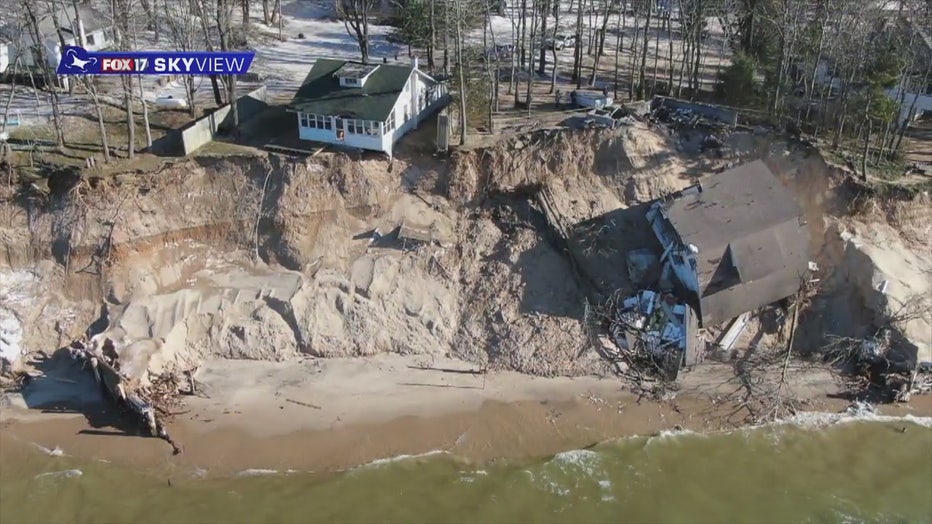
Cottage collapses into Lake Michigan after years of erosion

The movement of sand, and its effects on the shoreline and the underwater environment, is the focus of offshore projects at Illinois Beach State Park in Zion and the Fort Sheridan Forest Preserve in Lake County, north of Chicago.

There, a consortium of agencies, including the U.S. Army Corps of Engineers, the Illinois Department of Natural Resources, private researchers and the Lake County Forest Preserves, is working to install a series of offshore reefs and underwater natural breakwalls. The goal is to protect the shoreline, including the popular beaches at the state park, but also study whether reducing the flow of sand, sediment and crashing waves along the shore will alter the character of the lake itself, the nearshore habitat, the beaches and the unique marshlands beyond.

The Army Corps, working with the Lake County Forest Preserve District and other local partners, has nearly finished a large-scale project at the Fort Sheridan Forest Preserve in Lake Forest.

The project is focused on coastal restoration and underwater habitat improvement. Out in the water, the underwater reefs, made of large limestone blocks, tree roots, small cobblestones and sand, may end up having two benefits: improving the aquatic habitat for fish and state-threatened mudpuppies while also protecting the shoreline and the nearshore lakeshore bed, said Jim Anderson, director of natural resources for the Lake County Forest Preserve District.

“We’re really hoping for them to break the power of the waves a little so when they hit the shoreline, they’re not as destructive,” Anderson said.

The reefs, constructed parallel to the shore about 100 to 300 feet out, were designed so that when the lake levels subside, they will still be underwater.

On land, preservation work on 1.5 miles of coastal bluffs, dunes and beach has involved the eradication of invasive plant species and seeding the soil, dunes and ravines with native plants.

“A lot of these areas suffered from development that depleted habitat,” said Nicole Toth, project manager with the Army Corps’ Chicago District. “The goal of the project is to bring that back, to improve the habitat and to get these areas into more of a natural state.”

The project, authorized under the Great Lakes Fishery and Ecosystem Restoration program, costs an estimated $14 million, shared between the federal government, the Lake County Forest Preserve District, Openlands, the city of Lake Forest and Lake Forest Open Lands Association. Most of the federal share, about $9.1 million, was funded with Great Lakes Restoration and Initiative funds received from the U.S. Environmental Protection Agency.

The Army Corps’ Chicago District has been working on more than a dozen similar projects, mostly in urban areas along Illinois’ North Shore.

A few miles to the north, scientists are studying how the lake is interacting with the shore and exploring nature-based solutions to help protect the beach and the nearshore habitats; blunt the force of the waves, especially in record-high levels; and slow the movement of sediment and sand.

Jack Cox, a coastal engineer with Edgewater Resources who is a scientific consultant for lakeshore projects, including at Illinois Beach State Park, has been studying how waves act and react to the lake bed and the shore. Cox is using a giant physical model of the Lake Michigan coast at a facility in Wallingford, England. Cox and others built a model — so large you can enter it with waders — of the shoreline so they could see how waves form, react as they crash into the shore and affect the movement of sand.

But waves, even if people cannot see them from the shore, are also busy churning under the surface, scouring the lake bed when the water becomes shallow near the shore and carrying sand along with it.

Weather patterns have pushed sand and sediment southward for years. But as people built more harbors, piers, docks, breakwaters and paved over sections of the shoreline, sand has become trapped along the way by all of these structures, Cox said.

“Sand wants to move in one direction or the other,” Cox said. “All the sand or sediment wants to move south toward Gary. If we had never settled all of this, Gary, Indiana, would be the world’s greatest beach.”

Cox said it can be helpful to imagine a zigzag pattern, where a wave comes in at an angle toward the shore, recedes, then zags back to land. At developed sections of the lake, with hardened landscapes of structures like Chicago, the waves bounce back more forcefully and can scour more powerfully.

At Illinois Beach, where there is 5 to 6 miles of natural shoreline, the goal of offshore, underwater barriers is to slow the scouring and the damage that waves can do to the beach and the unique marshlands beyond.

“And we want this to be as natural or as invisible as it can be,” Cox said.

The ideas range from underwater reefs, like to the south at Fort Sheridan, to offshore islands to underwater breakwaters. Success, Cox said, is a project that holds the shoreline so it does not retreat any farther. It may also have the added benefit of protecting onshore bird habitats and nesting grounds, and underwater fish habitats.

“It may be even able to cause a beach to be self-healing,” Cox said.

LAKE VS. HUMANS

In some communities like Saugatuck, Michigan, and the North Shore in Illinois, homeowners have put up their own barriers of boulders or breakwalls to hold back the lake. But officials are increasingly opposed to this piecemeal approach because it merely pushes erosion problems to neighboring properties or blocks public access to the lake.

With cotton clouds hanging low in the sky, whitecaps churned toward the shore of Oval Beach near Saugatuck, the southwestern Michigan town popular with many Chicagoans. The beach attracts tourists, walkers and bodysurfers to the white sand and sandy bluffs covered in dune grass.

Here, the tug between nature and human protection efforts is on full display. To the south of the public beach, dozens of expensive homes have prime lakefront property. As the lake rises and the waves do their work, the beaches and bluffs have been eroding, forcing some homeowners to seek remedies such as seawalls or stone barriers.

At the spot where the public land ends and private property begins, a sign was staked into the ground with a notice from the Michigan Department of Environment, Great Lakes and Energy, permitting 213 feet of large stones “to protect against lakeshore erosion.”

A steady stream of visitors gawked, some shaking their heads, and took photos of the sign and the giant boulders at the water’s edge.

Among them was Kathleen Johnson, a retired teacher who has lived in Saugatuck for 40 years.

“It looks terrible,” Johnson said. “It’s brutal. It changes the way the lake reacts.”

The new structures and breakwalls also prevent people from being able to walk along the beach, since Michigan law allows the public to access the lakeshore as long as they are right along the water’s edge.

Johnson’s beach-walking route has been altered by seawalls and stabilization efforts.

“That’s impossible now,” she said.

To the north, on the other side of the Kalamazoo River, a battle is ongoing over the future of land near Saugatuck Dunes State Park. Developers are eager to build homes and a marina on the riverbank, at a protected inlet not far from the lake. Others aren’t keen on the idea, including David Swan, president of the Saugatuck Dunes Coastal Alliance.

“The only thing wrong with Saugatuck Dunes State Park: It’s too small,” Swan said.

The coronavirus pandemic, he said, has only underscored the benefits of outdoors parks and preserves, as people search for safe places for exercise, fresh air and space away from other people.

“Our public lands are being threatened up to the line by proposed development,” Swan said. “We need these natural areas more than ever.”

AN UNCERTAIN FUTURE

At an Environmental Law and Policy Center virtual event in early September, Chicago Mayor Lori Lightfoot acknowledged that high lake levels, shoreline flooding and access to clean water are continual challenges for city officials as they look to a more sustainable future.

Lightfoot said the city needs to rethink how it approaches the lakefront, work with federal partners to secure funding for projects and make sure residents understand the dangers and risks of shoreline flooding.

Millions of dollars have been spent and allocated for beach repair, revetment work and shoreline protections along the city’s lakefront, from Juneway, Howard and Rogers beaches in the north to Promontory Point near Hyde Park and the shoreline to the south.

A group of Great Lakes mayors has estimated that in the last year alone, high water, flooding and erosion has caused $500 million worth of damage in cities throughout the region.

Lake Michigan beach erosion - Michigan Drone Pros Photography & Video

In January, Gov. J.B. Pritzker issued a state disaster proclamation for Cook and Lake counties that helped municipalities apply for federal funding.

Lake Michigan set a monthly high mean record for each month in 2020 from January through August. The lake was nearly 3 feet higher than usual for early summer, and levels came close to reaching the all-time high, recorded in October 1986, according to the U.S. Army Corps of Engineers, which maintains the official records. This fall, lake levels have fallen, and the Army Corps forecasts that they will remain flat or drop until the spring, when levels typically rise during the thaw.

However, in the National Oceanic and Atmospheric Administration’s winter forecast for the Great Lakes, there is an increased chance for above-normal precipitation and snow accumulation. If that occurs, it increases the chances for more runoff and flooding. NOAA also notes that the potential for more ice on the lake later in the winter, caused by colder than normal temperatures, may result in less evaporation from surface water, keeping lake levels high. When you combine those factors, Lake Michigan may be on the path to high lake levels again next year.

Last year was the second-wettest year on record in the United States, according to NOAA’s National Centers for Environmental Information. Chicago was pelted by 49.54 inches of precipitation, which ranks as the third wettest year on record and more than 12 inches greater than normal, according to the National Weather Service. Since Illinois meteorologists began collecting precipitation records in 1871, four of the top five wettest years in Chicago have occurred in the last decade.

Air temperatures are also on the rise. Last year was the second warmest year since records began to be collected in 1880, NOAA reported. The warmest was 2016, aided by El Nino events. Rising temperatures and increased precipitation are linked, scientists said.

OUT OF BALANCE

As climate change contributes to the warming of Lake Michigan’s more shallow waters, scientists across the Midwest are studying how changes in air and water temperature are altering the water, aquatic life and the proliferation of invasive species.

Joel Petersen, a fourth-generation commercial fisherman and captain of the “Joy,” which uses Fishtown, the historic and functional fishing village in Leland, Michigan, as its home port, said invasive species like the quagga mussel have upset the bottom food chain, altering the fish species at the higher end. With tiny snails and shrimp populations dwindling, he said, chubs have vanished and whitefish are scarce.

“With the food web all screwed up, it takes the whitefish a lot longer to grow,” Petersen said. “It’s been decimated from top to bottom. The whole thing’s out of balance.”

University of Minnesota researchers Tedy Ozersky and Sergei Katsev have been studying the effect of the quagga mussels on the biology and chemistry of the lake.

What they have found is that the quagga mussels, an aquatic mollusk native to Ukraine that arrived in ballast water from transoceanic vessels in the early 1990s, have outcompeted zebra mussels — which two decades ago were the more prolific invasive mussel — in the deep, offshore regions of the lake bottom.

Their impact stretches beyond changing the bottom of the food web. Their proliferation has filtered the water and changed the chemistry of the sediment. When the researchers lowered a camera into the water, they were surprised at not just how many mussels they saw, but also how active they were.

“It looked like they were having a party,” Ozersky said.

The invasives, he said, can filter 200 meters of lake in a matter of days, pulling the nutrients from the water, stealing them from other creatures that need them to survive.

For Petersen, the upending of that underwater interdependence has had a direct connection to how many fish he is able to catch. Peterson once caught 250 pounds of fish in the waters surrounding the Manitou islands, to the west of Leland. Now, it’s down to about 30 pounds a week.

“We don’t get very many,” he said.

The fish Petersen does catch he sells to Carlson’s Fishery, the popular shop in Fishtown. On an early fall weekday, the coronavirus a constant worry, the shop still had a line out the door during lunchtime.

Petersen is not sure how much longer he will be able to make a living out on the lake.

“You don’t want to stop,” he said. “But there might be a time when you have to. You never know what next year might look like.”

HISTORY ENDURES

The recent high water levels also have ravaged Fishtown, where on a blustery autumn day people bundled up in windbreakers and sweatshirts still flocked to the village on the fingertip Leelanau Peninsula. In bad weather, storm surges cause short-term flooding, swamping the wooden shanties, shops, pier, docks and walkway along the Leland River near where it empties into the lake.

The Fishtown Preservation Society has been working to raise the buildings and docks, many of which have been around since the early 20th century. The cost of all of the work will be at least $500,000, said Amanda Holmes, the society’s executive director.

“We keep having to add new projects,” Holmes said.

But while high lake levels and river flooding have led to changes, Fishtown’s unique northern Michigan location is part of its appeal.

“It can be so mesmerizing to be in a place where you are able to be one with the weather,” Holmes said.

The effort, and cost, is worth it, Holmes said. The society receives donations from people in 46 states, and many of those who stroll the docks and check out the shops at Fishtown are repeat visitors from across the Midwest. One of the recent catchphrases is “Save Our Shanties.”

“This is a place,” Holmes said, “that people have loved for a very long time.”

The challenge, she said, is to protect the buildings while maintaining and preserving their character.

“You just endure,” Holmes said.

–––

(This story received financial support from the Pulitzer Center’s Connected Coastlines initiative.)

Why experts are sounding the alarm about the hidden dangers of gas stoves

Quartz – SLOW BURN

Why experts are sounding the alarm about the hidden dangers of gas stoves

By Jonathan Mingle                            December 4, 2020
Gas stove burner
AP PHOTO/JOERG SARBACH.
Keeping the flame at a low burn. Every industry can be part of the solution — or part of the ongoing problem.

As a physician and epidemiologist with the US Centers for Disease Control and Prevention, T. Stephen Jones spent his career fighting major threats to public health in the US and globally, from smallpox to HIV to viral hepatitis. But it wasn’t until Jones was well into retirement that he learned about a widespread yet widely overlooked health risk in his own home in Florence, Massachusetts, and in most US households: pollution emitted by natural gas appliances.

While many Americans might think illness linked to indoor cooking and heating is a problem confined to smoke-filled kitchens in the developing world, the natural gas-burning stoves and furnaces found in millions of US kitchens and basements can produce a range of health-damaging pollutants, including particulate matter (PM), nitrogen dioxide (NO2), carbon monoxide (CO), and formaldehyde. Over the past four decades, researchers have amassed a large body of scientific evidence linking the use of gas appliances, especially for cooking, with a higher risk of a range of respiratory problems and illnesses.

Since the publication of two new reports on the subject from the nonprofit research group the Rocky Mountain Institute (RMI) and the UCLA Fielding School of Public Health, this past spring, the existence of these gas-fired health hazards has garnered increasing media scrutiny. But less discussed has been how the Covid-19 pandemic has compounded the risks of this pollution, especially for low-income and vulnerable populations, and how key regulatory agencies have lagged decades behind the science in acting to protect them.

“There’s no question this has been a neglected issue,” said Jones, who has drawn on lessons from his long career in public health epidemiology and disease prevention in sounding the alarm throughout Massachusetts and with former CDC colleagues over the past few years. The first step, he said, is “letting people know what the risks are—particularly when they can be substantial, life-threatening risks that can kill kids.”

One of the clearest signals emerging in the scientific literature is the connection between cooking with gas and childhood asthma—a disease suffered by people of color and lower-income groups at much higher rates than the rest of the population. A 2013 meta-analysis of 41 studies found that children living in homes with gas stoves had a 42% higher risk of experiencing asthma symptoms, and, over their lifetime, a 24% increase in the risk of being diagnosed with asthma. That study confirmed, in turn, what a 1992 meta-analysis found: Children exposed to higher levels of indoor NO2 (at an increment “comparable to the increase resulting from exposure to a gas stove”) had an elevated risk of respiratory illness. More recently, a 2018 study from the University of Queensland found that in Australia, where 38% of households rely on gas stoves for cooking, more than 12% of the total burden of childhood asthma was attributable to their use.

Meanwhile, troubling new findings suggest that exposure to NO2—the primary pollutant of concern from gas appliances—could compound the dangers of the novel coronavirus in communities that are already at higher risk of infection and of dying from the disease. A recent peer-reviewed study led by researchers at Emory University examined Covid-19 mortality data in more than 3,000 US counties, and found that long-term exposure to elevated NO2 was correlated with a higher risk of death from Covid-19—and that NO2 appeared to be more dangerous than particulate matter or ozone.

The hazards now have a growing chorus of scientists and public health experts insisting that better and stricter oversight of burning gas indoors—a health threat that has been hiding in plain sight for decades, they say—can no longer be ignored. “It’s fundamental and imperative,” said Jones. “We ought to get up on the rooftops and shout about it.”

The cumulative evidence was enough for the venerable New England Journal of Medicine to publish an editorial in January recommending that “new gas appliances be removed from the market.” It was co-authored by Howard Frumkin, a former director of the CDC’s National Center for Environmental Health, which is responsible for investigating environmental drivers of illness and promulgating guidance about those risk factors.

Despite such calls—and despite compelling evidence that gas appliances can produce levels of air pollution inside homes that would be illegal outdoors in the US—indoor air quality remains entirely unregulated in the US today, and gas appliances largely maintain their industry-manufactured reputation as “clean.” The Environmental Protection Agency only monitors pollutants in outdoor air. And while building codes typically require natural gas furnaces and water heaters to be vented outside, many states lack requirements that natural gas cooking stoves be vented to the outdoors.

Still, recent signs suggest that some measure of regulatory action reflecting the current understanding of the health risks of gas cooking and heating devices might finally be forthcoming. At the end of September, the California Energy Commission held a day-long workshop on indoor air quality and cooking to inform its triennial update to its building energy efficiency standards. The California Air Resources Board (CARB), which regulates air pollution in the state, presented evidence that gas stoves harm health, and that a statewide transition to electric appliances would result in substantial health benefits. These obscure energy code deliberations have generated an unprecedented number of public comments—testament, advocates say, to mounting concern about greenhouse gas emissions, and to growing awareness of the health impacts of residential fossil fuel use.

Last month, the 16 members of CARB unanimously adopted a resolution in support of updating building codes to improve ventilation standards and move toward electrification of appliances—making California the first state to issue official guidance addressing the health impacts of gas stoves and other appliances.

This guidance—which cited the evidence linking gas appliances with asthma and exposure to air pollution more generally with elevated Covid-19 risks—boosts the hopes of those advocating for the decarbonization of California’s buildings that the Energy Commission will require new construction in the state to be all-electric in 2022. If that happens, it would instantly transform the country’s largest market for gas appliances, in a move that could reverberate nationwide.

Until then, advocates for reform suggest they’ll keep pushing—not least because, while this long chain of evidence would be worrying under any circumstance, the Covid-19 pandemic is keeping more people inside cooking at home than ever before.


Jones’ advocacy started with a phone call. In 2017, his wife, Adele Franks, also a retired public health physician, received a call from the local chapter of the Sierra Club, asking if she would like to help raise awareness among Massachusetts state public health officials about the health effects of gas appliances. She was too busy, so Jones took on the project instead.

He started digging into the peer-reviewed literature. He called experts on air pollution and respiratory health at research universities and reached out to former colleagues at the CDC. While the topic was new to him, analyzing epidemiological studies and assessing their rigor was not. At the CDC, Jones had worked on childhood immunization and child survival programs in Latin America and Africa and spent over a decade as its lead policy expert on HIV and viral hepatitis prevention. (He and Franks are both alumni of the CDC’s Epidemic Intelligence Service, which trains “disease detectives” to investigate and respond to public health emergencies in the US and around the world.)

Jones says he was struck by the discrepancy between the firmness of the evidence and the nearly non-existent response from regulators and public health agencies. Indeed, he found the evidence so persuasive that he traveled around Massachusetts, making presentations to local boards of health in more than 70 different cities and towns.

“One of the things I would always ask them was, ‘Have you heard about this connection between cooking with a gas stove and increased asthma among children living in the household?’” Jones said. The answer he received—from health board members and from former colleagues working in medicine and public health—was almost always “No.”

The fact that these gas stoves contribute to elevated NO2 is indisputable.

At around this same time, Brady Seals, a researcher at the Rocky Mountain Institute (RMI), a nonprofit clean energy think tank, who co-authored its recent report summarizing decades’ worth of research on the health effects of gas stoves, was combing through the preceding 20 years’ worth of peer-reviewed studies on the subject. She pored over the EPA’s 2008 and 2016 Integrated Science Assessments on nitrogen oxides, the latter of which concluded that short-term NO2 exposure can exacerbate asthma and cause other adverse respiratory effects.

“The more I dug in and talked to experts in the field, I kept waiting to find out we were wrong,” Seals said. “It was the opposite. In every case, the evidence seems to be strengthening on NO2 and its impacts on health.” The RMI report (co-sponsored by advocacy groups Mothers Out Front, Physicians for Social Responsibility, and the Sierra Club) drew on that evidence to conclude that combustion products emitted by natural gas stoves can cause chronic respiratory illness.

“And the fact that these gas stoves contribute to elevated NO2 is indisputable,” added Seals.

Indeed, the EPA’s own analysis has found that American homes with gas stoves have much higher concentrations of NO2 than those using electric stoves—levels that would violate legal limits if measured outdoors.

Several of the studies cited in RMI’s report were led by Brett Singer, a staff scientist and leader of the Indoor Environment Group at Lawrence Berkeley National Laboratory (LBNL), who has been studying indoor air pollution for two decades. Measurement studies have found higher concentrations of NO2 and other pollutants in homes that rely on gas cooking since at least the 1980s, he said in an email.

“It is still a big problem,” he said. “LBNL has done several moderately-sized measurement studies in California in the past 10 years to show that elevated pollutant concentrations are still associated with gas cooking.”

Given that more than a third of all US households rely primarily on gas for cooking, the extent of the damage to people’s health, the RMI report concluded, could be quite large.

Seals spent over a decade working on clean cookstove programs in the developing world, where pollution from reliance on burning wood, coal, and dung for cooking kills 3.8 million people each year. But like Steve Jones, she wasn’t aware of these health risks from a fuel long touted by the natural gas industry, and embraced by the American public, as clean. “I was working on nothing but cookstoves for the past 11 years, but I didn’t really know a lot of this,” she said. “It’s humbling, in a way.”


The links between gas appliances and asthma—and the fact that environmental regulators and consumer protection agencies have long ignored the risk—have both been on Kevin Hamilton’s radar for a while. Hamilton is a licensed respiratory therapist and leader of the Central California Asthma Collaborative (CCAC), an organization that provides direct support to residents of California’s San Joaquin Valley who suffer from asthma and advocates for policy on their behalf.

In the San Joaquin Valley, which has long had some of the worst outdoor air pollution in the US, as many as 1 in 4 children have asthma. But from his years of working directly with asthmatics, Hamilton knows firsthand that their indoor air can trigger asthma, too.

His organization’s community health workers regularly visit homes to look for potential asthma triggers like mold, dust, and allergens, and help homeowners find ways to reduce their exposure. (Since the Covid-19 pandemic emerged, CCAC staff have been doing “virtual” home assessments using smart phones.) One of the key items on their checklist: the presence of a gas appliance. “We note whether or not they have a gas stove or electric stove, and gas for their heating and cooling,” Hamilton said. “Some homes are pretty old, and still have wall furnaces and floor heaters. We have concerns about all those things.”

Californians’ gas consumption is much higher than the national average. In about two thirds of California’s 14 million homes, gas is the primary cooking fuel, and a similar share relies on gas for heating. (Nationwide, 58% of households rely on natural gas as their main space heating fuel and 56% use gas for water heating, according to the Energy Information Administration.)

The vast majority of households that the asthma collaborative serves are low-income. “Our families are all on Medicaid or underinsured,” Hamilton said. Unvented gas-burning space heaters are illegal in California, but he noted that plenty of people still use them because they can’t afford alternatives or live in sub-standard rental housing.

These gas heaters can be even more dangerous than gas cooking appliances, Singer noted, because they are used for much longer periods, and are designed to vent directly into the living space, resulting in “very high pollutant concentrations.”

Especially in a home with poor ventilation, these particles can be highly concentrated with long-term health effects on people’s lives.

And some people, especially renters, even use their gas ovens as supplemental heating sources in the winter, or as a primary one if their electricity gets shut off.

“These are the most vulnerable folks, and have the least resources to do anything about this,” Hamilton said. “Especially in a home with poor ventilation, these particles can be highly concentrated with long-term health effects on people’s lives.”

Yifang Zhu, a professor of environmental health sciences at UCLA’s Fielding School of Public Health, underscored that point. “Smaller spaces, with more people in them, and poor ventilation, especially in rental apartment units, all mean higher levels of pollutants,” she said.

Zhu led a team of researchers that published a report in April examining the impact of natural gas appliances—including furnaces and water heaters—on health and air quality in California. One of the most striking findings from their modeling: In nearly all small apartments, cooking for just one hour on a gas stove results in NO2 concentrations that would far exceed ambient air quality limits set by the EPA and CARB.

Many of the houses and apartments that the asthma collaborative’s health workers evaluate don’t have functioning range hoods. And survey data cited by Zhu shows that only about a third of Californians who do have exhaust hoods use them regularly.

“Our work highlights that environmental-justice communities are disproportionately impacted by these issues,” Zhu said, referring to low-income and minority communities who often have higher exposures and greater vulnerability to environmental harms. “We need to understand there’s a cumulative, compounding health impact of those environmental conditions those populations are experiencing.”

Zhu’s team also calculated how much outdoor concentrations of nitrogen oxides and PM2.5—microscopic, airborne particles 2.5 micrometers or less in diameter—would be reduced by eliminating natural gas appliances from California homes. They estimated that the health benefits of going all-electric—in the form of avoided deaths and chronic illness—would amount to $3.5 billion per year.

And that estimate does not include the added benefits of indoor air quality improvements. Gaining access to people’s homes to observe their cooking and heating preferences and patterns, understand the physical layout, and monitor personal exposure is both logistically and ethically challenging, given privacy concerns and funding constraints. As a result, there are comparatively fewer studies that involve direct measurements of indoor air and individuals’ exposure.

Still, Zhu noted that if the impacts of breathing indoor particulate matter, carbon monoxide, and nitrogen oxides from gas combustion were tallied up, the health benefits of avoiding that exposure would almost certainly be far larger. “We know the most serious impacts happen indoors, so we can assume most health benefits will occur from replacing those indoor polluting appliances,” she said.

The people most burdened by these impacts are those who struggle the most to pay for cleaner alternatives.

The toll exacted by asthma alone gives a sense of the potential scale. Nearly 1.5 million children in California suffer from asthma. A 2015 report by the California Environmental Health Tracking Program found that childhood asthma results in more than 72,000 emergency room visits and 1.3 million missed school days per year. It calculated that the costs of childhood asthma—both the direct costs of treatment and hospitalization, as well as indirect costs from keeping sick kids home from school—due to environmental factors alone would be $208 million. The total cost of all asthma in the state, among children and adults, is estimated to be $11 billion.

During the recent wildfires plaguing California, CARB tweeted advice to stay indoors and shut windows to avoid breathing wildfire smoke. “Avoid vacuuming, frying foods or using gas-powered appliances,” the agency added.

For the millions of Californians who cook and heat with gas, however, that guidance presents an impossible choice—as does the specter of Covid-19, which has more of us worried about indoor ventilation. Several new studies suggest that people infected with SARS-CoV-2, the virus that causes Covid-19, who have higher exposure to air pollution are more likely to have severe cases of the disease.

“The people most burdened by these impacts are those who struggle the most to pay for cleaner alternatives,” says Seals. “We need policymakers to target those folks, and we need better rebates for electric stoves.”


For a long time, the blue flame coming out of a gas burner has evoked cleanliness. That was no accident, but the result of a concerted advertising campaign.

In the late 19th century, the nascent natural gas industry began marketing their product to homeowners as a cleaner, more hygienic alternative to coal and wood. After the famous comedian Bob Hope popularized the catchphrase “now you’re cooking with gas!” on his 1930s-era radio show, the slogan became synonymous with “modern, efficient, clean.”

Compared to the wood and coal it replaced in US households, gas was, and is, undoubtedly far better for air quality and health. That’s still true for the billions of people in the developing world who rely on solid fuels for cooking and heating, and are exposed to dangerous smoke every day as a result.

But the catchphrase is in need of updating, critics of such marketing argue. Compared to electric-powered appliances, gas burners are unquestionably more polluting. Induction cooktops—which use magnetic fields to heat pots quickly, rather than burning gas or using the resistance heating coils of conventional electric ranges—have been widely used in Europe for many years, and are now becoming more available in the US.

“Induction is both cleaner with fewer pollutant emissions and also the most efficient and least dangerous in terms of burns and fires,” said Brett Singer, “but cooking on induction still can produce pollutants that need to be vented.” Using a ventilation hood is essential with any cooking system, he emphasized.

We’re not accounting for what the pollution from gas stoves is doing to health costs, so we can’t monetize those.

Electric-powered induction cooktops may save energy and help homeowners breathe easier, but they are more expensive than conventional gas stoves. Right now, the only incentive program in California is a rebate of $100 to $750 from Sacramento’s municipal utility for homeowners who switch to an induction cooktop.

“We’re not accounting for what the pollution from gas stoves is doing to health costs, so we can’t monetize those,” Seals argued. If policymakers took those health costs into account, she added, the dollar value of all those avoided emergency room visits for asthma attacks and lost school and workdays could make wide-scale programs incentivizing adoption of induction cookers look like a bargain.

California is the birthplace of a growing movement by towns and cities to ban natural gas use in new construction. Nearly 40 cities and towns throughout the state have adopted ordinances mandating all-electric appliances in new residential buildings, with San Francisco among the most recent to do so. But those ordinances don’t touch the 70 million existing buildings in the US, including California’s 14 million homes—90% of which use natural gas in some form. Retrofitting those homes with electric heat pumps and water heaters and induction cooktops would be an expensive, politically-fraught undertaking.

Organizations such as the Sierra Club and the Natural Resources Defense Council are pushing for state and regional air quality management districts to put in place tighter limits on outdoor emissions from gas appliances. If that happens, it could drive up the costs of those appliances. As homeowners and landlords increasingly switch to electric alternatives for space heating and heating water, keeping the gas line to a building just to supply a stove will become too expensive to justify.

But without targeted incentives, most homeowners and renters won’t be able to afford new heat pumps and induction cookers, and will be stuck paying for increasingly costly gas hookups.

“People are generally not aware of this issue,” said Hamilton. “Even our asthma patients who we educate about this, they just nod. They’d take a free electric range in a minute. But there’s no incentive to do that. There’s no source of funding—that’s key.” The frustration was evident in his voice when he said, “this is just not a regulated area.”

In Massachusetts, Steve Jones’ efforts helped persuade more than 100 boards of health (representing more than half of the state’s population, and including those from the three biggest cities of Boston, Worcester, and Springfield) to write to Gov. Charlie Baker to express concerns about the health impacts of natural gas consumption and infrastructure, and helped secure the adoption of an unprecedented resolution from the Massachusetts Medical Society, the nation’s oldest, recognizing that gas stoves contribute to childhood asthma.

The interior air pollution from gas cooking stoves may contribute to higher rates of Covid-19.

But while these gestures might boost awareness, they haven’t precipitated any changes to the state’s building codes or official state health guidance, nor have they unlocked any resources to help lower-income households make the transition from gas to electric cooking.

Before the pandemic shut everything down, Jones would drive down I-91 to Springfield from his home near Northampton to meet with officials running the city’s Healthy Homes Program, which aims to help reduce environmental triggers of asthma in the home and provides zero-interest loans to upgrade housing for lower-income households.

The Asthma and Allergy Foundation of America ranks Springfield as the most challenging city in the country to live with asthma. Jones wanted to put them in touch with counterparts in Worcester, who were using Department of Housing and Urban Development funding to rehabilitate rental housing, including installing wiring to enable a switch to electric cooking.

Now those conversations are on hold, but the risks haven’t gone away, said Jones.

“Covid-19 has dramatically demonstrated the health threats of living in small, crowded housing, typically apartments,” he said. “The interior air pollution from gas cooking stoves may contribute to the higher rates of Covid-19 in Chelsea, Lynn, Worcester, and Springfield.”


Nearly a quarter-century ago, a commentary appeared in The Lancet, the highly respected British medical journal. “The relation between respiratory health and indoor pollution from [gas] appliances has received considerable attention during the past 25 years; both positive and negative associations have been reported,” the authors noted. “Nevertheless, as the researchers suggest, continued investigation of the role of gas appliances and NO2 in the development and aggravation of respiratory disease is clearly warranted.”

The authors were commenting on a study published in the same issue of The Lancet that tracked 15,000 adults in East Anglia, U.K., and found that women who cooked primarily with gas stoves had a significantly higher risk of asthma-like symptoms and reduced lung functions in tests than those who didn’t. (Intriguingly, they found no significant association among men, perhaps explained by the fact that women spent more time in the kitchen cooking, and in the home generally.) They concluded: “Although the issue of indoor gas appliances, NO2, and respiratory health is not new, this remains an extremely common, possibly increasing, exposure throughout the world. The stakes are high.”

Despite those high stakes, the issue has received scant attention from policymakers and public health authorities up to this day. The natural gas industry points to this fact as an indication that there is nothing for homeowners to worry about, and that its product is safe to burn in the home.

Audrey Casey, a spokesperson for the American Public Gas Association (APGA), a national trade group for municipally-owned gas utilities, flatly denied any link between gas cooking and asthma, despite the emerging consensus from the scientific community. “The risks to respiratory health from NO2 documented in the scientific literature are not associated with gas stoves,” Casey said in an email message. “The association between the presence of a natural gas cooking appliance along with the increases in asthma in children is not supported by data-driven investigations that control for other factors that can contribute to asthma and other respiratory issues.”

She also noted that the Consumer Product Safety Commission (CPSC), which oversees safety and performance standards for consumer appliances like water heaters, furnaces, and stoves, and the EPA “do not view gas ranges as a significant contributor to adverse air quality or a health hazard in their technical or public information literature, guidance, or requirements.”

While the EPA does not regulate indoor air quality, it does provide extensive information through its Indoor Air Quality program, based on its decades of analysis of the same pollutants found in outdoor air. The EPA includes NO2 on its list of asthma triggers; “unvented combustion appliances, e.g. gas stoves” is first on its list of primary sources of NO2 indoors.

“Existing regulations—including from the CPSC—have found no health or safety risk associated with normal use of gas appliances,” the APGA’s Casey added.

Writ large, the industry’s core response to the scientific indictments laid out in the Rocky Mountain Institute and UCLA reports might be summarized this way: If gas appliances are so dangerous, why aren’t they regulated more tightly?

But critics of the industry ask precisely the same question: Given the evidence, which has mounted for decades, why hasn’t the CPSC or the CDC taken any action to limit indoor pollution from gas appliances, or issue updated guidance to health professionals and homeowners?

One possible reason, experts say, is that it’s not clear which US federal agency is responsible for regulating indoor air. The EPA has the authority, under the Clean Air Act, to regulate outdoor air. Should setting standards for the air we breathe indoors be under the purview of a health-focused institution like the CDC? Or should the CPSC take the lead?

In 1985, the chair of the CPSC wrote to the EPA, requesting help in determining whether gas stoves and appliances produced dangerous levels of nitrogen dioxide, and whether it should set targets for their manufacturers. The EPA directed its Clean Air Scientific Advisory Committee, a panel of independent experts that reviews the latest science and issues recommendations on air quality standards, to address the question, which it did in a 37-page review on the health effects of exposure to NO2 from gas appliances. The committee characterized the evidence as “equivocal” and stopped short of recommending a standard, but recommended further investigation.

Other than replacement of gas stoves with electric stoves, fewer methods are currently available for indoor NO2 reduction.

Thirty-five years’ worth of subsequent investigation has yielded a large body of research confirming the risks, with little corresponding action from federal regulatory guardians of health and safety.

Change might be on the horizon. In an email message, Patty Davis, the deputy director of communications and press secretary for the CPSC, said that the agency was “aware of recent studies” and “looking at approaches for reviewing this latest research and understanding how this new information could be used to potentially update recommendations for indoor exposure levels and the development of new, or update of existing voluntary standards.” She noted that CPSC has, over the years, conducted emissions testing that led to the development of voluntary standards for nitrogen oxides from gas space heaters.

The CDC did not respond to a request for a telephone interview with a staff scientist, but in an email message, Ginger Chew, a deputy associate director for science within the CDC’s National Center for Environmental Health, said that, while the agency’s current guidance for health professionals on combustion sources and ventilation in the home was “up-to-date,” agency staff were nonetheless “actively reviewing the peer-reviewed literature” on indoor air quality and gas appliances. In the same email message, Chew also noted that one of the CDC’s scientists served on a recent expert working group investigating the effects of indoor environments on childhood asthma. Interestingly, that group’s 2017 report noted that, while HEPA filter technology has improved in recent years to capture particles in indoor air, only one technology offers similar promise on the cooking front: “Other than replacement of gas stoves with electric stoves,” the report stated, “fewer methods are currently available for indoor NO2 reduction.”

Until there’s more robust action from these agencies, Jones argues at the bare minimum doctors should be asking patients about the presence of gas appliances in their homes. He’s not alone: In a commentary published in September, one pediatrician in the Bay Area compared the risks associated with gas appliances to those posed by leaded gasoline until it was phased out in the 1980s.

“If a child with asthma is seen by a healthcare provider, the provider should ask about what kind of stove they have at home,” Jones said. “There’s absolutely enough evidence for that.”

But most parents are left to fend for themselves. Ellie Goldberg, who like Jones has worked to spread the word in Massachusetts on indoor gas pollution, agreed. As an advocate for children with chronic health conditions in the local school system in Newton, Massachusetts, she says she first became aware of the science connecting gas with asthma in the early 1980s, when she served on an asthma-focused subcommittee of the National Heart, Lung, and Blood Institute.

“I began seeing the literature develop about combustion byproducts indoors from gas appliances,” she said, “and that’s when I saw information on gas as one of the inflammatory triggers for asthma.”

When she moved with her two young daughters, one of whom has asthma, to a home in Newton in 1986—the same year the CPSC asked the EPA for guidance on the subject—she made the switch from gas to electric. “There was no way I was going to move into a house with gas,” she said. “You do everything you can as a parent to lower the risks and exposures.”

Goldberg, of course, was lucky enough to have had options and access to information. Over three decades later, many lower-income Americans, Seals noted, simply don’t.

“The idea that our homes are more polluted than outdoors, even in cities,” Seals said, “is just a staggering fact.”


This article was originally published on Undark. Read the original article.

Jonathan Mingle is a freelance writer and a 2020 Alicia Patterson Foundation Fellow. He is the author of “Fire and Ice: Soot, Solidarity, and Survival on the Roof of the World,” about the health and climate effects of black carbon pollution, and his work has appeared in The New York Times, The Boston Globe, Slate, Quartz, Atlas Obscura, and the Los Angeles Times, among other publications.

Trump Strutted Like a Player, But Also Got Played

Trump Strutted Like a Player, But Also Got Played

Timothy L. O’Brien                December 14, 2020


(Bloomberg Opinion) — Anyone still clinging to the idea that Donald Trump is a crafty strategist who furthered his goals by corrupting everyone around him during an unspooled and vindictive presidency might want to consider, instead, that Trump himself was often gamed — at least when it comes to some of the signature policies that will define his administration. To be sure, Trump unleashed torrents of dangerous vitriol that made it safe for his party and supporters to embrace racial, economic and cultural divisions more openly and enthusiastically. And Trump’s stagecraft was certainly sui generis, tethered to outre mythmaking and serial fabulism. But apart from propagating a cult of personality, Trump’s performance art rarely revolved around policy debates or goals. It just revolved around him. On the policy frontier, where voters’ lives are shaped and institutions are remodeled, others were in charge. Those people most likely regarded Trump as a useful foil, someone easy to manipulate or outmaneuver if you had the stomach and patience for it. There are myriad examples, but for now let’s focus on Senate Majority Leader Mitch McConnell, Attorney General William Barr and Federal Reserve Chair Jerome Powell. Each of those men embodies some traits needed to turn Trump into a sock puppet — or to simply keep him out of the way. They could be wily (McConnell, Barr, Powell), craven (McConnell, Barr) or courageous (Powell), but needed at least one of those attributes to achieve their goals. History will also probably judge each of them in proportion to how much their particular vices or virtues drove policy and procedure.“ At the risk of tooting my own horn, look at the majority leaders since L.B.J. and find another one who was able to do something as consequential as this,” McConnell, a history buff, told the New York Times after he rammed Justice Amy Coney Barrett onto the Supreme Court in October. McConnell regards his conservative reshaping of the federal judiciary as his signature accomplishment, and his legacy goes well beyond the Supreme Court. He has pressed the Senate to confirm at least 229 federal court appointments during Trump’s presidency, and, for the first time in 40 years, hasn’t left a left a single vacancy on district and circuit courts — even if that has meant repopulating the judiciary with young, white men bearing threadbare resumes. Trump didn’t have a sophisticated, informed view of the judiciary before becoming president. But he let McConnell transform such traditionally liberal venues as the Ninth Circuit Court of Appeals because the senator sustained him in other ways. McConnell ran interference when Trump was impeached. He helped court Trump’s incendiary political base. He kept to the shadows when Trump attacked the Black Lives Matter movement. He remained silent when Trump savaged the integrity of the presidential election. McConnell, according to those close to him, held Trump in low regard but protected him anyway to feed his own political ambitions, further fuel his fundraising apparatus and go about dismantling the federal government. McConnell’s fealty and machinations came home to roost this year when Trump failed to effectively respond to the Covid-19 pandemic and the Senate was left so broken it appears unable to pass a second coronavirus relief package even though it has bipartisan support. It’s not clear yet whether McConnell, content to wield power for power’s sake alone, will pay any penalties for cuddling with Trump. But there’s no question that he has spun the president like a top the last several years whenever one of his own goals was in play. Then there’s Barr, who, when asked last year whether his ward-heeler’s advocacy for Trump has tainted his legacy and his reputation in the legal community, responded with trademark indifference: “I’m at the end of my career. … Everyone dies.” Barr has been a longstanding proponent of an unrestrained imperial presidency, and those views took root long before he encountered Trump. But he went out of his way to audition for his Justice Department job because he undoubtedly saw Trump as a useful vehicle for furthering those aims. Among other things, Barr helped Trump end-run Special Counsel Robert Mueller’s Russia investigation, gave Trump the latitude to misuse federal force on U.S. streets, helped protect White House advisers on the wrong side of the law, knee-capped federal prosecutors investigating matters close to Trump and helped give early credence to Trump’s claims that the presidential election was rigged before later reversing himself. Trump grew weary with Barr after the attorney general refused to rush a Justice Department probe of how law enforcement went about investigating the president, but Barr initiated the investigation to begin with because he shared Trump’s belief that the deep state was out to get him. Barr reportedly worked hard to make sure that a federal investigation into President-elect Joe Biden’s son, Hunter, was kept under wraps during the election, but one wonders, given Barr’s record, how the investigation was started in the first place. Trump harbored authoritarian designs well before he intersected with Barr, but it’s Barr who tried to build a throne for the president — and taught Trump how to go about it. Powell, inhabiting the wonky and cloistered confines of the Federal Reserve, is the brighter tale here. An articulate, compassionate and relatively soft-spoken member of Trumplandia, Powell runs a financially powerful institution that Trump has repeatedly tried to strong-arm during his presidency. “Who is our bigger enemy, Jay Powell or Chairman Xi?” Trump once asked. Powell endured all of this with great calm and confidence, managing to win plaudits as one of the best Fed leaders of the modern era. He’s also been directly responsible for helping the U.S. economy weather the Covid-19 pandemic. He’s well aware that the Federal Reserve Act is meant to protect his independence from the White House, and he’s demonstrated repeated bravery charting his own course despite Trump’s interference. Asked during a congressional hearing if he’d pack up and leave if Trump tried to fire him, Powell said three times that he wouldn’t. “The law clearly gives me a four-year term, and I intend to serve it,” he responded. Trump pressured Powell to adopt rate cuts that would stoke the economy in the short run, but Powell largely made such calls on the merits. He also became one of the strongest voices in the government for using federal powers to support the financial well-being of average workers and the lives and livelihoods of those bowled over by the pandemic. To get there, he essentially ignored Trump — and expanded the Fed’s mandate and mission along the way. Powell’s tenure is a reminder that Trump can’t corrupt people willy-nilly. They have to be primed for it beforehand. And bad things didn’t happen during Trump’s time in office because he landed in Washington with a fully realized plan. Bad outcomes took root because Trump was surrounded by bad actors, some of whom knew exactly how to play him.

Trump Just Broke Through the Last Level of Neo-Fascism

Trump Just Broke Through the Last Level of Neo-Fascism

Michael Tomasky                           December 10, 2020
Tasos Katopodis/Getty


Never mind his latest Twitter storm of complaints and threats. Or do mind them, because their very desperation proves that it’s dawning on the Undapper Don that his chances of staying in the White House much longer are, as the mayor of Munchkin City put it, morally, ethically, spiritually, physically, positively, absolutely, undeniably, and reliably dead. He’ll see for what will probably be the first time in his life that there’s no judge he can buy (including the one he assumed he was buying, who has at least shown herself to be above mob-style corruption; hey, we’ll take it), no fixer he can bribe, no idiot cousin he can put on the payroll to fix things.

For the first known time in 74 years, Trump morality has met normal morality, and normal morality has won.

Which raises the question: With his legal options all but exhausted (we’re waiting on this Texas case, which seems more insane than most of them), what will Trump do next? Perhaps more concerningly, what will his followers do? Until this week, Trump and they could keep entertaining the fiction that some brave soul would step forward and, within the parameters of “the system,” somehow fix this and save him.

Rubbing Trump’s Face in His Loss Isn’t Just Fun—It’s Important

I’ve been writing lately that Trump foes should see him as a figure of derision and take joy in mocking him, and I believe that. That kind of moral cleansing is mentally healthy and necessary, after what he’s done to our brains for four years. But in saying that I don’t mean to make light of the threat Trump and his backers pose. That threat is still terrifying, both over the next 40-plus days and further into the American future than I’d care to admit. We’d better be ready.

When they start writing histories of the Trump era, I think the one-line summary will be something like this: While some portion of his appeal was based on legitimate grievances of working-class people against elites, he awakened an authoritarian impulse among the citizenry that was far larger and more rabid, and more easily triggered, than most of us ever imagined.

That is, if you’d asked me back in, oh, 2013, when Donald Trump was still just the foolish corrupt narcissist most everybody knew he was, what portion of the American public would fall for neo-fascism, I’d have said 25 percent tops. But events have shown us that it’s more like 40. At least 35. That’s pretty frightening.

What do I mean by neo-fascism? It’s a fairly obvious set of criteria. Here are five essential ones, though there are others: blind loyalty to a leader who’s really more of a national father figure; belief that the leader is the state; belief that opposition to the leader is opposition to the state, and thus treason; conviction (instilled or ignited by the leader) that the source of the problems facing the good wholesome ethnic majority is some Other or collection of Others who must be ostracized if not banished; agreement that the rules and constraints of democratic order are sometimes useful and should be obeyed as long as one can obey them and win, because doing so confers a certain legitimacy, but if they have to be cast aside to hold power, then cast aside they must be. These principles animate every fascist regime in human history. They are at the heart of Trumpism, and they have drawn many more adherents than I’d have thought possible in this country.

Among advanced democracies, the United States is, if not unique in this regard, certainly more susceptible now than most. If a Trump came along in Denmark, say, would Denmark elect him? I doubt it. Ditto most European countries. Some would. Some have: Hungary, Poland, and Turkey. But I think most would not.

We, however, did. And now that that impulse has been awakened, putting it back to bed will be the work of a generation. Or two. The main thing that has to happen is that the system has to work well for enough working- and middle-class people again such that neo-fascism’s allures are diminished.

That means doing things that will help working-class people: a decent minimum wage, infrastructure, public investment in rural areas and small towns, and yes, the building of a greener economy that might be able to bring some new hope to places like my native West Virginia.

But the confounding irony of course is that the working-class people have been convinced that those things, or most of those things, are socialism, and so they don’t want them. Their voting patterns tell us they’d rather stay with a set of ideas and priorities that are frankly failing them. So the hope of changing this dynamic in the long term is slim. But we have to try.

And in the short term, by which I mean until Jan. 20? A lot of it depends on the father-leader. Given that we’ve already seen armed protesters surrounding a Michigan state official’s house, and the Arizona GOP suggest that its members should be ready to martyr themselves for Trump, it’s hard to say. One casual comment from the father-leader could set something off. Or he might not even have to say a thing. If people are willing to die for him, anything is possible.

Go back over my list above of the five criteria of neo-fascism with special focus on number five. That’s exactly where we are now.

Democratic trappings were of use to Trump as long as he was the winner as he was in 2016. But this time around, he lost. Then he tried everything he knew to try within the democratic system (the recounts); then he tried audacious and outrageous things that no one has ever tried before but still were not against any democratic law (pressuring Georgia Governor Brian Kemp, summoning those two Michigan legislators to the White House). None of it worked. So there are no more democratic options.

Which means other options might now be pursued. So yeah, be on your guard. And, uh, why did Trump replace all those people at the Pentagon anyway? Remember that? Could be nothing. But it could be… something. The one thing we know is that he has no conscience holding him back.

What Joe Biden could do to bring down drug costs

VOX

What Joe Biden could do to bring down drug costs

Pharma is having its best moment in years. What does it mean for Biden’s health care agenda?
President-elect Joe Biden may have a difficult time reining in drug prices, given the drug industry’s renewed political clout during the Covid-19 pandemic. The Washington Post/Getty Images


Just as Joe Biden prepares to take over the presidency, the pharmaceutical industry is having its best political moment in years. Numerous Covid-19 vaccines are on the verge of approval, promising an (eventual) end to the pandemic that has upended every American’s life for the last nine months.

Reducing prescription drug costs has long been a top priority for voters. But given the prospect of a divided government, the other health care issues likely to dominate the Biden administration’s attention, and pharma’s renewed political clout, lobbyists and health care experts are skeptical there will be significant action to rein in drug costs over the next few years.

“Now that it’s looking like we’ll have successful vaccines, drug companies could come out of this pandemic as heroes that saved us from the evil virus,” Larry Levitt, executive vice president at the Kaiser Family Foundation, told me. “That will make it harder to demonize the pharmaceutical industry in a fight over drug pricing.”

There are two kinds of drug pricing problems. One is the actual list prices set by drug companies, which most patients and health systems don’t actually pay, but still set the top line from which various discounts and rebates are applied. (And for the uninsured, that is their price unless they get some kind of assistance.) List prices are more difficult to control, without the more aggressive kind of price-setting that pharma and many lawmakers would balk at. The other issue is out-of-pocket costs, or what patients must pay under their insurance plan. That may be easier to fix; it’s just a matter of finding the money to improve, for example, the Medicare drug benefit so patients have smaller obligations when they fill a prescription.

There could be an opportunity for incremental improvements through Congress. A bipartisan Senate bill would serve as an obvious template for a compromise, if the Senate remains in Republican hands and with Democrats holding onto the House.

As one health care lobbyist told me, lawmakers are cognizant that after years of fierce partisan divisions that have stymied even small-bore improvements to US health care, “the voting public needs to see points on the board.”

But any legislating could still be difficult, as even small coalitions in the House and the Senate can make it hard for bills to move forward, and pharma still wields tremendous influence within the US Capitol.

As for President-elect Biden’s regulatory agenda, he will have to decide how much to prioritize drug pricing alongside improving Obamacare and reversing some of Trump’s actions on Medicaid. Pharmaceuticals are one area where the Trump administration has been more creative, but they also have failed to actually put many of their proposals in place. Biden could, in theory, pick up and build on some of the Trump initiatives. But many experts are skeptical he will.

Health care activists are still pushing for big changes. The US public still wants drug affordability addressed. But the context of the debate has shifted. On top of the vaccine news, drug prices have not been rising as quickly as in previous years, and the headline-grabbing price gouging appears to have subsided from the days when Martin Shkreli was briefly the face of the industry.

Taken together, experts have lowered their expectations about significant reforms happening any time soon, even though many Americans are still struggling to afford the medications they need.

“I think now, you don’t have all those stories about insulin and Epipen, plus you have positive stories about vaccines and other drugs,” Walid Gellad, director of the Center for Pharmaceutical Policy and Prescribing at the University of Pittsburgh, says. “You don’t have as fertile an environment for more extreme drug measures.”

There could be targeted action in Congress if everybody gets on board

A bipartisan bill introduced last year by Sens. Chuck Grassley (R-IA) and Ron Wyden (D-OR) and passed out of the Senate Finance Committee could be the initial template for drug pricing legislation under the Biden administration. As the lobbyist told me, if Senate Republicans and Senate Democrats can agree on a plan, that will put intense pressure on the House to come to an agreement.

The bill would penalize drug companies for any price hikes that are higher than inflation, requiring them to pay rebates to the Medicare program to make up the difference. For patients, the Finance Committee’s legislation would also redesign Medicare Part D benefits and cap patients’ out-of-pocket obligations at no more than $3,100 a year (and many would pay far less than that). The Congressional Budget Office projected that the bill would save beneficiaries a combined $20 billion over 10 years.

Both of those provisions are shared in concept, if not in all the details, with the major drug pricing bill passed by House Democrats in 2019, indicating they would represent a common ground between the two chambers if Republicans retain control of the Senate.

The Senate Finance bill didn’t get past the committee stage, partly because Senate Majority Leader Mitch McConnell was unenthused and President Donald Trump did little to apply pressure on reticent Republicans. Biden could try to use his bully pulpit to get a deal done.

The legislation “just lacked the push from the president,” Gellad said. Under Biden, “I think you might actually see a push from the president.”

Other policies cracking down on anti-competitive practices by drug makers have earned support from lawmakers in both parties. For example, a bipartisan Senate bill from Grassley and Sen. Amy Klobuchar (D-MN) and a plan sponsored by a group of House Republicans would bar brand-name manufacturers from making “pay for delay” payments to generic drug companies. Those arrangements currently can push back the introduction of generic competitors — one of the main tools in the US health system for limiting drug prices after the monopolies granted to new drugs expire — for months or more.

But more direct negotiations between Medicare and drug companies, a popular campaign talking point for Biden and other Democrats, are likely off the table unless Democrats can win both Georgia Senate runoffs, and with them a narrow Senate majority. Republicans not named Donald Trump have never warmed to the idea.

The health care lobbyist told me that a deal agreed to by Biden, McConnell, and Senate Democrats should be able to get through the House, too, even if the left and right wings balk.

“Pelosi can’t say no. McCarthy can’t say no,” the lobbyist said. “They can bring enough of their guys.”

Biden will have to decide whether to press on with any of Trump’s executive actions

The Trump health department has been busy on drug prices. They’ve authorized drug importation from other countries and released a bevy of proposals to bring American drug prices more in line with other countries.

The trouble has been in their lack of follow-through, which means the Biden administration will largely be left to decide whether to pick up Trump’s policies and run with them or start from scratch on their own.

But if nothing else, Trump’s aggressive posture toward the pharma industry may give Biden more leeway to be ambitious during his own presidency.

“Despite the Trump Administration’s failure to implement its most ambitious drug pricing policy goals, the administration’s rhetoric has been successful in normalizing and making the case for these bold reforms,” Rachel Sachs, a law professor at Washington University in St. Louis, wrote in Health Affairs shortly after the election.

International reference pricing has been the calling card of Trump’s agenda, though his administration’s attempt to finalize it has been done in a legally shoddy, last-minute way that experts think leaves it vulnerable to the legal challenges already filed by the drug industry. In brief, under this “most favored nation” proposal, Medicare would not pay a higher price for drugs than other similarly wealthy countries do.

Sachs suggested in her article that Biden’s team could reevaluate the referencing pricing model, but refine it to make it less administratively complex. They could also shift the focus from automatic price controls to an independent review board that would take the foreign prices into account while setting its own recommended prices for Medicare.

Biden could also revisit the Obama administration’s plan to change how Medicare pays physicians for certain drugs, which was introduced too late to be fully implemented before Obama and Biden left office, Levitt said.

The federal government theoretically has expansive powers to try to curb drug prices. Progressives argue the federal government could use existing authorities to effectively revoke patents issued to drug makers if their medicines were developed through substantial public investment. It is an idea with a lot of purchase on the left and something even Biden’s newly announced nominee to lead the Department of Health and Human Services, Xavier Becerra, has sounded receptive to under certain circumstances.

Activists argue that the urgency of reducing drug costs for Americans has become only more apparent during the Covid-19 pandemic, even if pharmaceutical companies try to use their success with vaccines to their political advantage.

“If there is anything that this pandemic should have taught us, it’s that something should be done. We shouldn’t allow ourselves to think it’s not possible,” Dana Brown, who promotes drug pricing reform for the Democracy Collaborative, told me. “Can we literally afford the status quo? For me, the answer is no.”

Progressives will try to keep the pressure on Biden to go big. But there is a belief among savvy DC observers that drug pricing may be crowded out by other health care priorities. As Rob Smith, an analyst at the investment advisory firm Capital Alpha, wrote in a note in the days after the election: “We think drug pricing will fall to a third or fourth tier issue for the next administration.”

What Trade War? Trump Heartland Sees Record Farm Sales to China

What Trade War? Trump Heartland Sees Record Farm Sales to China

Bloomberg News                            December 8, 2020

(Bloomberg) — Measured by the bushel, the U.S.-China relationship has never been stronger. Through the trade war and open hostilities at the highest political levels, pig farmers in China and crop farmers in the U.S. have become increasingly interdependent. Already America’s biggest customer of soybeans and sorghum, for this season China bought an unprecedented 11.2 million metric tons of corn, up nearly 1,300% compared with pre-trade-war purchases.

For the moment, both sides seem happy. The American imports have helped China feed its hog herd, which is recovering faster than expected after the African swine fever outbreak created a shortage of the country’s most staple protein. Meanwhile, U.S. farm profits are at a seven-year high, riding China’s demand and additional support from federal aid to agriculture.

China’s bought nearly 30 million metric tons of U.S. soybeans, the most for this point in the season since 1991 and 57% of America’s export sales. For sorghum, which is also a substitute for corn, China accounts for 80% of sales. Corn purchases, once negligible, rocketed to almost 30%.

But the deeper reliance is tenuous. As the trade war showed, that market can quickly evaporate, and experts warn that any number of geopolitical events – an incident in the South China Sea, for example, or further activity in Hong Kong – could end with another chill on Chinese imports.

“American agriculture has to be careful of putting too many eggs in the China basket,” said Tom Vilsack, who served as Agriculture Secretary from 2009 to 2017 and has emerged as a leading candidate for the position under President-elect Joe Biden. “I think the lesson that should be learned from the last couple of years is the need for American agriculture to continue to diversify so there’s always somewhere else the products can go, other than the storage bins.”

For now, purchases are so big that traders are even drawing parallels with the Soviet era’s “Great Grain Robbery,” another huge agricultural trade at a time of tensions between superpowers. Overall, the U.S. has nearly exhausted its export capacity.

“We are loading boats as fast as we can,” Gregg Doud, the U.S. Trade Representative’s chief negotiator for agriculture, said in an interview with Bloomberg at the end of October. “North of 95% of what can possibly be done in 2020 is already booked, and a huge chunk of that is soybeans to China.”

The farm belt, which voted overwhelmingly for the re-election of Donald Trump, is waiting to see how Biden will approach trade negotiations with China. Trump’s North American and Chinese trade deals, plus Covid-linked farm aid, have sustained the agricultural economy, said Jim Putnam, who grows corn and soy in Minnesota. “I was never a big Trump fan but he did get the Chinese attention with Phase 1,” he said. “I hope that the Biden administration can keep things going.”

Even if relations improve, China’s appetite for American crops reflects a combination of factors that won’t remain static: the strength of China’s post-Covid economy, the unanticipated consequences of the African swine fever recovery, and the limitations on the country’s own corn production.

When the disease killed roughly half the country’s herd after China first reported outbreaks in 2018, traders projected a five-year timeline for recovery. It’s been far faster. The herd is now at 80% of its pre-disease levels. But the industry has changed. Multi-story “hog hotels” and large industrial producers have replaced the backyard farms where pigs grew fat on table scraps. The more professional operations mean hogs are eating more corn, soybean meal and other feed grains. “Everybody focuses on soybean trade, but as the Chinese livestock industry is professionalizing their feeding practices, it means not only the soybean meal demand will grow, but it also means the corn demand grow as well too,” Greg Morris, president of Archer-Daniels-Midland Co.’s Ag Services and Oilseeds unit, said at a recent investment conference. Outgoing U.S. President Trump has taken credit for the deal that resolved the two-year long trade war and required China to increase purchases of agricultural goods by 52% from 2017. As of the end of October, China had met 71% of the $36.5 billion target based on exports through August and sales scheduled for import by Dec. 31, according to the USTR.

“The recent increase in grain exports to China, and tighter grain supply and demand has driven commodity prices higher,” Pat Bowe, chief executive officer of grain handler Andersons Inc., said Tuesday at the company’s investor day. “A demand-led rally is stronger than a supply shortage as it usually has lasting clock power.”

Agriculture Secretary Sonny Perdue, at a separate industry event Tuesday, credited the rally in crop prices to a functioning trade policy with China achieved by the Trump administration. Still, he added that while China may not reach the target for purchases, U.S. shipments are well on their way to showing a significant increase in the first quarter of 2021.Others are skeptical about the influence of the trade deal. “China doesn’t adhere to trade policies because they’d like to, it only happens when there is a need,” said Dan Basse, president of Chicago-based consulting firm AgResource. “I think China would have bought the same amount of grain relative to having a phase one agreement or not.” China has already bought so much corn from the U.S. and Ukraine, traditionally its biggest supplier, that imports this year exceeded for the first time the 7.2 million ton quota set by the World Trade Organization. The USDA’s Foreign Agriculture Services expects China’s purchases to triple to 22 million tons this season. Those are the projections that will inform U.S. farmers as they decide how to allocate their land for the 2021 growing season. Behind closed doors, American executives worry that they’re at a disadvantage. China closely guards the status of its reserves, and only its state-owned enterprises understand the full scale of the country’s demand. Typhoons in the northeast could have done serious damage to the country’s harvest or, as its agriculture minister said, this year could see a bumper crop. The amount of corn subject to lower tariffs is also opaque. Les Finemore, chief investment officer at commodity hedge fund Imbue, drew a parallel with what’s known as the Great Grain Robbery of the 1970s. Hiding a severe domestic crop failure, Soviets bought millions of tons of American wheat in a frenzied spree, driving global prices higher and heavily contributing to inflation in the U.S.

In China, the goal is self-sufficiency. President Xi Jinping visited a corn farm in Jilin in July, urging local authorities to protect the fertile soil in the region. If the country can improve its yield by 2.5% per year, it could meet domestic demand by 2029, according to Xu Weiping, a chief analyst with the agriculture ministry. The country is reallocating land from non-grain crops to corn. ChemChina also acquired Syngenta in 2017, and plans to use genetically modified crops and other technologies to help get the country to 90% self-sufficiency.

The Trump administration sought to add pressure on Beijing over its crackdown on dissent in Hong Kong, announcing sanctions Monday against 14 members of China’s National People’s Congress. Biden has said he expects to keep up pressure on Beijing over Hong Kong, but he’s unlikely to resort to unilateral sanctions to the extent that Trump has.

Even if the political relationship sours, China has been developing its global supply chain. As part of its Belt-and-Road Initiative, it has heavily invested in Brazil, the world’s top producer of soybeans, and in the Black Sea region. It has also developed its own commodity-trading powerhouse, with the acquisition of Noble Group’s agriculture arm and Dutch grain trader Nidera BV, now merged and renamed Cofco International Ltd.Despite the jumps in purchases, the scars of the trade war remain. Tariffs are still in place, a challenge the Biden administration will eventually have to deal with, said Joseph Glauber, a former USDA chief economist. The new president will also have to tackle issues such as intellectual property and business practices, which remain on the table.

Any sticking points over any of those issues could stress agricultural trade, as China’s tension with Australia is once again making clear. What began in 2018, when Canberra barred Huawei Technologies Co. from building its 5G network on national security concerns, has snowballed; this year, China moved to block imports of barley, wine, sugar, lobster, coal and copper ore.“ The issue has never really been about agricultural trade,” said Glauber. “The bigger issues have been outside of agriculture, and I think those are going to be the tough ones.”

Michael Flynn’s firing: A lie, a leak, and then a liability

NBC News

Michael Flynn’s firing:
A lie, a leak, and then a liability

Inside the 25 days that shook the Trump presidency.

By Carol E. Lee       December 3, 2020

Donald Trump pardons ex-national security adviser Michael Flynn | Financial  Times

WASHINGTON — Michael Flynn was looking for a criminal defense attorney — on the internet.

The sun had set and much of the White House staff had cleared out for the night. Nearly alone, Flynn hovered over his assistant who was seated at her desk just outside his corner office, scanning attorney biographies on her computer screen.

He hadn’t told the president or his top advisers what prompted the Google search: Two FBI agents had interviewed him that afternoon about his contacts with Russia.

It was Flynn’s fifth day as President Donald Trump’s national security adviser. On Feb. 13, 2017, the 25th day of the Trump presidency, Flynn would be gone, fired for lying to the vice president and the FBI.

Now, after twice pleading guilty to making false statements to federal agents, Flynn is a free man — thanks to a president who says his former national security adviser was targeted by an overzealous FBI in a set up orchestrated by political foes. On a balmy Thanksgiving eve in Washington, Trump short-circuited the judicial process to grant Flynn a full pardon. He wished the retired Army general and his family a warm holiday. And Flynn returned the favor by appealing to the president’s leading grievance, writing that his former boss has been “viciously targeted” as a victim of “a coup against our nation.”

The president’s Nov. 25 pardon abruptly capped nearly four years of legal and political drama that began when Trump fired a national security adviser he’d come to privately disparage and ended with the White House declaring Flynn “an innocent man.”

“The president has pardoned General Flynn because he should never have been prosecuted,” the White House statement read. Vice President Mike Pence has so far been silent about the pardon. After portraying himself as a victim of Flynn’s deception who unwittingly repeated his falsehoods publicly, Pence earlier this year said he believes Flynn unintentionally misled him about his clandestine talks with the Russians.

But a comprehensive examination of his time as Trump’s national security adviser, including interviews with more than 20 people who were directly involved in uncovering or covering up his actions, suggests that Flynn knowingly misled investigators and the president’s inner circle repeatedly. Once considered one of the country’s top intelligence officials and skilled in deception, Flynn not only concealed key details of his conversations with Vladimir Putin’s handpicked ambassador in Washington, but also an investigation he knew was closing in on him.

By the end of the first week of Trump’s presidency, as the new administration plunged itself into foreign and domestic turmoil, a small group of senior White House officials had been repeatedly confronted with the truth about Flynn’s conversations with Russia’s ambassador, Sergey Kislyak – that they had discussed newly-imposed U.S. sanctions against Moscow. They also learned that two FBI agents had questioned Flynn about those conversations in a secure conference room just a short walk from the Oval Office, and that he’d answered with a false account similar to the one he’d given Pence.

“Everyone’s forgetting that Flynn was fired because he was lying to everyone,” one senior White House official directly involved with the Flynn matter said recently. “After weeks of asking him, he was still saying he never talked to the Russian ambassador about sanctions.”

And as officials grappled with Flynn’s own cover-up, they too engaged in similar action. The president and his closest aides worked to keep the revelations, including warnings from senior Justice Department officials that Flynn could be blackmailed by the Russians, from the public and just about every senior official in the fledgling administration all the way up to the vice president.

White House officials who worked alongside Flynn when he was national security adviser described a perfect storm of secrecy, distrust, loyalty and confusion that enabled the retired three-star general to remain on the payroll of the American taxpayers, with access to the country’s most tightly held secrets and at the helm of life-and-death decisions — despite knowledge at the highest levels of government that he could be a liability.

Those who agreed to share details from that time spoke to NBC News over many months on the condition of anonymity.

Their recollections revealed angry confrontations between a deceptive Flynn and his colleagues in the West Wing, an indecisive president more worried about his public image than the potential national security implications of Flynn’s actions, and a White House counsel searching for a crime instead of confronting a potential threat. Key evidence that Flynn had lied was only shared with Pence when its existence became public — 15 days after Trump and a handful of senior White House officials were informed of it.

This period of time, which was the subject of intense examination by Special Counsel Robert Mueller, stood at the intersection of his investigations: how Russia interfered in the 2016 election, whether Trump associates conspired with Moscow in that endeavor, and if the president attempted to obstruct the FBI’s investigation into any such coordination.


Flynn was one of the first Trump associates to be ensnared in the Russia investigation – and on Nov. 25 of this year he became the first to be relieved of the legal consequences of being a convicted felon.

Trump’s use of the presidential pardon power circumvented a pending decision by a federal judge, Emmet Sullivan, on whether to move forward with sentencing Flynn after the Justice Department filed a motion on May 7 to dismiss the case. Leadership at the Justice Department wasn’t consulted about the pardon and had preferred to see through the request for dismissal, which argued there was no investigation to justify the FBI interview in which the former national security adviser made false statements.

Flynn admitted to making false statements in that interview not only about his Russia contacts but also his attempt during the Trump transition to scuttle an Obama administration effort to condemn Israeli settlements with a resolution at the United Nations. As part of his plea deal, Flynn further admitted to giving false statements to the Justice Department about being paid for lobbying on behalf of the government of Turkey.

Sullivan balked at the Justice Department’s motion to dismiss a case the president had relentlessly portrayed as unfair in his efforts to undermine the Mueller investigation. Sullivan brought in a retired federal judge — who, as an assistant U.S. attorney, had prosecuted the mafia boss John Gotti — to argue that the judicial branch can reject a Justice Department request to dismiss a case if it’s believed to be politically motivated.

This past summer, Flynn tried to force Sullivan to grant the Justice Department’s motion. But the D.C. Circuit Court of Appeals ultimately rejected the effort.

It was one of many dramatic twists and turns in the sentencing of Flynn since he first appeared in Sullivan’s court in December of 2018. At that time the judge angrily rejected Mueller’s recommendation that Flynn merely be put on probation because he was a model cooperating witness. Over the next year, Flynn made the surprise decision to hire new lawyers, broke from the federal prosecutors he’d cooperated with and requested to withdraw his guilty plea.

“In truth, I never lied,” Flynn wrote in a court filing this past January. “I will fight to restore my good name.”

In response to specific questions about this article, Flynn’s lawyer, Sidney Powell, referred NBC News to court filings posted on her website.

Flynn’s first lawyer, Robert Kelner, declined to comment. The White House and Pence’s office had no comment.

A pardon for Flynn was a long-sought outcome for the president who hired him, fired him and, until losing re-election, said he’d consider bringing him back into the White House.

From his earliest days in office Trump has sought to shield Flynn from federal investigation, reportedly asking his then-FBI director to let any inquiry go. And after distancing himself from Flynn when he cooperated with the Mueller investigation, Trump later latched onto his case as a political cudgel. Flynn became a cause célèbre for the president and his Republican base.

Had Sullivan sentenced Flynn, Trump made clear he would pardon him, and the president’s team had been prepared since at least June for an announcement. “There was no question internally whether he would pardon Flynn,” a senior White House official said. It was just a matter of when.

In September, Powell, Flynn’s lawyer, said during a court hearing that she had spoken with the president directly and asked him not to pardon her client. But with Trump leaving the White House on Jan. 20, time was running out. “That was the motivation,” the senior White House official said of the timing.

Still, the pardon changes nothing about why Trump has said he fired Flynn: because he lied. Neither does Flynn’s reversal on his guilty plea. Or Pence’s newly adopted view that he is now “more inclined to believe” Flynn didn’t intentionally lie to him.

That Flynn remains the leading personification of Trump’s grievances – namely that forces are out to get him – and a catalyst for additional presidential pardons based on similar motivations makes his time as national security adviser and the circumstances around his firing newly germane.

Despite the lies and warnings that Flynn could be compromised, the president and his closest aides didn’t seriously discuss firing Flynn until the controversy was made public by journalists. That delay allowed Flynn to play a leading role in every sensitive national security decision in the early days of the Trump presidency:

* Trump’s hastily executed order banning travel to the U.S. by individuals from some majority-Muslim countries.

* An ill-fated counterterrorism raid in Yemen that led to the death of a Navy SEAL.

* A North Korea missile launch that caught the new administration flat-footed at the president’s Florida resort.

* Flynn publicly put Iran “on notice” over its aggression in the Middle East, a move that foreshadowed sharply escalated tensions between Washington and Tehran.

* As head of the National Security Council, Flynn arranged for a permanent council seat for the president’s chief political strategist, Steve Bannon, an unusual move and an unwelcome surprise to Trump.

Jan. 26, 2017

Trump was unmoved.

White House counsel Don McGahn was sharing what he had just learned: Flynn had been interviewed by the FBI and may have lied. McGahn had just met with Acting Attorney General Sally Yates for about 15 minutes and chief among Yates’ concerns was that Flynn wasn’t truthful with Pence and other White House officials when he told them he had not discussed U.S. sanctions with Kislyak, Russia’s ambassador in Washington, during phone calls several weeks before Trump’s inauguration on Jan. 20, 2017.

Flynn and Kislyak spoke on Dec. 29, 2016, the same day the Obama administration announced new sanctions against Russia in response to Moscow’s interference in the U.S. presidential election held the month before. They spoke again two days later, after Russian President Vladimir Putin announced he would not retaliate against the U.S. for the sanctions. Putin’s restraint had shocked American intelligence officials, who only later learned about Flynn’s discussions with Kislyak while analyzing Russia’s response to the sanctions.

Flynn’s Dec. 29 conversation with Kislyak became public in news reports on Jan. 12. Three days later, Pence said publicly that after talking to Flynn he could confirm that call “had nothing whatsoever to do with those sanctions.” That raised concerns at the Justice Department that Pence might also be in on the deception with Flynn.

The White House didn’t know it but the FBI had previously opened an investigation into Flynn because of concerns about his relationship with the Russian government. And Flynn’s phone calls with Kislyak, as well as his false assurance to Pence that they didn’t discuss sanctions, had raised new alarms among investigators.

McGahn explained Flynn’s possible legal exposure: the perjury statute and the Logan Act, which makes it illegal for any American to negotiate with foreign governments in a dispute with the U.S. without authorization from the current U.S. government.

Trump, with his chief of staff Reince Priebus and senior adviser Stephen Bannon by his side, listened but seemed unphased. He asked McGahn to start again.

McGahn told the president he didn’t think the FBI clearly had Flynn on charges of giving false statements and, after meeting with Yates, McGahn wasn’t sure what the issue was: Is Flynn a security risk? Should the president get rid of him? Is the national security adviser under investigation?

That’s when Trump perked up: “Not again, this guy, this stuff.”

The president had already grown frustrated with Flynn, in what one senior White House official described as “a personality clash.” Trump had started complaining to aides about Flynn during the transition. He thought Flynn interrupted him too much during briefings and that his Kislyak contacts were generating a steady stream of negative press coverage. Just days into his presidency, Trump wouldn’t even look at Flynn during intelligence briefings. “He couldn’t stand Mike Flynn,” another senior White House official said. “He wanted to fire Flynn before he even got to the White House.”

Trump told McGahn, Priebus and Bannon not to discuss the issue with any other White House officials. Instead, he directed them to figure out the problem and come back with a plan.

“Then no one looked into it,” with any urgency, a senior White House official at the time said.

Bannon was the one official among them who seemed to possibly know for weeks that Flynn had been lying. He’d spoken with Flynn about the sanctions on Jan. 1 — the day after Flynn’s second discussion with Kislyak — and they agreed they had “stopped the train on Russia’s response,” according to Mueller’s report.


Trump has insisted he had no knowledge of Flynn’s discussions about sanctions with Kislyak before the talks took place, though federal investigators later found it implausible that senior officials including Bannon and Flynn would have kept it from him.

The circle of people with knowledge of Flynn’s lies, his FBI interview, and the Justice Department’s warning, was tight. But McGahn made a decision to widen it slightly when he ignored Trump’s instructions and tapped John Eisenberg, a deputy White House counsel and legal adviser to the National Security Council, to figure out whether Flynn had given false statements to the FBI or violated the Logan Act.

McGahn also figured there must be a recording of Flynn’s phone call with Kislyak that they could listen to. The National Security Agency had wiretapped the phone of the Russian ambassador. It’s a standard U.S. intelligence operation that Flynn, a former military intelligence officer, later said he knew about when the FBI interviewed him on Jan. 24.

Deputy FBI Director Andrew McCabe had called Flynn on a secure phone line around lunch time that day to tell him the FBI wanted to come by the White House to talk to him about his contacts with Russians.

McCabe told Flynn he could have a lawyer present, though stressed that the matter would be handled more quickly if he didn’t. He also said if Flynn did bring along a lawyer, officials at the Justice Department would also have to get involved.

Flynn replied that he didn’t need a lawyer.

He agreed to meet without asking McCabe for any details.

Ahead of their arrival at the White House, FBI officials discussed how to approach Flynn. “What’s our goal? Truth/Admission or to get him to lie so we can prosecute him or get him fired?” one official wrote in a memo.

By 2:15 p.m. Flynn was alone in the White House with two FBI agents, including FBI Deputy Assistant Director Peter Strzok. Flynn appeared in a good mood. He talked about everything from hotels he’d stayed at during the presidential campaign to terrorism to Trump’s knack for interior design. He even offered the agents “a little tour” of the West Wing, walking them right past Trump and a couple of movers discussing where to place artwork.

When the conversation moved to his contacts with Kislyak, Flynn “was fully aware that federal officials routinely monitor, record, and transcribe such conversations with foreign officials,” he later wrote in a court filing, and knew the FBI probably had transcripts of his calls.

And yet there in the White House, with the two FBI agents, he denied asking Kislyak to hold back on moves that would escalate tensions. “It wasn’t, ‘don’t do anything,’” he said.

Flynn also said he didn’t remember a follow-up conversation with Kislyak, after Putin announced he would not escalate. That’s when the ambassador told Flynn his request had gone to the highest levels of the Russian government.

Despite the obvious discrepancies, the agents later noted that Flynn displayed no “indicators of deception” and didn’t leave them with the impression that he was lying or thought he was lying. Within hours of their departure, Flynn would be on the hunt for a lawyer.

Jan. 27, 2017

It’s possible the president’s national security adviser broke the law.

That’s what deputy White House counsel Eisenberg told his boss on a Friday morning, exactly one week after Trump’s inauguration.

After an initial look at Flynn’s conduct, Eisenberg suggested that Flynn might have given false statements to the FBI or violated the Logan Act. But, he noted, no one has ever been successfully charged under the Logan Act, and he downplayed the likelihood the Justice Department would pursue such charges.

McGahn told Eisenberg to ask Yates back to the White House for another meeting.

McGahn, Priebus and Bannon were already suspicious of Yates, a holdover from the Obama administration, and questioned her motives. Obama officials made clear they had no respect for Flynn. Obama had ousted Flynn as director of the Defense Intelligence Agency in 2014. And after the 2016 election, Obama personally advised Trump against hiring Flynn.

McGahn’s second meeting with Yates was also 15 minutes long but more contentious. McGahn questioned why it would matter to the Justice Department if one White House official lied to another. Yates replied that this situation “was a whole lot more than that,” walking McGahn again through her concerns.

He asked if taking action against Flynn would interfere with an FBI investigation into his conduct. Yates said it would not. “It wouldn’t really be fair of us to tell you this and then expect you to sit on your hands,” she said.

That’s when McGahn asked for evidence. “Is this something we could see?” Yates said she couldn’t give him the recordings of Flynn’s conversation but said she’d look into getting him transcripts.


A few paces away in the Oval Office, Trump called FBI Director James Comey, who was in charge of the Russia investigation, to invite him to the White House that night for dinner. The previous evening, Trump had asked several of his senior advisers during dinner what they thought of Comey.

Bannon and Priebus seemed nervous about the president dining alone with the FBI director. “Do you want someone to come with you?” Bannon asked Trump. Trump said he wanted to have dinner with Comey alone, that he was just meeting with him to decide whether to keep him in the job.

“Don’t talk about Russia, whatever you do,” Priebus told the president. Trump promised he wouldn’t.

But alone with Comey in the Green Room on the main floor of the White House, Trump did just that.

And he indicated he was souring on Flynn. To illustrate the point, he told Comey a story about Flynn waiting six days after Putin had reached out to Trump to schedule a return phone call with the Russian leader.

“The guy has serious judgment issues,” Trump said.

Jan. 28 to Feb. 2, 2017

“How’d it go?” Bannon asked the president the next after his dinner with Comey.

All the president revealed was that he had determined Comey was a good guy whom he intended to keep.

It was Saturday and Trump was about to hold his first phone call as president with Putin. Kislyak had tried multiple times for weeks to get Flynn to arrange for the two leaders to speak the day after Trump’s inauguration. The Russians had wanted it to be via secure video. But Flynn didn’t respond to those requests from Kislyak, who even left a voicemail for the incoming national security adviser the day before the inauguration asking for “an answer to the idea of our two president’s speaking.”

A week after the Russians had hoped that conversation would take place, Flynn, Pence, Priebus, Bannon and White House press secretary Sean Spicer had gathered around the Resolute Desk, while Trump was on the phone call with Putin.

Across the West Wing, a different phone call was about to be set up.

Mary McCord, the acting assistant attorney general who had accompanied Yates to her first meeting with McGahn, received an email sent from Flynn’s White House account requesting a secure phone call to follow up on the McGahn meeting. It was odd enough that Flynn was sending her an email. But what made this truly a mystery for McCord is that the email was signed by Eisenberg.

She decided not to reply and instead sent a new email directly to Eisenberg.

The following day, she and Eisenberg spoke. He told McCord that he had been in Flynn’s office the day before and an assistant had accidentally switched his and Flynn’s phones when giving them back. He then said that he and Flynn had the same password for their phones, and so he accidentally sent the email from the national security adviser’s account.

He also told McCord that from now on he would be handling the Flynn matter, not McGahn.

They spoke again the next day, Monday, about arranging for Eisenberg to review the transcripts of Flynn’s call with Kislyak. Yates also called McGahn to tell him the transcripts were ready for review.

Within hours of their discussion that morning of Jan. 30, Trump fired Yates, citing her refusal to enforce his travel ban.

McCord emailed Eisenberg Tuesday to say the transcripts were ready for him to review and she put him in touch with Peter Strzok, one of the FBI agents who interviewed Flynn and was involved with the case.

Eisenberg didn’t respond. She emailed him again the following day to ask if he’d accessed the transcripts. He didn’t respond until Feb. 2.

Within hours, two FBI agents arrived at the White House carrying a secure briefcase containing the highly classified transcripts.

McGahn told Eisenberg to look them over and report back on potential issues.

Flynn, meanwhile, held a meeting with National Security Council officials in the auditorium of the Eisenhower Executive Office Building next to the White House.

When one of them asked him what he thought about Yates refusing to defend Trump’s travel ban — and generally the idea of an administration official refusing to implement a president’s policies — Flynn was dismissive. “What she did was illegal,” he replied.

Eisenberg sat with the two FBI agents in McGahn’s West Wing office and read through the transcripts. It was clear Flynn had misled Pence.

But it wasn’t clear to Eisenberg what criminal charge deceiving the vice president would bring.

Eisenberg asked the FBI agents: Is this it? What am I missing? Is this a big deal?

The agents remained stone-faced and didn’t respond.

The agents packed up the documents in the briefcase and left the White House.

Eisenberg wrote a memo outlining the possible crimes Flynn could be accused of committing. But he wasn’t sure the White House had enough information to make a recommendation to the president. He discussed his findings with McGahn and they agreed that Flynn was unlikely to be charged with violating the Logan Act. However, they remained unsure if Flynn was vulnerable to a charge of giving false statements in his FBI interview.

The next day, Flynn had a private lunch with Trump in the presidential dining room.

Feb. 6 to Feb. 8, 2017

Trump had barely begun settling into the White House and was already seething over the latest chyrons scrolling across cable news about his administration.

He was in the Oval Office with Flynn, complaining about negative media coverage that had been circulating for almost a month about the calls with Kislyak. The details of Trump and Flynn’s private conversation were disclosed by Flynn to investigators and included in the final report issued by the Special Counsel.

The president wanted specifics. So Flynn dutifully listed the dates on which he said he had spoken with Kislyak.

When Trump asked what he and Kislyak talked about — the question driving the controversy — Flynn said that they might have discussed the Obama administration’s sanctions against Russia. It was a stunning departure from his insistence to the vice president, other senior White House officials, and the FBI that the topic had not come up.

Trump didn’t seem particularly shocked, according to Flynn’s own retelling of the meeting. And, he told investigators, that the president actually corrected him on one of the dates on which he said he’d spoken with Kislyak.

At 4 p.m. on Wednesday, Feb. 8, Comey arrived at the White House for a meeting with Priebus.

Trump had suggested that his chief of staff be the FBI director’s main point of contact in the White House, so Priebus had invited Comey over for what he described as a “meet and greet.” After some initial discussion of immigration issues, intelligence gathering and leaks, Priebus steered the conversation to Flynn.

“Do you have a FISA order on Mike Flynn?” Priebus asked, referring to a top-secret warrant to wiretap an American citizen suspected of being a spy for a foreign government.

It was highly unusual for a White House chief of staff to ask the FBI director such a question. But Comey agreed to answer and said there wasn’t a FISA warrant on Flynn.

A few hours later Flynn had a meeting with a Washington Post reporter. At the end of their discussion on a variety of foreign policy issues, the reporter asked Flynn if he was sure he didn’t discuss sanctions with Kislyak during their Dec. 29 call.


Despite denials, the Post had learned from multiple administration officials that Flynn had raised the topic on the call.

Although he had told Trump in the Oval Office that he might have, Flynn again repeated the answer he’d given multiple times: he was sure sanctions weren’t discussed. The reporter asked if that could be on the record, and Michael Anton, the NSC’s spokesperson, agreed.

Around 10 p.m., however, Flynn called Anton to ask the status of the Post’s story. Changing his story once again, Flynn told Anton he could no longer say with 100 percent confidence that he didn’t discuss sanctions with Kislyak. Anton called the Post reporter with a new statement — and unsuccessfully asked the paper not to report that Flynn had said just hours earlier that sanctions weren’t discussed.

The new statement that Flynn “couldn’t be certain that the topic never came up” was carefully worded but marked a sea change. Neither Flynn nor Anton told other senior officials about the new statement.

Feb. 9 to Feb. 10, 2017

At 9:30 p.m. on Feb. 9, the Post published its article. It immediately set off a firestorm inside and outside the White House. Nearly everyone in the West Wing was blindsided.

“We went bananas,” said a senior White House official who was there at the time.

Only then did McGahn, whom Trump had tasked with looking into Flynn’s conduct, decide to refocus on the issue.

Priebus was having dinner with the president in the White House residence when McGahn, who still had not read the transcripts of Flynn’s calls with Kislyak, urgently asked him to leave the dinner to discuss the Post article. Priebus was fuming. They summoned Flynn from the national security adviser’s suite, and a handful of senior White House officials, including White House counsel, deposed him in Priebus’ office.

“What the f— is going on?” Priebus asked Flynn.

Flynn responded that he now wasn’t completely sure if sanctions had come up in the Kislyak call.

“Well, you told me that didn’t happen, so which is it?” Priebus said to Flynn, who responded again that he was unsure.

Around 6:20 the following morning, Pence’s aide, Marc Lotter walked over to the West Wing to see Anton.

“We have a problem,” he said, adding that Flynn had “essentially made the Vice President of the United States a liar” by telling him he hadn’t discussed sanctions with Kislyak – a lie Pence then repeated in a nationally televised interview. Pence wanted to read the transcripts of Flynn’s Kislyak calls.

When David Ignatius of the Washington Post first reported that Flynn had spoken with Kislyak the day the Obama administration’s sanctions were announced, Flynn directed his deputy, KT McFarland, to call the columnist and say that he and the Russian ambassador did not discuss sanctions during the call.

“I want to kill the story,” Flynn told McFarland.

After McFarland spoke with the columnist, the Post updated his article with an anonymous Trump official saying Flynn and Kislyak did not discuss sanctions.

Pence knew he’d be asked about it during an interview the following Sunday on CBS, and he wanted to hear Flynn’s explanation directly. He called the incoming national security adviser, who told the vice president-elect that the topic of sanctions never came up. And that’s what Pence said on national television.

It was almost a month after Flynn told Pence he hadn’t discussed sanctions with Kislyak that Pence wanted to compare his conversation with Flynn to the ones Flynn had with Kislyak.

McCabe had been at the White House for an unrelated briefing that morning. When he got to his car outside the West Wing, his driver told him the White House had been frantically trying to reach him.

He connected by phone with Priebus who said the Vice President wanted to see the transcripts — now. McCabe said he’d have to get them.

“Where’s your office?” Priebus asked.

McCabe, the deputy director of the FBI, explained that he worked out of FBI headquarters.

The transcripts of Flynn’s phone calls with Kislyak were brought to the White House in a secure briefcase, just as they were eight days earlier.

Pence, his chief of staff Nick Ayers, Priebus and McGahn huddled in a conference room in the Situation Room suite reading the transcripts. McCabe remained in the room and at one point was asked whether Flynn had violated the Logan Act. He told the group that was a possibility that the FBI was investigating.

Pence asked Ayers to get him a printed copy of his CBS interview. After Ayers returned with it, Pence compared the transcript of his interview with the transcripts of Flynn and Kislyak.

He barely spoke as he read through the documents line by line.

“Number one, what I would ask you guys to do – and make sure this, make sure that you convey this, okay?” the transcript showed Flynn said to Kislyak during their Dec. 29 call – the day the Obama administration announced the Russia sanctions – “do not uh, allow this administration to box us in, right now, okay?”

“I know you have to have some sort of action,” Flynn continued. “Make it reciprocal. … Don’t go any further than you have to. Because I don’t want us to get into something that has to escalate.”

Kislyak explained that one of the problems Moscow had is in addition to expelling Russian diplomats from the U.S., the Obama administration just sanctioned key Russian intelligence entities.

“So that’s something that we have to deal with,” Kislyak said to Flynn. “But I’ve heard what you say, and I certainly will try to get the people in Moscow to understand it.”

Flynn made the case that “we need cool heads to prevail.”

Pence compared that to the transcript of his response on CBS, when asked about Flynn’s Dec. 29 phone call with Kislyak.

“I talked to General Flynn about that conversation,” Pence said in the interview. “They did not discuss anything having to do with the United States’ decision to expel diplomats or impose censure against Russia.”

“So did they ever have a conversation about sanctions ever on those days or any other day?” Pence was asked.

“They did not,” the vice-president elect replied.

Pence read the transcript of a follow-up call between Flynn and Kislyak on Dec. 31, after Russia announced it would not retaliate for the sanctions.

“I have a small message to pass to you from Moscow,” Kislyak told Flynn.

“I appreciate the steps your president has taken. I think that it was wise,” Flynn interjected.

“I just wanted to tell you that our conversation was also taken into account in Moscow,” Kislyak said.

“Good,” said Flynn.

“Your proposal that we need to act with cold heads, uh, is exactly what is uh invested in the decision,” Kislyak added.

“Good,” Flynn said again.

In Pence’s interview on CBS, the transcript showed, he had dismissed the idea of more than one conversation between Flynn and Kislyak. “I don’t believe there were more conversations,” he said.

“He was smoldering,” one person in the room described Pence as he read the transcripts.

Priebus got up in the middle of the meeting, said he’d seen enough, and left the room.

Afterward, Pence was clear: The transcripts revealed that Flynn hadn’t been truthful. But Pence wanted to think about whether he’d advise the president to fire Flynn.

More than two weeks after Yates’ first warning about Flynn, McGahn, Priebus and Bannon had the first serious conversation with Trump about whether to fire the national security adviser. They told Trump they had reviewed the transcripts of Flynn’s call with Kislyak, and that it was clear he had lied to Pence.

Priebus, who early on thought Flynn had to go, was even more certain. Flynn either knowingly lied to the vice president — which Priebus and McGahn believed he had done — or he was too incompetent to serve as national security adviser if he couldn’t remember details like the topics of his conversation with the Russian ambassador. Neither, from their perspective, was acceptable. All three advisers recommended Trump fire Flynn.

The drama unfolded behind the scenes as Trump welcomed Japanese Prime Minister Shinzo Abe to the White House for official meetings, followed by a weekend at his sprawling South Florida estate, Mar-a-Lago.

As national security adviser, Flynn had a high-profile role in Abe’s visit that day.

That afternoon Flynn joined Trump and senior White House officials on Air Force One for the flight to Florida and the weekend with Abe.

Trump wandered to the press cabin in the back of the plane while giving his wife a tour of the aircraft and told reporters he hadn’t seen the Post report on Flynn.

“I don’t know about that,” he said.

Feb. 11 to Feb. 12, 2017

“What’s he doing here?” Trump snapped to a friend when he saw Flynn that weekend at Mar-a-Lago.

The controversy over Flynn’s contacts with Kislyak showed no signs of waning. Yet Flynn felt confident he would weather the firestorm.

He played a role in the scramble that night on the outdoor terrace at Mar-a-Lago as the U.S. and Japanese delegations were dining, to craft a response to a North Korean missile test.

White House aide Stephen Miller was asked the following morning on the Sunday news shows whether Trump has confidence in Flynn, and he did not have an answer.

Meanwhile, Flynn was among those helping plan for Trump’s Monday meeting with Canadian Prime Minister Justin Trudeau at the White House.

On the president’s flight back to Washington Sunday, Flynn was in the conference room on Air Force One leaning over an aide to go over some paperwork, his image splashed on a large flat-screen TV behind him showing news coverage about whether he’d be fired.

During the flight, Trump asked Flynn if he had lied to Pence. Flynn said he might have forgotten details of his conversations with Kislyak but he didn’t believe he had lied. “OK,” Trump said. “That’s fine. I got it.”

After landing at the military base in Maryland where Air Force One is kept, Flynn was among the handful of aides who joined the president on his helicopter for the flight back to White House.

Feb. 13, 2017

Trump was still unsure about whether Flynn should go.

“He was torn,” said a White House official who was involved in the discussions.

The White House plan was for Flynn to do TV interviews that day criticizing North Korea’s test launch. And Flynn juggled national security meetings throughout the morning, ducking out of lunch with Trudeau to deal with a hiccup in the rollout of a major escalation in U.S. sanctions on a top government official in Venezuela that the administration was about to announce.

In a parallel set of Monday morning meetings, Trump’s most senior aides were vigorously debating Flynn’s future.

McGahn, Priebus and Bannon shuttled back and forth between the Oval Office and the chief of staff’s suite. All three had advised firing Flynn.

But Trump’s view was that firing his national security adviser after just a few weeks would play into the hands of his critics. And he worried about how it would reflect on him.

“It’s going to make me look bad,” he told his advisers. “We’re going to look like a bunch of clowns.”

Spicer told reporters Trump was “evaluating the situation” and speaking with Pence and others about the issue.

One of the president’s top aides thought Trump was trying to shift the burden of deciding whether to fire Flynn onto Pence when he said: “Mike, he disappointed you. He let you down.” Flynn had apologized privately to Pence who wasn’t happy with him. Still, Pence told Trump he’d support whatever decision he made.

By the afternoon, Trump had concluded that Flynn had to go. He tasked Priebus with delivering the news. A resignation letter was prepared and Priebus delivered the news.

“Flynn said he wanted to take a shot at drafting the letter,” one senior White House official who was there at the time said. “But there was a draft given to him.”

Flynn asked to say goodbye to Trump, so Priebus brought him to the Oval Office for his last meeting as Trump’s national security adviser. “He didn’t see this coming,” the official said of Flynn.

Trump hugged his national security adviser of just 24 days and shook his hand. “We’ll give you a good recommendation,” the president told him. “You’re a good guy. We’ll take care of you.”

Publicly, the White House had been sending a different message. Kellyanne Conway, the president’s counselor, said in an afternoon TV interview that Trump had full confidence in Flynn.

McGahn, meanwhile, worked with the White House press office on drafting talking points on Flynn’s resignation that said the president had been advised Flynn was unlikely to be prosecuted for any crime, but that Flynn had lost the president’s trust.

Before the White House announced Flynn’s resignation, The Washington Post published a detailed account of Yates’ Jan. 26 warning about him to McGahn.

Once again, the White House press office was caught off guard. McGahn hadn’t told officials about the meeting, even after the initial report about Flynn discussing sanctions with Kislyak.

“You didn’t need to know,” McGhan told Spicer.

Spicer told reporters that Flynn’s departure was “not based on a legal issue but based on a trust issue.”

After Flynn

Trump seemed relieved during lunch at the White House with New Jersey Gov. Chris Christie, a friend, and Jared Kushner, his son-in-law and senior adviser.

“Now that we fired Flynn, the Russia thing is over,” Trump told Christie. A former federal prosecutor, Christie laughed. “No way,” he said. “This thing is far from over.” And he warned Trump that Flynn would never go away, “like gum on the bottom of your shoe.”

Around 4 p.m., after a homeland security briefing, Trump asked Comey to stick around and kicked all the other officials out of the Oval Office, including the attorney general.

“I want to talk about Mike Flynn,” Trump said to Comey.

“He’s a good guy and has been through a lot,” Trump said, insisting Flynn didn’t do anything wrong in talking to the Russian ambassador but had to be fired for lying to Pence. “I hope you can see your way clear to letting this go, to letting Flynn go.”

Trump never said publicly or privately that Flynn had lied to him. Just to Pence, and, in a tweet in December 2017, the FBI.

Comey interpreted the president’s words “letting this go” as a directive to stop investigating Flynn. At this point in the FBI’s investigation, no grand jury subpoenas had been issued.

Yet the president still seemed worried that Flynn’s legal troubles might ensnare him. Ten days after Flynn was fired, Trump ordered Priebus to have the deputy national security adviser write an internal email saying that Trump did not direct Flynn to call Kislyak to discuss sanctions.

The deputy, KT McFarland, was already uncertain about her own future. She had been asked to resign and told a possible ambassadorship to Singapore was on offer. But she wasn’t sure about the truthfulness of the claim the president wanted her to make.

She consulted the White House counsel’s office and Eisenberg advised her against writing the email. Priebus then later did the same, coming by her office to tell her not to write it and to forget he even mentioned it.

Trump then asked Priebus to call Flynn to check in and tell him the president still cared about him. Priebus did and added that Flynn is an American hero. And then the president asked McFarland to convey to Flynn he felt bad for him and he should stay strong.

On March 5, McGahn learned the FBI had asked the presidential transition team for documents relating to Flynn. The president told his aides he wanted Dana Boente, the acting attorney general in charge of the Russia investigation, to find out whether he or the White House was under investigation.

Concerned about what else might come out on Flynn and the Russia investigation generally, Priebus and Bannon set up a Russia “war room” inside the White House in May, in part to compile a thick file on Flynn that included detailed diagrams on whom he met with and what conflicts he might have had. The idea was to be prepared with responses before any damaging new stories emerged.

But the “war room” was disbanded soon after because, some officials believed, the White House response was increasingly handled by a very tight circle of aides as the Mueller investigation appeared to get closer to members of the president’s family.

Six months later, Flynn began cooperating with Mueller’s investigation. His lawyer informed the president’s legal team that he could no longer share information with him, a typical step for someone whose client has decided to cooperate with investigators.

Trump’s personal lawyer at the time, John Dowd, left a voicemail for Flynn’s lawyer on Nov. 22, 2017, saying if “any information that implicates the president” comes up, “we need some kind of heads up. Um, just for the sake of protecting all of our interests if we can.” He then added that Trump’s feelings about Flynn hadn’t changed.

Flynn’s lawyer returned the call to reiterate that he couldn’t share information anymore. Dowd said the decision indicated a hostility toward Trump and he’d be sure to relay that to the president. Flynn’s lawyer took Dowd’s comments as an attempt to get Flynn to reconsider cooperating.

Before Flynn’s plea agreement was publicly disclosed in December, Jared Kushner spoke with Mueller’s team about the two issues the former national security adviser pleaded guilty to lying about: the Kislyak calls and Trump transition officials’ efforts to derail an Obama administration policy on Israel.

Five days after Flynn pleaded guilty in a Virginia federal court to lying to the FBI, Trump called then-Attorney General Jeff Sessions into the Oval Office. Sessions had infuriated Trump by recusing himself because of his own contacts with Kislyak and his deep involvement in the Trump campaign. Trump suggested to Sessions that he “unrecuse” himself and take control of the Russia investigation.

“You’d be a hero,” the president said.

Mueller concluded that it would have been reasonable for Flynn to want Trump to know about his conversations with Kislyak, given that the ambassador had indicated to Flynn that his request for Moscow not to retaliate had been relayed went all the way to Putin.

The special counsel also noted that when Trump explained why he fired Flynn, he never said that Flynn had lied to him, just to Pence. Still, he wrote, “the evidence is inconclusive and could not be relied upon to establish the president’s knowledge.”

Pence was asked in Dec. 2017 if he knew Flynn had lied to the FBI at the time he was fired. “”What I can tell you is that I knew that he had lied to me,” Pence told CBS. “And I know the president made the right decision with regard to him.”

Flynn reaffirmed his guilty plea at his first sentencing hearing in December 2018, when Judge Sullivan rejected the Mueller team’s recommendation of probation.


Over the next 23 months, the alliance between Flynn and federal prosecutors frayed – and the Justice Department under the new leadership of Attorney General Barr intervened.

“There was a lot of pressure on the Justice Department,” one person close to the White House said.

Flynn requested to withdraw his guilty plea on Jan. 14, 2020 – almost three years to the day that Pence publicly assured the country that Flynn had not discussed sanctions with Kislyak. . In response, federal prosecutors revised their sentencing recommendation to include a short jail sentence.

Several weeks later the prosecutors reversed that position to again say probation is an “appropriate” sentence, fueling speculation that pressure from the top levels of the Justice Department was weighing in on cases in which the president had a keen interest.

Unknown publicly at the time was that Barr was seeking an internal review of Flynn’s case, specifically his FBI interview. In February, Barr tasked a U.S. attorney in Missouri with investigating the circumstances surrounding the interview. That led to the Justice Department’s determination that Flynn’s case should be thrown out because “evidence is insufficient to prove its case beyond a reasonable doubt.”

The request followed a public shift by Flynn that aligned more closely with the president’s narrative.

“When FBI agents came to the White House on January 24, 2017, I did not lie to them,” Flynn wrote in a court filing. “I believed I was honest with them to the best of my recollection at the time.”

Yet for officials who worked with Flynn in the White House at the time — who asked him repeatedly for weeks if he’d talked about sanctions with Kislyak and were told no — the mystery still lingers: why wasn’t he honest with them?

“The biggest question that’s never been answered is why didn’t he tell everyone in the West Wing that he talked to him about sanctions?” one official said. “Because no one would have cared if he did.”

I saw Donald Trump’s presidency come crashing down at Four Seasons Total Landscaping

I saw Donald Trump’s presidency come crashing down at Four Seasons Total Landscaping

Richard Hall                         December 2, 2020
Trump and Biden supporters outside a press conference where Rudy Giuliani spoke to the media in the back parking lot of landscaping company on November 7, 2020 in Philadelphia, Pennsylvania (Photo by Chris McGrath/Getty Images) (Getty Images)


It began, as all good 2020 capers do, with a tweet from the president of the United States. It ended with his personal lawyer in the parking lot of a landscaping company, struggling to be heard over a man in his underpants shouting about George Soros.

They say a star burns brightest just before it dies, and this was the Trump presidency in all its flaming glory.

For five straight days, the world had waited for news, any news, from Pennsylvania, which for all of that time had been expected to imminently decide the winner of a bitter election. The president had spent much of the intervening period making grave and entirely unsubstantiated allegations of voter fraud, but even so he was unusually quiet.

“Lawyers Press Conference at Four Seasons, Philadelphia. 11:00 A.M,” he wrote to his 88 million followers on Saturday morning.

Journalists from around the world who had gathered in Philadelphia, most of whom had spent the last four days transfixed by moving maps on CNN, were eager for stimulation, and perhaps as a side note to see evidence of massive election fraud the president and his lawyers had alleged.

I sprang into action immediately, gathered my things, and was heading out of the door towards the Four Seasons Hotel in downtown Philadelphia when the next tweet came.

“Big press conference today in Philadelphia at Four Seasons Total Landscaping — 11:30am!”

Some mistake, I thought. A presidential typo? We’d seen worse over the last four years. Remember Covfefe?

I did a quick Google search. There was indeed a place called Four Seasons Total Landscaping in Philadelphia, but it was a small business in a drab industrial area on the edge of town. I struggled to think of any reason why the president’s lawyers would hold their press conference here, at this establishment, with its 3.1 star rating on Google reviews.

I decided to call the Four Seasons Hotel, from whom I was sure I would get confirmation that this press conference was indeed being held on their premises — perhaps in a grand ballroom or conference room.

A woman answered — she was primed: I was obviously not the first person to call.

“Yes there has been some confusion about this,” she said politely. “The press conference is not taking place here, it is taking place at Four Seasons Total Landscaping.”

It’s hard to explain the confusion I experienced as I sped along the highway out of downtown Philadelphia towards Four Seasons Total Landscaping. Was this one last act of revenge by the president against the lying fake news media while he still had our enrapt attention? Was it a ruse to get all the journalists out of town for when the results were announced?

Truth be told, it didn’t matter. However this turned out, Four Seasons Total Landscaping was the story now.

I arrived to see a media scrum around a chain link fence that led into the parking lot of Four Seasons Total Landscaping. The building itself was one-story, with a neat lawn and a row of hedges at the front. It was in that part of town that every town has, where businesses which have no right being grouped together nonetheless gather due to one reason or another — usually the cheap rent. Across the street from Four Seasons Total Landscaping was a crematorium. Next door to it was an adult book store with a bright yellow sign that displayed its offerings: DVDs and lotions, novelty gifts, viewing booths. It was called Fantasy Island. In retrospect, it was an omen of what was to come.

The Fantasy Island adult bookstore, next door to the place where the president&#x002019;s personal lawyer, Rudy Giuliani, held a press conference to allege voter fraud.Richard Hall / The Independent
The Fantasy Island adult bookstore, next door to the place where the president’s personal lawyer, Rudy Giuliani, held a press conference to allege voter fraud.Richard Hall / The Independent


The media was told to line up outside while the press conference was prepared. Journalists from Japan, Germany and Britain took their place as a crowd of Trump supporters gathered around them.

I approached a man named Ron, who held a sign that read: “Biden Laptop Matters.” Since we were about to hear from the president’s lawyers about how this election was stolen, I wanted to hear what he thought about the process.

“What they did is they got ‘em fearful with corona, and once they got them in a fearful state, they suppressed them, they funneled all the ballots through mail-in, where they controlled that process, they can manipulate better,” he said.

As we waited outside Four Seasons Total Landscaping, we began to wonder what had led us to this point. Had a Trump campaign staffer booked the wrong Four Seasons and diverted to the landscaping company as a quick fix? Was the owner of the business a witness to this massive voter fraud the president had alleged?

One journalist remarked that the entire episode was beginning to acquire a Muammar Gaddafi flavor to it. When Nato powers bombed Tripoli in support of Libyan rebels during the country’s civil war, and it appeared the leader was on his last legs, he emerged briefly from hiding, riding a golf cart and holding an oversized umbrella. It was intended to project perseverance and strength — it had the opposite effect.

Private security guards hired by the president’s lawyers began to call media outlets into the parking lot. When the names were called, gathered Trump supporters booed those which they felt had been unfair to the president. “Washington Post”.. “Boooo.” “Fox News”…. “Boooooo!” “CNN” “BOOOOOOOO!”

This was an American pantomime.

Inside Four Seasons Total Landscaping, the cameras were assembled, the sound levels checked, the pens were poised and the gates were closed. The world’s press waited for the evidence that would blow this big scam wide open. The sun shone brightly.

Then, out of nowhere, a journalist with a European accent announced the news: “CNN called the presidency for Biden!”

The assembled journalists were paralyzed for a moment. Phones started to ring and calls were made. Some were given instructions to leave and started to do so.

Soon after, the sound of car horns honking and cheers in the street began to drift into the back-lot of Four Seasons Total Landscaping.

Kelisha Carter and her daughters outside of four Seasons Total LandscapingRichard Hall / The Independent


A car with a young Black woman named Jada Carter stopped in front of the Trump supporters. She screamed at the top of her lungs: “Black lives matter! Black lives matter!” A flag with a picture of Donald Trump’s head superimposed onto the body of Rocky Balboa fluttered in the wind as she cried out.

Just a few minutes later, Rudy Giuliani appeared. This was the second press conference Mr. Giuliani had called in Philadelphia in a matter of days, both to make unsubstantiated claims about voter fraud. The first took place at an airport hangar.

The president’s personal lawyer was serious and solemn as he took his place at the podium, in front of a garage door covered with Trump campaign posters and a bright yellow hose pipe attached to the wall.

“I’m here to describe to you the first part of a situation that is very troubling,” he began. He went on to claim that dead people were still voting in Philadelphia.

“Joe Frazier is still voting here. Also, Will Smith’s father voted here twice since he died.”

He said he had brought with him a number of poll watchers who claimed they had been blocked from monitoring the vote count. When they spoke, however, their complaint appeared to center around how far they had been asked to stand away from the counting process. Not the evidence of massive fraud Mr. Giuliani or the president had promised.

Amid all the drama of the preceding 30 minutes, no one had told him that Joe Biden had been projected the winner of the presidential election. A member of the press asked Mr. Giuliani how his lawsuits could overturn the call for the former vice president.

“Who was it called by?”

“All of them,” came the response.

Mr. Giuliani took a moment before erupting in mock incredulity: “All the networks? Wow! All the networks!” He raised out his arms and looked to the sky, for a moment looking and sounding like Larry David doing a bit. But the wind had been sucked out of him. The smile had gone.

I walked out onto the street, where more Biden supporters had gathered across the road. A Trump supporter in his underwear and a Biden mask pulled up over his head (who appeared to be dressed as an embodiment of Trump’s insult “Sleepy Joe Biden”) shouted: “Who pays for all that? Who pays for it all. George Soros! George Soros! Tell your daughter who George Soros is hun! Give her a real education. Look it up!”

Next to him, a man wearing an American flag suit and hat, and a full Donald Trump mask, stood silently and still. Even the mask seemed to wear a dejected expression.

Across the road, Kelisha Carter was jubilant. She had come down with two of her daughters and a giant Biden flag to soak up the atmosphere.

“Relief! There’s some hope coming. God, I prayed for this,” she said, when asked how she felt about the victory.

“It’s not even that I don’t like that man, I just don’t like his tactics,” she said of Mr. Trump. “He just divides everybody. He brings the racists out of the closet. It’s scary for Black people, it’s scary for a lot of people. I have daughters and I have a husband that goes out every day and I want him to come home at night.”

Her daughter Jada, who had earlier argued with the Trump supporters from her car, was too excited to stand still. She performed a backflip in the middle of the road.

The owner of the Fantasy Island adult book store had come out onto his porch to watch the circus. He stood and stared in disbelief until a customer jolted him awake again.

“Are you open?”

“Yes,” he said, before following him inside.

It felt like an ending.