Dahlen, N.D., rancher deals with burnt-up pastures and low or empty water holes

Dahlen, N.D., rancher deals with burnt-up pastures and low or empty water holes


DAHLEN, N.D. — Grass crunched under Jeff Trenda’s boots as he walked across a parched pasture, where a herd of about 20 Angus-Simmental crossbred cows gathered under a tree as the temperature neared 90 degrees.

The combination of too much heat and too little rain dried up the pasture grass that usually would be green and lush in early summer. On this day, it’s brown and sparse.

Trenda’s situation echoes across North Dakota’s farms and ranches. North Dakota pasture and range conditions for the week ending Sunday, June 27, were rated 33% very poor, 32% poor, 27% fair and 8% good, according to the National Agricultural Statistics Service-North Dakota. Stock water supplies were rated 38% very short, 36% short and 26% percent adequate. No pasture or rangeland in North Dakota was rated excellent and there was no surplus of water in the state, the statistics service said.

In late June, Trenda already was resigned to the fact that this year’s summer grazing season would be greatly shortened.

“If we get to the first of August, we’ll be lucky,” Trenda said. Most years, he would leave the cows in the pasture until mid-October.

Because pasture conditions are poor late last month, half of his herd of 120 cow-calf pairs were still in a corral, where he was feeding them hay and silage.

“We’re trying to hold them in the yard to let the grass get a little longer,” Trenda said. He’s grateful that last winter was mild so he didn’t use all of the hay he baled in 2020.

This year’s hay crop is likely to be scanty, and Trenda figures he’ll get less than a third of the bales he usually does. He is hoping Conservation Reserve Program acres will be opened early for haying. If farmers and ranchers aren’t allowed to cut and bale CRP land until August, the quality of the grass, which generally isn’t good, will be even poorer, Trenda said.

“It’s going to be better than nothing, but it would be a lot better if we could get it earlier, quality-wise,” he said.

Trenda plans to sell 10 older cows in the next couple of weeks to ease pressure on his feed supply. It’s likely he’ll also have to sell some heifers that he wanted to keep and use as breeding stock.

The drought, besides damaging pastures, has resulted in dry or nearly dry water holes, like the one in his pasture east of Dahlen.

“There was water there a week ago when I put the cows in it, but now there’s nothing” Trenda said. The water hole not only was empty, but the top of the ground had cracked into brittle pieces, and the sides of the hole showed no signs of moisture.

Other pasture water holes have a small pool of water but it’s poor quality, and Trenda is concerned his cattle will get sick if they drink from them. He’s hauling water to his herd to ensure they have access to good water. For the past few weeks, Trenda has been filling a 3,000-gallon water trailer, pulling it to the pastures, and then pumping the water into troughs.

Two years ago, Trenda and his neighbors were struggling to cut corn silage because the fields were knee-deep in mud. That year, 2019, farmers banded together and modified manure spreaders and used them to haul their silage through the field.

“It’s a battle. Every day is a battle. You just don’t know what’ s going to happen,” he said.
Super rich’s wealth concentration surpasses Gilded Age levels

Super rich’s wealth concentration surpasses Gilded Age levels

Ethan Wolff – Mann, Senior Writer                     July 7, 2021
FILE - In this June 6, 2019, file photo Amazon CEO Jeff Bezos speaks at the the Amazon re:MARS convention in Las Vegas. The Amazon founder officially stepped down as CEO on Monday, July 5, 2021, handing over the reins as the company navigates the challenges of a world fighting to emerge from the coronavirus pandemic. Andy Jassy, the head of Amazon’s cloud-computing business, replaced Bezos, a change the company had announced in February. (AP Photo/John Locher, File)

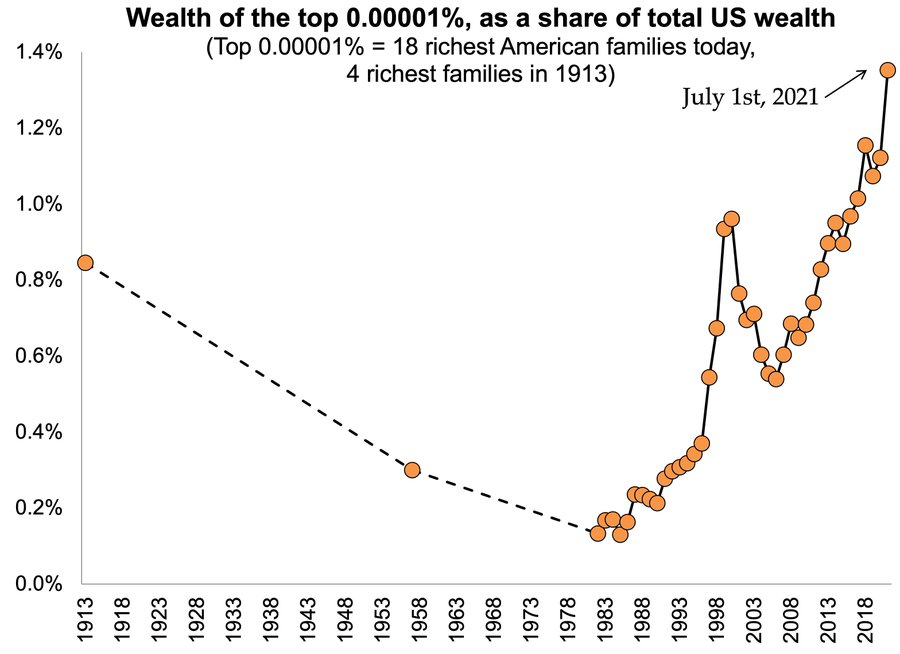
The wealth of the richest 0.00001% of the U.S. now exceeds that of the prior historical peak, which occurred in the Gilded Age, according to economist Gabriel Zucman.

In the late 19th century, the U.S. experienced rapid industrialization and economic growth, creating an inordinate amount of wealth for a handful of families. This era was also known for its severe inequality; and some have called the period that began around 1990 a “Second Gilded Age.” Back then, just four families represented the richest 0.00001% – today’s equivalent is 18 families.

Zucman, a French economist whose doctoral advisor was the historical economist Thomas Piketty, author of bestseller “Capital in the Twenty-First Century,” released data this week showing that as of July 1, the top 0.00001% richest people in the U.S. held 1.35% of the country’s total wealth. These 18 families include those of Jeff Bezos, Mark Zuckerberg and Bill Gates.

Image

Zucman used real-time data from Forbes for the calculations. In 1913, at the end of the Gilded Age, the Rockefeller, Frick, Carnegie, and Baker families – names all tied to monopolistic power – held 0.85% of the country’s total wealth.

The richest 0.01% — around 18,000 U.S. families — have also surpassed the wealth levels reached in the Gilded Age. These families hold 10% of the country’s wealth today, Zucman wrote. By comparison, in 1913, the top 0.01% held 9% of U.S. wealth, and a mere 2% in the late 1970s.

The increasing concentration of wealth comes as the ultra-rich face more scrutiny for the money they’re not paying in taxes. Recent reports have highlighted that because so much of their wealth consists of unrealized gains in stocks and real estate, they pay little or nothing in income tax. Many CEOs and founders take small salaries given their outsized stock holdings, as lower capital gains tax is preferable to a higher tax on ordinary income.

Seated portrait of John Davison Rockefeller (1839 - 1937), American oil magnate, early twentieth century. (Photo by Interim Archives/Getty Images)
Seated portrait of John Davison Rockefeller (1839 – 1937), American oil magnate, early 20th century. (Photo by Interim Archives/Getty Images)

Zucman gained fame in 2019 as an architect of then-presidential candidate Sen. Elizabeth Warren’s wealth tax plan, which aimed to address the fact that the extremely rich pay little in taxes compared to their net worth. The plan would have imposed a 2% tax on net wealth above $50 million and 6% above $1 billion.

Since the pandemic began, the stock market’s gains have widened the gap between the wealthy and non-wealthy because stock ownership is largely concentrated among wealthy people. The number of millionaires globally jumped 5.2 million to 56.1 million, according to Credit Suisse. Though the pandemic’s wealth gains largely benefitted the richest Americans, “most” Americans did fare well financially during the pandemic, according to the Federal Reserve. Around $13.5 trillion of wealth was added to all households. Still, while a large portion of the country got somewhat richer, the rich saw most of that, with the top 1% seeing a third of the $13.5 trillion and the top 20% seeing 70% of it.

Ethan Wolff – Mann is a writer at Yahoo Finance focusing on consumer issues, personal finance, retail, airlines, and more. 

Report: Great Lakes region needs about $2B for flood repairs

Report: Great Lakes region needs about $2B for flood repairs

FILE – In this Dec. 4, 2019 file photo, erosion reaches a house along Lake Michigan’s southwestern shoreline in Stevensville, Mich. Shoreline cities and towns in the Great Lakes region will be spending heavily in coming years to fix public infrastructure damaged by recent flooding and erosion, with estimated costs approaching $2 billion, officials said Thursday, June 8, 2021. (Robert Franklin/South Bend Tribune via AP. File)


TRAVERSE CITY, Mich. (AP) — Shoreline cities and towns in the Great Lakes region will be spending heavily in coming years to fix public infrastructure damaged by recent flooding and erosion, with estimated costs approaching $2 billion, officials said Thursday.

Communities already have poured about $878 million into repairs over the last two years, according to the results of a survey by the Great Lakes and St. Lawrence Cities Initiative, a coalition of mayors and local officials in the region’s eight states and two Canadian provinces.

But the survey of 241 cities, villages and other jurisdictions found that at least $1.94 billion more will be needed over the next five years. The total is certain to be even higher because the report didn’t include all shoreline municipalities, said Jon Altenberg, the initiative’s executive director.

“Communities around the Great Lakes face a growing crisis, and we need both the federal governments of the U.S. and Canada to assist with the necessary investments,” Milwaukee Mayor Tom Barrett said. “Our coastal infrastructure is vital to the economic and recreational health of our communities, and coordinated action is required.”

Abnormally high lake levels and severe rains since 2019 have hammered drinking water intake pipes, sidewalks, ports and docks. Parkland, beaches and wetlands have washed away. Portions of roads have crumbled.

Great Lakes levels fluctuate annually with the seasons and historically experience prolonged high- and low-water periods. But scientists say the warming climate may be making those multi-year swings more abrupt and extreme.

Lakes Huron and Michigan reached their lowest levels on record in early 2013, while the other Great Lakes — Superior, Erie and Ontario — were well below average. Then came a turnabout, as wetter weather filled the lakes to the brim. All five set record highs during the past two years.

Although levels have dipped this year, intense storms have brought flooding to some cities on the lakes or rivers connecting them, including Chicago and Detroit.

The cities group is joining other government, business and environmental organizations in pushing for the Great Lakes region to get a generous share of the infrastructure funding proposed by President Joe Biden and under consideration in Congress.

In addition to continued funding of the Great Lakes Restoration Initiative cleanup program established in 2010, the groups in a June 24 letter to congressional leaders requested billions for water and sewer upgrades, flood prevention and related needs.

“These investments will address longstanding basin-wide priorities while stimulating economic activity in hard-hit communities throughout our region,” the letter said.

Europe is becoming a right-wing continent

Europe is becoming a right-wing continent

Europe.
Europe. Illustrated | iStock


For a certain kind of American liberal, it’s almost a reflexive gesture to wish the United States were more like Europe. There, health care is provided on a more egalitarian basis and a university education is much cheaper, if not free; sexual mores are more relaxed and gun ownership is rare; religion is vestigial and militant nationalism is strictly taboo. Widespread European distress over the presidencies of George W. Bush and Donald Trump only confirmed what American liberals knew: that the Old Country was also the dreamland of their imagined liberal American future.

I wonder how it will feel when Europe becomes distinctly more right-wing than the United States.

It’s not an inconceivable prospect. The United Kingdom has a Tory government right now, and based on current polling their position looks increasingly secure. France’s centrist president Emmanuel Macron would likely be re-elected if the election were held today, but Marine Le Pen’s right-wing National Rally party polls considerably higher today in a one-on-one contest with Macron than it did in 2017. Italy’s fragile coalition could be followed by a right-wing coalition of Matteo Salvini’s Lega and the neofascist-derived Fratelli D’Italia.

Even in Germany, where the Christian Democrat Angela Merkel’s 16-year rule is coming to a close, the next government may once again be a coalition led by the CDU/CSU, if not with the center-left SDP, then in a “Jamaica coalition” with a reinvigorated center-right FDP joining the Greens by their side.

Of course polls can and do change, and one election does not imply a radical cultural shift. But the overall political climate in Europe has been trending rightward for some time. After the financial crisis, and the austerity that followed, the traditional left-wing parties began to collapse, and more nationalist and extreme-right alternatives to the mainstream — the AfD in Germany, National Rally in France, UKIP in England — began to arise. The surge in immigration that followed Syria’s and Libya’s collapse into civil war were further sources of fuel. These parties and movements — critical of the European Union, strongly opposed to immigration, frequently more friendly to Russia — were initially and in many cases still are opposed by all the mainstream parties, but that opposition did little to stem their growth. Eventually, in countries like Hungary and Poland, they began to win elections and assume the powers of government.

In Europe today, the most viable traditional parties are often mainstream right-wing parties that have sought to coopt the nationalist right’s issues — most notably Boris Johnson’s Tory Party, which eclipsed UKIP by adopting Brexit for itself — or parties self-consciously constituted around the technocratic center so as to unite the mainstream against the far right. True left-wing parties like Jean-Luc Mélenchon’s in France or Jeremy Corbyn’s Labour have largely fizzled. Meanwhile, the far right continues to produce new phenomena, most recently France’s Eric Zemmour, who has outflanked Le Pen on the right by being even more nationalist than she is.

If the result of all this ferment is a European political realignment that contains the far right by reviving a more inward-focused traditional conservatism, that would be good for Europe and, ultimately, for European relations with America. A Europe that was more oriented around national solidarity than global humanitarianism, open immigration, or free markets is a Europe America could readily live, work, and trade with. If by that means the continent achieved greater political stability and democratic accountability, most observers would consider it far preferable to either a lurch to the far right or a descent into civil strife.

But it might be startling for the American left to hear even centrist European politicians like Emmanuel Macron blame them for undermining national solidarity with their “woke” leftism. They might have to get used to it, though. Nothing is more useful for promoting national unity than a foreign threat. And while America’s foreign policy establishment would likely prefer that China be that threat, it makes far more sense for a Europe turning inward to decry pernicious American influence on their social fabric than China’s threats to Taiwan or its oppression of the Uyghur people.

The question then would be whether America’s left will take a lesson from the demise of their European cousins, and rethink their own approach to politics before they face a similar eclipse, and downgrade cultural questions in favor of bread and butter issues. Or, perhaps, whether Europe’s turn to the right will inspire America’s left to see unique promise once more in our own country’s distance from nationalism of the Old World, and redefine their own vision of a culturally egalitarian future not as a necessary redemption of our nation’s sinful history, but as a hoped-for fulfillment of distinctively American promise.

Europe is becoming a right-wing continent

Europe is becoming a right-wing continent

For a certain kind of American liberal, it’s almost a reflexive gesture to wish the United States were more like Europe. There, health care is provided on a more egalitarian basis and a university education is much cheaper, if not free; sexual mores are more relaxed and gun ownership is rare; religion is vestigial and militant nationalism is strictly taboo. Widespread European distress over the presidencies of George W. Bush and Donald Trump only confirmed what American liberals knew: that the Old Country was also the dreamland of their imagined liberal American future.


I wonder how it will feel when Europe becomes distinctly more right-wing than the United States.

It’s not an inconceivable prospect. The United Kingdom has a Tory government right now, and based on current polling their position looks increasingly secure. France’s centrist president Emmanuel Macron would likely be re-elected if the election were held today, but Marine Le Pen’s right-wing National Rally party polls considerably higher today in a one-on-one contest with Macron than it did in 2017. Italy’s fragile coalition could be followed by a right-wing coalition of Matteo Salvini’s Lega and the neofascist-derived Fratelli D’Italia.

Even in Germany, where the Christian Democrat Angela Merkel’s 16-year rule is coming to a close, the next government may once again be a coalition led by the CDU/CSU, if not with the center-left SDP, then in a “Jamaica coalition” with a reinvigorated center-right FDP joining the Greens by their side.

Of course polls can and do change, and one election does not imply a radical cultural shift. But the overall political climate in Europe has been trending rightward for some time. After the financial crisis, and the austerity that followed, the traditional left-wing parties began to collapse, and more nationalist and extreme-right alternatives to the mainstream — the AfD in Germany, National Rally in France, UKIP in England — began to arise. The surge in immigration that followed Syria’s and Libya’s collapse into civil war were further sources of fuel. These parties and movements — critical of the European Union, strongly opposed to immigration, frequently more friendly to Russia — were initially and in many cases still are opposed by all the mainstream parties, but that opposition did little to stem their growth. Eventually, in countries like Hungary and Poland, they began to win elections and assume the powers of government.

In Europe today, the most viable traditional parties are often mainstream right-wing parties that have sought to coopt the nationalist right’s issues — most notably Boris Johnson’s Tory Party, which eclipsed UKIP by adopting Brexit for itself — or parties self-consciously constituted around the technocratic center so as to unite the mainstream against the far right. True left-wing parties like Jean-Luc Mélenchon’s in France or Jeremy Corbyn’s Labour have largely fizzled. Meanwhile, the far right continues to produce new phenomena, most recently France’s Eric Zemmour, who has outflanked Le Pen on the right by being even more nationalist than she is.

If the result of all this ferment is a European political realignment that contains the far right by reviving a more inward-focused traditional conservatism, that would be good for Europe and, ultimately, for European relations with America. A Europe that was more oriented around national solidarity than global humanitarianism, open immigration, or free markets is a Europe America could readily live, work, and trade with. If by that means the continent achieved greater political stability and democratic accountability, most observers would consider it far preferable to either a lurch to the far right or a descent into civil strife.

But it might be startling for the American left to hear even centrist European politicians like Emmanuel Macron blame them for undermining national solidarity with their “woke” leftism. They might have to get used to it, though. Nothing is more useful for promoting national unity than a foreign threat. And while America’s foreign policy establishment would likely prefer that China be that threat, it makes far more sense for a Europe turning inward to decry pernicious American influence on their social fabric than China’s threats to Taiwan or its oppression of the Uyghur people.

The question then would be whether America’s left will take a lesson from the demise of their European cousins, and rethink their own approach to politics before they face a similar eclipse, and downgrade cultural questions in favor of bread and butter issues. Or, perhaps, whether Europe’s turn to the right will inspire America’s left to see unique promise once more in our own country’s distance from nationalism of the Old World, and redefine their own vision of a culturally egalitarian future not as a necessary redemption of our nation’s sinful history, but as a hoped-for fulfillment of distinctively American promise.

Utah’s Great Salt Lake is in trouble

Axios

Utah’s Great Salt Lake is in trouble


Utah’s Great Salt Lake is in trouble, with serious ramifications for one of America’s fastest-growing areas.

Why it matters: It’s the largest natural lake west of the Mississippi River and has been shrinking for years, with the mega-drought making it even worse, reports AP’s Lindsay Whitehurst.

Get market news worthy of your time with Axios Markets. Subscribe for free.

  • The lake’s levels are expected to hit a 170-year low this year.
  • Wildlife is suffering from the decline, especially birds and shrimp.
Visitors stand in the shallow waters in June. Photo: Rick Bowmer/AP

The waves have been replaced by dry, gravelly lakebed that’s grown to 750 square miles. Winds can whip up dust from the dry lakebed that is laced with naturally occurring arsenic.

Tourism is also at risk: The dust from the lakebed could speed up snowmelt at Utah’s popular ski resorts.

  • And once-popular lakeside resorts are now long shuttered.

People swim at Saltair in 1933. The resort once drew sunbathers who would float like corks in the Great Salt Lake’s extra salty waters. Photo: Salt Lake Tribune via AP

The bottom line: To maintain lake levels, diverting water from rivers that flow into it would have to decrease by 30%.

  • But for the state with the nation’s fastest-growing population, addressing the problem will require a major shift in how water is allocated.

The ‘Good’ Republicans Are Bad, and the Bad Ones Are Batshit

The ‘Good’ Republicans Are Bad, and the Bad Ones Are Batshit

Photo Illustration by The Daily Beast/Getty


Chip Roy from Texas’ 21st Congressional District didn’t vote to overturn the election of the 2020 election, which made him slightly better than 147 of his colleagues who voted to change the election results because they didn’t like them.

Roy released a statement with a small group of Republican reps who wanted to follow the law despite the fact that their guy lost, warning that trying to overturn the election would “strengthen the efforts of those on the left who are determined to eliminate it or render it irrelevant.” He even went as far as to challenge the seating of representatives from states where members of his party were challenging the results of the election—a pretty bold move considering one of the people who was challenging the results was his old boss Ted Cruz.

But what a difference six months makes. Roy is no longer Team Electoral College and the Constitution. He’s joined the rest of his party—with the exception of soon-to-be-purged Adam Kinzinger and Liz Cheney—on Team Own the Libs Even If It Means Killing Your Supporters.

GOP Rep: If Dems Win Senate, We’ll Be in ‘Full-Scale Hot Conflict’

This weekend he was sounding like a mini-Newt, telling a group in a recently surfaced video that “Honestly, right now, for the next 18 months, our job is to do everything we can to slow all of that down to get to December of 2022, and then get in there and lead.” When CNN followed up, “Roy responded to coverage of his earlier comments in a statement standing by his remarks, saying he plans to ‘oppose almost everything that Congress does,’ and pledging ‘to fight with every ounce of my being to stop the radical left—and weak Republicans.’” And then of course there was his weird anti-vaxxer tweet: “come inject it.” A great message when the most contagious delta variant is taking hold and new polling from the Washington Post-ABC shows that 47 percent of Republicans “aren’t likely to get vaccinated.”

This is the Republican brand now: death before decency. What Roy’s colleague Paul Gosar learned from Trumpism is that working with terrifying far-right extremists is totally cool. Gosar is now even more far-right than Steve King, who was censured for his white nationalist statements back when Republicans at least pretended to give a shit.

This Trump Wannabe Just Might Be the Worst of the Rotten Bunch

Now Gosar is being praised by white nationalist Nick Fuentes—and minority “Leader” Kevin McCarthy is fine with that, just like he’s fine with Marjorie Taylor Greene raving about the Jews and Matt Gaetz (R-Sex Creep) staying on the House Ethics Committee so that he could question the head of the FBI while continuing to be investigated by the FBI.

Meanwhile Stop the Steal speaker Mo Brooks is now running for Senate in Alabama. Brooks, who was a planner of the Jan. 6 rally, according to a deleted video from Ali Alexander, claims in a new civil filing that he only spoke at the rally-turned-riot because the White House told him to. That was in the same legal filing in which he said he believes that Trump still won the election (Trump did not).

Since no one in Trumpworld has been punished for anything, Republicans have learned that you do anything at all and no one will ever hold you accountable. Local Republicans continue trying to make it harder for the “wrong people” to vote, including Native Americans in Montana this week. It’s not about racism, they insist; it’s about stopping groups that back Democrats who oppose racism.

Trump taught Republicans that they can be as shitty as they want, and no one will stop them, as long as they don’t cross Trump. Just look at former Missouri Gov. Eric Greitens, who resigned after he was indicted on felony charges after cheating on his wife with a woman he blackmailed and abused. He’s running for Senate now, and a GOP mega-donor just gave him $2.5 million because allegations of sexual assault are no longer a barrier to entry in today’s GOP; they may even be the mark of a “real man.” Just ask Donald.

These people will continue to break rules and wreck our democracy until someone—are you listening, Merrick Garland?—holds them accountable.

If Chip Roy is the best of this rotten bunch, it’s time to toss the whole barrel. William Butler Yeats must have been writing about the Republicans when he wrote that “the best lack all conviction, while the worst / Are full of passionate intensity.”

Pew Poll: The Republican Party is Literally Dying, With The GOP’s Backbone Now People Over 75. 

The Sierra Madre Tattler

Pew Poll: The Republican Party is Literally Dying, With The GOP’s Backbone Now People Over 75.

thesierramadretattler.blogspot.com              July 7, 2021


Mod: Bad news for Jumbo. Many of the Republican Party‘s most loyal voters are not as young as they used to be, and nobody is exactly rushing in to line up and replace them.

The Republican Party Is Literally Shrinking And Dying Right Before Our Eyes (PoliticusUSA link): A new analysis of voter file information found that the Republican Party’s backbone is people over 75, and that group is becoming a smaller share of the electorate. 

The Week reported, “But Pew also broke the survey down into not just age groups but generational cohorts. And it’s here where you’ll find the most terrifying information for the GOP. According to PewTrump won a decisive majority only with members of the “Silent Generation,” those born between 1928 and 1945 (and the extremely tiny number of living people older than that).”

Trump dominated that cohort by 16 points, 58-42. That means that the only reliably Republican voter bloc will shrink considerably between now and 2024, and that 65- to 74-year-olds must have been a much more blue-leaning group in 2020 to produce Trump’s comparatively narrow 4-point margin with all over-65s.”
The Republican Party is literally dying, These numbers suggest that the Republican base will continue to get smaller, as younger and more Democratic voters take up a larger share of the electorate. 

Given this context, the Republican Party has opted for a strategy of making the electorate as small as possible. The only way that they can win elections, even while the backbone of their party is expiring, is to make sure that as many people as possible can’t vote and participate in elections.

Republicans had a choice after they lost in 2020. They could have opted to reassess their tactics and tried to rebrand themselves to appeal to younger voters, or they could run it all back with an even older and defeated Donald Trump, who is young voter repellent in human form.They have chosen voter suppression and Trump.

The clock is ticking on the Republican Party. They are fighting a battle that they have already lost. The party isn’t just getting smaller, it is literally dying before our eyes.

Sen. Ron Johnson mouths to GOP group that climate change is ‘bullsh–‘ just weeks before deadly heat wave

Sen. Ron Johnson mouths to GOP group that climate change is ‘bullsh–‘ just weeks before deadly heat wave

Sen. Ron Johnson, a Wisconsin Republican.
Sen. Ron Johnson, a Wisconsin Republican. Samuel Corum/Getty Images 

  • Ron Johnson mouthed to a GOP luncheon that climate change is “bullsh–,” CNN reported.
  • His comments came weeks before a fatal heat wave in the Pacific Northwest that scientists attributed to climate change.
  • Johnson has a long record of rejecting facts or making comments at odds with science on climate change.

Republican Sen. Ron Johnson of Wisconsin called climate change “bullsh–” during a GOP luncheon in early June, just weeks before a heat wave claimed dozens of lives in the Pacific Northwest. Scientists have linked the historic high temperatures to climate change.

“I don’t know about you guys, but I think climate change is – as Lord Monckton said – bullsh–,” Johnson said during the Republican Women of Greater Wisconsin Luncheon at Alioto’s in Wauwatosa, Wisconsin, in comments caught on video and first reported by CNN. “By the way, it is.”

Johnson – who referred to Lord Christopher Monckton, a climate skeptic who has held positions in the British government and press – did not actually say “bullsh–” out loud, but mouthed the word.

The Wisconsin senator defended himself in comments to CNN, rejecting the notion that he’s a climate change denier.

“My statements are consistent. I am not a climate change denier, but I also am not a climate change alarmist. Climate is not static. It has always changed and always will change,” Johnson said.

The world’s top scientists say that climate change is real and caused by human activities. In short, Johnson’s comments are not backed up by science.

Johnson further defended himself on Twitter, writing, “I do not share Rep. Ocasio-Cortez view that the ‘world is going to end in 12 years if we don’t address climate change.’ Or POTUS saying the ‘greatest threat’ to U.S. security is climate change. I consider those to be extreme positions – to say the least.”

The Wisconsin Republican was referencing remarks made by Democratic Rep. Alexandria Ocasio-Cortez of New York in January 2019. Ocasio-Cortez has said she did not mean the world would literally end in 12 years, and was referencing a United Nations report that said humans only had a dozen years to change their behavior and avoid a climate change catastrophe.

Johnson also dismissed President Joe Biden’s comments on the national security threat posed by climate change, which have been backed up by Chairman of the Joint Chiefs of Staff Gen. Mark Milley.

“Climate change is going to impact natural resources, for example,” Milley said during a Senate Armed Services Committee hearing in June. “It’s going to impact increased instability in various parts of the world. It’s going to impact migrations, and so on.”

Johnson has a long record of making statements at odds with science and denying that climate change is a product of human activities. In 2010, for example, Johnson falsely said Greenland only recently froze and erroneously suggested it was named for its previously green landscapes.