Republicans’ confidence in science has dropped significantly from 1975, poll finds
Brigid Kennedy, Contributing Writer
Science, welcome to 2021 — you’ve been politicized.
A new Galluppoll reveals that, in 2021, just 45 percent of Republicans report having a “great deal” or “quite a lot” of confidence in science, compared to 72 percent of Republicans in 1975. Democrats and independents have remained largely confident in science as an institution over the years, shifting from 67 percent to 79 percent, and 73 percent to 65 percent, respectively, between 1975 and 2021, per Gallup.
Gallup Poll.
The current partisan gap regarding confidence in science (79 percent to 45 percent) is “among the largest Gallup measured” for any of the institutions in its annual Confidence in Institutions survey. It is “exceeded only by a 49-point party divide in ratings of the presidency and 45 points in ratings of the police,” Gallup writes.
Such distrust toward the scientific community can be felt in recent Republican attitudes toward mask mandates, the COVID-19 vaccine, and the seriousness of the pandemic as a whole, Gallup notes. Ironically, just 46 years ago, Republicans were actually more likely than Democrats to report a great deal of trust in science — but now, conservative thought and political leaders are seemingly pushing their caucus in the opposite direction.
Among all Americans, trust in science between 1975 and 2021 is down only 6 percentage points, from 70 percent to 64 percent, Gallup notes.
Gallup surveyed 1,381 adults from July 1-5, 2021. Results have a margin of error of three percentage points. See more results at Gallup.
How hot is too hot? What to know about wet bulb temperatures, an increasing danger in extreme heat.
Elinor Aspegren, USA TODAY
The persistent heat wave in the Pacific Northwest has been blamed for hundreds of deaths in Oregon and Washington and into Canada.
It’s a scenario experts warn will soon become all too common: As temperatures continue to rise, so will the death toll – potentially by the tens of thousands.
“By the mid-century, we anticipate a pretty significant extra burden of extreme heat and public health somewhere in the neighborhood of about 10,000 additional deaths,” Vijay Limaye, a climate and health scientist with the Natural Resources Defense Council, told USA TODAY.
Heat is already the deadliest weather-related hazard, killing about 1,300 Americans each year, Limaye said, and wet bulb temperatures – an underreported health outcome for decades – have increasingly become a most fatal culprit. Wet bulb conditions occur when it’s too hot and humid for a human’s sweat to evaporate, specifically at 95 Fahrenheit and 95% relative humidity.
A thermometer shows an official temperature at Death Valley National Park in California on July 11, 2021.
But serious impacts can even occur at 79 degrees wet bulb. When that happens, “your body’s natural cooling mechanisms can’t work,” Limaye said.
In other words, when wet bulb temperatures are high, there’s so much humidity in the air that sweating becomes ineffective at removing the body’s excess heat, according to Colin Raymond, a researcher at the NASA Jet Propulsion Laboratory in California.
“At some point, perhaps after six or more hours, this will lead to organ failure and death in the absence of access to artificial cooling,” he told the National Oceanic and Atmospheric Administration.
Extreme humidity has more than doubled in frequency since 1979, Limaye said. He pointed specifically to a study written by Raymond last year: Though climate models predicted these extreme temperatures by the mid-21st century, they’ve already occurred in places like India, Pakistan, the Gulf of Mexico and even in California.
The dangerous weather risks are “expected to significantly worsen the already pretty terrible burden of extreme heat on health,” Limaye said.
“We’re getting to the point in which even in dry conditions, we are at risk of basically having potentially uninhabitable parts of the world – just kind of too hot for people to be outside working or moving around,” he added.
The sun shines behind the Space Needle in Seattle on June 28, 2021.
With no wind and sunny skies, an area with 50% humidity will hit an unlivable wet-bulb temperature at around 109, according to an article by MIT. In dry air, temperatures will become unlivable over 130 degrees – the temperature reached earlier this month in Death Valley, California.
Experts like Limaye are certain the increasing frequency of heat waves in general – and deaths that come along with them – are caused by human-created climate change.
The deadly and record-breaking heat wave in parts of the Western U.S. and Canada that began in late June and has stretched into July would have been “virtually impossible” without the influence of climate change, according to a recent study.
Every heat wave occurring today, in fact, is made more likely and more intense by climate change, the study found.
“If we continue to let climate change worsen year after year, what sort of health situation might we be confronted with, by say, the middle of the century around 2050?” Limaye asked.
Water wells are at risk of going dry in the US and worldwide
Debra Perrone May 10, 2021
Debra Perrone, Assistant Professor of Environmental Studies, University of California Santa Barbara and Scott Jasechko, Assistant Professor of Water Resources, University of California Santa Barbara.
As the drought outlook for the Western U.S. becomes increasingly bleak, attention is turning once again to groundwater – literally, water stored in the ground. It is Earth’s most widespread and reliable source of fresh water, but it’s not limitless.
Wells that people drill to access groundwater supply nearly half the water used for irrigated agriculture in the U.S. and provide over 100 million Americans with drinking water. Unfortunately, pervasive pumping is causing groundwater levels to decline in some areas, including much of California’s San Joaquin Valley and Kansas’ High Plains.
We are a water resources engineer with training in water law and a water scientist and large-data analyst. In a recent study, we mapped the locations and depths of wells in 40 countries around the world and found that millions of wells could run dry if groundwater levels decline by only a few meters. While solutions vary from place to place, we believe that what’s most important for protecting wells from running dry is managing groundwater sustainably – especially in nations like the U.S. that use a lot of it.
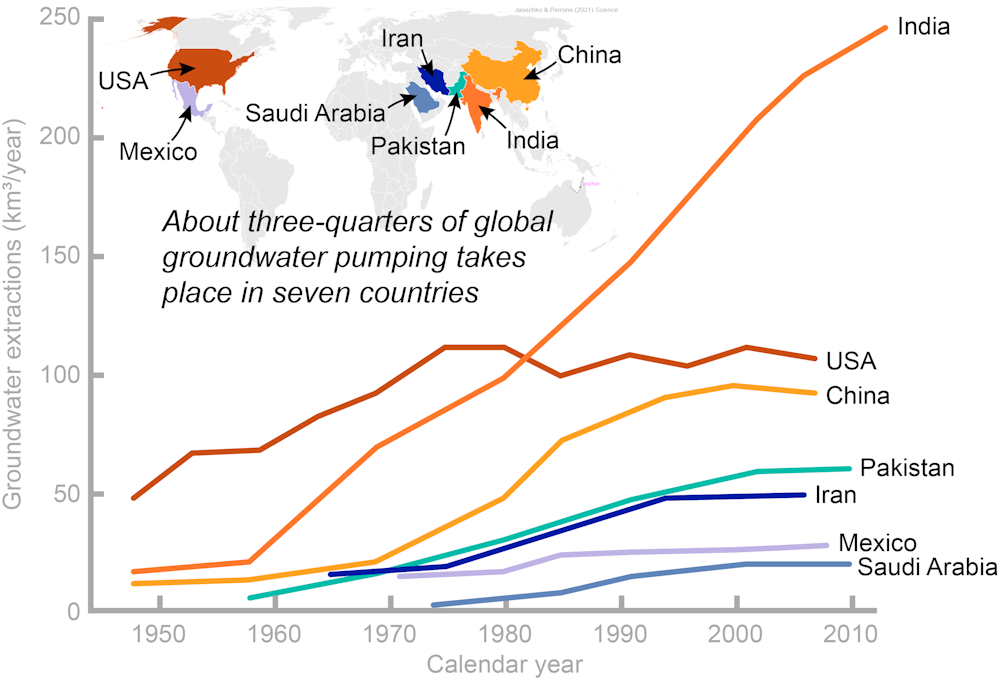
About 75% of global groundwater pumping occurs in India, the U.S., China, Pakistan, Iran, Mexico and Saudi Arabia.
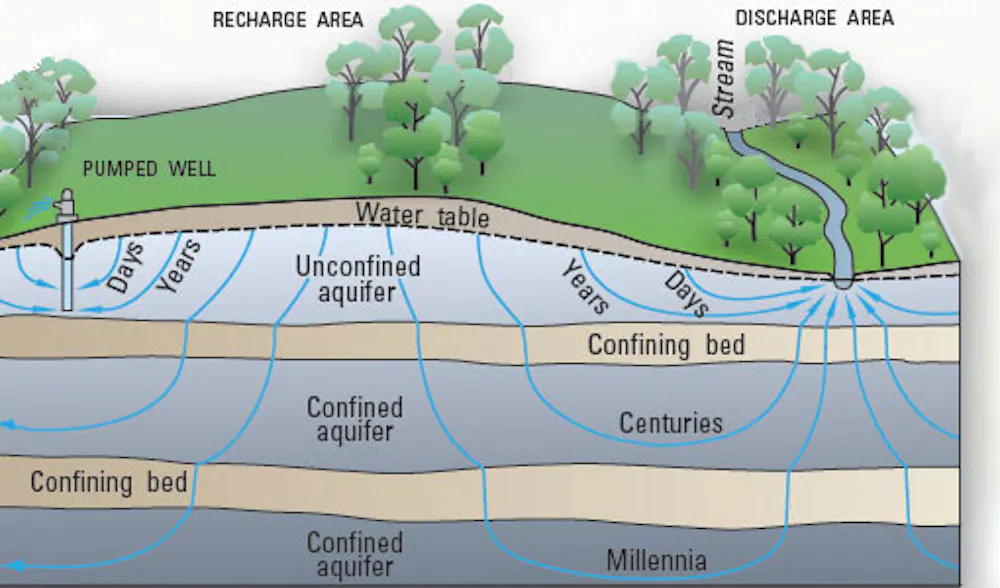
Groundwater flows through tiny spaces within sediments and their underlying bedrock. At some points, called discharge areas, groundwater rises to the surface, moving into lakes, rivers and streams. At other points, known as recharge areas, water percolates deep into the ground, either through precipitation or leakage from rivers, lakes and streams.
Pumping can remove groundwater from underground faster than it recharges.
Groundwater depletion can also cause wells to run dry when the top surface of the groundwater – known as the water table – drops so far that the well isn’t deep enough to reach it, leaving the well literally high and dry. Yet until recently, little was known about how vulnerable global wells are to running dry because of declining groundwater levels.
There is no global database of wells, so over six years we compiled 134 unique well construction databases spanning 40 different countries. In total, we analyzed nearly 39 million well construction records, including each well’s location, the reason it was constructed and its depth.
Our results show that wells are vital to human livelihoods – and recording well depths helped us see how vulnerable wells are to running dry.
Millions of wells at risk
Our analysis led to two main findings. First, up to 20% of wells around the world extend no more than 16 feet (5 meters) below the water table. That means these wells will run dry if groundwater levels decline by just a few feet.
Second, we found that newer wells are not being dug significantly deeper than older wells in some places where groundwater levels are declining. In some areas, such as eastern New Mexico, newer wells are not drilled deeper than older wells because the deeper rock layers are impermeable and contain saline water. New wells are at least as likely to run dry as older wells in these areas.
– Sell the property. This is often considered if constructing a new well is unaffordable. Drilling a new household well in the U.S. Southwest can cost tens of thousands of dollars. But selling a property that lacks access to a reliable and convenient water supply can be challenging.
– Divert or haul water from alternative sources, such as nearby rivers or lakes. This approach is feasible only if surface water resources are not already reserved for other users or too far away. Even if nearby surface waters are available, treating their quality to make them safe to drink can be harder than treating well water.
– Reduce water use to slow or stop groundwater level declines. This could mean switching to crops that are less water-intensive, or adopting irrigation systems that reduce water losses. Such approaches may reduce farmers’ profits or require upfront investments in new technologies.
– Limit or abandon activities that require lots of water, such as irrigation. This strategy can be challenging if irrigated land provides higher crop yields than unirrigated land. Recent research suggests that some land in the central U.S. is not suitable for unirrigated “dryland” farming.
Households and communities can take proactive steps to protect wells from running dry. For example, one of us is working closely with Rebecca Nelson of Melbourne Law School in Australia to map groundwater withdrawal permitting – the process of seeking permission to withdraw groundwater – across the U.S. West.
State and local agencies can distribute groundwater permits in ways that help stabilize falling groundwater levels over the long run, or in ways that prioritize certain water users. Enacting and enforcing policies designed to limit groundwater depletion can help protect wells from running dry. While it can be difficult to limit use of a resource as essential as water, we believe that in most cases, simply drilling deeper is not a sustainable path forward.
The authors do not work for, consult, own shares in or receive funding from any company or organization that would benefit from this article, and have disclosed no relevant affiliations beyond their academic appointment.
Walmart, Target, and Amazon are among the biggest corporate polluters thanks to overseas shipping
Hannah Towey
The Exxon Valdez is one of thousands of ships dismantled at the Alang ship-breaking yard in western Indian state of Gujarat, India. AP Photo
A new study measures the climate pollution retailers emit from overseas shipping.
Retail giants Walmart, Target, Ikea, and Amazon are among the top 10 maritime polluters.
Walmart generates more greenhouse gas than a coal plant would in a year, The Verge first reported.
A new report from Pacific Environment and Stand.earth reveals 15 major corporations that emit as much climate pollution from overseas shipping as 1.5 million American homes.
Retail giants Walmart, Target, Home Depot, Ikea, Amazon, and Nike are among the worst polluters, according to the report. Walmart tops the list, generating more greenhouse gas than a coal plant would in a year, The Verge first reported.
“There really hadn’t been an investigation into this pillar of companies’ emissions portfolio,” Madeline Rose, primary author of the report, told The Verge. “Quite frankly, with the climate emergency on our doorstep, we just feel like there needs to be disruption of the data system and there needs to be greater transparency.”
Pacific Environment / Stand.earth
Right now, Americans are buying so many imported goods that shipping companies are racing to build more boats and brands are paying ten times typical shipping prices, Insider reported in July.
The study measures greenhouse gas emissions and air pollution released by the 15 retailers while importing goods overseas to the US.
To calculate the final rankings, researchers tracked cargo ships used by each company as a way of estimating fuel consumption and emissions. The results do not include the cargo ships’ return, meaning the pollution is probably even more severe than the study found.
In 2019, Ikea announced an ambitious plan for the company to become “climate positive” – meaning it would reduce more pollution than it creates – by 2030. According to the study, shipping from the world’s largest furniture retailer is the seventh-biggest polluter, a ranking worse than Amazon’s.
Last year, Walmart said it will eliminate its carbon footprint by 2040. This goal does not encompass Walmart’s entire supply chain, and therefore does not calculate emissions released by overseas shipping.
Similarly, Amazon has pledged to be net-zero carbon across its business by 2040. An Amazon spokesperson told Insider that the company includes indirect emissions such as cargo shipping into its carbon footprint calculations, which are published online.
Target’s sustainability goals do take its entire supply chain into account – the company also aims to be net-zero by 2040.
“Major retail companies are directly responsible for the dirty air that sickens our youth with asthma, leads to thousands of premature deaths a year in U.S. port communities, and adds to the climate emergency,” Rose said in a statement. “We are demanding that these practices change.”
Walmart, Target, Ikea, and Amazon did not respond to Insider’s request for comment.
Delta variant: Doctor cautions Americans about traveling to Florida
Seana Smith, Anchor July 21, 2021
As the highly transmissible Delta variant spreads nationwide, the Centers for Disease Control and Prevention (CDC) and the State Department are urging Americans to avoid traveling to the UK.
But that’s not going far enough, U.S., Dr. Ebony Jade Hilton, GoodStock Consulting co-founder and medical director, told Yahoo Finance Live. In fact, Americans should be careful traveling to certain areas within the U.S.
“If we’re going to talk about traveling to the U.K., then we should also caution Americans about traveling to Florida,” Hilton said. “Right now, one in every five new COVID cases are coming out of Florida.”
In Florida, only 47% of the population is fully vaccinated as the state is seeing an average of 55.1 daily new COVID-19 cases per 100,000 people, the highest rate in the country, according to data from the Brown School of Public Health. And according to the Florida Department of Health’s weekly COVID-19 report, the number of new COVID-19 cases nearly doubled in the state last week from the prior week.
‘The Delta variant is a game changer’
During a press briefing on Friday, White House Coronavirus Response Coordinator Jeffrey Zients said four states accounted for more than 40% of all cases in the past week, with 20% of new cases occurring in Florida alone.
Arkansas is also among the nation’s current pandemic hot spots. Brown School of Public Health data shows the state is reporting an average of 38.1 daily new COVID-19 cases per 100,000 people, and is designated “red” on the risk-assessment map.
“We’re seeing an uptick across the Southeast, and even to the Midwest,” Hilton said. “We’re looking at places like Alabama and Arkansas. So we can talk about the rest of the world, but the United States really needs to hone in and focus on what is preventing us from having a successful vaccine rollout in those heavily hit areas.”
The CDC is urging caution about traveling to Florida amid the spread of the Delta variant. (Photo by Paul Hennessy/SOPA Images/LightRocket via Getty Images)
Vaccinations are the key to slowing the spread of the Delta variant. In Alabama, where only about 33% of the population is fully vaccinated, the state department reported a 39% jump in COVID-19 cases from June 26 to July 9, and unvaccinated people represented 96% of COVID-19 deaths in the state since April 1.
Nationwide, Johns Hopkins University data shows a total of 243,110 new cases were reported last week as the Delta variant spreads, accounting for about 40% of the total cases in the past month.
“The Delta variant is a game changer,” Hilton said. “New cases nationwide are up 140% in the last two weeks. Our hospitalizations are up 34%, and our deaths, unfortunately, are increasing by 33%. We’re not finished with this pandemic.”
The largest wildfire in the U.S. advances toward Oregon mountain towns
Molly Hennessy-Fisk
Flames and smoke rise from the Bootleg fire in southern Oregon last week. The wildfire was burning northeast of the blaze that ravaged the Klamath Tribes’ community less than a year ago. (John Hendricks / Oregon Office of the State Fire Marshal)
In 20 years of Oregon firefighting, Wayne Morris has never seen anything like the Bootleg fire.
Fire commanders had planned to flank the blaze that erupted about 300 miles southeast of Portland around the Fremont-Winema National Forest on July 6. But the fire proved too fast and intense, scorching more than 388,000 acres of southern Oregon forest — half the area of Rhode Island — destroying at least 70 homes and forcing thousands to evacuate. No injuries or deaths had been reported as of Tuesday afternoon.
The fire was only 30% contained Tuesday and continued to advance toward mountain towns, even as 2,250 firefighters and others fought it. The blaze absorbed a smaller one this week to become the largest wildfire now burning in the U.S., and fourth-largest in state history — so big that it has created its own lightning.
“We’re seeing things we’ve never seen before as far as size and activity,” Morris said as his crew walked the fire line, extinguishing flames.
Firefighters came to help from as far away as Florida and Kentucky, along with many from California. At a fire base in the tiny community of Bly, firetrucks were on hand from Fremont, Rancho Cucamonga and San Bruno.
Firefighters were sooty and exhausted after days of being forced to retreat as the blaze leaped over fire lines.
Anaheim Fire Capt. Aaron Mooney arrived with his crew 10 days ago, and knows others in the area from Fullerton, Laguna Beach, Long Beach and Orange.
It was Mooney’s first time fighting fires in Oregon, but he said the Bootleg fire reminded him of those he had fought in recent years in Northern California. It was a timber-fueled fire as opposed to the wind-driven fires common in Southern California. He pointed to the towering pines that surrounded him, many of their trunks charred.
“It’s the timber litter — the ‘down and dead’ fuels, what falls out of the trees naturally,” Mooney said. He noted that it had been so unseasonably hot and dry in recent days that there was more than a 90% probability that new fires would be sparked.
On Tuesday, temperatures dipped, with clouds and even some spotty rain that helped firefighters tamp down lingering fires on the southern flank.
“We’re hoping to hold this line,” Mooney said as his team refueled a water truck.
The incident commander for the south side of the fire, Joe Hessel of the Oregon Department of Forestry, said Tuesday that he expected firefighters to gain control of the Bootleg fire’s southern flank within 48 hours.
Pointing to a map in his command post, set up at Lakeview High School on the fire’s southeast edge, Hessel traced the fire’s latest path northeast toward the rural communities of Paisley, Summer Lake and Silver Lake. Some residents who grew up around smaller wildfires had refused to evacuate, he said.
“They’ve lived with fire their whole lives,” he said. “But we’re not used to having million-acre fires” — which the Bootleg fire was shaping up to be.
The largest forest fire in Oregon’s recent history was the Biscuit fire, which burned nearly 780 square miles in 2002 in the Rogue River-Siskiyou National Forest in southern Oregon and Northern California. Oregon’s megafires usually start after spring rains, and can burn until early winter. This year they started early, in March, before things had greened up, which firefighters said added to the fires’ strength.
On the Bootleg fire map, Hessel traced the western edge of Summer Lake’s basin, known as Winter Rim or Winter Ridge.
“If it goes over that rim, it’s going to get really challenging,” he said.
Hessel knows because he fought a fire in the area — the Winter Rim fire — in 2002, and remembers how it sucked hot air into the basin. That fire burned about 31,000 acres. The Bootleg fire was burning about as many acres each day.
In 38 years of firefighting, Hessel said, “I’ve never experienced that continuous, day after day fire behavior and growth.”
His counterpart to the north, Incident Cmdr. Rob Allen, was trying to stop the fire from reaching the lake’s rim Tuesday, sending helicopters to drop water and fire retardant, as firefighters on foot chopped logs and other brush that could feed the flames.
“Fighting this fire is a marathon, not a sprint,” Allen said. “We’re in this for as long as it takes to safely confine this monster.”
Western wildfire smoke creates fiery sunrise 2,000 miles away in New York City
By Jeremy Lewan and Kathryn Prociv July 20, 2021
Wildfires rage across 13 states as smoke swirls across the country creating hazy skies along the Eastern Seaboard from Toronto to Washington, D.C.
The sun rises above the CN Tower through a thick haze caused by smoke from forest fires burning in western Canada moving through the upper atmosphere July 19, 2021, in Toronto.Gary Hershorn / Getty Images
After baking in weeks of searing heat, the West is erupting in fierce wildfires so strong the smoke was visible Tuesday on the East Coast in cities such as New York and Washington, D.C.
Air quality alerts were issued for New York City on Tuesday, and the National Weather Service urged sensitive groups to remain indoors.
More than 75 wildfires have already scorched more than 1 million acres in 13 states. On Tuesday, 3 million people remained under red flag warnings blanketing eight states across the Northwest and the northern Plains, including the area of the Bootleg Fire in Oregon, currently the largest fire this year.
Now classified as a megafire,or a fire burning more than 100,000 acres, the Bootleg Fire has blazed over 350,000 acres, which is about half the size of Rhode Island, and was only 30 percent contained as of Tuesday.
Conditions surrounding the area have exhibited extreme fire behavior, and the massive inferno has been so powerful that it created its own weather, generating dangerous columns of lightning-charged smoke and ash, called pyrocumulus or pyrocumulonimbus clouds, reaching the stratosphere. These can reach more than 40,000 feet into the atmosphere – the altitude at which commercial airplanes fly.
The Beckwourth Complex Fire, raging in Northern California, has topped 100,000 acres burned, also earning the megafire title. With more than 1,000 firefighters working, the fire was nearly 90 percent contained Tuesday.
Pacific Gas and Electric, California’s largest utility, may be responsible for another blaze licking across Northern California. On Sunday, a spokesperson admitted that blown fuses on one of its utility poles may have sparked the over the Dixie Fire, which is 30,000 acres and growing. This comes after PG&E has taken responsibility for the devastating 2018 Camp Fire and the 2019 Kincade Fire that burned more than 100 square miles of Sonoma County.
According to an update Monday from the California Department of Forestry and Fire Protection, or CAL FIRE, compared to this same time last year, there are over 900 more fires and 165,000 additional acres burned. For context, 2020 was the worst Western fire season in history.
The situation has become so dire that the National Interagency Fire Center has upgraded the national preparedness level to the highest category, Level 5, signifying that at least 80 percent of wildland firefighters are currently responding to fires.
Wildfire growth and spread are expected to intensify through the week as yet another major heat wave roasted the high Plains and the Rocky Mountains, peaking Monday. Triple-digit temperatures, combined with humidity as low as 10 percent and wind gusts up to 40 mph, will produce ideal wildfire conditions. An additional major concern is the dry thunderstorms expected to flare along the interior Northwest, producing abundant lightning that could easily spark sun-baked vegetation.
Paul Krugman Points Out The Unusual Thing About The GOP Cult Of Donald Trump
Lee Moran
Economist Paul Krugman, in his latest column for The New York Times, pointed out the “unusual thing” about the GOP’s cult-like devotion to one-term, twice-impeached former President Donald Trump.
The party “doesn’t have a monopoly on power; in fact, it controls neither Congress nor the White House,” noted Krugman in his essay published Monday.
“Politicians suspected of insufficient loyalty to Donald Trump and Trumpism in general aren’t sent to the gulag. At most, they stand to lose intraparty offices and, possibly, future primaries,” Krugman continued. “Yet such is the timidity of Republican politicians that these mild threats are apparently enough to make many of them behave like Caligula’s courtiers.”
Krugman, who was awarded the Nobel Memorial Prize in Economics in 2008, pointed out that “many people, myself included, have declared for years that the GOP is no longer a normal political party.”
But it now “bears a growing resemblance to the ruling parties of autocratic regimes,” he added.
The GOP “has become something different, with, as far as I know, no precedent in American history although with many precedents abroad,” Krugman concluded. “Republicans have created for themselves a political realm in which costly demonstrations of loyalty transcend considerations of good policy or even basic logic. And all of us may pay the price.”
The Democrat blocking progressive change is beholden to big oil. Surprised?
Alex Kotch
United States Senator from West Virginia
Photograph: J Scott Applewhite/AP
As “thousand-year” heat waves caused by the climate crisis rock the west coast and biblical floods engulf major cities, Senate Democrats are negotiating a $3.5tn budget package that could include an attempt to slow the use of fossil fuels over the next decade.
One prominent senator is very concerned about proposals to scale back oil, gas and coal usage. He recently argued that those who want to “get rid of” fossil fuels are wrong. Eliminating fossil fuels won’t help fight global heating, he claimed, against all evidence. “If anything, it would be worse.”
Which rightwing Republican uttered these false, climate crisis-denying words?
Wrong question. The speaker was a Democrat: Senator Joe Manchin of West Virginia.
West Virginia is a major coal-producing state. But Manchin’s investment in dirty energy goes far beyond the economic interests of the voters who elect him every six years. In fact, coal has made Manchin and his family very wealthy. He founded the private coal brokerage Enersystems in 1988 and still owns a big stake in the company, which his son currently runs.
In 2020 alone, Manchin raked in nearly $500,000 of income from Enersystems, and he owns as much as $5m worth of stock in the company, according to his most recent financial disclosure.
Despite this conflict of interest, Manchin chairs the influential Senate energy and natural resources committee, which has jurisdiction over coal production and distribution, coal research and development, and coal conversion, as well as “global climate change”.
He even gave a pro-coal speech in May to the Edison Electric Institute (EEI) while personally profiting from Enersystems’ coal sales to utility companies that are EEI members, as Sludge recently reported.
Manchin is one of many members of Congress who are personally invested in the fossil fuel industry – dozens of Congress members hold Exxon stock – but he is among the biggest profiters. As of late 2019, he had more money invested in dirty energy than any other senator.
How can this be? Wouldn’t basic ethics prevent someone from being in charge of legislation that could materially benefit them? Unfortunately, conflict-of-interest rules in the Senate are remarkably weak. And guess who is seeking to strip conflict-of-interest rules from a 2021 democracy reform bill?
His proposal “leaves out language that S 1 would add to federal statute prohibiting lawmakers from working on bills primarily for furthering their financial interests”, Sludge reported.
Manchin, the most conservative Democrat in the Senate, has used the evenly split chamber to block Joe Biden’s agenda. In the process he has become arguably the most powerful person in Washington. Hardly any Democratic legislation can pass without his vote.
That’s a problem – especially given that Manchin sometimes seems like he’s an honorary Republican. Earlier this month the Texas Tribune and other publications reported that Manchin was heading to Texas for a fundraiser hosted by several major Republican donors, including oil billionaires.
Manchin, along with Senator Kyrsten Sinema of Arizona, has vowed to protect the filibuster – a rule, frequently used to empower white supremacists, that requires 60 votes for most Senate bills to pass. That includes vital voting rights legislation, passed by the House, that is the only way to stop the Republican party from eviscerating what’s left of our democracy in the name of the “big lie” of voter fraud.
Because of his uniquely powerful position as a swing vote, Manchin can rewrite major legislation to his liking – effectively dictating the legislative agendas of Congress and the White House.
It appears that Manchin will have his way with the White House’s infrastructure package as well, and his changes will probably be more devastating, given the climate emergency we live in.
Manchin isn’t just sticking up for the coal industry and his family’s generational wealth; he’s doing the bidding of oil and gas executives, who also stand to lose money if the nation transitions away from toxic fuels.
Manchin’s political campaigns are fueled by the dirty energy industry. Over the past decade, his election campaigns have received nearly $65,000 from disastrously dishonest oil giant Exxon’s lobbyists, its corporate political action committee, and the lobbying firms that Exxon works with. A top Exxon lobbyist recently bragged about his access to Manchin.
In the 2018 election cycle, his most recent, Manchin’s campaign got more money from oil and gas Pacs and employees than any other Senate Democrat except then North Dakota senator Heidi Heitkamp. Manchin was also the mining industry’s top Democratic recipient in Congress that cycle.
If Biden wants to have any kind of legacy, he needs to stand up to Manchin, a member of his own party, and work with the Senate majority leader, Chuck Schumer, to get him in line. I don’t fully know why Biden permits the West Virginian to dictate his own presidential policy agenda. But what is crystal clear is that the leader of the United States should be doing a whole lot more.
Alex Kotch is an investigative reporter and editor with the Center for Media and Democracy, a nationally recognized watchdog that leads award-winning investigations into the corruption that undermines our democracy, environment, and economic prosperity
With Disasters Mounting By The Day, The U.S. May Finally Enact Real Climate Policy
Alexander C. Kaufman
Detroit residents observe a stretch of I-94 under several feet of water after rains flooded parts of Metro Detroit last month. (Photo: SOPA Images via Getty Images)
It’s the summer of cascading disasters in the United States: Downpours have made rivers of major metropoles’ transit lines, a coastal condo collapsed, flames have engulfed vast swaths of land, and triple-digit heat has roasted typically temperate regions. The catastrophes have brought a mounting death toll and incalculable trauma.
But, for the first time in over a decade, the U.S. government may actually do something about the emissions destabilizing the climate.
This week, the Biden administration and its allies in Congress announced plans to pack the federal budget with resources and rules that could jolt a country long paralyzed by corporate obstruction and science denial into finally confronting an unprecedented crisis.
Democrats plan to use their slim majorities in Congress to pass a $3.5 trillion spending package that includes mandates to cut 80% of planet-heating pollution from the electricity sector by 2030, fund a new green jobs corps, and make it easier for drivers to swap gas guzzlers for electric vehicles.
Whether enough funding will make it into the final budget to make the programs significant remains unclear. By tacking the proposals to the budget process, which requires only 51 votes to become law, Democrats can circumvent the 60-vote threshold for passing traditional legislation that grants Republicans filibuster power.
But doing so gives Sen. Joe Manchin (D-W.Va.), widely considered the most conservative Democrat in the caucus, kingmaker status, and already he’s signaled his opposition to anything that disadvantages fossil fuels.
There’s pull on the other end of Democrats’ ideological spectrum, too, as 16 senators, including Majority Leader Chuck Schumer (D-N.Y.), have vowed to vote against any budget that excludes climate provisions. But, as Mother Jones reported, those in the “No Climate, No Deal” contingent have yet to settle on any uniform demands about what kinds of policy they want to see in the budget.
“We cannot address a small sliver of our carbon pollution and call it a victory. We have to tackle this problem at scale,” Leah Stokes, an associate professor of political science at the University of California, Santa Barbara, and author of ”Short Circuiting Policy,” wrote in The Atlantic this week. “The last chance we had for a federal climate bill was 12 years ago. I’m afraid that Congress will again fail to pass climate legislation that invests at the necessary level. I’m worried that we’ll keep burning time we no longer have.”
In this handout provided by the USDA Forest Service, the Bootleg Fire burns on July 12 in Bly, Oregon. The Bootleg Fire has spread over 212,377 acres, making it the largest among the dozens of blazes fueled by record temperatures and drought in the western United States. (Photo: Handout via Getty Images)
While negotiators hash out the budget, other lawmakers are proposing standalone legislation that could ultimately appear in the final funding bill.
The Senate Energy Committee approved Manchin’s bill directing $95 billion to carbon capture and storage technology in fossil fuel plants on Wednesday.
On Thursday, Sen. Martin Heinrich (D-N.H.) unveiled a bill to provide Americans with rebates to buy efficient new appliances aimed at slashing the 37% of U.S. emissions that stem from household energy use.
And on Friday, Sens. Cory Booker (D-N.J.) and Sheldon Whitehouse (D-R.I.) joined two Republicans to introduce legislation to give grants to financially imperiled nuclear power plants in hopes of maintaining the supply of the country’s biggest source of carbon-free electricity.
Progressives in the House of Representatives, meanwhile, are pitching their own vision for how to legislate on climate.
In March, lawmakers announced the THRIVE Act, a $10 trillion spending plan, their banner policy.
In April, Rep. Cori Bush (D-Mo.) put forward a plan to give $1 trillion in federal aid to cities, towns and tribes seeking to slash emissions in a bid to circumvent anti-climate mandates on the state level.
On Thursday, Rep. Jamaal Bowman (D-N.Y.) proposed what he called the “Green New Deal for public schools,” a $1.4 trillion package to fund major retrofits at schools, hire more teachers and help kids living in poverty.
The steeper price tags the left-leaning candidates are seeking may seem big. But the numbers are actually more in line with what economists on the left and right ― from the progressive Roosevelt Institute to George W. Bush-era Treasury Secretary Henry Paulson ― say is needed to rapidly scale down the U.S. output of planet-heating gases.
Yet President Joe Biden and his treasury chief, Janet Yellen, worry that borrowing more money to justify climate spending poses financial risks for the country, despite warnings from economists and forecasters that failing to invest enough now in decarbonization carries even bigger risks as warming worsens. Under those self-imposed restraints, the White House sought to offset all its infrastructure and climate spending with new taxes.
Facing ferocious blowback from industries and their allies in Congress, the federal policymakers could only come up with $2.4 trillion in direct revenue to offset the program and managed to muster another $1.1 trillion through accounting techniques with the budget.
And while the Biden administration has faced mounting protests from climate activists demanding more action to curb emissions, pleas for something as wonky as “more deficit spending” have yet to materialize or gain popularity.
The memorial site for the collapsed 12-story Champlain Towers South condo building on July 13, 2021, in Surfside, Florida. (Photo: Anna Moneymaker via Getty Images)
Despite far stricter budget constraints due to its multinational euro currency, the European Union this week took some even more aggressive climate steps, proposing a dozen bills that would, among other things, ban diesel- and gas-powered cars by 2035 and levy new taxes on heating gas.
Expanding on those efforts could prove crucial ahead of November’s United Nations climate conference in Scotland. The world is already 1.1 degrees Celsius hotter than in pre-industrial times, and even if every country adheres to its pledged emissions cuts, the planet would still be on pace to warm by at least another 2 degrees this century. Changing that trajectory depends not only on rich nations cutting emissions, but on poorer countries doing the same, and in many cases forswearing the development of heavily polluting industries that helped North America and Europe grow so wealthy.
If the U.S. and European Union — home to the people most responsible for the accumulated carbon in the atmosphere today — can’t rapidly slash emissions, convincing the majority of humanity in Africa, Asia and Latin America to do the same will be a tough sell.