China’s Port Shutdown Raises Fears of Closures Worldwide

China’s Port Shutdown Raises Fears of Closures Worldwide


China’s Port Shutdown Raises Fears of Closures Worldwide


(Bloomberg) — Supply Lines is a daily newsletter that tracks trade and supply chains disrupted by the pandemic. Sign up here.

A Covid outbreak that has partially shut one of the world’s busiest container ports is heightening concerns that the rapid spread of the delta variant will lead to a repeat of last year’s shipping nightmares.

The Port of Los Angeles, which saw its volumes dip because of a June Covid outbreak at the Yantian port in China, is bracing for another potential decline because of the latest shutdown at the Ningbo-Zhoushan port in China, a spokesman said. Anton Posner, chief executive officer of supply-chain management company Mercury Resources, said that many companies chartering ships are already adding Covid contract clauses as insurance so they won’t have to pay for stranded ships.

Read More: China Partly Shuts World’s Third-Busiest Port, Risking Trade

It seemed as if things were just starting to calm down, “and we’re now into delta delays,” Emmanouil Xidias, partner at Ifchor North America LLC, said in a phone interview. “You’re going to have a secondary hit.”

The shutdown at Ningbo-Zhoushan is raising fears that ports around the world will soon face the same kind of outbreaks and Covid restrictions that slowed the flows of everything from perishable food to electronics last year as the pandemic took hold. Infections are threatening to spread at docks just as the world’s shipping system is already struggling to handle unprecedented demand with economies reopening and manufacturing picking up.

Ningbo-Zhoushan Port said in a statement late Thursday that all other terminals aside from Meishan have been operating normally. The port is actively negotiating with shipping companies, directing them to other terminals, and releasing information on a real-time data platform, it said.

To minimize the impact, it’s also adjusting the operating time of other terminals to make sure clients can clear their shipments. A spokesman for the port said there were no further updates when contacted Friday.

Company Reactions

Some ships that docked at the Meishan terminal before the closure are suspending cargo operations until the terminal re-opens, according to a notice sent by shipping line CMA CGM SA to shippers.

Other vessels which usually call at the Meishan terminal will stop at the Beilun terminal instead, according to a statement Thursday from A.P. Moller-Maersk A/S. One of the company’s ships will skip Ningbo next week, it said.

“We are working on contingency plans in order to mitigate the likely impact on our vessel schedules and cargo operations,” Orient Overseas Container Line, a subsidiary of Orient Overseas International Ltd. container subsidiary said via email.

Ningbo city is still considered a low risk virus area, according to the city’s health commission, although flights to and from the capital Beijing have been canceled.

Authorities in Ningbo said the port worker was fully vaccinated with an inactivated vaccine and had the second dose on March 17. The worker was asymptomatic as of Thursday afternoon. He was infected with the delta strain, genetic sequencing showed, and epidemiological investigation shows the worker had come into close contact with sailors of foreign cargo ships.

The Baltic Dry Index that serves as a global benchmark for bulk shipping prices is up more than 10% since a month ago as the delta variant began to spread rapidly. While there haven’t been significant effects on U.S. ports, the problems in China could hurt companies that rely on container exports from the nation.

Container prices also have soared, with the benchmark cost of shipping a container from Shanghai to Los Angeles up more than 220% over the past year to $10,322 this week.

Covid may have begun with Chinese scientist collecting bat samples, says WHO investigator

Covid may have begun with Chinese scientist collecting bat samples, says WHO investigator

Field workers from the Wuhan Institute of Virology hunt for bats  - Chinese Academy of Sciences
Field workers from the Wuhan Institute of Virology hunt for bats – Chinese Academy of Sciences


A Chinese scientist may have started the pandemic after being infected with coronavirus while collecting bat samples, the head of the World Health Organization’s investigation has said.

In a documentary released this week by the Danish television channel TV2, Dr Peter Embarek said it was a “likely hypothesis” that a lab employee could have picked up the virus while working in the field.

Scientists from the Wuhan Institute of Virology were known to be working on bat coronavirus at labs in the city, but China has been uncooperative in providing details of their research.

Dr Embarek said WHO investigators were forced to conclude that a lab leak was “extremely unlikely” in their official report to avoid further arguments with the Chinese.

He said the team had come to an “impasse” with China, which would only allow a lab leak scenario to be included in the report if there were no recommendations to look further.

“My counterpart agreed we could mention (the lab leak scenario) in the report under the condition that we wouldn’t recommend specific studies of that hypothesis. We would just leave it there.”

Asked whether the Chinese would have agreed to the report without the scenario being labelled “extremely unlikely”, Dr Embarek said: “That would have probably demanded further discussion and arguments for and against I didn’t think it was worth it.”

However, Dr Embarek said it was possible that a lab employee may have been infected in the field.

“We consider that hypothesis a likely one,” he added.

Chinese pressure

Pressure is growing on China to release documentation of work at laboratories in Wuhan and allow a thorough investigation.

A report into the lab leak scenario, which was commissioned by Joe Biden, is expected to report at the end of August, and last month the WHO called for an in-depth audit, a request that the Chinese had rejected.

Sir Iain Duncan Smith, co-chairman of the Inter-Parliamentary Alliance on China, said the international community urgently needed to identify how the virus outbreak erupted.

“There’s no question now that this process needs to be undertaken by the WHO. They need to come clean, as China needs to come clean, about the origins of the virus,” he said.

‘Arrogant refusal to accept the origins of the virus’

Sir Iain said millions of people had lost their lives on account of the “terrible and arrogant refusal to accept that the origins of the virus” may be linked to the Wuhan lab.

Dr Embarek, pictured below, also told the documentary team that he was concerned about a second lab, the Wuhan Centre for Disease Control and Prevention (CDC), which had moved premises to just a third of a mile from the Wuhan wet market where the outbreak first emerged.

Peter Ben Embarek - Hector Retamal/AFP
Peter Ben Embarek – Hector Retamal/AFP


“There are other labs in Wuhan that are interesting, such as CDC, which also worked with bats,” he said.

“What is more concerning to me is the other lab that is next to the market, because they were also handling coronaviruses, without potentially having the same level of expertise or safety …

“When we were being shown around I thought it all looked new. I asked how old the lab was and they said, ‘We moved on 2 December’.

“That’s when it all started. We know that when you move a lab it disturbs all the procedures. You have to move the virus collection and the samples. That’s why that period of time and that lab are interesting.”

Lab leak theory persists

Experts in Britain said it was “plausible” that a lab employee could have brought the virus back to Wuhan, which would also fit with genetic studies showing it had jumped from an animal.

Dr Jonathan Stoye, group leader of the Retrovirus-Host Interactions Laboratory at The Francis Crick Institute, said: “It sounds entirely plausible to me

“My feeling when I read the original WHO report was there was no grounds for calling it extremely unlikely so it was always slightly strange.

“I have been saying for a while that this isn’t solved, the lab link is still there and we need to know more. The question is how we go about getting more.

“To my mind, there is no evidence of manipulation of the virus, but we know these investigators have been collecting bat samples, so they could have carried something back.”

Genetic studies support both a lab leak scenario and a wild infection

Ravi Gupta, professor of microbiology at the University of Cambridge, said that current genetic studies supported both a lab leak scenario and a wild infection

“The genetics are consistent with the lab leak/field work infection scenario described by the WHO mission lead, and also consistent with infection from the wild in general by a non-lab worker,” he said.

However, other researchers said the comments did little to move the investigation forward.

“There are many possible ways the virus was transmitted to humans,” said Prof David Robertson, head of viral genomics and bioinformatics at the University of Glasgow,

“Peter was just referring to something that was possible. As we’ve no evidence for this, or any link to a lab-leak, it remains just speculation.”

Inconvenient truth: Droughts shrink hydropower, pose risk to global push to clean energy

Inconvenient truth: Droughts shrink hydropower, pose risk to global push to clean energy

Hoover Dam reservoir sinks to record low, in sign of extreme Western U.S. drought.
SACRAMENTO, Calif./BRASILIA/SHANGHAI (Reuters) – Severe droughts are drying up rivers and reservoirs vital for the production of zero-emissions hydropower in several countries around the globe, in some cases leading governments to rely more heavily on fossil fuels.

The emerging problems with hydropower production in places like the United States, China and Brazil represent what scientists and energy experts say is going to be a long-term issue for the industry as climate change https://www.reuters.com/business/environment/once-in-50-year-heat-waves-now-happening-every-decade-un-climate-report-2021-08-09 triggers more erratic weather and makes water access less reliable.

They also could pose a threat to international ambitions to fight global warming by hindering one of the leading forms of existing clean power. Hydropower is the world’s top source of clean energy and makes up close to 16% of world electricity generation, according to the International Energy Agency (IEA).

This year, climate-driven droughts have triggered the biggest disruptions in hydropower generation in decades in places like the western United States and Brazil. China is still recovering from the effects of last year’s severe drought on hydro production in Yunnan province in the southwestern part of the country.

Elsewhere, too much water is the problem.

Last year in Malawi, for example, flooding and debris from megastorms forced two power stations to go offline, reducing hydropower capacity from 320 megawatts (MW) to 50 MW, according to the IEA.

Those effects have forced power grid operators to rely more heavily on thermal power plants, often fired by natural gas or coal, and to ask businesses to curtail electricity use to prevent outages, according to Reuters interviews with grid operators and regulators.

“When we’re talking about hydropower we’re really talking about making sure we have enough water to get electricity,” said Kristen Averyt, a research professor focusing on climate resilience at the University of Nevada in Las Vegas. “What does that hydro generation get replaced with?”

SHUTDOWN AT LAKE OROVILLE

In California, the State Water Project was forced to shut down a 750-MW hydroelectric power plant at Lake Oroville this month for the first time since it was built in 1967 because of low water levels. In good years, the plant can power half a million homes.

Power facilities at Lake Shasta, the largest reservoir in the federal government’s Central Valley Project in California, were also generating about 30% less power than usual this summer, said Cary Fox, a team leader for the Bureau of Reclamation’s operations in the state.

The lake usually provides about 710 MW during the summer, but in July was producing only 500 MW, Fox said.

At the huge 2,000 MW Hoover Dam on the Colorado River at the border of Nevada and Arizona, production was also down by about 25% last month, the agency said.

One megawatt can power up to 1,000 U.S. homes.

Tight power supplies in California, driven in part by low hydropower production, led Governor Gavin Newsom to issue an order on July 30 allowing industrial power consumers to run on diesel generators and engines that emit more greenhouse gases. [

The order also allowed ships at port to use diesel generators instead of plugging into the grid, and lifted restrictions on the amount of fuel natural gas plants can use to generate power.

Environmentalists have criticized the move, saying it will worsen air quality in California and undermine the state’s efforts to fight climate change.

Tim Welch, director of hydropower research at the U.S. Department of Energy, said the department is researching ways that dams can more efficiently store water during rainy periods so it can be reserved for use during droughts.

Hydropower plants in the United States are capable of producing about 80 gigawatts (GW) of energy, about 7% of total energy production, Welch said.

DROUGHT IN BRAZIL

In Brazil, where hydroelectric power is the top source of electricity at 61%, drought recently cut water flows into hydro dams to a 91-year low, the country’s mines and energy minister said.

To offset the drop in hydropower, the country is seeking to activate thermoelectric plants, mainly powered by natural gas, threatening to drive up greenhouse gas emissions. In July, sector regulator Aneel raised the most expensive electricity rate by 52%, due to the drought crisis.

Severe weather events like the current drought will become increasingly frequent with climate change, and Brazilians will need to change their attitudes about water, said José Marengo, a climatologist at the government’s disaster monitoring center.

“People always thought that water is unlimited, but it really isn’t,” Marengo said.

Brazil Mines and Energy Minister Bento Albuquerque said in an online briefing with reporters that a boom in the construction of power lines to reroute electricity to where it is needed and diversification away from hydro to solar and wind will help the country deal with such events in the future, and prevent the need for water rationing.

Even so, Brazil will remain reliant on hydropower for years. By 2030, the energy ministry predicts 49% of electricity will come from hydro. The country is also maintaining plans to build more hydro plants, exploring potential cross-border dam projects with Bolivia, Guyana and Argentina, as well as building 2 GW worth of small dams domestically.

DAMS – SAVE THE PLANET OR HARM IT?

Last year’s drought in China’s Yunnan province slashed hydro power generation by nearly 30% during the first five months of 2020, according to official data. Output this year remains curtailed by around 10%.

Yunnan usually accounts for roughly a quarter of China’s total hydro generation, and the province is home to several aluminum smelting businesses that require vast quantities of power to operate. The province restricted metal producers’ power use earlier this year, forcing some smelting capacity to be temporarily shut.

More disruptions are expected.

A recent study by researchers in Nanjing looked at the potential impact of climate change and rising temperatures on hydropower generation in Yunnan. Their models showed decreases in rain and snowfall during the October-April drought season and increases in the summer rainy season.

To even out the variability, the researchers proposed more storage capacity – more dams and reservoirs.

But the diversions could worsen droughts elsewhere, according to experts. China’s giant reservoirs https://www.reuters.com/article/us-mekong-river-idUSKCN21V0U7 on the upper reaches of the Mekong River in Yunnan have already been blamed https://www.reuters.com/article/us-mekong-river-idUSKBN2AC0K0 for reducing downstream flows – affecting water access in Thailand, Cambodia https://www.reuters.com/article/us-mekong-river-cambodia-idUSKBN2B002T and Myanmar.

(Reporting by Sharon Bernstein in Sacramento, California, Jake Spring in Brasilia, David Stanway in Shanghai; Editing by Marguerita Choy)

Former ambassador to Afghanistan blames Taliban surge on Trump ‘delegitimizing’ Afghan government

Yahoo – News

Former ambassador to Afghanistan blames Taliban surge on Trump ‘delegitimizing’ Afghan government

Former U.S. Ambassador to Afghanistan Ryan Crocker appeared Thursday on Anderson Cooper 360, where he blamed former President Trump for the Taliban’s recent surge in the country. Trump had planned to meet with Taliban leaders and the Afghan president at Camp David in 2019. After the meeting was canceled, a U.S. representative for Afghanistan met with Taliban leaders in Qatar in February 2020, where both sides signed a peace agreement. It’s at that meeting that Crocker believes the current situation in Afghanistan was born. Not only were there no representatives from the Afghan government present at the meeting, but Afghanistan was asked to make certain concessions to the Taliban.

“In my view, we bear a major responsibility for this. Began under President Trump when he authorized negotiations between the U.S. and the Taliban without the Afghan government in the room. That was a key Taliban demand. We acceded to it, and it was a huge demoralizing factor for the Afghan government and its security forces,” Crocker said. “We pressed them to release 5,000 Taliban prisoners. Eventually they did it, and watched them go back into the fight against the people who released them. So this is a year and a half worth of demoralization.”

Crocker, who was appointed to his position by President George W. Bush, believes the U.S. pulling troops out of the country, which was part of the 2020 agreement, means the end for Afghan forces.

“Now this abrupt withdrawal on our part, I think, solidifies it,” Crocker said. “So it’s like any complex phenomenon. There are a number of reasons for the collapse, I think, of the Afghan forces, but we cannot ignore that we had a central role in delegitimizing them and their government.”

As the Taliban continues to capture major cities with seemingly little to no resistance, Crocker reiterated that the failure can be traced back to the supposed peace agreement.

“We were a major backer, of course, of the state and of its security forces. Symbolism counts, and the symbol of the U.S. military affecting a complete and final withdrawal was devastating,” Crocker said. “And again, it didn’t happen overnight. This demoralization process, if you will, began the first day we sat down with the Taliban and excluded the Afghan government.”

Former Ambassador to Afghanistan says Trump is responsible for ‘demoralizing’ Afghan forces

Former Ambassador to Afghanistan says Trump is responsible for ‘demoralizing’ Afghan forces

On Anderson Cooper 360 Thursday, former U.S. Ambassador to Afghanistan, Ryan Crocker, blamed former President Trump for the current situation in Afghanistan. The Taliban has been surging through the country, capturing cities with seemingly little to no resistance from Afghan forces as the U.S. pulls troops out. Crocker believes Afghan forces were demoralized when a U.S. representative met with Taliban leaders in early 2020 without representation from the Afghan government.

“In my view, we bear a major responsibility for this. Began under President Trump when he authorized negotiations between the U.S. and the Taliban without the Afghan government in the room. That was a key Taliban demand. We acceded to it, and it was a huge demoralizing factor for the Afghan government and its security forces,” Crocker said. “We pressed them to release 5,000 Taliban prisoners. Eventually they did it, and watched them go back into the fight against the people who released them. So this is a year and a half worth of demoralization.”

Donald’s Plot Against America

Donald’s Plot Against America

Now, he and his GOP enablers are peddling the Second Big Lie: that January 6 was just legitimate protest. It’s the crucial ingredient in convincing America to return them—and him—to power.

Win McNamee / Getty Images

I felt as though I had stumbled across a crime scene so violent that I couldn’t process it, let alone synthesize the images in front of me. The parts remained stubbornly separate, and there was no way to grasp the meaning of the whole.

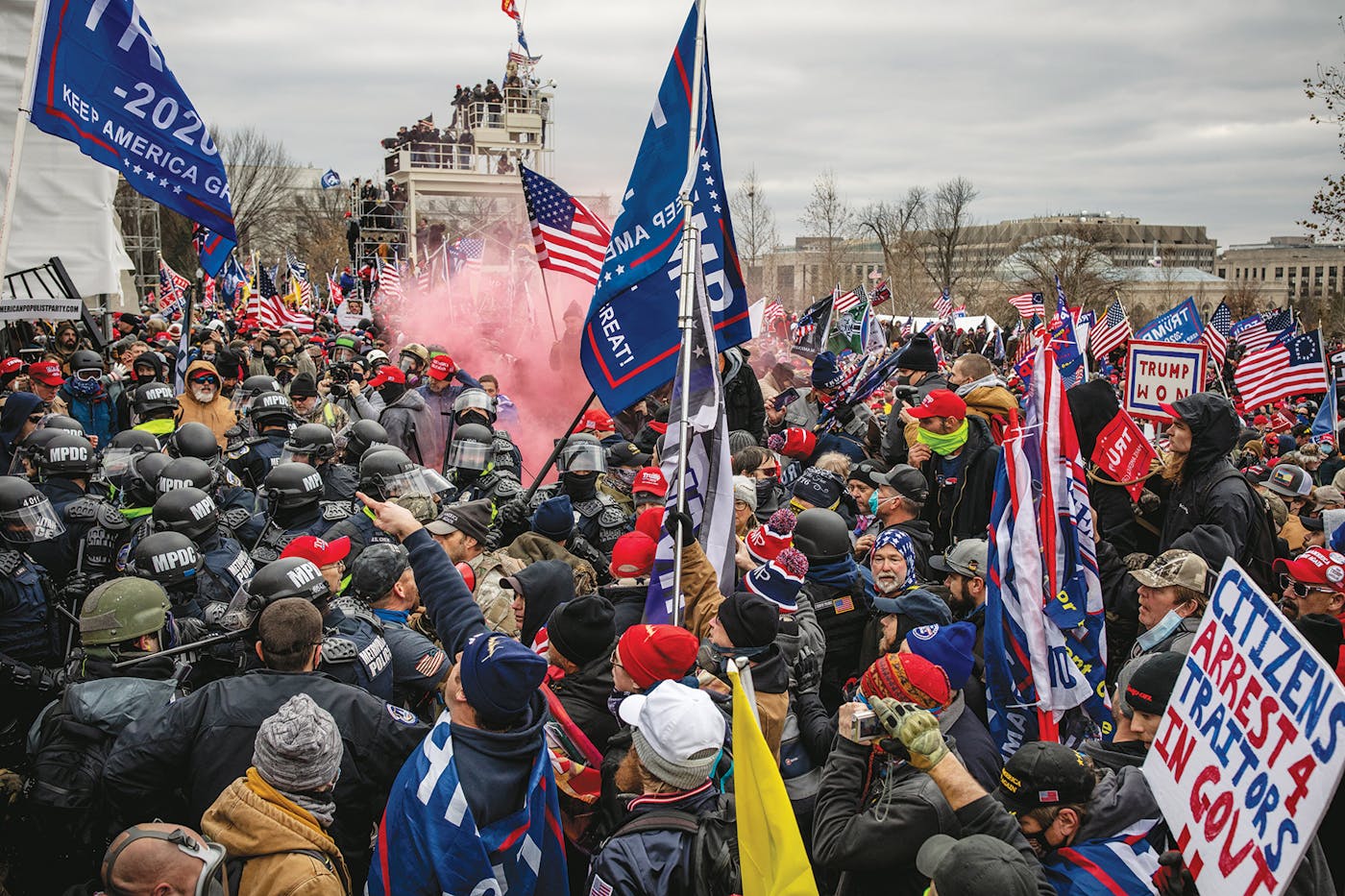
In the early afternoon of January 6, while the mob was still swarming the stairs of the Capitol, I was asked in an interview what I thought of the unfolding situation. I watched the crowd that had been stoked that morning by my uncle, and by Republicans like Ted Cruz, Josh Hawley, and Mo Brooks, with their Confederate flags, their MAGA hats, and their Camp Auschwitz shirts; I watched the smoke (the origin of which I couldn’t yet discern) drift through the air, and I heard their shouts of grievance and anger. It looked like a scene from a failed country whose government had just been toppled, a banana republic; but it was the United States of America, my country, our country, and, knowing who was responsible for the chaos here, the first word that came to my mind was “tawdry.”

Of course, it was so much more than that—so much more dangerous and serious than that, as we would eventually find out. At around 2:15, while Republicans Cruz and Paul Gosar were objecting to the legitimate results of the election, the insurrectionists breached the Capitol, Congress was adjourned, and frantic attempts were made to get the vice president and all of the senators and representatives to safety.

Two hours later, the Georgia Senate race was called for Jon Ossoff. It mattered, certainly; it meant that the Democrats would control the Senate. But there was no room for celebration. After four years of Donald’s incessant attacks and ineptitude, we were already exhausted. Joe Biden’s victory was supposed to have offered us some reprieve, but having given Donald room to promote his Big Lie, elected Republicans had now granted him the opportunity to incite an insurrection. So there would be no respite from the madness, from Donald’s particular blend of mendacity, cruelty, and destructiveness. There would be no celebrating.

Mary Trump

PHOTOGRAPH BY DINA LITOVSKY/REDUX FOR THE NEW REPUBLIC

That horrific day—which we now know General Mark Milley, chairman of the Joint Chiefs of Staff, referred to as a “Reichstag moment”—was bracketed by Donald’s incendiary speech given just before noon and a video released two hours after the Capitol had been breached that added more fuel to the fire. The speech itself was full of grievances—lies about the “landslide election” that had been stolen from him, threats to Mike Pence, whom he led the crowd to believe had the power to overturn the results of the election, fabulations about people voting as Santa Claus and Democrats’ taking down statues of Jefferson and Lincoln, and calls to action demanding that the crowd force Congress to “do the right thing.” In the 62 second video, Donald says the word peace three times, presumably because somebody convinced him he had to distance himself from the role he played in stoking the mob’s violence; but, because he can never help himself in these instances, he kept hammering away at what was supposedly stolen from them. The video sickened me just as the “apology” video he recorded after the Access Hollywood tape was released had sickened me. I feared the same result—that there would be no consequences.

That night, after I was finally able to turn off the news, the only two things I knew with absolute certainty were: one, that for the first time in our nation’s history there had not been a peaceful transfer of power, because my uncle, who could not accept his resounding defeat and the humiliation that came with it, had attempted to inspire a coup; and two, the next two weeks before Joe Biden’s inauguration would be the most dangerous this country had ever lived through.

On November 7, after Joe Biden was declared the winner, Donald began peddling the Big Lie—massive voter fraud and cheating by Democrats had turned Donald’s landslide victory into a loss. The phrase “the Big Lie,” coined by Adolf Hitler, describes the technique of saying something so outrageously false that people will believe it simply because they think nobody would have the audacity to lie so brazenly. This has been a specialty of Donald’s since, as a teenager, he had to convince his father everything he did was always the biggest, the greatest, and the best. Back then, his lies protected him from his father’s wrath. The Big Lie about the election protected him from having to face the deep narcissistic wound he’d suffered after losing to Biden. In addition, it kept his base riled up—keeping them afraid of what a Biden administration planned to take away from them (or force upon them) and enraged by what he claimed had been stolen from them.

In Donald’s January 6 video, the Second Big Lie was born. By telling them that they are loved and special, he transformed the violent anti-American mob into patriots who had merely been trying to save their country from the Democratic Party’s treasonous attempt to steal the election from him—and therefore from them. We’ve seen how this has become a strategy for almost every single Republican politician as well. Despite the testimony given by D.C. police officers Daniel Hodges and Michael Fanone, Capitol Police Officer Harry Dunn, and Capitol Police Sgt. Aquilino Gonell in front of the House select committee on July 27, which was impossible for any empathetic human being to watch without feeling a visceral rage and profound sadness, this will continue to be the Republican strategy. They know that if midterm voters still remember the truth about January 6, they’re in trouble. The insurrection of January 6 should have been a wake-up call. It looks, instead, to have been a dress rehearsal.

In the mind-bogglingly long and destabilizing year since the publication of my first book, Too Much and Never Enough, America’s weaknesses and structural deficiencies have been laid bare because one man, Donald John Trump, did something none of his predecessors would have dreamed of doing—through his destruction of norms, he actively set out to undermine and dismantle the very institutions that were designed, in part, to protect us from leaders like him. Keeping him in check required a functioning legislative branch and Cabinet secretaries, like the attorney general or the head of health and human services—who were willing to act with some independence—to put country over party. But having shown himself incapable of building anything, Donald has always been expert at tearing things down. In this endeavor, he has had plenty of sycophants, enablers, and users, just as he has throughout his life. And Republicans saw a way to make the most of it.

As a politician, Donald has benefited greatly from his rabid base of supporters. He embodies their fear and gives expression to their grievance. He doesn’t just give them permission to indulge in their white supremacy; he champions it. He makes them feel good about their prejudices. Following him by denying the virus or claiming immunity from it is another way for them to feel superior. It’s bizarre, because in the process they are putting themselves and those they love at risk, but it is similar to the function lynching has historically served for white people. Lynchings are not only about showing the power of the aggressor but also about demonstrating the other person’s weakness and total subservience. That makes sense in the context of what white supremacists and white supremacy were trying to accomplish, because, in an incurably racist society, the power so clearly belonged to the one race, and the vulnerabilities so clearly belonged to the other. The response to Covid—the denialism and disdain for science—functions the same way, but in this case, whether they acknowledge the reality and the risk or not, the denialists are victims, too. These are devout (for lack of a better word) Republicans. If the people they’ve voted for, at every level of government, equate mask-wearing with being liberal or claim that worrying about catching a deadly virus somehow makes you weak, you will follow their lead. Donald took it a step further. In order to demonstrate their allegiance and support, it was no longer enough for them to attend a rally. They had to do so in the middle of a deadly pandemic without social distancing or wearing a mask

That’s the part that is confounding. But it demonstrates how deeply it matters to them that they, at least in their own minds, maintain a position of superiority over those they consider less-than—particularly Black Americans and immigrants—and stay connected to a man who, through a mesmerizing dance of his followers’ micro-concessions and his own micro-aggressions against them, keeps them in thrall. That their children are dying or their parents and friends are dying isn’t beside the point—it is the point.

It’s impossible to understand the appeal Donald has for his followers if we try to do so from the perspective of people who value honor, decency, empathy, and kindness in their leaders. It isn’t that they see things in Donald that aren’t there. They identify with what is—the brazenness of his lies, his ability to commit crimes with impunity, his bottomless sense of grievance, his monumental insecurity, his bullying, and, perhaps most intriguing, the fact that he is an inveterate failure who keeps being allowed to succeed. Donald is their proxy and their representative. And their ardor has only seemed to grow since his loss. We need only look at data from North Carolina Senate candidate Ted Budd’s campaign to see how complete this identification is. When Republican primary voters were told that Budd had been endorsed by Donald, there was a 45-point net swing in his favor, skyrocketing him to a 19-point lead over his primary opponent. The idea that any other one-term president (George H.W. Bush or Jimmy Carter) would have had the same kind of influence is laughable. On the other hand, though, neither one of them would have tried.

By the same token, elected Republicans, Donald’s chief enablers, see Donald as a means of perpetuating their own power. But they aren’t just putting up with the worst of him simply because they see him as a means to an end. He is them. They value his mendacity and his name-calling and his autocracy because these work for them as well.

Republicans counter truth with absurdity, rendering the truth inoperable. Now a party of fascists, they call Democrats socialist communist Marxists, which is effective in part because it is so nonsensical and in part because they are never asked to define the terms. They cover up their massive (and successful) efforts at voter suppression with wild claims of widespread voter fraud, which essentially doesn’t exist—31 incidents in over a billion votes cast, a number so vanishingly small as to have no meaning.

The main mechanism by which they can successfully carry out these sleights of hand is fear. Whether it’s drug dealers from Mexico or caravans from Central America or Democratic presidents coming for your guns, abolishing religion, or letting gay people get married, they need to keep their voters afraid.

Mr. Lockwood, the frame-narrator of Wuthering Heights, describes a feverish nightmare in which, during a blizzard, he sees a child outside his window begging to be let in. He is so undone by the appearance of this wraith that he drags its wrist across the broken pane of glass, until its blood soaks his bedsheets. “Terror made me cruel,” he says. Fear is a deeply unpleasant emotion, and Republicans have become expert at stoking it, on the one hand, and transforming it into anger on the other. This state of affairs makes it much easier for their followers to become comfortable with the cruelty of their leaders—whether of policy or of action—as long as it is directed at groups they’ve been told they should fear. It also makes it easier for the Republican rank and file to be comfortable with their own cruelty—it feels better than fear, and it allows them to delude themselves into thinking they have some measure of control, because they have been granted permission by the powers that be to express their cruelty with impunity.

Elected Republicans have become Donald’s greatest enablers since his father, Fred. For all of their professed reluctance and half-hearted attempts to keep Donald at arm’s length, almost every single elected Republican at every level of government, either tacitly or enthusiastically, very quickly came to support his breaches—against decency, the rule of law, and the Constitution. Kevin McCarthy went from being one of Donald’s critics in the immediate aftermath of January 6 to pretending that creating a commission to find out what happened on that day was somehow a partisan witch hunt. Elise Stefanik intuited that going all in with Donald would be her best chance for advancement. The number three Republican in Congress, Liz Cheney, had the audacity to stand up against the Big Lie, for which she was removed from her leadership position and replaced by Stefanik.

The most dangerous Republican enabler by far is, of course, Mitch McConnell, who saw an opportunity that even he probably never dared hope for: The guy in the Oval Office wouldn’t just sign off on every aspect of the Republicans’ agenda, he would push the envelope—of decorum, of autocracy—so far that the system itself could be used to create permanent minority rule. Donald showed his party (and yes, it is his party) the limits of pretending to care about good governance or play by the rules. He also showed them the utility of not just stoking racism and hatred of the Other—in the form of immigrants, Democrats, and even epidemiologists—but championing those who espoused them.

McConnell is the greatest traitor to this country since Robert E. Lee (with the difference that McConnell has been trying to take our country down from within). He has always been expert at using existing rules and procedures in ways they weren’t intended to be used, and yet—whether it was denying Merrick Garland a hearing, pushing through Amy Coney Barrett’s confirmation, or ending the filibuster as it applied to Supreme Court nominees but employing it to block legislation that would expand voting rights—his anti-democratic maneuvers have been performed within the bounds of the system. The fact that he’s misusing the system outlined in the Constitution isn’t an exoneration of him, however; it’s a condemnation of the Constitution’s limitations. The definition of treason in the Constitution is so narrow (levying war against the country or giving aid and comfort to the enemy) that a case could never be made against him. It would be difficult, however, to find anybody in modern times who has so undermined our democracy.

This destruction of norms by Donald and other Republicans in the executive and legislative branches has happened so quickly, and has been so thorough, that it’s clear the seeds of it must have been planted a long time ago. It was possible for Donald, the weakest man I have ever known, to exploit the weaknesses in the system not because he introduced them, but because they were there for him to exploit in the first place.

These situations are not the result of four years or even four decades of poor governance—although the worsening of the problem has certainly accelerated since Ronald Reagan’s disastrous presidency. The combination of “trickle-down” economics, his devastating handling of the AIDS crisis, and the intensification of the “War on Drugs,” with all of its racist implications, accelerated the divide between Americans along economic, cultural, and racial dimensions. But we really need to go back to this country’s inception to understand how we got here and to assess how we can possibly repair the extensive damage. With Joe Biden’s election, we did indeed snatch democracy from the jaws of autocracy—a rarity in human history. But as the insurrection of January 6 made clear, we are not out of the woods yet—far from it.

I contend that we have arrived at this fraught political moment in which it feels that everything is at stake because of our long history of, on the one hand, failing to hold powerful white men accountable and, on the other, the normalization of white supremacy. How else do we grapple with the fact that we Americans appear so spectacularly vulnerable to corrupt and incompetent leaders? How else do we understand the breathtaking extent to which the federal government, because of the cynicism, selfishness, and opportunism of one man, proved incapable of managing the crises of Covid and the ensuing economic fallout? How else do we explain the effectiveness of Donald’s strategy of race-based division? And how do we avoid acknowledging that supporting him or even accepting him meant that institutionalized racism was not only not a deal breaker, it was an effective political strategy?

American terrorists, January 6, 2021

ASHLEY GILBERTSON/VII/REDU​X

The initial response of Donald’s administration to the pandemic was driven by his inability to take it seriously. Once the virus had undeniably taken hold here, Donald hung on to the fact that it had originated in China, which allowed him to make it about the Other from the outset. In spring of 2020, when Covid was spreading almost exclusively in blue states, and later, when it became clear that Black Americans were being disproportionately affected, it was easier for him to dismiss the danger. Even when it became clear that no one was safe, he made the case that Americans had to choose between combating the virus and saving the economy, squandering what could have been an extraordinarily unifying moment for this country. But Donald has no interest in unity. He thrives on division and chaos—much of it racially driven. We saw this in the way he exploited the backlash against Barack Obama’s presidency, thereby giving his base permission to express their racism even more openly and proudly.

The Republicans haven’t lost their way. They have, instead, found it. And it has led them straight toward unabashed white supremacy and fascism. This is nothing new. We saw what happened after the Civil War. The traitors of the Confederacy were given a pass by the North, and the promise to grant freedmen and women their 40 acres was largely reneged in the interest of reestablishing “national unity.” Because of the enormity of the North’s postbellum failures and the terrorist tactics employed by the re-empowered Southern Redeemers—those believers in the Lost Cause, who are the direct ancestors of those who sullied the Capitol Rotunda with their Confederate flags—the Black vote in the South was all but eliminated. The large majority of the electorate of the Southern slave states remained racist and reactionary, allowing the South to continue as a closed, fascist state for another century.

Only the Democrats and the media can save democracy from fascism. But the Democrats are split between the activists who understand the stakes, and the institutionalists who keep following a rule book the Republicans lit on fire a long time ago. On the one side, the progressives and pragmatists, senators like Elizabeth Warren, Chris Murphy, and Amy Klobuchar, seem to understand the urgency of the problem—American democracy can’t survive if we fail to realize that the United States Senate is currently operating under the tyranny of the minority. On the other side, institutionalists like Joe Manchin and Dianne Feinstein cling to the idea that maintaining long-standing mechanisms like the filibuster, which is not in the Constitution and impedes the Senate’s ability to act democratically, is more important than enacting legislation that would, on the one hand, help the American people in substantive ways while bolstering Biden’s presidency and, on the other, prevent the Republican Party from turning this country into an apartheid state. It remains to be seen whether President Biden himself, who understands the workings of the body in which he served for almost 40 years, will be able to transcend his own institutionalist leanings. His July 13 speech on voting rights was a powerful repudiation of Republican voter suppression—but he didn’t mention the filibuster once.


What happens next also depends on how the media portray what’s currently going on. In 2016, the media lent Donald’s run a gravitas and seriousness it hadn’t earned. The Senate’s failure to convict him of impeachment the first time around was a crucial moment, as it allowed Donald to campaign for the 2020 election as if he were a legitimate candidate—but this time with all of the attendant powers of incumbency, including the massive bullhorn. By asking him questions they would ask any other candidate, the media didn’t just confer upon him legitimacy, they erased the fact that he was a traitor to his country who had been impeached for abuse of power and obstruction of Congress after seeking the help of a foreign power (for the second time) in undermining his political opponent. Anybody who was paying attention knew the trial Republicans put on was a sham, a shabby bit of political theater, the outcome of which was a foregone conclusion. “I am trying to give a pretty clear signal I have made up my mind,” said Senator Lindsey Graham before the trial even began. “I’m not trying to pretend to be a fair juror here.”

Since the election was called for Joe Biden, the media have done reasonably well calling the Big Lie what it is, and yet Republicans who lie about the Big Lie continue to be given a platform. There are propaganda outlets, led by Fox News, that amplify the lies of the Republican Party while distorting (or ignoring) facts. Many in the mainstream media, however, act as if journalistic neutrality means giving both sides equal time no matter the content of their message.

The Republicans continue to think that Donald is somebody whom they need. While it’s true that Trumpism, so-called, doesn’t scale, and that only Donald can carry the mantle of Trumpism, the fact that it’s not a winning formula (after all, Republicans, largely thanks to Donald, lost the House, the Senate, and the White House) is completely irrelevant. They continue to embrace Donald because they need him to keep the Big Lie alive in order to maintain the support of the base, so they can advance their voter-suppression legislation while continuing to cast doubt on the last election by pushing for audits in states, like Arizona, where the popular voter margin was narrow.

Every undemocratic facet of our system—from the filibuster to the Electoral College to voter suppression to failing to make the District of Columbia a state—favors Republicans. They have no incentive to change anything. Tens of millions of voters may be effectively disenfranchised by their legislation and faux-audits, but their voters are not. The endgame is to make it impossible for people who would vote against them to vote at all. In a country of changing demographics and increasing openness to diversity, at a time when elected Republicans are on the wrong side of almost every issue—gun safety, taxes, voting rights—they know the only way for them to cling to power is to cheat, and if there is one skill the de facto leader of their party has, it’s his ability to cheat his way out of—or into—just about anything.

Trumpism doesn’t need to scale. Republicans just need to keep that 35 percent so riled up that the base seems bigger than it is while they quietly make sure the rest of us don’t have a voice.

The stakes are incredibly high in every election going forward. The 2020 election was more important than 2016, and 2022 will be more important than 2020. We can’t discount the pernicious influence of white supremacy, which is not just an extremist movement. It’s not just the KKK, the Proud Boys, the Oath Keepers. It is the mainstream of the Republican Party, and we don’t need to qualify it.

Not only can’t Republicans give up their white supremacy, it turns out they don’t have to. It has been and continues to be a winning strategy. Donald got 62 million votes in 2016 and 74 million votes in 2020. Though Biden’s win was decisive, Republicans overall beat expectations, picking up seats in the House and becoming a minority in the Senate that, because of the filibuster, functionally leaves them with an enormous amount of leverage. We desperately needed a total repudiation of Donald and his Republican enablers. We did not get one.

It’s a tragedy, but it comes from having for decades convinced their electorate to vote against its own economic self-interest in the name of racial superiority. Their attitudes in this matter are positional. The question for them isn’t just “Am I doing well?” but “Am I doing better than?” And we all know who it is they need to be outperforming. As long as that is what matters to them, they will double down on white supremacy and hatred of the other side while maintaining their ability to do so through gerrymandering and voter suppression. That’s all they’ve got.

On July 6, President Biden tweeted, “Six months ago today, insurrectionists carried out a violent and deadly assault on our Capitol. It was a test of whether our democracy could survive. Half a year later we can declare unequivocally that democracy did prevail. Now, it falls on all of us to protect and preserve it.”

This well-intentioned statement misses the mark. The danger hasn’t passed—in fact, as Republicans continue their almost universal support for the first Big Lie, while using it to promote hundreds of sweeping voter-suppression laws in almost every state, they are now lining up behind the Second Big Lie, which is that the insurrection of January 6 was an inside job perpetrated by the FBI, or that the violent attempt to disrupt the peaceful transfer of power with the intention of hunting down the speaker of the House and hanging the vice president was a fun-filled protest carried out by wonderful real Americans like Ashli Babbitt, the latest martyr to their cause. Now, those who participated (and their supporters) are being told that it is they who have been wronged, it is they who are the patriots, and only they whose voices deserve to be heard.

Republicans have made it clear that going forward they will embrace whichever version of the Second Big Lie is most useful in the moment—causing the kind of cognitive dissonance they have become quite comfortable with. It’s absurd—but it’s also effective with enough of their voters that we can’t dismiss it, just as we can’t dismiss Donald. It’s exhausting. And it’s infuriating. But we look away at our peril. Democrats need to accept that there is no longer anything to hope for from their Republican colleagues. For all intents and purposes, we currently live in a country with only one functioning political party that is working to make the lives of all Americans better, only one party that believes in democracy.

Democrats must stop squandering their advantage as they waste time waiting for Republicans to feel shame. They have none. Over the four years Donald was in the Oval Office, there were any number of opportunities for Republicans to break with a man who, at every turn, undermined everything they claimed to have stood for—law and order, the military, moral conservatism, fiscal responsibility, and small government. And yet they never did.

January 6 should have been a wake-up call for all of us, Republicans in particular. Initially at least, some of them had been scared enough by a mob intent on committing violence against any member of Congress they came across to recognize that the monster they’d deluded themselves into thinking they controlled could not, after all, be tamed. Instead, they have followed Donald’s lead. Less than six months after the fact, Georgia Representative Andrew Clyde claimed the insurrection was a “bold-faced lie” and nothing more than “a normal tourist visit,” despite the fact that there is a photo of him rushing to help barricade the door against the mob. Donald continues to double down on his claim that these were peaceful people and actually said “there was such love at that rally.” There has been no pushback from Republican leadership. There can’t be. They know that any investigation into what happened that day is a losing proposition for them—either because they’ve been covering it over or because they’re guilty of sedition. They also know that the 2022 election will turn in part on how many Americans they can convince of the Second Big Lie: that the insurrection never happened.

And as far as the 2024 presidential election is concerned, I initially thought Donald wouldn’t run. Even if he managed to convince himself that he had won but the Democrats had somehow stolen the victory from him, his defeat was so resounding, I believed that, although he might pretend to run as a way to raise money and keep the spotlight on himself, he would never put himself in that position again. Now I’m not so sure. As has been the case since my grandfather discovered that his second son could be of use to him, everything has broken his way. In this case, almost the entire Republican Party has backed not one but two Big Lies that benefit him. If enough people buy into the Second Big Lie, if enough of those voter-suppression laws pass and Republicans make significant gains in Congress and state legislatures in 2022, Donald might begin to think that a win in 2024 would be a sure thing for him, and he might make the decision to run after all. And if he were to win … there would be no coming back from that.

Debt in a warm climate: coronavirus and carbon set scene for default

Debt in a warm climate: coronavirus and carbon set scene for default

Villagers attempt to put out a wildfire, in Achallam village


LONDON (Reuters) -Where COVID-19 has precipitated unprecedented debts, climate change could trigger defaults across a planet which a United Nations panel says is dangerously close to runaway warming.

To avert disaster, countries are committing to carbon cutting steps. But these will be costly and likely to add to a global debt pile which asset manager Janus Henderson estimates ballooned to $62.5 trillion by the end of last year.

With floods and wildfires devastating the world, estimates vary on how much damage warming will inflict on its economy.

But a report earlier this year by BofA put it at $54-69 trillion by 2100, which compares to a valuation of the entire global economy of around $80 trillion.

The financial repercussions could manifest themselves in under a decade, a study by index provider FTSE Russell warns.

The first climate-linked credit rating downgrades are set to hit countries soon, the report’s co-author and FTSE Russell’s senior sustainable investment manager, Julien Moussavi, added.

In a worst-case “hot house world” scenario developing countries including Malaysia, South Africa, Mexico and even wealthier economies such as Italy may default on debt by 2050.

In another, where governments are initially slow to react, states including Australia, Poland, Japan and Israel, will be at risk of default and ratings downgrades too, the study concluded.

While developing countries are inherently more vulnerable to rising sea levels and drought, richer ones will not escape the climate change fallout, such studies show.

“You can talk about climate change and its impact and it won’t be long before someone talks about Barbados, Fiji, or the Maldives,” Moritz Kraemer, chief economist at Countryrisk.io and former head of sovereign ratings at S&P Global.

“What was a surprise to me is the impact on higher-rated, richer countries,” Kraemer added.

Another study by a group of universities including Cambridge concluded that 63 countries – roughly half the number rated by S&P Global, Moody’s and Fitch – could see credit ratings cut by 2030 because of climate change.

China, Chile, Malaysia, and Mexico would be the hardest hit with six notches of downgrades by the end of the century, it said, while the United States, Germany, Canada, Australia, India, and Peru could see around four.

The corresponding increase in borrowing costs would add $137–$205 billion to countries’ combined annual debt service payments by 2100, this study estimated.

Ratings downgrades typically raise borrowing costs, especially if they cause countries to be ejected from bond indexes tracked by funds managing trillions of dollars.

WARNING LIGHT

Developed countries are ramping up spending to temper climate damage, with Germany creating a 30 billion euro recovery fund after recent floods, while Singapore is budgeting the equivalent of $72 billion to protect against rising sea levels in the next century.

For emerging economies, already scarred by COVID-19, the climate crisis will heap on more pressure.

The International Monetary Fund (IMF) warns that a 10 percentage-point rise in climate change vulnerability, as measured by the Notre Dame Global Adaptation Initiative index, is associated with an increase of over 150 basis points in long-term government bond spreads for developing nations.

The average rise across all countries was 30 bps.

The U.N. environment programme estimates that in developing countries, annual adaptation costs will be as much as $300 billion in 2030, rising to $500 billion in 2050.

As a percentage of gross domestic product, sovereign debt is still about 60% in emerging economies, data from the Institute of International Finance (IIF) shows, versus 100% or so in the United States and Britain, and 200% in Japan,.

The rise from pre-pandemic levels of around 52% is a particular concern. European, U.S. and Japanese central banks are essentially underwriting state borrowing, but this is not possible in poor countries, who must ultimately repay debt.

“How do you enable the sort of funding that is required given the high debt levels and the importance of the ratings frameworks?” Sonja Gibbs, director for global capital markets at the IIF said.

(Reporting by Dhara Ranasinghe and Karin Strohecker; Editing by Sujata Rao and Alexander Smith)

The New U.N. Climate Report Shows an Even Hotter Future—Unless We Start Acting

The New U.N. Climate Report Shows an Even Hotter Future—Unless We Start Acting

Photo credit: Trevor Bexon - Getty Images
Photo credit: Trevor Bexon – Getty Images


The new U.N. Intergovernmental Panel on Climate Change (IPCC) report on the current climate crisis has made news this week for offering a bleak picture of the state of global climate change, especially poignant while major fires and heat waves blanket California, Greece, and Siberia. The world could look very different, with more and more extreme weather and heat effects, unless we change global industry very soon.

The report is based on the contributions of over 200 scientists from around the world, and it combines more than 14,000 research works into one master report on the state of the entire world’s climate as both a point in time and as part of our near and further future.

Humans are causing the change

The report explicitly calls out the human effects on things like greenhouse gas emissions that have caused the climate to warm and change compared with a control simulation where there are no human activities. To make this comparison, the report’s authors compared attribution studies from around the world that showed a persistent, notable increase in global temperature and “well-mixed greenhouse gases” that are attributable to human activities like industry.

Aerosols mask some of our impact

Aerosols are clouds of particulate that can act as tiny sunblocks basically, helping to keep heat out by bouncing it away back into space. Aerosol cooling, the IPCC says, has helped to “mask” or mitigate the human impact on climate change. Aerosols are generated by industry in the form of black carbon soot, for example, and in nature as volcanic ash. Some scientists want to try solar geoengineering, a process in which we intentionally use aerosols as a way to mitigate climate change, but so far, scientists have hesitated to commit to studies in this space.

Extreme weather has increased and will continue

Heat waves have increased in severity and frequency, while cold extreme events have decreased as the planet is warmed. Even heavy rain events have increased in frequency and severity, along with an increase in tropical cyclones. The report says compound extreme events around the world, like heat and drought, have increased since the 1950s, likely caused by anthropogenic, or humanmade, climate change.

The report says it’s “very likely” that precipitation events like monsoon rains will continue to increase, with a rate of 7% more daily precipitation events for each degree of climate change—a proportional increase as the Earth grows warmer. In some scenarios where the climate changes just 1.0 or 1.8° Celsius, that may seem like not such a big deal. But without changes to global emissions, our temperature could increase 5° Celsius or more.

Hot temperature extremes like heatwaves that previously happened once in ten years will be up to 9.4 times more likely to occur depending on just how much the global average temperature increases, up to 5° Celsius. Hot temperature extremes that happened once in fifty years will be up to 39.2 times more likely to occur based on the degree of warming. Heavy precipitation will be up to 2.7 times more likely to occur, and droughts will be up to 4.1 times more likely to occur.

It’s going to get hotter, but by how much?

The report posits five possible futures to explore the impact of climate change. These range from the most conservative estimate, where the surface warms just 1.8° Celsius by 2050, to where the surface warms 5.7° Celsius, both compared to the control time period 1850-1900.

“The last time global surface temperature was sustained at or above 2.5°C higher than 1850–1900 was over 3 million years ago,” the report explains.

The report also explains that land mass as well as Arctic ice are likely to bear the brunt of surface cooling compared with the oceans, which makes sense considering how much more energy it takes to heat deep water compared with air or the surface of a solid material. (Think about frying an egg versus boiling a pot of water for pasta.)

The Arctic may melt

Permafrost is the term for soil and ice that are permanently frozen, often above the Arctic Circle or at high elevations of lower latitudes. The report says that permafrost and sea ice will both melt severely under all five of the report’s theoretical futures, from conservative to most extreme: “The Arctic is likely to be practically sea ice free in September at least once before 2050 under the five illustrative scenarios considered in this report, with more frequent occurrences for higher warming levels.” Permafrost thaw alters the arctic climate as well as releasing trapped greenhouse gases that were previously held in frozen “carbon sink” conditions.

We’ll exceed nature’s carbon sinks

The oceans and land masses both absorb some amount of carbon, which has started to lead to the acidification of the oceans, for example. Acidification reduces sealife’s access to building blocks like calcium carbonate, killing off shelled organisms. In the IPCC’s five future scenarios, all exceed nature’s ability to absorb carbon emissions, but this number grows larger as the emissions far overtake how much our oceans and land can absorb.

Many changes will take millennia to reach equilibrium

The report states that many of the changes we have induced with human global emissions will last for millennia even without any further heating or increased carbon emissions. Sea levels will continue to rise, they say, because of the warming deep ocean and other changes that are already set into motion. Glaciers will continue to melt for “decades or centuries.”

There’s still hope, and a mandate for change

In the report’s most conservative future, the climate still changes up to almost 2° Celsius by 2050—this isn’t a fantasy future where nothing bad happens. But even so, we have the opportunity, the necessity, to rapidly reduce emissions around the world and curb many of the effects of climate change during the 21st century.

“From a physical science perspective, limiting human-induced global warming to a specific level requires limiting cumulative CO2 emissions, reaching at least net zero CO2 emissions, along with strong reductions in other greenhouse gas emissions,” the report explains. “Strong, rapid and sustained reductions in CH4 emissions would also limit the warming effect resulting from declining aerosol pollution and would improve air quality.”

If we make serious changes today, like reduction of global carbon emissions from heavy industry, that means we could begin to see reversals in some of the telltale effects of climate change beginning in as little as 20 years, which is the blink of an eye in Earth’s lifetime but a key window of time for humankind.

Take a look at some of the lakes in California that have been swallowed up by the ‘megadrought,’ hitting record low levels

Take a look at some of the lakes in California that have been swallowed up by the ‘megadrought,’ hitting record low levels

California drought
Associated Press
  • California has been hit by a “megadrought” that has dried up key reservoirs in the state.
  • Entire lakes have shrunk exponentially, leaving yachts and docks beached on dry land.
  • Nearly 95% of the state is experiencing “severe drought” and is susceptible to wild fires.

California is experiencing its worst drought in over four years and climate change experts warn it could just be the tip of the (melting) iceberg.

On Monday, the Intergovernmental Panel on Climate Change (IPCC) released a report that found global temperatures will continue to increase by at least 1.5 degrees Celsius between now and 2040. For every half-degree of warming, the frequency and intensity of heat waves and droughts also increases.

California has already seen a significant impact from climate change, which has pushed temperatures an average of about 2 degrees hotter to date – drying out soil and melting Sierra snow rivers, which causes less water to soak into the ground, as well as flow through rivers and reservoirs.

A man walks through the dried-up bed of a reservoir in Sanyuan county, Shaanxi province July 30, 2014. REUTERS/Stringer
A man walks through the dried-up bed of a reservoir in Sanyuan Thomson Reuters


Over 37 million people have already been impacted by the “megadrought” and nearly 95% of the state has been classified as experiencing “severe drought,” which has put the land in significant danger of wildfires, according to the National Integrated Drought Information System (NIDIS).

Last year, California land was consumed by over 8,200 wildfires – a number double the state’s previous record. This year, scorching weather has made the state even more susceptible to breakout wildfires than in 2020. Last week, a California town was consumed in only 30 minutes by the Dixie wildfire, which has become the state’s largest wildfire in recorded history.

dixie fire greenville
Homes and cars destroyed by the Dixie Fire line central Greenville in Plumas County, California. Noah Berger/AP Photo


In June, Jay Lund, co-director of the Center for Watershed Sciences at UC-Davis told the Associated Press the water levels of California’s over 1,500 reservoirs were 50% lower than they should be at that time of year.

In April, scorching weather turned the San Gabriel Reservoir lake bed to dust. The reservoir is not expected to see rain fall until the end of the year.

The drought turned the San Gabriel reservoir lake bed to dust
The drought turned the San Gabriel reservoir lake bed to dust Getty

In June, the drought dried up a lake so much that it potentially exposed a decades old mystery, allowing officials to find a plane that had crashed in 1965.

A composite image showing Folsom Lake, California, at drought levels in 2017, and a sonar image of a plane underwater there.
Folsom Lake, California, under drought conditions in 2017 (L), and the sonar image of a plane there taken by Seafloor Systems (R) Robert Galbraith/Reuters/CBS13


On Monday, California shut down a major hydroelectric power plant at Lake Oroville for the first time since the plant went into operation in 1967 when the major reservoir hit 25% capacity – its lowest level on record. The decision puts extra strain on the electrical grid during the hottest part of the summer.

In June, about 130 houseboats had to be hauled out of the lake as its water levels hit 38% capacity. Water elevations at Lake Oroville are forecast to reach as low as 620 feet above sea level by the end of October, according to the California Department of Water Resources.

House boats pulled out of Lake Orovill
Getty

It’s going to be a rough summer for boat owners in the state.

Pictures from the Associated Press show massive lakes have run dry, leaving boats and docks completely beached

Boats at Fulsom Lake
Associated Press

Experts say the drought could devastate local wildlife populations, as well as California’s tourism industry.

California drought
Associated Press

In April, Governor Gavin Newsom held a press conference in the dried up waterbed of Lake Mendocino. Where he stood there should have been about 40 feet of water.

“This is without precedent,” Newsom said. “Oftentimes we overstate the word historic, but this is indeed an historic moment.”

California drought
Associated Press

The California Department of Water Resources reduced farmers and growers to 5% of their expected water allocation in March. Last week, the State Water Resources Control Board voted to further restrict the amount of water that farmers can draw from rivers and reservoirs – cutting it altogether for some farmers.

When the authorities cut off water supplies, farmers find themselves forced to rely on wells, dug deep into the ground at costs of thousands of dollars. Many farmers say they have been forced to leave their fields mostly barren as even their wells have begun to dry up.

CA drought
Justin Sullivan/Getty Images

Put Rob Reiner in Charge of January 6th Investigation: Nails the Single MOST Important Evidence Needed

Political Flare – Politics – News

Put Rob Reiner in Charge of January 6th Investigation: Nails the Single MOST Important Evidence Needed


Put Rob Reiner in Charge of January 6th Investigation: Nails the Single MOST Important Evidence Needed

Highway hypnosis? Trump hypnosis? Similar things, you get so used to the same damn things coming at you for long periods, yellow or white dashes, old traditions were broken, rules never applied, you get so used to it that you damn near crash into the menu at McDonald’s.

Or your country crashes as a democratic republic. You got distracted and missed all the signs.

The fact that this country has yet to even convince half its citizens that January 6th was an extremely sophisticated and organized plot to overthrow the incoming proper government just goes to show that society is screwed. Everyone’s too into their social media, their online life (however risque one wants to be), and their sports teams, no one even really cares. There may be legitimate UFO objects breaking all known laws of physics flying around our country. The NYT cares, the Pentagon cares, citizens don’t. Our government was almost overthrown. The more we learn about what happened behind the scenes, the more we realize that we were almost “lucky” to get through that day with Biden still scheduled to be president. “Lucky,” on a day that’s supposed to be ceremonial.

But here’s where we get back to highway hypnosis, or Trump White House hypnosis again. We got so used to not seeing or hearing the evidence, we figure now it’s just impossible to get. We’re hypnotized.

But as Jeffery Rosen showed on Friday and Saturday, through his own testimony, Trump was personally (Dick Durbin’s words) building the fraud movement which led to the coup attempt, personal involvement, is the type of evidence we’re not used to getting. Trump’s first “Impeachment Trial” didn’t have a “witness.” Some of us STILL believe C.J. Roberts needed to actually pound the gavel and say, “It says here that I preside over a trial. Trials have witnesses. Would the prosecution please call its first witness.” But we didn’t, we’re used to Trump getting whatever he wanted, Putin-Like.

And here’s another thing we didn’t get much out of either impeachment, something normally assumed, documents. Governments are big on documents because no one would ever know who did what when and with what money without documents. Additionally, people make memorandums to keep memories fresh and to protect themselves. We didn’t get many documents in Trump’s first impeachment, some texts, and Trump’s “perfect phone call.” (He used the word “perfect” so many times one wondered if they doctored it. Probably not). But we did not get a lot of documents about communication back and forth among the staff wanting to send the aid.

Documents are more reliable than eyewitness testimony precisely because they’re nearly always made right as it happened. Studies have proven that eyewitness testimony is actually some of the least reliable evidence, rather than the gold standard. Documents, however….

Rob Reiner wants some documents, the ones that would tell a big part of the story:

Oh, it’s “arguable.” The “argument” would be that shit like that doesn’t come from the Trump White House. They were not constrained by laws, which is how we got here in the first place. Who here wonders whether they’ve already been destroyed? Maybe. But yes, documents are obviously needed, and we’ll go a little further.

We want documents from the 4-6th. Who visited the White House? Who called? Want to know what else we want? We want to look at the call logs to Josh Hawley and Ted Cruz the day or two before both – almost on the same day, maybe a day or two apart – said that they would be objecting to the votes.

Trump needed two things to win: Objections, getting electoral votes back to the states. And he needed Pence out of the Capitol for 12 hours. Pence wouldn’t get in the SUV under the Capitol – didn’t trust them. The call logs would cover that portion. We want Hawley and Cruz.

The Trump-highway hypnosis lifted, a lot, this last weekend. We have direct testimony about what Trump said and did with respect to telling his acting attorney general to sign a letter saying there was fraud in the election. Now, if we could just get over a few more elements, we would be able to tell the whole story, undeniably – for history’s sake, at least.

Get the damned documents.