Mexico to reroute trade railway connection from Texas to New Mexico due to Abbot’s $4 billion stunt.
Gabe Ortiz, Daily Kos Staff – May 03, 2022
“A Texas Department of Public Safety trooper inspects a commercial truck near the Pharr-Reynosa International bridge on April 13, 2022 in Pharr, Texas.”
Mexico has been planning a trade railway that spans thousands of miles from Mazatlán to Winnipeg, with a connection in Texas. But while the T-MEC Corridor railway connecting the two nations is still happening, the stop in Texas is not.
Mexican officials have now decided to instead reroute the line through New Mexico, The Dallas Morning News reports. It’s a major loss for Texas, because border states thrive and depend on international trade. But the state has only one person to blame for this change: Greg Abbott.
Mexican Economy Minister Tatiana Clouthier said Abbott’s political stunt forcing commercial vehicles to undergo redundant inspections caused officials to rethink the Texas connection, all but calling the right-wing governor too volatile to deal with. Abbott shut down his $4 billion stunt just ten days after announcing it, following intense bipartisan opposition ranging from fellow state Republicans to the White House.
“We’re now not going to use Texas,” Clouthier said in the report. “We can’t leave all the eggs in one basket and be hostages to someone who wants to use trade as a political tool.”
But despite Texas’ own data showing that the governor’s redundant inspections turned up precisely zero migrants or drugs, he’s threatened to reinstate the policy. Not because of some new perceived threat—but because he didn’t like critical remarks by Mexico’s president. That threat probably didn’t help Abbott’s case when it came to the rail line—but why should Mexican officials further deal with a hostile actor when there are far friendlier neighbors?
“Jerry Pacheco, president of the Santa Teresa-based Border Industrial Association, called Clouthier’s announcement ‘a very positive step for New Mexico,’ but cautioned that such a project will take years to complete and ‘anything can happen in that time,’” The Dallas Morning News said. Pacheco told the outlet that they hope this fosters a continued relationship even if there’s a snag with the line.
“If this particular project doesn’t work out, there’ll be other projects that the Mexican government will have and they’ll speak favorably of New Mexico because they know we want to work with them in a constructive way,” Pacheco continued. He noted that Abbott’s stunt forcing massive commercial delays led to higher traffic numbers for his state.
Economists in Texas have said Texas’ now-rescinded policy “will cost the equivalent of 77,000 job years for the country and 36,300 for Texas’ economy,” The Dallas Morning Newsrecently reported. Nationally, Abbott caused us roughly $9 billion in lost gross domestic product. But he’s also going to have to grapple with the interpersonal damage he created with his neighbor to the south (that is, if he even cares). The Dallas Morning News in its newer report said that Mexican Foreign Minster Marcelo Ebrard called Abbott’s policy extortion.
“I close the border and you have to sign whatever I say,” he said is what Abbott was forcing on them. “That’s not a deal; a deal is when you and I are in agreement on something.”
‘Everything is halted’: Shanghai shutdowns are worsening shortages
Abha Bhattarai – April 26, 2022
Containers are seen at the Yangshan Deep-Water Port in Shanghai, China
Thousands of air fryers are stuck in factories, warehouses and ports in central China, where shutdowns have stalled millions of dollars worth of inventory for Yedi Houseware, a family-run business in Los Angeles.
How quickly those backlogged appliances make it to the United States could have wide-ranging implications across the U.S. economy, as domestic manufacturers and retailers brace for another round of disruptions from recent covid-related shutdowns in Shanghai, China’s largest city. White House officials are paying close attention to the disruptions to monitor the potential impact on the U.S. economy.
“Things are getting crazy again,” said Bobby Djavaheri, the company’s president. “Everything is halted. There are closures this very minute that are adding to the supply chain nightmare we’ve been experiencing for two years.”
Other executives are dealing with similar scrambles as the situation in China appears to change every day, sweeping up many different sectors.
Widespread covid outbreaks in China have bought entire cities to a standstill and hobbled manufacturing and shipping hubs throughout the country. An estimated 373 million people – or about one-quarter of China’s population – have been in covid-related lockdowns in recent weeks because of what is known as the country’s zero covid policy, according to economists at Nomura Holdings. There are also fears that new lockdowns could soon take hold in the capital city, Beijing, escalating the threat to the global economic recovery.
Anxiety over new disruptions has already caused the Chinese stock market to fall sharply, weighing on U.S. stock indexes as well.
And there are signs things could only get worse. Continuing lockdowns in Shanghai – a major hub for America’s semiconductor and electronics supply chains – has set up automakers, electronics companies and consumer goods firms for months of delays and higher costs.
The challenges come on top of more than two years of global shipping disruptions that some had hoped would ease this year.
Tech giants and major automakers rely heavily on Shanghai-based suppliers and ports. Roughly one-half of Apple’s top suppliers, for example, are based in or near the city, according to an analysis by Nikkei Asia. (Apple did not immediately respond to requests for comment.) Meanwhile, Volkswagen’s chief executive said this month that the automaker is “temporarily unable to meet high customer demand” because of ongoing lockdowns. The company, which had to stop production at certain facilities for more than a month for covid-related reasons, says it is gradually resuming production now.
“If Shanghai continues being unable to resume work and production, from May, all tech and industrial players involving the Shanghai supply chain will completely shut down, especially the auto industry!” Richard Yu, head of consumer and auto business at Chinese tech giant Huawei, was reported to have said on the social media platform WeChat.
The delays and closures are adding to costs and could pose another threat to long-term inflation, which is already at a 40-year high. Yedi Housewares, for example, raised prices on all of its products, including air fryers, electric pressure cookers and bread makers, by 10 percent in January.
Costs have continued to climb since then, in part because of the war in Ukraine. The price of plastic, a major component in air fryers, is up about 5 percent this year, Djavaheri said. The company is also paying more for transportation, since it’s begun moving goods by truck from Shanghai to ports in Ningbo, three hours away, in hopes of putting them on a ship there.
White House officials are closely monitoring the situation in Shanghai, with the State Department providing frequent updates on the potential impacts. New economic data from March shows Chinese exports of good rose by 15 percent relative to last year, but this data does not reflect the impact of the Shanghai lockdown that began at the end of last month, according to a White House official, who spoke on the condition of anonymity to provide internal administration assessments.
The administration is already seeing “significant impacts” to airports critical to air cargo shipments and links in the supply chain such as factories and warehouses, the person said. Despite the closure of the port, White House officials are seeing alternate ports ratcheting up their work, relieving some of the expected pressure for consumers.
Mark Beneke, who co-owns a used car dealership in Fresno, Calif., says it’s become increasing difficult to secure parts for Asian-made vehicles like Hyundai Sonatas and Kia Optimas since the Shanghai lockdown began a month ago.
Used car prices are already up 35 percent from a year ago, according to the Bureau of Labor Statistics, and Beneke says he expects them to climb even higher in coming weeks as a result of new shortages and delays.
“We were expecting prices to start coming down this summer, but it looks like they’re going to keep going up,” he said.
In some cases, though, retailers are better positioned to weather the latest challenges than they were a year ago. Many have stashed away extra inventory in U.S. warehouses and stores to guard against supply chain delays. Roughly 90 percent of goods at grocery and drugstores are in stock, according to data analytics firm Information Resources. And the number of import containers sitting on the docks for more than nine days at the ports of Los Angeles and Long Beach has been cut by one-half since October.
At the same time, consumer demand for many goods – including clothing, toys and furniture – appears to be waning as people spend more on travel, dining out and other experiences that they largely avoided earlier in the pandemic.
“The demand just isn’t there anymore,” said Isaac Larian, chief executive of MGA Entertainment, the toy giant behind popular brands like Little Tikes and L.O.L. Surprise. “Sales are slowing down. Families are saying, ‘I’ll take my kids to Disney this summer instead of buying more toys.”
The shipping time for toys from China to U.S. stores has ballooned from 21 days to 159 days during the pandemic, he said.
“All holiday toys have to ship out of China by the beginning of August, but that is not going to happen,” Larian said. “The factories are having a tough time getting labor, prices are going up, China keeps closing provinces. The big picture is bad, worse than last year.”
Back in Los Angeles, Djavaheri of Yedi Houseware, says he’s just beginning to recover from closures in southern China earlier this year, where his company makes electric pressure cookers. The brand – which has been featured in Oprah’s Favorite Things list for three years in a row – is still struggling to make enough products to meet demand.
“To be honest, I don’t even want to be in China but it’s the only option,” Djavaheri said. “If there was a way to make air fryers or electric pressure cookers in America, I would’ve been there yesterday. Instead we’re dealing with hurdle after hurdle: Inflation, logistics, it’s a constant nightmare.”
The Washington Post’s Jeff Stein contributed to this report.
Climate change: ‘We are not backing down,’ White House climate advisor says
Akiko Fujita,Anchor/Reporter – April 22, 2022
White House National Climate Advisor Gina McCarthy defended the Biden administration’s policies to ease record energy prices, even as the president struggles to balance the immediate threat of inflation with long-term challenges posed by climate change.
Speaking to Yahoo Finance Live, McCarthy said the president’s commitment to halve U.S. greenhouse gas emissions from 2005 levels remains “absolute.”
“We’re not backing down,” McCarthy said. “Nor are we giving up on our targets. They are aggressive. But we are on target domestically to do what we need to do.”
McCarthy’s comments come amid growing unease among environmentalists that the White House is backing off of ambitious climate pledges set one year ago in the face of public frustration over rising energy costs.
President Biden addresses a press conference at the COP26 UN Climate Change Conference in Glasgow on November 2, 2021. (Photo by Brendan Smialowski/AFP)
The president rejoined the Paris Agreement on his first day in office, and vowed to lead global leaders in putting countries on path to carbon neutrality by 2050.
At the White House’s first Leaders Summit on Climate last year, Biden announced the U.S. would nearly double its commitment to reducing emissions, while aiming to eliminate fossil fuels from the country’s electric grids by 2035.
However, higher energy prices brought on by pandemic-related supply shortages and the Russia-Ukraine War have threatened to derail those policies. Gas prices have climbed nearly 20% between February and March, though they have moderated in recent weeks.
Under pressure to act, the president has publicly accused oil companies of holding back production to keep prices high. In March, Biden announced a record release of 1 million barrels of oil a day by tapping into the Strategic Petroleum Reserve. He followed that by issuing an emergency waiver to allow for the year long sale of fuel with higher ethanol content, typically banned during the summer because of higher smog levels.
Last week, the Interior Department announced it would resume selling leases to drill in 145,000 acres of federal land across nine states, reversing his campaign pledge.
White House Climate Adviser Gina McCarthy speaks at a news conference about the American Jobs Plan on April 22, 2021 in Washington, DC. (Photo by Drew Angerer/Getty Images)
“The problem is that we have a Putin war that has actually created an emergency, which the president is making sure he takes control of,” McCarthy said. “We believe we can still get [to the climate targets] but we need Congress to help.”
Biden’s key climate and social spending bill, Build Back Better (BBB), remains stalled in Congress amid opposition from Sen. Joe Manchin (D-WV), a crucial swing vote. McCarthy said lawmakers are looking to break up the $500 billion in climate initiatives tied up in BBB to ensure passage of policies that are critical to keeping the administration’s policies on track.
Manchin has held informal talks with the administration, and told staff that the legislation must be voted on before the August recess, according to the Washington Post.
“We know that Congress is interested in moving,” McCarthy said. “What we want to make sure we do is have enough conversations with Senator Manchin that we can be assured that we can move this forward in reconciliation.”
McCarthy has faced speculation about her own future within the administration as the climate agenda she helped craft sputters. Earlier this week, she released a statement amid reports she was planning to step down next month. McCarthy, who previously led the National Resources Defense Council, said she had no plans to return to the private sector just yet.
“I’m sticking around because there’s still so much more work to do,” she said. “I wouldn’t be staying around if I didn’t think that work was available to us.”
Akiko Fujita is an anchor and reporter for Yahoo Finance.
Michigan state senator hits back at GOP colleague accusing her of ‘grooming’ kids
Christopher Wilson, Senior Writer – April 20, 2022
Michigan state Sen. Mallory McMorrow pushed back in a viral speech against the growing trend of Republicans labeling their Democratic opponents as groomers and pedophiles.
McMorrow responded Tuesday morning to accusations made in a fundraising email by Republican state Sen. Lana Theis that her Democratic colleague wanted to “groom and sexualize kindergarteners.”
“I didn’t expect to wake up yesterday to the news that the senator from the 22nd District had, overnight, accused me by name of grooming and sexualizing children in an email fundraising for herself,” McMorrow said at the beginning of her remarks. “So I sat on it for a while wondering: Why me? And then I realized: Because I am the biggest threat to your hollow, hateful scheme. Because you can’t claim that you are targeting marginalized kids in the name of ‘parental rights’ if another parent is standing up to say no.”
Michigan state Sen. Mallory McMorrow. (Senate TV via Twitter)
“So then what?” continued McMorrow. “Then you dehumanize and marginalize me. You say that I’m one of them. You say she’s a groomer, she supports pedophilia, she wants children to believe that they were responsible for slavery and to feel bad about themselves because they’re white.”
McMorrow’s speech has been viewed over 9 million times in the less than 24 hours since she posted it to her Twitter account. During her comments, she talked about growing up being active in the church, working with her mother at a soup kitchen and the civil rights work of Father Ted Hesburgh, the former president of her alma mater, Notre Dame.
“I learned that service was far more important than performative nonsense like being seen in the same pew every Sunday or writing ‘Christian’ in your Twitter bio and using that as a shield to target and marginalize already marginalized people,” McMorrow said, emphasizing that she is a white, straight, Christian, suburban mom and that those promoting the attacks were using it to deflect from the fact that they weren’t working on the real issues.
“I know that hate will only win if people like me stand by and let it happen,” concluded McMorrow, who was first elected in 2018 and is on the ballot again this November. “So I want to be very clear right now: Call me whatever you want. I hope you brought in a few dollars. I hope it made you sleep good last night. I know who I am. I know what faith and service means and what it calls for in this moment. We will not let hate win.”
Theis’s rhetoric against McMorrow in the fundraising email sent out on Monday read, “These are the people we are up against. Progressive social media trolls like Senator Malloy McMorrow (D-Snowflake) who are outraged they can’t teach can’t groom and sexualize kindergarteners or that 8-year-olds are responsible for slavery.” She added that “enlightened elites” believe parents “must surrender to the wisdom of teacher unions, trans-activists, and the education bureaucracy.”
Theis targeted McMorrow and other Democrats in the Senate after they walked out of a session last Wednesday due to the content of Theis’s invocation, which the legislators took as a precursor to action against LGBTQ educators.
“Dear Lord, across the country we’re seeing in the news that our children are under attack. That there are forces that desire things for them other than what their parents would have them see and hear and know. Dear Lord, I pray for your guidance in this chamber to protect the most vulnerable among us,” said Theis, who is chair of the Senate Education and Career Readiness Committee.
Michigan state Sen. Lana Theis in 2019. (David Eggert/AP)
“The ‘forces’ are, of course, public school teachers, and the ‘things’ are the LGBTQ community,” tweeted Democratic state Sen. Dayna Polehanki. “To pervert the Senate Invocation in this way is beyond the pale.”
“Without sharing or repeating closed-minded harmful words from a sitting Senator under the guise of a ‘prayer,’ to every child in Michigan — you are perfect and welcome and loved for being exactly who you are,” added McMorrow on Twitter.
A number of GOP senators used the confirmation hearings of new Supreme Court Justice Ketanji Brown Jackson to label her as soft on child pornography offenders, despite repeated analyses showing that Jackson’s rulings were within the mainstream of her fellow judges. When three Republican senators said they would vote to confirm Jackson, Rep. Marjorie Taylor Greene, R-Ga., called them “pro-pedophile.” The following day, she referred to Democrats as the “party of pedophiles.”
Greene’s comments and the general trend toward accusations of pedophilia echo the QAnon conspiracy theory, supported by Greene in the past, which alleges that former President Donald Trump was working to take down a powerful cabal of child traffickers typically portrayed as the Democratic elite. Believers in the debunked theory frequently allege that their political opponents support pedophiles. Those pushing the accusations have a large audience, as a recent survey from the Public Religion Research Institute found that 16% of Americans believed that “the government, media, and financial worlds in the U.S. are controlled by a group of Satan-worshipping pedophiles who run a global child sex-trafficking operation.”
Rep. Marjorie Taylor Greene, R-Ga., addresses Trump supporters in Commerce, Ga., on March 26. (Megan Varner/Getty Images)
McMorrow’s direct response is a contrast to what the national Democratic strategy has been to the increase of Republicans claiming they are a party of “pedophiles” and “groomers.” Vice News spoke to a number of prominent House Democrats last week about Greene’s comments.
“I don’t even really pay attention to anything she says because she has nothing rational to say. It seems to me to be a ridiculous allegation,” said Rep. Hakeem Jeffries, D-N.Y., a member of House Democratic leadership. “We’re focused right now on getting things done for everyday Americans: lowering costs, addressing gas prices and inflation. They can continue to peddle lies and conspiracy theories.”
“I see polling that shows that that outrageous characterization is landing with some folks,” Rep. Eric Swalwell, D-Calif., told the outlet. “But you also don’t really want to give oxygen to the land of misfit toys, which is where this is coming [from].”
Op-Ed: As the world questions globalization, China will become the big loser
Minxin Pei – April 14, 2022
China has been the world’s largest exporter, shipping $3.3 trillion in goods last year. (Eric Risberg / Associated Press)
Russia’s unprovoked war against Ukraine has accelerated the division of the world into two blocs, one comprising the world’s democracies, and the other its autocracies. This has exposed the risks inherent in economic interdependence among countries with clashing ideologies and security interests. And although the coming deglobalization process will leave everyone worse off, China stands to lose the most.
Of course, China was headed toward at least a partial decoupling with the United States well before Russia invaded Ukraine. And it has been seeking to ensure that this process happens on its terms, by reducing its dependence on U.S. markets and technology. To that end, in 2020 China unveiled its so-called dual-circulation strategy, which aims to foster domestic demand and technological self-sufficiency.
And yet, last year, China was still the world’s largest exporter, shipping $3.3 trillion in goods to the rest of the world, with the U.S. its leading export market. In fact, overall trade with the U.S. grew by more than 20% in 2021, as total Chinese trade reached a new high. Trade with the European Union also grew, reaching $828 billion, even as disagreements over human rights torpedoed a controversial EU-China investment agreement.
That agreement had been born of the belief that Europe would maintain strategic neutrality in the Sino-American cold war in order to reap the economic benefits of engagement with China. But if human rights concerns were enough to convince the European Parliament not to ratify the deal, Russia’s war against Ukraine — in which China has tacitly supported Russia, and which has pushed the U.S. and the EU closer together — seems likely to drive the EU toward a broader economic decoupling from China.
One cannot blame Western democracies or their autocratic adversaries for prioritizing security over economic welfare. But they must brace for the economic consequences. And a middle-income autocracy like China will bear a far larger cost than rich democracies like the U.S. and its European allies.
For starters, China will suffer from reduced access to major Western markets. In 2021, Chinese merchandise exports to the U.S., the EU, and Japan — accounting for 38% of total exports — amounted to nearly $1.3 trillion. If China’s access to these three markets is halved over the next decade — a likely scenario — the country will need other markets to absorb roughly 20% of its exports, worth some $600 billion (based on 2021 trade data).
Here, China appears to have no good options. China’s dual-circulation strategy indicates that not even its leaders expect other external markets to pick up the slack left by the U.S. and its allies. And China’s apparent belief that domestic demand can offset this loss also seems farfetched.
High debt, rapid population aging, and an imploding real-estate sector will continue to hamper GDP growth, while sharp income inequality, soaring housing costs, and inadequate social protections will constrain consumer demand. The closure of factories producing goods for export, and the associated job losses, will exacerbate these challenges further. A significant share of China’s infrastructure — especially energy and transportation networks — will be underused or even become redundant.
Aside from facing shrinking export markets, China will lose access to the technologies it needs to build a knowledge economy. U.S. sanctions have already crippled telecom giant Huawei and prevented SMIC, a semiconductor manufacturer, from getting its hands on the most advanced technologies. If the U.S. persuades the EU and Japan to revive the Coordinating Committee for Multilateral Export Controls (CoCom) to choke off technology flows to China — a prospect made more likely by the Ukraine war — China will have little chance of winning the technology race with the U.S.
The third key cost of deglobalization for China is harder to measure, but it may well turn out to be the highest: the loss of efficiency gains from dynamic competition. Products made and sold in China are of a far higher quality today than they were two decades ago, largely because Chinese companies must compete with their Western rivals. But if they are insulated from such pressure, they will not face pressure to produce higher-quality products at lower cost. This will hamper innovation and hurt consumers.
All of these costs might be bearable if economic decoupling actually made China more secure. And, at first, it might seem to be doing just that, with China reducing its vulnerability to the kinds of economic and financial weapons that the West has deployed against Russia. But as China’s economic might declines, so will its position on the global stage and the Communist Party’s status at home.
Seven decades ago, Mao Zedong embraced economic self-reliance and foreign-policy militancy, which turned China into an impoverished pariah state. This history should be a stark warning to President Xi Jinping. If he allows Russia, China’s “no limits” strategic partner, to divide the world with its war on Ukraine, it is China that will pay the heaviest price.
Minxin Pei is a professor of government at Claremont McKenna College.
In Conference Call Before Riot, a Plea to ‘Descend on the Capitol’
Alan Feuer – April 13, 2022
One week before an angry mob stormed the Capitol, a communications expert named Jason Sullivan, a onetime aide to Roger Stone, joined a conference call with a group of President Donald Trump’s supporters and made an urgent plea.
After assuring his listeners that the 2020 election had been stolen, Sullivan told them that they had to go to Washington on Jan. 6, 2021 — the day that Congress was to meet to finalize the electoral count — and “descend on the Capitol,” according to a recording of the call obtained by The New York Times.
While Sullivan claimed that he was “not inciting violence or any kind of riots,” he urged those on the call to make their presence felt at the Capitol in a way that would intimidate members of Congress, telling the group that they had to ensure that lawmakers inside the building “understand that people are breathing down their necks.”
He also pledged that Trump was going to take action on his own; the president, he said, was going to impose a form of martial law on Jan. 6 and would not be leaving office.
“Biden will never be in that White House,” Sullivan declared. “That’s my promise to each and every one of you.”
The recording of the call, which took place on Dec. 30, 2020, emerged as the Justice Department has expanded its criminal investigation of the Capitol attack. It offers a glimpse of the planning that went on in the runup to the storming of the Capitol and the mindset of some of those who zeroed in on Jan. 6 as a kind of last stand for keeping Trump in office.
It also reflects the complexities that federal prosecutors are likely to face as they begin the task of figuring out how much — or even whether — people involved in the political rallies that preceded the assault can be held accountable for the violence that erupted.
After more than a year of focusing exclusively on rioters who took part in the storming of the Capitol, prosecutors have widened their gaze in recent weeks and have started to question whether those involved in encouraging protests — like the one that Sullivan was describing — can be held culpable for disrupting the work of Congress.
Sullivan’s remarks during the call appeared to be an effort to motivate a group of people aggrieved by the election to take direct action against members of Congress on Jan. 6, presaging what Trump himself would say in a speech that day. While it remains unclear whether anyone on Sullivan’s call went on to join the mob that breached the Capitol, he seemed to be exhorting his listeners to apply unusual pressure on lawmakers just as they were overseeing the final count of Electoral College votes.
In a statement provided by his lawyer, Sullivan played down the nature of the call, saying he had merely “shared some encouragement” with what he described as “people who all felt their votes had been disenfranchised in the 2020 elections.” Sullivan said he had been asked to participate in the call by a group of anti-vaccine activists — or what he called “health freedom advocate moms” — who were hosting “a small, permitted event” at the Capitol on Jan. 6.
“I only promoted peaceful solutions where Americans could raise their voices and be heard as expressed in our First Amendment,” Sullivan said in the statement. “I in no way condone the violence of any protesters.”
Still, in the recording of the call, Sullivan can be heard telling his listeners that the lawmakers inside the Capitol “need to feel pressure.”
“If we make the people inside that building sweat and they understand that they may not be able to walk in the streets any longer if they do the wrong thing, then maybe they’ll do the right thing,” he said. “We have to put that pressure there.”
As the Justice Department widens its inquiry, federal prosecutors are using a grand jury in Washington to gather information on political organizers, speakers and so-called VIPs connected to a series of pro-Trump rallies after the 2020 election. One prominent planner of those rallies, Ali Alexander, received a subpoena from the grand jury and said last week that he intended to comply with its requests.
In the run-up to Jan. 6, Alexander publicly discussed a pressure campaign against lawmakers that was meant to stop the final electoral count, saying he was working with Reps. Mo Brooks of Alabama and Andy Biggs and Paul Gosar of Arizona, all Republicans.
“We four schemed up of putting maximum pressure on Congress while they were voting,” Alexander said in a since-deleted video on Periscope. The plan, he said, was to “change the hearts and the minds of Republicans who were in that body, hearing our loud roar from outside.”
It is unclear if the Justice Department is aware of Sullivan’s conference call; the department declined to comment. The House committee investigating the events of Jan. 6 was provided with a copy of the recording some months ago by the woman who made it, Staci Burk, a law student and Republican activist from Arizona.
Shortly after the election, Burk became convinced that phony ballots had been flown in bulk into Phoenix Sky Harbor International Airport. She eventually submitted an anonymous affidavit concerning the ballots in an election fraud case filed in U.S. District Court in Phoenix by pro-Trump lawyer Sidney Powell.
After becoming involved with Powell, Burk said she had been approached by several members of a right-wing paramilitary group, the 1st Amendment Praetorian, which was associated with a former legal client of Powell’s, Michael Flynn, Trump’s first national security adviser.
Burk said that members of the group then placed her under unwanted surveillance, insisting on moving into her home in what they described as an effort to protect her from people who might want to retaliate against her for coming forward about voter fraud.
It was a member of the 1st Amendment Praetorian, Burk said, who had joined the conference call that featured Sullivan. Burk said she recorded the call, much like she recorded other activities by the 1st Amendment Praetorian, because she felt threatened and unsafe by the group’s presence in her home.
At one point during the call, Sullivan was asked by an unknown questioner whether Trump intended to impose martial law on Jan. 6. That explosive notion had been raised publicly two weeks earlier by Flynn during an appearance on the right-wing television network Newsmax.
Sullivan answered the question by telling the man that he foresaw Trump putting in place “a limited form of martial law” on Jan. 6.
“I don’t see any other way around it, because he’s not going to allow an election fraud to take place,” Sullivan said. “It’s not going to happen.”
A social media consultant who calls himself “the Wizard of Twitter,” Sullivan worked for a political action committee run by Stone, a longtime confidant of Trump’s, during the 2016 presidential campaign. According to Reuters, one of the projects he did for Stone was a strategy document describing how to use Twitter “swarms” to amplify political messages.
More recently, Sullivan has taken an active role in promoting the QAnon conspiracy theory, which holds that prominent liberals belong to a cult of Satan-worshipping pedophiles. At a public appearance last year with Powell and Flynn, Sullivan called Hillary Rodham Clinton a “god-awful woman” and then made a gesture suggesting she should be hanged.
On the conference call ahead of Jan. 6, Sullivan told his listeners that he was an expert at making things go viral online, but that it was not enough to simply spread the message that the election had been stolen.
“There has to be a multiple-front strategy, and that multiple-front strategy, I do think, is descend on the Capitol, without question,” he said. “Make those people feel it inside.”
Why this week’s French elections matter to the wider world
Thomas Adamson – April 8, 2022
French Far-left presidential candidate for the 2022 election Jean-Luc Melenchon gestures as he speaks during a meeting in Nantes, western France, Sunday, Jan. 16, 2022. Jean-Luc Melenchon used to call Russia a “partner,” even as European governments were scrambling to find ways to avert a Russian invasion of Ukraine. He now supports the Ukrainian’s “resistance” and Russians who are opposing the war and fighting “dictatorship” in their own country. (AP Photo/Jeremias Gonzalez, File)French far-right leader Marine Le Pen delivers a speech during a campaign rally, Feb. 5, 2022 in Reims, eastern France. Marine Le Pen, 53, is considered Macron’s main challenger. Le Pen’s plans include the end of family reunification, restricting social benefits to the French only, deporting foreigners who stay unemployed for over a year and other migrants who entered illegally in the country. (AP Photo/Michel Euler, File)French far-right presidential candidate Eric Zemmour delivers his speech during a campaign rally on the Trocadero square, in front of the Eiffel Tower, Sunday, March 27, 2022 in Paris. Eric Zemmour wants France to get out of NATO military command and make its own security choices. Zemmour’s plans include creating a coast-guard military force, removing social benefits for non-European foreigners, deporting migrants who entered illegally in the country and foreigners who stay unemployed for more than six months. (AP Photo/Michel Euler, File) French conservative candidate for the upcoming presidential election Valerie Pecresse delivers her speech during a campaign rally, Sunday, April 3, 2022 in Paris. Pecresse denounced Putin’s brutality and pushed for firm sanctions on Russia. Valerie Pecresse said she prepared herself for the role of army chief assigned to the President. She wants a ban on wearing the veil for young girls and in sport associations. (AP Photo/Lewis Joly, File)French President Emmanuel Macron and centrist candidate for reelection delivers his speech during a meeting in Paris, Saturday, April 2, 2022. Emmanuel Macron has been at the forefront of international talks on how to support Ukraine and take sanctions against Russia. The situation tended to enhance his stature as world leader and boosted his popularity in polls. Macron vowed to keep investing in the French military and “significantly” reinforcing European armies’ capacities and cooperation. (AP Photo/Francois Mori, File)
PARIS (AP) — With war singeing the European Union’s eastern edge, French voters will be casting ballots in a presidential election whose outcome will have international implications. France is the 27-member bloc’s second economy, the only one with a UN Security Council veto, and its sole nuclear power. And as Russian President Vladimir Putin carries on with the war in Ukraine, French power will help shape Europe’s response.
Twelve candidates are vying for the presidency — including incumbent and favorite President Emmanuel Macron who is seeking a new term amid a challenge from the far-right.
Here’s why the French election, taking place in two rounds starting Sunday, matters:
Russia’s war in Ukraine has afforded Macron the chance to demonstrate his influence on the international stage and burnish his pro-NATO credentials in election debates. Macron is the only front-runner who supports the alliance while other candidates hold differing views on France’s role within it, including abandoning it entirely. Such a development would deal a huge blow to an alliance built to protect its members in the then emerging Cold War 73 years ago.
Despite declaring NATO’s “brain death” in 2019, the war in Ukraine has prompted Macron to try and infuse the alliance with a renewed sense of purpose.
“Macron really wants to create a European pillar of NATO,” says Susi Dennison, Senior Fellow at the European Council on Foreign Relations. “He’s used it for his shuttle diplomacy over the Ukraine conflict.”
On the far-left, candidate Jean-Luc Melenchon wants to quit NATO outright, saying that it produces nothing but squabbles and instability. A NATO-skeptic President Melenchon might be a concern especially for Poland, which has a 1,160-kilometer border with territory now controlled by Russia.
Several other candidates want to see either diminished engagement with the alliance or a full withdrawal. Although unlikely, France’s departure from NATO would create a deep chasm with its allies and alienate the United States.
EUROPEAN COOPERATION
Observers say a Macron re-election would spell real likelihood for increased cooperation and investment in European security and defense — especially with a new pro-EU German government.
Under Macron’s watch, France’s defense spending has risen by €7 billion euros ($7.6 billion) with a target to raise it to 2% of gross domestic product — something that leaders including Putin are watching closely. In his second term, Macron would almost certainly want to build up a joint European response to Ukraine and head off Russian threats.
A FAR RIGHT ALLIANCE?
This election could reshape France’s post-war identity and indicate whether European populism is ascendant or in decline. With populist Viktor Orban winning a fourth consecutive term as Hungary’s prime minister days ago, eyes have now turned to France’s resurgent far right candidates — especially National Rally leader Marine Le Pen who wants to ban Muslim headscarves in streets, and halal and kosher butchers, and drastically reduce immigration from outside Europe.
“If a far-right candidate wins, it could create some sort of alliance or axis in Europe,” said Dennison, of the European Council on Foreign Relations. “Le Pen has been tweeting pictures of herself shaking hands with Orban in recent days. She is championing a Europe of strong nation states.”
That axis might include Poland’s President Andrzej Duda, a right-wing populist and ally of Donald Trump. It has alarmed observers.
“Over 30 percent of French voters right now say they are going to vote for a far right candidate. If you include Melenchon as another extreme, anti-system candidate — that’s almost half the entire voting population. It is unprecedented,” Dennison said.
Far right candidate Eric Zemmour has dominated the French airwaves with his controversial views on Islam in France and immigration.
However, even centrist Macron ruffled feathers in Muslim countries two years ago when he defended the right to publish cartoons of the prophet Muhammad. That came during a homage to a teacher beheaded by a fundamentalist for showing the cartoons to his pupils as part of a class on free speech.
A FRIEND OF AMERICA
The US often touts France as its oldest ally — and from Russian sanctions to climate change and the United Nations, Washington needs a reliable partner in Paris. France is a vital trans-Atlantic friend for America, not least for its status as continental Europe’s only permanent UN Security Council member wielding veto power.
Despite the bitter US-France spat last year over a multibillion deal to supply Australia with submarines — which saw France humiliated — President Joe Biden and Macron are now on solid terms.
“Macron is obviously the only candidate that has history and credentials in the US relationship. All the others would be starting from scratch at a time of great geopolitical uncertainty,” said Dennison..
Unlike Macron, an Elysee in the hands of Zemmour or Le Pen would likely mean less preoccupation with issues that the U.S. considers a priority such as climate change. “They might not prioritize the large economic cost of keeping the Paris Climate Agreement alive and the potential to limit global warming to 1.5%,” Dennison added.
MIGRATION IN THE CONTINENT
In light of a huge migrant influx into Europe last year, France’s position on migration will continue to strongly impact countries on its periphery and beyond. This is especially so because of its geographical location as a leg on the journey of many migrants to the U.K.
A migrant vessel capsized in the English Channel last November killing 27 people, leading to a spat between France and the U.K. over who bore responsibility The British accused France of not patrolling the coast well enough, yet Macron said this was an impossible task. Observers consider France not to be a particularly open to migrants within a European context and see Macron as a relative hardliner on migration.
But Le Pen or Zemmour would likely usher in tougher policies than Macron if they either emerges victorious, such as slashing social allocations to non-French citizens and capping the number of asylum seekers. Some candidates have supported a Trump-style construction of border fences.
The Trump Organization used to borrow from major banks. Now look who’s lending it money.
Gretchen Morgenson – April 7, 2022
Donald Trump used to bank with the big guns. Now he’s borrowing from Axos Financial, an obscure, internet-only institution based in San Diego and Las Vegas.
In mid-February, Axos refinanced a $100 million Trump Tower mortgage due in September, a New York City Finance Department document shows. The new loan was made just days after The Trump Organization’s auditor resigned, saying that 10 years of the company’s financial statements could not be relied upon.
In lending to The Trump Organization, Axos is stepping up when other banks have balked. But this is not unheard-of for Axos. An examination of legal filings, internal documents and land records shows Axos has a history of handling atypical loans.
Axos has teamed up with nonbank lenders on loans to small businesses that carried cripplingly high double- and triple-digit effective annual interest rates, loan documents show. The bank has also specialized in loans to foreign nationals, internal documents and its website state, and has offered a type of loan that allows borrowers who paid cash for a property to turn around and instantly take money out. Such loans may pose money laundering risks, banking analysts say.
The bank has also been sued by two former employees who say they were wrongfully fired after they raised questions about its practices. On March 21, Jennifer Brear Brinker, hired in 2018 to review the bank’s loan portfolios for its Governance, Risk Management and Compliance Department, filed suit against Axos in federal court in California.
Brinker accused the bank of intentionally understaffing its compliance department “in an effort to conceal its failure to comply with federal banking regulations” and contends she was terminated in January 2021 while completing a report highlighting deficiencies at Axos including “significant issues in the bank’s anti-money laundering practices.”
A spokesman for Axos, who asked not to be identified, said the bank disputes Brinker’s allegations “and her perception of the underlying factual circumstances.” Axos intends to defend against the lawsuit vigorously, the spokesman added.
A lawyer representing Brinker declined to comment further on her case but said they both look forward to proving her claims in court.
Later this month, Axos is scheduled to face a former internal auditor in a wrongful termination case in California federal court. That auditor, Charles Matthew Erhart, 35, was fired by Axos after he raised concerns about its practices, his 2015 lawsuit says. Among other practices alleged by Erhart — Axos allegedly failed to advise regulators of substantial and risky loans to dubious borrowers, did not disclose to regulators that it had received grand jury and other subpoenas, improperly denied that it held documents responsive to a Securities and Exchange Commission subpoena and instructed employees not to communicate with regulatory officials.
The bank’s spokesman said it denies every one of Erhart’s allegations. “All were investigated, both internally by Axos’s audit committee and independent counsel, and externally by government regulators and outside auditors,” the statement said. “None of the investigations or audits found any merit in Erhart’s allegations.”
‘Cash-recapture loans’
Axos was founded in 2000 as Bank of Internet USA, or BofI, a digital enterprise with no brick-and-mortar branches; it changed its name to Axos in 2018. Its shares trade on the New York Stock Exchange.
With $15.5 billion in assets at the end of 2021, Axos is a relatively small, federally chartered savings institution. J.P. Morgan Chase, by comparison, holds over $3 trillion in assets. Some $12.6 billion of Axos’ assets are loans, including residential mortgages and loans on commercial real estate and multi-family dwellings, SEC filings show.
Axos is overseen by Gregory Garrabrants, a lawyer, former Goldman Sachs banker and McKinsey & Co. consultant. Before joining Axos in October 2007, Garrabrants was an executive at Indymac, a huge California savings & loan that collapsed in July 2008 under a mountain of toxic mortgages, according to bank regulators. Indymac was one of the nation’s biggest bank failures, costing the FDIC fund more than $10 billion, a government investigator estimated.
Axos has been a fast grower and has turned in a torrid stock performance in recent years. In 2018, Garrabrants earned $27 million, just 10 percent less than the $30 million received by Jamie Dimon, the chief executive of JPMorgan Chase.
In lending to the Trump Organization, Axos is forging ties with a borrower that has proved troublesome for other banks over the years, with multiple bankruptcies more than a decade ago and many lawsuits.
Axos declined to comment about the terms of the loan and the Trump Organization’s spokeswoman did not respond to an email seeking comment from NBC News. But Eric Trump told CNN in a statement that “Trump Tower is one of the most iconic properties in the world and sits on arguably the most prestigious corner in all of New York. We have incredibly low debt, have a tremendous amount of cash and have an extremely profitable company. We had no problem refinancing.”
In September, Forbes valued the commercial office and retail space backing the $100 million Trump Tower mortgage Axos refinanced at $285 million; Gucci is a retail tenant on the ground floor, paying an estimated $24 million a year.
Gucci Flagship Store Extends Lease In Trump Tower (John Smith / VIEWpress via Getty Images)
The $100 million Trump Tower mortgage represents a large loan for a bank the size of Axos. As a savings association, Axos is subject to limits on loans to one borrower based on a measure of its capital. On June 30, 2021, that limit was $203.8 million, the bank’s filings show, and its largest outstanding loan balance was $145 million.
For fiscal year 2021, Axos held $3.2 billion in commercial real estate loans, or 27.5 percent of its total loans. Most were on properties in California, its regulatory filings show. The new Trump Tower financing increases Axos’ lending in New York state by almost 30 percent, based on its December 2021 holdings.
Axos held $4.4 billion in single-family mortgages in 2021 or 38 percent of its loans held for investment.
In her lawsuit, former employee Brinker alleged that in 2020 Axos tried to conceal problems with home loans made to borrowers by A & D Mortgage, a Hollywood, Fla.-based nonbank mortgage lender financed by Axos. The bank failed to tell its board or its investors the loans had become problems, Brinker alleged. A&D Mortgage was funded by an Axos credit line for five years, from April 2016 to April 2021, Uniform Commercial Code filings show.
A&D would sell the mortgages it had underwritten using Axos’s line of credit into a pool of loans packaged and issued by a related entity known as Imperial Fund Capital Partners. But when Covid struck, investors refused to buy the security and the loans remained as collateral backing Axos’s credit line for longer than the 60 days the bank’s policy allowed, according to Brinker’s lawsuit.
A&D Mortgage is headed by Maksim Slyusarchuk, according to Florida corporate records, who described himself in a 2013 lawsuit he filed in Miami-Dade County as “an international businessman with experience in the Russian markets and in international finance.”
Slyusarchuk also owns 50 percent of Imperial Fund Capital, an SEC registered investment adviser with $316 million under management; it pools mortgages into securities and sells them to investors. One of its units, Imperial Fund II LLC, is financed by Sovcombank, a UCC filing shows, Russia’s ninth largest bank. Sovcombank was sanctioned by the U.S. Treasury on Feb. 24.
Neither A&D Mortgage, Imperial Fund nor Slyusarchuk responded to an email message seeking comment.
On its website, Axos says it has extensive experience in mortgage lending to “nonresident aliens” and offers loans of up to $20 million accompanied by 50 percent down payments. A 2014 investor presentation noted that the bank specialized in lending to Chinese nationals, for example, who do not have tax returns that they can present to document their financial standing.
Axos has also made loans to Russian nationals; asked about the risk of such lending given the Ukraine invasion, the Axos spokesman said they represent a fraction of 1 percent of Axos’ loans. “All such loans were done at low loan-to-value ratios and are well secured,” he added.
The 2014 Axos investor presentation also shows the bank offered so-called cash recapture loans, made to individuals paying cash in full for a property who want “to recoup some of their investment.” The bank required no waiting period to cash out, the presentation noted, but said the source of the initial purchase funds “must be sourced/seasoned.” Bank analysts say such loans may raise the risk of money laundering.
The Axos spokesman said the bank conducts “a full, know-your-customer investigation” of each cash-recapture loan applicant. The loans are “subject to strict underwriting and program qualification parameters,” he said, “designed to ensure full compliance with Anti-Money Laundering and Bank Secrecy Act laws and all other legal or regulatory requirements.”
Axos has also teamed up with some aggressive non-bank lenders charging sky-high interest rates to small business borrowers, NBC News has previously reported. The bank conducted some of these arrangements through its unit in Nevada, a state with no interest rate limits, allowing downstream lenders to evade state usury caps on loans they made to borrowers operating in more restrictive jurisdictions. Predatory lending experts call these arrangements “rent-a-bank schemes,” and they were permitted under a Trump-era banking rule. Last year, President Joe Biden signed a resolution rescinding the rule.
Axos disputed that this business involved “rent-a-banks” and said its operation was “a bank sponsorship program, operated so as to be fully compliant with legal and regulatory requirements, through which it entered into agreements with several third-party service providers.” All but one of these programs have been wound down, the spokesman added.
Joint interest agreement
In recent years, Axos has aggressively pursued anonymous bloggers who posted critical analyses of the bank’s activities on investing websites, court documents show. In 2017, Axos joined forces with top executives at MiMedx Group, a formerly high-flying maker of skin grafts, to identify anonymous critics of the companies. Axos and MiMedx entered into a “joint interest agreement” to investigate the critics, court documents and internal emails show.
Two of the top MiMedx executives with whom Axos pursued the joint interest agreement — former chief executive Parker Petit and former COO William Taylor — were convicted of fraud in 2021 and sentenced to jail in a case unrelated to Axos. Much of what had been alleged about MiMedx by the critics it targeted turned out to be accurate, the criminal case showed.
A spokeswoman for MiMedx said the company does not comment on legal matters but noted that its “senior leadership team and board of directors are entirely new since 2019.”
Regarding its arrangement with the convicted former MiMedx executives, the Axos spokesman said that when it struck the agreement with Petit and Taylor, Axos needed to communicate with MiMedx about the activities of investors who had bet against both companies and publicized those bets. He added that “the truth of allegations against MiMedx was unknown and the company and its executives appeared to enjoy a favorable reputation.”
The Erhart case
Later this month, the 2015 wrongful termination case filed by Erhart, the former Axos auditor, is scheduled to go to trial. Erhart‘s lawyer, Carol Gillam, declined to comment on the case.
Erhart began working at Bank of Internet, as Axos was known at the time, in Sept. 2013, documents show. Previously an examiner at the Financial Industry Regulatory Authority, he’d led an examination that identified a broker who allegedly stole $4.2 million from his customers, his lawyer said.
A native of rural Kansas who put himself through the University of Kansas working on an assembly line and a road construction crew, Erhart began identifying problems soon after he was hired at Axos, according to his complaint. He says he expressed concerns about concentration risk at the bank, for example, noting to superiors that just nine of its customers accounted for 40 percent of its total deposits. Erhart alleges that he was advised by his boss’s superior not to put that information in an email.
Some of Erhart’s allegations about Axos’s practices had to do with the Bank Secrecy Act, which aims to curtail and detect money laundering and loans to what banking regulators call “politically exposed persons.” They are people who, because of their public positions or relationships, “may present a risk higher than other customers by having access to funds that may be the proceeds of corruption or other illicit activity.”
Banks are supposed to collect information about customers’ risk profiles to monitor and determine whether a client’s banking activities are suspicious. Erhart contended in his lawsuit the bank made material alterations of “numerous reports” required under the Bank Secrecy Act’s quality control rules and did not disclose substantial loans to criminals and politically exposed persons. In early 2015, Erhart’s complaint says, he uncovered information about borrowers who exposed the bank to reputation risk, including “very high level foreign officials from major oil-producing countries and war zones.” He did not identify specific borrowers in the complaint.
In March 2015, Erhart turned over bank records to Axos’s main regulator, the Treasury Department’s Office of the Comptroller of the Currency, his complaint said. He emailed the information he had compiled to his mother for safekeeping. He was fired in June 2015.
The OCC has not taken regulatory action against the bank. Erhart now works as a partner at a cryptocurrency consulting firm.
“In the years since Erhart first made his allegations,” the bank’s spokesman said, “Axos has suffered no adverse business event, no restatement, no spike in reserves, no loss of a major contract, no material weakness disclosure, no earnings miss. Independent auditors and government regulators — all with full knowledge of all Erhart’s allegations — have consistently issued clean audit opinions, passed examinations, and granted further regulatory approvals for more than seven full years.”
Asked to supply copies of the clean audit opinions and examinations, Axos declined, saying they are confidential.
The company did supply a copy of a 2017 letter from the Securities and Exchange Commission saying it had closed an investigation into Axos and did not intend to recommend an enforcement action against the bank. Still, the SEC said its letter “must in no way be construed as indicating that the party has been exonerated or that no action may ultimately result from the staff’s investigation.”
In a separate civil case in 2017, Garrabrants sued Erhart alleging that he had stolen his confidential information. The bank also sued Erhart’s mother in Kansas, to whom the former auditor had sent information about the bank’s activities for backup. Axos settled the case against Erhart’s mother; it declined to state the terms.
Garrabrants’ case against Erhart went to trial last fall. The jury found that Erhart had violated California law “in connection with theft of Garrabrants’ personal, confidential, and financial information,” the bank’s spokesman said.
Gillam, Erhart’s lawyer, provided a statement on this suit. “The documents Mr. Erhart accessed that related to Mr. Garrabrants were in bank files he found in the course of doing his work as an internal auditor,” she said. “They were only used to support Mr. Erhart’s allegations of wrongdoing that he presented to the bank’s principal regulator, the Office of the Comptroller of the Currency.”
The jury “rejected Garrabrants’ claim of intentional infliction of emotional distress and awarded him $1,500 on an invasion of privacy claim,” Gillam added. On an anti-hacking allegation, the jury awarded $1 to Garrabrants, an amount he had requested.
Erhart is appealing that verdict, Gillam said.
In late February, Axos also entered into a settlement agreement with a Houston Municipal pension fund that had sued the bank in 2015. That matter, which became a class action, alleged securities fraud largely based on Erhart’s allegations.
The terms of the settlement have not yet been made public. When asked why the bank was settling now, its spokesman said: “While Axos continues to believe that it would have prevailed at trial, this settlement allows Axos to avoid the distraction and continued expense of litigation.”
War in Ukraine is testing some American evangelicals’ support for Putin as a leader of conservative values
Melani McAlister – April 6, 2022
Melani McAlister, Professor of American Studies and International Affairs, George Washington University had received funding from Princeton’s Davis Center for Historical Studies.
Vladimir Putin lights a candle as he attends an Orthodox Church service in 2011. AP Photo/Alexander Zemlianichenko
In February 2022, evangelical leader Franklin Graham called on his followers to pray for Vladimir Putin. His tweet acknowledged that it might seem a “strange request” given that Russia was clearly about to invade Ukraine. But Graham asked that believers “pray that God would work in his heart so that war could be avoided at all cost.”
The backlash was fast and direct. Graham had not solicited prayers for Ukraine, some observers commented. And he had rarely called on believers to pray for U.S. President Joe Biden.
A significant subset of the U.S. evangelical community, particularly white conservatives, has been developing a political and emotional alliance with Russia for almost 20 years. Those American believers, including prominent figures such as Graham and Jay Sekulow of the American Center for Law and Justice see Russia, Putin and the Russian Orthodox Church as protectors of the faith, standing against attacks on “traditional” and “family” values. At the center is Russia’s spate of anti-LGBTQ laws, which have become a model for some anti-trans and anti-gay legislation in the U.S.
Now, with Russia bombing churches and destroying cities in Ukraine, the most Protestant of the former Soviet Republics, American evangelical communities are divided. Most oppose Russia’s actions, especially because there is a strong evangelical church in Ukraine that is receiving attention and prayers from a range of evangelical leaders.
Nonetheless, a small group of the most conservative American evangelicals cannot quite break up with their long-term ally. The enthusiasm for Russia is embodied by Graham, who in 2015 famously visited Moscow, where he had a warm meeting with Putin.
On that trip, Putin reportedly explained that his mother had kept her Christian faith even under Communist rule. Graham in turn praised Putin for his support of Orthodox Christianity, contrasting Russia’s “positive changes” with the rise of “atheistic secularism” in the U.S.
But it was not always so. Once upon a time, American evangelicals saw the Soviet Union and other communist countries as the world’s greatest threat to their faith.
They carried out dramatic and illegal activities, smuggling Bibles and other Christian literature across borders. And yet, today, Russia, still a country with low church attendance and little government tolerance for Protestant evangelism, has become a symbol of the conservative values that some American evangelicals proclaim.
Bible smuggling
Starting in the 1950s, but intensifying in the 1970s and 1980s, U.S. and European evangelicals presented themselves as intimately linked to the Christians who were suffering at the hands of communist governments.
One evangelical group that emerged at this time was “Open Doors,” whose main aim was to work for “persecuted Christians” around the world. It was founded by “Brother Andrew” Van der Bijl, a Dutch pastor who smuggled Bibles into the Soviet Union and Eastern Europe.
Brother Andrew and other evangelicals argued that what Christians in communist countries really needed were Bibles – reflecting how important personal Bible reading is in evangelical faith.
Brother Andrew turned the smuggling into anti-communist political theater. As he headed toward the border in a specially outfitted vehicle with a hidden compartment that might hold as many as 3,000 Bibles, he prayed. According to one ad that ran in Christian magazines, he said:
“Lord, in my luggage I have forbidden Scriptures that I want to take to your children across the border. When you were on earth, you made blind eyes see. Now I pray, make seeing eyes blind. Do not let the guards see these things you do not want them to see.”
Van der Bijl’s memoir, “God’s Smuggler,” became a bestseller when it was published in 1967.
Taking Jesus to the communist world
By the early 1970s, there were more than 30 Protestant organizations engaged in some sort of literature smuggling, and there was an intense, sometimes quite nasty, competition between groups.
For example, in 1966, a Romanian pastor named Richard Wurmbrand appeared before the Senate Judiciary Committee’s Internal Security subcommittee, stripped to the waist and turned to display his deeply scarred back.
Rev. Richard Wurmbrand, a refugee Lutheran pastor, stands stripped to the waist to show scars of torture in a prison in Romania, as he testifies to the Senate Internal Security subcommittee in Washington, May 6, 1966. AP Photo/Henry Griffin
A Jewish convert and Lutheran minister, Wurmbrand had been imprisoned twice by the Romanian government for his activities as an “underground” minister before he finally escaped to the West in 1964.
Standing shirtless before U.S. senators and the national news media, Wurmbrand testified, “My body represents Romania, my country, which has been tortured to a point that it can no longer weep. These marks on my body are my credentials.”
The next year, Wurmbrand published his book, “Tortured for Christ,” which became a bestseller in the U.S. He founded his own activist organization, “Jesus to the Communist World,” which went on to engage in a good bit of attention-grabbing behavior.
In May 1979, for example, two 32-year-old men associated with the group flew their small plane over the Cuban coast, dropping 6,000 copies of a pamphlet written by Wurmbrand. After the “Bible bombing,” they lost their way in a storm and were forced to land in Cuba, where they were arrested and served 17 months in jail before being released.
As I describe in my book “The Kingdom of God Has No Borders,” critics hammered these groups for such provocative approaches and hardball fundraising. One leading figure in the Southern Baptist Convention complained that the practice of smuggling Bibles was “creating problems for the whole Christian witness” in communist areas.
Another Christian activist, however, admitted that the activist groups’ mix of faith and politics was hard to beat and had the ability to draw “big bucks.”
After communism: Islam and homosexuality
These days, there is little in the way of swashbuckling adventure to be had in confronting communists. But that does not mean an end to the evangelical focus on persecuted Christians.
Meanwhile, Putin’s policies of cracking down on evangelism do not seem to overly bother some of his conservative evangelical allies. When Putin signed a Russian law in June 2016 that outlawed any sharing of one’s faith in homes, online or anywhere else but recognized church buildings, some evangelicals were outraged, but others looked away.
This is in part because American evangelicals in the 2010s continued to see Putin as being willing to openly support Christians in what they saw as a global war on their faith. But the more immediately salient issue was Putin’s opposition to LGBTQ+ rights and nontraditional views of the family.
In the 21st century, then, the most conservative wing of evangelicals was not promoting its agenda by touting the number of Bibles transported across state lines, but rather on another kind of border crossing: the power of Putin’s reputation as a leader in the resurgent global right.
For the moment, Putin’s status as the global right’s moral vanguard is being severely tested, and the border-crossing advocates of traditional marriage may find themselves on the brink of divorce.
This article includes material from a piece pub. on September 4, 2018.
Before you go…
The Conversation is a nonprofit organization, and we depend on readers like you to help us do our important work of sharing ideas and knowledge from academia with the public. Your support keeps us going strong. Your donation will help us reach more people with more research-based journalism. Thank you.
Supreme Court reinstates Trump-era water rule, for now
Jessica Gresko – April 6, 2022
Visitors walk outside the Supreme Court building on Capitol Hill in Washington, Feb. 21, 2022. The Supreme Court reinstated for now a Trump-era rule that had curtailed the power of states and Native American tribes to block pipelines and other energy projects that can pollute rivers, streams and other waterways. (AP Photo/Patrick Semansky, File)
Frozen water pools in a corn field near a Keystone pipeline pumping station in rural Milford, Neb., Thursday, Jan. 9, 2020. The Supreme Court reinstated for now a Trump-era rule that had curtailed the power of states and Native American tribes to block pipelines and other energy projects that can pollute rivers, streams and other waterways. (AP Photo/Nati Harnik, File)
WASHINGTON (AP) — The Supreme Court on Wednesday reinstated for now a Trump-era rule that curtails the power of states and Native American tribes to block pipelines and other energy projects that can pollute rivers, streams and other waterways.
In a decision that split the court 5-4, the justices agreed to halt a lower court judge’s order throwing out the rule. The high court’s action does not interfere with the Biden administration’s plan to rewrite the rule. Work on a revision has begun, but the administration has said a final rule is not expected until the spring of 2023. The Trump-era rule will remain in effect in the meantime.
The court’s three liberal justices and Chief Justice John Roberts dissented. The court’s other conservative justices, including three nominated by President Donald Trump, voted to reinstate the rule.
Writing for the dissenters, Justice Elena Kagan said the group of states and industry associations that had asked for the lower court’s ruling to be put on hold had not shown the extraordinary circumstances necessary to grant that request.
Kagan said the group had failed to demonstrate their harm if the judge’s decision were left in place. She said the group had not identified a “single project that a State has obstructed” in the months since the judge’s decision and had twice delayed making a request, indicating it was not urgent.
Kagan said the court’s majority had gone “astray” in granting the emergency petition and was misusing the process for dealing with such requests. That process is sometimes called the court’s “shadow docket” because the court provides a decision quickly without the full briefing and argument. The liberal justices have recently been critical of its use.
As is typical, the justices in the majority did not explain their reasoning.
Kagan wrote that her colleagues’ decision “renders the Court’s emergency docket not for emergencies at all.”
Alsup was nominated to the bench by President Bill Clinton.
The section of federal law at issue in the case is Section 401 of the Clean Water Act. For decades, it had been the rule that a federal agency could not issue a license or permit to conduct any activity that could result in any discharge into navigable waters unless the affected state or tribe certified that the discharge was complied with the Clean Water Act and state law, or waived certification.
The Trump administration in 2020 curtailed that review power after complaints from Republicans in Congress and the fossil fuel industry that state officials had used the permitting process to stop new energy projects. The Trump administration said its actions would advance then-President Donald Trump’s goal to fast-track energy projects such as oil and natural gas pipelines.
States, Native American Tribes and environmental groups sued. Several mostly Republican-led states, a national trade association representing the oil and gas industry and others have intervened in the case to defend the Trump-era rule. The states involved in the case are: Arkansas, Louisiana, Mississippi, Missouri, Montana, West Virginia, Wyoming and Texas.








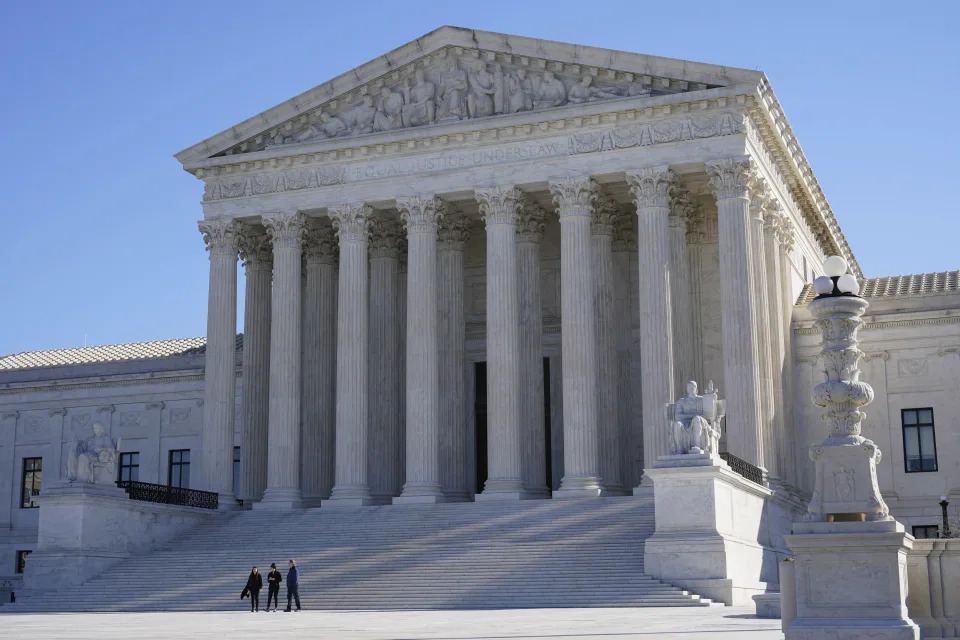 Visitors walk outside the Supreme Court building on Capitol Hill in Washington, Feb. 21, 2022. The Supreme Court reinstated for now a Trump-era rule that had curtailed the power of states and Native American tribes to block pipelines and other energy projects that can pollute rivers, streams and other waterways. (AP Photo/Patrick Semansky, File)
 Frozen water pools in a corn field near a Keystone pipeline pumping station in rural Milford, Neb., Thursday, Jan. 9, 2020. The Supreme Court reinstated for now a Trump-era rule that had curtailed the power of states and Native American tribes to block pipelines and other energy projects that can pollute rivers, streams and other waterways. (AP Photo/Nati Harnik, File)