Evictions spiking as assistance, protections disappear

Associated Press

Evictions spiking as assistance, protections disappear

Michael Casey – August 10, 2022

Jada Riley sits in her car at night with her son Jayden Harris, 6, as she contemplates where she might spend the night, having had to move out of her apartment a few days before, Thursday, July 28, 2022, in New Orleans. “I've slept outside for a whole year before. It's very depressing, I'm not going to lie,” said Riley, who often doesn't have enough money to buy gas or afford food every day. “I don't want to have my son experience any struggles that I went through.” (AP Photo/Gerald Herbert)
Jada Riley sits in her car at night with her son Jayden Harris, 6, as she contemplates where she might spend the night, having had to move out of her apartment a few days before, Thursday, July 28, 2022, in New Orleans. “I’ve slept outside for a whole year before. It’s very depressing, I’m not going to lie,” said Riley, who often doesn’t have enough money to buy gas or afford food every day. “I don’t want to have my son experience any struggles that I went through.” (AP Photo/Gerald Herbert)
Jada Riley poses with her son Jayden Harris, 6, as they play on a basketball court near her former apartment, Thursday, July 28, 2022, in New Orleans. Two months behind on rent, Riley made the difficult decision last month to leave her apartment rather than risk an eviction judgment on her record. Now, she's living in her car with her 6-year-old son, sometimes spending nights at the apartments of friends or her son's father. (AP Photo/Gerald Herbert)
Jada Riley poses with her son Jayden Harris, 6, as they play on a basketball court near her former apartment, Thursday, July 28, 2022, in New Orleans. Two months behind on rent, Riley made the difficult decision last month to leave her apartment rather than risk an eviction judgment on her record. Now, she’s living in her car with her 6-year-old son, sometimes spending nights at the apartments of friends 
Jada Riley blows bubbles on a basketball court to entertain her 6-year-old son Jayden Harris, Thursday, July 28, 2022, near her former apartment in New Orleans. “I've slept outside for a whole year before. It's very depressing, I'm not going to lie,” said Riley, who often doesn't have enough money to buy gas or afford food every day. “I don't want to have my son experience any struggles that I went through.” (AP Photo/Gerald Herbert)
Jada Riley blows bubbles on a basketball court to entertain her 6-year-old son Jayden Harris, Thursday, July 28, 2022, near her former apartment in New Orleans. “I’ve slept outside for a whole year before. It’s very depressing, I’m not going to lie,” said Riley, who often doesn’t have enough money to buy gas or afford food every day. “I don’t want to have my son experience any struggles that I went through.” (AP
Jada Riley goes through her possessions in the trunk of her car near her former apartment, Thursday, July 28, 2022, in New Orleans. Two months behind on rent, Riley made the difficult decision last month to leave her apartment rather than risk an eviction judgment on her record. Now, she's living in her car with her 6-year-old son, sometimes spending nights at the apartments of friends or her son's father. (AP Photo/Gerald Herbert)
Jada Riley goes through her possessions in the trunk of her car near her former apartment, Thursday, July 28, 2022, in New Orleans. Two months behind on rent, Riley made the difficult decision last month to leave her apartment rather than risk an eviction judgment on her record. Now, she’s living in her car with her 6-year-old son, sometimes spending nights at the apartments of friends or her son’s father. (AP
Jayden Harris, 6, sits in the backseat of his mother Jada Riley's car, after having to move out of her apartment days before, Thursday, July 28, 2022, in New Orleans. Eviction filings nationwide have steadily risen in recent months and are approaching or exceeding pre-pandemic levels in many cities and states. That's in stark contrast to the pandemic, when state and federal moratoriums on evictions, combined with $46.5 billion in federal Emergency Rental Assistance, kept millions of families housed. (AP Photo/Gerald Herbert)
Jayden Harris, 6, sits in the backseat of his mother Jada Riley’s car, after having to move out of her apartment days before, Thursday, July 28, 2022, in New Orleans. Eviction filings nationwide have steadily risen in recent months and are approaching or exceeding pre-pandemic levels in many cities and states. That’s in stark contrast to the pandemic, when state and federal moratoriums on evictions, combined
Jada Riley leaves a basketball court as she walks to her car with her 6-year-old son Jayden Harris, Thursday, July 28, 2022, near her former apartment in New Orleans. Eviction filings nationwide have steadily risen in recent months and are approaching or exceeding pre-pandemic levels in many cities and states. That's in stark contrast to the pandemic, when state and federal moratoriums on evictions, combined with $46.5 billion in federal Emergency Rental Assistance, kept millions of families housed. (AP Photo/Gerald Herbert)
Jada Riley leaves a basketball court as she walks to her car with her 6-year-old son Jayden Harris, Thursday, July 28, 2022, near her former apartment in New Orleans. Eviction filings nationwide have steadily risen in recent months and are approaching or exceeding pre-pandemic levels in many cities and states. That’s in stark contrast to the pandemic, when state and federal moratoriums on evictions, combined with $46.5 billion in federal Emergency Rental Assistance, kept millions of families housed. (AP Photo/Gerald Herbert)

Jada Riley thought she had beaten homelessness.

The 26-year-old New Orleans resident was finally making a steady income cleaning houses during the pandemic to afford a $700-a-month, one-bedroom apartment. But she lost nearly all her clients after Hurricane Ida hit last year. Then she was fired from a grocery store job in February after taking time off to help a relative.

Two months behind on rent, she made the difficult decision last month to leave her apartment rather than risk an eviction judgment on her record. Now, she’s living in her car with her 6-year-old son, sometimes spending nights at the apartments of friends or her son’s father.

“I’ve slept outside for a whole year before. It’s very depressing, I’m not going to lie,” said Riley, who often doesn’t have enough money to buy gas or afford food every day.

“I don’t want to have my son experience any struggles that I went through.”

Eviction filings nationwide have steadily risen in recent months and are approaching or exceeding pre-pandemic levels in many cities and states. That’s in stark contrast to the pandemic, when state and federal moratoriums on evictions, combined with $46.5 billion in f ederal Emergency Rental Assistance, kept millions of families housed.

“I really think this is the tip of the iceberg,” Shannon MacKenzie, executive director of Colorado Poverty Law Project, said of June filings in Denver, which were about 24% higher than the same time three years ago. “Our numbers of evictions are increasing every month at an astonishing rate, and I just don’t see that abating any time soon.”

According to The Eviction Lab, several cities are running far above historic averages, with Minneapolis-St. Paul 91% higher in June, Las Vegas up 56%, Hartford, Connecticut, up 32%, and Jacksonville, Florida, up 17%. In Maricopa County, home to Phoenix, eviction filings in July were the highest in 13 years, officials said.

Some legal advocates said the sharp increase in housing prices due to inflation is partly to blame. Rental prices nationwide are up nearly 15% from a year ago and almost 25% from 2019, according to the real estate company Zillow. Rental vacancy rates, meanwhile, have declined to a 35-year low of 5.8%, according to the Census Bureau.

A report last month from the National Low Income Housing Coalition found that a tenant working full time needs to make nearly $26 per hour on average nationally to afford a modest two-bedroom rental and $21.25 for a one-bedroom. The federal minimum wage is $7.25 an hour.

“Landlords are raising the rent and making it very unaffordable for tenants to stay,” said Marie Claire Tran-Leung, the eviction initiative project director for the National Housing Law Project.

“Inflation has really shrunk the supply of housing that is available for people with the lowest incomes,” she added. “Without more protections in place, which not all states have, a lot of those families will be rendered homeless.”

Patrick McCloud, chief executive officer of the Virginia Apartment Management Association, said the trend is a return to normal. “No one likes evictions, but they are in some ways a reset to the economy,” McCloud said, adding that evictions have been “artificially depressed.”

“Housing is based on supply and demand. And when no one moves and you have no vacancies, you have a tight market and prices go up.”

Graham Bowman, a staff attorney with Legal Aid Society of Columbus, Ohio, said evictions there are rising — 15% above historic averages in June alone — at a time when there are fewer places for those forced out to go.

Sheryl Lynne Smith was evicted in May from her two-bedroom townhouse in Columbus after she used her rent money to repair a sewage leak in the basement. Smith, who is legally blind and has a federal housing voucher, fears she won’t be able to find anything by September when the voucher expires because of rising housing prices and the eviction on her record.

“It’s very scary,” said Smith, 53, whose temporary stay at a hotel funded through a state program ends this weekend.

In Boise, Idaho, Jeremy McKenney, 45, moved into his car last week after a judge sided with a property management company that nearly tripled the rent on his two-bedroom house. The Lyft and DoorDash driver will have to rent a hotel room whenever he has custody of his children, 9 and 12.

“It’s definitely mind blowing,” said McKenney, adding that everything on the market is beyond his reach even after a nonprofit offered to cover the security deposit. “I have never been homeless before. I have always had a roof over my head.”

The other challenge is the federal emergency rental assistance that helped keep millions housed during the pandemic has dried up in some jurisdictions or been increasingly rejected by some landlords.

“What really gets me is there is rental assistance and so many landlords just don’t want it. They would rather throw someone on the street than take money,” Eric Kwartler, managing attorney of Lone Star Legal Aid’s Eviction Right to Counsel Project, which covers Houston and Harris County in Texas. “If you take the money, you can’t evict them. They want them out.”

The U.S. Treasury said last week that more than $40 billion of the $46.5 billion in Emergency Rental Assistance had been spent or allocated.

According to the National Low Income Housing Coalition, California, Connecticut, Massachusetts, Minnesota, North Carolina, and Virginia have gone through at least 90% of their first disbursement. Twelve states and the District of Columbia had used 50% of the second allocation, known as ERA2, by the end of May. Three — Idaho, Ohio and Iowa — haven’t spent any ERA2 money and two — Nebraska and Arkansas — didn’t accept the funds.

“The public health emergency may still be here but the funds to deal with it are rapidly disappearing,” said Martin Wegbreit, director of litigation for the Central Virginia Legal Aid Society.

Treasury is encouraging states and cities to tap other federal stimulus funds to cover the gaps. So far, over 600 state and local governments had budgeted $12.9 billion in stimulus funds to meet housing needs, including affordable housing development.

Gene Sperling, who oversees President Joe Biden’s $1.9 trillion coronavirus rescue package, highlighted the success of its rental assistance program, which has reached 7 million mostly low-income households.

But, more needs to be done to ensure the country doesn’t return to pre-pandemic times when 3.6 million tenants were evicted annually and “evictions were too often a first resort, not a last resort,” he told a forum on eviction reforms at the White House last week.

Some lawmakers said the answer is a permanent rental assistance program. A bill introduced in July would provide $3 billion annually for rental assistance and fund services to keep families housed. A study commissioned by the National Apartment Association and the National Multifamily Housing Council says the answer is building 4.3 million apartments by 2035.

Other advocates called for permanent legal protections like right to counsel for tenants or eviction diversion programs to resolve evictions before they reach the courts.

In Richmond, Virginia, eviction filings in June were 54% below historic averages, attributed to rental assistance and more legal representation for tenants in court, Wegbreit said. Similar programs were credited with New Mexico’s eviction filings being 29% below historic averages in June.

Philadelphia, which passed a law making eviction diversion mandatory through this year, saw filings down 33%. The City Council in Philadelphia also approved spending $30 million over two years for rental assistance.

“We are trying to change the way we look at this issue in Philadelphia, where the only thing you do is go to landlord tenant court or start an eviction,” said Catherine Anderson, supervising attorney with Philadelphia Legal Assistance, who oversees the paralegals on the Save Your Home Philly hotline.

Associated Press writers Jesse Bedayn in Denver, Ben Finley in Norfolk, Virginia, and Claudia Lauer in Philadelphia contributed to this report

This story has been corrected to show that McKenney is from Boise, Idaho, not Boise, Utah.

Russia’s Trump Raid Tantrum Is a Spectacle You Don’t Want to Miss

Daily Beast

Russia’s Trump Raid Tantrum Is a Spectacle You Don’t Want to Miss

Julia Davis – August 9, 2022

Photo Illustration by Elizabeth Brockway/The Daily Beast/Getty

The FBI raid on former U.S. President Donald J. Trump’s Mar-a-Lago residence in Florida triggered shockwaves across Russia, with outraged Kremlin propagandists rushing to defend their favorite American president and going so far as to predict that the raid will eventually spark a civil war in the United States.

When Trump lost the last presidential election to Joe Biden, experts and pundits in Moscow worried out loud that his prosecution for a bevy of potential offenses is imminent. They even contemplated offering their beloved “Trumpushka” asylum in Russia. As time went by, Putin’s mouthpieces became convinced that Trump was in the clear, and their fears subsided.

On Monday’s broadcast of The Evening With Vladimir Solovyov, the host and his panelists praised the participants of the Conservative Political Action Conference (CPAC) and expressed their admiration for Trump and his allies. The same day, appearing on state TV program 60 Minutes, military expert Igor Korotchenko openly called for Russia to support Trump’s candidacy in the 2024 elections.

News of the raid landed in Moscow with a thud, as angry propagandists embellished the search with made-up details, claiming that “one hundred FBI agents” and hordes of police dogs rummaged through Mar-a-Lago. On Tuesday’s broadcast of 60 Minutes, Korotchenko angrily condemned the raid: “There is a straight-up witch hunt happening in America. Trump, as the most popular politician in the United States—who has every chance of prevailing in the upcoming presidential election—was chosen as such a witch,” he raged. “They won’t just be vilifying him, they will be strangling him. These raids, involving dozens of FBI officers and police dogs—this is worse than McCarthyism, my friends! This is a symbol of inordinate despotism.”

Russian Media Wants Moscow to Grant Asylum to Trump

In the days preceding the raid, the host of 60 Minutes, Evgeny Popov, who is also a deputy of Russia’s State Duma, repeatedly referred to Trump as Russia’s “friend,” “protégé”, and a favored candidate, but cautiously added that Moscow is yet to decide on who to support in the upcoming U.S. elections. On Tuesday, Popov said: “As soon as Donald Trump complained that Biden was the worst president in the history of the United States, which is fast becoming a third world country, there was a knock on Donald’s door: “Knock-knock, this is the FBI!” More than one hundred agents stormed in and searched Trump’s Florida residence, Mar-a-Lago.” Popov joked that the agents were said to have found a couple of matryoshka, Putin’s portrait, a pioneer scarf, two icons, a parachute, and a chained bear with balalaika.

Without a hint of irony, the state TV host described the search of the former president’s home as a symptom of political persecution of dissidents in the United States. “Dozens of agents ransacked every office, went through every box, and took every document that was of interest to them. It is thought that the FBI was interested in the Top Secret documents supposedly taken by the ex-president from the White House… Biden, with his dictatorial tendencies, repressions, and persecution of dissidents, is turning America into Ukraine. He already did that, since the opposition is being persecuted by authorities,” Popov said. He fantasized that as the result of the raid, Florida would split from the United States and its new constitution would feature Trump’s assertion that there are only two genders: male and female.

Decorated Kremlin propagandist Vladimir Solovyov started Tuesday’s broadcast of his radio program, Full Contact With Vladimir Solovyov, by bringing up the raid of Trump’s Florida digs. He brought on state TV correspondent Valentin Bogdanov, reporting from New York City. “You couldn’t say we didn’t anticipate this turn of events. Machinery, meant to squeeze Trump out of political life, has been activated… They want to deprive him of an opportunity to participate in the upcoming presidential election… All of this is designed to create a nasty aura, to make Trump more toxic.”

Summing up the potential penalties for the suspected removal of top secret government documents, Bogdanov said they weren’t all that bad and were limited to a three-year prison term or a fine. He added: “The scariest consequence is that a person convicted for such a crime can’t be a candidate in the presidential election. Bingo! That’s what his opponents want: to deprive him of the opportunity to take part in this race.”

Assuming that Trump would be knocked out of the upcoming presidential election, Bogdanov speculated that Florida governor Ron DeSantis—whom he described as “Number Two” in the GOP—could easily defeat Joe Biden.

Solovyov asked: “Could this be the beginning of a civil war?” He ominously opined: “This is totally unprecedented, I don’t remember anything like this in American history. If Trump calls on his supporters to come out—and half the states are led by Trump’s allies—there’ll be hell to pay.”

Bogdanov replied: “The civil war is already underway in the United States. For now, this is a cold civil war, but it keeps heating up.”

Here’s what the Inflation Reduction Act will do to combat climate change

Yahoo! News

Here’s what the Inflation Reduction Act will do to combat climate change

Ben Adler, Senior Editor – August 9, 2022

The Inflation Reduction Act (IRA) passed by the Senate over the weekend will pursue an extremely wide and varied array of strategies intended to combat climate change. The $369 billion in climate-related spending over 10 years targets five areas: consumer clean energy costs, decarbonizing various sectors of the economy, domestic clean energy manufacturing, environmental justice, and agriculture and land use. Taken together, these programs would help the U.S. reduce its greenhouse gas emissions by 40% from 2005 levels by 2030, and would save an estimated 3,700 to 3,900 lives per year thanks to cleaner air from a reduction in burning fossil fuels.

Steam rises from the cooling towers of the coal-fired power plant at Duke Energy's Crystal River Energy Complex in Crystal River, Fla.
Steam rises from the cooling towers of the coal-fired power plant at Duke Energy’s Crystal River Energy Complex in Crystal River, Fla. (Dane Rhys/Reuters)

This approach represents a break from many past congressional proposals designed to reduce the greenhouse gas emissions that cause global warming, most of which proposed using a singular, overarching policy, such as taxing emissions or requiring tradable permits for emissions. Those measures all died in Congress, but this one made it through the Senate and is expected to pass the House later this week.

“The whole package in terms of dealing with climate change is a long-overdue improvement,” former Democratic Rep. Henry Waxman told Yahoo News on Tuesday. Waxman was chair of the House Energy and Commerce Committee for many years, and he co-wrote a bill that passed the House but died in the Senate that would have capped carbon emissions and gradually reduced the number of tradable credits for them, a system known as cap-and-trade.

“Unlike other efforts in the past, such as cap-and-trade or a carbon tax, this approach gives a lot of incentives, financial especially, through the tax code and appropriations for industry to accomplish a reduction in emissions,” Waxman said. “This climate proposal has very little, if any, regulation. It’s a lot of incentives to develop, in effect, a partnership with industry and the government … to sharpen up the technology to accomplish our goals.”

Here’s a guide to the biggest programs in each bucket of climate policies, and what they will mean for American families.

Consumer clean energy costs
Solar panels create electricity on the roof of a house in Rockport, Mass.
Solar panels create electricity on the roof of a house in Rockport, Mass. (Brian Snyder/Reuters)

The IRA would pour money into helping homeowners, especially those with low and moderate incomes, and lower their carbon footprint and their energy bills by helping them transition to more efficient heating and cooling systems. There will be a $9 billion program to help low-income households switch to electric appliances (such as stoves) and to retrofit their homes for energy efficiency (by insulating windows, for example).

There will also be tax credits for replacing oil and gas burners with electric heat pumps and water heaters and installing rooftop solar, allowing customers to get 30% off the cost of these purchases.

To reduce dependence on oil, the bill would provide a $4,000 consumer tax credit for lower- and middle-income individuals to buy used electric vehicles, and a $7,500 tax credit to those who make less than $150,000 per year or couples who make less than $300,000 per year who buy new electric vehicles. (Qualifying EVs must cost less than $55,000 for cars and less than $80,000 for trucks.) There is also a $1 billion grant program to help local authorities make affordable housing more energy-efficient.

A family that uses all these rebates and tax credits could receive an additional grand total of $28,500 in incentives, according to the Center for American Progress. Rewiring America, an advocacy group that promotes electrification, estimates that a family that takes advantage of these incentives will save an average of $1,800 per year on home heating fuel and lower energy bills.

However, in order to win the crucial support of Sen. Joe Manchin, D-W.Va., the IRA requires that an EV eligible for the tax credit must have a battery built in North America with minerals mined or recycled there as well. Currently, most EVs on the market would not qualify. The purpose is to develop EV building capacity domestically, instead of relying on China, which is the main producer of lithium-ion batteries. But automakers have expressed doubts that they will be able to meet the bill’s requirements on its timeline.

Decarbonizing the economy
Piles of coal at the PacifiCorp Hunter coal-fired electrical generation plant in Castle Dale, Utah.
Piles of coal at the PacifiCorp Hunter coal-fired electrical generation plant in Castle Dale, Utah. (George Frey/Bloomberg via Getty Images)

About $30 billion will be doled out in grants and loan programs to states and electric utilities to switch utilities from burning gas and coal to using clean energy sources such as wind and solar power. There are also grants and tax credits for clean commercial vehicles — think electric delivery trucks, buses and taxis — and money for efforts to reduce emissions from industrial processes, such as chemical, steel and cement plants.

In order to use the federal government’s buying power to catalyze private sector investment as well, the IRA contains $9 billion for the U.S. to buy clean technologies. For example, it includes $3 billion for the U.S. Postal Service to purchase zero-emission vehicles.

As part of this bill’s emphasis on equity, there is a $27 billion “clean energy technology accelerator” that will distribute funds to deploy clean energy technologies, especially in lower-income communities. An example of a recipient of these funds would be, say, a nonprofit that helps low-income renters, who can’t buy a solar panel for their own home, enjoy the cost savings of buying solar panels by pooling their money and buying solar panels to go in a public space and sharing in the savings

In a major win for environmentalists, there is also going to be a program to reduce the leakage of methane, a highly potent greenhouse gas, from oil and gas wells and pipelines. This is the rare portion of the IRA that includes sticks as well as carrots: grants to help the industry comply and the imposition of fees for operators that continue to leak methane at a high rate.

Domestic clean energy manufacturing
An electric vehicle charging station in New Rochelle, N.Y.
An electric vehicle charging station in New Rochelle, N.Y. (Star Max/IPx via AP)

Whatever the costs and benefits of Manchin’s buy-American requirements for the EV tax credits, every Democrat agrees that developing the ability to produce the key ingredients of a clean energy economy within the United States would be beneficial. So the IRA includes $30 billion worth of tax credits for manufacturing solar panels, wind turbines, batteries capable of storing wind and solar energy, and the processing of key minerals needed for all those technologies (and for electric vehicles).

Separate from those tax credits for making the actual products, there are $10 billion in tax credits for building the infrastructure needed for that production, such as wind turbine and solar panel factories, and $2 billion for renovating auto factories to make EVs. The federal government will also offer up to $20 billion in loans to build new EV manufacturing facilities across the country and will provide $2 billion for additional clean energy research.

Environmental justice

Predominantly Black and Latino neighborhoods and poorer communities suffer an outsize share of the effects of climate change, such as extreme heat, flooding and the pollution from burning fossil fuels on highways and in factories and power plants. The IRA will give out $3 billion in block grants for community-led projects to deal with those kinds of problems, another $3 billion for neighborhood improvements like reconnecting areas separated by highways, $3 billion to reduce pollution at ports and $1 billion for electric heavy-duty vehicles, like garbage trucks.

Agriculture and land use
Drought-conditioned saplings from resilient seeds used to reforest burn scars are grown at John T. Harrington Forestry Research Center in Mora, N.M.
Drought-conditioned saplings from resilient seeds used to reforest burn scars are grown at John T. Harrington Forestry Research Center in Mora, N.M. (Adria Malcolm/Reuters)

Plants absorb carbon dioxide, so how they are managed can affect how much carbon is in the atmosphere. The IRA will spend $20 billion on climate-smart agriculture practices (rotating crops instead of planting the same ones in the same place every year, for example) and $5 billion for forest conservation and urban tree planting.

The bill also incorporates tax credits and grants to support the domestic production of lower-carbon biofuels and $2.6 billion in grants to conserve and restore coastal areas that are needed both to absorb carbon and to manage storm surges that are becoming severe because of climate change, via rising sea levels and more intense storms.

The bill also includes some measures that were needed to win Manchin’s support that will actually make climate change worse, such as requirements that the federal government lease swaths of federal land and coastal areas for oil and gas drilling. As with the electric vehicles, Manchin is focused on producing as much energy domestically as possible. Still, the overwhelming majority of environmentalists are exultant at the IRA’s overall potential to reduce the severity of climate change.

How Ruth Bader Ginsburg Will Have The Last Laugh on Samuel Alito

Politico

How Ruth Bader Ginsburg Will Have The Last Laugh on Samuel Alito

John F. Harris – August 4, 2022

Susan Walsh/AP Photo

Justice Samuel Alito, in drafting Dobbs v. Jackson Women’s Health Organization, said he and the other justices who joined him in ending a constitutional right to abortion had no ability to foresee what the political implications would be. Even if they could know, he added, justices have “no authority to let that knowledge influence our decision.”

Does Alito genuinely write his opinions with no concern at all of what the practical political consequences might be?

In overturning Roe v. Wade, a decision he said was “egregiously wrong,” Alito asserted that the place to decide the morality and legality of abortion is not the Supreme Court but the political process in 50 states.

So what does Alito think now, in the wake of Kansas voters resoundingly rejecting a proposal to remove protections for abortion rights from their state constitution?

These are not gotcha questions. Alito presumably would answer that what happened in Kansas on Tuesday is precisely the kind of democratic process that the Supreme Court “short-circuited,” as he wrote in Dobbs, when it established a national right to abortion by judicial edict even as the issue remained deeply unsettled in the society.

They are questions, however, that highlight how life is full of surprise and paradox, even for a Supreme Court justice who specializes in blustery self-assurance. Alito’s career as an advocate for social conservatism began long before he joined the court. His record is replete with deference to religious tradition and skepticism of loosening sexual mores on all fronts, including gay rights. His references to “abortionists” in the Dobbs opinion hardly conceal his personal disdain. There can be little doubt of how he would have cast his ballot if he were a Kansas voter.

Yet the Kansas result raises an arresting possibility: Alito’s long-term legacy may well be as the justice who facilitated a national consensus on behalf of abortion rights. Quite unintentionally, today’s hero of the “pro-life” movement could end up being a giant of the “pro-choice” movement.

Alito’s achievement was to take abortion out of the arena where it has been for a half-century — a place in which aggrieved advocates on both sides invoked a hypothetical world in which abortion is no longer legal — and move it to an emphatically real-world arena. In this new environment, all kinds of people who under ordinary circumstances would prefer not to have to think and argue about abortion must decide which side they are on.

There is good reason to be wary the old maxim of Fleet Street journalism — first simplify, then exaggerate — in some of the post-Kansas analysis. The impact of abortion politics on the mid-term elections remains murky. In most cases, voters will be choosing among candidates, not deciding a sharply framed referendum. Moreover, while Kansas is undoubtedly conservative, it is also a state with a Democratic governor and is not necessarily predictive of the dynamics in conservative states with abortion bans that took place immediately after the Supreme Court’s June ruling.

But if the Kansas result isn’t necessarily a portent of the politics of 2022 it is suggestive of the politics of 2032. Long-term, under current trends, it is easy to envisage a decisive shift that would leave a national resolution of the issue in favor of abortion rights, even in states that do not currently support that. It is hard to envisage the opposite result.

The difference lies in the gap between abstract politics and concrete politics. This is the same dynamic that makes Social Security highly popular among people who claim they disdain big government. The Kansas result, which mirrors polling showing solid majorities of people supported leaving Roe v. Wade intact, suggests that opponents of legal abortion do better when the prospect of an abortion ban is hypothetical, while abortion-rights supporters do better when the issue is tangibly real.

Values take on meaning not in the abstract but in the particular. What do you really believe when it is your adolescent child who is pregnant or has impregnated someone? Or your extramarital affair that results in a pregnancy? Or your obstetrician who calls to say she has unwelcome news from the results of a genetic test?

Thankfully, most people do not get to learn what they really believe by landing in such a situation. But lots of people — of all political persuasions — do get to learn. The Guttmacher Institute, which conducts research on abortion policy, found that about one in five pregnancies in 2020 ended in abortion. In an earlier study, from 2017, it found that about one in four women will have an abortion by age 45.

Is that number surprising? As long as abortion was a legal right, plenty of these women and their partners were likely animated by plenty of other political issues. The question now is what has changed, and Kansas suggests an answer.

Even many abortion-rights advocates acknowledge there is some truth to what Alito asserted multiple times in his opinion: That the court hindered, rather than helped, a national resolution of the abortion question. Somewhat tauntingly, the Dobbs opinion cited a 1992 speech from one of the most prominent abortion-rights supporters of all, Ruth Bader Ginsburg, that Roe “halted a political process that was moving in a reform direction and thereby, I believed, prolonged divisiveness and deferred stable settlement of the issue.”

It was as if Alito was playing a joke on Ginsberg’s memory by quoting her. It seems entirely likely that she will end up having the last laugh.

Greenland hit with ‘unusually extensive’ melting of ice sheet, boosting sea levels, scientists say

USA Today

Greenland hit with ‘unusually extensive’ melting of ice sheet, boosting sea levels, scientists say

Saleen Martin – July 24, 2022

A July 2022 photo of melting summer sea ice in the Arctic Ocean near Greenland.

It’s getting hotter in Greenland, and last weekend temperatures rose enough to cause 18 billion tons of the country’s ice sheet to melt over three days.

Scientists have warned about the fate of Greenland’s ice sheet and say what happened between July 15 and 17 is the latest massive melting event contributing to an increase in the global sea level.

The amount of water from the melt – about 6 billion tons a day, or 18 billion tons over the weekend – is enough to “cover West Virginia in a foot of water – 4 inches per day, roughly,” Ted Scambos, a senior research scientist at the University of Colorado’s Earth Science and Observation Center and National Snow and Ice Data Center, told USA TODAY.

Video: Sightseers capture huge chunk of Norway glacier crumbling into sea

Sightseers capture huge chunk of Norway glacier crumbling into sea

During a tour in Spitsbergen, Norway, sightseers captured a portion of the Monaco glacier breaking off and crumbling into the sea.

Much of the melting came from northern Greenland because warm air drifted over from the Canadian Arctic Archipelago, Scambos said.

There is also a high-pressure dome over Greenland. Together, they created an “unusually extensive melt event,” he said.

A July 2022 photo of melting summer sea ice in the Arctic Ocean near Greenland.
Temps heating up in Greenland

Temperatures vary over Greenland, but the coldest temperatures are in areas of high elevation, toward the center of the ice sheet, said William Lipscomb, a senior scientist in the National Center for Atmospheric Research’s Climate and Global Dynamics Laboratory.

Once temperatures are above freezing or 32 degrees Fahrenheit, the melting begins. Temperatures last weekend were around 60 degrees, or 10 degrees warmer than normal for this time of year, according to CNN.

“In recent years, we’ve seen a lot of heat waves in Greenland, this recent warming of it being one example,” Lipscomb told USA TODAY. “Any temperature above freezing can cause some surface melting.”

More from Greenland: Greenland’s ice sheet is melting so fast, it’s raising sea levels and creating global flood risk

Fact check: Greenland is still losing ice; no reversal in trend

Greenland loses ‘tremendous amount of ice every year now’

In the 1980s and 1990s in Greenland, a melt event of this sort never occurred, but starting in the 2000s – especially since 2010 – the melting has been more extensive.

The melt is two times larger than normal, said Xavier Fettweis of the University of Liège. Fettweis, a polar researcher, created a model scientists use, along with satellite data, to study Greenland’s changes.

The melt is among two of the largest melts in the ice sheet history after the 2012 and 2019 melting events; in 2019, the runoff was about 527 billion tons. So far, the total melt is far below 2019 levels, but the situation is more dire over the Svalbard ice caps at the North of Norway, Fettweis said.

More melting was expected, said Scambos, of the National Snow and Ice Data Center. “This event is one of many events over the whole summer,” he said. “We can expect on the order of 100 billion tons of water going into the ocean. Greenland as a whole is losing a tremendous amount of ice every year now.”

A July 2022 photo of melting summer sea ice in the Arctic Ocean near Greenland.

NASA Goddard Space Flight Center ice scientist Nathan Kurtz was recently in Greenland to help better calibrate ICESat-2, one of the agency’s satellites used to monitor Greenland.

Its data has shown a loss of ice from Greenland of about 200 billion tons a year over the past two decades, Kurtz told USA TODAY. “This loss of ice contributes directly to global sea level rise, which has significant societal impacts,” he said.

Lipscomb, of the National Center for Atmospheric Research, said scientists measure the amount of water melted in units of gigatons per year, or 1 billion tons of water. Before climate change, about 600 gigatons of snowfall were coming in each year and about 300 gigatons were going out in the form of summer melting.

Now, Greenland’s ice sheet is losing nearly 300 gigatons of water each year more than it gains from snowfall, Lipscomb said. “There’s still time to avoid catastrophic sea level rise, but every year that greenhouse gas emissions continue at the present rate increases the chances of serious problems down the road.”

In some parts of the world such as Asia, seasonal water supply depend on the timing of the glacier melt.

“If the melt is happening too early, you may not be getting the water when you need it for farming,” he said. “And if the glaciers completely melt, then you won’t have the glacier melt water source at all. And that’s something people worry about for later this century as the warming continues.”

Saleen Martin is a reporter on USA TODAY’s NOW team. She is from Norfolk, Virginia – the 757 – and loves all things horror, witches, Christmas, and food.

Justice Kagan gives pointed warning about the ‘legitimacy’ of the court, seemingly calling out justices with ‘political social preferences’

Insider

Justice Kagan gives pointed warning about the ‘legitimacy’ of the court, seemingly calling out justices with ‘political social preferences’

Azmi Haroun – July 21, 2022

Justice Elena Kagan
Justice Elena KaganErin Schaff-Pool/Getty Images
  • SCOTUS Justice Elena Kagan opened up about the public perception of the Supreme Court on Thursday.
  • She said that “partisan” justices harm the legitimacy of the court, according to The Washington Post.
  • Only a quarter of Americans have confidence in the SCOTUS, according to a June 2022 Gallup Poll.

US Supreme Court Justice Elena Kagan ruminated on the legitimacy of the Supreme Court at a conference full of lawyers and judges, warning that a disconnected court and political appointments could be “a dangerous thing for the democratic system.”

Kagan said that SCOTUS justices had their work cut out for them in terms of earning and maintaining “legitimacy” in the eyes of Americans, according to a report from The Washington Post.

“By design, the court does things sometimes that the majority of the country doesn’t like,” Kagan said. “Overall, the way the court retains its legitimacy and fosters public confidence is by acting like a court, is by doing the kind of things that do not seem to people political or partisan, by not behaving as though we are just people with individual political or policy or social preferences.”

In June, Supreme Court justices voted 5-4 to overturn Roe v. Wade, in a majority opinion supported by conservative Justices Samuel Alito, Clarence Thomas, Neil Gorsuch, Brett Kavanaugh, and Amy Coney Barrett.

The core of the challenge to abortion rights that had been codified for 50 years was a Mississippi law that aimed to ban abortion after 15 weeks – which is stricter than the 24-week standard set by Roe v. Wade.

At least 61% of people support abortion access in the US, according to a Pew Research poll.

Within two weeks, the court also expanded gun rights and imposed limits on the Environmental Protection Agency’s ability to implement greenhouse gas regulations.

She added that the court generally being on the opposite side of public opinion could have grave consequences for democracy.

“I’m not talking about any particular decision or any particular series of decisions. But if, over time, the court loses all connection with the public and the public sentiment, that’s a dangerous thing for democracy,” Kagan told the conference.

In the days before the Roe V. Wade decision, a Gallup poll showed that confidence in the Supreme Court had tanked — with only 25% of Americans saying that they had faith in the institution.

“We have a court that does important things, and if that connection is lost, that’s a dangerous thing for the democratic system as a whole,” Kagan reiterated.

Liz Cheney says Trump is ‘preying’ on his supporters by pushing 2020 election lie

Yahoo! News

Liz Cheney says Trump is ‘preying’ on his supporters by pushing 2020 election lie

Jon Ward, Chief National Correspondent – July 21, 2022

The patriotism of many Americans was turned into a “weapon” during the Jan. 6 attack on the U.S. Capitol, by a former president who continues to prey on his supporters, Rep. Liz Cheney said Thursday night.

Cheney, the vice chair of the Jan. 6 House select committee investigating the attack, delivered a forceful and sober final statement at the conclusion of a nearly three-hour hearing on Capitol Hill.

The Republican congresswoman from Wyoming addressed her comments to those who are skeptical of the committee’s work, which includes many voters in her own home state.

“The case against Donald Trump in these hearings is not made by witnesses who were his political enemies. It is, instead, a series of confessions by Donald Trump’s own appointees, his own friends, his own campaign officials, people who worked for him for years, and his own family,” Cheney said.

Rep. Liz Cheney at a House select committee hearing.
Rep. Liz Cheney, R-Wyo., delivers a closing statement during the House select committee hearing on Thursday. (Saul Loeb/AFP via Getty Images)

Cheney made a distinction between Trump and his supporters, noting that many who voted for the former president would eagerly defend the country with their own lives. “Donald Trump knows that millions of Americans who supported him would stand up and defend our nation were it threatened. They would put their lives and their freedom at stake to protect her,” she said.

But, she said, on Jan. 6, 2021, Trump “turned their love of country into a weapon against our Capitol and our Constitution.”

Trump is even now “preying on their patriotism” by continuing to insist he somehow won the 2020 election, despite no evidence to support his baseless claims, Cheney said.

The nine hearings so far, she said, have shown that “Donald Trump’s plan to falsely claim victory in 2020, no matter what the facts actually were, was premeditated.”

A video of former President Donald Trump plays during a Jan. 6 committee hearing.
A video of former President Donald Trump plays during Thursday night’s hearing of the Jan. 6 committee. (Al Drago/Bloomberg via Getty Images)

The hearing Thursday showed evidence that Trump did nothing to stop the violence on Jan. 6, that Vice President Mike Pence called in police and military units to shut down the riot and that Trump rejected calls from his family and aides to call off the mob until he knew the attack would be repelled by law enforcement.

Cheney closed her comments by asking Americans to consider the gravity of allowing Trump back into power again.

“Every American must consider this: Can a president who is willing to make the choices Donald Trump made during the violence of Jan. 6 ever be trusted with any position of authority in our great nation again?” she said.

Cheney is facing the possibility of losing her seat in Congress if she loses the Aug. 16 primary in Wyoming to a Republican challenger who has parroted Trump’s lies about the 2020 election. But her words Thursday demonstrated a resolve on her part to continue waging a battle for the soul of the Republican Party.

Rep. Liz Cheney shakes hands with Sandra Garza, the longtime partner of Capitol Police Officer Brian Sicknick.
Cheney shakes hands with Sandra Garza, the partner of Capitol Police Officer Brian Sicknick, who died from injuries he sustained in the insurrection. (Saul Loeb/AFP via Getty Images)

When Cheney was stripped of her leadership position in the House Republican Conference last year, she vowed then to stop Trump from being reelected. “I will do everything I can to ensure that the former president never again gets anywhere near the Oval Office,” she said.

If Cheney loses her congressional seat, and even if she wins, she’s likely to run for president in 2024 in order to keep making the case that Trump is unfit to lead the GOP, much less the nation, according to conversations with Republicans close to the matter.

Cheney ended the hearing Thursday by making clear that the committee’s work is not done, and that there will be more hearings after Labor Day.

“Ronald Reagan’s great ally Margaret Thatcher said this: ‘Let it never be said that the dedication of those who love freedom is less than the determination of those who would destroy it,’” she said. “Let me assure every one of you this: Our committee understands the gravity of this moment, the consequences for our nation. We have much work yet to do, and will see you all in September.”

It’s the accumulation’: The Jan. 6 hearings are wounding Trump, after all

Politico

‘It’s the accumulation’: The Jan. 6 hearings are wounding Trump, after all

David Siders – July 20, 2022

Shawn Thew/AP Photo

The conventional wisdom about the Jan. 6 committee hearings was that no single revelation was going to change Republican minds about Donald Trump.

What happened instead, a slow drip of negative coverage, may be just as damaging to the former president. Six weeks into the committee’s public hearing schedule, an emerging consensus is forming in Republican Party circles — including in Trump’s orbit — that a significant portion of the rank-and-file may be tiring of the non-stop series of revelations about Trump.

The fatigue is evident in public polling and in focus groups that suggest growing Republican openness to an alternative presidential nominee in 2024. The cumulative effect of the hearings, according to interviews with more than 20 Republican strategists, party officials and pollsters in recent days, has been to at least marginally weaken his support.

“It is definitely kind of this wet drip of, do you really want to debate the 2020 election again? Do you really want to debate what happened on Jan. 6?” said Bob Vander Plaats, the evangelical leader in Iowa who is influential in primary politics in the first-in-the-nation caucus state. “Frankly, I think what I sense a little bit, even among some deep, deep Trump supporters … there’s a certain exhaustion to it.”

Trump’s public approval rating among Republicans remains high as he prepares for a widely expected run for president again in 2024. He still tops most primary polls, and Republicans largely haven’t been persuaded by much of what the Jan. 6 committee is doing. They were more likely last month than last year — before the hearings began — to describe the events of Jan. 6 as a “legitimate protest.”

But for many Republicans, the ongoing, backward-looking call-and-response between the committee and Trump may nevertheless be getting old.

“I think what everybody thought was that the first prime-time hearing was such a non-event that that would continue,” said Randy Evans, a Georgia lawyer who served as Trump’s ambassador to Luxembourg. “But over the course of the hearings, the steadiness, the repetitiveness, has had a corrosive effect. You’d have to be oblivious to the way media works, the way reputations work, the way politics works, to not understand that it’s never the one thing. It’s the accumulation.”

Evans said, “This is all undoubtedly starting to take a toll — how much, I don’t know. But the bigger question is whether it starts to eat through the Teflon. There are some signs that maybe it has. But it’s too early to say right now.”

For more than a year after Trump lost the presidential election, his political durability was not even in question. But the committee hearings appear to have had an effect on Trump’s enormous fundraising operation, which has slowed in recent months. Florida Gov. Ron DeSantis, who may run in 2024, has been gaining on Trump in some polls, including in New Hampshire, the first primary state, where one recent survey had DeSantis statistically tied with Trump among Republican primary voters. Republicans are still poring over a New York Times/Siena College poll last week that showed nearly half of Republican primary voters would rather vote for a Republican other than Trump in 2024.

In a series of focus groups with 2020 Trump supporters from across the country since the riot at the Capitol on Jan. 6, 2001, Sarah Longwell, a moderate Republican strategist who became a vocal supporter of Joe Biden in 2020, for more than a year found about half of participants consistently said they wanted Trump to run again. But that number has fallen off since the hearings began, she said.

“We’ve had now three focus groups where zero people have wanted him to run again, and a couple other groups where it’s been like two people,” Longwell said. “Totally different.”

The Trump supporters in her focus groups are still dismissive of the hearings, Longwell said, “and I don’t think people are sitting down and being persuaded” by them.

However, she said, the hearings have “turned the volume up on the Trump baggage.”

“The other thing,” she said, “is I cannot tell you how much these Republican voters want to move on from the conversation of January 6th.”

‘Political Theater’

That’s a far cry from the Republican view of the hearings when they started: Rep. Jim Banks (R-Ind.) derided what he called a “prime-time dud.” Jim Justice, the Republican governor of West Virginia, dismissed them as “political theater.” And Sen. Josh Hawley of Missouri called them a “complete waste of time.”

One reason that the hearings are resonating now is that even if Republicans don’t agree with the committee’s findings, they read polls. The percentage of Republicans who say Trump misled people about the 2020 election has ticked up since last month, while a majority of Americans say Trump committed a crime. Perhaps most problematic for Trump, 16 percent of Republicans in the Siena College survey said they would vote for someone else in the general election or aren’t sure what they will do in 2024 if Trump is the nominee.

That’s a relatively small segment of the Republican electorate, but a critical one in competitive states that will decide which party controls the White House.

“I think you’re starting to see the impact of the hearings, and just overall his behavior since he lost the election,” said Dick Wadhams, a former Colorado Republican Party chair and longtime party strategist.

“He’s got a hard-core base, and there’s no doubt about that,” said Wadhams. “I voted for him twice, I loved his accomplishments. But I do think he’s compromised himself into a situation where it would be very difficult for him to win another election for president.”

Electability concerns may loom especially large this year for Republicans, who view Biden as a beatable incumbent. His cratering public approval ratings, now hovering below 39 percent, are worse than Trump’s at this point in his presidency. One senior House Republican aide described the resonance of the Jan. 6 committee hearings as in part a product of the contrast they are drawing between “a golden opportunity to win back the White House in 2024 and the only person who might not be able to do it.”

A Trump spokesperson did not respond to a request for comment. Trump has regularly criticized the committee’s work as a partisan exercise. And because most other Republicans view it that way, too, it’s unlikely that many of Trump’s opponents will leverage the committee’s revelations explicitly in the run-up to 2024.

Proxy wars

Still, the Republicans who may run against Trump in 2024 are increasingly breaking with him as the midterm year drags on.

On Friday, former Vice President Mike Pence will campaign in Arizona for gubernatorial candidate Karrin Taylor Robson, while Trump that same day appears in the presidential swing state for Robson’s rival for the GOP nomination, former TV news anchor Kari Lake. Former New Jersey Gov. Chris Christie and former Secretary of State Mike Pompeo, among others, have split with Trump in midterm endorsements in other states. So has outgoing Maryland Gov. Larry Hogan, who engaged in proxy war with Trump in the gubernatorial primary held Tuesday in Hogan’s home state.

As much has anything, those midterm primaries – coinciding with the Jan. 6 committee hearings – have laid bare the willingness of Republicans in at least some cases to disassociate their adoration for Trump with support for him politically. Trump’s endorsement has pulled Republicans across the line in competitive primaries in places like Ohio and Pennsylvania, but his chosen candidates have flopped in other races, including in Georgia and Nebraska.

“The effect of the hearings will be negligible on Trump’s favorable ratings among Republicans,” said Whit Ayres, the longtime Republican pollster. “The ‘Always Trumpers’ and the ‘Maybe Trumpers’ are resolute in their insistence that they are paying no attention whatsoever to the hearings. It’s almost an article of faith among Republicans to say, ‘I am not paying attention to these hearings’.”

However, Ayres said, “The way it translates is that they believe that other candidates will carry less baggage … and that gets reinforced by what seeps into the political water from these hearings.

And as the Jan. 6 committee prepares for another hearing on Thursday, the ongoing focus on Trump’s behavior on Jan. 6 is now in the political waters.

John Thomas, a Republican strategist who works on House campaigns across the country, said that in recent conversations with state party chairs and Republican activists in numerous states, “almost to the T, and I don’t really care what state it’s in, they all say, ‘Love Trump, love his policies, wish he would just be a kingmaker.’ And that’s really a shift, because six months ago, a year ago, it was, ‘Trump’s got to run again, he’s the only one who can fight the swamp, drive the policy agenda.’”

“It’s not Trump hatred,” Thomas added. “It’s Trump fatigue. I think [the Jan. 6 committee hearings] reminds people to the degree that they’re tuning in that, eh, is this that important of an issue? No. But damn … And then Trump goes on his rants and it’s like, ‘We’re tired of it.’”

U.S. swelters in latest heat wave, with Texas and Oklahoma hitting 115°F

Yahoo! News

U.S. swelters in latest heat wave, with Texas and Oklahoma hitting 115°F

David Knowles, Senior Editor – July 20, 2022

The latest extreme heat wave to hit the United States is showing no mercy, leaving more than 105 million Americans in 28 states under heat advisories and excessive heat warnings from the National Weather Service.

Temperatures of 115 degrees Fahrenheit have been recorded in Texas and Oklahoma this week, and more than 211 million people across the country will experience heat of 90 degrees or higher on Wednesday.

In a year when record-breaking heat waves have become commonplace, scientific research has shown that climate change is behind the uptick in their frequency and duration.

“While each heat wave itself is different, and has individual dynamics behind it, the probability of these events is a direct consequence of the warming planet,” Jason Smerdon, a climate scientist for the Columbia Climate School’s Lamont-Doherty Earth Observatory in New York, told ABC News.

Residents of Texas, a state that has been subjected to daily triple-digit temperatures and is in the midst of a mega-drought affecting much of the West, have for weeks been asked to conserve water and electricity.

As in much of Europe, where local officials have urged residents to avoid unnecessary travel as a heat wave there has buckled roadways, airport runways and rail lines, people in several U.S. states have retreated inside air-conditioned spaces.

“When it’s 110 outside, you’re a prisoner in your home,” Andrew Dessler, a professor of atmospheric sciences at Texas A&M University, told the Washington Post. “Is this the kind of life you want to live?”

Like Texas, Oklahoma has been particularly hard hit by the heat, with every one of the state’s 120 weather monitoring stations recording temperatures of 102°F or higher on Tuesday.

Coupled with high humidity, the high temperatures pose a serious risk to human health. The human body sweats in order to cool off, but when humidity is high and there is too much moisture in the atmosphere, that sweat cannot evaporate and results in even higher internal temperatures.

Over the last several days in Spain and Portugal, where temperatures have reached near 110°F, more than 1,700 people have died due to heat-related causes.

Officials in Phoenix are worried that the city will once again break heat-death records this year, especially among the vulnerable homeless population.

“I wouldn’t be surprised if we are in worse shape from a heat-associated-death standpoint than we were last year because there are so many more unsheltered folks that are at 200 to 300 times the risk of heat-associated death,” David Hondula, director of the city’s Office of Heat Response and Mitigation, told Yahoo News.

While climate change skeptics often argue that excessive heat is simply a normal seasonal consequence, scientists have established that the burning of fossil fuels since the start of the Industrial Revolution is responsible for rising temperatures.

This year alone, there have been 92 new high-temperature records set in the U.S., compared with just five new records for low temperatures. That same pattern has played out across the planet, with 188 new high-temperature marks having been set through July 16 as compared with 18 new record lows, data from the National Oceanic and Atmospheric Administration shows.

Of course, that would be exactly what you would expect if, as has been proved, global temperatures are rising. In states sweltering in triple-digit heat, meanwhile, the reality of climate change is playing out in real time.

“It looks like we’re going to stay in the range of highs of 100 to 105 degrees for the next week and a half,” Erin Maxwell, a meteorologist at the National Weather Service in Norman, told the Oklahoman. “But in terms of real relief from the heat, that doesn’t look to be on the horizon any time soon.”

Justice Thomas’ lusterless tenure began with a lie. It keeps getting worse.

The Columbus Dispatch

Justice Thomas’ lusterless tenure began with a lie. It keeps getting worse. |Opinion

Michael M. Lederman – July 19, 2022

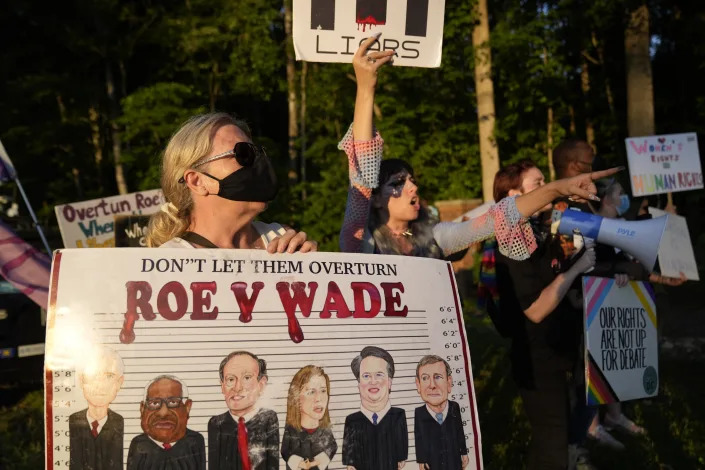
Abortion-rights protesters demonstrate near the home of Associate Justice Clarence Thomas in Fairfax Station, Va. on June 24, 2022, after the Supreme Court opinion in Dobbs v. Jackson Women's Health Organization overturned the landmark 1973 Roe v. Wade decision that established a constitutional right to abortions.
Abortion-rights protesters demonstrate near the home of Associate Justice Clarence Thomas in Fairfax Station, Va. on June 24, 2022, after the Supreme Court opinion in Dobbs v. Jackson Women’s Health Organization overturned the landmark 1973 Roe v. Wade decision that established a constitutional right to abortions.

Dr. Michael M. Lederman is professor of medicine (emeritus) and biomedical ethics at Case Western Reserve University. He is editor-in-chief of the scientific journal Pathogens and Immunity.

Clarence Thomas should not be on the Supreme Court.

He was approved to sit on the court by a timid Democrat majority Senate that was afraid to conclude that this Black man had sexually harassed a colleague, Anita Hill.

More: Petition calls for impeachment of Chatham’s Clarence Thomas. Can you impeach a Supreme Court justice?

The truth of the matter is undetermined but to my eye and in the eyes of many, Professor Anita Hill (and two other women) were telling us the truth and Judge Thomas was lying.

Clarence Thomas, then a Supreme Court nominee, testifies before the Senate Judiciary Committee during his 1991 confirmation hearing.

A terrible start for a Supreme Court justice and it did not get any better. His tenure on the Supreme Court has been lusterless. For many years, he would not even write an opinion and his writings have been largely pedestrian or extremist.

Law professor Anita Hill testifies before the Senate Judiciary Committee on Capitol hill Oct. 11, 1991. In a 1994 book titled " Strange Justice, The selling of Clarence Thomas," written by two Wall Street Journal reporters, the authors revealed that Thomas' volatile Supreme Court confirmation hearings raise fresh questions about his denial that he had talked dirty to Hill while she worked for him as an aide at two government agencies in the 1980s.
Law professor Anita Hill testifies before the Senate Judiciary Committee on Capitol hill Oct. 11, 1991. In a 1994 book titled ” Strange Justice, The selling of Clarence Thomas,” written by two Wall Street Journal reporters, the authors revealed that Thomas’ volatile Supreme Court confirmation hearings raise fresh questions about his denial that he had talked dirty to Hill while she worked for him as an aide at two government agencies in the 1980s.

His wife – Virginia “Ginni” Thomas, a refugee from an 80’s cult –  is a danger to America who has placed Justice Thomas proximate to sedition. Ginni Thomas has worked relentlessly to undermine the outcome of the 2020 presidential election using lies and misrepresentations to urge electors to resist the legitimate transition of government.

More: Clarence Thomas’ wife asks Anita Hill for apology

This is an embarrassment to the court.

But even worse is Clarence Thomas’s refusal to recuse himself from deliberations that address this very election.

Most recently, Thomas delivered the majority opinion in New York State Rifle and Pistol Association v. Bruen, finding that the right to carry concealed handguns in public for the purpose of self-defense is protected by the Second Amendment to the Constitution.

Michael M. Lederman, M.D., is professor of medicine (emeritus) and biomedical ethics at Case Western Reserve University. He is editor-in-chief of the scientific journal Pathogens and Immunity.

More: How to submit guest opinion columns to the Columbus Dispatch

Justice Thomas (and other conservative justices) deliberately misunderstand the Second Amendment. None of the other nine amendments to the Constitution that comprise the Bill of Rights requires justification; those are self-evident and fundamental.

The Second Amendment alone has an explanatory introduction: “A well-regulated Militia, being necessary to the security of a free state,” the Amendment begins, “the right of the people to keep and bear Arms shall not be infringed.”

Nowhere in the Amendment is self-defense mentioned.

More: Supreme Court justices don’t have a code of ethics. Hundreds of judges say that’s a problem

If the framers of Bill of Rights understood that that the right to keep and bear arms was fundamental, why was this unique introduction even warranted?

In the 2008 Heller decision, the unique importance of this introduction is simply ignored as nearly accidental and a labyrinth of decisions is used to link the Amendment to the use of arms in activities such as self-defense. When applied to the original words of the  framers, this is sophistry.

Thomas is marinated in conflicts of interest that render impartiality risible. He has been a headliner for the Eagle Forum (an anti-abortion organization) and the conservative Council for National Policy.

He gave a keynote speech at a fundraiser for the conservative Manhattan Institute and has a longstanding relationship with the Heritage Foundation.

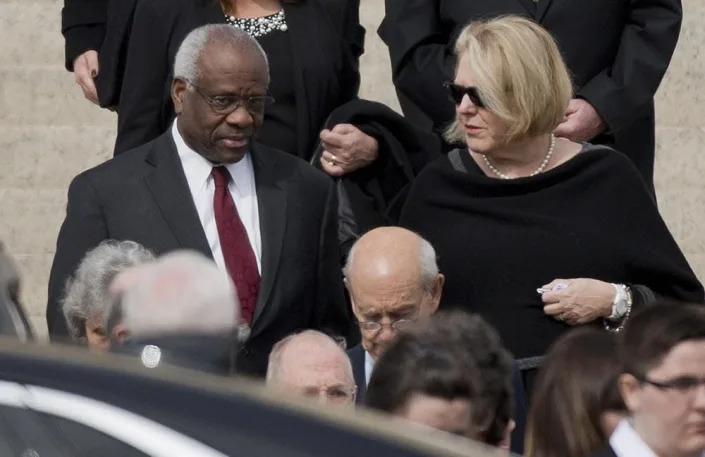
Supreme Court Associate Justice Clarence Thomas, left and his wife Virginia Thomas, right, on Feb. 20, 2016. Virginia Thomas sent weeks of text messages imploring White House Chief of Staff Mark Meadows to act to overturn the 2020 presidential election, according to copies of the messages obtained by The Washington Post and CBS News.

His wife has prominent roles in a number of conservative activist organizations and she was actively engaged in promoting the Jan. 6, 2021, Ellipse rally that ultimately resulted in the violent assault on the Capitol. Mrs. Thomas has given at least $13,000 to support Republicans seeking elected office.

More: What ties does Ginni Thomas, the Supreme Court justice’s wife, have to Jan. 6?

Apparently, Thomas’ colleagues have been unable or unwilling to get Thomas to recuse himself when conflicted.

His service on the court offers a compelling argument for term limits, if not impeachment.

Dr. Michael M. Lederman is professor of medicine (emeritus) and biomedical ethics at Case Western Reserve University. He is editor-in-chief of the scientific journal Pathogens and Immunity.