Barbara Ehrenreich, muckraking writer and activist, dies
Associated Press –September 2, 2022
Barbara Ehrenreich, the muckraking author, activist and journalist who in such notable works as “Nickel and Dimed” and “Bait and Switch” challenged conventional thinking about class, religion and the very idea of an American dream, has died at age 81.
Ehrenreich died Thursday morning in Alexandria, Virginia, according to her son, the author and journalist Ben Ehrenreich. She had recently suffered a stroke.
Barbara Ehrenreich, author of Dancing in the Streets, poses in New York on Wednesday, January 10, 2007.Andrew Harrer | Bloomberg | Getty Images
Barbara Ehrenreich, the muckraking author, activist and journalist who in such notable works as “Nickel and Dimed” and “Bait and Switch” challenged conventional thinking about class, religion and the very idea of an American dream, has died at age 81.
Ehrenreich died Thursday morning in Alexandria, Virginia, according to her son, the author and journalist Ben Ehrenreich. She had recently suffered a stroke.
“She was, she made clear, ready to go,” Ben Ehrenreich tweeted Friday. “She was never much for thoughts and prayers, but you can honor her memory by loving one another, and by fighting like hell.”
Barbara Ehrenreich was a Montana native, raised in a union household where family rules included “never cross a picket line and never vote Republican.” A prolific author who regularly turned out books and newspaper and magazine articles, she was a longtime proponent of liberal causes from economic equality to abortion rights. For “Nickel and Dimed,” one of her best known books, she worked in minimum wage jobs so she could learn firsthand the struggles of the working poor, whom she called “the major philanthropists of our society.”
“They neglect their own children so that the children of others will be cared for; they live in substandard housing so that other homes will be shiny and perfect; they endure privation so that inflation will be low and stock prices high,” she wrote. “To be a member of the working poor is to be an anonymous donor, a nameless benefactor, to everyone.”
Barbara Ehrenreich, author who resisted injustice, dies aged 81
Ed Pilkington – September 2, 2022
Barbara Ehrenreich in 2018. Photograph: Stephen Voss/The Guardian
Writer of the 2001 bestseller Nickel and Dimed died on 1 September, her son announced
Barbara Ehrenreich, the author of more than 20 books on social justice themes ranging from women’s rights to inequality and the inequities of the American healthcare system, has died at the age of 81.
The news that Ehrenreich had died on 1 September was released by her son, Ben Ehrenreich, on Friday. He accompanied the announcement with a comment redolent of his mother’s spirit: “She was never much for thoughts and prayers, but you can honor her memory by loving one another, and by fighting like hell.”
Ehrenreich battled over a half a century as a writer committed to resisting injustice and giving a voice to those who were typically unheard.
Her first book, published in 1969, Long March, Short Song, was an account of the student uprising against the Vietnam war.
In Nickel and Dimed: On (Not) Getting By in America, her 2001 bestseller, she wrote an immersive experience of living as a low-waged worker in Key West, Florida.
The book helped spread awareness of an economy in which it was necessary to work two or three jobs to survive, and acted as a catalyst of the minimum wage movement.
Later, she used her name and energy to try to give low-income and other disadvantaged groups a direct voice to tell their own stories.
She founded the Economic Hardship Reporting Project which supports independent journalists to write about their lives including in poor rural areas of the US.
Ehrenreich, who acquired a doctorate in cell biology before she turned to social activism and writing, was diagnosed in 2000 with breast cancer. She wrote an award-winning essay Welcome to Cancerland about the experience.
She brought her trademark clear-eyed reporting to the subject of her own mortality. In 2018 she published Natural Causes: An Epidemic of Wellness, the Certainty of Dying, and Killing Ourselves to Live Longer, in which she described coming to the realization that she had lived long enough to die.
“That thought had been forming in my mind for some time,” she told the Guardian at the time. “I really have no hard evidence about when exactly one gets old enough to die, but I notice in obituaries if the person is over 70 there’s not a big mystery, there’s no investigation called for. It’s usually not called tragic because we do die at some age. I found that rather refreshing.”
Announcing his mother’s death on Twitter, Ben Ehrenreich echoed that point. “She was, she made clear, ready to go,” he said.
Positive Views of the Supreme Court Drop Sharply After Abortion Ruling
Madeleine Carlisle – September 1, 2022
Texas Challenges Elecetion Results at Supreme Court
The U.S. Supreme Court stands on December 11, 2020 in Washington, DC. Credit – Getty Images—Stefani Reynolds/Getty Images
Favorable views of the Supreme Court have dropped since the ruling overturning Roe v. Wade, a new Pew Research Center survey found, driven largely by a steep drop in approval among Democrats.
In its 35 years of polling on the court, Pew has never documented a wider partisan gap in views of the institution. In August, just 28% of Democrats and Democratic-leaning independents said they view the Supreme Court favorably. That’s the lowest rating Democrats have ever given the court in the poll’s history—18 percentage points lower than in January before the court gutted abortion rights, and almost 40 points lower than in 2020.
Favorable opinions of the court among Republicans, on the other hand, have moderately increased. In January, 65% of Republicans and Republican-leaning independents viewed the court favorably, while 73% said the same in August.
Overall, Pew found the American public is split over the Supreme Court: 48% of the public views the court favorably, while 49% holds an unfavorable view. Jocelyn Kiley, associate director of research at Pew Research Center, says this is the highest percentage of Americans sharing unfavorable views of the Supreme Court that Pew has documented in more than three decades. In August 2020, for example, Pew found that 70% of Americans held favorable views of the high court.
The survey released Thursday was conducted among 7,647 U.S. adults, including 5,681 registered voters, between August 1 and 14. Nonpartisan Pew Research Center said the intention of the survey was to understand the public view of the high court after its term concluded in June with several high-profile rulings along largely ideological lines, including the overturning of the constitutional right to an abortion in Dobbs v. Jackson Women’s Health Organization.
The portion of Democrats who believe the U.S. Supreme Court has too much power has almost tripled since 2020, and increased by more than 20 points this year alone: 64% percent of Democrats said the court has too much power, compared to 40% in January. The survey found that 45% of U.S. adults overall said the court has too much power, which is 15 points higher than in January. 48% of the public said the court has the “right amount of power” and only 5% said the court does not have enough power.
“We are seeing a shift in a lot of different components of how Americans view the court,” says Kiley. “We see a growing share of Americans saying that the court has too much power. A growing share of Americans also say that they see the court as conservative.”
Pew found Americans’ favorability ratings of the Supreme Court is similar to what it was in 2015, when the high court issued another controversial landmark decision: Obergefell v. Hodges, which extended same-sex couples the right to marriage. In July 2015 after the ruling, Pew found that 48% of Americans had a favorable opinion of the court, while 43% viewed it unfavorably, and 61% of Republicans viewed the court unfavorably. The partisan divide over the Supreme Court is even starker today.
The US is drastically undercounting the cost of climate change damages
Tim McDonnell – September 1, 2022
The economic impacts of climate change are likely to be more than three times higher than what economists and US government officials have previously expected, according to a major analysis published Sept. 1 in the journal Nature.
The “social cost of carbon” (SCC) is a metric used by the government to evaluate the costs and benefits of climate policies and investments in infrastructure. It projects the costs of flooding, crop failure, higher bills for air conditioning, and loss of life under different future climate change scenarios, and then translates that estimate into a cost per ton of CO2 emissions.
The SCC is an inexact measure, but it’s a critical tool for policymakers and is often cited in legal and political battles over clean energy spending and greenhouse gas regulations. If the cost is very low, then any spending required to cut emissions probably isn’t worth it. If it’s high, then more aggressive climate policies are economically justified.
Under president Barack Obama, the US’s official SCC was about $51. President Donald Trump slashed artificially that to about $4. President Joe Biden quickly re-established the Obama figure, and tasked a team of economists to develop a new estimate, a process which is ongoing. The Nature study, which was conducted independently by two dozen researchers from several think tanks and top-tier universities, is meant to inform the government’s analysis. It pegs the SCC at $185.
Why the previous social cost of carbon was much too low
The new estimate is much higher for several reasons. Trump’s estimate was limited to impacts in the US, whereas Biden’s and the new estimate are global (which makes more sense, given that the US has an economic stake in global supply chains, in addition to ethical obligations to consider impacts outside its borders). The new estimate also incorporates updated models of the damages themselves, reflecting the latest science on how severe climate change is likely to be and the implications for crop yields, health impacts, and other aspects of life and the economy.
Most importantly, the new estimate uses a lower “discount rate,” the rate by which future damages are given less value than current costs. (In other words, a dollar saved today is worth more than one saved tomorrow). Trump’s discount rate was 7%; currently the rate is 3%. The new estimate uses a rate of 2%, which the authors say more closely matches real interest rates and changes in the value of the dollar over time.
The Biden administration has not announced when it will update its official SCC. If it lands on a number close to what the Nature researchers recommend, it would help the administration make a stronger case on everything from new methane regulations to buying electric vehicles for government fleets.
Arizona AG, governor candidates call for Saudi Arabian water leases investigation
Rob O’Dell, Arizona Republic – August 30, 2022
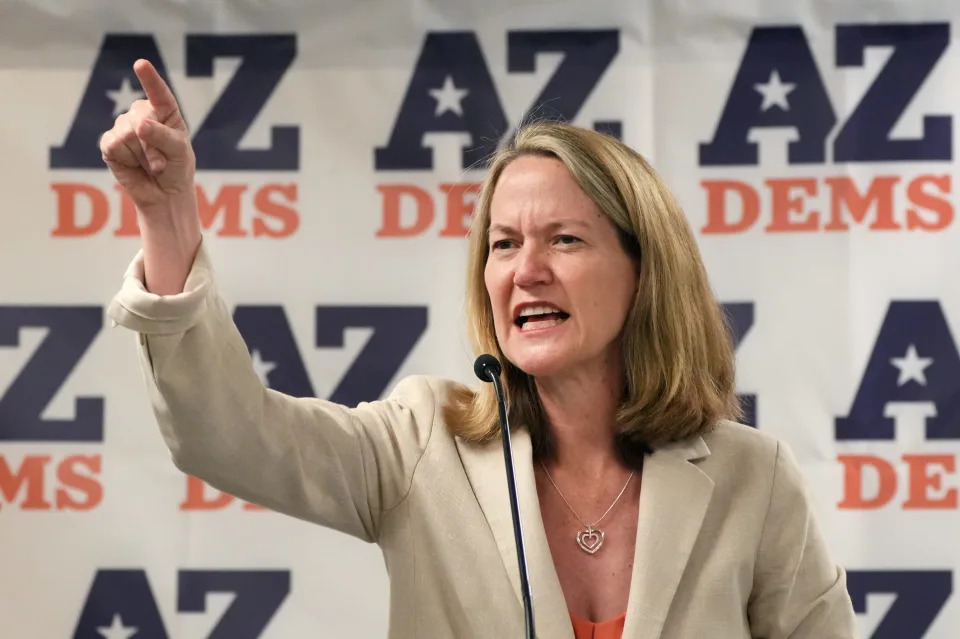
Democratic attorney general candidate Kris Mayes is calling to investigate and potentially cancel the leases the State Land Department signed with a Saudi Arabian company that is pumping from Phoenix’s backup water supply in western Arizona.
Mayes is also calling for the Saudi Arabian company to pay the state approximately $38 million for using the water in La Paz County, which sits in a basin that could be tapped as future water source for the Phoenix metro area.
Mayes says the lease should be put on hold while they are investigated because they potentially violate the Arizona Constitution in two ways: they could violate the gift clause as well as a clause that requires state land and its products to be appraised and offered at their true value.
Fondomonte pays only $25 per acre annually, which is about one-sixth of the market price for farm land in that area, according to experts interviewed by The Republic as well as the state’s own mass appraisal for areas in and around Butler Valley.
Kris Mayes, Democratic candidate for Arizona Attorney General.
In addition, the water that is being pumped by Fondomonte is located in what’s called a transfer basin, meaning water sucked from the ground can be shipped to areas of the state where groundwater is regulated. That makes the water underneath the desert in Butler Valley extremely valuable.
State Land Department employees said the water being pumped from the ground could be worth as much as $4 million annually. But Fondomonte is paying just $86,000 annually to lease the land.
Money generated from the rental and sale of state land is earmarked to help fund K-12 education.
“One of the most egregious aspects of this water giveaway is that it is shortchanging our schools and our kids,” Mayes said. “We need to be maximizing the amount of money that our schools receive from state trust land and the water beneath it.”
Mayes held a press conference about the issue this month and discussed it at length in an interview with The Republic.
“I think most Arizonans find it shocking that our government is giving the state’s water away to a Saudi corporation at a time of extreme drought,” Mayes said. “This Saudi water lease is a flat out scandal and our current governor and attorney general allowed it happen on their watch.”
Gubernatorial candidate Kari Lake.
Mayes is not the only candidate for top public offices in Arizona calling for the leases to be terminated when contacted by The Republic.
Republican gubernatorial candidate Kari Lake wants to cancel the leases as well, said communications director Ross Trumble.
“We want to terminate the Fondomonte lease and will examine all existing leases to ensure Arizona’s water and natural resources primarily benefit Arizonans, not overseas corporations,” Trumble said in statement.
The State Land Department is overseen by Ducey, who appointed current Land Commissioner Lisa Atkins. Both have declined to talk about the leases.
This week, the Hobbs campaign said the leases need to reflect the market and not be sweetheart deals for foreign and special interests. She also said in a statement that Arizona’s Groundwater Management Act needs to be updated to give rural areas more tools for regulating groundwater pumping.
She stopped short of calling for the leases to be canceled or investigated.
Mayes’s opponent in the attorney general’s race, Republican Abe Hamadeh, said in a statement that “government should not be subsidizing private industry, especially when it involves private or foreign entities freely accessing and capitalizing off our natural resources.”
He said the government has a duty to show private entities and foreign governments that Arizona is not for sale.
“I generally believe the attorney general should not be invalidating or overturning lawful contracts with private entities,” he said. “However, I have a growing concern that the agency tasked to care for our state land has been involved in recent controversies related to undervalued public land auctions and now the Saudi groundwater land deal threatening Arizona’s precious water supply.”
Mayes said the state can’t afford water deals like the one with Fondomonte.
“Arizonans deserve and attorney general who will be a watchdog over things like this,” she said. “I call for a cessation of these leases, an audit of the leases, and an investigation into this particular lease. … This is a particularly terrible place for the state to be engaging in this kind of behavior.”
Dramatic increase in deadly US heat waves now likely inevitable, but experts say there’s still hope
Doyle Rice, USA TODAY – August 30, 2022
A dramatic increase in deadly heat waves is now probably inevitable, a study published Thursday says.
The authors say there’s still hope that global temperature increases resulting from human-caused climate change can be curbed, which would avert even more catastrophic heat in some areas on Earth.
“The frequency of extreme heat waves is likely to increase by 3 to 10 times by the end of the century, depending on where you live in the U.S.,” study lead author Lucas Vargas Zeppetello told USA TODAY.
The authors say their results highlight the need to reduce future greenhouse gas emissions and to protect populations, especially outdoor workers, against dangerous heat.
Heat already kills more Americans each year than any other weather hazard, including hurricanes, tornadoes and floods, according to the National Weather Service.
The findings suggest carbon dioxide emissions from human activity could drive increases in exposure to extreme temperatures in the coming decades, even if global warming is limited to 2 degrees C, in line with the Paris Agreement.
“The record-breaking heat events of recent summers will become much more common in places like North America and Europe,” said Vargas Zeppetello, who did the research as a doctoral student at the University of Washington and is now a postdoctoral researcher at Harvard University.
High temperatures pose a threat to public health, with extreme heat contributing to heat cramps, heat exhaustion and chronic illnesses, according to the study.
“This is especially dangerous for hot and humid places like the South and Eastern Seaboard, but we’ve seen the consequences of extreme heat on the West Coast as well, so there really is no place in the U.S. where this will not be an issue,” Vargas Zeppetello said.
People in equatorial regions will suffer even more
The forecast is even more ominous in other parts of the world:
“For many places close to the equator, by 2100 more than half the year will be a challenge to work outside, even if we begin to curb emissions,” Vargas Zeppetello said.
In a worst-case scenario in which emissions remain unchecked until 2100, “extremely dangerous” conditions, in which humans should not be outdoors for any amount of time, could become common in countries closer to the equator – notably in India and sub-Saharan Africa.”
The study looks at the “heat index,” which measures the effect of heat on the human body. A “dangerous” heat index is defined by the Weather Service as 103 degrees. An “extremely dangerous” heat index is 124 degrees, which is considered unsafe to humans for any amount of time.
According to study co-author David Battisti, a professor of atmospheric sciences at the University of Washington, the number of days with dangerous levels of heat in the southeastern and central U.S. will more than double by as soon as 2050.
“It’s extremely frightening to think what would happen if 30 to 40 days a year were exceeding the extremely dangerous threshold,” Vargas Zeppetello said. “These are frightening scenarios that we still have the capacity to prevent. This study shows you the abyss, but it also shows you that we have some agency to prevent these scenarios from happening.”
California lawmakers approve landmark fast food workers bill
Don Thompson – August 29, 2022
SACRAMENTO, Calif. (AP) — California lawmakers on Monday approved a nation-leading measure that would give more than a half-million fast food workers more power and protections, over the objections of restaurant owners who warn it would drive up consumers’ costs.
The bill will create a new 10-member Fast Food Council with equal numbers of workers’ delegates and employers’ representatives, along with two state officials, empowered to set minimum standards for wages, hours and working conditions in California.
A late amendment would cap any minimum wage increase for fast food workers at chains with more than 100 restaurants at $22 an hour next year, compared to the statewide minimum of $15.50 an hour, with cost of living increases thereafter.
“We made history today,” said Service Employees International Union President Mary Kay Henry, calling it “a watershed moment.”
“This legislation is a huge step forward for workers in California and all across the country,” she said as advocates offered it as a model for other states.
The Senate approved the measure on a 21-12 vote, over bipartisan opposition. Hours later the Assembly sent it to Gov. Gavin Newsom on a final 41-16 vote, both chambers acting with no votes to spare.
Debate split along party lines, with Republicans opposed, although three Democratic senators voted against the measure and several did not vote.
“It’s innovative, it’s bringing industry and workers together at the table,” said Democratic Sen. Maria Elena Durazo, who carried the bill in the Senate. She called it a “very, very well-balanced method of addressing both the employers, the franchisees, as well as the workers.”
Almost every Republican senator spoke in opposition, including Sen. Brian Dahle, who also is the Republican nominee for governor in November.
“This is a steppingstone to unionize all these workers. At the end of the day, it’s going to drive up the cost of the products that they serve,” Dahle said. He added later: “There are no slaves that work for California businesses, period. You can quit any day you want and you can go get a job someplace else if you don’t like your employer.”
Restaurant owners and franchisers cited an analysis they commissioned by the UC Riverside Center for Economic Forecast and Development saying that the legislation would increase consumers’ costs. Gov. Gavin Newsom’s administration also fears the measure would create “a fragmented regulatory and legal environment.”
The debate has drawn attention nationwide, including on Capitol Hill where Democratic U.S. Rep. Ro Khanna has expressed hope it will trigger similar efforts elsewhere.
It’s “one of the most significant pieces of employment legislation passed in a generation,” said Columbia Law School labor law expert Kate Andrias. She called it “a huge step forward for some of the most vulnerable workers in the country, giving them a collective voice in their working conditions.”
The bill grew out of a union movement to boost the minimum wage and Andrias said it would “work in conjunction with traditional union organizing to give more workers a voice in their working conditions.”
International Franchise Association President and CEO Matthew Haller countered that the legislation “is a discriminatory measure aimed to target the franchise business model to bolster union ranks.”
Organizations representing Asian, Black and LGBTQ businesses sent a letter to senators Monday arguing that the measure would harm minority owners and workers.
Ted Cruz says there’s a ‘real risk’ that Biden’s student-loan forgiveness will help Democrats in the 2022 midterm elections
Yelena Dzhanova – August 27, 2022
Republican Sen. Ted Cruz of Texas at the Senate.Bill Clark/CQ-Roll Call via Getty Images
Sen. Ted Cruz said Biden’s student-loan forgiveness plan will “drive up turnout” for Democrats in November.
“Maybe you weren’t gonna vote in November, and suddenly you just got 20 grand,” Cruz said of the plan.
“If you can get off the bong for a minute … it could drive up turnout,” he said.
Sen. Ted Cruz on Friday railed against President Joe Biden’s student-loan forgiveness plan, predicting it’ll give Democrats an edge in the upcoming midterm elections.
“If you are that slacker barista who wasted seven years in college studying completely useless things, now has loans and can’t get a job, Joe Biden just gave you 20 grand,” Cruz said during an appearance on his “Verdict with Ted Cruz” podcast. “Like, holy cow! 20 grand. You know, maybe you weren’t gonna vote in November, and suddenly you just got 20 grand.”
“And you know, if you can get off the bong for a minute and head down to the voting station,” he continued. “Or just send in your mail-in ballot that the Democrats have helpfully sent you, it could drive up turnout, particularly among young people.”
Cruz said “there is a real risk” that the Democrats will net more support in November.
The Biden administration earlier this week announced a plan to cancel $10,000 in student-loan debt for borrowers whose annual income does not exceed $125,000.
“For too many people, student loan debt has hindered their ability to achieve their dreams—including buying a home, starting a business, or providing for their family,” Education Secretary Miguel Cardona said in a statement. “Getting an education should set us free; not strap us down! That’s why, since Day One, the Biden-Harris administration has worked to fix broken federal student aid programs and deliver unprecedented relief to borrowers.”
Prominent Democrats like Sen. Bernie Sanders have slammed Cruz’s remarks.
“This is what a leading Republican thinks of young ‘slacker’ Americans who took out loans to go to college,” Sanders tweeted in response to a clip of his remarks.
A former official working in the Obama administration also criticized Cruz.
“Since Ted Cruz knows baristas have been spitting in his coffee for years, it’s technically not punching down,” said Brandon Friedman, former deputy assistant secretary for public affairs at the United States Department of Housing and Urban
I have finally seen enough. Donald Trump will be indicted by a federal grand jury.
You heard me right: I believe Trump will actually be indicted for a criminal offense. Even with all its redactions, the probable cause affidavit published today by the magistrate judge in Florida makes clear to me three essential points:
(1) Trump was in unauthorized possession of national defense information, namely properly marked classified documents.
(2) He was put on notice by the U.S. Government that he was not permitted to retain those documents at Mar-a-Lago.
(3) He continued to maintain possession of the documents (and allegedly undertook efforts to conceal them in different places throughout the property) up until the FBI finally executed a search warrant earlier this month.
That is the ball game, folks. Absent some unforeseen change in factual or legal circumstances, I believe there is little left for the Justice Department to do but decide whether to wait until after the midterms to formally seek the indictment from the grand jury.
The cruelest irony for Trump is that it never needed to be this way.
Put aside that in the chaos following his election loss Trump’s team never undertook the normal procedure for properly sorting through and archiving his presidential records in coordination with the National Archives and Records Administration (NARA). Put aside that properly marked classified records were shipped to Mar-a-Lago and sat there for months until he began turning stuff over to NARA in late 2021.
If he had fully cooperated at that point, and returned all of the records to NARA last year, this likely never would have become a criminal matter. DOJ would have declined to take any action, notwithstanding the existence of the classified records, and it would have been a “no harm, no foul” situation. Just another minor story in the Trump saga of incompetence.
But Trump just could not bring himself to play by the rules. He turned over 15 boxes last January but did not turn over all the records. Political operatives from conservative organizations started whispering into his ear that he had legal precedent on his side to refuse to turn over the classified records to NARA (he did not). His lawyers surprisingly wrote a rather condescending letter to DOJ in May 2022, effectively arguing that even if there were still classified records at Mar-a-Lago the FBI lacked the authority to take any criminal action against Trump given his former status as president. Then, in June 2022 after the FBI executed a subpoena to recover more records at Mar-a-Lago, two Trump lawyers wrote (and one signed) a sworn affidavit reassuring the government there were no more classified records at the property.
We now know that statement was not true. The FBI found multiple more classified records, including some with markings for Top Secret/Sensitive Compartmented Information (TS/SCI) during the search this month, and not just located in the storage room with the other boxes of records. They found records located in different parts of Mar-a-Lago.
Of course, there are various arguments for why a prosecution might not succeed in this situation.
There is the contention by Trump and his allies that he declassified the documents, whether through a “standing order” or more specific verbal action. No evidence has been produced corroborating that assertion, and there certainly is no indication that the classification markings themselves were ever revised to reflect the declassification. The Trump lawyers in May certainly did not provide any such evidence in their letter to DOJ, and they similarly provided no evidence of it in their “motion” filed earlier this week in district court in Florida seeking a Special Master.
And that is before we even consider if the classification status would matter for an Espionage Act prosecution, which only requires that the information relate to the national defense.
There is also the issue of selective political prosecution and supposed bad faith by the government in its decision to pursue the case. This is something that has been mentioned ad nauseum by Trump allies on cable news, and was briefly mentioned in the “motion” filed earlier this week in court. Lacking from those arguments is anything beyond rank speculation. That will not fly in court. Just ask Sidney Powell how well it works to try to litigate in court the way you argue on cable news. Hint: it does not go well.
All in all, this case should and in my opinion will result in an indictment. Sure, an indictment does not equal a conviction. Trump is still assumed innocent until proven guilty. There are unknown variables like whether the prosecution would occur in Florida or in D.C. We do not know what evidence Trump might have to substantiate his declassification claim. And we do not know what the courts would say about his various arguments.
Get the popcorn ready either way.
Bradley P. Moss is a Partner and national security attorney at the Washington, D.C. Law Office of Mark S. Zaid, P.C.
Murkowski’s primary win spurs interest in election reforms, as well as criticism
Jon Ward, Chief National Correspondent – August 23, 2022
Republican Sen. Lisa Murkowski’s surprisingly strong showing in Alaska last week has sparked new interest in election reforms used by the state and that could be a model for the rest of the country, as well as scrutiny from those who suspect the changes may favor one party more than another.
Murkowski, a Republican, was targeted for defeat by former President Trump, whom she voted to impeach after the January 6, 2021 assault on the U.S. Capitol. But Murkowski received the most votes of any candidate in the nonpartisan primary, with 44% of the vote to just under 40% for the Trump-backed candidate, Kelly Tshibaka. The rest of the vote was split between a handful of other contenders.
Senate candidate Kelly Tshibaka with Donald Trump during a rally in Anchorage, Alaska, July 9. (Patrick T. Fallon/AFP via Getty Images)
If Alaska had conducted its primaries the way it has in the past — the way most states still do — Murkowski likely would have lost to Tshibaka. But election reform advocates say it’s a mistake to view the new system as helpful or hostile to either Republicans or Democrats.
“This doesn’t mean Trump-endorsed candidates don’t win. If that’s who a majority of November voters want, that’s who they get. It just means all November voters have a voice rather than just 10% of people who turn out in summer primaries,” said Katherine Gehl, founder of the Institute for Political Innovation, a group that has pushed for the changes.
In other words, Alaska’s new system stops a minority of voters in either party from eliminating a candidate with broad appeal before most voters even cast ballots.
In 2020, Alaska voters approved a system which discarded multiple party primaries and merged them all into one contest. Last week, all voters cast ballots in one single primary, rather than separate primaries for Republicans, Democrats and other minor parties.
The top four vote-getters advanced to the fall election, the final round of voting. Murkowski, with 82% of the vote counted, has received almost 69,000 votes, far more than the 39,545 she received in the 2016 Republican primary and more than the 53,872 votes she received in the 2010 Republican primary.
Murkowski lost that 2010 primary to a more right-wing Republican candidate, Joe Miller, but she ran as a write-in candidate in the fall general election, and pulled off a remarkable and decisive victory.
Sen. Lisa Murkowski at the Capitol on July 21. (Anna Moneymaker/Getty Images)
The second change Alaskans made in 2020 was to the fall election, known as the general election. The winner of that contest will now be chosen by ranked-choice voting, ensuring that the eventual winner will receive more than 50% support from the voters, rather than winning with less than 50% as other candidates split up the rest of the vote.
Much of the attention on election reforms in the past few years has been on ranked-choice voting. But Murkowski’s survival last week had nothing to do with ranked choice.
Reform advocates increasingly say that it is the combination of nonpartisan primaries with ranked-choice voting that will do the most to depolarize American politics and empower politicians to fix problems, and their emphasis is ever more so on the primary part of the equation.
“We see the combination of nonpartisan primaries and ranked-choice voting as the most powerful election reform,” Nick Troiano, executive director of Unite America, told Yahoo News. Unite America published a report last year showing that 8 out of 10 members of Congress are effectively chosen by about 10% of voters, because of the party primary system.
“Reform is gaining momentum as more Americans are realizing that if they want to fix the people they have to fix the system,” Troiano said.
Sarah Palin at the Conservative Political Action Conference earlier this year. (Lev Radin/Pacific Press/LightRocket via Getty Images)
But some Republicans in Alaska have attacked the voting reforms. Former Alaska Gov. Sarah Palin, who is running for Congress, has been one of the loudest critics. Palin called the new system “crazy” and “cockamamie” even though it might enable her to win the special election for former Rep. Don Young’s open seat, even though she finished second in the first round of voting.
Republicans in the state legislature also told the Anchorage Daily News that there will likely be efforts to repeal parts of the new system in the next legislative session. And right-wing activists have complained that Murkowski worked behind the scenes to help pass the nonpartisan primary and ranked-choice system because it would favor her politically.
But in Nevada, Democrats are opposing the push by reformers to enact the very same system that Republicans are complaining about in Alaska. Democratic Gov. Steve Sisolak and both U.S. senators, Jacky Rosen and Catherine Cortez Masto — both also Democrats — all are against the changes. And Democrats in Nevada led the legal challenge to stop the issue to be decided by voters in the first place, but the state Supreme Court ruled in June that the reforms would be allowed on the ballot this fall.
Nevada voters will have to approve of the nonpartisan primary and ranked-choice system in two separate referendums, this year and again in 2024, for it to become state law.
Gov. Steve Sisolak, D-Nev. (Bill Clark/CQ-Roll Call via Getty Images)
“I’d be worried if we were not attracting political opposition because that would mean the status quo is not threatened by these reforms,” Troiano said.
It makes sense that both political parties find it disconcerting to get rid of party primaries. It is the way that they have chosen a nominee for every political office since the 1970s, when party bosses lost control of the nominating process.
But public discontent with the political status quo is rising. A recent New York Times/Siena College poll found that 50% of Americans think the country’s system of government should have “major reforms,” and 8% think it should be “completely replaced.” Another 29% said they think at least “minor changes” are required.
Troiano shared the results of a recent poll conducted by Frank Luntz for Unite America that showed 65% support for a nonpartisan primary, and only 13% opposition.
And as the number of unaffiliated voters rises in some states, it may be that letting go of the party primary is the best way for Republicans and Democrats to reduce the chance of a viable third-party establishing itself, or of multiple parties bursting through. These election reforms would enable both parties to grow beyond their most extreme and hardline voters and to send representatives to Congress, state legislatures and even the presidency. The reforms would bolster pragmatic politicians who are looking to please the majority of voters by solving problems rather than a small slice of the electorate that only wants them to fight the other side.
“Eventually, one of two things will happen: Either more states will adopt Alaska’s system, or the frustrated middle will become large enough to push both sides out,” wrote Henry Olsen, a conservative columnist for the Washington Post. “That latter response is what’s happening in many European countries as traditional parties are swept aside in favor of new, outsider ones.”