2nd Arizona county delays certifying election, for now
Bob Christie – November 21, 2022
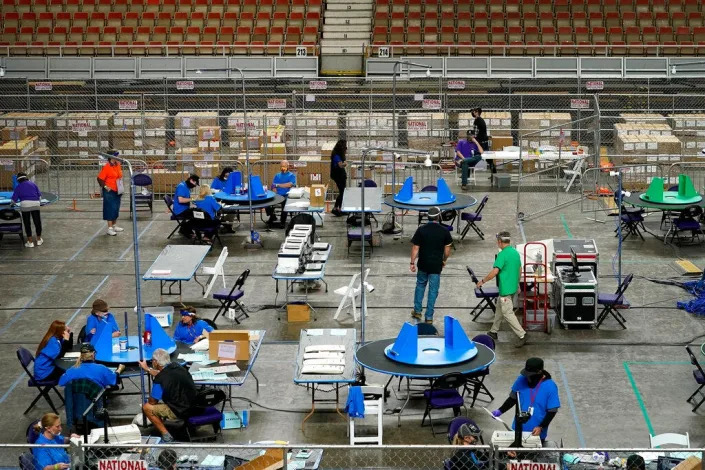
FILE – An election worker gathers tabulated ballots to be boxed inside the Maricopa County Recorders Office on Nov. 10, 2022, in Phoenix. A second Republican-controlled Arizona county on Monday, Nov. 21, delayed certifying the results of this month’s election as a protest against voting issues in Maricopa County that some GOP officials have blamed for their losses in top races including the contest for governor. (AP Photo/Matt York, File) (ASSOCIATED PRESS)
PHOENIX (AP) — A second Republican-controlled Arizona county on Monday delayed certifying the results of this month’s election as a protest against voting issues in Maricopa County that some GOP officials have blamed for their losses in top races including the contest for governor.
The delay came as Maricopa, the state’s most populous county, finished counting the last remaining ballots and the state attorney general demanded that officials there explain Election Day problems some voters experienced.
Arizona voters elected a Democratic governor, Katie Hobbs, and gave Democratic Sen. Mark Kelly a full six-year term in office. But the race for attorney general was heading to a mandatory recount once the election is certified by all 15 counties and the secretary of state. Democrat Kris Mayes ended up ahead of Republican Abraham Hamadeh by just 510 votes on Monday after Maricopa County counted about 1,200 remaining ballots. Nearly 2.6 million Arizonans voted.
The split vote by the board of supervisors in Mohave County in northwest Arizona came with an explicit vow to certify the election on the Nov. 28 deadline. Members called it a political statement to show how upset they were with the issues in Maricopa County, home to Phoenix and about 60% of the the state’s voters.
The all-Republican boards of two other counties, Pinal and La Paz, voted with little fanfare Monday to certify their election results.
Mohave became the second state county to delay certification, following Cochise in Arizona’s southeast. The board there made its decision Friday without a promise to certify the results by the deadline for doing so, despite setting a meeting to consider it. Instead the two Republicans who constitute a majority on the board demanded that the secretary of state prove their vote-counting machines were legally certified.
The state elections director told them they were, but the two board members sided instead with claims put forward by a trio of men who alleged the certifications had lapsed.
On Monday, state Elections Director Kori Lorick provided the county board with certifications for the vote-counting machines from the U.S. Election Assistance Commission. Lorick also warned the board that the state would sue if they did not certify on time.
County boards do not have the legal right to either change the results provided by their elections officials or refuse to certify them. And Lorick wrote that if the certification is not received by the secretary of state by Dec. 5, all the Cochise County votes will go uncounted.
That would give a boost to Democrats up and down the ballot in tight state races, since some Republican candidates got as much as 60% of the vote in the county.
Maricopa County had problems at about 30% of its vote centers Nov. 8 when tabulators were unable to read some ballots.
County officials have repeatedly said that all the ballots were counted and that no one lost their ability to vote. Those with ballots that could not be read were told to place them in a secure box to be tabulated later by more robust machines at county elections headquarters.
Republican Attorney General Mark Brnovich wants an explanation of how the printer problems happened before Maricopa County does its certification on Nov. 28. The head of his Elections Integrity Unit also wants to know how some of the uncounted ballots were mixed up at the polling sites and an explanation for issues experienced by voters who left to go to another vote center with operating tabulators.
“Arizonans deserve a full report and accounting of the myriad problems that occurred in relation to Maricopa County administration of the 2022 general election,” the head of the unit, Jennifer Wright, wrote.
Maricopa County board Chair Bill Gates said the county will respond “with transparency as we have done throughout this election.”
The county said that about 17,000 Election Day ballots were involved and had to be counted later instead of at the polling place. Only 16% of the 1.56 million votes cast in Maricopa County were made in-person on Election Day.
In Mohave County, the board and the chair of the county Republican Party praised their elections director. But Jeanne Kentch joined GOP state chair Kelli Ward in saying Republicans were disenfranchised because of issues in Maricopa County.
“Mohave County voters, their votes have been diluted,” Kentch said. “Their votes have been worth less than they were prior to this vote due to the mismanagement and the disfunction of the Maricopa County elections department.”
The vote to delay the Mohave County vote canvass was not unanimous, although all five board members are Republicans. Member Jean Bishop called the decision “kind of ludicrous.”
“We’re not Maricopa County, we’re Mohave County,” she said. “Our vote is solid.”
The county board did the same after the 2020 election as former President Donald Trump pushed concerns about his loss in Arizona and pointed to Maricopa County as the source of his defeat. The board eventually accepted the results, however.
“This is 2020 redux,” board member Hildy Angius said. “If we don’t certify today, we’re just making a statement of solidarity.”
Ron Gould, a former state lawmaker, agreed that it was only a message.
“It is purely a political statement,” Gould said. “But it’s the only way that we can make that statement.”
Associated Press writer Anita Snow in Phoenix contributed to this report.
Eric Lipton and Maggie Haberman – November 21, 2022
Former President Donald Trump during his election night party at Mar-a-Lago in Palm Beach, Fla. on Nov. 8, 2022. (Josh Ritchie/The New York Times)
WASHINGTON — When former President Donald Trump returned briefly last week to his office at Trump Tower in New York, he was joined by his son Eric Trump and the top executive of a Saudi Arabian real estate company to sign a deal that creates new conflict-of-interest questions for his just-launched presidential campaign.
The deal is with a Saudi real estate company that intends to build a Trump-branded hotel, villas and a golf course as part of a $4 billion real estate project in Oman. The agreement continues a practice that had been popular for the Trump family business until Trump was elected president — selling branding rights to an overseas project in exchange for a generous licensing fee.
But what makes this project unusual — and is sure to intensify the questions over this newest transaction — is that by teaming up with the Saudi company, Trump is also becoming part of a project backed by the government of Oman itself.
The deal leaves Trump, as a former president hoping to win the White House again, effectively with a foreign government partner that has complex relations with the United States, including its role in trying to end the war in Yemen and other important foreign policy agenda items for Washington.
The deal Trump signed was with Dar Al Arkan, the Saudi-based real estate company that is leading the project in collaboration with the government of Oman, which owns the land. It is the second deal signed recently between Trump and his family that has direct financial ties to a Middle East government.
The Trump Organization also hosted the Saudi-government-backed LIV Golf tournaments at family-owned golf clubs in New Jersey and Florida. The Saudi government’s $620 billion Public Investment Fund has financed the LIV Golf effort, which then paid venues like Trump National Doral in Miami and Trump National Golf Club Bedminster in New Jersey to host two of its tournaments this year.
The Trump administration, including Jared Kushner, Trump’s son-in-law, had close ties with Saudi Arabia during Trump’s tenure in the White House. Kushner has also received financial support from the Saudi government, a $2 billion investment in his newly formed private equity firm, Affinity Partners.
Before being elected president, Trump and his family had signed deals to license the Trump name in locations including Indonesia, Turkey, the Philippines, Dubai, India, Panama and Canada, and it owns golf resorts in Scotland and Ireland. One planned skyscraper deal in Dubai, announced in 2005, involved Nakheel, a Dubai-government-controlled real estate company. But that project was eventually abandoned.
Eight months before Trump entered the presidential race in 2015, the family company announced plans to license its name for a 33-story hotel in Baku, Azerbaijan, and the partner there was the son of a government minister. That project was also ultimately abandoned.
Elsewhere, the Trump Organization’s foreign deals generally did not directly involve a financial role by a foreign government, or at least any public acknowledgment of direct foreign government financing or a major land contribution, according to an examination of the transactions by The New York Times.
During Trump’s time in the White House, Trump International Hotel in Washington was frequently a destination for foreign government officials, including delegations in town for planned meetings with Trump. The governments of Malaysia, Saudi Arabia, Qatar, the United Arab Emirates, Turkey and China each spent money at the hotel, according to documents that his former accounting firm turned over to Congress. The hotel received more than $3.75 million from foreign governments from 2017 to 2020, the House investigators estimated.
The Trump Organization has asserted that it paid all profits from these hotel stays to the Treasury Department through annual voluntary payments.
But this new deal — in which the Trump Organization benefits from land or financial capital provided by foreign governments — only elevates the potential for a conflict of interest to emerge, as Trump continues his dual roles as a White House candidate and business executive, ethics lawyers said.
“This is yet another example of Trump getting a personal financial benefit in exchange for past or future political power,” said Kathleen Clark, a law professor at Washington University in St. Louis. “The Saudis and Oman government may believe that giving Trump this licensing deal will benefit them in the future, should Trump become president again. This deal could be a way to ensure that they will be in Trump’s good graces.”
The Aida project in Oman is slated to be built 20 minutes outside the capital city of Muscat, on a series of hills overlooking the Arabian Sea on land controlled by the Omani Company for Development and Tourism, an Oman-government-owned tourism agency. It will include 3,500 luxury villas, two hotels with a total of 450 rooms and a golf course, as well as various restaurants and stores.
The project is part of what the government there is calling Oman Vision 2040 to try to diversify the small nation’s economy by building new hotels and golf courses and other tourist attractions. Officials in Oman did not respond Sunday to a request for comment on the project, nor did representatives for Dar Al Arkan, which is one of Saudi Arabia’s largest real estate companies.
Relations between the United States and Oman were not nearly as warm during Trump’s tenure as they were with Saudi Arabia. Oman declined to sign the agreement, called the Abraham Accords, that normalized relations between other Middle East nations and Israel.
Executives at Riyadh-based Dar Al Arkan sent out a news release Sunday confirming the deal with Trump Organization for the new project in Oman, while also distributing photos of Donald and Eric Trump at Trump Tower in New York with executives from Dar Al Arkan.
It is one of the first times since Trump was elected president that he has publicized his role in a new family real estate deal. The Trump family stopped signing new international deals after Trump was elected. The real estate deal with the Saudi partner in Oman is the first since he left the White House.
Ziad El Chaar, CEO of Dar Al Arkan Global, who attended the deal-signing event, used to work at Damac Properties, the Trump family’s partner in Dubai, where the family has licensed its name to what is known as Trump International Golf Club Dubai and Trump Estates at DAMAC Hills, a gated community adjacent to the fairways.
“We are confident the relationship with Trump will further enhance the beauty of Aida and attract investors from around the world looking to be part of an exceptional project,” El Chaar said in the statement released on Sunday.
Eric Trump, in a statement, said that the family company did not believe the new deal represented a conflict, and since the time his father was in office, it has worked to avoid any such conflicts. “We are excited to expand our golf and hotel portfolio in this incredible location,” he said Sunday. “It is going to be an exceptional project.”
Steven Cheung, a spokesperson for Donald Trump’s campaign, responded to questions about the Oman deal, or whether the former president will be more involved with his business now, with a statement attacking the Biden administration.
The Oman deal was announced just as Trump was kicking off his third campaign for the White House, and while the Trump family, and Trump himself, are the target of a collection of civil and criminal investigations, including tax fraud charges against the Trump Organization and its long-serving chief financial officer, Allen Weisselberg.
If the company is convicted, it will face fines and potential blowback from lenders and business partners that might shy away from doing business with a felon; a conviction could also present new political challenges for Trump. But the maximum possible fine in the tax fraud case is only $1.62 million, a small amount for the company. In his most recent financial disclosure report, filed in early 2021 as Trump left the White House, Trump reported assets worth at least $1.3 billion.
What Will Russia Without Putin Look Like? Maybe This.
Guest Essay By Joy Neumeyer – November 21, 2022
Ms. Neumeyer is a journalist and historian of Russia and Eastern Europe.
Credit…Nanna Heitmann for The New York Times
Russia’s current condition — militarized, isolated, corrupt, dominated by the security services and hemorrhaging talent as hundreds of thousands flee abroad to escape service in a horrific war — is bleak.
In hopes of an end to this grim reality, some wait expectantly for Vladimir Putin to leave office. To change the country, however, it is not enough for Mr. Putin to die or step down. Russia’s future leaders must dismantle and transform the structures over which he has presided for more than two decades. The challenge, to say the least, is daunting. But a group of politicians is devising a plan to meet it.
Composed of well-known opposition figures as well as younger representatives from local and regional governments, the First Congress of People’s Deputies of Russia met in Poland in early November. The location, Jablonna Palace outside Warsaw, was symbolic: It was the site of early negotiations in the round-table talks that led to the end of Communist rule in Poland. There, over three days of intense debate, participants laid out proposals for rebuilding their country. Taken together, they amount to a serious effort to imagine Russia without Mr. Putin.
The first and most pressing priority, of course, is the invasion of Ukraine. Everyone at the congress opposes the war, which they assume will be lost or lead to nuclear disaster. To deal with the consequences and to prevent a repeat tragedy, they propose an “act on peace” that would demobilize the army and end the occupation of Ukrainian territory, including Crimea; create a joint group for the investigation of war crimes; pay reparations for damaged infrastructure and the families of the dead; and reject future “wars of conquest.” In addition to offering a deterrent to future expansionism, this wide-ranging pledge would provide an essential reckoning with Russia’s history of imperialist invasion.
The officials responsible for the devastation will need to be rooted out, too — something that never happened after the collapse of the Soviet Union. The Congress would bar from working in state and educational institutions those who belonged to “criminal” organizations — such as the Federal Security Services or state television channels — or publicly supported the war, as well as restricting their voting rights. It would also create a “de-Putinization” commission to consider the rehabilitation of certain groups, including those who publicly recant and did not commit especially serious crimes, and open the archives of the security services.
Then there’s the structure of Russia itself. The Russian Federation is highly centralized, with a patchwork of over 80 republics and regions that are strongly subordinate to the president, enabling the accumulation of enormous power. The Congress, drawing on decentralized visions from around the time of the Soviet collapse, proposes to dissolve the Russian Federation and replace it with a new parliamentary democracy. According to a broadly worded draft provision on “self-determination,” the future Russian state should be “joined on the basis of free choice by the peoples who populate it.”
This break with the present could correct the failed promises of the past. From Vladimir Lenin to Boris Yeltsin, modern Russian leaders have a history of offering decentralization to win support and then reneging once they consolidate power. Though all federal subjects are legally equal under Russia’s current Constitution, substantial inequalities persist — a fact that has been highlighted by the disproportionate deployment and death of ethnic minorities from poorer republics like Dagestan and Buryatia in the war in Ukraine.
Revisiting the issue of greater sovereignty could allow the breakaway republic of Chechnya, for example, to leave Russia after its brutal subjugation by Mr. Putin, while enabling regions and republics without strong secessionist movements to renegotiate the allocation of resources and balance of power with the center. It would create a fairer country while undermining Russian nationalism.
The congress is vaguest on its economic plans. One act promises to “review the results of privatization” carried out during the 1990s (which led to the rise of Russia’s oligarchs), while another aims to cancel Mr. Putin’s highly unpopular pension reform of 2020. Missing, however, is a commitment to a strong social safety net or any discussion of transitioning Russia’s economy away from its dependence on energy exports. This is a major oversight. Since the 1990s, when privatization and free elections were introduced simultaneously, wealth and power have been intertwined. Political and economic reform cannot be viewed in isolation from each other.
That’s not the only hitch. The congress’s main organizer and sponsor is Ilya Ponomarev, a leftist tech entrepreneur. The only member of the Russian parliament to vote against the annexation of Crimea in 2014, he left the country, obtained Ukrainian citizenship and now runs a Russian-language news channel in Kyiv. A controversial figure in opposition circles, in August he endorsed the assassination of Daria Dugina, the daughter of the Eurasianist philosopher Alexander Dugin, and asserted it was the work of a secret partisan army inside Russia. This uncorroborated claim outraged fellow opposition figures. Mr. Ponomarev was subsequently disinvited from an event organized by the longtime Kremlin critics Garry Kasparov and Mikhail Khodorkovsky.
Despite their disagreements, Russia’s opposition has a loosely converging vision for the future. Mr. Khodorkovsky and Aleksei Navalny, the country’s most well-known dissident, who is currently languishing in a penal colony, have also issued calls to turn Russia into a parliamentary democracy with more power devolved to the local and regional levels. But associates of Mr. Navalny did not attend the congress, nor did Mr. Kasparov or Mr. Khodorkovsky. Its legitimacy — already challenged by a number of Russian antiwar organizations that said it does not represent them — was also questioned by some participants, several of whom left in protest over what they saw as a lack of equality and transparency in how it was being run.
Such feuding doesn’t help the proposals, which can seem far-fetched. Yet history shows that radical developments are often incubated abroad or underground. In the late 19th and early 20th centuries, political émigrés in bickering communities around Europe plotted the downfall of the Russian empire. Among them was Vladimir Lenin, who was living in Poland at the outbreak of World War I.
For now, with most of Russia’s population forced into quiescence while others lose their jobs or freedom for expressing dissent, the possibility of the country’s transformation appears remote. Change, however, can come when it’s least expected. In early 1917, a pessimistic Lenin lamented that he probably wouldn’t live to see the revolution; a few weeks later, the czar was overthrown.
Russia is no more doomed to repeat the past than any other country. The time to reimagine its future is now.
U.S. Supreme Court rejects challenge to Republican-drawn Texas electoral district
Andrew Chung – November 21, 2022
FILE PHOTO: The U.S. Supreme Court building is seen in Washington
(Reuters) – The U.S. Supreme Court on Monday turned away an appeal by Black and Hispanic voters accusing the Republican-led Texas legislature of intentionally redrawing a state Senate district to diminish their political clout, part of broader challenge to congressional and state legislative maps in the state.
The justices declined to review a ruling by a three-judge federal district court panel denying an injunction against the reconfigured state Senate district sought by the challengers. The plaintiffs have argued that the district’s redrawn boundaries resulted from intentional racial discrimination against them in violation of the U.S. Constitution’s 14th Amendment guarantee of equal protection under the law.
The dispute centers on a state Senate district that includes part of the city of Fort Worth in north-central Texas.
The district is currently held by Democratic state Senator Beverly Powell. But she dropped her re-election bid last April, calling the race “unwinnable” because of the way the legislature had redrawn the district’s boundaries. Following the Nov. 8 election, the newly configured district will be represented by Republican Phil King, who ran unopposed.
Black and Hispanic plaintiffs sued after the Texas legislature approved new electoral maps in 2021. They argued that they had been “splintered” into other Senate districts where they will be “overpowered” by white voters.
While Powell’s state Senate district was previously confined within a single county, it is now spread across seven others that the three-judge panel said are “populated mostly by rural Anglos who tend by a large margin to vote Republican.”
Redistricting, carried out each decade after the completion of the U.S. census, is an increasingly contentious process in the United States. It is typically controlled by politicians already in office who may draw lines for partisan gain.
The Supreme Court in 2019 blocked federal courts from reviewing claims of so-called partisan gerrymandering, a practice that according to critics warps democracy by crafting electoral districts in a way that reduces the voting power of some voters while boosting the clout of others.
The Texas case represents one of many legal challenges to reconfigured electoral maps around the country.
The Supreme Court is set to hear arguments in a major case on Dec. 7 that could prevent state courts from second-guessing state legislatures’ rules and maps for federal elections.
The Texas lawsuit is one of several that have been consolidated before the three-judge panel. President Joe Biden’s administration sued Texas over the new maps last December. The panel denied an injunction that would have blocked the use of the newly devised district boundaries. In its ruling last May, the panel agreed that, given racially polarized voting patterns, the new map has a disproportionate impact resulting in “the loss of a seat in which minorities were able to elect candidates they preferred.”
But the court said there was no direct evidence that the legislature was motivated by an intent to racially discriminate.
In their appeal to the Supreme Court, the plaintiffs said resolution was needed prior to the 2024 election.
(Reporting by Andrew Chung in New York; Editing by Will Dunham)
World Cup 2022: Iranian players refused to sing national anthem before match with England
Tyler Greenawalt – November 21, 2022
Iran football players refused to sing their country’s national anthem before the team’s World Cup match with England in a show of support for those protesting their country’s government.
There have been nationwide protests in Iran for months over the country’s treatment of women, particularly after the death of Mahsa Amini, a young woman who was arrested for allegedly wearing a hijab too loosely and later died in police custody. Many Iranian athletes and celebrities have backed the protestors, but the football team’s decision to remain silent during the national anthem is perhaps the biggest display of support.
This act doesn’t appear spontaneous, either. Ehsan Hajsafi, the captain of the Iranian squad, offered his condolences to “all the bereaved families of Iran” following the many arrests and deaths (including 58 Iranian children) in the fallout from the protests. Hajsafi added that “we are with them and sympathize with them.”
“We are here but it does not mean that we should not be their voice, or we must not respect them,” Hajsafi said. “Whatever we have is from them. We have to fight, we have to perform the best we can and score goals, and present the brave people of Iran with the results. And I hope that the conditions change to the expectations of the people.”
IMPORTANT 🇮🇷 Ahead of their game against England, Iran’s captain Ehsan Hajsafi becomes the first Iranian player to speak out in support of women’s rights protesters in his home country, expressing condolences to families who’ve lost loved ones.pic.twitter.com/iyOiZ9cikl
While the players remain silent on the pitch, fans in the stands stayed loud as their own form of protest.
Women aren’t allowed to attend men’s football matches in Iran, so some traveled to Qatar (about a two-hour flight) to watch.
Some fans were even heard booing the national anthem, while others carried banners and flags similar to the Iranian flag that read “Woman. Life. Freedom.” Other fans were denied entry to the game for displaying a Persian flag instead of an Iranian one, according to the New York Times. (The difference between the flags is that the Persian one is adorned with a lion and sun in the center while the Iranian flag has a red Islamic emblem with Kufic script written above and below).
These acts of defiance against the Iranian government on an international stage come with potentially frightening consequences. Iranian professional climber Elnaz Rekabi didn’t wear a hijab during an international competition in October and her safety was questioned even after she returned.
More than a quarter of the country wants the GOP to start impeachment investigations against Biden
Rafi Schwartz, Staff writer – November 21, 2022
President Joe Biden ANDREW CABALLERO-REYNOLDS/AFP via Getty Images
Their razor-thin majority assured, House Republicans are now faced with the reality of actual governance and the demands of their increasingly raucous base for whom the once-fringe prospect of impeaching President Biden has now become a majority opinion, according to a new Morning Consult/Politico poll.
While 28 percent of the country overall said a GOP House investigation into whether Biden should be impeached was a “top priority,” that number nearly doubled to 55 percent among GOP respondents. Just 6 percent of Democrats agreed. Notably, GOP support for investigating Hunter Biden’s finances — a major source of conservative ire and conspiratorial theorizing — is slightly lower than their interest in an impeachment investigation, with 52 percent of GOP respondents calling it a priority for the incoming Congress. Meanwhile, 7 percent of Democrats agreed.
Biden has acknowledged the growing chorus within the GOP House for his impeachment, calling it “almost comedy” and riffing “‘lots of luck in your senior year,’ as my coach used to say” when asked for his response to Republicans pushing the impeachment talk. He previously joked, “I don’t know what the hell they’re going to impeach me for.”
Aspiring House Speaker Kevin McCarthy (R-Calif.) has largely demurred from backing impeachment for Biden, telling Punchbowl News in October he thinks “the country doesn’t like impeachment used for political purposes at all” and that in the president’s case “I don’t see it before me right now.”
The Morning Consult/Politico poll was conducted between Nov. 10-14 from a sample of 1,983 registered voters.
Kari Lake Claims Her Voters Were Disenfranchised. Her Voters Tell a Different Story.
Charles Homans, Alexandra Berzon, Jim Rutenberg and Ken Bensinger November 20, 2022
Republican gubernatorial candidate Kari Lake speaks to reporters after voting with her family on Election Day in downtown Phoenix, Ariz. on Tuesday, Nov. 8, 2022. (Alisha Jucevic/The New York Times)
When he stepped inside a Phoenix polling place on the morning of Election Day on the way to work, Kevin Bembry was told that the tabulation machines were not functioning properly and he might want to vote somewhere else.
“I’ve never had that happen before,” Bembry, 57, a security officer, said in a video later posted online.
His testimony was one of many circulated on social media by activist groups, right-wing media outlets and Kari Lake, the Republican candidate for governor, whose campaign posted Bembry’s video along with several others on Thursday.
Lake has vowed to keep fighting the election after her race was called by The Associated Press for her Democratic opponent, Katie Hobbs. Lake has claimed her defeat was the result of the “disenfranchisement” of her supporters in Maricopa County, which includes Phoenix and where technical problems on Election Day introduced delays, confusion and conspiracy theories. On Twitter, Lake’s campaign has claimed that the election was compromised and said that “the appropriate thing to do would be to let Maricopa County cast their votes again.”
But a crucial element has been missing so far in all of these accounts: clear claims that any eligible voters in Maricopa County were actually denied the chance to vote.
The video the campaign circulated of Bembry, for instance, was an edited version of a longer video posted on the site Rumble. In the full video, he states that, despite the inconvenience, he cast his ballot at a nearby polling site. “I was able to vote — no waiting, no misreads of the tabulation machines, nothing,” he says.
The New York Times reviewed 45 accounts offered by voters and 20 additional accounts from poll workers and observers in legal filings, public meeting testimony, submissions to the Arizona secretary of state’s office and on social media posts associated with Lake, her campaign and her allies, in some cases interviewing the voters to clarify details.
In 34 of the 45 accounts, voters acknowledged that, while inconvenienced, they had ultimately been able to cast their ballots.
Three other people described having run into possible issues with their voter registrations. Only one voter, who did not give her full name, claimed to have actually been denied the opportunity to cast a ballot outright, in a brief video that Lake posted to Twitter. That voter noted, however, that she had arrived at the polling place at the time it closed, suggesting that her late arrival, rather than any disenfranchisement, might have been the reason she was unable to vote.
In seven other accounts reviewed by the Times, voters were unclear about whether they had successfully cast ballots or believed their vote had not been counted properly.
The Times also reviewed two reports released Saturday by the Election Integrity Network, a national right-wing election activist group, compiling accounts from Maricopa County observers, poll workers and Republican attorneys that echoed the voter accounts.
In an interview, Bembry, the security officer, repeated the same account of his experience that he had given in the video. He said he believed the poll worker had intentionally given him the wrong information about where to go to vote. Bembry went to a nearby polling site, cast his ballot and arrived at work with “about 10 minutes to spare.”
Maricopa County officials have said that all voters who went to polling places to cast ballots in person on Tuesday were given the opportunity to vote.
Lake’s campaign has hinted on social media that its lawyers are reviewing more damning evidence that they have not made public. “It’s either total incompetence or malice, and that’s what we’re going to try to find out,” Caroline Wren, a spokeswoman for the campaign, told Steve Bannon on his “War Room” podcast on Thursday.
In response to questions from the Times about voters’ accounts, Wren said: “Has The NYT quantified how many disenfranchised voters is too many? Is it 10, 100, 500, 5,000, 25,000?”
That Lake and her supporters would dispute a losing result in the race for governor was in some ways preordained. Lake, a former TV news anchor endorsed by Donald Trump, embraced his false claims of a stolen 2020 election, and during the campaign she refused to say whether she would accept the result if she lost. “I’m going to win the election and accept that result,” Lake told CNN in October.
Hobbs has 17,150 more votes than Lake as of Saturday morning, a margin of 0.6%. The state is scheduled to certify the election on Dec. 5.
The drama in recent days has carried echoes of the post-2020 election period, when Maricopa County was the subject of a raft of conspiracy theories and a partisan audit that became a rallying point for the movement pushing the false claims that the last presidential election had been stolen from Trump. Lake’s public denunciations about the election results have likely made Maricopa County the final battleground this year for 2020 election deniers who were involved in midterm races.
Appearing onstage at Trump’s Mar-a-Lago resort on Thursday evening, Lake declared, “Our elections are a circus, run by clowns.”
But legal experts say the evidence presented publicly thus far by and on behalf of the campaign has fallen far short of what would be necessary to mount a serious legal challenge to the election result. Claims of voting slowdowns and technical difficulties often factor into voting rights litigation, but seeking to invalidate an election based on them — and in this case, throwing out more than 2.5 million actual votes statewide — is all but unheard-of.
“Civil rights attorneys would not ask for a new election,” said Sarah Brannon, a managing attorney with the Voting Rights Project of the American Civil Liberties Union. “What we would ask for are systematic fixes for the future.”
Many of the voters’ accounts and the Lake campaign’s claims have their origins in a widespread malfunction of voting equipment early on the morning of Election Day that caused delays and confusion across the Phoenix area. The voting issues are playing out in the nation’s fourth-most populous county, larger in area than four states, with a population of 4.4 million, more than half of Arizona’s population.
Megan Gilbertson, a spokeswoman for the county elections department, said that by 6:30 a.m. on Election Day, technicians had started reporting technical issues and that by 7 a.m. officials had realized those reports were part of a broader pattern.
Jeff Ellington, the chief executive of Runbeck Election Services, said, “They’re like, ‘Hey, the ballots aren’t tabulating — they’re not going through the precinct scanners.’”
Runbeck has a contract with Maricopa County to service its voting centers, which, because Arizonans can vote at any polling place in their home county, are equipped with laser printers that print ballots on demand. When he saw a photograph of the ballots, Ellington said, he quickly realized the printers were to blame.
Some ballots were printed too lightly, and others had toner flaking off the paper, two conditions that kept them from being read by the optical scanners in the tabulators used at the polling locations. Although some voting centers had been open for early voting, which started Oct. 12, none used tabulators until Election Day. Instead, early votes were deposited in locked drop boxes and kept to be counted later.
Runbeck’s field technicians soon determined that the problem lay in the insufficient temperature of the fuser, the component of a laser printer that heats the toner, causing it to adhere to paper.
Isolated printer malfunctions are common enough, but the scale of what happened in Maricopa County was far from ordinary. At least one printer failed at 70 of the county’s 223 polling places on Tuesday morning, according to Gilbertson.
Both Gilbertson and Ellington said that the mass malfunction of the printers had so far baffled the county’s and the company’s technicians. Gilbertson said that a full investigation would be conducted once the more immediate task of counting the ballots had been completed.
“We are going to look into the root cause,” Gilbertson said.
Technicians had solved the printer problem by late morning on Election Day, and by the afternoon the affected printers’ settings had been updated. In the meantime, poll workers offered voters three options for casting their ballots. The simplest was to place them in a slot marked “3” in the locked box beneath the tabulator, for collection and counting later at the county’s central elections facility in downtown Phoenix.
But within two hours of the first printer problems, wild claims and free-floating suspicions were circulating on social media surrounding Slot 3, or Box 3 as it was often called, including posts by Kelli Ward, the chairwoman of the state Republican Party, and Andy Biggs, a Republican congressman from Arizona. After Maricopa County officials on Twitter had informed voters affected by the glitch of their options, including using Box 3, Ward tweeted in response: “DO NOT PUT YOUR BALLOT IN ‘BOX 3’ TO BE TABULATED DOWNTOWN. Maricopa County is not turning on their tabulators downtown today!” Her post was retweeted almost 400 times.
As the day went on, Lake’s campaign, wary of depressing turnout, began gently pushing back on its political allies’ claims.
Harmeet Dhillon, a lawyer for the campaign, tried to reassure voters on Twitter about the integrity of their ballots that had been set aside for later counting. “They have to have this,” she wrote of Box 3. “It isn’t nefarious per se.” At a news conference, Lake urged her supporters to stay in line to vote, and Dhillon again reassured them about using Box 3.
County election officials have blamed the Box 3 claims and other conspiracy theories for exacerbating the slowdowns and confusion caused by the printer malfunctions. Gilbertson said that 146 provisional ballots out of the near-total of 1.6 million votes counted so far in the county had been set aside for further research, because the voters had checked in at more than one polling place.
Bill Gates, the chairman of the Maricopa board of supervisors and a former election lawyer for the state Republican Party, said some voters “were insisting on putting the ballot through the tabulator 10, 20, even 40 times.”
He added: “Obviously, that slowed things down. Were there lines? Yes. But a certain political party is as responsible for those lines as Maricopa County is.”
One of the earliest efforts by Republicans to compile testimony about Election Day irregularities was led by Floyd G. Brown, the founder of the right-wing website Western Journal.
Brown — a political operative known for his role in producing the race-baiting “Willie Horton” ad in the 1988 presidential campaign — wrote on Twitter that he had held lengthy discussions with a close circle of Lake campaign associates, an account confirmed by a person familiar with the talks.
“Spent hours last night working with the Lake team on a continuing war for Arizona,” he tweeted. “She will not go quietly into the night.”
This Week, Billionaires Made a Strong Case for Abolishing Themselves
Guest Essay By Anand Giridharadas – November 20, 2022
Mr. Giridharadas is the author of “Winners Take All: The Elite Charade of Changing the World” and other books.
Jeff Bezos, the founder of Amazon. Credit…Tom Brenner for The New York Times
In recent years, a swelling chorus of Americans has grown critical of the nation’s bajillionaires. But in the extraordinary week gone by, that chorus was drowned out by a far louder and more urgent case against them. It was made by the bajillionaires themselves.
One after another, four of our best-known billionaires laid waste to the image of benevolent saviors carefully cultivated by their class.
It is a commendable sacrifice on their part, because billionaires, remember, exist at our collective pleasure. If enough of us decided to, we could enact labor, tax, antitrust and regulatory policies to make it hard for anyone to amass that much wealth while so many beg for scraps. It is not only the vast political power of billionaires that keeps us keeping them around, it’s also the popular embrace of certain myths — about the generosity, the genius, the renegade spirit, the above-it-ness of billionaires, to name a few.
As of this writing, Elon Musk is running Twitter into the ground, with much of the company’s staff fired or quitting, outages spiking and everyone on my timeline hurrying to tell the app the things they have been meaning to say before it departs for app heaven (or hell?).
In tweeting through one of the most extraordinary corporate meltdowns in history, Mr. Musk has been performing a vital public service: shredding the myth of the billionaire genius.
His particular pretension of benevolence is that his uncontainable genius can solve any challenge. Now he is lavishing his mind and time on electronic money, now on colonizing Mars, now on electric cars and solar panels, now on saving Thai soccer players trapped in a cave, now on liberating speech from its liberal oppressors.
Mr. Musk’s genius pose has long been undermined by his actual record, which is defined by claiming credit for what others have built and is shot through with complaints of discrimination, mismanagement and fraud.
But it wasn’t until Mr. Musk took over Twitter that his claim of infinitely transferable genius truly fell apart. That what Mr. Musk has called the global town square can be eviscerated in a time period somewhere between a Scaramucci and a Truss makes one wonder if we should be more skeptical of all the other billionaire geniuses with ideas for our schools, public health systems and politics.
For example, Jeff Bezos, the founder of Amazon, who this week was doing his part to undermine another pretension of billionaire benevolence: the generosity pose.
On Monday, he made a big splash when CNN released an interview in which he announced that he was giving the great bulk of his more than $120 billion fortune away, with a focus on fighting climate change and promoting unity.
That sure sounds impressive, but his gesture wasn’t about generosity any more than Herschel Walker’s Senate candidacy in Georgia is for the children. After all, the money Mr. Bezos is now so magnanimously distributing was made through his dehumanizing labor practices, his tax avoidance, his influence peddling, his monopolistic power and other tactics that make him a cause of the problems of modern American life rather than a swashbuckling solution.
It’s too soon to tell if Mr. Bezos’s philanthropy will help others, but what’s certain is that it will help Mr. Bezos a lot. Mega-philanthropists of his ilk tend to give through foundations, which they establish in ways that save them an immense amount in taxes, sometimes merely by moving the money from one of their own accounts to another. Giving will also burnish Mr. Bezos’s reputation, in that way preserving and protecting his opportunity to earn yet more money — and to do more social damage.
And it will increase his already gigantic power over public life. For plutocrats like Mr. Bezos, that may be the biggest payoff of all. Their wealth is so vast that by distributing even a small fraction of it, they skew the public agenda toward the kind of social change they can stomach — the kind that doesn’t threaten them or their class. Shortly before his big announcement, Mr. Bezos gave Dolly Parton a $100 million “Courage and Civility Award” to spend on her chosen causes. Ms. Parton is indeed courageous and civil, but so are the workers fighting to unionize Amazon facilities, and I don’t see anyone offering them nine-digit thank-you bonuses.
But once again, instead of the usual critics having to make this case, this week Mr. Bezos took the wheel. Just minutes after his philanthropy announcement on CNN, news broke that Amazon would be laying off thousands of workers, reminding everyone of what was really going on.
At first glance, the two stories might seem like matter and antimatter, or at least two opposite realities. But they are the same story: The system that treats human beings as disposable commodities upholds and reproduces itself by sprinkling some fairy dust and hoping that we will forget the injustice that paid for it.
Then, of course, there was Sam Bankman-Fried, the disgraced crypto kingpin whose spectacular downfall, along with that of FTX, the company he founded, caused $32 billion to disappear, much of it belonging to hundreds of thousands of regular people.
Mr. Bankman-Fried embodies another pretension of plutocratic benevolence: that of the renegade, the people’s billionaire. Like many others, he hawked cryptocurrency as a fight against the establishment, against the big banks, against the powers that be, man. He has said his work was motivated by the ideals of effective altruism, a trendy school of thought that encourages people to go out and make as big a heap of money as they can so that they can use it to heal the world. But, as he admitted in an interview this week with Kelsey Piper of Vox, Mr. Bankman-Fried’s claims about the ethical nature of his pursuit were an example of “this dumb game we woke Westerners play where we say all the right shibboleths and so everyone likes us.”
Finally, of course, this week there was Donald Trump (because let’s face it, there’s always Donald Trump), who has incarnated the most dangerous billionaire pretension of all: that of the hero who in all the world is the only one who can save us. He gamed the system so effectively that only he knows how to un-game it; he manipulated politicians so much that only he knows how to drain the swamp; he amassed so much money that only he is above corruption.
On Tuesday night he addressed a crowded room at Mar-a-Lago and, as expected, announced that he was going to run for president again. He said the usual things that politicians are supposed to say, about how he was doing it for America’s benefit. But this time it was no longer possible to imagine that even he believed it. After all, only a week had passed since America had voted in the midterm elections and rejected most of the high-profile candidates he endorsed — in the process, even Republican commentators agree, rejecting him. He dragged the party down so far that it did not regain the Senate and only barely regained the House.
Fearing even more disastrous outcomes, trusted advisers and allies encouraged him not to run again, or at least to delay his announcement. But they were wasting their time. Standing up there onstage, so low-energy that even Jeb Bush’s son felt compelled to comment, Mr. Trump took in the applause but offered no new ideas or directions. It was a variant of the performance that the others had been putting on, but with one crucial difference: Unlike Mr. Musk and Mr. Bezos and Mr. Bankman-Fried, who strain to show us how public-spirited they are, Mr. Trump could hardly be bothered to care.
It was a particularly unsubtle reminder that billionaires are not our saviors. They are our mistake.
Russian chess legend says war in Ukraine is a ‘battle between freedom and tyranny’
Alexander Nazaryan, Senior W. H. Correspondent – November 19, 2022
NEW YORK — Chess is a cerebral game, but legendary Soviet grand master Garry Kasparov could make it seem like a contact sport. When he was at the height of his powers in the mid-1980s, he approached the chessboard with the buzzing physical intensity of a wrestler consigned to the wrong contest.
Today, his relentless energies are directed entirely against Russian President Vladimir Putin, whom Kasparov approaches with the same singular focus he once reserved for his Soviet nemesis, Anatoly Karpov — who, as it happens, now serves as a pro-Putin parliamentarian. But if the Kremlin autocrat disgusts him, nothing enrages Kasparov like Western hand-wringing over how much to help Ukraine, and for how long.
“Putin is attacking not just Ukraine. He is attacking the entire system of international cooperation,” Kasparov told Yahoo News in a recent interview. “Ukraine is on the frontline of this battle between freedom and tyranny.”
Garry Kasparov at the Congress of Free Russia in Vilnius, Lithuania, on Sept. 1. (Oleg Nikishin/Getty Images)
Last week’s congressional elections in the U.S. could complicate Ukrainian aid, especially if Republican skepticism hardens into outright resistance. Speaking at a press conference last week, President Biden expressed hope that aid to Ukraine would continue — but also bristled at charges that he’d given Ukraine too much.
“We’ve not given Ukraine a blank check,” the president told reporters, alluding to a complaint about the extent of Ukraine-focused spending made by Rep. Kevin McCarthy, who will assume the role of House speaker in January. “There’s a lot of things that Ukraine wants that we didn’t do.”
That is precisely the kind of talk that frustrates Kasparov. He praises Biden’s support of the Ukrainian effort, which has been consistently supplemented by European allies, but can’t imagine its scope being scaled back. “It was much less than Ukraine needed and wanted, but much more than Putin expected.”
The war in Ukraine is closer to poker than chess, a contest of stare-downs and bluffs. On the chessboard, an opponent has nowhere to hide his pieces, but poker is by its nature a game of incomplete information, of trying to guess and then being forced to act on those guesses.
Is one of the cards Putin is holding a nuclear strike? How long can an energy-starved Europe last before folding? How long will American aid last?
Kasparov does not ignore those very real considerations, but he also refuses to become paralyzed by the infinite varieties of geopolitical speculation. For him, the war retains an unignorable moral clarity. “I believe Ukraine can and will win,” he says. “I think it’s inevitable. It’s a matter of the cost. And every day of delay, of giving Ukraine what it needs to win, simply is pushing this cost up.”
Russia President Vladimir Putin at a videoconference at the Novo-Ogaryovo residence outside Moscow on Monday. (Gavriil Grigorov, Sputnik, Kremlin Pool Photo via AP)
Utterly unpalatable to Kasparov is the argument that Ukraine should sue for peace, not because the war is going badly for Kyiv but because it is expensive for Washington, London and Berlin.
That was the widely understood subtext of a letter sent on Oct. 24 by House progressives to Biden, urging him to “pursue every diplomatic avenue” while pointing out — not incorrectly — that the war is “fueling inflation and high oil prices for Americans in recent months.” A furor followed, and a day later the letter was recalled, but not without the Russians having noticed growing American reluctance to fund the Ukrainian resistance.
Kasparov finds such talk exceptionally dangerous. He thinks of the conflict in the Manichaean world of chess, where there is only black and white, defeat or victory. Either the West defeats Putin, or Putin defeats the West. “If we capitulate today in light of Putin’s nuclear blackmail, who’s to say that he won’t use the same exact blackmail five years later, six years later?” Kasparov wonders, his tone and expression suggesting this is far from an idle musing.
“And who’s to say,” he continues, “that other dictators around the world won’t look at this and say, ‘Oh, look at that. The West is willing to capitulate to nuclear blackmail? Why don’t we do the same thing?’ And for countries that don’t have nuclear weapons today? Why shouldn’t they have nuclear weapons if nuclear weapons are effective, and helping them get what they want?”
In a photo released on Oct. 26, a Yars intercontinental ballistic missile is test-fired as part of Russia’s nuclear drills in Plesetsk, northwestern Russia. (Russian Defense Ministry Press Service via AP)
Kasparov was especially dismayed — and, characteristically, infuriated — by Elon Musk’s “peace plan,” which would effectively cede vast swaths of Ukraine to Russia. Kremlin propagandists instantly embraced the idea, pointing to condemnation from the American political and media establishment as evidence that Musk (who did not respond to a Yahoo News request for comment sent over Twitter) had spoken some forbidden, consensus-shattering truth.
“He’s buying Russian propaganda points,” Kasparov says of Musk. “It’s very, very damaging.”
Kasparov left Russia in 2013, disgusted by the ever-deepening repressions of the Putin regime. In 2015 he published “Winter Is Coming,” an urgent warning to Western policymakers about Putin, whom he called “clearly the biggest and most dangerous threat facing the world today.”
Never especially shy or circumspect, Kasparov blames President Barack Obama for trying to “reset” relations with Putin shortly after Russia invaded Georgia in 2008, in what was the first incursion by the Kremlin into a sovereign nation since the fall of the Soviet Union. Later, Obama warned that if Russia crossed a “red line” in Syria and used chemical weapons in support of Bashar Assad’s regime, “there would be enormous consequences.”
Putin and President Barack Obama at a bilateral meeting during a G20 summit in Los Cabos, Mexico, in 2012. (Carolyn Kaster/AP)
Then Russia did use chemical weapons. “And Obama blinked,” Kasparov laments, charging the president with “weakness.” It’s not clear, however, what Obama — already managing two costly conflicts, in Afghanistan and Iraq — could have done to stop Putin, short of a military intervention that likely would have been unpalatable to the American public. A representative for the former president did not respond to a request for comment.
No development emboldened Putin to invade Ukraine, Kasparov argues, like the chaotic withdrawal of U.S. forces from Afghanistan. “I wouldn’t call it withdrawal. It was a stampede,” he told Yahoo News. “And it was a disaster. And undoubtedly, it added to Putin’s confidence.”
Today, the 59-year-old New York resident — who is retired from professional chess but still teaches a class on MasterClass — runs the Renew Democracy Initiative, a nonprofit that closely coordinates aid efforts with not-for-profit relief organizations working in Ukraine, which RDI executive director Uriel Epshtein says ensures that supplies and funds get to the right people, in the right places, instead of being squandered or lost.
“It’s our responsibility to give them what they need not merely to survive, not just enough to survive, but enough to actually win the war,” Epshtein, the son of Soviet immigrants who settled in New Jersey, told Yahoo News. He also described efforts in what has come to be known as the “information space,” which the Kremlin has tried to flood with its own propaganda.
Kasparov on MasterClass. (PR Newswire via AP)
RDI works with retired U.S. Gen. Ben Hodges to produce short, polished videos that explain the state of war in digestible terms. It has also solicited and published essays by dissidents from around the world in partnership with CNN, part of a series called Voices of Freedom. Contributors have included, among others, the Egyptian-American dissident Mohamed Soltan and the Iranian journalist Masih Alinejad, who was recently the target of an assassination attempt in New York.
“They have the credibility to break through our partisan shields,” Epshtein says, “to remind us that America is a force for good, and it can remain a force for good.”
That argument has been challenged by Putin’s dark tirades against what he has described as a West whose colonial bloodlust, in his telling, has been married to an anti-Christian progressive agenda. As the war has gone ever more poorly for Russia, these anti-Western screeds have grown ever more sharp.
“Putin’s Russia is on a steep decline,” Kasparov says. “I don’t believe that by next spring Russia will be able to conduct this war.” Recent military advances by Ukraine, including most recently the liberation of Kherson, do give hope of an eventual Ukrainian battlefield victory.
Here Epshtein intercedes: “It’s up to us,” he says.
Election certification avoiding chaos, except in Arizona
Morgan Lee and Scott Sonner – November 19, 2022
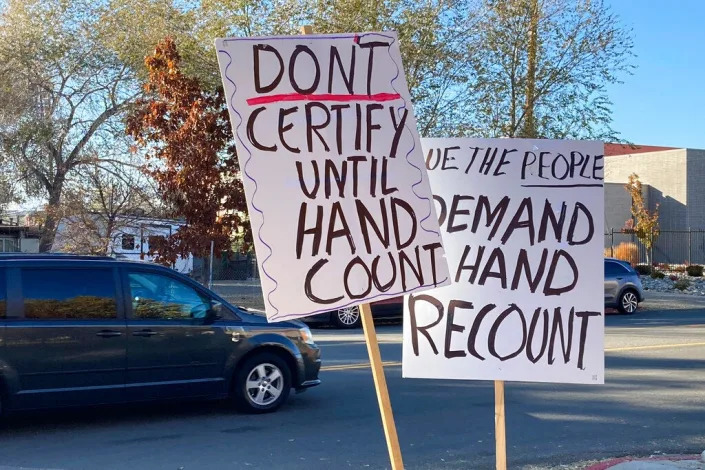
Signs are displayed outside the Washoe County Commission chambers to demand a hand count of ballots before commissioners were scheduled to canvass the vote in Reno, Nev., Friday, Nov. 18, 2022.
SANTA FE — Certification of this year’s midterm election results appears to be proceeding smoothly with little controversy across the country, with a small Arizona county being a rare exception, calming fears that local commissions consumed by talk of election conspiracies would create chaos by refusing to validate the will of the voters.
Action has been orderly even in places where suspicions about election fairness ran deep and led to bitter clashes at local public meetings.
In Nevada, a state that has been a hotbed of election conspiracy accusations and movements to ditch voting machines in favor of hand-counting all ballots, all 17 counties met a Friday-night deadline to certify election results.- ADVERTISEMENT -https://s.yimg.com/rq/darla/4-10-1/html/r-sf-flx.html
In rural Elko County, the county commission unanimously certified the results just weeks after questioning the reliability of voting machines and expressing support for hand-counting all ballots.
Commissioners praised county Clerk Kris Jakeman for a post-election audit that included random hand-counts backing up the results from machine tabulators. Some commissioners had watched the audit and said it helped relieve some of their skepticism.
“I’ve learned a lot this year,” said Commissioner Delmo Andreozzi. “And I appreciate everybody’s willingness to help educate me and help me become more aware about the whole process.”
It was much the same story in New Mexico, where several rural county commissions have been under intense pressure by some residents to reject certification since the state’s primary election in June.
In Otero County, where a crisis occurred this summer when commissioners initially denied certification after the primary, the general election results were certified this week with a drama-free unanimous vote.
“In my heart of hearts, I think Otero County does a good job,” Commission Chairwoman Vickie Marquardt said. “I have no reason not to certify this election.”
In another rural New Mexico county, where a livid crowd in June berated county commissioners as “cowards” and “traitors” as they certified the primary results, the room fell silent this week as the all-Republican board pored over vote tallies and signatures from poll judges. Commissioners peppered Torrance County election officials with questions before voting 3-0 to certify.
The commission had spent months responding to doubts about voting systems with a hand recount of the primary ballots and invitations to attend security testing of ballot-counting machines.
“I’m not seeing any discrepancies, commissioners. Are you?” Republican commission Chairman Ryan Schwebach told colleagues. He won reelection to the local post with roughly two-thirds of the vote, defeating a challenger who said vote-counting machines can’t be trusted. All but one county in New Mexico certified vote tallies this week.
Conspiracy-focused protesters rallied Friday outside an election board meeting in Reno, Nevada, with signs reading “Don’t certify before hand count” and “We the people demand hand count.” Despite the protests, the Washoe County commission voted 4-1 to certify the results.
County Commissioner Jeanne Herman, who represents the most rural part of the county, which stretches north to the border with Oregon, cast the lone dissenting vote. She made a failed attempt earlier this year to push an election reform package that, among other things, would have posted National Guard troops at polling places and relied almost exclusively on paper ballots.
Christiane Brown, a Reno gun control activist, told the commission that the system worked this year, and even most candidates who had embraced the 2020 election falsehoods conceded defeat.
“Denying results does not change them,” she said. “The people rejected lies, disinformation, intimidation and ignorance, as well as hatred. The voters spoke, the system worked, and the rule of law held.”
In Arizona, the state’s 15 counties are just beginning to certify their election results and have until Nov. 28 to do their canvass and send final vote tallies to the secretary of state. Kari Lake, the Republican who lost the race for governor, has refused to concede and in a Thursday video said she has a team of lawyers reviewing whether Election Day issues at the polls disenfranchised some voters.
Maricopa County, Ariz., ballots cast in the 2020 general election are examined and recounted by contractors working for Florida-based company, Cyber Ninjas, in Phoenix on May 6, 2021. At least one recount will be on tap in Arizona after the counting from the Nov. 8, 2022, midterm elections ends.
The two Republicans who control the board in southeastern Arizona’s Cochise County delayed their certification Friday night after hearing from a trio of conspiracy theorists who argue vote-counting machines are not certified. The board ignored testimony from the state elections director, who said the contention was false.
The board delayed the vote until the Nov. 28 deadline, saying they wanted to see proof and have the three men evaluate it. State Elections Director Kori Lorick threatened legal action “to compel compliance” and ensure that votes from about 46,000 residents were property reported.
The state is set to certify results from all 15 counties on Dec. 5, a move needed before a recount can proceed in the race for state attorney general, which is too close to call.
Under Arizona law, the only role of the elected county boards is to accept the numbers as they are tallied by their elections departments. If they refuse to do so, either the secretary of state or a candidate would sue.
Election certification emerged as an issue after the 2020 presidential election in Michigan, where Trump and his allies pressured Republicans on both the state certification board and the one for Wayne County, which includes Detroit. The results, showing Democrat Joe Biden winning the state by 154,000 votes, were eventually certified.
Detroit City Clerk Janice Winfrey said her office anticipates having no problems with certification of the Nov. 8 general election. By midday Friday, 71 of the state’s 83 counties had certified results.
“More Michigan citizens cast ballots than ever before in a midterm election, and now bipartisan canvassing boards across the state are certifying the results in accordance with state law,” said Michigan Secretary of State Jocelyn Benson. “We are optimistic that all canvassers will continue to demonstrate this level of professionalism and commitment to upholding the will of the voters.”
Sonner reported from Reno, Nevada. Associated Press writers Christina A. Cassidy in Atlanta, Ken Ritter in Las Vegas, Gabe Stern in Reno; and Corey Williams in Detroit contributed to this report.