Donald Trump’s $99 ‘Digital Trading Card’ Is The Saddest Thing I’ve Ever Seen
Sisi Jiang – December 15, 2022
A muscular Trump poses in a skintight superhero outfit.
If you or a far-right-pilled relative wants to be a mark in Donald Trump’s latest grift, you’re in luck. For the low low price of $99 and your irreplaceable dignity, you can now own an official Donald Trump NFT.
A new line of, expensive non-fungible tokens is apparently the “major announcement” Trump first teased yesterday, in a Truth Social post declaring that “AMERICA NEEDS A SUPERHERO!” The accompanying teaser video showed a brief glimpse of a muscled, Trump-like figure adorned like Superman, complete with animated lasers beaming from its eyes. And now we know: That “major announcement” is just a new line of NFTs.
I went to Trump’s account on Truth Social so that you don’t have to. The former president wrote:
MAJOR ANNOUNCEMENT! My official Donald Trump Digital Trading Card collection is here! These limited edition cards feature amazing ART of my Life & Career! Collect all of your favorite Trump Digital Trading Cards, very much like a baseball card, but hopefully much more exciting. Go to collecttrumpcards.com/ & GET YOUR CARDS NOW! Only $99 each! Would make a great Christmas gift. Don’t Wait. They will be gone, I believe, very quickly!
Aside from Trump shooting flaming lasers out of both of his eyes, other NFTs in the range feature him photoshopped awkwardly in gaudy outfits. But wait, there’s more! If you buy one of these “digital collectibles,” you could win the opportunity to meet him over dinner, play a round of golf, or speak to the ex-president over a Zoom call.
I don’t know what’s more depressing: the sheer insecurity that oozes from these NFT trading cards, or the plausibility that his cult of Republican goons might actually purchase these in droves. There’s also a chance that he’s selling this junk to fund his next presidential campaign (he formally announced his intention to run last month).
The crypto industry is rife with scammers who successfully run off with millions of dollars, so I’m actually surprised that it’s taken him this long to start peddling a “digital collectible.” I’m guessing that he didn’t have much free time while he was busy fending off four major criminal investigations. Last December, the courts ruled against the Trump Organization for tax fraud. In August, the FBI raided his club at Mar-a-Lago and discovered that he had taken documents related to nuclear weapons.The New York Attorney General recently sued the Trump family for financial fraud. Last month, Trump was subpoenaed to testify in front of the committee investigating the January 6 insurrection.
If he manages to sell 40 of these “trading cards,” then he’d be able to pay off the $4,000 he owes for being found in contempt of court on Tuesday. I wish him all the best.
DeSantis blasted for ‘Orwellian’ vaccine investigation
Alexander Nazaryan, Senior W. H. Correspondent – December 15, 2022
Florida Gov. Ron DeSantis at a news conference in Miami on Dec. 1. (Ronen Tivony/SOPA Images via ZUMA Press Wire)
One day after Florida Gov. Ron DeSantis announced a push to investigate alleged harms caused by coronavirus vaccines, Dr. Anthony Fauci, President Biden’s chief medical adviser, criticized the move as a pointless exercise that would only undermine public confidence in efforts to boost and maintain protection against the circulating pathogen.
“We have a vaccine that, unequivocally, is highly effective and safe and has saved literally millions of lives,” Fauci said Wednesday on CNN. “What’s the problem with vaccines?”
The problem is vaccines have become part of America’s polarized politics. Since the advent of COVID-19 vaccines late in the Trump administration, skepticism of the established medical science has become a kind of creed for many conservatives, as well as for some on the far left. Political disagreements about lockdowns, mask mandates and vaccine requirements have hardened into antipathy toward the vaccines themselves.
Seizing on rare adverse side effects and diminishing effectiveness — the result of new variants and low booster uptake — vaccine critics have dismissed inoculation as ineffective and potentially dangerous.
Some have also embraced outlandish conspiracy theories about vaccines as a form of government and corporate control.
Anti-vaccination activists at a rally at the Lincoln Memorial in Washington, D.C., in January. (Alex Wong/Getty Images)
During a pandemic-related hearing in the House, Rep. Jamie Raskin, a Maryland progressive, called the proposed grand jury an “Orwellian” development. “These actions are transparently designed to falsely suggest that coronavirus vaccines, and not the coronavirus itself, are dangerous,” he said Wednesday.
DeSantis, who is widely expected to seek the Republican presidential nomination in 2024, played open to those concerns on Tuesday, when he announced he would call for Florida’s Supreme Court to empanel a grand jury “to investigate crimes and wrongdoing committed against Floridians related to the COVID-19 vaccine.” He is also seeking “further surveillance into sudden deaths of individuals that received the COVID-19 vaccine in Florida.”
Such deaths are rare, according to the Centers for Disease Control and Prevention, whose vaccine surveillance statistics indicate that 17,868 people — or 0.0027% of vaccine recipients — died after their shots. Those reports unquestionably include thousands of deaths that happened after vaccination but had nothing to do with the vaccines themselves.
Vaccine skeptics have often used reports of supposed side effects — such as those to a vaccine database that does not require confirmation — to exaggerate supposed dangers. And such critics invariably downplay the fact that vaccines are exceptionally effective at stopping serious and critical COVID-19 illness, which has killed more than 6.6 million people globally.
A health care worker administers a COVID-19 vaccine at a drive-through site in Miami in December of last year. (Joe Raedle/Getty Images)
And with online misinformation and partisan politics exercising strong pressures on the American public, vaccine fears have been easily exploited, leading to low uptake among Republicans. As a consequence, heavily Republican areas have had higher death rates than Democratic ones.
In Florida, more than 83,000 people have died from COVID-19, and cases there have been rising recently. DeSantis, who has decried what he describes as “Faucism” (the echoes of “fascism” are difficult to miss), downplayed the seriousness of the pandemic from the start, though he has also been credited for opening schools and other businesses well before Democratic counterparts, some of whom remained in a cautious crouch well into 2021.
Earlier this year, DeSantis clashed with former President Donald Trump for supporting vaccination, refusing to say whether he had received a booster shot. Trump shot back by calling DeSantis “gutless.”
DeSantis has also regularly attacked Fauci in personal terms. “Someone needs to grab that little elf and chuck him across the Potomac,” he said earlier this year of Fauci, who has been the face of the pandemic for both the Trump and Biden administrations. (He was eventually sidelined by the former in favor of experts closer in line with DeSantis’s views.)
In late 2021, DeSantis hired Dr. Joseph Ladapo as Florida’s surgeon general. Ladapo has had no experience with infectious diseases and has routinely attacked vaccination and masking. “With these new actions, we will shed light on the forces that have obscured truthful communication about the COVID-19 vaccines,” Ladapo said after Tuesday’s event.
Florida’s surgeon general, Dr. Joseph Ladapo, with DeSantis looking on, in Brandon, Fla., in November 2021. (Chris O’Meara/AP)
The announcement by DeSantis comes days after new Twitter owner Elon Musk attacked Fauci on Twitter, calling for his prosecution. A supporter of DeSantis, Musk has argued that prior to his ownership, Twitter executives suppressed information on the coronavirus that presumably undermined public health messaging.
Last week, he invited Stanford’s Dr. Jay Bhattacharya — an outspoken critic of pandemic precautions — to Twitter’s headquarters. Bhattacharya, who has advised DeSantis in the past, will be on the governor’s new public safety committee, along with Dr. Martin Kulldorff of Harvard (a co-author, with Bhattacharya, of the pro-reopening Great Barrington Declaration) and Bret Weinstein, a quasi-celebrity on the so-called Intellectual Dark Web with no professional experience in vaccinology.
“I’m not sure what they’re trying to do down there,” Fauci said in the Wednesday CNN interview. Though he is about to retire after four decades of federal service, he is likely to face calls to testify from House Republicans, who continue to accuse him of making misleading statements on masks, vaccines and the origins of the coronavirus.
As his retirement has approached, Fauci has been increasingly vocal and defiant about the challenges revealed by the nation’s faltering coronavirus response, which has left more than a million people dead in the U.S.
In a New York Times essay, Fauci lamented the role that “disinformation and political ideology” have played in sowing doubt about masks, vaccines and other measures.
Dr. Anthony Fauci on Dec. 9 during a virtual event to urge Americans to get vaccinated ahead of the holiday season. (Saul Loeb/AFP via Getty Images)
Rep. Adam Kinzinger in final House floor speech says ‘limited government’ for GOP now means ‘inciting violence against government officials’
Bryan Metzger – December 15, 2022
Republican Rep. Adam Kinzinger of Illinois at a January 6 committee meeting on December 1, 2021.Stefani Reynolds for The Washington Post via Getty Images
GOP Rep. Adam Kinzinger spoke on the House floor for the last time, having declined re-election.
He condemned his own party on Thursday, saying it has “embraced lies and deceit.”
He also criticized Democrats for boosting election-denying candidates in GOP primaries this year.
Republican Rep. Adam Kinzinger of Illinois spoke on the House floor for the final time on Thursday after declining to seek re-election.
Kinzinger, a member of the January 6 committee and one of 10 House Republicans who voted to impeach former President Donald Trump for incitement of insurrection following the Capitol riot, has emerged as a key critic of the GOP from within the party.
In his farewell speech, Kinzinger declared that “our democracy is not functioning” and said Republicans have “embraced lies and deceit.” Despite not mentioning Trump by name, he made numerous references to the assault on the Capitol.
“Republicans once believed that limited government meant lower taxes and more autonomy,” he said. “Today, limited government means inciting violence against government officials.”
He also criticized the leadership of the Republican National Committee, which used the phrase “legitimate political discourse” as it moved to censure him and Republican Rep. Liz Cheney of Wyoming for their participation in the January 6 committee.
“Our leaders today belittle, and in some cases justify attacks on the US Capitol as ‘legitimate political discourse,'” Kinzinger added. “We shelter the ignorant, the racist, who only stoke anger and hatred to those who are different than us.”
Rep. Adam Kinzinger (R-IL) rebukes the GOP during his farewell address as a member of Congress:
“Today, limited government means inciting violence against government officials … The Republican Party used to believe in a big tent … Now we shelter the ignorant, the racist.” pic.twitter.com/PkeV9MR6hT
Kinzinger also criticized Democrats for helping to boost election-denying candidates in Republican primaries this year in order to produce weaker general-election nominees, a controversial tactic that some top Democrats publicly defended.
“To my Democratic colleagues, you must too bear the burden of our failures. Many of you have asked me: where are all the good Republicans? ” he said. “Over the past two years, Democratic leadership had the opportunity to stand above the fray.”
“Instead, they poured millions of dollars into the campaigns of MAGA Republicans, the same candidates Biden called a national security threat, to ensure these good Republicans did not make it out of their respective primaries,” Kinzinger continued. “This is no longer politics as usual. This is not a game.”
Dictionary.com announces word of the year: ‘woman’
Erum Salam – December 14, 2022
Photograph: Nathan Posner/Rex/Shutterstock
The website Dictionary.com has named its word of the year for 2022: woman.
In a statement, the website said: “Our selection of woman … reflects how the intersection of gender, identity and language dominates the current cultural conversation and shapes much of our work as a dictionary.”
It also said: “Searches for the word woman on Dictionary.com spiked significantly multiple times in relation to separate high-profile events, including the moment when a question about the very definition of the word was posed on the national stage.”
That was a reference to a supreme court confirmation hearing in March, when the nominee, Ketanji Brown Jackson, was asked by Marsha Blackburn, a Republican senator from Tennessee, to define the word woman.
Soon after, Jackson became the first Black woman confirmed to the court.
Searches for woman increased by 1,400% after the hearing, Dictionary.com said, the highest spike for the word this year.
According to Dictionary.com, the definition of woman is “an adult female person”.
Other key moments that led to the word being chosen included the supreme court voting to overturn Roe v Wade and thereby revoke the constitutional right to abortion; the death of Queen Elizabeth II; tennis player Serena William’s retirement announcement; freedom protests led by women in Iran; and more.
Referring to the supreme court abortion decision, Dictionary.com said: “Unsurprisingly, it resulted in both polarization and galvanization. That dynamic played out in November’s midterm elections, which upended trends and expectations.
“The outcome has been attributed in part to an electorate, and particularly women, voting in reaction to the Dobbs ruling. The election also added to the ranks of the nation’s women governors, resulting in what will be a record number of women – 12 – serving as governors in 2023.”
Dictionary.com’s senior director of editorial, John Kelly, said that to qualify as word of the year, a word must see “a significant increase in searches” and “capture the major cultural themes and trends in language” for the 12 months in question.
In 2022, shortlisted words included inflation, quiet quitting, democracy, the Ukraine flag emoji and Wordle – the last a popular word game bought by the New York Times.
In 2021, Dictionary.com named allyship as its word of the year. Previous words of the year were pandemic (2020), existential (2019), misinformation (2018), complicit (2017), xenophobia (2016), identity (2015), exposure (2014), privacy (2013), bluster (2012), tergiversate (2011), and change (2010).
“We will beat the Ukrainian out of you so that you love Russia,” a Russian interrogator told one torture survivor I spoke to in Ukraine, before he whipped her and raped her. That seems a pretty good summation of Vladimir Putin’s strategy.
It isn’t working in Ukraine, where Putin’s atrocities seem to be bolstering the will to fight back. That brave woman triumphed over her interrogators, albeit at horrific personal cost.
But I worry that we in the West are made of weaker stuff. Some of the most momentous decisions the United States will make in the coming months involve the level of support we will provide Ukraine, and I’ve had pushback from some readers who think President Biden is making a terrible mistake by resolutely helping Ukraine repel Russia.
A woman named Nancy protested on my Facebook page that I was more interested in securing Ukraine’s border than the American border. She argued that we should focus on our own challenges rather than Ukraine’s.
“We’re over our head in debt but funding a war that we shouldn’t be involved in,” she said. “Enough is enough.”
Polls find American support for aid to Ukraine still robust but slipping, especially among Republicans. And almost half of Americans want the United States to push Ukraine “to settle for peace as soon as possible,” even if it loses territory — a finding that must gladden Vladimir Putin’s heart.
The exhaustion with Western support for Ukraine may continue to gain ground in the coming months as people grow weary of high energy prices and, in the case of some European countries, possible rolling power cuts.
So let me make the case, to Nancy and others, for why we should continue to provide weaponry to Ukraine.
The fundamental misconception among many congressional Republicans (and some progressives on the left) is that we’re doing Ukraine a favor by sending it weapons. Not so. We are holding Ukraine’s coat as it is sacrificing lives and infrastructure in ways that benefit us, by degrading Russia’s military threat to NATO and Western Europe — and thus to us.
“They’re doing us a favor; they’re fighting our fight,” Wesley Clark, the retired American general and former supreme allied commander of NATO forces in Europe, told me. “The fight in Ukraine is a fight about the future of the international community.”
If the war ends in a way favorable to Russia, he argues, it will be a world less safe for Americans. One lesson the world would absorb would be the paramount importance of possessing nuclear weapons, for Ukraine was invaded after it gave up its nuclear arsenal in the 1990s — and Russia’s nuclear warheads today prevent a stronger Western military response.
“If Ukraine falls, there will certainly be a wave of nuclear proliferation,” Clark warned.
For years, military strategists have feared a Russian incursion into Estonia that would challenge NATO and cost lives of American troops. Ukrainians are weakening Russia’s forces so as to reduce that risk.
More broadly, perhaps the single greatest threat to world peace in the coming decade is the risk of a conflict in the Taiwan Strait that escalates into a war between America and China. To reduce that danger, we should help Taiwan build up its deterrent capacity — but perhaps the simplest way to reduce the likelihood of Xi Jinping acting aggressively is to stand united against Russia’s invasion. If the West falters and allows Putin to win in Ukraine, Xi will feel greater confidence that he can win in Taiwan.
Putin has been a destabilizing and brutal bully for many years — from Chechnya to Syria, Georgia to Moldova — partly because the world has been unwilling to stand up to him and partly because he possesses a powerful military force that Ukraine is now dismantling. Aside from energy, Russia’s economy is not substantial.
“Putin and Russia are weak,” Viktor Yushchenko, a former Ukrainian president who challenged Russia and then was mysteriously poisoned and disfigured, told me. “Russia is a poor country, an oil appendage to the world, a gas station.”
The world owes Ukraine for its willingness to finally stand up to Putin. If anything, I’d like to see the Biden administration carefully ratchet up the capabilities of the weaponry it supplies Ukraine, for it may be that the best way to end the war is simply to ensure that Putin finds the cost of it no longer worth paying.
I don’t mean to suggest that everyone backing peace negotiations is craven, fatigued or myopic. Gen. Mark Milley and other Pentagon officials are understandably worried that the Ukraine conflict could spiral out of control into a nuclear war. That’s a legitimate concern, and it’s always good to peer through the fog of war for off-ramps. But bowing to nuclear blackmail and rewarding an invasion would create their own risks for many years to come, and on balance those dangers seem greater than those of maintaining the present course.
In arguing for the West to stand with Ukraine, I’ve emphasized our national interest in doing so. But we have values at stake as well as interests, for there is also a moral question to face.
When one nation invades a neighbor and commits murder, pillage and rape, when it traffics in thousands of children, when it pulverizes the electrical grid to make civilians freeze in winter — in such a blizzard of likely war crimes, neutrality is not the high ground.
Let’s not let Russia beat the Ukrainian out of us: The world could use a spinal transplant from brave Ukrainians.
Nicholas Kristof joined The New York Times in 1984 and has been a columnist since 2001. He has won two Pulitzer Prizes, for his coverage of China and of the genocide in Darfur.
Trump and his MAGA political movement are done. Republicans need their version of Biden.
Rex Huppke, USA TODAY – December 14, 2022
If we’ve learned anything from the past three national elections it’s this: Donald Trump and his “MAGA movement” have nothing to sell but crazy, and Americans aren’t buying it.
The 2022 midterm elections should’ve been a Republican blowout. They weren’t – at all – and it’s clear voters cared little about bizarre 2020 presidential election conspiracies and wanted nothing to do with fearmongering over drag queen shows or whatever other weird nonsense the MAGA-dominated Republican Party was peddling.
Add to that the GOP failures in the 2018 midterms and in the 2020 presidential election and it’s safe to say anyone who thinks Trump carries a popular message is allergic to popularity.
Less than half of Republicans – 47% – now want him to run again, down considerably from July, when 60% wanted Trump to take another shot at the White House.
Don’t get your hopes up that GOP sanity will prevail
Before you spend a moment thinking the party faithful are breaking toward sanity, consider this from USA TODAY’s report on the same poll: “By 2-1, GOP and GOP-leaning voters now say they want Trump’s policies but a different standard-bearer to carry them. While 31% want the former president to run, 61% prefer some other Republican nominee who would continue the policies Trump has pursued.”
Florida Gov. Ron DeSantis signs his “Stop Woke” bill in Hialeah Gardens on April 22, 2022.
So rather than blame the message – which clearly doesn’t resonate with the masses – many Republican voters are blaming the messenger. And who is their next-in-line choice? Florida Gov. Ron DeSantis, a guy who, like Trump, has made snarling cruelty his brand by focusing on culture war issues like “critical race theory” and “wokeness,” all while scapegoating LGBTQ kids and painting school teachers as malevolent forces of liberal indoctrination.
No, no, no. Here’s a tip, Republicans. You don’t need a Trump-esque figure like DeSantis. You need your own version of Joe Biden.
Let me explain.
Cruelty just ain’t the political calling card it was back when Trump won
DeSantis’ war on “wokeness” and his faux-tough-guy stunt flying migrants to Martha’s Vineyard appeals to a narrow band of American voters, people who get a kick out of meanness and “owning the libs.”
That’s effectively what Trump did, and while he caught lightning in a bottle and won the 2016 presidential election, he and that whole jerk-ish attitude have been broadly rejected ever since:
People cheer as former President Donald Trump announces a third run for president as he speaks at Mar-a-Lago in Palm Beach, Fla., Tuesday, Nov. 15, 2022.
Kari Lake tried it in the Arizona gubernatorial race. She lost.
Herschel Walker tried it in the Georgia U.S. Senate race. He lost.
Doug Mastriano tried it in the Pennsylvania gubernatorial race. He lost.
‘We choose sanity over chaos’
Katie Hobbs, the Democrat who won the Arizona governor’s race, put it perfectly in this recent tweet: “In this election, we chose solving our problems over conspiracy theories. We chose sanity over chaos. We chose unity over division.”
A crowd of supporters of former president Donald Trump on Nov. 15, 2022, in West Palm Beach, Fla.
Voters chose sanity, as they did in the previous two election cycles. The noise and rancor and outrage that nourishes the 24-hour conservative media ecosystem resonates only in that bubble. Elsewhere, people don’t want bullies and fabulists. They want reasonable people who might actually stand a chance of getting something done.
Biden wasn’t many Democrats’ first choice, but …
In the 2020 Democratic presidential primary, liberal voters coalesced around Biden not because he was everyone’s favorite candidate but because he provided a sane counter to Trump. Democratic voters knew Biden would likely appeal to independents, who are often key to winning.
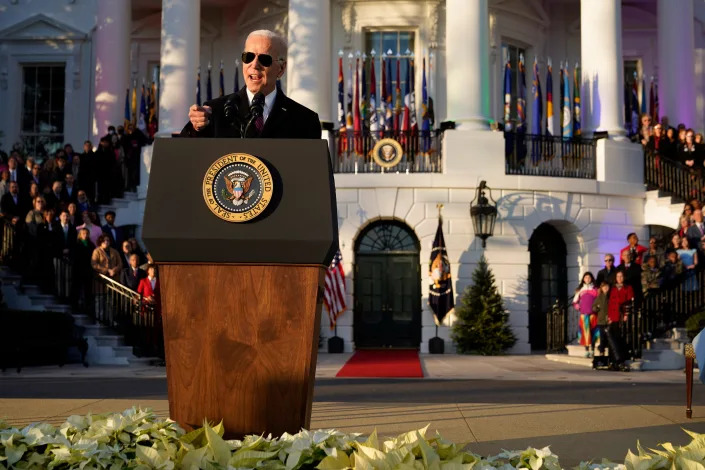
President Joe Biden speaks during a bill signing ceremony for the Respect for Marriage Act on Dec. 13, 2022.
They were right. Biden won not by being some supercandidate or having a pop-culture-driven cult of personality. He ran by being the adult in the room.
Go on, Republicans! Go get yourself a RINO to return you to relevancy!
So if Republicans want a chance at appealing to a broader electorate, they need to find their own Biden. And it sure as heck isn’t an uncharismatic grump like DeSantis.
At the peak of Trump’s popularity with the Republican base, he would regularly lambaste members of his own party – like Rep. Liz Cheney and Sen. Mitt Romney – as RINOs, or Republicans In Name Only. It was stupid, of course – Cheney and Romney are closer to true conservatives than Trump could ever hope to be.
But if that’s how a RINO is defined by today’s Republican Party, then the party desperately needs to find itself a RINO to run for president.
R.I.P. MAGA. You will not be missed, not even a little.
Trumpism, the MAGA movement or whatever you want to call it has been thrice rejected. Younger voters in particular are repelled by culture-war fearmongering.
So Republicans need to offer more than bitterness toward liberals and performative acts of spite. Americans have clearly had it with pugilistic frauds.
The party that has developed an almost cult-like devotion to hating Biden and spinning him and his family into perverse conspiratorial narratives needs to recognize that nobody outside noisy social-media circles gives a hoot about Hunter Biden’s laptop.
In a fine bit of irony, the thing Republicans who loathe Joe Biden need right now, more than anything, is not Trump, not the MAGA movement and not Ron DeSantis.
It’s to find themselves a Joe Biden they can call their own.
At Lake Powell, a ‘front-row seat’ to a drying Colorado River and an uncertain future
Brandon Loomis, Arizona Republic – December 13, 2022
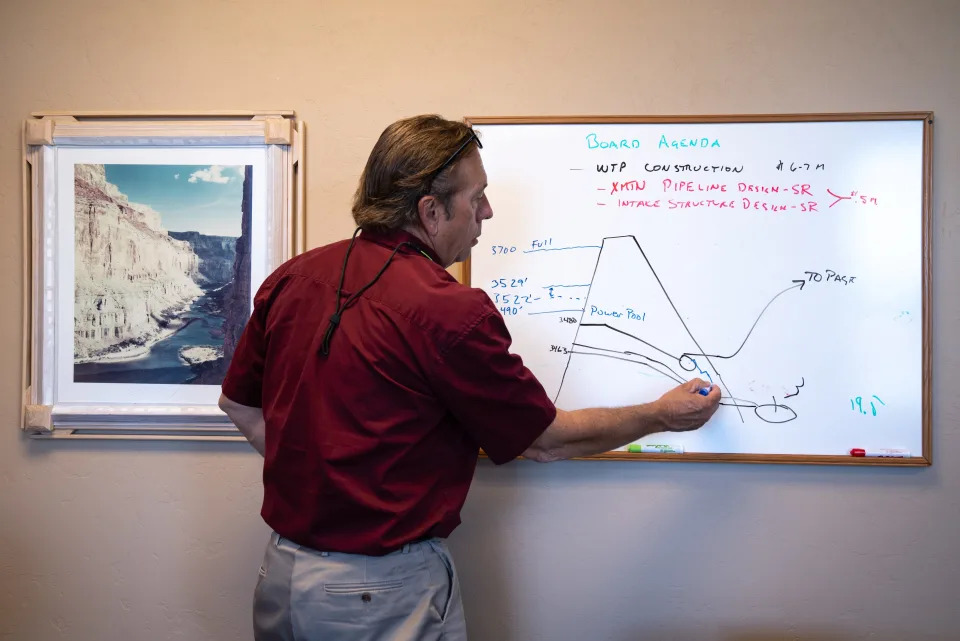
PAGE — At his office whiteboard on this dam town’s desert edge, the water utility manager recited the federal government’s latest measures of the colossal reservoir that lay 4 miles down the road, then scrawled an ominous sketch showing how far it has shrunk.
In his stylized drawing of Lake Powell, the surfacelapped just above where he marked his town’s drinking water pipe, bringing the Colorado River drought crisis uncomfortably close to home.
Against a diagram of Glen Canyon Dam’s concrete arch, Bryan Hill used blue marker to ink progressively shallower water lines from 22 years of Southwestern drought and overuse: 3,700 feet above sea level when full. Just 3,529 feet now.
He was updating a presentation he had created to reassure a worried City Council that it was merely time to act, not to panic. That day’s line fell just 39 feet above a black one Hill had drawn to indicate the dam’s hydropower intakes, the point at which the last of 1,320-megawatts flickers off.
As personal as the threat feels to Hill and his neighbors, his charts depicted a troubling reality for millions of other water users. If the lake keeps dropping below those generator intakes, dam managers will have difficulty pushing enough water downstream to keep Lake Mead from tanking and to satisfy the Southwest’s legal rights to water.
Lake Mead’s own decline threatens to upend a vast irrigated agricultural empire in Southern California and southwestern Arizona, and to restrict or eventually cut off a significant source of hydroelectricity and household water for the urban Southwest.
Powell once seemed Mead’s failsafe backup, a reservoir that, in a wet string of years, could accumulate far more than what the river delivers in a single year. During dry spells, it could pour its excess through Grand Canyon and into Mead, supplying users downstream.
Now the excess was gone. Hill’s drawing showed a reservoir on the brink after two decades of aridification, holding less water than it is supposed to send downstream in the coming year. Further declines could lend momentum to a long-simmering clamor for moving most or all of Powell’s stored water down to Mead.
If the snows that melt to replenish the reservoir are lower than expected this winter, the dam’s managers warn, it’s possible that water will dip below Glen Canyon Dam’s hydropower intakes by the end of 2023.
Page and a neighboring Navajo Nation community, Lechee, get their water from those same intakes, constructed at an elevation that government dam builders in the 1950s and ‘60s expected to remain forever inundated.
Bryan Hill, general manager of Page Power u0026 Water, draws the Glen Canyon Dam and Page’s water supply issues on a whiteboard on May 25, 2022, in his office. Page and neighboring Lechee get water from Lake Powell.
It was late May when Hill stood at his whiteboard, and snowmelt from the Rocky Mountains had started coursing down the Colorado to provide the storage pool a temporary, seasonal lift from its most recent record low. Still, the intakes sat just 39 feet below a surface that already had fallen 148 feet since the same date in 2000. After trees, plants and parched soil took their share, this spring’s runoff was shaping up poorly again. One more dry winter, Hill predicted, and “shit gets real.”
Page won’t go dry, for now. Its 7,500 residents and another 3,000 in Lechee will draw water from an emergency pipe link that federal officials are designing and connecting to tap deeper tunnels that allow managers to bypass the hydro powerplant when necessary or desired, such as for environmental flows downstream in Grand Canyon.
Even those tunnels are at risk of drying in coming years. Soon, the region’s accelerating aridification will force Page, like the vast irrigated farms and growing metropolises throughout the Southwest, to dig deeper for a solution.
A houseboat is anchored on Clear Creek at Lake Powell on Aug. 16, 2022. The future of Lake Powell, including its recreation opportunities, is uncertain after years of decreasing water levels.
Already, southern Nevada has spent $817 million to build a deeper tunnel under Lake Mead — a new “straw” into the reservoir — to keep water flowing to Las Vegas.
There are 40 million people who rely on the Colorado River water stored here, and millions more who eat the vegetables, beef and winter greens that it grows. They all face hazards on the desiccated horizon. For the few thousand who live on a red-rock bluff by the plunging reservoir, it’s in full view.
“It’s an American problem,” Hill said. “We just have a front-row seat.”
Those who love free-flowing rivers see this problem as an opportunity. Their canyon is returning, and with it the rapids and awe-inspiring rock features. Others fear the price spikes that will come with replacing the dam’s hydropower with other sources, or the loss of a motorized playground that provided thousands of jobs for decades.
As the Southwest braces for a worsening water crisis, one of its major holding tanks faces a growing identity crisis. Nature will have the final word in determining what Powell becomes, further draining it if drought worsens or refilling it if a wet period ensues. If recent trends hold, federal water managers face tough decisions in the next few years about how hard to fight to retain a shrunken lake at Page, and at what cost to other resources and users up and down the river.
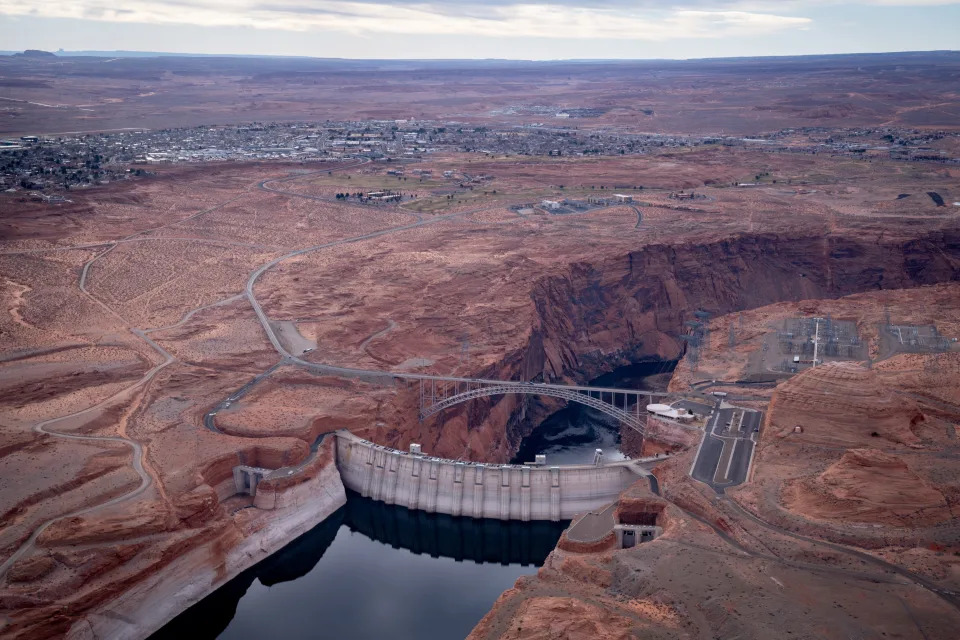
Glen Canyon Dam and Page as seen on Feb. 3, 2022. Page was founded in the late ’50s as housing for those working on Glen Canyon Dam.
Drought weakens Lake Powell’s promise
Controversial from the start, 59-year-old Glen Canyon Dam arose as a compromise of sorts. Its construction sacrificed a secluded maze of desert river and side canyons after the U.S. rejected plans to flood other treasures, sparing places like Utah’s Dinosaur National Monument. After the dam buried Glen Canyon, environmental concerns ended a scheme for more dams in Arizona’s Grand Canyon, whose “grandeur,” “sublimity” and “great loneliness” President Theodore Roosevelt had famously cautioned could not be improved upon.
The government built Glen Canyon Dam in large part to ensure that exactly what is happening in 2022 would not happen. With Hoover Dam already impounding the nation’s largest reservoir in Lake Mead near Las Vegas, the river was ready to supply water to farms and cities in Arizona, Nevada, California and Mexico.
A second reservoir upstream at Lake Powell would almost double that capacity, theoretically ensuring that the headwaters states — Wyoming, Colorado, Utah and New Mexico— could store enough water there near the Utah-Arizona line to top Lake Mead off when needed.
Instead, Lake Mead’s decline has already triggered mandatory shortages for the Central Arizona Project and the Southern Nevada Water Authority, with deeper cuts in store for next year. Arizona will give up about a fifth of its normal share of the river in 2023, deepening the hardship for farmers in the middle of the state and reducing cities’ ability to store water in their aquifers for later use.
California’s senior water rights have so far protected it from reductions. Arizona decades ago accepted junior rights as a condition of congressional approval for the CAP canal that delivers water to Phoenix and Tucson.
When the states and federal dam operators split up shares of the river on paper in the 20th century, they gave 7.5 million acre-feet of water to the three states below Lees Ferry, a spot downstream of present-day Glen Canyon Dam, and an equal share to four states that share the upper Colorado and its largest tributary, the Green River. That would add up to 15 million acre-feet, with a few million more dedicated to evaporation and Mexico. Yet in this century, the river’s natural flow has averaged far less than was spoken for, just 12.4 million acre-feet.
An acre-foot — the amount it takes to cover an acre to a 12-inch depth — is the government’s water accounting unit and contains about 326,000 gallons. Each acre-foot can support two or three households, though a large majority of the Colorado’s water goes to farms.
Now, mighty Lake Powell, big enough to fit 25 million acre-feet on its own, is just a quarter full. Dam managers made emergency releases from smaller upstream dams earlier this year to prop up the reservoir, and also held back 480,000 acre-feet that otherwise would have flowed to Lake Mead.
On paper, the government decided to treat those 480,000 acre-feet as if they were already in Lake Mead, to keep that reservoir’s official holdings from triggering even greater austerity on downstream users. Winter weather will determine whether Powell can afford to let that water flow downstream next year and still produce power.
For next year, an official with Reclamation’s Upper Colorado Basin office said, the agency will work with states on a plan to release more from upstream reservoirs and to determine what administrative steps are necessary to continue releasing only 7 million acre-feet a year from Powell, if necessary, an amount made possible by the cutbacks in Arizona, Nevada and Mexico.
In announcing next year’s shortage, Reclamation officials said the conservation efforts throughout the Colorado River basin must increase by 600,000 to 4.2 million acre-feet a year, depending on weather, to stabilize the reservoirs at current levels over the next four years. That worst-case figure, 4.2 million, represents more than a third of what the river’s flow has averaged during the long drought. It’s almost as much as California, the biggest user, takes from the river.
It’s unclear where such a large savings could be found, though the region’s Democratic senators won $4 billion in climate legislation passed this summer. It could help pay for efficiency upgrades and to compensate farmers who agree not to use their full share of the river.
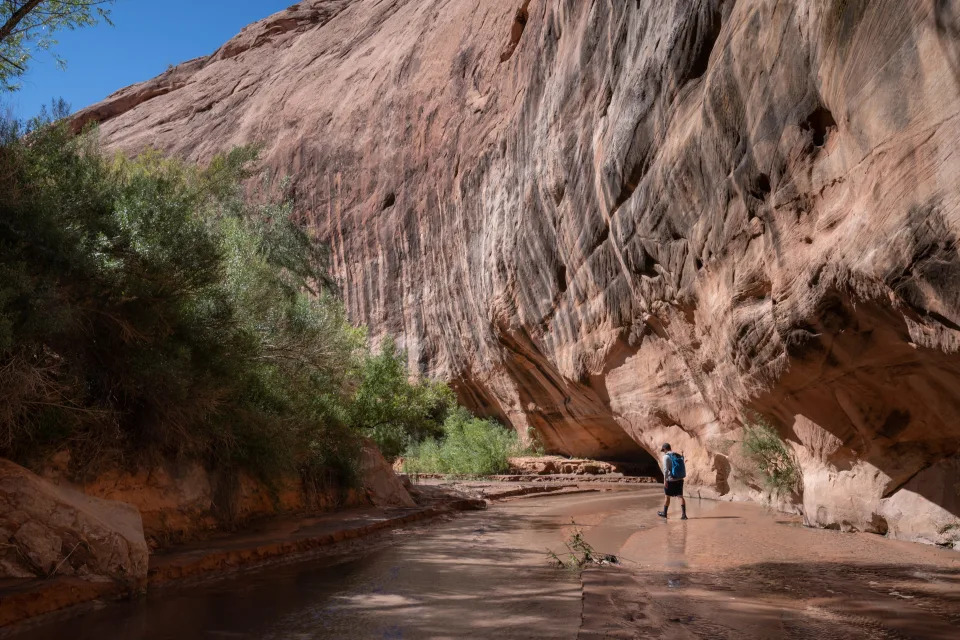
Eric Balken of the Glen Canyon Institute hikes up Lake Canyon on Aug. 16, 2022. This area in Lake Canyon was under water for approximately 20 years and now has been dry for approximately 20 years, due to declining lake levels. The area has seen a resurgence of vegetation, like Goodding’s Willow.
‘I’m not the one draining this’
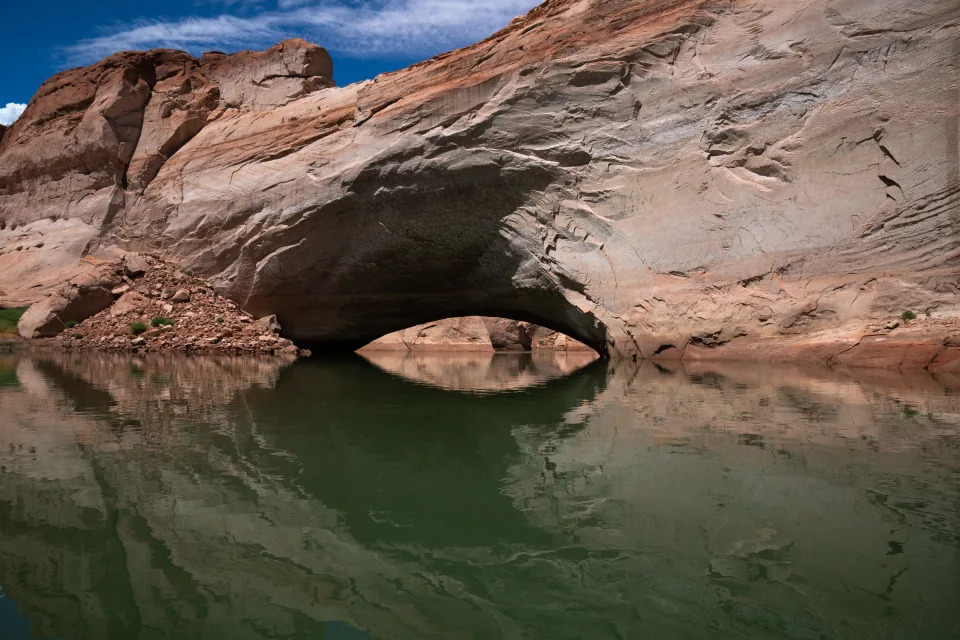
As the receding waters expose canyons, rock features and even whitewater rapids that long were buried under the reservoir, some who love the river for itself see nature reclaiming its rightful place.
“You can hear it,” Utahn Eric Balken said as he tromped through dense cattails and creekside willows during his first inspection of the reemerging Slick Rock Canyon, one of many remote watershedsnotched into Glen Canyon’s sandstone. “There’s lots of bugs buzzing around. I was stepping over frogs left and right.”
Discoveries like these thrill Balken, who directs the nonprofit Glen Canyon Institute. His organization has long advocated draining Lake Powell and storing its water downstream in the similarly depleted Lake Mead. Now, he figured, nature was doing his work for him. He and allies believe Lake Mead was always enough to serve the region’s needs, and that it makes little sense to divide the water now that it’s so low.
Indian paintbrush grows in Lake Canyon on Lake Powell. As water recedes, plants and animals are returning to canyons that were once under water.
Motoring out of Bullfrog Marina in mid-August, he said he tries to keep a low profile when boating from canyon to canyon, given how attached house boaters and water skiers are to their impounded playground. Soon, though, it may not matter what anyone wants for Lake Powell.
“Guess what?” Balken said. “I’m not the one draining this.”
Slick Rock, south of Halls Crossing, now supported multiple beaver dams and ponds, but also held disappointments for Balken. Tumbleweeds choked the zone nearest the retreating reservoir, while a nonnative grass vine crisscrossed the creek bed and threatened to outcompete the native flowers and grasses seeking a foothold. There are remnants of a dam-altered floodplain that he hopes will fade as nature takes over.
A notch to the north, Lake Canyon, yielded unequivocal joy for Balken the next morning. He throttled his boat up the meandering sandstone canyon and past a slalom of ghostly gray cottonwoods that still jut from the flatwater that buried them in the 20th century. He drove a sand spike into the beach to secure the boat, marched through a wall of briars and over a logjam deposited by recent flash flood, then emerged into an open canyon with a flowing stream.
Soon, a rushing waterfall echoed from the canyon walls and pitched muddy water from its bedrock perch like a monsoon deluge draining from a flat-roofed adobe.
Walking up on resurrected features like this, or on rock grottos or natural bridges elsewhere around Lake Powell, feels a bit like discovering Atlantis, long rumored to exist under the sea but buried under the waves for ages. The upper reaches of Lake Canyon’s dam-flooded zone first saw daylight again some 20 years ago, but this particular waterfall remained inundated until more recently.
Gregory Natural Bridge at Lake Powell pictured on Aug. 15, 2022. Until recently, this natural bridge was entirely under water.
Even after the water retreated, Balken and colleagues three years ago walked across lakebed sediments that still entombed it. Flash floods apparently blew out those deposits to expose the falls, which in turn blew his mind when he first saw it and heard its power.
“I love to see a creek finding its original bed,” he said.
More consequential treats awaited as he ascended the canyon this time. Atop the falls, 15-foot willows sprang out of a cutbank and rang with birdsong, evidence that the native vegetation and rust-colored canyon wrens can quickly return here.
Around elevation 3,650 feet, a mark that first reemerged some 20 years ago, some willows reached to 40 feet. Then came the cottonwoods, towering kings of the desert oasis, first one seedling at a time, then in tall clusters at higher elevations, and finally in dense ribbons of forest. Underfoot, purple wildflowers sprouted. Cicadas droned.
In the 1950s and ‘60s, when Reclamation Commissioner Floyd Dominy pushed for and finished the dam, Balken said, the dam builder had argued there was nothing of value to preserve there. Indeed, into his old age early in this century, Dominy asserted that he had improved the environment.
“I believe that nature can be improved upon,” he told High Country News in 2000, when Powell was nearly full and only academics used the term “megadrought.”
“This is a miracle,” Balken said in Lake Canyon’s recovery zone. “Our values have clearly evolved. Clearly, there is something here.”
But one canyon’s gain may be another’s loss.
Eric Balken of the Glen Canyon Institute walks up a sediment deposit hill at Cathedral in the Desert on Aug. 15, 2022, at Lake Powell.
Jack Schmidt traveled to a park in Moab, Utah, on a June evening to explain the Colorado’s woes to a few dozen interested Utahns and Canyon Country visitors. Schmidt is a Utah State University watershed scientist who has spent his career studying the river, and he leads a band of regional researchers who publish science and policy white papers through the Center for Colorado River Studies. To his eyes, Glen Canyon’s reemergence is both locally beautiful and regionally troubling.
“Don’t kid yourself into thinking the only environmental issue is everything wonderful in Glen Canyon popping up again,” Schmidt said to the crowd assembled on folding lawn chairs for a weekly Science Moab discussion and movie viewing. (The post-apocalyptic sci-fi “Waterworld” was the flick that week.)
During the Obama administration he served as head of the Grand Canyon Research and Monitoring Center for 3 ½ years, and before that he proposed what would become a series of artificial floods from Glen Canyon Dam to push sand downstream and offset some of the dam’s profound damage to the Grand Canyon’s ecology.
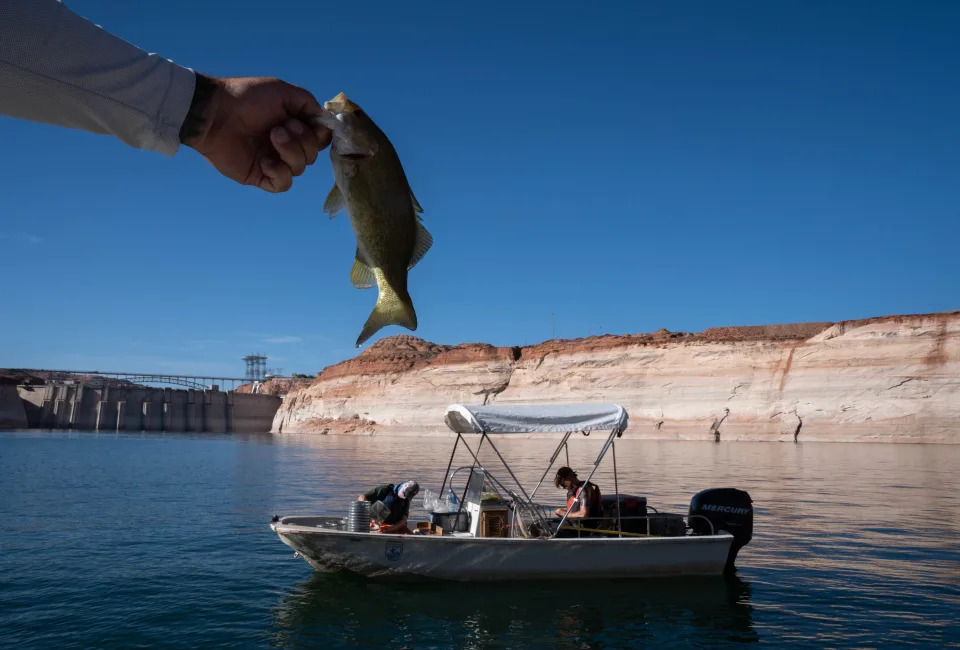
But Schmidt had another threat to Grand Canyon on his mind. Smallmouth bass were massing just upstream of Glen Canyon Dam, where the declining water levels brought the lake’s relatively warm surface close to the hydropower intakes. If enough bass or other nonnative, warm-water sportfish slipped through the turbines to start a downstream population, they could menace a recovering population of native humpback chubs.
Paul McNabb holds a small mouth bass, while Utah State University researchers record fish species during a survey on June 9, 2022, above Glen Canyon Dam on Lake Powell.
If that happens, he said, it’s “game over” for a fish that has swum Grand Canyon for millennia.
On that summer evening in the park, Schmidt urged his listeners to demand action if they care about saving the river environment. The United States must address two seemingly intractable problems, he noted: climate change and overuse.
Bullfrog Marina at Lake Powell pictured on June 15, 2022.
The challenges of climate and overuse
Scientists have explained the long-term crisis that a warming Rocky Mountain region is imposing on the Southwest as a “hot drought.” As the region warms, even snowpacks that seem healthy while piled up in the mountains can result in a trickle into reservoirs after the atmosphere, stressed trees and dry soils soak up their share.
A 2017 study by scientists at the University of Arizona and Colorado State University found that warming exacerbated the current drought to reduce annual flows by about a fifth, and that unabated greenhouse gas emissions through this century could push losses to a third or more of the river’s normal flow.
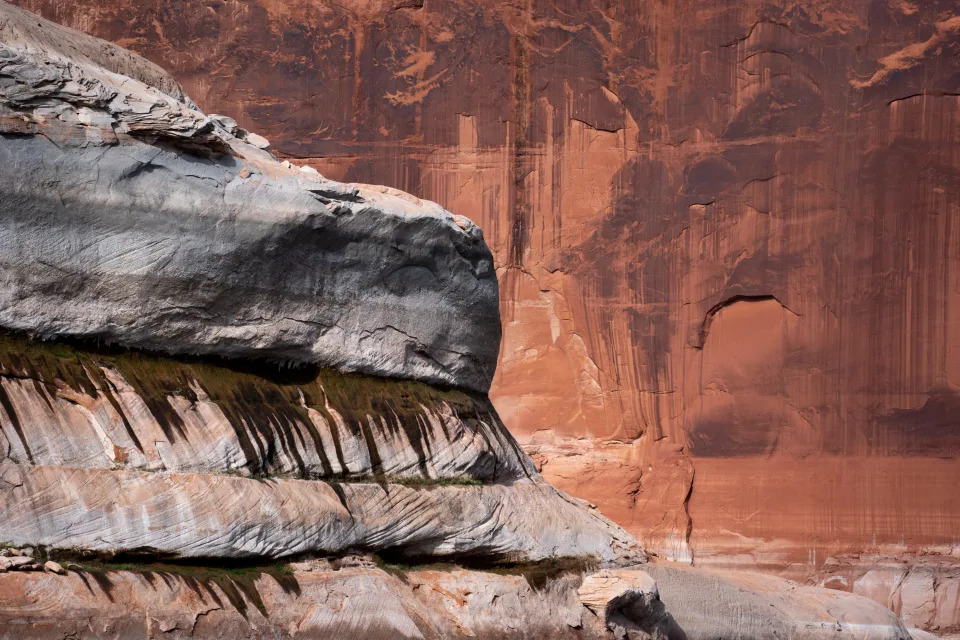
Lake Powell near Bullfrog Marina pictured on Aug. 15, 2022. Previous water levels are visible on the walls surrounding the lake.
The Bureau of Reclamation itself warned a decade ago that climate change would eat into the river. Its projections of a 9% reduction in flows by mid-century underestimated what has already happened to the river.
“The important point,” Schmidt told his audience that day in Moab, more than 300 miles from his home campus, “is I shouldn’t have driven down here from Logan in a gas-guzzling van and loaded the atmosphere with carbon, I guess.”
The second problem, overuse, is more immediate. In recent years, the dam-stored equivalent of the entire, shrunken river’s flow has gone to supply California, Arizona, Nevada and Mexico, including evaporation in Lake Mead. Although the less-populous upstream states of Wyoming, Utah, Colorado and New Mexico take much less, the combined effect is depletion of reservoirs that once held several years’ worth of flows.
Schmidt’s solution, he would later tell The Arizona Republic, is to reengineer Glen Canyon Dam to allow it to spill water into the river and through Grand Canyon even after it sinks lower than the existing hydropower intakes and bypass tunnels. That might require drilling new and lower tunnels through the sandstone beside the dam. At least, he said, the government must study that option, because without it the drought could push the reservoir into “dead pool,” when a river no longer flows from it until more snowmelt arrives to buoy the surface.
“We should know what it costs to bypass,” Schmidt said.
On that, Schmidt and Glen Canyon preservationists like Balken agree. The Glen Canyon Institute this summer joined the Utah Rivers Council and Great Basin Water Network in calling on the Bureau of Reclamation to study such a plan that would, effectively, allow managers to drain Powell while leaving the dam in place.
The Colorado River (right), pictured on June 11, 2022, near Hite, Utah. The sediment delta and Lake Powell’s low water levels have cut off Farley Canyon (bottom left) and White Creek Canyon (top left) from the river and what used to be Lake Powell.
But Schmidt would not drain the lake. Instead, he said, lower bypass tunnels would allow the government to decide how much storage Lake Powell needs in order to consistently send water downstream based on Grand Canyon’s environmental needs. It would still hold back water, but in dry times Lake Mead would need to handle the bulk of the Southwest’s storage needs. Reengineering the dam could cost tens or hundreds of millions of dollars, depending on the design. The Bureau of Reclamation has directed $2 million toward a study of options.
“There’s no way in this country we’ll eliminate the potential storage at Powell,” Schmidt said. The question is how often it will be actual storage, and how often mostly potential.
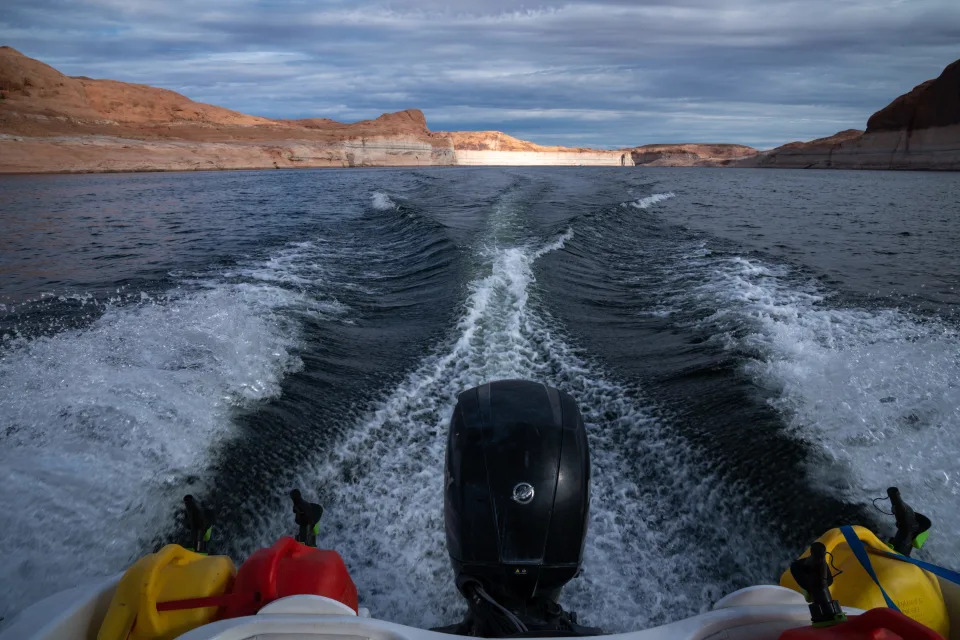
A boat cruises on Lake Powell near Bullfrog Marina on Aug. 15, 2022. Boat ramps have had to be extended multiple times as water levels receded at Lake Powell.
Tough choices for recreation
The National Park Service has spent several million dollars extending concrete boat ramps at Stateline in the south of Lake Powell and Bullfrog in the north, to enable continued access for houseboats. But that work likely won’t be enough to support the park’s congressional mandate to manage for boat recreation, and so the agency is planning a bigger investment.
The Bullfrog Marina ramp can handle houseboats only until the reservoir’s surface sinks below elevation 3,529 feet, park officials said in August. By then the spring snowmelt runoff had helped the lake rebound past that point, precisely where it had hovered when Hill had drawn it on his whiteboard in March.
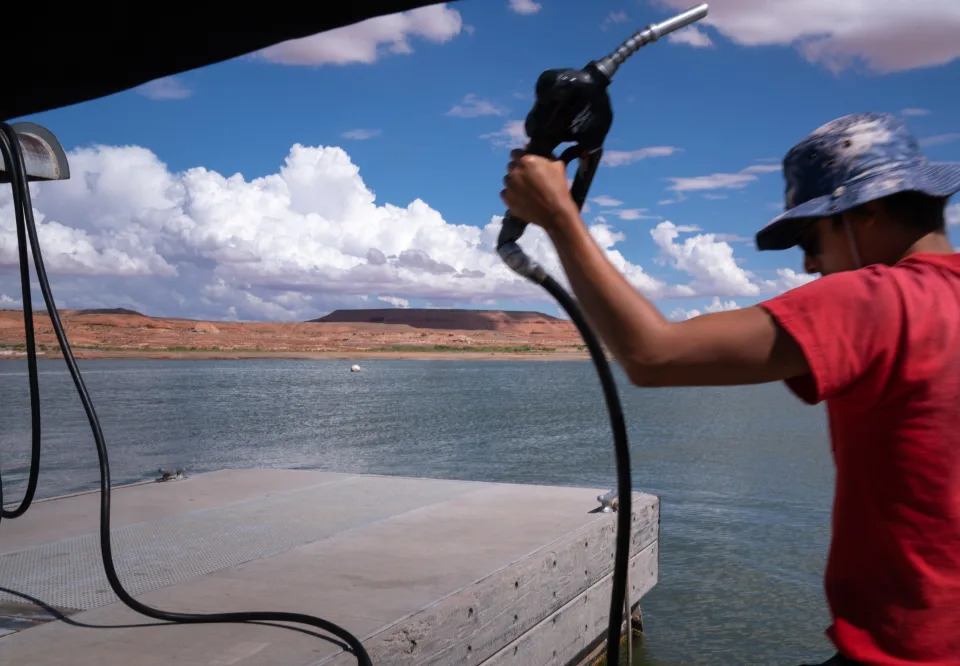
A Bullfrog Marina employee fuels a watercraft at Lake Powell on Aug. 16, 2022. The marina was scheduled to be moved into the Colorado River main channel because of declining water levels.
The Bureau of Reclamation’s current projections show Lake Powell likely dropping back below that mark in September but rising to it again by next June. Seeking a longer-term solution, the Park Service is applying $26 million in federal disaster funding it received this year toward building a new ramp at Stanton Creek, a nearby but deeper part of the lake that could reach elevation 3,450 feet. That would enable boating well after the reservoir drops below the point of generating electricity.
The uncertainty is forcing boaters to make hard choices. Tom Parker, a semi-retired contractor from Erda, Utah, wasn’t sure whether to haul his houseboat out from its mooring at Bullfrog as the season winds down. He wanted to get it on dry land to scrape off the quagga mussels that crust over the hull, the engine and water intakes. But with the reservoir continuing to fall, he wasn’t sure he could risk it.
“If you get it out, you might not get it back in. That’s the problem,” he said while lining up on the ramp on a mid-August morning.
Parker was launching personal watercraft for his children and grandchildren to zoom around on during a stay on the houseboat. That’s something he’s done routinely over the years, as someone from his extended family visits the boat at least every other week in summer. Some even work remotely from it now that there’s a satellite internet link.
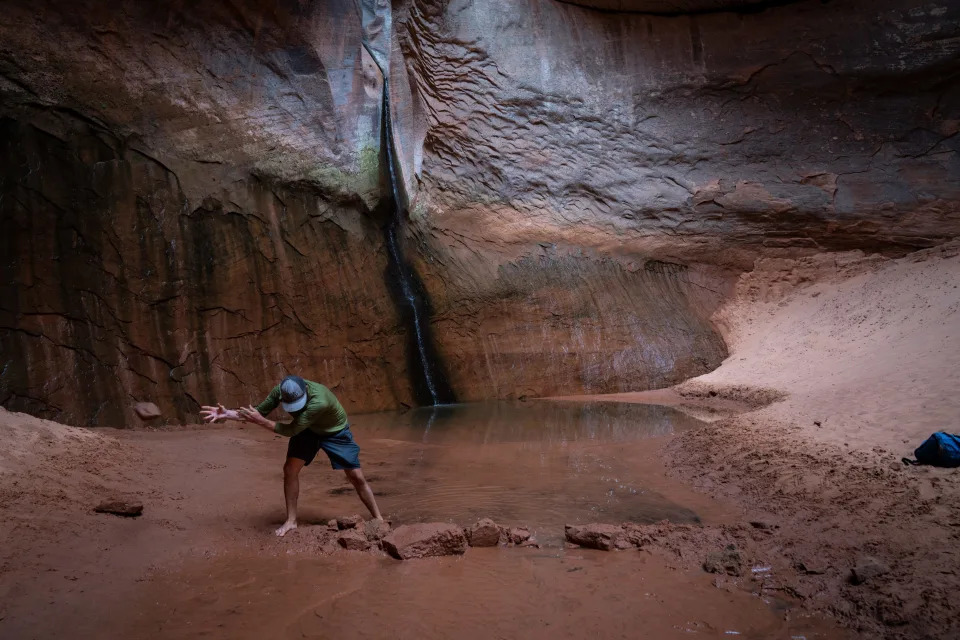
Eric Balken of the Glen Canyon Institute dismantles a rock dam at the base of the waterfalls at Cathedral in the Desert on Aug. 15, 2022, at Lake Powell.
‘You can’t improve on nature’
Balken, the activist who longs for the reservoir’s demise and the river’s return, acknowledges that lots of people love lake recreation. Before them, though, there were those who loved the river and loathed what became of it after the dam. They include people he has known, like the late singer and renowned river guide Katie Lee, who didn’t live to see Glen Canyon’s return, and Ken Sleight, also a pre-dam guide and one who still yearns for the death of “Lake Foul.” Balken said he’s motivated partly by “the pain of their loss.”
Eric Balken of the Glen Canyon Institute rests at Cathedral in the Desert on Aug. 15, 2022, at Lake Powell. This area, known for its beauty, was buried when Lake Powell filled.
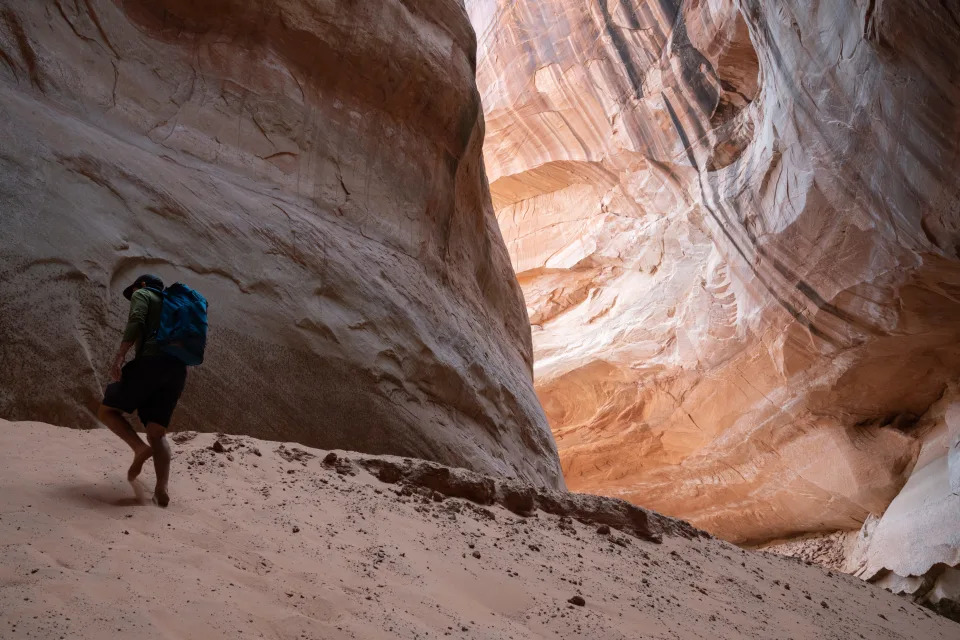
One of their losses was Cathedral in the Desert, a shady sandstone grotto in a side canyon that admits a beam of sunshine to backlight a ribbon of water falling through a narrow slot. It was a place Sleight discovered while guiding tourists out of Escalante, Utah, on horseback before Lake Powell flooded it. Today, it’s back from the depths.
When Balken approached its sandy base in bare feet this summer, he found a row of rocks that someone had placed as a dam across the stream at its base, perhaps to raise a pool for bathing beneath the falls. He promptly chucked the rocks aside.
“You can’t improve on nature,” he said.
At home outside of Moab, Sleight looked at freshly shot digital photos of his beloved Cathedral in the Desert, and at new images of other side canyons. Their rebirth pleased him, but had taken too long.
“I don’t think I’ll be doing any more river running,” he said. “I wish I could.”
Ken Sleight pictured on Aug. 17, 2022, in Moab, Utah. The guide inspired a character in author and friend Edward Abbey’s book u0022The Monkey Wrench Gang.u0022
Sleight spoke softly and haltingly while sunken into his sofa, worn down from days of waging his own struggle with the fickle climate. A wildfire last year denuded the hills above his home, and recent monsoon rains had rushed over the bare ground and washed out small bridges on his property. He and wife, Jane, had been busy with repairs.
In younger days, the guide had befriended author Edward Abbey partly out of a shared disdain for the dam, and he had inspired a character, Seldom Seen Smith, in Abbey’s signature novel, “The Monkey Wrench Gang.” He still invokes his late friend’s prayer “for a precision earthquake to take down the dam,” but says he doubts it will now take an act of God to drain the reservoir.
“I’m 93 now and I don’t have too much time to live,” he said, “but I’m sure hoping I can live long enough to see it go.”
If the Colorado does flow freely through Glen Canyon again, he fears, there will be a new threat: people. Even before the dam, he remembered, the place had become crowded for his taste. A renewed Glen Canyon will require careful management, he believes. “It’s going to attract thousands, because it’s so beautiful.”
North Wash boat ramp, June 10, 2022, on the Colorado River, near Hite, Utah.
Amid new beauty, dangers lurk
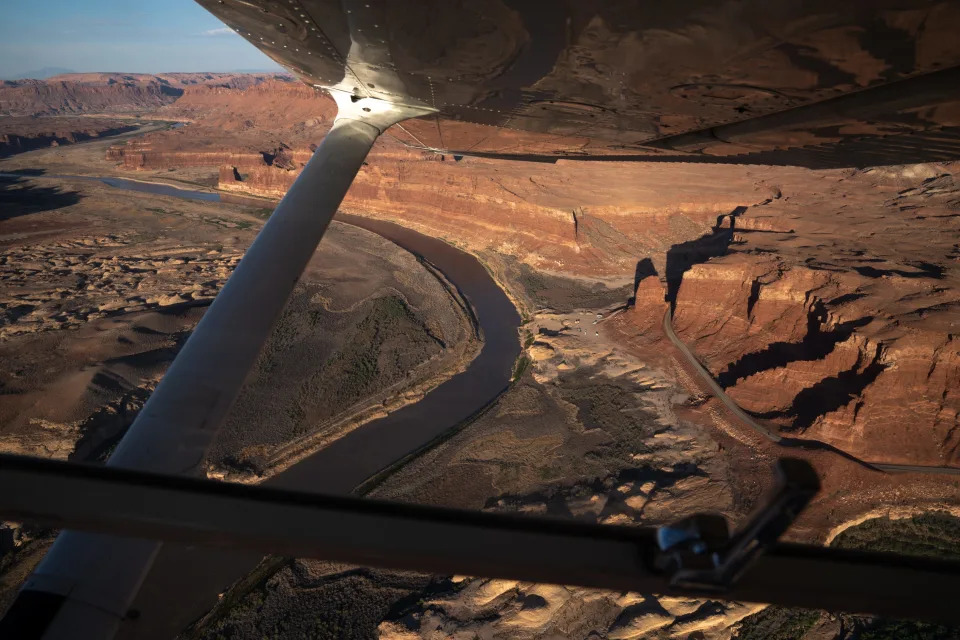
From an airplane over Lake Powell’s upper reaches, the folds and crevasses of mud resemble a dirty glacier plowing through the Colorado Plateau.
As the reservoir retreats from the floodplain’s edge, where for decades the river dropped sediment it had eroded from points upstream, the accumulation slumps raggedly away from sandstone walls as a fault line would in an earthquake.
This is no flightseeing tour of geologic time, exhibiting Earth’s grindingly slow mechanics as they carve Canyon Country’s latest wonder. It is instead a real-time window on the fast-moving consequences of a changing, drying regional climate and the Southwest’s slow response to it as Lake Powell drains toward oblivion.
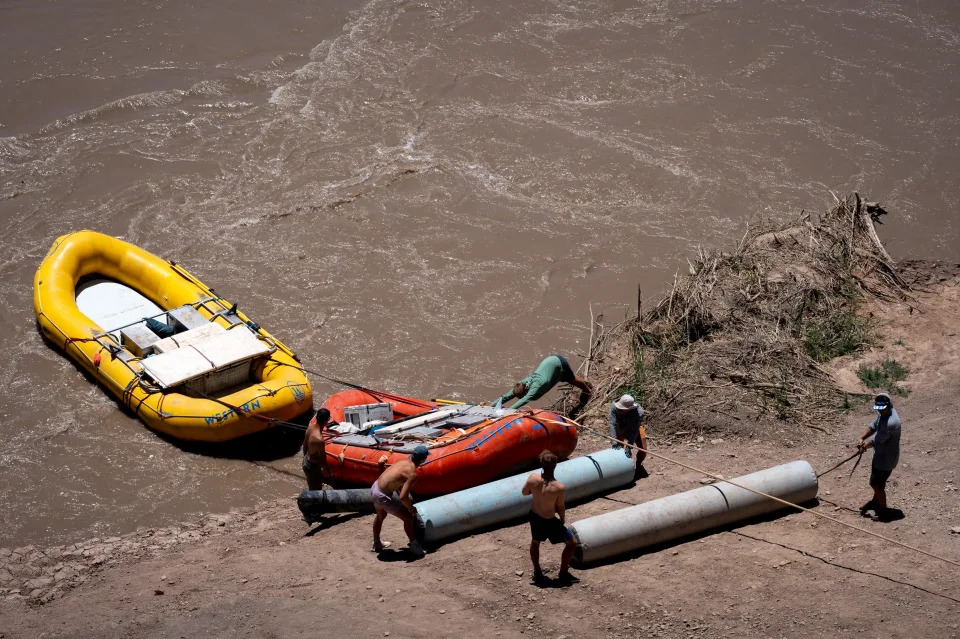
A Western River Expeditions raft is taken off the Colorado River at North Wash boat ramp near Hite, Utah, on June 10, 2022.
River rafters paddling or motoring down from Moab years ago were forced to abandon the Hite takeout ramp on the narrow upper lake’s east side, in favor of an intimidating gravel incline called North Wash on the west side. The makeshift ramp has steepened as the bank at its bottom continues to slough, making for a difficult retrieval of the big, motor-equipped rafts that tour company guides pilot down from Moab daily in summer.
After customers step out and walk toward a waiting bus, a pickup with a trailer backs gingerly down the top of the embankment and sets its brake. Guides from multiple boats then push and pull the rafts uphill on inflatable rollers. The combination of massive loads on the hill and deep muddy waters at the bottom requires vigilance.
“It’s scary,” Hannah Wood, a seasonal Moab-based guide from northern Utah’s Salt Lake valley, said when she arrived at North Wash after a June trip. “Every time we come here I’m worried someone will die.”
Wood said a colleague had fallen at the ever-changing takeout’s edge, and had cut himself on the raft’s motor. While the rapids upstream in Cataract Canyon are supposed to be the trip’s big thrill, she said, takeout at this site is “the most dangerous part of our job.”
A boat cruises on Lake Powell near Bullfrog Marina on Aug. 15, 2022. Lake Powell was at 25% of capacity and more than 160 feet below full pool.
The only other place to take out is at Bullfrog Marina, a two-day motor across flatwater. But even that has become problematic for operators of larger rafts, as the shifting and shallow mud beneath the delta that’s emerging downstream of North Wash can trap the heavy rigs.
The river also appears to be building a waterfall over a sediment deposit upstream of the North Wash takeout, threatening further complications.
The same thing happened hundreds of miles downstream when Lake Mead drained away from the lower Grand Canyon. There, a waterfall made Pearce Ferry the final takeout chance for Grand Canyon river trips.
Already, North Wash is “probably the worst boat ramp in North America,” Moab river runner and pilot Chris Benson said while looking down from a rented four-seat Cessna Skyhawk that’s usually used to give rafting patrons a look at Canyonlands National Park on the way back to their cars in Moab.
The North Wash boat ramp (center, right of river) on the Colorado River, near Hite, Utah, pictured on June 10, 2022. The way Lake Powell has receded has limited takeout points for river rafters.
Benson’s friend, river guide Pete Lefebvre, pointed to a muddy riffle upstream of the ramp, near where the Dirty Devil River meets the Colorado, fresh evidence of a fast-changing landscape. “That wasn’t there two days ago,” he said.
Benson and Lefebvre are amateur “investigators” with a small nonprofit group of river enthusiasts called Returning Rapids. They photograph and share changes in the river and lake environment as the water recedes. Their work can help other recreationists navigate new hazards, but increasingly they also want government officials to take notice. As the reservoir’s northern edge creeps downstream, they say, the river is pushing its mud delta farther south.
Mike DeHoff (right), with the Returning Rapids Project, points out the sediment delta on a map of the Colorado River at Swanny City Park in Moab, Utah, on June 10, 2022,
This mud is what the group considers the “tailings” from the region’s “mining” of the Colorado River: The West used up the water and left a mess more than a hundred feet deep. They call these deposits the “Dominy Formation,” in honor of the late dam builder.
Farther downlake, the San Juan River, a major tributary that joins the reservoir, has pushed its delta closer to Lake Powell’s main channel. When that happens, possibly in a few years, they fear the band of mud could at least temporarily cut Lake Powell in two, creating a new set of hazards.
Who will mind the mud? How will it affect recreation, the environment and safety? To date, there’s no plan.
“Are we making a conscious decision?” Lefebvre said. “Or are we just saying, ‘Oh, that’s Lake Powell. That’s just what happens.’”
A Western River Expeditions raft is taken out of the Colorado River at North Wash boat ramp, near Hite, Utah, on June 10, 2022.
Worried as they are about the mud, Returning Rapids members are unabashedly joyful about what else the reservoir’s decline is giving them. It’s in their name: the whitewater rapids that are rising again from lower Cataract Canyon, the river stretch that is no longer inundated.
Eleven rapids have returned, clearly visible from the air and adding about 50% more fun to the 22 that the float trip previously offered. Lefebvre points them out from above, each the result of a side canyon whose drainage has poured boulders into the Colorado over the ages. Several of them have emerged alongside sandy camping beaches of the sort that river runners covet.
“Good for us!” Lefebvre said.
At North Wash, where Wood was helping offload rafting clients and trailer the rafts in June, one client said he had a blast on his multiday river trip, but worried about what Lake Powell’s plunging waterline portends.
“In 20 years the Colorado River won’t be here,” said Jeff Dudek, a tourist from Prairieville, Louisiana, “unless something drastic happens.”
Will hydropower survive the crisis?
Glen Canyon Dam pictured on Feb. 1, 2022. There are 40 million people who rely on the Colorado River water stored here
More than 4 million Americans who buy Glen Canyon Dam’s power also stand to lose as the water recedes. Consumer-owned utilities from Arizona to Wyoming, including Native American entities like the Navajo Tribal Utility Authority, will need to add new and likely costlier sources to their mix.
Supplemental sources could include solar, pumped-storage hydro projects or even small, modular nuclear plants, said Leslie James, who directs the Colorado River Energy Distributors Association. If Glen Canyon loses all of its power-generating capacity, it would shut off the primary revenue source that pays for the dam’s operations and maintenance. The dam accounts for $119 million of the $150 million that electric generation pumps into a basin fund that also aids environmental initiatives on the river.
Looking at the government’s current projections for flows and reservoir levels, she fears Glen Canyon water will dip below the minimum level for power production by 2024.
Before then, James hopes, a bill proposed by Sen. Mark Kelly, D-Ariz., could help limit the pain. Kelly’s bill would keep the government from collecting standard operations and maintenance or dam financing fees from hydropower customers when the dam isn’t actually churning out electricity because of drought.
Improved forecasting technology could help the Bureau of Reclamation fine-tune releases from upstream reservoirs such as Navajo or Flaming Gorge to maximize their effect. Ultimately, though, the river’s hydropower users are at nature’s mercy.
“It needs to rain and snow,” James said.
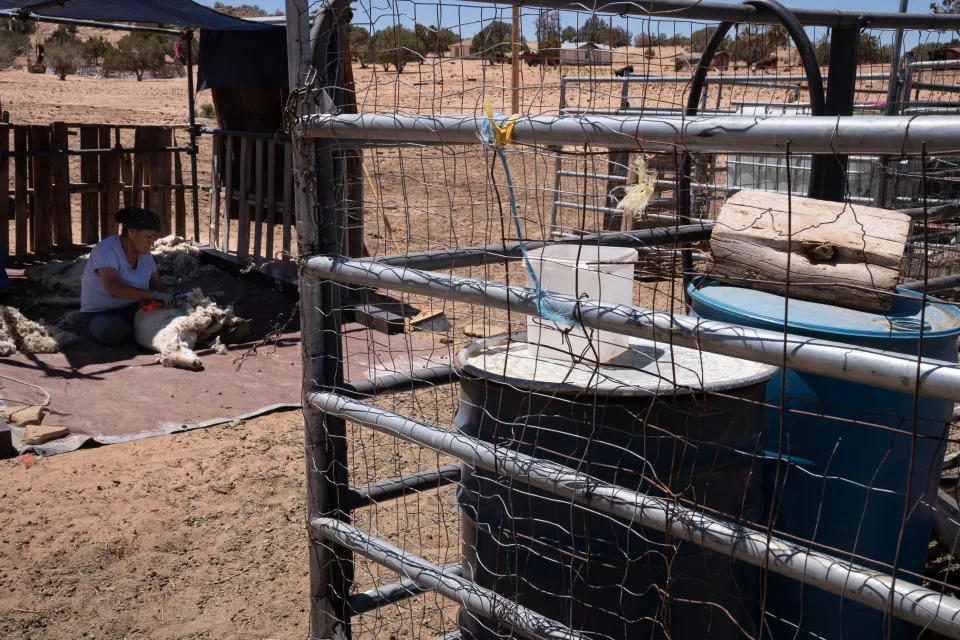
Michael and Marjorie Bigman shear sheep in their camp near Coppermine on the Navajo Nation on May 24, 2022. The Bigman’s haul water from Pageevery other day, for their sheep, goats, cattle and horses.
Learning to live with less
At the Navajo community of Lechee, outside of Page, coping with drought is a way of life. The houses, many of them mobile homes, have brown yards. Rural residents beyond the village have cut back on sheep and cow herds, partly to offset the cost of hauling water and partly because there’s little grass for the livestock to eat.
And yet, like Page, Lechee exists as a population center because of Lake Powell and access to its water.
Jimmy Shaw of White Mesa fills the 55-gallon barrels in the back of his truck at the Marathon water station in Page on May 26, 2022. Shaw hauls water for his sheep, goats and cattle.
“My parents remember when it was just a little bitty stream, before the dam came,” said JoAnne Yazzie-Pioche, who heads local government as the Lechee chapter president. Navajos made do with groundwater pumped by windmills, and did not build their homes next to each other.
Then Page tapped the dam, and Lechee got access to water piped from the same intake. With that, some congregated around the village water tower, while others remained in rural homes but trucked water from a filing station in town. They brought water to maintain livestock, but are now culling herds because of both the expense of hauling and the drought-stricken forage.
Watching Lake Powell’s decline has been painful for Yazzie-Pioche, for multiple reasons.
For one, her dad was a laborer who helped build Glen Canyon Dam during her childhood. She frequently boated and camped on the lake for recreation while raising her own children, back when the monolith Lone Rock on the lake’s south end was surrounded by water.
“We love Lake Powell,” she said, though her children have grown and moved to metro Phoenix, and the lower water has reduced the draw for her personally. “It’s sad to see. And not a whole lot of beaches. But still, people do come.”
Her community, like neighboring Page, is hoping for a new water source that draws from deeper than the dam’s hydropower intakes. The Navajo Nation has begun work on a pipeline from the pump upstream of the dam that supplied cooling water to the now demolished coal-fired Navajo Generating Station.
Even before it comes online, the plunging water line is raising questions about this new source’s viability.
“We’re just like, ‘Great. We finally have access to Lake Powell on this side, on the (Navajo) Nation’s side, but the water’s going down,” Yazzie-Pioche said.
The Southwest must learn to live with less, she said, from the lawns of Phoenix to the farms of Yuma. Whatever happens along the Colorado, though, there will still be windmills around Lechee.
“We’re always going to be here,” she said. “We were here prior. Even when we had no water, people still lived here.”
Marjorie Bigman shears a sheep on May 24, 2022, near Coppermine on the Navajo Nation.
Page was not there before the big water. It was founded in the 1950s to house the workers who built Glen Canyon Dam. They came to improve on nature.
“The federal government built Page,” said Hill, the city’s utility director. ‘Yea verily,’ in 1957 they said, ‘There shall be Page.’”
It was a proclamation with echoes across the Colorado River’s 1,450-mile length, not least along the federally backed projects importing water to Phoenix and Los Angeles.
What the government created, Hill said, the government should fix. Page needs a new and deeper intake beyond the quick fix that the Bureau of Reclamation is planning within the dam. A new intake outside of the dam would protect the city’s supply of drinking water even if drought pushes the lake to “dead pool,” lower than the dam’s bypass tunnels. But it will cost $40 million, he said. The city is angling for federal funds to build it.
Whatever identity Lake Powell ultimately assumes, the costs will ripple far beyond its waters.
Brandon Loomis covers environmental and climate issues for The Arizona Republic and azcentral.com.
Environmental coverage on azcentral.com and in The Arizona Republic is supported by a grant from the Nina Mason Pulliam Charitable Trust. Follow The Republic environmental reporting team at environment.azcentral.com.
Chinese Rocket Stage Now a Cloud of Orbital Debris After Disintegrating in Space
Passant Rabie – December 13, 2022
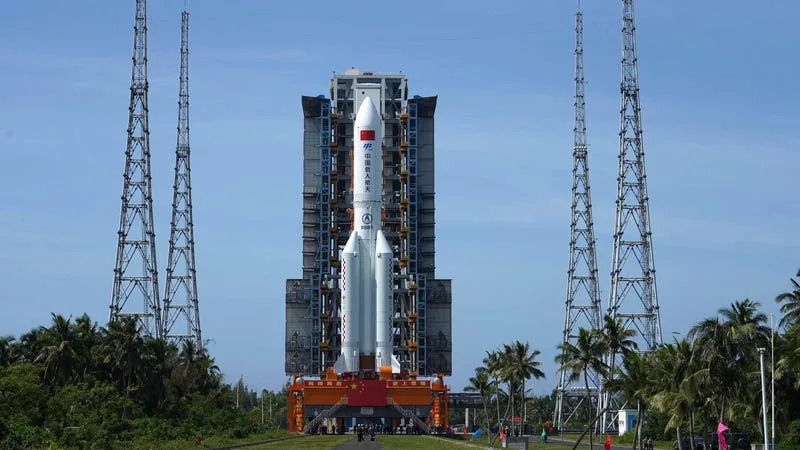
China’s Long March-5B Y3 rocket carried the Wentian lab module to China’s space station in July.
On November 12, China’s Long March 6A rocket broke apart after launch, scattering debris in low Earth orbit. Now, reports suggest that the disintegrated upper stage of the rocket has grown to a cloud of 350 pieces of space debris.
The rocket launched at 5:52 p.m. ET on November 11 from Taiyuan Satellite Launch Center in north China, carrying the Yunhai 3 environmental monitoring satellite.
Shortly after delivering the satellite to low Earth orbit, the upper stage of the Long March 6A rocket broke apart, the South China Morning Post reported at the time. The U.S. Space Force’s 18th Space Defense Squadron tracked 50 pieces of space debris resulting from the rocket’s break up at an estimated altitude of 310 miles to 435 miles (500 to 700 kilometers), the squadron announced on November 13.
Nearly a month later, experts are still tracking the disintegrated pieces from the rocket. “There are now 350 debris objects cataloged from the Nov 12 disintegration of a Chinese rocket stage (CZ-6A Y2), in sun-sync orbit,” Jonathan McDowell, an astronomer at the Harvard-Smithsonian Center for Astrophysics, wrote on Twitter based on ongoing tracking by the Space Defense Squadron.
China has been reckless with its rockets before, but the Long March 6A rocket breakup wasn’t meant to happen. The rocket’s upper stage was supposed to reenter Earth’s atmosphere in one piece, and burn up during reentry. It’s not clear what went wrong to cause the rocket to break up before its reentry.
The rocket breakup sent debris flying near Starlink’s internet satellites, but Chinese officials are claiming that pieces of the rocket will not threaten other low Earth orbit assets. “As far as we know, the relevant incident will not affect the Chinese space station or the International Space Station,” Mao Ning, spokesperson for China’s Foreign Ministry, is quoted in the South China Morning Post as saying during a press conference.
As of last year, more than 27,000 pieces of space debris were being tracked in orbit by the Department of Defense’s global Space Surveillance Network, with lots of smaller pieces also floating around undetected.
How nuclear fusion works, and why it’s a big deal for green energy that scientists made a ‘breakthrough’
Paola Rosa-Aquino – December 12, 2022
Engineers work at the National Ignition Facility in California’s Lawrence Livermore Laboratory.David Butow / Contributor
Scientists produced a nuclear fusion reaction that created a net energy gain, preliminary results suggest.
The Department of Energy is expected to make an official announcement about the finding on Tuesday.
Fusion energy advocates say it’s a step forward in clean, cheap, and almost limitless electricity.
Scientists have reportedly made a “breakthrough” in their quest to harness nuclear fusion.
The US Department of Energy is expected to make an official announcement regarding the milestone in fusion energy research on Tuesday, the the Financial Times reported.
For the first time, researchers created a nuclear fusion reaction that produced more energy than they put into it, FT and the Washington Post reported.
The experiment, conducted within the last two weeks at Lawrence Livermore National Laboratory in California, generated 2.5 megajoules of energy, 120% more than the 2.1 megajoules put into creating it, FT reported, citing preliminary data.
“Scientifically, this is the first time that they showed that this is possible,” Gianluca Sarri, a physicist at Queen’s University Belfast, told New Scientist. “From theory, they knew that it should happen, but it was never seen in real life experimentally.”
What is fusion energy and why is it a big deal?
This illustration shows how lasers heat a target to the necessary conditions for nuclear fusion to occur.Lawrence Livermore National Laboratory
Nuclear fusion works by forcing together two atoms — most often hydrogen — to make a heavier one — like helium.
This explosive process releases massive amounts of energy, the Department of Energy explains. Fusion is the opposite of fission, the reaction that powers nuclear reactors used commercially today.
Fusion occurs naturally in the heart of the sun and the stars, providing these cosmic objects with fuel.
Since the 1950s, scientists have been trying to replicate it on Earth in order to tap into what nuclear energy advocates suggest is clean, cheap, and almost limitless electricity.
According to the International Atomic Energy Agency, fusion generates four times more energy per kilogram than the fission used to power nuclear plants, and nearly 4 million times more energy than burning oil or coal.
What’s more, unlike fossil fuels, fusion doesn’t release carbon dioxide — the greenhouse gas that’s the main driver of climate change — into the atmosphere. And unlike nuclear fission, fusion doesn’t create long-lived radioactive waste, according to the Department of Energy.
A view of Leningrad Nuclear Power Plant, in Leningrad, Russia on September 14, 2022.Sezgin Pancar/Anadolu Agency via Getty Images
But so far, nuclear fusion hasn’t solved our energy problems on a grand scale.
What Tuesday’s ‘breakthrough’ announcement means for the future
Tuesday’s announcement is likely a huge step forward in nuclear fusion energy, but applying the technology at commercial scale is likely still years away.
Chanda Prescod-Weinstein, a theoretical physicist, pointed out that the process the Department of Energy uses requires tritium, a rare and radioactive isotope of hydrogen.
“It may yet yield important information that is ultimately transformative. We don’t know yet,” Prescod-Weinstein tweeted on Monday. “Being able to do this once a day with a laser does not at all mean that this mechanism will scale!”
What is nuclear fusion, and could it power our future?
Haley Ott – December 12, 2022
What is nuclear fusion, and could it power our future?
Scientists, governments, and companies from around the world have been increasingly investing in a potential source of energy that could provide unlimited, clean power to everyone on Earth: nuclear fusion. Fusion is the process that powers the sun and the stars. It’s the opposite of nuclear fission, the process used in today’s nuclear power plants, which splits atoms apart.
U.S. Department of Energy was expected to announce in mid-December a major breakthrough in the quest to harness the power of nuclear fusion. The Financial Times reported that scientists at the government-run Lawrence Livermore National Laboratory (LLNL) in California had managed for the first time ever to create more energy in a fusion reactor than was required to drive the process — a “net energy gain.”
U.S. Rep. Ted Lieu, a California Democrat, said if confirmed it “could be a game changer for the world” in the bid to create sustainable electricity.
The interior of the Joint European Torus (JET) tokamak in the United Kingdom is shown with a superimposed plasma. / Credit: EUROfusion
In fusion, two atomic nuclei are combined to create a heavier nucleus, and the process releases energy. The reaction takes place in a state of matter called plasma, which is distinct from liquids, solids or gasses.
In the sun, nuclei collide at hot enough temperatures to overcome the electric repulsion that would normally keep them apart. When they are very close together, the attractive nuclear force between them becomes stronger than the electric repulsion, and they are able to fuse. The gravity of the sun ensures that nuclei are kept close enough together to increase their chances of colliding.
If humans can harness the power of fusion on an industrial scale, it could help create a virtually limitless source of clean energy on earth, with the power to generate four million times more energy than burning coal or oil, according to the U.N.’s International Atomic Energy Agency.
Scientists believe fusion plants would be much safer than today’s nuclear fission plants — if the process can be mastered.
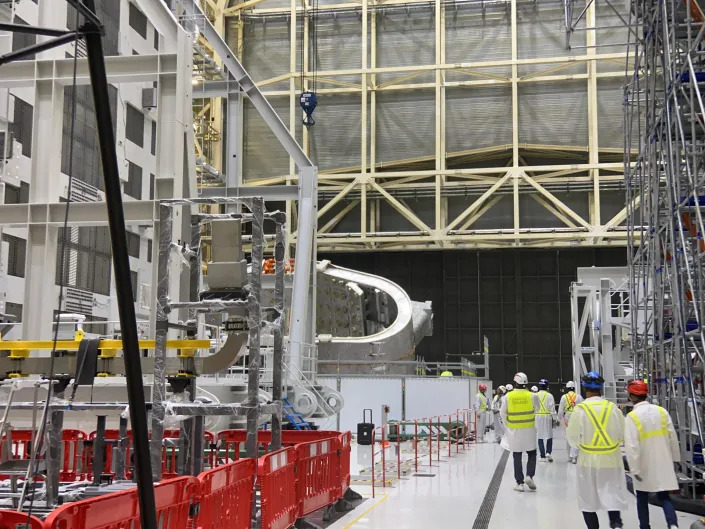
Parts of the ITER tokamak are prepared for assembly, August 3, 2022. / Credit: Haley Ott/CBS News
“It can’t run away. It’s a very difficult reaction to sustain; it needs to be driven. Whereas fission can run on a chain reaction, and it has to be controlled,” Tim Luce, the head of science at ITER, told CBS News.
Fusion also creates much less radioactive byproduct than fission, and what it does leave behind is “not water soluble — they won’t get into the food supply, the water supply,” Luce said.
Some concepts for fusion reactors being developed today will use two types of hydrogen atoms, deuterium and tritium, for fuel.
Deuterium can be easily and cheaply extracted from sea water. Tritium, which does not exist abundantly in nature, could potentially be produced by a reaction between fusion-generated neutrons and lithium. It is also a byproduct of the nuclear fission process used in power plants around the world today.
Scientists have already managed to produce fusion reactions, but not without using more energy to trigger the process than they were able to produce through it.
Assuming scientists are able to achieve “net energy” — producing more energy than they use to create the fusion reaction — other things will still need to fall in place for fusion to become a secure, viable energy source for the world.
“We must also prepare the path broadly for fusion commercialization, going well beyond R&D,” Dr. Scott C. Hsu, lead fusion coordinator in the Office of the Undersecretary for Science and Innovation at the U.S. Department of Energy, said in a Senate hearing last month.
“This includes public engagement and energy justice, diverse workforce development, a regulatory framework that engenders public trust and supports timely deployment, market identification, attracting investment and commercialization partners, export controls, nuclear nonproliferation, cybersecurity, international coordination, building critical supply chains and manufacturing capabilities, and waste disposition,” Hsu said.