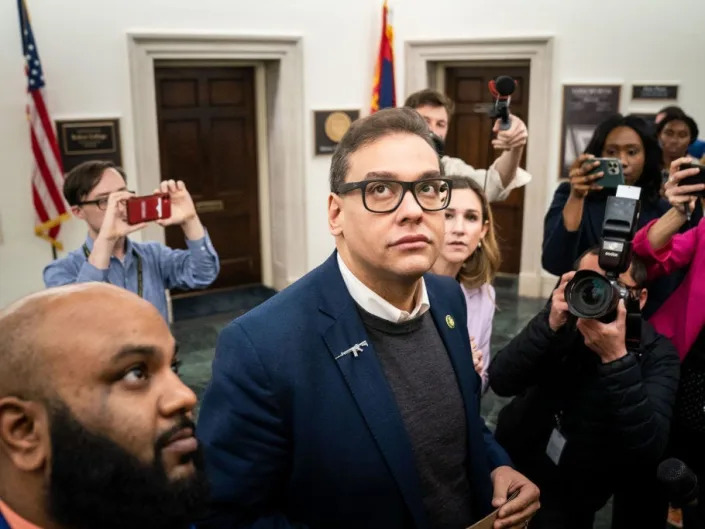
C-SPAN captured a tense back-and-forth between George Santos and Mitt Romney at the State of the Union
Bryan Metzger – February 7, 2023
Republican Rep. George Santos of New York at the State of the Union Address on February 7, 2023.Win McNamee/Getty Images
George Santos and Mitt Romney had what appeared to be a tense exchange at the State of the Union.
C-SPAN cameras captured the interaction, but the two men gave competing accounts.
Following the speech, Santos tweeted that Romney “will NEVER be PRESIDENT!”
Before President Joe Biden entered the chamber to deliver his State of the Union address on Tuesday evening, Rep. George Santos found himself in an apparently tense conversation with fellow Republican Sen. Mitt Romney of Utah.
C-SPAN cameras captured the tense interaction between Santos — the scandal-plagued Long Island congressman — and Romney, the party’s 2012 presidential nominee.
Following the speech, the Utah Republicantold reporters that Santos is a “sick puppy” who “shouldn’t have been there.”
“He should be sitting in the back row and being quiet instead of parading in front of the president,” he told reporters, noting the ethics inquiries Santos faces.
Santos — not exactly the most reliable interlocutor — claimed to Semafor’s Kadia Goba that Romney called him an “ass” and that Santos retorted that Romney is a “much bigger asshole.”
Santos sat in a seat on the center aisle beside fellow Republican Rep. Thomas Massie of Kentucky, giving him the opportunity to shake dignitaries’ hands as they entered the chamber.
He could be seen shaking hands with Senate Minority Leader Mitch McConnell, Senate Minority Whip John Thune, Republican Sen. Tommy Tuberville, and even a couple of Democrats: Sens. Amy Klobuchar of Minnesota and Dick Durbin of Illinois.
Following the speech, Santos tweeted that Romney “will NEVER be PRESIDENT!”
Black ‘1870’ pins worn by Congress members for State of the Union have deep significance
Members of the Congressional Black Caucus wore black pins with the number “1870” on them, which marks the year of the first known police killing of an unarmed and free Black person in the U.S.
Marquise Francis, National Reporter – February 7, 2023
An “1870” pin to be worn by members of the Congressional Black Caucus and others at the State of the Union address. (Photo illustration: Yahoo News; photos courtesy of the office of Rep. Bonnie Watson Coleman, Jabin Botsford/Washington Post via Getty Images)
At President Biden’s State of the Union speech Tuesday in which he addressed the country’s top issues before Congress, members of the Congressional Black Caucus and other Democrats made a bold statement of their own — albeit a silent one.
Many of them wore black pins with the number “1870” on them, which marks the year of the first known police killing of an unarmed and free Black person that occurred in the U.S. The pins are a call for action on reforming the institution of policing that has killed thousands of Black people in the 153 years since.
“I’m tired of moments of silence. I’m tired of periods of mourning,” New Jersey Rep. Bonnie Watson Coleman, a Democrat who came up with the idea to create the pins, told Yahoo News ahead of the speech. “I wanted to highlight that police killings of unarmed Black citizens have been in the news since 1870, and yet significant action has yet to be taken.”
Rep. Bonnie Watson Coleman at an event at the Capitol to demand that Congress renew an assault weapons ban, July 12, 2016. (Leigh Vogel/Getty Images for MoveOn.org)
On March 31, 1870, 26-year-old Henry Truman, a Black man, was shot and killed by Philadelphia Officer John Whiteside after being accused of shoplifting from a grocery store.
Whiteside had allegedly chased Truman into an alley when at some point Truman turned to ask what he had done wrong, and the officer fatally shot him, according to an account in the Philadelphia Inquirer the following day. At trial, Whiteside claimed he had been ambushed by a crowd while he chased Truman. Whiteside was later convicted of manslaughter. That same year the country adopted the 15th Amendment, which granted Black men the right to vote.
Over a century and a half since Truman’s killing, a steady stream of Black people have been killed by law enforcement, including 1,353 since 2017, according to data from Statista, a digital insights company. In fact, Black Americans are three times as likely to be killed by police as white people are, and they account for 1 in 4 police killings despite making up just 13% of the country’s population.
Many of the parents, siblings and children of Black people killed by police over the last decade were invited to Tuesday’s address as guests of members of the Congressional Black Caucus. The guest list included the families of Tamir Rice, the 12-year-old who was gunned down by Cleveland police in 2014 on a playground; Amir Locke, the 22-year-old fatally shot by Minneapolis police in a predawn, no-knock raid last year; Tyre Nichols, the 29-year-old fatally beaten by Memphis police during a traffic stop early last month; and a dozen other families who have lost loved ones.
“I hope today that we can get Congress to see that we need to pass this bill because this should never happen,” Nichols’s mother, RowVaughn Wells, said Tuesday afternoon at a press conference with the Congressional Black Caucus. “I don’t wish this on my worst enemy.”
RowVaughn Wells, mother of Tyre Nichols, who died after being beaten by Memphis police officers, speaks with reporters on Tuesday about police reform. (Cliff Owen/AP)
In contrast, several Republicans chose to honor members of law enforcement as their guests, including Rep. Mike Garcia of California, who brought Tania Owen, a retired detective and widow of a Los Angeles County sheriff’s sergeant who was shot and killed by a suspect when he answered a burglary-in-progress call in 2016. Rep. Elise Stefanik of New York and Rep. Lori Chavez-DeRemer of Oregon hosted police officers from their respective districts.
The invitations came after several other Republicans last week, during National Gun Violence Survivors Week, were photographed wearing AR-15 pins, which were passed out by Rep. Andrew Clyde of Georgia on the House floor. Clyde claimed the pins were “to remind people of the Second Amendment of the Constitution and how important it is in preserving our liberties.”
Many police reform advocates have argued that the systemic issues tied to policing transcend even racial lines, highlighting the fact that the five main officers involved in the brutal beating of Nichols were also Black.
“Blackness doesn’t shield you from all of the forces that make police violence possible,” James Forman Jr., a Yale law school professor and expert on race and law enforcement, told the New York Times. “What are the theories of policing and styles of policing, the training that police receive? All of those dynamics that propel violence and brutality are more powerful than the race of the officer.”
Karundi Williams, CEO of Re:power, an organization that trains Black people to become political leaders, told NBC News that addressing the core issues is the only way to prevent more killings.
“When we have moments of racial injustice that is thrust in the national spotlight, there is an uptick of outrage, and people take to the streets,” Williams said. “But then the media tends to move on to other things, and that consciousness decreases. But we never really got underneath the problem.”
Protesters in Oakland, Calif., on Jan. 29 to protest the police killing of Tyre Nichols in Memphis. (Tayfun Coskun/Anadolu Agency via Getty Images)
In 2022 alone, police killed 1,192 people, more than any year in the past decade, according to a new report released last week by the nonprofit Mapping Police Violence. Black people accounted for more than 300 of those killings. The report also claimed that many of these killings could have been avoided by changing law enforcement’s approach to such encounters, such as sending mental health providers to certain 911 calls.
But substantial police reform has continued to lag.
The 2021 George Floyd Justice in Policing Act, which was put forth following the murder of 46-year-old Floyd by Minneapolis police in 2020, seeks to end excessive force, qualified immunity and racial bias in policing and to combat police misconduct. The bill passed the House of Representatives twice in the previous Congress, but has continued to fail in the Senate.
“With the support of families of victims, civil rights groups, and law enforcement, I signed an executive order for all federal officers banning chokeholds, restricting no-knock warrants, and other key elements of the George Floyd Act,” Biden said in his State of the Union speech. “Let’s commit ourselves to make the words of Tyre’s mother come true, something good must come from this.”
Following the recent police killing of Nichols, members of the Black Caucus are cautiously optimistic that change will soon come.
“This unfortunately reignites the fervor and the necessity and the urgency,” Rep. Sheila Jackson Lee, D-Texas, a ranking member of the Judiciary Subcommittee for Crime, Terrorism, Homeland Security, and Investigations, recently told Yahoo News. “With 18,000 police communities, there has to be a federal law that addresses the training and the relationship between police. We have to restart.”
President Biden and Vice President Kamala Harris meet with members of the Congressional Black Caucus in the Oval Office last week. (Susan Walsh/AP)
An info card attached to the black pin given to members of the Black Caucus expresses the frustration of numerous police killings from Truman to Nichols.
“153 years later, nothing has changed,” the note reads in part. “We are tired of mourning and demand change.”
McCarthy warns Republicans not to misbehave at State of the Union, promises no ‘childish games’ like Pelosi’s infamous speech tearing moment
Oma Seddiq, Nicole Gaudiano – February 7, 2023
House Speaker Kevin McCarthy; former House Speaker Nancy Pelosi.SAUL LOEB/AFP via Getty Images; MANDEL NGAN/AFP via Getty Images
McCarthy swiped at Pelosi ahead of Biden’s state of the union address on Tuesday.
“We’re not going to do childish games tearing up a speech,” he told CNN.
Pelosi infamously ripped up a copy of Trump’s speech after his 2020 SOTU address.
House Speaker Kevin McCarthy insisted that Republicans would show proper decorum during President Joe Biden’s state of the union address on Tuesday evening, swiping at former House Speaker Nancy Pelosi’s viral moment tearing up former President Donald Trump’s speech during his 2020 speech.
“We’re members of Congress. We have a code of ethics of how we should portray ourselves,” McCarthy told CNN’s Manu Raju on Tuesday. “And that’s exactly what we’ll do. But we’re not going to do childish games tearing up a speech.”
Privately, however, McCarthy has expressed concerns about his own caucus’ behavior and has warned them about their conduct, according to CNN’s Melanie Zanona.
Pelosi made headlines when she ripped up a copy of Trump’s speech after he delivered his third state of the union address three years ago. The top Democrat at the time remarked to reporters that “it was a courteous thing to do, considering the alternatives.”
“It was such a dirty speech,” she said.
McCarthy, the newly elected House speaker, will take Pelosi’s previous seat on the platform behind Biden during his address on Tuesday night. The president is planning to lay out his plans to advance his “unity agenda” this year, including policies to fight cancer, help veterans, provide mental health treatment, and fight opioid addiction.
In a closed-door meeting with the House Republican conference on Tuesday, McCarthy and other GOP leaders warned their members to behave during the address, CNN’s Melanie Zanona wrote.
The “cameras are on,” and the “mics are hot,” House GOP leadership reportedly said in the meeting.
Republicans in the past have made headlines with outbursts during past presidential State of the Union speeches, which are viewed by millions.
Rep. Lauren Boehbert of Colorado heckled Biden last year when he talked about how his son Beau’s death may have been linked to burn-pit exposure during his Iraq deployment. She shouted that he put “13 of them” in coffins, a reference to 13 American troops who were killed in Afghanistan during the US’ chaotic withdrawal.
Boehbert and Rep. Marjorie Taylor Greene of Georgia also tried to start a “build the wall” chant last year during Biden’s speech.
“My initial instinct is, ‘Let me walk down and smack this guy on the head. What is he thinking?'” Obama said during a CBS interview in 2020 when his book “A Promised Land” was released. “And instead, I just said, ‘That’s not true,’ and I just move on. He called afterward to apologize – although, as I point out in the book, he saw a huge spike in campaign contributions to him from Republicans across the country who thought he had done something heroic.”
12 of the most unforgettable moments from State of the Union addresses
Shelby Slauer and Rebecca Cohen – February 7, 2023
12 of the most unforgettable moments from State of the Union addressesFormer President Barack Obama during a State of the Union address.REUTERS/Mandel Ngan/Pool
The State of the Union address allows the US president to update Congress on the nation’s progress.
Former President Harry S. Truman’s speech in 1947 was the first to be broadcast on television.
Nancy Pelosi ripped up a copy of Donald Trump’s speech after he finished speaking.
Parts of Abraham Lincoln’s State of the Union speech were leaked and it prompted an investigation.
His wife was accused of leaking information, but Lincoln said she hadn’t seen the speech in advance.Hulton Archive / Stringer / Getty Images
Hours after Abraham Lincoln sent his State of the Union address to Congress, the newspaper The New York Herald published a few excerpts from the speech that had been leaked. Readers of the paper got to see parts of the speech before it was formally released.
The leak prompted the House Judiciary Committee to launch an investigation into the cause of the leaks in February 1862.
Harry S. Truman’s speech in 1947 was the first to be broadcast on television.
Former President Harry S. Truman giving the State of the Union address.AP/Byron Rollins
In 1947, Harry S. Truman’s State of the Union address was the first to be televised. At the time, television owners were only in the thousands, so most Americans missed his debut, instead listening to it on the radio.
Richard Nixon called for an end to the Watergate investigation during his State of the Union address in 1974.
President Richard Nixon delivering the State of the Union address in 1974.AP Photo
In Nixon’s 1974 address, he called for an end to the Watergate investigation, saying, “one year of Watergate is enough.”
Ronald Reagan invited Lenny Skutnik to the address in 1982, starting a new tradition for State of the Union addresses.
Lenny Skutnik being recognized during the State of the Union speech in 1982.Frank Johnston/Washington Post/Getty Images
Reagan was the first president to bring a guest to honor at the State of the Union address, which began an annual tradition of recognizing everyday American heroes.
Congressional Budget Office employee Lenny Skutnik was honored for saving the life of Priscilla Tirado after an Air Florida plane crashed into the freezing Potomac River. He sat beside the First Lady during the address.
Bill Clinton called for an end to big government during his address in 1996.
President Clinton during one of his State of the Union addresses.AP/ RON EDMONDS
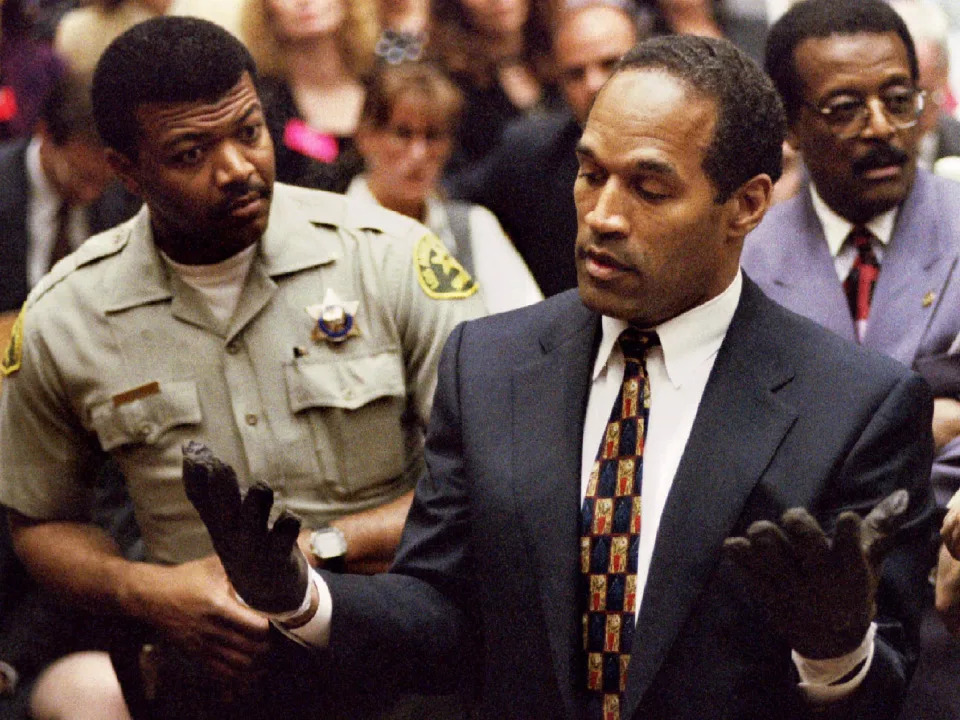
Networks cut away from Clinton’s State of the Union address in 1997 to air the OJ Simpson verdict.
Defendant OJ Simpson during his trial.Reuters
Clinton’s 1997 address was coming to an end right as the jury was about to deliver the verdict for OJ Simpson’s highly publicized criminal trial.
Networks cut straight from his address to the Simpson trial before the Republican response to Clinton’s address was aired.
George W. Bush coined “Axis of Evil” in his 2002 address, marking the beginning of the Iraq War.
George W. Bush giving a State of the Union address.Luke Frazza/Getty Images
Soon after the 9/11 attacks, Bush labeled North Korea, Iran, and Iraq as an “Axis of Evil,” arguing in favor of what would become the Iraq War.
Justice Samuel Alito shook his head in disagreement during Obama’s 2010 State of the Union address.
Supreme Court Justice Samuel Alito prior to President Barack Obama’s State of the Union address.AP Photo/Pablo Martinez
As Obama criticized the Supreme Court ruling on campaign finance, the camera cut to Justice Samuel Alito, who quietly mouthed “not true,” according to Politico’s reports.
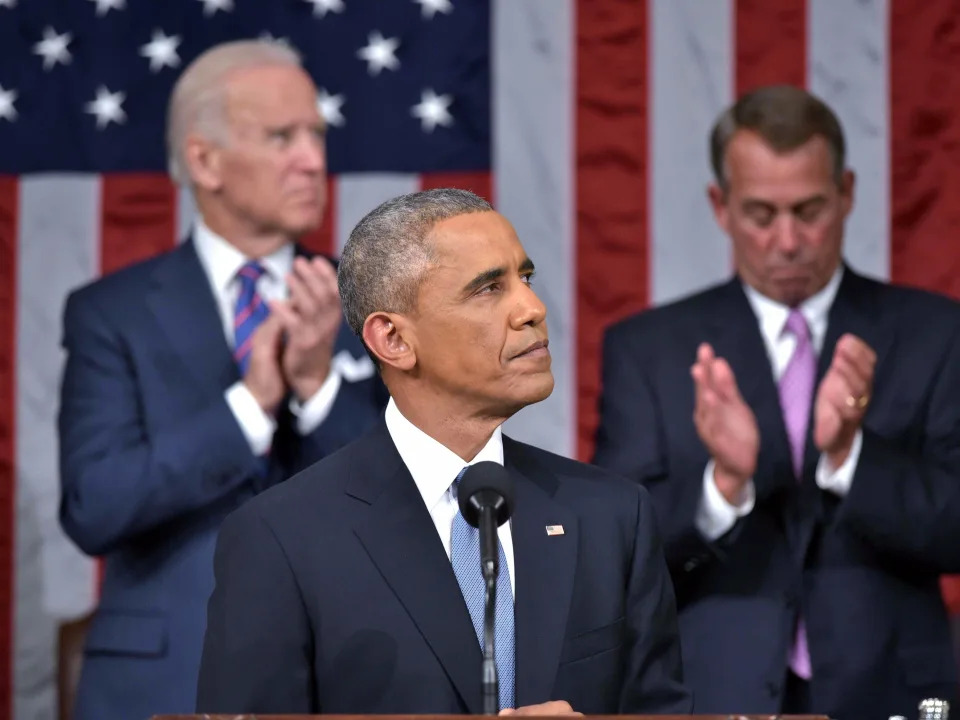
Joe Biden pointed during Obama’s State of the Union address.
Biden’s facial expressions went viral.Fox News
During Obama’s State of the Union address in 2014, many couldn’t help but be distracted by former Vice President Joe Biden’s sudden pointing and laughing behind the president.
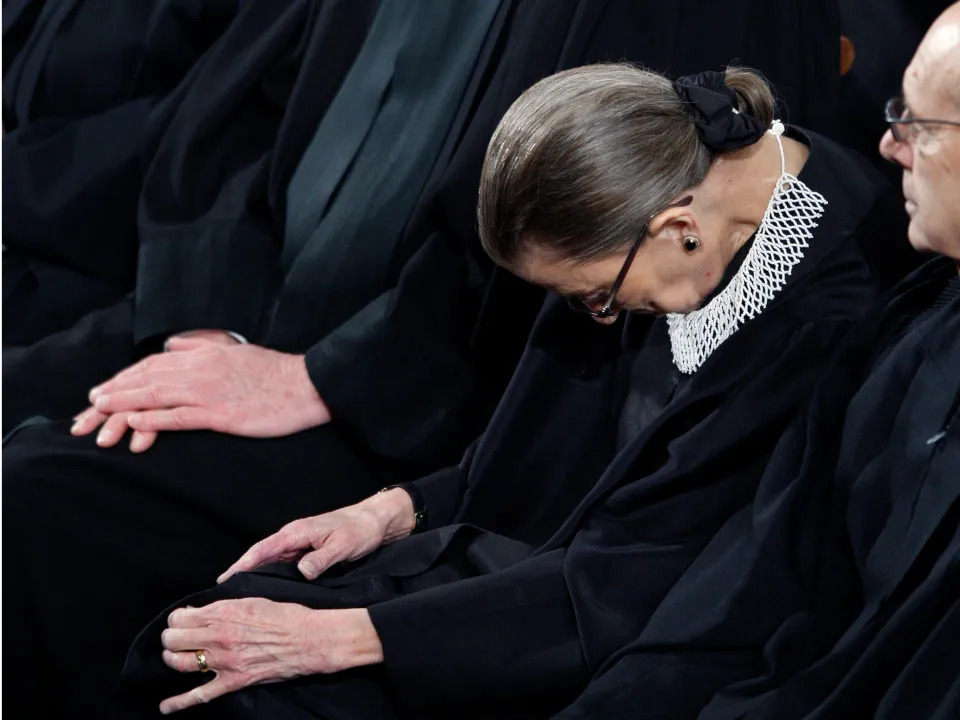
Supreme Court Justice Ruth Bader Ginsburg fell asleep during Obama’s 2015 State of the Union address.
Supreme Court Justice Ruth Bader Ginsburg during Obama’s State of the Union address.Pablo Martinez Monsivais/AP
Justice Ginsburg was caught on camera during Obama’s 2015 address with her head fully bowed, taking a nap.
Later, as per Reuters reports, she explained why her head was down: “The audience, for the most part, is awake, but they’re bobbing up and down all the time. And we sit there as stone-faced, sober judges. But we’re not. At least I wasn’t 100% sober when we went to the State of the Union.”
Donald Trump shrugged off a handshake from Speaker of the House Nancy Pelosi ahead of the 2020 State of the Union.
Nancy Pelosi extending a hand to Donald Trump ahead of the State of the Union address on February 4, 2020.OLIVIER DOULIERY/AFP via Getty Images
When Trump entered the chambers to give his 2020 State of the Union speech, Speaker of the House Nancy Pelosi offered a handshake in an attempt at being cordial with the president.
He seemed to ignore her handshake and walked right past her. Pelosi shrugged it off and was seen shaking her head and looking down throughout the duration of his address.
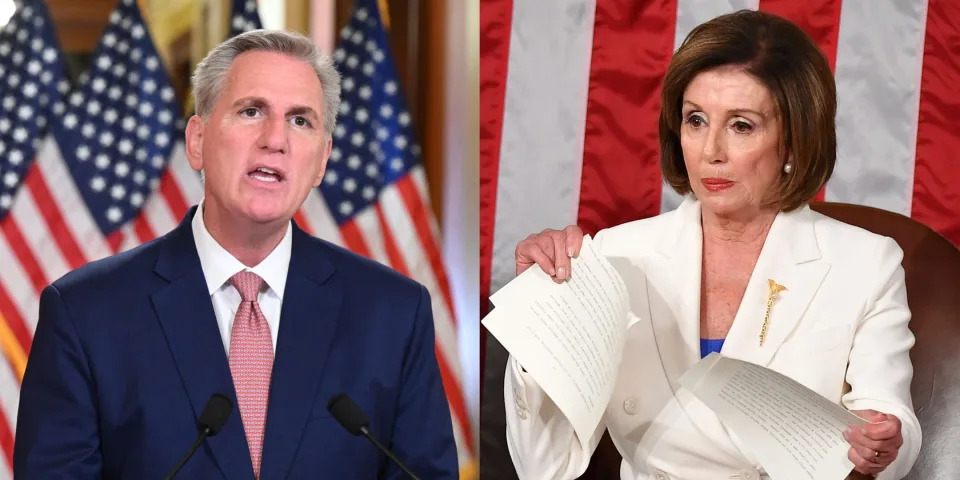
Pelosi ripped up a copy of Trump’s 2020 State of the Union speech after he finished speaking.
Nancy Pelosi ripping up pages of the prepared speech at President Donald Trump’s State of the Union on February 4, 2020.Mark Wilson/Getty Images
After he finished speaking during his 2020 State of the Union, Pelosi was seen ripping up a copy of Trump’s speech right behind him.
When asked why she did that, she said, “Because it was the courteous thing to do. It was the courteous thing to do considering the alternative.” It is not clear what she meant by “the alternative.”
Huge chunk of plants, animals in U.S. at risk of extinction -report
Brad Brooks – February 6, 2023
A Venus flytrap is seen at the meat-eating plant exhibition “Dejate Atrapar” (Let Yourself Get Caught), in BogotaEndangered Key Deer are pictured in a puddle following Hurricane Irma in Big Pine Key, FloridaEndangered Arizona hedgehog cactus is seen in the Oak Flat recreation area outside Superior, ArizonaA full moon rises over a cactus in PhoenixThe endangered dusky gopher frog, a darkly colored, moderately sized frog with warts covering its back and dusky spots on its belly, is shown in this handout photo
(Reuters) -A leading conservation research group found that 40% of animals and 34% of plants in the United States are at risk of extinction, while 41% of ecosystems are facing collapse.
Everything from crayfish and cacti to freshwater mussels and iconic American species such as the Venus flytrap are in danger of disappearing, a report released on Monday found.
NatureServe, which analyzes data from its network of over 1,000 scientists across the United States and Canada, said the report was its most comprehensive yet, synthesizing five decades’ worth of its own information on the health of animals, plants and ecosystems.
Importantly, the report pinpoints the areas in the United States where land is unprotected and where animals and plants are facing the most threats.
Sean O’Brien, president of NatureServe, said the conclusions of the report were “terrifying” and he hoped it would help lawmakers understand the urgency of passing protections, such as the Recovering America’s Wildlife Act that stalled out in Congress last year.
“If we want to maintain the panoply of biodiversity that we currently enjoy, we need to target the places where the biodiversity is most threatened,” O’Brien said. “This report allows us to do that.”
U.S. Representative Don Beyer, a Democrat who has proposed legislation to create a wildlife corridor system to rebuild threatened populations of fish, wildlife and plants, said NatureServe’s work would be critical to helping agencies identify what areas to prioritize and where to establish migration routes.
“The data reported by NatureServe is grim, a harrowing sign of the very real problems our wildlife and ecosystems are facing,” Beyer told Reuters. “I am thankful for their efforts, which will give a boost to efforts to protect biodiversity.”
HUMAN ENCROACHMENT
Among the species at risk of disappearing are icons like the carnivorous Venus flytrap, which is only found in the wild in a few counties of North and South Carolina.
Nearly half of all cacti species are at risk of extinction, while 200 species of trees, including a maple-leaf oak found in Arkansas, are also at risk of disappearing. Among ecosystems, America’s expansive temperate and boreal grasslands are among the most imperiled, with over half of 78 grassland types at risk of a range-wide collapse.
The threats against plants, animals and ecosystems are varied, the report found, but include “habitat degradation and land conversion, invasive species, damming and polluting of rivers, and climate change.”
California, Texas and the southeastern United States are where the highest percentages of plants, animals and ecosystems are at risk, the report found.
Those areas are both the richest in terms of biodiversity in the country, but also where population growth has boomed in recent decades, and where human encroachment on nature has been harshest, said Wesley Knapp, the chief botanist at NatureServe.
Knapp highlighted the threats facing plants, which typically get less conservation funding than animals. There are nearly 1,250 plants in NatureServe’s “critically imperiled” category, the final stage before extinction, meaning that conservationists have to decide where to spend scant funds even among the most vulnerable species to prevent extinctions.
“Which means a lot of plants are not going to get conservation attention. We’re almost in triage mode trying to keep our natural systems in place,” Knapp said.
‘NATURE SAVINGS ACCOUNT’
Vivian Negron-Ortiz, the president of the Botanical Society of America and a botanist with the U.S. Fish and Wildlife Service, who was not involved in the NatureServe report, said there is still a lot scientists do not know and have not yet discovered about biodiversity in the United States, and that NatureServe’s data helped illuminate that darkness.
More than anything, she sees the new data as a call to action.
“This report shows the need for the public to help prevent the disappearance of many of our plant species,” she said. “The public can help by finding and engaging with local organizations that are actively working to protect wild places and conserve rare species.”
John Kanter, the senior wildlife biologist with the National Wildlife Federation, said the data in the report, which he was not involved with, was essential to guiding state and regional officials in creating impactful State Wildlife Action Plans (SWAPs), which they must do every 10 years to receive federal funding to protect vulnerable species.
Currently $50 million in federal funding is divided up among all states to carry out their SWAPs. The Recovering America’s Wildlife Act, whose congressional sponsors say will be reintroduced soon, would have increased that to $1.4 billion, which would have a huge impact on the state’s abilities to protect animals and ecosystems, Kanter said, and the NatureServe report can act as roadmap for officials to best spend their money.
“Our biodiversity and its conservation is like a ‘nature savings account’ and if we don’t have this kind of accounting of what’s out there and how’s it doing, and what are the threats, there’s no way to prioritize action,” Kanter said. “This new report is critical for that.”
Read more:
GRAPHIC-The collapse of insects
Penguins offer varied clues to Antarctic climate change
ANALYSIS-U.N. nature deal can help wildlife as long as countries deliver
(Reporting by Brad Brooks in Lubbock, Texas; Additional reporting by Julio-Cesar Chavez in Washington; Editing by Lisa Shumaker)
Colorado River crisis is so bad, lakes Mead and Powell are unlikely to refill in our lifetimes
Rong-Gong Lin II, Ian James – February 5, 2023
Boaters are dwarfed by a white bathtub ring around Lake Mead. (Luis Sinco/Los Angeles Times)
The snowpack in the Sierra Nevada is the deepest it’s been in decades, but those storms that were a boon for Northern California won’t make much of a dent in the long-term water shortage for the Colorado River Basin — an essential source of supplies for Southern California.
In fact, the recent storms haven’t changed a view shared by many Southern California water managers: Don’t expect lakes Mead and Powell, the nation’s largest reservoirs, to fill up again anytime soon.
“To think that these things would ever refill requires some kind of leap of faith that I, for one, don’t have,” said Brad Udall, a water and climate scientist at Colorado State University.
Lake Mead, located on the Arizona-Nevada border and held back by Hoover Dam, filled in the 1980s and 1990s. In 2000, it was nearly full and lapping at the spillway gates. But the megadrought over the last 23 years — the most severe in centuries — has worsened the water deficit and left Lake Mead about 70% empty.
Even with this winter’s above-average snowpack in the Rocky Mountains, water officials and scientists say everyone in the Colorado River Basin will need to plan for low reservoir levels for years to come. And some say they think the river’s major reservoirs probably won’t refill in our lifetimes.
“They’re not going to refill. The only reason they filled the first time is because there wasn’t demand for the water. In the 1950s, ’60s, ’70s and ’80s, there was no Central Arizona Project, there was no Southern Nevada Water Authority, there was not nearly as much use in the Upper [Colorado River] Basin,” said Bill Hasencamp, manager of Colorado River resources for the Metropolitan Water District of Southern California. “So the water use was low. So that filled up storage.”
Demand for Colorado River water picked up in the late 1990s and early 2000s. The Central Arizona Project, a 336-mile-long water delivery system, brings water from the Colorado River to Arizona’s most populous counties and wasn’t completed until the 1990s. The Southern Nevada Water Authority was created in 1991.
Arizona began starting to take its full apportionment of river water in the late 1990s, and Nevada in the early 2000s. California continues using the single largest share of the river.
“Now the water use is maxed out. Every state is taking too much, and we have to cut back. And so there’s just not enough. You would need wet year after wet year, after wet year after wet year, after wet year. Even then, because the demand is so high, it still wouldn’t fill,” Hasencamp said in an interview.
Climate change has dramatically altered the river. In the last 23 years, as rising temperatures have intensified the drought, the river’s flow has declined about 20%.
Scientists have found that roughly half the decline in the river’s flow has been caused by higher temperatures, and that climate change is driving the aridification of the Southwest. With global warming, average temperatures across the upper watershed — where most of the river’s flow originates — have risen about 3 degrees since 1970.
Research has shown that for each additional 1 degree Celsius (1.8 degrees Fahrenheit), the river’s average flow is likely to decrease about 9%.
In multiple studies, scientists have estimated that by the middle of this century, the average flow of the river could decline by 30% or 40% below the average during the past century.
“The last 23 years are the best lessons we have right now, and they should scare the pants off of people,” said Udall, who has been a co-author of research showing how warming is sapping the river’s flows.
Based on the low levels of Lake Mead and Lake Powell, Udall said, he would estimate that refilling the reservoirs would take roughly six consecutive extremely wet years, with water flows similar to those in 2011.
“We’d need six years like that to refill this system, in a row, based on current operating rules,” Udall said. “And I just don’t see that even being remotely possible.”
The Colorado River Basin very well could get a few wet years, he said.
“We might even get a wet decade. But, boy, the long-term warming and drying trend seems super clear to me,” Udall said. “And a bet on anything other than that seems like water management malpractice, that we have got to plan for something that looks like a worst-case future.”
The Colorado River supplies water to seven states, tribal nations and Mexico. The states are under pressure from the federal government to agree on cuts to prevent reservoirs from dropping to dangerously low levels.
California and the six other states are at odds over how to make the cuts, and have submitted separate proposals to the federal government, with some disagreements centering on the legal system that governs how the river is managed.
In a 2008 study, scientists Tim Barnett and David Pierce examined the likely flow declines with climate change and estimated there was a 50% chance the usable water supply in Lake Mead and Lake Powell would be gone by 2021. They titled their study “When Will Lake Mead Go Dry?” In research published in 2009, they wrote that based on projections with climate change or even the long-term average flows, “currently scheduled future water deliveries from the Colorado River are not sustainable.”
“Climate change is reducing the flow into the Colorado River system, so the agreements are divvying up more water than exists,” said Pierce, a climate scientist at Scripps Institution of Oceanography. “This drop in reservoir levels is happening because we are abiding by agreements that do not account for changes in water inflow into the system due to climate change.”
There is always the chance of a few extremely wet years with the potential to refill reservoirs, Pierce said.
“It’s just that in the coming decades that likelihood decreases. Our work has estimated that the chance of the reservoirs refilling decreases from about 75% today to about 10% by 2060 if no changes in [water] delivery schedules are made,” Pierce said. “We should be planning for the situation where the hotter temperatures decrease the river flow in the future.”
The capacity of lakes Mead and Powell is gargantuan compared with the capacity of California’s two largest reservoirs, Shasta Lake and Lake Oroville. Lake Mead can store more than 27 million acre-feet of water, and Lake Powell 25 million acre-feet. By contrast, Shasta Lake can hold about 4.6 million acre-feet, and Lake Oroville 3.5 million acre-feet.
The Colorado River supplies, on average, about 25% of the water supplies in coastal Southern California, while the region also gets water from Northern California through the State Water Project, and other sources.
California’s Sierra Nevada snowpack is now about 200% of average at this point in the season, while the snowpack in the Upper Colorado River Basin so far stands at about 140% of the median over the last 30 years.
The bigger snowpack could help the Colorado’s reservoir levels this year somewhat. How much won’t be clear for a few months.
“Absolutely this snow is welcomed. The cold weather is welcome. The real question will be in the spring,” Hasencamp said.
In recent years, hot, dry conditions have led to reduced flows in the river. “That’s what’s been the killer the last few years, is a hot dry spring has taken the snow that’s been there, and it doesn’t make it to the reservoirs,” Hasencamp said.
Daniel Swain, a UCLA climate scientist, said an exceptionally wet decade might someday change things.
“But the problem is, it doesn’t just have to be wetter than average, it would have to be dramatically wetter than the long-term average,” Swain said. And for many years.
Scientists say higher temperatures effectively make the atmosphere “thirstier,” causing more moisture to evaporate off the landscape. Vegetation also takes up more water as temperatures rise, leaving less runoff flowing in streams.
“There is no question that there will be an ongoing downward trend in inflows, but extreme high events are also more likely to occur in the context of climate change, according to the U.S. National Climate Assessment,” said Kathy Jacobs, director of the University of Arizona’s Center for Climate Adaptation Science and Solutions.
Jacobs noted that researchers project atmospheric rivers will become more intense with rising temperatures, and scientists expect more intense extreme storms and periodic flooding.
“I strongly suspect that the dams on the Colorado will be needed for flood control in the future as well as for water supply,” Jacobs said.
As for the future, Jacobs said a great deal depends on whether greenhouse gas emissions are reduced “to net zero in the near term.”
There are workable ways of managing reduced water supplies from the river, she said. “The longer we wait to build more flexible future management schemes, the harder it will be.”
Mired in scandal, Santos has said he will step down from serving on committees in the House of Representatives while he faces multiple investigations.
While everyone tells lies occasionally, some people appear to do so much more than others. So, why and how do people become compulsive liars? This is what the experts say.
What is a compulsive liar?
Christian Hart, a professor of psychology at Texas Woman’s University who specializes in pathological lying, told Insider that the terms “habitual liar,” “compulsive liar,” and “pathological liar” essentially mean the same thing — people who lie a lot.
Hart said that compulsive liars typically engage in excessive lying that causes some problems in the normal functioning of their lives, whether with work, romantic relationships, or with friends and family.
They typically have some kind of internal conflict over the lies, he said, as they want to stop but find themselves compulsively engaging in the behavior over and over again.
While Hart said he can’t formally diagnose the lawmaker without knowing details about whether he experiences functional problems or distress, he notes that Santos does appear to engage in pathological lying.
“In the sense that most people use the term ‘pathological lying,’ I’d say yes, it seems like he’s got this long track history preceding his entering into politics where he’s cultivated this reputation of being an extremely dishonest person,” Hart said.
So why do people lie? Hart explains that people don’t lie unless there is some incentive to do so — though this incentive might not always be obvious to an outsider.
Many of Santos’ lies appear to serve a clear purpose. He embellished his résumé while on the campaign trail, likely in an attempt to impress voters. He fabricated connections to the 9/11 attacks, possibly in order to burnish his reputation as a true New Yorker or to garner sympathy.
But along with lying about details about important elements of his life and history, Santos has also appeared to tell outlandish lies about seemingly insignificant things.
“When people have historically defined pathological lying, many of them have said these people lie with no apparent reason. But I argue that it does serve a purpose, it’s just a purpose that we are unfamiliar with,” Hart said.
Santos, Hart said, “lied about being a star athlete on a volleyball team at a kind of a lower-tier college — that wouldn’t carry any cache for most people. But just because we can’t see the purpose of the lie doesn’t mean the purpose doesn’t exist for him. Perhaps, he’s always had a sense of inferiority about not being an athletic person, and so to be seen that way means a lot to him where it would mean nothing to other people.”
A representative for Santos did not reply to Insider’s request for comment.
Reporters surround embattled Rep. George Santos as he heads to the House Chamber for a vote, at the US Capitol on Tuesday, January 31, 2023 in Washington, DC.Kent Nishimura / Los Angeles Times via Getty Images
Hart has written a book about the science of pathological lying along with his colleague Drew Curtis, who is a psychology professor at Angelo State University.
Curtis told Insider that, like many psychological tendencies, pathological lying is often due to a combination of factors involving environment and genetics, both nature and nurture, and typically begins in later childhood and adolescence.
Do compulsive liars know they’re lying?
Many psychologists say compulsive lying is often a feature of a personality disorder, such as antisocial-personality disorder or narcissistic-personality disorder.
Compulsive lying is not, in itself, classified as a disorder in the DSM, the handbook healthcare professionals use as the guide to classifying mental-health disorders.
Curtis explained that it is important to distinguish people who are just pathological liars, and those that engage in pathological lying as part of a personality disorder — a key difference being that pathological liars do typically exhibit some remorse about lying.
While again Hart said he can’t formally diagnose him, he said Santos does appear to exhibit some traits of antisocial-personality disorder — where people manipulate and exploit others for personal benefit, with little guilt or remorse.
“Looking at the types of things that historically Santos has been accused of lying about and given his reaction when he’s confronted about those instances of dishonesty, he certainly seems that he could have many of the traits of antisocial-personality disorder,” Hart said.
Along with being accused of lying about things to boost his reputation, a military veteran has also accused Santos of pocketing $3,000 from a GoFundMe page for a dying dog, which the FBI is now probing.
Peers and the public have also raised questions about the congressman’s personal and campaign finances, which he is facing federal and local investigations over.
Typically, compulsive liars believe they won’t be caught and that any negative consequences from their lies are tolerable, according to Hart.
However, Santos’ lies are often well-documented, as he puts them in writing on social media or his websites, or verbalizes them in on-camera interviews.
Hart noted that it is “unusual” that Santos does not appear to be concerned about others discovering his lies and, in fact, “appears to just double down in many cases when he’s accused of lying.”
“That is unusual for him and unusual for many of the cases that we’ve explored of pathological liars,” Hart said. “It looks to me like he’s the type of person who doesn’t seem to worry too much about the reputation he’s cultivating around his honesty or dishonesty.”
Rep. George Santos.Patrick Semansky/AP Photo
When people lie constantly and repeatedly, it can be easy to question whether they are even aware that they are lying any more and whether they have simply become detached from reality.
In a recently leaked audio recording from January 30, obtained by Talking Points Memo, Santos admits to his track record of lying and appears to express frustration with himself.
“I’ve made bad judgment calls, and I’m reaping the consequences of those bad judgment calls,” Santos said in the recording.
“I’ve obviously fucked up and lied to him, like I lied to everyone else,” Santos later said, apparently referring to his chief of staff Charley Lovett. “And he still forgave me and gave me a second shot, unlike some other people.”
Curtis noted that the fact that Santos has admitted to lying about some aspects of his past suggests a conscious deception.
“I think in the case of Santos, he’s come out, at least from my understanding, he’s come out and apologized and said, you know, this wasn’t necessarily true. So then if someone’s claiming that what they said wasn’t true, then I think it’s easier to say that was a deception, not a delusion,” Curtis said.
Professions like politics are more closely linked to lying
Curtis and Hart note in their research that certain professions, like sales and politics, are more closely linked with lying.
Hart explained that these professions do not necessarily attract dishonest people, but might push people toward dishonesty. For example, a salesperson may be dishonest if they must sell an inferior product. Similarly, politicians might not be able to be honest all of the time and so might find themselves exaggerating, concealing, or outright lying about things.
He noted that politicians who are willing to tell lies are actually more likely to get reelected than politicians who are unwilling to be dishonest.
How do you deal with compulsive liars?
Rep. George Santos.
Rep. George Santos.Mary Altaffer
Curtis and Hart note that pathological lying can be difficult to treat as it is not a formally recognized diagnosis.
As it currently stands, psychologists typically treat pathological liars with cognitive-behavioral therapy, a common type of talk therapy.
Outside of a professional setting, it can be hard to know how to respond to a compulsive liar. Hart suggested that the best way to respond to pathological liars is to call them out on their lies.
“Most people don’t like being called out on their lying and feel extremely uncomfortable, and they want to prevent any further reputational damage,” he said.
Curtis suggested ignoring the deception and intentionally giving attention to honest behavior instead.
“One of the real challenges of how to respond to pathological lying is that we give attention to their lies, which then can become reinforcing. So one of the suggestions we have is called ‘differential reinforcement of other behavior,’ where you ignore the deception. Then you have to intentionally give attention to honest behavior,” Curtis said.
“So, even when honesty may be mundane, not very exciting, we need to give that attention to the person who lies a lot.”
China accuses US of indiscriminate use of force over balloon
Emily Wang Fujiyama – February 5, 2023
Business owner “Annie” weights down copies of the Chinese Daily News newspaper showcasing pictures of a suspected Chinese spy balloon, in the Chinatown district of Los Angeles Sunday, Feb. 5, 2023. The balloon’s presence in the sky above the United States before a military jet shot it down over the Atlantic Ocean with a missile Saturday has further strained U.S.- China ties. (AP Photo/Damian Dovarganes) ASSOCIATED PRESS
BEIJING (AP) — China on Monday accused the United States of indiscriminate use of force in shooting down a suspected Chinese spy balloon, saying it “seriously impacted and damaged both sides’ efforts and progress in stabilizing Sino-U.S. relations.”
The U.S. shot down the balloon off the Carolina coast after it traversed sensitive military sites across North America. China insisted the flyover was an accident involving a civilian aircraft.
Vice Foreign Minister Xie Feng said he lodged a formal complaint with the U.S. Embassy on Sunday over the “U.S. attack on a Chinese civilian unmanned airship by military force.”
“However, the United States turned a deaf ear and insisted on indiscriminate use of force against the civilian airship that was about to leave the United States airspace, obviously overreacted and seriously violated the spirit of international law and international practice,” Xie said.
The presence of the balloon in the skies above the U.S. dealt a severe blow to already strained U.S.-Chinese relations that have been in a downward spiral for years. It prompted Secretary of State Antony Blinken to abruptly cancel a high-stakes Beijing trip aimed at easing tensions.
Xie repeated China’s insistence that the balloon was a Chinese civil unmanned airship that blew into U.S. airspace by mistake, calling it “an accidental incident caused by force majeure.”
China will “resolutely safeguard the legitimate rights and interests of Chinese companies, resolutely safeguard China’s interests and dignity and reserve the right to make further necessary responses,” he said.
U.S. President Joe Biden issued the shootdown order after he was advised that the best time for the operation would be when it was over water, U.S. officials said. Military officials determined that bringing down the balloon over land from an altitude of 60,000 feet (18,000 meters) would pose an undue risk to people on the ground.
“What the U.S. has done has seriously impacted and damaged both sides’ efforts and progress in stabilizing Sino-U.S. relations since the Bali meeting,” Xie said, referring to a recent meeting between Biden and his Chinese counterpart, Xi Jinping, in Indonesia that many hoped would create positive momentum for improving ties that have plunged to their lowest level in years.
Foreign Ministry spokesperson Mao Ning provided no new details on Monday, repeating China’s insistence that the object was a civilian balloon intended for meteorological research, had little ability to steer and entered U.S. airspace by accidentally diverging from its course. She also did not say what additional steps China intended to take in response to Washington’s handling of the issue and cancellation of Blinken’s trip, which would have made him the highest-ranking U.S. official to visit since the start of the COVID-19 pandemic.
“We have stated that this is completely an isolated and accidental incident caused by force majeure, but the U.S. still hyped up the incident on purpose and even used force to attack,” Mao said at a daily briefing. “This is an unacceptable and irresponsible action.”
Balloons thought or known to be Chinese have been spotted from Latin America to Japan. Japanese Deputy Chief Cabinet Secretary Yoshihiko Isozaki told reporters Monday that a flying object similar to the one shot down by the U.S. had been spotted at least twice over northern Japan since 2020.
“We are continuing to analyze them in connection with the latest case in the United States,” he said.
Mao confirmed that a balloon recently spotted over Latin American was Chinese, describing it as a civilian airship used for flight tests.
“Affected by weather and due to its limited self-control ability, the airship severely deviated from its set route and entered the space of Latin America and the Caribbean by accident,” Mao said.
Washington and Beijing are at odds over a range of issues from trade to human rights, but China is most sensitive over alleged violations by the U.S. and others of its sovereignty and territorial integrity.
Beijing strongly protests U.S. military sales to Taiwan and visits by foreign politicians to the island, which it claims as Chinese territory, to be recovered by force if necessary.
It reacted to a 2022 visit by then-U.S. House Speaker Nancy Pelosi by firing missiles over the island and staging threatening military drills seen as a rehearsal for an invasion or blockade. Beijing also cut off discussion with the U.S. on issues including climate change that are unrelated to military tensions.
Last week, Mao warned Pelosi’s successor, House Speaker Kevin McCarthy, not to travel to Taiwan, implying that China’s response would be equally vociferous.
“China will firmly defend its sovereignty, security and development interests,” Mao said. McCarthy said China had no right to dictate where and when he could travel.
China also objects when foreign military surveillance planes fly off its coast in international airspace and when U.S. and other foreign warships pass through the Taiwan Strait, accusing them of being actively provocative.
In 2001, a U.S. Navy plane conducting routine surveillance near the Chinese coast collided with a Chinese fighter plane, killing the Chinese fighter pilot and damaging the American plane, which was forced to make an emergency landing at a Chinese naval airbase on the southern Chinese island province of Hainan. China detained the 24-member U.S. Navy aircrew for 10 days until the U.S. expressed regret over the Chinese pilot’s death and for landing at the base without permission.
At a news conference Friday with his South Korean counterpart, Blinken said “the presence of this surveillance balloon over the United States in our skies is a clear violation of our sovereignty, a clear violation of international law, and clearly unacceptable. And we’ve made that clear to China.”
“Any country that has its airspace violated in this way I think would respond similarly, and I can only imagine what the reaction would be in China if they were on the other end,” Blinken said.
China’s weather balloon explanation should be dismissed outright, said Oriana Skylar Mastro, an expert on Chinese military affairs and foreign policy at Stanford University.
“This is like a standard thing that countries often say about surveillance assets,” Mastro said.
China may have made a mistake and lost control of the balloon, but it was unlikely to have been a deliberate attempt to disrupt Blinken’s visit, Mastro said.
For the U.S. administration, the decision to go public and then shoot down the balloon marks a break from its usual approach of dealing with Beijing on such matters privately, possibly in hopes of changing China’s future behavior.
However, Mastro said, it was unlikely that Beijing would respond positively.
“They’re probably going to dismiss that and continue on as things have been. So I don’t see a really clear pathway to improved relations in the foreseeable future.”
AP journalists Tian Macleod Ji in Bangkok, Mari Yamaguchi in Tokyo and news assistant Caroline Chen in Beijing contributed this report.
50-car train derailment causes big fire, evacuations in Ohio
February 4, 2023
In this photo provided by Melissa Smith, a train fire is seen from her farm in East Palestine, Ohio, Friday, Feb. 3, 2023. A train derailment and resulting large fire prompted an evacuation order in the Ohio village near the Pennsylvania state line on Friday night, covering the area in billows of smoke lit orange by the flames below. (Melissa Smith via AP)This photo taken with a drone shows portions of a Norfolk and Southern freight train that derailed Friday night in East Palestine, Ohio are still on fire at mid-day Saturday, Feb. 4, 2023. (AP Photo/Gene J. Puskar)In this photo provided by Melissa Smith, a train fire is seen from her farm in East Palestine, Ohio, Friday, Feb. 3, 2023. A train derailment and resulting large fire prompted an evacuation order in the Ohio village near the Pennsylvania state line on Friday night, covering the area in billows of smoke lit orange by the flames below. (Melissa Smith via AP) ASSOCIATED PRESS
EAST PALESTINE, Ohio (AP) — A freight train derailment in Ohio near the Pennsylvania state line left a mangled and charred mass of boxcars and flames Saturday as authorities launched a federal investigation and monitored air quality from the various hazardous chemicals in the train.
About 50 cars derailed in East Palestine at about 9 p.m. EST Friday as a train was carrying a variety of products from Madison, Illinois, to Conway, Pennsylvania, rail operator Norfolk Southern said Saturday. There was no immediate information about what caused the derailment. No injuries or damage to structures were reported.
“The post-derailment fire spanned about the length of the derailed train cars,” Michael Graham, a member of the National Transportation Safety Board, told reporters Saturday evening. “The fire has since reduced in intensity, but remains active and the two main tracks are still blocked.”
Norfolk Southern said 20 of the more than 100 cars were classified as carrying hazardous materials — defined as cargo that could pose any kind of danger “including flammables, combustibles, or environmental risks.” Graham said 14 cars carrying vinyl chloride were involved in the derailment “and have been exposed to fire,” and at least one “is intermittently releasing the contents of the car through a pressure release device as designed.”
“At this time we are working to verify which hazardous materials cars, if any, have been breached,” he said. The Environmental Protection Agency and Norfolk Southern were continuing to monitor air quality, and investigators would begin their on-scene work “once the scene is safe and secure,” he said.
Vinyl chloride, used to make the polyvinyl chloride hard plastic resin used in a variety of plastic products, is associated with increased risk of liver cancer and other cancers, according to the federal government’s National Cancer Institute. Federal officials said they were also concerned about other possibly hazardous materials.
Mayor Trent Conaway, who earlier declared a state of emergency citing the “train derailment with hazardous materials,” said air quality monitors throughout a one-mile zone ordered evacuated had shown no dangerous readings.
Fire Chief Keith Drabick said officials were most concerned about the vinyl chloride and referenced one car containing that chemical but said safety features on that car were still functioning. Emergency crews would keep their distance until Norfolk Southern officials told them it was safe to approach, Drabick said.
“When they say it’s time to go in and put the fire out, my guys will go in and put the fire out,” he said. He said there were also other chemicals in the cars and officials would seek a list from Norfolk Southern and federal authorities.
Graham said the safety board’s team would concentrate on gathering “perishable” information about the derailment of the train, which had 141 load cars, nine empty cars and three locomotives. State police had aerial footage and the locomotives had forward-facing image recorders as well as data recorders that could provide such information as train speed, throttle position and brake applications, he said. Train crew and other witnesses would also be interviewed, Graham said.
Firefighters were pulled from the immediate area and unmanned streams were used to protect some areas including businesses that might also have contained materials of concern, officials said. Freezing temperatures in the single digits complicated the response as trucks pumping water froze, Conaway said.
East Palestine officials said 68 agencies from three states and a number of counties responded to the derailment, which happened about 51 miles (82 kilometers) northwest of Pittsburgh and within 20 miles (32 kilometers) of the tip of West Virginia’s Northern Panhandle.
Conaway said surveillance from the air showed “an entanglement of cars” with fires still burning and heavy smoke continuing to billow from the scene as officials tried to determine what was in each car from the labels outside. The evacuation order and shelter-in-place warnings would remain in effect until further notice, officials said.
Village officials warned residents that they might hear explosions due to the fire. They said drinking water was safe despite discoloration due to the volume being pumped the fight the blaze. Some runoff had been detected in streams but rail officials were working to stem that and prevent it from going downstream, officials said.
Officials repeatedly urged people not to come to the scene, saying they were endangering not only themselves but emergency responders.
The evacuation area covered 1,500 to 2,000 of the town’s 4,800 to 4,900 residents, but it was unknown how many were actually affected, Conaway said. A high school and community center were opened, and the few dozen residents sheltering at the high school included Ann McAnlis, who said a neighbor had texted her about the crash.
“She took a picture of the glow in the sky from the front porch,” McAnlis told WFMJ-TV. “That’s when I knew how substantial this was.”
Norfolk Southern opened an assistance center in the village to take information from affected residents and also said it was “supporting the efforts of the American Red Cross and their temporary community shelters through a $25,000 donation.
Elizabeth Parker Sherry said her 19-year-old son was heading to Walmart to pick up a new TV in time for the Super Bowl when he called her outside to see the flames and black smoke billowing toward their home. She said she messaged her mother to get out of her home next to the tracks, but all three of them and her daughter then had to leave her own home as crews went door-to-door to tell people to leave the evacuation zone.
Jan. 6 panel witness Cassidy Hutchinson said Trump assaulted Secret Service agent
Antonio Fins, Palm Beach Post – February 4, 2023
A witness has testified that a furious President Donald Trump assaulted the head of his Secret Service detail in the presidential vehicle after being told he could not go to the U.S. Capitol amid a mushrooming riot on Jan. 6, 2021.
Cassidy Hutchinson, an aide to then-White House Chief of Staff Mark Meadows, related the account on Tuesday during her appearance before the U.S. House committee investigating the attack on the Capitol.
She said a top White House official, Tony Ornato, who served as White House deputy chief of staff, told her that story in the presence of the Secret Service agent, Robert Engel, with whom Trump had the altercation.
After Engel told Trump he could not go the Capitol due to security concerns, the then-president in a fit of anger was said to have reached for the steering wheel. When told to let it go, Trump then lunged at Engel, Hutchinson said Ornato told her.
Neither Ornato nor Engel ever told her the story was wrong, Hutchinson said during questioning.
That conversation, Hutchinson testified, took place moments after the president, his Secret Service detail and a group of aides, including Hutchinson, returned to the White House after Trump’s Jan. 6 rally speech.
Hutchinson also testified that Trump was irate before his speech because metal detectors were keeping armed rallygoers from entering the area closest to where he and others were speaking. Police reports, presented during the hearing, stated some attendees were carrying weapons, including AR-15s and “Glock-style pistols.”
But Hutchinson said Trump dismissed the obvious threat saying they were “not there to hurt me” and demanded that the metal detectors be taken away.
President Donald Trump passes supporters while traveling in his motorcade in West Palm Beach, Fla., on Wednesday, January 27, 2021 on his way to Mar-a-Lago in Palm Beach.
Hutchinson also said she received a call from GOP Minority Leader Kevin McCarthy who was angry that Trump had stated during his speech that he would march with rallygoers to the Capitol.
Another White House aide, lawyer Pat Cipollone, also warned that Trump’s plans to go to the Capitol would raise serious legal exposure and liability. And upon hearing of “hang Mike Pence chants” among Capitol rioters, Trump said: “Mike deserves it.”
Hutchinson also testified that she had helped a White House valet wipe ketchup stains after Trump threw a dish at a wall in anger. That followed Trump’s hearing that Attorney General William Barr had told the Associated Press on Dec. 1, 2020, that there was no evidence of massive electoral fraud.
Hutchinson offered the in-person testimony before the Select Committee investigating the Jan. 6, 2021, violence on Capitol Hill as well as allegations that Trump abused his powers to remain in office despite losing the November 2020 election.
In a statement on Truth Social, Trump said he “hardly” knew Hutchinson, but then described her as “a total phony and ‘leaker.’ ” He also said he personally “turned her request down” when Hutchinson asked to join his team in Florida. “She is bad news,” he wrote.
He then posted 11 more missives on the platform denying he was dismissive of the threat against Pence and saying her “made up” statements were evidence of “a social climber.”
And Trump also denied he “complained” about the crowd for his Jan. 6 rally speech, or that he wanted to “make room for people with guns to watch my speech.”
An image of a photo shown during the sixth hearing of the U.S. House committee investigating the Jan. 6 attack on the Capitol.
Antonio Fins is a politics and business editor at the Palm Beach Daily News, part of the USA TODAY Florida Network.