Trump rips Forbes after removal from wealthiest Americans list
Dominick Mastrangelo – October 9, 2023
Trump rips Forbes after removal from wealthiest Americans list
Former President Trump tore into Forbes magazine after it again dropped him from its annual list of the wealthiest Americans.
Trump ripped the magazine in a Truth Social post on Monday, calling it “very badly failing” and asserting it “lost most of its relevance long ago.”
Trump bemoaned that Forbes “took me off their Fake Forbes 400 list, just by a ‘whisker,’ even though they know that I should be high up on that now very dated and discredited ‘antique.’”
The magazine announced last week Trump had fallen off the list of its 400 richest Americans for the second time in three years, citing what it said was Trump’s estimated $2.6 billion fortune, which came in $300 million short of the threshold used to make the list.
“For years Forbes has attacked me with really dumb writers assigned to hit me hard, and I am now up 60 Points on the Republicans, and beating Crooked Joe by a lot,” Trump wrote. “So much for Forbes!”
The Forbes announcement comes amid Trump’s civil fraud trial in New York, where he faces a lawsuit from New York Attorney General Letitia James (D). She has alleged the former president inflated the value of his companies and properties and defrauded business partners.
What Ukrainian Soldiers Really Think of Trump and the GOP
Ben Makuch – October 9, 2033
Two Ukrainian soldiers fire a mortar in Bakhmut, where some of the fiercest fighting of the war has taken place. TYLER HICKS/THE NEW YORK TIMES/REDUX
For starters: “Donald Trump is a fucking asshole.”
“Donald Trump is a fucking asshole,” said Anatolii, a soldier in the Ukrainian Territorial Defense Forces. The leaves are changing, and it’s a chilly fall day in Bilopillya, a village in the Sumy region where you can see Russia a few kilometers away. “That’s what I think of him.”
His brigade defends flat farmland that wouldn’t be out of place in a Tolstoy novel—except the endless, rolling scene, laced with crops and thickets of trees, is heavily mined and pockmarked with artillery blasts.
The question of who will become U.S. president in 2024 is far from his mind. Anatolii is one of a few soldiers in his brigade, made up of other locals, who defend the Ukrainian border with Russia. On any given day, he deals with barrages of artillery, Grad rockets, the pings of gunfire, and the occasional missile, one of which took out a local school in March.
“The problem is, they never give us enough weapons,” he told me in an almost exasperated tone about U.S. and NATO arms transfers. “If he comes back and what? Give us none again?” Many in the Ukrainian military and government already feel that they are not receiving enough military aid. The stakes of the nascent Republican primary, which has been defined by isolationist rhetoric, are potentially dire.
Back in Kyiv, sitting in a hipster bistro near the banks of the Dnipro River, I find it tough to remember that, less than 48 hours ago, a swarm of Iranian-designed Shahed drones were shot down overhead, the debris landing near baroque architecture and cobblestoned streets.
I’m in a casual conversation with a Ukrainian official in the upper brass of Kyiv’s military effort. The war, he and his colleagues believe, is far from over. The need for continued support from the West is vital.
“For now, it’s going to be the same, then up and down,” he said to me, referring to the kinetic energy of a conflict that has grinded to mostly a standstill as Ukraine’s counteroffensive crawls on in the east. “But in Donbas, there is always going to be crazy shelling and missiles all day long.”
Spilling in and out of the American news cycle, the war in Ukraine has settled into its moodier, teenage era: One moment you might be sipping coffee on a sunny, cloudless day in the picturesque capital city, safely sitting on a cushioned seat; the next, it could be raining missiles in the distance, with air sirens singing for you to get into a shelter.
The consensus among Ukrainians is that the duration of the fight is indefinite, with no peace deal in sight. Stateside, the question of what to do about a war that has settled into a stalemate has become one of the most divisive issues in the ongoing Republican primary. Trump, the front-runner, has long complained that the war is too expensive, and that he could simply end it if reelected; his copycats, Vivek Ramaswamy and Ron DeSantis, have largely followed his lead. The party’s establishment wing, all languishing in the single digits, has backed continued financial and tactical support for the war effort.
Whatever path the immediate future of the war takes, recent chatter from the GOP primary has U.S. and, especially, Ukrainian intelligence and military figures theorizing about what the future of the conflict might be should Republicans retake the presidency.
The main concern? The $44 billion worth of weaponry (and counting) that has been essential to Ukrainians’ ability to stall Russian advances and carry out some of their own.
There isn’t yet any level of overt panic about what the future holds. But there is a sense of vigilance and preparation for the worst-case scenario.
One American ex-Marine, a foreign volunteer who trains Ukrainian soldiers in combat, told me that the Ukrainian officers he schools in places like the Donetsk region are well aware of what a Republican president could mean for the war effort.
“Anyone on the front lines who reads English-language media and follows either U.S. elections or news around the funding is aware that Republicans potentially want to pull the plug,” he said, keeping his anonymity in order to protect against possible Russian reprisals. “They know that 2024 is potentially a big, big problem, and they have objectives to hit in the counteroffensive to make sure they’re comfortable in case Trump wins, then stops the weapons transfers.”
But, oppositely, the same Ukrainian official at the bistro shares the uncanny confidence in American resolve that his president, Volodymyr Zelenskiy, expressed to The Economist in September. Shrugging off a question about the possible consequences of Trump returning to power, Zelenskiy insisted that a President Trump would “never” take an action supporting Vladimir Putin: “That isn’t what strong Americans do.”
“I think Trump would keep giving us the weapons,” the Ukrainian official told me flatly, explaining that the consequences of withdrawing support would be so profound that they make it unlikely for any leader—even one as vociferously isolationist as Trump—to fully pull out.
“They have already given so much money and weapons for our war, if [the Republicans] take over and Ukraine turns into a disaster, they would be responsible for that, just like [President Joe Biden was] in Afghanistan,” he said, referencing America’s disastrous summer 2021 withdrawal, which started the current president’s slide in the polls.
So far, the Department of Defense has unleashed a torrent of weapons transfers to Ukraine that have proved essential in the fight against a Kremlin war machine that is vastly better armed and manned. Everything from Javelin anti-tank missile systems, to the infamous Stingers used by the mujahedin during the Afghan-Soviet war, to F-16 fighter jets and M1 Abrams tanks has been promised in increasingly bolder Pentagon and allied packages.
It isn’t just national Republicans who have begun to question the scale of support for the war—skepticism is growing in otherNATO countries as well.
“Everywhere some politicians are using Ukraine to make support for their cause,” said one senior Ukrainian officer with knowledge of war planning. “The American people must know it is much cheaper for us to fight than for you to fight.”
To him, the conflict is already a quagmire for Russia on par with that of the Afghan-Soviet war. But ending aid could quickly reverse that. The same soldier, almost doubting himself, was frank and saw the pitfalls of a Republican win.
“Of course, our fighting costs a lot of money, and we know there are no security guarantees if Trump wins.”
It is possible, however, that opinion on Ukraine will shift as the Republican primary progresses and the candidates continue to appear at monthly debates—especially since Trump, the most prominent voice against U.S. support for Ukraine, has thus far declined to participate. Still, Trump’s prominence and level of support could draw even more Republicans to question the war.
A growing number of Republican voters oppose further aid to Ukraine, and there’s good reason to believe that figure will rise as the primary process and the accompanying debates drag on.
Perhaps the most extremist take on Ukraine in the primary comes from the oft-arrogant Ramaswamy, who has made the outlandish demand not only for the dismantling of the FBI, but also for granting Russia Ukrainian territory. The pharma-businessman has gone so far as to label the Biden administration’s current posture “disastrous” and has declared that military resources for Ukraine should be redirected “to prevent the invasion of our own southern border” with Mexico.
But a Republican president might not be catastrophic for the Ukrainian war effort. Lucas Webber, cofounder of the Militant Wire research network, concurred. “It is unlikely, even if Trump truly means what he says, that he would be able to shift America’s Ukraine policy in any meaningful way,” Webber told The New Republic over email. “The U.S. political elite and security establishment consensus on Ukraine will leave Trump very little room to maneuver, as seen during his first term. Moreover, it is also highly improbable that either Ukraine or Russia would accept anything remotely resembling the territorial status quo on the battlefield.”
There have been efforts to push back, however. Former Vice President Mike Pence has made support for Ukraine a major campaign issue that he’s used to hammer his rivals, particularly DeSantis, whom he has attacked for minimizing the conflict.
“I know that some in this debate have called the war in Ukraine a ‘territorial dispute,’” said Pence, directly quoting comments the Florida governor made in March 2023.
“It’s not; it was a Russian invasion, an unprovoked Russian invasion. And I believe the United States of America needs to continue to provide the courageous soldiers in Ukraine with the resources they need to repel that Russian invasion and restore their territorial integrity.”
Even if the Republicans commit to a total withdrawal of aid to Ukraine, it is possible that contingencies will be put in place should Biden know his presidency will be coming to an end. If Biden loses in 2024, weapons could be sent over right before the Republicans take the White House.
Whatever position on the war the eventual Republican presidential candidate takes, there is no denying one simple fact: If Ukraine loses to the despotic Putin regime, it not only would bolster autocrats around the world (or perhaps even herald the renormalization of imperial conquest) but also would undoubtedly weaken the West.
But if Biden can hold out, perhaps all the fears surrounding an end to the arms flow to Ukraine will be for naught. NATO and the EU want to continue thinking of themselves as global leaders, both militarily and economically. The loss of Ukraine after so much was spent to save it would be the crack in their castle that countries like China and its allies will see as a further sign of the decline of the West.
“Trump is not coming back,” Anatolii said to me at the end of a long week manning checkpoints. “I don’t think so.”
For the fate of Ukraine, he’d better hope he’s right.
Ben Makuch is a national security reporter and former correspondent for VICE News Tonight. His reporting has taken him to the Middle East, Pakistan, Russia, and Ukraine, where he has covered the war since 2016. He hosted the 2022 podcast American Terror, about far-right extremism in the United States.
Florida has ‘Help Wanted’ hanging on it. Economist says labor shortage is here to stay
Mary Ellen Klas, Syra Ortiz Blanes – October 8, 2023
“We’re hiring” banners hang above grocery stories in nearly every community in Florida. “Help wanted” signs are taped to storefronts and posted on hundreds of online job boards. Florida’s unemployment rate is nearing a record low, even as the state population grows.
“Get used to it,” said Ron Hetrick, who lives in St. John’s County, south of Jacksonville. He’s a senior labor economist at labor market analytics firm Lightcast.
This is Florida’s new normal, and the results will translate into competitive wages, longer waits for professional and domestic services, and higher costs of living — for everyone.
Florida is unlike many other states because of its fast growth, aging population and dependence on migrants for both skilled and unskilled labor, Hetrick said. But a beefed-up state law that attempts to crack down on undocumented labor is exacerbating the deep hole in the work force that may take years to close.
“What makes Florida unique is that people are moving from all over the country, but the unemployment rate is not going up — it’s going down or holding a low level,’’ Hetrick said.
According to the Florida Chamber of Commerce, which is updating its 2021 “Workforce Needs Study,” 73% of job creators surveyed in Florida reported challenges in recruiting qualified candidates, and more than 58% reported they anticipate a need for training and “up-skilling” current employees.
Hardest hit are industries such as construction, restaurants, hotels, roofing, landscaping and agriculture, which traditionally have relied on both legal and illegal migrant workers. They have hit a new hurdle with Gov. Ron DeSantis’ recent crackdown on undocumented workers in Florida.
At DeSantis’ urging, legislators passed a package of immigration related measures this year that attempt to keep undocumented immigrants from coming into the state and make it more difficult for those living here to stay.
Dependence on migrant labor
Greg Batista, founder and owner of G. Batista Engineering & Construction, has seen the effect of the new laws first hand. He specializes in condo development in Miami-Dade and Broward counties and employs about 50 people.
“The immediate impact is that we’ve got four or five ongoing construction jobs at this moment and fewer people to do the jobs,’’ he said. “The job that you told the owner was going to take five months is now going to take 10 months.”
He attributed much of the problem to the exodus of construction workers from Florida.
“They’re just picking up and leaving to a state where they’re more friendly towards migrants, where they don’t have to be looking over their shoulder every 10 seconds and saying, ‘Look, I’m going have to go to be deported, going to go to jail, or I’m going to be fined,’ ’’ he said.
According to a 2021 analysis of U.S. Census data by the policy research and polling firm KFF, undocumented workers in Florida made up 11% of the state’s workforce, including 37% of all agriculture workers, 23% of construction workers, 14% of service workers, and 14% of transportation workers.
In Miami-Dade County, the number of all immigrants, legal and undocumented, are even higher: 65% of the county’s employed labor force are immigrants, according to the county’s Office of cq New Americans.
According to a survey of 25 Florida construction companies in 2023 by The Associated General Contractor of America and Autodesk, nearly all the surveyed companies were having difficulty filling some or all craft and salaried positions.
Eighty percent of companies reported having to increase base pay rates, 65% reported delays due to shortage of workers, and 68% said they expected to add new employees over the next 12 months.
Jeff Lozama, CEO of Miami-based glazing contractor CMS Group, said his staff is made up of immigrants and, without them, the construction industry in Florida could not continue at its current pace.
“They often take on jobs that are physically demanding and require skills in jobs that most Americans are not willing to take on,’’ he told an audience during the Miami Opportunity Summit in August.
Lozama recounted his company’s experiences at a recent job fair in Liberty Square, a predominantly Black community with a small immigrant population.
“We had a poor showing. It was really horrible. No one showed up,’’ he said. They also participated in a similar job fair in North Miami, home to a large Haitian population.
“There were busloads of immigrants that showed up,’’ Lozama said. “… It just tells you how important that immigrant population is.”
Many professions in Florida are heavily dependent on legal immigrants, such as nurses coming to Florida from the Philippines. The state’s agricultural industry depends on H2-A workers, a federal visa program that farmers use to bring temporary workers that harvest crops.
“People aren’t fully aware of just how dependent our labor force growth is on immigration,” Hetrick said. “A lot of our homes, a lot of our foods that we’re eating are because of immigration right now.”
Enforcement crackdown
Florida’s strengthened immigration laws increase the penalties for anyone who transports an undocumented migrant into the state, require hospitals that accept Medicaid to ask patients about their immigration status and require employers with 25 or more workers to check whether new hires are allowed to work in the country by using the federal E-verify program.
There is little evidence that the laws have produced many arrests, but they have had a chilling effect on available workers.
Rep. Rick Roth, a Belle Glade vegetable farmer and one of the Republican legislators who supported the laws strengthening immigration enforcement, said many Florida farmers are relying on a loophole in the law that allows seasonal workers who were employed last season to come back without having their immigration status checked.
“The good news is, we’re hearing pretty much from the industry that if you had a seasonal workforce back in April and May and you told them to come back in November, that’s not going to be a problem,’’ he said. “They’ll come back and we’ll get to treat them as returning workforce. They’re not new employees who would have to go through E-verify.”
Roth acknowledged, however, that the law has added to a labor shortage years in the making. “Absolutely,’’ it’s having an impact, he said. “The difficulty is measuring the problem.”
Florida’s retiree dilemma
As Florida has grown, so has its labor force — just not fast enough to meet the demand.
In 2008, before the Great Recession, the state’s unemployment rate was 2.4% and the labor force was about 9 million people. In 2023, the unemployment rate is 2.6% and there are 11 million people in the workforce. By comparison, the national unemployment rate is 3.8%
According to the U.S. Bureau of Labor Statistics’ Job Openings and Labor Turnover Survey, there were 552,000 job openings in Florida in July, the last month with data.
The dilemma now facing Florida, Hetrick said, is whether to continue to encourage population growth when that growth is not producing workers to match the demand, or tamp down expansion to allow the labor force to catch up and costs to stabilize.
Remote workers are coming to the Sunshine State bringing jobs with them, new residents quickly find something once they arrive, or retirees are coming with demands for services but aren’t working while they’re here, he explained.
“The reality is, to get somebody to fill your job, you’re gonna have to unseat them from an existing job,’’ he said.
Retirees entering Florida “used to be a good thing, but it’s not anymore,’’ he said. “Because you cannot have people who put demand on an economy but who don’t contribute to the supply of an economy.”
Former Gov. Rick Scott used his “Let’s Get to Work” mantra to activate Baby Boomers and get elected in Florida.
But, now job creation absent a steady stream of new workers is “the worst thing you could possibly do,’’ Hetrick said, “because your existing employers are dying and they need workers.”
Legal immigration slowdown
Part of the pressure of the influx of migrants on the U.S.-Mexico border is happening because consulates shut down and stopped processing visas during the pandemic, Hetrick said.
He tells governors and other elected officials with whom he consults across the country, that “instead of focusing so much attention on talking about what we should not be doing, let’s focus on what we should be doing: Creating faster visa processing, getting companies involved in sponsorships” and expanding the federal temporary worker programs of H2-A and H2-B.
“You would see a lot more people pursuing the legal route if they knew something would happen in two or three months, rather than two or three years,’’ he said.
Getting creative
Batista, the Davie construction and engineering company owner, said the market has forced him to “get creative.” In August, he went on a recruiting mission to a large engineering conference in Puerto Rico, an American territory, where he hoped to recruit U.S. citizens and avoid immigration paperwork.
He was prepared to pay to relocate structural engineers to have them move to Florida to help fill the need for people to certify inspections to meet Florida’s new condominium safety laws, he said.
But, he discovered, Puerto Rico continues to rebuild after Hurricane Maria, “everyone is looking for structural engineers” and none of the prospective candidates wanted to move to South Florida.
“I thought the trip to Puerto Rico was going to be more fruitful and it hasn’t been,’’ Batista said. “I don’t know what else to do. If people aren’t there, they aren’t there.”
Israel Attacks Condemned by President Biden as TV News Plans Special Reports: ‘Terrorism Is Never Justified’
Michaela Zee – October 7, 2023
Hamas militants launched a surprise attack on Israel Saturday, in which they fired thousands of rockets, sent dozens of fighters into Israeli towns near the Gaza Strip and kidnapped Israeli civilians and soldiers. The attacks started during a religious holiday weekend in Israel, and nearly 300 people have been killed, according to the New York Times.
President Joe Biden shared a statement regarding the attacks against Israel: “This morning, I spoke with Prime Minister Netanyahu about the horrific and ongoing attacks in Israel. The United States unequivocally condemns this appalling assault against Israel by Hamas terrorists from Gaza, and I made clear to Prime Minister Netanyahu that we stand ready to offer all appropriate means of support to the Government and people of Israel. Terrorism is never justified. Israel has a right to defend itself and its people. The United States warns against any other party hostile to Israel seeking advantage in this situation. My Administration’s support for Israel’s security is rock solid and unwavering.”
Vice President Kamala Harris posted a statement on X/Twitter, writing that Biden’s and her support for “Israel’s security is unwavering.”
Doug’s and my prayers are with the victims of the heinous terrorist attacks in Israel. @POTUS and my support for Israel’s security is unwavering.
NBC News broadcast a special report on the Hamas’ surprise attack at 6 a.m. ET, featuring “NBC News Now” anchor Joe Fryer and NBC News senior legal correspondent Laura Jarrett. They were joined by NBC News foreign correspondents Raf Sanchez and Richard Engel and foreign affairs correspondent Andrea Mitchell.
“We haven’t seen something like this, this level of sophistication, to catch the Israelis off guard and to keep this operation moving for hours now. This began at dawn, its is already afternoon in Israel. So, this has been going on for multiple hours now,” said Richard Engel, NBC News chief foreign correspondent, during Saturday’s special report. “I think it’s very likely that we’re going to see an escalation in some sort of small-scale war, maybe bigger scale war, between Hamas and Israel. And I think we’re in the early phases of that right now.”
MSNBC announced the news channel will continue live, ongoing coverage of the latest developments in Israel, with Ayman Mohyeldin anchoring coverage live from New York starting at 8 p.m. ET. and José Díaz-Balart picking up coverage from 11 p.m. to 2 a.m.
Fox News Channel is also presenting continuous coverage of the developing conflict in Israel, with FNC foreign correspondent Trey Yingst reporting live from southern Israel. FNC chief political anchor and “Special Report’s” Bret Baier will contribute to live coverage throughout the day, while chief national security correspondent Jennifer Griffin will report from the Pentagon with correspondent Lucas Tomlinson reporting from the White House.
NewsNation will present a special edition of “NewsNation Prime” to cover the war in Israel and the Gaza Strip from 7 to 10 p.m. ET. Chief Washington anchor Leland Vittert will co-anchor from Washington D.C. with “NewsNation Prime’s” Natasha Zouves and “The Hill’s” Blake Burman live from the White House.
CNN chief Washington correspondent Jake Tapper will anchor “CNN Special Coverage: Israel at War” from 9 p.m. to 12 a.m. ET. CNN’s Nic Robertson is covering live from Ben Gurion airport in Tel Aviv.
Hamas surprise attack out of Gaza stuns Israel and leaves hundreds dead in fighting, retaliation
Josef Federman and Issam Adwan – October 7, 2023
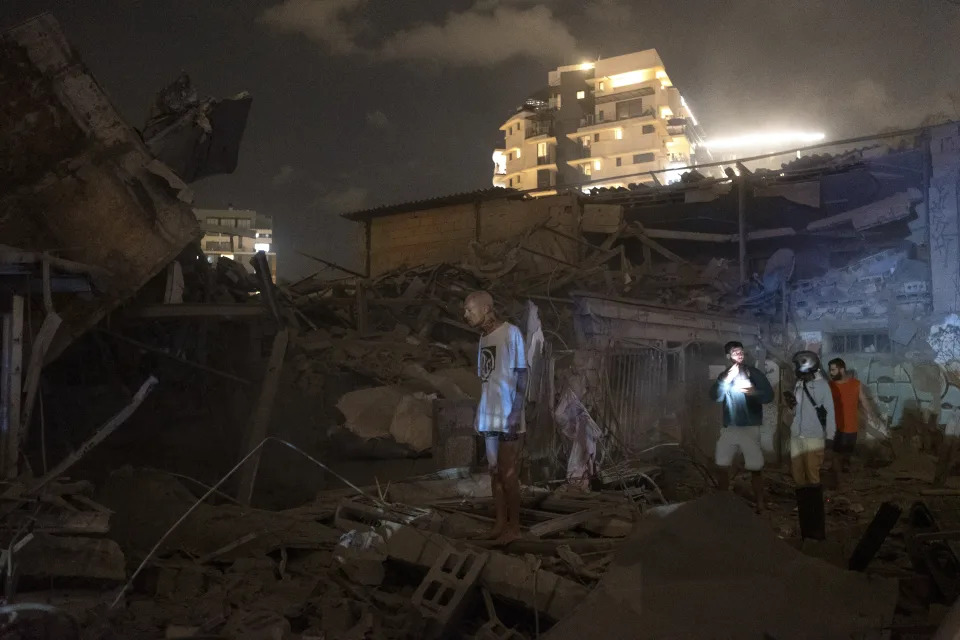
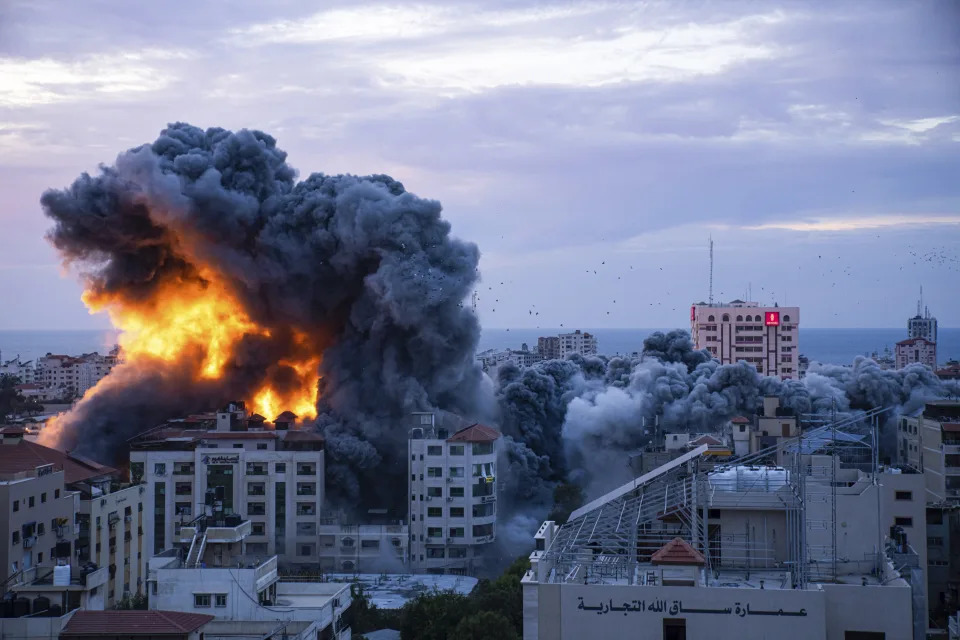
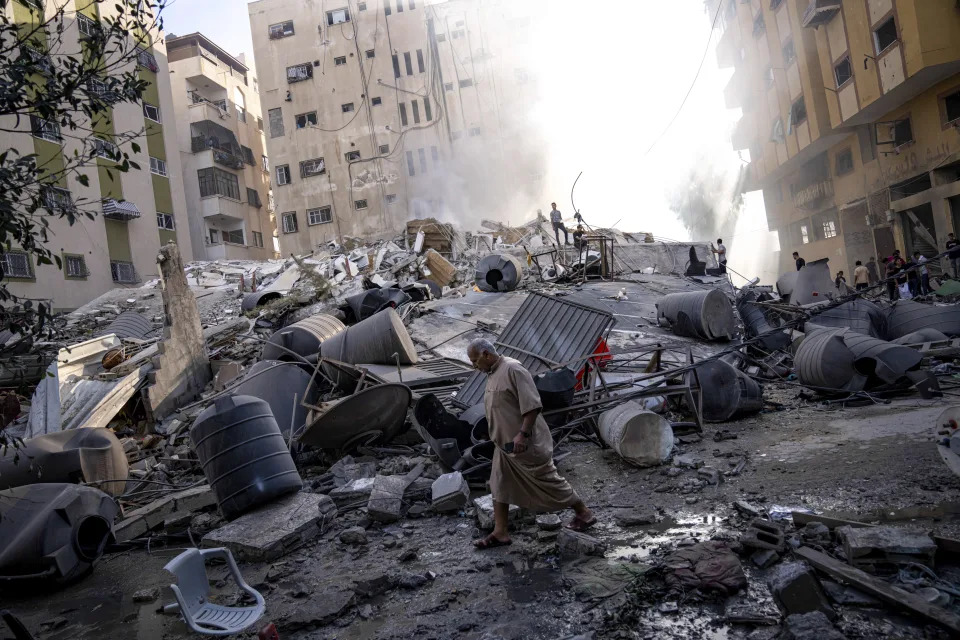
People look at the damage from a rocket fired from the Gaza Strip in Tel Aviv, Israel, Saturday, Oct. 7, 2023. (AP Photo/Moti Milrod)Fire and smoke rises following an Israeli airstrike, in Gaza City, Saturday, Oct. 7, 2023. The militant Hamas rulers of the Gaza Strip carried out an unprecedented, multi-front attack on Israel at daybreak Saturday, firing thousands of rockets as dozens of Hamas fighters infiltrated the heavily fortified border in several locations by air, land, and sea, killing dozens and stunning the country. Palestinian health officials reported scores of deaths from Israeli airstrikes in Gaza. (AP Photo/Fatima Shbair)Palestinians inspect the rubble of a building after it was struck by an Israeli airstrike, in Gaza City, Saturday, Oct. 7, 2023. The militant Hamas rulers of the Gaza Strip carried out an unprecedented, multi-front attack on Israel at daybreak Saturday, firing thousands of rockets as dozens of Hamas fighters infiltrated the heavily fortified border in several locations by air, land, and sea and catching the country off-guard on a major holiday. (AP Photo/Fatima Shbair)An Israeli woman react over the body of her relative who was killed by Palestinian armed militants who entered from the Gaza strip, in the southern Israeli city of Sderot, Saturday, Oct. 7, 2023. Hamas, the militant group ruling the Gaza Strip, carried out a surprise, multi-front attack on Israel at daybreak Saturday, firing thousands of rockets and infiltrating the country by land, air and sea. (AP Photo/Baz Ratner)An Israeli soldier stands by the bodies of Israelis killed by Palestinian armed militants who entered from the Gaza Strip, in the southern Israeli city of Sderot, Saturday, Oct. 7, 2023. Hamas, the militant group ruling the Gaza Strip, carried out a surprise, multi-front attack on Israel at daybreak Saturday, firing thousands of rockets and infiltrating the country by land, air and sea. (AP Photo/Tsafrir Abayov)
JERUSALEM (AP) — Backed by a barrage of rockets, Hamas militants stormed from the blockaded Gaza Strip into nearby Israeli towns, killing dozens and abducting others in an unprecedented surprise attack during a major Jewish holiday Saturday. A stunned Israel launched airstrikes in Gaza, with its prime minister saying the country is now at war with Hamas and vowing to inflict an “unprecedented price.”
In an assault of startling breadth, Hamas gunmen rolled into as many as 22 locations outside the Gaza Strip, including towns and other communities as far as 15 miles (24 kilometers) from the Gaza border. In some places they gunned down civilians and soldiers as Israel’s military scrambled to muster a response.
Gunbattles continued well after nightfall, and militants held hostages in standoffs in two towns. Militants occupied a police station in a third town, where Israeli forces struggled until Sunday morning to finally reclaim the building.
Before daybreak Sunday, militants fired more rockets from Gaza, hitting a hospital in the Israeli coastal town of Ashkelon. The hospital sustained damage, said senior hospital official Tal Bergman. Video provided by Barzilai Medical Center showed a large hole punched into a wall and chunks of debris scattered on the ground of what appeared to an empty rooms and a hallway. There was no report of casualties.
Israeli media, citing rescue service officials, said at least 250 people were killed and 1,500 wounded in Saturday’s attack, making it the deadliest in Israel in decades. At least 232 people in the Gaza Strip were killed and 1,700 wounded in Israeli strikes, the Palestinian Health Ministry said. Hamas fighters took an unknown number of civilians and soldiers captive into Gaza.
The conflict threatened to escalate with Israel’s vows of retaliation. Previous conflicts between Israel and Gaza’s Hamas rulers brought widespread death and destruction in Gaza and days of rocket fire on Israeli towns. The situation is potentially more volatile now, with Israel’s far-right government stung by the security breach and with Palestinians in despair over a never-ending occupation in the West Bank and suffocating blockade of Gaza.
In a televised address Saturday night, Israeli Prime Minister Benjamin Netanyahu, who earlier declared Israel to be at war, said the military will use all of its strength to destroy Hamas’ capabilities. But he warned, “This war will take time. It will be difficult.”
“All the places that Hamas hides in, operates from, we will turn them into ruins,” he added. “Get out of there now,” he told Gaza residents, who have no way to leave the tiny, overcrowded Mediterranean territory of 2.3 million people.
Early Sunday, the Israeli military issued warnings in Arabic to residents of communities near the border with Israel to leave their homes and move to areas deeper inside the tiny enclave. In previous Israel-Hamas fighting on Gaza soil, the Gaza communities near the border were hit particularly hard, both by artillery fire and at times by ground incursions.
Gaza’s residents have endured a border blockade, enforced to varying degrees by Israel and Egypt, since Hamas militants seized control in 2007. Civilians are trapped and particularly vulnerable during wars and bouts of fighting.
Israeli airstrikes in Gaza intensified after nightfall, flattening residential buildings in giant explosions, including a 14-story tower that held dozens of apartments as well as Hamas offices in central Gaza City. Israeli forces fired a warning just before.
Around 3 a.m., a loudspeaker atop a mosque in Gaza City blared a stark warning to residents of nearby apartment buildings: Evacuate immediately. Just minutes later, an Israeli airstrike reduced one nearby five-story building to ashes.
After one Israeli strike, a Hamas rocket barrage hit four cities, including Tel Aviv and a nearby suburb. Throughout the day, Hamas fired more than 3,500 rockets, the Israeli military said.
The strength, sophistication and timing of the Saturday morning attack shocked Israelis. Hamas fighters used explosives to break through the border fence enclosing Gaza, then crossed with motorcycles, pickup trucks, paragliders and speed boats on the coast.
In some towns, civilians’ bodies lay where they had encountered advancing gunmen. At least nine people gunned down at a bus shelter in the town of Sderot were laid out on stretchers on the street, their bags still on the curb nearby. One woman, screaming, embraced the body of a family member sprawled under a sheet next to a toppled motorcycle.
In amateur video, hundreds of terrified young people who had been dancing at a rave fled for their lives after Hamas militants entered the area and began firing at them. Israeli media said dozens of people were killed.
Among the dead was Col. Jonathan Steinberg, a senior officer who commanded the Israeli military’s Nahal Brigade, a prominent infantry unit.
The shadowy leader of Hamas’ military wing, Mohammed Deif, said the assault was in response to the 16-year blockade of Gaza, Israeli raids inside West Bank cities over the past year, violence at Al Aqsa — the disputed Jerusalem holy site sacred to Jews as the Temple Mount — increasing attacks by settlers on Palestinians and the growth of settlements.
“Enough is enough,” Deif, who does not appear in public, said in the recorded message. He said the attack was only the start of what he called “Operation Al-Aqsa Storm” and called on Palestinians from east Jerusalem to northern Israel to join the fight.
The Hamas incursion on Simchat Torah, a normally joyous day when Jews complete the annual cycle of reading the Torah scroll, revived painful memories of the 1973 Mideast war practically 50 years to the day, in which Egypt and Syria launched a surprise attack on Yom Kippur, the holiest day of the Jewish calendar, aiming to take back Israeli-occupied territories.
Comparisons to one of the most traumatic moments in Israeli history sharpened criticism of Netanyahu and his far-right allies, who had campaigned on more aggressive action against threats from Gaza. Political commentators lambasted the government and military over its failure to anticipate what appeared to be a Hamas attack unseen in its level of planning and coordination.
Asked by reporters how Hamas had managed to catch the army off guard, Lt. Col. Richard Hecht, an Israeli army spokesman, replied, “That’s a good question.”
The abduction of Israeli civilians and soldiers also raised a particularly thorny issue for Israel, which has a history of making heavily lopsided exchanges to bring captive Israelis home. Israel is holding thousands of Palestinians in its prisons. Hecht confirmed that “substantial” number of Israelis were abducted Saturday.
Associated Press photos showed an elderly Israeli woman being brought into Gaza on a golf cart by Hamas gunmen and another woman squeezed between two fighters on a motorcycle. AP journalists saw four people taken from the kibbutz of Kfar Azza, including two women.
In Gaza, a black jeep pulled to a stop and, when the rear door opened, a young Israeli woman stumbled out, bleeding from the head and with her hands tied behind her back. A man waving a gun in the air grabbed her by the hair and pushed her into the vehicle’s back seat. Israeli TV reported that workers from Thailand and the Philippines were also among the captives.
Netanyahu vowed that Hamas “will pay an unprecedented price.” A major question now was whether Israel will launch a ground assault into Gaza, a move that in the past has brought intensified casualties.
Israel’s military was bringing four divisions of troops as well as tanks to the Gaza border, joining 31 battalions already in the area, the spokesman Hagari said.
In Gaza, much of the population was thrown into darkness after nightfall as electrical supplies from Israel — which supplies almost all the territories’ power — were cut off. Netanyahu’s office said in a statement that Israel would stop supplying electricity, fuel and goods to Gaza.
Hamas said it had planned for a potentially long fight. “We are prepared for all options, including all-out war,” the deputy head of the Hamas political bureau, Saleh al-Arouri, told Al-Jazeera TV. “We are ready to do whatever is necessary for the dignity and freedom of our people.”
U.S. President Joe Biden said from the White House that he had spoken with Netanyahu to say the United States “stands with the people of Israel in the face of these terrorist assaults. Israel has the right to defend itself and its people, full stop.”
Saudi Arabia, which has been in talks with the U.S. about normalizing relations with Israel, called on both sides to exercise restraint. The kingdom said it had repeatedly warned about the danger of “the situation exploding as a result of the continued occupation (and) the Palestinian people being deprived of their legitimate rights.”
Lebanon’s Hezbollah militant group congratulated Hamas, praising the attack as a response to “Israeli crimes.” The group said its command in Lebanon was in contact with Hamas about the operation.
The attack comes at a time of historic division within Israel over Netanyahu’s proposal to overhaul the judiciary. Mass protests over the plan have sent hundreds of thousands of Israeli demonstrators into the streets and prompted hundreds of military reservists to avoid volunteer duty — turmoil that has raised fears over the military’s battlefield readiness.
It also comes at a time of mounting tensions between Israel and the Palestinians, with the peace process effectively dead for years. Over the past year, Israel’s far-right government has ramped up settlement construction in the occupied West Bank, Israeli settler violence has displaced hundreds of Palestinians there and tensions have flared around a flashpoint Jerusalem holy site.
Palestinians demonstrated in towns and cities around the West Bank on Saturday night. Palestinian health officials said Israeli fire killed five there, but gave few details.
Adwan reported from Rafah, Gaza Strip. Associated Press writers Wafaa Shurafa in Gaza City and Isabel DeBre and Julia Frankel in Jerusalem contributed to this report.
This week, Donald Trump delivered his version of a sad tiny desk performance, hunched over the defendant’s table in a New York courtroom, diminished and watching the illusion of power and grandeur he has sold voters thin and run like oil in a hot pan.
He insisted on appearing in person at his civil fraud trial, apparently believing that he would continue to perform his perverse magic of converting that which would have ended other political careers into a political win for himself.
His hubris seemed to consume him, persuading him that in matters of optics, he’s not only invincible but unmatched.
He has done it before: In August he scowled in his mug shot — a precursor to his Fulton County, Ga., criminal trial — summoning the allure of an outlaw, using the photo to raise millions of dollars, according to his campaign.
But I think his attempts at cosplaying some sort of roguish flintiness will wind up being missteps. Courtrooms don’t allow for political-rally stagecraft. There’s no place to plant primed supporters behind him to ensure that every camera angle captures excited admirers. He’s not the center of attention, the impresario of the event; no, he must sit silently in lighting not intended to flatter and in chairs not intended to impress.
Courtrooms humble the people in them. They equalize. They democratize. In the courtroom, Trump is just another defendant — and in it, he looks small. The phantasm of indomitability, the idea of him being wily and slick, surrenders to the flame like tissues in a campfire.
The image was not of a defiant would-be king but of a man stewing and defeated.
The judge in the case even issued a limited gag order after Trump posted a picture of and a comment about the judge’s clerk on Truth Social.
Meanwhile, there’s the historic ouster of the House speaker, Kevin McCarthy, by members of his own party for the unforgivable sin of seeking a bipartisan solution to keep the government open.
In Greek mythology exists the story of the Gigantomachy, a battle between the Olympian gods and giants. According to prophecy, the gods could emerge victorious only if assisted by a mortal. Hercules came to the rescue.
But in Republicans’ version of this drama, McCarthy could have emerged victorious over his party’s anarchists only if Democrats had come to his aid. None did.
He was felled by a revolt led not by a giant but by the smallest of men, not in stature but in principles: the charmless Representative Matt Gaetz of Florida.
Anyone who thought that Democrats were going to save McCarthy should have thought again. Ultimately, he succumbed to the result of his own craven pursuit of power: The rule that Gaetz used to initiate the vote to strip McCarthy of the speaker’s gavel was the rule McCarthy agreed to in order to get his hands on the gavel in the first place.
Republicans are engaged in an intense session of self-flagellation. Does it also hurt the country? Yes. But in one way it might help: America needs to clearly see who the culprits are in today’s political chaos, and the damage they cause, so that voters can correct course.
And the events of this week should give voters pause. The tableau that emerges from the troubles of Trump and McCarthy is one in which the G.O.P.’s leaders are chastened and cowed, one in which their power is stripped and their efforts rebuked.
This is just one week among many leading up to the 2024 elections, but it is weeks like this that leave a mark, because the images that emerge from them are indelible.
All the inflamed consternation about Joe Biden’s age and Hunter Biden’s legal troubles will, in the end, have to be weighed against something far more consequential: Republicans — obsessed with blind obeisance, a lust for vengeance and a contempt for accountability — who no longer have the desire or capacity to actually lead.
Their impulses to disrupt and destroy keep winning out, foreshadowing even more of a national disaster if their power grows as a result.
How Republican primary voters respond to this Republican maelstrom of incompetence is one thing. How general election voters will respond to it is quite another.
Franklin elections: Hanson says Tennessee Active Club not hired; board decries ‘neo-Nazis’
Craig Shoup, Nashville Tennessean – October 4, 2023
Controversial Franklin mayoral candidate Gabrielle Hanson posted on social media Wednesday that she did not hire members of the Tennessee Active Club, an organization identified by the Southern Poverty Law Center as a white nationalist hate group, for security during Monday’s candidate forum.
Hanson’s comments were followed by a response from Franklin’s Board of Mayor and Aldermen, which released its own public statement via email within hours of her post.
“We, the Board of Mayor and Aldermen, are deeply concerned and disturbed by the events that unfolded at Monday night’s candidate forum for the upcoming city election,” the board’s statement reads. “Individuals identifying as neo-Nazi’s and self-admitted supporters of Gabrielle Hanson threatened both our citizens and members of the media during and after this important civic event.”
The board’s statement said it wouldn’t “tolerate any form of hatred, intimidation, or violence directed at our residents, media representatives, or anyone else attending or participating in the democratic process,” and it urged all candidates currently seeking office in Franklin, including Hanson, to “join us in denouncing the actions and organizations as well.”
The statement ended with the names of the current Franklin board, including Hanson’s opponent in the mayoral race, incumbent Ken Moore. She wasn’t listed.
In her post, Hanson said she wanted to set the record straight about what happened Monday.
“I want to make something very clear. I did not hire the group that showed up at the debate the other night, nor did I ask them to participate as security for the event. I want to be unequivocal on this matter,” Hanson said in the statement posted to her Instagram story Wednesday afternoon.
“Furthermore, I want to state categorically that I am not, nor have I ever been associated with any white supremacy or Nazi-affiliated group.”
Hanson explained that she’s working as the “broker on Brad’s (Lewis Country) store,” and categorized her interactions with him as nothing but professional and courteous. Lewis Country Store came under fire earlier this summer after it was revealed that members of the Tennessee Active Club were using the gym above the store.
Media coverage focusing on the Tennessee Active Club’s presence at the forum is “nothing more than a baseless hit piece meant to distract from the real issues at hand,” Hanson wrote.
Tennessee Active Club also released statements about what happened Monday, noting that it was “absurd Gabrielle Hanson hired us. We do this for free at our own expense.”
The group did not say whether Hanson asked them for help.
MAGA Mayoral Candidate Seemingly Promotes White Nationalists in News Release
Josh Fiallo – October 4, 2023
Office of Alderman Gabrielle Hanson
Gabrielle Hanson, the MAGA-loving mayoral candidate who’s become embroiled in controversy after controversy this year, has done it again—this time inserting screenshots of messages from a known white nationalist group into her own news release.
Hanson, who’s vying to become the mayor of Franklin, Tennessee, shared the messages in an attempt to prove that the Tennessee Active Club—a recognized hate group by the Southern Poverty Law Center—weren’t invited to provide security for her outside a mayoral forum on Monday. She claimed they instead showed up and acted on their own.
But Hanson never condemned the neo-Nazis in her news release, nor did she ask them to not show up at future forums and events. Instead, she embedded three Telegram messages to a news release that did more to promote the hate group than it did to denounce it.
The posts claimed the current Franklin mayor, Ken Moore, has connections to “antifa”—a blanket term for a loosely-affiliated network of anti-fascist groups that have battled right-wing demonstrators at various public gatherings over the past few years—and that the group of white nationalists showed up to provide security for community members.
“Our group is not backing any political entity but is protecting the public from Antifa,” the first message said. “Remember there is no political solution.”
The other messages emphasized that the group showed up “for free at our own expense” and that they’ll continue to pop up at municipal gatherings until Franklin—a wealthy suburb of Nashville that’s famously home to scores of country musicians and their families—is free of antifa.
Hanson emphasized in her release that she’s never been associated with a neo-Nazi group. She also took a shot at the local TV news reporter Phil Williams—who’s been a thorn in Hanson’s side—by claiming he published a “baseless hit piece” for pointing out that white supremacists escorted Hanson and her husband inside Monday’s forum.
Others involved in Franklin politics quickly denounced the Active Club’s presence, including Moore and State Rep. Sam Whitson, but Hanson never did. In a News Channel 5 report, Williams said that masked neo-Nazis told reporters on Monday that they were “just here to protect Gabrielle.”
One of the men working as security detail reportedly identified himself as Sean Kauffmann, who was described by the Stop Antisemitism watchdog group as being a “disturbed neo-Nazi and Holocaust denier with a documented history of violence and a massive cache of firearms.” He was reportedly spotted doing a Nazi salute outside a drag show in Cookeville, Tennessee, earlier this year.
Hanson’s beef with Williams escalated last week. The reporter’s station was the first to reveal on Sept. 27 that Hanson’s husband once rocked an American flag Speedo—and nothing else, save for a gold chain, glasses, and shoes—to a Pride event in Chicago, with Hanson’s blessing. The report exposed her hypocrisy on LGBTQ issues, as she’d earlier that year used her position as a city alderman to try to stop a local Pride festival because she feared it’d bring out drag queens and scantily clad revelers she deemed a threat to “innocent children.”
Later that day, drama broke out at a mayoral forum held inside a ritzy subdivision’s clubhouse, with Hanson-supporting residents getting into a nasty—and briefly physical—spat with Williams as he tried to enter the event with a cameraman.
One Hanson supporter was captured on video taking a swipe at Williams, which prompted a Franklin cop to scold the woman and say, “Stop touching him or you’re going to jail.” After the event, Hanson didn’t apologize for her supporters’ behavior, instead railing against Williams on Facebook and painting him as an agitator. A recording by a journalist at the event also captured Hanson telling someone, “No Channel 5. They have to leave.”
Even prior to last week’s forum, Hanson routinely put herself in the center of drama. She claimed in May that Audrey Hale, the shooter who gunned down six before being killed by cops at The Covenant School, was in a love triangle with staffers there. Cops immediately shot that rumor down as false, but Hanson has still insisted her sources know the truth.
Hanson has also been skewered for downplaying lynching and for opposing the addition of “racial terror” markers in Franklin. She was also criticized for bizarrely threatening to retaliate against the local airport for supporting a Juneteenth festival, and it was revealed in September that she was arrested in college for promoting prostitution—charges she claimed publicly amounted to a simple misdemeanor, though Williams confirmed last week that they were actually felony charges.
Whether Hanson’s laundry list of controversies will hurt her at the polls will be known soon, as Franklin’s mayoral election is slated to be held on Oct. 24.
The ultra-rich are not just the worst polluters–their donations to climate action are also another way of hoarding money and gaming the system
Alan Davis – October 4, 2023
Getty Images
Everyone should know that we’re heading to a climate disaster that can best be modified by immediate actions addressing the causes. But it doesn’t appear that the excessively rich are feeling the heat and stepping up to the plate. Their philanthropic foundations announce commitments to fight climate change but in reality, they are building up endowments to save for the future.
It is estimated that it could take $3 to 10 trillion (twelve zeroes) per year to avoid climate disaster. Even if they wanted to fix the climate problem, it would require extraordinary collective action for philanthropists to pony up enough money to fix the climate problem. Only governments (funded by taxes on these very ultra-wealthy donors) can effectively do that. In short, the philanthropic investments now being made are necessary but insufficient.
We need to hold the ultra-rich responsible for the role their investments play in worsening the climate crisis, call out their insincere philanthropic efforts aimed at “addressing” climate change, and hold them accountable for paying their fair share of taxes to provide funding for clean energy.
Extreme inequality and wealth concentration undermine humanity’s ability to stop climate breakdown. The richest of the rich play the largest role in driving and accelerating the climate crisis with out-of-control carbon footprints due to extravagant lifestyles, excessive wealth-hoarding, corporate greed, and investments in polluting industries. Poor and middle-class communities who share the least responsibility for the problem will bear the brunt of climate change and suffer the most as shifting weather patterns, destructive storms, floods, wildfires, and heat waves wreak havoc across the globe, with the potential to displace 216 million people from their homes (and countries) by 2050.
According to the most recent data, the world’s top 125 billionaires have “an average of 14% of their investments in polluting industries, such as fossil fuels and materials like cement….Only one billionaire in the sample had investments in a renewable energy company.” When combining the impact from both their investments and lifestyles, carbon emissions exceed 3 million tons per billionaire, about a million times greater than the average person! The same report finds that through campaign contributions and lobbying, the wealthiest among us have an oversized impact on election outcomes and more political power than anyone else to protect their investments and shape climate policies in their favor.
And therein lies the biggest problem: We must have a functioning democracy to address society’s most pressing issues, including climate change–one where an exclusive ruling class doesn’t control our policies. When the government is beholden to the excessively wealthy, backroom deals influence laws and shape the rules without the public’s knowledge or ability to change the outcomes. The only way to limit the power of the excessively wealthy is to stop the hoarding of excessive wealth.
Extremely rich Americans hoard their wealth through tax loopholes and preferential policies enforced by their armies of lawyers, accountants, wealth advisers, and politicians. Four simple tax solutions would address excessive wealth hoarding: a multi-millionaire income tax, a robust wealth tax, closing gaping estate tax loopholes through an estate or inheritance tax, and finally, changes to the tax rules to foster increased, transparent and more equitable charitable giving.
We are facing a collective emergency: to save the planet from–and for–ourselves. The rapidly accelerating climate crisis is a class issue that impacts all of humanity. The reality is that our futures are interconnected with one another–and economic and climate inequality reinforce each other. To develop solutions that slow or solve climate change, we must address the deep-seated conflicts of interest and the systemic inequalities of our unjust wealth system.
Giuliani to lose 2nd attorney in Georgia, leaving him without local legal team
Olivia Rubin – October 4, 2023
Giuliani to lose 2nd attorney in Georgia, leaving him without local legal team
A second lawyer for Rudy Giuliani is seeking to depart his legal team in Georgia, sources familiar with the matter tell ABC News, a move that would appear to leave the former New York City mayor without any local lawyers in the state.
A motion to withdraw has been submitted to the clerk, the sources said. A judge in the case has to sign off on the motion.
News of the move comes after several other former attorneys of the Trump ally have sued Giuliani for failure to pay his bills, including his longtime friend and attorney Bob Costello, who sued Giuliani for over $1 million in payments due to his firm.
Earlier, an additional lawyer for Giuliani in Georgia, David Wolfe, submitted his own motion to withdraw from his representation of Giuliani.
Sources close to Giuliani say the former mayor is close to retaining new local representation.
Giuliani, along with former President Donald Trump and 17 others, have pleaded not guilty to all charges in a sweeping racketeering indictment for alleged efforts to overturn the results of the 2020 presidential election in Georgia.


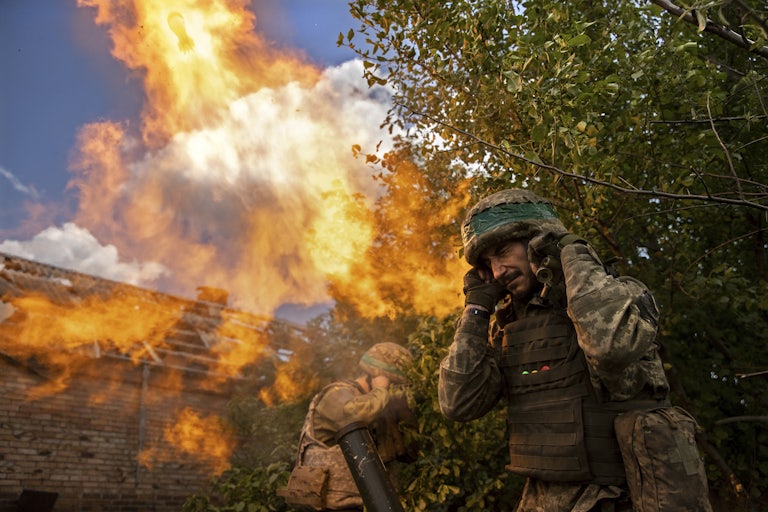 Two Ukrainian soldiers fire a mortar in Bakhmut, where some of the fiercest fighting of the war has taken place. TYLER HICKS/THE NEW YORK TIMES/REDUX