Donald Trump is talking like a Nazi again. Over the weekend, in both a speech and a subsequent social media post, he referred to his enemies as “vermin”—a favorite word of fascists and antisemites of yore—and channeled Hitler, declaring that America’s biggest enemies were domestic foes that needed to be “rooted out” and destroyed. “The real threat is not from the radical right; the real threat is from the radical left, and it’s growing every day, every single day,” he said. “The threat from outside forces is far less sinister, dangerous, and grave than the threat from within. Our threat is from within.”
As if doubling down on the authoritarianism, Axios reported on Monday morning that Trump and his allies had formulated a plan to purge the federal government of ideological opponents. Trump and his allies “are pre-screening the ideologies of thousands of potential foot soldiers, as part of an unprecedented operation to centralize and expand his power at every level of the U.S. government if he wins in 2024,” wrote Mike Allen and Jim VandeHei. Although they note that this plan—which they’ve taken to calling “Agenda 47”—has an “authoritarian sounding” name, Allen and VandeHei (the latter of whom has harbored some authoritarian sentiments of his own), ever eager to ingratiate themselves, observe that those in charge of this plan “are smart, experienced people, many with very unconventional and elastic views of presidential power and traditional rule of law.” For sure!
Finally, to underline the weekend of goose-stepping, Trump spokesperson Steven Cheung responded to the criticism by tellingThe Washington Post that those “who try to make [the] ridiculous assertion [that Trump is channeling Hitler] are clearly snowflakes grasping for anything because they are suffering from Trump Derangement Syndrome and their entire existence will be crushed when President Trump returns to the White House.” Not exactly a posture aimed at reassuring those who are alarmed by the increasingly fascistic bent of the leading contender for the Republican presidential nomination.
The response to Trump’s “vermin” comments and the revelation of the “Agenda 47” plan have led to a deserved round of hand-wringing about Trump’s authoritarianism, the threat his political project poses to American democracy, and the media’s role in covering both. In 2016, the press failed to adequately capture the sum total of this threat, partly because Trump’s political career was seen as a doomed project and partly because it was still too abstract. Seven years later, Trump’s rhetoric is substantially darker and we’ve had plenty of hard evidence of his willingness to push past the acceptable boundaries of our democracy in his continued insistence that the 2020 election was stolen from him, as well as in the Capitol riots that this rhetoric inspired.
Emphasizing Trump’s authoritarianism—and the related damage he can do to the fabric of the country—will be a necessity both for the press and for Joe Biden. Trump is rather transparently announcing his intentions to purge and weaponize the federal government against his political opponents, immunize himself against legal prosecution, and manipulate the levers of power to preserve his own for as long as possible. Given the threat of physical violence that so often accompanies his words, this is more or less open fascism. But declaiming against it will not be enough to defeat him.
“This is not normal” was a potent rallying cry during Trump’s presidency—it was arguably the defining admonition of that period. In many ways, Trump’s abnormality has only metastasized since voters evicted him from the White House. His rhetoric has grown more extreme. He is facing multiple criminal trials and will likely head into the presidential election as both his party’s nominee and as a convicted felon.
But Trump very much is a normal Republican now. That is true in many frightening ways, certainly. Trump’s political rivals have begun to echo his authoritarianism. Vivek Ramaswamy has arguably an even more insane plan to force the federal bureaucracy to submit to his will (he has suggested firing everyone whose social security number ends in an odd number). Ron DeSantis has called for shooting migrants. Nikki Haley has advocated for invading Mexico. Trump’s positions are the norm in the GOP now, and they will remain that way for the party’s foreseeable future: The GOP has, in eight years, been remade in his image.
But Trump has also become a normal Republican in the traditional sense, in that he’s more or less ended up embracing the long-standing policy positions of his GOP forebears. During his first term in office, his most important legislative accomplishment was a gigantic tax cut for corporations and the rich. Even though it is unlikely that he will staff his second-term office with the same kind of establishment figures—think Rex Tillerson and Steven Mnuchin—who briefly defined the early part of his presidency, one can rightly assume that he will continue to pursue regressive, supply-side economic policies, especially considering that this is what Republicans in Congress will want to do. The domestic agenda of a second Trump term would likely involve the greatest hits of Republican fiscal policy: tax and entitlement cuts, as well as the elimination of various environmental, labor, and economic regulations.
For all the talk of Trump’s abnormality, the fact that he’s always marched to the recognizable, old-school beats of the GOP drum has always been the less celebrated aspect of his time in politics. So there’s a danger in continually casting him as a pathbreaking sort of politician. Voters don’t like the status quo. They’ve repeatedly voted to reject the economic dogmas that have defined Republican policymaking for several consecutive elections. They thought that this was what they were getting from Trump in the first place—and the media did a much better job of selling Trump as a change-of-pace candidate, and clung to the notion that he was an economic populist long after he’d demonstrated no real interest in refreshing the Republican brand.
Democratic messaging needs to account for both Trump’s unique authoritarian leanings and his embrace of vintage Republican ideas. To solely advance the idea that Trump is a unique political figure in American life—a wild departure from the norm—runs the risk of implanting the idea that he is a politician bent on shattering the status quo during a time when many might prefer the short sharp shock of change. Ideally, you want to capture Trump as a chaos agent whose plans to sledgehammer the system won’t lead anywhere fruitful or new, but will more deeply entrench the unpopular ideas for which the GOP has long been known.
The clearest and most potent position for Democrats is to push on reproductive rights—it embodies the new post-Dobbs dystopia with the Republican Party’s decades-long effort to bring it about. Trump has, of late, escaped much attention for his abortion policy, in part because he’s skipped the Republican debates and in part because many of his opponents have adopted even more extreme positions. (Trump claims to oppose a nationwide abortion ban, though it seems highly likely he would sign one if he was given the chance.) More to the point, no one in the country is more responsible for the repeal of Roe v. Wade than Donald Trump, who appointed the three justices to the Supreme Court necessary to do the deed. Still, there is nothing new under the sun. Here we see a normal Republican doing normal Republican stuff. It is both odious and unpopular: Republicans have repeatedly lost elections when abortion is on the ballot. It will be again in 2024.
For Democrats, campaigning against Trump’s reelection will be an exercise in threading a needle between the new threats he poses and bad, old ideas to which he clings. This is something Democrats did successfully in the 2020 presidential election and then refined to great effect in the 2022 midterms; voters said that abortion and threats to democracy were the two issues that were front of mind as they tamed the “red wave” that was supposed to sweep Republicans into power. With less than a year before the election, both Biden and the press are doing a better job of making the case that Trump is a unique danger to the Republic. They should spend a little time reminding voters that he’s just as bad in other, more banal ways, as well.
Trump Campaign Officials Try to Play Down Contentious 2025 Plans
Maggie Haberman – November 14, 2023
Republican presidential candidate and former U.S. President Donald Trump speaks during a campaign rally in Claremont, New Hampshire, U.S., November 11, 2023. REUTERS/Brian Snyder (Brian Snyder / reuters)
Two top officials on former President Donald Trump’s 2024 campaign on Monday sought to distance his campaign team from news reports about plans for what he would do if voters return him to the White House.
Susie Wiles and Chris LaCivita, who are effectively Trump’s campaign managers, issued a joint statement after a spate of articles, many in The New York Times, about plans for 2025 developed by the campaign itself, and trumpeted on the trail by Trump, as well as efforts by outside groups led by former senior Trump administration officials who remain in direct contact with him.
Wiles and LaCivita focused their frustration on outside groups, which they did not name, that have devoted considerable resources to preparing lists of personnel and developing policies to serve the next right-wing administration.
“The efforts by various nonprofit groups are certainly appreciated and can be enormously helpful. However, none of these groups or individuals speak for President Trump or his campaign,” they wrote, calling reports about their personnel and policy intentions “purely speculative and theoretical” and “merely suggestions.”
Trump’s team has sought to portray him as the most substantive candidate on policy in the Republican Party. But according to several people with knowledge of the internal discussions, who spoke on the condition of anonymity to discuss private conversations, Trump’s campaign advisers have grown enraged at what they perceive alternately as credit-taking by the groups, and headlines that could be problematic for more moderate voters in a general election.
The statement noticeably stopped short of disavowing the groups and seemed merely intended to discourage them from speaking to the press.
One challenge for the Trump team is that the most incendiary rhetoric and proposals have come from Trump’s own mouth.
For instance, an article in the Times in June explored Trump’s plans to use the Justice Department to take vengeance on political adversaries by ordering investigations and prosecutions of them, eradicating the post-Watergate norm of Justice Department investigative independence from White House political control.
Trump said in June: “I will appoint a real special prosecutor to go after the most corrupt president in the history of the United States of America, Joe Biden, and the entire Biden crime family.”
The Times recently published an extensive article on Trump’s immigration plans for a second term. He has promised what he called “the largest domestic deportation operation in American history” and has used increasingly toxic language to describe immigrants, including saying that they are “poisoning the blood of our country.”
The Times article detailed plans for an immigration crackdown in part based on a lengthy interview with Stephen Miller, the architect of the Trump White House immigration policy. The Trump campaign, after being approached by Times reporters about Trump’s immigration agenda, had asked Miller to speak with them.
President Joe Biden’s 2024 campaign pounced on the article concerning immigration — which described plans for mass detention camps, among other things — saying that Trump had “extreme, racist, cruel policies” that were “meant to stoke fear and divide us.”
Other Times articles have focused on plans being fleshed out by close allies of Trump who occupied senior roles in his White House and are likely to return to power if he is elected.
Those plans include efforts to increase White House control over the federal bureaucracy that are being developed, among others, by Russell Vought, who was Trump’s director of the Office of Management and Budget.
But as the Times noted, Vought’s plans dovetailed with statements Trump made in a video his campaign published on its website, including vowing to bring independent regulatory agencies “under presidential authority.”
The Times series has also examined plans by Trump allies to recruit more aggressive lawyers seen as likely to bless extreme policies. Trump fired the top lawyer at the Department of Homeland Security in 2019 after disputes over White House immigration policies and has blasted key lawyers from his administration who raised objections to his efforts to overturn his 2020 election loss.
The statement from Wiles and LaCivita on Monday said that, “all 2024 campaign policy announcements will be made by President Trump or members of his campaign team. Policy recommendations from external allies are just that — recommendations.”
Joe Scarborough Warns Trump Is ‘Going Full-On Hitler’ After Weekend Rhetoric
Josephine Harvey – November 13, 2023
MSNBC’s Joe Scarborough said Donald Trump is “going full-on Hitler” after the former president referred to political opponents as “vermin” over the weekend.
The “Morning Joe” host took it as a warning ahead of the 2024 election.
“You look at the language of Donald Trump, you look at what Donald Trump says he’s going to do, and you go back to Maya Angelou saying that ‘when somebody tells you who they are, believe ‘em the first time,’” Scarborough said on his morning show Monday, quoting the late civil rights activist.
“We have to believe him, and we also have to believe that this is the most important election probably since 1864,” he added. That election, during the Civil War, saw Abraham Lincoln elected to a second term.
In a Truth Social post on Saturday, Trump vowed to “root out the Communists, Marxists, Fascists, and Radical Left Thugs that live like vermin within the confines of our Country, lie, steal, and cheat on Elections, and will do anything possible, whether legally or illegally, to destroy America, and the American Dream.”
“The threat from outside forces is far less sinister, dangerous, and grave, than the threat from within,” the leading contender for the Republican 2024 nomination added.
He made similar remarks during a Veterans Day rally in Claremont, New Hampshire.
Last month, Trump drew rebuke after he said undocumented immigrants are “poisoning the blood of our country,” another phrase that echoes language used by Nazi dictator Adolf Hitler.
People warned me before I came to Tel Aviv a few days ago that the Israel of Oct. 7 is an Israel that I’ve never been to before. They were right. It is a place in which Israelis have never lived before, a nation that Israeli generals have never had to protect before, an ally that America has never had to defend before — certainly not with the urgency and resolve that would lead a U.S. president to fly over and buck up the whole nation.
After traveling around Israel and the West Bank, I now understand why so much has changed. It is crystal clear to me that Israel is in real danger — more danger than at any other time since its War of Independence in 1948. And it’s for three key reasons:
First, Israel is facing threats from a set of enemies who combine medieval theocratic worldviews with 21st-century weaponry — and are no longer organized as small bands of militiamen but as modern armies with brigades, battalions, cybercapabilities, long-range rockets, drones and technical support. I am speaking about Iranian-backed Hamas, Hezbollah, Islamic militias in Iraq and the Houthis in Yemen — and now even the openly Hamas-embracing Vladimir Putin. These foes have long been there, but all of them seemed to surface together like dragons during this conflict, threatening Israel with a 360-degree war all at once.
How does a modern democracy live with such a threat? This is exactly the question these demonic forces wanted to instill in the mind of every Israeli. They are not seeking a territorial compromise with the Jewish state. Their goal is to collapse the confidence of Israelis that their defense and intelligence services can protect them from surprise attacks across their borders — so Israelis will, first, move away from the border regions and then they will move out of the country altogether.
I am stunned by how many Israelis now feel this danger personally, no matter where they live — starting with a friend who lives in Jerusalem telling me that she and her husband just got gun licenses to have pistols at home. No one is going to snatch their children and take them into a tunnel. Hamas, alas, has tunneled fear into many, many Israeli heads far from the Gaza border.
The second danger I see is that the only conceivable way that Israel can generate the legitimacy, resources, time and allies to fight such a difficult war with so many enemies is if it has unwavering partners abroad, led by the United States. President Biden, quite heroically, has been trying to help Israel with its immediate and legitimate goal of dismantling Hamas’s messianic terrorist regime in Gaza — which is as much a threat to the future of Israel as it is to Palestinians longing for a decent state of their own in Gaza or the West Bank.
But Israel’s war against Hamas in Gaza entails urban, house-to-house fighting that creates thousands of civilian casualties —innocent men, women and children — among whom Hamas deliberately embedded itself to force Israel to have to kill those innocents in order to kill the Hamas leadership and uproot its miles of attack tunnels.
But Biden can sustainably generate the support Israel needs only if Israel is ready to engage in some kind of a wartime diplomatic initiative directed at the Palestinians in the West Bank — and hopefully in a post-Hamas Gaza — that indicates Israel will discuss some kind of two-state solutions if Palestinian officials can get their political house unified and in order.
This leads directly to my third, deep concern.
Israel has the worst leader in its history — maybe in all of Jewish history — who has no will or ability to produce such an initiative.
Worse, I am stunned by the degree to which that leader, Prime Minister Benjamin Netanyahu, continues to put the interests of holding on to the support of his far-right base — and pre-emptively blaming Israel’s security and intelligence services for the war — ahead of maintaining national solidarity or doing some of the basic things that Biden needs in order to get Israel the resources, allies, time and legitimacy it needs to defeat Hamas.
Biden cannot help Israel build a coalition of U.S., European and moderate Arab partners to defeat Hamas if Netanyahu’s message to the world remains, in effect: “Help us defeat Hamas in Gaza while we work to expand settlements, annex the West Bank and build a Jewish supremacist state there.”
Let’s drill down on these dangers.
Last Saturday night, a retired Israeli Army commander stopped by my hotel in Tel Aviv to share his perspective on the war. I took him to the 18th-floor executive lounge for our chat, and when we got into the elevator to go up, we joined a family of four — two parents, a toddler and a baby in a stroller. The Israeli general asked them where they were from. “Kiryat Shmona,” the father answered.
As we stepped out, I joked with the general that he could dispense with his briefing. It took just 18 floors and those two words — “Kiryat Shmona” — to describe Israel’s wickedly complex new strategic dilemma created by the surprise Hamas attack of Oct. 7.
Kiryat Shmona is one of the most important Israeli towns on the border with Lebanon. That father said hisfamily had fled the northern fence line with thousands of other Israeli families after the pro-Iranian Hezbollah militia and Palestinian militias in southern Lebanon began lobbing rockets and artillery and making incursions in solidarity with Hamas.
When might they go back? They had no idea. Like more than 200,000 other Israelis, they have taken refuge with friends or in hotels all across this small country of nine million people. And it has takenonly a few weeks for Israelis to begin driving up real estate prices in seemingly safer central Israeli towns. For Hezbollah, that alone is mission accomplished, without even invading like Hamas. Together, Hezbollah and Hamas are managing to shrink Israel.
On Sunday I drove down to a hotel on the Dead Sea to meet some of the hundreds of surviving members of Kibbutz Be’eri, which had some 1,200 residents, including 360 children. It was one of the communities hardest hit by the Hamas onslaught — suffering more than 130 murders in addition to scores of injured and multiple kidnappings of children and elderly. The Israeli government has moved most survivors of the kibbutz across the country to the Dead Sea, where they are now starting their own schools in a hotel ballroom.
I asked Liat Admati, 35, a survivor of the Hamas attack who ran a clinic for facial cosmetics for 11 years in Be’eri, what would make it possible for her to go back to her Gaza border home, where she was raised.
“The main thing for me to go back is to feel safe,” she said. “Before this situation, I felt I have trust in the army. Now I feel the trust is broken. I don’t want to feel that we are covering ourselves in walls and shelters all the time while behind this fence there are people who can one day do this again. I really don’t know at this point what the solution is.”
Before Oct. 7, she and her neighbors thought the threat was rockets, she said, so they built safe rooms, but now that Hamas gunmen came over and burned parents and kids in their safe rooms, who knows what is safe? “The safe room was designed to keep you safe from rockets, not from another human who would come and kill you for who you are,” she said. What is most dispiriting, she concluded, is that it appears that some Gazans who worked on the kibbutz gave Hamas maps of the layout.
There are a lot of Israelis who listened to the recording, published by The Times of Israel, of a Hamas gunman who took part in the Oct. 7 onslaught, identified by his father as Mahmoud, calling his parents from the phone of a Jewish woman he’d just murdered and imploring them to check his WhatsApp messages to see the pictures he took of some of the 10 Jews he alone killed in Mefalsim, a kibbutz near the Gaza border.
“Look how many I killed with my own hands! Your son killed Jews,” he says, according to an English translation. “Mom, your son is a hero,” he adds. His parents can be heard seemingly rejoicing.
This kind of chilling exuberance — Israel was built so that such a thing could never happen — explains the homemade sign I saw on a sidewalk while driving through the French Hill Jewish neighborhood of Jerusalem the other day: “It’s either us or them.’’
The euphoric rampage of Oct. 7 that killed some 1,400 soldiers and civilians has not only hardened Israeli hearts toward the suffering of Gaza civilians. It has also inflicted a deep sense of humiliation and guilt on the Israeli Army and defense establishment, for having failed in their most basic mission of protecting the country’s borders.
As a result, there is a conviction in the army that it must demonstrate to the entire neighborhood — to Hezbollah in Lebanon, to the Houthis in Yemen, to the Islamic militias in Iraq, to the Hamas and other fighters in the West Bank — that it will stop at nothing to re-establish the security of the borders. While the army insists that it is hewing to the laws of war, it wants to show that no one can outcrazy Israel to drive its people from this region — even if the Israeli military has to defy the U.S. and even if it does not have any solid plan for governing Gaza the morning after the war.
As Israel’s defense minister, Yoav Gallant, told reporters on Wednesday: “Israel cannot accept such an active threat on its borders. The whole idea of people living side by side in the Middle East was jeopardized by Hamas.”
This conflict is now back to its most biblical and primordial roots. This seems to be a time of eyes for eyes and teeth for teeth. The morning-after policy thinking will have to wait for the mourning after.
Which is why I so worry about the leadership here today. I was traveling around the West Bank on Tuesday when I heard that Netanyahu had just told ABC News that Israel plans to retain “overall security responsibility” in Gaza “for an indefinite period” after its war with Hamas.
Really? Consider this context: “According to Israel’s official Central Bureau of Statistics, at the end of 2021, 9.449 million people live in Israel (including Israelis in West Bank settlements), the Times of Israel reported last year. “Of those, 6.982 million (74 percent) are Jewish, 1.99 million (21 percent) are Arab, and 472,000 (5 percent) are neither. The Palestinian Bureau of Statistics puts the West Bank Palestinian population at a little over three million and the Gaza population at just over two million.”
So Netanyahu is saying that seven million Jews are going to indefinitely control the lives of five million Palestinians in the West Bank and Gaza — while offering them no political horizon, nothing, by way of statehood one day on any demilitarized conditions.
Early on the morning of Oct. 29, as the Israeli Army was just moving into Gaza, Netanyahu posted and then deleted a message on social media in which he blamed Israel’s defense and intelligence establishment for failing to anticipate Hamas’s surprise attack. (Netanyahu somehow forgot how often the Israeli military and intelligence leaders had warned him that his totally unnecessary coup against the country’s judicial system was fracturing the army and Israel’s enemies were all noticing its vulnerability.)
After being slammed by the public for digitally stabbing his army and intelligence chiefs in the back in the middle of a war, Netanyahu published a new post. “I was wrong,” he wrote, adding that “the things I said following the press conference should not have been said, and I apologize for that. I fully support the heads of [Israel’s] security services.”
But the damage was done. How much do you suppose those military leaders trust what Netanyahu will say if the Gaza campaign stalls? What real leader would behave that way at the start of a war of survival?
Let me not mince words, because the hour is dark and Israel, as I said, is in real danger. Netanyahu and his far-right zealots have taken Israel on multiple flights of fancy in the last year: dividing the country and the army over the fraudulent judicial reform, bankrupting its future with massive investments in religious schools that teach no math and in West Bank Jewish settlements that teach no pluralism — while building up Hamas, which would never be a partner for peace, and tearing down the Palestinian Authority, the only possible partner for peace.
The sooner Israel replaces Netanyahu and his far-right allies with a true center-left-center-right national unity government, the better chance it has to hold together during what is going to be a hellish war and aftermath. And the better chance that Biden — who may be down in the polls in America but could get elected here in a landslide for the empathy and steel he showed at Israel’s hour of need — will not have hitched his credibility and ours to a Netanyahu Israel that will never be able to fully help us to help it.
This society is so much better than its leader. It is too bad it took a war to drive that home. Ron Scherf is a retired member of Israel’s most elite special forces unit and a founder of Brothers in Arms, the Israeli activist coalition that mobilized veterans and reservists to oppose Netanyahu’s judicial coup. Immediately after the Hamas invasion,
Hillary Clinton visits “The View”, says Donald Trump winning in 2024 would be the ‘end of our country’
Joey Nolfi – November 8, 2023
“The wreckage is almost unimaginable,” Clinton said on The View.
Hillary Clinton brought a premonition of the United States’ decimation when she visited The View for a summit on current events.
The former Secretary of State stopped by the show Wednesday for a multi-segment interview, during which cohost Sunny Hostin told Clinton that her 2016 election loss to Donald Trump would go down as “one of the most pivotal moments” in U.S. history, and asked the politician to comment on Trump’s potential re-election in 2024 despite multiple indictments against him.
“I can’t even think that, because I think it would be the end of our country as we know it, and I don’t say that lightly. I hated losing, and I especially hated losing to him because I’d seen so many warning signals during the campaign,” Clinton replied, adding that she tried to support Trump as the leader of the country. “Literally, from his inauguration on, it was nothing but accusing people of things, making up facts, denying the size of the crowd at his own inauguration. Everything I worried about, I saw unfolding.”
She said the warning signs are “even worse now” and speculated that he was “restrained” by those around him during his first term from 2016 through 2020 because “they stood up to him.”
The camera then cut to View star Alyssa Farah Griffin, who worked for Trump’s communications team before resigning — and subsequently spoke out against her former boss in 2020.
ABC Hillary Clinton on ‘The View’
Clinton went on to predict that, if Trump regained control of the White House, his administration would be filled with “people who have no principles, no conscience, who are totally tied to his fortunes, literally, and therefore would do whatever he said,” she observed. “The wreckage is almost unimaginable.”
The 76-year-old finished her thought by comparing Trump to Adolf Hitler, who was “duly elected” in Germany, Clinton said, as well as other authoritarian and dictatorial leaders in history.
Unlike Trump, though, Clinton stressed that those figures “didn’t usually telegraph” their intentions at first, she stressed. “Trump is telling us what he intends to do. Take him at his word. The man means to throw people in jail who disagree with him, shut down legitimate press outlets, do what he can to undermine the rule of law and country’s values.”
Before throwing the show to commercial, moderator Whoopi Goldberg referenced Trump’s ongoing criminal woes — which he has consistently pushed back against and called a “witch hunt” against him — telling the audience that “he’s not going to do a whole bunch of stuff right now” as he’s tied up in a legal web.
At a live speaking event in New York City in October, Griffin and fellow ex-Trump associate Cassidy Hutchinson, who testified during the House investigation into the Capitol insurrection on Jan. 6, 2021, warned their fellow Republicans about electing Trump in 2024, amid polls indicating that the ex-Apprentice TV host is the party’s leading candidate.
“I think it’s the responsibility of every American to make sure his name is not on the Republican ticket,” Hutchinson said, later adding: “If Donald Trump were to be elected to a second term in office, I fear for the future of our country, I fear for the future of our democracy.” (Trump’s office did not respond to EW’s request for comment.)
Democratic Kentucky Gov. Andy Beshear Narrowly Secures a Second Term Following Tough Reelection Bid
Virginia Chamlee – November 7, 2023
Beshar won reelection against Republican nominee Daniel Cameron, Kentucky’s attorney general
AP Photo/Timothy D. Easley (2)Kentucky Gov. Andy Beshear and Kentucky Attorney General Daniel Cameron
Democratic Gov. Andy Beshear won his reelection bid in Kentucky, a red state easily carried by former President Donald Trump in the past two presidential elections, the Associated Press reports. Beshear defeated GOP nominee Daniel Cameron, currently Kentucky’s attorney general.
Polling showed Beshear, 45, with a sizable lead as recently as last month, when he was up 16 points, but an Emerson College poll released last week saw both candidates tied at 47%, with 4% of voters undecided.
Greg Eans/The Messenger-Inquirer via APKentucky Gov. Andy Beshear at a reelection campaign event in Owensboro on Nov. 4, 2023
Representing a conservative state with a Republican-dominated legislature and two Republican U.S. senators, Beshear worked hard to shift the focus of the race away from partisan politics, instead zeroing in on his leadership.
Speaking at a campaign rally Monday, he said, “I run as a proud Democrat, but you saw the moment I won, I took that hat off and I serve every single family, because it’s time for us to recognize that a good job isn’t Democrat or Republican. So, whether you’re a Democrat, Republican or independent, there is a place for you in this campaign.”
In a separate event held in recent days, Beshear stressed that he is adept at reaching across the aisle and working with conservative politicians, saying, “The people of northern Kentucky know how hard I’ve worked to get this grant for building this corridor. But I didn’t do it alone. The person I did it with is a Republican governor of Ohio. We worked across party lines to get it done.”
AP Photo/Timothy D. EasleyKentucky Attorney General Daniel Cameron, the 2023 Republican nominee for governor
Cameron, 37, would have made history as the first Black Republican governor in the country since the Reconstruction era.
Cameron previously made national headlines for his handling of the investigation into Louisville police officers involved in Breonna Taylor‘s 2020 killing. In that case, his office opted not to seek criminal charges for the officers who fired at Taylor, leading to widespread protests against the decision. (The federal Justice Department later announced civil rights charges against four Louisville police officers in relation to her death.)
Kentucky’s 2023 gubernatorial race was closely watched, with many political pollsters speculating that it could signify how next year’s presidential race will play out in the state. Kentucky has not given its Electoral College votes to a Democratic presidential candidate since Bill Clinton‘s 1996 reelection bid.
A new Biden proposal would make changes to Advantage plans for Medicare: What to know
Maureen Groppe, USA TODAY – November 6, 2023
WASHINGTON − The Biden administration wants to make changes to private Medicare insurance plans that officials say will help seniors find plans that best suit their needs, promote access to behavioral health care and increase use of extra benefits such as fitness and dental plans.
“We want to ensure that taxpayer dollars actually provide meaningful benefits to enrollees,” said Health and Human Services Secretary Xavier Becerra.
If finalized, the proposed rules rolled out Monday could also give seniors faster access to some lower-cost drugs.
Administration officials said the changes, which are subject to a 60-day comment period, build on recent steps taken to address what they called confusing or misleading advertisements for Medicare Advantage plans.
Just over half of those eligible for Medicare get coverage through a private insurance plan rather than traditional, government-run Medicare.
Here’s what you need to know.
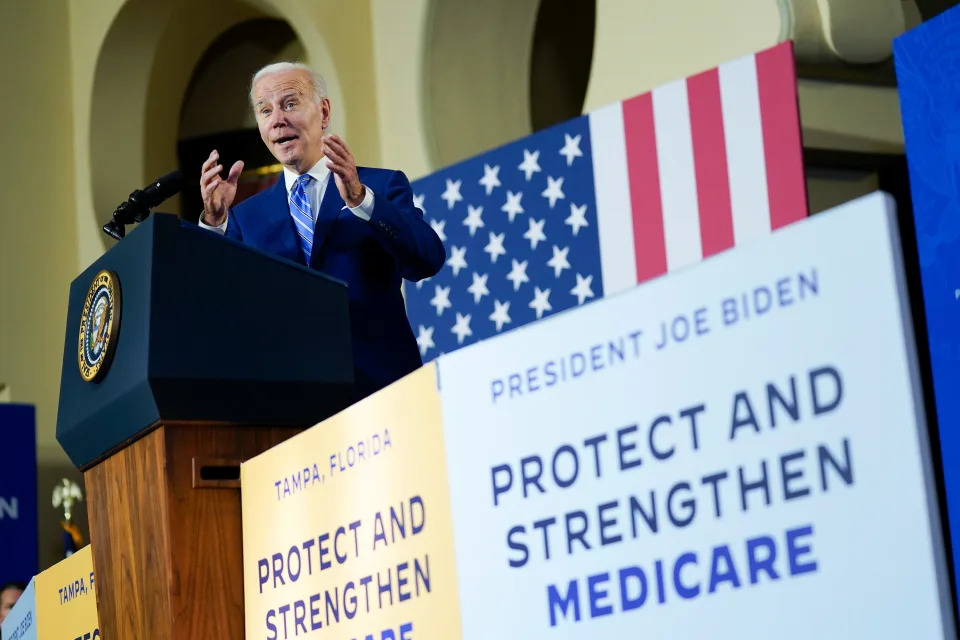
President Joe Biden speaks about his administration’s plans to protect Social Security and Medicare and lower healthcare costs, Feb. 9, 2023, at the University of Tampa in Tampa, Fla.
Extra Medicare benefits
Nearly all Medicare Advantage plans offer extra benefits such as eye exams, dental and fitness benefits. They’re offered at no additional cost to seniors because the insurance companies receive a bump up from their estimated cost of providing Medicare-covered services.
But enrollees use of those benefits is low, according to the Centers for Medicare and Medicaid Services.
To prevent the extra benefits serving primarily as a marketing ploy, the government wants to require insurers to remind seniors mid-year what’s available that they haven’t used, along with information on how to access the benefits.
“The rule will make the whole process of selecting a plan and receiving additional benefits more transparent,” Becerra said.
Broker compensation limits
Because many seniors use agents or brokers to help them find a Medicare Advantage plan, the administration argues better guardrails are needed to ensure agents are acting in the best interest of seniors. Officials said the change would also help reduce market consolidation.
“Some large Medicare Advantage insurance companies are wooing agents and brokers with lavish perks like cash bonuses and golf trips to incentivize them to steer seniors to those large plans,” said Lael Brainard, director of Biden’s National Economic Council.
“That’s not right. Seniors should get the plan that is based on their needs, in their best interests, not based on which plan has the biggest payoff for marketers,” Brainard said.
The proposed changes would broaden the definition of broker compensation so limits on compensation are harder to get around.
Behavioral health care
Medicare Advantage plans must maintain an adequate network of providers. Under the proposed changes, networks would have to include a range of behavioral health providers, including marriage and family therapists and mental health counselors.
An estimated 400,000 of such therapists and counselors will be able to bill Medicare for services next year under recently passed legislation intended to expand access to mental health services.
Lower drug costs
The administration wants to give seniors faster access to cheaper versions of biologic pharmaceuticals, which are made from living cells. The proposed change would give Medicare drug plans more flexibility to substitute a lower-cost version of a biologic – a “biosimilar” – for the more expensive original.
“Any increased competition in the prescription drug market is a key part of our comprehensive effort to lower drug prices,” said Neera Tanden, Biden’s domestic policy adviser.
In a Worldwide War of Words, Russia, China and Iran Back Hamas
Steven Lee Myers and Sheera Frenkel – November 3, 2023
Motorists drive past a giant billboard depicting Muslim peoples walking with their national flags towards the Dome of the Rock shrine in Jerusalem, erected in Valiasr Square in the centre of Tehran on October 25, 2023. (Photo by ATTA KENARE / AFP) (Photo by ATTA KENARE/AFP via Getty Images) (ATTA KENARE via Getty Images)
The conflict between Israel and Hamas is fast becoming a world war online.
Iran, Russia and, to a lesser degree, China have used state media and the world’s major social networking platforms to support Hamas and undercut Israel, while denigrating Israel’s principal ally, the United States.
Iran’s proxies in Lebanon, Syria and Iraq have also joined the fight online, along with extremist groups, like al-Qaida and the Islamic State, that were previously at odds with Hamas.
The deluge of online propaganda and disinformation is larger than anything seen before, according to government officials and independent researchers — a reflection of the world’s geopolitical division.
“It is being seen by millions, hundreds of millions of people around the world,” said Rafi Mendelsohn, vice president at Cyabra, a social media intelligence company in Tel Aviv, Israel, “and it’s impacting the war in a way that is probably just as effective as any other tactic on the ground.” Cyabra has documented at least 40,000 bots or inauthentic accounts online since Hamas attacked Israel from the Gaza Strip on Oct. 7.
The content — visceral, emotionally charged, politically slanted and often false — has stoked anger and even violence far beyond Gaza, raising fears that it could inflame a wider conflict. Iran, though it has denied any involvement in the attack by Hamas, has threatened as much, with its foreign minister, Hossein Amir Abdollahian, warning of retaliation on “multiple fronts” if Israeli forces persisted in Gaza.
“It’s just like everyone is involved,” said Moustafa Ayad, executive director for Africa, the Middle East and Asia at the Institute for Strategic Dialogue. The institute, a nonprofit research organization in London, last week detailed influence campaigns by Iran, Russia and China.
The campaigns do not appear to be coordinated, American and other government officials and experts said, though they did not rule out cooperation.
While Iran, Russia and China each have different motivations in backing Hamas over Israel, they have pushed the same themes since the war began. They are not simply providing moral support, the officials and experts said, but also mounting overt and covert information campaigns to amplify one another and expand the global reach of their views across multiple platforms in multiple languages.
The Spanish arm of RT, the global Russian television network, for example, recently reposted a statement by the Iranian president calling the explosion at Al-Ahli Arab Hospital in Gaza on Oct. 17 an Israeli war crime, even though Western intelligence agencies and independent analysts have since said a missile misfired from Gaza was a more likely cause of the blast.
Another Russian overseas news outlet, Sputnik India, quoted a “military expert” saying, without evidence, that the United States provided the bomb that destroyed the hospital. Posts like these have garnered ten of thousands of views.
“We’re in an undeclared information war with authoritarian countries,” James Rubin, the head of the State Department’s Global Engagement Center, said in a recent interview.
From the first hours of its attack, Hamas has employed a broad, sophisticated media strategy, inspired by groups like the Islamic State. Its operatives spread graphic imagery through bot accounts originating in places like Pakistan, sidestepping bans of Hamas on Facebook and X, formerly known as Twitter, according to Cyabra’s researchers.
A profile on X that bore the characteristics of an inauthentic account — @RebelTaha — posted 616 times in the first two days of the conflict, though it had previously featured content mostly about cricket, they said. One post featured a cartoon claiming a double standard in how Palestinian resistance toward Israel was cast as terrorism while Ukraine’s fight against Russia was self-defense.
Officials and experts who track disinformation and extremism have been struck by how quickly and extensively Hamas’ message has spread online. That feat was almost certainly fueled by the emotional intensity of the Israeli-Palestinian issue and by the graphic images of the violence, captured virtually in real time with cameras carried by Hamas gunmen. It was also boosted by extensive networks of bots and, soon afterward, official accounts belonging to governments and state media in Iran, Russia and China — amplified by social media platforms.
In a single day after the conflict began, roughly 1 in 4 accounts on Facebook, Instagram, TikTok and X posting about the conflict appeared to be fake, Cyabra found. In the 24 hours after the blast at Al-Ahli Arab Hospital, more than 1 in 3 accounts posting about it on X were.
The company’s researchers identified six coordinated campaigns on a scale so large, they said, that it suggested the involvement of nations or large nonstate actors.
The Institute for Strategic Dialogue’s report last week singled out Iranian accounts on Facebook and X that “have been spreading particularly harmful content that includes glorification of war crimes and violence against Israeli civilians and encouraging further attacks against Israel.”
Although the country’s supreme leader, Ayatollah Ali Khamenei, denied the country’s involvement in the attack, the accounts have depicted him as the leader of a “Pan-Islamic resistance” to Israel and neocolonial Western powers.
A series of posts on X by a state-affiliated outlet, Tasnim News Agency, said the United States was responsible for “the crimes” and showed a video of wounded Palestinians. On Telegram, accounts have also spread false or unverified content, including one widely debunked account that CNN had faked an attack on a television crew.
Cyabra also identified an online campaign in Arabic on X from Iraq, evidently from Shiite Muslim paramilitary groups supported by Iran, including the movement of Muqtada al-Sadr. A network of accounts posted identical messages and photos, using the hashtag #AmericasponsorIsraelTerrorism. Those posts peaked on Oct. 18 and 19, amassing more than 6,000 engagements, and had the potential to reach 10 million viewers, according to Cyabra.
Israel, which has its own sophisticated information operations, has found itself unexpectedly on the defensive.
“Like its military, Israel’s social media was caught flat-footed and responded days late,” said Ben Decker, the CEO of Memetica, a threat intelligence consulting firm, and a former researcher for The New York Times. “The response, even when it got off the ground, was chaotic.”
Two Israeli government officials, speaking on the condition of anonymity to discuss intelligence matters, said Israel was tracking the bot activity from Iran and other countries. They noted that it was larger than any previous campaign they had seen.
The war has heightened concerns in Washington and other Western capitals that an alliance of authoritarian governments has succeeded in fomenting illiberal, anti-democratic sentiment, especially in Africa, South America and other parts of the world where accusations of American or Western colonialism or dominance find fertile soil.
Russia and China, which have grown increasingly close in recent years, appear intent to exploit the conflict to undermine the United States as much as Israel. The State Department’s Global Engagement Center, which combats state propaganda and disinformation, has in recent weeks detailed extensive campaigns by Russia and China to shape the global information environment to their advantage.
A week before Hamas attacked Israel, the State Department warned in a report that China was employing “deceptive and coercive methods” to sway global opinion behind its worldview. Since the war began, China has portrayed itself as a neutral peacemaker, while its officials have depicted the United States as a craven warmonger that suffered a “strategic failure in the Middle East.”
Accounts of Russian officials and state media have shared that sentiment. Numerous pro-Kremlin accounts on Telegram abruptly shifted after Oct. 7 from content about the war in Ukraine to post exclusively on Israel, including an Arabic-language channel linked to the Wagner Group, the Russian paramilitary force that rebelled against President Vladimir Putin in June.
Putin, who met with Hamas leaders after the war began, described the wars in Ukraine and Israel as part of the same broad struggle against American global dominance. He also claimed, without evidence, that “Western intelligence services” were behind a riot Sunday that targeted Jews at the airport in Dagestan, a predominantly Muslim region in southern Russia.
“They’re in a conflict, a geostrategic competition, with the United States,” said Michael Doran, a former White House and Pentagon official who is now director of the Center for Peace and Security in the Middle East at the Hudson Institute. “And they recognize that when Israel, the U.S.’ primary ally in the Middle East, is wrapped up in a war like this, it weakens the United States.”
Florida voters are ‘hoodwinked’ alright. But not by women seeking abortion access | Opinion
Fabiola Santiago – November 2, 2023
The debate over abortion rights in Florida isn’t, as Attorney General Ashley Moody has alleged before the state’s highest court, too hard for voters to understand.
She underestimates us.
The issue boils down to basics: Who gets to make one of the hardest and most personal decisions a woman has to confront in her life? A choice that affects her physical and mental health forever.
Under the leadership of Gov. Ron DeSantis, Republican politicians decided last legislative session that they have the ultimate say — imposing on Florida’s 10.8 million women a near-ban on abortion, without giving any consideration of the opposition.
For years, the Florida GOP has been inching toward total control of this vital healthcare right, first coming after Planned Parenthood with bogus accusations, then banning most abortions after 15 weeks of pregnancy in 2022, with no exceptions for rape or incest.
With a Republican super-majority in the Legislature in place — and emboldened by the U.S. Supreme Court’s overturning Roe vs. Wade’s constitutional protection — the governor and lawmakers went quite far this year.
They passed, and DeSantis signed in a telling private ceremony in his office, a near ban by instituting a six-week limit on access. The restriction means that by the time many women find out they’re pregnant, they no longer can legally get an abortion in the state — and that any doctor performing the procedure could go to prison.
Now, DeSantis and Moody are trying to keep voters from fighting back, Kansas-style, by putting abortion on the ballot — and winning constitutional protection.
Did Republicans really think women and their male allies would sit back and allow politicians to take over bodily rights, family decisions and healthcare choices — without pushing back?
Now, the 15-week ban is under legal challenge in the state Supreme Court — and it’s not the only one.
A petition to put an abortion rights amendment on the November 2024 ballot that would prevent the outright ban the GOP ultimately wants — ensuring constitutional access against political whim — has gathered an impressive 500,000 of the 891,523 voter signatures needed by the Feb. 1 deadline.
The committee behind the petition, Floridians Protecting Freedom, has raised almost $5 million in six months. Both are strong indicators of voter support.
But, Moody claims, the ballot initiative is an effort to “hoodwink” voters and she calls the all-American democratic practice of activism to secure rights, “war.”
Florida voters are being hoodwinked alright. But it’s not by women seeking access to safe, legal abortion.
It’s by a Florida GOP doing the bidding of the wealthy, ultra-conservative Christian lobby buying political power — and doesn’t care if studies show that the women most affected by abortion bans are poor and dark-skinned.
By going straight to the state’s conservative Supreme Court to ask for a repeal of the petition, Moody shows that she’s running scared of voters’ will and complex points of view on abortion. She’s afraid they’ll exercise their say and vote in favor of constitutionally protecting abortion in Florida — as they did in 2018 when 65% voted to restore the voting rights of felons who done their time.
She has put forth no valid legal argument for seeking to quash people’s right to make their voice heard by unilaterally taking the proposed amendment off the ballot — especially before the committee has completed gathering signatures.
It’s not a democratic move on Moody’s part, but Florida’s autocratic Republicans are beyond caring about democracy and its institutions.
It’s their way or the highway, voters need not opine and neither should Democratic lawmakers. The abortion debate proved there’s no room for bipartisanship or working to reach a consensus.
Republicans assume that Florida is a blindingly red state, and people will keep voting for them in support of an increasingly intrusive, extremist agenda. That’s how it’s been in recent elections, but in the case of abortion restrictions, families are experiencing what it’s like to live under someone else’s choice when it’s their daughter, wife or girlfriend’s life on the line.
That’s when the public debate becomes deeply personal — and choice matters.
If Moody — or any other woman, for that matter — doesn’t want an abortion, she doesn’t have to get one. Under restrictions, women and families have no choice.
It is that simple.
No party, no politician should be making the decision for the woman who feels that having one more child may kill her. Or, for the teen swept away by hormones and false promises of eternal love whose future suddenly is a question mark.
With extremist DeSantis vying for the GOP presidential nomination and the privilege of leading the nation, Florida’s abortion rights debate becomes a matter of national importance.
DeSantis, who as Trump did nationally has stacked the courts with conservatives — at least two critical appointees, highly inexperienced — only serves a narrow sliver of the population. In other words, his view of governance is minority rule over the diverse majority.
If Florida’s attorney general prevails with the state Supreme Court and silences voters’ voice on a topic as crucial as abortion, she will have set a dangerous precedent.
If Trump Wins, His Allies Want Lawyers Who Will Bless a More Radical Agenda
Politically appointed lawyers sometimes frustrated Donald J. Trump’s ambitions. His allies are planning to install more aggressive legal gatekeepers if he regains the White House.
Jonathan Swan, Charlie Savage and Maggie Haberman – November 1, 2023
Top Trump allies, including Russell Vought, seated in the middle, have come to view the Republican Party’s legal elites — even leaders with impeccable conservative credentials — as out of step.Credit…Andrew Harnik/Associated Press
Close allies of Donald J. Trump are preparing to populate a new administration with a more aggressive breed of right-wing lawyer, dispensing with traditional conservatives who they believe stymied his agenda in his first term.
The allies have been drawing up lists of lawyers they view as ideologically and temperamentally suited to serve in a second Trump administration. Their aim is to reduce the chances that politically appointed lawyers would frustrate a more radical White House agenda — as they sometimes did when Mr. Trump was in office, by raising objections to his desires for certain harsher immigration policies or for greater personal control over the Justice Department, among others.
Now, as Trump allies grow more confident in an election victory next fall, several outside groups, staffed by former Trump officials who are expected to serve in senior roles if he wins, have begun parallel personnel efforts. At the start of Mr. Trump’s term, his administration relied on the influentialFederalist Society, the conservative legal network whose members filled key executive branch legal roles and whose leader helped select his judicial nominations. But in a striking shift, Trump allies are building new recruiting pipelines separate from the Federalist Society.
These back-room discussions were described by seven people with knowledge of the planning, most of whom spoke on the condition of anonymity to describe private conversations. In addition, The New York Times interviewed former senior lawyers in the Trump administration and other allies who have remained close to the former president and are likely to serve in a second term.
The interviews reveal a significant break within the conservative movement. Top Trump allies have come to view their party’s legal elites — even leaders with seemingly impeccable conservative credentials — as out of step with their movement.
“The Federalist Society doesn’t know what time it is,” said Russell T. Vought, a former senior Trump administration official who runs a think tank with close ties to the former president. He argued that many elite conservative lawyers had proved to be too timid when, in his view, the survival of the nation is at stake.
Such comments may surprise those who view the Federalist Society as hard-line conservatives. But the move away from the group reflects the continuing evolution of the Republican Party in the Trump era and an effort among those now in his inner circle to prepare to take control of the government in a way unseen in modern presidential history.
Two of the allies leading the push are Stephen Miller, Mr. Trump’s former senior adviser, and John McEntee, another trusted aide whom the then-president had empowered in 2020 to rid his administration of political appointees perceived as disloyal or obstructive.
The nonprofit groups they are involved in are barred by law from supporting a candidate, and none of the work they are doing is explicitly tied to Mr. Trump. But Mr. Miller and Mr. McEntee remain close to the former president and are expected to have his ear in any second term.
Mr. Trump himself, focused for now on multiple criminal and civil cases against him, appears disengaged from these efforts. But he made clear throughout his term in office that he was infuriated by many of the lawyers who worked for him, ranting about how they were “weak” and “stupid.”
By the end of his term, lawyers he appointed early in his administration had angered the White House by raising legal concerns about various policy proposals. But Mr. Trump reserved his deepest rage for the White House and Justice Department legal officials who largely rejected his attempts to overturn the 2020 election, according to people who spoke with him. Casting about for alternative lawyers who would tell him what he wanted to hear, Mr. Trump turned for that effort to a group of outside lawyers, many of whom have since been indicted in Georgia.
People close to the former president say they are seeking out a different type of lawyer committed to his “America First” ideology and willing to endure the personal and professional risks of association with Mr. Trump. They want lawyers in federal agencies and in the White House who are willing to use theories that more establishment lawyers would reject to advance his cause. This new mind-set matches Mr. Trump’s declaration that he is waging a “final battle” against demonic “enemies” populating a “deep state” within the government that is bent on destroying America.
Several of Mr. Trump’s key allies — including Stephen Miller, his former senior adviser — are drawing up lists of lawyers they plan to hire if the former president returns to the White House in 2025.Credit…Cooper Neill for The New York Times
There were a few lawyers like that in Mr. Trump’s administration, but they were largely outnumbered, outranked and often blocked by more traditional legal conservatives. For those who went to work for Mr. Trump but grew disillusioned, the push to systematically install Trump loyalists who may see the law as malleable across a second Trump administration has been a cause for alarm.
John Mitnick was appointed by Mr. Trump as general counsel of the Homeland Security Department in 2018. But he was fired in 2019 as part of a broad purge of the agency’s leaders — whom Mr. Trump had installed — and was replaced by one of Mr. Miller’s allies.
Inside Trump’s 2025 Plans
Here’s how the former president and his allies are planning to wield power in a second term.
The Biden administration is trying to Trump-proof the federal work force, hoping to thwart the former president’s plan to fire civil service workers if he gets back in the White House.
Mr. Mitnick predicted that “no qualified attorneys with integrity will have any desire to serve as political appointees” in a second Trump term, and that instead it would be “predominantly staffed by opportunists who will rubber-stamp whatever Trump and his senior White House staff want to do.”
In many ways, the Federalist Society has become synonymous with the Republican establishment, and its members’ most common interests — including pushing an originalist interpretation of the Constitution and federal statutes — can be distinct from the whims and grievances of Mr. Trump himself. Its membership dues are low, and politically ambitious Republican lawyers of various stripes routinely join it or attend its events. Many of the more aggressive lawyers the Trump allies are eyeing have their own links to it.
But after both the legal policy fights inside the Trump administration and the refusal by the group’s most respected luminaries to join Mr. Trump’s efforts to overturn the 2020 election, the phrase “Federalist Society” became a slur for some on the Trump-aligned right, a shorthand for a kind of lawyerly weakness.
Hard-right allies of Mr. Trump increasingly speak of typical Federalist Society members as “squishes” too worried about maintaining their standing in polite society and their employment prospects at big law firms to advance their movement’s most contentious tactics and goals.
“Trump and his administration learned the hard way in their first term that the Democrats are playing for keeps,” said Mike Davis, a former congressional aide who helped shepherd judicial nominees during the Trump administration and has become a close ally of the 45th president. “And in the Trump 47 administration, they need much stronger attorneys who do not care about elite opinion who will fight these key cultural battles.”
The chilling of the relationship between Mr. Trump and Leonard Leo, a leader of the Federalist Society, embodies a broader rift between Mr. Trump and conservative legal elites.Credit…T.J. Kirkpatrick for The New York Times
A Fraught Union
When Mr. Trump wrested the 2016 Republican presidential nomination from the party’s old guard, it was unclear whether social conservatives would turn out in the general election to vote for a thrice-married New Yorker who had cultivated a playboy reputation and once described himself as “very pro-choice.” But Mr. Trump won their support by essentially striking a deal with legal conservatives: He agreed to fill Supreme Court vacancies from a list of prospects compiled by a small number of movement stalwarts.
This group helping to shape the judiciary included Leonard A. Leo — arguably the most powerful figure in the conservative legal movement and a leader of the Federalist Society — and Donald F. McGahn II, Mr. Trump’s 2016 campaign general counsel and first White House counsel. With a seat already open after the death of Justice Antonin Scalia, the move worked: Exit polls showed that court-focused voters helped secure Mr. Trump’s narrow victory.
Along with the Republican leader in the Senate, Mitch McConnell of Kentucky, Mr. Leo and Mr. McGahn — and later Pat A. Cipollone, Mr. Trump’s second White House counsel — created an assembly line for turning Federalist Society-style lawyers into appeals court judges and Supreme Court justices.
But the union between Mr. Trump and the conservative legal establishment could be more fraught than it sometimes appeared. As his presidency wore on, Mr. Trump attacked and sidelined many of the lawyers around him. That included Mr. Leo.
One episode, described by a person familiar with the incident, illustrates the larger chill.
In January 2020, Mr. Leo was having dinner at Mar-a-Lago when Mr. Trump strode up to his table. The president stunned Mr. Leo, publicly berating him and accusing him of recommending the deputy attorney general, Rod J. Rosenstein, who appointed a special counsel to investigate ties between the Russian government and the Trump campaign.
Taken aback, Mr. Leo protested that he had actually suggested someone else for the position — Mr. Cipollone. Mr. Trump walked away without apologizing.
Nearly a year later, when Mr. Trump was trying to enlist legal assistance for his efforts to overturn his 2020 election loss, he reached out three times to Mr. Leo. But Mr. Leo declined to take or return Mr. Trump’s calls, and has since only dealt with him through others.
A spokesman for Mr. Trump did not respond to repeated requests for comment.
In a statement, Mr. Leo said, “I have nothing to say regarding his current efforts, but I’m just grateful that President Trump transformed the Supreme Court and the federal judiciary in his first term.”
Mr. Mitnick’s experience underscores the style of lawyering that Trump allies saw as too cautious. His role as the top lawyer at the Department of Homeland Security put him in the path of increasingly aggressive policy proposals from a top White House adviser to Mr. Trump, Mr. Miller.
In 2019, the White House purged the leadership ranks of the Homeland Security Department, firing Mr. Mitnick. Mr. Trump ultimately installed as his replacement Chad Mizelle, who had been out of law school just seven years but was a close Miller ally.
Like numerous other positions filled later in Mr. Trump’s term, Mr. Mizelle was appointed as “acting” general counsel, sidestepping a Senate vetting and confirmation process that would most likely have closely scrutinized whether he was qualified for the job.
With Mr. Mizelle acting as the department’s top lawyer when the Covid-19 pandemic arose, the Trump administration seamlessly invoked emergency powers to flatly refuse to consider the petition of any asylum seeker arriving at the southern border.
Seeking ‘America First’ Lawyers
Mr. Miller has stayed close to Mr. Trump and is expected to play an even more important role in shaping policy if Mr. Trump returns to power.
While out of office, Mr. Miller has been running a foundation focused on suing the Biden administration and recruiting a new generation of “America First” lawyers, with some from attorney general and solicitor general offices in Texas and other Republican-controlled states. “America First” Republicans are often opposed to both legal and illegal immigration, protectionist on trade and skeptical of international alliances and military intervention overseas.
One first-term Trump lawyer who would most likely serve in a second term is Mark Paoletta, who served as general counsel at the Office of Management and Budget and worked closely with Mr. Vought, the agency’s director. The O.M.B. team saw itself as an island of facilitators within an executive branch they believed was too quick to tell Mr. Trump that his ideas were unachievable or illegal.
“The Federalist Society doesn’t know what time it is,” said Russell Vought, a former senior Trump administration official.Credit…Doug Mills/The New York Times
Together, Mr. Vought and Mr. Paoletta came up with the idea of having Mr. Trump declare a national emergency and invoke special powers to spend more taxpayer money on a border wall than Congress was willing to appropriate.
Mr. Paoletta also believed that Mr. Trump could have exerted greater personal control over the Justice Department, although Mr. Paoletta said in an interview that he did not advocate using the presidency’s command over federal law enforcement for partisan and personal score-settling. He and other advisers likely to follow Mr. Trump back into power view White House authority to direct the Justice Department as proper under the so-called unitary executive theory. It holds that presidents can directly command the entire federal bureaucracy and that pockets of independent decision-making authority are unconstitutional.
“I believe a president doesn’t need to be so hands-off with the D.O.J.,” Mr. Paoletta said, adding: “It’s not an independent agency, and he is the head of the executive branch. A president has every right to direct D.O.J. to look at items that are his policy priorities and other matters of national importance.”
Mr. Trump is not known for pondering legal philosophy. But he has found common cause with lawyers who have a sweeping view of presidential power.
In his 2024 campaign, Mr. Trump has promised to “appoint a real special prosecutor to go after” President Biden and his family — shattering the post-Watergate norm of Justice Department independence. More than any legal policy statement on his campaign website, retribution may be the closest thing to a governing philosophy for Mr. Trump as he seeks a second term.
‘Legal Creativity’
Mr. Trump has rarely looked closely at a lawyer’s area of specialty. Instead, he has often looked at whether a particular lawyer can help him gain something he wants. He spent much of his first term railing against the lawyers who worked for him and wondering aloud why none of them could live up to the memory of his notoriously ruthless mentor, Roy Cohn, who represented Mr. Trump in his early business career in New York.
When he sought to overturn the 2020 election, Mr. Trump was unsatisfied with his government lawyers, including his second White House counsel, Mr. Cipollone, who largely rejected his efforts to subvert the results. Mr. Trump turned to a different set of outside lawyers.
Those lawyers included Rudolph W. Giuliani, John C. Eastman, Kenneth Chesebro, Jenna Ellis and Sidney K. Powell, all of whom have since been indicted in Georgia in a racketeering case that charged the former president and 18 of his allies with conspiring to overturn his election loss there in 2020. Ms. Powell, Mr. Chesebro and Ms. Ellis have pleaded guilty.
Mr. Trump was also infuriated that the justices he had put on the Supreme Court declined to repay his patronage by intervening in the 2020 election. As Mr. Trump criticized the court, Mr. Leo with the Federalist Society is said to have told associates he was disappointed that the former president’s rhetoric made his judicial appointment record look “transactional,” aimed at advancing Mr. Trump’s personal interests rather than a broader philosophical mission.
Jeffrey Clark, a former high-ranking Justice Department official, was criminally charged in Georgia in connection with efforts to overturn Mr. Trump’s 2020 election loss in that state. Credit…Pool photo by Susan Walsh
In the same way, Mr. Trump had a falling-out with his attorney general, William P. Barr, who refused to falsely say that the Justice Department had evidence of widespread voter fraud. After Mr. Barr resigned, his deputy and successor, Jeffrey A. Rosen, also refused to throw the department’s weight behind Mr. Trump’s claims. Mr. Trump then explored the idea of installing Jeffrey Clark — an official who was willing to raise concerns about purported election fraud — as acting attorney general.
Mr. Clark has also been indicted in the Georgia case, but remains in favor with Mr. Trump and has met with the former president at his private clubs. Over the summer, at Mr. Trump’s golf club in Bedminster, N.J., Mr. Clark attended a fund-raiser for the people who have been imprisoned for rioting at the Capitol on Jan. 6, 2021.
Mr. Clark will most likely be in contention for a senior Justice Department position in any second Trump administration, depending on the outcome of his legal travails. He has written a constitutional analysis, titled “The U.S. Justice Department Is Not Independent,” that amounts to an intellectual blueprint for direct presidential control of federal law enforcement.
He declined to comment. On a conservative podcast last year, Mr. Clark said that “extraordinary times call for extraordinary, responsive legal creativity.”
Jonathan Swan is a political reporter who focuses on campaigns and Congress. As a reporter for Axios, he won an Emmy Award for his 2020 interview of then-President Donald J. Trump, and the White House Correspondents’ Association’s Aldo Beckman Award for “overall excellence in White House coverage” in 2022. More about Jonathan Swan
Maggie Haberman is a senior political correspondent and the author of “Confidence Man: The Making of Donald Trump and the Breaking of America.” She was part of a team that won a Pulitzer Prize in 2018 for reporting on President Trump’s advisers and their connections to Russia. More about Maggie Haberman