Mom encourages parents to teach their children about differences after son ridiculed at church
Joi-Marie McKenzie, Good Morning America July 22, 2017
An Arizona mother has taken to the web to encourage other parents to teach their kids about differences after her son was ridiculed at church.
Stacey Gagnon said she and her husband, along with their six kids — four of whom have special needs and were adopted — attended a new church last Sunday in Camp Verde, Arizona.
As she and her three youngest children walked into the separate children’s church, where she was dropping the kids off, “the room became silent and every child stared or pointed at my son, Joel,” Gagnon wrote in a Facebook post that has gone viral.
Gagnon, 41, adopted Joel when he was 18 months old. He has been diagnosed with Goldenhar syndrome, a congenital birth defect that affects the development of the face and other parts of the body. Joel was born without a right ear and a right rib, his mother said.
Other than that, “he’s just like a normal boy,” Gagnon added.
After the incident, Gagnon went on Facebook, saying, “I know he looks different, but today hurt.”
Although Gagnon, a former school teacher, has usually educated children on the value of differences when similar scenarios occurred in the past, she said that last Sunday she simply tended to her upset son.
“I held him in my arms during church and he drew ‘Joel loves Mom’ on my palm,” she began. “I have always stepped into the role of teacher to educate kids… but today I did not. Today, I did not teach someone else’s kid, because I was too busy holding my broken-hearted son.”
Gagnon said she hopes her emotional post, which has been shared more than 20,000 times, will encourage other parents to teach their children about differences.
“These weren’t bad kids,” she said, referring to the children in church that day. “But we have to be intentional about teaching kids about this. Kids fear things that look different, but when you just explain it, it’s not a big deal.”
Gagnon, who taught second and third grade and is now a nurse for special needs children, said one of the most important thing parents can teach their kids is compassion.
“And empathy,” she added. “It doesn’t just happen because they see you do it.”
As for Joel, Gagnon said he recovered quickly and had an enjoyable time when the family went out to lunch after church.
Scientists Found a Second Giant Garbage Patch in the Pacific
As if one wasn’t bad enough.
Getty Rosemary Calvert / Contributor
By Avery Thompson July 21, 2017
Somewhere in the North Pacific, there’s a giant floating patch of garbage thousands of miles wide. It contains millions of tons of plastic and is estimated to take up an area the size of Alaska. We’ve known about it for around 30 years, and scientists have struggled to develop a method to clean it up.
And now, a group of researchers has discovered another one.
The Great Pacific Garbage Patch floating in the North Pacific is the result of ocean currents called gyres. These gyres are circling currents that can trap particles floating in them and push them into a single area. Essentially, all the trash thrown into the North Pacific is brought to a single area off the coast of North America.
But the Pacific Ocean has another gyre in the Southern hemisphere, and it behaves the same way. Recently, scientists exploring a remote island in the South Pacific found almost 20 tons of plastic washed up on a beach, and they began to suspect that the South Pacific had a garbage patch of its own.
A recent expedition to the area appears to confirm that this new garbage patch does exist. The researchers found an area about a million square miles in size, bigger than the state of Texas, containing over a million tons of plastic.
Most of this plastic is tiny, less than a millimeter in size. These “microplastics” are often worn down, broken apart, and eroded by ocean currents until they become microscopic in size. These microplastics can still kill large ocean animals, but they also pose a danger to smaller organisms too.
This second garbage patch appears to be a relatively new phenomenon. An expedition to the area in 2011 picked up little trace of the patch, which means it’s likely only formed in the past few years.
With any luck, we can figure out how to get rid of it as quickly as we created it.
Trump has lost 1 in 8 people who backed him in 2016 – and now say they want a do-over
Just 88 per cent of Trump voters say they would support him again if the 2016 election were held again today
That number is better than the 82 per cent who said the same thing in May
‘If I had to walk around wearing a T-shirt saying who I voted for, I may have voted differently,’ one Trump backer said
By Reuters Published July 20, 2017
About one in eight people who voted for President Donald Trump said they would not do so again after witnessing Trump’s tumultuous first six months in office, according to a Reuters/Ipsos poll of 2016 voters.
While most of the people who voted for Trump on Nov. 8 said they would back him again, the erosion of support within his winning coalition of older, disaffected, mostly white voters poses a potential challenge for the president.
Trump, who won the White House with the slimmest of margins, needs every last supporter behind him to push his agenda through a divided Congress and potentially win a second term in 2020.
The poll surveyed voters who had told Reuters/Ipsos on Election Day how they had cast their ballots. While other surveys have measured varying levels of disillusionment among Trump supporters, the Reuters/Ipsos poll shows how many would go as far as changing the way they voted. The survey was carried out first in May and then again in July.
President Donald Trump has lost the support of 12 per cent of the Americans who voted for him in November
The new Reuters poll shows 12 per cent of Trump voters would abandon him in a do-over
In the July survey, 12 percent of respondents said they would not vote for Trump ‘if the 2016 presidential election were held today’ – 7 percent said they ‘don’t know’ what they would do, and the remaining 5 percent would either support one of the other 2016 presidential candidates or not vote.
Eighty-eight percent said they would vote for Trump again, a slight improvement over the May figure of 82 percent. Taken together, the polls suggest that Trump’s standing with his base has improved slightly over the past few months despite his Republican Party’s repeated failures to overhaul the healthcare system and multiple congressional and federal investigations into his campaign’s ties to Russia.
To be sure, most presidents lose support among core supporters the longer they are in the White House. According to the Gallup polling service, former President Barack Obama saw his popularity dip among Democrats and minority voters, though it did not come until later in his first term. But Obama, who won the Electoral College with greater margins than Trump, was not as reliant on retaining his core supporters.
The minority of Trump voters who said they would not vote for him again gave varying reasons in interviews for why they had changed their minds.
Some were tired of his daily trolling of Democrats, the media and the judiciary. Some were disappointed that the Trump administration has not yet swept illegal immigrants out of their communities. Others said the president has not ended the mistrust and hyper-partisanship in Washington as much as they had hoped.
Some of the president’s failures in his first six months have turned die-hard supporters into skeptics
‘If I had to walk around wearing a T-shirt saying who I voted for, I may have voted differently,’ said Beverly Guy, 34, a Trump voter who took the poll in July. If the election were held today, Guy said she would vote for Libertarian candidate Gary Johnson.
Guy said she picked Trump mostly because she did not support Democratic candidate Hillary Clinton. She never cared that much for Trump and now finds herself rationalizing a decision that has angered many of her friends.
‘I care more about my neighbors than I do about politics,’ she said.
Another poll respondent, Brian Barnes, said he was standing by his choice to vote for Trump. He thinks the media is focusing too much on the Russia investigation and not enough on Trump’s accomplishments like his elevation of another conservative justice to the Supreme Court.
‘I think he’s doing all he can,’ Barnes said, ‘even though the Republicans in the House and Senate are creating a lot of problems’ by not passing a healthcare bill.
Experts in American politics said it makes sense that a transformative political figure like Trump would retain a high degree of loyalty from his supporters no matter what negative headlines are swirling around the White House. Political winds do not shift quickly in a strong economy, they said, especially when many of the president’s decisions have yet to take root.
‘People are still invested in the choices they made’ on Election Day, said Larry Sabato, director of the University of Virginia’s Center for Politics. ‘They’re not about to admit that they’re wrong, at least not yet.’
Elaine Kamarck, an expert in American electoral politics at the Brookings Institution, said the erosion in Trump’s base could certainly hurt his chances of re-election, though it is too early to say so for sure. The most important question is whether he loses support where it counts – in battleground states that he barely won last year.
‘If these disenchanted Trump voters are in California, it doesn’t matter,’ Kamarck said. ‘If they live in Wisconsin or Michigan or Pennsylvania, it matters.’
The Reuters/Ipsos poll was conducted online in English throughout the United States and has a credibility interval, a measure of accuracy, of about 5 percentage points.
The July 11-12 poll gathered its sample from 1,296 people, including 541 Trump voters, while the May 10-15 poll gathered its sample from 1,206 people, including 543 Trump voters. In both cases, Ipsos weighted their responses according to voter profiles gathered from the U.S. Census´ voting and registration supplement to the Current Population Survey.
Climate change will force today’s kids to pay for costly carbon removal technologies, study says
By Chelsea Harvey July 19, 2017
New research suggests that if immediate and significant emissions reduction efforts are undertaken — amounting to a decline in global carbon output by at least 3 percent annually starting in the next four years — then less carbon extraction will be needed. (Martin Meissner/AP)
The longer humans continue to pour carbon dioxide into the atmosphere, the closer we draw to leaving the next generation with an unmanageable climate problem, scientists say. A new study, just out Tuesday in the journal Earth System Dynamics, suggests that merely reducing greenhouse gas emissions may no longer be enough — and that special technology, aimed at removing carbon dioxide from the atmosphere, may also be necessary to keep the Earth’s climate within safe limits for future generations.
The research was largely inspired by a landmark climate change lawsuit brought by 21 children against the federal government, which is scheduled to go on trial in February 2018, and will be used as scientific support in the case. In fact, its lead author, Columbia University climatologist and former NASA scientist James Hansen, is a plaintiff on the case, along with his now 18-year-old granddaughter.
The new paper argues that the Paris Agreement’s target of keeping global temperatures within 1.5 to 2 degrees Celsius (2.7 to 3.6 degrees Fahrenheit) of their preindustrial levels isn’t strong enough. During a previous warm period in the Earth’s history, known as the Eemian, or the last interglacial period, the planet experienced similar levels of warming, the authors note — and the resulting consequences included the disintegration of ice sheets and six to nine meters of sea level rise.
Noting the dramatic changes that occurred during the last interglacial period, the paper calls for a more stringent target of bringing atmospheric carbon dioxide levels down from their current concentration of more than 400 parts per million to about 350 parts per million by the end of the century. This would bring global temperature closer to a 1-degree threshold, rather than 1.5 or 2 degrees, the authors say.
But the study has already come in from some criticism from other scientists, such as Kevin Trenberth of the National Center for Atmospheric Research, who told The Washington Post that some aspects of the study were “alarmist” and that if changes come slowly enough, society will be able to adapt to them. Trenberth said he disagreed that the 1 degree target is justified and thinks that even 1.5 degrees is “unrealistic.”
Hansen is no stranger to controversy. In 2015, he and more than a dozen colleagues published a highly contested paper in the open-access journal Atmospheric Chemistry and Physics, suggesting that sea level rise may occur more rapidly in this century than previously predicted by the Intergovernmental Panel on Climate Change.
In the new study, the researchers suggest that allowing temperatures to creep into the Eemian range once again could eventually trigger the onset of certain slow-developing climate processes that may ultimately enhance global warming, once again inducing catastrophic ice melt, sea level rise and other harmful climate effects. For instance, continued loss of ice may reduce the Earth’s reflectivity, they suggest, allowing more solar radiation to warm the planet’s surface and melt more ice.
But to keep temperatures lower, the paper finds, would require not only significant emissions reductions efforts, but also the use of “negative emissions” technology, or special methods for pulling carbon dioxide back out of the atmosphere.
Using models, the researchers suggest that if immediate and significant emissions reduction efforts are undertaken — amounting to a decline in global carbon output by at least 3 percent annually starting in the next four years — then less carbon extraction will be needed. A majority of it could be accomplished through basic changes in agricultural and forestry practices to promote greater storage of carbon in vegetation and soil.
On the other hand, the longer global greenhouse gas emissions are allowed to remain at high levels, the more carbon extraction will be needed to reach this target, requiring additional, costlier forms of technology. These may include the burning of biomass for energy, accompanied with carbon capture and storage technology, or technology that directly sucks carbon dioxide out of the air.
If humans immediately began reducing global greenhouse gas emissions by a relatively high rate of 6 percent each year, the researchers estimate that the carbon extraction technology needed to get down to 350 parts per million could cost anywhere from $8 trillion to nearly $18.5 trillion. And if no emissions reductions occur, these costs could rise above $500 trillion through the end of the century.
“Some consequences [of climate change] are already becoming inevitable, but as yet it could be moderate if we begin to reduce emissions rapidly,” Hansen said. “So that’s the objective — to try to get the global community to understand the importance of beginning those emissions reductions soon, and keeping the task that we’re leaving for young people one that they can manage.”
But Trenberth said of the paper that while “it is a good point that some slow feed-backs do not kick in until temperatures have been sustained at a certain level,” a great deal of the future human experience with climate change will depend not only on which thresholds we cross, but how quickly we cross them.
Energy and Environment newsletter
The science and policy of environmental issues.
“If we can slow things down then a lot of adaptation can occur,” he said.
Other researchers are a little more cautiously accepting of the paper’s points.
Christian Proistosescu, a postdoctoral researcher at the University of Washington who was not involved with the new research (but who recently led a major study, himself, on the potential future impact of slow-developing climate modes) expressed some skepticism about using the Earth’s ancient history as an analogy for the future.
He noted that some of the conditions that were true during the Eemian — the existence of large ice sheets that have already disappeared, for instance — are not the same now. And because humans have not been around to witness some of the slow-developing climate processes that scientists fear will intensify in the future, there’s uncertainty about how and even whether they will affect future climate change.
“But that would be the wrong way to think about it,” he added in an email to The Post. “The more important point is that we cannot rule out the very real probability that there are slow feed-backs — and risk is probability times cost. … Once you start thinking in terms of risks I would concur with Dr. Hansen that the current trajectory presents some unacceptable risks.”
Chelsea Harvey is a freelance journalist covering science. She specializes in environmental health and policy.
China may be the planet’s biggest polluter but it’s also powering ahead of other countries on renewable energy.
As the Trump administration yanks the U.S. out of the Paris climate change agreement, claiming it will hurt the American economy, Beijing is investing hundreds of billions of dollars and creating millions of jobs in clean power.
China has built vast solar and wind farms, helping fuel the growth of major industries that sell their products around the world.
“Even in China where coal is — or was — king, the government still recognizes that the economic opportunities of the future are going to be in clean energy,” said Alvin Lin, Beijing-based climate and energy policy director with the Natural Resources Defense Council.
More than 2.5 million people work in the solar power sector alone in China, compared with 260,000 people in the U.S., according to the most recent annual report from the International Renewable Energy Agency.
While President Trump promises to put American coal miners back to work, China is moving in the opposite direction.
Coal still makes up the largest part of China’s energy consumption, but Beijing has been shutting coal mines and set out plans last year to cut roughly 1.3 million jobs in the industry. The Chinese government has also moved to restrict the construction of new coal power plants.
For the first time ever, China’s National Energy Administration in January established a mandatory target to reduce coal energy consumption. It also set a goal for clean energy to meet 20% of China’s energy needs by 2030.
Analysts expect China to easily meet that target. Greenpeace noted in a report earlier this year that the country’s clean energy consumption rose to 12% at the end of 2015. Renewable energy sources account for about 10% of total U.S. energy consumption, according to official statistics.
To help reach the 2030 goal, China is betting big on renewable energy. It pledged in January to invest 2.5 trillion yuan ($367 billion) in renewable power generation — solar, wind, hydro and nuclear — by 2020.
The investment will create about 10 million jobs in the sector, the National Energy Administration projects. China currently boasts 3.5 million jobs in clean energy, by far the most in the world, according to the International Renewable Energy Agency.
The country has already become a major manufacturer and exporter of renewable energy technology, supplying some two-thirds of the world’s solar panels.
China also has a strong grip on wind power. It produces nearly half of the world’s wind turbines — at a rate of about two every hour.
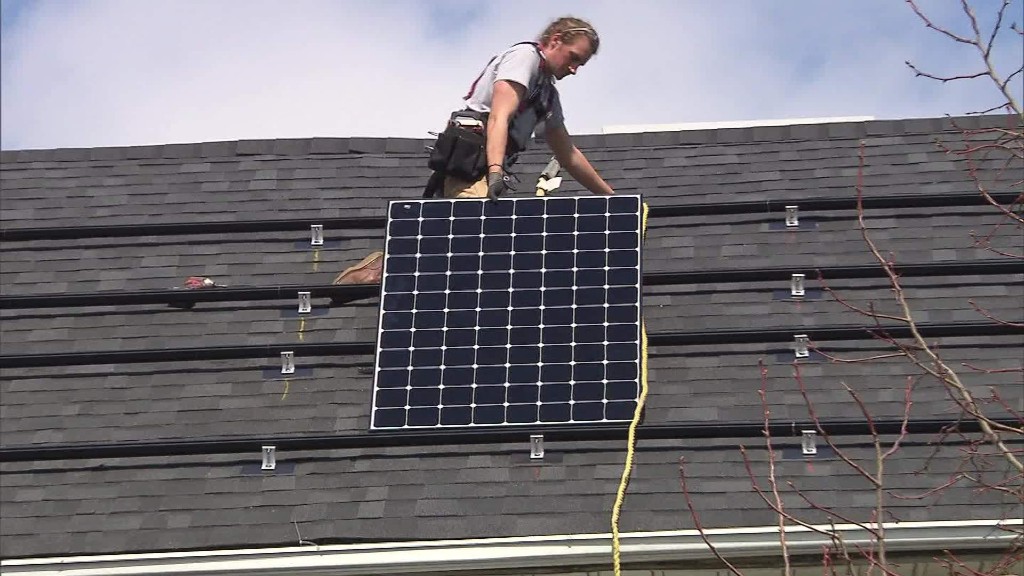
Inside the U.S. solar jobs boom
China’s hottest new project is a giant floating solar energy farm located in the eastern province of Anhui.
Covering about 100 square miles, it is the largest floating panel facility in the world. It has the capacity to produce enough energy to power 15,000 homes, according to Sungrow Power Supply, the company behind the farm.
Fittingly, the solar farm floats atop a flooded area once home to a coal mining factory.
The idea to float solar panels is fast catching on in an industry that faces one persistent problem — space.
“The government won’t allow us to just install panels wherever we want,” says Yao Shaohua, the deputy director of the project. “This lake wouldn’t be used otherwise, so it makes sense.”
Initially it is more expensive to build solar farms on water than on the land. But experts say floating solar panels can run more efficiently in the long run, because they are cooled by the water underneath.
“The whole world, including China, is recognizing that we need to fight climate change,” said Yao. “I’m pretty sure this is going to be a trend.”
China’s growing dominance in the sector has had a huge effect on the global market.
Manufacturers dramatically ramped up production of solar panels, driven by an estimated $42 billion in government subsidized loans between 2010 and 2012, according to the GW Solar Institute at George Washington University. The flood of Chinese panels was one of the main reasons why world prices crashed by 80% between 2008 and 2013.
The U.S. accused China of flooding the market and the Commerce Department started imposing steep tariffs on Chinese-made solar panels in 2012 in a bid to protect American producers.
Just last month, the U.S. informed the World Trade Organization that it may impose tariffs on imports of solar panels from other countries as well, alleging that Chinese companies have opened production facilities in third countries to get around import restrictions.
Wind, solar do not harm power grid reliability-draft U.S. study
By Timothy Gardner, Reuters July 19, 2017
Snow is seen on the San Gorgonio Mountains behind a windmill farm in Palm Springs, California, January 7, 2016. REUTERS/Sam Mircovich
(The July 17 story corrects paragraph 14 to show that ERCOT does not serve a small part of Nevada.)
WASHINGTON (Reuters) – The growth of renewable power, including wind and solar, has not harmed the reliability of the U.S. electricity grid, according to a draft U.S. Department of Energy study, echoing the findings of grid operators across the country.
The conclusion of the draft, dated July and viewed by Reuters, could ease fears in the renewable energy industry that the widely anticipated study would be used by President Donald Trump’s administration to form policies supporting coal plants at the expense of wind and solar.
“Numerous technical studies for most regions of the nation indicate that significantly higher levels of renewable energy can be integrated without any compromise of system reliability,” the draft says.
It added that growth of renewables could require the building of more transmission lines, advanced planning, and more flexibility to balance generation and meet demand. But it said that baseload power – coal and nuclear power – “is not as necessary as it used to be” given advances in grid technology.
Shaylyn Hynes, an Energy Department spokeswoman, said the draft was “outdated” and had not gone through “any adjudication” from career or political staff. The final report had been slated for release in early July, but is now expected within a couple of weeks, she said.
The draft can be seen at http://tmsnrt.rs/2v9PJ9l. Bloomberg first reported on it on Friday.
Energy Secretary Rick Perry had called in April for his department to examine whether regulations backing renewable energy use imposed by former president Barack Obama and other administrations “threaten to undercut the performance of the grid well into the future.”
Critics of wind and solar energy have argued that those technologies leave the U.S. power system vulnerable to shortages when the sun is blocked or the wind does not blow – meaning that coal, nuclear, and natural gas plants that do not depend on weather should remain the bulk producers.
Renewable energy is seen by many state and local government as a cost-effective way to reduce emissions linked to climate change. Nuclear energy is virtually emissions-free but poses potential safety risks and the thorny issue of disposing radioactive plant waste.
Renewables and natural gas have displaced a slew of coal and nuclear plants in recent years, due to lower prices, environmental regulations and government subsidies. The draft said this is “not yet a problem for grid reliability and resilience – but further study is needed,” to determine how much of this “baseload” power can be lost while still ensuring reliability.
GRID OPERATORS SEE NO THREAT
Officials at four grid operators, serving about 133 million customers, agreed renewables do not harm energy security or reliability.
“I don’t see them as threatening, no,” said Woody Rickerson, vice president of the Electric Reliability Council of Texas. “We can perform reliably with renewable generation; there are just things you have to do with renewables that you don’t have to do with (conventional) power generation.”
ERCOT said Texas got about 15 percent of its power from wind generation in 2016, and the region’s solar power will grow quickly.
Grid operators said that as renewables become more common they depend more on weather forecasting. Storm fronts and cloud covers sometimes require grid operators to ensure that conventional power is readily available as solar and wind power generation waxes and wanes.
Stu Bresler, senior vice president for operations at PJM Interconnection, which coordinates the movement of power in all or parts of 13 states from New Jersey to Tennessee, said renewables have not harmed reliability in his region.
Steven Greenlee, senior spokesman at the California Independent System Operator, said on one day in May wind and solar served 67 percent of CALISO’s demand.
California Just Did Something That Will Make the Rest of the Nation’s Liberals Green With Envy
Bipartisan agreement on climate change is possible.
Oliver Milman July 18, 2017
This story was originally published by The Guardian and appears here as part of the Climate Deskcollaboration.
California legislators have voted to extend a centerpiece program to cut greenhouse gas emissions, burnishing the state’s reputation as a bulwark against Donald Trump’s demolition of climate change measures.
In a rare show of bipartisan agreement on climate change, eight Republicans joined with Democrats in California’s two legislative houses to extend the cap-and-trade emissions system a further 10 years until 2030.
The emissions-lowering scheme, the second-largest of its kind in the world, aims to help the state reach its target of cutting planet-warming gases 40% by 2030, compared to 1990 levels.
“Tonight, California stood tall and once again, boldly confronted the existential threat of our time,” said Jerry Brown, California’s governor. “Republicans and Democrats set aside their differences, came together and took courageous action. That’s what good government looks like.”
The cap-and-trade program, established in 2006 under then governor Arnold Schwarzenegger, sets a limit on emissions and requires polluters to either reduce their output or purchase permits from those who have. As the limit steadily becomes stricter, it nudges businesses to take the more financially attractive option of cutting their pollution.
California, the sixth-largest economy in the world, is in stark opposition to Trump’s administration. The president has said he will withdraw the US from the Paris climate agreement and has set about dismantling federal policies that lower emissions.
Brown has positioned himself as a countervailing force to Trump, visiting China to talk to its leaders about climate change and promising to build and launch weather-monitoring satellites should federal budget cuts endanger programs handled by Nasa and the National Oceanic and Atmospheric Administration (NOOA).
“A lot of you people are going to be alive, and you’re going to be alive in a horrible situation,” Brown told California lawmakers at a committee hearing shortly before the vote. “This isn’t for me, I’m going to be dead. This is for you, and it’s real.”
“A lot of you people are going to be alive, and you’re going to be alive in a horrible situation,” Brown told California lawmakers. “This isn’t for me, I’m going to be dead. This is for you, and it’s real.”
Many Californian Republicans remain opposed to the cap-and-trade system, warning it will pose a “crushing” blow to small businesses. But the bill ended up gaining an unusual level of Republican support, with the extension also supported by key conservative constituencies, including the California Chamber of Commerce and associations representing manufacturers and agriculture interests.
Concessions to get some Republican support, such as the limiting of separate regulations on refineries, risked alienating more liberal Democrats. Some environmental groups, including the Sierra Club, attacked the bill for allowing polluters to continue emitting greenhouse gases if they offset them with green projects, including those outside California.
But other climate activists declared themselves pleased with the outcome, pointing out that it showed that action to reduce emissions is bipartisan and popular.
“California is once again showing Washington DC and the rest of the world that fighting climate and air pollution is the right thing for our health, economy and future,” said Fred Krupp, president of the Environmental Defense Fund.
California’s pioneering attitude to climate change action was underlined by separate court action launched on Monday, aimed at holding fossil fuel companies accountable for global warming.
Marin and San Mateo counties, along with the City of Imperial Beach, filed a lawsuit in the California superior court to complain that 37 oil, gas and coal companies knew burning their products would increase carbon pollution and cause sea levels rise.
“Defendants have known for nearly 50 years that greenhouse gas pollution from their fossil fuel products has a significant impact on the Earth’s climate and sea levels,” the complaint states.
The municipalities are claiming damages from the fossil fuel firms, echoing a strategy used against the tobacco industry in the 1990s that resulted in multi-billion dollar payouts.
The companies targeted in the lawsuit include Shell, Exxon Mobile, Chevron and BP. According to the municipalities, these businesses have caused around 20% of all industrial carbon dioxide and methane pollution since the 1960s.
Dakota Access-style protests may happen often, panel tells pipeline companies
Written by Wire Services July 19, 2017
BISMARCK, N.D. — Well-funded and organized protests like the one involving the disputed Dakota Access oil pipeline may become commonplace, officials said Wednesday as they urged the industry to prepare for such activity.
The struggle over the recently completed $3.8 billion pipeline was discussed at an annual oil industry conference in Bismarck, with a panel dissecting what the industry learned. Native Americans and other opponents worried about the pipeline’s effect on the environment established a massive encampment in North Dakota to protest it.
“The opponents will not rest,” said Craig Stevens, a spokesman for Grow America’s Infrastructure Now, a pro-pipeline coalition of businesses, trade associations and labor groups.
Stevens called such protests the “new normal” and the “new cost of doing business.” He said pipelines will be targeted by those wanting to stop the use of fossil fuels, by attempting to “kill the heart by cutting the veins.” Stevens said the oil industry must battle what he called misinformation about pipeline projects while touting benefits, such as jobs.
“It is important for us to engage the opposition … and provide context to the overall debate,” Stevens said.
The Dakota Access pipeline began moving North Dakota oil to Illinois on June 1. But a judge has ordered the Army Corps of Engineers to do more study on its impact on the Standing Rock Sioux tribe, which believes the pipeline threatens sacred sites and the Missouri River that provides drinking water for millions of people. Texas-based developer Energy Transfer Partners maintains it’s safe.
Troy Eid, a former U.S. attorney in Colorado who specializes in Native American law, said tribal consultation is key in building such projects and something the industry must take “much more seriously.”
Based on information supplied by ETP in court documents, delays have cost it more than a half-billion dollars.
Companies can save money in the long run by doing more work with tribes “on the front end,” he said.
One-fifth of all oil production comes from in and around American Indian reservations, Eid said.
VIDEO: People in Denmark Are a Lot Happier Than People in the United States. Here’s Why.
When governments provide benefits and services that allow its citizens to thrive, everyone wins.
By The Nation Twitter July 17, 2017
Text by Joshua Holland. Graphics and animation by Rob Pybus. This work was supported by the Economic Hardship Reporting Project and its Puffin Story Innovation Fund.
Last week, in Denmark, Malthe and Lærke Knudson had a baby girl they named Emma. That same day, the Robinsons—Dale and Beth—had a little baby in the United States. They called her Rachel.
Right now, they’re just two little babies keeping their parents awake at night. But Emma and Rachel were born in countries that have very different priorities, and that’s going to lead to pretty different futures.
It all boils down to this: Though Danes pay a lot more than Americans in taxes and government fees, they get a whole lot more back in social services.
As a result, Americans end up spending twice as much out-of-pocket for those social goods and services. Let’s see how that plays out over their two lives.
Early Childhood Education
In six months, Emma will probably enroll in preschool. By law, every 6-month-old Danish baby is guaranteed high-quality preschool, and parents can’t be charged more than a quarter of the cost of those services. Parents who can’t afford it? They don’t have to pay.
In the United States, kids from low-income families are often eligible for full-time Head Start programs. Even then, the program only has enough funding for a half-million slots nationwide. But the Robinsons make too much to qualify, so they’ll either have to park little Rachel with Dale’s mom, or one of them will have to get a second job to help cover the cost of daycare. That little luxury could set the Robinsons back as much as $22,000 a year.
Danes receive a child benefit which starts with $225 a month at birth, and goes to $140 a month from age 7 to 17. That’s not a benefit just for poor people, everyone gets it!
Child Benefit
It costs a lot to raise kids these days no matter where you live, but the Knudsons will enjoy a child benefit which starts at $225 a month. When Emma hits age seven, they’ll get $140 a month until she’s 17. That’s not a benefit just for poor people; everyone gets it!
Rachel, on the other hand, will have to start learning some cool tricks ASAP in order to get into a decent elementary school and prepare herself for a high school that will help her get into a good college.
Public Schools
Some American schools are world class, but others, often serving students from low-income families, can rank down there with those in developing countries.
That means the Robinsons may soon be shopping for a house in another school district—a notion that would never even occur to the Knudsons, because all of the public schools in Denmark are really good.
Free College
Emma and Rachel are both good students, and they’ll both go to college when they get older. In Denmark, almost every college student attends public colleges and universities, which don’t charge tuition.
Rachel will navigate a very different educational system. She’ll probably end up with a good deal of debt—in the US, 71 percent of the class of 2015 graduated with student-loan debt averaging around $35,000.
Many Danes get about seven weeks of paid vacation every year.
Vacation
Fresh out of school, the young women enter the workforce. And again, they’ll have very different experiences.
If Rachel is lucky, she’ll get two weeks a year of paid vacation, but maybe not—the US is the only industrialized nation that does not require any amount of paid vacation. Emma, like most full-time workers in Denmark, is guaranteed five weeks of paid vacation time a year.
That doesn’t include the nine public holidays, which most employees get. And many Danes enjoy a sixth week of paid vacation during the holidays. And that’s how you relax like a Viking!
Leisure Time
Danes and Americans have similar incomes, but Americans work a whopping 24 percent more hours per year. That means that Danes get to spend about an hour and a half more each day on leisure activities than Americans.
Unemployment Benefits
When Rachel loses her job she’ll qualify for unemployment benefits that cover about half of her income, usually up to half a year.
Emma will face a similar situation—hey, it happens to the best of us—but she’ll get up to 90 percent of what she was making, and she can collect that for up to two years and sometimes more!
Employment
Now, some people say those generous benefits create a culture of dependency and discourage people from looking for a job, but 73 percent of working-age Danes have a paid job, compared with 60 percent of Americans.
Health Care
And Emma will always have access to an excellent public health-care system. In Denmark, everyone’s covered. Americans, on the other hand, spend two and a half times as much per person on health care as the Danes, but around one in eight are still uninsured.
With our lack of paid parental leave, the US has a gender pay gap around three times as large as Denmark’s.
Parental Leave and Gender Pay Disparity
Some day, Emma and Rachel will meet the right partner and have babies themselves. Emma won’t pay anything for delivering her baby, but Rachel will pay around $5,000 out-of-pocket for a normal delivery.
Rachel also lives in the only advanced economy that doesn’t mandate paid family leave. She can take some unpaid time, but for most women, there’s no guarantee that her job will be waiting for her.
One in four American women quit or are laid off when they have a baby, so they lose seniority and end up with an uneven work history. According to one study, each child lowers an American woman’s earnings by 6-8 percent.
Emma and her partner, on the other hand, will be able to divide a full year of paid parental leave between them. Many Danes work under union contracts that give them up to 100 percent of their salaries during that time, but if they don’t, the government will give them $630 per week while they’re on leave.
This is one reason why the gender pay gap is around three times bigger in the United States than it is in Denmark.
Retirement
Emma and Rachel will watch their kids grow up, and then they’ll look to enjoy their golden years.
According to the World Happiness Report, Denmark is the 2nd happiest country in the world. The US is 15th.
As an average American, Rachel will work two years longer than Emma. Emma’s pension will cover two-thirds of her pre-retirement income, while Rachel’s Social Security benefits will cover less than half of what she had earned.
The Result?
Emma will have lived her life under the crushing burden of democratic socialism. That combination of state-funded education, health care, parental leave, and plenty of other benefits has made the citizens of Denmark the second happiest in the world. And Americans? Number 15.