‘Stop the Steal’ Organizer Says Several GOP Congressmen Helped Plan the Rally
Alex Montrose January 12, 2021
Image via Getty
One lead organizer of last week’s “Stop the Steal” rally that morphed into an attack against the U.S. Capitol claims that GOP congressmen Paul Gosar and Andy Biggs of Arizona, and congressman Mo Brooks of Alabama all participated in planning of the Jan. 6 catastrophe.
As CNN points out, Arizona resident and pro-Trump activist Ali Alexander implicated the three members of the House of Representatives during a December livestream on Periscope, where he told followers the four of them had been “planning something big.”
“I’m the guy who came up with the idea of January 6 when I was talking with Congressman Gosar, Congressman Andy Biggs, and Congressman Mo Brooks. So we’re the four guys who came up with a January 6 event — #DoNotCertify — and it was to build momentum and pressure, and then on the day change hearts and minds of congresspeoples who weren’t yet decided, or saw everyone outside and said, ‘I can’t be on the other side of that mob,’” Alexander said in a livestream on Dec. 29.
Biggs, who is chair of the House Freedom Caucus, denied associating with Alexander.
“Congressman Biggs is not aware of hearing of or meeting Mr. Alexander at any point — let alone working with him to organize some part of a planned protest,” his spokesperson told CNN. “He did not have any contact with protestors or rioters, nor did he ever encourage or foster the rally or protests. He was focused on his research and arguments to work within the confines of the law and established precedent to restore integrity to our elections, and to ensure that all Americans — regardless of party affiliation — can again have complete trust in our elections systems.”
The Arizona Republican Party, which Gosar and Biggs belong to, faced backlash last month after promoting one of Alexander’s tweets and asking republicans if they were willing to die to overturn the legitimate outcome of the 2020 presidential election.
Since the violent riot that resulted in five deaths, Alexander’s social media accounts have been suspended by social media platforms across the board.
Following the attack, democratic House members pushed to have republicans involved in the Wednesday riot removed from office, including Alexandria Ocasio-Cortez and newly-elected Cori Bush.
“I believe the Republican members of Congress who have incited this domestic terror attack through their attempts to overturn the election must face consequences,” Bush wrote introducing a bill that would expel members like Gosar, Biggs, and Brooks. “They have broken their sacred Oath of Office.”
Capitol rioter caught hitting officer with fire extinguisher in viral video
Blue Telusma January 12, 2021
Simultaneously, the crowd continues to chant ‘USA!’ as chaos ensues all around them.
As the public continues to learn more about the Trump supporters who took over the U.S. Capitol last Wednesday, new footage has emerged that shows a rioter hitting an officer in the head with a fire extinguisher during the melee.
According to theNew York Post, the clip obtained by Storyful shows a sea of MAGA supporters aggressively pushing past a barricade as U.S. Capitol Police tries in futility to keep them corralled on the west side of the building.
“They broke through, it’s on!” one man is heard yelling at the beginning of the video.
You can see a rioter forcefully throwing an officer over the barricade with little no remorse. A few moments later, another rioter is seen hurling a fire extinguisher directly at a group of officers before striking one on the helmet.
Simultaneously, the crowd continues to chant “USA!” as chaos ensues all around them.
“There’s a guy, like, dying over there,” a witness can be heard yelling on the clip. “They’re trying to hold him up.”
It has yet to be confirmed if the man in the video was Capitol Police Officer Brian Sicknick. But two law enforcement sources informed the Associated Press that Sicknick died at a hospital Thursday after being hit in the head with a fire extinguisher. A source has reported that authorities have now launched a probe into Sicknick’s death.
“The entire USCP Department expresses its deepest sympathies to Officer Sicknick’s family and friends on their loss, and mourns the loss of a friend and colleague,” the department said in an official press release which also acknowledges he was injured “while physically engaging with protesters.”
Four other people succumbed to fatal injuries during the siege, including a California woman shot by Capitol Police and three others who experienced medical emergencies.
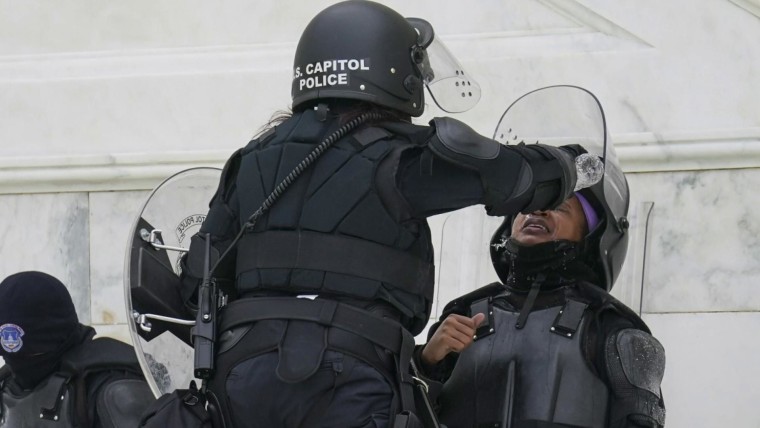
Capitol police officers in riot gear push back demonstrators who try to break a door of the U.S. Capitol on Wednesday, Jan. 6, 2021, in Washington. (AP Photo/Jose Luis Magana)
An inside job?
As we previously reported, last week, a Washington D.C police officer came forward to make stunning allegations about off-duty police officers and even some members of the military being among the rioters who took part in Wednesday’s siege.
“If these people can storm the Capitol building with no regard to punishment, you have to wonder how much they abuse their powers when they put on their uniforms,” the officer making the allegations wrote in a public Facebook post.
He went on to allege that the officers in question covertly flashed their badges and identification cards at on-duty officers as they joined in on the attempt to overrun the U.S. Capitol.
Despite other accounts corroborating this assertion and numerous videos circulating on social media of officers fraternizing with the rioters – at times even stopping to take selfies with them – D.C. Police Chief Robert Contee maintained that the department was unprepared for the violence.
Thursday, Contee said in a press conference that there was “no intelligence that suggested there would be a breach of the U.S. Capitol.”
Amazon, Intel Join Other Major Companies Suspending Donations To Republicans Involved In Biden Certification Challenge
Jemima McEvoy, Andrew Solender January 12, 2021
TOPLINE
In the wake of the U.S. Capitol attacks, scores of major corporations and banks have said they are altering or reviewing the political donations made through their PACs, with many suspending contributions specifically to the Republican members of Congress who challenged the certification of President-elect Joe Biden’s victory.
U.S. Sen. Joshua Hawley (R-MO) was one of eight senators who objected to Congress’ certification of … [+] GETTY IMAGES
KEY FACTS
Hotel giant Marriott International, the health insurance network Blue Cross Blue Shield and bank holding company Commerce Bancshares were the first to indefinitely suspend donations to members of Congress who objected to the certification of the Electoral College vote on Jan. 6, as reported Sunday by Popular Information, a political newsletter run by ThinkProgress founder and editor Judd Legum.
All three companies, through their corporate PACs, had donated to at least one of the eight senators involved in the last-minute challenge during the 2020 election cycle: Marriott’s donated $1,000 apiece to Sen. Josh Hawley (R-MO) and his leadership PAC, Blue Cross Blue Shield’s donated nearly $12,000 in total to Hawley, Tommy Tuberville (R-AL) and Roger Marshall (R-KS), while Commerce Bancshares’ donated $2,500 to Marshall.
CitiBank and JPMorgan Chase & Co., whose PACs donated $1,000 to Hawley and $1,000 to Marshall this cycle, respectively, also confirmed Sunday that they would suspend donations to both parties for the coming months, with a JPMorgan & Chase spokesperson clarifying to Forbes that its pause will last six months.
Dozens of other companies have joined the growing group since: American Airlines, Boston Scientific, BP, Coca Cola, Facebook, Goldman Sachs, Hallmark, Hilton Hotels, Kroger, Microsoft and Visa all said they will suspend and review political giving to both parties, while Disney, AirBnb, Amazon, American Express, AT&T, Best Buy, Comcast, Dow, Intel, Mastercard, PricewaterhouseCoopers and Verizon are halting donations to the Republican objectors specifically for either a few months or an indefinite period of time.
In addition to the vows to indefinitely suspend donations, Bank of America and Ford Motor Co. all said they will take recent events into consideration before making future donations, while CVS Health Corp., Exxon Mobil, TMobile, FedEx, Delta and Target and Target said they are reviewing their political giving.
TANGENT
Hallmark has asked Sens. Hawley and Marshall to return past political contributions, saying in a statement sent to Forbes on Monday that their recent actions “do not reflect our company’s values.”
CHIEF CRITIC
“We continuously evaluate our political contributions to ensure that those we support share our values and goals,” wrote the Blue Cross Blue Shield Association in a statement to Popular Information. “In light of this week’s violent, shocking assault on the United States Capitol, and the votes of some members of Congress to subvert the results of November’s election by challenging Electoral College results, BCBSA will suspend contributions to those lawmakers who voted to undermine our democracy.”
CRUCIAL QUOTE
“We have taken the destructive events at the Capitol to undermine a legitimate and fair election into consideration and will be pausing political giving from our Political Action Committee to those who voted against certification of the election,” Marriott spokesperson Julie Rollend said in a statement to Forbes.
KEY BACKGROUND
These donation suspensions come amid mounting criticism—and calls for repercussions—for members of the GOP who chose to vote against Biden’s win even after enraged supporters of President Trump, echoing his claims of voter fraud, stormed the U.S. Capitol in an effort to halt the process. Hawley has been disavowed by a former mentor, dropped from a publishing contract with Simon & Schuster and asked to resign by the two largest newspapers in Missouri. Other senators have faced calls for resignation from their Senate colleagues and major newspapers.
Evangelicals face a reckoning: Donald Trump and the future of our faith
Ed Stetzer, Opinion contributor January 11, 2021
No one likes to admit they were fooled. It’s tough to admit we were wrong. Now, many evangelicals are seeing President Donald Trump for who he is, but more need to see what he has done to us.
It’s time for an evangelical reckoning.
I’m an evangelical, like about a quarter of the United States population. Evangelicals believe in the good news of the Gospel — that Jesus died on the cross, for our sins, and in our place — and we need to tell the world about that.
But that’s not what most people are talking about today. You see, white evangelicals embraced the president, some begrudgingly and some enthusiastically, because he addressed many of their concerns.
Many evangelicals and leaders invested money, time and conviction toward the promise of making America great again. In turn, Donald Trump made good on these investments from an evangelical perspective. Most evangelicals (me included) are grateful for the Supreme Court justices he appointed and for some of the religious liberty concerns he addressed. His anti-abortion stances surprised many (again, me included), and for that I was thankful.
Nevertheless, most of that is in jeopardy now because Trump is who many of us warned other evangelicals that he was.
We reap what Trump has sown
He has burned down the Republican Party, emboldened white supremacists, mainstreamed conspiracy theorists and more.
Yet of greater concern for me is the trail of destruction he has left within the evangelical movement. Tempted by power and trapped within a culture war theology, too many evangelicals tied their fate to a man who embodied neither their faith nor their vision of political character.
As a result, we are finally witnessing an evangelical reckoning.
For years we’ve been talking about a coming evangelical reckoning. A flood of books, articles and conferences — many of which I wrote and participated in — have warned of the approaching storm clouds for the evangelical movement.
This reckoning is here.
Americans (and the world) have the right to ask us some hard questions. Some of us were vocal, often and early, about the dangers of Trumpism. It was costly. As we sort through the coming months and years, we must be clear on three reasons why we have arrived at this point:
►First, far too many tolerated egregious behavior. The past half-decade has offered near daily examples of people co-opting the Gospel for sinful ends. Racism, nationalism, sexism and a host of other sins have found purchase within the evangelical movement in both overt and subtle expressions. Many have been able to dismiss these examples as outliers that did not truly represent the evangelical movement. We have long since exhausted this excuse.
As evangelicals, we have to stop saying this isn’t who we are. This is who we are; these are our besetting sins. However, this isn’t who we have to be.
Pastors from the Las Vegas area pray with Republican presidential candidate Donald Trump in 2016.
►Second, far too many failed to live up to their promise of speaking truth to power. During the 2016 election, and at many points since, many evangelicals justified their full-throated support by promising to be a check on Trump’s character. What has become apparent is that this promise was hollow. Too few were willing to speak out regularly and often couched their criticism so much it lacked any weight. When evangelicals finally had access to the White House, they seemed unable or unwilling to use their prophetic voice to speak truth to power.
Watergate figure, and later evangelical leader, Chuck Colson once said:
“When I served under President Nixon, one of my jobs was to work with special-interest groups, including religious leaders. We would invite them to the White House, wine and dine them, take them on cruises aboard the presidential yacht. … Ironically, few were more easily impressed than religious leaders. The very people who should have been immune to the worldly pomp seemed most vulnerable.”
That was us.
►Finally, all of us have failed to foster healthy political discipleship. The foundation of our reckoning was laid far before Trump. Committed to reaching the world, the evangelical movement has emphasized the evangelistic and pietistic elements of the mission. However, it has failed to connect this mission to justice and politics.
The result of this discipleship failure has led us to a place where not only our people but also many of our leaders were easily fooled and co-opted by a movement that ended with the storming of the U.S. Capitol.
What comes next
At the root of these three causes lies our inability to live up to our calling as evangelicals: to righteously, prophetically and compassionately proclaim the Gospel of Jesus Christ to the world. Our reckoning is not because we have lost worldly power but because of what we betrayed to attain and sustain it in the first place.
I have been working on a book on evangelicalism for three years, and it has been one of the most frustrating projects in my life. At its core, the problem is not in diagnosing the illness but in prescribing the cure. Where do we go? What do we do? How can the evangelical movement navigate this reckoning?
In listening and praying, I’ve found myself coming back to Martin Luther’s words: “Toward those who have been misled, we are to show ourselves parentally affectionate, so that they may perceive that we seek not their destruction but their salvation.”
I don’t believe that everyone who voted for Trump was fooled or foolish. And Trump voters are not Trump. They are not responsible for all of his actions over the past four years, but they are responsible for the ways they responded and for their own hearts.
If the evangelical movement is to flourish in the coming generations, we must face (and even embrace) this reckoning. As leaders and members, we must acknowledge our failings but also understand the habits and idols that drew us to Trump in the first place.
That we have failed and been fooled is disheartening but not surprising. The true test will be how we respond when our idols are revealed.
Will we look inside and repent when needed, or will we double down? Every political and cultural instinct will pull us to the latter, but God calls us to the former. Into this temptation we hear the words of Jesus: “For what will it profit a man if he gains the whole world and forfeits his soul?” (Matthew 16:26).
We have reached a reckoning. What comes next will reveal where our trust truly lies.
Ed Stetzer is a dean and professor at Wheaton College, where he also leads the Wheaton College Billy Graham Center.
Two-thirds of Earth’s land is on pace to lose water as the climate warms – that’s a problem for people, crops and forests
Yadu Pokhrel, Associate Prof. of Civil and Environmental Engineering, Michigan State University and Farshid Felfelani, Postdoctoral Research Associate, Michigan State University January 11, 2021
Cape Town residents queued up for water as the taps nearly ran dry in 2018. Morgana Wingard/Getty Images
The world watched with a sense of dread in 2018 as Cape Town, South Africa, counted down the days until the city would run out of water. The region’s surface reservoirs were going dry amid its worst drought on record, and the public countdown was a plea for help.
By drastically cutting their water use, Cape Town residents and farmers were able to push back “Day Zero” until the rain came, but the close call showed just how precarious water security can be. California also faced severe water restrictions during its recent multiyear drought. And Mexico City is now facing water restrictions after a year with little rain.
There are growing concerns that many regions of the world will face water crises like these in the coming decades as rising temperatures exacerbate drought conditions.
Understanding the risks ahead requires looking at the entire landscape of terrestrial water storage – not just the rivers, but also the water stored in soils, groundwater, snowpack, forest canopies, wetlands, lakes and reservoirs.
We study changes in the terrestrial water cycle as engineersand hydrologists. In a new study published Jan. 11, we and a team of colleagues from universities and institutes around the world showed for the first time how climate change will likely affect water availability on land from all water storage sources over the course of this century.
We found that the sum of this terrestrial water storage is on pace to decline across two-thirds of the land on the planet. The worst impacts will be in areas of the Southern Hemisphere where water scarcity is already threatening food security and leading to human migration and conflict. Globally, one in 12 people could face extreme drought related to water storage every year by the end of this century, compared to an average of about one in 33 at the end of the 20th century.
These findings have implications for water availability, not only for human needs, but also for trees, plants and the sustainability of agriculture.
Where the risks are highest
The water that keeps land healthy, crops growing and human needs met comes from a variety of sources. Mountain snow and rainfall feed streams that affect community water supplies. Soil water content directly affects plant growth. Groundwater resources are crucial for both drinking water supplies and crop productivity in irrigated regions.
While studies often focus just on river flow as an indicator of water availability and drought, our study instead provides a holistic picture of the changes in total water available on land. That allows us to capture nuances, such as the ability of forests to draw water from deep groundwater sources during years when the upper soil levels are drier.
The declines we found in land water storage are especially alarming in the Amazon River basin, Australia, southern Africa, the Mediterranean region and parts of the United States. In these regions, precipitation is expected to decline sharply with climate change, and rising temperatures will increase evaporation. At the same time, some other regions will become wetter, a process already seen today.
The map shows the projected change in terrestrial water storage by the end of the 21st century, compared to the 1975-2005 average, under a mid-range scenario for global warming. A continuum of yellow to orange to dark red reflects increasing severity of loss of stored water; teal to blue to dark blue reflects increasing gains in stored water.Yadu Pokhrel, et al, Nature Climate Change, 2021, CC By -ND
Our findings for the Amazon basin add to the longstanding debate over the fate of the rainforest in a warmer world. Many studies using climate model projections have warned of widespread forest die-off in the future as less rainfall and warmer temperatures lead to higher heat and moisture stress combined with forest fires.
In an earlier study, we found that the deep-rooted rainforests may be more resilient to short-term drought than they appear because they can tap water stored in soils deeper in the ground that aren’t considered in typical climate model projections. However, our new findings, using multiple models, indicate that the declines in total water storage, including deep groundwater stores, may lead to more water shortages during dry seasons when trees need stored water the most and exacerbate future droughts. All weaken the resilience of the rainforests.
A new way of looking at drought
Our study also provides a new perspective on future droughts.
There are different kinds of droughts. Meteorological droughts are caused by lack of precipitation. Agricultural droughts are caused by lack of water in soils. Hydrological droughts involve lack of water in rivers and groundwater. We provided a new perspective on droughts by looking at the total water storage.
Water in the environment. U.K. Met Office
We found that moderate to severe droughts involving water storage would increase until the middle of the 21st century and then remain stable under future scenarios in which countries cut their emissions, but extreme to exceptional water storage droughts could continue to increase until the end of the century.
That would further threaten water availability in regions where water storage is projected to decline.
Changes driven by global warming
These declines in water storage and increases in future droughts are primarily driven by climate change, not land-water management activities such as irrigation and groundwater pumping. This became clear when we examined simulations of what the future would look like if climate conditions were unchanged from preindustrial times. Without the increase in greenhouse gas emissions, terrestrial water storage would remain generally stable in most regions.
If future increases in groundwater use for irrigation and other needs are also considered, the projected reduction in water storage and increase in drought could be even more severe.
See inside the Idaho factory where a company turns shipping containers into sustainable tiny homes
Mary Meisenzahl October 31, 2020
IndieDwell factory. IndieDwell
IndieDwell builds modular, tiny homes that it sells to groups and organizations.
The company has a factory in Caldwell, Idaho, and a new factory opened recently in Pueblo, Colorado.
It builds sustainable tiny homes for under-housed communities.
Tiny homes have often been proposed as an affordable housing solution, and some locales in the US have encouraged them as construction lags behind demand.
IndieDwell, a modular home company based in Idaho, is focused on the same goal. It makes one, two, and four-bedroom homes out of recycled shipping containers, partnering with communities or housing organizations to create affordable, mixed-income communities.
IndieDwell just opened a second factory in Pueblo, Colorado that will employ 160 people. The company says that it opens factories in areas where there are organizations to partner with, and communities in need of jobs, and it has plans to expand further. Current projects include housing for the homeless in San Jose, housing for people recovering from addiction in Colorado, and homes for veterans in Washington.
IndieDwell gave Business Insider a look inside the original Idaho factory to see what happens inside a tiny home factory. Take a look here.
IndieDwell makes homes out of shipping containers, using more containers for larger homes.
IndieDwell factory. IndieDwell
First, the containers have to be significantly updated to be suitable for living.
IndieDwell factory. IndieDwell
The metal is completely covered in siding to prevent rust.
IndieDwell factory. IndieDwell
To keep energy costs down, the containers are insulated with foam and fiberglass. Sustainability is important for IndieDwell, which hopes to make the Idaho factory carbon neutral by the end of the year.
IndieDwell factory. IndieDwell
Each unit comes with a mini-split heat pump and air conditioner.
IndieDwell factory. IndieDwell
IndieDwell builds factories in communities with a low to moderate-income, and a need for affordable housing.
IndieDwell factory. IndieDwell
IndieDwell estimates that by 2025, 20,000 IndieDwell homes will be built.
IndieDwell factory. IndieDwell
“We believe housing is a right and when created properly and supported with the appropriate services can be the first step toward a healthy and fruitful life,” the company’s mission statement reads.
IndieDwell factory. IndieDwell
They make single and multifamily homes, like this $55,000 320 square foot, single container, one-bedroom home.
IndieDwell factory. IndieDwell
IndieDwell doesn’t sell directly to individual homeowners, only to organizations or developers.
IndieDwell factory. IndieDwell
By the time they get to the buyer, IndieDwell homes are move-in ready, with a water heater, refrigerator, stove, and HVAC set up. The cost includes delivery and installation within 100 miles of the Idaho factory.
IndieDwell factory. IndieDwell
The homes also have an Energy Recovery Ventilator to keep air free from contaminants.
Fraternal Order of Police President John Catanzara isn’t an embarrassment to the force. He’s an embodiment.
By Neil Steinberg
Fraternal Order of Police President John Catanzara speaks of the support from President Donald Trump and local officials during a Southside Trump Rally at Firewater Saloon at 3910 W 111th St in Mount Greenwood, Sunday, Nov. 1, 2020. | Anthony Vazquez/Sun-Times
Saturday morning: coffee, sunshine and an email with the subject, “John Catanzara, Chicago FOP President, IMMEDIATE REMOVAL FROM OFFICE.”
Hmmm, thought I, must be from a retired police officer.
It was, Richard W. Sanchez Sr., “CPD Retired.” I knew it!
In retirement, Chicago police officers go through this marvelous metamorphosis. They serve for decades, mute caterpillars of the silent brotherhood. Then they disappear into their retirement cocoons, to emerge in the sunshine of Florida or Arizona or, in this case, Valparaiso, Indiana, as these glorious butterflies of opinion, their colorful views on display for the world to admire.
Not Catanzara, of course. As you know, he is the bigmouth president of the Fraternal Order of Police Lodge 7, the one CPD job where the gag comes off. He’s made it his personal mission to remind the public at every opportunity just how touchy and reactionary police officers can be, how passionately devoted to serving and protecting themselves.
Self-regard and bottomless grievance make them the ideal Trump fan demographic. One of the least surprising fallouts from Wednesday’s storming of the Capitol is how many police officers from around the country joined the mob. Wonder why Catanzara wasn’t there; maybe he was busy, talking.
While you and I and every decent person were slack-jawed in horror at the sight of the mob sacking the seat of democracy, someone at WBEZ had the presence of mind to stick an open mike in front of Catanzara’s eternally flapping yap, and he justified away.
“There’s no, obviously, violence in this crowd,” he began.
Not so obvious to the Capitol police officer, Brian D. Sicknick, who was killed. Nor to the cops injured trying to hold off the attack.
Reaction from the thinking community was swift, and Catanzara issued the typical half apology, satisfying no one, including my retiree, who demanded the national union fire him. No. 4 of his six bullet points was: “I believe John Catanzara has committed ‘a gross dereliction of his duty’ by siding with the insurrectionist mob and stating it with craven zeal.”
Maybe all this COVID lockdown business is getting to me. But I phoned Sanchez up to sound him out about why he wrote the email.
“I felt I had to say something, I had to voice my opinion,” Sanchez said. “A leader is supposed to put the fires out, supposed to be the calm in the storm, supposed to lead. He wants to put gas on the fire. … This guy, he is the worst thing that could have happened to the FOP.”
Yet elected by the rank and file, yes? The mass of good officers we always invoke, like a kind of benediction, every time one busts into the wrong house or shoots a Black kid scratching his ear. How come?
“A lot of people who should have voted didn’t, including myself,” he said.
But isn’t Catanzara a perfect representative of the CPD? Particularly his shoot-off-his-mouth-first, assess-the-situation-later defense of the riot? That’s unofficial police procedure, is it not?
”Police officers around the country are feeling that everybody is against them,” Sanchez said. “Believe me, I’m not condoning any wrongdoing.”
Too much of that already. And for the record I do regularly bump into solid, professional Chicago police officers just trying to do their jobs and get home at night.
“Most police officers want to help people,” Sanchez agreed. “I believe most police officers want to be good police officers, they don’t go out there, wake up in the morning, ‘Hey, I’m going kick somebody’s ass, going to lock somebody up because I don’t like how they look.’ That’s not how it is.”
Life is good in retirement. Being able to say what you think without fear is only the beginning.
“Out here, we have a little bit of property, keeps you busy,” he said. “It’s like living in a big park.”
Though retired for eight years, Sanchez still cares about FOP leadership.
“We can’t have people in his position who believe conspiracy theories and preach violence and say it’s all right,” said Sanchez. “If he misspoke, he isn’t watching. And if he can’t take the time to watch before he speaks, what kind of leader is that?”
The kind the FOP elected, that’s who. Maybe the kind it deserves. Don’t do the crime if you can’t do the time.
Study: Wildfires produced up to half of pollution in US West
FILE – In this Sept. 9, 2020, file photo, the San Francisco skyline in the distance behind Crissy Field is barely visible due to smoke from wildfires burning across California. Researchers say smoke from wildfires accounted for up to half of all small particle air pollution in parts of the western U.S. in recent years (AP Photo/Eric Risberg, File).
BILLINGS, Mont. (AP) — Wildfire smoke accounted for up to half of all health-damaging small particle air pollution in the western U.S. in recent years as warming temperatures fueled more destructive blazes, according to a study released Monday.
Even as pollution emissions declined from other sources including vehicle exhaust and power plants, the amount from fires increased sharply, said researchers at Stanford University and the University of California, San Diego.
The findings underscore the growing public health threat posed by climate change as it contributes to catastrophic wildfires such as those that charred huge areas of California and the Pacific Northwest in 2020. Nationwide, wildfires were the source of up to 25% of small particle pollution in some years, the researchers said.
“From a climate perspective, wildfires should be the first things on our minds for many of us in the U.S.,” said Marshall Burke, an associate professor of earth system science at Stanford and lead author of the study.
“Most people do not see sea-level rise. Most people do not ever see hurricanes. Many, many people will see wildfire smoke from climate change,” Burke added. The study was published in the Proceedings of the National Academy of Sciences.
The researchers used satellite images of smoke plumes and government air quality data to model how much pollution was generated nationwide by fires from 2016 to 2018 compared to a decade earlier. Their results were in line with previous studies of smoke emissions across earlier time periods and more limited geographic areas.
Air pollution experts say that residents of the West Coast and Northern Rockies in particular should expect major smoke events from wildfires to become more frequent.
There’s little doubt air quality regulations helped decrease other sources of pollution even as wildfire smoke increased, said Loretta Mickley, an atmospheric chemist at Harvard University. But it’s difficult to separate how much of the increase in smoke pollution is driven by climate change versus the forest fuel buildup, she added.
Mickley and researchers from Colorado State University also cautioned that fires can vary significantly from year to year because of weather changes, making it hard to identify trends over relatively short periods such as the decade examined in the new study.
An AP analysis of data from government monitoring stations found that at least 38 million people in California, Oregon, Washington, Idaho and Montana were exposed to unhealthy levels of wildfire smoke for at least five days in 2020. Major cities in Oregon suffered the highest pollution levels they had ever recorded.
Smoke particles from those wildfires were blamed for health problems ranging from difficulty breathing to a projected spike in premature deaths, according to health authorities and researchers.
Fires across the West emitted more than a million tons of particulate pollution in 2012, 2015 and 2017, and almost as much in 2018.
Scientists studying long-term health problems have found correlations between smoke exposure and decreased lung function, weakened immune systems and higher rates of flu.
The new study matches up with previous research documenting the increasing proportion of pollution that comes from wildfire smoke, said Dan Jaffe, a wildfire pollution expert at the University of Washington. Jaffe added that it also raises significant questions about how to better manage forests and the role that prescribed burns might play.
“We have been making tremendous progress on improving pollution in this country, but at the same time we have this other part of the puzzle that has not been under control,” Jaffe said. “We’re now at the point where we have to think about how to manage the planet a whole lot more carefully than we’ve done.”
What to know about Capitol Police officer Brian Sicknick, who died from injuries after pro-Trump riot
Grace Hauck, USA TODAY January 8, 2021
A U.S. Capitol Police officer died Thursday after he was injured in a pro-trump riot, the fifth person to die in relation to Wednesday’s attack on the Capitol building.
Thursday evening, Capitol Police officer Brian D. Sicknick died from injuries. He joined the force in July 2008 and was part of the department’s First Responders Unit, officials said.
Flags were at half-staff in front of the Capitol building Friday morning. Sicknick’s death is being investigated as a homicide by federal and local authorities – a development that raises the stakes of the investigation into possible crimes committed during the violent security breach.
Brian D. Sicknick, 42, the youngest of three sons, was from South River, New Jersey. He graduated in 1997 from Middlesex County Technical Vocational High School and joined the New Jersey Air National Guard that year.
Sicknick “wanted to be a police officer his entire life,” his brother, Ken Sicknick, said in a statement. He “served his country honorably” and made his family “very proud,” Sicknick said.
“Brian is a hero and that is what we would like people to remember.”
Sicknick deployed to Saudi Arabia in 1999 in support of Operation Southern Watch. After 9/11 he served in Kyrgyzstan in support of Operation Enduring Freedom, the Iraq war. And he was honorably discharged in 2003, according to Lt. Col. Barbara Brown, a spokeswoman for the New Jersey National Guard.
Public records indicate Sicknick currently lived in Springfield, Virginia.
What happened to the officer Brian Sicknick?
Sicknick died “due to injuries sustained while on duty,” U.S. Capitol Police said in a statement. On Wednesday, he “was injured while physically engaging with protesters,” police said. He returned to his division office and collapsed, then was taken to a local hospital where he died around 9:30 p.m. Thursday.
Sicknick was hit in the head with a fire extinguisher, according to two law enforcement officials who spoke to the Associated Press.
“The entire USCP Department expresses its deepest sympathies to Officer Sicknick’s family and friends on their loss, and mourns the loss of a friend and colleague,” the department said in a statement.
Will there be charges?
U.S. Capitol Police said Sicknick’s death will be investigated by the homicide branch of the Washington, D.C., Metropolitan Police Department. Any criminal charges related to Sicknick’s death will be federal because the events leading up to it happened on federal property, an official with knowledge of the matter said.
U.S. Reps. Rosa DeLauro, D-Conn., and Tim Ryan, D-Ohio, released a statement late Thursday calling for the “mob who attacked the People’s House” to be held accountable.
“Our hearts break over the senseless death of United States Capitol Police Officer Brian D. Sicknick, who was injured in the line of duty during yesterday’s violent assault on the Capitol,” they said in a statement. “Our prayers are with his family, friends, and colleagues on the force.”
They added: “This tragic loss should remind all of us of the bravery of the law enforcement officers who protected us, our colleagues, congressional staff, the press corps, and other essential workers yesterday.”
The chaos has already led to at least 55 criminal cases filed by the Justice Department against rioters who were charged with unlawful entry, gun violations, theft, assault and others. One man was arrested after officers found a military-style semi-automatic rifle and 11 Molotov cocktails in his possession, said acting U.S. Attorney Michael Sherwin.
More charges are expected in the coming weeks. Sherwin also made clear that no charges, including sedition, rioting and insurrection, are off the table.
Meanwhile, Capitol Police Chief Steven Sund will resign later this month. The top law enforcement officials in charge of protect the House and Senate have also resigned.
Contributing: Kristine Phillips, Kevin Johnson, Cara Richardson and Trevor Hughes, USA TODAY; Michael L. Diamond and Susan Loyer, MyCentralJersey.com
On Wednesday, I listened as sirens blared outside my Washington apartment, within walking distance of the Capitol. Along with the rest of America, I watched the most astounding images on television and social media of violent instigators.
But just as disturbing were the images of the U.S. Capitol Police treating white militants with kid gloves, even as these agitators — dare I say, domestic terrorists — broke into the building, smashed windows and physically assaulted the police.
I could ask you to imagine how these agitators might be treated if they were Black. But we don’t have to imagine what we already know.
The Capitol Police are not exactly known for their restraint. In 2013, a Black woman named Miriam Carey made a U-turn near the White House and the police fired at her 26 times, killing her. Her baby daughter was in the backseat and survived.
We know the history of this country, from slavery to Reconstruction to Jim Crow, when the law, legal institutions and state-sanctioned violence conspired to control and dominate Black people. In contrast, white people did not have to be dominated in the same way; the same institutions appeased white people when they got angry.
Black protesters must be controlled. White supremacists must be appeased.
Perhaps even more disconcerting than the response we saw Wednesday is the knowledge that the anti-democracy vigilantes made no secret of their intentions. And did anyone doubt that President Donald Trump would encourage the hordes? He who told the Proud Boys to “stand by?” Yet, the Capitol Police didn’t staff up on Wednesday, didn’t hold a perimeter, and, once overwhelmed, had to plead to other law enforcement agencies around the region for assistance.
And why? As a Black man from a Black community who has seen all that American racism has to offer, I can say it’s most likely because the police just don’t inherently see white people as violent. They don’t see what I saw yesterday: a planned attack on the democratic foundation of our country and our people, encouraged by a president who refuses to accept that millions of people — many of them Black, Latino, Asian, Native and immigrant — voted for a progressive future for our families.
On Wednesday, we saw an insurrection unfold on national television spearheaded by angry white militants. It was eerily reminiscent of the violence that has accompanied every progressive advancement in this country, from Reconstruction to the civil rights movement to the election of President Barack Obama, to the election of his vice president.
Wednesday was supposed to be a day of celebration, a day to rejoice over the win of the Rev. Raphael Warnock, the heir to the work of Martin Luther King Jr. and Rep. John Lewis, D-Ga.
Warnock’s Senate victory was the result of years of investment in the changing electorate in Georgia, with Black-led organizations like the New Georgia Project Action Fund leading the way.
People of color organizing and pushing their friends and family to go out and vote flipped the Senate. Black women, especially, helped to make Warnock the first Black senator to represent Georgia, as well as the first Black senator elected in the South as a Democrat. Democrat Jon Ossoff will be the first Jewish Senator to represent a Southern state since the 1880s.
But instead of celebrating our increasingly multiracial democracy or marking this as a moment when we bend the arc of history a little more toward justice, our story was again occluded by the backlash and violence that progress engenders.
We must push through. This presidential election was held during a pandemic — some people literally risked their lives to vote. We the people have spoken; this is our country. And in our country, we have a peaceful transfer of power. And anyone who stands in the way of that should resign or be removed.
Despite the chaos, Congress confirmed the Electoral College victory of President-elect Joe Biden and Kamala Harris. It is a monumental step that allows us to continue to acknowledge, not just our racist past, but a racist legacy that reverberates so strongly that white people can attack the building that embodies our democracy and face little, if any, force.



:format(webp)/cdn.vox-cdn.com/uploads/chorus_image/image/68646249/merlin_94031438.0.jpg)