Plague of ravenous, destructive mice tormenting Australians

Plague of ravenous, destructive mice tormenting Australians

Rod McGuirk        May 27, 2021

BOGAN GATE, Australia (AP) — At night, the floors of sheds vanish beneath carpets of scampering mice. Ceilings come alive with the sounds of scratching. One family blamed mice chewing electrical wires for their house burning down.

Vast tracts of land in Australia’s New South Wales state are being threatened by a mouse plague that the state government describes as “absolutely unprecedented.” Just how many millions of rodents have infested the agricultural plains across the state is guesswork.

“We’re at a critical point now where if we don’t significantly reduce the number of mice that are in plague proportions by spring, we are facing an absolute economic and social crisis in rural and regional New South Wales,” Agriculture Minister Adam Marshall said this month.

Bruce Barnes said he is taking a gamble by planting crops on his family farm near the central New South Wales town of Bogan Gate.

“We just sow and hope,” he said.

The risk is that the mice will maintain their numbers through the Southern Hemisphere winter and devour the wheat, barley and canola before it can be harvested.

NSW Farmers, the state’s top agricultural association, predicts the plague will wipe more than 1 billion Australian dollars ($775 million) from the value of the winter crop.

The state government has ordered 5,000 liters (1,320 gallons) of the banned poison Bromadiolone from India. The federal government regulator has yet to approve emergency applications to use the poison on the perimeters of crops. Critics fear the poison will kill not only mice but also animals that feed on them. including wedge-tail eagles and family pets.

“We’re having to go down this path because we need something that is super strength, the equivalent of napalm to just blast these mice into oblivion,” Marshall said.

The plague is a cruel blow to farmers in Australia’s most populous state who have been battered by fires, floods and pandemic disruptions in recent years, only to face the new scourge of the introduced house mouse, or Mus musculus.

The same government-commissioned advisers who have helped farmers cope with the drought, fire and floods are returning to help people deal with the stresses of mice.

The worst comes after dark, when millions of mice that had been hiding and dormant during the day become active.

By day, the crisis is less apparent. Patches of road are dotted with squashed mice from the previous night, but birds soon take the carcasses away. Haystacks are disintegrating due to ravenous rodents that have burrowed deep inside. Upending a sheet of scrap metal lying in a paddock will send a dozen mice scurrying. The sidewalks are strewn with dead mice that have eaten poisonous bait.

But a constant, both day and night, is the stench of mice urine and decaying flesh. The smell is people’s greatest gripe.

“You deal with it all day. You’re out baiting, trying your best to manage the situation, then come home and just the stench of dead mice,” said Jason Conn, a fifth generation farmer near Wellington in central New South Wales.

“They’re in the roof cavity of your house. If your house is not well sealed, they’re in bed with you. People are getting bitten in bed,” Conn said. “It doesn’t relent, that’s for sure.”

Colin Tink estimated he drowned 7,500 mice in a single night last week in a trap he set with a cattle feeding bowl full of water at his farm outside Dubbo.

“I thought I might get a couple of hundred. I didn’t think I’d get 7,500,” Tink said.

Barnes said mouse carcasses and excrement in roofs were polluting farmers’ water tanks.

“People are getting sick from the water,” he said.

The mice are already in Barnes’ hay bales. He’s battling them with zinc phosphide baits, the only legal chemical control for mice used in broad-scale agriculture in Australia. He’s hoping that winter frosts will help contain the numbers.

Farmers like Barnes endured four lean years of drought before 2020 brought a good season as well as the worst flooding that some parts of New South Wales have seen in at least 50 years. But the pandemic brought a labor drought. Fruit was left to rot on trees because foreign backpackers who provide the seasonal workforce were absent.

Plagues seemingly appear from nowhere and often vanish just as fast.

Disease and a shortage of food are thought to trigger a dramatic population crash as mice feed on themselves, devouring the sick, weak and their own offspring.

Government researcher Steve Henry, whose agency is developing strategies to reduce the impact of mice on agriculture, said it is too early to predict what damage will occur by spring.

He travels across the state holding community meetings, sometimes twice a day, to discuss the mice problem.

“People are fatigued from dealing with the mice,” Henry said.

The US “labor shortage” is just a wage shortage

Quartz – Wage of Innocence

The US “labor shortage” is just a wage shortage

By Tim Fernholz, Senior reporter                        May 27, 2021

A retail store advertising a full time job on its open door in Oceanside, California
REUTERS/MIKE BLAKE.    The workers are on the way.


The US is coming back from the pandemic recession, and all eyes are on the job market. Some business owners, and in particular restaurateurs, are complaining vociferously about the difficulty they’re having finding workers. So is there a labor shortage?

The short answer is, not really.

The right speed for the employment recovery is simple: as fast as possible. In that sense, anything less than a return to full employment isn’t enough. But in reality, thanks to the unique character of the pandemic recession and the historic magnitude of the US government’s response to it, we are seeing an unusually speedy jobs recovery compared to recent recessions.

The US labor market is recovering

April’s 266,000-job increase was significantly less than desired, but the US also saw 430,000 people return to the labor force—that is, start searching for a job again after giving up on finding one—making for the largest gain in six months. The number of new claims for unemployment insurance fell to their lowest level since March 2020, when the pandemic’s economic impact was first being felt. And the most recent measure of new job openings, from late March, reached a record high of 8.1 million.

There’s always a labor market shortage

It might help to try and define a labor shortage. Let’s call it a situation where the wages needed to hire workers increase at an unsustainable pace, to the point where employers can’t hire workers and remain in business.

The nature of a recession is that it creates job losses and damages the economy. As recovery proceeds, and businesses start hiring again, there is also always a period when it’s difficult to match workers and employers—there are more unemployed workers and more job openings and professional networks are out of date, making the whole process more challenging. After the housing bubble popped in 2008, we were treated to years of talk about a “skills mismatch,” and particularly labor shortages in the building trades—not coincidentally, one of the sectors hardest hit in that recession. Ultimately, what solved the shortage was growing demand leading to higher wages for contractors.

Employers also complained about skills shortages in 2017, when the US economy was humming. As Minneapolis Federal Reserve president Neel Kashkari put it then, “If you’re not raising wages, then it just sounds like whining.”

What about restaurant workers?

There are lots of viral stories about unhappy employers trying to re-open, or pictures of handwritten signs saying nobody wants to work. Restaurants are often at the center of these tales, and not coincidentally, leisure and hospitality workers are the lowest paid of any sector in the US.

What does the data tell us about that sector and its wages? In April, leisure and hospitality was the fast growing sector in the US, adding 330,000 jobs—not exactly the signal of an industry that can’t hire. It was also the sector with the largest increase in pay.

The question, then, is whether the growing wages for leisure and hospitality workers are unsustainable. The answer appears to be: Not yet. The average hourly pay for restaurant workers in April was $15.68; if the pre-pandemic trend of 4% annual growth in these wages had continued in 2020, workers would have started this year earning $15.44. Remember too that this is an average: Many workers will earn less than this number.

Economists will be watching to see if the US Bureau of Labor Statistics’ report for the month of May shows this trend increasing significantly or not, which will help them figure out how sustainable this wage growth is. The Economic Policy Institute, a left-leaning think tank, notes that leisure and hospitality wages make up only 4% of all wages in the economy, which suggests that the sector’s dynamics won’t spread to other industries and create an economy-wide burst of out-of-control wage growth. The average wages of all nonsupervisory employees increased just 1.1% in the last year.

What about unemployment insurance?

A major complaint from employers is that the increase in unemployment insurance (UI) benefits during the pandemic is causing people to stay at home rather than seek work. This remains an open question empirically, and we’ll surely see some interesting studies now that some 23 states are canceling the $300 weekly pandemic bonus, which otherwise expires in September, in an effort to get people back into the labor force.

It’s worth noting, however, that in the most generous states, weekly benefits top out in the low $700s per week. In Oregon, for example, the average UI payment is about $688 a week, equivalent to $17.20 an hour. That’s lower than the average pay of every sector in the economy—except for leisure and hospitality. Also worth noting: Companies can summon laid-off workers back to work, and if they don’t return to their job, their unemployment benefits can be revoked.

One smart idea that deserves more attention is converting the remaining extra UI into a one-time bonus for any unemployed person who gets a job—eliminating the conflict of interest without losing the benefit of increasing demand in the economy while joblessness remains high. Other studies suggest that extending unemployment insurance actually helps people return to employment by giving them time to find the best-matching job.

There’s still a pandemic

It’s easy to forget if you’re vaccinated and fancy free, but half of Americans are not still vaccinated. Many states and counties are still not fully re-opened, notably California, the largest economy in the US. Use of transit and visits to restaurants and hotels have still not recovered to pre-pandemic levels. Research shows that even in states that have relaxed restrictions, people are still behaving cautiously in response to their own estimations of the level of pandemic danger. Texas’ early lifting of all pandemic restrictions, for example, did not lead to more people going to businesses or to higher employment.

Many workers and potential workers are waiting to be fully vaccinated, which for mRNA vaccines can take between five and six weeks. They are also well aware that the US government has no apparent plan to allow businesses to mandate vaccinations, pay their employees to be vaccinated, provide standards for creating a Covid-19 safe workplace, or create reliable credentials to identify people who have been vaccinated.

In labor market terms, we can see this in the April jobs report as well: 4.2 million Americans told government surveyors that health fears kept them from looking for a job, and 9.4 million people said that they were unable to work because their former employers were still closed or offering fewer hours due to the pandemic. That’s nearly the entire gap between pre-pandemic employment levels and today’s.

Workers are people, too

The folks the restaurant industry is looking to hire have their own concerns, which are as legitimate as those of employers. Food service is, as mentioned, low-paying, and notoriously rife with toxic workplaces and tough hours. One thing we’re seeing is pressure for a long overdue increase in benefits and better treatment for workers, while others who can are leaving the industry entirely.

“I lost four really good employees to other businesses that weren’t affected by shutdowns,” one restaurateur told an Oregon newspaper. “I lost a 20-year cook that wasn’t going to tolerate getting laid off anymore. He started painting. I paid him very well.”

Beyond the specific trials of the food service industry, there is speculation that school closings and lack of access to childcare are slowing parents’ return to the workforce. Some economic analysis suggests that parents weren’t disproportionately affected, but 392,000 women left the labor force last month, which other economists argue is a sign that childcare issues are still hindering employment.

The labor market is a market, and that means buyers need to offer the right price. Industries that relied on cheap labor before the pandemic are finding it harder to do so for many reasons, from ongoing pandemic fears, to unsatisfactory wages, to better opportunities in other industries. Focusing on the desire by employers not to compete for workers, or a political agenda of cutting aid to the unemployed, misses the reality that thus far, the system is working the way it should.

Ryan Sutter Shares He Has Lyme Disease After Year-Long Health Battle

Ryan Sutter Shares He Has Lyme Disease After Year-Long Health Battle

Elyse Dupre                          May 25, 2021


After months of uncertainty, Trista and Ryan Sutter finally have some answers about his health.

During the May 25 episode of her podcast Better Etc., the former Bachelorette and her husband shared he has been diagnosed with Lyme disease.

“It’s been hard,” Trista said while looking back at their path to Ryan’s diagnosis. “It’s a really difficult thing to see the person that you love most in this world struggling. And he’s a big strong guy, and to see him get emotional and feel helpless in a way in that all I could do was really advocate for him. So, that’s what I did.”

While Trista informed her followers of Ryan’s medical journey in November, her spouse of 17 years said he actually started experiencing symptoms in early 2020.

“My body would just itch for no reason. I’d get some pretty severe headaches…swollen lymph nodes, nausea, night sweats, fevers, really really deep bone aches and muscle aches and joint aches, periods of extreme fatigue—almost paralyzing fatigue…. All things that I just had never really experienced before in my life,” he recalled. “I mean, I’ve done a lot of things that have made me tired, but this was beyond tired.”

After speaking with a number of doctors and undergoing a series of tests, Ryan still didn’t have clarity. It wasn’t until about a year into the investigative process that he received a diagnosis.

Ryan later learned he has a genetic predisposition that makes him more susceptible to toxins, which he said he’s exposed to as a firefighter. He also said he was dealing with mold in his body.

“On top of being exposed to mold, I was also dealing with these long days, exhaustion, dehydration, all these other things that weaken your immune system, products of combustion,” he explained. “So, my immune system was weakened, making it difficult to fight off infections, or what it seems like, allowing prior infections that my immune system had been able to sort of suppress and keep down to resurface. One of those infections was indeed Lyme disease.”

Ryan tested positive for Lyme disease. “I now essentially have Lyme disease,” he said. “It seems like that’s something that I will always have. It’s just that, now, I know and I can start to try to build back my immune system so I can fight it off. Again, Epstein-Barr I had shown that virus. This weakened immune system may have allowed that to kind of come back in. On top of that, COVID. So, I had the COVID virus, EBV virus and Lyme disease all were able to show back up. I don’t know which ones necessarily did and which ones didn’t other than Lyme disease.”

Now, “the major things” Ryan is addressing are Lyme disease and mold toxicity. For Lyme disease, he said he’s “responded well” to supplements and dietary changes. He also noted he has a “good team” supporting him.

“I truly believe that we’re on the right path now,” he continued. “I’m very thankful for where we are and for everyone who’s helped us get there, whether that’s doctors, our family support or even all the people that have written in on social media or in other avenues.”

Trista and Ryan also hope to use their platform to help other people in their health journeys. “For anyone out there who is struggling, keep up hope and keep advocating for yourself,” Trista said. “Never stop, never settle for an answer that you don’t believe to be true. Keep advocating, keep looking for answers. It’s your right. It’s your right to find answers and consult with different doctors.”

Sen. Angus King Introduces Legislation To Go After High-Income “Tax Cheats”

Maine Public Radio

Sen. Angus King Introduces Legislation To Go After High-Income “Tax Cheats”

Angus King
J. Scott Applewhite/AP. Sen. Angus King, I-Maine, arrives as the Senate holds the final vote to confirm Xavier Becerra, President Joe Biden’s pick to be secretary of Health and Human Services, at the Capitol in Washington, Thursday, March 18, 2021.


Maine Senator Angus King has introduced legislation that would order the IRS to go after high income tax cheats. The measure would allocate $80 billion over 8 years and bolster audit efforts.

Sen. King says that with the demand for money to invest in the nation’s infrastructure and other economic development programs, the IRS should do more audits of high-income earners and corporations. King told MSNBC on Thursday that tax increases should not be on the table when taxes are being under collected.

“Let’s collect the taxes the tax cheats aren’t paying. The estimates are from a half a trillion to a trillion dollars a year,“ King says.

The measure would direct the IRS to set audit rate goals for high-income individuals, corporations, and estates, and increase the penalties for tax noncompliance on taxpayers who earn more than $2 million a year of taxable income. King says most people pay what they owe, but the rich can afford professional help to avoid paying taxes they owe.

“Unfortunately in the last few years they have been focusing their audits on lower income people, are they cheating on the earned income tax credit where they will collect hundreds of dollars instead of on the high income high roller cheats where they could collect millions of dollars,” King says.

‘It’s insane’: Proud Boys furor tests limits of Trump’s GOP

‘It’s insane’: Proud Boys furor tests limits of Trump’s GOP

David Siders                              May 26, 2021


It’s been less than two weeks since South Carolina Republicans rejected Lin Wood’s Q-Anon inspired run for state party chair. In Arizona, the GOP is still consumed with infighting over a farcical review of November election results.

Now comes Nevada, where open warfare has broken out in recent days between state and local party officials over a pro-Trump insurgency involving far-right activists with ties to the Proud Boys.

More than six months after the November election, the forces unleashed by former President Donald Trump — election conspiracists, QAnon adherents, MAGA true believers and even the often violent Proud Boys — are attempting to rewire the Grand Old Party’s leadership at the state and local levels, including in some swing states that will be critical in the midterm elections.

It’s a reflection of Trump’s influence on the Republican Party, but also evidence of the breadth of interests seeking to define Trumpism in the vacuum left by his November defeat.

“It’s insane,” said Katie Williams, a Republican school board trustee in Nevada’s Clark County, where party officials canceled a meeting at a church this week, citing security concerns about extremists trying to take over the party. “We can’t have people acting the way they’re acting. That’s the problem. … It’s like an election hangover.”

The uproar in Nevada, which came on suddenly, suggests how far the GOP is from being finished with its post-election reckoning. After the Republican Party’s state central committee voted narrowly last month to censure Nevada’s Republican secretary of state, Barbara Cegavske — for “failing to investigate” Trump’s baseless allegations of widespread voter fraud — Clark County party officials accused the state party chair, Michael McDonald, of tipping the scales against Cegavske by adding extremist members to the county’s roster at the state central committee meeting.

The state party, in turn, accused the Clark County chair, David Sajdak, of spreading “slanderous lies.” But one self-described member of the Proud Boys, Matthew Anthony Yankley, who goes by Matt Anthony, said on a recent episode of the Johnny Bru Show, a Las Vegas-based podcast, that he participated in the censure and that “our votes absolutely made the difference.”

Meanwhile, the Las Vegas Review-Journal published an exhaustive account detailing an effort by Anthony and other far-right activists to gain control of the party in Las Vegas’ Clark County through its elections in July.

For Nevada Republicans, the timing of the feud is fraught. The state Legislature has been tilting Democratic in recent years, but Republicans picked up several seats in November anyway, while Trump lost to President Joe Biden by just more than 2 percentage points — a narrower margin than widely expected.

A well-organized Republican Party could help candidates who have at least an outside chance of upsetting Democratic Sen. Catherine Cortez Masto — or first-term Gov. Steve Sisolak next year. Instead, state and local party officials are at one another’s throats — and the GOP’s connections to the Proud Boys are in the headlines.

“I’m really disheartened by this,” said Carrie Buck, a Nevada state senator and the establishment-backed candidate for chair of the Clark County GOP. “If we don’t get this fixed, we don’t win our state back.”

The conflict in Nevada is about more than just a loyalty test to Trump, which is the motivating concern behind Cegavske’s censure. There’s a more fundamental question about what kind of Republican is welcome in the post-Trump GOP. The Trump era not only mainstreamed conspiracy theories — a large majority of Republicans believing Trump’s baseless claims that the election was rigged — it also gave rise to militant, pro-Trump groups like the Proud Boys, which the Southern Poverty Law Center has labeled a hate group. Nationally, several members of the Proud Boys are facing charges for their involvement in the insurrection at the Capitol on Jan. 6.

Last year, the group was emboldened when Trump declined to explicitly condemn white supremacists and militia groups during the first presidential debate, telling the Proud Boys to “stand back and stand by.” (He later adjusted his tone, saying “they have to stand down.”) And other Republicans have struggled more recently with how accommodating to be to extremists within the party. In Washington, GOP leaders this week criticized Rep. Marjorie Taylor Greene (R-Ga.) for comparing coronavirus vaccine and mask requirements to the Holocaust, but they are not disciplining her, much less excommunicating her from the party.

In Clark County, Republican Party leaders are attempting to draw a rare line in the sand. Officials said they have barred seven people, including Anthony, from membership due to their associations with groups they said have disseminated racist and other hateful messages.

Noting the majority-minority composition of Clark County — the state’s most populous county, and a Democratic stronghold — Sajdak said at a news conference this week that “we welcome everyone that is a reasonable and decent human being” but that “I will never tolerate racist or hateful speech.”

Stephen Silberkraus, the party’s vice chair, said after the press conference, “This isn’t a problem within our party. It’s one at the gates that we have to fend off.”

Nevada Sen. Barbara Cegavske, R-Las Vegas, listens to colleagues pay tribute to her 18-years of public service during a Senate floor session on the final day of the 77th Legislative session at the Legislative Building in Carson City, Nev., on Monday, June 3, 2013. (AP Photo/Cathleen Allison)

Republicans in the state Senate appear to be following that reasoning, calling for a review of the vote to censure Cegavske.

“News reports that state party leaders may have formed a relationship with members of the organization known as the Proud Boys to sway the censure vote of a public official is profoundly concerning,” the caucus said in a prepared statement. “If there is a determination that any member or employee of the Nevada Republican Party conspired with these individuals or had knowledge of any wrongdoing in the party vote, Senate Republicans call for their immediate removal and resignation.”

Amy Tarkanian, a former chair of the state party, said there may be enough frustration with McDonald among Nevada Republicans “to possibly not reelect him finally. So, he very well may just be either so desperate that he’s willing to bring in literally anyone of any background, such as the Proud Boys, to help boost up his numbers, or just let the whole ship burn and sink if he doesn’t get reelected.”

She said, “It makes no sense to be bringing people like that into the fold where they’re not welcome.”

McDonald did not respond to requests for comment. Nor did Anthony.

McDonald told the Review-Journal he does not condone hateful or antisemitic rhetoric. Anthony said on the Johnny Bru Show that the Proud Boys are unfairly maligned and that he is “against hate of all kinds.”

In Clark County, the dispute over who can belong is now playing out in court. Anthony and several other activists filed a lawsuit against the Clark County GOP last week complaining they had “arbitrarily been denied membership” or are having their memberships in the party withdrawn, accusing the county party of “discriminatorily and arbitrarily picking and choosing what applicants to approve for membership in the committee.” County party officials said the lawsuit has no merit.

“What they’re clearly afraid of,” said Ian Bayne, a co-founder of No Mask Nevada, which has been supportive of the effort to challenge the local party, is that new activists will “take the entire party out from under them.”

Bayne said he does not know the local Proud Boys members, but added that denying Republicans membership in the local committee is discriminatory. Bayne’s group, though not part of the lawsuit, was encouraging its members to join the county committee to “replace the failures who now run the Clark County GOP,” promising that an unnamed former Trump staffer would be running for chair, likely announcing his candidacy next week.

Bayne said the intra-party tension in Nevada — as in the GOP elsewhere — is little different than past upheavals within the party, dating back to the days of Barry Goldwater and Ronald Reagan.

In Clark County, he said, “the establishment is running and canceling meetings because they’re scared.”

Why it matters that the Wisconsin GOP rejected Medicaid expansion

MSNBC – MaddowBlog

Why it matters that the Wisconsin GOP rejected Medicaid expansion

Biden thought he’d come up with a Medicaid expansion offer that states couldn’t refuse. Republicans still don’t care.
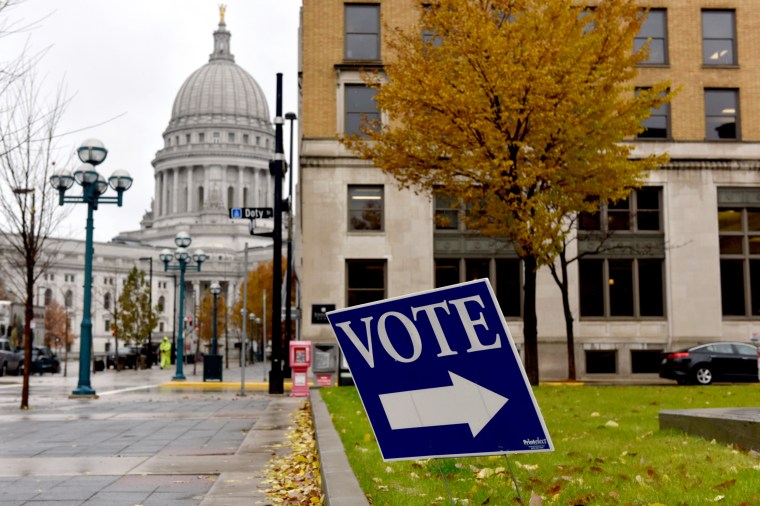
Image: A sign for a polling place near the state capitol in Madison, Wis., on Nov. 6, 2018.

A sign for a polling place near the state capitol in Madison, Wis., on Nov. 6, 2018.Nick Oxford / Reuters file

For most of the country, it was obvious years ago that Medicaid expansion through the Affordable Care Act is a good deal, but as regular readers know, there are still 12 holdouts. As a consequence, there are more than 2 million low-income Americans who don’t have health security, simply because Republicans in their respective states refuse to do the right thing.

One of those 12 states was handed an opportunity to act yesterday. As the Associated Press reported, it did not go well.

Republicans who control the Wisconsin Legislature on Tuesday convened and within seconds ended a special session called by Democratic Gov. Tony Evers to expand Medicaid, dashing chances for the state to receive a one-time bonus of $1 billion in federal coronavirus relief funding. The Senate and Assembly gaveled in and adjourned the special session in mostly empty chambers with only a handful of lawmakers in attendance.


The process was remarkably efficient. After Wisconsin’s Democratic governor called a special session on the matter, officials in the Republican-led state Assembly showed up, banged the gavel, and left after 40 seconds. In the Republican-led state Senate, they moved with even greater speed: the session wrapped up in less than 10 seconds.

GOP legislators not only refused to vote on Tony Evers’ Medicaid expansion plan, they also refused to even debate it.

There are two angles to this that matter, and not just in the Badger State. The first is that, in theory, Republicans in the Wisconsin legislature are risking a fierce public backlash by expressing such callous indifference toward struggling families and their own state’s finances. But in practice, GOP state lawmakers assume they’re free to act with impunity, and they’re almost certainly correct: Wisconsin Republicans have rigged the state’s district lines to such a degree that the GOP keeps power, even when Democrats win more votes.

In other words, Wisconsin Republican legislators can make unpopular and irresponsible decisions, comfortable in the knowledge that, despite operating in an ostensible democracy, there’s little voters can do about it.

But let’s also not lose sight of the financial incentives GOP lawmakers in Wisconsin rejected out of hand. In the Democrats’ COVID relief package, called the American Relief Plan, President Joe Biden thought he’d come up with an offer that states couldn’t refuse.

As we discussed in March, the policy may sound a little complicated, but the offer was straightforward: under the ACA, the federal government already covers 90% of the costs of expanding Medicaid. As Vox explained, the Democrats’ relief package ups the ante: “[N]ewly expanding states would also receive a 5 percent bump in the federal funding match for their traditional Medicaid programs for two years. Because the traditional Medicaid population is significantly larger than the expansion population, the funding bump is projected to cover a state’s 10 percent match for expansion enrollees and then some over those two years.”

It led Jon Chait to joke, “Now states taking the Medicaid expansion would have more than 100 percent of the cost covered by Washington. They would literally have to pay for the privilege of denying coverage to their poorest citizens.”

Nearly three months later, how many states did the obvious thing? None. Literally, not one of the 12 holdouts has budged.

To be sure, Republicans were made aware of the incredibly generous offer, but they nevertheless said no in Wisconsin. And Texas. And Wyoming. And Florida. And Tennessee.

Meanwhile, in Missouri, voters added Medicaid expansion to the state constitution last year, but GOP officials said they don’t care and still won’t approve the policy. A new lawsuit intends to force Republicans’ hands. Watch this space.

‘I’m cancer free!’ How a diagnosis of stage 4 cancer is no longer a death sentence

‘I’m cancer free!’ How a diagnosis of stage 4 cancer is no longer a death sentence

Kathryn W. Foster                          May 27, 2021


Nanita Edwards of Fort Lauderdale got the shock of her life last year.

Edwards, who had prided herself on never missing work, went to urgent care because she had some “pain in her backside.” She was sent immediately to the hospital and diagnosed with Stage IV ovarian cancer.

“I was told it was too advanced. I had maybe six months to a year to live and that there was nothing they could do,” Edwards recalled.

That was in July. In November, a palliative care doctor referred Edwards to Dr. Scott Jordan, a gynecologist/oncologist with Broward Health. By that time, she was too weak for surgery.

“First off, we never write off ovarian cancer patients because approximately 80 percent of the time, they respond to treatment. Even in really advanced disease, giving chemotherapy makes patients so much better and stronger, sometimes even in the intensive care unit, and then we can go back and look and see if they’re a surgical candidate,” Jordan said.

That’s what happened with Edwards. After three cycles of chemo, she “had put on about 20 pounds and had vastly improved her activity level” and was able to withstand extensive surgery, Jordan said.

“It was long-standing dogma until five to 10 years ago to first do surgery, then chemo. Increasingly, data has shown that it’s at least as good to start with chemo, especially if you have a frail patient, and then go for a smaller surgery” because the tumors will have shriveled, Jordan said.

Dr. Scott Jordan, gynecologist/oncologist with Broward Health who treated Nanita Edwards.


In Edwards’ case, cancer had spread throughout her abdomen. Jordan had to remove Edwards’ reproductive organs, her appendix, the area connecting the stomach with other abdominal organs, known as the ommentum, part of her colon and some enlarged lymph nodes.

Doctors also had to ablate, or burn off, a lot of small tumors implanted throughout her abdomen and pelvis.

“Additionally, she had the BRCA-2, a hereditary gene mutation that puts her in a camp of patients who respond even better to chemotherapy and who will respond very well with a maintenance treatment after therapy, an oral medication called a PARP inhibitor,” trade-named Lynparza. “It works especially well in someone who developed their cancer due to missing one of the BRCA genes. Ms. Edwards was also in that category,” Jordan said.

Edwards is now cancer free. “Based on data published in 2019, she has over a 50 percent chance of being disease free after three years and it potentially never reoccurring,” Jordan said.

“I’m cancer free, cancer free, cancer free,” Edwards said.

Changes in pancreatic cancer treatment

“Twenty or 25 years ago, pancreatic cancer was probably the most lethal,” said Dr. Mike Cusnir, co-director of gastrointestinal malignancies at Mount Sinai Medical Center in Miami Beach. “At that time, we used to say that the patient has such a poor prognosis, why do we make them sick [with treatment]?

Dr. Mike Cusnir, co-director of gastrointestinal malignancies at Mount Sinai Medical Center in Miami Beach.


“What has changed is we have gone in the opposite direction to give patients the most aggressive therapies, super treatments that are innovative with a lot of different drugs, and what we’ve seen is that we can extend the life of the patient.”

Added Dr. Kfir Ben-David, chairman of surgery at Mount Sinai, “The whole point of treating cancer is to get rid of it.”

When treating pancreatic cancer, the two Mount Sinai doctors are increasingly turning to immunotherapy, which unleashes the immune system of the patient’s own body to fight the cancer cells.

Ben-David and his team also remove diseased parts of the pancreas “with minimally invasive surgery using a small instrument the size of your pen to go through the abdomen to remove lymph nodes and cut out cancer. We are now able to put things back together through these small incisions,” Ben-David said.

New treatments for blood cancers

One of the areas where doctors have more treatments at their disposal is in blood cancers.

Dr. Mikkael Sekeres, who specializes in leukemia and bone marrow disorders in older adults at Sylvester Comprehensive Cancer Center at the University of Miami.


“It’s never a great thing to have a cancer diagnosis, but it is comforting to know we have so many cancer therapies available,” said Dr. Mikkael Sekeres, who specializes in leukemia and related bone marrow disorders in older adults. He is chief of the division of hematology at Sylvester Comprehensive Cancer Center at the University of Miami.

“We’ve had a number of innovations in treatment of blood and bone marrow cancers over the last decade. As a result, we have seen a tsunami of approvals by the FDA.

“Some of the most exciting inroads have been the immunotherapy approach using drugs that harness the power of the immune system to attack cancer. Some of these drugs are referred to as checkpoint inhibitors and they have particular efficiencies in lymphoma,” Sekeres said.

Certain cancers no longer a death sentence

Sekeres is optimistic about the future and how certain cancers will no longer be a death sentence.

“I think we’ll increasingly see people live longer and blood and bone marrow cancers managed like chronic disease. Already in the past 40 years, if you look at the survival for leukemia, it’s doubled. I think we will continue to see that trend.

“On a personal note, my grandmother, who lived in Delray Beach, when she was diagnosed with leukemia in 1980s, it was a death sentence. She did, in fact, die within 10 months.

“Nowadays, it’s no longer a death sentence. It’s something we can treat,” Sekeres said.

Carolyn Allen, who was diagnosed with Stage IV brain cancer and now has no active cancer, her doctor said.


Carolyn Allen of Oakland Park is one of those grateful cancer survivors. “I went from Stage IV to Stage 0 in a year,” Allen said.

In February of last year, she went to her doctor because she was having trouble with her eyesight and was getting confused. An MRI found a tumor in her brain.

“They put me in the hospital that very day and did the surgery on Saturday. They told me my brain cancer was from another part of my body.”

They found lung cancer, Allen remembered.

Immunotherapy making a difference

Allen’s oncologist, Dr. Mehmet Hepgur of Broward Health, put her on a regimen of chemotherapy and immunotherapy for three months. She’s now on immunotherapy for another year.

“In the past the only treatment of lung cancer stage IV was chemotherapy. Now we have a combo approach,” Hepgur said.

“She has no active cancer. I do anticipate she may remain cancer free for the rest of her life,” Hepgur said.

“Based on CDC data from 1999 to 2019, cancer death rates dropped 27 percent all across the board,” Hepgur said. “In my opinion, immunotherapy is part of the improvement,” he added.

Said Jordan, the oncologist who treated Edwards’ ovarian cancer, “We’re going to a direction of personalized medicine, testing the genes you are born with and also the genes in the tumor to guide our therapy and target with a targeted agent.”

Added Cusnir, “Until we cure 100 percent of our patients, we’re not going to stop studying every single permutation.”

Climate: World at risk of hitting temperature limit soon

Climate: World at risk of hitting temperature limit soon

David Shukman – Science editor                  May 26, 2021
Nantou in Taiwan during a drought this year


It’s becoming more likely that a key global temperature limit will be reached in one of the next five years.

A major study says by 2025 there’s a 40% chance of at least one year being 1.5C hotter than the pre-industrial level.

That’s the lower of two temperature limits set by the Paris Agreement on climate change.

The conclusion comes in a report published by the World Meteorological Organization (WMO).

The analysis is based on modelling by the UK Met Office and climate researchers in 10 countries including the US and China.

In the last decade, it was estimated that the chance of any one year reaching the 1.5C threshold was only 20%.

This new assessment puts that risk at 40%.

Leon Hermanson, a senior Met Office scientist, told BBC News that comparing projected temperatures with those of 1980-1900 shows a clear rise.

“What it means is that we’re approaching 1.5C – we’re not there yet but we’re getting close,” he said.

“Time is running out for the strong action which we need now.”

The researchers point out that even if one of the next five years is 1.5C above the pre-industrial level, it’ll be a temporary situation.

Temperature curve
Temperature curve


Natural variability will mean the following few years may be slightly cooler and it could be another decade or two or more before the 1.5C limit is crossed permanently.

The Paris Agreement established the goal of keeping the increase in the global average temperature to no more than 2C and to try not to surpass 1.5C – and that’s understood to mean over a long period rather than a single year.

According to Dr Joeri Rogelj, director of research at the Grantham Institute, Imperial College London, “the 1.5C in the Met Office announcement should not be confused with the 1.5C limit in the Paris Agreement”.

“The Paris targets refer to global warming – that is, the temperature increase of our planet once we smooth out year-to-year variations,” he explained.

“A single year hitting 1.5C therefore doesn’t mean the Paris limits are breached, but is nevertheless very bad news.

“It tells us once again that climate action to date is wholly insufficient and emissions need to be reduced urgently to zero to halt global warming.”

Wildfire consumes house in St Helena, California
A house is consumed by flames during the Glass wildfire in California last year


A landmark report by the UN climate panel in 2018 highlighted how the impacts of climate change are far more severe when the increase is greater than 1.5C.

At the moment, projections suggest that even with recent pledges to cut emissions of greenhouse gases, the world is on course to heat up by up to 3C.

The WMO’s secretary-general, Prof Petteri Taalas, said the results of the new research were “more than mere statistics”.

“This study shows – with a high level of scientific skill – that we are getting measurably and inexorably closer to the lower target of the Paris Agreement on Climate Change,” he explained.

“It is yet another wake up call that the world needs to fast-track commitments to slash greenhouse gas emissions and achieve carbon neutrality.”

Prof Ed Hawkins, a climate scientist at the University of Reading, told me that if the new forecast is proved right “it does not mean that we have exceeded the Paris Agreement limit”.

He points out that two individual months in 2016 saw a rise of 1.5C.

“As the climate warms, we’ll get more months above 1.5C, then a sequence of them, then a whole year on average above 1.5 and then two or three years and then virtually every year,” Prof Hawkins said.

He also stresses that 1.5C is “not a magic number that we’ve got to avoid”.

“It’s not a sudden cliff edge, it’s more like a slope that we’re already on and, as the climate warms, the effects get worse and worse.

“We have to set a line in the sand to try to limit the temperature rise but we clearly need to recognize that we’re seeing the effects of climate change already in the UK and around the world and those effects will continue to become more severe.”

The report comes in the approach to the COP26 summit on climate change, due to be held in Glasgow in November.

The summit aims to raise ambition among world leaders on tackling the climate crisis.

New Mexico Stuck With $8 billion in Cleanup for Oil Wells, Highlighting Dangers From Fossil Fuel Dependence

DeSmog

New Mexico Stuck With $8 billion in Cleanup for Oil Wells, Highlighting Dangers From Fossil Fuel Dependence

The oil industry boasts that it fills state coffers with revenues from drilling, but a new study finds a serious gap in funding available to tackle the environmental legacy of abandoned wells.
Nick Cunningham         May 26, 2021
 
Oil stored in tanks. Credit: Bureau of Land Management (CC BY 2.0)

New Mexico is facing more than $8 billion in cleanup costs for oil and gas wells, an enormous liability that taxpayers could be left to pick up if drillers go out of business or walk away from their obligations.

Cleaning up old wells at the end of their operating lives can be expensive, and typically states require drillers to cover part of the cleanup cost at the outset, known as financial assurance requirements. The money is tapped later on when the well or pipeline must be dismantled and cleaned up.

But a study commissioned by the New Mexico State Land Office published on April 30 found that “financial assurance requirements do not exist for much of the oil and gas infrastructure explored in this study, and in some cases where such requirements are imposed, operators may have multiple ways of minimizing or avoiding those requirements.” The study was conducted by the Center for Applied Research, an independent analytical firm.

Inadequate bonding requirements means there is a serious gap in available funding to properly clean up after the fossil fuel industry. According to the report, it could cost as much as $8.38 billion to clean up the state’s tens of thousands of wells and associated pipeline infrastructure. Alarmingly, however, New Mexico only has $201 million tucked away for cleanup, leaving a hole of $8.1 billion.

“That’s $8.1 billion that we don’t have,” New Mexico Commissioner of Public Lands Stephanie Garcia Richard said in a statement. “Enormous sums of taxpayer money and money meant for public schools, along with the long-term health of our lands, are on the line.”

The industry likes to boast that oil and gas revenues contribute roughly a third of the state’s general fund — a fact that the New Mexico Oil & Gas Association (NMOGA) triumphantly advertised in a recent report and regularly highlights on social media.

Indeed, drilling accounts for a large source of state revenues. In April 2021, for example, the state took in $109 million in royalties, a record high. Those funds will be funneled into public services, including schools and hospitals.

As the report exposed, however, the massive liability put onto the public in cleanup costs somewhat undercuts the notion that the oil and gas industry is a financial godsend.

The industry has helped fill state coffers in recent years, with oil production booming to roughly 1 million barrels per day, more than double production levels from five years ago. According to the report, last year the oil and gas industry produced nearly 370 million barrels of oil and 2 trillion cubic feet of natural gas from roughly 60,000 wells, which was transported on 35,000 miles of pipelines.

But as the State Land Office study highlights, the industry is leaving behind enormous costs for the state and the general public to deal with at a later date, a liability that is mostly obscured from public discussion.

The average cost to plug an old well and reclaim the surface is over $182,000 per well, but the state only has the finances to cover a little over $3,200 per well. The funding gap is even more staggering for pipelines. Decommissioning and reclamation costs are roughly $211,000 per mile of pipeline, but available financial assurance only totals about $51 per mile.

A pump jack in Roswell, New Mexico. Credit: BLM(CC BY 2.0)


The risk to the public from inadequate bonding requirements is compounded by the fact that oil and gas drillers can go out of business long before wells are cleaned up, which can be years or even decades later. The U.S. shale industry has burned through hundreds of billions of dollars in cash, and there have been more than 250 bankruptcies of North American oil and gas companies since 2015. And as the clean energy transition accelerates, the financial challenges to the industry are likely to only grow more severe.

The state has long suffered from the roller coaster cycles of extractive industry, according to James Jimenez, executive director of New Mexico Voices for Children, a health, education, and economic advocacy organization. “We’ve made policy choices in boom times that have really exacerbated our over-dependence on oil and natural gas revenues,” Jimenez told DeSmog.

“Because of the really volatile nature of the oil and gas industries, we haven’t had sustainability in the programs,” he said. A dependence on a boom-and-bust industry has forced the state to make cuts to school systems during downturns in the past.

“We need to reduce this over reliance we have on oil and natural gas to fund really basic important programs like our K-12 education and higher education systems,” Jimenez said. He added that the state should diversify its revenue base, such as through progressive taxation on the wealthy and supporting non-extractive business sectors.

Even as money flows to the state from drilling today, the unfunded liabilities of cleanup that are dumped onto the public also highlight the downside to such high levels of drilling. “The $8 billion that it would take to do the cleanup would have to come from somewhere,” Jimenez said. Dollars spent on cleaning up the waste from the oil and gas industry, are dollars not spent on other important needs, such as rural broadband or road infrastructure, he added.

“The answers are simple and urgent — raise royalty rates and taxes on the industry, stash away the revenues in our Permanent Fund to stabilize cash flows, and spend current budget dollars on investments to diversify our economy,” Thomas Singer, senior policy advisor at the Western Environmental Law Center, told DeSmog via email.

NMOGA did not respond to a request for comment.

Well pad near Roswell, NM. Credit: BLM(CC BY 2.0)


On top of the financial risks from abandoned wells, the fossil fuel industry brings numerous environmental and public health hazards as well. Oil and gas operations have contributed to a deterioration in air quality in the state. And in northwestern New Mexico, there have been more than 300 accidents since 2019, including oil spills, fires, blowouts, and gas releases, and much of it has occurred on Navajo land, as reported by Capital & Main.

A recently published peer-reviewed study found that shut-in conventional oil wells in the Permian basin could be leaking a substantial amount of methane, a powerful greenhouse gas that exacerbates climate change.

“New Mexicans must recognize that while industrialization of our landscape to produce oil and gas brings revenue today, if not properly cleaned up, it also jeopardizes our economy of the future,” Singer said. Allowing drillers “to defer this obligation indefinitely puts the state and taxpayers at great risk that they will have pick up the tab or leave these areas as polluted sacrifice zones.”

Nick Cunningham is an independent journalist covering the oil and gas industry, climate change and international politics. He has been featured in Oilprice.com, The Fuse, YaleE360 and NACLA.

U.S. freeways flattened Black neighborhoods nationwide

U.S. freeways flattened Black neighborhoods nationwide

New York state highway plan shows potential pitfalls of Biden’s infrastructure push.


SYRACUSE, N.Y. (Reuters) – Syracuse wasn’t the only city where Black residents were displaced by the U.S. freeway-building boom of the 1950s and 1960s.

Across the country, local officials saw the proposed interstate system as a convenient way to demolish what they regarded as “slum” neighborhoods near their downtown business districts, historians say. With the federal government picking up 90% of the cost, freeway construction made it easier for politicians and business leaders to pursue their own “urban renewal” projects after residents were evicted.

“It was a mistake that many cities were making,” said University of California, Irvine law professor Joseph DiMento, an expert in the policies of the freeway-building era. “The reasons they were built were heavily for removal of Blacks from certain areas.”

Existing long-distance highways, like the New York State Thruway, largely skirted city centers. The new interstates were built right through them.

Road builders at the time were largely free to ignore environmental, historical, social or other factors, allowing them to focus on the most direct route from one point to another.

More often than not, that meant routing those freeways through Black neighborhoods, where land was cheap and political opposition low.

Some black neighborhoods were targeted even when more logical routes were available, research by the late urban historian Raymond Mohl shows. According to his findings:

*In Miami, Interstate 95 was routed through Overtown, a Black neighborhood known as the “Harlem of the South,” rather than a nearby abandoned rail corridor.

*In Nashville, Interstate 40 took a noticeable swerve, bisecting the Black community of North Nashville.

*In Montgomery, Alabama, the state highway director, a high-level officer of the Ku Klux Klan, routed Interstate 85 through a neighborhood where many Black civil rights leaders lived, rather than choosing an alternate route on vacant land.

*In New Orleans and Kansas City, officials re-routed freeways from white neighborhoods to integrated or predominantly Black areas.

Residents in a handful of cities, including Washington, D.C., Philadelphia and Baltimore, successfully mobilized to block freeway construction in Black neighborhoods. But that was not typically the case.

The road-building program ultimately displaced more than 1 million Americans, most of them low-income minorities, according to Anthony Foxx, who served as transportation secretary under Democratic President Barack Obama.

(Reporting by Andy Sullivan; editing by Marla Dickerson)