In Congress, Republicans Shrug at Warnings of Democracy in Peril

In Congress, Republicans Shrug at Warnings of Democracy in Peril

The biggest attack on American democracy, these photos will bow to the eyes of superpower


  • WASHINGTON — Sen. Christopher S. Murphy concedes that political rhetoric in the nation’s capital can sometimes stray into hysteria, but when it comes to the precarious state of American democracy, he insisted he was not exaggerating the nation’s tilt toward authoritarianism.

“Democrats are always at risk of being hyperbolic,” said Murphy, D-Conn. “I don’t think there’s a risk when it comes to the current state of democratic norms.”

After the norm-shattering presidency of Donald Trump, the violence-inducing bombast over a stolen election, the pressuring of state vote counters, the Capitol riot and the flood of voter curtailment laws rapidly being enacted in Republican-run states, Washington has found itself in an anguished state.

Almost daily, Democrats warn that Republicans are pursuing racist, Jim Crow-inspired voter suppression efforts to disenfranchise tens of millions of citizens, mainly people of color, in a cynical effort to grab power. Metal detectors sit outside the House chamber to prevent lawmakers — particularly Republicans who have boasted of their intention to carry guns everywhere — from bringing weaponry to the floor. Democrats regard their Republican colleagues with suspicion, believing that some of them collaborated with the rioters on Jan. 6.

Republican lawmakers have systematically downplayed or dismissed the dangers, with some breezing over the attack on the Capitol as a largely peaceful protest, and many saying the state voting law changes are to restore “integrity” to the process, even as they give credence to Trump’s false claims of rampant fraud in the 2020 election.

They shrug off Democrats’ warnings of grave danger as the overheated language of politics as usual.

“I haven’t understood for four or five years why we are so quick to spin into a place where part of the country is sure that we no longer have the strength to move forward, as we always have in the past,” said Sen. Roy Blunt of Missouri, a member of Republican leadership, noting that the passions of Republican voters today match those of Democratic voters after Trump’s triumph. “Four years ago, there were people in the so-called resistance showing up in all of my offices every week, some of whom were chaining themselves to the door.”

For Democrats, the evidence of looming catastrophe mounts daily. Fourteen states, including politically competitive ones like Florida and Georgia, have enacted 22 laws to curtail early and mail-in ballots, limit polling places and empower partisans to police polling, then oversee the vote tally. Others are likely to follow, including Texas, with its huge share of House seats and electoral votes.

Because Republicans control the legislatures of many states where the 2020 census will force redistricting, the party is already in a strong position to erase the Democrats’ razor-thin majority in the House. Even moderate voting-law changes could bolster Republicans’ chances for the net gain of one vote they need to take back the Senate.

And in the nightmare outcome promulgated by some academics, Republicans have put themselves in a position to dictate the outcome of the 2024 presidential election if the voting is close in swing states.

“Statutory changes in large key electoral battleground states are dangerously politicizing the process of electoral administration, with Republican-controlled legislatures giving themselves the power to override electoral outcomes on unproven allegations,” 188 scholars said in a statement expressing concern about the erosion of democracy.

Sen. Angus King, an independent from Maine who lectured on American politics at Bowdoin College before going to the Senate, put the moment in historical context. He called American democracy “a 240-year experiment that runs against the tide of human history,” and that tide usually leads from and back to authoritarianism.

He said he feared the empowerment of state legislatures to decide election results more than the troubling curtailments of the franchise.

“This is an incredibly dangerous moment, and I don’t think it’s being sufficiently realized as such,” he said.

Republicans contend that much of this is overblown, though some concede the charges sting. Sen. Patrick Toomey, R-Pa., said Democrats were playing a hateful race card to promote voting-rights legislation that is so extreme it would cement Democratic control of Congress for decades.

“I hope that damage isn’t being done,” he added, “but it is always very dangerous to falsely play the race card and let’s face it, that’s what’s being done here.”

Toomey, who voted to convict Trump at his second impeachment trial, said he understood why, in the middle of a deadly pandemic, states sharply liberalized voting rules in 2020, extending mail-in voting, allowing mailed ballots to be counted days after Election Day and setting up ballot drop boxes, curbside polls and weeks of early voting.

But he added that Democrats should understand why state election officials wanted to course correct now that the coronavirus was ebbing.

“Every state needs to strike a balance between two competing values: making it as easy as possible to cast legitimate votes, but also the other, which is equally important: having everybody confident about the authenticity of the votes,” Toomey said.

Trump’s lies about a stolen election, he added, “were more likely to resonate because you had this system that went so far the other way.”

Some other Republicans embrace the notion that they are trying to use their prerogatives as a minority party to safeguard their own power. Sen. Rand Paul of Kentucky said the endeavor was the essence of America’s system of representative democracy, distinguishing it from direct democracy, where the majority rules and is free to trample the rights of the minority unimpeded.

“The idea of democracy and majority rule really is what goes against our history and what the country stands for,” Paul said. “The Jim Crow laws came out of democracy. That’s what you get when a majority ignores the rights of others.”

Democrats and their allies push back hard on those arguments. King said the only reason voters lacked confidence in the voting system was that Republicans — especially Trump — told them for months that it was rigged, despite all evidence to the contrary, and now continued to insist that there were abuses in the process that must be fixed.

“That’s like pleading for mercy as an orphan after you killed both your parents,” he said.

Sen. Tim Kaine, D-Va., said in no way could some of the new state voting laws be seen as a necessary course correction. “Not being able to serve somebody water who’s waiting in line? I mean, come on,” he said. “There are elements that are in most of these proposals where you look at it and you say, ‘That violates the common-sense test.’”

Missteps by Democrats have fortified Republicans’ attempts to downplay the dangers. Some of them, including President Joe Biden, have mischaracterized Georgia’s voting law, handing Republicans ammunition to say that Democrats were willfully distorting what was happening at the state level.

The state’s 98-page voting law, passed after the narrow victories for Biden and two Democratic candidates for Senate, would make absentee voting harder and create restrictions and complications for millions of voters, many of them people of color.

But Biden falsely claimed that the law — which he labeled “un-American” and “sick” — had slapped new restrictions on early voting to bar people from voting after 5 p.m. Sen. Chuck Schumer of New York, the majority leader, said the Georgia law had ended early voting on Sunday. It didn’t.

And the sweep — critics say overreach — of the Democrats’ answer to Republican voter laws, the For the People Act, has undermined Democratic claims that the fate of the republic relies on its passage. Even some Democrats are uncomfortable with the act’s breadth, including an advancement of statehood for the District of Columbia with its assurance of two more senators, almost certainly Democratic; its public financing of elections; its nullification of most voter identification laws; and its mandatory prescriptions for early and mail-in voting.

“They want to put a thumb on the scale of future elections,” Sen. John Cornyn, R-Texas, said Wednesday. “They want to take power away from the voters and the states, and give themselves every partisan advantage that they can.”

Sen. Mitt Romney, R-Utah, who could conceivably be a partner in Democratic efforts to expand voting rights, called the legislation a “fundamentally unserious” bill.

Republican leaders have sought to take the current argument from the lofty heights of history to the nitty-gritty of legislation. Sen. Mitch McConnell of Kentucky, the minority leader, pointed to the success of bipartisan efforts such as passage of a bill to combat hate crimes against Asian Americans, approval of a broad China competition measure and current talks to forge compromises on infrastructure and criminal justice as proof that Democratic catastrophizing over the state of American governance was overblown.

But Democrats are not assuaged.

“Not to diminish the importance of the work we’ve done here, but democracy itself is what we’re talking about,” said Sen. Brian Schatz of Hawaii. “And to point at other bills that don’t have to do with the fair administration of elections is just an attempt to distract while all these state legislatures move systematically toward disenfranchising voters who have historically leaned Democrat.”

King said he had had serious conversations with Republican colleagues about the precarious state of American democracy. Authoritarian leaders like Vladimir Putin, Viktor Orban and Adolf Hitler have come to power by election, and stayed in power by warping or obliterating democratic norms.

But, he acknowledged, he has yet to get serious engagement, largely because his colleagues fear the wrath of Trump and his supporters.

“I get the feeling they hope this whole thing will go away,” he said. “They make arguments, but you have the feeling their hearts aren’t in it.”

Electric heat pumps use much less energy than furnaces, and can cool houses too – here’s how they work

Electric heat pumps use much less energy than furnaces, and can cool houses too – here’s how they work


<span class="caption">Heating or cooling? I do both.</span> <span class="attribution"><a class="link rapid-noclick-resp" href="https://flic.kr/p/2kKjBWT" rel="nofollow noopener" target="_blank" data-ylk="slk:FanFan61618/Flickr">FanFan61618/Flickr</a>, <a class="link rapid-noclick-resp" href="http://creativecommons.org/licenses/by-sa/4.0/" rel="nofollow noopener" target="_blank" data-ylk="slk:CC BY-SA">CC BY-SA</a></span>
Heating or cooling? I do both. FanFan 61618/Flicker, CC BY – SA


To help curb climate change, President Biden has set a goal of lowering U.S. greenhouse gas emissions 50%-52% below 2005 levels by 2030. Meeting this target will require rapidly converting as many fossil fuel-powered activities to electricity as possible, and then generating that electricity from low-carbon and carbon-free sources such as wind, solar, hydropower and nuclear energy.

The buildings that people live and work in consume substantial amounts of energy. In 2019, commercial and residential buildings accounted for more than one-seventh of U.S. greenhouse gas emissions. New heating and cooling strategies are an important piece of the puzzle.

Fortunately, there’s an existing technology that can do this: electric heat pumps that are three to four times more efficient than furnaces. These devices heat homes in winter and cool them in summer by moving heat in and out of buildings, rather than by burning fossil fuel.

As a scientist focusing on renewable and clean energy, I study energy use in housing and what slowing climate change means for industrialized and developing countries. I see powering buildings with clean, renewable electricity as an essential strategy that also will save consumers money.

Heat pumps work by moving heat, not air

Most heating systems in the U.S. use forced-air furnaces that run on natural gas or electricity, or in some cases heating oil. To heat the building, the systems burn fuel or use electricity to heat up air, and then blow the warm air through ducts into individual rooms.

A heat pump works more like a refrigerator, which extracts energy from the air inside the fridge and dumps that energy into the room, leaving the inside cooler. To heat a building, a heat pump extracts energy from outdoor air or from the ground and converts it to heat for the house.

Here’s how it works: Extremely cold fluid circulates through coils of tubing in the heat pump’s outdoor unit. That fluid absorbs energy in the form of heat from the surrounding air, which is warmer than the fluid. The fluid vaporizes and then circulates into a compressor. Compressing any gas heats it up, so this process generates heat. Then the vapor moves through coils of tubing in the indoor unit of the heat pump, heating the building.

In summer, the heat pump runs in reverse and takes energy from the room and moves that heat outdoors, even though it’s hotter outside – basically, functioning like a bigger version of a refrigerator.

More efficient than furnaces

Heat pumps require some electricity to run, but it’s a relatively small amount. Modern heat pump systems can transfer three or four times more thermal energy in the form of heat than they consume in electrical energy to do this work – and that the homeowner pays for.

In contrast, converting energy from one form to another, as conventional heating systems do, always wastes some of it. That’s true for burning oil or gas to heat air in a furnace, or using electric heaters to heat air – although in that case, the waste occurs when the electricity is generated. About two-thirds of the energy used to produce electricity at a power plant is lost in the process.

Retrofitting residences and commercial buildings with heat pumps increases heating efficiency. When combined with a switch from fossil fuels to renewables, it further lowers energy use and carbon emissions.

Going electric

Growing restrictions on fossil fuel use and proactive policies are driving sales of heat pumps in the U.S. and internationally. Heat pumps are currently used in 5% of heating systems worldwide, a share that will need to increase to one-third by 2030 and much higher after to reach net-zero emissions by 2050.

In warmer areas with relatively low heating demands, heat pumps are cheaper to run than furnaces. Tax credits, utility rebates or other subsidies may also provide incentives to help with up-front costs, including federal incentives reinstated by the Biden administration.

In extremely cold climates, these systems have an extra internal heater to help out. This unit is not as efficient, and can significantly run up electric bills. People who live in cold locations may want to consider geothermal heat pumps as an alternative.

Infographic advertising rebates for installing geothermal heat pumps in New Jersey.

These systems leverage the fact that ground temperature is warmer than the air in winter. Geothermal systems collect warmth from the earth and use the same fluid and compressor technology as air source heat pumps to transfer heat into buildings. They cost more, since installing them involves excavation to bury tubing below ground, but they also reduce electricity use.

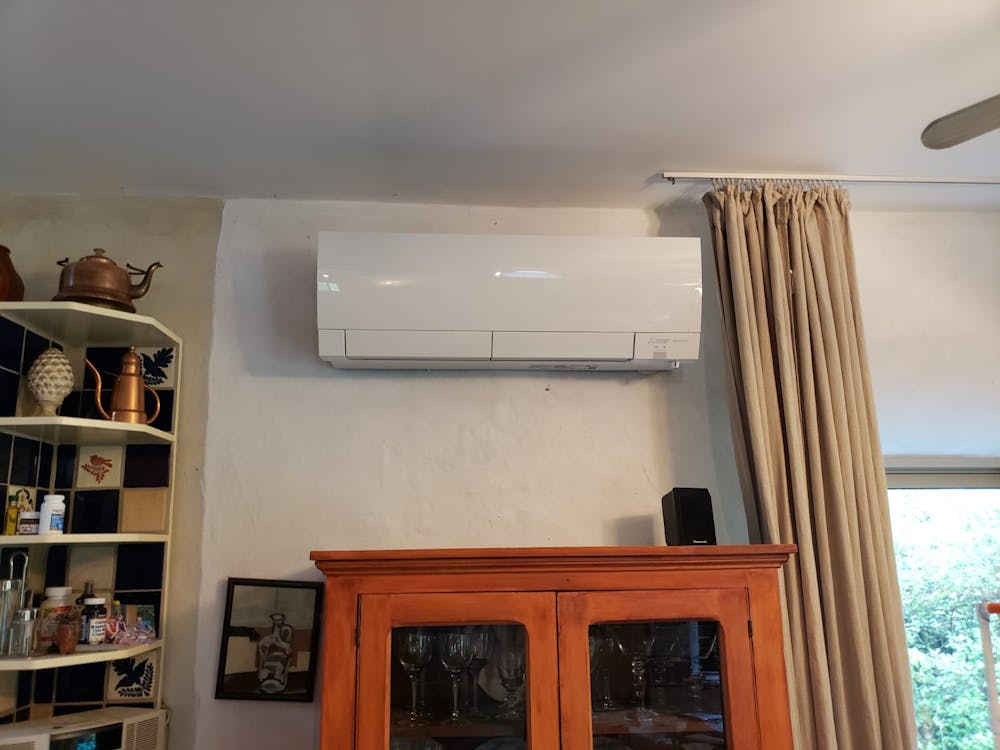
New, smaller “mini-split” heat pump systems work well in all but the coldest climates. Instead of requiring ducts to move air through buildings, these systems connect to wall-mounted units that heat or cool individual rooms. They are easy to install and can be selectively used in individual apartments, which makes retrofitting large buildings easier.

Even with the best heating and cooling systems, installing proper insulation and sealing building leaks are key to reducing energy use. You can also experiment with your thermostat to see how little you can heat or cool your home while keeping everyone in it comfortable.

Mini split heat pump indoor unit mounted over a fireplace.


For help figuring out whether a heat pump can work for you, one good source of information is your electricity provider. Many utilities offer home energy audits that can identify cost-effective ways to make your home more energy-efficient. Other good sources include the U.S. Department of Energy and the American Council for an Energy Efficient Economy. As the push to electrify society gains speed, heat pumps are ready to play a central role.

Read more:

Robert Brecha does not work for, consult, own shares in or receive funding from any company or organization that would benefit from this article, and has disclosed no relevant affiliations beyond their academic appointment.

Habitat for Humanity is building a 3D-printed home in Arizona to help solve the affordable housing crisis. See how it’s being constructed.

Habitat for Humanity is building a 3D-printed home in Arizona to help solve the affordable housing crisis. See how it’s being constructed.


Habitat for Humanity is building a 3D-printed home in Arizona to help solve the affordable housing crisis. See how it’s being constructed.
The home being 3D printed
The site of the 3D-printed home. Habitat for Humanity
  • Habitat for Humanity in Central Arizona is building a 3D-printed home in Tempe, Arizona.
  • The home will have three bedrooms and two bathrooms.
  • Prefabricated and 3D-printed homes are increasingly being seen as solutions to our housing crisis.

A massive housing crisis and shortage has been tearing across the US.

A portion of the home with plumbing
The site of the 3D-printed home. Habitat for Humanity

In an effort to help alleviate this issue, Habitat for Humanity in Central Arizona is now building a 3D-printed home in Tempe, Arizona …

Constructing the 3D-printed home
The site of the 3D-printed home. Habitat for Humanity

Source: Habitat for Humanity Central Arizona

… designed in partnership with luxury architecture firm Candelaria Design.

Documents from the City of Tempe
Documents from the City of Tempe for the 3D-printed home. Habitat for Humanity

According to Habitat for Humanity, 3D printing could be an economical way to address said crisis.

A person constructing the 3D-printed home
A person and machinery on the site of the 3D-printed home. Habitat for Humanity

“When we consider the housing issues facing Arizona, the need for affordable homeownership solutions becomes clear,” Jason Barlow, president and CEO of Habitat Central Arizona, said in the press release.

People and machinery on the 3D-printed home&#39;s site
People and machinery on the site of the 3D-printed home. Habitat for Humanity

Source: Habitat for Humanity Central Arizona

“If we can deliver decent, affordable, more energy-efficient homes at less cost, in less time and with less waste, we think that could be a real game-changer,” Barlow continued.

The home being 3D printed
The site of the 3D-printed home. Habitat for Humanity

Homebuilding methods like 3D printing or prefabrication are increasingly being considered as feasible alternatives to “traditional” construction.

The home being printed
The site of the 3D-printed home. Habitat for Humanity

Using a 3D printer to create homes is often seen as a more efficient and sustainable alternative to traditional construction methods.

People and machinery on the 3D-printed home&#39;s site
People and machinery on the site of the 3D-printed home. Habitat for Humanity

“In addition to affordable homes, the market increasingly demands innovative housing concepts,” Yasin Torunoglu, the housing and spatial development alderman at the municipality of Eindhoven, said in regards to a different 3D-printed home in the Netherlands.

The home being 3D printed
The site of the 3D-printed home. Habitat for Humanity

Source: Insider

The home in Tempe is being built using both a 3D printer and “traditional” construction techniques.

The site of the 3D-printed home
The site of the 3D-printed home. Habitat for Humanity

Between 70 to 80% of the home will be printed, including the walls.

The home being 3D printed
The site of the 3D-printed home. Habitat for Humanity

The team is relying on a printer from Germany-based Peri: the “build on-demand printer,” or the BOD2.

The 3D-printer
Machinery on the site of the 3D-printed home. Habitat for Humanity

Peri is a European formwork and scaffolding maker, and its 3D printer has also been used to print another home and a three-floor apartment building in Germany.

The home being printed
The site of the 3D-printed home. Habitat for Humanity

Source: Insider

The printer was sent to the US in March and moved to Arizona in April. It officially began its printing work in Tempe one month later.

A person and machinery on the 3D-printed home&#39;s site
A person and machinery on the site of the 3D-printed home. Habitat for Humanity

Peri describes the BOD2 as a “gantry printer.”

The home being printed
The site of the 3D-printed home. Habitat for Humanity

The printing mechanism can move left, right, forward, backward, up, and down …

The home being 3D printed
The site of the 3D-printed home. Habitat for Humanity

… which allows the printer head to move anywhere within the construction space.

The home being 3D printed
The site of the 3D-printed home. Habitat for Humanity

The printer can also be used while workers are completing other on-site construction projects, creating a human and machine team that works in harmony.

People on the 3D-printed home&#39;s site
People and machinery on the site of the 3D-printed home. Habitat for Humanity

The home is still in progress, but Habitat for Humanity projects the project will be ready in August or September.

A portion of the home with wiring
The site of the 3D-printed home. Habitat for Humanity

By October, the home could be occupied by “income-qualified homeowners,” according to the team.

Renderings of the 3D-printed home
The site of the 3D-printed home. Habitat for Humanity

Source: Habitat for Humanity Central Arizona

In total, the home will sit at 2,433 square feet, but its living space will fall a bit shorter at 1,738 square feet.

The home being 3D printed with machinery and a person
The site of the 3D-printed home. Habitat for Humanity

All of this space will then accommodate three bedrooms and two bathrooms.

overhead view of the site of the 3D-printed home.
The site of the 3D-printed home. Habitat for Humanity

“Beyond our city borders, this project can serve as a model for other communities as we all work to meet the critical needs of families who truly are the faces of this growing housing affordability crisis,” Corey Woods, the mayor of Tempe, said in the press release.

The home being printed
The site of the 3D-printed home. Habitat for Humanity

Source: Habitat for Humanity Central Arizona

OPINION: Like Donald Trump, Tennessee GOP voters are delusional

Tribune Publishing

Jun. 12—Tennessee used to be a state with a centrist temperament, a state where in election after election voters cast ballots for moderate politicians of both political stripes — Howard Baker, Fred Thompson, Zach Wamp, Ned McWherter, Bill Frist, Al Gore, Phil Bredesen, Lamar Alexander and Bill Haslam to name a few.

But that’s over. Tennessee Republicans are no longer centrists and moderates. They are now leaning hard, hard right — and straight over the edge of a flat earth.

Judging from a recent Vanderbilt University survey of 1,000 registered voters, it isn’t just former president Donald Trump who is delusional in insisting the election was stolen from him.

It’s also 71% of Tennessee’s Republican voters who last month told Vandy pollsters they agreed with the statement: “Joe Biden stole the 2020 presidential election.”

And why not? As disheartening as it is, it shouldn’t be completely surprising. Tennessee’s new hard-right politicians bang the drum daily on social media and Fox News, peppering Tennesseans with continued references to Trump and his ever-increasing false claims.

Never mind that the “big lie” of a rigged or stolen election was soundly rejected by state officials, the courts, the Electoral College, Trump’s own administration and eventually Congress — which acted to certify the results amid a Capitol breach by a violent mob of Trump supporters.

You already know how Republicans answered that question posed in the statewide survey by Vanderbilt’s Center for the Study of Democratic Institutions in Nashville. But among all of those 1,000 voters, only 40% agreed with the big lie; among independents, 30% agreed and among Democrats, only 5% agreed.

“This is a remarkable number — that the vast majority of a political party feels the other party is illegitimate, despite the lack of any evidence,” said Dr. Josh Clinton, a Vanderbilt political science professor and co-director of Vanderbilt’s Center for the Study of Democratic Institutions.

The partisan disconnect doesn’t stop there:

— 37% of Republicans and 30% of Independents said they do not plan to get the COVID-19 vaccine (60% of Republicans and 94% of Democrats said they already are or plan to be vaccinated).

— 90% of Democrats but only 29% of Republicans said they agree that the legacy of slavery affects the position of Black people in today’s America a great deal or a fair amount.

— 57% of Republicans and 8% of Democrats approve of making it legal for those 21 and over to carry a handgun without a permit. (Overall, only 39% of Tennesseans approve.)

Testing the partisan divide, the pollsters ran a small experiment, asking about voters’ support for infrastructure upgrades two different ways.

When respondents were asked if they approved of Biden’s American Jobs Plan that would use $2.3 trillion to upgrade the country’s infrastructure over the next 10 years, including improving roads and bridges, electric grids, drinking water and access to broadband internet, only 29% of Republicans approved while 96% of Democrats approved. But when the question was posed without naming the plan or President Biden, Republican approval for infrastructure doubled — to 59%, while the same 96% of Democrats approved.

It seems those anti-Biden, anti-Democrats Fox News talking points are getting through.

Professor Clinton was more tactful: “The fact that there is broad support for these economic issues when partisan indicators are omitted shows that political context can really affect people’s reactions to important policy issues, depending on how the issues are framed.”

Of course, the Vandy survey isn’t alone in noticing the hard right-wing slide in Tennessee. History is telling, too. Trump won the state in 2020 by 23 percentage points, and the Republican margin of victory has consistently widened in every presidential election since 1996 — the last time the state went to a Democrat.

Former Tennessee Gov. Haslam talked about that slide in a Q & A published last week in The Atlantic about his new book, “Faithful Presence.”

Haslam, a moderate and an evangelical Christian who says he loved being a mayor and loved being governor, faces a dilemma with Tennessee’s new right-wing lean. It’s a place where he’s having a hard time identifying with his own evangelical faith and with his party’s recent direction.

“One of the reasons I wrote the book is this conflation of folks’ personal views of Christianity with the personal political views. This to me is a sign of how far off track the Church has gone. There’s been damage to the Church by the identification with this political cause [Trumpism].”

Haslam told The Atlantic he hasn’t figured out whether he’s going to run for office again, and the magazine noted it’s also not clear that he could win in today’s political environment.

Talking of Tennessee voters, Haslam noted that unlike in Georgia where newcomers helped flip the Peach State blue in 2020, “the folks who are moving here are actually more conservative than the people who were here to begin with.”

Haslam added that Republicans did a good job in the last election of reaching out to more rural voters, even attracting a lot of people who haven’t been heavy voters in the past. But at the same time, the GOP lost a lot of the suburban voters — particularly women.

“As a party, we’re trading high-propensity voters for low-propensity voters,” he said. “That’s a concern for the Republican Party in Tennessee, and everywhere else for that matter.”

Perhaps therein lies another hint as to why 71% of Tennessee’s Republican voters believe the “big lie.”

Driest summer in 50 years a glimpse of the future

Tribune Publishing

EDITORIAL: Driest summer in 50 years a glimpse of the future


Clatsop County Oregon


Jun. 13—For growers of everything from pears to cannabis, the news is grim. Irrigation water may be shut off by Aug. 1, just as crops enter the stage when they need it most. The long-term outlook is even more dire.

Drought is not a new phenomenon in Southern Oregon. In fact, if you want to get technical about it, every year is a drought year, because farmers must use stored water to irrigate crops in the summer months. That’s according to the U.S. Geological Survey’s summary of weather trends.

But in most years, that stored water, held in reservoirs until released, is enough to last through the growing season. Not this year. Coming off a dry year in 2020, there was not enough precipitation to replenish reservoirs for the 2021 season.

State climatologist Larry O’Neill, an associate professor at Oregon State University, told Oregon Public Broadcasting that the data indicate this part of the world is experiencing the driest 20-year period in the past 1,000 years. The evidence points to something more ominous than just a couple of dry years.

All across the country, temperatures are climbing, a symptom of climate change. The National Oceanographic and Atmospheric Administration issued its latest “climate normals” last month, based on measurements of temperature, rain, snow and other variables from thousands of points nationwide.

The New York Times reported that the “normals” — issued every 10 years since 1930 — show a steadily warming climate when compared with the 20th century average.

Precipitation totals have changed, too — and on the surface that should be a good thing, because warm air holds more moisture. Oregon is expected to see more precipitation in coming years, according to the state’s latest climate assessment. But more of it will be rain, and less will be snow. In addition, warming temperatures mean what snowpack there is will melt sooner in the year, rather than the slow, steady melting that fills reservoirs. Rain, even torrential rain, is no substitute for snowpack, because it runs off before it can be captured.

All that is likely to mean longer and more severe droughts. And that could mean fundamental changes to the Rogue Valley’s agriculture industry.

The problem is not confined to the Rogue Valley, or even to Oregon. And the reality is, it may not ever go away. As the Los Angeles Times wrote in a recent editorial, “Droughts are deviations from the norm. What we have now is no deviation. It is the norm itself. Our climate has changed. As much water falls from the sky as before, but at different times and in different ways.”

That might be the result of natural cycles. It might be the result of human activity. Either way, we had better get used to it.

Guns a danger to their owners most of all

Chicago Suntimes – Opinion

Guns a danger to their owners most of all


Gun sales leapt during the COVID lockdown, and a California judge just overturned that state’s ban on assault weapons. Here, a clerk shows a customer a TPM Arms LLC California-legal featureless AR-10 style .308 rifle an Orange County gun show.
Gun sales leapt during the COVID lockdown, and a California judge just overturned that state’s ban on assault weapons. Here, a clerk shows a customer a TPM Arms LLC California-legal featureless AR-10 style .308 rifle an Orange County gun show. PATRICK T. FALLON, Getty


There’s no hope for help from laws, but you can protect yourself from guns with common sense.

Or do — it’s your choice. I don’t want you to immediately clutch at yourself and collapse to the floor, writhing and moaning how wronged you are. I’m so tired of that. Grow up. My saying “Don’t buy a gun” isn’t a command from the ooo-scary, all-powerful media.

Rather, it’s just a suggestion. From me. A friendly suggestion. Please don’t buy a gun. Why? They’re dangerous, for starters. And apparently confusing, because the reasons that people typically offer for buying guns — to protect themselves and guard their families — are actually the top reasons not to buy a gun. Gun ownership imperils you and your family.

How? There’s suicide, for starters. Two-thirds of gun deaths are self-inflicted. I don’t want to start throwing numbers at you, since people are flummoxed already. Be assured the odds of killing yourself leap when you buy a gun.

Why isn’t this better known? Imagination trips people up. It’s far easier for men to imagine Freddy Krueger breaking through the door, while much harder to imagine themselves rashly deciding to end it all on some dark night of the soul.

Guess which happens more often? It isn’t that you can’t kill yourself without a gun. Just that guns are such efficient killing machines. Three percent of those who attempt suicide with drugs succeed; 85 percent of those using a gun do.

I know I’m applying rational thought to an area of emotion and frenzy. In the set piece fantasy of male power and safety, guns are a masturbatory aid. Why else would some guys get so worked up over them?

Guns are part of the whole Republican fear junkie scramble. Not only the fear of somebody coming through the door. But fear that guns might get taken away, a terror that gun companies profit by stoking. A reader sent me a laughable letter from the National Rifle Association with “NOTICE OF GUN CONFISCATION” in huge letters on the envelope.

I wish I could share the whole letter. It’s ridiculous. The first three sentences will have to serve: “Dear Friend of Freedom,” it begins. “Unless you fight back starting right now, you face the real threat of having your guns forcibly confiscated by the federal government after the next election. No, I’m not talking about run-of-the-mil gun control. I’m talking about armed government agents storming your house, taking your guns, and hauling you off to prison.”

What does it mean to “fight back ”— any guesses? Of course. Send $30 to the NRA.

If this prompts you to give even more money to the NRA, to spite me, no need to write your vindictive little note. Having rung the Pavlovian bell, I’ll also react here: “Curses, I am so shocked! Foiled again.” (Note to everybody else: ot-nay, eally-ray).

You don’t need a gun. Most police officers never use theirs, not once in their entire career. And in situations when you think you need a gun, you usually don’t. They’re worse than unnecessary; they’re problem multipliers. Guns take whatever situation you’re faced with and make it a thousand times worse.

Look at Deshon Mcadory. If the Lombard barber hadn’t been packing a gun, he’d be out the price of a trim after Christian McDougald supposedly refused to pay for a haircut at his Maywood shop. But Mcadory did — a legally purchased, legally carried gun — so now McDougald is dead, and Mcadory in jail, charged with first-degree murder. I don’t want to speak for Mcadory, but were it me, I’d rather simply be out the $20.

I’ll be honest, I don’t really care if you buy a gun. They’re like vaccines. I’ve got mine. I’m safe, relatively, if you don’t want your vaccine, well, it’s your funeral. I hope you’re OK, but if you’re not, the person to blame is as close as the nearest mirror.

With guns, I don’t have mine. I’m safer because of it. And, frankly, better. I manage to go to the hardware store to buy birdseed without arming or wetting myself; if you can’t do that, well, you have my sympathy. It must be awful to be that afraid without your comfort object, your lethal pacifier, your mechanical teddy bear that sometimes kills people.

Space dwindles, so let’s end as we began, with a sentiment you don’t read nearly enough:

Don’t buy a gun.

600,000 dead: With normal life in reach, covid’s late-stage victims lament what could have been

600,000 dead: With normal life in reach, covid’s late-stage victims lament what could have been

They came so close. Philip Sardelis already had his vaccine appointment in hand. Cinnamon Jamila Key had just received her first shot. Charles Pryor tried but couldn’t get the coronavirus vaccine in time. Alexey Aguilar had been reluctant to commit to such a new medicine but was coming around to the idea.

And then covid-19 took them. On top of the grief and sorrow, their families now also must deal with the unfairness, the eternal mystery of what might have been.

The Americans who have died of covid-19 in recent days and weeks – the people whose deaths have pushed the total U.S. loss from the pandemic to nearly 600,000 – passed away even as their families, friends and neighbors emerged from 15 months of isolation and fear. The juxtaposition is cruel: Here, masks off; workplaces, shops and schools reopening. There, people struggling to breathe, separated from loved ones, silenced by ventilators.

“The finish line is in sight and if you don’t make it now, it’s like the astronauts who make it all the way home and then their capsule splashes down and sinks,” said Peter Paganussi, an emergency room physician in Ranson, W.Va., who still sees new cases of covid, the illness caused by the coronavirus, every day.

Even as the number of Americans dying of covid has plummeted from thousands to hundreds each day, the death toll keeps climbing.

It has taken about as long to move from 500,000 U.S. deaths to 600,000 as it did to go from zero to the first dark marker of 100,000 – about four months. That’s a huge improvement over the harrowing one month it took for the death count to soar from 300,000 to 400,000 last winter.

Covid deaths are becoming relatively rare in some places, basically tracking the pace of vaccinations, which varies enormously state to state – 70% of Vermonters have received at least one dose, compared with only 34% of Mississippians.

But rosier statistics are small solace to families who now find themselves living in communities of reborn freedom and optimism, even as they stumble through a crushing grief, burdened by an overwhelming sense of almost having made it through.

Deaths that came so late, so close to the possibility of protection by a vaccine, “eat at people,” said Therese Rando, clinical director of the Institute for the Study and Treatment of Loss in Rhode Island. “It’s such a violation. They were so close, they weren’t doing anything wrong and for death to take them, it adds to our outrage. It’s very distressing because people were assumed to be right on the cusp of being safe.”

– – –

In the centuries-old tradition of the Ho-Chunk Nation, a relative dresses a deceased tribal member in a skirt, moccasins and a handmade top sewn from patterned fabric. But on the crisp, cool May afternoon in Trempealeau, Wis., when Michelle De Cora was buried, her sister was not permitted to follow the tradition. The funeral home’s coronavirus restrictions required that only its employees touch the body, so the staff took care of dressing her.

A hundred mourners came to pay their respects, but that evening, although her daughter Amanda had invited any and all to “bring a tent and stay the night,” no one did.

“She’d always said she wanted us to have a party when she died, but nobody was really feeling like that, because of covid,” Amanda said.

As May began, Amanda could feel the first wisps of normalcy. “I was finally getting a glimmer of hope,” she said.

Amanda was already fully vaccinated, as was her husband. Their 17-year-old had just received a second shot. Michelle, however, had not gotten around to it.

At 61, Michelle was an obvious candidate to get vaccinated. She had kidney problems. She was diabetic. Her family was nudging her to do it. The Ho-Chunk Nation, the Indian tribe that employed Michelle for many years, has suffered 17 covid deaths among its 8,000 members and made a big push to get shots in arms.

There were reasons Michelle didn’t get around to getting the shot. She’d stayed fairly isolated through the first months of the pandemic. She lived an hour away from the tribal clinic. She’d tested positive for the coronavirus back in December, and though she never had symptoms and her children suspected it’d been a false positive, she believed she had at least some protection from the virus.

“So she never went,” Amanda said.

Michelle entered the hospital in early May to deal with her long-standing kidney condition – she’d spent many months in the queue for a transplant. But then the coronavirus test that was routinely administered to new patients came back positive.

Amanda was immediately told she had to leave, and her mother was transferred to the covid ward.

“Within a couple of days, they went from saying, ‘She’ll be OK, she’ll be home in a few days’ to ‘We can’t do anything else for her,’ ” Amanda said. “We talked on the phone after that, but she was really out of breath, and then they put the [oxygen] mask on her and she couldn’t talk much.”

Early on in the pandemic, Michelle had mainly stayed home.

“My son would drop off groceries for her,” said Amanda, who spoke to her mother mostly by phone through those months.

Even at home, Michelle kept busy, right up to her last days, working on Ho-Chunk politics, seriously considering a run for the tribal legislature.

Last summer, she volunteered to be laid off so that another worker, who she believed needed the paycheck more keenly, could stay on the job – a selfless gesture her daughter didn’t learn about until after her mother died. (Amanda also found among her mother’s documents several denials of unemployment benefits – apparently things had gotten tight, but Michelle never told her kids about it.)

As the year of home isolation wore on, Michelle let her guard down. This spring, she started going out a bit more, even traveling with her brother and sister to Denver. Still, no one has figured out exactly how she caught the virus.

Amanda still wears a mask to most places, and it angers her to see so many people going barefaced, “fighting what the doctors said to do,” she said. “Everywhere I go now, I’m the only one in a mask. They don’t realize how fast it can take you.”

– – –

Cinnamon Jamila Key signed up for a vaccine as soon as Florida opened up eligibility to people 40 and over. She was 41, a mental health clinician and life coach who planned to go back to school and earn a doctorate in grief counseling with a Christian focus.

In early April, she got her first shot of the Moderna vaccine. But on April 8, she was diagnosed with covid. Whether she became infected before she got the dose or immediately after is not clear. Her mother remembers her complaining of a scratchy throat around when she got the shot.

Cinnamon had a long history of battling back from the edge. She had turned a crippling bout with depression – including two suicide attempts – into a career in mental wellness, focusing on Black and other underserved communities in her area of Miami-Dade County.

She was, her friends and family said, as warm and spicy as her name. She loved pencil skirts and six-inch heels and singing in the church choir at Second Baptist Church near her town of Homestead, south of Miami – leading the congregation in her trademark rendition of the stirring gospel song, “I’ve Got a Reason.”

Even after she fell ill, she took time early one morning – her voice weakened – to speak to her mother’s prayer chain about dealing with grief, said her mother, Betty Key.

“She wrote a book called ‘Crying is Allowed,’ so I think the first thing she would say is, ‘It’s OK . . . to feel what you feel when you feel it,’ ” Betty said.

Cinnamon’s resilience was evident from a young age. She had a business portfolio when she was 11, filling her grandfather’s old briefcase with her detailed drawings for a beauty emporium. After she flunked out of the University of South Florida, Cinnamon struggled through low-paying jobs and attempts to resume higher education.

In 2007, she was nearly done in by a mental health struggle.

“Imagine being diagnosed with clinical depression while you’re getting your degree in social work! Whew! And two failed suicide attempts. Yikes!” Cinnamon told a blogger last year. “It has been quite the journey. Not smooth, but I’m grateful for every inch of this road.”

Eventually, Cinnamon sought help and went on to earn bachelor’s and master’s degrees, spending 11 years as a social worker for Miami-Dade County Public Schools.

She had so many projects outside of her day job – a self-esteem course for young women, a podcast called “Naturally Cinnamon,” and a “Forever” brunch to help mothers and their adult daughters stave off rocky times – that last December, she finally took her side business full time.

Then, covid. As her illness worsened, Cinnamon’s parents – Wallace Key, a retired insurance claims manager, and Betty, a retired Miami-Dade schools administrator, both long vaccinated – drove from their home in South Carolina to be with their daughter.

On April 13, Cinnamon was hospitalized with breathing issues.

“She just didn’t get better and didn’t get better,” her mother recalled.

Doctors wanted to put her on a ventilator, but Cinnamon resisted, said her mother, who could see her daughter only through a window because of anti-infection rules.

On April 15, “my time for visitation was up and I had to leave,” Betty recalled. Usually, the two would blow kisses. That evening, Cinnamon could only wave bye-bye.

Not long after, Betty got a call from the doctor. She thought it would be about the intubation.

“She was gone,” the mother said. Cinnamon died of complications from covid 15 days after receiving her first vaccine dose.

Natalie Rowe, a longtime friend from church and an administrator at the clinic where Cinnamon got her first shot, initially put off getting the vaccine. Its development, she said, “was really quick for me.” Now, she said she hopes Cinnamon’s death will inspire other people of color to overcome their fears.

Cinnamon “tried so hard to do the right thing,” her mother said. “She wasn’t going out, and she wore her mask, and she had her gloves, and she got the vaccine as soon as she could.”

Betty said it’s hard for her to hear even good news about vaccines, though she still believes everyone should get the shot. “If a story comes on the news about the vaccine, I walk away,” she said. “I don’t want to hear the success stories. I don’t. Because my daughter is not one of them.”

– – –

Claudia Nodal was going into ninth grade at Miami Carol City Senior High in Miami Gardens, Fla., when Alexey Aguilar asked her to marry him.

“I said yes, of course,” Claudia recalled.

They wed two months after she graduated, in 1999. Since then, they had raised three daughters, built careers – he as a corrections officer, she as a third-grade teacher – and now they were planning a retirement close to the beach.

Claudia loves the ocean. Alexey wasn’t crazy about the beach, but, for her, he would move there.

They and their girls – Monica, 20, who is in college; Angelica, 17, just finishing high school; and Viviana, 15 – were looking forward to getting back to Walt Disney World. They bought passes every year and, pre-pandemic, drove up to Orlando at least once a month.

They were concerned about covid, especially because Alexey’s job in the mental health treatment center at Turner Guilford Knight Correctional Center in Miami put him among a vulnerable population.

“He would double mask, wear double gloves, he never even took off his jacket at work,” his wife said. “When he came home . . . nobody could talk to him or hug him until he took a shower.”

His yearly physical gave him a clean bill of health. But in March, Alexey – who emigrated from Honduras with his parents when he was 4 years old – caught the virus, probably at work, his wife said. He fell ill a month before Florida Gov. Ron DeSantis, a Republican, made vaccine doses available to people over 40.

At that point, Claudia and Alexey weren’t entirely on board with the vaccine.

“We weren’t going out, we felt like we could keep it under control a little longer,” Claudia said. “It’s a very new medication, and you don’t really know the side effects. . . . We’re not anti-vaccine, we believe in that stuff. But we thought we could wait, let the other people who need it more get it, the older people. I thought I had time.”

Alexey’s cough “got progressively worse,” his wife said. “He had such a bad coughing fit, his back muscles spasmed and he couldn’t breathe.” They called fire rescue; his vitals were OK. But two days later, the cough became so bad that Claudia made him go to the hospital.

Alexey’s stay stretched to nearly a month. Claudia could see that “he knew he might not come home. I think he was very afraid.” They spoke every day until he went on a respirator.

Jessica Herrera, Alexey’s co-worker and close friend, said he told her: “I don’t think I’m gonna make it, I think death is really trying to get me on this one.”

She assured him: “We’re both gonna be here in 30 years, we’ve got to see your daughters give birth, see the grandkids. But he knew.”

Alexey died April 23. He was 42.

Claudia and all three daughters tested positive for the coronavirus while Alexey was hospitalized, but their cases were mild. They got vaccinated soon after Alexey died.

“And oh my God, I wish it would have been available sooner,” Claudia said.

Alexey’s funeral drew more than 100 people, many of whom couldn’t get inside because of distancing rules. The service was on Facebook Live, but, she said, “a lot of people got left out.”

Now, as life around them edges back toward normal, the grieving seems harder.

“People are acting like it’s over,” Claudia said, “but it’s still with us. We still wear masks and take precautions. Sometimes we feel like we’re the weird ones for wearing masks. Covid is still here. And people are still dying.”

– – –

Charles Pryor, 79, waited for the call from his doctor’s office that would be the ticket to his family reunion.

He had a vaccine appointment in late March, but then the site in Medford, Ore., ran out of shots. Charles got a promise he’d be notified when more vaccine arrived.

The call didn’t come on time. On April 13, Charles began to feel the telltale symptoms: fatigue, low appetite, persistent cough. His wife fell ill two days later.

The elderly couple had spent much of the lockdown year cooped up in their southern Oregon home. Charles, a retired area manager for Arco gas stations, occupied himself with yard work. He and his wife organized their belongings, hoping eventually to downsize and live closer to their daughters, who are four hours away.

Their daughter Lynette Anderson hoped to surprise her parents for a Mother’s Day visit. She and her 16-year-old son, Trevin, would show off how much he’d grown since they last got together two years ago.

But on April 22, Charles collapsed at home and was hospitalized. Four days later, unable to visit in person, Lynette called her father and told him she loved him. To her surprise, her normally reticent father started asking about vaccines.

“Did Jeff get it?” he asked, referring to Lynette’s husband.

“Yes,” his daughter replied.

“Did Trevin?”

“Yes, his first one.”

Her father paused.

“Oh man, I wish I would have gotten it,” he said.

The next day, Charles went on a ventilator. Pneumonia scarred his lungs. His kidneys started to fail. He died on Mother’s Day.

The family reunion went on without him later that week in Canby, Ore., home to his other daughter, Christine Denison. They marked Christine’s 47th birthday with a small chocolate mousse cake and angels gifted by Lynette – a celebration overshadowed by grief.

No stranger to the pandemic’s toll, Lynette has three friends who lost loved ones to the virus. She can’t help but dwell on how close her father came to immunization. photo

“If only he just got it,” she said.

Now, she encourages others to get the shot – but gently. Vaccine skepticism and mistrust of government mandates run deep in her wine country community, which leans conservative. Rather than telling people what to do, she shares her own positive experience with getting vaccinated. And she tells her father’s story.

“When you talk about somebody passing, it really changes the mind,” she said. “Once you have it in your family, you realize it’s real.”

Lynette has already swayed her best friend’s daughter and hopes to win over others.

The family planned to bury Charles, a Navy veteran, at Eagle Point National Cemetery, near Medford, on June 11, but postponed the services because his widow still feels weak from her covid-19 illness.

“We all wanted to get together and have a family gathering,” Lynette said. “We went all those months and nobody got sick, and now we are going to have a funeral.”

– – –

Philip Sardelis was ecstatic to travel to Greece again this summer, a chance to take his aging mother back to her home country and celebrate his wife’s 45th birthday.

The co-founder of Sardi’s Chicken, a District of Columbia-area Peruvian restaurant chain, spent hours on the phone trying to land vaccine appointments for his mother and mother-in-law. He beamed after driving his mom back from her first shot in February. His own appointment was just around the corner, on March 26.

Eighteen days before Philip could receive a jab of immunity, before his restaurants could fully reopen, before he could revive his Greek vacation tradition, he tested positive for the virus.

He was 48, without serious medical conditions, so he wasn’t too worried. His fever spiked to 103, but he seemed to be getting better.

“The doctors said I’ll be OK, it’s not that bad,” he texted his cousin and business partner, also named Philip Sardelis, on March 9.

Less than 24 hours later, he couldn’t eat, couldn’t get up. The fever wouldn’t break.

“Dude I hate this,” he texted his cousin, who had recovered from his own bout with the virus in January. “I will fight through.”

On March 11, his wife, Lissette, drove him to Holy Cross Hospital in Silver Spring, Md., after an oximeter showed his oxygen levels dipping.

“im being told im in bad shape,” Philip wrote on Facebook on March 13. “I am not ready to leave this world yet but i need the power of everyones prayers.”

Raised by Greek immigrants in Aspen Hill in Montgomery County, Md., Philip attended Wheaton High School and Montgomery College. He dabbled in computers and worked for a title company before following his father into the food industry. He joined forces with his cousin Philip – both named for their grandfather, a Greek tradition – to operate a catering business.

The rotisserie chicken they catered from a Peruvian restaurant was a big hit, and the cousins opened their own place to sell the dish. From one store in Beltsville, Md., in 2008, their chain has grown to more than a dozen outlets.

“There’s something about these two Greek cousins: They take risks, they never think that they are going to fail,” said Lissette, a native of El Salvador.

At the hospital, Philip struggled to breathe. Other symptoms waned, but he developed blood clots in his lungs. Still, he managed to text his wife to make sure their teenage son drove his grandmother to her second vaccine appointment.

A week into his stay, Philip texted his cousin a selfie showing tubes in his nose. He said he looked like he had “one foot in the casket.”

He was intubated and transferred to Johns Hopkins Hospital in Baltimore, where he qualified for a last-resort treatment in which the patient’s blood is removed and run through an artificial lung to be enhanced with higher oxygen levels.

He couldn’t speak or move. He communicated by squeezing his wife’s hands. Lissette said doctors couldn’t say why he deteriorated so quickly. He was overweight but had no other common risk factors.

Deeply devoted to his four children, Philip now missed big achievements in their lives. His 12-year-old son, Georgie, won a wrestling tournament. Michael, 19, won admission to the University of Maryland.

On April 24, a doctor called Lissette and urged her to get to the hospital quickly. She hadn’t seen her husband in 10 days because of covid safety protocols. On her 45-minute drive, nurses called every 10 minutes.

By the time Lissette arrived with her sister and two oldest sons, doctors were performing CPR. Philip was already dead after a massive heart attack and kidney failure.

In the family’s close-knit Greek community, Philip’s funeral would have normally drawn a crowd of hundreds. His home would have teemed with visitors bringing food and condolences.

Big crowds were still out of the question, but Philip’s death came late enough in the pandemic that the Greek Orthodox Church allowed 100 people into the service, which was live-streamed on YouTube.

Lissette said she hopes her husband’s story pushes more people to get the shot. She can’t get over the feeling that his late death was so “unfair. But then again,” she said, “we are not special. Covid attacks anybody. It doesn’t matter who you are.”

She still hears people defend their decision not to get vaccinated by saying that they have more than a 90% chance of survival if infected.

“It doesn’t make me feel better that it’s only 2%, or 5%,” Lissette said. “The families like mine, we also matter. I can’t believe there are people that say that just because they don’t have anyone dead.”

The Washington Post’s Alice Crites contributed to this report.

Turkey hoovers up vast blooms of sea snot in biggest ever maritime cleanup

Turkey hoovers up vast blooms of sea snot in biggest ever maritime cleanup

eams continue cleaning process of mucilage
Teams continue cleaning process of mucilage.


Turkey launched the biggest maritime cleanup operation in its history this week to tackle an unprecedented bloom of marine mucilage in the Sea of Marmara that experts say is an unsightly symptom of a much larger environmental problem.

In recent weeks “sea snot” has blanketed much of the shoreline around Istanbul in the waterway between the Aegean and the Black Sea. Underneath the waves curtains of the sludge hang in sheets, with the blooms depleting oxygen levels in the ocean, choking aquatic life and threatening Turkey’s fishing industry.

Turkey&#39;s president has promised to rescue the Marmara Sea from an outbreak of &quot;sea snot&quot; that is alarming marine biologists and environmentalists
Turkey’s president has promised to rescue the Marmara Sea from an outbreak of “sea snot” that is alarming marine biologists and environmentalists.


President Recep Tayyip Erdogan promised to designate the Sea of Marmara a conservation area this week, vowing to save Istanbul’s shorelines from “the mucilage calamity.”

“We must act without delay,” he said, as officials dispatched a fleet of surface cleaning boats and an army of workers equipped with trucks with vacuum hoses to suck up the worst of the scum along the shoreline.

The algal bloom first appeared in Turkish waters in 2007 but this year’s outbreak is the worst on record, experts say.

The floating organic matter is secreted by a booming phytoplankton population, whose out-of-control growth has been fuelled by a nutrient-rich cocktail of raw sewage, agricultural runoff and other pollution, according to an academic committee formed by Turkey’s Higher Education Council.

Children swim in the Marmara sea covered by sea snot
Children swim in the Marmara sea covered by sea snot.


While overfishing, ocean acidification and the impact of invasive species are other interrelated factors, the experts believe that warmer waters associated with climate change are turbocharging the bloom.

“The impact of rising sea temperatures due to climate change also plays an important role,” said President Erdogan.

According to researchers at the Institute of Marine Sciences at Turkey’s Middle East Technical University, the temperature of the Sea of Marmara has increased by an average of 2-2.5 degrees over the past two decades.

Between the immediate cleanup efforts and the long-term effects of climate change, Turkey is looking at solutions to improve water water treatment and reduce pollution.

A view of the sea, on the Caddebostan shore, on the Asian side of Istanbul
A view of the sea, on the Caddebostan shore, on the Asian side of Istanbul.


Environmental protection has failed to keep pace as the population of Istanbul and its surroundings has increased massively in recent decades, with around 20 million people now living around the Sea of Marmara.

That is about to change, with Environment Minister Murat Kurum pledging to reduce nitrogen levels in the sea by 40 percent .

“We will take all the necessary steps within three years and realize the projects that will save not only the present but also the future together,” he said, speaking aboard a marine research vessel.

Meanwhile the mucilage has began to infiltrate portions of the adjoining Aegean and Black seas.

A new election forecast gives Democrats hope for 2022

The Point – With Chris Cillizza

A new election forecast gives Democrats hope for 2022

(CNN) Conventional wisdom — and history — points to a disappointing 2022 at the ballot box for Democrats.

The first midterm election of a newly elected president is almost always bad news for their party in Congress. Republicans lost 40 seats in the House in 2018, while Democrats dropped 62 seats in 2010.
In fact, the president’s party has lost, on average, nearly 28 House seats and more than three Senate seats in the 19 midterm elections between 1946 and 2018.
Those numbers come courtesy of Emory University political science professor Alan Abramowitz, who came out with his first 2022 election forecast on Thursday.
And while history doesn’t look great for Democrats’ chances of holding onto their narrow majorities in the House and Senate, Abramowitz’s model suggest that all is not lost for the Party — by a long shot.
“A model using the generic ballot and seat exposure shows that a single digit lead on the generic ballot would give Democrats a good chance to keep control of the Senate,” he writes. “Given the expected impact of redistricting, however, Democrats probably need a larger lead to keep control of the House.”
Abramowitz’s model is primarily powered by two factors:
1) The generic ballot question. This Is a common question asked in national polls that usually goes along these lines: “If the election was today, would you vote for the Democratic or Republican candidate for House?” No names are used — hence “generic.” While the generic ballot is useless in predicting the outcome of any individual race, the question has generally served as a good indicator of what way the national winds are blowing — and which party is benefitting.
2) The raw number of seats both parties are defending. In Abramowitz’s model, he sets that at 222 Democratic House seats (out of 435) and 14 Senate seats (out of 34 up in 2022).
Depending then on which side has the edge in the generic ballot, Abramowitz’s model spits out a variety of outcomes.
The rosiest for Democrats (a 10-point lead in the generic ballot in the fall of 2022) would result in a gain of two seats for House Democrats and a three-seat pickup for Senate Democrats.
The worst scenario (a 10-point edge for Republicans in the generic ballot) would, according to the Abramowitz model, result in a 32-seat loss by Democrats in the House and a 1-seat loss in the Senate.
(Worth noting: A Quinnipiac University national poll in May gave Democrats a 9-point advantage in the generic ballot.)
“Despite their extremely narrow majorities, the forecasts … show that Democrats have a reasonable chance of keeping control of both chambers in the midterm elections if they maintain at least a narrow lead on the generic ballot,” concludes Abramowitz.
The Point: Next November is a loooong way off. But Abramowitz’s model provides a glimmer of hope for Democrats expecting doom and gloom in 2022.

Here’s Why Schumer’s Mostly OK With Manchin Blocking His Agenda

Here’s Why Schumer’s Mostly OK With Manchin Blocking His Agenda

Aaron P. Bernstein/Getty


Washington’s most popular parlor game, after a round of Kamala Harris is wrong no matter what she does, is guessing What in the world is Joe Manchin up to?

Manchin is now the man of the moment, with the fate of the Democratic agenda in his hands in a 50-50 Senate. He’s going about it in his wide-eyed, can’t-we-all-get-along way that his colleagues might find grating if it weren’t so sincere. Senators in his party who agree with him from afar on delicate issues like the For the People Act and maintaining the filibuster call him a heat shield. He told a confidant that after the shock of the Jan. 6 insurrection, he feared a civil war could break out between and within the parties. He wanted to create a safe space for warring sides and factions to talk it out.

Call him what you want—and many use unprintable epithets—he looks like the Pied Piper as reporters and other senators follow in his wake as he goes to cast another vote that will enrage someone. Eight Democrats voted against raising the minimum wage but Manchin and Arizona’s Kyrsten Sinema, a Green Party activist who’s tilted right since she ran for her seat in 2018, is generally inscrutable but something snapped in her that day. She flounced to the well in an exaggerated schoolgirl get up and what looked like a wig, gave a theatrical thumbs down, and flounced out seeming as happy to own the libs in that moment as Marjorie Taylor Greene is to taunt them every day.

The Democratic Senators Hiding Behind Joe Manchin

It’s messy up there. Manchin is generally at the center trying to calm things down but often stirs them up. He said it was the GOP’s duty to vote for a commission to find out what happened on Jan. 6, insisting “You have to have faith there’s ten good people.”

No, you don’t when those ten good people in the Republican Party don’t show up even though the commission in question had already been watered down to a thin gruel with equal power between the parties and a hard stop on Dec. 31, no matter what. Republicans who believe subpoenas are mere invitations to show up would only have to stonewall for a few months before claiming to have exonerated the ex-president who demands it. Delay is their friend. Former White House Don McGahn finally came to Congress last week to give limited testimony on his own terms behind closed doors, four years after being ordered to do so and long after Ship Mueller set sail.

After bipartisanship failed in such an easy instance, surely Manchin would have realized he’s naive to believe anyone’s going to buy his belief in bipartisanship. Not at all. Afterward, he said he’s not “willing to destroy our government” by ending the filibuster over it.

No one benefits from Manchin’s belief that there’s a pony in the manure McConnell is shoveling more than Majority Leader Chuck Schumer. As long as Manchin is so publicly standing in the way of so much, Schumer can go home, have AOC stand on the podium next to him, and not get hit too hard by progressives for what he’s not getting done. Schumer’s up in 2022. AOC hasn’t said she’s going to primary him but she also hasn’t said she won’t, so keeping her close is in order. Manchin taking the hits also protects Schumer’s other members running in 2022, like Arizona’s Mark Kelly, New Hampshire’s Maggie Hassan, New Hampshire’s Jeanne Shaheen.

Joe Manchin: Deeply Disappointed in GOP and Prepared to Do Absolutely Nothing

It’s unlikely any Democrat other than Manchin could win statewide in an increasingly Trumpian state. Trump won West Virginia by 39 points last year; as the Times noted; no other member of the House or Senate represents voters who favored the other party’s presidential candidate by more than 16 points. In 2018, two years after Trump won the state by 32 points, Manchin won a second term by just three points.

And for all his faith in Republicans now, it’s not true that the Democrat from West Virginia might as well be a Republican, as Joe Biden said this month when he said the reason he couldn’t get Democrats’ voting rights bill through was “two members of the Senate”—meaning Manchin and Sinema, “who vote more with my Republican friends.”

In fact, Manchin voted consistently against repeal of Obamacare and for Medicare for All, to preserve funding for Planned Parenthood, against Trump’s tax cuts (and for his impeachment), and periodically reintroduces a gun control bill he co-sponsored with Sen. Pat Toomey. He’s no longer high on S.1, the bloated For the People Act, but he wants to fatten and pass the John Lewis Voting Rights Act.

Still, I threw up my hands and said that’s it when Manchin stuck with the filibuster after losing the Jan. 6 commission vote. Didn’t he hear Senate Minority Leader Mitch McConnell say he is “100 percent focused “on stopping President Joe Biden’s socialist administration? Imagine what he’d say about a Democratic president he hasn’t been friends with for decades. Then I read something Manchin wrote when he took a hard vote last year against the confirmation of Amy Coney Barrett.

He warned that Republicans had chosen “a dangerous, partisan path” to cram Barrett onto the court an unprecedented eight days before an election. “The Senate is supposed to be the greatest deliberative body in the world… But each time a Senate majority–regardless of party–changes the rules, we reduce the incentive to work together across party lines” and “fan the flames of division.”

He’s applying that to his party now. And on Thursday it worked. The infrastructure bill that had appeared to be dead on Wednesday came back to life after hours and hours of Manchin talking it out in his safe place along with—you guessed it—a bipartisan group of 10 senators.

I still fear the country is paralyzed until the filibuster ends or McConnell’s obstruction does. Otherwise, an election has no consequences. But I no longer feel Manchin is wrong to play by the rules as they exist. He’s put his own seat on the line as collateral and so that others might survive. I’m sure he’s hoping for a pony to come out of it. I’m hoping too.