Death Valley to see another round of record-rivaling temps
Rina Torchinsky
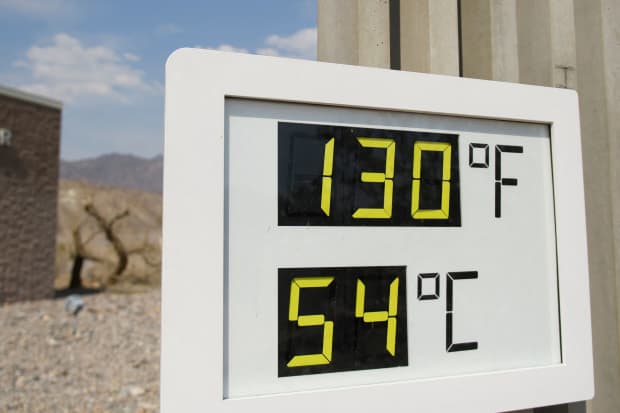
High heat in Death Valley pushed the mercury up to 128 degrees Fahrenheit about three weeks ago, far above what’s normal there for this time of year. And another round of above-average heat was building in the region, which could send temperatures just as high over the weekend.
Death Valley, along with parts of Nye County and the Mojave Desert, is set to be under an excessive heat warning from 8 a.m. Wednesday through 8 p.m. PDT Monday, according to the National Weather Service (NWS). On Wednesday, the first day of that warning, the temperature soared to 126 degrees in Death Valley.
FILE – In this Aug. 17, 2020, file photo, Steve Krofchik cools off with a bottle of ice water on his head in Death Valley National Park, Calif. Climate-connected disasters seem everywhere in the crazy year 2020, but scientists Wednesday, Sept. 9, say it’ll get worse. (AP Photo/John Locher, File)
“This is exceptionally hot. It’s scary how hot it is,” Linda Utz of Titusville, Florida, marveled. “We planned this trip last October and made reservations,” she explained to Wadell. “While we knew it would be warm because it was summer, we never expected this type of heat.”
And as far as it goes for people who spend almost all of their time in Death Valley, “This is an extremely hot place for us to live and work, as well as it is for people to visit,” Abby Wines, Death Valley National Park spokesperson, said. “There is something to be said for climatizing, so a person who acclimatizes to a high altitude, their body can adjust somewhat to dealing with extreme heat.”
The stretch of weather extending through the end of the week could bring “dangerously hot conditions,” according to the NWS. The western Mojave Desert and Owens Valley could see temperatures as high as 110 degrees. The region could see record-rivaling or record-breaking temperatures.
Bishop, California, already saw a record-high temperature of 105 degrees Tuesday, tying a previous record set in 1945, according to a record report from the NWS.
Just last week, the Northwest battled a round of its own record-breaking temperatures. The historic heat wave stretched well into Canada as Lytton, British Columbia, broke a national record at 121 degrees, Canada’s government weather service reported. Within days of reaching that mark, the small town was devastated by wildfires, which consumed 90% of the village.
British Columbia’s chief coroner said that there were 486 reports of “sudden and unexpected” deaths in a five-day period during the heat wave, according to The Associated Press. The province usually sees about 165 deaths within that time interval.
The NWS cautioned that the warm conditions in the Southwest could increase the potential for heat-related illnesses, especially for those who are outside. The heat warning encourages people to drink plenty of fluids and to stick to air-conditioned spaces.
Climate Central
A number of cooling stations will be activated in Clark County, Nevada, from July 7 to 12, according to a tweet from the city of Las Vegas, which cautioned residents about the dangers of heat exhaustion and heatstroke.
In addition, high heat is notorious for causing a spike in visits to the hospital. According to data compiled by Climate Central, as extreme heat builds, the risk of heat-related illnesses also mounts. The Climate Central data shows a correlation between a rise in hospital visits for different parts of the country as temperatures rise, noting that “People in historically cooler regions may be less acclimatized to heat, and lack the infrastructure to cope with it.”
Former Republican Congressman Debunks A Modern Myth About The GOP
Lee Moran
Former Rep. David Jolly (R-Fla.) on Tuesday rejected the idea that there’s currently “a fight for the soul of the party” between moderate Republicans and sycophants of ex-President Donald Trump.
“There is nothing left of this Republican Party other than a party that’s able to embrace and to elevate an undemocratic, anti-republic theme that somehow we can engage in a fraud on the American people as long as it supports our guy winning an election,” Jolly told MSNBC’s Nicolle Wallace during a discussion about GOP support of Trump’s election lies.
“Every election is so important, but it does make the next presidential election so important because is that part of the Republican platform?” he asked. “And do we now live in a two-party America where only one supports a true democratic republic or not?”
Jolly, who left the Republican Party in 2018, said America was now “a long ways” from being a multiparty democracy. He added that the GOP that celebrates Trump would continue to be “anti-republican, anti-democratic” until “someone wrests control of the party from the former president.”
Watch the interview here:
"This notion that somehow there's a fight for the soul of the party… there is nothing left of this Republican Party other than a party that's able to embrace and to elevate an undemocratic, anti-republic theme" – @DavidJollyFL w/ @NicolleDWallacepic.twitter.com/HI31AOVzRU
Want to see a snapshot of the U.S. economy? Look at patio furniture
It’s expected that there will be a patio furniture shortage until 2023, but ‘you’re much better off having too much demand than too little’
John Hessler, 62, the patio section manager at Valley View Farms in Cockeysville, Md., poses in his showroom. AP Photo / Julio Cortez
COCKEYSVILLE, Maryland (AP) — People used to go to Valley View Farms to buy five tomato plants and end up with $5,000 in patio furniture.
This year is different. After a record burst of sales in March, the showroom floor is almost empty of outdoor chairs, tables and chaises for people to buy.
The garden supply store in suburban Baltimore has been waiting six months for a shipping container from Vietnam full of $100,000 worth of wicker and aluminum furniture. Half of the container has already been sold by showing customers photographs. The container should have arrived in February, but it reached U.S. waters on June 3 and has just docked in Long Beach, California.
“Everyone is just so far behind,” said John Hessler, 62, the patio section manager. “I’ve never seen anything like it.”
The Biden economy faces the unusual challenge of possibly being too strong for its own good.
There is the paradox of the fastest growth in generations at more than 6% yet also persistent delays for anyone trying to buy furniture, autos and a wide mix of other goods. It’s almost the mirror opposite of the recovery from the Great Recession of 2007-2009, which was marred by slow growth but also the near-instant delivery of almost every imaginable product.
What ultimately matters is that demand stay strong enough for companies to catch up and shorten the long waits.
“This is a very good problem for the economy to have,” said Gus Faucher, chief economist for PNC Financial Services. “You’re much better off having too much demand than too little, because too little demand is the recipe for an extended recession.”
Republicans have held out the shortages and price increases as a sign of economic weakness, while Biden can counter that wages are climbing at a speed that helps the middle and working classes. But the real challenge goes far beyond the blunt talking points of politicians to an economy being steered by a mix of market forces, tensions with China, setbacks from natural disasters and the unique nature of restarting an economy after a pandemic.
A sign is seen on a sold patio furniture floor model at Valley View Farms in Cockeysville, Md. AP PHOTO/JULIO CORTEZ
As America hurtles out of the July 4th weekend into the heart of summer, the outdoor furniture industry provides a snapshot of the dilemmas confronting the economy. A series of shortages has left warehouses depleted and prices rising at more than 11% annually as Americans resume BBQs and parties after more than a year of isolation. The industry cannot find workers, truckers and raw materials — a consequence of not just government spending but crowded ports, an explosion at an Ohio chemical plant and the devastating snowstorm that hit Texas in February.
Patio furniture makers interviewed by the Associated Press say they expect the supply squeeze to end in 2022 or 2023 — meaning it could remain a political flashpoint even if the broader risk of inflation fades as expected by many Federal Reserve officials and Wall Street analysts. The shortages reflect both the stranded shipping containers, a dearth of truckers and the compounded effect of a fatal explosion in April at the Yenkin-Majestic Paints and OPC polymer plant in Columbus, Ohio that depleted the domestic supply of furniture pieces.
The Biden administration, well aware of the challenge, has made fixing supply chains a priority. It’s also trying to direct more money to making the U.S. power grid and other infrastructure more resilient against extreme weather events as part of a bipartisan deal reached with Senate Republicans.
“You saw what happened in Texas this winter: The entire system in the state collapsed,” Biden said in a recent Wisconsin speech. “That’s why we have to act.”
Administration officials expect the supply chain issues to self-correct, though they’re cautious about asserting a specific time frame because of the unprecedented nature of the recovery from the pandemic.
They noted that a shortage of toilet paper when the pandemic started was fixed within weeks because factories could ramp up production. But in this case, Biden’s White House views the problem in global terms, with many of the challenges being in Asian ports, rather than a problem that is solely domestic in nature.
Republican lawmakers have placed the blame exclusively on Biden’s $1.9 trillion coronavirus rescue package, saying the shortages are causing inflation that behaves like a tax by eating into workers’ salaries and savings. Outdoor furniture companies do say that finding workers has become more of a challenge in part because of the greater unemployment benefits, but they don’t buy fully into the Republican line that government dollars have caused a lasting price bump.
“The Biden inflation agenda of too much money chasing too few goods is causing major harm to hard-working families,” House Republican Whip Steve Scalise of Louisiana said at a June hearing.
The reality is not so simple for William Bew White III, who founded Summer Classics, an Alabama-based furnisher whose outdoor products look like they belong next to a Gilded Age mansion or terraced hotel along the Italian Riviera. He summarizes his problems as the three F’s: foam, fabric and freight.
“The freeze in Texas closed down two of the plants that make the chemicals that make foam,” he said. “These plants were not able to reopen until mid to late March. And supply dried up. I’m not sure how someone that’s in the upholstery business makes it on 40% to 60% of the needed products.”
His company can produce as many as 3,500 outdoor cushions a day, but for most of the year he was not getting the supplies he needed largely because of snow shutting down the Texas power grid. He’s having revenue growth of between 40% and 60% on an annual basis and it’s hard to judge how much to increase production to meet that demand and whether that demand can last.
He is more concerned with what his Chinese furniture suppliers are charging than prices at home. His prices in China have jumped as much as 26.5% since January, sometimes retroactively on orders that were already in shipping containers.
“This is not sustainable,” White said.
In many cases, companies are simply trying to absorb the higher costs. Erik Mueller, CEO of the Cincinnati-based outdoor furniture and home recreation chain Watson’s, said he wants to protect his store’s reputation as providing value. He doesn’t see the situation as paralleling the 1970s mix of stagnation and inflation that helped to drive Jimmy Carter out of the presidency after one term.
“This isn’t the 70s,” he said. “We still have goods that are reasonably priced.”
While he believes that generous unemployment benefits have stunted hiring because people can earn more by not working, Mueller also sees the inflation as a spillover from the pandemic. Some people could not work because of the disease or their shifts were cut. The rush for supplies as economies reopened occurred too fast for factories and shipping firms not yet able to return to their previous capacity. All of that was coupled with a United States that after a brutal year simply welcomed the relief of lounging by the pool with friends.
The problem is one of market forces that are beyond anyone individual’s authority, even the U.S. president’s.
“You have just this exorbitant amount of demand due to a unique situation that was out of everyone’s control,” Mueller said.
Opinion: If you want to fix climate change, you need to fix this flaw in conventional economic thought
Thinking along the margins does no good when what’s needed is wholesale change
By Tom Brookes and Gernot Wagner
A thermometer at the visitors’ center at Death Valley National Park in June. AFP Getty Images
BRUSSELS, Belgium (Project Syndicate)—Nowhere are the limitations of neoclassical economic thinking—the DNA of economics as it is currently taught and practiced—more apparent than in the face of the climate crisis. While there are fresh ideas and models emerging, the old orthodoxy remains deeply entrenched. Change cannot come fast enough.
The economics discipline has failed to understand the climate crisis—let alone provide effective policy solutions for it—because most economists tend to divide problems into small, manageable pieces. Rational people, they are wont to say, think at the margin. What matters is not the average or totality of one’s actions but rather the very next step, weighed against the immediate alternatives.
The most effective way to introduce new ideas into the peer-reviewed academic literature is to follow something akin to an 80/20-rule: stick to the established script for the most part; but try to push the envelope by probing one dubious assumption at a time.
Such thinking is indeed rational for small discrete problems. Compartmentalization is necessary for managing competing demands on one’s time and attention. But marginal thinking is inadequate for an all-consuming problem touching every aspect of society.
Economics’ power over public discourse
Economists also tend to equate rationality with precision. The discipline’s power over public discourse and policy-making lies in its implicit claim that those who cannot compute precise benefits and costs are somehow irrational. This allows economists—and their models—to ignore pervasive climate risks and uncertainties, including the possibility of climatic tipping points and societal responses to them.
A return to equilibrium—getting “back to normal”—is an all-too-human preference. But it is precisely the opposite of what is needed—rapidly phasing out fossil fuels—to stabilize the world’s climate.
And when one considers economists’ fixation with equilibrium models, the mismatch between the climate challenge and the discipline’s current tools becomes too glaring to ignore.
Yes, a return to equilibrium—getting “back to normal”—is an all-too-human preference. But it is precisely the opposite of what is needed—rapidly phasing out fossil fuels—to stabilize the world’s climate.
These limitations are reflected in benefit-cost analyses of cutting emissions of carbon dioxide and other greenhouse gases. The traditional thinking suggests a go-slow path for cutting CO2. The logic seems compelling: the cost of damage caused by climate change, after all, is incurred in the future, while the costs of climate action occur today. The Nobel Prize-winning verdict is that we should delay necessary investment in a low-carbon economy to avoid hurting the current high-carbon economy.
To be clear, a lot of new thinking has gone into showing that even this conventional logic would call for significantly more climate action now, because the costs are often overestimated while the potential (even if uncertain) benefits are underestimated.
Marginalized ideas
The young researchers advancing this work must walk a near-impossible tightrope, because they cannot publish what they believe to be their best work (based on the most defensible assumptions) without invoking the outmoded neoclassical model to demonstrate the validity of new ideas.
The very structure of academic economics all but guarantees that marginal thinking continues to dominate. The most effective way to introduce new ideas into the peer-reviewed academic literature is to follow something akin to an 80/20-rule: stick to the established script for the most part; but try to push the envelope by probing one dubious assumption at a time.
Needless to say, this makes it extremely difficult to change the overall frame of reference, even when those who helped establish the standard view are looking well beyond it themselves.
Against the backdrop of this traditional view, recent pronouncements by the International Monetary Fund and the International Energy Agency are nothing short of revolutionary. Both institutions have now concluded that ambitious climate action leads to higher growth and more jobs even in the near term.
Consider the case of Kenneth J. Arrow, who shared a Nobel Prize in Economic Sciences in 1972 for showing how marginal actions taken by self-interested individuals can improve societal welfare. That pioneering work cemented economists’ equilibrium thinking.
But Arrow lived for another 45 years, and he spent that time moving past his earlier work. In the 1980s, for example, he was instrumental in founding the Santa Fe Institute, which is dedicated to what has since become known as complexity science—an attempt to move beyond the equilibrium mind-set he had helped establish.
Because equilibrium thinking underpins the traditional climate-economic models that were developed in the 1990s, these models assume that there are trade-offs between climate action and economic growth. They imagine a world where the economy simply glides along a Panglossian path of progress. Climate policy might still be worthwhile, but only if we are willing to accept costs that will throw the economy off its chosen path.
Climate investments create jobs
Against the backdrop of this traditional view, recent pronouncements by the International Monetary Fund and the International Energy Agency are nothing short of revolutionary. Both institutions have now concluded that ambitious climate action leads to higher growth and more jobs even in the near term.
The logic is straightforward: climate policies create many more jobs in clean-energy sectors than are lost in fossil-fuel sectors, reminding us that investment is the flip side of cost. That is why the proposal for a $2 trillion infrastructure package in the United States could be expected to spur higher net economic activity and employment. Perhaps more surprising is the finding that carbon pricing alone appears to reduce emissions without hurting jobs or overall economic growth. The problem with carbon taxes or emissions trading is that real-world policies are not reducing emissions fast enough and therefore will need to be buttressed by regulation.
There is no excuse for continuing to adhere to an intellectual paradigm that has served us so badly for so long. The standard models have been used to reject policies that would have helped turn the tide many years ago, back when the climate crisis still could have been addressed with marginal changes to the existing economic system. Now, we no longer have the luxury of being able to settle for incremental change.
The good news is that rapid change is happening on the political front, owing not least to the shrinking cost of climate action. The bad news is that the framework of neoclassical economics is still blocking progress. The discipline is long overdue for its own tipping point toward new modes of thinking commensurate with the climate challenge.
Tom Brookes is executive director of strategic communications at the European Climate Foundation. Gernot Wagner is clinical associate professor of environmental studies at New York University.
California braces for dangerously high temperatures in new heatwave
Erin McCormick in San Francisco
Photograph: Bloomberg/Getty Images
A new heatwave is predicted to bring dangerously hot weather to California’s inland regions this week, as relentlessly high temperatures continue to torment the west coast.
Meteorologists are warning residents to prepare for “potentially record-breaking” temperatures as high as 115F (46C) in the Central Valley and 120F (49C) in desert areas like Palm Springs, with temperatures in Death Valley set to approach an all-time high. The heat is predicted to start to build on Wednesday and increase through the weekend.
“Temperatures are going to be about 10 degrees above normal for this time of year,” said Diana Crofts-Pelayo a spokesperson for the California office of emergency services. “This will be a record-setting heatwave.”
The state is already facing extreme drought and fires spawned by the dry conditions. The fire situation could be intensified by gusty winds near the Oregon border and predicted lightning storms in the Sierra Nevada mountains, the forecasters said.
“The big story is the developing heat,” said Eric Schoening, a meteorologist for the National Weather Service (NWS). “This will be a long duration event, where it is not going to cool down much at night. So it is a dangerous time for the state.”
The warnings follow on the heels of last week’s record-setting heatwave in the normally-cool Pacific north-west, which left hundreds dead in Oregon, Washington and British Columbia from heat-related illness, and as North America emerges from the hottest June on record.
The fact that California’s heat is expected to continue at night raises the risks of heat illness, said Sierra Littlefield, an NWS meteorologist.
“When it’s hot in the day and warm at night, it really wears people down,” she said.
Littlefield said residents should prepare themselves to cope with the heat by drinking plenty of water, postponing outdoor work to the early mornings or evenings and making sure to get animals out of the sun. Residents should plan for a place to go, if it gets so hot they need air conditioning.
“People should know where they can find air conditioning – whether it’s with friends or at a cooling center,” she said.
Forecasters said that those in the biggest population centers of the state, such as Los Angeles and San Francisco, which lie along the coast, will benefit from ocean cooling and not face the extra high temperatures.
One danger state officials are still assessing is whether the heatwave could result in power shortages, said Crofts-Pelayo.
She advised residents in the inland areas to pre-cool their homes, if they have air conditioning, and lower their shades to keep the cool air in. She also asked residents statewide to conserve electricity by shutting off unnecessary appliances.
“What we don’t want is for there to be a shortage of energy that requires power shutdowns,” she said.
BC Heat Wave Caused Over 1 Billion Tidal Creatures to Cook to Death, Scientist Says
By Andrea Germanos, Common Dreams July 07, 2021
A mussel bed on Vancouver Island. Stephen Bentsen / CC BY-NC-ND 2.0
It’s “a frightening warning sign,” said one observer.
“Heartbreaking,” another commented.
“Can we now mobilize en masse to save all Earthly beings?” asked another.
Those were some of the responses to new reporting by the CBC on how last week’s extreme heatwave that gripped British Columbia may have led to the deaths of more than one billion intertidal animals like mussels and starfish that inhabit the Salish Sea coastline.
Christopher Harley, a marine ecologist at the University of British Columbia, told the outlet about how he had noticed a foul odor from dead intertidal animals on rocks at Vancouver’s popular Kitsilano Beach as the city experienced record heat. Harley then set off with a team of researchers to gather data on nearby coastlines.
What the researchers noticed, CBC reported, were “endless rows of mussels with dead meat attached inside the shell, along with other dead creatures like sea stars and barnacles.”
They tracked temperatures too, recording 50°C (122°F) on rocky shoreline habitats, well above the high 30s (around 100°F) mussels can endure for short spurts. Harley likened a mussel on the rock enduring the scorching temperatures to “a toddler left in a car on a hot day”—stuck “at the mercy of the environment” until the tide returns. “And on Saturday, Sunday, Monday, during the heat wave, it just got so hot that the mussels, there was nothing they could do.”
The heat wave was deadly for humans too.
Lisa Lapointe, British Columbia’s chief coroner, announced Friday that from June 25 to July 1, the province’s death toll was 719—three times higher than normal—and said heat was likely “a significant contributing factor to the increased number of deaths.” The heat wave was also blamed for dozens of deaths in the U.S. states of Oregon and Washington.
The recent heat wave’s deadly impact on shellfish was noted in the U.S. Pacific Northwest as well.
The Daily Mail reported last week on comments from the family-run Hama Hama Oyster company in Washington. “The epic heatwave is something no one has seen and then we had a low tide that was as far as it has been in 15 years and it happened mid-day,” the company said.
The clams “look like they had just been cooked, like they were ready to eat,” the company told the outlet.
In a June 30 Instagram post sharing an image of heat-impact clams, the company had a clear message: “Please vote for politicians who are brave enough to address climate change.”
Park rangers find body after tracking footprints away from car in New Mexico desert
Maddie Capron
A line of footprints in the sand led park rangers in New Mexico to a hiker’s body.
White Sands National Park officials found an abandoned and unoccupied car within the park at 11 p.m. on July 4. A rescue team discovered a man’s body off-trail the next afternoon, the National Park Service said.
New Mexico State Police identified the man as Jeffrey Minshew, a 63-year-old from Moriarty, New Mexico. The incident is under investigation.
“During the extreme summer heat, it is critical to be prepared and know your limitations,” park officials said in a news release. “For summer hiking at White Sands, the park recommends starting in the coolest part of the day, early morning or early evening.”
Volunteers with the Organ Mountain Technical Rescue Squad spent hours searching for the man’s footprints on Monday. Once rescue officials located the footprints, they tracked them for a half mile before finding the body.
White Sands National Park and its never-ending sand dunes encompasses 275 square miles of desert. There is no shade or water along trails at the park, according to the National Park Service. Hikers should be prepared with food and water, a fully charged cell phone and know where they are.
“Each year, park rangers respond to dozens of search and rescue incidents in the park,” park officials said. “These frequently involve heat exhaustion, dehydration, and injuries.”
During the summer, temperatures can rise above 100 degrees during the day. Over the weekend, the high temperature reached at least 94 degrees.
“We also recommend that hikers bring at least one gallon of water per person per day and high energy snacks,” park officials said. “Wear a hat, sunscreen, sunglasses, and lightweight, loose-fitting clothing with long sleeves and long pants to help protect skin from the sun.”
The national park is about 95 miles north of El Paso, and also sits next to the White Sands Missile Range, where testing for the first atomic bomb took place in 1945.
Australia mice plague: How farmers are fighting back
Australian farmers have been locked in a months-long battle with hordes of mice devouring their crops
There’s a debate in Australia about how to deal with a huge plague of mice across the east of the country. Poison? Regulator says no. Snakes? That could create another problem. So what then? Steve Evans of The Canberra Times goes in search of answers.
A friend of mine still remembers the last plague of mice.
They took over his house in Dubbo in northern New South Wales. They were everywhere, hundreds of them, coming under doors, running loudly in the loft, leaving a revolting stench, not least by dying in inaccessible cavities.
His answer was a brutal trap made of sticky paper. The mice would stick to it and he would drown them in a bucket. He still remembers the horror of the squealing.
In the current plague, all kinds of other ingenious methods have been devised.
Most hardware stores have run short of commercial mice traps, so people are improvising. One fills buckets with water and coats the rims with vegetable oil, placing a peanut butter lure in the water. Mice find the peanut butter irresistible and slip on the edge of the bucket to their doom.
Some farmers have set up water-filled tubs to catch the rodents en masse
People are sharing recommendations.
“Plaster of Paris in flour will kill a mouse eventually but I prefer to see where the mice die and being able to get rid of the carcass,” Sue Hodge, a cleaner in the tiny town of Canowindra, three hours’ drive north from Canberra, told me.
She prefers traps, though they aren’t infallible. She reckons that what she calls “light-footed mice” can still lick a trap clean and get away alive.
Some farmers around here have turned whole shipping containers into traps. The trick is to lure the mice in their hundreds in at one end and funnel them through to the bait and a drowning in a tank at the other end.
But that is arduous and inadequate for the numbers involved, so some favour industrial scale poison.
In response, the government of New South Wales has allocated A$50m (£27m; $37m) in grants for a chemical called bromadiolone which has been described as “napalm for mice”.
Poison is one method being used on fields but there are concerns it is doing more harm than good
The snag is that it poisons pretty well everything else, too and destroys an eco-system.
The stuff kills mice within 24 hours but it stays active for months, and goes into the food chain as predators eat poisoned prey. That has now led the Australian Pesticides and Veterinary Medicines Authority to decline permits for its use in some places.
Other answers have been offered.
Dr Gavin Smith of the Australian National University says snakes, as natural predators of mice, would be a good antidote. He feels they should be allowed to do their natural work.
The snag with this holistic view is that they ARE doing it – there are reports that snakes are much fatter this year because of the abundance of mice. And the rodents are still multiplying.
Mice have bred like – well, I suppose you could say like rabbits – in Australia recently because of the end of the drought and the torrents of rain which have produced an abundance of crops. Thick crops mean good feeding for mice.
And for snakes.
But there’s another factor – a bit of blowback from agricultural progress.
Land is much more intensively used these days as farming methods have improved. Sowing machines are now so accurate that they can plant seed far more precisely – within a few millimeters, in between last year’s stalks – so the previous season’s old growth doesn’t even need to be cleared away.
This abundant growth is perfect for mice – and for snakes. Progress has a cost.
Why is there a mouse plague?
It started in the spring of 2020 during the harvest season
Ideal weather conditions for breeding and a bountiful harvest followed devastating bushfires and a years-long drought
Mice flourished with plenty of grain to feed on due to diminished populations of predators
Infestations reported at schools, hospitals, supermarkets and family homes
Farmers grapple with the costs of pest control and the destruction of their crops
Some farmers have also blamed damage to machinery on gnawing mice
Iceland experimented with giving some of its workers a four-day workweek.
One percent of Iceland’s workforce participated in two trials.
There was generally no reduction in productivity, and well-being improved, according to analysis.
The success of two four-day working-week trials in Iceland could act as an example for other governments, analysts say.
More than 2,500 people across 100 workplaces took part in two government-backed trials, representing roughly 1% of the country’s working-age population.
Many saw their workweek reduced to 35 hours from 40 without a reduction in pay and saw no real loss in productivity, according to joint analysis of the trials by the UK future-of-work think tank Autonomy and the Icelandic Association of Sustainability and Democracy.
The results add credence to the concept of a four-day working week without a significant cut in pay, which has been increasingly pushed as a remedy for improving work-life balance, boosting employee performance, and helping the environment.
The trials were initiated by the Reykjavik City Council and the national government following lobbying by civil-society groups and trade unions, which claimed the nation lagged behind most of its Nordic neighbors in terms of work-life balance.
The first trial took place in the capital, Reykjavik, from 2014 to 2019 and initially saw childcare and service-center workers cut their hours to 35 a week from 40. It then expanded to encompass staff members in the mayor’s office and care homes.
The second, conducted from 2017 to 2021, saw 440 civil servants from several national government agencies reduce their hours. Their roles covered both traditional nine-to-five hours and irregular shift patterns.
Contrary to claims that working reduced hours could be counterproductive, and actually lead staff members to work longer, the analysis suggests that overall there was no overall loss of productivity or quality of service provided.
In fact, teams were encouraged to work more efficiently by reducing meeting time, reorganizing their schedules, and improving communication between departments.
There was also generally an improvement in worker well-being. Perceived levels of stress and burnout fell in many cases, with many employees saying they felt more positive and happy at work as a result of the new regime.
Participants say reduced hours meant they could spend more time exercising and socializing, which in some cases had an impact on their work performance. In workplaces where there was no noticeable improvement in well-being, there was also no marked decrease.
More governments could introduce 4-day-week trials
The researchers described Iceland’s trial as a “crucial blueprint” for how similar trials might be organized around the world, highlighting that in the years since trade unions had been able to negotiate the right to shorter hours for 86% of the Icelandic workforce.
“It shows that the public sector is ripe for being a pioneer of shorter working weeks — and lessons can be learned for other governments,” said Will Stronge, the director of research at Autonomy, in a statement issued alongside the analysis.
Iceland is not the only national government to test the concept of a four-day week.
In May 2021 the Spanish government approved plans for a three-year pilot and pledged 50 million euros to support businesses implementing the plans, according to The Guardian.
Jacinda Ardern, New Zealand’s prime minister, has also highlighted the concept as a means of helping the economy bounce back from the coronavirus pandemic.
We Still Won’t Admit Why So Many People Believe the Big Lie
David Rothkopf
Photo Illustration by The Daily Beast/Photo by Scott Olson/Getty
How could so many Americans believe in “the Big Lie?” We see the numbers and we shake our heads. Poll after poll shows that one third of all of us believe the 2020 election was stolen from Donald Trump. Even though the matter has been adjudicated in scores of courts. Even though not a single scintilla of evidence exists that the election was anything but fair.
Six months after the attack on the Capitol triggered by that lie, commentators, political scientists, and families around the dinner table still struggle to come to grips with perverse reality. It is natural to want to understand how we got here. The fate of our democracy turns on not just what our electorate believes but why they believe it. Why are a third of us such gullible rubes?
It’s a question serious enough that it deserves a straight answer, even if that answer makes us uncomfortable. And I warn you, dear reader, the answer will make you uncomfortable. So, if you are tender-minded or sensitive to self-criticism, or a credulous stooge yourself, this might be a good time to stop reading.
Because even the most modest amount of analysis and introspection will reveal that buying into the nonsense peddled by the former president and his clown college of cronies is not an aberration, not due to some momentary lapse on the part of the American electorate. We were raised on lies—including many lies that are much, much bigger than the big one that troubles us today.
That’s the problem. We are as a society—and by “we” I mean virtually all of us on the planet —brought up to believe howling absurdities, ridiculous impossibilities, and insupportable malarkey from our very first moments on Earth. We have massive lie-delivery systems that are the core institutions of our society. And we have created cultural barriers to even questioning those fabrications which are most deserving of skeptical scrutiny. For example, we regularly label as sacred those ideas that are least able to stand up to scrutiny. (Heck, we have folks in our society who can’t even handle the idea that the history we teach our kids might actually be based on what happened, you know, back in the past.)
Our parents lie to us. Our churches, synagogues, and mosques lie to us. Our schools lie to us. Hollywood lies to us. Madison Avenue lies to us. The media lies to us. Our leaders lie to us. Our friends lie to us. (They do. Going to the gym couldn’t hurt.)
What is more the lies they offer are not always big lies (e.g. Buying a particular brand of beer will not make you more attractive) while some are just gross oversimplifications (e.g. The Founding Fathers did a lot of good… but they were not the figures carved out of marble we were sold for years). Some have a seed of truth within them but are gross distortions (e.g. Columbus did not discover America). And some of the time we invite the lies because they open the door to enjoyment (e.g. Keto? All the bacon I can eat? I’m in).
But one of the key reasons we buy into so many small lies is that we have been force fed so many big ones. I mean really big ones. I mean ones that make the current Big Lie look like one of those low-calorie snacks that is actually a high-calorie treat shrunk to a smaller size and repackaged.
The original big lies are so big that if you are like most people some of them are ingrained in your identity, they are who you are. They come from religions and heritage. They are cooked into the primal soup of our minds. Many of them have been around for longer than many of the “facts” we have and as such are so covered in the dust of history and tradition that they appear to be as substantial as what is true. Indeed, some have a timeworn patina that makes them seem almost more important than that which is verifiable or even knowable.
Social science research gives a variety of reasons for why we are inclined to believe “alternative facts.” (Studies show a person is “quick to share a political article on social media if it supports their beliefs, but is more likely to fact check a story if it doesn’t.” We tend to vote for what we want to be true or what our friends believe. According to Peter Ditto, a social psychologist at the University of California, “our wishes, hopes, fears and motivations often tip the scales to make us more likely to accept something as true if it supports what we want to believe.” That said, another reason is often cited for our willingness to buy into the bullshit we are being fed. According to a 2019 University of Regina study, “People who believe false headlines tended to be the people (who) didn’t think carefully, regardless of whether those headlines aligned with their ideology.” So, one way or another, we fall for fake news because it’s easier for us, socially or intellectually.
Many of these lies were created out of necessity. Life is finite. (OK, I’m sorry. It is. Take a deep breath if you need to and then continue reading.) If we don’t come up with a good story about what happens after it ends or why we are here we will all go mad. So we make up preposterous stories about magic people in the sky and then immediately say that we cannot question those stories, that “faith” in them is more important than knowledge of what is real. Why? Because they will not stand up to scrutiny.
When challenged, the defenders of these original big lies say the truth is unknowable. Good try. Hard to argue with that. We don’t know there is not an omniscient rule-maker beyond the clouds or a heaven filled with virgins to give pleasure to the faithful so how can you question it? But of course, selling what is unknowable as a truth is one of the most important categories of lies we encounter in life. Indeed, it is the foundation of much of (speculation-based and often hooey-ridden) human philosophy. And it works.
According to a 2011 poll from the Associated Press, nearly eight out of 10 Americans believe in the existence of angels and a 2015 poll showed 72 percent of Americans believe in Heaven and 58 percent believe in the existence of Hell. A 2019 YouGov poll showed that almost half of all Americans believe in demons and ghosts… and 13 percent believe in vampires. (Note: Over half of Republicans believe in demons, whereas only 37 percent of Democrats do. How far is it from there to a similar percentage of Trump voters, according to an Economist/YouGov poll, believing that the Hillary Clinton campaign was a hotbed of “pedophilia, human trafficking and satanic ritual abuse?”)
There are other big lies, of course. Some are related to the religious lies—like the divine right of kings or the lie that the clergy somehow are more in touch with truth than, say, scientists who actually devote their lives to studying the truth. Some come from political leaders. For example, the lie that to die in war is glorious is one that has done irreparable damage for eons. It has been disproven for thousands of years and yet remains so essential to getting young men and women to give up their lives to serve the ambitions of the rich and powerful that it endures. You know many of the other lies that have lived for centuries—about the superiority of races or genders or nationalities, about patriotism, about comforting ideas like that everything is for the best or things work out in the end. It’s not. They don’t. Read a book.
We dress these lies up in protective cloaks. You will burn in Hell for all eternity if you don’t believe one set of lies. You are betraying your country if you don’t believe in the merits of a particular war. Don’t question your elders. If a teacher says it it must be true. Priests and rabbis and imams are tighter with the Alleged Almighty than you. (Do you capitalize the “a” in alleged when you are using it to question the existence of a God?)
All these lies are aided and abetted by the fact that simply believing in what you are told to believe is much easier than actually figuring out the truth. What is more, if your family and friends believe in a lie, challenging that lie might make you an outcast, might alienate those with whom you have or wish to have a bond. With the advent of social media, where like-minded friends become “editors” and select the news their followers see, lies spread among audiences inclined to believe and thereby endorse them. We live in an age of media “echo-systems”, ecosystems that reinforce disinformation spreading it from dubious sources like QAnon to Facebook to TV propaganda networks to you.
And of course, when lots and lots of people adhere to a lie it is seemingly validated. And to help that along for millennia, the purveyors of lies have made it clear that not believing those lies makes one an other, apart, the enemy, an infidel. It’s not just wrong to question these big lies, by doing so you actually side with evil, with the enemy. We have created a world divided and left bloody by the differences between the lies to which different groups of people adhere.
Which brings us back to today and to our own Big Lie of the moment. (Although I would argue Trump is responsible for two big lies at least—the other being that the pandemic was not serious, that science was not necessary to combat it.) When that lie is preached from the pulpit, propagated by elders and friends and neighbors, pumped up on your favorite quasi-news network and rejected by your enemies—by the other—of course you cling to it as though it were, well, gospel. That’s what you have been taught to do all your life.
We have the Big Lie because we have so many big lies. We have the Big Lie because many of the most powerful institutions in our society teach lies and condemn critical thinking. And herein we get to the central problem of our democracy. If we are to have a government of the people—and that is for the moment, an open question, I am afraid—and those people thrive on lies, follow liars, reject the search for truth, fear science and history and math, don’t want to do the work required to figure out what is really happening around them—then we will have an irreparably fucked-up government.
We have known this is a special challenge of democracy and good governance since the Enlightenment. It’s just a bit of a sensitive subject. It calls more than just the ugliness and ignorance of Trumpism into question. Rather it notes that Trump is just like generations of other demagogues who sought to profit from the easy appeal of deception for the intellectually lazy, lock-step indoctrinated masses. Trump, like so many others since time immemorial, peddles lies because he knows people are buying, he knows lies are easy and the truth is hard.