More than half of foreign-born people in US live in just 4 states and half are naturalized citizens
Mike Schneider – April 9, 2024
FILE – Women representing more than 20 countries take part in a Naturalization Ceremony, March 8, 2024, in San Antonio. More than half of the foreign-born population in the United States lives in just four states — California, Texas, Florida and New York — and their numbers grew older and more educated over the past dozen years, according to a new report released Tuesday, April 9, 2024, by the U.S. Census Bureau. (AP Photo/Eric Gay, File)More
ORLANDO, Fla. (AP) — More than half of the foreign-born population in the United States lives in just four states — California, Texas, Florida and New York — and their numbers grew older and more educated over the past dozen years, according to a new report released Tuesday by the U.S. Census Bureau.
In 2022, the foreign-born population was estimated to be 46.2 million people, or almost 14% of the U.S. population, with most states seeing double-digit percentage increases in the last dozen years, according to the figures from the bureau’s American Community Survey.
In California, New Jersey, New York and Florida, foreign-born individuals comprised more than 20% of each state’s population. They constituted 1.8% of West Virginia’s population, the smallest rate in the U.S.
Half of the foreign-born residents in the U.S. were from Latin America, although their composition has shifted in the past dozen years, with those from Mexico dropping by about 1 million people and those from South America and Central America increasing by 2.1 million people.
The share of the foreign population from Asia went from more than a quarter to under a third during that time, while the share of African-born went from 4% to 6%.
The report was released as immigration has become a top issue during the 2024 presidential race, with the Biden administration struggling to manage an unprecedented influx of migrants at the Southwest border. Immigration is shaping the elections in a way that could determine control of Congress as Democrats try to outflank Republicans and convince voters they can address problems at the U.S. border with Mexico.
The Census Bureau report didn’t provide estimates on the number of people in the U.S. illegally.
However, the figures show that more than half of the foreign-born are naturalized citizens, with European-born and Asian-born people leading the way with naturalization rates at around two-thirds of their numbers. Around two-thirds of the foreign-born population came to the U.S. before 2010.
The foreign-born population has grown older in the past dozen years, a reflection of some members’ longevity in the U.S., with the median age increasing five years to 46.7 years. They also became more educated from 2010 to 2022, with the rate of foreign-born people holding at least a high school degree going from more than two-thirds to three-quarters of the population.
Acquisition of Budapest Airport may conclude within days, says PM Orban
Reuters – April 8, 2024
European leaders and EU’s Michel meet in Bucharest
BUDAPEST (Reuters) – The acquisition of Budapest Airport could conclude “within days”, Prime Minister Viktor Orban said in parliament on Monday, signalling an end to months of negotiations with majority owner AviAlliance.
Since Orban took power in 2010, his government has boosted Hungarian ownership in energy, banking, telecoms and the media, and has been planning to buy the airport for years.
“We hope that within days, the airport… will be owned in majority by the state”, he said. Hungary’s government submitted its binding offer in September 2023.
In 2021, Orban’s government submitted a non-binding offer to buy the airport, but the process was later halted amid high inflation and volatility in global financial markets.
Economy minister Marton Nagy said earlier in 2023 the financing of the package could include budget funds and development bank money. He did not say which assets the government might sell.
(Reporting by Boldizsar Gyori; Editing by Emelia Sithole-Matarise)
Rising opposition leads rally against Hungary’s Orban
Reuters Videos – April 7, 2024
STORY: Many protesters carried the national flag, shouting slogans such as, “We are not scared” and “Orban resign!”
“I believe in him and trust that he will lead this country out of this corrupt situation, which is heading in the direction of North Korea,” demonstrator Eva Hazenberger said.
The protesters marched to the parliament building in Budapest, where Magyar told his supporters he would help them get rid of the Orban administration.
“I did not start this whole thing to bring down the whole power elite alone,” Magyar said in his speech. “I began this to launch a completely new era. I am a spark that will ignite the engine.”
The 43-year-old, who says he plans to launch his own party, stated that the upcoming European parliamentary election would be the “first nail in the coffin” of the present government.
Magyar became widely known in February when he unleashed incendiary comments about the inner workings of the government and published a recording of a conversation with his ex-wife, where she detailed an attempt by a senior aide to Orban’s cabinet chief to interfere in a graft case. Prosecutors are now investigating the statements.
The probe comes at a politically sensitive time for Orban, ahead of European parliamentary elections in June and also follows a sex abuse scandal that brought down two of his key political allies – Hungary’s former president and Varga – in February.
By Jamelle Bouie, Opinion Columnist – February 13, 2024
Credit…Patrick T. Fallon/Agence France-Presse — Getty Images
It is unclear whether Donald Trump has forgotten the precise nature of NATO or whether he ever fully grasped it in the first place.
What is clear, however, is that Trump — who ostensibly spent four years as president of the United States — has little clue about what NATO is or what NATO does. And when he spoke on the subject at a rally in South Carolina over the weekend, what he said was less a cogent discussion of foreign policy than it was gibberish — the kind of outrageous nonsense that flows without interruption from an empty and unreflective mind.
“One of the presidents of a big country stood up and said, ‘Well, sir, if we don’t pay, and we’re attacked by Russia, will you protect us?’” Trump said, recalling an implausible conversation with an unnamed, presumably European head of state. “‘You didn’t pay? You’re delinquent?’” Trump recounted responding. “‘No, I would not protect you. In fact, I would encourage them to do whatever the hell they want. You gotta pay. You gotta pay your bills.’”
The former president’s message was clear: If NATO members do not pay up, then he will leave them to the mercy of a continental aggressor who has already plunged one European country into death, destruction and devastation.
Except NATO isn’t a mafia protection racket. NATO, in case anyone needs to be reminded, is a mutual defense organization, formed by treaty in 1949 as tensions between the United States and the Soviet Union hardened into conflict. “The parties agree that an armed attack against one or more of them in Europe or North America shall be considered an attack against them all,” states Article 5 of the North Atlantic Treaty.Sign up for the Opinion Today newsletter Get expert analysis of the news and a guide to the big ideas shaping the world every weekday morning. Get it sent to your inbox.
According to the terms of an agreement reached last year, member states will work to spend at least 2 percent of national G.D.P. on military investment.
But let’s set this bit of fact-checking aside for a moment and look at the big picture.
It is not just that Trump is ignorant on this and other vital questions; it is that he is incoherent.
Consider his remarks at a recent gathering of the National Rifle Association in Harrisburg, Pa. “We have to win in November, or we’re not going to have Pennsylvania. They’ll change the name. They’re going to change the name of Pennsylvania,” Trump said.
Who, exactly, is going to change the name of Pennsylvania? And to what? I don’t know. I doubt Trump does either.
Or consider the time, last November, when Trump confused China and North Korea, telling an audience of supporters in Florida that “Kim Jong Un leads 1.4 billion people, and there is no doubt about who the boss is. And they want me to say he’s not an intelligent man.”
There was also the time that Trump mistook Nikki Haley, his former ambassador to the United Nations, for Nancy Pelosi, the former speaker of the House.
“Nikki Haley, you know they, do you know they destroyed all of the information, all of the evidence, everything, deleted and destroyed all of it. All of it, because of lots of things like Nikki Haley is in charge of security. We offered her 10,000 people, soldiers, National Guard, whatever they want. They turned it down. They don’t want to talk about that. These are very dishonest people,” Trump said, repeating his false claim that Pelosi was responsible for the failure of Capitol security on Jan. 6.
If you would like, you can also try to make sense of the former president’s recent attempt to describe a missile defense system:
“I will build an Iron Dome over our country, a state-of-the-art missile defense shield made in the U.S.A.,” Trump said, before taking an unusual detour. “These are not muscle guys here, they’re muscle guys up here, right,” he continued, gesturing to his arms and his head to emphasize, I guess, that the people responsible for building such systems are capable and intelligent.
“And they calmly walk to us, and ding, ding, ding, ding, ding, ding. They’ve only got 17 seconds to figure this whole thing out. Boom. OK. Missile launch. Whoosh. Boom,” he added.
I assume Trump is describing the pressure of actually manning a missile defense system. Even so, one would think that a former president — currently vying to be the next president — would at least try to be a little more articulate.
But this gets to one of the oddest things about this election cycle so far. There is no shortage of coverage of President Biden’s age, even if there’s no evidence that his age has been an obstacle to his ability to perform his duties. Indeed, it is plainly true that Biden has been an unusually successful president in areas, like legislative negotiations, that require skill and mental acuity.
Coverage of Biden’s age, in other words, has more to do with the vibes of an “elderly” president — he isn’t as outwardly vigorous and robust as we would like — than it does with any particular issue with his performance.
In contrast to the obsessive coverage of Biden’s age, there is comparatively little coverage of Trump’s obvious deficiencies in that department. If we are going to use public comments as the measure of mental fitness, then the former president is clearly at a disadvantage.
Unfortunately for Biden, Trump benefits from something akin to the soft bigotry of low expectations. Because no one expected Trump, in the 2016 election, to speak and behave like a normal candidate, he was held to a lower effective standard than his rivals in both parties. Because no one expected him, during his presidency, to be orderly and responsible, his endless scandals were framed as business as usual. And because no one now expects him to be a responsible political figure with a coherent vision for the country, it’s as if no one blinks an eye when he rants and raves on the campaign trail.
It’s not that there aren’t legitimate reasons to be concerned about Biden’s age. He is already the oldest person to serve in the Oval Office. The issue here is one of proportion and consequence. Biden may be unable to do the job at some point in the future; Trump, it seems to me, already is.
One of those is a lot more concerning than the other.
Supreme Court slow to resolve potentially election-altering cases as justices inch toward final arguments
John Fritze, CNN – April 6, 2024
As the Supreme Court turns toward a series of politically charged disputes in its final arguments later this month, it is wrestling with a backlog of controversies on guns, elections and transgender rights that will thrust its conservative majority into the middle of another turbulent presidential contest.
But as the high court moves toward a busy and fraught final sitting this term, it is also once again slipping behind its past pace, issuing fewer opinions than it did at this same point in its nine-month work period just a few years ago. The court has handed down 11 opinions so far this term – most in relatively obscure matters that were decided unanimously.
The Supreme Court has issued opinions in just 22% of its argued cases this year, compared with 34% through mid-April two years ago and 46% in 2021, according to data compiled by Adam Feldman, founder of Empirical SCOTUS. The share of resolved cases is up slightly over last year – a historic low.
The comparison would improve if new rulings land next week.
Taken together, the numbers point to a term in which the court’s decisions could be scrunched into a shorter time fame – potentially giving the court’s 6-3 conservative supermajority an opportunity to reshape the political debate around culture war issues just as Americans begin tuning into the Biden-Trump rematch for president.
Erwin Chemerinsky, dean of the University of California Berkeley School of Law, said it had become a “clear trend” in recent years that the court is “very slow” releasing decisions. Though there are many theories about why that may be, the court’s opaque-by-design practice of negotiation and opinion crafting makes it difficult to say with certainty.
A large share of the court’s docket touches on “enormously significant and difficult issues,” Chemerinsky told CNN. “It also is a court that has deep divisions. I assume that all of this leads to delays in releasing decisions.”
Writing a majority opinion is only part of the behind-the-scenes process: Sometimes delays are caused by the concurrences and dissents other justices write. More fractured decisions, in other words, can generate separate opinions and take longer.
The slower pace could prove particularly meaningful this year because of Trump’s assertion of immunity from special counsel Jack Smith’s election subversion charges. Trump asked the justices to block a lower court ruling that flatly rejected those immunity claims. The high court agreed to hear the case in late February, but did not set arguments until the end of this month.
The case has put the Supreme Court on the clock and opened it up to criticism that delay will play into Trump’s broader legal strategy of pushing off his pending criminal trials until after the November election. Unless the court speeds up its work, it’s difficult to see how the Trump immunity decision would arrive before the end of June.
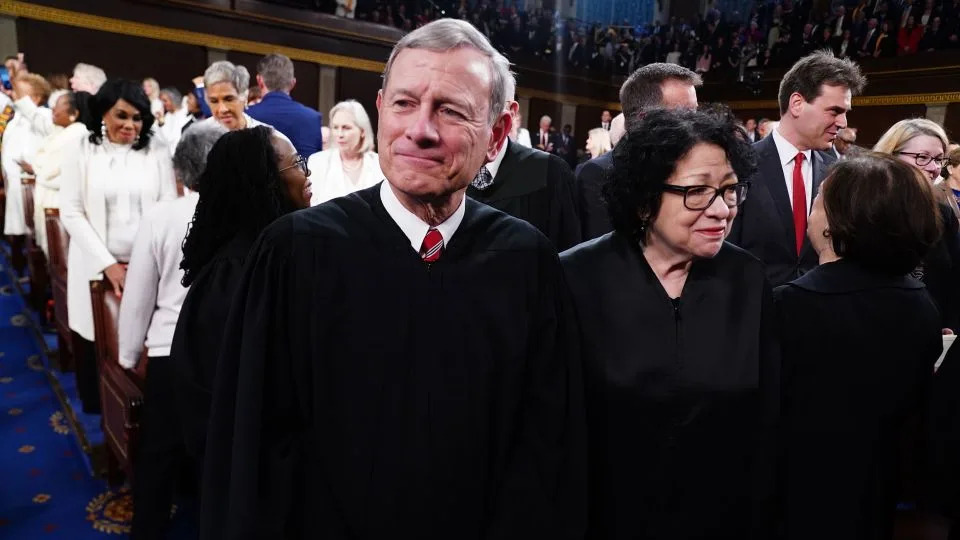
U.S. Supreme Court Chief Justice John Roberts and Associate Justice Sonia Sotomayor stand on the House floor ahead of the annual State of the Union address by U.S. President Joe Biden. – Shawn Thew/Pool/Getty Images
Trump redefines Supreme Court’s docket
The court heard oral arguments in mid-October over South Carolina’s new congressional map, which a lower court found was a racial gerrymander that violated the Constitution. Both the GOP state lawmakers defending the map and the parties challenging it had asked the Supreme Court to rule by January.
Noting that deadlines for this year’s election were nearing, the state lawmakers filed an emergency appeal last month, asking for permission to use the disputed map while the justices continued their deliberations. Ultimately, a lower court stepped in to allow the state to use the map for now, lamenting that “the ideal must bend to the practical.”
On the court’s emergency docket, meanwhile, where cases are decided more quickly and without oral argument, the justices have been sitting for weeks on a request from Idaho officials to enforce a strict statewide ban on gender-affirming care for minors. Initially filed in mid-February, the request has been fully briefed since early March.
The go-slow approach is not a new phenomena this year. The pace of opinions fell sharply last year, according to Feldman’s data, which led to speculation that the shocking leak of the court’s draft opinion overturning Roe v. Wade months earlier gummed up the court’s internal works.
Several justices indicated the leak damaged trust, including Justice Clarence Thomas, who described the unprecedented breach as “kind of an infidelity.”
Last year, Justice Brett Kavanaugh downplayed the slower pace by noting many of the court’s biggest cases – which usually are not settled until June – were heard at the start of the term. For instance, the court heard arguments early on that year in a major challenge to the consideration of race in admissions at Harvard and the University of North Carolina. The Supreme Court ultimately barred consideration of race in June.
This year, some of the biggest cases have been more spread out. On the other hand, the court has been pummeled by a series of divisive emergency appeals. It also has agreed to take on several high-profile matters involving Trump.
In one, the court ruled that Trump would remain on Colorado’s presidential ballot despite claims he violated the 14th Amendment’s “insurrectionist ban” because of his actions leading up to the January 6, 2021, attack on the US Capitol. The court was unanimous on the bottom line conclusion but splintered over its reasoning.
In another, the justices agreed to hear arguments April 25 about Trump’s immunity claims.
Republican presidential candidate former President Donald Trump speaks at a campaign event in Grand Rapids, Michigan, on Tuesday, April 2. – Paul Sancya/AP
The Supreme Court will also hear arguments later this month over a federal law the Biden administration says requires hospitals to provide an abortion if the health of the mother is in danger, even in states such as Idaho that have approved strict abortion bans. The rise of state abortion restrictions following the court’s overturning of Roe has become an election-year cudgel for Biden and congressional Democrats.
Also this month, the court will take up the question of whether a federal obstruction law can be used to prosecute some of the rioters involved in the Capitol attack. The decision could also affect Trump, who has also been charged with that crime.
‘Something has to give’ on Supreme Court docket
The court also dealt with a divisive and ongoing dispute over a Texas immigration law that allowed law enforcement in the state to arrest and detain people it suspects entered the country illegally. Over a public dissent from the three liberal justices, the court cleared the way for Texas to enforce that law last month.
The 5th US Circuit Court of Appeals temporarily blocked the enforcement hours later and the appeals court heard arguments over the law Wednesday.
The emergency cases, which have drawn increased criticism in recent years, take time away from consideration of the court’s regular docket.
“The court only has so many resources,” said Steve Vladeck, CNN Supreme Court analyst and professor at the University of Texas School of Law. “Something has to give, and the court really ought to be thinking through ways to avoid putting itself in this position every year.”
In an aerial view, Texas National Guard soldiers load excess concertina wire onto a trailer at Shelby Park on January 26, 2024 in Eagle Pass, Texas. – Michael Gonzalez/Getty Images
At the same time, the Supreme Court has always moved at its own pace and the justices have little incentive to worry about timing. By its own standards, the court moved unusually quickly to resolve the Trump ballot dispute this year – handing down a decision two months after the former president filed his appeal.
That kind of speed is the exception.
“If you look systematically over time, they’re becoming slower and they’re taking fewer cases,” Feldman said.
But other than stirring speculation among court watchers, he said, the pace of opinions doesn’t have much practical impact. Taking an extra few weeks to finish an opinion, Feldman said, simply means the justices get more time to write.
“It makes sense to me from their perspective that they might want to be slower,” Feldman said. “For efficiency, it probably makes sense to hold off as much as they can until the end of the term.”
‘Building an authoritarian axis’: the Trump ‘envoy’ courting the global far right
Richard Grenell’s shadow foreign policy campaign is unsettling diplomats and threatens to collapse US interests.
Robert Tait – April 5, 2024
For Donald Trump, he is “my envoy”, the man apparently anointed as the former US president’s roving ambassador while he plots a return to the White House.
To critics, he is seen as “an online pest” and “a national disgrace” – and most importantly, the dark embodiment of what foreign policy in a second Trump administration would look like.
Meet Richard Grenell, vocal tribune of Trump’s America First credo on the international stage and the man hotly tipped to become secretary of state if the presumed Republican nominee beats Joe Biden in November’s presidential election.
A senior executive in the rightwing Newsmax cable channel, Grenell, 57, has crafted a persona as the archetypal Trump man, keen and ever-ready to troll liberals, allies and foreign statesmen in public forums and social media.
Grenell – who served as a rambunctious ambassador to Germany and acting director of national intelligence during Trump’s first term – has carved a niche as the articulator-in-chief of a Maga approach to global affairs that appears to echo his political master’s voice.
Seasoned analysts fear his hyperactivity is already unsettling US diplomats even while Trump is out of office.
In recent months, he has pitched up in Guatemala, where he tried to stymie US state department pleas for a peaceful transition of power by backing rightwing efforts to block the inauguration of the liberal president-elect, Bernardo Arévalo, on supposed electoral fraud grounds about a poll previously declared “free and fair” by international observers.
Arévalo subsequently took office, but not before Grenell lambasted American diplomats for “trying to intimidate conservatives” over “a phony concern about democracy”.
He has also repeatedly visited the Balkans – building on a previous role as the Trump administration’s special envoy to the region and working on property deals in Serbia and Albania with Trump’s son-in-law, Jared Kushner.
He attempted to broker a meeting between Trump and Turkey’s president, Recep Tayyip Erdoğan at last year’s United Nations general assembly in New York at a time when the Turkish leader was blocking Sweden’s bid to join Nato, although the proposal was subsequently rejected amid security concerns.
Grenell knows who can be seduced, intimidated and destroyed
Fulton Armstrong
Grenell’s high profile has an intimidating effect on serving US diplomats, according to Fulton Armstrong, senior fellow at American University’s Centre for Latin American Studies.
“Grenell’s very cunning and effective. Having penetrated both the intelligence and the policy world, he knows who can be seduced, intimidated and destroyed,” Armstrong, a former senior analyst at the CIA, told the Guardian.
“The state department eventually did the right thing in Guatemala but only after a lot of dawdling and this tells Grenell that it has issues of commitment and allegiance [that he can exploit].
“Weak people at the state department are scared to piss off the right wing because they want to be ambassadors and fear for their careers, which makes them vulnerable. Someone like Grenell knows how this can be used for issues favoring Trump.”
For his part, Grenell has accused the state department of “playing politics” and “pushing leftwing ideas” in Latin America.
Addressing the influential CPAC gathering of conservatives in February, he said US foreign policy cried out for an “SOB diplomat”, a role he apparently envisions for himself.
“What we need right now is diplomacy with muscle,” Grenell told an online video debate last summer on the Balkans hosted by the pro-Trump America First Policy Institute. “We need to stop mocking tough diplomats. What we’ve seen with Ukraine is that when diplomats fail, we have war and conflict.”
There are many aspects to what Grenell is doing. One is grift …
Joe Cirincione
Grenell has become a strident advocate of abandoning negotiations in decades-old territorial disputes in the Middle East and the Balkans in favor of trade and economic agreements that he hails as sidestepping political problems through creating jobs.
“The success that Donald Trump had was that he avoided politics and concentrated on the economy,” he told CPAC. “Young people leave the region because they don’t have help and they don’t have a job. So part of our foreign policy, if we want to solve problems, is to avoid the political talk and figure out ways to do greater trade.”
For detractors, such talk is code for a transactional foreign policy tailored to Trump’s personal and business interests at the expense of America’s traditional democratic alliances – as well as a signal that Ukraine would be pressured to surrender territory to end its war with Russia.
“There are many aspects to what Grenell is doing,” said Joe Cirincione, a veteran Washington foreign policy and arms control specialist. “One is grift, looking for business deals, particularly in Serbia, where Trump has longstanding business interests and Trump seems to be helping him pursue this.
“Another is more sinister. It looks as though Grenell is trying to build up a developing authoritarian network of rightwing leaders to form this authoritarian axis that Trump might govern by – ranging from Putin to [Viktor] Orbán [prime minister of Hungary] to Erdoğan.
“All these are anti-democratic forces and use the simple playbook of using democracy to overthrow democracy.”
Grenell’s own pronouncements give proponents of America’s existing alliances little cause for comfort.
A relentless critic of Germany’s financial contributions to Nato, he trolled Sweden’s prime minister, Ulf Kristersson, when he attended Biden’s State of the Union address in January to mark his country’s accession to Nato, a move Grenell had opposed, purportedly on the grounds that it would not pay its way.
“The leader of Sweden, who currently isn’t paying his fair share of Nato obligations but has promised to do it later, is leaping to his feet to applaud Joe Biden and the far Left spending policies Biden wants to enact,” Grenell posted on X.
All these are anti-democratic forces and use the simple playbook of using democracy to overthrow democracy
Joe Cirincione
The comment echoed Grenell’s crockery-breaking spell as ambassador to Berlin, where he infuriated his hosts on arrival by demanding that they renew sanctions on Iran after Trump withdrew the US from the nuclear deal agreed by Barack Obama’s administration – even though Germany still adhered to the agreement.
He also ruffled German feathers by telling Breitbart that part of his ambassadorial role was “to empower other conservatives throughout Europe”, a comment seen by some as a tacit olive branch to the far-right Alternative for Germany (AFD) party.
For figures like Cirincione, such rhetoric is a harbinger of worse to come.
“If Trump were president and Grenell secretary of state, it would set back American interests by decades, collapse the development of the democratic west and assist the rise of the global right wing, no questions about it,” he said.
Terrified Parents, New Age Health Nuts, MAGA Exiles. Meet the R.F.K. Jr. Faithful.
By Michelle Goldberg, Opinion Columnist – April 4, 2024
Photographs by Michael Schmelling
Chris Inclan, an alcohol and drug counselor from Sonoma, Calif., voted for the Green Party candidate Jill Stein in 2016. In 2020 he backed Andrew Yang in the Democratic primary and cast a ballot for Donald Trump in the general election. Joe Biden, he said, was “so ingrained in the establishment and politics as usual,” while Trump “went against the grain on a lot of issues,” including wars and government regulation. But Inclan, a big bearded 39-year-old with tattoos on his hands, doesn’t want to have to make that choice again, which is why he’s now enthusiastically supporting Robert F. Kennedy Jr.
I met Inclan at the Oakland rally where Kennedy introduced his new running mate, the 38-year-old political donor Nicole Shanahan. Held in the auditorium of the Henry J. Kaiser Center for the Arts, it was the first political rally Inclan had ever attended.
“The system is corrupt,” he said of what he called the two-party “duopoly.” “We keep playing the same game. But I think Americans are fed up.” He’d joined Kennedy’s We the People Party, formed to help Kennedy get on the ballot in several states, and has aspirations to run for office himself someday.
Setting up banners at Kennedy’s campaign event in Oakland, Calif., to announce his pick for a running mate.
Inclan’s politics are hard to understand in purely left or right terms. The more relevant dichotomy, for him as for many Kennedy voters, is insider versus outsider, which is why Kennedy’s following sometimes overlaps, in unexpected ways, with the MAGA movement.
Matt Castro, a San Francisco bus driver at the rally, described himself as “extremely left-leaning,” but didn’t vote in the last election and said that, if Kennedy isn’t on the ballot, he’d probably vote for Trump in the next one, because of his opposition to military support for Ukraine. Alex Klett, a 33-year-old Kennedy volunteer from Wisconsin who was handing out American flags, described himself as a right-leaning independent who voted for Trump in 2016 and then, in 2020, wrote in Kanye West.
Another Kennedy volunteer, Jaclyn Aldrich, a striking 43-year-old Black woman who sometimes works as a model, has never cast a presidential ballot, because she hadn’t trusted any of the candidates. “I didn’t even vote for Obama,” she said. Among her fellow volunteers, she said, are some former Bernie Sanders voters, but “it’s mostly Trump people.”
This is a paradox of the Kennedy campaign. Many Democratic and Republican insiders view Kennedy as a danger to Biden’s re-election. Timothy Mellon, the top donor to the Trump super PAC Make America Great Again Inc., is also the top donor to the Kennedy super PAC American Values 2024, suggesting he thinks Kennedy will help Trump. The Democratic National Committee, meanwhile, has recently formed a unit, including veteran Democratic operative Lis Smith, devoted to battling third-party candidates, and Kennedy is getting most of its attention.
But on the ground, I haven’t met many Kennedy-curious voters for whom Biden is a second choice. Instead, Kennedy attracts many of the same sort of alienated political eccentrics who in the past have gravitated to Trump. “They keep saying that he’s pulling from Biden, but most of our people are actually coming from the right,” said Leigh Merinoff, volunteer chair of the finance committee of American Values.
Anecdotes aren’t the same thing as data, and people who go to rallies and volunteer for campaigns aren’t necessarily representative of the electorate, which is full of people who are much more disengaged. Nevertheless, there’s a gap between both Democratic and Republican assumptions about Kennedy’s appeal and the character of his real-life movement. He’s much more of a wild card than left-wing third-party candidates like Stein and Cornel West. There’s something distinctly Trumpy in his campaign’s mix of New Age individualism, social media-fueled paranoia and intense, aching nostalgia for the optimistic America of the early 1960s, when Kennedy’s uncle John F. Kennedy was president and his father, Robert F. Kennedy, served as attorney general. It’s not surprising that some otherwise Trump-leaning voters are picking up on it.
Faces at recent Kennedy campaign events in California.
On the surface, Kennedy’s choice of Shanahan, a patent lawyer and former Democrat who has donated to candidates like Pete Buttigieg and Marianne Williamson, might seem as if it would draw more left-leaning voters into the campaign. In introducing Shanahan, an avid surfer who met her ex-husband, the Google founder Sergey Brin, at a yoga festival, Kennedy said, “I wanted a vice president who shared my passion for wholesome, healthy foods, chemical-free, for regenerative agriculture, for good soils,” as well as an athlete who “would help me inspire Americans to heal, to get them back in shape.”
One can imagine voters who frequent farmers markets and follow wellness influencers seeing an idealized version of themselves in her. And while large parts of the New Age and alternative health community moved right during the pandemic in response to lockdowns and vaccine mandates, it’s still a world with plenty of people who think of themselves as progressives.
Indeed, the most interesting thing about Shanahan is the way she dramatizes how Kennedy wins over voters like her. In the week after her debut as a candidate, Shanahan hasn’t made any mainstream media appearances, but she did speak at length on the podcast of Rick Rubin, the music producer and, recently, self-help author, telling the story of her conversion from lifelong Democrat to Kennedy acolyte.
Their conversation is fascinating, demonstrating how frustrations with conventional medicine and the desire for a transcendent order — for a big holistic framework that makes sense of the world’s destabilizing chaos — lead away from technocratic liberalism and toward, well, the unstable political formation that’s coalescing around Kennedy. Listening to it, you can hear a smart and sensitive woman narrating her own journey down the rabbit hole, a portal that took her to a place where she could help swing the 2024 election and thus the course of American history.
Shanahan came to Kennedy the way many desperate parents have. During the pandemic, her 18-month-old daughter was diagnosed, over Zoom, with autism, and she described how none of the interventions offered by experts helped. Another Silicon Valley mom with an autistic child urged her to listen to Kennedy, who has long asserted a false link between vaccines and autism. Though Shanahan was resistant at first — she knew about Kennedy’s reputation as a conspiracy theorist — she tuned into his podcast.
Around the same time, she got deep into the work of Jack Kruse, a neurosurgeon and self-described “biohacker” who emphasizes the importance of sunlight for good health. (Kennedy and Kruse appeared together on Rubin’s podcast last year.) Kruse, said Shanahan, awakened her to the idea that autism could be “related to the way that the brain was responding to some kind of outside influence” — like vaccines — “and how to heal the brain.”
She started her daughter, Echo, on a regimen that included lots of early morning light, swimming in a saltwater pool and music frequencies that send “a signal to brain cells that they can repair.” (“Morning sunlight in particular is like chicken soup for metabolic health,” she told Rubin.) At the same time, she worked to reduce Echo’s exposure to “nonnative light sources,” and cellular and Wi-Fi signals. These interventions, she said, have all helped her daughter. “When it works, maybe we need science to catch up,” she said.
When she met Kennedy last summer, she was impressed by his record of “looking at the environmental exposures and the things that impact human health that are man-created,” she said. Shanahan lamented what she sees as widespread closed-mindedness in the face of the questions she wants to explore. “My daughter has lifted the veil for me,” she said, in an allusion to Aldous Huxley’s work on psychedelics. “If we’re talking about my support for Bobby Kennedy, that is what has brought me to this movement.”
A Kennedy supporter in Oakland.Nicole Shanahan, Kennedy’s running mate.
Shanahan was never all that left-wing; she helped fund the recall campaign against San Francisco’s progressive district attorney, Chesa Boudin. Still, her presence on the ticket has alienated some right-leaning Kennedy fans. Shortly after she was announced, one erstwhile Kennedy supporter posted a link to an online “Save R.F.K. Jr. Rally” on Kennedy’s campaign website, demanding the firing of Kennedy’s campaign manager for promoting a “C.I.A., feminist agenda” by bringing Shanahan on board. (It was quickly taken down.) “I think the pick was meant to be more about covering his left flank, and I found that an odd calculation,” Chamath Palihapitiya, a venture capitalist who has co-hosted a fund-raiser for Kennedy, said on the podcast “All-In.”
In fact, the calculation makes perfect sense: Kennedy needs Shanahan’s money. Her divorce settlement from Brin isn’t public, but she reportedly asked for more than $1 billion, about 1 percent of his net worth at the time, and she’s clearly extremely wealthy. Campaign finance law allows both presidential and vice-presidential candidates to pour unlimited funds into their own races, and the process of getting Kennedy on state ballots as a third-party candidate is going to be expensive. Shanahan has shown she’s willing to spend; she gave $4 million to American Values 2024 to fund a Kennedy ad that ran during the Super Bowl.
Introducing Shanahan in Oakland, Kennedy said, with a straight face, that there is “no American more qualified” than she to serve as vice president. But his speech also gestured at the heart of those qualifications. Shanahan, he said, would help him liberate America from the “predatory cabal” that controls the campaign finance system.
It’s doubtful, however, that Shanahan will be able to help Kennedy in ways that go beyond finances, and not just because the influence of vice-presidential candidates tends to be limited, especially with third-party aspirants. (My guess is that few readers remember either Ralph Nader’s or Jill Stein’s running mates.) Shanahan appears to find negative publicity debilitating, an unusual quality in an aspiring politician and one that may limit her visibility.
Before joining the Kennedy ticket, she was probably best known for her divorce from Brin, which, according to The Wall Street Journal, was precipitated by an affair with Elon Musk. (Both she and Musk deny this.) In an essay in People magazine, she described the scrutiny that followed the Journal article as unbearable. “I was thrust into the public eye; the online images and commentary felt more like a zeitgeist than depictions of my lived experiences,” she wrote. Insisting that she’s “not a public person,” she called the Journal article and its aftermath “a disaster for my work life, my reputation and my ability to communicate the things I care most deeply about.”
This week, “Fox & Friends” promoted an appearance by Kennedy and Shanahan, but Kennedy ended up going on alone. In a post on the social media platform X, Shanahan wrote, “While Bobby’s out there spreading our message on TV right now, I’m working behind the scenes to make sure we’re on the ballot in all 50 states.” So rather than add a new note to Kennedy’s message, Shanahan is mostly just using her fortune to amplify what he’s already been saying. And what he’s been saying is often quite reactionary. (The campaign didn’t respond to my requests to interview Kennedy or Shanahan.)
At a Kennedy campaign event in Los Angeles.
The last time I saw Kennedy speak, in June in New Hampshire, he was still a Democrat, running a doomed primary challenge to Biden in a campaign managed by the quirky former Democratic congressman Dennis Kucinich. Seeking to echo the famous 1963 “Peace” speech in which his presidential uncle called for a halt to the Cold War arms race, Kennedy warned against antagonizing Russia over Ukraine, presenting himself as an antiwar candidate.
Some of his followers still see him that way, but now they must either rationalize or overlook his zealous support for Israel’s war in Gaza. In March, weeks after the Biden administration called for a six-week cease-fire, Kennedy was skeptical of the idea, telling Reuters that previous truces have “been used by Hamas to rearm, to rebuild and then launch another surprise attack.” Though he often rails against censorship, he cheered on the hedge fund billionaire Bill Ackman’s demand that Harvard do more to crack down on antisemitism, writing, “It’s time to hold college administrations responsible for the epidemic of campus antisemitism by insisting on zero-tolerance policies.”
Kucinich left the campaign in mid-October in ambiguous circumstances, though he’s hinted that disagreements with Kennedy about Gaza had something to do with his departure. (The campaign is now run by Kennedy’s daughter-in-law Amaryllis Fox Kennedy, a former C.I.A. officer.) In November, Sayer Ji, an alternative medicine promoter and key anti-vaccine influencer, withdrew his endorsement of Kennedy over Gaza. Charles Eisenstein, a major intellectual figure in New Age circles, is still advising Kennedy but has been openly critical of his stance on Israel.
While there are still some progressive figures in Kennedy’s orbit, his campaign has an increasingly right-wing vibe. Border security has become a central part of his pitch. Since January, his communications director has been Del Bigtree, a leading anti-vaccine activist who doubts that climate change is caused by human activity and who spoke at the MAGA Freedom Rally near the Capitol on Jan. 6. “I wish I could tell you that this pandemic really is dangerous,” Bigtree said then. “I wish I could believe that voting machines work and that people care. You’ve been sold a lie!”
The conservative talk radio host Randy Economy, one of the leaders of the campaign to recall Gov. Gavin Newsom of California, is Kennedy’s senior adviser for ballot access. An opening speaker at the Oakland event was Angela Stanton-King, a Black conservative QAnon promoter who served time for her role in a car-theft ring and was pardoned by Donald Trump.
An attendee at a Kennedy event carried a book of L. Ron Hubbard essays.Yvette Corkrean, the Republican nominee for a California Senate seat, attended the Oakland event.
Some strains of New Age wellness culture — with its distrust of mainstream expertise, moralistic view of health and weakness for quackery — have long intersected with right-wing politics. (Alex Jones, after all, made much of his fortune shilling health supplements.) The connection between alternative medicine and conservatism grew significantly stronger during the pandemic, as the center of gravity in the anti-vaccine movement moved rightward and longtime right-wingers grew increasingly mistrustful of Big Pharma and, with it, Big Food.
“The globalists want you to be fat, sick, depressed and isolated — the better to control you and to milk you for as much economic value as they can before they kill you,” a pseudonymous far-right figure who goes by Raw Egg Nationalist said on the 2022 Tucker Carlson special “The End of Men.”
Kennedy’s conservationism can sound a lot like that of Raw Egg Nationalist. His commitment to the environment is tempered by paranoia about federal government power that makes him suspicious of regulation. Climate change “is being used as a pretext for clamping down totalitarian controls, the same way the Covid crisis was, and it’s the same people,” he said in a campaign video featuring Jordan Peterson, the anti-woke psychologist and author. Dismissing the efficacy of a “war on carbon,” Kennedy said he’d approach energy issues using “free markets and not top-down control.”
Because of his hostility to the state, Kennedy’s environmentalism often manifests as a belief in the redemptive power of healthy living and closeness to nature, which Shanahan shares. This ethos helps explain Shanahan’s much-publicized criticism of I.V.F. “I believe I.V.F. is sold irresponsibly, and my own experience with natural childbirth has led me to understand that the fertility industry is deeply flawed,” she wrote in People. She’s interested in low-cost, organic alternatives. “I’m not sure that there has been a really thorough mitochondrial respiration study on the effects of two hours of morning sunlight on reproductive health,” she said on a panel last year. “I would love to fund something like that.” Hearing this, I couldn’t help thinking of Carlson’s promotion, on his “End of Men” special, of testicle tanning to raise testosterone levels.
Of course, even though the Kennedy camp has a lot in common with the esoteric new right, Kennedy could still siphon Democratic votes from Biden. A lot of undecided voters don’t follow politics closely, and some who are unhappy about their major-party choices may find themselves drawn to Kennedy’s mythic last name and green-seeming, anti-establishment pitch.
“Anything that splits up the anti-Trump coalition hurts Biden,” said Sarah Longwell, an anti-Trump conservative pollster who regularly asks about Kennedy in focus groups. As she sees it, the largest group of persuadable voters in 2024 are the so-called double haters, those who disapprove of both Trump and Biden. “My experience over the years in the focus groups is that when Trump is top of mind for people, people who dislike both him and Biden end up disliking Trump more,” said Longwell. Kennedy, she fears, could give people who might otherwise reluctantly vote for Biden an off-ramp from making a dispiriting decision.
No one knows how the race will ultimately shake out.
Some polls back up this analysis. A recent Quinnipiac survey shows Kennedy getting 13 percent of the vote; he has support from 9 percent of Democrats, 8 percent of Republicans and 20 percent of independents. The poll shows Biden leading Trump by three points in a head-to-head matchup but Trump ahead by one point when third-party candidates are included. Though both numbers are within the poll’s margin of error, they suggest that Trump could benefit if the election isn’t seen as a binary choice.
Other polls, however, show Kennedy pulling more voters from Trump, and the truth is no one knows how the election will ultimately shake out. “The public polling, if you dig into it, can be really head-swiveling,” said Smith. “It’s very hard to gauge the impact, but it does seem like he pulls from both, and right now — emphasis on ‘right now’ — slightly more from Biden.”
Kennedy certainly has no qualms about spoiling the election for Trump. On CNN on Monday, he argued that Biden poses a “much worse” threat to democracy than Trump because of the Biden administration’s attempts to get social media companies to remove vaccine misinformation, much of it spread by Kennedy.
“President Biden is the first candidate in history that has used the federal agencies to censor political speech, to censor his opponent,” he said. The primary threat to democracy, he added, “is not somebody who questions election returns,” noting that he believed the 2004 election was stolen from John Kerry. “So I don’t think people who say that the election is stolen — we shouldn’t make pariahs of those people,” he said.
This interview was clarifying about Kennedy’s intentions. But precisely because he evidently views Trump, not Biden, as the lesser of two evils, he may prove most attractive to voters who also view the election that way. That, however, would depend on people grasping what he stands for. So it might not be a disaster for Democrats if Shanahan can help Kennedy be more widely heard.
“If anyone is listening who never considered an independent ticket, I want to extend the same invitation to you that my friend did to me last year,” said Shanahan in her Oakland speech. “Please, listen to Bobby Kennedy in his own words.” It’s sage advice.
Michelle Goldberg has been an Opinion columnist since 2017. She is the author of several books about politics, religion and women’s rights, and was part of a team that won a Pulitzer Prize for public service in 2018 for reporting on workplace sexual harassment.
1.7 million Texas households are set to lose monthly internet subsidy
Pooja Salhotra – April 2, 2024
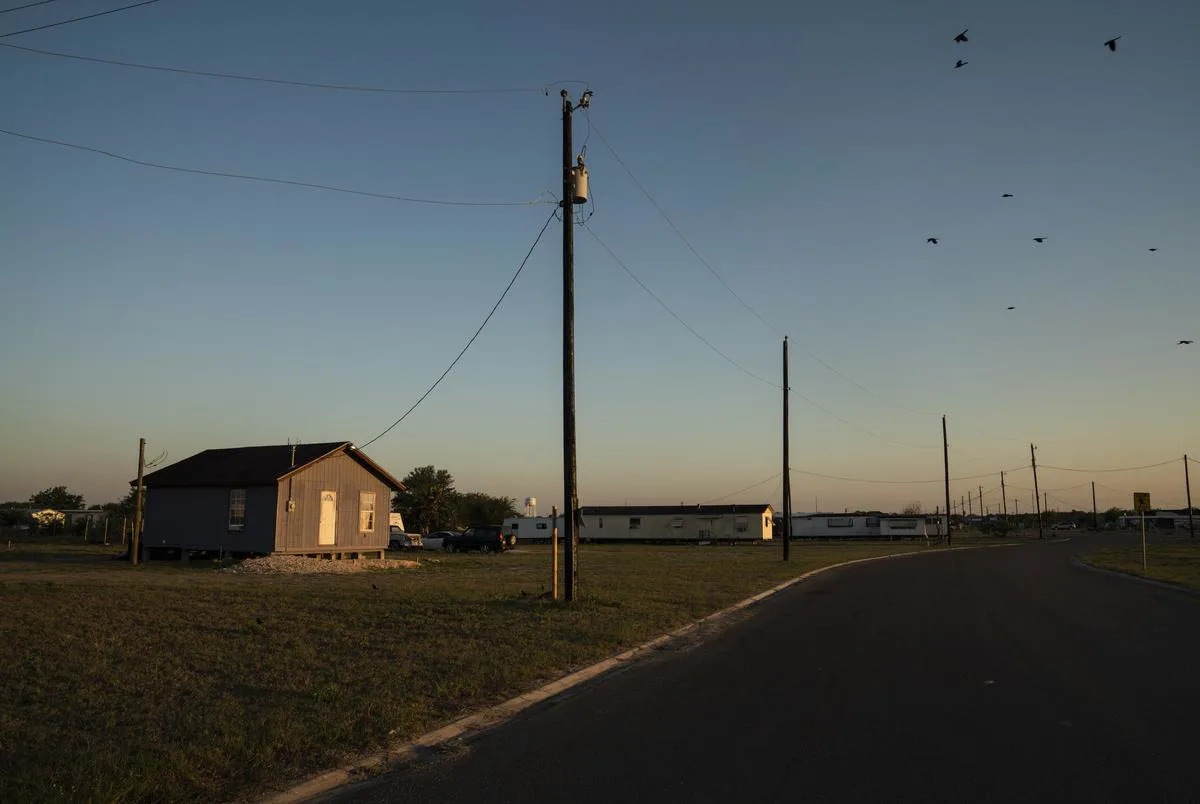
A colonia, unincorporated neighborhoods that lack basic services such as street lights, proper drainage, paved roads or waste management, is seen near Edinburg on March 25, 2020. Credit: Verónica G. Cárdenas for The Texas Tribune
The $30 per month Daisy Solis has saved off of her internet bill for the past two years stretched a long way.
Those dollars covered new shoes for her three, growing children, dinners out at the Chick-fil-A that popped up in her town of Peñitas in South Texas, and part of a higher-than-usual electricity bill.
Now, Solis worries she might have to sacrifice on her internet speed because a federal subsidy that has helped her pay for her internet plan is set to expire at the end of April.
The Affordable Connectivity Program provides a $30 monthly subsidy to help low-income households pay for internet service, and up to $75 per month for households on tribal lands. The $14.2 billion program was part of the 2021 Bipartisan Infrastructure Law and has helped 23 million households in the U.S — including 1.7 million in Texas — save money on their internet bills. The program’s funding is slated to dwindle at the end of April, though, potentially cutting millions off from the internet. In May, limited remaining funding in the program will allow eligible households to receive a partial discount; there won’t be any benefits after May.
“It has really helped me in that I don’t have to stress out about the bill,” said Solis, 27. “Even though it’s $30, $30 goes a long way.”
The program’s termination will disproportionately impact South Texas, where counties along the Texas-Mexico border had higher than average rates of participation. Overall, 1 in 7 Texans used the program. But in some border counties, including Hidalgo County, about half of its residents used the subsidy, according to data from the Federal Communications Commission.
“Some people have told me they might not get internet if [the subsidy] goes away,” said Marco Lopez, a community organizer at La Unión del Pueblo Entero, a nonprofit organization that supports low-income neighborhoods in the Valley. “I don’t know what to tell them because it’s not just cutting off their internet; it’s cutting off their opportunities for jobs, for school, for telehealth.”
A bipartisan group of lawmakers has introduced a bill that would extend funding for the Affordable Connectivity Program through the end of 2024. But the bill has not moved and faces considerable pushback from Republican lawmakers who claim the Biden administration has spent “recklessly.”
In a December letter to the chair of the FCC, a group of lawmakers, including U.S. Sen. Ted Cruz, disputed that the broadband program was necessary. The lawmakers said that most households using the subsidy already had broadband subscriptions. But that’s likely untrue. According to an FCC survey, 47% of respondents reported having either zero connectivity or relying on mobile service before enrolling in the federal program.
On Tuesday, FCC Chair Jessica Rosenworcel sent a letter to Congress urging them to fund the program until the end of the year. She said the funding has been particularly critical for vulnerable populations, including veterans, seniors, and students.
“We know that nearly half of ACP households are led by someone over the age of 50,” she wrote. “The ACP and the broadband service it supports is ‘need to have’ for many seniors, who depend on the program for managing their health and maintaining access to their medical teams.”
The program’s termination comes as the state and federal government pump historic sums of money to expand broadband infrastructure and close the so-called digital divide. Texas is poised to receive more than $3.3 billion federal dollars to help connect the roughly 7 million Texans who lack access to affordable internet. The state will bolster those funds with an additional $1.5 billion that voters approved in November.
Some advocates worry that terminating the Affordable Connectivity Program at this juncture could jeopardize the success of future broadband investments.
“If we build the infrastructure but then all these people lose internet access, we are going to be taking one step forward and two steps back,” said Kelty Garbee, executive director of Texas Rural Funders, a nonprofit focused on rural philanthropy. “It is important to take a long view.”
Rural areas lag behind their urban counterparts when it comes to broadband access. The combination of low population density and remoteness make such areas unattractive to internet service providers, who are hesitant to invest in expensive infrastructure without a guaranteed pool of customers. Garbee worries that ending the government subsidies could shrink the rural customer base and make those areas even less attractive to internet companies.
Jordana Barton-Garcia, who focuses on broadband investments for nonprofit organization Connect Humanity, said that while the termination of ACP will be a significant loss for high poverty areas, the program is a “Band-Aid” solution. She said the subsidy doesn’t address the root of the problem: that the economics of broadband do not work in rural, low-income areas.
“Instead of being ruled by profit-maximizing major corporations, we need other models to serve low and moderate income communities,” she said. “We need to be able to serve without maximizing profits and instead serve for the public good.”
Some communities have found innovative ways to provide broadband to their rural constituents at a low cost. The city of Pharr in Hidalgo County, for example, created a municipal internet service program that offers plans for as low as $25 per month, the price residents in the border community said they could afford. Barton-Garcia said Pharr won’t be affected by the termination of government subsidies because the city has already secured its own funding. Pharr used grant money, a municipal bond as well as American Rescue Plan dollars to create a municipally-run internet service.
Large internet providers such as Comcast said they will continue to support low-income customers with an affordable plan. Comcast offers eligible customers a plan called internet essentials for $9.95 and a slightly higher-speed plan for $29.95.
For smaller providers in rural Texas, though, a low-cost plan is not financially feasible without government support. Charlie Cano, CEO of ETex Telephone Cooperative, said his lowest cost option is $62 per month.
“Anything lower than that is going to jeopardize our business model,” Cano said. “I’m nervous about what we are going to do about that low-cost option.”
In order to qualify as a grantee for the Broadband Equity Access and Deployment Program — the main broadband program created by the bipartisan infrastructure law — providers must offer a low-cost option to low-income customers. Providers like Cano worry this requirement may make it difficult for companies like his to win federal grant dollars.
Disclosure: Comcast has been a financial supporter of The Texas Tribune, a nonprofit, nonpartisan news organization that is funded in part by donations from members, foundations and corporate sponsors. Financial supporters play no role in the Tribune’s journalism. Find a complete list of them here.
Biden administration points finger at Republicans for internet bill hikes
Brian Fung, CNN – April 2, 2024
Spencer Platt/Getty Images
Tens of millions of Americans could see skyrocketing internet bills this spring or may be abruptly kicked off their plans — and it will be congressional Republicans who are to blame, the Biden administration said Tuesday.
The accusation reflects a last-ditch pressure campaign to save a federal program that has helped connect more than 23 million US households to the internet, many for the first time. Without it, those households will be forced to pay hundreds of dollars more per year to stay online.
By the end of the month, funding for the Affordable Connectivity Program (ACP) will run out, jeopardizing the monthly discounts on internet service benefiting an estimated 59 million low-income people, including veterans, students and older Americans.
Many ACP subscribers would be forced to choose between paying for groceries and paying for internet service if the program is shut down, CNN has previously reported.
Although popular with users from across the ideological spectrum, the ACP’s future is in doubt as legislation to extend the program has stalled. Now, as the Federal Communications Commission has begun winding it down, the Biden administration is ramping up pressure on the GOP for standing in the way of a critical lifeline for accessing health care, jobs and education.
“President [Joe] Biden has been calling on Congress to pass legislation that would extend the benefit through 2024. And we know Democratic members and senators have joined him in that effort,” a senior administration official told reporters. “But unfortunately, Republicans in Congress have failed to act.”
Biden has called on Congress to approve $6 billion to continue the ACP. A bill introduced in January by a bipartisan group of lawmakers in the House and Senate would authorize $7 billion. That legislation has 216 co-sponsors in the House, including 21 Republicans, and three in the Senate, including two Republicans.
But policy experts have said it is unlikely Republican House Speaker Mike Johnson will let the bill onto the House floor as GOP leaders have decried government spending, despite the program being used in virtually every congressional district nationwide.
“It is clear the program would be extended if the speaker would allow a vote,” said Blair Levin, an analyst at the market research firm New Street Research. “So far, he has not said anything about it, but it appears he will not allow the House to vote on the legislation. He has not, to my knowledge, said anything substantive about the legislation or the program.”
Levin added that support by Republican Sens. J.D. Vance of Ohio and Kevin Cramer of North Dakota also suggest the bill would pass the Senate, making the House “the biggest obstacle.”
Spokespeople for Johnson and for Senate Majority Leader Chuck Schumer didn’t immediately respond to a request for comment.
The result is a stalemate that, if left unresolved, will lead to the collapse of the ACP by early May.
Administration officials declined to say whether Biden or Vice President Kamala Harris have personally discussed the ACP with congressional Republicans. But the officials told reporters there is currently no Plan B if Congress fails to extend the program.
“There are really no good options in a world in which Congress leaves us without any funding,” said another senior administration official. “There are certainly no easy answers for us to move forward if this program ends. So we want to work as hard as possible to make sure we avoid that possibility.”
Some lawmakers had hoped that money for the ACP could have been included in the recent bipartisan spending deal intended to keep the government open, but those hopes were ultimately left unfulfilled.
On Tuesday, FCC Chairwoman Jessica Rosenworcel sent a letter to Congress outlining the impact that the ACP’s disruption would cause.
“The end of the ACP will have broad impact,” Rosenworcel wrote. “But it is worth noting that they will have special impact on certain vulnerable populations, including senior citizens. We know that nearly half of ACP households are led by someone over the age of 50.”
More than 4 million military households are signed up for the ACP, Rosenworcel added, while 3.4 million households within the ACP program reported using school lunch or breakfast programs, indicating that many program subscribers are parents of children whose ability to do homework assignments may be interrupted by the loss of the ACP. To qualify for the ACP, users are required to meet certain income limits or be a participant in one of a number of other federal aid programs, such as the National School Lunch Program.
Rosenworcel called on Sen. Maria Cantwell and the panel she chairs, the Senate Committee on Commerce, Science, and Transportation, to quickly advance legislation to extend the ACP. But the bill’s future remains foggy.
Our Trump reporting upsets some readers, but there aren’t two sides to facts: Letter from the Editor
Chris Quinn, Editor, Cleveland Plain Dealer – March 30, 2024
Some readers complain that we have different standards involving Donald Trump and Joe Biden. (AP Photo, File)AP
A more-than-occasional arrival in the email these days is a question expressed two ways, one with dripping condescension and the other with courtesy:
Why don’t our opinion platforms treat Donald Trump and other politicians exactly the same way. Some phrase it differently, asking why we demean the former president’s supporters in describing his behavior as monstrous,insurrectionist and authoritarian. I feel for those who write. They believe in Trump and want their local news source to recognize what they see in him.
The angry writers denounce me for ignoring what they call the Biden family crime syndicate and criminality far beyond that of Trump. They quote news sources of no credibility as proof the mainstream media ignores evidence that Biden, not Trump, is the criminal dictator.
The courteous writers don’t go down that road. They politely ask how we can discount the passions and beliefs of the many people who believe in Trump.
This is a tough column to write, because I don’t want to demean or insult those who write me in good faith. I’ve started it a half dozen times since November but turned to other topics each time because this needle hard to thread. No matter how I present it, I’ll offend some thoughtful, decent people.
The north star here is truth. We tell the truth, even when it offends some of the people who pay us for information.
The truth is that Donald Trump undermined faith in our elections in his false bid to retain the presidency. He sparked an insurrection intended to overthrow our government and keep himself in power. No president in our history has done worse.
This is not subjective. We all saw it. Plenty of leaders today try to convince the masses we did not see what we saw, but our eyes don’t deceive. (If leaders began a yearslong campaign today to convince us that the Baltimore bridge did not collapse Tuesday morning, would you ever believe them?) Trust your eyes. Trump on Jan. 6 launched the most serious threat to our system of government since the Civil War. You know that. You saw it.
The facts involving Trump are crystal clear, and as news people, we cannot pretend otherwise, as unpopular as that might be with a segment of our readers. There aren’t two sides to facts. People who say the earth is flat don’t get space on our platforms. If that offends them, so be it.
As for those who equate Trump and Joe Biden, that’s false equivalency. Biden has done nothing remotely close to the egregious, anti-American acts of Trump. We can debate the success and mindset of our current president, as we have about most presidents in our lifetimes, but Biden was never a threat to our democracy. Trump is. He is unique among all American presidents for his efforts to keep power at any cost.
Personally, I find it hard to understand how Americans who take pride in our system of government support Trump. All those soldiers who died in World War II were fighting against the kind of regime Trump wants to create on our soil. How do they not see it?
The March 25 edition of the New Yorker magazine offers some insight. It includes a detailed review of a new book about Adolf Hitler, focused on the year 1932. It’s called “Takeover: Hitler’s Final Rise to Power” and is by historian Timothy W. Ryback. It explains how German leaders – including some in the media — thought they could use Hitler as a means to get power for themselves and were willing to look past his obvious deficiencies to get where they wanted. In tolerating and using Hitler as a means to an end, they helped create the monstrous dictator responsible for millions of deaths.
How are those German leaders different from people in Congress saying the election was stolen or that Jan. 6 was not an insurrection aimed at destroying our government? They know the truth, but they deny it. They see Trump as a means to an end – power for themselves and their “team” – even if it means repeatedly telling lies.
Sadly, many believe the lies. They trust people in authority, without questioning the obvious discrepancies or relying on their own eyes. These are the people who take offense to the truths we tell about Trump. No one in our newsroom gets up in the morning wanting to make a segment of readers feel bad. No one seeks to demean anyone. We understand what a privilege it is to be welcomed into the lives of the millions of people who visit our platforms each month for news, sports and entertainment. But our duty is to the truth.
Our nation does seem to be slipping down the same slide that Germany did in the 1930s. Maybe the collapse of government in the hands of a madman is inevitable, given how the media landscape has been corrupted by partisans, as it was in 1930s Germany.
I hope not.
In our newsroom, we’ll do our part. Much as it offends some who read us, we will continue to tell the truth about Trump.