Biden aimed to prove US and global doubters wrong with NATO speech
Alexander Ward and Myah Ward – July 9, 2024
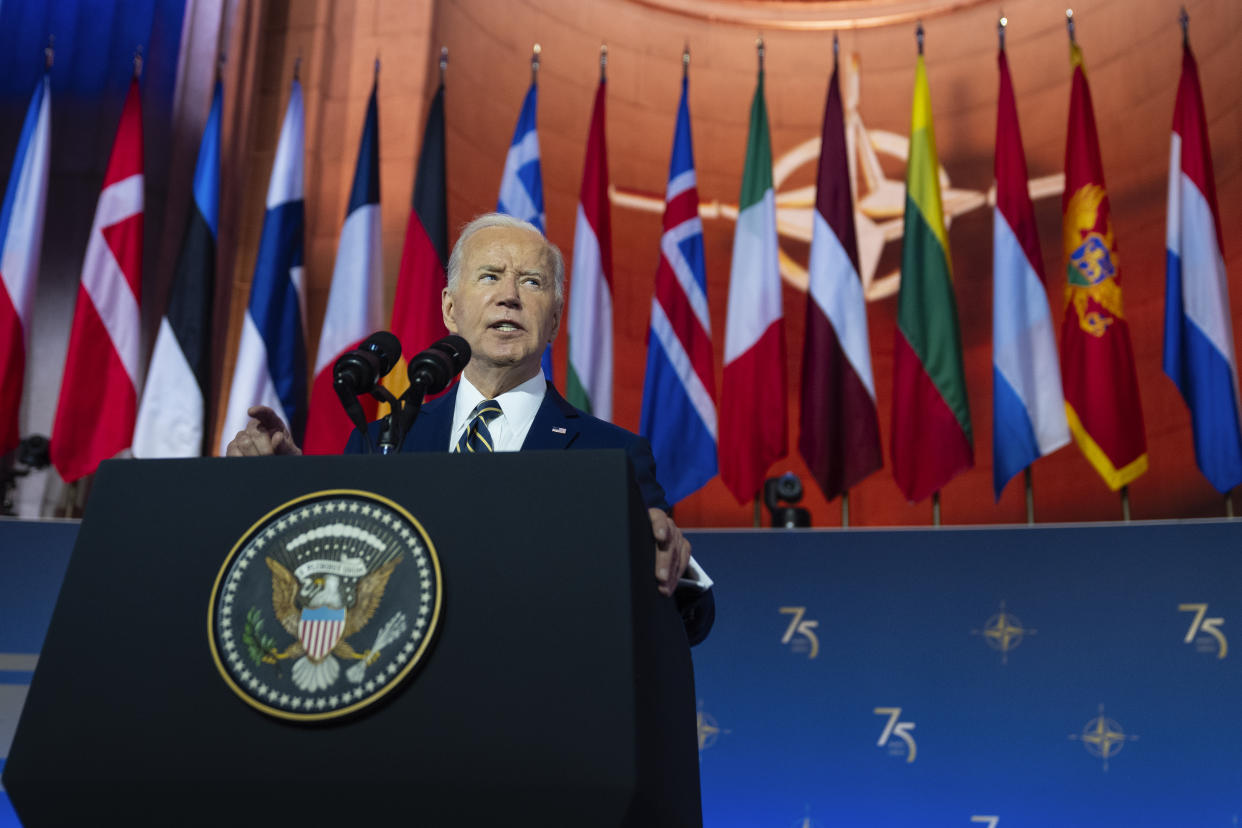
With the eyes of the world on him, President Joe Biden delivered a forceful speech to open the NATO summit in Washington, aiming to reverse doubts about his fitness for the job domestically while boasting that his leadership revitalized the storied alliance and saved Ukraine.
The address, which kicked off three days of high-profile meetings in the steamy U.S. capital, served as both a political and geopolitical test for Biden. With every speech, he must prove that age is just a number and that his shambolic debate performance against former President Donald Trump was a one-off bad night. And with every appearance at the NATO Summit this week, Biden must demonstrate he can still rally allies to Ukraine’s cause for the long haul.
“Ukraine can and will stop Putin,” he said at the ornate Mellon Auditorium in Washington. “Russia will not prevail. Ukraine will prevail.”
The president didn’t fumble over words as he often does during remarks. He was clear and forceful, appearing energized by the transatlanticism that he has embraced throughout his political career.
The speech was more than atmospherics. Biden used the occasion to announce the delivery of new air defenses for Ukraine, one of Kyiv’s top requests for this summit. The U.S. and four NATO allies — the Netherlands, Germany, Italy, Romania — will this year send four Patriot air-defense systems and related components as well as one SAMP/T system. In the coming months, Washington and its partners will also deliver dozens more tactical air-defense systems to bolster Ukraine’s security and expect to make similar announcements later in the year.
A critical part of the new assistance package will see some countries who have ordered air defense missiles from U.S. companies bumped down the list, as supplying those interceptors to Ukraine will take priority.
“Make no mistake: Russia is failing in this war,” Biden declared before noting that 350,000 Russian soldiers have been killed or wounded, with another 1 million people fleeing the country. “When this senseless war began, Ukraine was a free country. Today, it’s still a free country, and the war will end with Ukraine remaining a free and independent country.”
In a joint statement released shortly after Biden’s remarks, the president and the leaders of the Netherlands, Germany, Italy, Romania and Ukraine said: “Our message to Moscow and the world is clear: Our support for Ukraine is strong and unwavering.”
The move ends months of a U.S.-led search for air-defense systems to send to Ukraine and negotiations over how to procure them. Some nations didn’t want to part with the sophisticated defensive weapons, at least not before figuring out how to replace them. Last week, a senior Biden administration official told POLITICO “we’re shaking the hell out of the trees, and we’re going to get the highest number that we can.”
A boost in air-defenses was high on Ukraine’s list, as Russia’s superior arsenal allowed it to bombard cities and key military targets. On Monday, Russia overwhelmed Ukraine’s defenses in Kyiv, launching a deadly strike on a children’s hospital — one of Europe’s largest — leading surviving patients to receive cancer treatments on the street.
Andriy Yermak, head of Ukrainian President Volodymyr Zelenskyy’s office, told POLITICO reporters before the announcement that he was pleased his country would get more support, but he lamented that the delivery was unnecessarily “delayed” and should’ve been completed much sooner. “Now it’s necessary to close our cities,” he said, claiming these and future air-defense system transfers will better protect against Russian missiles and deter future barrages.
Biden will continue to be under a microscope this week as he manages a busy schedule, including a jam-packed Wednesday and a rare news conference on Thursday, when he will face questions about his age and mental acuity.
Biden will use the days ahead to reassure NATO allies — and skittish Democrats at home — that he’s up to the job of taking down Trump, as heads of state from Europe and North America prepare for the possibility of his predecessor’s return. The president has said the summit is a good venue for judging his abilities and has pointed to his leadership in rallying NATO support for Ukraine as evidence that he’s equipped to serve four more years.
With the potential of Trump’s return to power looming, the president has repeatedly highlighted his commitment to NATO, while warning voters that his predecessor would abandon the alliance if he returns to the White House.
Unlike in 2016, NATO allies are actively preparing to manage the return of a NATO-skeptic Trump administration. NATO officials are ramping up weapons production, consulting with Trump’s advisers and holding meetings to prepare for the former president’s return, and with that, an America-first, restraint-focused approach and a deep skepticism toward Europe.
The Most Interesting Justice on the Supreme Court Is Also the Loneliest
By Stephen I. Vladeck – July 8, 2024
Credit…Stefani Reynolds for The New York Times
When this Supreme Court term began last October, one of the more intriguing predictions from commentators was that Justice Amy Coney Barrett — entering her third full term on the court — would come out of her shell and emerge as the court’s new swing justice, casting the decisive vote in the most divisive cases.
The commentators got half of that right: There’s little doubt, in looking at the oral arguments the court has conducted and the decisions it has handed down over the past nine months, that Justice Barrett has found her voice — and has easily become the most interesting justice. Her questions at argument are penetrating; the analysis in her written opinions spares no one in its detail.
The second part of that prediction didn’t come true, though. Justice Barrett did side with some or all of the three Democratic appointees in several of the term’s most important cases — but her fellow conservatives seldom joined her. Indeed, while Justice Barrett was establishing her principled independence in the middle of the court, the other five Republican appointees moved only further to the right.
When the majority in the Colorado ballot disqualification case went further than necessary, and the Democratic appointees called them out for doing so, there was Justice Barrett — writing separately to chastise all of her colleagues for failing to send a unified message to the country. When Justice Clarence Thomas took too wooden an approach to assessing historical practice and tradition in a trademark case, there was Justice Barrett — pushing back in an important concurrence that was joined by Justice Elena Kagan and in part by Justices Sonia Sotomayor and Ketanji Brown Jackson.
When the Fifth Circuit allowed anti-vaccine activists and red states to bring an unprecedented lawsuit against the Biden administration built on the dubious claim that the government had coerced social-media networks into removing vaccine-related disinformation and misinformation, there was Justice Barrett — writing the majority opinion holding that the plaintiffs hadn’t come close to establishing that they had been harmed by the alleged government action and that the Fifth Circuit clearly erred in concluding to the contrary. And when the court sidestepped a highly charged dispute over emergency abortions in Idaho, it was Justice Barrett who wrote for the court’s “middle” in explaining why.
Even on Monday, when Justice Barrett otherwise joined the five other Republican appointees in holding that presidents enjoy at least some immunity from criminal prosecution, she went out of her way to push back against the majority’s most controversial holding — that protected conduct can’t even be used as evidence in criminal prosecutions against former chief executives.
Her partial concurrence offered a not-so-subtle road map to Judge Tanya Chutkan, presiding over the Jan. 6 prosecution, for how she might apply the majority’s new framework. Just as in her dissenting opinion in the Fischer v. United States case — in which the other Republican appointees, joined by Justice Jackson, voted to narrow a criminal obstruction statute used to prosecute Jan. 6 rioters — Justice Barrett was cleareyed about the threat to democracy Jan. 6 posed and the importance of holding to account those who were responsible for it.
This pattern has repeated in the more opaque context of emergency applications. In March, when the court briefly allowed Texas’ new state-level deportation regime to go into effect, it was a not-so-subtle nudge from Justice Barrett, in a concurring opinion, that prompted the Fifth Circuit to quickly put it back on hold (where it remains).
And in January, it was Justice Barrett who provided the fifth vote (joined by the three Democratic appointees and Chief Justice John Roberts) to allow the Biden administration to remove razor wire that Gov. Greg Abbott of Texas had placed along the U.S.-Mexico border — defusing what had been a brewing conflict between state and federal authorities in and around the town of Eagle Pass.
The justice reflected in all of these cases is someone who comes across in her writings as principled, nuanced and fair-minded — regardless of the bottom line that her votes end up supporting. Many of us may not agree with the principles reflected in her writings (like her majority opinion in a case holding that U.S. citizens don’t have a liberty interest in the immigration status of their noncitizen spouses). What cannot be doubted is that they are principles, and that, to an extent greater than many of her colleagues, Justice Barrett does her best to hew to them.
The problem that the court’s rulings at the end of the term drove home is that, as willing as Justice Barrett is to follow her principles even when they lead her away from Republican political preferences, the same can’t always be said of the other two justices in the court’s middle — Chief Justice Roberts and Justice Brett Kavanaugh. The chief justice wrote the majority opinion in Loper Bright Enterprises v. Raimondo, in which the court overruled its 40-year-old decision in Chevron — and the principle of deference to administrative agencies for which it stood. The chief justice wrote the majority opinion in Fischer, which narrowed the criminal obstruction statute so prevalent in Jan. 6 cases in blatant defiance of the principles of textualism to which the conservative justices are supposedly committed. And the chief justice wrote the court’s sweeping majority opinion in the Trump immunity case.
And it is the split between the five other Republican appointees and Justice Barrett in that last case that is most revealing. Whereas the majority mostly left application of its new and not exactly clear approach to presidential immunity to be hashed out by the lower courts, Justice Barrett “would have answered it now.” Whereas the majority went out of its way to punt on whether the charges against Mr. Trump can go forward, Justice Barrett was emphatic that, for at least some of the charges, she saw “no plausible argument for barring prosecution of that alleged conduct.”
And whereas the majority went out of its way to hold that immunized presidential conduct couldn’t even be used as evidence to try charges for which even the majority agrees there is no immunity, Justice Barrett criticized the majority and endorsed Justice Sotomayor’s dissent, noting that “the Constitution does not require blinding juries to the circumstances surrounding conduct for which presidents can be held liable.”
As with her dissent in the Jan. 6 obstruction ruling, Justice Barrett seems willing to accept that the court lives in the real world — and that the rules it hands down should be designed to actually work on the ground and to persuade those reading them that the court understands the limits on its proper role in our constitutional system.
In the end, this contrast is perhaps one of the defining — and most chilling — takeaways from the Supreme Court’s term: Justice Barrett came out of her shell. And the other Republican appointees retreated into theirs.
Stephen I. Vladeck is a professor of law at Georgetown, writes the One First weekly Supreme Court newsletter and is the author of “The Shadow Docket: How the Supreme Court Uses Stealth Rulings to Amass Power and Undermine the Republic.”
What Happened to the Originalism of the Originalists?
By David French, Opinion Columnist– July 7, 2024
Credit…Samuel Corum/Getty Images
When I read the majority opinion on Monday in Trump v. United States, which held that presidents enjoy absolute immunity for official acts within their “conclusive and preclusive” constitutional authority and presumptive immunity for all other official acts, I was genuinely and sincerely confused. The Supreme Court’s opinion is difficult to decipher, and in many important ways it is not originalist. For the second time this term — after Trump v. Anderson, which blocked efforts to remove Donald Trump from the ballot under Section 3 of the 14th Amendment — the court has reached a decision that’s truly difficult to square with the constitutional text.
What is going on?
I reject the simplest explanation — the explanation you can see plastered all over social media — that the court’s conservative majority is biased in favor of Trump. In this era of institutional collapse, I’m certainly more open to allegations of corruption or venality than I was in years past, but it’s hard to square this explanation with the judicial evidence. After all, if the conservative majority was truly in thrall to Trump, the election challenges in 2020 would have had a very different outcome. Instead, conservative judges at every level of the judiciary — including at the Supreme Court — rejected Trump’s specious arguments.
Even more, as I’ve explained in detail in long analyses in 2023 and 2024, in many other areas the court has specifically rejected MAGA legal arguments, including by dismissing a dangerous legal theory — called the independent state legislature doctrine — that was one of the cornerstones of Trump’s effort to overturn the 2020 election and would be the cornerstone of any future effort to disrupt election results.
Given this history, however, one would have expected a narrower immunity ruling in Trump v. United States and a narrower ruling in Trump v. Anderson. Instead, the conservative majority created a barrier to prosecuting presidents for even the most blatantly corrupt official acts and blocked any enforcement of Section 3 against candidates for federal office in the absence of congressional action.
In reading both decisions, I’m struck by the way the court’s conservative majority (with the partial and notable exception of Amy Coney Barrett) ultimately made a series of policy choices more than it engaged in the kind of close textual analysis that should be the hallmark of originalism. The court’s policy choices are rooted in real concerns, but they’re not textual, they should not be constitutional, and they contradict the wiser judgment of the founders in key ways.
If the court in Trump v. Anderson had upheld Colorado’s decision to remove Trump from the ballot, such a ruling would have raised the possibility that rogue state officials or a rogue judge could knock candidates off ballots for illegitimate reasons. And in Trump v. United States, there was an obvious concern that future presidents would wield their prosecutorial discretion in blatantly political ways, perhaps pursuing their political opponents by stretching broad federal criminal statutes to prosecute predecessors for their different policy choices, not for true corruption or criminality.
There is no question that it would be terrible for our democracy if states engaged in abusive attempts to limit candidates’ access to the ballot, or if presidents ordered prosecutions for political reasons. The court’s decisions in both cases go a long way toward preventing future injustices, including potential future injustices by Trump.
As a matter of pure policy, then,these Supreme Court rulings represent a credible choice. But I fear that the court’s originalist majority neglected its originalism.
The Supreme Court isn’t a policy-making body; it’s an interpretive body. Indeed, conservatives often deride any approach that injects the judge’s policy preferences into the textual analysis of the Constitution as a form of “living constitutionalism.” Yet in both cases it was the court’s liberal dissenters who made the better textual case for their position.
Let’s take, for example, the plain text of Section 3 in Trump v. Anderson. Section 3 begins with an unequivocal declaration: “No person shall be a senator or representative in Congress, or elector of president and vice president, or hold any office, civil or military, under the United States, or under any state” having taken a previous oath of office and then engaged in insurrection or rebellion against the Constitution or provided “aid and comfort” to the enemies of the Constitution.
The language is plainly mandatory. Yet the practical result of the Supreme Court’s opinion is to change the plain meaning to add a final, unwritten additional condition: Section 3 is enforceable against candidates for federal office only if Congress makes it enforceable.
Similarly, the court’s immunity ruling both adds to the Constitution and deviates from its text. You can read the entire document from cover to cover and not find a single reference to presidential immunity, and it’s not as if the founders were unfamiliar with the concept.
This is entirely consistent with a constitutional structure that is comprehensively anti-monarchical. The founders could have made the president more powerful and less accountable, but they chose the opposite course — and for good reason. They had fresh experience with the terrible consequences of consolidating power in the hands of one person.
Consequently, to the extent that the Constitution speaks at all to presidential criminal liability, it leaves the door wide open. The impeachment judgments clause limits the reach of an impeachment conviction to removal from office and disqualification from future federal office (in other words, impeachment convictions do not function like criminal convictions), but the clause also states, “the party convicted shall nevertheless be liable and subject to indictment, trial, judgment and punishment, according to law.”
The court’s ruling alters that clause — essentially changing the word “shall” to “may.” Even a party convicted after impeachment can still be absolutely immune from prosecution if he was acting while carrying out a “core constitutional power.” Even when the president’s official actions aren’t “core,” they’re still presumptively immune, presenting a high bar for prosecuting any official act.
I disagree with the conservative majority in both Trump cases, but not because I think the court is trying to do Trump favors or because I think its policy concerns are frivolous. There are legitimate reasons to worry about rogue prosecutions or rogue efforts to knock candidates from ballots.
I disagree with the Supreme Court’s rulings for the most basic reason of all — they do not square with the text of the document the justices are supposed to interpret, and that means they’re granting the presidency a degree of autonomy and impunity that’s contrary to the structure and spirit of American government. In both Trump cases, the liberal minority was more originalist than the conservative majority. This time, it was the conservatives who created a living constitution.
What is Project 2025? The conservative road map is raising a lot of eyebrows, on both sides of the aisle.
Katie Balevic – July 6, 2024
Project 2025 is a road map for the next Republican president.
The Heritage Foundation, a prominent conservative think tank, authored the plan.
It calls for eliminating the Education Department, among some other surprising things.
Well before the disastrous presidential debate during which President Joe Biden may have handed the keys to the White House back to former President Donald Trump, conservative thinkers were assembling a game plan.
In January 2023, The Heritage Foundation began promoting Project 2025, a 922-page “playbook” assembled with input from dozens of other conservative organizations to guide the next Republican administration.
“The time is short, and conservatives need a plan,” reads the website for the right-wing presidential transition plan. “The project will create a playbook of actions to be taken in the first 180 days of the new Administration to bring quick relief to Americans suffering from the Left’s devastating policies.”
Some of Project 2025’s priorities include:
Slashing employment in the federal government and muzzling “woke propaganda at every level of government”
Eliminating the Department of Education and its “woke-dominated system of public schools”
Prohibiting the FBI from fighting misinformation and disinformation
Ending the “war on fossil fuels” and allowing further development on Native American lands
Ending active FBI investigations that are “contrary to the national interest”
The plan is so extreme that even Trump has distanced himself from it, writing on Truth Social this week that he knows “nothing about Project 2025.”
“I have no idea who is behind it. I disagree with some of the things they’re saying and some of the things they’re saying are absolutely ridiculous and abysmal. Anything they do, I wish them luck, but I have nothing to do with them,” Trump wrote.
A spokesperson from Project 2025 told Business Insider that the playbook “does not speak for any candidate or campaign.”
“We are a coalition of more than 110 conservative groups advocating policy and personnel recommendations for the next conservative president. But it is ultimately up to that president, who we believe will be President Trump, to decide which recommendations to implement,” the spokesperson said.
Heritage faces blowback after ‘bloodless’ revolution comment
Emily Brooks – July 6,2024
The Heritage Foundation and its president, Kevin Roberts, are facing blowback in the wake of his comment about an ongoing second American revolution that will “remain bloodless if the left allows it to be.”
President Biden’s campaign jumped on the comment, with a spokesperson saying it shows that former President Trump’s allies are “dreaming of a violent revolution to destroy the very idea of America.” Commentators ranging from former GOP Rep. Adam Kinzinger (Ill.) to MSNBC hosts and guests reacted with alarm.
And in the wake of the comment, though without mentioning it, Trump distanced himself from Project 2025 — an initiative led by the conservative think tank that aims to provide a conservative policy blueprint for the next Republican administration and that has also ignited political firestorms.
Heritage and Roberts, though, are standing by the comment, dismissing the criticism as being in bad faith.
“Americans in 2024 are in the process of carrying out the Second American Revolution to take power back from the elites and despotic bureaucrats. These patriots are committed to peaceful revolution at the ballot box,” Robers said Wednesday in a post on the social platform X, continuing to describe the threat he sees and warning that “the Left may not allow a peaceful transfer of power.”
Heritage itself repeated the “bloodless” comment in a separate post on X alongside a compilation video of Democrats, commentators and public figures making controversial comments about unrest and protests.
“The Second American Revolution will remain bloodless if the Left allows it to be,” the Heritage post said. “Unfortunately, they have a well established record of instigating the opposite.”
Roberts made his original comment Tuesday on Steve Bannon’s “War Room” podcast — hosted that day by former Rep. Dave Brat (R-Va.), since Bannon reported to prison for his contempt of Congress sentence the day before — when discussing the Supreme Court’s ruling that presidents have presumptive immunity for official actions. The decision handed a win to Trump as he fights indictments over his attempts to overturn the 2020 election results.
“The left has taken over our institutions. The reason that they are apoplectic right now, the reason so many anchors on MSNBC, for example, are losing their minds daily, is because our side is winning,” Roberts said. “And so I come full circle on this response, and just want to encourage you with some substance. That we are in the process of the second American revolution, which will remain bloodless if the left allows it to be.”
For the Biden campaign, the comments were an opportunity to advance one of its core messages: that Trump is a threat to democracy.
“248 years ago tomorrow America declared independence from a tyrannical king, and now Donald Trump and his allies want to make him one at our expense,” Biden campaign spokesperson James Singer said in a statement. “On January 6, they proudly stormed our Capitol to overturn an election Donald Trump lost fair and square – something not even the Confederacy was able to accomplish – now they are dreaming of a violent revolution to destroy the very idea of America.”
Kinzinger, the former Republican congressman who is critical of Trump and has endorsed Biden, wondered about the implications of if the left did not “allow” a “bloodless” revolution.
“And if they dont? What if Americans decide they prefer to hash out differences as the constitution calls for, vis a vis politics, then what? Spell it out. If you can win politically then what?” Kinzinger said in a post on X.
And MSNBC host Joe Scarborough responded directly to Roberts’s quip about anchors on the network.
“First of all, Kev, I’m not losing my mind,” Scarborough began, later saying, “You’re the one talking about revolution. Why are you so angry, Kevin? Why are you losing your mind? America’s great. We’re strong militarily, we’re strong economically, we’re strong culturally … This whole idea that we need a new revolution — I mean, I know it is great fundraising, but it’s just B.S.”
The outrage about the comment builds on heightened attention on the leading conservative think tank and its advocacy group as it leads dozens of conservative organizations in Project 2025, which aims to compile policy proposals for the next right-wing administration.
Democrats and Biden’s campaign have repeatedly pointed to Project 2025 when warning about policies a Trump administration would enact if he wins in November, noting that former Trump administration officials have ties to it.
But in a signal that the project could have too many political liabilities for Trump’s electoral prospects, the former president said in a post on his Truth Social website Friday that he “know[s] nothing about Project 2025″ and has “no idea who is behind it.”
“I disagree with some of the things they’re saying and some of the things they’re saying are absolutely ridiculous and abysmal. Anything they do, I wish them luck, but I have nothing to do with them,” Trump said.
Neither Trump nor his campaign said the “bloodless” comment from Roberts impacted his statement, but Trump’s move to distance himself from the Heritage-led project further highlights the ideological controversies that the conservative think tank has embraced under Roberts’s leadership.
A spokesperson for Project 2025 posted on X that the coalition “does not speak for any candidate or campaign.”
A conservative leading the pro-Trump Project 2025 suggests there will be a new American Revolution
Ali Swenson – July 3, 2024
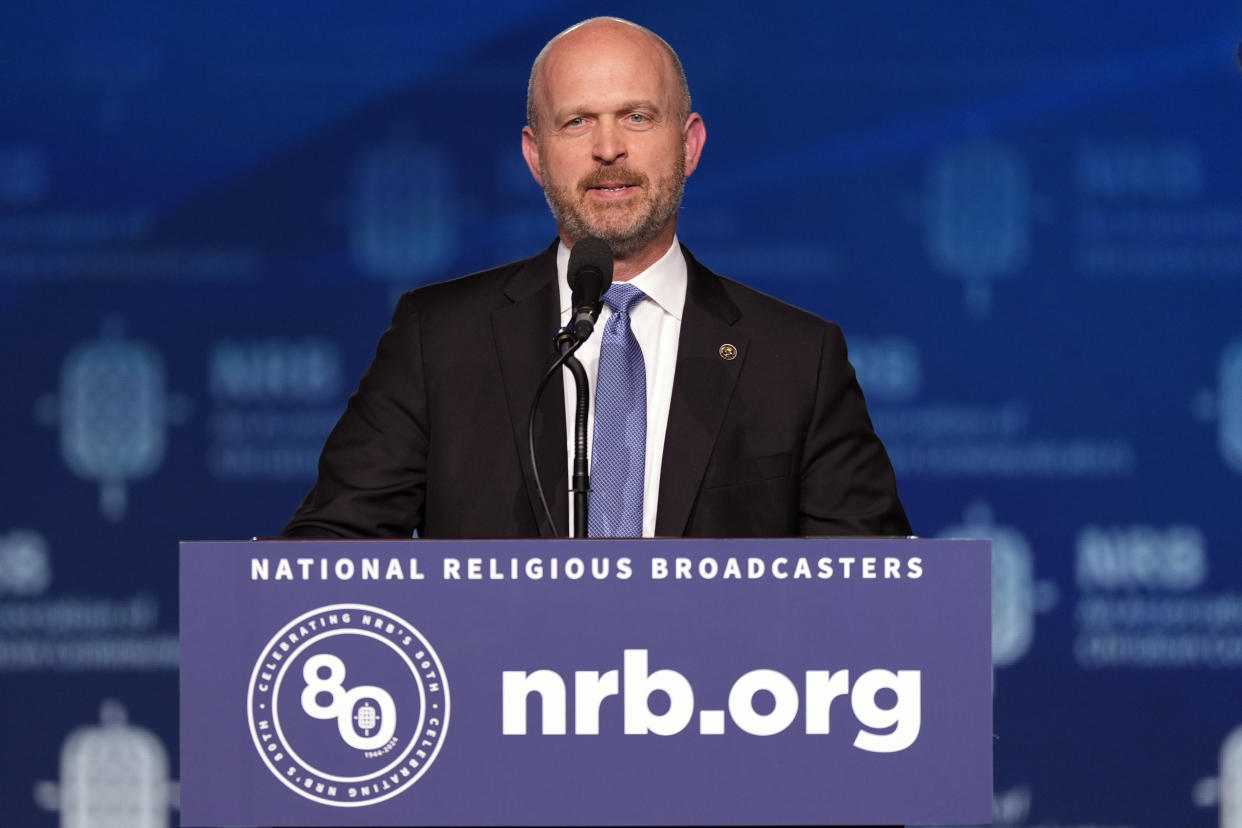
FILE – Kevin Roberts, president of The Heritage Foundation, speaks at the National Religious Broadcasters convention at the Gaylord Opryland Resort and Convention Center Feb. 22, 2024, in Nashville, Tenn. Roberts, the leader of a conservative think tank planning for a massive overhaul of the federal government says we are in the midst of “a second American Revolution” that will be bloodless “if the left allows it to be.” (AP Photo/George Walker IV, File)More
NEW YORK (AP) — The leader of a conservative think tank orchestrating plans for a massive overhaul of the federal government in the event of a Republican presidential win said that the country is in the midst of a “second American Revolution” that will be bloodless “if the left allows it to be.”
Heritage Foundation President Kevin Roberts made the comments Tuesday on Steve Bannon’s “War Room” podcast, adding that Republicans are “in the process of taking this country back.”
Democrats are “apoplectic right now” because the right is winning, Roberts told former U.S. Rep. Dave Brat, one of the podcast’s guest hosts as Bannon is serving a four-month prison term. “And so I come full circle on this response and just want to encourage you with some substance that we are in the process of the second American Revolution, which will remain bloodless if the left allows it to be.”
Roberts’ remarks shed light on how a group that promises to have significant influence over a possible second term for former President Donald Trump is thinking about this moment in American politics. The Heritage Foundation is spearheading Project 2025, a sweeping road map for a new GOP administration that includes plans for dismantling aspects of the federal government and ousting thousands of civil servants in favor of Trump loyalists who will carry out a hard-right agenda without complaint.
His call for revolution and vague reference to violence also unnerved some Democrats who interpreted it as threatening.
“This is chilling,” former Democratic presidential candidate Marianne Williamson wrote on the social platform X. “Their idea of a second American Revolution is to undo the first one.”
James Singer, a spokesperson for President Joe Biden’s reelection campaign, pointed to this week’s Fourth of July holiday in an emailed statement.
“248 years ago tomorrow America declared independence from a tyrannical king, and now Donald Trump and his allies want to make him one at our expense,” Singer said, adding that Trump and his allies are ”dreaming of a violent revolution to destroy the very idea of America.”
Roberts, whose name Bannon recently floated to The New York Times as a potential chief of staff option for Trump, also said on the podcast that Republicans should be encouraged by the Supreme Court’s recent immunity ruling.
He said Monday’s decision — which gives presidents broad immunity from prosecution — is “vital” to ensure a president won’t have to “second guess, triple guess every decision they’re making in their official capacity.”
In an emailed statement on Wednesday, Roberts reiterated his comments from the podcast, saying Americans “are in the process of carrying out the Second American Revolution to take power back from the elites and despotic bureaucrats.”
“These patriots are committed to peaceful revolution at the ballot box,” he said. “Unfortunately, it’s the Left that has a long history of violence, so it’s up to them to allow a peaceful transfer of power.”
Roberts pointed to the protests after the killing of George Floyd by police in 2020, some of which erupted into crime, vandalism and violence. Democrats, in turn, have accused their Republican counterparts of violence, using the Jan. 6, 2021, Capitol riot in which Trump supporters tried to forcibly overturn his loss to President Joe Biden.
Heidi Beirich, co-founder of the Global Project Against Hate and Extremism, said Roberts’ comments about a “second American Revolution” are “a bit terrifying but also elucidating.” The 1,000-page Project 2025 playbook calls for far-reaching changes in government, including rolling back protections for the LGBTQ community and infusing Christianity more deeply into society.
“Roberts, the Heritage Foundation, and its allies in Project 2025 want to reorder American society and fundamentally change it,” Beirich said. “He’s said the quiet part out loud.”
Trump seeks to disavow ‘Project 2025’ despite ties to conservative group
Nathan Layne – July 5,2024
Former U.S. President and Republican presidential candidate Donald Trump holds a campaign event in ChesapeakeHouse Freedom Caucus and others hold a press conference regarding federal government spending, in Washington
(Reuters) – Former President Donald Trump tried to distance himself on Friday from a conservative group’s sweeping plans for the next Republican presidency, days after its leader claimed a second American Revolution was underway that would “remain bloodless if the left allows it to be.”
The Republican presidential candidate renounced any connection with Project 2025, a plan Democrats have been attacking to highlight what they say is Trump’s extreme policy agenda for a second term should he beat President Joe Biden in the Nov. 5 election.
Many people involved in the project lead by the Heritage Foundation, America’s top conservative think tank, worked in the Trump White House and would likely help fill out his administration if he wins in November.
But Trump said on his Truth Social platform he had nothing to do with the plan.
“I know nothing about Project 2025. I have no idea who is behind it,” he wrote.
“I disagree with some of the things they’re saying,” he continued, adding some of their assertions were “absolutely ridiculous and abysmal.”
Trump’s post came three days after Heritage Foundation president Kevin Roberts’ comments on Steve Bannon’s “War Room” podcast about a second American Revolution. Democrats and others criticized what they viewed as a veiled threat of violence.
In a statement provided by a Project 2025 spokesperson on Friday, Roberts repeated his claim that Americans were carrying out a revolution “to take power back from the elites and despotic bureaucrats” and said it was the political left that had a history of political violence.
The spokesperson said that while Project 2025 provided recommendations for the next Republican president, it would be up to Trump, should he win, to decide whether to implement them.
Trump’s move to create distance with Project 2025 could in part reflect an effort to moderate his message in the final months of the race, especially with Biden’s campaign faltering after the Democratic candidate’s June 27 debate, said James Wallner, a political science professor at Clemson University.
“Trump is basically now seeking to appeal to a broader audience,” Wallner said.
The Biden campaign has stepped up its efforts to tie Trump’s campaign to Project 2025.
“Project 2025 is the extreme policy and personnel playbook for Trump’s second term that should scare the hell out of the American people,” campaign spokesperson Ammar Moussa said in a statement.
The 900-page blueprint calls for drastic reform of the federal government, including a gutting of some federal agencies and a vast expansion of presidential power. Trump’s statements and policy positions suggest he is aligned with some but not all of the project’s agenda.
The plans have been drawn up by the Heritage Foundation in coordination with a collection of other like-minded groups.
A number of people who worked on Project 2025 have close ties to the former president. Russ Vought, who was Trump’s director of the Office of Management and Budget and is heading up a key committee at the Republican National Convention, authored one of the project’s chapters.
Stephen Miller, a former senior adviser to Trump who is widely expected to be tapped for a top job in a second Trump administration, heads up a legal group on Project 2025’s advisory board.
(Reporting by Nathan Layne; Editing by Colleen Jenkins and Chris Reese)
Who Should Lead the Democratic Ticket? Six Columnists Weigh In.
Gretchen Whitmer, Kamala Harris, President Biden — who is best positioned to beat Donald Trump in November? July 4, 2024
By Charles M. Blow, Ross Douthat, David French, Nicholas Kristof, Pamala Paul and Lydia Polgreen
Produced by Derek Arthur, Sophia Alvarez Boyd, Vishakha Darbha and Jillian Weinberger
With President Biden’s candidacy in question, we asked six New York Times Opinion columnists: Who would you like to see as the Democratic nominee? Read their answers below. Or listen here:
Who Should Lead the Democratic Ticket? Six Columnists Weigh In.
Gretchen Whitmer, Kamala Harris, President Biden — who is best positioned to beat Donald Trump in November? Listen · 29:20 min
00:35: Lydia Polgreen on Vice President Kamala Harris
06:33: Nicholas Kristof on Gov. Gretchen Whitmer of Michigan
09:42: Ross Douthat on Senator Joe Manchin of West Virginia
13:55: Pamela Paul on Gov. Wes Moore of Maryland
18:10: David French on Gov. Josh Shapiro of Pennsylvania
23:57: Charles M. Blow on President Biden
Lydia Polgreen: Kamala Harris ‘Does Very Well in Going Up Against Bullies’
I’m Lydia Polgreen, Opinion columnist for The New York Times. Like many of my colleagues, I think it’s time for Joe Biden to bow out. And I believe that the best person to replace him is Kamala Harris.
She didn’t make it that far in the primaries, and that might make you think: This is someone who has tried and failed to become president — why would she be good on the national stage? But I think it’s important to remember that running in the primaries and running for the general election are actually two very different things.
In the primaries, you’re essentially running against your peers — in many cases, your fellow politicians from your party — and you’re arguing with them over smaller differences than the big differences that separate our politics in this very polarized time. And where gender and race actually play a huge role in terms of how people are perceived and where the showing of emotion or anger or other feelings play very differently, depending on whether you’re a woman, depending on whether you’re a person of color — that primary environment, I think, is actually quite complicated.
Those same dynamics can be at play in a general election, as well, but they’re actually much different in thisparticular general election, because Donald Trump is a very particular kind of politician.
I think one of the things that makes Kamala Harris really compelling in this environment is that we’re dealing with a bully. And she is a person who does very well in going up against bullies. She has a demeanor, she has a way of speaking that very much comes from her experience as a prosecutor that plays very well when dealing with someone who really is kind of outside the bounds of the law.
One of the things that was most troubling about the debate between Biden and Trump was that, unsurprisingly, Trump just spouted lie after lie after lie, The thing that was so devastating was that Joe Biden just seemed completely unable to counter those lies. And it’s just impossible to imagine that Kamala Harris, who is really a very successful debater, wouldn’t be able to just methodically come in and counter, point for point, every single thing that came out of Donald Trump’s mouth.
The Biden administration has put Kamala Harris front and center on the messaging about abortion rights, and rightfully so. Everyone knows that Joe Biden is not a great messenger on this issue. He has had a long history of ambivalence about choice. He is a devout Catholic, and I think it’s fair to say he does not feel particularly comfortable speaking in strident terms about a woman’s right to choose.
That is not a problem for Kamala Harris. She is a lifelong believer and fighter for this cause and would be an eloquent and powerful spokesperson for the issue as the nominee, just as she has been on the campaign trail as part of the ticket.
I think there are really two separate questions we need to ask ourselves. One question is: Would Harris be a good nominee? I feel, based on what we’ve seen, that actually she could make a pretty compelling case for herself as a strong candidate. Then there’s another question, which is: Would she make a good president? And in an abstract world where we weren’t weighing her against Donald Trump, that’s an interesting conversation to have.
One of the criticisms of her when she was a primary candidate was that there wasn’t a clear and compelling reason that she could give for why she should be president. What was her vision? And I don’t think that she solved that problem. But I think it’s important to remember that circumstances dictate who the right person is at any given time.
What is the need of the hour? The need of the hour is to somehow find a way to ease Joe Biden out of the presidency, somehow find somebody to take on Donald Trump. And so for me, the case for Kamala Harris is that she is the right person for that first part of the job. Which is, frankly, the most important part of the job.
This is an existential crisis. We cannot survive another Trump administration. Preventing Trump from winning the presidency, I think, has to be the paramount goal. I’m not saying that I don’t think that Kamala Harris would be a good president. She might very well be a great president. I have no idea. But I don’t think that that’s a question that we, frankly, have the luxury to ask right now. Because we know that Donald Trump would be a catastrophic president.
In order to have a vacancy, in order to have an opportunity to run another candidate, President Biden has to decide not to run. And that, ultimately, is his decision to make. And it’s going to be an excruciating and very hard decision.
And to me, part of the reason that anointing Kamala Harris, who is his vice president, is an easier thing to do than simply throwing it open to a brokered convention is that this is a natural order of things. You choose a vice president because you might not live through your entire term. That’s true of any president. I think it would be easier and less damaging for the party for President Biden to simply say, “You know what? I think my time is up. It’s time for me to pass the baton to the person you, the voters, voted into office as part of my administration to carry us forward.”
Nicholas Kristof: ‘Gretchen Whitmer Is the Best Biden Alternative’
I’m Nicholas Kristof, and I’m here with a case for Gretchen Whitmer, the governor of Michigan.
I’m rooting for Whitmer because the job of the nominee — and especially at a time when the stakes are so high, when Donald Trump is the opposition — the job of the nominee is to win. I do think that Governor Whitmer is particularly well placed to get votes in the handful of states that are in play.
For starters, Michigan is an absolute must-win state for the Democrats, and Whitmer has won it handily in both her races for governor. That suggests that she will also do well in nearby states like Wisconsin and Pennsylvania, and I think her pragmatism will also play well with centrists in states like Arizona and Georgia.
I think a Michigan governor is well positioned to ride the anti-incumbent, anti-elitist mood that we see among voters in the U.S. and just to generate excitement as a fresh face on the national scene, somebody from a new generation. And boy, I would just relish seeing how a dynamic younger candidate can force Trump on his heels and make him defend himself as the old guy with dubious mental acuity left in the race.
I’ve been following Whitmer ever since she was a state senator, and in 2013 she gave just an extraordinary speech for abortion rights that put her on the national map.
Audio clip of Gretchen Whitmer: I rise for my “no” vote explanation, as the Republican male majority continues to ignorantly and unnecessarily weigh in on important women’s health issues that they know nothing about.
Toward the end of that speech, she put down her notes and disclosed something that she had hidden from most people that was intensely personal.
Clip of Whitmer: Over 20 years ago, I was a victim of rape. And thank God, it didn’t result in a pregnancy, because I can’t imagine going through what I went through and then having to consider what to do about an unwanted pregnancy from an attacker.
She was emotional, raw, powerful and persuasive. And that speech marked her as a politician to watch.
Look, there are lots of uncertainties ahead. I have no idea what Whitmer’s foreign policy would be. But I do know that she’s a good speaker, that she has shown she can win over centrist voters and that she was only 1 year old when Biden was elected to the Senate. So in my view, Gretchen Whitmer is the best Biden alternative. Keep an eye on her.
Ross Douthat: Joe Manchin Would Be ‘the Most Moderate Candidate’
I’m Ross Douthat, and I’m a columnist for The New York Times. I’m here to make the case that the Democrats should nominate the senator from West Virginia Joe Manchin.
Much of the Democratic Party and many of my friends in the media are convinced that this election has almost existential stakes for the United States of America. And if that is the case, there is a reasonable argument for the Democratic Party to nominate someone who is as close to the center of American politics as you can get, with a long record of voting for Democratic causes. So, Manchin 2024.
I’ve thought Joe Manchin should run for president for a while. In 2023, I made the case that he should run as an independent. I thought, as a moderate Democrat, Manchin was well positioned to run basically, I argued, a kind of test-the-waters campaign.
But the reason to think of him as a plausible third-party candidate is also the reason to think of him as a plausible nominee for the Democrats — if their absolute goal is to defeat Donald Trump, no matter what.
Manchin is a guy who successfully managed to get elected to the Senate from West Virginia over the course of multiple election cycles where West Virginia was being transformed from a reliably Democratic state into a reliably Republican one. And his strategy always seemed to be: Pull a given piece of Democratic legislation more toward the middle (or toward the middle as he understood it), but be willing to vote for it when push came to shove.
He was more socially conservative in various ways on issues ranging from abortion to immigration. He tended to be more skeptical of large spending bills of all kinds, climate change legislation in particular. He did a lot of things, especially in the Biden era, that made more ideological Democrats incredibly frustrated with him. At the same time, he remained a pretty reliable vote for Democratic causes and programs and judicial nominations and everything else.
In imagining him as a Democratic nominee, you’re picking someone who in a different kind of era would have been the leader of probably a pretty big centrist faction in the Democratic Party. And so nominating him wouldn’t require the Democratic Party to radically shift its positions on almost any issue. It would be a unique signal to the country that the Democrats were willing to make a major ideological compromise, which is the kind of signal that, if you are determined to win the election at all costs, you want to be sending.
I think Manchin’s biggest challenge in the incredibly unlikely event that he was the Democratic nominee is that because he is a moderate who is despised by key activist groups in the Democratic coalition, most Democrats are just not going to turn out for someone who spent the Biden years trying to make Joe Biden’s agenda more moderate and sometimes contributing to derailing it.
That’s always the problem with trying to nominate the most moderate candidate: You risk alienating your own base. But I think in this scenario, given the lateness of the hour and Donald Trump as the presumptive Republican nominee, that what you would gain among swing voters would outweigh what you would lose in the party’s base.
Both political parties have nominated candidates for president who are broadly unacceptable to the middle 30 percent of Americans, and it would probably be useful for the country if one of the two parties tried to nominate someone who was much more acceptable to Americans in that middle ground.
Pamela Paul: Wes Moore Could ‘Energize the Electorate’
I’m Pamela Paul, an Opinion columnist for The New York Times, and I’m here to make the case for Wes Moore as the Democratic candidate for president.
Wes Moore is the first-term governor of the State of Maryland. So, relatively inexperienced in politics but with a broad range of experience before coming to politics. He has served in the military, including serving at war in Afghanistan. He’s worked in the private sector in investment banking. He has foreign policy experience and expertise, and he’s published five books, including books for young people.
As the former editor of The Book Review, I’ve been aware of Wes Moore for a long time as an author, and that’s how I often thought about him. I first met him out at Stanford University, where he was participating in a conference about revitalizing American institutions. He and Gov. Chris Sununu, Republican of New Hampshire, did a panel together in which they had a really lively, interesting conversation.
Audio clip of Chris Sununu: I’m absolutely honored to be here and to be with Wes who I consider a great friend. He’s a great governor.
And the thing that struck me most about their conversation is that they were friends, even though they are from very different sides of the political spectrum.
Chris Sununu, as the more experienced governor, has given advice to Wes Moore, and Wes Moore called him his best adviser as a governor.
Clip of Wes Moore:When I think about some of the governors who are the most helpful to me, as I made the transition, because I’d never run for office before I became governor. People can think about “It’s this governor, that governor, which political party.” The reality is, you’ve been one of the most helpful governors to me in this transition. And that’s a Republican governor.
And I thought that was remarkable because, as we all know, we live in a hyperpartisan time.
And something that really came out in their conversation was that, as governors, you need to get things done. You need to balance a budget. You cannot just not vote. You cannot just slide by. It’s not like the Senate. And one of the reasons I think that Governor Moore is one of the best-equipped people to assume the presidency is that as a governor, he has better experience than many people who have served in Washington for a long time.
I think his relative youth could shake up a campaign that no one is happy with between two geriatric candidates. He could energize the electorate. I think that he could win and govern well and he could really usher in a new era of leadership for Democrats. I mean, how have we gotten into a situation where we have an 81-year-old man who’s been in politics his entire life as being our candidate when it’s clear that Americans are not happy with how things are going and with the current direction of this country?
The No. 1 thing people will say about Wes Moore is that he doesn’t have the experience necessary, that it’s not his time yet. But first of all, I feel very frustrated with the “it’s his time” or “it’s not his time” thinking because when Biden was running, everyone thought, “Oh, it’s his time. He deserves it.” When Bob Dole was running: “Oh, it’s his turn. He deserves it.” This is a way to lose a campaign.
This is not about making someone feel better. This is about what’s doing right for the country. And Wes Moore, though he may not have a lot of governmental experience, he certainly has a lot more experience than Donald Trump did coming on.
And in fact, I think his relative inexperience would work in his favor because people are looking for someone to bring a new perspective who is not afraid of change, who can draw from a wide range of experience outside Washington and who’s shown that he knows how to solve problems and lead.
David French: Josh Shapiro Would Be a Choice Americans Can Feel ‘Unambiguously Good About’
I’m David French. And I’m here to make the case that Josh Shapiro should replace Joe Biden on the top of the Democratic ticket.
Until 2016, I was a Republican. I’m still conservative. I’m a conservative in the Reagan conservative mold. So it is very unusual for me to be giving any kind of advice to the Democratic Party. However, I am of the belief that Donald Trump needs to lose in 2024 for the health of the country, for the health of our Constitution and for the health, honestly, of the Republican Party and the conservative movement. And so I want to see the best possible Democrat face Donald Trump in 2024.
Josh Shapiro is the first-term governor of Pennsylvania, a former attorney general of Pennsylvania and a former member of the State House of Pennsylvania.
I think there are multiple reasons Josh Shapiro would be a very good pick. And we can start with ideology, we can go to temperament, and then we can end with location, location, location.
So, ideology. Josh Shapiro is a more moderate or centrist Democrat. There are a number of initiatives, for example, in the State of Pennsylvania, that he has broken with his party on, at least to some degree, to move toward the center. For example, he has advocated for lowering corporate tax rates in Pennsylvania, the kinds of things that Republican voters would either appreciate or at least see that this person is not an ideological extremist, but somebody who’s willing to reach out across the aisle.
He’s somebody who ideologically is much closer to the exact kinds of voters who helped give Joe Biden the presidency in 2020, a lot of these suburban voters and college-educated women and others, many of whom voted Republican in the past. He seems to be much more in line with the bulk of the American people than somebody who’s more on the left side of the Democratic Party.
And then let’s talk about the really important aspect of temperament. This is a guy who really, by and large, has a pretty measured tone, an ideal way of confronting someone like Donald Trump, who really needs to be meticulously rebutted in all of his falsehoods. Dismantling these wild statements that Donald Trump has made and doing so in a calm and measured way, I think, is exactly what the doctor ordered for the public square. It would, in many ways, be a restoration of the way we think about the presidency: that we’re not just electing a vehicle for an agenda but a human being who we could actually have a degree of trust in.
And then finally, he has the advantage of location, location, location — the three most important things in real estate. He’s a popular governor in a key swing state. This is perhaps the key swing state in the 2024 election. And this is something that’s really important not just for the sake of Pennsylvania but other swing states. I think there’s some real possibility there that he’s actually a good cultural fit for some of these swing states.
And there’s one other thing I didn’t mention: He’s relatively young. He was born in 1973. He’s a Gen X-er. And this contrast between a Gen X candidate who’s reasonable, who’s sober, who’s sharp as a tack, against a 78-year-old man who physically is able to sort of cover up his decline but cognitively is capable of the exact kinds of word salads that we saw come out of Joe Biden’s mouth in the debate — the contrast, I believe, would be very real and very obvious and exactly the kind of contrast that the American people are looking for.
And so these are all things that I think speak strongly in his favor, but I’m not going to pretend that it’s just a no-brainer of a decision. There are also some downsides that come with Josh Shapiro. Nothing major or glaring, but there’s two right away that you can think of. One, he’s a first-term governor. He’s not had a complete term as a governor, so there would be some questions about experience. It also has to be acknowledged that nobody knows who he is. If you’ve tuned into this and you knew who Josh Shapiro was before you tuned in, you’re either a Pennsylvanian or a political nerd. And nothing against political nerds — I’m one of you — but it’s just part of the challenge that you have when you’re trying to introduce yourself to the American people.
But on balance, when you’re talking about the identity of a candidate: Is he a man for the moment? It’s not simply the case that you can say people want anyone not named Donald Trump. That’s not where the American people are. They’re wanting a choice that they can feel unambiguously good about. And the debate performance, I think, robbed Biden of that message now and for the rest of the campaign.
Here is a different candidate people can be voting for, as opposed to purely voting againstDonald Trump.
Charles M. Blow: ‘Joe Biden Should Not Be Forced Off the Ticket’
I’m Charles Blow, an Opinion columnist at The New York Times. And while a lot of my colleagues are making the case for replacements for Joe Biden, I’m making the case that Joe Biden should not be forced off the ticket.
I assume that most people who want to replace Joe Biden want the exact same thing that I want, which is to prevent Donald Trump from being re-elected as president of the United States.
If that is the goal, then you have to go with the person who has the best chance of defeating him. And I think that for right now, that person remains Joe Biden.
There is no evidence that any of the other candidates who have been proposed as possible replacements for Joe Biden would do better than Joe Biden. There is no F.D.R.-, Barack Obama-like candidate waiting in the wings whom everyone knows and who is going to galvanize the Democratic Party.
The people in Louisiana do not know the governor of Michigan. The people in North Carolina do not know the governor of California. And we are saying that somehow in a brokered convention at the end of the summer with only three months to go, you could put forth a virtually unknown person to the country and that somehow that would be better than sticking with a person whom we already know.
In addition to that, a brokered convention would mean that the voters would not have a say in who the candidate is. There would be no direct voting for the person the Democrats put forward. These would be delegates. Some of them are elected officials, and I guess you could say that elected officials are kind of secondhand representatives of the people. So people did vote for the elected officials, and if they vote for the candidate, maybe that makes you feel a little bit better.
But delegates are also party leaders. No one voted for these party leaders. These are just people who have participated and won favor and people like them. Those are the people who would pick the candidate? That is not democratic. That doesn’t feel like the business that the Democratic Party would want to be in, which is having the candidates produced not by the voice of the people but by the voice of the insiders.
This has become an election about people who are for democracy and those who are not for it. It has nothing to do with the individual people and the individual characters and their individual competency.
So I’m not trying to convince anyone that Biden is your best candidate, he’s a fantastic person, shooting on all cylinders and full of verve. I’m just saying that as it stands, he is likely your best option to prevent catastrophe. None of these candidates are people that I’m going to say, ‘Oh, I’m just jumping up and down because this person is so electric and magnetic.”
I’m simply saying, “Do you want to keep a country or not? Where’s your best chances of keeping the country that you know and you love and that will have a chance to fight again one day with different candidates who may be younger, may be more to your tastes?”
I am convinced that people are not scared enough yet. I don’t think that people will be turning out for Biden. They’ll be turning out against Donald Trump.
I don’t need a champion in the White House this cycle. What I need is someone to hold the White House and to hold the country in its current customs, in its current structure, so that the next cycle, maybe we have better options that we can be excited about.
Joe Biden is already strapped to the rocket. At this point, he remains the best option.
Credit…Illustration by The New York Times; photographs by Kevin Lamarque/Reuters, Laurent Cipriani, Matt Rourke, and Evan Vucci/Associated Press, Andrew Harnik and Kent Nishimura/Getty Images
This episode of “The Opinions” was produced by Jillian Weinberger, Vishakha Darbha, Derek Arthur and Sophia Alvarez Boyd. It was edited by Kaari Pitkin, Alison Bruzek and Annie-Rose Strasser. Engineering by Sonia Herrero, Isaac Jones, Pat McCusker and Carole Sabouraud. Mixing by Sonia Herrero, Pat McCusker and Carole Sabouraud. Original music by Carole Sabouraud, Isaac Jones, Efim Shapiro, Sonia Herrero and Pat McCusker. Fact-checking by Kate Sinclair and Mary Marge Locker. Audience strategy by Shannon Busta and Kristina Samulewski. Our executive producer is Annie-Rose Strasser.
Charles M. Blow is an Opinion columnist for The New York Times, writing about national politics, public opinion and social justice, with a focus on racial equality and L.G.B.T.Q. rights.
Ross Douthat has been an Opinion columnist for The Times since 2009. He is the author, most recently, of “The Deep Places: A Memoir of Illness and Discovery.”
Nicholas Kristof became a columnist for The Times Opinion desk in 2001 and has won two Pulitzer Prizes. His new memoir is “Chasing Hope: A Reporter’s Life.”
Pamela Paul is an Opinion columnist at The Times, writing about culture, politics, ideas and the way we live now.
Lydia Polgreen is an Opinion columnist and a co-host of the “Matter of Opinion” podcast for The Times.
There Is Apparently No Accountability — Ever — for Donald Trump
By Frank Bruni – July 4, 2024
Mr. Bruni is a contributing Opinion writer who was on the staff of The Times for more than 25 years.
Credit…Ben Wiseman
We tell children — or at least we used to — that actions have consequences. What goes around comes around. Watch your behavior. You’ll answer for it someday.
Donald Trump is the living, lying contradiction of that.
He answers for nothing. He’s accountable to no one.
You thought that changed with a Manhattan jury’s verdict five weeks ago? With “guilty” on all 34 counts? How adorable. That only bound most of his supporters even closer to him. Only amplified the theatrical ardor with which Republican politicians pledged their devotion. Only increased donations to his presidential campaign.
The House of Representatives impeached him twice, but a cabal of collaborators in the Senate chose tribalism over justice and made it all go away. They said that it was up to others to decide if he’d committed crimes, up to others to punish him for those. It was up to them to get re-elected.
The voters repudiated Trump, but he simply pretended it hadn’t happened. He invented dark conspiracies and embroidered wild fantasies to turn defeat — by seven million votes, no less — into supposed victory. Into full-blown martyrdom. He cried “rigged,” he cried “stolen,” he stood by as a mob stormed the Capitol and stood mute as it chanted for his vice president to be hanged. For that ethical savagery the members of his political party lined up dutifully behind him once again. David Koresh never knew loyalty like this.
Trump schemed to steal the election himself. Prosecutors rightly charged him for that. But he has lawyers upon lawyers. He has gall atop gall. He has Fox News, Newsmax, Stephen Miller, Steve Bannon. He has that rogue Supreme Court stacked in his favor, thanks to his and Mitch McConnell’s brazen stacking of it. Its justices have kicked the can so far down the road that it has tumbled into a different galaxy, a different cosmos, one where there’s no moral gravity, where transgressions vanish and worries disappear with the abracadabra of executive privilege.
Trump’s unpopularity with most voters should be a much bigger obstacle for him and a much bigger opportunity for Democrats than it is. Time worked in his favor, as it has so often in the past. It stiffened his political rival’s gait. Weakened his political rival’s voice. President Biden can’t answer Trump’s outrages with optimal passion, ideal precision, laser-guided disdain. He’s Trump’s better in decency, many times over. He’s Trump’s lesser in lung power, and in an age of invective, that matters.
Creditors left in the lurch. Accomplices left holding the bag. (Here’s looking at you, Rudy Giuliani.) Spurned associates. Appeals and delays and delays and appeals. Attorney General Letitia James of New York won her fraud case against Trump, but it doesn’t seem to have hobbled him at all. It’s seldom even mentioned anymore. E. Jean Carroll won her sexual abuse and defamation case. He swaggered (and slandered) on.
Trump has made a career of evasion. No, he has made a legend of it. And while there’s a kind of smarts and a sort of skill in that, it owes more to luck than to brilliance. It owes the most to the perverse freedom that comes with a total lack of conscience — with the readiness to stoke people’s darkest fears and cruelest impulses, to shrug at the damage done, to bilk charities, to run a sham university, to tell little lies, to tell big ones, to place self-promotion and self-preservation so far above everything else that they’re not so much his guiding values as his only ones.
All of that has gone around. When exactly is it coming around?
Perhaps we owe children a new adage, as oversimplified as the ones with which I began but no less true: The shameless shall inherit the earth, while the blameless grapple with the mess they make of it.
The Long Trump Tease
The wait for Donald Trump’s announcement of a running mate will apparently continue into next week.
Let’s not pretend for a second that this is a normal process.
I don’t mean Trump’s hyping of the suspense, as if he’s engaged in some reality-show reveal. I mean this: Whoever is willing to be considered has made that decision despite Trump’s attempt after the 2020 election to get Mike Pence, his vice president the first time around, to ignore the will of American voters and violate the Constitution. Despite Trump’s reported equanimity with calls for Pence’s execution. That bespeaks not only a perilously high tolerance for risk but also a rapacity for power at odds with responsibly wielding it. Which is to say that the reputed finalists for the Republican vice presidential nomination complement Trump beautifully.
But the argument for many of them ends there. J.D. Vance? His singular mix of contemptuousness and smarm should be patented — and then promptly outlawed. Doug Burgum? Proof that plutocrats can be as dull as the rest of us. Tim Scott? An unctuous blur. Tom Cotton? He scares small children and many forest animals.
Keep an eye on Marco Rubio. Sure, he’d have to resign his Senate seat and establish a primary residence somewhere other than Florida to join the ticket, but that’s nothing compared to stepping into Pence’s old cement shoes. And while it took Rubio a while, he has now traveled — now completed — the modern Republican arc from being appalled by Trump to being in thrall to him.
For the Love of Sentences
Credit…Samuel Corum for The New York Times
In The New Yorker, Susan B. Glasser reflected on a micro-tussle toward the end of last Thursday night’s presidential debate: “Is this how democracy dies, in a shouting match between two seniors about their golf game?” (Thanks to Mike Greenwald of Melville, N.Y., for nominating this.)
In The Connecticut Post, Colin McEnroe pondered the president’s proper course: “I’m guardedly a ‘replace him’ guy. Some of you may recall that in 2019, I compared Biden to a Subaru with 310,000 miles on the odometer. ‘America has gotten a lot of use out of Joe Biden, and now it’s time to leave him by the side of the road, unscrew the plates, and walk away,’ I wrote. I was wrong … ish. He turned out to have deeper treads and more left in his tank than I had supposed. But Thursday night was 90 minutes of the ‘check engine’ light flashing desperately in the darkness.” (Holly Franquet, Fairfield, Conn.)
In The Times, Maureen Dowd acknowledged Biden’s gracious response to her tough coverage of him over the years: “He was so un-vengeful, I doubted he was Irish.” (Nancy Jackson, Taos, N.M., and Peter J. Geisser, Cranston, R.I., among others)
In The Atlantic, Caitlin Flanagan evaluated Americans’ attitudes toward NATO over time (and worked in a reference to a recent movie directed by and starring Jerry Seinfeld): “From age to age, a new generation of supporters must be rallied, and that is becoming the 13th labor of Hercules. If the thudding disappointment of ‘Unfrosted’ taught us anything, it’s that young people hate boomer nostalgia. And NATO is the rotary phone of geopolitical alliances.” (Richard Reams, San Antonio)
To return to The Times, Rory Smith explained the hubbub in Britain over the soccer commentator Gary Lineker’s uncharacteristically negative appraisal of England’s performance in the Euro2024 tournament: “To the public, Lineker is supposed to be the embodiment of neutrality. Hearing him be so scathing is akin to seeing David Attenborough pummel a dolphin.” (Ian Wallace, Wilmington, Del.)
Margaret Lyons appraised a beloved television show. “‘The Bear’ has an arms-length relationship to sex and romance, and that was one of its zestiest calling cards in Season 1: plenty of knifing, but no forking or spooning,” she wrote. (Jonathan Gerard, Durham, N.C., and Lee Burdette Williams, Mystic, Conn., among others)
And Margaret Renkl connected her concerns about fireworks to her concerns about America: “The conflation of selfishness with patriotism is the thing I have the hardest time accepting about our political era. Maybe we have the right to eat a hamburger or drive the biggest truck on the market or fire off bottle rockets deep into the night on the Fourth of July, but it doesn’t make us good Americans to do such things. How can it possibly be ‘American’ to look at the damage that fireworks can cause — to the atmosphere, to forests, to wildlife, to our own beloved pets, to ourselves — and shrug?” (George Fero Jr., Chicago)
On a Personal Note
Credit…Getty Images
A reader wrote to me a few weeks ago to describe her recent vision loss and to ask for my advice — based on my own, somewhat similar situation — about how best to cope. She’d both read and listened to my memoir on the topic, “The Beauty of Dusk,” but she wondered if I had more to say.
I guess I do, if only because three years have passed since I finished that book. I’ve had additional experiences and reflections.
By her account, her eyesight is much more gravely diminished than mine, raising questions about the work she can and cannot continue to do. I’m hugely blessed — while I need to pace myself carefully and devote extra time and effort to tasks that I once accomplished with relative ease, my professional life remains much the same. So I offer the following observations humbly, knowing that some of them may have wide application and some not.
I cut myself more slack than I used to. I forgive myself for small mistakes (typos related to the sporadic blurring of my vision), medium-size hiccups (the occasional need to request a deadline extension) and what can feel like discourtesy (emails unanswered and invitations declined because of the limits of my focus and energy).
And I resolve, as best as possible, to see that permission as its own kind of gift. Throwing off the yoke of perfectionism or its lesser kinfolk can be liberating. It doesn’t compensate for loss, but it helps enormously with the adjustment to it. There are people who slow down voluntarily; I’ve slowed down involuntarily. That still leaves me in a place not wholly unlike theirs.
Also? I let myself get mad — at judiciously staggered intervals, in rigidly contained increments. I pounded my desk just the other day because the words on my screen began to shimmy and the words on the printouts that I’d made in case that happened were doing their own ugly dance. That necessitated a half-hour break that I didn’t think I could afford. Not fair!
So I seethed, not for a few seconds but for several long minutes, rationalizing that I couldn’t make more productive use of the time and then realizing that this was productive use of the time. It was a warranted exhalation of frustration, a worthwhile release of pressure. I was a laptop shutting down and rebooting. I was a drain being unclogged.
And then I was OK, or at least OK enough for a new keystroke, and then a keystroke after that. One foot in front of the other. It’s the strategy for any journey, slow or fast, long or short.
Frank Bruni is a professor of journalism and public policy at Duke University, the author of the book “The Age of Grievance” and a contributing Opinion writer.
Forcing Biden Out Would Have Only One Beneficiary: Trump
By Charles M. Blow, Opinion Columnist– July 3, 2024
Credit…Tom Brenner for The New York Times
Joe Biden refuses to drop out of the presidential race even as some liberals, rattled by the incumbent’s frightening debate performance last week, keep pressuring him to do so.
Who’s surprised by that?
The inertia of a presidential campaign is one of the most powerful forces in politics. Ending one after a party’s nomination has been secured is almost unfathomable. The candidate is already strapped to the rocket.
Furthermore, all serious presidential contenders, particularly those who hold or have already held the office — this year, we have both — have a God complex. They must. And doubt doesn’t exist in the presence of God. There are throngs of advisers, boosters and confidants around Biden to keep that doubt at bay; to introduce it is blasphemy.
Biden can’t be forced out of the race; he would have to be persuaded to leave it. And that eventuality, while not impossible, lives next door to “Never!”
And Biden staying the course may be the best course.
The American University historian Allan Lichtman, a prescient predictor of presidential election results, told me on Sunday that pushing Biden out of the race would be a “tragic mistake for the Democrats,” because he believes that the president remains his party’s best chance at winning the election.
As for the alternatives, Lichtman adds, “It’s not as if there’s some, you know, J.F.K. out there just waiting to jump on the white horse and save the Democratic Party.”
I agree with him: There are no potential replacements that would stand a better chance of defeating Donald Trump than Biden.
Yes, a CNN-SSRS poll conducted in the days after the debate found that Vice President Kamala Harris performed slightly better than Biden against Trump, within the margin of error but still trailing. (But note that a brand-new Reuters-Ipsos poll found that only one-third of Democrats think Biden should exit.)
If Biden were replaced, yes, Harris would be Democrats’ safest option. But approval ratings and standings in one poll before she becomes the actual candidate could be a bit of a mirage.
During stretches of Hillary Clinton’s time in the Senate and her tenure as secretary of State she enjoyed solid approval ratings, but when she ran for president against Trump, her approval numbers gradually diminished.
There were lots of reasons for this, and one of them, I am convinced, is the patriarchal nature of our society. That would likely be revisited for Harris, only this time amplified by patriarchy’s twin evil: racism.
Harris is competent and capable, regardless of what her needling detractors suggest, but unfortunately, I do not believe that she is more electable than Biden in the current climate.
Yet if Biden did stand aside and Harris was passed over in favor of another candidate, there would very likely be strong protest from her legions of Democratic supporters, many of them Black women, a voting bloc that is essential to a Democratic victory.
On top of that, a free-for-all selection process would be sheer chaos. Factions would fiercely compete, egos would be bruised and convention delegates would select a candidate, effectively bypassing direct participation by Democratic voters.
This would all play out just a few months before Election Day, and opposition researchers would have a field day vetting the list of probable Democratic alternatives, several of whom are governors with only regional name recognition, increasing the possibility of a devastating October surprise.
To be clear: I’m not saying that Biden should continue to run because an eventual victory is assured. It isn’t. He was struggling before the debate kerfuffle and will continue to struggle if he survives it.
Trump’s support has gelled while Biden’s has frayed. Many Americans haven’t felt the benefits of what is a structurally sound Biden economy, and the young, activist portion of the Democratic base is angry about Biden’s handling of the war in Gaza.
I, like many others, wish Biden hadn’t sought a second term. I wish that the Democratic nominee was a young visionary with verve.
But retrospective wishing is worthless.
Biden is the Democratic candidate. He’s the only person standing between us and Trump’s destructive, retributive impulses and the ever-increasing latitude that the Supreme Court has granted him.
The fact that an 81-year-old is increasingly showing signs of being an 81-year-old doesn’t panic me; what Trump has signaled he’ll do with another term does.
There’s another way that calls for Biden’s withdrawal could backfire on liberals. One of my favorite TV lines comes from Omar on “The Wire,” paraphrasing Emerson: “You come at the king, you best not miss.” A failed attempt to usurp a man in power risks his vengeance.
But I’ve been thinking of that line in another way as it relates to Biden. By building a case for Biden’s incapacity and his need for capitulation — without convincing him of the same — liberals risk further wounding their standard-bearer and increasing the probability of the thing they most desperately seek to avoid: Trump’s re-election.
And if Biden should decide to leave the race, as The Times reported on Wednesday that he is considering, his withdrawal would only add credence to the idea that some Democrats had, in effect, conspired to conceal a disqualifying impairment and only changed course when forced. The taint of this would linger over the party and any replacement candidate.
Instead of clearing the way for victory, liberals may well be paving the way for defeat.