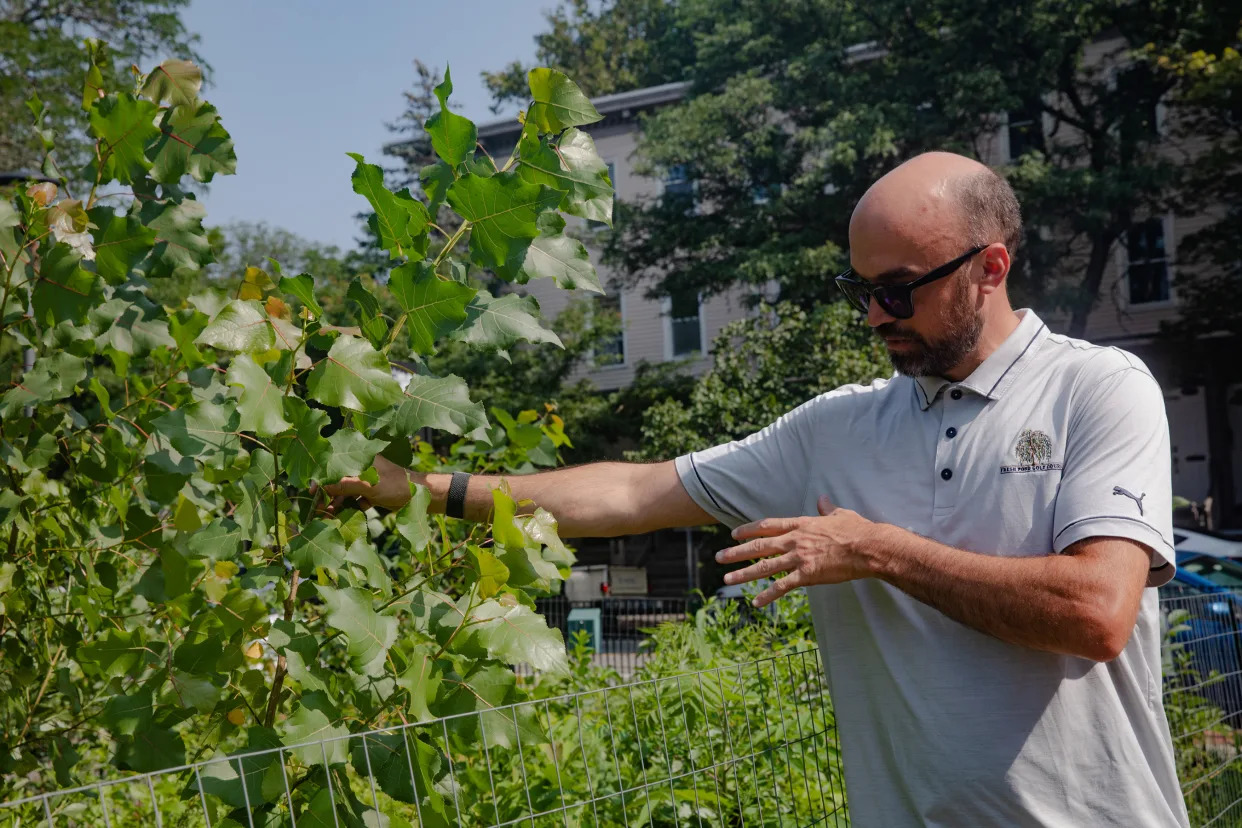
Andrew Putnam, superintendent of urban forestry and landscapes for the city of Cambridge, Mass., in Danehy Park, near Harvard University, July 26, 2023. (Cassandra Klos/The New York Times)
The tiny forest lives atop an old landfill in the city of Cambridge, Massachusetts. Although it is still a baby, it’s already acting quite a bit older than its actual age, which is just shy of 2.
Its aspens are growing at twice the speed normally expected, with fragrant sumac and tulip trees racing to catch up. It has absorbed stormwater without washing out, suppressed many weeds and stayed lush throughout last year’s drought. The little forest managed all this because of its enriched soil and density, and despite its diminutive size: 1,400 native shrubs and saplings, thriving in an area roughly the size of a basketball court.
It is part of a sweeping movement that is transforming dusty highway shoulders, parking lots, schoolyards and junkyards worldwide. Tiny forests have been planted across Europe, in Africa, throughout Asia and in South America, Russia and the Middle East. India has hundreds, and Japan, where it all began, has thousands.
Now tiny forests are slowly but steadily appearing in the United States. In recent years, they’ve been planted alongside a corrections facility on the Yakama reservation in Washington state, in Los Angeles’ Griffith Park and in Cambridge, where the forest is one of the first of its kind in the Northeast.
“It’s just phenomenal,” Andrew Putnam, superintendent of urban forestry and landscapes for the city of Cambridge, said on a recent visit to the forest, which was planted in fall 2021 in Danehy Park, a green space built atop the former city landfill. As dragonflies and white butterflies floated about, Putnam noted that within a few years, many of the now 14-foot saplings would be as tall as telephone poles and the forest would be self-sufficient.
Healthy woodlands absorb carbon dioxide, clean the air and provide for wildlife. But these tiny forests promise even more.
They can grow as quickly as 10 times the speed of conventional tree plantations, enabling them to support more birds, animals and insects and to sequester more carbon, while requiring no weeding or watering after the first three years, their creators said.
Perhaps more important for urban areas, tiny forests can help lower temperatures in places where pavement, buildings and concrete surfaces absorb and retain heat from the sun.
“This isn’t just a simple tree-planting method,” said Katherine Pakradouni, a native plant horticulturist who oversaw the forest planting in Griffith Park. “This is about a whole system of ecology that supports all manner of life, both above and below ground.”
The Griffith Park forest occupies 1,000 square feet and has drawn all manner of insects, lizards, birds and ground squirrels, along with western toads that journeyed from the Los Angeles River, Pakradouni said. To get to the forest, the toads had to clamber up a concrete embankment, traverse a bike trail, venture down another dirt embankment and cross a horse trail.
“It has all the food they need to survive and reproduce, and the shelter they need as a refuge,” Pakradouni said. “We need habitat refuges, and even a tiny one can, in a year, be life or death for an entire species.”
Known variously as tiny forests, miniforests, pocket forests and, in the United Kingdom, “wee” forests, they trace their lineage to Japanese botanist and plant ecologist Akira Miyawaki, who in 2006 won the Blue Planet Prize, considered the environmental equivalent of a Nobel award, for his method of creating fast-growing native forests.
Miyawaki, who died in 2021 at the age of 93, developed his technique in the 1970s, after observing that thickets of indigenous trees around Japan’s temples and shrines were healthier and more resilient than those in single-crop plantations or forests grown in the aftermath of logging. He wanted to protect old-growth forests and encourage the planting of native species, arguing that they provided vital resilience amid climate change while also reconnecting people with nature.
“The forest is the root of all life; it is the womb that revives our biological instincts, that deepens our intelligence and increases our sensitivity as human beings,” he wrote.
Miyawaki’s prescription involves intense soil restoration and planting many native flora close together. Multiple layers are sown — from shrub to canopy — in a dense arrangement of about three to five plantings per square meter. The plants compete for resources as they race toward the sun, while underground bacteria and fungal communities thrive. Where a natural forest could take at least a century to mature, Miyawaki forests take just a few decades, proponents say.
Crucially, the method requires that local residents do the planting, in order to forge connections with young woodlands. In Cambridge, where a second tiny forest, less than half the size of the first one, was planted in late 2022, Putnam said residents had embraced the small forest with fervor. A third forest is in the works, he said, and all three were planned and organized in conjunction with the nonprofit Biodiversity for a Livable Climate.
“This has, by far and away, gotten the most positive feedback from the public and residents than we’ve had for any project, and we do a lot,” Putnam said.
Still, there are skeptics. Because a Miyawaki forest requires intense site and soil preparation, and exact sourcing of many native plants, it can be expensive. The Danehy Park forest cost $18,000 for the plants and soil amendments, Putnam said, while the pocket forest company, SUGi, covered the forest creators’ consulting fees of roughly $9,500. By way of comparison, a Cambridge street tree costs $1,800.
“A massive impact for a pretty small dollar amount in the grand scheme of the urban forestry program,” Putnam said.
Doug Tallamy, an American entomologist and author of “Nature’s Best Hope,” said that while he applauded efforts to restore degraded habitat, particularly in urban areas, many of the plants would eventually get crowded out and die. Better to plant fewer and save more, he said.
“I don’t want to throw a wet blanket on it; the concept is great, and we have to put the plants back in the ground,” Tallamy said. “But the ecological concept of a tiny forest packed with dozens of species doesn’t make any sense.”
Kazue Fujiwara, a longtime Miyawaki collaborator at Yokohama National University, said survival rates are between 85% and 90% in the first three years, and then, as the canopy grows, drop to 45% after 20 years, with dead trees falling and feeding the soil. The initial density is crucial to stimulating rapid growth, said Hannah Lewis, author of “Mini-Forest Revolution.” It quickly creates a canopy that shades out weeds and shelters the microclimate underneath from wind and direct sun, she said.
Throughout his life, Miyawaki planted forests at industrial sites globally, including at an automotive parts plant in southern Indiana. A turning point came when an engineer named Shubhendu Sharma took part in a Miyawaki planting in India. Enthralled, Sharma turned his own backyard into a miniforest, started a planting company called Afforestt and, in 2014, delivered a TED Talk that, along with a 2016 follow-up, ended up drawing millions of views.
Around the world, conservationists took notice.
In the Netherlands, Daan Bleichrodt, an environmental educator, plants tiny forests to bring nature closer to urban dwellers, especially city children. In 2015, he spearheaded the country’s first Miyawaki forest, in a community north of Amsterdam, and has overseen the planting of nearly 200 forests since.
Four years later, Elise van Middelem started SUGi, which has planted more than 160 pocket forests worldwide. The company’s first forest was planted on a dumping ground alongside the Beirut River in Lebanon; others were sown later near a power plant in the country’s most polluted city and in several playgrounds badly damaged by the 2020 blast at Beirut’s port.
And Earthwatch Europe, an environmental nonprofit, has planted more than 200 forests, most of them the size of a tennis court, throughout the United Kingdom and mainland Europe in the past three years.
Although many of the forests are still very young, their creators say there have already been outsize benefits.
The woodlands in Lebanon have drawn lizards, geckos, birds and tons of insects and fungi, according to Adib Dada, an architect and environmentalist and the main forest creator there. In the West African country of Cameroon, where eight Miyawaki forests have been planted since 2019, there are improved groundwater conditions and higher water tables around the forest sites, according to Limbi Blessing Tata, who has led the reforestation there. Crabs and frogs have also returned, she said, along with birds that were thought to be extinct.
According to Bleichrodt, a 2021 university study of 11 Dutch miniforests found more than 1,100 types of plants and animals at the sites — kingfishers, foxes, hedgehogs, spider beetles, ants, earthworms and wood lice.
“A Miyawaki forest may be like a drop of rain falling into the ocean,” Fujiwara wrote in an email, “but if Miyawaki forests regenerated urban deserts and degraded areas around the world, it will create a river.”
“Doing nothing,” she added “is the most pointless thing.”
The CDC just published new flu vaccine guidelines: What you need to know
There’s a notable change for people with egg allergies.
Korin Miller – August 25, 2023
Flu season is coming. Here’s what to know. (Getty Images)
Flu season typically runs from October to May, making the unofficial start just weeks away. The Centers for Disease Control and Prevention has issued new guidelines for this flu season — and there’s a surprising change in the mix.
Here’s everything you need to know about the new flu guidance, plus how to prepare for this tricky time of year.
What’s new about the guidelines?
This year’s guidelines are “pretty standard, with one big exception,” Dr. Thomas Russo, chief of infectious diseases at the University at Buffalo in New York, tells Yahoo Life. That’s the CDC’s position on which flu vaccines people with egg allergies can use.- ADVERTISEMENT -https://s.yimg.com/rq/darla/4-11-1/html/r-sf-flx.html
The CDC says people with egg allergies can now get any vaccine — egg-based or non-egg-based — that is “otherwise appropriate for their age and health status.” Previous recommendations had been that people with severe egg allergies should avoid egg-based vaccines.
“Data now shows that people who are egg-allergic really do not have a major contraindication to egg-based flu vaccines,” Dr. Amesh A. Adalja, a senior scholar at the Johns Hopkins Center for Health Security, tells Yahoo Life.
While this is new in the U.S., it isn’t in other parts of the world. “The U.S. has now caught up to the Canadians and Europeans, who for some time have looked at the data regarding rare but serious allergic reactions with the flu vaccine and have come to the conclusion that eggs have almost nothing to do with it,” Dr. William Schaffner, an infectious disease specialist and professor at the Vanderbilt University School of Medicine, says.
Schaffner says that “there will be a few people who are still twitchy” about getting an egg-based vaccine, noting that egg-free vaccines will continue to be available.
What’s in this year’s flu vaccine?
Flu vaccines for this season are designed to target these strains, per the CDC:
Worth noting: There is just one update to this year’s flu vaccine from last year’s.
As for how effective this year’s vaccine will be, Russo says we’ll have to wait and see. “Sometimes we hit, sometimes we miss,” he says. “It happens every single year.”
When will flu vaccines become available?
They’ll be available soon. Many major pharmacies, including CVS and Walgreens, are allowing people to schedule vaccine appointments for as early as Sept. 1. Some pharmacies may even offer them now, along with doctor’s offices — it really depends on when supplies arrive at any given location, Russo says.
When should I get my flu vaccine?
It’s best to hold off a little if you can. “Ideally, you want to get your flu vaccine at the end of September, in October or the very first week or so in November — that’s the ideal time,” Schaffner says. Timing your flu vaccine this way helps ensure you have adequate protection through the peak of flu season, he explains.
“If you get it too early, the protection begins to wane at the end of the flu season,” he adds.
There is an exception, though: Children under the age of 8 who have never received a flu vaccine will need two doses, separated by a month, Schaffner points out. If your child meets those criteria, he recommends contacting your pediatrician to get an appointment scheduled now.
When is flu season at its worst?
Flu season usually peaks between December and February, per the CDC, which is why the timing of your vaccine is important. “It doesn’t make sense to get vaccinated this early,” Adalja says.
How can I prepare for flu season?
Getting vaccinated is an important place to start, Russo says. “Vaccination is the pillar of protection,” he says.
But he also suggests that you keep high-quality masks handy in case flu activity rises in your area and that you remain aware of risk-benefit situations as flu cases increase. “If you’re high-risk, you may want to avoid scenarios that are indoors, with lots of people and poor ventilation,” Russo says.
Schaffner says this year’s flu activity is likely to increase in October, as opposed to last year, when it started early. “There will be flu. Will it be mild, moderate or severe this year? We just don’t know,” he says. “But there will be flu, and we should protect ourselves.”
“Trump is in the final stage of cult leadership”: Fulton County arrest elevates his MAGA “martyrdom”
Chauncey DeVega – August 24, 2023
Donald Trump with “TRUMP 2024” flag Photo illustration by Salon/Getty Images
Donald Trump continues to be at the center of America’s political universe. His gravity and pull are that powerful.
Later today, Trump, the twice impeached four-time indicted ex-president traitor who attempted a coup on Jan. 6 and who is facing hundreds of years in prison for his political crime spree will surrender to law enforcement authorities in Fulton County, Georgia. Last night, Trump participated in an “interview” with former Fox News host Tucker Carlson, where he was allowed an unrestricted platform to lie, spread other misinformation and distortions, and attack his “enemies” and other imagined foes.
In all, this week has been a spectacle of the worst sort. At CNN, Stephen Collinson accurately described it as, “No other GOP leader could confidently snub a prime-time television debate and turn his no-show into an argument for his inevitability. But Trump – as with his attempt to use criminal indictments to advance a political career that has always prospered amid perceptions that he’s being unfairly treated – is changing all the rules of campaigning once again.”
The American news media, political class, and general public will do their best (and will largely fail) to navigate these “historic” events with the goal of finding some sense of balance, normalcy, and clarity in unprecedented times. Unfortunately, it is those same bad habits and norms that helped to create the disaster that is the Age of Trump and ascendant American neofascism in the first place.
So, in an attempt to make sense of what comes next in this truly historic and unprecedented moment with Donald Trump and his criminal indictment(s) in Georgia, wishcasting and other forms of denial by the news media and political elites about the true depth of the country’s democracy crisis, and what potentially comes next, I recently asked a range of experts for their thoughts and insights.
The interviews have been lightly edited for clarity:
Gregg Barak is an emeritus professor of criminology and criminal justice at Eastern Michigan University and author of “Criminology on Trump.”
As Trump is about to be booked in Atlanta, Georgia for orchestrating a criminal enterprise that spanned seven battleground states and involved at least 50 indictable people, and as the GOP is holding its first presidential debate in Milwaukee — whether Trump is present or not. I am feeling very optimistic about the looming legal and political demise of the former president who currently faces 91 criminal charges. I am also feeling optimistic about the likelihood of Boss Trump taking down the GOP with him in 2024 unless the party abandons him starting Wednesday night which seems unlikely even though his poll numbers after the fourth criminal indictment are now plummeting with the general electorate. Meanwhile, while his legal fees have become astronomical — $40 million and counting — his fundraising has been declining since its peak after his first criminal indictment in Manhattan on April 4.
The danger of Trump taking the other Republican candidates and the Republicans off the proverbial cliff with him has to do with how overly invested they are in Trump’s lawlessness and corruption. In short, the Republicans and the GOP have become trapped by their endorsing the Big Lie, by their habitual shielding of Trump from the indefensible, and by their kowtowing to the MAGA base.
This Trumpian dilemma coupled with the former Racketeer-in-Chief’s anti-democratic and authoritarian agenda will certainly be a losing formula up and down the ballots across America, the same as they were in the 2022 midterms only it will be much worse in 2024. Think of landslide elections like Barry Goldwater losing to President Lyndon Johnson in 1964 or President Jimmy Carter’s loss to the former governor of California Ronald Reagan in 1980.
I am looking forward to each of these criminal trials especially because they are “slam dunks” for the prosecution regardless of what Trump or his attorneys and supporters have been saying up to now. Reality check: There are simply no legal defenses for Trump’s criminal behavior other than trying to procedurally dissolve these cases by denying that they were crimes in the first place or to simply make motion after motion in the hopes of delaying these trials from beginning for as long as possible.
With respect to the January 6 and Georgia election fraud and conspiracy cases, neither one has anything to do with free speech or with the weaponization of the Justice Department (DOJ) by either President Joe Biden or Attorney General Merrick Garland. While both of these political talking points may continue to thrive in the Trumpian alternative universe, I believe that their powers of persuasion are already starting to fade or decline as a byproduct of the powerful RICO indictments in Georgia. No matter though, these arguments may have had or have value in the court of public opinion, they will have no value whatsoever in the federal or state criminal courts of law where Trump should ultimately be tried will also be convicted.
I am especially looking forward to these trials as they converge with Trump’s campaigns during the GOP primaries like Super Tuesday in March and in the runup to the general election as well. Although Trump could probably stop campaigning altogether and still win the GOP nomination he won’t have to. Instead of taking to the expensive campaign trail week after week, he will simply transfer what passes for political campaigning, or more accurately, his staged and unhinged tirades of doom, gloom, and bada-bing bada-boom to the courthouse steps each and every day of those first two federal criminal trials that will probably not be televised.
I am looking most forward to the RICO trial and to Trump’s Court TV reality show because it will be televised, and its star defendant Donald Trump won’t say one word because he will never take the stand. More importantly, the trial of Trump’s criminal enterprise will be a most illuminating and entertaining criminal trial. If it materializes, this trial will captivate viewers and audiences like never before and that includes the 9-month-long criminal trial of OJ. Simpson. Watched literally by the whole world, this fairly complex yet easily understood criminal trial will witness the prosecution methodologically taking us through those 161 acts that furthered the conspiracy of their criminal enterprise. When Trump leaves the Fulton County criminal trial daily for perhaps as long as nine months he will uncharacteristically no longer be talking about his innocence or his persecution. Instead, with his tail tucked firmly between his legs Trump will be demonstrating that he is quite capable of keeping his gaslighting mouth shut when it better serves his interests or when his talking will only make a fool of himself even to his sycophantic MAGA base.
Regardless of the facts or the law, people often interpret events like January 6 as they want to see them as opposed to how they actually were. So, while I agree that there are a lot of Republicans, and many more Democrats, as well as people in the news media, the political class, and so on who want to turn the page on Trump, I think it is important to ascertain the different reasons or motives as to why they want to move on.
In the case of Republicans who want to move on from Trump, most of these folks like the other candidates running for the GOP presidential nomination who don’t have a chance of defeating Trump for the nomination want to do so only because they know Trump will be defeated once again and that he has become a terrible election liability for the party. In other words, their distancing themselves from Trump has nothing to do with Trump’s ideology of authoritarianism or his assault on democracy and the rule of law.
With respect to the right-wing political class and Fox News or Newsmax, they fully understand the big picture and what is at stake in the 2024 election but that so far has been okay with them. On the other hand, the true-believing MAGA folks for the most part are rather clueless about politics, crime, and the administration of justice. As for most of the other Republicans at large with the exception of the Never Trumpers, these folks are either deeply confused or they have simply drank the “Kool Aid” or succumbed to Trumpian disinformation, gaslighting, and/or propagandistic brainwashing.
Donald Sherman serves as Executive Vice President and Chief Counsel of the Citizens for Responsibility and Ethics in Washington (CREW).
Nobody goes into government ethics work unless they trend towards optimism, but this is an especially important and optimistic time. After more than seven years of egregious and unprecedented ethics abuses in the campaign, in government, and in his post-presidency, Donald Trump is finally facing real accountability that can’t be undermined by his sycophants in Congress and other parts of the government.
The only way that our nation can move forward and repair our democracy in the wake of the January 6 insurrection is for there to be accountability. More than 1,000 participants in the mob have been charged by DOJ for their role in the insurrection, and now Donald Trump is finally facing charges. The complex and damning indictment brought in Georgia by Fani Willis, the district attorney in Fulton County, makes clear that you can’t reach into states to try to overturn their election. With the Georgia grand jury’s indictment of Trump, we also have the potential for a conviction that can’t be pardoned by Trump, or some other Republican president. Not even Georgia Gov. Brian Kemp, a Republican, can pardon Trump under Georgia law. Several elements of the Georgia indictment are especially important for accountability including that being charged with his co-conspirators increases the likelihood of cooperation and that if this matter eventually goes to trial, there are likely to be cameras in the courtroom.
These cases also strengthen the public case made by CREW, and scholars across the ideological spectrum that Trump is legally disqualified from serving in office under Section 3 of the 14th Amendment to the Constitution. Last year, CREW brought and won the first successful case in more than 150 years to remove an official from office for violating the Disqualification Clause – which bars a state or federal officer who takes an oath to defend the Constitution from engaging in insurrection or rebellion against the United States. Although a criminal conviction of any kind is not necessary to enforce Section 3 of the 14th Amendment against Trump, it certainly bolsters the public and legal case for his disqualification. As conservative academics William Baude and Michael Pauslen wrote: “On the basis of the public record, former President Donald J. Trump is constitutionally disqualified from again being President (or holding any other covered office) because of his role in the attempted overthrow of the 2020 election and the events leading to the January 6 attack.”
A lot of the pundit class went from claiming that Donald Trump was an “existential threat” to our democracy to writing him off or telling us to move on. Funnily enough, we saw similar rhetoric in 2016 as well. CREW is a non-partisan organization, so Trump’s electoral prospects are inconsequential to the need for accountability, but it is important to note that the last time that Trump was on a ballot, he was rejected by the voters and responded by inciting a violent insurrection to overturn our election and steal the presidency from the American people. The Constitution makes clear that insurrectionists like Trump should not and do not get a second chance to violate their oaths. I understand that people are exhausted by Trump and want to reject him at the ballot box. However, his actions make him ineligible to be on the ballot in the first place. Just like the American public can’t elect George W. Bush or Barack Obama in 2024 because of the 22nd Amendment, Trump is also ineligible to serve as president pursuant to the Constitution.
Existential threats don’t disappear in a single election cycle. If the Constitution is not enforced against Donald Trump and other insurrectionists, then our democracy will remain at risk of this kind of attack for the foreseeable future. Section 3 of the 14th Amendment was built precisely for this moment in history, and that’s what is at stake. If our country finds itself in a similar place, 50 or 100 years from now, there will need to be a public record of accountability and legal precedent addressing Trump’s egregious conduct. The multiple indictments filed over the summer are a great start. Litigation CREW plans to bring to enforce the Disqualification Clause against Trump is another necessary step. Thankfully the drafters of the 14th Amendment had the foresight to ratify this tool for a future insurrection that they could not entirely predict. We cannot afford to leave any tools of accountability on the table, lest we expose ourselves to an even greater threat to democracy than Trump.
Brynn Tannehill is a journalist and author of “American Fascism: How the GOP is Subverting Democracy.”
This is every 20th Century historian’s worst nightmare come to life. Demagogue unsuccessfully tries to overthrow the government, goes to jail for it, and then goes on to be elected supreme leader on the backs of promises to eradicate communists, degenerates, and his political enemies while restoring power to the herrenvolk.
The worst part is, the polls say things are tied, they have consistently underestimated his strength in elections, and the electoral college gives him a 3.5-4 point advantage (i.e. Biden needs to win the popular vote by 3.5-4 points to have a 50-50 shot of winning the Electoral College). It’s bad for most people with a sense of history, and even worse for me, since I’m considered to be one of the people who need to be eradicated according to the conservative Project 2025 “Mandate for Leadership”, which is effectively the GOP playbook for ending democracy and civil rights in the US. Be afraid. Be very afraid.
There are a lot of people who are saying “Trump can’t win,” when fundamentally, NOTHING has changed since 2016 or 2020, except that President Biden has gotten less popular. The indictments don’t move the needle much. The vast majority of Republicans will still vote for him no matter what. It even feeds into the persecution and lost cause narratives popular with his white evangelical base. If you look at conservative media, they’re speculating that it might make him more popular and help “Get Out the Vote” (GOTV) by the base. The sad part is, they might be right: it’s a plausible theory. Independents are swinging a little away from Trump, but they’re not happy with Biden either. If they sit out the election, and Democrats don’t bother voting the way they did in 2016, we’re very much headed for a repeat there.
I think that only the people who are deep down in the weeds, who have read things like the Mandate for Leadership understand the hellscape that awaits us if Trump is elected again. This is going to be orders of magnitude worse than his first term, especially with a fully weaponized Department of Justice and federal bureaucracy via Schedule F.
Rich Logis, a former member of the Republican Party and right-wing pundit, is the founder of Perfect Our Union, an organization dedicated to healing political traumatization, building diverse pro-democracy alliances and perfecting our union.
Trump is in the final stage of cult leadership: martyrdom.
He hasn’t been defrauded and persecuted, he tells his supporters—YOU have been cheated and persecuted. This leitmotif has been present since 2015, but Trump has significantly ramped up the rhetoric, recently. Some of his primary opponents are now mustering up faux courage, saying that, yes, Trump did lose; these opponents have always believed Trump lost, however, and I will continue to posit that candidates such as Pence, Scott and DeSantis are angling for the nomination via a brokered convention. They, and those running the GOP, know that every indictment strengthens Trump’s standing amongst those who matter most to Republican candidates: their primary voters, who are, overwhelmingly, MAGA devotees.
Even having said all this, however, the lower the voter turnout next year, the more likely it could result in a Trump/MAGA victory. The time to begin emphasizing the importance of registering to vote, and turnout, is now. We must leave nothing to chance: Voters of differing political beliefs must form unlikely, but necessary, alliances, to ensure that Republicans suffer electoral losses, next year, up and down the ballot; such alliances have been formed many times in our history, and our current epoch—one in which threats to democracy and democratic institutions are real and prevalent—demands another such alliance.
Right on cue, after yet another Trump indictment, America’s national centrist and center-left press continued rolling out their achingly yearning op-eds and columns wishing, hoping, and praying for a Republican to save the GOP. At this point, I’ve accepted that the press will remain in its well-meaning, but delusional, enchantment of making the GOP great again; it is now self-parody. If our national press devoted less time to a seemingly mythological Republican savior who will never come, and more to highlighting those who left behind the politically traumatic world of MAGA/Trump, I suspect they’d be more bearish on the prospects of repairing the irreparable GOP. I just wish our media recognized that; but, since they don’t, the onus falls on we the people to disabuse Americans, of all political beliefs, that the GOP will finally move on from Trump.
Some cautious optimism: Yes, the GOP is irredeemable. But just as I had my own Road to Damascus epiphany, renouncing my support for MAGA/Trump, let’s pay close attention to those in our lives who remain in the thrall of MAGA abuse and trauma; I anticipate that some may start to doubt their allegiance to Trump. There is, very much, an abuser/abused dynamic with MAGA supporters and Trump. Those who might question their past political choices and votes need to see and hear the stories of those who severed from MAGA; the regretful, understandably, will be ambivalent about publicizing the errors of their ways. They will have fewer qualms, though, if they see living examples of former MAGA/Trump/DeSantis/GOP voters.
MAGA voters are undeserving of being dehumanized, and had some valid motivations for supporting Trump, even though, yes, Trump exploited those concerns and fears. We must, as a nation, build a broad consensus that electing Trump was one of the most egregious mistakes in our history. Admitting when we’re wrong is an unnatural act, but it is possible—and liberating. When I look back at my MAGA time, I remain stunned at the level of political trauma I put upon myself; my hope is that others will begin to recognize their own trauma, which has been, to some extent, self-inflicted.
Joe Walsh was a Republican congressman and a leading Tea Party conservative. He is now a prominent conservative voice against Donald Trump and the host of the podcast “White Flag with Joe Walsh.”
I’ll be blunt. The vast majority of Americans have no clue where this country is at right now. Way too many in the media, commentary, and political world cling to this notion that this is just kind of an extreme political time, that it’s a game that’s gotten a little crazy, but that we’re still playing in the general boundaries of normal society and politics. Bull**it!
This country is on the precipice of sustained violence we haven’t seen in 150-160 years, we are on the verge of complete institutional breakdown, we’re on a path that, if continued, will lead to democracy’s end here.
I have a different perspective than virtually everyone in the political commentariat. I come from the populist Republican Party base, I left that base, and I still engage with that base every day. That base is the animating force of one of our two major political parties. Trump radicalized that base. By radicalized, I mean – they no longer believe in basic truths, they’ve given up on democracy, they eagerly embrace authoritarianism, and they don’t want to simply defeat their political opponents, they want their political opponents destroyed & killed.
This is the stuff I hear from them. Every day for the past 5-6 years. How are we doing? I just described the status of one of our two major political parties. It’s now fully anti-democracy. This isn’t tenable.
So, with all that as context, where are we with Trump? How am I feeling? As concerned and frightened as ever. The media treats this like some game. I was actually on CNN a couple of weeks ago and two reporters on the panel with me talked about the GOP race for president as if it was actually some kind of contest. Still a contest? Bull**it. It never was. The guy leading the anti-democracy cult was always going to be the nominee. It’s no contest. Barring death or a jail cell, Trump will be the nominee, and he has a better than 50/50 shot at getting elected. You heard me right. Assuming Trump is the nominee, he’d be the odds-on favorite against Biden. I know everyone says he can never win a general election. Again, bull**it! Large swaths of independents are privately dying for an excuse to vote for him again. An underappreciated segment of Americans wants that entertaining buffoon in the White House. They’ll never say that publicly.
Trump has moved beyond cult leader. He’s a full-on martyr with his base. I hear it every day. Each new indictment has strengthened his support among “non MAGA” Republicans & conservatives who’ve told me it really seems like they’re piling on him now and he’s being unfairly targeted by the justice system. That’s a powerful narrative.
The chatter about violence that I hear now is greater than what I heard before January 6th. We’re in for 14-15 months of danger this country just doesn’t understand. And danger the media refuses to discuss.
So yes, I’m feeling pretty damned despondent. And angry. We’re only a few years into this storm and so many people still don’t understand the gravity of the approaching storm. We’ve entered a revolutionary period in America. A revolution that will determine whether this great democracy stays united or not. And having most of the country in denial about where we are scares me even more.
Chicago roasting in record-setting heat that feels like 120 degrees
Denise Chow and Bill Karins – August 24, 2023
Brian Cassella
Chicago set a heat index record Thursday after “feels like” temperatures at an airport hit a blistering 120 degrees Fahrenheit, smashing the previous record set in July 1995 during a heat wave that killed more than 500 people in the city.
Heat index values measure what conditions feel like to the human body when humidity and air temperatures are combined. An intense heat wave across the Midwest and through the South sent heat index values skyrocketing well into the triple digits this week, as 98 million people remained under heat alerts Thursday.
Chicago’s previous heat index record of 118 F, set July 13, 1995, stood for nearly three decades. Just before 3 p.m. Thursday, however, a heat index of 120 F was recorded at O’Hare International Airport, becoming the city’s highest in recorded history.
Temperatures up to 20 degrees hotter than normal have been recorded from the Upper Midwest to the Gulf Coast, with heat indexes well over 100 F in Missouri, Iowa and Illinois.
Cities across the southern part of the U.S. are also baking. High temperatures Thursday were forecast to hit 105 in Houston, 106 in Dallas and 101 in Memphis, Tennessee.
Temperatures are expected to cool off in the Midwest heading into the weekend, but high heat and humidity will linger across the South into next week.
Studies have shown climate change is making heat waves more likely to occur — and longer and more severe when they do.
Republican activist says party ‘deserves to lose’ if it fails to address climate crisis
Oliver Milman – August 24, 2023
Photograph: Chandan Khanna/AFP/Getty Images
Republicans “deserve to lose” electorally if they can’t show they care about the climate crisis, according to the head of a conservative climate organization that put forward a rare question on the issue to GOP candidates in Wednesday’s televised debate.
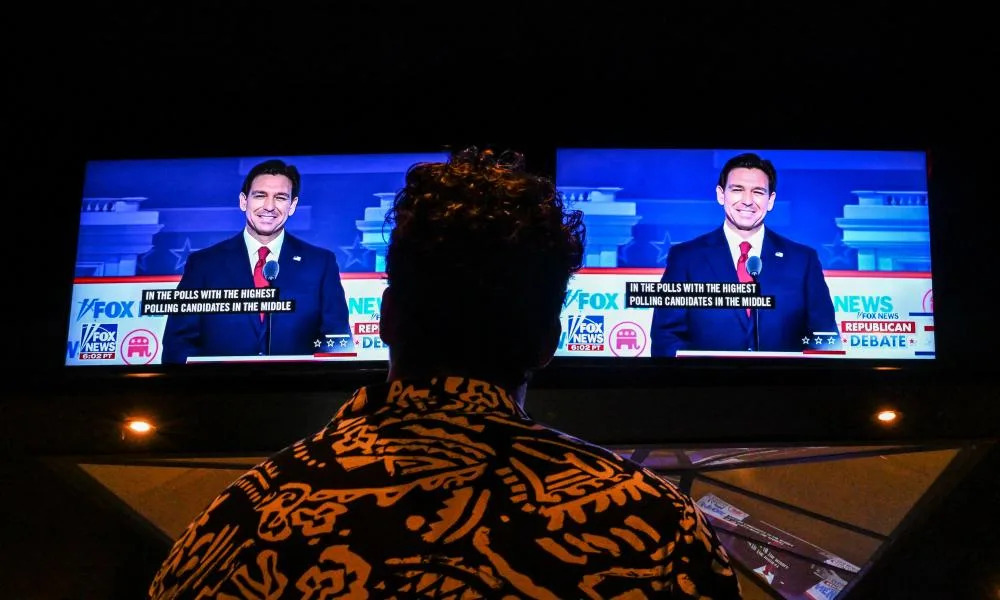
The Republican presidential hopefuls, minus Donald Trump, were asked at the Fox News debate what they would do to improve the party’s standing on climate policy by Alexander Diaz, a young conservative who is part of the American Conservation Coalition (ACC), a youth conservative group that pushes for action on the climate crisis.
Asked by the moderators for a show of hands over whether climate change is real, none of the candidates did so, with one, Vivek Ramaswamy, the far-right businessman, declaring that the “climate agenda is a hoax”. Two other candidates, Tim Scott and Nikki Haley, accepted the well-established scientific reality of global heating but looked to shift the blame to other major carbon polluters, such as China, and even, in Scott’s case, to Africa, which is responsible for about 3% of the world’s emissions.
Benji Backer, founder and executive chairman of ACC, said the question on climate was “historic” and highlighted the desire among young Republicans for their leaders to take the threat of global heating seriously.
“That we didn’t get an immediate hand raise speaks to how much work we have left to do; young people will never vote for a candidate that doesn’t believe in climate change,” he said after the debate. “We’re not going away, we are normalizing this as part of the Republican conversation. Republicans deserve to lose if they are climate deniers and don’t have a plan.”
Backer said that Ramaswamy “has always been wrong on this issue” and that Haley’s answer was a “winning one” for young people. He noted how Ramaswamy, who he said an ACC colleague confronted about his remarks after the debate, was booed by the audience for his dismissal of climate science.
“Republicans are environmentalists, we are the original conservationists,” Backer told a debate after-party attended by campaign staffers, some Republican members of Congress and Ramaswamy, a video shared with the Guardian shows. “And by sitting on the sidelines and letting the Democrats take this issue and run with it over the last few decades we’ve not only lost an entire generation of young voters we’ve also ceded the ground to really, really bad policy that is impacting our day-to-day lives in so many ways.”
Polling shows there is growing concern among all Americans over the impacts of the climate crisis, which have been on vivid display this summer, with devastating fires in Hawaii, floods in California and Vermont and a series of punishing heatwaves that have broken temperature records across the US.
There remains a partisan divide, however, with far more Democrats considering climate a priority than Republicans. Among GOP voters, younger people are more likely to see the climate crisis as a threat that requires action than the party’s older voters, polls suggest.
Few Republican leaders have backed strong climate action in recent years, however, with Trump, the dominant force in the party, calling the climate crisis a “hoax” and “bullshit”. During Trump’s presidency, the US withdrew from the Paris climate agreement and scrapped various regulations designed to reduce carbon pollution. Republicans in Congress have since attempted to demolish key aspects of Joe Biden’s landmark Inflation Reduction Act, which provides enormous incentives to proliferate renewable energy and electric vehicles.
The specter of Trump, the clear frontrunner for the Republican nomination despite his various criminal indictments, still haunts Republicans when it comes to dealing with the climate crisis, according to Bob Inglis, a former Republican congressman who now advocates for conservative action on climate.
“At the debate last night the future called to the present and the present seized up in fear – the candidates couldn’t answer the future’s call because they are in fear of a certain constituency in the party and the person who leads that,” Inglis said.
“It’s an abysmal failure of vision. The smart money is moving towards innovation to deal with climate change. But that guy [Trump] is an angel of death. He can’t get you elected, but he can kill you in the primary.”
Environmental groups were scathing of the Republican candidate’s responses. “Republicans are stuck between a hoax and a hard place,” said Lori Lodes, executive director of Climate Power. “Their Maga base demands a rigid stance against the obvious reality of climate change, which requires that they ignore what we’re all experiencing – extreme weather that disrupts lives and destroys communities week in and week out.”
How Centuries of Extractive Agriculture Helped Set the Stage for the Maui Fires
The sugar and pineapple plantations that dominate the Hawaiian island changed the landscape, how the water flows, and contributed to the devastation of the fire.
By Katie Rodriguez – August 23, 2023
A sugarcane field in Pu’unene, Maui, with a sugar mill in the background. (Photo credit: John Elk, Getty Images)
Lahaina, the former capital of the Hawaiian Kingdom, was once a thriving, ecologically diverse landscape full of fish ponds and diverse crops that included sweet potatoes, kalo (taro), and ‘ulu (breadfruit). But colonization, and the extractive agricultural systems that came with it, had a devastating impact on reshaping the landscape ecologically, culturally, and economically—not only depleting soils of fertility but making much of the island more fire-prone.
As these maps of historic sugarcane lands and pineapple lands illustrate, the two crops covered vast portions of West Maui.
A map showing the 1937 area of pineapple and sugarcane lands. (Map credit: Hawaii Statewide GIS Program)
The sugarcane and pineapple industries reigned for nearly two centuries, with monocropping farming methods made exceptionally profitable with indentured servitude. This process transformed natural ecosystems, as the companies diverted water from wet areas of the island to irrigate the fields in the drier parts.
As workers slowly gained rights, profits plummeted, and Brazil and India became competitors of cheap sugar production. Maui’s last sugar mill, the 36,000-acre Hawaiian Commercial & Sugar, Co. (HC&S), shut down in 2016, and the land was left in the hands of management company Alexander & Baldwin.
Now, tens of thousands of acres that had been used for sugarcane and pineapple production sit untended, much lying fallow, some overrun with non-native grass species, or in the hands of development companies who aim to offset the economic loss of agricultural production with tourism. Meanwhile, local communities are engaged in an ongoing battle for water rights as the residents of Hawaii look toward rebuilding.
Civil Eats spoke with Noa Lincoln, an assistant professor of Indigenous crops and cropping systems at the University of Hawaii, Manoa, about water diversion, deforestation, and Big Ag’s impact on Maui.
Will you briefly describe the history of sugarcane? When did it get to Hawaii and what were some of its benefits?
Sugarcane was introduced to Hawaii probably about a millennia ago by Polynesians. It played a pivotal role in a broad range of traditional cropping systems before Europeans’ arrival.
We have very recent work that shows that it has high nitrogen fixation potential, and it was probably critical in the long-term sustainability of our dryland systems for nitrogen dynamics. It plays really important hydrologic functions in certain systems, acting as a windbreak. It’s one of the world’s highest biomass producers, so it was critical for mulching and labor maintenance in terms of weeds and covering the soil.
And sugarcane itself is actually a tremendously powerful tool, when applied properly, and it enhances soil health and ecosystem function within agricultural systems. Which then, of course, becomes very ironic in terms of how the plantations then [put] a horrible, detrimental end to our soil quality.
What conditions did the sugarcane thrive in originally?
Pretty diverse conditions. [Many] varieties of sugarcane tend to be much more grass-like, much more acclimated to dry habitats. When you look at the wild occurrence of these sugarcane ancestors, they occupy everything from inundated bogs, all the way to pretty dry mesic habitats. Polynesians, as they traveled across the islands, occupied a broad range of habitats, and selected varieties that performed across a broad spectrum of habitats.
Chinese contract laborers on a sugar plantation in 19th century Hawaii. (Photo credit: Hawaii State Archives)
While everyone always thinks of sugarcane as a very thirsty crop [that] can take up a lot of water, it is also actually drought adapted. It’s coated in wax to reduce water loss. It has amazing stomatal control, so it can really close itself up and reduce its water loss. So, yes, if you pump them full of water, you are going to get more production. But, actually, sugarcane can perform and produce across a range of habitats, including pretty dry habitats.
Can you describe the diversion of water for sugarcane?
You could grow sugarcane without irrigation in the wet areas of Hawaii, but you had lower sunlight, so you got lower yields. A lot of the plantations wanted to exploit the drier, mesic areas of Hawaii, which have better sunlight and significantly better soil. A lot of the big water diversions are to move water from these wet areas out into the mesic areas that don’t have flowing surface streams. It’s not that they needed irrigation everywhere, but they did need irrigation to establish these plantations in areas that probably shouldn’t have been supporting plantations.
On Maui, most of the sugarcane cultivation is in the Central Valley, which is largely a mesic habitat. Alexander & Baldwin, one of the early, large sugar plantations, created a really extensive irrigation ditch that cut across 27 windward valleys; they completely de-watered those streams and took all 27 and diverted them into this canal that went into the Central Valley so they could irrigate an area that was not wet enough for sugarcane cultivation.
Where do those water diversions stand today?
It’s fascinating and unprecedented in our country, because [at the time the plantations were planted] Hawaii was an independent monarchy. The monarchy eventually got overthrown, and Hawaii became a territory, and eventually a state. There’s really not a parallel in U.S. law or U.S. history. It’s a unique case study.
There have been very long fights over the water in East Maui, because obviously when they took all the water from the stream, that displaced the ability for the downstream Native communities to cultivate, for instance, the flooded irrigated Kalo, which was their main production and food staple. This has gone through a lot of legal fights.
One of the big culminating cases that went to the Hawaii Supreme Court and is actually taught in a lot of water law courses today is the Waiahole Ditch case, in which the Supreme Court affirmed that cultural applications of water are protected under the public trust doctrine for governing water law.
That opened the door for a lot of other traditional users to fight for these water returns. And so on that East Maui irrigation ditch, there have been some victories over the last decade in terms of reestablishing inflow streams standards and guaranteeing a certain amount of water for downstream users.
How much land in Maui is currently fallow?
It’s pretty high. Maui has probably one of the lower percentages [when compared to other islands across the state], but more than 50 percent of our agriculturally zoned lands are fallow. It’s estimated that only something like 15 percent of our ag lands are actually used to grow active crops.
How are farmers working to regenerate the soil on former sugarcane land?
Unfortunately, it’s hardly on the radar, because there are so many larger struggles just to operate in agriculture in Hawaii today. The biggest is that our state does nothing to protect or value land for agriculture. And therefore, the land value of ag land is tied to its development potential.
On the north shore of Oahu, if you want to get an acre of land, you’re talking like half a million dollars. And the costs of land, water, and labor in Hawaii are so high, it’s very, very challenging to just exist as a farmer. Because of that, if you’re thinking about regenerative agricultural practices, that is a further investment on the farmers’ behalf; it’s taking a longer time horizon. [Organic] amendments are more expensive than industrial fertilizers. If you’re doing tree crops, that takes longer [than annual] crops. All these things amount to additional economic investment on the farmer’s behalf in an already extremely challenging economic landscape.
An aerial view of a sugarcane field next to the community of Paia, Maui. (Photo CC-licensed by Forest and Kim Starr)
Because of that, the vast majority of people who are engaging in regenerative agricultural practices are not strictly farmers. There’s a lot of nonprofit education or social enterprises that subsidize farming through youth engagement or cultural education, and that allows them to engage in more regenerative practices without being beholden to the bottom line.
You have a lot of retirees or people who work other jobs to support themselves. That farming is more of a passion and, in some cases, a hobby. And they have the luxury, I would say, of engaging in regenerative practices. But in terms of where the food production is coming from in Hawaii, there are very few food-producing farmers who can do that. It’s just economically restricted.
How much of the former sugar ag land is going toward development?
Since the 1950s, we’ve lost about 1 percent of our farmlands annually. That’s being rezoned for residential or other development purposes. There are no restrictions, really, of what you can do with agricultural lands in Hawaii. There’s a tremendous amount of ag lands that are supporting gentleman’s farms where people come in and buy 20 acres. They put up a mansion; they have a horse.
How did the history of the sugarcane industry lead to this month’s wildfire?
In some of the old Hawaiian language newspapers, Lahaina used to have significant wetlands and lowland flats. They would say, “Lahaina sits in the house of the Ulu trees,” or the ancient breadfruit grove Malaulumulele.
“Our state does nothing to protect or value land for agriculture. And therefore, the land value of ag land is tied to its development potential.”
People just describe almost the entirety of Lahaina town as this forested area filled with breadfruit. And as the plantations came in, they were cutting down a lot of these trees. It got to the point where they passed a law that made it illegal to cut down an ulu tree. And so plantation owners started to pile their bagasse, their spent sugarcane pressings, around the base of the tree and burn it.
After three or four burnings, it would kill the tree. They weren’t breaking the law. They weren’t cutting it down, but they were very systematically and deliberately eliminating the trees from this region.
Those trees probably had a very significant effect in terms of the region’s moisture. Deep-rooted trees are able to tap into the water table. If you look at the rainfall, Lahaina was always way too dry to grow breadfruit. But the fact that you had this huge breadfruit growth and all these wetlands essentially speaks to the fact that the trees were tapping into this subterranean water table, lifting moisture up to the surface, redepositing some of that moisture through leaf litter, allowing for additional rain capture, for reduced evaporation, increased carbon in the soil, and holding additional moisture.
You basically just had an entirely different ecology of that region for two reasons: the undisturbed flow of the river, which allowed the recharge of the subterranean water sources; and these extensive treed landscapes in that area. The plantations removed both of those. They diverted the river in its entirety and eliminated the tree cover. I think the long-term ecological implications of those changes were a huge factor in [the conditions that led to] the fire.
Is there anything you’d like to add?
It’s not a new concept, but it’s important to recognize that agriculture provides a lot of different services, most of which are not valued. Our country has, over the last century, become increasingly aware of the negative externalities of agriculture, in terms of soil loss, groundwater poisoning, and eutrophication and dead zones in the Gulf of Mexico. As a country, we’ve started to acknowledge and at least begin to address the negative externalities of agriculture.
I would like to see the conversation shift to focus on agriculture’s positive impacts. Basically everything that can be done negatively, agriculture can also do it positively. Agriculture can contribute to soil remediation, improved water quality, and biodiversity. How do we encourage those activities? That work really needs to be accelerated and expanded. In Hawaiian culture, really any Indigenous culture, agriculture is the fundamental way that people interact with their environment. To me, it really sets the tone for our entire society.
This interview has been edited for length and clarity.
Katie Rodriguez is a U.C. Berkeley-11th Hour Food and Farming Journalism Intern spending the summer working for Civil Eats. She is a 2023 graduate of U.C. Berkeley’s Graduate School of Journalism and a reporter from the Investigative Reporting Program. She is passionate about telling stories of environmental health, climate policy, agriculture, and marine food systems. Her work has appeared in Inside Climate News, USA Today, Outside, and more. She is based in San Francisco and very excited about the Yucatán banana leaf tamales she recently discovered in her neighborhood.
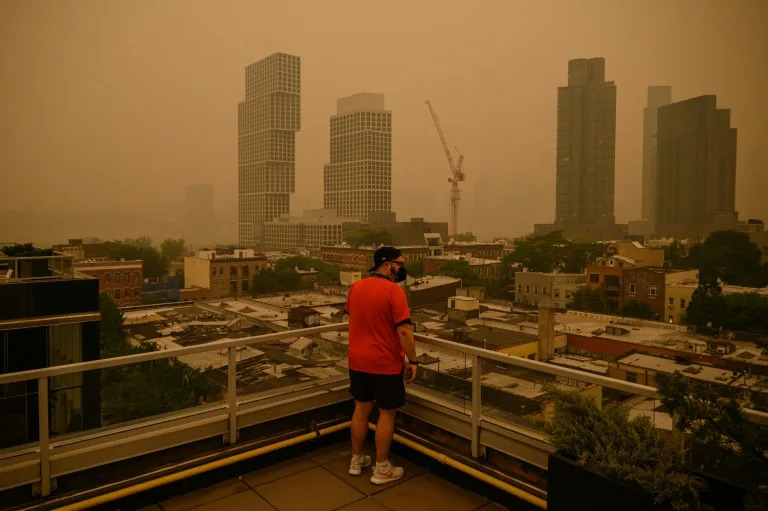
Heavy smog covers the skylines of the boroughs of Brooklyn and Manhattan in New York on June 7, 2023 (Ed JONES)
From Quebec to British Columbia to Hawaii, North America is facing an extraordinary wildfire season — and regions both near and far have found themselves increasingly blighted by smoke exposure.
Here’s what you should know about air pollution from these blazes.
– What we know –
One of the defining aspects of smoke from wildfires is “particulate matter” — toxins that, in their numbers, can make smoke visible.
Particulate matter of 2.5 micron diameter, PM2.5, is “particularly dangerous for human health and emitted in really large quantities,” Rebecca Hornbrook, an atmospheric chemist at the National Center for Atmospheric Research, who flies in planes through smoke for her research, told AFP.
“Typically if you are downwind of a wildfire, that’s the thing that’s causing the majority of the darkening of the sky and the lack of visibility,” she said, such as the shrouded skies seen in New York as a result of fires hundreds of miles away in Quebec earlier this year.
PM2.5 penetrates deep inside the lungs and potentially even the bloodstream.
The average American had already been exposed to 450 micrograms of smoke per cubic meter by early July, worse that the entirety of the years from 2006-2022, economist Marshall Burke at Stanford posted on X recently, citing calculations made by the university’s Environmental Change and Human Outcomes Lab.
Also of concern are invisible substances known as volatile organic compounds such as butane and benzene. These cause eye and throat irritation, while some are known carcinogens.
When VOCs mix with nitrogen oxides — which are produced by wildfires but also are abundant in urban areas from burning fossil fuels — they help form ozone which can exacerbate coughing, asthma, sore throat and difficulty breathing.
– What we don’t know –
Automobile ownership exploded after World War II, and in the decades since scientists have gained insights on how it impacts humans — from the onset of asthma in childhood to increased risk of heart attacks and even dementia later on in life.
That breadth of knowledge is lacking for wildfire smoke, explained Christopher Carlsten, director of the Air Pollution Exposure Laboratory at the University of British Columbia.
Based on the two dozen studies published “there seems to be a greater proportion of respiratory versus cardiovascular effects of smoke as compared to traffic pollution,” he told AFP.
The reason might be that nitric oxides are more prominent in traffic pollution.
Carlsten’s lab has begun conducting human experiments with wood smoke to gain more clarity.
Medical interventions exist, said Carlsten, who is also a physician, including inhaled steroids, non-steroid inflammatories, and air filters — but research is urgently needed to know how best to use them.
– Will it spur action? –
The warming planet also impacts our psychological wellbeing in myriad ways, Joshua Wortzel, chair of the American Psychiatric Association’s committee on climate change in mental health, told AFP.
One response is distress, “anger, grief, anxiety, in the face of the natural disasters they expect to come,” with these rates far higher in younger people than older.
Another is mental “acclimatization,” a byproduct of evolution that helps us cope with new stressors, but if we’re not careful can inure us to dangers, much like the proverbial frog in boiling water.
For Hornbrook, who is based in Colorado, what eastern North America experienced in 2023 is what the western side of the continent has already been dealing with for many years — and the global picture is only set to worsen given humanity’s appetite for burning fossil fuels.
While historic pollution regulations helped rein in emissions from cars and industry, climate action will be needed to tackle the wildfire scourge, she said.
“It gets frustrating knowing that we’ve been ringing the warning bell for years and years, and we’re now seeing what we’ve been warning about,” she said, but added there was still hope. “Maybe now people are actually starting to notice and we’ll see some change.”
Flooding overtakes Palm Springs, California, during Hilary as local emergency declared
Hillary Andrews – August 21, 2023
PALM SPRINGS, Calif. – A local emergency was declared in Palm Springs, California, Sunday afternoon as flash flooding from Hilary overwhelmed the city.
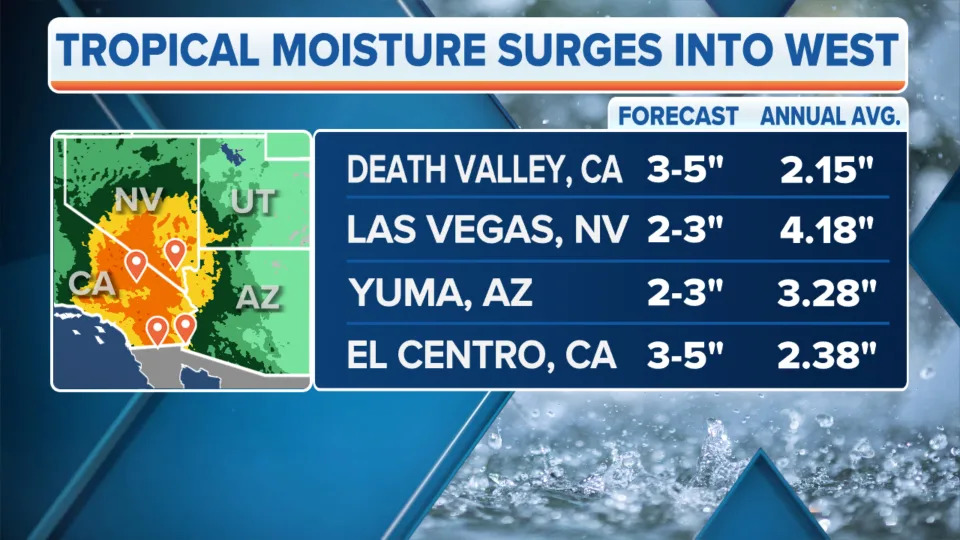
The desert resort city so far received more than a half-year’s worth of rain in less than a day. As of early evening, the NWS recorded 2.64 inches since early morning. The city only sees an average of 0.14 inches each August and 4.61 inches a year. No monthly average exceeds 1.15 inches.
“Due to unprecedented rainfall and flooding of local roadways and at least one swift water rescue, City Manager Scott Stiles has declared a local emergency due to the critically dangerous impacts,” announced the City of Palm Springs on X, the company formerly known as Twitter.
The city reported that 911 was down in the overnight hours.
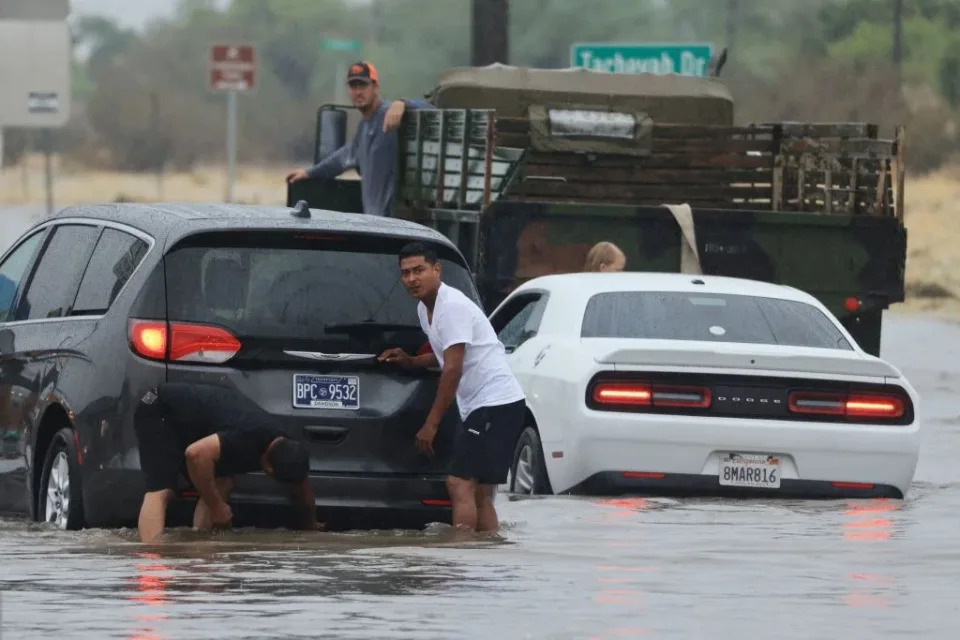
Motorists deal with a flooded road and stuck vehicles during heavy rains from Tropical Storm Hilary in Palm Springs, California, on August 20, 2023. Heavy rain lashed California on August 20 as Tropical Storm Hilary approached from Mexico, bringing warnings of potentially life-threatening flooding in the typically arid southwestern United States.More
The Palm Springs Fire Department shared a video of the raging wash over major city roads. They closed at least five roads because they were underwater.
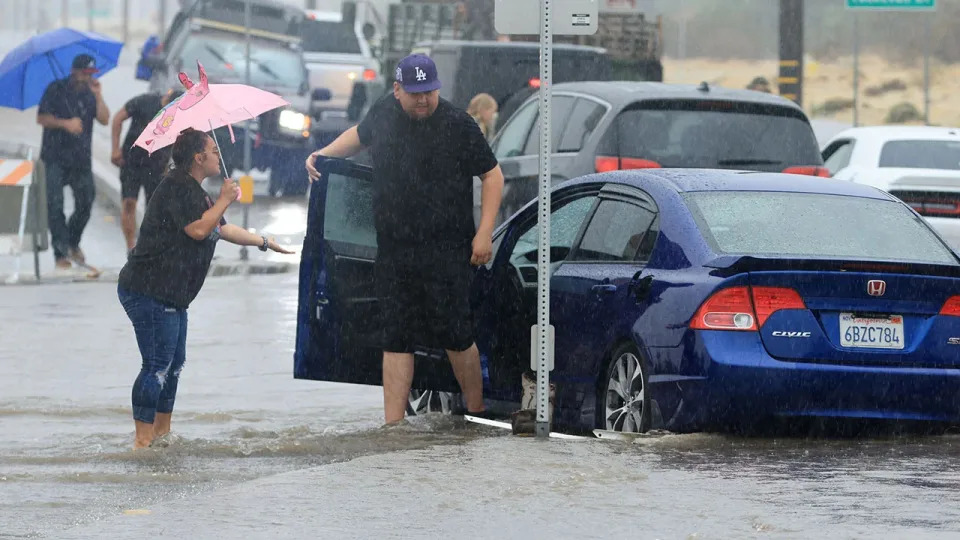
More cars in Palm Springs were trapped as well by floodwaters. Cars stalled, and drivers tossed off shoes and tried to help each other in the calf-deep water. This was the first-ever Tropical Storm Warning for Southern California.
Motorists deal with a flooded road and stuck in vehicles during heavy rains from Tropical Storm Hilary in Palm Springs, California, on August 20, 2023.
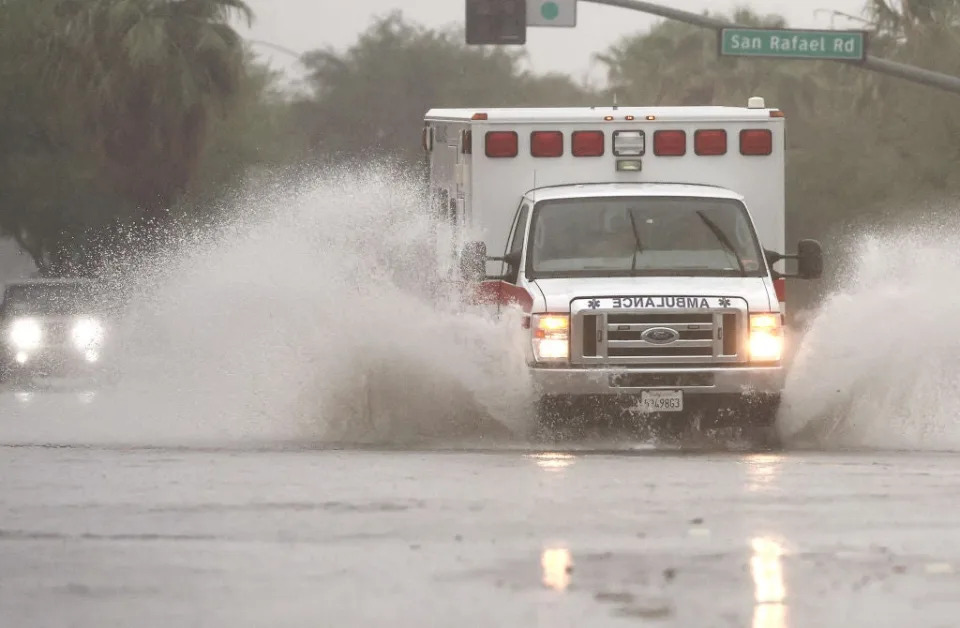
First responders coming to the aid of those stranded by the flooding had some issues themselves. This ambulance looked more like it was on a log flume instead of a city street.
PALM SPRINGS, CALIFORNIA – AUGUST 20: An ambulance drives through a flooded street as Tropical Storm Hilary approaches on August 20, 2023 in Palm Springs, California. Southern California is under a first-ever tropical storm warning as Hilary nears, with parts of California, Arizona and Nevada preparing for flooding and heavy rains. All California state beaches have been closed in San Diego and Orange counties in preparation for the impacts from the storm, which was downgraded from hurricane status.More
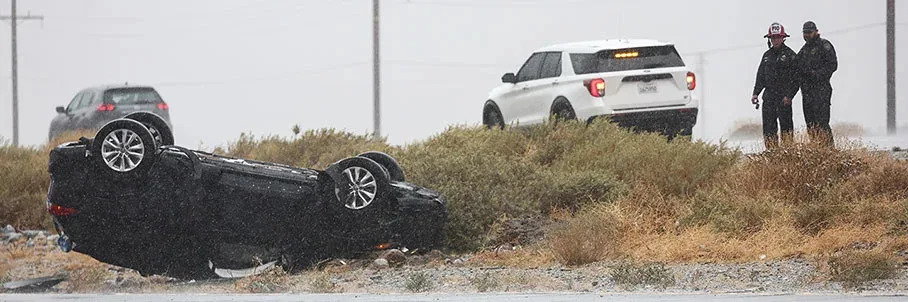
Roads became slick from the rain. A film of oil and the detergents in gasoline accumulates and coats the asphalt during the dry season. Before rain fell heavy enough to wash it away, the streets proved too slippery for this car.
First responders keep watch near a vehicle that flipped over during rainfall from approaching Tropical Storm Hilary on August 20, 2023 near Palm Springs, California.
Car parts floated down flooded streets in nearby Coachella.
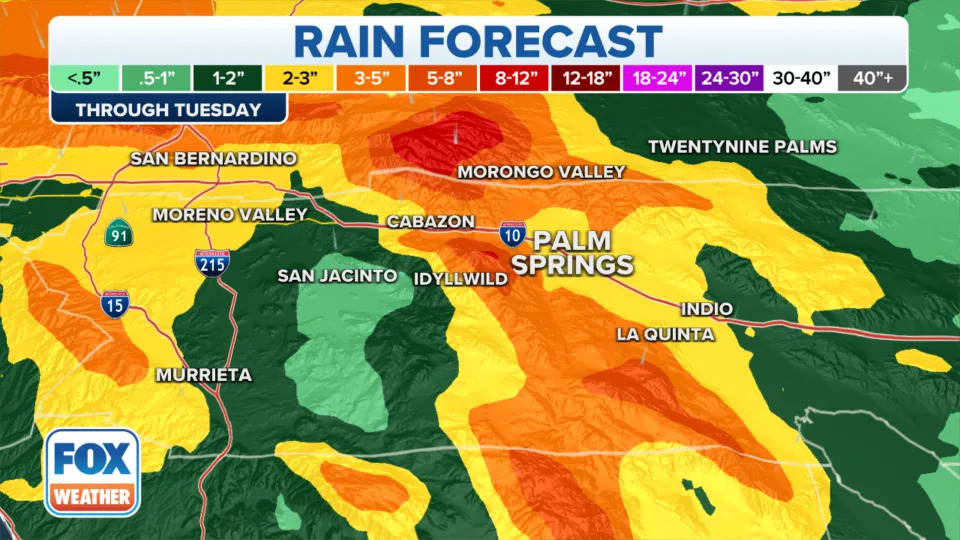
Sunday already set a record for the wettest August day in history for Palm Springs. The previous record has been held since 1930. And more rain is on the way. The FOX Forecast Center calls for 3 to 5 inches total for the city before Hilary departs.
The highest rainfall amounts are on the highest elevation of the mountains cradling Palm Springs and the entire Coachella Valley.
California’s unique mountainous geography, which tourists and residents flock to enjoy, is working against the helpless desert valley.
“That rain is going to be forced up along some of those mountains, especially east of San Diego,” explained Meteorologist Michael Estime. “And that’s going to create what we call orographic lift. And as moisture is lifted up the mountains, it’s it is then going to condense, and it’s going to get squeezed out like a wet washcloth over these areas again, east of the mountains.”
The extreme wind gusts with Hilary, already up to 84 mph on Big Black Mountain, blow south-southwesterly and lift the moisture and heavy rain on normally dry west slopes, explained the FOX Weather Forecast Center.
Palm Springs sits at the foot of 10,000-foot Mount Jacinto, according to the Bureau of Tourism. Gravity will force the water downhill, where it will overwhelm already taxed spillways, washes and gullies.
Water exploded through a low-lying road so fast that this truck in Thousand Palms, part of the Coachella Valley, couldn’t escape. The driver was trapped.
While Palm Springs braces for a year of rain from this one storm, some arid cities will see several years worth of rain in just a day before Hilary departs.
Proud purple to angry red: These Florida residents feel unwelcome in ‘new’ Florida
Tom McLaughlin, USA TODAY NETWORK – August 21, 2023
When Alexander Vargas was a senior at Port Orange’s Spruce Creek High School in 2021, he spoke at a school board meeting to fight for recognition of LGBTQ+ Health Awareness Week. The school board voted against the idea, but the superintendent later decided the week should be acknowledged.
Jean Siebenaler moved to Florida following her retirement to bask in the warmth of the Sunshine State.
“I finally thought I’d be sitting on the water with an umbrella drink in my hand,” she said.
The Milton resident, a military veteran and retired physician, now says she wonders if Florida was where she needed to relocate after all. Having been politically active in her home state of Ohio, she finds beach time consumed by “steaming and stewing” over the state of the state and local politics.
“It’s very upsetting, the direction we see Florida heading,” she said. “Every day I wonder why I am living here.”
For many, Florida has changed. What was once a proudly purple state has turned an angry red, they say. Gov. Ron DeSantis, with the dedicated backing of a Republican supermajority in the state legislature, is waging war on what he calls “wokeism” — a term he has loosely defined as “a form of cultural Marxism.” But many — people of color, the LGBTQ+ community, immigrants, non-Christians, teachers, union members, students — feel it is a war against themselves, as they face ridicule, discrimination, and, potentially, violence.
The NAACP, Equity Florida and the League of United Latin American Citizens each issued travel advisories for Florida. The NAACP advisory states, in part, “Florida is openly hostile toward African Americans, people of color and LGBTQ individuals.”
“Under the leadership of Gov. DeSantis, the state has become hostile to Black Americans and in direct conflict with the Democratic ideals that our union was founded upon,” the advisory states.
Democrats feel vilified because of affiliation
There exist widespread reports of people abandoning the state because they no longer feel welcome here. Following her family’s exodus to Pennsylvania in May, former Brevard County resident and Democratic Party activist Stacey Patel told FLORIDA TODAY, “It’s like breathing, you know? After holding your breath for a really long time.”
Nikki Fried, the state’s former commissioner of agriculture and current Florida Democratic Party chair, predicted 800,000 immigrants had left the state after DeSantis signed SB 1718 into law. It imposes strict restrictions and penalties to deter the employment of undocumented workers in the state.
Democrats also count themselves among the groups feeling persecuted. Patel’s family was vilified, she said, for its party affiliation.
Siebenaler, who has stepped into the position of legislative chair for the Democratic Women’s Club of Florida, attended an early June meeting of the Santa Rosa County Commission to call out Commissioner James Calkins for labeling the Democratic Party as evil.
“I took an oath to defend against all enemies, foreign and domestic,” she told the governing board. “And I must speak out against the hate speech that is emanating from the Santa Rosa County Commission dais.”
Calkins has been admonished on several occasions by the public and his peers for his incendiary rhetoric and disruptive behavior. But Siebenaler is not one to typically show up at county board meetings.
“It’s very, very upsetting. We’ve lost all sense of sanity, logic and civil discourse. It’s so difficult to sit in on meetings because it’s such a clown show,” Siebenaler said. “People are so dramatic, so theatrical. It makes me just so sad that we have gotten to the point where the average person doesn’t want to go to these meetings, where all people do is yell and scream.”
Teachers are heading for the exit
Similarly, according to Lisa Masserio, the president of the teacher’s union in Hernando County, a minority segment of that county’s school board attached to Moms For Liberty is creating chaos in that area.
The school district typically provides at its May 30 meeting an accounting of how many teachers will be leaving the school district that year. This year it was announced that of the 49 people not returning to Hernando County schools next year, 33 had voluntarily tendered their resignations.
Masserio estimated the number of resignations had approximately doubled those of the year before and would create “the highest number of vacancies we’ve had in a long time.”
“We’ve seen so many resignations of people who have made the decision ‘I don’t want to teach here,’ ” she said.
Eighty-three percent of the Hernando County teachers with three years or less experience were among those who resigned, said Dan Scott, a former World History teacher at Springstead High School.
Scott, who was in his third year of teaching, was one of “13 or 14” at Springstead alone who chose to pursue another occupation, in large part, “based on the overhead decisions in the government of Florida,” he said.
“There are a lot of limitations being placed on teachers in regards to how we can communicate with students and what kind of content we’re allowed to discuss within the curriculum,” he said. “Education has become a very hostile environment from top to bottom.”
Among the limitations, Scott said, were soon-to-be-imposed sanctions on what text he could use. Among the outrages, a school board member stalking school hallways searching for items that didn’t correlate with the curriculum. In other words, Pride flags, Scott said.
“Not everyone left for the same reasons I did. For me, I didn’t want to teach if I couldn’t teach the truth and if I couldn’t represent students the way I thought I should,” he said. “I let every student be exactly who they wanted to be, whatever religion, whatever they identify as. I tried to give everybody their space. Whenever I couldn’t do that any more I realized I didn’t need to be in this career.”
Scott has returned to school himself to embark on the study of technology and cybersecurity, and Siebenaler remains steadfast in her dedication to battle the state’s continuing rightward trek. “I’m hoping it’s a blip on the historical radar and that I live to see sanity come back,” she said.
Others around Florida are facing what they view as ostracization by their state government in different ways. These are their stories:
‘Fighting with one hand tied behind your back’
David Lucas, left, unwittingly became the poster child for urban renewal in the early 1960s when he was a small child. His father, Harold Lucas, at right, was shopping for fishing poles in Sears on Beach Street in Daytona Beach when a man asked if it was OK if he photographed his son. The elder Lucas said OK, not realizing the photographer was a government official involved in the urban renewal program that wound up leveling many homes and businesses in Midtown.More
David Lucas grew up listening to his 90-year-old father’s stories of how cruel the world was to Black people in decades past.
While the 60-year-old Lucas has been spared much of what his father’s generation endured, he’s been getting an unexpected reality check on how some things have yet to improve for minorities.
The flurry of bills passed in Tallahassee over the past two years that impact voting, immigration, education, guns and LGBTQ+ people has left his head spinning.
“I just don’t understand how they can make so many changes so fast,” Lucas said. “As a Black man it’s alarming because we have so many different fronts we have to fight.”
The new laws have already impacted Lucas and his wife, who works alongside him at their Jamaican food restaurant in Daytona Beach’s Midtown neighborhood.
She’s from Jamaica, and while she’s not a U.S. citizen yet, she’s in the United States legally and has a visa. Some of Lucas’ friends from Jamaica, other Caribbean islands, Russia and Poland also have visas, but others are undocumented.
Several of those friends cleared out of Florida and headed north more than a month ago after a new immigration law left them scared they could be sent back to the countries they chose to leave.
“They were people who had lives here,” Lucas said.
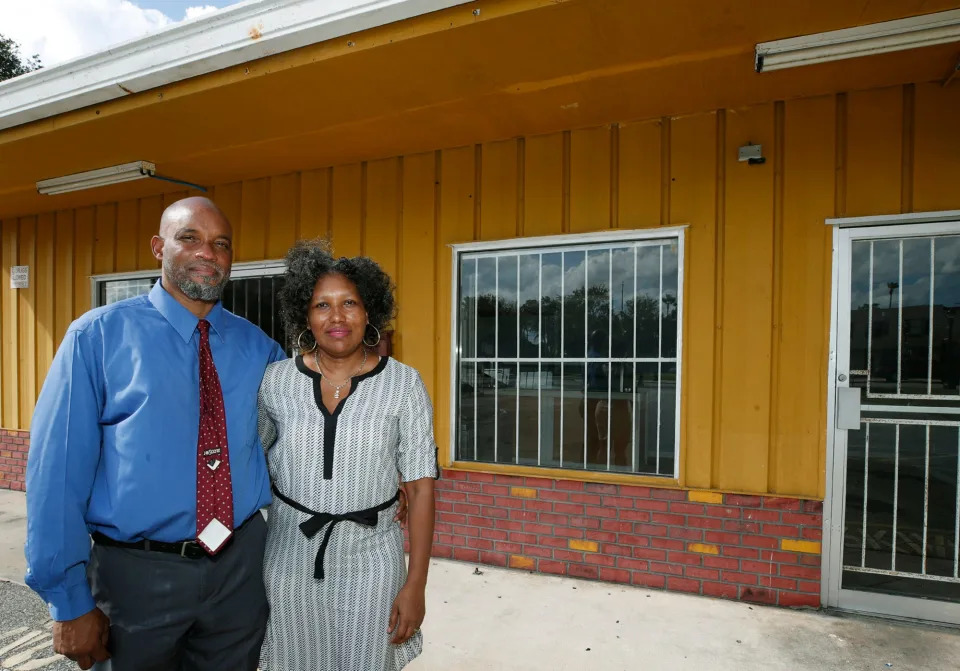
David Lucas and his wife Claudette are shown in front of their restaurant, A Golden Taste of Jamaican Food and Treats, on Mary McLeod Bethune Boulevard in Daytona Beach. Lucas is still trying to digest all the new laws passed in Florida the past two years that impact voting, education, immigration, guns and LGBTQ+ people.
The new law requires employers with 25 or more workers to use the U.S. Department of Homeland Security’s E-Verify system to confirm employees’ eligibility to work in the United States beginning July 1. E-Verify is an Internet-based system that compares information entered by an employer from an employee’s Form I-9, Employment Eligibility Verification, to records available to the U.S. Department of Homeland Security and the Social Security Administration to confirm employment eligibility.
The new Florida law imposes penalties for those employing undocumented immigrants, and enhances penalties for human smuggling.
The statute also prohibits local governments from issuing identification cards to undocumented immigrants, invalidates ID cards issued to undocumented immigrants in other states, and requires hospitals to collect and submit data on the costs of providing health care to undocumented immigrants.
Lucas is also bothered by a new law that will allow people to carry concealed weapons without securing a permit, taking a previously required class, or getting fingerprinted.
“You’ll have a lot of armed heroes,” Lucas predicted. “A lot of people don’t know how to use a handgun, but they’ll have their chest poked out waiting for a reason.”
Lucas said permitless carry has him personally worried.
“Now I don’t want to go anywhere there’ll be a lot of people,” he said.
A third of Black men in the United States have felony convictions, which prohibits them from purchasing or possessing a firearm. Lucas is afraid that’s going to mean many of them will be left vulnerable as more people than ever will be carrying concealed firearms without a permit.
Lucas is also bothered by recent changes in Florida laws that could make it more difficult for some people to vote.
“Voting is most important because that’s how things are changed,” he said. “That’s how jobs are created and taken away, laws are created and taken away. If you don’t have the strength of voting, then you’re basically fighting with one hand tied behind your back.”
New laws impacting what’s taught in Florida classrooms are also not sitting well with Lucas.
“I have children now that are in school not learning history the way it happened,” he said.
It appears to him to be an effort to erase pieces of history “like it doesn’t exist.”
Lucas said some people around his age aren’t pushing back on recent changes impacting minorities.
“They close their eyes and hope it’ll get better,” he said. “They say we’ll just have to live with it. Younger people aren’t going to have it. They have groups trying to fight it.”
‘Pretty damn depressed’
Erin Rothrock of Lakeland is a transgender man. He said the current political atmosphere in Florida makes him depressed and scared.
Until recently, Erin Rothrock felt relatively stable and content living in Florida.
Rothrock, a veterinarian and a married father of four (with another on the way), was considering buying into a clinic to become a business owner. His wife has a well-established law practice. Their children are enmeshed in their schools and have plenty of friends.
But Rothrock, a transgender man, no longer feels secure in Florida, his home since 2009.
“Emotionally, if I think about it, I get pretty damn depressed,” said Rothrock, 39, a Lakeland resident. “And I get scared.”
Rothrock said the climate of acceptance in Florida for LGBTQ+ people, and especially for transgender residents, has dramatically altered.
“It really feels like it’s really changed in the last six months,” he said. “Before that, it really felt like — OK, yeah, there are some conservative people around, but things aren’t bad. And now it’s just like — OK, now we have this environment where these conservative ideas and these conservative people are just making life miserable for people that are living here.”
He added: “I mean, it’s really uncomfortable. It’s off-putting. It’s unwelcoming, and it feels dangerous.”
Discussions with other transgender people have lately taken on a fraught quality, Rothrock said.
“So, conversations I’ve had with a lot of other trans people — besides just the usual, ‘Hey, how you doing? How’s life? How’s school? How’s work? How are the kids?’ — it’s ‘How are you doing? How are you feeling? Have you had any problems? Have you had any trouble getting your meds? Are you going to move? Where are you going? I’ve heard this place is safe,’ ” he said.
Rothrock and his family are considering a move out of Florida. He said he knows other transgender people who have already taken that step.
“I’ve got a friend in Canada that’s begging me to move up,” he said. “They’re offering to assist me. I’ve got a friend in New York begging me to move up. They’re offering to help me.”
Rothrock said that what’s happening in Florida seems to counter the prevailing overall trend in the country.
“I feel like nationally there’s a big push and pull because we know that the general consensus is that most people are OK with gay marriage, support gay marriage,” Rothrock said. “They support transgender people being able to transition and use the restroom that they fit into. But I feel like there’s this real pushback from that conservative base. At this point, I think they’ve outmaneuvered the progressive side.”
The push for new laws — in Florida and elsewhere — targeting medical care and other aspects of life for transgender residents seems a reaction against their increased visibility and acceptance, Rothrock said.
“I think it’s that backlash to the small gains in equality that we’ve made,” he said. “You know, we see it time and time again, historically, that whenever minorities get progress and make some advancements, there’s always a backlash. After the Civil War, there were these Jim Crow laws because Black people got too much power. Marriage equality (emerged), and now we have these new transgender restrictions and restrictions on what people can do.”
New guidelines on gender-affirming care are affecting adults and not only minors, Rothrock said. He recently had to scramble to find a new provider for his regular supply of hormone treatment and briefly ran out of medication.
“I don’t do well mentally, my mental state declines, when I’m not on my medication,” he said. “So I’ve got a therapist; I talk to her on a regular basis. I do everything I can to mitigate those things. But that’s extra mental baggage.”
‘Fear culture’ in the classroom
There is ‘no way’ retired educator Lillian De La Concepcion Martinez would step back into the classroom to do the work she once loved: teach Spanish and Art History to students in Manatee County.
Born to Cuban parents in Miami and raised in Fort Lauderdale, Martinez served as a hospital corpsman in the U.S. Coast Guard in the mid-1970s, and worked as an educator at Manatee County schools from 1989 until she retired in 2020.
“I’m of a different generation,” Martinez said. “When I showed up to boot camp, my staff sergeant looked at me, because I was this pretty girl, tan, nice clothes and I had this designer luggage with me. Nobody told me I couldn’t bring any clothes and I was carrying my suitcase.”
“He gets all us girls together and says, ‘well you girls are going to learn to cuff like a man or grow hair on your chest.’ Can you imagine that now? It’s almost like people are too sensitive nowadays, they take everything personally,” she said.
Lillian De La Concepcion Martinez
But he is glad she never had to experience the fear her former coworkers say they experience as educators today.
“There is a fear culture in the classroom now,” Martinez said. “I’m glad that I retired when I did, because I don’t know that I would want to teach under these circumstances. They did call me a few months back because they wanted to know if I wanted to come back and teach. I said, not ‘no,’ but ‘hell no.’ There is no way.”
Martinez began her career teaching English to migrant students as a tutor in Manatee County, then as a parent social educator. She attended the University of South Florida at night, and when she graduated in 1999 she became a teacher. Her last teaching job was at Lakewood Ranch High Schoo from 2003 until she retired.
She loves to teach, and always enjoyed using music and poetry and other outside-the-box strategies to teach her students.
“I just have a love for the language, for the culture, so I like to get them enthused,” Martinez said. “I love teaching Spanish 1 because they are fresh, but I really love teaching (Spanish) 4 because I could do so much with them culturally, and with poetry.”
“I think the last couple years (the song) “La Gozadera” was very popular,” she said. “I played that one for my level one kids like their second day. I gave them a sheet and said ‘write down how many countries that they say in Spanish that you recognize,’ just to see what they could hear, and they would surprise themselves when they were able to pick out a lot of words.”
“My kids had to memorize José Martí poems,” she said. “I said ‘guys, it will help with your language’ because of the flow. You can’t come up here and just say, ‘Yo soy un hombre sincero, de donde crece la palma.’ You have to have emotion. That’s what they had to work on and it helped with their fluency.”
But today, under the watchful eye of parents and politicians, Martinez said she doesn’t know how others would perceive many of the books she kept in her classrooms, or the historically accurate lessons she imparted to her students.
“I had a lot of books in my classroom by Spanish authors,” she said. “Books that I had read, and they were open and free for kids that wanted to take a book and read it. I did have a lot of multicultural-type books. Biographies on Hispanic people, artists. Frida. Dalí. Celia Cruz. Roberto Clemente.”
“And I’m hearing that a lot of those books are being pulled now, because they reflect a culture that’s different,” she said. “What is it, that it could ‘stress them out’ for whatever reason. Like with Celia Cruz, you have to talk about communism. She fled Cuba, and she said as long as Castro was alive she would never set foot in Cuba again. That’s very political. I don’t know if I could teach that now. You know? Because that’s a political statement. And Celia Cruz is Afro-Cuban, she identified as that. Could we even say that?”
Martinez questions the future of art history classes, especially after an incident in March when Hope Carrasquilla, a former principal at the Tallahassee Classical School, was forced to resign after teaching sixth-grade students about Michelangelo’s “David” and showing photos of the masterpiece sculpture.
“Somebody complained that it was pornographic,” Martinez said. “I just rolled my eyes and told a former colleague of mine that is also retired, I said, ‘you wait and see.’ This is after they banned the AP African Studies program. I said ‘pretty soon, they are going to drop AP art history,’ because there is nudity in AP art history.”
She wonders about her lessons about the casta paintings, and how lessons about their historic significance would be perceived today.
The paintings were drawn in the 18th century as a way to establish hierarchical scale of races after Spanish colonization of the Americas led to anxiety over racial mixing between Spanish colonizers, indigenous people and African slaves.
“The casta paintings, it’s treated like a work of art but it’s really an anthropological piece, because of what they documented in that artwork,” Martinez said. “I talked about one, but there were others. It’s really about the mixing of the races, and that white European is No. 1 on the hierarchy.
“I don’t know if that would fly right now,” she said.
“I like history, so I used art to teach something about the stuff that was going on,” she said. “It was never like ‘oh my god, Spaniards were bad, or anything.’ No. Those are just facts, it’s just the way it was. We can’t change history, all we can do is just not repeat it.”
“Gut punch after gut punch’
Andy Crossfield was in an airport in Lyon, France, last year when a fellow tourist from North Carolina learned that he and his wife, Emily, hailed from Florida.
“Don’t you just love your governor?” the woman asked.
Crossfield replied, “Are you kidding?”
Crossfield, a Lakeland resident and a self-described liberal Democrat, said the episode in France offered a reminder of his status as an undisputed political minority in Florida.
A Georgia native, Crossfield moved to Florida in 1978, during the tenure of Gov. Reubin Askew, the state’s third-to-last Democratic leader. Crossfield said that he didn’t become politically engaged until after his retirement in 1997 from a career as a mutual fund wholesaler.
He has since served as president of the Lakeland Democratic Club and an officer with the League of Women Voters of Polk County.
Crossfield, 70, said Democrats and Republicans seem to perceive virtually all occurrences through different lenses. He compared the phenomenon to the 2015 internet fad involving a photo of a dress that some perceived as blue and black and others as white and gold.
“We see instances of an event, and right away we try to figure out, ‘Is that good for my side, or is that bad for me?’ ” he said. “And this is politics taken to the extreme.”
Crossfield said the political divide has become personal for him and fellow Democrats. He said his relationship with his brother, who is conservative, has become strained.
“Everybody’s lost friends and neighbors over this,” he said. “You can’t have anything in common when you wish a completely different future for the country.”
Has Crossfield maintained friendships with any conservative Republicans?
“I try,” he said. “They make it difficult. I mean, they’re intelligent people, but they want to believe the most ridiculous things. I had a woman tell me — that I had a pretty good relationship with, I guess — that COVID was a fake. All these people that were dying, (it) was just a lie. And that (former President Donald) Trump had intercepted the virus and had his people manipulate it into something benign.”
Andy Crossfield, a self-described liberal Democrat living in Lakeland, holds a spark-spitting, windup u0022Trumpzillau0022 toy in his office.
Crossfield said it is “humbling” to be a Democrat in Florida at this point. He is highly critical of the policies promoted by DeSantis and the Legislature.
“We seem to have Jim Crow 2.0 now, because the attack on voting rights is very frightening,” he said, “The restrictions that Florida has put on people who just want to register people to vote is outrageous.”
Crossfield said he now avoids watching the news because he finds Florida’s politics so irksome.
“I think the electorate, the populace, is responsible for this,” he said. “Life is so hard that they’ll take somebody who wants to stick it to somebody they don’t like, rather than make my life better. I hate to say that, but that’s what it looks like to me.”
Crossfield lives in Polk County, which has not elected a Democrat to any partisan office in well over a decade. In recent cycles, some Republican legislators and county commissioners have been reelected without opposition.
“We have a catch-22 that I don’t know how to solve,” he said. “You can’t get quality candidates unless you have support from the grassroots. And you can’t get grassroots support after gut punch after gut punch results from elections without a quality candidate. I don’t know what breaks first.”
Crossfield empathized with liberal friends who yearn to flee the state.
“Yeah, there’s a lot of people who say, ‘Well, I’m going to leave,’ ” he said. “Somebody on Facebook posted this thing, saying, ‘Don’t leave Florida. Fix it’. And I think I responded, ‘Florida is not an old car that would shine with a little TLC. In fact, every time we take it in for repairs, the mechanic is stealing parts off of it.’ That’s where we are.”
When asked if he has become depressed about Florida’s politics, Crossfield found optimism in the performance of Lakeland Mayor Bill Mutz, an evangelical Christian and a Republican who has defied some expectations by supporting the removal of a Confederate statue from a downtown park and by not blocking the city’s issuance of LGBTQ Pride proclamations.
Crossfield said he now concentrates on small, concrete measures to improve the lives of his fellow citizens. For example, he and others in the local chapter of the League of Women Voters are promoting the distribution of gun locks.
“All we’re trying to do is just pick these areas that we can make some good, some change,” he said. “And yeah, that gives me hope.”
‘To hell and back because of who they are’
Transgender Stetson University student Alexander Vargas wants the same things other people his age do: To finish college, find a career he enjoys, and share his life with friends and family. Some new state laws are making his day-to-day life harder, including one measure that’s making it more difficult for him to find a bathroom he can legally use.More
Alexander Vargas is a 19-year-old college student. His biggest worries should revolve around getting good grades, figuring out what kind of a career he wants after college, and deciding what he wants to do for fun every weekend.
Instead the Stetson University psychology major is always reminding himself to steer clear of public men’s restrooms so he won’t get fined for using bathrooms that align with his gender identity, but not the gender he was assigned at birth. Stetson officials have set him up with a one-person restroom he can use on campus, but once he leaves school property, bathroom access becomes a problem again.
He’s also adjusting to new state government rules that have made it more complicated for him to get the testosterone his doctor prescribes so he can more fully live as a male.
The young transgender man is trying to figure out if he should move to another state where basic day-to-day living wouldn’t be such a struggle, and he could escape the worsening anti-LGBTQ+ climate in Florida.
“Moving out of Florida is a last resort if things get worse, like if I can’t receive my gender-affirming care,” Vargas said. “I could move to another state and switch schools. It would be the easiest way to do it.”
He has both a “Plan B” and a “Plan C,” but he hopes he never feels compelled to use either one. Vargas would prefer to stay right where he is.
Vargas has a very supportive family he still lives with in eastern Volusia County. His partner and job are in the area.
He would love to finish his last two years of college at Stetson as he progresses toward his goal of working with autistic children and using art therapy as a form of communication for the kids when they become nonverbal.
“My life is here, and the thought of uprooting it is terrifying,” he said.
Vargas has been called a freak and he’s had slurs hurled his way.
He’s seen others in Florida subjected to the same things.
“I have trans friends who’ve been to hell and back because of who they are,” Vargas said.
Two years ago, when he was a senior at Spruce Creek High School, he found the courage to speak out.
Vargas attended a school board meeting to advocate for the LGBTQ+ community in the wake of a board vote that shot down recognition of LGBTQ+ Health Awareness Week. The school superintendent eventually decided the week should be acknowledged.
Vargas knows his family and friends have his back, and that empowers him to advocate for LGBTQ+ rights. But if things ever do get bad enough for him in Florida, he’ll start a new chapter somewhere else.
“I’m just waiting for that last straw,” he said.
Fighting against misinformation and fear
Grace Resendez McCaffery, the publisher of the Pensacola-based La Costa Latina Newspaper, a Spanish-language newspaper that covers Northwest Florida and South Alabama, has lived in Florida for 30 years after moving from her hometown of El Paso, Texas.
She founded La Costa Latina Newspaper a year after Hurricane Ivan hit in 2004. She saw the need in the region for a Spanish-language publication, and her newspaper has become a hub of information for the Hispanic community in the Panhandle.
Since DeSantis signed SB 1718, which targets immigrants who lack a permanent legal status, Resendez McCaffery has worked to fight against misinformation about the new law as well as make the broader community aware of its impact on the Hispanic community.
She said it’s discouraging to see a law like SB 1718, but is more worried about the state’s actions being adopted at the national level.
“I don’t have plans to leave,” Resendez McCaffery said. “I have imagined what would happen if our governor became the president.”
“If these types of policies became national policies, I think that would be pretty unpleasant,” she said. “And I have toyed with the idea that I might have to somewhere (out of country).”
Grace Resendez McCaffery, right, and Jessica Rangel, 21, hug as they and other protestors in support of DACA gathered at the corner of Palafox and Garden Streets in Pensacola on Sept. 5, 2017. United States attorney general Jeff Sessions announced the end of the DACA program.
In the meantime, Resendez McCaffery sees her mission as getting accurate information out to her community.
“My concern is an individual’s need right now,” she said. “They’re hungry, or they need housing, or they need just some support to know that not everybody hates them. Sometimes that’s all they want to know. And so, I know that my purpose here is to kind of relay that.”
Heartbreak and anger
In March, Jason DeShazo spoke to a Florida Senate committee while dressed as Momma Ashley Rose, his drag character, in a demure yet colorfully checkered dress with a fluffy blond wig.
“Do I look like a stripper?” the Lakeland resident asked members of the House Judiciary Committee, as they considered a bill intended to curtail drag performances.
With the legislative session over and the law taking effect July 1, DeShazo said it is a bleak time for Florida’s drag performers and the LGBTQ+ population in general.
“It’s kind of a mix between heartbreaking and anger, right?” said DeShazo, 44. “You just want to kind of shout it from the rooftops, like, we’ve got more important things to worry about. We worry about a drag queen reading stories to children when children are having to learn how to do active-shooter training and how to get away from active shooters in schools. And you’re telling me that I’m the issue?”
DeShazo, a gay man, has been performing in drag for more than 20 years. He created Momma Rose Dynasty, a nonprofit that he says has raised hundreds of thousands of dollars to support LGBTQ-oriented charities.
DeShazo specializes in “family friendly” shows and readings, at which his matronly character serves up affirmation and acceptance for youngsters who are LGBTQ or unsure about their sexuality or gender.
Last December, about a dozen men wearing Nazi attire showed up to protest a Lakeland event DeShazo had organized. The demonstrators projected lights onto the venue’s exterior bearing such messages as “Warning: Child grooming in process” — a claim DeShazo vehemently rejects.
An Orlando high school canceled DeShazo’s appearance in March as Momma Ashley Rose at a long-planned “Drag and Donuts” after-school event, under pressure from the Florida Department of Education.
And then the Legislature passed and DeSantis signed the bill officially titled “Protection of Children.”
“It’s just something that we never thought we would have to go through again,” DeShazo said. “This is stuff that our community went through in the ‘50s, ’60s and ’70s. It’s just kind of a shocker that drag has become such a target — not only just drag, but the trans(gender) community, too, is a huge target with what’s happening politically right now.”
Jason DeShazo of Lakeland performs as the drag queen Momma Ashley Rose. He said he is shocked that drag performers have become such a political target in Florida.
Since the Nazi incident, DeShazo said he has been forced to spend hundreds of dollars at every event for extra security. He has also bolstered protections at his house in response to death threats.
In May, the group Fathers for Freedom urged supporters to “accost” parents who took children to a tea party brunch in Lakeland staged by DeShazo’s organization. He said he was relieved that no protesters actually showed up.
“So, it is a daily fear,” he said. “I mean, I can honestly tell you that there are times I’m walking through a grocery store and I’m having to look over my shoulder because you never know, right? Especially now that my face as a boy and in drag is out there.”
DeShazo said he sought legal help to review the new law, and he is confident that his performances do not violate it. His costumes do not feature prosthetic breasts, one of the elements identified in the law as potentially lewd when used in “adult live performances.”
DeShazo said he knows of two drag queens who have already fled Florida and another who is making plans to leave. But he is determined to stay.
“I have no judgment for anyone that wants to leave because I think everyone has their own reasons — and valid reasons,” he said. “But for me, of course I want to pack up and leave. I don’t want to have to sit here and worry about my life and worry about what laws are going to be passed next to dehumanize me. But who’s going to stay and fight if we all leave? If everyone who is different, that they’re trying to drive out of here, leaves, who’s going to be here to stay and fight for the ones that can’t leave?”
Does DeShazo feel that as a gay man and a drag queen he is no longer welcome in Florida?
“Politically, 100%,” he said. “It’s been known that we’re not welcome here. It’s been known that we’re not wanted here. But it definitely seems like the people don’t necessarily agree; the majority don’t agree.”
The publicity surrounding the taunts by neo-Nazis in December produced an outpouring of solidarity, DeShazo said.
“I think people are starting to see other people’s true colors, like, other people’s true discriminations and hate,” he said. “At the same time, we’ve had a huge influx of support, right? I would say 90% of the contacts we get are support, are love, are ‘We thank you for what you’re doing. Keep fighting; we stand with you.’ But that 5% to 10% is a lot to weigh you down because that could make a huge difference.”
Should Biden be getting more credit for his massive climate bill?
Mike Bebernes, Senior Editor – August 21, 2023
“The 360” shows you diverse perspectives on the day’s top stories and debates.
Demetrius Freeman/The Washington Post via Getty Images
What’s happening
President Biden held a press conference last week to celebrate the first anniversary of the Inflation Reduction Act — a bill he called the “the largest investment in clean energy and climate action ever” — becoming law.
The IRA passed through the Senate last August by the narrowest possible margin after months of negotiations among Democrats. Although the bill’s name targeted the soaring inflation of the time, the legislation was essentially a sprawling collection of programs designed to supercharge the country’s green energy transition through investments and tax incentives. It also included a handful of non-climate provisions, including rules to lower the cost of prescription drugs and billions in extra funding for the Internal Revenue Service.
While even the president concedes that the IRA shouldn’t be credited for falling inflation, the bill has already helped drive more than $100 billion into green energy production and created more than 170,000 clean energy jobs — many of them in Republican parts of the country. The White House argues that this is just a preview of the IRA’s full impact, which won’t be realized for several years. One estimate predicted that the bill could result in as much as $1.2 trillion in green energy spending over the next 10 years.
Yet despite these massive investments, voters aren’t giving Biden credit for leading the effort to make the bill a reality. More than half of Americans disapprove of his handling of climate change, and a strong majority say they know little or nothing about what the Inflation Reduction Act has done, according to a recent Washington Post-University of Maryland poll.
Why there’s debate
Many political analysts say that stuffing a bunch of individually popular initiatives into a single bill created a piece of legislation too complicated for voters to wrap their heads around. The slow process of launching major energy projects also means that many Americans haven’t yet seen the impact of the IRA in their communities.
But others say Biden’s real problem is that he’s taking the wrong approach to climate change in the first place. Republicans argue that the IRA is far too large and will end up wasting extraordinary amounts of taxpayer money by imposing the Democrats’ green agenda on the country. Many progressives, on the other hand, say climate-minded voters are disappointed that the bill isn’t nearly big enough and that Biden has undermined his own case by approving fossil fuel projects throughout his presidency.
What’s next
Biden’s effort to draw more attention to the IRA’s benefits is part of a larger effort to change voters’ minds about his stewardship of the economy, which have remained stubbornly low despite persistent growth and tumbling inflation. Convincing Americans that “Bidenomics” is working will likely be a core focus for the president throughout his reelection campaign.
Perspectives
Most Americans can’t make sense of such a massive and complex bill
“I think part of the issue is they have to cram so many things in these giant bills, to get everybody on board and something for everyone to get passed. So it’s really hard for the public to wrap their head around. … It’s very, very tricky when it’s hard to know what’s in it.” — Nova Safo, Marketplace
Americans aren’t seeing the effects in their everyday lives
“While the Inflation Reduction Act is bringing dramatic savings to Medicare recipients, and offers rebates and tax credits to consumers for energy-saving home improvements and electric vehicle purchases, nothing in it really addresses the day-to-day expenses most Americans incur, like groceries and gas.” — Mark Zandi, chief economist at Moody’s Analytics, to HuffPost
The IRA isn’t remotely enough to change our climate trajectory
“It left the U.S. with no realistic path toward meeting its stated goal of zeroing carbon emissions by 2050. At the rate we’re still pumping planet-heating carbon into the atmosphere, today’s heat waves could come to seem downright pleasant.” — Mark Gongloff, Bloomberg
The IRA is bad policy and voters know it
“Even if you give the bill the most charitable take possible, it’s just throwing money at failed programs and wasted resources.” — Alex Salter, economist at Texas Tech University, to Washington Times
The president has repeatedly undercut his own climate message
“Biden has also faced the ire of climate progressives for somewhat undercutting his landmark moment with an aggressive giveaway of oil and gas drilling leases on public land … and for incentivizing the use of technologies such as carbon capture that have been criticized as an unproven distraction at a time when the world is baking under record heatwaves.” — Oliver Milman, Guardian
Voters will begin to appreciate the IRA once the projects it’s funding get off the ground
“I think, over the long run, a lot of these Republican skeptics, they’re going to start to see jobs in their district, investments. And I think they’re going to come along with the clean energy technologies of the 21st century.” — Leah Stokes, UC Santa Barbara professor of environmental politics, to PBS NewsHour
The media has mostly ignored the actual impact of the IRA
“I’ve covered a lot of policy fights, and a huge problem in how policy coverage is done is there is all this attention to the fight to pass a bill — the Affordable Care Act, the Trump tax cuts, the Inflation Reduction Act. And then the bill passes. And if the fight stops, attention just drops off a cliff.” — Ezra Klein, New York Times.