Davos Elite Size Up the Global Risks of Another Trump Presidency
Francine Lacqua – January 15, 2024
(Bloomberg) — Donald Trump is thousands of miles away from the Alpine Swiss town of Davos but talk of his possible return to the White House is on everyone’s lips even before the annual shindig of the global elite has kicked off.
On Monday, in the subzero temperatures of Iowa, he’s set to cement his status as the Republican frontrunner in the first GOP contest of the 2024 election. His crushing lead over rivals appears unsurmountable and polls show Trump and US President Joe Biden facing off and in a dead heat.
Last seen mingling with the Davos crowd in 2020, when he made a dramatic entrance by landing with a squadron of helicopters, Trump is the last US leader to have shown up at the World Economic Forum but has remained a popular topic of conversation for attendees ranging from CEOs, financiers and policymakers.
“You know, we’ve been there before, we survived it, so we’ll see what it means,” BlackRock Inc. Vice Chairman Philipp Hildebrand said in a Bloomberg Television interview. “Certainly from a European perspective, from a kind of globalist, Atlanticist perspective, it’s of course a great concern.”
The former Swiss National Bank president shared the assessment of European Central Bank President Christine Lagarde, who last week said in plain language unusual for a central banker that another term of Trump would clearly be a threat.
Former US Vice President Al Gore, of course, is no stranger to political shocks having come within a whisker of becoming president himself almost a quarter of a century ago. These days he’s better known for being a climate warrior but he shared some caveats about assuming Trump is an inevitability even as the Republican candidate.
“I don’t think that it’s a foregone conclusion,” he told Bloomberg Television in Davos. “I’ve been through the process, I’ve run four national campaigns over the years and seen it from that perspective. I’ve seen a lot of surprises over the years. Something tells me this may be a year of significant surprises. I hope it’s the case because I don’t want to see him re-nominated and re-elected.”
He even issued a warning about not overplaying the importance of the Iowa vote.
“I’m not sure they’re as significant as some believe, he said. “There have been so many examples – last time in 2016 Ted Cruz won the Iowa caucus, and then it mattered not a whit. We’ve seen others win the Iowa caucus on the Republican side and then disappear.”
–With assistance from Laura Millan and Zoe Schneeweiss.
Doctors Alarmed by Young People Getting Cancer at Unprecedented Rates
Noor Al-Sibai – January 14, 2024
People below the age of 50 are getting cancer more than ever before — and doctors are stumped as to why.
As the Wall Street Journal reports, the shocking 2020 death of beloved actor Chadwick Boseman, who died of colorectal cancer at only 43 years old, seemed to wake the public up to the growing trend that researchers had been warning about for a decade prior.
“Colorectal cancer was the canary in the coal mine,” mused cancer epidemiologist Timothy Rebbeck of the Dana-Farber Cancer Institute in Boston. Soon after, there was seemingly an explosion of all different types of cancers, many of which deal with or are near the gastrointestinal tract: appendix, pancreatic, stomach, and uterine.
As the WSJ points out, incidences of colorectal cancer in younger people have risen significantly in recent decades, with one in five new patients diagnosed with that type of cancer being below 50 in 2019, a rate that had doubled since the year 1995, per an analysis from the American Cancer Society last year.
“We are seeing more and more young people who don’t fit the classic teaching that cancer is a disease of aging,” Monique Gary, the medical director of the cancer program at Pennsylvania’s Grand View Health Center, told the WSJ.
One such youthful cancer patient is 27-year-old Meilin Keen, who had her stomach removed at the end of 2023 following a gastric cancer diagnosis. Keen told the newspaper that she had to postpone taking the bar exam because the brain fog from chemo made studying too hard, which effectively put her dreams of becoming a lawyer and moving to New York City on hold.
Though she’d struggled with stomach issues, including acid reflux and heartburn, since she was a teen, Keen was understandably taken aback to be diagnosed with cancer in her 20s.
“I didn’t really think that much about cancer until I got it,” she told the WSJ. “It messes with your identity.”
GI-based cancers like Keen’s seem to be occurring among youthful populations much more often than other types, and it remains unclear why. There’s been all kinds of educated speculation as to what may be going on there, from research into the amount of time young women spent watching TV growing up and many others that deal with nutrition, diet, and weight. One study even claimed to find a link between being born via caesarian section and developing young-onset colorectal cancer.
Regardless of the causes, doctors are having to deal with the onslaught of young cancer diagnoses. Just a few months after Boseman died in 2020, the American Cancer Society began recommending colon cancer screenings starting at age 45 — though for people like Keen, that’s still much too old to catch it.
“If we’re not understanding what it is now,” Dr. Kimmie Ng of Dana-Farber, told the WSJ, “there’s another whole generation that’s going to be dealing with this.”
But turning ideas into action when governments owe an unprecedented $88.1 trillion — equivalent almost to the world’s annual economic output — will be hard.
Public debt exploded during the pandemic and new borrowing this year is likely to break records in several big economies, leaving governments less able to respond to shocks such as financial meltdowns, pandemics or wars.
Even in the absence of a new crisis, soaring debt servicing costs will constrain efforts to tackle climate change and care for aging populations. Public services in many countries are already strained after successive budget cuts.
More worryingly still, as debt burdens grow, governments could find themselves unable to borrow more to service existing obligations and fund basic services adequately.
A government unable to finance its debt “would be forced to implement abrupt and painful” spending cuts or tax hikes, said Michael Saunders, a former member of the Bank of England’s monetary policy committee.
“And such a government may lack the fiscal space to respond to future adverse shocks, preventing fiscal support when it is most needed,” he told CNN.
Saunders, now a senior economic adviser at consultancy Oxford Economics, doesn’t think rich economies are approaching what is roughly equivalent to a personal credit limit and points to sustained investor appetite for government debt. But that’s not to say the limit won’t be tested “10, 20, 30 years from now.”
Testing the limit
The United Kingdom — the world’s sixth-biggest economy — offers a cautionary tale of how badly things can go wrong when investors reject a government’s plan to borrow.
In September 2022, the pound and UK government bonds, or gilts, sold off sharply, partly in response to plans by former Prime Minister Liz Truss to issue more debt in order to pay for tax cuts. Mortgage rates and other borrowing costs soared as investors demanded much higher premiums for owning UK debt.
The Bank of England was ultimately forced to intervene and pledge to buy gilts on “whatever scale is necessary.”
“Were dysfunction in this market to continue or worsen, there would be a material risk to UK financial stability,” Dave Ramsden, a senior official at the central bank, said at the time. “This would lead to … a reduction of the flow of credit to the real economy.”
While central banks can provide temporary emergency support, they cannot finance government deficits in lieu of bond investors.
Just ask crisis-stricken Argentina, where for years the central bank printed pesos to help the country’s spendthrift government continue paying interest on its debt and avoid default. That tactic caused the value of the currency to plummet and prices to rocket. Annual inflation exceeded 211% last month, the highest level in three decades.
A risky year of elections
Government budgets will face renewed scrutiny this year from investors on high alert for politicians tempted to make promises in a bid to win over voters.
Half the world’s population is going to the polls. That swathe of elections means little incentive for belt-tightening among incumbent administrations, while also raising the prospect that incoming leaders will seek to make their mark with new tax and spending plans.
Already, debt is shaping up to be a key issue in this year’s US elections, which will culminate in the presidential election in November. Record levels of public borrowing have become a major point of contention between Republicans and Democrats, aggravating standoffs over the national budget that periodically threaten to starve federal agencies of funds and prevent them from operating.
Mounting debt and political brinksmanship have already taken their toll on America’s credit rating, which typically affects borrowing costs for the government, businesses and households.
Fitch cut its rating on US sovereign debt to AA+ from the top AAA grade last August, citing political polarization as a factor in its decision. Meanwhile, in November, Moody’s warned that it could also remove the United States’ last remaining perfect rating from the big three ratings agencies.
“One of the key elements sustaining a country’s credibility on its ability to repay (debt) is political consensus,” said Raghuram Rajan, a former governor of the Reserve Bank of India.
“It’s not unimaginable that if democracy takes a downturn in the United States, if there is a sense that there will be a political calamity,” the value of US sovereign bonds would fall, he added. And that would increase the government’s borrowing costs.
AI to the rescue?
Even if the worst scenarios are avoided, the increased cost of servicing debt after a recent rapid rise in official interest rates is siphoning ever greater amounts of money away from vital public services — and making it harder to address the climate crisis.
According to reports in UK media, Britain’s main opposition Labour Party has scaled back some of its enormous green spending plans because of concerns about adding to country’s debt burden.
In the current financial year, which ends on April 5, the UK government is expected to spend more on debt interest (£94 billion, or $120 billion) than on either education or defense, according to the Office for Budget Responsibility, a fiscal watchdog.
In the United States, interest costs on a common measure soared to $659 billion in fiscal year 2023, which ended on September 30, according to the Treasury Department. That’s up 39% from the previous year and nearly double what it was in fiscal year 2020.
In 2023 the government spent more to service its debt than it did on each of housing, transport and higher education, according to the Committee for a Responsible Federal Budget, a non-profit.
The surge in advanced economies’ debt that those hefty interest payments partly illustrate coincides with slowing economic growth and a rise in the number of the elderly relative to working-age people. Against that backdrop, it’s unclear how the world will dig itself out of its debt hole.
“What could rescue us relatively painlessly is if we have huge productivity improvements without job losses,” Rajan, now a professor of finance at the University of Chicago Booth School of Business, told CNN, suggesting that artificial intelligence could hold the key.
For Some Young People, a College Degree Is Not Worth the Debt
Emily Withnall – January 14, 2024
Soleil Revell, who dropped out of college after losing a scholarship, sits at a restaurant in Albuquerque, N.M., on Jan. 9, 2024. (Adria Malcolm/The New York Times)
When Alex, my elder child, who identifies as nonbinary, was ready to apply for college in 2022, I felt ill-equipped to help them navigate the process. I was raised in a low-income household and had been unprepared to figure out how to make my own college experience affordable.
I have been a single parent for 17 years. I have never earned enough income to have to make payments on my student loans, which total $81,000 for two degrees. I assumed I would carry the debt to my grave.
Alex is neurodivergent — their brain processes differently than what is considered to be typical for a majority of people — so we looked for schools that centered hands-on learning, where they would have a better chance of succeeding. We landed on the Evergreen State College in Olympia, Washington. The application of the Western Undergraduate Exchange — an agreement among various public colleges in the West — reduced the annual out-of-state tuition costs to $13,000 from $29,000. But even after financial aid was applied, the remaining cost of attendance came to $15,500 per year.
Alex’s financial aid package included $5,500 in federal student loans — the maximum that freshmen can take out. The rest was designated to me in the form of Parent PLUS loans, which allows parents to borrow money directly from the federal government. I was floored. After filling out the Free Application for Federal Student Aid, or FAFSA, my expected family contribution was zero. How could the school and the loan carrier know I didn’t have money and still approve me for a debt of $40,000 over four years?
By researching Parent PLUS loans, I learned that the parent alone carries the debt, there are fewer forgiveness options than other federal student loans, and the loans carry a current interest rate of 8.05%. There was no way I could sign. I’m a renter, and until two years ago, I didn’t have a retirement account. So instead of taking out Parent PLUS loans, I secured a private loan with a much lower interest rate through my credit union. Although I had to co-sign, Alex was designated the primary borrower.
Alex understood that this was the only option to pay for college, but as they struggled to adjust to college life in the years following the start of the pandemic, the debt began to weigh on them. This led them to drop out of college after two trimesters.
Although they have $7,000 in loans to pay off from their short stint, Alex knew the implications of accumulating even more debt over the course of four years. I did my best to alleviate their worries, but my own student loan debt wasn’t reassuring. Alex believed that even with a minimum wage job, they could pay off their debt and continue to support themself with jobs that didn’t require a degree.
Alex is not alone in this belief. Because of the combined costs of tuition and living expenses, some young people have opted to delay, drop out of or forgo attending college altogether to avoid student debt that could hang over them for decades. A recent report from the National Student Clearinghouse, a nonprofit provider of educational reporting, showed that freshman enrollment declined by 3.6% last fall, reversing recent gains. In addition, the share of students who left college without a degree rose to 40.4 million as of July 2021.
Although Americans are questioning the value of college, research shows that people with college degrees typically earn nearly 75% more than those without them. Jobs that require a degree also often come with a range of benefits: flexible schedules, paid time off and sick and parental leave.
But there is no clear path toward those benefits.
Michele Shepard, senior director of college affordability at the Institute for College Access & Success, said that while she still has faith in the value of a college degree, obtaining one is becoming increasingly inaccessible.
“If you just look at the amount of college costs that are covered by Pell Grants, it used to cover about 80% of the average cost of a four-year degree in the late 1970s, and now it covers 25%,” Shepard said.
Burned Out
For much of her life, Soleil Revell’s mother, Reina Fernandez, was a single parent working multiple jobs while raising her children on a tight budget. When it came time for Revell to go to college, a small university in her hometown in New Mexico was the most affordable option. The state offers a scholarship that covers tuition and is available to in-state residents enrolling in college right after high school who meet certain criteria. Revell took advantage of this option by going to New Mexico Highlands University and living at home to save money.
But when the pandemic hit, trying to keep up with online classes and the pressures of family life became too difficult for her. Revell lost her scholarship after her grade-point average dipped, which left her owing $2,700 to the school. She dropped out after a year and a half and moved to Albuquerque, New Mexico, in 2021, where she now waits tables full time and has a part-time job creating social media posts for a car dealership. She said that, given the loss of the scholarship, she would have accumulated $20,000 in debt if she had stayed in school.
“I was really driven to go to school in the beginning, but after I took a break, I kind of lost that drive,” Revell, 23, said. “My mom told me not to take a break because it’s going to be a lot harder to go back, but I was just really burned out.”
In addition to her bills, Revell has some medical debt. She has recently learned that a friend’s employer is considering removing a degree requirement for potential new hires, so she plans to apply. It’s a work-from-home job that pays more than her current role. Revell said a remote position would allow her to pick up more social media gigs.
Her plan is to save enough to cover the costs of rent and tuition so that when she returns to school, she can do so without going into debt. She hopes to study psychology at the University of New Mexico.
Sandy Baum, a senior fellow at the Urban Institute, says it can be difficult for students to go back to college later if they’ve dropped out.
“For adults, it’s really clear that going back to college has a lot to do with unemployment,” Baum said. “But when the economy is strong, when employment is strong, then you just get a job.”
A Military Alternative
Maria Han, 20, has just entered the third year of her contract with the U.S. Navy. Because of an unstable home life, she moved in with a classmate when she was 16. While in high school, Han was enrolled in an accelerated program that would have helped her earn an entry-level nursing degree by the time she graduated from high school in 2021. But because she was estranged from her parents, she did not have the resources to cover the $1,500 in fees for the program.
Instead, she took interest in joining the Navy as an option to pay for college when recruiters came to her school. Han is stationed in O‘ahu, Hawaii, after spending two years training to become a fire controlman. She said that, through the Navy, she has multiple options to complete a college degree or receive training in a trade. One option is to have the full cost of college attendance covered by extending her contract for five additional years. Another is to complete her current contract, which runs through 2027, and have tuition costs covered by the GI Bill of Rights when her time is up.
At this point, Han doesn’t think she’ll extend her contract. “I feel like the schooling part of the Navy kind of gave me a false picture of what was going to actually happen,” she said. “Then I went on my boat that I’m on right now, and it was a big reality check. Like, it’s just a little bit more scary than I thought it was going to be.”
For Han, confinement on the ship paired with limited connectivity to friends back home and a steep learning curve even after basic training made the transition more challenging than she expected.
Still, Han said she doesn’t know what she would have done without the Navy and that there are a lot of other people on her boat who feel the same. “Some people were homeless, and they joined the Navy, and it gave them an opportunity to start their life again,” Han said.
Challenges and Opportunities
There are few options for people who don’t have sufficient income, savings or financial aid to pay for college, said Laura Perna, an expert on college affordability, access and success at the University of Pennsylvania Graduate School of Education. “You can borrow what’s available to borrow, or you can work more hours for pay, and both of those have different types of consequences,” she said.
While attending community college is often touted as the easiest, most affordable choice for those who can’t pay higher prices to go elsewhere, it is not always a solution, especially in places where there are no local options. In addition, some four-year institutions do not accept credits from community college classes.
Perna believes free tuition programs are an important step toward reconsidering education costs and who is responsible for paying them.
“State governments have a role in funding public higher education through appropriations and financial aid,” Perna said. “The federal government has a role, especially through the Pell Grant. Government should have a role if you know there are so many public benefits of higher education, in addition to those ways that individual participants benefit. And so I think I’m hopeful that we can have some kind of rethinking on this. Because higher education matters.”
Alex, my older child, is 20 now, and they work in ecological monitoring earning $15 an hour. It’s a field they are interested in, and they see some limited paths toward career advancement. But they don’t see a clear path to financial security.
Part of this, no doubt, comes from them watching me continue to struggle financially even after earning a master’s degree. In Alex’s view, if they’re going to be living paycheck to paycheck because of the debt they’ll need to pay off from obtaining a degree, they would rather avoid the debt and earn what they can without a degree.
They understand that this route will still leave them living with fewer means, but they prefer it to the one that comes with the financial and mental weight of enormous student loan debt.
After so many years of watching me struggle, Alex finally had the opportunity to witness some relief: In December, my loans were finally forgiven through the Public Service Loan Forgiveness program. I don’t know if the program will last or if Alex will ever need it, but I hope it’s one of many solutions that could help make college more accessible for everyone.
Biden has forgiven billions in student loans, but his allies say voters aren’t giving him enough credit
Gabe Gutierrez and Ghael Fobes – January 14, 2024
Kent Nishimura
WASHINGTON — More than six months after the U.S. Supreme Court struck down President Joe Biden’s ambitious program to erase $430 billion in student loan debt, the White House has been rolling out smaller, more targeted relief programs that it says have now canceled $132 billion in debt for more than 3.6 million Americans.
At the time of the court’s decision, it appeared that Biden wasn’t going to be make good on one of the biggest promises he made to young voters, who helped propel him into the White House. But as he’s gone about doing the same work more slowly, he seems to be getting little credit from those same voters.
On Friday, the administration said that it’s fast-tracking a key provision of the Saving on a Valuable Education plan — known as SAVE — that was scheduled to take effect this summer. Starting next month, borrowers enrolled in SAVE who took out less than $12,000 in loans and have been paying them back for at least 10 years will get their remaining debt canceled right away. With each additional $1,000 of debt, the window for forgiveness increases by a year. For example, a student who took out $13,000 in loans will now have their debt wiped out if they’ve been paying it back for 11 years, or in 12 years for those who borrowed $14,000 — and so on.
Separately, eligible borrowers don’t need to wait 10 years to get some financial benefit from the SAVE plan, which has a more generous formula for calculating income-based repayments than previous government programs. Most low-income borrowers will pay less. For example, a borrower making $38,000 a year with $25,000 in public student loans would see their payment drop from $134 to $43 a month, according to the Department of Education.
The White House said almost seven million borrowers have signed up for SAVE.
“I won’t back down from using every tool at our disposal to get student loan borrowers the relief they need to reach their dreams,” Biden said in a written statement.
Democrats are trying to motivate younger voters ahead of crucial months of the 2024 presidential campaign. According to an NBC News poll in November, Republican front-runner Donald Trump holds a slight advantage within the margin of error in the survey among voters ages 18 to 34 (46% to 42%) — a reversal from past election results and past NBC News polls.
Biden initially announced his broad student debt relief forgiveness plan in 2022, ahead of the midterm elections. The Supreme Court struck it down the following summer, ruling that a president doesn’t have the authority for such a broad policy under the law.
Since then, the White House has used other tools that no president had ever used to this extent. For example, using anti-fraud and consumer protection regulations, the administration has forgiven $22.5 billion for more than 1.3 million borrowers who claim they were cheated by their schools or that their schools closed.
The administration is now ramping up efforts to communicate that to voters. In South Carolina, some Democratic voters that NBC News spoke with said they were disappointed with the Biden administration — and cited what they perceived as a lack of results on student loan debt forgiveness as one of the reasons.
“I feel like my generation, we were promised that student loans would be erased and that hasn’t happened,” said Nashonda Hunter, 41. “We see how much aid that we’re sending over to foreign countries, and there are so many Americans that are suffering.”
That comment, while anecdotal, reveals some of the challenges that the Biden campaign is facing: ensuring that voters give the president credit for policies he has focused on.
Some Biden staffers have been frustrated that the president’s efforts on student debt relief haven’t gotten more attention. Acknowledging that, last week Rep. Jim Clyburn, D-S.C., introduced Biden at Mother Emanuel AME Church and highlighted the administration’s efforts to revamp loan assistance program for public workers such as teachers, police officers, firefighters and federal and state employees.
“But for some strange reason,” Clyburn said, “we don’t see reports about that.”
Diane Stuckey Bruce, who works at South Carolina State University, said she’d been paying off student loans since 2002 and never missed a payment. But the debt was crushing — and didn’t allow her to buy a home.
Then, in late 2021, she said she had her entire remaining student loan debt — $263,585.35 — forgiven through the program known as Public Service Loan Forgiveness (PSLF).
“I’ll never forget that day for the rest of my life,” she said, calling it a game changer. “It was the biggest blessing I have ever received.”
The White House has touted that it receives notes from constituents thankful for the loan relief.
“I actually sat and cried,” one writer who was worried they’d have to refinance their home to pay off the debt. “I am so relieved and my heart overflows with gratitude.”
Still, while the debt forgiveness programs have been popular on the political left, many Republicans have come out strongly against them and praised the Supreme Court for striking down the administration’s wide-ranging debt forgiveness plan, arguing that it was unfair for people who paid off their debts to have their tax dollars used to subsidize others who didn’t. GOP presidential candidates sounded off on the issue last year.
“Why should a truck driver have to pay for somebody that got a degree in zombie studies?” Florida Gov. Ron DeSantis said at an Iowa event in August. “It doesn’t make sense.”
On Friday, Republican members slammed the White House and the Department of Education for the new debt forgiveness plan that they argue is too expensive.
“President Biden is downright desperate to buy votes before the election — so much so that he green-lights the Department of Education to dump even more kerosene on an already raging student debt fire,” said the Republican chair of the House Education Committee, Virginia Foxx of North Carolina, after Friday’s announcement. “It’s clear that the Biden administration needs a good old-fashioned dose of fiscal common sense — all it knows how to do is spend like a drunken sailor.”
Costco rotisserie chickens being prepared – Bloomberg/Getty Images
Costco boasts nearly 130 million members worldwide. The vast majority of these are found in the United States, but regardless of whether they’re shopping in the U.S. or abroad, customers turn to Costco for the same reason: the store’s shockingly low prices.
Bargains form the basis of Costco’s brand, and discounted products can be found everywhere in the store. Furthermore, some of the store’s most iconic products — such as the $4.99 rotisserie chicken or $1.50 hot dog and soda combo — have not experienced price increases for years. But while the prices of these products are widely and frequently celebrated, few customers are aware of the outsized social, environmental, and ethical costs associated with them.
In an effort to drive down prices and maximize profit, Costco has been linked with some rather unsavory business practices including rearing animals in horrible conditions, the use of illegal labor, and questionable product labeling. Although prices remain low, it appears that Costco’s well-loved bargains do not come cheap.
Costco’s Chickens Were Reared Inhumanely
Chickens at Costco farm – mercyforanimals/YouTube
Costco’s $4.99 rotisserie chicken is the store’s most celebrated product. In fact, the cheap chicken is so integral to the brand that Costco has spent $1 billion building an industry-leading chicken processing plant in Nebraska with the sole goal of streamlining its rotisserie chicken supply chain. That being said, a $4.99 chicken is never going to be far from controversy, and Costco’s rotisserie chicken has received its fair share of criticism in recent years.
The majority of these complaints stem from a 2021 investigation of a Costco-controlled poultry farm. Videos taken by nonprofit organization Mercy For Animals showed birds living in cramped, filthy conditions. Some were even suffering from open wounds. When confronted with the evidence, Costco claimed to the New York Times that much of the footage was unremarkable and also stated that the company adhered to standards laid out by trade associations (via CNN). Despite pressure, Costco has not followed the lead of many other food businesses and signed on to the Better Chicken Commitment, a welfare policy designed to improve the lives of industrially reared broiler chickens.
Following the Mercy For Animals investigation, two shareholders, represented by the litigation nonprofit Legal Impact for Chickens, launched a lawsuit against Costco. The lawsuit alleged that decisions made by Costco executives caused the company to neglect its livestock, meaning the fast-growing chickens were often unable to access food and water. The case was dismissed, but during the summer of 2023, Costco announced it was reviewing and investigating the issue. No actions have been reported.
Several Costco Products Have Been Linked With Child Labor
A Darigold plant – Ian Dewar Photography/Shutterstock
An article published by The New York Times at the end of 2023 alleged that numerous migrant children were and are working for the producers of various Costco products. According to the article, the vast majority of these children use forged documents to gain and keep employment. Lax checks and the huge workforces associated with many plants and factories mean that child workers are often missed by private auditors, while senior employees often turn a blind eye. What’s more, auditors rarely visit businesses during the night shift when child labor is most prevalent.
As part of its article, NYT interviewed Miguel Sanchez, a child migrant who works at Darigold, a milk supplier for Costco. In his interview, Sanchez detailed dangerous working conditions that resulted in him suffering from an injury. Other workers noted that minors were a common part of the workforce.
This is not the only instance of child labor linked with Costco. Underage workers have also been found to work in sanitation teams, cleaning slaughterhouses which supply Costco with meat. Packers Sanitation Services, the company that employed these minors, had over 100 underage workers on its payroll and was fined $1.5 million. In all these instances, Costco has said it was not aware of any child labor practices in its supply chain.
Customers’ Private Health Data Was Shared With Meta
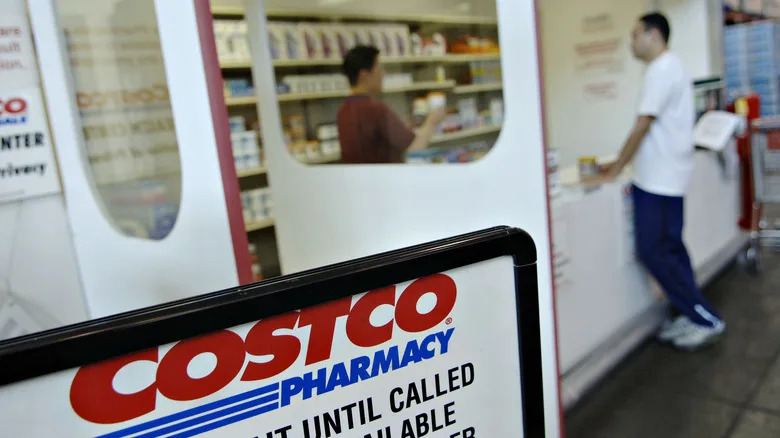
Costco Pharmacy sign – Bloomberg/Getty Images
Costco boasts a pharmacy as part of its business. As with any pharmacy, Costco’s pharmacy frequently requires and receives customers’ private healthcare information, including their prescriptions and prior illnesses or conditions. This information is both private and sensitive, meaning it should be treated with the utmost care. Unfortunately, Costco has not always managed to do this.
According to The Seattle Times, a lawsuit raised against Costco in 2023 alleged that the company had shared millions of Americans’ medical information with Meta without customer consent. This was due to Costco’s improper use of Meta Pixel, a tracking code that is designed for use as a business tool. By having Meta Pixel active on the health care section of Costco’s website, any sensitive information that customers entered was automatically shared with Meta. Health-specific targeted ads were reported as a result of the illicit information sharing.
Meta itself has said that using Meta Pixel in this way is against company policy and claims that steps are taken to educate businesses on how to use Meta products properly. Costco has refused to comment on the issue, and the lawsuit is currently ongoing.
Terrible Conditions Were Reported At Costco’s Egg Suppliers
An egg-laying hen at a Costco farm – Direct Action Everywhere – DxE/YouTube
It’s not just Costco’s rotisserie chickens that have been victims of inhumane farming practices but the company’s egg-laying hens, too. Initially, calls to improve the chicken’s lifestyles centered upon the removal of battery cages from the company’s supply chain. These cages were shown to cause the birds immense suffering due to the chickens’ inability to move properly in such a small space. Celebrities such as Bill Maher and Brad Pitt called for the company to remove them in 2015, and Costco listened; 97% of Costco eggs were cage free by September 2022.
Unfortunately, the near complete removal of battery cages from Costco’s supply chain does not mean hens are reared in humane conditions. Videos recorded by a network of animal rights activists, Direct Action Everywhere, at a chicken farm that supplied eggs for Costco’s Kirkland brand showed appalling conditions. The barn the animals were kept in was filthy, and dead and rotting birds littered the floor. Many living chickens also bore injuries associated with the increased aggression the animals display in cage-free systems.
In a response to the video, reported by The Seattle Times, Costco said: “We have reinspected the barn and other operations of this supplier, and based on these inspections and prior audits, we are comfortable with the animal-welfare aspects of the operation.”
Costco Is Clamping Down On Membership Card Sharing
Costco member card being checked – View Press/Getty Images
Costco runs a membership model wherein customers must pay an annual fee to shop at its stores. In order to ensure that non-members do not slip into the shop — and benefit from its low prices — all members are given a card they must display when prompted by cashiers or other staff members. These cards usually feature a photograph of the member, ensuring one card cannot be used by numerous people. However, savvy shoppers have frequently used the self-checkout lanes to get away with using another person’s membership card.
Costco committed to closing this loophole during the summer of 2023 by requiring all customers to show their membership cards when using the self-service checkouts. While an unpopular policy for those who have benefited from this loophole, many members think it is only fair that such a policy gets put in place. After all, they pay for access to discounted goods, so why shouldn’t others?
Some Costco members are not in favor of the crackdown. Many of these individuals are tired of being forced to prove they are members time and again. As one Redditor put it, “I think people are getting more annoyed when they’re getting accused of card sharing and have to jump through hoops to prove that it’s them. It doesn’t help that the picture quality on Costco’s cards is cra***.”
The Company’s Advertising Practices Have Been Challenged
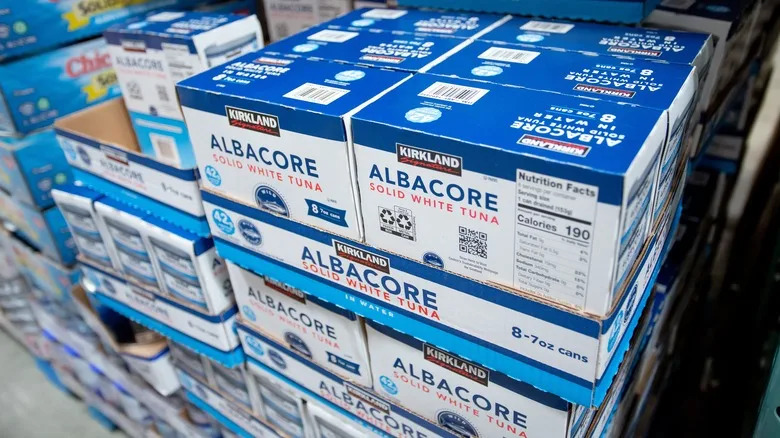
Costco canned tuna in boxes – The Image Party/Shutterstock
In 2023, it was announced that Costco was being taken to court over false and deceptive advertising and labeling practices. The product at the center of the lawsuit was Kirkland Signature White Albacore Tuna in Water. This product carried the “Dolphin Safe” label on its packaging. The plaintiff in the case, Melinda Wright, claimed that this label was directly misleading as the method in which tuna was caught is not dolphin safe.
The Dolphin Protection Consumer Information Act lays out specific criteria tuna products need to achieve to be labeled as dolphin safe. Due to Costco supplier’s use of potentially harmful longline fishing techniques to catch tuna, the Kirkland Signature White Albacore Tuna cannot be defined as dolphin safe according to the Dolphin Protection Consumer Information Act. This suggests that Wright, and other customers like her, were deliberately misled by Costco, which sought to play up the product’s environmental credentials.
This is not the first time Costco has been accused of mislabeling seafood. Also in 2023, the grocery store brand was forced to pay $33,000 AUD after it sold imported Canadian lobsters in its Australian stores, per 9News. In this instance, it was not how the lobsters were caught that was misrepresented but where. Although hailing from Canada, the crustaceans were erroneously labeled as being from Australian waters.
Costco Accepted Illegal Kickbacks From Drug Companies
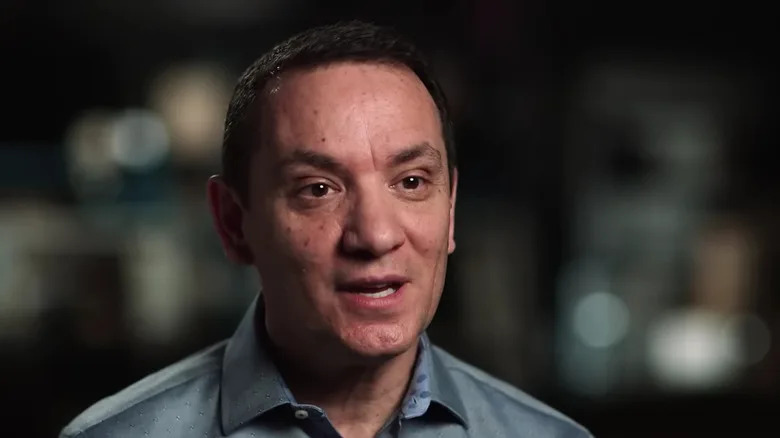
Tony Gagliese talking – The Fifth Estate/YouTube
Kickbacks, often known as rebates, are payments drug companies make to pharmacy chains. These payments are made to ensure the pharmacy will stock the company’s drugs. Kickbacks are legal in some parts of Canada but not in Ontario, which outlawed the practice during 2013 in an effort to lower drug prices. Despite the law, two senior pharmacy executives at Costco in Ontario — Joseph Hanna and Lawrence Varga — demanded kickbacks from drug salesmen several years after 2013.
Tony Gagliese, a salesman for drug company Ranbaxy, secretly recorded Costco pharmacy executives asking for kickbacks in 2018. The Ontario government subsequently launched an investigation into the brand’s illegal kickback practices. It found Costco had accepted over $7.2 million in illegal kickbacks. In an email to CBC, Hanna said: “I genuinely believed at the time Ranbaxy made the payments in question that they were permissible. Neither I, nor Costco, would ever knowingly accept a payment that was prohibited.”
Costco was fined the amount it illegally earnt in kickbacks, around $7.25 million according to CBC. Hanna and Varga were ordered to pay $50,000 each in fines and costs. Neither pharmacy executive was fired.
Costco Underwent An Eight-Year Lawsuit With Tiffany
People by Costco jewlery case – Bloomberg/Getty Images
Unlike many other grocery store brands, Costco often stocks an impressive range of jewelry. However, this aspect of the store took a hit when famous jewelry brand Tiffany and Co. launched a lawsuit against Costco on Valentine’s Day 2013. Once again, the lawsuit revolved around Costco’s advertising and labeling choices. In this instance, Costco used the name “Tiffany” to describe a range of diamond rings.
Costco defended this choice by stating that “Tiffany” was being used to describe the ring’s pronged setting and did not indicate any connection with the well-known jewelry brand. Tiffany and Co. begged to differ, alleging that Costco was deliberately misleading customers into believing the rings were made by or in association with the brand. Over 3,000 of the rings were sold.
In 2017, four years after the lawsuit was brought against Costco, a judge ruled that Costco had to pay Tiffany and Co. nearly $20 million in damages and punitive damages, per Reuters. Costco appealed the judgment and won. The two companies settled out of court in 2021, according to CNBC. No details regarding the settlement were released.
Multiple Employees Have Accused Costco Of Discrimination
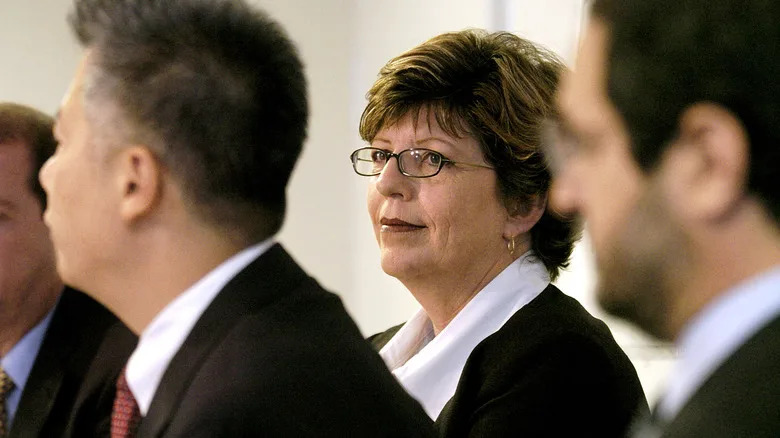
Rae Ellis smiling – Bloomberg/Getty Images
Costco has a reputation for being a good place to work. Employee pay and benefits are among the highest in the sector, and the company’s employee turnover is very low. That being said, Costco has also been accused of taking various discriminatory actions against employees. The most infamous of these resulted in over 700 women launching a class-action lawsuit against Costco.
The lawsuit, led by plaintiff Rae Ellis, alleged that Costco discriminated against women when it came to filling managerial positions. The lawsuit was initiated in 2004. At this time women made up half of Costco’s entire workforce, yet only 13% of Costco store managers were female. The lawsuit was settled in 2013, according to Public Justice. As part of the deal, Costco committed to changing its promotion procedures. These changes are working; at the end of the 2022 fiscal year 37.5% of Costco managers were female.
Other lawsuits have accused Costco of disability discrimination. One such lawsuit was leveled against the company by Marisa Martinez. Martinez was the Mexico Buyer for Costco and was on a work trip to the country when she witnessed a car being held at gunpoint. Martinez developed anxiety after this event and did not feel able to travel to Mexico. In retaliation, Costco banned her from performing any other work-related travel and threatened to remove her from management if she did not travel to Mexico. In the ensuing court case, Costco was forced to pay Martinez $1.85 million in damages, per McGillivary Steele Elkin LLP.
Costco Was Found To Have Lax Pharmacy Controls
Employee working in Costco pharmacy – Bloomberg/Getty Images
In January 2017, it was announced that Costco would pay $11.75 million as a result of a number of its pharmacies improperly filling prescriptions. Lax controls were reported in multiple Costco pharmacies in locations including Washington, Michigan, and California. Among the alleged actions were the filling of incomplete prescriptions and the filling of prescriptions without valid Drug Enforcement Administration registration numbers.
After the settlement was reached, U.S. Attorney Eileen M. Decker released a statement. In it she said: “These are not just administrative or paperwork violations — Costco’s failure to have proper controls in place in its pharmacies likely played a role in prescription drugs reaching the black market.”
In an effort to ensure such violations do not occur again, Costco invested in a new pharmacy management system. The chain also adopted an auditing system that involved the use of external auditors.
Many Of Costco’s Steaks Are Mechanically Tenderized
Costco meat – ARTYOORAN/Shutterstock
The process of mechanically tenderizing meat involves tiny holes being punctured into the meat by needle-like blades before packaging and selling. This process helps break down some of the meat’s fibers, making the meat feel more tender when it is eaten.
While there is no disputing that mechanically tenderizing steaks works, the process has drawn some criticism as it increases the risk of foodborne illnesses being transferred by the meat. The United States Department of Agriculture highlights that mechanical tenderizing increases the risk of foodborne illnesses, as any pathogens or bacteria that happen to be located on the meat’s surface will be driven into the center of the meat during the puncturing process. This makes the pathogens harder to kill during cooking, increasing the chances that a contaminated piece of meat makes a customer ill.
One way to mitigate this risk is to cook the steaks more thoroughly, raising their internal temperature to 145 degrees Fahrenheit and holding it there for three minutes, or making sure the internal temperature reaches 160 degrees as Costco recommends. Thankfully, Costco indicates on a steak’s label whether it has been mechanically tenderized, giving customers the knowledge they need to prepare and consume their steaks safely.
Costco’s Gold Ingots Are Not A Great Investment
Gold bought from Costco – goldeagleprice/X, formerly known as Twitter
Costco made headlines throughout 2023 due to the popularity of an unlikely grocery store product: 1-ounce gold bars. Costco repeatedly sold out of the product, with CFO Richard Galanti indicating in a company earnings call that after restocking, the product sold out in a few hours. The ingots do not come cheap; Costco has been selling them at around $2,000, and some customers have likely seen them as a worthwhile investment.
Although gold is known to hold its value in times of uncertainty, those looking to make some money are probably better off looking elsewhere. George Milling-Stanley, chief gold strategist at State Street Global Advisors, explained the reason for this in an interview with Investopedia: “There’s a premium of up to 5% when you go to buy it, and there’s often a discount of up to 5% when you want to sell it […] gold’s really got to go up 10% before you actually break even.”
Despite being known as a discount wholesaler, Costco has not waived the costs associated with gold. The price of the company’s gold ingots has hovered between 5% and 7% above the market value. This ensures that it’s Costco, and not the buyers, that are benefiting from this transaction the most.
The wealth of the world’s five richest men more than doubled since 2020
Tami Luhby – January 14, 2024
Getty Images
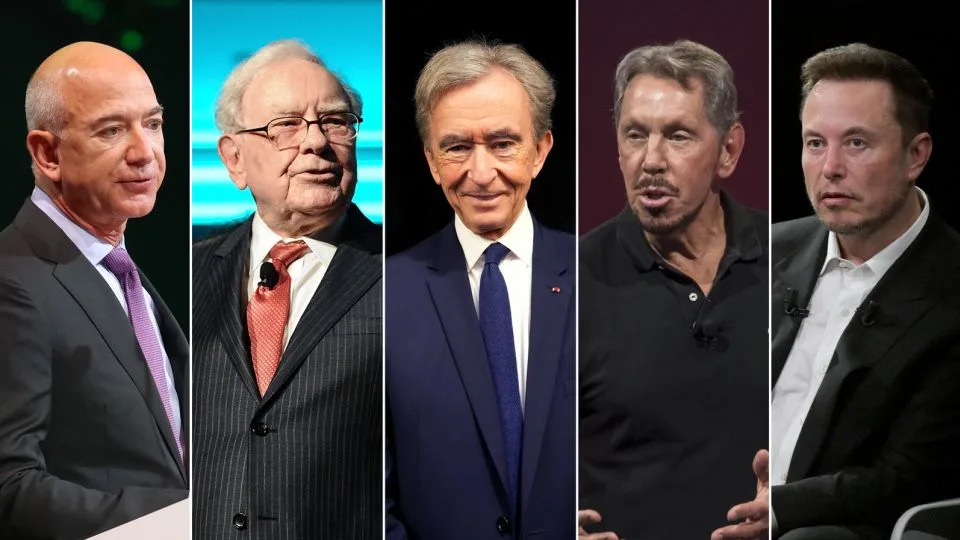
The five wealthiest people on Earth have become a whole lot richer in recent years.
Since 2020, these billionaires’ net worth has skyrocketed 114% to a total of $869 billion, after taking inflation into account, according to Oxfam’s annual inequality report, released Sunday. If current trends continue, the world could see its first trillionaire in a decade.
At the same time, nearly 5 billion people globally have become poorer, as they contend with inflation, war and the climate crisis. It would take nearly 230 years to eliminate poverty based on the current trajectory.
The report, which draws on data compiled by Forbes, is timed to coincide with the kickoff of the annual World Economic Forum meeting in Davos, Switzerland, an elite gathering of some of the wealthiest people and world leaders.
Though inequality is on the rise, there are some bright spots, said Nabil Ahmed, Oxfam America’s director of economic and racial justice. Workers have been flexing their muscle through strikes and deals that better their compensation and working conditions. Also, some governments have been on their side, pushing policies aimed at strengthening workers’ rights.
“We find ourselves in a new Gilded Age, but workers, regulators and union and community organizers are starting to make cracks in it,” Ahmed said.
Rising fortunes
Elon Musk, who runs several companies, including Tesla and SpaceX, was the big winner in recent years. His wealth soared to $245.5 billion at the end of November, up 737% from March 2020, after accounting for inflation.
Bernard Arnault, chairman of French luxury goods giant LVMH, and his family had a net worth of $191.3 billion, up 111%.
Amazon founder Jeff Bezos had a fortune of $167.4 billion, up 24%; while Oracle founder Larry Ellison’s wealth totaled $145.5 billion, up 107%.
Rounding out the list of top five wealthiest people was Berkshire Hathaway CEO Warren Buffett, whose net worth rose 48% to $119.2 billion.
Overall, billionaires have seen their wealth grow by $3.3 trillion, or 34%, since 2020, with their fortunes expanding three times faster than the rate of inflation, according to Oxfam.
US billionaires, many of whom derive their wealth from the equity in the companies they lead, are $1.6 trillion richer.
Corporate power
In this year’s report, Oxfam argues that businesses are raking in big profits, which are helping fuel the fortunes of the wealthy. Seven out of 10 of the world’s largest public companies have either a billionaire CEO or a billionaire as its principal shareholder.
What’s more, the top 1% holds 43% of the world’s financial assets, according to Oxfam, drawing on data from Wealth X. In the United States, this group owns 32%; in Asia, it’s 50%. In the Middle East, the top 1% holds 48% of the financial wealth, while in Europe, it’s 47%.
Some 148 of the world’s largest corporations made nearly $1.8 trillion in profits in the 12 months leading up to June 2023, Oxfam said. That’s 52.5% higher than their average was between 2018 to 2021. Oxfam calls out the oil and gas industry, pharmaceutical companies and the financial industry for reaping higher profits in the last year or two than their average in prior years.
“We ignore at our peril the role of monopoly power in redistributing wealth to the top,” Ahmed said.
Oxfam is calling on governments to step in.
“Public power can rein in runaway corporate power and inequality — shaping the market to be fairer and free from billionaire control,” Amitabh Behar, Oxfam International’s interim executive director, said in a statement. “Governments must intervene to break up monopolies, empower workers, tax these massive corporate profits and, crucially, invest in a new era of public goods and services.”
Many cities across the United States could become ghost towns by 2100
Adam Schrader – January 14, 2024
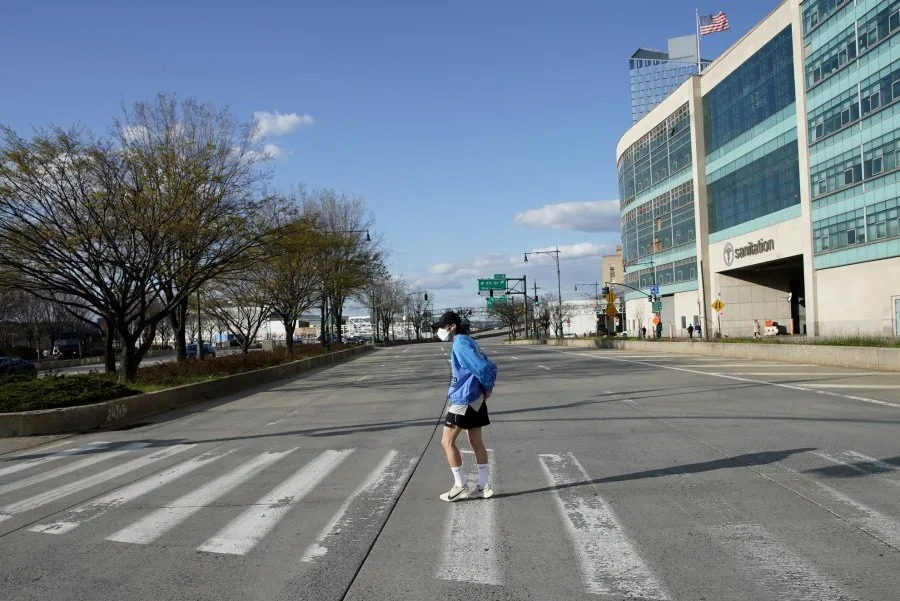
A man wears a protective face mask crossing a quiet West Side Highway in Manhattan during rush hour amid the onset of the coronavirus pandemic in April 2020. File Photo by John Angelillo/UPI
Jan. 14 (UPI) — Many cities across the United States could become ghost towns by 2100, according to new research published Thursday.
“Close to half of the nearly 30,000 cities in the United States will face some sort of population decline,” researchers from the University of Chicago in Illinois wrote in a journal article published in Nature Cities.
Major cities in the Northeast and Midwest are already slowly losing population. While cities in the South and West regions are experiencing a population increase, some major cities in Alabama, Georgia and Tennessee are slowly depopulating, the researchers found.
Cleveland, Buffalo, and Pittsburgh could see depopulation of 12 to 23 percent by 2100 while cities like Louisville, New Haven and Syracuse — not currently showing declines – likely could soon.
“You might see a lot of growth in Texas right now, but if you had looked at Michigan 100 years ago, you probably would have thought that Detroit would be the largest city in the U.S. now,” Sybil Derrible, one of the researchers, told Scientific American.
The study briefly looked at possible causes for these population changes, from the effects of an aging population to changes in the economy, wages and access to transportation — as well as things like climate change and similar factors.
“In the Northeast and Midwest, urban cities with lower median household income are more likely to experience depopulation over time,” the study authors wrote.
“Such trends could exacerbate socioeconomic challenges experienced by lower-income households in these regions, given that population decline can create affordability concerns with infrastructure services.”
Meanwhile, the research showed that urban cities with increasing populations in the South and West tend to have a higher reliance on vehicles. The study was conducted by a team originally commissioned by the Illinois Department of Transportation to analyze the challenges in the state over time.
“In the Midwest, urban cities with both low and high vehicle ownership, defined as percent population with two or more vehicles per household, are likely to gain population along with some suburban and periurban cities with low vehicle ownership,” the study authors wrote.
The study also looked at the effects of migration possibly curbing urban population decline in some area. Smaller cities like those on Long Island in New York and around Chicago currently experiencing population loss may still grow thanks to immigration.
“The number of depopulating cities in the Northeast and Midwest will be higher than in the South and West regions (although many cities in the North and Midwest will still grow),” the study reads. “In California, the southern coast may lose population, while the northern coast may gain population.”
‘This to Him Is the Grand Finale’: Donald Trump’s 50-Year Mission to Discredit the Justice System
The former president is in unparalleled legal peril, but he has mastered the ability to grind down the legal system to his advantage. It’s already changing our democracy.
By Michael Kruse – January 12, 2023
Michael Kruse, senior staff writer at POLITICO and POLITICO Magazine.
POLITICO illustration by Emily Scherer/Photos by Getty Images, iStock
NEW YORK — What happened in Room 300 of the New York County Courthouse in lower Manhattan in November had never happened. Not in the preceding almost two and a half centuries of the history of the United States. Donald Trump was on the witness stand. It was not unprecedented in the annals of American jurisprudence just because it was a former president, although that was totally true. It was unprecedented because the power dynamic of the courtroom had been upended — the defendant was not on defense, the most vulnerable person in the room was the most dominant person in the room, and the people nominally in charge could do little about it.
It was unprecedented, too, because over the course of four or so hours Trump savaged the judge, the prosecutor, the attorney general, the case and the trial — savaged the system itself. He called the attorney general “a political hack.” He called the judge “very hostile.” He called the trial “crazy” and the court “a fraud” and the case “a disgrace.” He told the prosecutor he should be “ashamed” of himself. The judge all but pleaded repeatedly with Trump’s attorneys to “control” him. “If you can’t,” the judge said, “I will.” But he didn’t, because he couldn’t, and audible from the city’s streets were the steady sounds of sirens and that felt absolutely apt.
“Are you done?” the prosecutor said.
“Done,” Trump said.
He was nowhere close to done. Trump’s testimony if anything was but a taste. (In fact, he said many of the same things in the same courtroom on Thursday.) This country has never seen and therefore is utterly unprepared for what it’s about to endure in the wrenching weeks and months ahead — active challenges based on post-Civil War constitutional amendments to bar insurrectionists from the ballot; existentially important questions about presidential immunity almost certainly to be decided by a U.S. Supreme Court the citizenry has seldom trusted less; and a candidate running for the White House while facing four separate criminal indictments alleging 91 felonies, among them, of course, charges that he tried to overturn an election he lost and overthrow the democracy he swore to defend. And while many found Trump’s conduct in court in New York shocking, it is in fact for Trump not shocking at all. For Trump, it is less an aberration than an extension, an escalation — a culmination. Trump has never been in precisely this position, and the level of the threat that he faces is inarguably new, but it’s just as true, too, that nobody has been preparing for this as long as he has himself.
Former President Donald Trump, flanked by his attorneys, waits to take the witness stand at New York Supreme Court on Nov. 6, 2023, in New York City. | Eduardo Munoz Alvarez/AP
Trump and his allies say he is the victim of the weaponization of the justice system, but the reality is exactly the opposite. For literally more than 50 years, according to thousands of pages of court records and hundreds of interviews with lawyers and legal experts, people who have worked for Trump, against Trump or both, and many of the myriad litigants who’ve been caught in the crossfire, Trump has taught himself how to use and abuse the legal system for his own advantage and aims. Many might view the legal system as a place to try to avoid, or as perhaps a necessary evil, or maybe even as a noble arbiter of equality and fairness. Not Trump. He spent most of his adult life molding it into an arena in which he could stake claims and hunt leverage. It has not been for him a place of last resort so much as a place of constant quarrel. Conflict in courts is not for him the cost of doing business — it is how he does business. Throughout his vast record of (mostly civil) lawsuits, whether on offense, defense or frequently a mix of the two, Trump has become a sort of layman’s master in the law and lawfare.
“He doesn’t see the legal system as a means of obtaining justice for all,” Jim Zirin, the author of Plaintiff in Chief: A Portrait of Donald Trump in 3,500 Lawsuits, told me. He sees it rather as a “tool,” said Ian Bassin, a former White House lawyer in the administration of Barack Obama and the current executive director of Protect Democracy, “in his quest to command attention and ultimately power.” But it’s not merely any tool. It’s his most potent tactic and fundamental to any and all successes he’s had. “There’s probably no single person in America,” said Eric Swalwell, the Democratic member of Congress from California and a former prosecutor and Trump impeachment manager, “who is more, I would say, knowledgeable and experienced in our legal system — as both a plaintiff and as a defendant — than Donald Trump.”
Many have been confounded by the legal system’s inability to constrain Trump, by his ability to escape at least thus far any legal accounting for behavior that even some leaders of his own party excoriated — and why that reckoning might never come. To understand this requires seeing Trump in a new mode — not as a businessman-turned-celebrity-turned-politician, or as a nationalist populist demagogue, or as the epochal leader of a right-wing movement, but rather as a legal combatant. “This is not a political rally — this is a courtroom,” the judge admonished him at one point in November in New York. It was only in the most technical sense correct. Just as he had upended the norms inside the New York courtroom, Trump has altered the very way we view the justice system as a whole. This is not something he began to do once he won elected office. It has been a lifelong project.
Starting in 1973, when the federal government sued him and his father for racist rental practices in the apartments they owned, Trump learned from the notorious Roy Cohn, then searched for another Roy Cohn — then finally became his own Roy Cohn. He’s exploited as loopholes the legal system’s bedrock tenets, eyeing its very integrity as simultaneously its intrinsic vulnerability — the near sacrosanct honoring of the rights of the defendant, the deliberation that due process demands, the constant constitutional balancing act that relies on shared good faith as much as fixed, written rules. He has routinely turned what’s obviously peril into what’s effectively fuel, taking long rosters of losses and willing them into something like wins — if not in a court of law, then in that of public opinion. It has worked, and it continues to work. Trump, after all, was at one of his weakest points politically until the first of his four arraignments last spring. Ever since, his legal jeopardy and his political viability have done little but go up, together. Deny, delay and attack, always play the victim, never stop undermining the system: Trump has taken the Cohn playbook to reaches not even Cohn could have foreseen — fusing his legal efforts with his business interests, lawyers as important to him as loan officers, and now he’s done the same with politics. He’s not fighting the system, it seems sometimes, so much as he’s using it. He’s fundraising off of it. He’s consolidating support because of it. He’s far and away the most likely Republican nominee, polls consistently show. He’s the odds-on favorite to be the president again.
As Trump was on the witness stand on Nov. 6, Judge Arthur Engoron (bottom) all but pleaded repeatedly with Trump’s attorneys to “control” him. “If you can’t,” the judge said, “I will.” | Spencer Platt/Getty Images; Pool photo by Brendan McDermid
“He has attacked the judicial system, our system of justice and the rule of law his entire life,” said J. Michael Luttig, a conservative former federal appellate judge and one of the founders of the recently formed Society for the Rule of Law. “And this to him,” Luttig told me, “is the grand finale.”
The 2024 presidential election, in the estimation of Paul Rosenzweig, a senior counsel during the investigation of President Bill Clinton and an assistant deputy secretary in the Department of Homeland Security in the administration of George W. Bush, isn’t a referendum on Joe Biden. It isn’t even a referendum, he said, on Donald Trump. “This election,” he told me, “is a referendum on the rule of law.”
More unnerving, though, than even that is an idea that has coursed through my conversations over these past several months: That referendum might already be over. Democracy’s on the ballot, many have taken to saying — Biden just said it last week — but democracy, and democratic institutions, as political scientist Brian Klaas put it to me, “can’t function properly if only part of the country believes in them.” And it’s possible that some critical portion of the population does not, or will not, no matter what happens between now and next November, believe in the verdicts or other outcomes rendered by those institutions. What if Trump is convicted? What if he’s not? What if he’s not convicted and then gets elected? What if he is and wins anyway? More disquieting than what might be on the ballot, it turns out, is actually what might not.
“Our democracy rests on a foundation of trust — trust in elections, trust in institutions,” Bassin said. “And you know what scares me the most about Trump? It’s not the sledgehammer he’s taken to the structure of our national house,” he told me. “It’s the termites he’s unleashed into the foundation.”
Trump (left) stands with his father, Fred Trump, in Brooklyn in 1973. That year, the federal government sued Trump and his father for racist rental practices in the apartments they owned. | Barton Silverman/The New York Times via Redux Pictures
‘Attack, attack, attack — no matter what the merits are’
The United States v. Fred C. Trump, Donald Trump, and Trump Management, Inc., filed by the Department of Justice on October 15, 1973, put a 27-year-old Donald Trump for the first time on the front page of the New York Times. He also used it to introduce himself to a man who was already an infamous rogue — Cohn becoming because of this case Trump’s most indispensable mentor.
Cohn, “clearly one of God’s most imperfect vessels” but “one of the most extraordinary, demonized, and misunderstood figures of 20th-century American politics,” Steve Bannon wrote in the 2023 Skyhorse Publishing reprint of Nicholas von Hoffman’s biography, “is more relevant today than when the book was originally published in 1988.” Bannon’s not wrong. And that’s because of Trump and what Trump has become. Pre-Trump, though, and before Cohn was disbarred and died in 1986 from complications from AIDS, Cohn was in post-World War II America a particular sort of poisonous force — the top attorney and aide to red-baiting Sen. Joseph McCarthy in the 1950s who then in the ’60s and ’70s turned his ill repute into a career as “ a legal executioner” for celebrities, executives and mob bosses. He didn’t pay his bills. He didn’t pay his taxes. He was shameless and remorseless and “ famous among lawyers for winning cases by delays, evasions and lies.” He was indicted four times, for bribery and conspiracy, for extortion and blackmail, for stock-swindling and obstruction of justice and filing false reports — and never once convicted. He was, to the people who knew him and watched him with some combination of wonder and disgust, “a bully,” “a scoundrel” and “as politically incorrect as they come.” Trump was transfixed.
Top: People sit outside Trump Village, a two-building apartment complex, in Brooklyn in 1973. Bottom: Donald and Fred Trump visit a tenant in one of their Brooklyn apartment buildings in Brooklyn in 1973. | Barton Silverman/The New York Times via Redux Pictures
And the federal race case was Trump’s first tutorial. “He went to court,” as Trump would put it, “and I went with him.” Cohn said the Department of Justice had “no facts to support the charges” that were “barebones” and “without foundation.” Cohn accused the feds of going after the Trumps’ organization because it was “one of the largest in the field.” He accused them of a “smear” that caused “damage” that was “never going to be completely undone.” Cohn filed a countersuit for a stunning $100 million that a judge tossed out as “frivolous” but not before it generated headlines and attention for a young Trump spoiling for a publicized fight. He accused a young female prosecutor of staging a “Gestapo-like investigation” with “undercover agents” wiretapping Trump offices and “marching around” like “storm troopers banging on the doors” — all charges the judge was forced to take the time to dismiss. And Cohn delayed, and delayed and delayed, frustrating for years a series of government attorneys who in court briefs repeatedly bemoaned Cohn’s “noncompliance” and “dilatory tactics” and “blithe disregard.” The director of the Open Housing Center of the New York Urban League worried that Cohn on behalf of Trump was, in spite of the evidence, actually “winning.”
Trump, with Roy Cohn beside him, speaks during a news conference where they announced a lawsuit against the National Football League in 1984. | Marilynn K. Yee/The New York Times via Redux Pictures
They weren’t. At least not officially. Because the DOJ got Trump and his father to sign a consent decree promising they would comply with the Fair Housing Act and create preferential vacancies and pay for ads for those vacancies and hire and promote minorities and self-report their progress. The agency called the agreement “one of the most far-reaching ever negotiated.” But Trump? He called it a win. He had been allowed to sign the decree without copping to guilt, and if that wasn’t quite a triumph, it also wasn’t in any real way a defeat. “Did Trump get nailed? No,” Cohn’s cousin, David Lloyd Marcus, told me. “He basically got out of it.” Trump had siphoned from Cohn lasting lessons. “He learned that the evidence can be irrelevant,” Zirin told me. He learned that “the law doesn’t matter, the government’s mission doesn’t matter,” Marcus told me. He learned “that you could use the law to sort of bend circumstances to your will,” former Trump attorney Ty Cobb told me. “Attack, attack, attack — no matter what the merits are — fuck the merits — attack, attack, attack,” longtime New York attorney Marty London told me. “That was Roy Cohn’s methodology that was adopted by Donald Trump.”
More than anything, though, Cohn had shown Trump not simply how to turn a loss into a win but how to turn a case on its head — how, in other words, to take the United States v. Trump and make it Trump versus the United States.
The Trump Parc East building, which was formerly known as 100 Central Park South, is seen in New York City in 2016. | Frank Franklin II/AP
‘Suddenly you are being sued. It gives you a headache’
If the ’70s were a training ground, the ’80s were a proving ground. And if Cohn was a weapon —“a weapon for me,” as Trump told the writer Ken Auletta — so, too, was the law and the legal system itself. Lawsuits were as central as public relations or loans from banks to the building of Trump’s business and the burnishing of his brand. And he came to understand during the decade of the ’80s that he didn’t have to play defense. He could just start on offense.
Trump bought the 15-story apartment building at the prime location of 100 Central Park South in 1981. He wanted to turn it into a fancier condominium. He just needed the mostly rent-controlled tenants to get out, and he quickly began legal proceedings to try to make that happen, filing with the city applications for permits for eviction and demolition. He sued one tenant for not paying his rent even though he had. He also got the company he had hired to run the building to cut back on services, like security, hot water and heat. At one point he made a plainly disingenuous offer to the city to house free of charge some of the area’s homeless in the building’s few vacant units. “I just want to help with the homeless problem,” he told the Times. He put tin on the windows of the empty apartments to make the whole building look shabby. One of the tenants told the Times, it felt like they were “living under a state of siege.”
So the tenants pooled money to hire attorneys to sue back. And judges sided with the tenants, not him, and so did state and city agencies, ruling that Trump had initiated “spurious” and “unwarranted litigation” that added up to “an unrelenting, systematic and illegal campaign” to “force tenants from their housing accommodations at the earliest possible time.” By 1985, Trump had built Trump Tower, opened two casinos in Atlantic City, New Jersey, and been on the cover of GQ. But Central Park South? This, as New York magazine put it on its cover, was “A Different Kind of Donald Trump Story” — “a fugue of failure, a farce of fumbling and bumbling.” The tenants had had it. “This merchant, this gambler, this Atlantic City man-whore,” one of them told a reporter for a British magazine. “He wants to be Jesus. He wants to be Hitler. He wants to be the most powerful thing in the world.”
Stymied, Trump in December of that year filed, of all things, a $105 million racketeering suit — in effect accusing the tenants’ attorneys and state and city agencies of conspiring against him in a criminal enterprise. He shared the details with the New York Post before he even filed the papers in court.
Trump, shown above in 1986, wanted to turn 100 Central Park South into a fancier condominium after buying it in 1981. He just needed the mostly rent-controlled tenants to get out. | Mario Suriani/AP; Bettmann Archive via Getty Images
“He had a temper tantrum,” Rick Fischbein, one of the attorneys for the tenants, told me recently. “He sued the firm. He brought a RICO action,” said David Rozenholc, another one of the attorneys for the tenants, “to try to get leverage.” It was “frivolous” and “absurd,” Rozenholc told me. But still: “You are an attorney representing a client, and suddenly you are being sued. It gives you a headache, it gives you a problem, it gives you an issue — you have to deal with it, you have to hire a lawyer …”
That lawyer was Marty London. “We attacked the claim on the merits, and quickly,” London told me. And time was of the essence, he explained, in large part because the firm’s bank account had been frozen because of the size of Trump’s claim. Any undue delay would accrue to the benefit of Trump and to the detriment of the defendants — and the judges seemed to understand. “It took a month to get it dismissed,” London recalled, and the appeal was similarly fast-tracked. “Further pleading would merely waste the time and resources of the litigants as well as divert scarce judicial resources,” an appellate judge concluded, denying Trump’s motion to replead “with prejudice.”
“Trump saw that the way to beat these people, these tenants, it was not on the merits, because there were no merits,” London told me. “So what you do is attack the lawyer,” he said. “You make the lawyer so afraid of Trump that he quits. That’s what he tried to do.”
But the lawyers did not quit. London even got a judge to order Trump to pay Fischbein’s firm $700,000 in fees, including London’s costs in the RICO case. Fischbein hung on the wall of his office a framed copy of Trump’s check along with a blue-T-shirt with a boast: “ I was sued by Donald Trump for $105 million.”
“He lost,” Fischbein told me last month.
Eventually, though, Trump turned 100 Central Park South into a condo called Trump Parc East. “His public position now,” Wayne Barrett would write in his book about Trump published in 1992, “was that the tenant battle had delayed his project just long enough for him to benefit from the boom in the market. So he announced that he had made money from the protracted conflict.” The upshot in The Art of the Deal: “All’s well that ends well.” A legal loss, Trump reasoned, didn’t have to be a loss overall.
A portrait of Donald Trump hangs inside Mar-a-Lago in Palm Beach, Fla., in 1995. | Ron Galella via Getty Images
‘He uses the legal system to tire people out’
Trump was in deep financial distress in the early ’90s. The arc of his life could have been irrevocably altered — and that of the nation, it turns out — had he been truly brought low by his debts, and had a passel of people with power made different decisions. That image he sought to convey, that brand he wanted to burnish — money maestro, billionaire business boss — in this window of time might have been tarnished forever. “Survive ‘til ’95,” Trump liked to say. He did it with family money. He did it through bankruptcy. He did it by turning his casinos into public money — a lifeline that was “the general public” in “middle America” trusting Trump and buying literal stock called DJT. He did it by turning Mar-a-Lago into a private club — and a lawsuit into a golf course. And he did that by opening up a whole new legal front in Florida — in Palm Beach.
“He sued the county,” former county commissioner Karen Marcus told me, “over airport noise.”
It was June of ’95. This had been a Trump pet peeve for years — almost ever since he had bought Mar-a-Lago 10 years before. But now he actually filed a suit for $75 million in damages because one of the flight paths for Palm Beach International Airport took low-flying planes directly over Mar-a-Lago. “Mar-a-Lago can no longer be enjoyed for its original purposes of relaxation, entertaining and everyday living,” the suit said. The next week, county commissioners sued him back, hiring a law firm for $190 an hour. “I think it’s ridiculous Mr. Trump has taken on the taxpayers of Palm Beach County,” commission chairman Ken Foster said at the time, “thinking his pockets are deeper than ours.” It’s exactly what he was thinking.
Top: A plane flies over Mar-a-Lago in 1999. Bottom: (Left to right) Businessman Alfons Schmitt, Trump, and golf course architect Jim Fazio at the Trump International Golf Club groundbreaking ceremony in Palm Beach in 1997. | Art Seitz/Gamma-Rapho via Getty Images; Davidoff Studios/Getty Images
“I first met Trump in the late ’80s,” former Palm Beach town councilman and mayor Jack McDonald told me. “And for all those years,” he said, “the strategy’s been quite clear.”
“He uses the legal system,” said Alan (no relation to Karen) Marcus, a Trump publicist at the time, “to tire people out.”
“He thinks the lawsuit will be easier for him to bear than his opponent,” a person in Palm Beach familiar with Trump who requested anonymity to speak candidly told me recently. “He doesn’t think he’s going to win necessarily,” this person continued. “He thinks that he’ll spend more money than the other side will, including municipalities, even Palm Beach, and that all of those expenses are much more wearing on government officials than they are on Donald Trump.”
And he was right.
By November ’95, the county’s attorneys told the county commission the Trump airport suit was going to cost the county perhaps more than $1 million. By April of ’96, the county’s attorneys and Trump’s attorneys were talking about a settlement. By September, it was official: Trump agreed to drop the suit. In return he got the right to lease at $438,000 a year — for at least 30 years, and up to 75 — 214 acres of untouched scrub land by the very same airport so he could build the golf course that is now Trump International Golf Club in West Palm Beach. To boot, the county promised to keep the planes from flying directly over Mar-a-Lago.
Trump’s attorney called it “a win-win.” Plenty of people in Palm Beach had feelings that were decidedly more mixed. “I realize you’re settling a lawsuit, but you’re giving up the use of that land for 75 years,” former county commissioner Bill Medlen told the South Florida Sun-Sentinel at the time. Said the Palm Beach Post’s editorial board: “Rather than getting him out of their hair, they have gotten themselves into a 30-year lease with the litigious Mr. Trump.”
Indeed, for the litigious Mr. Trump, a Palm Beach coda came a decade later. In 2006, he put up in front of Mar-a-Lago an American flag that was so big it was against town code — 15 by 25 feet of the Stars and Stripes mounted atop an 80-foot pole. It was bait. The town took it. The fine was $1,250 a day. Trump sued — for $25 million — arguing his giant flag was constitutionally protected speech. “No American should have to get a permit to fly the flag,” he crowed in interviews. Eventually, of course, Trump and the town settled — he made the flag a little smaller, the town waived the fines — but for Trump it was another legal draw that was in all other ways nothing but a win.
A large 15-by-25-foot American flag flies over Mar-a-Lago in October 2006. | Alyssa Schukar/The Palm Beach Post via AP
“It was a success for him in terms of how he was viewed across America,” McDonald, who was the mayor of at the time, told me. “Because that all of a sudden,” said McDonald, who was once a member of Mar-a-Lago but not anymore and told me he’s never voted for Trump, “made him this great American patriot.”
“I think he learned right on this little island a lot of the techniques that he used to become president,” said Laurence Leamer, the author of a book about Trump, Mar-a-Lago and Palm Beach. “Trump came down here just not giving a damn, pushing and pushing, pushing the town, pushing the law.”
According to Tim O’Brien, who came out with a book about Trump in 2005 and and was sued because of it, Trump sued him because of the brand — “to create it, maintain it, and cast it forever in amber.” | Peter Kramer/Getty Images
‘The Rosetta Stone of Donald Trump’s hallucinations’
By the time of the Palm Beach flag flap, any ’90s taint was gone, the overwhelming initial success of “The Apprentice” having reintroduced Trump to much of the country not as a hokey, aging emblem of the high-flying, go-go ’80s but as a still preeminent and ubiquitous tycoon — as a billionaire. The brand was somehow intact, and now again on the rise, and it needed to be protected at all costs.
So he sued Tim O’Brien.
“This book,” O’Brien told the Palm Beach Post when TrumpNation came out in the fall of 2005, “is about how a cartoon character became one of the most famous businessmen in America.”
Plenty of things in the book were unflattering. O’Brien quoted Trump, for instance, saying he had been “bored” when Marla Maples was walking down the aisle at the second of his three weddings. He pegged the Trump Organization as “a teeny operation.” And Trump told the author some things that stood out then and stand out even more now. “If you don’t win, you can’t get away with it,” Trump said. “And I win, I win, I always win …” He also said he considered crying a sign of “weakness” and as an example brought up mob boss John Gotti — the “Teflon Don.” Gotti, Trump told O’Brien, “went through years of trials. He sat with a stone face. He said: ‘Fuck you.’”
None of that, though, is why Trump sued O’Brien. He sued O’Brien essentially because of two sentences that cut straight to the core of the brand.
“Three people with direct knowledge of Donald’s finances, people who had worked closely with him for years,” O’Brien wrote, “told me that they thought his net worth was somewhere between $150 million and $250 million. By anyone’s standards this still qualified Donald as comfortably wealthy, but none of these people thought he was remotely close to being a billionaire.”
Tim O’Brien, shown above in 2017. After O’Brien’s book came out, Trump in the press described him as “a third-rate writer,” a “loser” and “a whack job.” | Matt Winkelmeyer/Getty Images
Donald J. Trump v. Timothy L. O’Brien was in some sense a direct extension of Trump versus the other Trumps — Jules and Eddie Trump — from the suit back in the ’80s.
Those Trumps’ use of their own name, Roy Cohn wrote in court papers in December of 1984, “can only be viewed as a poorly veiled attempt at trading on the good will, reputation and financial credibility of” his client. Their use of the corporate name of the Trump Group, Cohn concluded, was therefore “untenable.” It was a bold claim not least because Jules and Eddie Trump, South African emigrants, were big businessmen themselves — by some measures bigger, in fact, than Donald Trump. One of the main reasons Donald Trump even knew of Jules and Eddie Trump, after all, was that the other Trumps had just bid to buy a drugstore chain for $360 million. The other Trumps’ attorneys’ response was basically bafflement at the notion of “barring the defendants from using their family name.” The legal back-and-forth nonetheless went on for five years.
The other Trumps’ attorneys during their deposition of Trump in not so many words tried to make the case that Trump was a serial legal scourge. They peppered him with questions about the number of times he’d been deposed.
“I really don’t know,” he said. It “unfortunately” was “a part of doing business.” Trump grew testy the longer this line of query lasted. He called their questions “ridiculous.” He complained they were “trying to harass me.”
The other Trumps’ attorneys astutely went back to the beginning. They brought up the DOJ’s case from 1973. Trump bristled. “We acknowledged no wrongdoing,” he said before quickly attacking the inference of racism that hung in the air. “Your clients come from South Africa,” he said, “so don’t tell me about it.”
It was a split decision in the end. A judge concluded that “the name ‘Trump’ is well-recognized in the New York real estate development community, but the court does not think this is the same as being ‘unique.’” Trump did, however, successfully petition the Patent and Trademark Office, which ruled the other Trumps could keep using the name the Trump Group but could not keep the Trump Group trademark. The other Trumps had spent $250,000 in legal fees, because they could, but still: “It was very costly,” Jules Trump would tell the Miami Herald, “and a huge waste of time.” Not for Donald Trump. In his mind, the name was the brand, and the brand belonged to him.
Trump sued fellow New York businessmen Eddie (left) and Jules Trump in the 1980s because they had the same last name.The legal back-and-forth nonetheless went on for five years. | Paul J. Richards/AFP via Getty Images; Monica Schipper/Getty Images
Now, though, in 2005, here was O’Brien’s book. “The thrust of the book,” the suit stated, “is that Trump is an unskilled and dissembling businessman” — his attorneys saying Trump was worth at least $2.7 billion, seeking $5 billion in damages and calling the book “defamatory,” “malicious” and “egregiously false.” Trump went on the offensive in the press as well, describing O’Brien as “a third-rate writer,” a “loser” and “a whack job.”
A judge at first ruled that O’Brien had to reveal his sources, those three people “with direct knowledge” of Trump’s finances — but O’Brien’s lawyers won a series of appeals based on the broad protections for reporters provided by the nation’s libel laws. “The libel laws are very bad,” Trump told the New York Post in 2009. Those laws in essence said O’Brien had to have demonstrated “actual malice” and a “reckless disregard” for the truth in reporting what he did, and an appeals court finally in 2011 reaffirmed “no triable issue as to the existence of actual malice.”
“That case never had a chance of success,” Michael Cohen, Trump’s fixer of a lawyer at the time, told me. “His hope was that he could intimidate O’Brien,” he said. It was also, Cohen added, a threat of sorts meant for other reporters — “a warning shot,” he said.
But that’s not really why Trump sued O’Brien, O’Brien told me when I told him what Cohen had said. It was all about the brand, O’Brien said, just as it’s always been — “to create it, maintain it, and cast it forever in amber.”
“And his deposition was an eternal embarrassment,” O’Brien added. “That deposition is the Rosetta Stone of Donald Trump’s hallucinations, about how he runs his business, how much money he has, how he values things, and who he is in this world.”
“Have you ever lied in public statements about your properties?” Trump was asked.
“When you’re making a public statement, you want to put the most positive — you want to say it the most positive way possible,” he said.
“I’m no different from a politician running for office.”
Trump signs copies of his audio business course — produced by Trump University — called “How to Build a Fortune”, in 2006 in New York City. | Louis Lanzano/AP
‘The Roy Cohn stuff is still really ingrained in him’
Trump University, Donald Trump had announced in 2005, was going to be “Ivy League-quality” with “world-class faculty” ready to “teach you better than the best business school.” What it ended up being, according to “students” and staff, was “a joke” and “a lie.” So some of them sued him. Customers filed class-action suits starting in 2010. And then the attorney general of New York filed a sweeping $40-million civil suit in 2013, charging that thousands of people paid up to $35,000 for what in the main was a sham, leaving them with scant lessons of any value but mired in mountains of debt and regret. “Trump University,” Eric Schneiderman said, “with Donald Trump’s knowledge and participation, relied on Trump’s name recognition and celebrity status to take advantage of consumers who believed in the Trump brand.”
Trump was on defense again — reminiscent in this respect of the DOJ case from a full 40 years before. And even without Cohn in his corner, of course, Trump went to work in time-tested ways. “The Roy Cohn stuff is still really ingrained in him,” said Ty Cobb, the former Trump attorney. “I have thoughts about Roy Cohn,” longtime politically connected New York P.R. man George Arzt said, “almost every time I see Donald Trump.”
Trump’s new Cohn?
It wasn’t Michael Cohen, and it wasn’t anybody else, said Lawrence Douglas, an Amherst College professor who’s written extensively about Trump and the law.
“It’s Donald Trump.”
The big difference, though, was that Trump now was much more squarely playing politics, too. He had talked about running for president in the late ’80s. He had launched a brief third-party bid in 2000. But by this point he was considering more seriously a run for the White House. He spent a lot of 2011 stoking the racist “birtherism” lie that Barack Obama had been born in Kenya and therefore was not a legitimate commander in chief. He thought hard about running in 2012, and though he didn’t, his endorsement meant something in the GOP. And he had his eye on 2016 — and the damning, mounting legal problems stemming from his for-profit “school” were a problem.
“No one, no matter how rich or famous they are, has a right to scam hardworking New Yorkers. Anyone who does should expect to be held accountable,” Schneiderman told the New York Daily News. Trump is “going to have to face justice,” he said on CNBC. “And he doesn’t like doing that.”
What Trump University ended up being, according to “students” and staff, was “a joke” and “a lie.” | Gregory Bull/AP
Trump attacked Schneiderman personally, calling him “a lightweight” and “a sleazebag” and countersuing for (a familiar) $100 million. He hit him legally, calling the suit “incompetent.” And he attacked Schneiderman politically — the suit, he said, was “thug politics.”
Trump had made to Schneiderman in 2010 a $12,500 donation. “He was very unhappy because he wanted me to do much more than that,” Trump said on Fox News. “He wanted me to introduce him to a lot of my friends, my big business friends. I didn’t have time for it. He came up to my office. And, in fact, I actually gave him a contribution before he was elected. I think he was down in the polls. But it was never enough for him.”
“By the way,” Trump told George Stephanopoulos on “Good Morning America” on ABC, “he meets with President Obama on Thursday evening in Syracuse. He meets with him. On Saturday at 1 o’clock, he files a suit. So I’m gonna ask you …”
“So you’re saying President Obama is behind this?”
He didn’t answer. He just repeated himself. “He’s been looking into this thing for two years. He brings a lawsuit on Saturday afternoon, right after he meets with President Obama …”
Two and a half years later, obviously, Trump was at the very center of American politics, and the Trump University suits were not only still active but getting closer and closer to going to trial. And Trump was railing away not on TV talk shows but at packed rallies as the would-be Republican nominee. At a rally in Arkansas in late February of 2016, he attacked one of the class-action plaintiffs, mispronouncing her name and calling her a “horrible witness.” He attacked the attorney general for “doing a terrible job.” And he attacked one of the judges, whom he called “very hostile,” referring, too, to his Hispanic heritage in a plain, race-baiting dig.
Copies of “How To Build Wealth,” a series of nine audio business courses created by Trump University, lie on display at a Barnes & Noble store in New York City in 2005. | Scott Gries/Getty Images
“But I believe I can turn it around,” Trump told the crowd, “just to show you how dishonest these people are.” And the crowd cheered. And then Trump won on Super Tuesday, and then the party’s nomination, and then the November election. And then the president-elect settled with the attorney general and the class-action plaintiffs, agreeing to pay an aggregate $25 million.
That Trump would win the White House on a populist platform while preying on poor people — it’s a paradox that confounds his critics. “He has these people that are drawn to him because of his charisma and this image that he projects, and then the people that loved him the most, he actually hurt the most,” Tristan Snell, the lead prosecutor in the attorney general’s case, told me. “That’s the thing that people don’t get about this — still to this day — and it’s been replicated with the people who support him politically now.”
Snell has a book due out later this month. It’s called Taking Down Trump.
“There is still understandably a great deal of mixed feeling, of cautious optimism and bitter pessimism, on the question of whether justice will one day come for Donald Trump — or whether justice in America still exists all. It is perhaps the most important question,” Snell writes. “The answer to that question may well determine much of our collective fate.
“If the greatest malefactors are, in effect, untouchable, beyond the reach of the law, subject to a different set of rules — or no rules at all,” he continues, “then we will likely slip into a spiral from which we may never recover.”
A vendor moves his cart, which includes a flag that reads “THE RULES HAVE CHANGED,” outside a Trump rally on Dec. 19, 2023, in Waterloo, Iowa | Charlie Neibergall/AP
‘He’s pushing the system to the breaking point’
“Waterloo,” said Donald Trump.
“We cover all corners of your great state. You know that,” he said at the start of his rally late last month in this small city in eastern Iowa. “And they said, ‘What about Waterloo?’ I said, ‘We gotta get to Waterloo.’”
In spite of the potentially inauspicious name of the site of this event, Iowa, it seems, will not be Trump’s end. He enters Monday as maybe the biggest Republican favorite in the history of the state’s caucuses. At Trump’s rallies these days the most notable addition to the standard red MAGA hats and the vulgar Biden signs and the “Macho Man” soundtrack are the mug-shot shirts — with Trump’s glowering face on the front coupled with his message of “NEVER SURRENDER.”
At this particular convention center, I met a 55-year-old “semi-retired” independent contractor from Evansville, Indiana, who was attending his 86th Trump rally. “I’ll still vote for him if he’s in a prison cell,” Mike Boatman told me. “They can bring the Oval Office desk right inside of the prison cell.” I met a 27-year-old Muslim from the suburbs of Chicago who is training to be a police officer and was wearing a red hat. He asked that I not name him because his immigrant father detests Trump and didn’t know he was here. “My faith in the justice system, because of the indictments,” he said, “is at an all-time low.” I met a couple from nearby Charles City. Trust the justice system? “Why the fuck would I?” said Jeannie Waddingham, 53. But Trump? “I do,” she said.
“This is the lawfare by the Democrats to take him out, and people see that as unjust,” said Mike Davis of the Trump-supporting Article III Project. “No way” Trump would be looking like the runaway nominee, Davis told me, if not for the indictments.
And that’s because people don’t trust the system. They trust Trump. And that’s because Trump’s told them to — for 50 years. He started doing this in the ’70s, teaming with Cohn and accusing the government of “Gestapo-like” tactics and “smears.” He kept doing it in the ’80s, always playing the victim of Central Park South, claiming people were out to get him and using the courts to do it. “Trump,” Trump told the Times, “is not going to be harassed.” He did it in Palm Beach, and he did it when he sued O’Brien, and he did it with Trump U., and he only escalated the efforts once he came down the escalator in Trump Tower in 2015 and especially after he lost to Biden in 2020. He sends to supporters email after email every day asking for money for his campaign by attacking “Crooked Joe” and “the Radical Democrats” and “villainous forces” and “crooks” and “thugs” and “fools” and “their phony charges” and “this vicious witch hunt” and their “SHAM TRIALS.” Nothing is on the level, and the institutions can’t be trusted, and the system can’t be trusted, he has insidiously hammered home, and so he is free, he suggests, to go after the people he says have gone after him. It is, as George Conway said at the opening gathering of the Society for the Rule of Law in early November in Washington, “an infectious disease that is affecting the entire body politic.”
“He has made himself the arbiter of fairness,” Hank Sheinkopf, the longtime New York Democratic strategist who has watched Trump work for decades, told me, “for those who feel that they have been unfairly put upon.”
“He is wearing our institutions down to their nubs,” lawyer and legal analyst Danielle McLauglin told me, “and the judicial system, the system of justice, I think, is particularly vulnerable to him.”
“He’s pushing the system to the breaking point,” Ian Bassin told me.
“He’s poisoned the well,” Brian Klaas told me.
“It’s of surpassing importance what happens,” Judge Luttig told me, “but that still doesn’t change the fact that he’s already laid waste to our democracy and to our elections and to the rule of law.”
At Trump’s December rally in Waterloo, the most notable addition to the standard merch were the mug-shot shirts — with Trump’s glowering face on the front coupled with his message of “NEVER SURRENDER.” | Scott Olson/Getty Images
“That’s really the greatest danger he poses to our democracy,” Zirin told me. “Not that there would be a Muslim ban, not that he would give tremendous tax breaks to the rich who support him, not any of the Republican plans that he associated with, and not even that he would disengage us from foreign alliances,” he said. “The greatest danger is his undermining of the rule of law.
“Trump,” as Swalwell put it to me, “is a legal terrorist.”
“We’re about to go through a great trial in this country. … We’re going to be testing the proposition that the rule of law applies to everyone and no one’s above the law,” California congressman and Senate candidate Adam Schiff told me. “It will be particularly wrenching because Trump will continue to make the false claim that he’s being politically persecuted,” said Schiff, a former federal prosecutor and an impeachment manager in Trump’s first impeachment, “and it will also give Trump the continuing opportunity to tear down the system.”
And now here in Waterloo I heard Trump say immigrants “coming from all over the world” were “destroying the blood of our country.” I heard him say he will “begin the largest domestic deportation operation in American history.” I heard him say “slum areas will be demolished.” I heard him say he “will rout the ‘fake news’ media.” I heard him say he’d never even read Hitler’s Mein Kampf. I heard him call the 2020 election “rigged.” I heard him call Biden “truly the worst, most incompetent and most corrupt president in the history of our country.” I heard him call Biden “crooked” — 12 times. I heard him say, “They say, ‘I’m a threat to democracy.’ No, Joe Biden is a threat to democracy.” I heard him call the FBI “the Biden FBI” and the Department of Justice “the department of injustice.” I heard him say he “will direct a completely overhauled DOJ to investigate every radical, out-of-control prosecutor.” I heard him call special counsel Jack Smith “deranged.” I heard him call the documents case a “hoax.” I heard him say he “can’t get a fair trial in Washington.” I heard him say “Biden and the far-left lunatics” were “willing to violate the U.S. constitution.” I heard him say they were “weaponizing law enforcement.” I heard him call the indictments against him “a great badge of honor.” And I heard him say he had good news. “The good news is people get it. That’s why my poll numbers are so high,” he said. “I think we’d be winning by a lot, but now we’re winning by numbers that nobody can believe.” I heard the crowd roar. “This is the single biggest election in the history of our country,” Trump said. “This is going to determine whether or not we even have a country.”
And when the rally was over, I watched the people walk out into the cold, dark night, past the mug-shot merch, past the bumper stickers saying RIGGED, past the flags saying THE RULES HAVE CHANGED.
How Rep. Andy Biggs proves House Speaker Mike Johnson’s Texas border bonanza was bogus
EJ Montini, Arizona Republic – January 4, 2024
Arizona Rep. Andy Biggs was at the border community of Eagle Pass, Texas, on Wednesday, part of a group of 60-plus Republicans led by House Speaker Mike Johnson, all of whom made the trip to make speeches, make the news, make (perhaps) some campaign cash, and accomplish … nothing.
Accomplishing nothing is something Biggs has proven to be very good (?) at.
“No more money for this bureaucracy of his (President Joe Biden’s) government until you’ve brought this border under control,” Biggs is quoted as saying in The New York Times. “Shut the border down or shut the government down.”
The congressman made the same threat on X, formerly Twitter.
”Shut the border down, or we’ll shut the government down,” he posted, standing with three other Republicans, including Arizona Rep. Eli Crane, who appears to have spent his time in Congress being tutored by Biggs on how to get zero done.
Some make progress. Biggs make noise
U.S. House Speaker Mike Johnson, center left, and Texas Department of Public Safety chief Steve McCraw, center right, lead a group of Republican members of Congress during a tour of the Texas-Mexico border, Wednesday, Jan. 3, 2024, in Eagle Pass, Texas.
There are two groups of elected officials operating in Washington, D.C.
There is a very small collective who want to make progress. And there is an overwhelming majority who want to make noise. You can guess which group Biggs, Speaker Johnson and the other Texas tinhorns belong to.
Meantime, back at the Capitol, there is a small working group of senators, including Arizona’s independent Sen. Kyrsten Sinema, Oklahoma Republican Sen. James Lankford and Democratic Sen. Chris Murphy of Connecticut, who are trying to hammer out a bipartisan agreement on border measures.
Sinema told The Arizona Republic, “We’re dealing with very, very difficult, complex issues. Drafting is very technical. It must be done incredibly precise and to avoid unintended consequences and decades of litigation. And so this is really hard. But everyone is working in good faith to solve this crisis.”
Not everyone.
Border isn’t a crisis, it’s a GOP gold mine
Republicans already are using the border crisis as their primary campaign argument for the 2024 election. It’s how they hope to help Donald Trump get back to the White House.
The worst thing that could happen to them, politically, would be for Republicans and Democrats of good faith to reach a bipartisan deal on the border.
Speaker Johnson, like Biggs and Arizona Republican Rep. Paul Gosar, was among those who tried to stage a nonviolent coup to keep Trump in office after he lost the election in 2020.
The bogus bonanza in Texas on Wednesday wasn’t about the border. It was about Trump.
Congress can solve this, but will it?
It wasn’t even the first time Biggs threatened a government shutdown.
He did that last year when he and some Republican cronies were trying to strongarm then Speaker Kevin McCarthy.
On Wednesday, Democratic Sen. Chuck Schumer in Washington said of the Republicans and their Texas two-step, “It’s very nice that they have a trip to the border, but the only way to solve this is here, working in a bipartisan way with Senate Republicans, Senate Democrats and House Democrats to get it done, period.
“I hope the speaker will realize that if he wants to solve the problem on the border.”