California Republican pushes back on far-right calls to ‘burn it down’
Sarah Fortinsky – June 16, 2024
Rep. Tom McClintock (R-Calif.) on Sunday criticized the tactics of far-right lawmakers who say their Republican colleagues, rather than working within the confines of Congress, should be willing to “burn it down” to fight for conservative principles.
“The tactics that they’re using aren’t advancing those principles. They’re an impediment to those principles,” McClintock said on NewsNation’s “The Hill Sunday,” when asked about those who would “burn it down” instead of working within the system.
“We saw that with the ousting of [former Speaker Kevin McCarthy (R-Calif.)]. He had produced, with a very slender majority, some absolutely remarkable accomplishments, including the Fiscal Responsibility Act that bent federal spending back by $2.6 trillion over a 10-year period of time — not nearly enough, but a tremendous accomplishment,” McClintock said, also pointing to some GOP messaging bills that failed in the Senate.
“All of those things with a majority of just five members,” McClintock said. “He was able to accomplish all that and was then destroyed, not by the Republicans, but by all of the Democrats joined by eight Republican malcontents.”
Before a small handful of Republicans joined all Democrats in voting against keeping McCarthy as House Speaker, McClintock wrote a letter to his colleagues urging them to “have the wisdom to see the damage you have done to our country and the courage to set things right before it’s too late.”
McClintock was also one of three Republicans to vote against impeaching Homeland Security Secretary Alejandro Mayorkas, who was blamed for the handling of rising migration at the southern border.
The two other Republicans, Reps. Ken Buck (Colo.) and Mike Gallagher (Wis.), have since retired from Congress. Asked why he’s still around, McClintock quoted Winston Churchill.
“Well, Churchill put it best. He said, ‘I fight for my corner, and I leave when the pub closes,’” McClintock said.
“I think our country is at a pivotal moment in its history. And I think it’s going to prevail through the difficulties we’re in, but it’s going to require all of us doing whatever we can to bring our country through,” he continued. “So I’m just very privileged to have a seat in the House of Representatives on behalf of all my neighbors in California.
NewsNation is owned by Nexstar Media Group, which also owns The Hill.
Clarence Thomas took additional undisclosed trips paid for by GOP megadonor, Senate committee says
Zoë Richards and Lawrence Hurley – June 13, 2024
Supreme Court Justice Clarence Thomas was given additional undisclosed trips by a GOP megadonor that were not included in his financial disclosure forms, according to documents the Senate Judiciary Committee released Thursday.
Senate Majority Whip Dick Durbin, D-Ill., who chairs the Judiciary Committee, released records about gifts of private jet travel provided by Thomas’ billionaire friend, Harlan Crow, that included plane trips in 2017, 2019 and 2021.
“As a result of our investigation and subpoena authorization, we are providing the American public greater clarity on the extent of ethical lapses by Supreme Court justices and the need for ethics reform,” Durbin said in a statement.
The documents were released a day after Republicans blocked Democrats’ attempt to pass Supreme Court ethics legislation that the committee advanced nearly a year ago.
In a statement Thursday, Crow’s office said he had reached an agreement with the Judiciary Committee to provide information dating back seven years.
“Despite his serious and continued concerns about the legality and necessity of the inquiry, Mr. Crow engaged in good faith with the Committee,” his office said. “As a condition of this agreement, the Committee agreed to end its probe with respect to Mr. Crow.”
A spokesperson for Durbin told NBC News in a statement that the committee “reached an agreement with Mr. Crow for information and materials that was sufficient for compliance with the Committee’s request and subpoena authorization.”
An attorney for Thomas defended his disclosure practices.
“The information that Harlan Crow provided to the Senate Judiciary Committee fell under the ‘personal hospitality exemption’ and was not required to be disclosed by Justice Thomas,” attorney Elliot S. Berke said in a statement Thursday, adding that the Judicial Conference — the administrative office of the U.S. courts — “changed this provision last year, and Justice Thomas has fully complied with the new disclosure requirement.”
The response from Berke echoed Thomas’ statement last year that referred to the undisclosed travel as “personal hospitality from close personal friends,” not business.
Democrats on the Judiciary Committee cited a statute Thursday detailing financial disclosure requirements for federal personnel, which says that “food, lodging, or entertainment received as personal hospitality of an individual need not be reported,” while contending that the law requires disclosing travel given as gifts. They said they planned to release a report on their investigation of Supreme Court ethics this summer.
A Supreme Court spokesperson did not immediately respond to a request for comment Thursday about the travel records the committee released.
What the former president’s shark tirade says about American politics and media
By Tom Nichols – June 12, 2024
Eric Thayer / The Washington Post / Getty
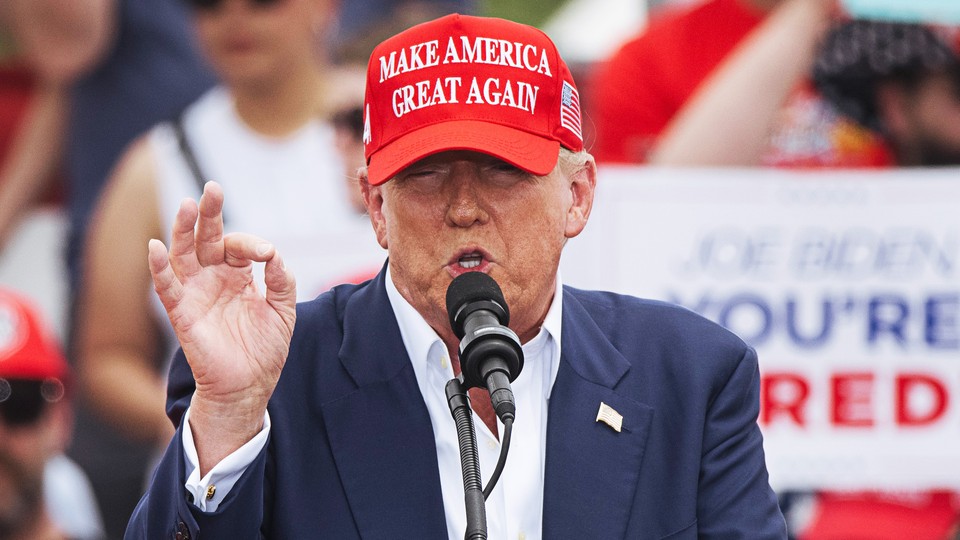
Perhaps the greatest trick Donald Trump ever pulled was convincing millions of people—and the American media—to treat his lapses into fantasies and gibberish as a normal, meaningful form of oratory. But Trump is not a normal person, and his speeches are not normal political events.
For too long, Trump has gotten away with pretending that his emotional issues are just part of some offbeat New York charm or an expression of his enthusiasm for public performance. But Trump is obviously unfit—and something is profoundly wrong with a political environment in which he can now say almost anything, no matter how weird, and his comments will get a couple of days of coverage and then a shrug, as if to say: Another day, another Trump rantabout sharks.
Wait, what?
Yes, sharks. In Las Vegas on Sunday, Trump went off-script—I have to assume that no competent speechwriter would have drafted this—and riffed on the important question of how to electrocute a shark while one attacks. He had been talking, he claims, to someone about electric boats: “I say, ‘What would happen if the boat sank from its weight and you’re in the boat, and you have this tremendously powerful battery, and the battery’s now underwater, and there’s a shark that’s approximately 10 yards over there?’”
As usual, Trump noted how much he impressed his interlocutor with his very smart hypothetical: “And he said, ‘Nobody ever asks this question,’ and it must be because of MIT, my relationship to MIT. Very smart.” (MIT? Trump’s uncle taught there and retired over a half century ago, when Trump was in his 20s, and died in 1985. Trump often implies that his uncle passed on MIT’s brainpower by genetic osmosis or something.)
This ramble went on for a bit longer, until Trump made it clear that given his choice, he’d rather be zapped instead of eaten: “But you know what I’d do if there was a shark or you get electrocuted? I’ll take electrocution every single time. I’m not getting near the shark. So we’re going to end that, we’re going to end it for boats, we’re going to end it for trucks.”
Hopefully, this puts to rest any pressing questions among Americans about the presumptive Republican nominee’s feelings on electric vehicles and their relationship to at least two gruesome ways to die.
Sure, it seems funny—Haha! Uncle Don is telling that crazy shark story again!—until we remember that this man wants to return to a position where he would hold America’s secrets, be responsible for the execution of our laws, and preside as the commander in chief of the most powerful military in the world. A moment that seems like oddball humor should, in fact, terrify any American voter, because this behavior in anyone else would be an instant disqualification for any political office, let alone the presidency. (Actually, a delusional, rambling felon known to have owned weapons would likely fail a security check for even a visit to the Oval Office.)
Nor was the Vegas monologue the first time: Trump for years has fallen off one verbal cliff after another, with barely a ripple in the national consciousness. I am not a psychiatrist, and I am not diagnosing Trump with anything. I am, however, a man who has lived on this Earth for more than 60 years, and I know someone who has serious emotional problems when I see them played out in front of me, over and over. The 45th president is a disturbed person. He cannot be trusted with any position of responsibility—and especially not with a nuclear arsenal of more than 1,500 weapons. One wrong move could lead to global incineration.
Why hasn’t there been more sustained and serious attention paid to Trump’s emotional state?
First, Trump’s target audience is used to him. Watch the silence that descends over the crowds at such moments; when Trump wanders off into the recesses of his own mind, they chit-chat or check their phones or look around, waiting for him to come back and offer them an applause line. For them, it’s all just part of the show.
Second, Trump’s staff tries to put just enough policy fiber into Trump’s nutty verbal soufflés that they can always sell a talking point later, as if his off-ramps from reality are merely tiny bumps in otherwise sensible speeches. Trump himself occasionally seems surprised when these policy nuggets pop up in a speech; when reading the teleprompter, he sometimes adds comments such as “so true, so true,” perhaps because he’s encountering someone else’s words for the first time and agreeing with them. Thus, they will later claim that questions about sharks or long-dead uncles are just bad-faith distractions from substance. (These are the same Republicans who claim that every verbal stumble from Joe Biden indicates full-blown dementia.)
Third, and perhaps most concerning in terms of public discussion, many people in the media have fallen under the spell of the Jedi hand-waves from Trump and his people that none of this is as disturbing and weird as it sounds. The refs have been worked: A significant segment of the media—and even the Democratic Party—has bought into a Republican narrative that asking whether Trump is mentally unstable is somehow biased and elitist, the kind of thing that could only occur to Beltway mandarins who don’t understand how the candidate talks to normal people.
Such objections are mendacious nonsense and represent a massive double standard. As Eugene Robinson of The Washington Post wrote today: “It is irresponsible to obsess over President Biden’s tendency to mangle a couple of words in a speech while Donald Trump is out there sounding detached from reality.” Biden’s mush-mouthed moments fall well within the range of normal gaffes. Had he or any other American politician said anything even remotely like one of Trump’s bizarre digressions, we’d be flooded with front-page stories about it. Pundits would be solemnly calling for a Much Needed National Conversation about the Twenty-Fifth Amendment.
It is long past time for anyone who isn’t in the Trump base to admit, and to keep talking about, something that has been obvious for years: Donald Trump is unstable. Some of these problems were evident when he first ran, and we now know from revelations by many of his former staff that his problems processing information and staying tethered to reality are not part of some hammy act.
Worse, the people who once managed Trump’s cognitive and emotional issues are gone, never to return. A second Trump White House will be staffed with the bottom of the barrel—the opportunists and hangers-on willing to work for a reprehensible man. His Oval Office will be empty of responsible and experienced public servants if the day comes when someone has to explain to him why war might be about to erupt on the Korean peninsula or why the Russian or Chinese nuclear forces have gone on alert, and he starts talking about frying sharks with boat batteries.
The 45th president is deeply unwell. It is long past time for Americans, including those in public life, to recognize his inability to serve as the 47th.
Scientists Found Microplastics in Every Human Semen Sample They Examined
Victor Tangermann – June 11, 2024
A team of researchers has found microplastics in all 40 semen samples they examined from healthy men, highlighting the urgent need to study how these tiny particles could affect human reproduction.
In a paper published in the journal Science of the Total Environment, researchers from a number of Chinese institutions identified eight different polymers in the samples, with polystyrene being the most prevalent.
As The Guardian reports, it’s only the latest in a string of studies that have equally found microplastics in semen.
While their effect on reproduction and human health still isn’t entirely understood, researchers have also been documenting a global decline in sperm count and other issues plaguing male fertility, linking them to a number of environmental and lifestyle factors.
Given the latest research, these tiny pollutants could even have troubling consequences for our ability to reproduce.
“As emerging research increasingly implicates microplastic exposure as a potential factor impacting human health, understanding the extent of human contamination and its relation to reproductive outcomes is imperative,” the researchers wrote in their paper.
Studies involving mice “demonstrate a significant decrease in viable sperm count and an uptick in sperm deformities, indicating that microplastic exposure may pose a chronic, cumulative risk to male reproductive health,” they added.
A different study published in the journal Toxicological Sciences last month found microplastics in all samples of 47 canine and 23 human testicles.
“At the beginning, I doubted whether microplastics could penetrate the reproductive system,” coauthor and University of New Mexico professor Xiaozhong Yu told The Guardian at the time. “When I first received the results for dogs I was surprised. I was even more surprised when I received the results for humans.”
Worse yet, the samples dated back to 2016, suggesting that the “impact on the younger generation might be more concerning,” given the particles’ growing prevalence, Yu added.
As a result, experts are calling for action to reduce the amount of plastic being produced worldwide, much of which will end up polluting the environment and our bodies.
“In particular, there is a need for action to avoid additional permanent damage to the planet and the human body,” University of Rome’s Luigi Montano, who coauthored a separate study that found microplastics in human semen, told The Guardian.
“If microplastic pollution impacts the critical reproductive process, as evidenced in particular by the decline in seminal quality recorded in recent decades globally, it may prove to be [even worse] for our species in the not too distant future,” he added.
A local councilwoman was gunned down Friday as she was leaving her home in the southern state of Guerrero, authorities and local media said, marking the second female politician to be killed in Mexico after Claudia Sheinbaum became the first woman to win the country’s presidency last week.
Esmeralda Garzon, a councilwoman in the municipality of Tixtla, was shot dead as she was leaving her house, local media reported. The Guerrero state attorney general’s office said in a statement that police were sent to the scene to gather evidence and find those responsible for the shooting.
Garzon, who led the equity and gender commission in Tixtla, had been elected under the Institutional Revolutionary Party (PRI), the Reuters news agency reported. However, she eventually backed Sheinbaum’s Morena party in the June 2 elections, according to posts on social media. Garzon herself was not running in the elections.
Her murder comes a few days after the mayor of a town in western Mexico and her bodyguard were killed outside of a gym. Yolanda Sanchez Figueroa was killed just hours after Sheinbaum won the presidency.
Most violent elections in modern Mexican history
At least 23 political candidates were killed while campaigning before the elections, according to official statistics, marking the most violent elections in modern Mexican history, according to Reuters.
But some non-governmental organizations have reported an even higher toll, including Data Civica, which counted at least 30 killings of candidates. The toll increases to more than 50 people if relatives and other victims of those attacks are counted, according to Data Civica.
A few days before the elections, one mayoral hopeful’s murder was captured on camera — an assassination that came just one day after another mayoral candidate in the central Mexican state of Morelos was murdered.
The week before that, nine people were killed in two attacks against mayoral candidates in the southern state of Chiapas. The two candidates survived.
Last month, six people, including a minor and mayoral candidate Lucero Lopez, were killed in an ambush after a campaign rally in the municipality of La Concordia, neighboring Villa Corzo.
In April, one mayoral hopeful was shot dead just hours after she began campaigning.
Mexico’s new president ran on climate goals. Will she follow through?
Thomas Graham in Mexico City – June 10, 2024
Claudia Sheinbaum in Mexico City, Mexico, last week.Photograph: Raquel Cunha/Reuters
The month before Mexico’s 2 June presidential vote the country was bedeviled by water cuts and blackouts as a record heatwave took the country beyond red and into an ominous purple on the weather map.
As dehydrated monkeys dropped dead from trees, the landslide victory of Claudia Sheinbaum, a climate scientist, might look like salvation. But her record paints a more complicated picture – one where climate convictions have often, and may still, come second to political pragmatism.
Sheinbaum will inherit a country that has slipped from frontrunner to laggard on climate policy – in part due to the policies of her predecessor and ally, Andrés Manuel López Obrador, which she has promised to continue.
López Obrador, who comes from the oil-rich state of Tabasco, prioritised “energy sovereignty” by growing the role of state companies and striving for self-sufficiency.
This was manifested in a $17bn oil refinery and colossal injections of cash and tax cuts for Pemex, the most indebted state oil company in the world, and one of the biggest historical polluters.
One result was to entrench a dirty-energy matrix, with almost 80% coming from fossil fuels.
“Not only are we nowhere near it, but we don’t have any specific and detailed plans to achieve it, let alone financing and concrete infrastructure projects,” said Diego Rivera Rivota, a researcher at Columbia University’s Center on Global Energy Policy.
“Acapulco taught us a big lesson. We weren’t prepared for that,” said Gustavo Alanís, general director of CEMDA, an environmental NGO. “These floods, droughts, hurricanes and heatwaves aren’t just going to continue, but possibly get more severe and frequent.”
Many hope Sheinbaum’s background as a climate scientist – one who contributed to the reports of the Nobel prize-winning Intergovernmental Panel on Climate Change – will shine through once she takes office on 1 October, notwithstanding her reliance on López Obrador to win the presidency.
When she was mayor of Mexico City, there were certain signs of the approach she might take as president, with an emphasis on solar energy, electrified public transport and a new cable car line.
But then, the city saw no great improvement in either of its fundamental environmental problems: air pollution and water shortages.
Meanwhile, on the campaign trail, Sheinbaum promised all things to all people, saying she would both continue López Obrador’s policies but also do more for the environment.
This means the Maya Train – one of López Obrador’s flagship infrastructure projects to develop historically poorer regions – will continue to cut through Latin America’s second-largest tropical forest. Sheinbaum has even suggested expanding it to neighbouring Belize and Guatemala.
There will also be more backing for Sembrando Vida, López Obrador’s pet forestry and rural development initiative that has had money plowed into it as budgets for state environmental agencies have been slashed – even though its results are little understood, and there are reports it even promotes deforestation.
And there will be more public money for Pemex as it staggers on under its debt burden and tries to increase its oil output.
On the other hand, Sheinbaum has also suggested that Pemex expand its remit to include mining for lithium, a crucial element of electric batteries.
And there was a campaign pledge to spend $14bn on clean-energy projects. That would mark a radical change from López Obrador’s government, which not only invested very little in renewables, but also revoked or blocked permits for private projects.
Experts also expect to see more action on the demand side of the equation, with an emphasis on electrification of public transport and incentives for residential solar panels. “This is a country with 300 days plus of sun,” said Rivera Rivota. “It has massive potential for that.”
Although Sheinbaum’s proposals lack detail at this stage, she has repeatedly emphasised the need for long-term planning for both energy and water – looking not just to 2030, but to 2050 and beyond.
“[Long-term planning] was not guaranteed during the current administration. We had several legal and regulatory changes, and other attempts at change that led to battles in court,” said Rivera Rivota. “As long as it’s clear what the rules of the game are, what the legal framework is, I think Mexico has enormous potential for investment in renewable energy.”
The scale of victory for Sheinbaum’s Morena party, which seems to have given it a supermajority in one and perhaps both houses of congress, as well as the governorships of 24 of Mexico’s 32 federal entities, has given Sheinbaum a huge mandate as president-elect.
But whether she wants or will be able to move away from her predecessor’s policies is an unknown.
López Obrador will remain a powerful figure – and his continued support may be needed to help hold together Morena, the party that he founded but has since expanded to house disparate ideologies, and fractious groups.
“She was never going to contradict the president during the campaign,” said Rivera Rivota. “But who knows what will happen when she’s sitting in the Palacio Nacional and making the calls herself.”
“There is hope, and there is a vote of confidence [in Sheinbaum],” said Alanís of CEMDA. “But here we will be vigilant, and we will be checking the actions of her administration every day.
Macron’s election call unsettles Paris Olympics build-up
Cyril Touaux – June 10, 2024
France will hold snap elections just weeks before the Paris Olympics (Ludovic MARIN)
Paris Mayor Anne Hidalgo on Monday described the prospect of French parliamentary elections just weeks before the start of the Paris Olympics as “extremely unsettling”, while the International Olympic Committee played down any direct impact on the event.
“Like a lot of people I was stunned to hear the president decide to do a dissolution (of parliament),” Hidalgo said of Emmanuel Macron’s decision to call snap parliamentary elections on Sunday.
The surprise announcement came after hugely disappointing European parliament election results for the centrist president which Hidalgo said meant the president “could not continue as before”.
“But all the same, a dissolution just before the Games, it’s really something that is extremely unsettling,” the 64-year-old Socialist, a domestic political rival of the president, added during a visit to a Paris school.
The two-round parliamentary elections have been called for June 30 and July 7, with the Paris Olympics set to begin less than three weeks later on July 26.
The vote could lead to political instability in the event of another hung parliament in which no party wins a majority, or a seismic change if the far-right National Rally party of Marine Le Pen emerges as the biggest party nationally.
Rumours in Paris had previously suggested Macron might dissolve parliament after the Games, with the 46-year-old head of state possibly eyeing a bounce in the polls if the first Games in France in 100 years were deemed a success.
Hidalgo stressed that from an operational perspective the elections would not affect the Olympics, a message echoed by the president of the IOC, Thomas Bach, who was with her during the school visit.
“I think that all the work of installing, of preparing the Games, the infrastructure, is behind us and what remains is to welcome the entire world and we will do it with the joy that we have to host these Olympic and Paralympic Games in Paris,” Hidalgo said.
Bach said the elections are “a democratic process which will not disturb the Olympics”.
“France is used to doing elections and they are going to do them once again. We will have a new government and a new parliament and everyone is going to support the Olympics,” Bach said.
– Divided country –
The Paris Olympics begin with an unprecedented open-air ceremony on the river Seine on July 26, the first time the opening festivities for a Summer Olympics have taken place outside the main stadium.
Organisers have consistently talked up the ambitions of their vision, promising “iconic” Games that will see the world’s biggest sports event play out against the historic backdrop of the City of Light.
Worries so far had focused on security arrangements for the opening ceremony, and whether the river Seine would be cleaned up in time to hold the open-water swimming events and triathlon as expected.
Repeated strike threats from trade unions have also cast a shadow over preparations, as did public feuding over the choice of music for the opening ceremony and the official poster — indicators of France’s starkly divided political class.
Those divisions were illustrated during Sunday’s European elections, in which anti-immigration and far-right parties won almost 40 percent of the vote, inflicting heavy defeat on Macron’s centrist allies.
The snap parliamentary elections raise question marks over the government that will be in place at the time of the Olympics, with ministers such as transport and interior set to play key roles in ensuring the smooth functioning and safety of the event.
The two-stage election will also mobilise hundreds of thousands of security forces, further straining resources.
“For the preparations, the installations are ready, accreditations have been sent, plans put in place for transport: everything is primed, it remains only to be put in place,” Jean-Loup Chappelet, an Olympics expert at the University of Lausanne in Switzerland, told AFP.
He also played down the impact of any personnel changes in the cabinet.
“Nothing will change between now and July 8 in the preparations of the Games and afterwards it will be absolutely too late to change anything,” he added.
David Roizen, an Olympics expert at the left-leading Jean Jaures Foundation think-tank in Paris, said the political turmoil would put an end to a “largely successful” phase for organisers, including the ongoing Olympic torch relay.
“It risks ending the positive dynamic, meaning that people only talk about the Olympics from a security perspective,” he told AFP.
The Success Narratives of Liberal Life Leave Little Room for Having Children
By Anastasia Berg and Rachel Wiseman – June 10, 2024
Dr. Berg and Ms. Wiseman are the authors of the forthcoming book “What Are Children For?: On Ambivalence and Choice.”
Credit…Andrea Settimo
For young, secular, politically progressive men and women, having children has become something of an afterthought. Liberal conventional wisdom encourages people to spend their 20s on journeys of personal and professional self-discovery and self-fulfillment. Children are treated as a bonus round, something to get to only after completing a long list of achievements: getting a degree, forging a satisfying and well-established career, buying a house, cultivating the ideal romantic partnership.
The standards of readiness for family are at once so high and so vague that it’s hardly a surprise when people fail to reach them. Indeed, the data suggest that people are having children later than they used to and are having fewer than they’d like.
For progressives, waiting to have children has also become a kind of ethical imperative. Gender equality and female empowerment demand that women’s self-advancement not be sacrificed on the altar of motherhood. Securing female autonomy means that under no circumstances should a woman be rushed into a reproductive decision — whether by an eager partner or tone-deaf chatter about ticking biological clocks. Unreserved enthusiasm for having children can come across as essentially reactionary.
Over the past four years, we’ve conducted interviews and surveys with hundreds of young Americans about their attitudes toward having children. These conversations revealed that the success narratives of modern liberal life leave little room for having a family. Women who want kids often come to that realization belatedly, at some point in their early 30s — the so-called panic years. If they are lucky, their partner (if they have one) will fall in line. If they are not, they face a choice of returning to the dating pool, freezing their eggs (if they haven’t done so already), single parenting or giving up their hope of having kids of their own.
In this way, the logic of postponement that has been promoted by liberals and progressives — and bolstered by overblown optimism about reproductive technologies — robs young people of their agency. How many children they have, and even whether they have them at all, is increasingly a decision made for them by circumstance and cultural convention.
This is not just a recipe for unhappiness; it also reflects a deep confusion. There is nothing inherently unprogressive about embracing the prospect of children. Even Simone de Beauvoir, the philosopher who was among the first to critique reproduction and family as instruments for the oppression of women, acknowledged that shaping the character and intellect of another human being was “the most delicate and the most serious undertaking of all.” While certain conservative visions of family life — such as “trad wives” and Silicon Valley pronatalism — no doubt have little to offer those on the left, our fellow progressives need to stop thinking of having children as a conservative hobbyhorse and reclaim it for what it is: a fundamental human concern.
The family — recognized as the seat of customs and traditional values — has long been central to the appeal of conservatism. Yet it wasn’t that long ago that Republicans and Democrats fought over who could rightfully claim to be the party of “family values.” Bill Clinton, while campaigning for president against George H.W. Bush in 1992, assailed the Republican Party’s commitment to families as little more than hypocrisy. “Where are they,” he asked, “when there is no health care for pregnant women? When too many children are born with low birth weights?” Mr. Clinton went on to announce a 14-point “American Family Values Agenda.”
But in time, liberals and progressives came to shy away from publicly embracing the American family as a symbol and an ideal. After Mr. Clinton was impeached in the wake of his own family-values hypocrisy and George W. Bush was elected with the help of energized evangelical voters, family-friendly rhetoric became anathema to liberals — perceived as phony, intrusive and toxic. (The notable exception was gay marriage, whose legalization was won with the help of arguments that promoted the virtues of families.) Today, the left proudly defends the sacrosanct right to abortion and reproductive justice while almost entirely sidestepping the question of whether having children is a worthy project to begin with.
The stark polarization of today’s public discourse has only heightened the left’s wariness of children, both privately and politically. Progressive policy defeats are often met with anti-natalist grandstanding. Members of the ecological activist group BirthStrike, founded in 2018, declared that they were protesting climate inaction by refusing to have kids. The following year, shortly after proposing legislation for a Green New Deal, Representative Alexandria Ocasio-Cortez of New York broadcast progressives’ hesitancy to reproduce in the face of climate change to her 2.5 million Instagram followers when she said, “It does lead young people to have a legitimate question: Is it OK to still have children?”
The Supreme Court’s Dobbs decision, which overturned the constitutional right to abortion in 2022, has also made liberals and progressives more uneasy with the idea of starting a family. A year after Dobbs, the reproductive-rights journalist Andrea González-Ramírez wrote that she had been contemplating having children in her early 30s, before the Supreme Court’s decision put an end to all that: “I have never been sure that I desire to be a mom, let alone that I desire it enough to assume the risks. These days, however, that door is shut. I choose myself.”
That choice is not uncommon. In a recent study, 34 percent of women ages 18 to 39 reported that they or someone they know had “decided not to get pregnant due to concerns about managing pregnancy-related medical emergencies.” That might sound like a worry about abortion access, but the study suggested that Dobbs intensified ambivalence about having children more generally. Indeed, of the women who said they were forgoing having children because of the Dobbs ruling, about half lived in states where abortion rights were still protected.
One can’t help noting the irony: In permitting the conservative movement to alienate them from the question of whether they want to have and raise children, these liberals and progressives are allowing the right to shape their reproductive agendas in yet another way.
But the partisan framing of the issue is flawed at a more fundamental level. The question of children ultimately transcends politics. In deciding whether to have children, we confront a philosophical challenge: Is life, however imperfect and however challenging — however fraught with political disagreement and disaster — worth living?
To be sure, having children is not the only way to address this question. But having children remains the most basic and accessible way for most of us to affirm the value of our lives and that of others. This is in part because becoming a parent represents one of the greatest responsibilities one human being can assume for another. And it is also because the perpetuation of human life is the condition of possibility for every other thing we care about.
Committing oneself to long-term leftist causes like economic, environmental, racial and social justice is more than just compatible with embracing children and family life. It presupposes a willingness to take personal and collective responsibility for the next generation — raising, nurturing and educating those who will decide the fate of our country and our planet.
Surely, progressives and conservatives will give as vastly different answers to the question of what raising children ought to look like as they will to the question of how American society ought to be governed. But progressives must not let partisan loyalties stop them from thinking about the ways in which having children does or does not express their values, and what shape they really want their lives to take. Children are too important to allow them to fall victim to the culture wars.
Anastasia Berg is an assistant professor of philosophy at the University of California, Irvine, and an editor of the magazine The Point, where Rachel Wiseman is the managing editor. They are the authors of the forthcoming book “What Are Children For? On Ambivalence and Choice.”
By Paul Krugman, Opinion Columnist – June 10, 2024
Outside the Heritage Foundation in Washington on May 31.Credit…Jose Luis Magana/Associated Press
After Donald Trump was convicted on 34 felony counts, the Heritage Foundation — a right-wing think tank that has, among other things, produced the Project 2025 agenda, a blueprint for policy if Trump wins — flew an upside-down American flag, which has become an emblem for support of MAGA in general and election denial in particular.
This action may have shocked some old-line conservatives who still thought of Heritage as a serious institution, but Heritage is, after all, just a think tank. It’s not as if upside-down flags were being flown by people we expect to defend our constitutional order, like Supreme Court justices.
But Heritage’s embrace of what amounts to an attack on democracy is a useful symbol of one of the really troubling developments of this election as it heads into the final stretch. Heritage presents itself as a defender of freedom, but its real mission has always been to produce arguments — frequently based on shoddy research — for low taxes on rich people. And its tacit endorsement of lawlessness illustrates the way many of America’s plutocrats — both in Silicon Valley and on Wall Street — have, after flirting with the crank candidacy of Robert F. Kennedy Jr., been rallying around Trump.
Why would billionaires support Trump? It’s not as if they’ve done badly under President Biden. Stock prices — which Trump predicted would crash if he lost in 2020 — have soared. High interest rates, which are a burden on many Americans, are if anything a net positive for wealthy people with money to invest. And I doubt that the superrich are suffering much from higher prices for fast food.
Wealthy Americans, though, are surely betting they’ll pay lower taxes if Trump wins.
Biden and his team have offered fairly explicit guidance about their tax agenda, which would directly raise taxes on high-income Americans and also raise corporate taxes, which would indirectly be mainly a tax on the wealthy. These measures wouldn’t produce taxes at the top remotely comparable to what they were during the Eisenhower years, when the top marginal income tax rate was 91 percent and large estates could face inheritance taxes as high as 77 percent. Still, Biden’s plans, if carried out, would make the rich a bit less rich.
Trump has been far less explicit, but he clearly wants to retain his 2017 tax cut in full, and his allies in Congress are committed not just to tax cuts but to starving the Internal Revenue Service of resources, which would allow more wealthy Americans to evade the taxes they legally owe.
So billionaires aren’t wrong in thinking they’ll pay less in taxes if Trump wins. But why aren’t they more concerned about the bigger picture?
After all, even if all you care about is money, Trump’s agenda should make you very worried. His advisers’ plans to deport millions of immigrants (supposedly only the undocumented, but do you really believe many legal residents wouldn’t get caught up in the dragnets?) would shrink the U.S. labor force and be hugely disruptive. His protectionist proposals (which would be very different from Biden’s targeted measures) could mean an all-out global trade war. If he’s able to make good on them, his attacks on the independence of the Federal Reserve risk much more serious inflation than anything we’ve experienced in recent years.
Beyond all that, Trump will almost certainly try to weaponize the justice system to go after his perceived enemies. Only someone completely ignorant of history would imagine himself safe from that kind of weaponization — even if Trump considers you an ally now, that can change in an instant.
And if you’ve been following Trump’s rantings, you know that his rhetoric is getting less rational and more vindictive by the week. Yet his support among billionaires seems if anything to be consolidating.
So what’s going on? Here’s what I think, although it’s admittedly speculative.
First, America’s oligarchs probably believe that their wealth and influence would protect them from the arbitrary exercise of power. Trump and company might turn corrupt law enforcement and a cowed judiciary against other people, but surely not them! By the time they realized how wrong they were, it would be too late.
As I’ve written before, the superrich can be remarkably obtuse and ignorant of history.
Second, at some level I don’t really think it’s about the money. How much difference does it make to a billionaire’s quality of life if he has to settle for a slightly smaller superyacht? At the top of the pyramid, wealth is largely about status and self-importance; as Tom Wolfe wrote long ago, it’s about “seeing ’em jump.”
And when politicians don’t jump, when they don’t treat the very wealthy with the deference and admiration they consider their due, some of them become enraged. We saw this when many Wall Streeters turned on President Barack Obama — after he helped bail them out in the financial crisis — because they felt insulted by his occasional criticisms.
Biden is hardly a class warrior, but he clearly doesn’t worship the superrich. And all too many of them are turning to Trump out of sheer pettiness.
Records tumble across Southwest U.S. as temperatures soar well into triple digits
Scott Sonner – June 6, 2024
Sofia Ramirez, left, of Mexico drinks water as she waits in line to take a photo at the Welcome to Fabulous Las Vegas sign in Las Vegas Thursday, June 6, 2024. (Steve Marcus/Las Vegas Sun via AP)Dean Leano takes a water break while photographing tourists at the Welcome to Fabulous Las Vegas sign in Las Vegas Thursday, June 6, 2024. (Steve Marcus/Las Vegas Sun via AP)
RENO, Nev. (AP) — Records tumbled across the U.S. Southwest on Thursday as temperatures soared past 110 degrees Fahrenheit (43 degrees Celsius) in some areas, and the region’s first heat wave of the year was expected to maintain its grip for at least another day.
Although the official start of summer was still two weeks away, roughly half of Arizona, California and Nevada were under an excessive heat alert, which the National Weather Service said it was extending until Friday evening.
At a campaign rally for presumptive Republican presidential nominee Donald Trump in Phoenix, 11 people fell ill from heat exhaustion by late afternoon and were taken to the hospital, where they were treated and released, fire officials said.
The weather service in Phoenix described the city experiencing “dangerously hot conditions.”
And in Las Vegas, the Clark County Fire Department said it has responded to at least 12 calls for heat exposure since midnight Wednesday. Nine of those calls ended with a patient needing treatment in a hospital. A spokesperson for the county said the number is likely higher, as the heat can also play a role in other types of calls to the fire department, including those related to alcohol intoxication or when conditions like fainting, dizziness or nausea are reported.
New record highs Thursday included 113 F (45 C) in Phoenix, breaking the old mark of 111 F (44 C) set in 2016, and 111 F (44 C) in Las Vegas, topping the 110 F (43 C) last reached in 2010. Other areas of Arizona, California and Nevada also broke records by a few degrees.
The heat has arrived weeks earlier than usual even in places farther to the north at higher elevations — areas typically a dozen degrees cooler. That includes Reno, Nevada, where the normal high of 81 F (27 C) for this time of year soared to a record 98 F (37 C) on Thursday.
The National Weather Service in Reno forecast mild cooling this weekend, but only by a few degrees. In central and southern Arizona, that will still means triple-digit highs, even up to 110 F (43 C).
____
Associated Press writers Anita Snow and Ty O’Neil in Phoenix, and Rio Yamat in Las Vegas contributed to this report.