Scientists sound the alarm after new research points to growing invisible threat putting coastal cities at risk: ‘We need very dramatic action’
Susan Elizabeth Turek – July 19, 2024
A new study that accounts for seawater intrusion between ice sheets estimates that other projections about future sea level rise could be too modest.
What’s happening?
As detailed by the Guardian, researchers used computer models to analyze how ocean water intruding into ice sheet cavities impacted melting rates. They believe this could create a “tipping point” where the sheets lose ice much faster than expected.
“[Seawater intrusion] could basically be the missing piece,” study leader Dr. Alexander Bradley told the news outlet. “… And there’s a lot of evidence that when you do include it, the amount of sea level rise the models predict could be much, much higher.”
The Guardian also highlighted a previous study that suggested seawater intrusion could cause some Antarctic ice sheets to lose ice around two times more quickly. The latest findings were published in the journal Nature Geoscience.
Why is this concerning?
As it stands, models by the National Oceanic and Atmospheric Administration project large swaths of the West and East Coasts will eventually succumb to the oceans, but the latest analysis suggests the tipping point could be closer than initially believed.
Almost 40% of the global population lives less than 65 miles from a coast, according to the UN Environment Programme. If sea levels continue to rise, those communities could be at a further increased risk of property and livelihood loss, as well as displacement.
Human activities have directly impacted our seas, with the burning of dirty fuels like gas, oil, and coal overwhelmingly driving the overheating of our planet.
According to NOAA, the 10 hottest years on record have all occurred in the past decade, with 2023 being the warmest ever recorded. These warmer temperatures are causing ice sheets to melt and ocean water to expand, thus contributing to rising sea levels.
The higher water levels also increase the risk of costly damage and deadly flooding during extreme weather events. Strong hurricanes, for example, have become more frequent as a result of our changing climate, with rapid intensification a growing phenomenon.
What can be done about rising sea levels?
Floating homes and land reclamation projects are among the initiatives providing hope that we can adapt to rising sea levels. However, Dr. Bradley also called for bold action to help preserve our coastal communities.
“With every tenth of a degree of ocean warming, we get closer and closer to passing this tipping point…” Dr. Bradley told the Guardian. “So we need very dramatic action to restrict the amount of warming that takes place and prevent this tipping point from being passed.”
The global community still has a ways to go to reduce its reliance on dirty fuels and meet its agreed-upon pollution-reduction goals, but there have been promising developments. For example, in 2023, clean energy accounted for a record 30% of electricity worldwide, with wind and solar installations leading the way, according to a report by Ember.
While the appointment of 2024 United Nations Climate Change Conference president Mukhtar Babayev has been criticized because of his past ties to an oil company, there is also optimism that November’s COP29 event will lead to continued cooperation to protect our planet.
Supporting eco-friendly policymakers at home can support efforts at a systemic level. There are also simple ways to reduce the pollution you generate, like by unplugging energy vampires. Doing this can even save you around $165 on your electric bills every year.
Teamsters exec announces challenge to O’Brien after RNC speech
Lauren Irwin – July 19, 2024
International Brotherhood of Teamsters Vice President at large John Palmer announced he is mounting a challenge to current President Sean O’Brien after he gave a speech at the Republican National Convention.
In a letter, Palmer said he was officially announcing his candidacy for Teamsters national office in the 2026 election and invited all Teamsters to join him in forming an opposition slate to “send Sean O’Brien back to the truck.”
“This administration rode into power on a wave of excitement generated by our members’ desires and frustration. We were promised a more engaged leadership and a more militant union. What we have received so far is a PR blast furnace of misinformation and betrayal,” Palmer wrote in the letter, first reported by In These Times’ Kim Kelly.
Palmer also appeared to post the letter to a Teamsters Facebook group.
Of the many speeches given at the RNC this week, one of the first ones was delivered by O’Brien.
Palmer laid out several reasons why O’Brien has shown he is not fit for his leadership position, including fear of retaliation among members and failing to support members in contracts.
“This has all culminated in his presence at the anti-union, anti-worker Republican national convention, kissing the ring of a man that scabbed a picket line, failing to pay workers, discriminating against people of color as a landlord, falsely accusing five black men in New York of murder, orchestrating an insurrection against the United States, dodging the draft, and appointing Union busters from the Jones Day law firm to create the most anti-union Labor Board in history,” Palmer wrote.
Palmer argued that its “naïve to believe” that people who attended the RNC will support unions in “any way, shape, form, or manner.”
“We have successfully estranged ourselves from the rest of the labor movement through the actions of one man. Should we really go out and seek more enemies right now?” his letter said.
The worst thing about Ted Cruz’s dystopian RNC speech
From immigration to crime to fentanyl, stoking fear mattered a lot more than getting the facts right.
By Radley Balko, investigative journalist – July 18, 2024
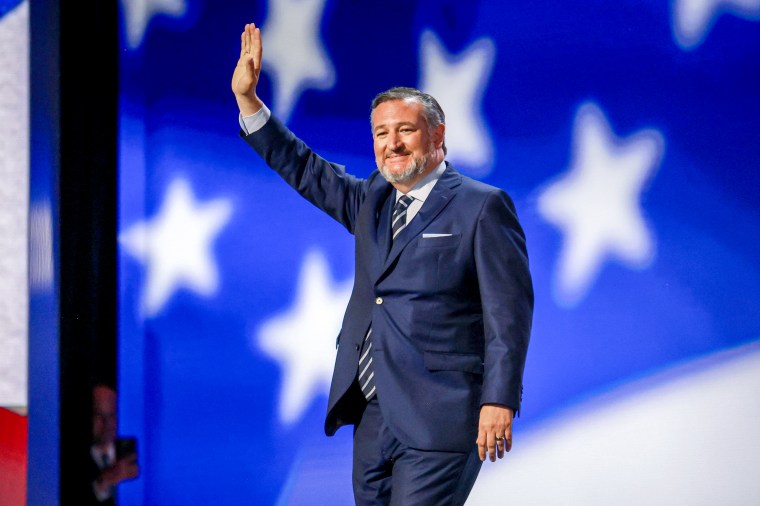
Ted Cruz on the second day of the Republican National Convention in Milwaukee on Tuesday. Joe Raedle / Getty Images
If there’s one thing we’ve learned over the last nine years, it’s that when reality proves inconvenient for MAGA, MAGA simply creates its own reality. This was certainly true of Tuesday’s “Make America Safe Once Again” night at the Republican National Convention, at which the speaker’s podium was the rhetorical equivalent of a wrench-opened fire hydrant, as one speaker after another recklessly sprayed lies, fear and demagoguery in every direction.
Sen. Ted Cruz’s undiluted rage was particularly dishonest, and because it was Ted Cruz, it was as awkward as it was angry. His clumsy attempt to coax the crowd into a refrain of “every damn day” — a reference to how often he claimed that “teenagers, girls and boys” are raped, murdered and “sold into a life of sex slavery” because of “our open border” — mostly fell flat.
Sen. Ted Cruz’s undiluted rage was particularly dishonest, and because it was Ted Cruz, it was as awkward as it was angry.
There are, of course, some documented examples of horrific crimes committed by undocumented people, as there are with any demographic group that numbers in the millions. But on the whole, immigrants both legal and undocumented commit crimes (violent crimes, in particular) at rates lower — often much lower — than the native-born population.
The much-maligned “sanctuary cities” have lower crime rates than other cities. Cities that have been hospitable to migrants seeking asylum have seen less crime than other cities. Crime in most of those cities has dropped since they began receiving migrants from the most recent wave of immigration, including the cities where Republican governors have been shipping migrants.
If such gruesome crimes were really happening “every damn day,” you’d think Cruz, R-Texas, could find more a recent horror story than, for example, the death of Kate Steinle, who died, as Cruz put it, after a man who “had been deported five times” fired a bullet that “ripped through her heart.”
If that name sounds familiar, it’s because Donald Trump also mentioned Steinle in his acceptance speech at the 2016 RNC. Steinle died nine years ago, after a man named José Inez García Zárate found a gun wrapped in cloth under a bench on a pier in San Francisco.
It’s true that Zárate had been deported five times. He was also a felon, though for nonviolent drug crimes. The gun had been stolen from an agent with the Bureau of Land Management, who left it unsecured in his car. Zárate testified at his trial that the gun went off when he picked it up. Ballistics reports confirmed that the bullet ricocheted off a concrete block and struck and killed Steinle, who was 90 feet away. There is no evidence that he intentionally fired the gun, much less that he intended to kill Steinle. A jury acquitted him on all charges but one (being a felon in possession of a firearm), and that charge was later thrown out by a judge. He pleaded guilty to related federal charges in 2022 and was deported this year.
Steinle’s family has repeatedly asked politicians to stop politicizing her death. For politicians like Cruz, a family’s grief is legitimate only when it can be harnessed to hoover up votes.
Cruz also claimed that “Democrats cynically decided they wanted votes from illegals more than they wanted to protect our children,” reiterating the central claim of conspiracists who push the racist “great replacement theory.” There is, of course, no evidence that undocumented people vote in significant numbers, that there’s some coordinated campaign to get them to the polls or that voting plays any role in the Biden administration’s immigration policy. (There is also evidence that Biden has actually been tougher on illegal border crossers than Trump.)
Beyond immigration, speaker after speaker attempted to terrify viewers into the voting booth with claims about crime that have been disproven over and over again.
House Majority Leader Steve Scalise, R-La., repeated Trump’s brazen lie about other countries’ “emptying prisons” by sending their felons to the U.S. (Trump often includes “mental institutions” in his claim). There’s no evidence this is true. Ironically, it’s a line first used by Fidel Castro to denigrate refugees fleeing his communist regime and that Republicans today often use to slander Venezuelan migrants fleeing the socialist government of Nicolás Maduro.
Several speakers also repeated the tired claim that fentanyl has been flowing through the border because of the Biden administration’s lax enforcement.
According to data compiled by Dan Bier of the Cato Institute, just 2 of every 10,000 people caught trying to enter the country illegally possess any fentanyl at all. Over 90% of fentanyl seizures come at legal points of entry, and 86% of people convicted of smuggling the drug are U.S. citizens. Moreover, smuggling of fentanyl, which is easier to conceal and far more concentrated than other illicit drugs, actually increased during the Covid travel restrictions. The idea that Biden has been lax on border enforcement will come as a surprise to the immigrant advocates who are furious with him.
There’s also no evidence that progressive or reformist prosecution policies more broadly correlate with an increase in violent crime.
There’s also zero evidence that terrorists are traipsing across the southern border, as several speakers claimed. There has yet to be a single documented case of an American citizen killed or injured by a terrorist who illegally crossed the southern border, and since 1975 there have been only nine documented cases of any person’s ultimately being convicted of terrorism after illegally entering the country.
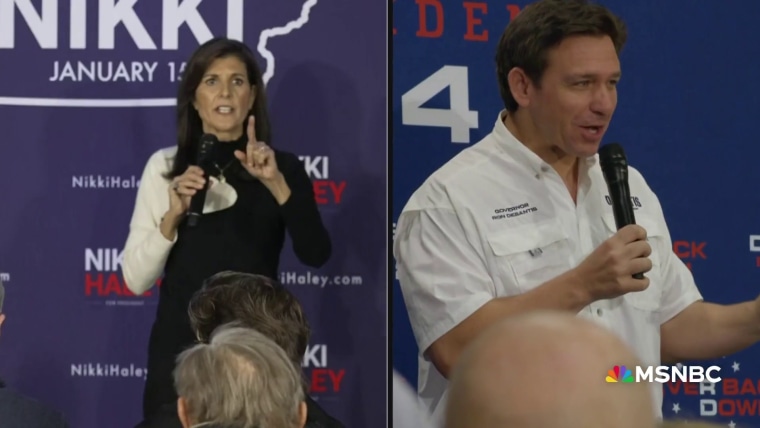
Beyond immigration, speaker after speaker attempted to terrify viewers into the voting booth with claims about crime that have been disproven over and over again. We heard much about “Soros-funded” prosecutors’ unleashing a wave of crime and violence on America’s cities. Florida Gov. Ron DeSantis lamented that these prosecutors “care more about coddling criminals than protecting their own communities” and that they “impose their will on us without our consent.”
This is a particularly rich accusation to come from DeSantis, who removed two prosecutors overwhelmingly elected (and re-elected) by their constituents and replaced them with the very sort of law-and-order prosecutors those voters had rejected. Though DeSantis accused the prosecutors of being “soft on crime,” there’s little evidence that crime has been higher in their districts than in similar districts around the state. There’s also no evidence that progressive or reformist prosecution policies more broadly correlate with an increase in violent crime.
Wisconsin GOP Senate candidate Eric Hovde claimed the Biden administration has “made us less safe at home with their ‘defund the police’ movement.”
That statement may be the most impressive lie-to-word-count ratio yet.
Biden didn’t support the “defund” movement; he was openly critical of it. The Biden administration hasn’t cut federal funding to law enforcement; it has increased it (sometimes over the objections of Republicans). In the two years after the George Floyd protests, 8 in 10 departments’ funding increased at least 2%. A handful of departments saw marginal cuts in funding, but no police department was “defunded.” There’s also zero evidence that more police funding corresponds with a reduction in crime or that less funding corresponds with an increase. (Otherwise, Hovde’s claim is accurate!)
Finally, here’s some context you didn’t hear: When Trump took office in 2017, he inherited the lowest murder rate of any president in half a century. He was then the first president in three decades to finish his term with a higher murder rate than when he started.
Trump isn’t to blame for all of that. He presided over a once-in-a-generation pandemic that disrupted black markets, took witnesses off the streets and brought a wave of desperation and despair. His term also included the largest civil rights protests in U.S. history, which only reinforced the (understandable) antipathy toward police in many marginalized communities.
Back in 2016, Trump and his surrogates blamed Obama for a surge in crime that never happened.
For the most part, presidents and their policies have little effect on crime. But there is some research suggesting that crime tends to go up when people see the government as corrupt, incompetent or hostile to their interests, particularly among marginalized groups. The theory here is that when people lose faith in government, they’re less likely to cooperate with state institutions like police and the courts. And it seems safe to say that from 2017 to 2021 there was ample reason to see the government as corrupt, incompetent and discriminatory. Immigrants, in particular, were less likely to report crimes and cooperate with police during the Trump years, most likely out of fear that they or their families would be subjected to immigration investigations.
All of that having been said, most of what drove the surge in crime was beyond Trump’s control. But this isn’t a courtesy Trump has given his opponents.
Back in 2016, Trump and his surrogates blamed Barack Obama for a surge in crime that never happened. They’re now doing the same thing to Biden. So it only seems fair to point out that the only major surge in crime in 40 years occurred while Trump was in the White House.
There is at least one class of crimes that has increased exponentially since Biden took office: crimes committed by former presidents. But that probably isn’t a trend the RNC wants to emphasize.
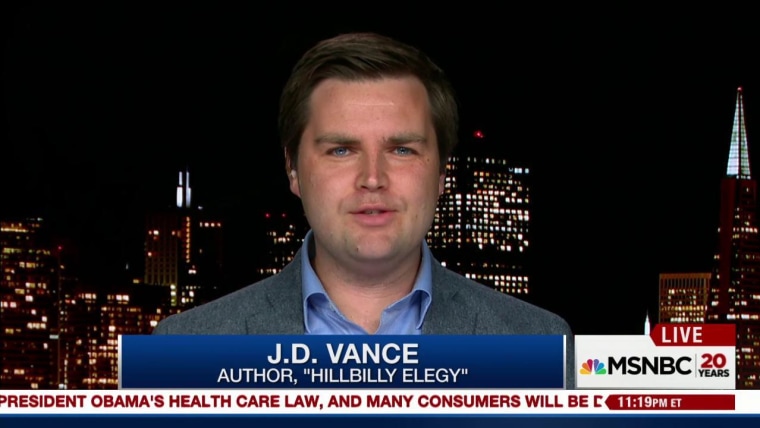
It’s easy to understand why “Hillbilly Elegy,” the 2016 memoir by JD Vance, piqued the interest of the American people. It recycles a narrative America has relied on for a century to sleep soundly despite the everyday horrors of our society: Rich people do well because they are morally better than the poor.
Add some powerful tropes — a firebrand “pistol packing lunatic” mamaw who protects at all costs, a rags-to-riches story in which Vance, a Marine, escapes the “worst of my cultural inheritance” (p. 253) of unsophisticated, drug-addicted, murderous hillbillies — and you’ve got a bestseller.
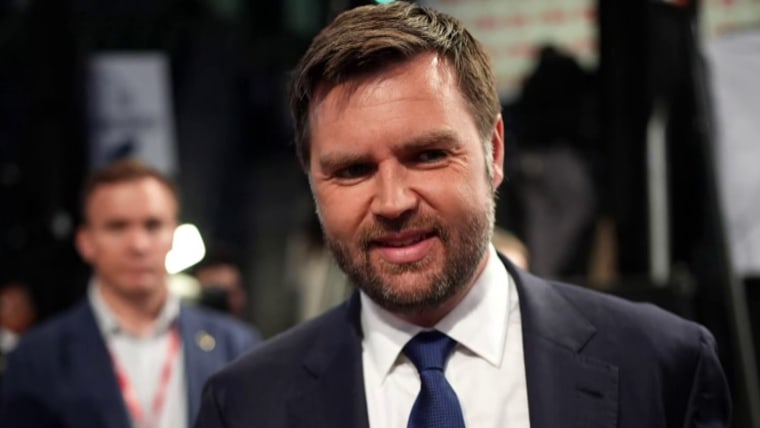
You’ve also got a dangerous lie, one relying on ugly stereotypes that harm real Appalachians in order to advance a political career. Former President Donald Trump announced Monday that Vance, the junior senator from Ohio, is his pick for his running mate.
Unlike me, Vance is not Appalachian. He was born and raised in Middletown, Ohio, well outside any maps of the distinct geographical and cultural region. Trump picking this Rust Belt charlatan as his running mate Monday sparked a resounding and unifying rant among conservative and liberal hillbillies alike in my social media feed: We do not acknowledge him.
Why would we? Vance introduces his reader to Appalachia by immediately profiling the worst behaviors of each of his uncles, including a scene of grotesque violence. He calls us a “pessimistic bunch” living in a “hub of misery” (p. 4), and over and over again he uses a wide brush to paint Appalachians as lazy, ignorant and unwilling to try at life.
Though there are dozens of offensive stories to choose from in “Hillbilly Elegy,” perhaps the most ridiculous one occurs when, during boot camp, Vance says he meets an eastern Kentuckian who, never having heard the term, asks “What’s a Catholic?” because, as Vance presents it, “down in that part of Kentucky [where he says that man is from], everybody’s a snake handler.” (p. 160). It’s an addictively stereotypical image: the ignorant, isolated, snake-handling hillbilly. But it’s not reality. There are a half dozen churches in that Kentuckian’s county seat, mostly Baptist and Methodist. Just 20 miles away, in Hazard, there’s a Catholic Church. Another 20 miles away, where Vance’s family lives, there’s a Catholic Church with more than 4,000 Facebook followers.
Vance’s memoir of Appalachia, full of gun-toting, drug-addicted “lunatics” aimlessly awaiting death, is at best a cherry-picking of the worst moments of his life. At worst, it’s a concoction of real memories and some of television’s worst stereotypes of what Appalachia is.
Anthony Harkins and Meredith McCarroll’s “Appalachian Reckoning,” a response to Vance’s bestseller, anthologizes more than 400 pages of responses from real Appalachians describing their lives in all the nuance they deserve.
But nuanced stories aren’t useful in politics.
Appalachia is simply a rhetorical device for Vance that he used to launch a political career. If your political goal is to blame the poor for their own problems, then using the regional ethnicity of your grandparents to present yourself as “authentic” can compel readers to believe your narrative or to feel good about having already believed it. After all, the narrative of the lazy hillbilly has existed for as long as rich folks outside of Appalachia needed an explanation for mountain poverty that doesn’t include blaming themselves.
Did the poverty come from the rest of the country ignoring a region they thought had no resources?
Did the poverty come from coal barons stealing resources once they were discovered.
Did the poverty come from outside coal companies not paying coal miners actual money for decades?
Why blame complex issues that implicate rich white folks when “lazy” is only two syllables?
Vance builds on this narrative, ignoring nuance and context, presenting supposed anecdote after supposed anecdote of cultural depravity and portraying himself as a hillbilly who survived and knows the answer to what ails Appalachia is political conservatism.
For Vance, issues of poverty, drug abuse and neglected children are “issues of family, faith, and culture.” (p. 238) He goes so far as to claim that these “problems were not created by governments or corporations or anyone else.” (p. 255)
He puts the blame entirely on poor Americans, on mothers on food stamps and on fathers who are out of work, extending the roots of that blame directly to Appalachians and some inherent moral flaw. In convincing readers outside of Appalachia that they need the solution he is selling, he paints the Appalachian as the moral problem in America:
The dog whistle is pretty clear: The immoral hill folks are already in your area. Trust me, I escaped them. I know the answer to save you from them.
“If there is any temptation to judge these problems as the narrow concerns of backwoods hollers, a glimpse at my own life reveals that Jackson [Kentucky]’s plight has gone mainstream. Thanks to the massive migration from the poorer regions of Appalachia to places like Ohio, Michigan, Indiana, Pennsylvania, and Illinois, hillbilly values spread widely along with hillbilly people.” (p. 20)
The “hillbilly” twist is a particularly clever political move because it allows poor white folks living in swing states (like those listed above) to draw a quick line of demarcation around themselves — hardworking but poor Americans — and the supposed immoral, lazy welfare queens and absent, violent hillbilly fathers spreading into their cities and towns.
Vance paints himself as having narrowly escaped “the deep anger and resentment” (p. 2) of those who raised him and laments the supposed white working class feeling that “our choices don’t matter.” (p. 176)
Wednesday morning, my sister, who has known overwhelming pain and difficulty, signed up for nursing classes at a community college. Last week, my nephew, a young man with everything stacked against him, asked me to meet him to talk about vocational school.
I see people making choices.
I see no anger.
Vance confuses frustration in a difficult system with anger and resentment.
Vance confuses frustration in a difficult system with anger and resentment; he misrepresents Appalachians acknowledging that the choices they have are few and far between and require great levels of personal sacrifice as their belief that the choices they make don’t matter.He sees the drowning person and decides they lack determination in swimming. He ignores those creating the flood.
Vance does identify one hillbilly trait that I will, at this moment, agree with: We can be distrustful of outsiders. I might add that I am most distrustful of outsiders pretending to be insiders and of outsiders with a political agenda.
Today’s GOP has no past, present, or future. It’s just Trump.
It’s as if MAGA wiped the GOP slate clean and made 2016 its Year Zero.
Michael A. Cohen, MSNBC Columnist – July 17, 2024
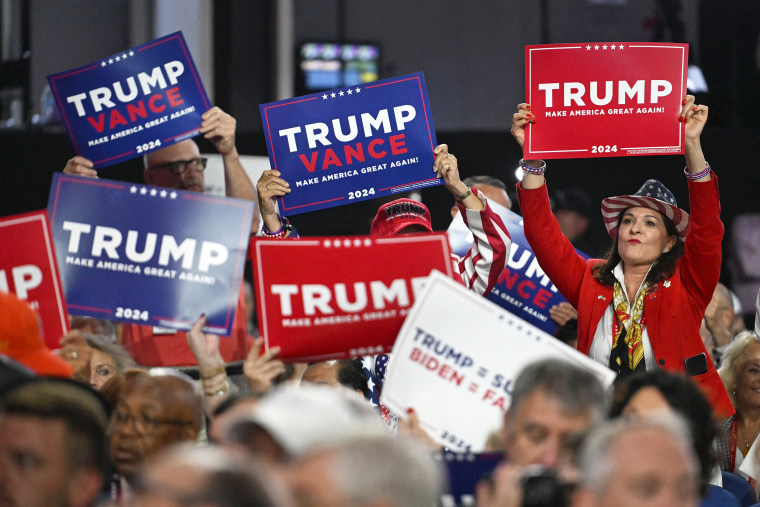
Delegates hold up signs during the second day of the 2024 Republican National Convention at the Fiserv Forum in Milwaukee, on July 16, 2024.Jim Watson / AFP – Getty Images
In his seminal dystopian novel, “1984,” George Orwell wrote “who controls the past controls the future: who controls the present controls the past.”
Indeed, there is no better example of former President Donald Trump’s hold over the modern GOP than this week’s near-total erasure of the Republican Party’s past.
You might not be aware of it by watching the Republican convention this week, but the Republican Party is, in fact, 170 years old. It was formed in 1854 as an abolitionist movement opposed to the expansion of slavery into western territories. Its first standard-bearer was Abraham Lincoln, which is why the GOP is sometimes referred to as the “Party of Lincoln.” Nineteen presidents have been Republicans.
But if you watch the 2024 Republican convention, you are likely to hear about only one: Donald Trump. It’s as if MAGA wiped the GOP slate clean and made 2016 its Year Zero.
Other than Trump, there’s only one other living Republican ex-president: George W. Bush. He’s one of only four Republican presidents in history to win two presidential elections and serve eight years in office. And the chances of hearing Bush’s name mentioned in a positive light by convention speakers in Milwaukee this week are close to nil.
Twenty years ago, Bush was a revered figure within the GOP (for those of you who are younger, you’ll have to take my word for it).
But in the 16 years since he left office, Bush’s presidency has largely been stuffed down the memory hole — and it has been a bipartisan effort. Even Democrats don’t bother talking about his disastrous presidency anymore. While Bush left office with a historically low approval rating and a cratering economy, that’s not necessarily why he is persona non grata in the party he once led.
Bush was an internationalist. Trump is an isolationist. W was pro-immigration and, by and large, opposed to demonizing people of color. Trump is, of course, the exact opposite. And Bush is part of a multigenerational political dynasty. In other words, for MAGA he is the embodiment of the dreaded political establishment.
But it’s not just Bush who has been kicked to the curb. There are also three living Republican vice presidents not in attendance — Dan Quayle, Dick Cheney and Mike Pence. Quayle has been out of the limelight for years; Cheney is the father of Liz Cheney, whom Trump despises for her role in co-chairing the House Jan. 6 committee, and, of course, on Jan. 6 Trump helped whip up a mob that threatened the life of Pence, his former vice president — so it’s probably best he didn’t make the trip to Milwaukee. (Incidentally, it was Quayle who told fellow Hoosier Pence that he didn’t have the authority to stop Congress from certifying the 2020 election.)
How about the 2012 GOP presidential nominee, Mitt Romney? He’s retiring from the Senate, in large measure because of his revulsion at the direction the party has taken since Trump won its presidential nod in 2016. (Of course, Trump hates him, too, as Romney was the only Republican who voted to convict at both of Trump’s impeachment trials.)0 seconds of 2 minutes, 38 secondsVolume 90%
Romney’s 2012 running mate, Paul Ryan, a former speaker of the House, might be in attendance in Milwaukee (he is, after all, from Wisconsin), but he’s not speaking. The same goes for 2008 nominee Sarah Palin. Her running mate, John McCain, passed away in 2018, but there won’t be any glossy tributes for him. Trump, infamously, mocked McCain’s time as a POW in Vietnam. The national convention where McCain is most likely to show up is the Democratic National Convention. McCain’s widow, Cindy, spoke there in 2020.
The 1996 presidential nominee (and 1976 vice presidential nominee), Bob Dole, passed away in 2021. What are the chances that there will be a tribute to him at this year’s Republican convention? There wasn’t one in 2020 to honor former President George H.W. Bush, who died in 2018. Will there even be a reference to Ronald Reagan, the president to whom Republicans tied themselves for decades after he left office? It’s hardly a guarantee, which once would have been sacrilegious at a GOP event but today is practically par for the course (although if one wants to see the new Reagan biopic starring Dennis Quaid, it’s showing every day in Milwaukee).
Historically, political parties have a tendency to turn their backs on failed presidents or losing candidates. There weren’t many Republican conventions that extolled the virtues of Herbert Hoover after his disastrous one term in office. The same goes for Richard Nixon, the only president who was forced to resign. But even Nixon got a shoutout from the party’s presidential nominees in 1992 and 1996.
For Democrats, Jimmy Carter might have lost re-election in 1980 and is generally considered a failed president — but that didn’t stop Democrats from giving him a prime-time speaking slot at the next three conventions. This year, one can fully expect prime-time speeches from Barack Obama, Bill Clinton and Hillary Clinton. It wouldn’t be a surprise if Al Gore, John Kerry or Tim Kaine made appearances.
But at this year’s RNC, it’s as if there was no Republican Party before Trump came along. And, in a sense, that’s true. The current incarnation of the GOP bears no resemblance to the party of Lincoln, Reagan or the Bush family. The only real blast from the past is former House Speaker Newt Gingrich. I could identify only two speakers who worked in the Bush administration. It’s now the party of Trump and Trumpism, of political outsiders and rebels — and the only price for entry is pledging one’s fealty to the leader (not the party).
Of the dozens of speakers over four days in Milwaukee, virtually all came to prominence in just the past decade or so — and largely on Trump’s coattails. People like Marjorie Taylor Greene, Kari Lake, Tom Cotton, Marco Rubio and Matt Gaetz are the faces of the modern GOP. Their rises to prominence have little to do with adherence to GOP policy orthodoxy or even their political chops but rather their willingness to prostrate themselves before Donald Trump — and fully embrace his many lies.
In Trump’s GOP, there are no legacy, no coherent ideological beliefs and no enduring political tradition. There is no past, present or future. There’s just Trump.
Michael A. Cohen is a columnist for MSNBC and a Senior Fellow and co-director of the Afghanistan Assumptions Project at the Center for Strategic Studies at the Fletcher School, Tufts University. He writes the political newsletter Truth and Consequences. He has been a columnist at The Boston Globe, The Guardian and Foreign Policy, and he is the author of three books, the most recent being “Clear and Present Safety: The World Has Never Been Better and Why That Matters to Americans.”
Picture this: A former Republican president is attempting a comeback into politics. Despite leaving office four years ago, he’s busy trying to convince the American people that his successor has been a disappointment. During an event on the campaign trail, a shot rings out as a would-be assassin attempts to end his life.
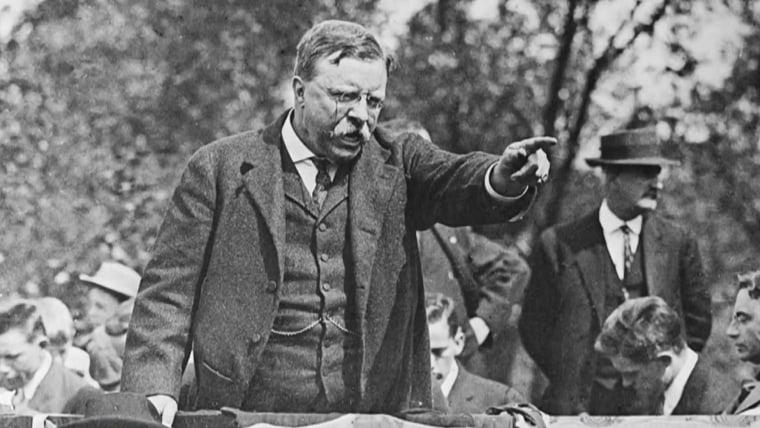
On Saturday, that scene played out for the second time in American history. Former President Theodore Roosevelt survived that 1912 shot, fired as he attempted to mount a strong third-party challenge to return to the White House. So too did former President Donald Trump when a single gunman fired at him during a rally in Pennsylvania on Saturday. It’s a dire reminder that in a country where political violence is never too far from the forefront of the nation’s consciousness, and guns remain widely available, those campaigning for the highest office in the land have long been considered prime targets.
While Trump’s wound was reportedly superficial, a few inches to the left would have likely been deadly. The latter was also true for Roosevelt, who was shot in the chest by his assailant. It was only thanks to the items in his jacket pocket — the 50 pages of his prepared remarks, folded once, and his steel eyeglass case — that the bullet was slowed. Though Trump was rushed offstage, Roosevelt concluded that the bullet had not pierced anything important. He then continued to deliver an off-the-cuff speech for close to an hour, only being taken for medical treatment afterward.
Roosevelt himself first ascended to the presidency because of an assassin’s bullet. He was vice president when President William McKinley was shot by an anarchist in 1901 while attending the Pan-American Exposition in Buffalo, New York. The resulting wound turned gangrenous thanks to poor handling from doctors, leaving Roosevelt the youngest president in history.
Decades later, Teddy’s distant cousin Franklin D. Roosevelt was the target of another would-be assassin. A month before he was sworn in as president in 1933, a man fired six shots at the car carrying the president-elect; Roosevelt was unscathed, but five other people were hit, including Chicago Mayor Anton Cermak, who would later die from his wounds.
Despite the attempt on Teddy Roosevelt’s life, Secret Service protection was only extended to former presidents in 1965. That level of security was only extended to “major presidential candidates” in 1968 when Sen. Robert F. Kennedy, D-N.Y., was assassinated while campaigning for the presidency. (His son, Robert F. Kennedy Jr., was assigned Secret Service protection for his long shot independent presidential campaign on Monday.) But the Secret Service agents assigned to protect Alabama Gov. George Wallace when he campaigned for the Democratic nomination in 1972 weren’t enough to prevent an attempted assassination that left Wallace paralyzed from the waist down for the rest of his life.
We still don’t know the motives of the shooter who fired at Trump. The motives of other assassins or would-be assassins of presidential candidates are a mixed bag. For some, like Kennedy’s assassin Sirhan Sirhan, there has been a distinct political target, in his case Kennedy’s support for Israel. Others, like the man who shot Wallace, literally did it for the fame, or infamy, involved in trying to kill a famous figure. John Schrank, the person who tried to kill Theodore Roosevelt, did so because he claimed McKinley’s ghost told him that Roosevelt had murdered McKinley and ordered Schrank to avenge his death.
We also can’t easily use the past to judge what effect this incident will have on the election. Tony Diver, The Telegraph’s U.S. editor, looked to the shooting of President Ronald Reagan in 1981 as a touchstone. Reagan had only been in office for less than a year when John Hinckley Jr. shot him in a delusional attempt to win the attention of actor Jodie Foster. “If history tells us anything, the events of Saturday will only increase his support,” Diver wrote. “In the months after Mr Reagan was shot, the newly-elected Republican president saw a poll boost of eight points.”
While that may have been the last credible assassination attempt on a president, there are a lot of differences here that make me skeptical about the bounce Trump might see. For one, no matter what has happened to him, there’s always been a ceiling for him in the polls and a floor from his die-hard supporters. In addition, the “rally around the flag” effect that often occurs after an attempt on a sitting president’s life is less frequently seen when the target is a candidate for the office, even one who has held the job before. Both Roosevelt and Wallace lost their presidential races.
In the end, there are only two main things that unite all the attempts on presidential candidates’ lives. The first, and most within our grasp to change, is access to guns in this country. The other, though, is harder to address. Every assassination undertaken or attempted, whether for personal glory or ideology, can rightly be seen as an attack on a symbol. For what else is a candidate for the presidency but a symbol of what the country might next be? It is the reaction to the attack on that symbol that they seek, be it praise and attention, or to spark a revolution. It’s not yet clear what reaction the man who fired at Trump wanted when he pulled the trigger — but I fear it won’t be long before we find out what tinderbox he hit as well.
Hayes Brown is a writer and editor for MSNBC Daily, where he helps frame the news of the day for readers. He was previously at BuzzFeed News and holds a degree in international relations from Michigan State University.
In a matter of days, former President Donald Trump’s anti-democracy agenda will most likely be met with thunderous applause as he officially accepts the Republican nomination for president at the party’s national convention.
The picture of a lawless America mired in poverty and perversion that Trump will paint isn’t backed up by reality, but it is set to be backed up by the official Republican Party platform.
On Monday, the Republican platform committee advanced a draft of the so-called principles that will guide the Republican Party for the next four years. But this platform isn’t a road map to prosperity for the American people. It doesn’t offer a framework for unity in a fractured country.
Instead, it is a manifesto for one man: Trump.
The 16-page document is written to appeal to Trump’s sensibilities — emotionally, rhetorically and even grammatically (the erratic capitalization reads like one of his unhinged social media rants).
The 16-page document is written to appeal to his sensibilities — emotionally, rhetorically and even grammatically (the erratic capitalization reads like one of his unhinged social media rants).
And because it’s tailor-made for the convicted figurehead of this once-great party, it’s riddled with lies and belligerence designed to divide us further.
Some tenets reflect the heartlessness Trump has ushered in.
For instance, the platform promises to “CARRY OUT THE LARGEST DEPORTATION OPERATION IN AMERICAN HISTORY” — a policy that Heritage Foundation President Kevin Roberts also backed in his recent interview with “The Weekend”about Project 2025.
Let’s put the logistics of deporting millions of people — many of whom have built lives and started families in this country — and kneecapping the economy aside for a moment. Let’s focus instead on the morality of breaking those families up, of devaluing human lives to the point of boasting about it.
The position flies in the face of President Ronald Reagan’s more measured stance.
After noting that “our strength comes from our own immigrant heritage and our capacity to welcome those from other lands,” Reagan said:
“Illegal immigrants in considerable numbers have become productive members of our society and are a basic part of our work force. Those who have established equities in the United States should be recognized and accorded legal status. At the same time, in so doing, we must not encourage illegal immigration.”
Reagan later signed substantial immigration reform into law with the Immigration Reform and Control Act of 1986. That bill banned the hiring of undocumented immigrants while still ensuring a pathway to lawful permanent residence and eventual citizenship for some 2.7 million undocumented immigrants who entered the country before 1982.
The platform is also riddled with these kinds of contradictions.
The document highlights the importance of free speech multiple times throughout its pages, pledging to “ban the Federal Government from colluding with anyone to censor Lawful Speech.” In the same document, it vows “to keep foreign Christian-hating Communists, Marxists, and Socialists out of America.”
Exactly how do you do that? I fervently disagree with communism, Marxism and socialism, but like the views that animate this MAGA platform, they aren’t unlawful, and, as long as their expression doesn’t put people in physical danger, I believe that even views I disagree with shouldn’t be regulated by the government. 0 seconds of 9 minutes, 11 secondsVolume 90%
If the government can begin sanctioning everyday people for their political views alone, it sets a dangerous precedent. The platform acknowledges this with the pledge to “hold accountable those who have misused the power of Government to unjustly prosecute their Political Opponents.”
Then, there’s a tapestry of issues that the Republican Party under Trump has proven ineffective at addressing.
“Republicans will reassert greater Federal Control over Washington, DC to restore Law and Order in our Capital City, and ensure Federal Buildings and Monuments are well-maintained.”
The irony is palpable. On Jan. 6, 2021, a mob of pro-Trump extremists stormed the U.S. Capitol, where they shattered windows, ransacked offices and trashed the emblem of American democracy. Federal authorities estimate that Trump’s foot soldiers wreaked $2.73 million in damage.
Now, Republicans claiming to support law and order have largely backed Trump’s promise to pardon the rioters who desecrated a building paid for by U.S. taxpayers while also threatening to undermine the self-governance of our capital city.
Then there’s the platform’s vow to “END INFLATION,” a problem already under control.
Just this Thursday, the Bureau of Labor Statistics reported that year-over-year inflation rose only 3% last month — a sharper decrease than expected, continuing a steady reduction from a peak of 9% two years prior.
Or maybe Trump means the inflation that he will kick off with his other campaign pledges, as economists have warned that the drastic increases in tariffs he has endorsed would decimate that progress and worsen inflation.
The current Republican platform is incoherent, hate-filled and ham-fisted, but that should come as no surprise. It was made in the image of the man who will accept the party’s nomination in just a few days.
A famous speech in “Macbeth” compares life to “a tale told by an idiot, full of sound and fury signifying nothing,” as the Scottish king’s empire implodes.
The platform of this once-great party has “sound and fury” in spades and is being told by no shortage of idiots, but unfortunately, it doesn’t signify “nothing.” It signifies what will guide the MAGA party if it is given the chance to write laws that govern your life.
Vote accordingly.
For more thought-provoking insights from Michael Steele, Alicia Menendez and Symone Sanders-Townsend, watch “The Weekend” every Saturday and Sunday at 8 a.m. ET on MSNBC.
Michael Steele is a co-host of “The Weekend,” which airs Saturdays and Sundays at 8 a.m. ET on MSNBC. He is a former lieutenant governor of Maryland and a former chairman of the Republican National Committee.
The Strongest Case for Biden Is His Resilience in the Face of the Onslaught
By Charles M. Blow – July 11, 2024
Credit…Jamie Kelter Davis for The New York Times
Joe Biden is still standing, refusing to bow out — he reiterated that once again in a lengthy and mostly successful news conference on Thursday night. Some may view it as selfish and irresponsible. Some may even see it as dangerous. But I see it as remarkable.
Despite sending a clear message — in his recent flurry of interviews and rallies, in his stalwart address this week to members of the NATO alliance and in his letter on Monday to congressional Democrats, in which he assured them that “I wouldn’t be running again if I did not absolutely believe I was the best person to beat Donald Trump in 2024” — there’s still a slow drumbeat from luminaries, donors and elected officials trying to write Biden’s political obituary.
The talent agency mogul Ari Emanuel (a brother of Rahm Emanuel, Biden’s ambassador to Japan), recently said Biden “is not the candidate anymore.” In a post on X, the best-selling author Stephen King said that it’s time for Biden “to announce he will not run for re-election.” Abigail Disney, an heiress to the Walt Disney fortune, said, “I intend to stop any contributions to the party unless and until they replace Biden at the top of the ticket.”
They seem to believe that they can kill his candidacy, by a thousand cuts or by starving it to death.
But none of this sits well with me.
First, because Biden is, in fact, his party’s presumptive nominee. He won the primaries. He has the delegates. He got there via an open, organized and democratic process.
Forcing him out, against his will, seems to me an invalidation of that process. And the apparent justification for this, that polls, which are highly fluctuant, now indicate that some voters want him replaced, is insufficient; responses to polls are not votes.
Yes, two weeks ago, Biden had a bad debate, and may well be diminished. Yes, there’s a chance he could lose this election. That chance exists for any candidate. But allowing elites to muscle him out of the race would be playing a dangerous game that is not without its own very real risk. It won’t guarantee victory and may produce chaos. The logic that says you have to dump Biden in order to defeat Trump is at best a gamble, the product of panicked people in well-furnished parlors.
Furthermore, no one has really made the case that whatever decline Biden may be experiencing has significantly impacted his policy decision-making or eroded America’s standing in the world. The arguments center on the visual evidence of somewhat worrisome comportment but mostly speculation about cognition.
That is just not enough.
I am not a Biden acolyte. I’ve never met the man. And I’m not arguing against the sense among those who have seen him up close and express worry. I’m not pro-Biden as much as I am pro-stay the course.
Like Biden’s Democratic doubters, I want above all to prevent Trump from being re-elected and to ensure the preservation of democracy. It’s just that I believe allowing Biden to remain at the top of the Democratic ticket is the best way to achieve that.
And since that’s the goal, perhaps the best argument in Biden’s favor is that his mettle has been revealed by the onslaught of criticism he has endured since the debate, much of it from other liberals.
Biden’s support hasn’t cratered, as one might have expected. Which suggests that the idea that Biden can’t win — or that another Democrat would have an easier run — is speculative at best.
Indeed, when I saw one headline that read, “Poll finds Biden damaged by debate; with Harris and Clinton best positioned to win,” I thought: Hillary Clinton? Now we’re truly in fantasy baseball territory.
And in the national poll on which that article was premised, Biden trailed Trump by just one percentage point while Vice President Kamala Harris led Trump by just one percentage point; in both cases, well within the margin of error.
A new Washington Post-ABC News-Ipsos poll found that Biden and Trump are tied nationally.
As for hypothetical candidates like Harris — who I do believe would acquit herself well at the top of the ticket — that same poll shows her performing slightly better against Trump than Biden does. But that is in the abstract, before the chaos of a candidate change, and before she received the full-frontal assault that being the actual nominee would surely bring. And in an era of opposition to “wokeness” and the values of diversity, equity and inclusion, that frontal assault, directed at the first Black, Asian American and female vice president, would be savage.
The potential drag on down-ballot races is a legitimate concern for some Democrats, but it appears to be the panic of some down-ballot candidates that has exacerbated the problem, as more than a dozen House Democrats and one Senate Democrat have called for Biden to leave the race.
There’s no guarantee that swapping out candidates would leave Democrats in a better position, but I believe the case is building that the continued dithering among Democrats about Biden’s candidacy is doing further damage to their chances.
Biden’s candidacy may not survive. But forcing him out of it may hurt Democrats more than it helps them, even with voters who say they want a different choice.
Charles M. Blow is an Opinion columnist for The New York Times, writing about national politics, public opinion and social justice, with a focus on racial equality and L.G.B.T.Q. rights.
While Democrats tear themselves apart over President Biden’s disastrous debate performance and his refusal to consider stepping aside, the Republican National Committee, without much fanfare, has released its 2024 platform.
Compared with previous platforms, it dials back references to abortion — downplaying what is, for Republicans, a losing issue. That choice goes along with Donald Trump’s recent attempt to distance himself from the extremist Project 2025 — even though that blueprint was concocted by some of his close political allies. Here, Trump is clearly employing sleight of hand in an effort not to be seen as autocratically inclined. But at this point, if you believe that, I have a degree from Trump University I’d like to sell you.
In any case, there’s nothing moderate about a platform whose first plank reads, “SEAL THE BORDER, AND STOP THE MIGRANT INVASION” and whose second item calls for “THE LARGEST DEPORTATION OPERATION IN AMERICAN HISTORY.” (Yes, the list is in all caps, just in case you need help imagining Trump shouting it to you from a Mar-a-Lago ballroom.)
I’ll have a lot more to say about Republican policy ideas in the weeks ahead. For today, however, I want to focus not on what the platform proposes but what it says about the G.O.P. image of America today — a dystopian vision that bears hardly any resemblance to the vibrant country I know, a nation that has coped remarkably well with the aftermath of the Covid-19 pandemic. Republicans may try to brand themselves as patriots, but they truly appear to despise the nation they live in.
Start with item No. 10, which begins with the promise to “STOP THE MIGRANT CRIME EPIDEMIC” — presumably one of the justifications for mass deportations. Any attempt to carry out such deportations would be a humanitarian, social and economic nightmare. But leaving that aside, the whole premise is false. There is no epidemic of migrant crime in America.
Yes, some Americans have been the victims of terrible crimes, and some of the perpetrators have been migrants. But violent crime in America, homicides in particular, which surged during the last year of the Trump administration — a year of low immigration — has plunged over the past two years.
And Americans have been signaling by their behavior, literally voting with their feet, that our big cities feel fairly safe. Downtown foot traffic on nights and weekends — that is, traffic that mainly reflects people going out for shopping and entertainment rather than for work — is close to or above prepandemic levels in many major cities.
Far from facing a crime “epidemic,” America has been highly successful in recovering from the Trump crime wave.
The G.O.P. platform also pledges to “MAKE AMERICA THE DOMINANT ENERGY PRODUCER IN THE WORLD.” The subtext here is the pervasive belief on the right that woke environmentalists have undermined the U.S. energy sector.
Given how often one hears this asserted, it’s a bit shocking to look at the data and learn that America produced more energy in 2023 than ever before. In fact, we’ve become a major energy exporter, for example selling Europe vast quantities of liquefied natural gas that helped it reduce dependence on Russian supplies after Vladimir Putin invaded Ukraine.
The area in which we’re really lagging China is renewable energy, which the Biden-Harris administration is promoting — and Republicans hate.
Further, the platform promises to “END INFLATION, AND MAKE AMERICA AFFORDABLE AGAIN.” In reality, inflation is already way down — from 9 percent at its peak to just 3 percent as measured by the Consumer Price Index, and is probably down to 2.4 percent according to an alternative price index preferred by the Federal Reserve. Gasoline and groceries are just as affordable, as measured by their prices compared with the average hourly earnings of nonmanagerial workers, as they were in 2019.
So what are Republicans talking about? Are they promising to roll back the price increases that took place almost everywhere as the world economy recovered from the pandemic? We haven’t seen deflation on that scale since the Great Depression — not exactly an experience we want to repeat.
Why does the Republican vision of America, as revealed in the party’s platform, bear so little resemblance to reality? A large part of it, I believe, is that the party instinctively favors harsh, punitive policies — which obliges it to believe that failure to pursue such policies must lead to disaster, even when it doesn’t. Democrats haven’t been deporting millions or toying with the idea of shooting protesters, therefore, the logic seems to go, we must be experiencing a crime epidemic. Democrats care about the environment, therefore they must be hampering energy production. Democrats want to expand health care coverage and alleviate poverty, therefore they must be feeding runaway inflation.
For a little while, reality seemed to cooperate with some of these grim visions, mainly because of spillovers from the pandemic and its aftermath. We did have a spike in homicides, although it mostly happened on Trump’s watch. We did have a burst of inflation, but it’s behind us.
Bottom line, there’s no reason at all to believe that Republicans have moderated their extremist agenda. Energy independence — which we have already achieved! — won’t be on the ballot this year. Health care, abortion and, probably, birth control will.
Paul Krugman has been an Opinion columnist since 2000 and is also a distinguished professor at the City University of New York Graduate Center. He won the 2008 Nobel Memorial Prize in Economic Sciences for his work on international trade and economic geography.
Rising Frustration in Houston After Millions Lost Power in Storm
With outages expected to last days, a top state official promised to look into whether the utility company could have done more to prepare for Hurricane Beryl.
By J. David Goodman and Ivan Penn July 10, 2024
Reporting from Houston and Los Angeles.
Fallen power lines littered the roads in Galveston after Hurricane Beryl hit the Texas coast on Monday.Credit…Meridith Kohut for The New York Times
The sun felt hotter than usual in Houston this week, as millions of sweltering residents emerged from the rapid thrashing of Hurricane Beryl to face a prolonged power outage — the largest ever seen by the city’s utility, according to the state’s lieutenant governor.
The outages from the storm affected as many as 2.7 million customers across the state, mostly in and around Houston. Despite a promise by the utility, CenterPoint Energy, to restore power to one million customers by the end of the day on Wednesday, large swaths of the nation’s fourth-biggest city remained without power.
The scale of the outages raised questions about whether enough had been done to prepare the city, just 50 miles from the Gulf Coast, for the kinds of storms that climate scientists predict will arrive with greater frequency.
“For a Category 1 hurricane to result in over a million customer outages in its immediate aftermath demonstrates that there is plenty of need for the resiliency hardening investments,” said Wei Du, an energy expert with PA Consulting and a former senior analyst and engineer for Con Edison.
Beryl was not a particularly strong storm when it made landfall early Monday. But the hurricane struck at the heart of Houston with a ferocity that toppled trees into power lines and that knocked over 10 transmission towers, officials said.
By late Tuesday, some 1.5 million of CenterPoint’s customers still had no power — and little sense of when it would return. Neighbors reported flickerings of light to each other on group chats, hoping for signs of progress. Many shared a map of open Whataburger locations, suggesting that the fast-food chain was a better way to find out about available electricity service, compared with the spotty information released by the utility.
As the temperatures rose, so did many residents’ anger.
“The response has been too slow,” said Patricia Alexander, 79, who sat in a cooling center in northwest Houston to get a break from the heat inside the senior center where she lives. “The mayor said he was looking out for senior centers and that CenterPoint’s teams were prioritizing senior facilities, but I don’t believe it, because we don’t have air-conditioning.”
About 2.2 million customers — 80 percent of the utility’s customers in the Houston area — lost power in the storm, a CenterPoint Energy spokesman said.Credit…Meridith Kohut for The New York Times
The sheer number of damaged lines accounted for the extent of the outages, which surpassed those during Hurricane Ike in 2008. After that storm, the utility described making efforts to better manage the vegetation around power lines.
Company officials said they had been surprised by the behavior of the storm, which initially was expected to strike further south but instead hit near Matagorda, Texas, after strengthening somewhat and then spiraling north toward Houston.
“No one should have been surprised,” said Dan Patrick, the state’s lieutenant governor, who has been acting in place of Gov. Greg Abbott while he travels abroad.
Mr. Patrick said in a news conference that he wanted the utility to focus on restoring power, but that afterward the company would need to explain its preparations for the storm.
“If they made mistakes beforehand, then that will be addressed,” Mr. Patrick said. “The real question is: Were they as prepared as they should be? And that’s up to them to answer, and they will answer not only to the public but to the P.U.C.,” he added, referring to the state’s Public Utility Commission.
Texas officials have spent much of the past few years worrying about the vulnerability of the state’s power grid to extreme cold after a failure during a winter storm in 2021.
But amid increasingly frequent extreme heat, the grid has also been tested in the summer, not just during storms but also on hot, cloudless days when energy demand is high.
“It’s not just during a storm: Texas in general tends to have more outages on a blue sky day than other states,” said Doug Lewin, an energy consultant and the author of the Texas Energy and Power newsletter. “We rank very poorly compared to other states. We’ve got a long way to go.”
In CenterPoint’s last three annual reports to federal regulators, including the most recent one in February, the utility said it had risks related to aging facilities. “Aging infrastructure may complicate our utility operations’ ability to address climate change concerns and efforts to enhance resiliency and reliability,” the company told the Securities and Exchange Commission.
A spokeswoman for CenterPoint said that the company had monitored Beryl’s development and had prepared, but “a lot of the issues were just purely because the hurricane hit more intensely than we expected.”
In particular, the company said, many of the outages occurred after trees fell on power lines.
“While we tracked the projected path, intensity and timing for Hurricane Beryl closely for many days, this storm proved the unpredictability of hurricanes as it delivered a powerful blow across our service territory and impacted a lot of lives,” Lynnae Wilson, senior vice president for CenterPoint, said in a statement.
About 2.2 million customers — 80 percent of the utility’s customers in the Houston area — lost power in the storm, a company spokesman said.
Utility experts said that power companies have little excuse for not being ready for events that develop over the course of days, in particular when the primary job is to deliver safe, reliable service.
“Most of all, it really is the preparation issue,” said Robert McCullough, of McCullough Research, a consulting firm based in Portland, Ore. “Mild storm. Why weren’t we better prepared?”
The outages from Beryl came less than two months after powerful thunderstorms knocked out power across Houston in May.Credit…Daniel Becerril/Reuters
In April, CenterPoint filed a resiliency plan with the state, proposing to spend billions to “modernize and harden our existing infrastructure” to increase reliability. A significant focus, according to the plan, is to modernize the company’s transmission and distribution systems.
After a series of powerful hurricanes struck Florida two decades ago, that state took steps to improve its electrical infrastructure.
The process, which included burying a targeted number of power lines, appeared to bear fruit, according to a 2024 report by the Lawrence Berkeley National Laboratory. The power grid grew more resilient to storms, the report found.
But simply burying power lines underground is not always the best solution, experts say, particularly in areas that are prone to flooding, like many parts of Houston.
“In areas where you worry more about water, you can end up making the system more vulnerable and more expensive when you underground,” said Ted Kury, director of energy studies for the Public Utility Research Center at the University of Florida. “Storm hardening is often a choice between what type of damage you’re more concerned about,” he added.
If it’s water, you go aboveground and accept the wind damage, he said, and “if it’s wind, you might want to underground” but would then have to worry about the water.
The $2.19 billion investment plan proposed by CenterPoint includes upgrading or replacing existing poles and structures to meet current wind loading standards, and improving the distribution system to prevent automatic shut-offs. The plan also proposes a pilot program to assess whether “utility-scale” microgrids can speed up the restoration of power during a fire or weather emergency.
The plan, which still needs state approval, calls for making these investments over a three-year period from 2025 to 2027.
A committee of the Texas Legislature was set to meet on Monday in Austin to discuss the utility resiliency issue — but the meeting was canceled because of the storm.
Delay is becoming more costly. Greenhouse gas emissions are increasing the capacity of the atmosphere to hold moisture, leading to more rain, more flooding and more potential for trees to fall, said Karthik Balaguru, a researcher at the Pacific Northwest National Laboratory. “I think Houston is an area that we should expect more outages,” he said.
The outages from Beryl came less than two months after powerful thunderstorms knocked out power across Houston in May. Hundreds of thousands of residents lost power in that storm, and many of the same people found themselves again dumping spoiled food and looking for cool air this week.
“This is a double whammy,” said Cleveland James, 70, of West Houston, describing the almost back-to-back storms as he sat in the local cooling center. “I lost power for five days. So that doesn’t give me much encouragement that it will come back soon. I think it’ll take a week.”
Ms. Alexander, nearby, said she worried that Beryl would not be the last time she found herself without power this summer.
“This is going to happen again,” she said of the storm, only the second to get a name this hurricane season. “I mean, we’re only in the B’s.”
Ivan Penn is a reporter based in Los Angeles and covers the energy industry. His work has included reporting on clean energy, failures in the electric grid and the economics of utility services. More about Ivan Penn