Record Salmon in One Place. Barely Any in Another. Alarm All Around.

Record Salmon in One Place. Barely Any in Another. Alarm All Around.

An aerial view of the Yukon River in Alaska, Aug. 3, 2021. (Ash Adams/The New York Times)


This summer, fishers in the world’s largest wild salmon habitat pulled a record-breaking 65 million sockeye salmon from Alaska’s Bristol Bay, beating the 2018 record by more than 3 million fish.

But on the Yukon River, about 500 miles to the north, salmon were alarmingly absent. This summer’s chum run was the lowest on record, with only 153,000 fish counted in the river at the Pilot Station sonar — a stark contrast to the 1.7 million chum running in year’s past. The king salmon runs were also critically low this summer — the third lowest on record. The Yukon’s fall run is also shaping up to be sparse.

The disparity between the fisheries is concerning — a possible bellwether for the chaotic consequences of climate change; competition between wild and hatchery fish; and commercial fishing bycatch.

“This is something we’ve never seen before,” said Sabrina Garcia, a research biologist with the Alaska Department of Fish and Game. “I think that we’re starting to see changes due to climate change, and I think that we’re going to continue to see more changes, but we need more years of data.”

The low runs have had ripple effects for communities along the Yukon River and its tributaries — the Andreafski, Innoko, Anvik, Porcupine, Tanana and Koyukuk rivers — resulting in a devastating blow to the people relying on salmon as a food staple, as feed for sled dogs and as an integral and enriching cultural tradition spanning millenniums.

“We have over 2,000 miles of river, and our numbers are so low,” said Serena Fitka, the executive director of the Yukon River Drainage Fisheries Association. “Where are all our fish? That’s the question hanging over everyone’s head.”

Because the critically low runs of chinook and chum didn’t meet escapement goals, the Alaska Department of Fish and Game prohibited subsistence, commercial and sports fishing on all of the Yukon, leaving nearly 50 communities with basically no salmon.

“When we have a disaster of this magnitude, where people are worried about their food security, they’re worried about their spiritual security, they’re worried about the future generations’ ability to continue our way of life and culture — our leadership is very anxious,” said Natasha Singh, who is general counsel for the Tanana Chiefs Conference, a tribal organization representing 42 villages in an interior Alaska region nearly the size of Texas. “Our people are very anxious. They want to remain Athabascan-Dene. They want to remain Native, and that’s at risk.”

It’s not the first time salmon runs on the Yukon River and its tributaries have plummeted, but this summer’s record low numbers feel particularly distressing. A large stretch of the Yukon River carries only two of the five species of salmon found in Alaska: chinook and chum.

“When one species crashes, we’re kind of shocked, but we’re OK because we know we can eat from the other stock,” said Ben Stevens, the tribal resource commission manager for Tanana Chiefs Conference. “But, this year is unprecedented in that we don’t have either stock there. They’re both in the tank.”

Yukon River chinook salmon have been in decline for decades, shrinking in size and in quantity as the years pass. The region is also seeing mass die-offs of salmon. In 2019, thousands of chum carcasses washed up on the banks of the Yukon River and its tributaries, which scientists blamed on heat stress from water temperatures nearing 70 degrees, about 10-15 degrees higher than typical for the area.

While warming waters can create an inhospitable habitat for salmon, some research indicates that the heat benefited the sockeye in Bristol Bay, boosting the food supply for young salmon.

Some fish processors are donating excess fish from Bristol Bay to communities along the Yukon. SeaShare and other Alaska fish processors are coordinating donations, and more salmon is expected to be shipped in the next few weeks.

“It’s so heartwarming to have our fellow Alaskans reach out and provide donations,” Stevens said. “I’m just kind of sad that we’ve allowed the situation to get this bad.”

Stevens is a Koyukon Athabascan from Stevens Village, a small community northwest of Fairbanks, Alaska, where the Trans-Alaska Pipeline crosses over the Yukon River. He toured the region last month to hear how communities are coping with the low runs. He said people are scared about a winter with no food, and for the consequences that come with being disconnected from the land and animals. With the loss of fish also comes “the incredible loss of culture,” Stevens said.

Meat harvested from the land is a core food for people living off Alaska’s road system, whose communities are accessible only by boat or plane. Steep shipping costs and long travel times make fresh food at village stores prohibitively expensive and limited; the custom of harvesting food together with friends and family goes back thousands of years.

No salmon also means no fish camp — an annual summer practice where families gather along the rivers to catch, cut and preserve salmon for the winter, and where important life lessons and values are passed down to the next generation.

“We go out and we pass on our tradition over thousands of years from the young to the old,” said PJ Simon, a chief and chairman of the Tanana Chiefs Conference. “That’s our soul. That’s our identity. And that’s where we get our courage, our craftsmanship, for everything that has led up to where we are today.”

Model and activist Quannah Chasinghorse, 19, travels to her family’s fish camp every summer. Chasinghorse is Han Gwich’in and Oglala Lakota, and is from the Eagle, Alaska.

“Every time I go out to fish camp there’s something new I notice that’s different — due to climate change, due to so many different things — and it breaks my heart because I want to be able to bring my children, and I want them to experience how beautiful these lands are,” Chasinghorse said. “I want to see younger generations fishing and laughing and having fun and knowing what it’s like to work hard out on the land.”

The future of Yukon salmon runs remains uncertain. But there’s still time for fishers in the region to adapt to the effects of climate change and to different management approaches, said Singh, the attorney. If salmon are allowed to rebound, then “our children will be fishing people,” she said.

“We shouldn’t conclude that climate change is going to change our fisheries to the point where we have to give up our identity,” Singh said.

Stevens said state and federal natural resource managers “need more Indigenous science” and more “traditional resource management principles in play right now.”

“I think we need folks to know that the last great salmon run on this globe, the last wild one, is about ready to end,” Stevens said. “But, we can stop it.”

© 2021 The New York Times Company

Days of hot weather grip Southern Europe, North Africa

Associated Press

Days of hot weather grip Southern Europe, North Africa


ROME (AP) — Stifling heat kept its grip on much of Southern Europe on Thursday, driving people indoors at midday, spoiling crops, triggering drinking water restrictions, turning public libraries into cooling “climate shelters” and complicating the already difficult challenge firefighters faced battling wildfires.

In many places, forecasters said worse was expected to come.

In Italy, 15 cities received warnings from the health ministry about high temperatures and humidity with peaks predicted for Friday. The cities included Rome, Florence and Palermo, but also Bolzano, which is usually a refreshing hot-weather escape in the Alps,

The local National Health Service offices in Rome and Bologna telephoned older residents who live alone to see if they needed groceries or medicines delivered so they wouldn’t venture out in the searing heat.

The Italian air force, which oversees the national weather service, said the interior parts of the islands of Sardinia and Sicily could expect to see temperatures upwards of 40 degrees Celsius (104 F) by Friday. By early afternoon on Thursday in Rome, the city famous for its ornamental as well as strategically placed sidewalk drinking fountains sizzled in 38 C (100 F) heat.

“I drink a lot of water, more water, more water and more water,” said Hank Heerat, a tourist from the Netherlands cycling down the broad boulevard flanking the Roman Forum.

At the ancient Colosseum, Civil Protection volunteers distributed hundreds of bottles of water to visitors.

In Serbia, the spell of hot, dry weather prompted four municipalities to declare an emergency after Rzav River levels plummeted, endangering water supplies. Authorities imposed drinking water restrictions affecting some 250,000 people, while the army brought in water tanks for public use.

“We have a period of severe drought, we cannot take any more water from the river,” Zoran Barac, the head of a local water supply utility, told state broadcaster RTS.

In Spain, the national weather service warned temperatures could hit 44 C (111 F) in some areas in coming days. Parts of the northeastern Catalonia region were forecast to reach 42 C (107.6 F) on Thursday.

Authorities in Barcelona, the Catalan capital, designated 162 museums, libraries, schools and other public places around the city as “climate shelters.” The sites offered an escape from the heat, cool drinking water and staff trained in dealing with heatstroke.

The surge in temperatures, due to a mass of hot, dry air from Africa, was expected to ease starting on Monday on the Iberian peninsula.

While Southern Europe is known for sunny, hot summers, climate scientists say there’s little doubt climate change from the burning of coal, oil and natural gas is driving extreme events such as heat waves, droughts and wildfires, which they say are likely to happen more frequently as Earth warms.

A German tourist in Rome concurred.

Because of climate change, “temperatures are very high. So I think it’s a better option is to reduce the carbon dioxide from the cars and travel more with the metro,” said Philippe Kutaski near the Colosseum in Rome.

As in past years, Croatia’s Adriatic Sea resorts were hosting hundreds of thousands of tourists. But those stepping out of the sea sweltered as temperatures reached 39 C (102 F) on the coast on Wednesday.

Crops and farm animals were suffering from days of extremely high temperature, too.

The Italian agriculture lobby Coldiretti said Thursday that 20% of the tomato crop in Italy’s south was lost due to torrid heat and humidity. Italy exports nearly 2 billion euros ($2.4 billion) worth of tomatoes and tomato products like canned or bottled sauce throughout the world.

Dairy farmers in southern Italy estimated that the heat wave meant cows were eating less, producing 20% less milk and drinking double the usual amount of water.

While much attention has focused on southern Europe’s heat crisis, it was even hotter on the North African shore of the Mediterranean Sea. Temperatures hit 50 C (122 F) in Tunisia, a record high for the country. The last previous high was 48.2 C (nearly 119 F) in 1968.

In Algeria, most of the regions of the north of the country have been placed on alert for heat waves. Fires ravaging mountain forests and villages in Algeria’s Berber region have killed at least 65 people, including 28 soldiers.

Blazes have devoured forest and brush areas in Greece and in southern Italy for days.

In Italy, temperatures in the mid-40s C (over 110 F) in inland parts of Sardinia, Calabria and Sicily made for ripe fire conditions. But long spells of drought also were blamed. By the start of summer in Italy, vegetation had already withered from lack of rain and “essentially became fuel” for wildfires, Italian Civil Protection official Luigi D’Angelo told Italian state TV.

Michele Calamaio in Rome, Barry Hatton in Lisbon, Jovana Gec in Belgrade, Sylvie Corbet in Paris, contributed reporting.

An estimated 300 trillion invasive mussels blanket Lake Michigan. Eradication may be impossible, but small-scale removal efforts could be the answer

An estimated 300 trillion invasive mussels blanket Lake Michigan. Eradication may be impossible, but small-scale removal efforts could be the answer


SLEEPING BEAR DUNES NATIONAL LAKESHORE — The divers leaned back from the edge of the boat and splashed into water, bobbing up for a moment before dropping down to a world just a few miles off the northern Michigan coast — and worlds away from the one above the surface.

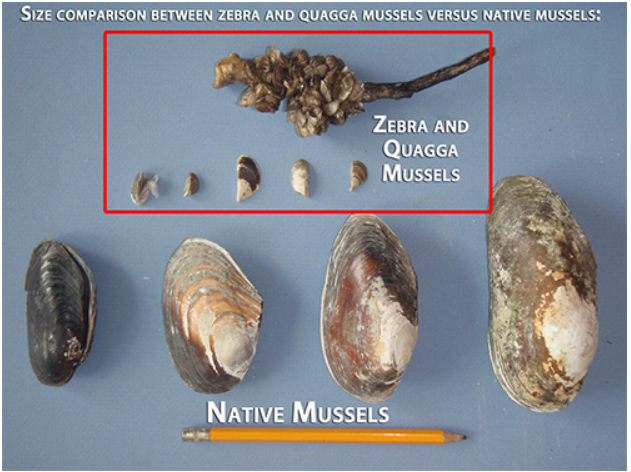
Today in Lake Michigan, quagga mussels, Eastern European invaders generally smaller than a stamp, reign over an upended underwater ecosystem. The mussels arrived in the Great Lakes more than three decades ago, eating, excreting and spreading zealously ever since, attaching themselves to everything from water intakes to shipwrecks, and all the while filtering life out of the food chain and a $7 billion fishing industry.
But solutions in open water, at least on a small scale, are starting to seem possible to soften the bivalves’ brunt.

Experiments are playing out in Lake Michigan with hopes of restoring fish spawning habitat. Manually removing mussels, with another invasive species offering an assist, has kept rocks clear. Other treatments from copper compounds to genetic biocontrol are in the mix as a collaborative dedicated to mussel control plans for the future.

The Lake Michigan survey on the U.S. Environmental Protection Agency’s 180-foot Lake Guardian research vessel, generally conducted every five years, just wrapped up. The bottom-dwelling census is essential to understanding what mussels have done to the lake in the last 30 years, and what they may do next.

Large-scale eradication is still a daunting idea with how many invasive mussels blanket Lake Michigan. By comparison, during peak migration, 30 million birds might fly over Illinois in a night. About 3 trillion trees cover the entire earth. The human body? Somewhere in the tens of trillions of cells.

National Oceanic and Atmospheric Administration scientists estimate about 300 trillion mussels in the lake from the 2015 count — and the mollusks are growing at deeper sites, and growing larger.

More than a decade ago, between regular dives off the Wisconsin shore, Harvey Bootsma, a professor at the University of Wisconsin at Milwaukee, told the Chicago Tribune the lake was “changing faster than we can study it.”
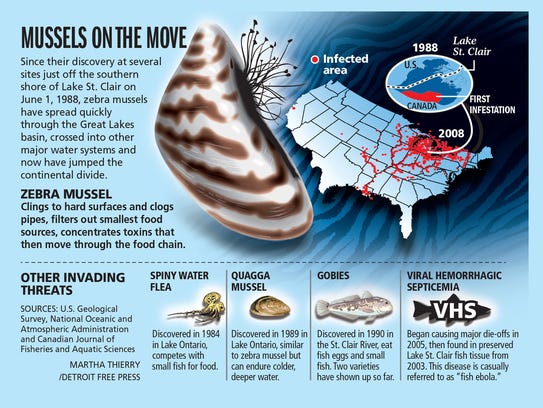
There are now more than 185 nonnative species in the Great Lakes region; some sneaked in through ships and human-made connections, while others, such as coho and king salmon, were introduced by people. Some acclimated with negligible — or even beneficial — consequences. The invasive mussels are among the most notorious of the unexpected visitors.

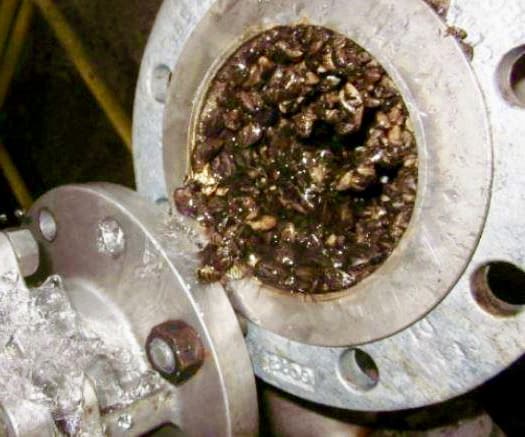
On top of the ecological damage caused to native mussels, fish and even shorebirds, they’ve cost billions — from clogging water intakes and power infrastructure, to damaging boats and docks.
Zebra mussels came first; the Caspian Sea travelers discharged in the 1980s, likely via ship-stabilizing ballast water. Quagga mussels, filter feeders armed with a more impressive propagation arsenal, arrived soon after.

Unlike zebra mussels, which generally attach to hard surfaces and stick to shallower water, quaggas tolerate colder temperatures, softer sediment and outcompete zebras with less food available, meaning they now dominate Lake Michigan — and most of the Great Lakes. Only Lake Superior has been largely spared due to the lake’s chillier conditions and lack of calcium, which mussels need to strengthen their shells.

Years later, Bootsma is still studying how the mussels have transformed Lake Michigan, suiting up and diving down to an underwater laboratory.

“What we’ve learned in the Great Lakes is that prevention is a lot cheaper than trying to implement cures,” Bootsma said. “So it’s really important for us now to understand how we can prevent such dramatic changes happening in the future.”

As zebra and quagga mussels engulfed Lake Michigan, their colonies transforming rocks into shelled clumps and the lake bed into serrated carpet, they gobbled up phytoplankton at the base of the food web.
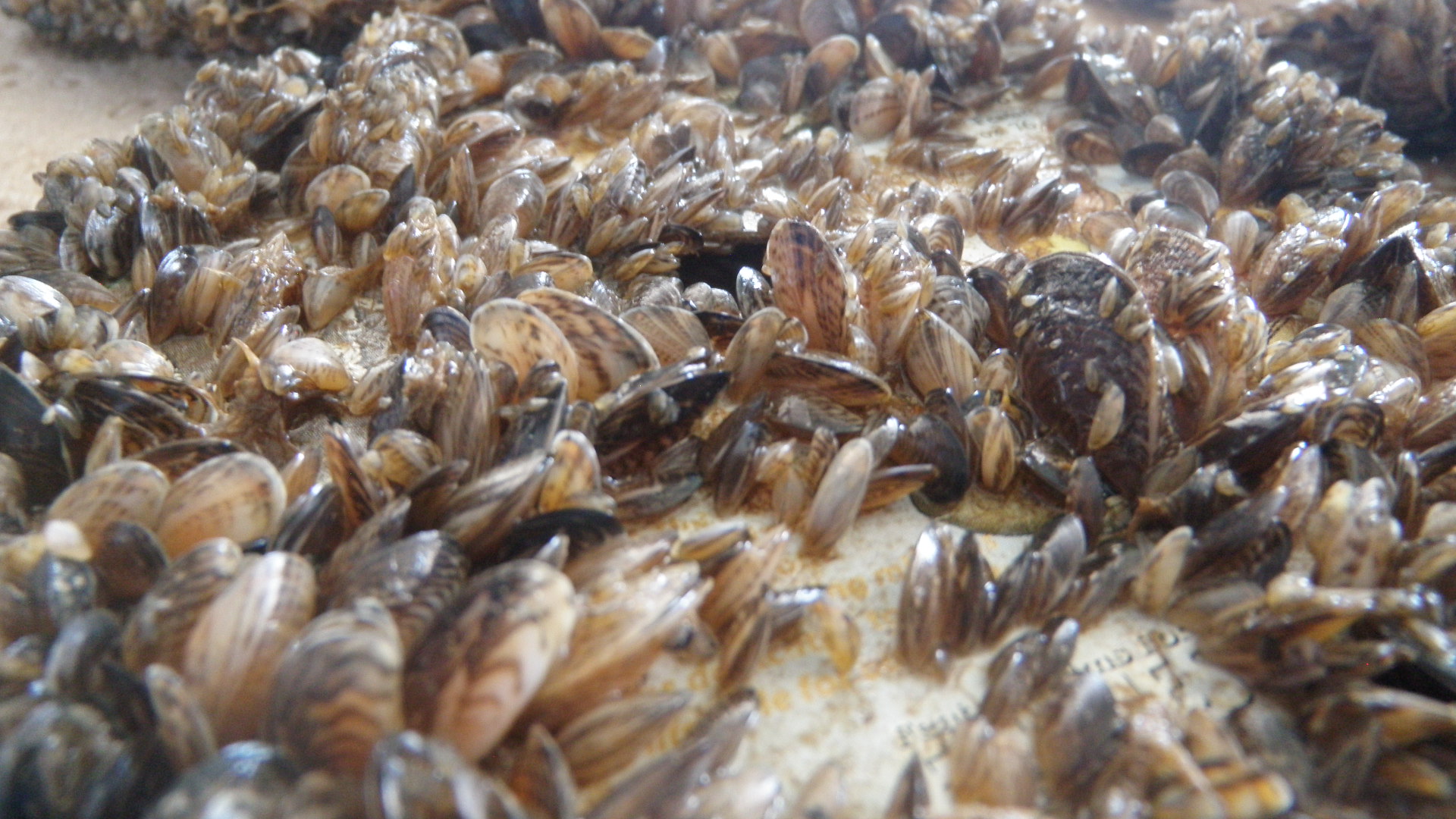
In the last 30 years, the bottom-dwelling czars have changed the look and chemistry of the lake: the water’s clearer, algae heartier, plankton scarcer. The nutrients — in the mussels’ control.

But, despite the improbability, if not impossibility, of large-scale mussel removal in Lake Michigan, Bootsma said it’s valid to ask: “Could we do it at scales large enough that there could be some positive impacts?”

Today, it’s still a challenge to get people to understand the widespread implications of the mussels, Bootsma said, because “most people don’t see what’s under the surface.”

Zebra mussels on a Lake Michigan Beach

If you went to Yellowstone National Park and discovered the bison were gone, you might be upset, he said. “The changes that have happened in the Great Lakes are more dramatic than that.”

Underwater landscape


On recent sunny days near Sleeping Bear Dunes National Lakeshore, a boy in a red jersey cast a fishing line from an old wooden dock; a woman on the beach, legs crossed, read a newspaper under a blue-green striped umbrella; from the top of a bluff, Lake Michigan’s surface flickered like the last moments of a firework. All along the shore you could spot the broken halves of bleached mussel shells.

A few miles out on the lake, framed by the towering dunes, U.S. Geological Survey scientists dove down to get a good look at Good Harbor Reef, a mix of cobblestones and sandy stretches.

They’d usually be diving to collect samples, said research fisheries biologist Peter Esselman, but as part of a project with the National Park Service, they were collecting 360-degree video footage to help people understand the underwater landscape — and its challenges. At Sleeping Bear, that includes invasive species.

On one dive, Glen Black, a biological science technician, scooped up mussels and crunched them in his hand for the video.

Along the lake bottom was another invasive species, Black said, the round goby — an invasive fish also from Eastern seas, now plentiful in Lake Michigan.

“You just see the bottom moving everywhere,” he said.

Esselman came up from a dive and stretched his hands beyond half a foot: “The algae’s about this high.”

As the mussels occupied the reef, so did nuisance cladophora algae, which appears to be linked to botulism outbreaks that left piles of birds — including endangered Great Lakes piping plovers — dead in the sand.

The mussels also choked historically important spawning grounds, just a few miles from Leland Harbor and Fishtown, where you can line up for fresh lake trout and whitefish.

The reef has subhabitats of sorts, some more optimal for fish spawning and mussel attachment than others, said Ben Turschak, a fisheries research biologist with the Michigan Department of Natural Resources. The department is working with the park service and geological survey to map and identify fish spawning habitat.

“That’ll help prioritize any kind of restoration or protection that we would do in the future,” Turschak said.

The places where native fish spawn aren’t infinite, said Brenda Moraska Lafrancois, aquatic ecologist with the National Park Service. “So we don’t need an infinite amount of invasive mussel removal effort either.”

“I think we’re actually getting to a point where you can envision a future where the most important parts of Good Harbor Reef are restored to some semblance of natural habitat,” she said.

Round goby’s role

The story of mussel removal in Lake Michigan is also the story of the reef, where researchers have tested hypotheses related to algae, mussels and bottom-dwellers for more than a decade. In 2016, they scraped off nearly 1 million mussels from an area the size of a studio apartment.

Scientists thought the mussels, whose millions of young float in the water and then settle down to colonize, might re-blanket the rocks after a year or two.

Five years later, some mussels occupy crevices, but the rocks are still largely mussel free.

Scientists think the round goby helped.

“They like small mussels because their shells are easier to crush and they’re easier to digest,” Bootsma said. “So we think what’s happening is that those rocks that we scraped just can’t get recolonized because anytime some small mussels settle on them and try to start growing, the gobies pick them off right away.”

Scientists are studying how the goby might give back to the food web; the fish are credited with reviving the Lake Erie water snake population. But they devour other small invertebrates — and native fish eggs.

Bootsma’s team set up a cage this summer with mussel-free rocks that are inaccessible to the gobies to see whether the mussels can recolonize.

“If the round gobies had gotten to the Great Lakes first, we might have avoided a lot of problems with invasive mussels,” Lafrancois said. But “invasive mussels are also probably part of why round gobies had such an easy time establishing here.”

The mussels also fed a “perfect storm for algae,” Bootsma said.

Nuisance cladophora algae was prevalent before controls aimed at reducing phosphorus from sewage pollution, farm runoff and detergents in the 1970s were put into place. The decaying shaglike mats announce their presence via a stench of rotting eggs.

Capable of filtering the entirety of Lake Michigan in less than two weeks, the mussels allowed more sunlight to reach the lake bottom where the algae grows — Lake Michigan is now sometimes clearer than Lake Superior — and their excreted nutrients offered an extra boost to algae growth.

In the removal patch, phosphorus content is lower in the algae on previously cleared rocks, in line with scientists’ hypotheses. But algae has returned to the rocks — another piece of the puzzle that keeps sending them underwater.

Ripple effects

In 2014, the EPA approved open water use of the molluscicide Zequanox, a treatment made up of dead cells from a soil bacteria that specifically targets mussels by destroying their digestive systems. A year later, the Invasive Mussel Collaborative formed.

“People thought, well, maybe there is something we can do about this,” said Erika Jensen, executive director of the Great Lakes Commission. “And we don’t just need to throw up our hands and accept that they’re here.”

As the collective, including the Great Lakes Commission, Geological Survey, NOAA and the Great Lakes Fishery Commission, among others, began to think about potential sites for mussel control projects, Good Harbor Reef, already a testing ground, was a natural fit.

But there were questions about how and where Zequanox could be used, and what would happen to a post-mussel ecosystem if they suddenly disappeared.

“If we were to be able to control them or suppress their populations to a significant degree, what ripple effects does that have for the rest of the ecosystem?” Jensen said. “And we still don’t have all the answers to that.”

A frame and tarp system was designed to pump Zequanox to cordoned-off areas of Good Harbor Reef over a few days in August 2019.

Bad weather caused delays — a challenge of working in open water — but mussel density was soon reduced by 95%.

Since, populations have crept back up more than the manual removal site; scientists think the treatment missed some mussels underneath rocks. But they’re still not as abundant as surrounding areas.

This summer, Bootsma hopes to try another control method at Good Harbor involving tarps — cheaper and less logistically demanding, but one that may take a lot longer to work.

The mussels would essentially be starved and smothered.

Aside from removal efforts, the findings from Good Harbor can help contribute to the development of mathematical models to play out future scenarios.

“You can say to the model, OK, now let’s see what happens to Lake Michigan if we reduce the number of mussels to 50% of what they are now, or if we warm the lake up by 3 degrees as a result of climate change,” Bootsma said. “And that’s really useful for managers because we want to know, for example, is there going to be more or less plankton in the future to support the food web and important fish in the lake?”

Growing larger

Lowell Friedman looked out on calm water and a smoky sky at Leland Harbor. He and his wife, a Michigan native, came to buy fresh fish on vacation. And, as kayakers, they’re familiar with invasive mussels.

“In the last 10 years we’ve now seen it move from just boaters to everything that enters the water has to be checked for mussels,” Friedman said.

The checks aren’t much of an inconvenience, and they’re necessary, he said, listing off the damage mussels have caused. And, Friedman said, “It keeps the ecosystem out of balance.”

A group within the mussel collaborative is developing a list of high-priority locations where control may be beneficial, looking at factors including: fish spawning and nursery habitat, cladophora algae and native mussel distribution, water intake infrastructure, and threatened and endangered fish species.

“They’re not good for fisheries, that’s for sure,” said Bob Lambe, executive secretary of the Great Lakes Fishery Commission.

Some Great Lakes fish have struggled through overfishing, pollution, the arrival of alewives and the devastation wrought by the invasive blood-sucking sea lamprey. Species like lake trout and salmon are somewhat stable in Lake Michigan, Lambe said, but mostly through aggressive restocking rather than natural reproduction.

In the latest survey of Lake Michigan prey fish, food for salmon and trout, their collective weight is comparable to surveys since the mid-2000s. But it’s still a fraction compared with earlier decades.

The mussels are faring better.
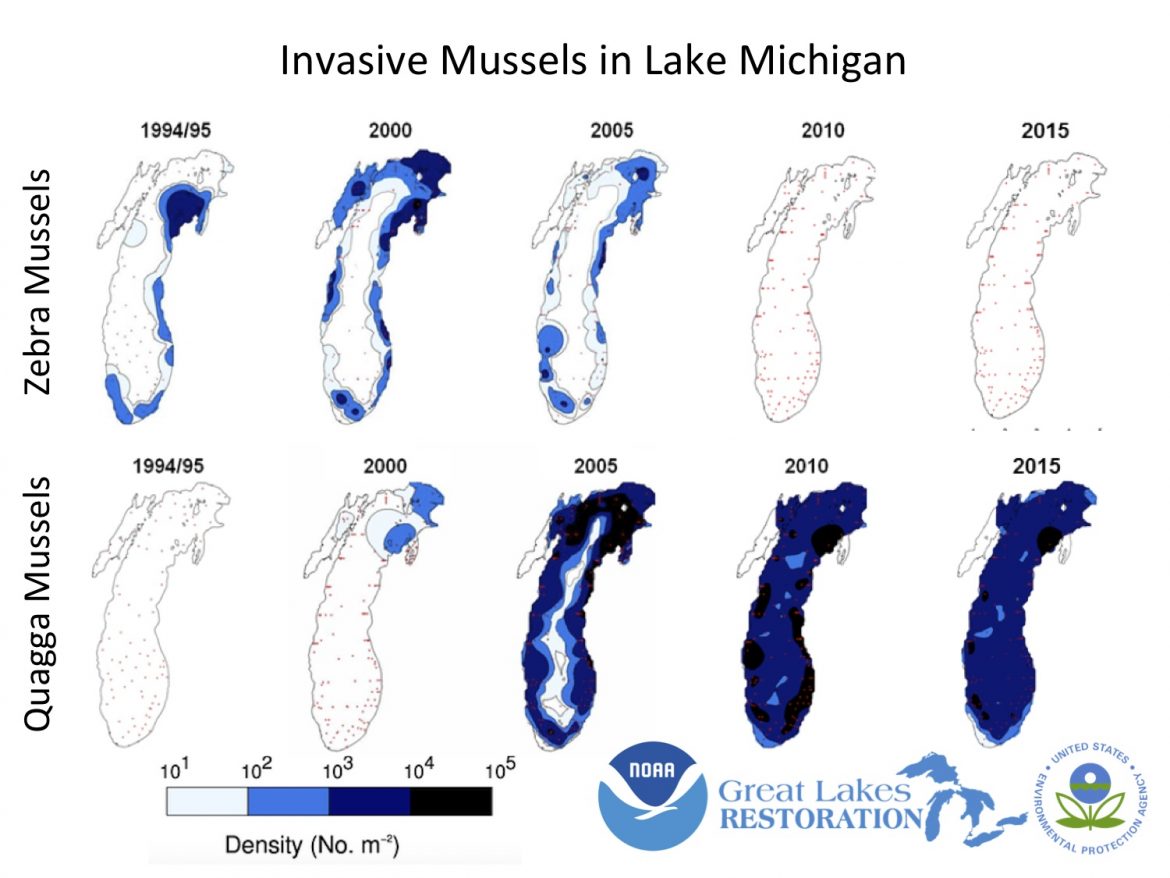
 

In 2015, 300 trillion mussels were counted in Lake Michigan, a drop from 480 trillion a decade ago, said Ashley Elgin, a research scientist with NOAA’s Great Lakes Environmental Research Laboratory. But they’re growing larger and heavier, increasing from about 40 million tons to 50 million tons, collectively weighing more than 300,000 hefty blue whales.

The overall mussel population may be stabilizing, but in deeper offshore reaches, which comprise more than half of the lake, populations have grown slowly and steadily.

“Monitoring’s important so that we have our finger on the pulse with what’s happening with the population,” Elgin said. “Mussels are one of the major drivers and major stressors in the lake, so to understand where their populations are at helps us understand how the rest of the food web is responding.”

Monitoring food-web changes

During the Lake Michigan survey on the Lake Guardian, scientists send down devices called Ponar grabs, which scoop up the lake bottom for sampling.

Throughout Ponarpalooza — the affectionate term given to the survey — there’s excitement, and trepidation, in seeing food-web changes firsthand. The bottom-dwellers are good indicators of ecosystem health and change, said EPA environmental scientist Beth Hinchey Malloy.

“Everybody gathers around on the back deck when they’re bringing up those Ponars from the deep sites, because the big question is, are we going to find diporeia or not?” Malloy said. “And when you find them, a big cheer erupts on that back deck.”

Before mussels, diporeia, a shrimplike fish food, were the predominant bottom-dwellers, and an energy-rich food source. The “Snickers bars of the deep,” Elgin said. But they keep disappearing.

Scientists on the Lake Guardian also used video technology, a newer tool to assess mussel coverage. A map from SUNY Buffalo State scientists is expected soon.

“There’s a lot of anticipation to see what these population curves are going to look like with this new data from 2021,” Malloy said.

How climate change may affect mussel populations — as even the depths of Lake Michigan are warming — is another question. Warming water may help mussel growth, Elgin said, but may also hamper food availability.

For now, with populations in the hundreds of trillions, the mussels are a driving force.

“The quagga and zebra mussels, they’re true ecosystem engineers,” Elgin said.

Advocates and officials are still fighting for more stringent ballast water regulations to prevent the next invader from occupying waterways.

Scientists, meanwhile, fixate on the ones already here, building on each small victory.
Greek wildfires a major ecological catastrophe, PM says

Greek wildfires a major ecological catastrophe, PM says


ATHENS, Greece (AP) — Greek Prime Minister Kyriakos Mitsotakis on Thursday described the devastating wildfires that burned across the country for more than a week as the greatest ecological catastrophe Greece had seen in decades.


The fires broke out as the country roasted during the most intense and protracted heat wave experienced since 1987. Hundreds of wildfires erupted across the country, stretching Greece’s firefighting capabilities to the limit and leading the government to appeal for help from abroad. Hundreds of firefighters, along with planes, helicopters and vehicles, arrived from 24 European and Middle Eastern countries to assist.

“We managed to save lives, but we lost forests and property,” Mitsotakis said, describing the wildfires as “the greatest ecological catastrophe of the last few decades.”

Speaking during a news conference in Athens, his first since the fires broke out, Mitsotakis said authorities had faced around 100 active blazes each day. By Thursday, the situation was much improved, with most large wildfires on the wane.

But the prime minister warned the danger of more blazes was still present.

“We are in the middle of August and it’s clear we will have difficult days ahead of us” until the main season during which fires break out is over, he said.

“The climate crisis — I’d like to use this term, and not climate change — the climate crisis is here, and it shows us everything needs to change” he said, adding he was ready to make the “bold changes” needed.

“This is a common crisis for all of us,” he said.

Several Mediterranean countries have suffered intense heat and quickly spreading wildfires in recent weeks, including Turkey, where at least eight people have died, and Italy. In Algeria, wildfires in the mountains have killed at least 65 people.

Worsening drought and heat – both linked to climate change – have also fueled wildfires this summer in the Western United States and in Russia’s northern Siberia region. Scientists say there is little doubt that climate change from the burning of coal, oil and natural gas is driving more extreme events.

Greece’s largest fire broke out on the country’s second-largest island of Evia on Aug. 3 and was still smoldering on Thursday, after having destroyed most of the island’s north.

More than 50,900 hectares were damaged in northern Evia, according to mapping from the European Union’s Copernicus Emergency Management Service. Entire mountains of mainly pine forest have been reduced to wastelands of blackened stumps, while olive and fig tree plantations and vineyards were also destroyed.

More than 850 firefighters, including hundreds from the Ukraine, Romania, Serbia, Slovakia, Poland and Moldova, were continuing efforts to prevent flare-ups in the area, assisted by four helicopters and three aircraft, including the massive Ilyushin 11-76 water-dropping planes sent by Russia.

The government prioritized protecting lives in its fire response, issuing dozens of evacuation orders for villages in the path of the flames. In that respect, the policy appears to have worked. One volunteer firefighter died while working in an area north of Athens hit by a major fire, after being hit by a falling electricity pole. Four volunteer firefighters have been hospitalized with burns, including two in critical condition in intensive care.

Greek authorities had been anxious to avoid a repetition of the summer of 2018, when a fast-moving wildfire engulfed a seaside settlement near Athens, killing more than 100 people, including some who drowned trying to escape by sea.

But the current tactic of evacuation orders has come under criticism by many residents and local officials in areas affected by this year’s fires, who have argued the orders were premature. They point to those who ignored the evacuation messages, staying behind to fight the flames and managing to save their homes.

“We managed to protect thousands of people. But we lost forests and property,” Mitsotakis said during his press conference. “And we are here to talk about everything … (including) where nature found us unprepared.”

The government has also come under criticism for not deploying enough firefighting planes and helicopters, and not sending them soon enough, particularly to Evia. Authorities have countered that the aircraft were flying wherever possible, but that the entire firefighting fleet cannot be airborne at the same time, as some need to land for essential servicing.

Asked about the cause of the fires, and whether an organized campaign of arson was suspected, Mitsotakis said it was “certain that some of the fires in the last few days were the result of arson.” Several people have been arrested over the past few days on suspicion of attempting to start fires, including some who are accused of doing so deliberately.

However, he added it was unclear whether this was a result of an organized plan, and noted that the hot, dry conditions had aided the spread of wildfires.

Follow all AP stories on climate change issues at https://apnews.com/hub/climate

Debt in a warm climate: coronavirus and carbon set scene for default

Debt in a warm climate: coronavirus and carbon set scene for default

Villagers attempt to put out a wildfire, in Achallam village


LONDON (Reuters) -Where COVID-19 has precipitated unprecedented debts, climate change could trigger defaults across a planet which a United Nations panel says is dangerously close to runaway warming.

To avert disaster, countries are committing to carbon cutting steps. But these will be costly and likely to add to a global debt pile which asset manager Janus Henderson estimates ballooned to $62.5 trillion by the end of last year.

With floods and wildfires devastating the world, estimates vary on how much damage warming will inflict on its economy.

But a report earlier this year by BofA put it at $54-69 trillion by 2100, which compares to a valuation of the entire global economy of around $80 trillion.

The financial repercussions could manifest themselves in under a decade, a study by index provider FTSE Russell warns.

The first climate-linked credit rating downgrades are set to hit countries soon, the report’s co-author and FTSE Russell’s senior sustainable investment manager, Julien Moussavi, added.

In a worst-case “hot house world” scenario developing countries including Malaysia, South Africa, Mexico and even wealthier economies such as Italy may default on debt by 2050.

In another, where governments are initially slow to react, states including Australia, Poland, Japan and Israel, will be at risk of default and ratings downgrades too, the study concluded.

While developing countries are inherently more vulnerable to rising sea levels and drought, richer ones will not escape the climate change fallout, such studies show.

“You can talk about climate change and its impact and it won’t be long before someone talks about Barbados, Fiji, or the Maldives,” Moritz Kraemer, chief economist at Countryrisk.io and former head of sovereign ratings at S&P Global.

“What was a surprise to me is the impact on higher-rated, richer countries,” Kraemer added.

Another study by a group of universities including Cambridge concluded that 63 countries – roughly half the number rated by S&P Global, Moody’s and Fitch – could see credit ratings cut by 2030 because of climate change.

China, Chile, Malaysia, and Mexico would be the hardest hit with six notches of downgrades by the end of the century, it said, while the United States, Germany, Canada, Australia, India, and Peru could see around four.

The corresponding increase in borrowing costs would add $137–$205 billion to countries’ combined annual debt service payments by 2100, this study estimated.

Ratings downgrades typically raise borrowing costs, especially if they cause countries to be ejected from bond indexes tracked by funds managing trillions of dollars.

WARNING LIGHT

Developed countries are ramping up spending to temper climate damage, with Germany creating a 30 billion euro recovery fund after recent floods, while Singapore is budgeting the equivalent of $72 billion to protect against rising sea levels in the next century.

For emerging economies, already scarred by COVID-19, the climate crisis will heap on more pressure.

The International Monetary Fund (IMF) warns that a 10 percentage-point rise in climate change vulnerability, as measured by the Notre Dame Global Adaptation Initiative index, is associated with an increase of over 150 basis points in long-term government bond spreads for developing nations.

The average rise across all countries was 30 bps.

The U.N. environment programme estimates that in developing countries, annual adaptation costs will be as much as $300 billion in 2030, rising to $500 billion in 2050.

As a percentage of gross domestic product, sovereign debt is still about 60% in emerging economies, data from the Institute of International Finance (IIF) shows, versus 100% or so in the United States and Britain, and 200% in Japan,.

The rise from pre-pandemic levels of around 52% is a particular concern. European, U.S. and Japanese central banks are essentially underwriting state borrowing, but this is not possible in poor countries, who must ultimately repay debt.

“How do you enable the sort of funding that is required given the high debt levels and the importance of the ratings frameworks?” Sonja Gibbs, director for global capital markets at the IIF said.

(Reporting by Dhara Ranasinghe and Karin Strohecker; Editing by Sujata Rao and Alexander Smith)

The New U.N. Climate Report Shows an Even Hotter Future—Unless We Start Acting

The New U.N. Climate Report Shows an Even Hotter Future—Unless We Start Acting

Photo credit: Trevor Bexon - Getty Images
Photo credit: Trevor Bexon – Getty Images


The new U.N. Intergovernmental Panel on Climate Change (IPCC) report on the current climate crisis has made news this week for offering a bleak picture of the state of global climate change, especially poignant while major fires and heat waves blanket California, Greece, and Siberia. The world could look very different, with more and more extreme weather and heat effects, unless we change global industry very soon.

The report is based on the contributions of over 200 scientists from around the world, and it combines more than 14,000 research works into one master report on the state of the entire world’s climate as both a point in time and as part of our near and further future.

Humans are causing the change

The report explicitly calls out the human effects on things like greenhouse gas emissions that have caused the climate to warm and change compared with a control simulation where there are no human activities. To make this comparison, the report’s authors compared attribution studies from around the world that showed a persistent, notable increase in global temperature and “well-mixed greenhouse gases” that are attributable to human activities like industry.

Aerosols mask some of our impact

Aerosols are clouds of particulate that can act as tiny sunblocks basically, helping to keep heat out by bouncing it away back into space. Aerosol cooling, the IPCC says, has helped to “mask” or mitigate the human impact on climate change. Aerosols are generated by industry in the form of black carbon soot, for example, and in nature as volcanic ash. Some scientists want to try solar geoengineering, a process in which we intentionally use aerosols as a way to mitigate climate change, but so far, scientists have hesitated to commit to studies in this space.

Extreme weather has increased and will continue

Heat waves have increased in severity and frequency, while cold extreme events have decreased as the planet is warmed. Even heavy rain events have increased in frequency and severity, along with an increase in tropical cyclones. The report says compound extreme events around the world, like heat and drought, have increased since the 1950s, likely caused by anthropogenic, or humanmade, climate change.

The report says it’s “very likely” that precipitation events like monsoon rains will continue to increase, with a rate of 7% more daily precipitation events for each degree of climate change—a proportional increase as the Earth grows warmer. In some scenarios where the climate changes just 1.0 or 1.8° Celsius, that may seem like not such a big deal. But without changes to global emissions, our temperature could increase 5° Celsius or more.

Hot temperature extremes like heatwaves that previously happened once in ten years will be up to 9.4 times more likely to occur depending on just how much the global average temperature increases, up to 5° Celsius. Hot temperature extremes that happened once in fifty years will be up to 39.2 times more likely to occur based on the degree of warming. Heavy precipitation will be up to 2.7 times more likely to occur, and droughts will be up to 4.1 times more likely to occur.

It’s going to get hotter, but by how much?

The report posits five possible futures to explore the impact of climate change. These range from the most conservative estimate, where the surface warms just 1.8° Celsius by 2050, to where the surface warms 5.7° Celsius, both compared to the control time period 1850-1900.

“The last time global surface temperature was sustained at or above 2.5°C higher than 1850–1900 was over 3 million years ago,” the report explains.

The report also explains that land mass as well as Arctic ice are likely to bear the brunt of surface cooling compared with the oceans, which makes sense considering how much more energy it takes to heat deep water compared with air or the surface of a solid material. (Think about frying an egg versus boiling a pot of water for pasta.)

The Arctic may melt

Permafrost is the term for soil and ice that are permanently frozen, often above the Arctic Circle or at high elevations of lower latitudes. The report says that permafrost and sea ice will both melt severely under all five of the report’s theoretical futures, from conservative to most extreme: “The Arctic is likely to be practically sea ice free in September at least once before 2050 under the five illustrative scenarios considered in this report, with more frequent occurrences for higher warming levels.” Permafrost thaw alters the arctic climate as well as releasing trapped greenhouse gases that were previously held in frozen “carbon sink” conditions.

We’ll exceed nature’s carbon sinks

The oceans and land masses both absorb some amount of carbon, which has started to lead to the acidification of the oceans, for example. Acidification reduces sealife’s access to building blocks like calcium carbonate, killing off shelled organisms. In the IPCC’s five future scenarios, all exceed nature’s ability to absorb carbon emissions, but this number grows larger as the emissions far overtake how much our oceans and land can absorb.

Many changes will take millennia to reach equilibrium

The report states that many of the changes we have induced with human global emissions will last for millennia even without any further heating or increased carbon emissions. Sea levels will continue to rise, they say, because of the warming deep ocean and other changes that are already set into motion. Glaciers will continue to melt for “decades or centuries.”

There’s still hope, and a mandate for change

In the report’s most conservative future, the climate still changes up to almost 2° Celsius by 2050—this isn’t a fantasy future where nothing bad happens. But even so, we have the opportunity, the necessity, to rapidly reduce emissions around the world and curb many of the effects of climate change during the 21st century.

“From a physical science perspective, limiting human-induced global warming to a specific level requires limiting cumulative CO2 emissions, reaching at least net zero CO2 emissions, along with strong reductions in other greenhouse gas emissions,” the report explains. “Strong, rapid and sustained reductions in CH4 emissions would also limit the warming effect resulting from declining aerosol pollution and would improve air quality.”

If we make serious changes today, like reduction of global carbon emissions from heavy industry, that means we could begin to see reversals in some of the telltale effects of climate change beginning in as little as 20 years, which is the blink of an eye in Earth’s lifetime but a key window of time for humankind.

Extreme weather: How is it connected to climate change?

Extreme weather: How is it connected to climate change?

Fire-fighters tackle a wildfire near Athens


Heatwaves, deadly floods and wildfires – this summer people are having to confront the link between extreme weather and climate change.

Emissions from the burning of fossil fuels have been trapping heat in the atmosphere since the start of the industrial era. As a consequence, average temperatures have risen by 1.2C.

This additional energy is unevenly distributed and bursts out in extremes like the ones we’ve been seeing this summer. Without reductions in global emissions, this cycle will keep going.

Here are four ways climate change is contributing to extreme weather.

1. Hotter, longer heatwaves

To understand the impact of small changes to average temperatures, you need to to think of them as a bell curve, with extreme cold and hot at either end, and the bulk of temperatures in the middle. A small shift in the centre means that more of the curve touches the the extremes – and so heatwaves become more frequent and extreme.

"A small shift makes a big difference". A line chart showing how small changes in the climate increases the probability of more hot weather and more extreme weather.
“A small shift makes a big difference”. A line chart showing how small changes in the climate increases the probability of more hot weather and more extreme weather.

In the UK, warm spells have more than doubled in length in the past 50 years, according to the Met Office.

But the record heatwaves in Western Canada and the US were made longer and more intense by another weather phenomenon – a heat dome.

Weeks ago, a Pacific storm, fuelled by warmer-than-normal sea temperatures, disrupted the jet stream. When a storm distorts the jet stream, which is made of currents of fast-flowing air, it is a bit like yanking a long skipping rope at one end and seeing the ripples transferring along it.

These waves cause everything to slow drastically and weather systems can become stuck over the same areas for days on end.

A graphic showing how heat domes are formed. 1) A mass of warm air builds up in still and dry summer conditions 2) High pressure in the atmosphere pressures the warm air down 3) The air is compressed and gets even hotter

In an area of high pressure, hot air is pushed down and trapped in place, causing temperatures to soar over an entire continent.

In Lytton, Western Canada, temperatures hit 49.6C, breaking the previous record by almost 5C. Such an intense heatwave would have been virtually impossible without climate change, according to the World Weather Attribution network.

One theory is higher temperatures in the Arctic are causing the jet stream to slow down, increasing the likelihood of heat domes.

And exceptional heat has not been limited to North America this summer. In Russia, a heatwave sent temperatures soaring – matching a 120-year record. Northern Ireland broke its temperature record three times in the same week, while a new high was set in the Antarctic continent.

Charts showing record temperatures set in June 2021: Lytton, British Columbia 49.6C; Portland, Oregon 46.7C; Seattle, Washington 42.2C; Spokane, Washington 42.8C
2. More persistent droughts

As heatwaves become more intense and longer, droughts can worsen.

Less rain falls between heatwaves, so ground moisture and water supplies run dry more quickly.

And this in turn means the ground heats up more quickly, warming the air above and leading to more intense heat.

A map of the world showing where record temperatures, or close to record temperatures were set during June 2021

Demand for water from humans and farming puts even more stress on water supply, adding to water shortages.

And by mid-July, following the early summer heatwaves, more than a quarter of US land was experiencing “extreme” or “exceptional” drought.

3. More fuel for wildfires

Wildfires can be sparked by direct human involvement – but natural factors can play a huge part.

The cycle of extreme and long-lasting heat caused by climate change draws more and more moisture out of the ground and vegetation.

And these tinder-dry conditions provide fuel for fires, which can spread at an incredible speed.

The impact of the heatwave on fire development was seen in an explosive fashion in western Canada this summer.

A volunteer stands by a wildfire near Marmaris, Turkey
This summer wildfires also tore through forests in southern Turkey, leaving the land scorched


Fires developed so rapidly and explosively they created their own weather system, as pyrocumulonimbus clouds formed.

And these colossal clouds produced lightning, igniting more fires.

This same story is being repeated in Siberia.

The frequency of large wildfires has increased dramatically in recent decades.

Compared with the 1970s, fires larger than 10,000 acres (40 sq km) are now seven times more common in western America, according to Climate Central, an independent organization of scientists and journalists.

4. More extreme rainfall events

In the usual weather cycle, hot weather creates moisture and water vapour in the air, which turns into droplets to create rain.

The warmer it becomes, however, the more vapour there is in the atmosphere, resulting in more droplets – and heavier rainfall, sometimes in a shorter space of time and over a smaller area.

A chart showing how record temperatures cause extreme rainfall. 1) More heat from sun causes greater evaporation 2) More moisture forms clouds 3) Heavier rain

Historic flooding in China, Germany, Belgium and the Netherlands has shown the devastating impact extreme rainfall events can have.

And these rainfall events are connected to the impacts of climate change elsewhere, according to Peter Gleick, a water specialist from the US National Academy of Sciences.

“When areas of drought grow, like in Siberia and western US, that water falls elsewhere, in a smaller area, worsening flooding, like Germany and Belgium,” he says.

The weather across the globe will always be highly variable – but climate change is making that more extreme.

And the challenge now is not only limiting the further impact people have on the atmosphere but also adapting to and tackling the extremes we are already facing.

Take a look at some of the lakes in California that have been swallowed up by the ‘megadrought,’ hitting record low levels

Take a look at some of the lakes in California that have been swallowed up by the ‘megadrought,’ hitting record low levels

California drought
Associated Press
  • California has been hit by a “megadrought” that has dried up key reservoirs in the state.
  • Entire lakes have shrunk exponentially, leaving yachts and docks beached on dry land.
  • Nearly 95% of the state is experiencing “severe drought” and is susceptible to wild fires.

California is experiencing its worst drought in over four years and climate change experts warn it could just be the tip of the (melting) iceberg.

On Monday, the Intergovernmental Panel on Climate Change (IPCC) released a report that found global temperatures will continue to increase by at least 1.5 degrees Celsius between now and 2040. For every half-degree of warming, the frequency and intensity of heat waves and droughts also increases.

California has already seen a significant impact from climate change, which has pushed temperatures an average of about 2 degrees hotter to date – drying out soil and melting Sierra snow rivers, which causes less water to soak into the ground, as well as flow through rivers and reservoirs.

A man walks through the dried-up bed of a reservoir in Sanyuan county, Shaanxi province July 30, 2014. REUTERS/Stringer
A man walks through the dried-up bed of a reservoir in Sanyuan Thomson Reuters


Over 37 million people have already been impacted by the “megadrought” and nearly 95% of the state has been classified as experiencing “severe drought,” which has put the land in significant danger of wildfires, according to the National Integrated Drought Information System (NIDIS).

Last year, California land was consumed by over 8,200 wildfires – a number double the state’s previous record. This year, scorching weather has made the state even more susceptible to breakout wildfires than in 2020. Last week, a California town was consumed in only 30 minutes by the Dixie wildfire, which has become the state’s largest wildfire in recorded history.

dixie fire greenville
Homes and cars destroyed by the Dixie Fire line central Greenville in Plumas County, California. Noah Berger/AP Photo


In June, Jay Lund, co-director of the Center for Watershed Sciences at UC-Davis told the Associated Press the water levels of California’s over 1,500 reservoirs were 50% lower than they should be at that time of year.

In April, scorching weather turned the San Gabriel Reservoir lake bed to dust. The reservoir is not expected to see rain fall until the end of the year.

The drought turned the San Gabriel reservoir lake bed to dust
The drought turned the San Gabriel reservoir lake bed to dust Getty

In June, the drought dried up a lake so much that it potentially exposed a decades old mystery, allowing officials to find a plane that had crashed in 1965.

A composite image showing Folsom Lake, California, at drought levels in 2017, and a sonar image of a plane underwater there.
Folsom Lake, California, under drought conditions in 2017 (L), and the sonar image of a plane there taken by Seafloor Systems (R) Robert Galbraith/Reuters/CBS13


On Monday, California shut down a major hydroelectric power plant at Lake Oroville for the first time since the plant went into operation in 1967 when the major reservoir hit 25% capacity – its lowest level on record. The decision puts extra strain on the electrical grid during the hottest part of the summer.

In June, about 130 houseboats had to be hauled out of the lake as its water levels hit 38% capacity. Water elevations at Lake Oroville are forecast to reach as low as 620 feet above sea level by the end of October, according to the California Department of Water Resources.

House boats pulled out of Lake Orovill
Getty

It’s going to be a rough summer for boat owners in the state.

Pictures from the Associated Press show massive lakes have run dry, leaving boats and docks completely beached

Boats at Fulsom Lake
Associated Press

Experts say the drought could devastate local wildlife populations, as well as California’s tourism industry.

California drought
Associated Press

In April, Governor Gavin Newsom held a press conference in the dried up waterbed of Lake Mendocino. Where he stood there should have been about 40 feet of water.

“This is without precedent,” Newsom said. “Oftentimes we overstate the word historic, but this is indeed an historic moment.”

California drought
Associated Press

The California Department of Water Resources reduced farmers and growers to 5% of their expected water allocation in March. Last week, the State Water Resources Control Board voted to further restrict the amount of water that farmers can draw from rivers and reservoirs – cutting it altogether for some farmers.

When the authorities cut off water supplies, farmers find themselves forced to rely on wells, dug deep into the ground at costs of thousands of dollars. Many farmers say they have been forced to leave their fields mostly barren as even their wells have begun to dry up.

CA drought
Justin Sullivan/Getty Images

Put Rob Reiner in Charge of January 6th Investigation: Nails the Single MOST Important Evidence Needed

Political Flare – Politics – News

Put Rob Reiner in Charge of January 6th Investigation: Nails the Single MOST Important Evidence Needed


Put Rob Reiner in Charge of January 6th Investigation: Nails the Single MOST Important Evidence Needed

Highway hypnosis? Trump hypnosis? Similar things, you get so used to the same damn things coming at you for long periods, yellow or white dashes, old traditions were broken, rules never applied, you get so used to it that you damn near crash into the menu at McDonald’s.

Or your country crashes as a democratic republic. You got distracted and missed all the signs.

The fact that this country has yet to even convince half its citizens that January 6th was an extremely sophisticated and organized plot to overthrow the incoming proper government just goes to show that society is screwed. Everyone’s too into their social media, their online life (however risque one wants to be), and their sports teams, no one even really cares. There may be legitimate UFO objects breaking all known laws of physics flying around our country. The NYT cares, the Pentagon cares, citizens don’t. Our government was almost overthrown. The more we learn about what happened behind the scenes, the more we realize that we were almost “lucky” to get through that day with Biden still scheduled to be president. “Lucky,” on a day that’s supposed to be ceremonial.

But here’s where we get back to highway hypnosis, or Trump White House hypnosis again. We got so used to not seeing or hearing the evidence, we figure now it’s just impossible to get. We’re hypnotized.

But as Jeffery Rosen showed on Friday and Saturday, through his own testimony, Trump was personally (Dick Durbin’s words) building the fraud movement which led to the coup attempt, personal involvement, is the type of evidence we’re not used to getting. Trump’s first “Impeachment Trial” didn’t have a “witness.” Some of us STILL believe C.J. Roberts needed to actually pound the gavel and say, “It says here that I preside over a trial. Trials have witnesses. Would the prosecution please call its first witness.” But we didn’t, we’re used to Trump getting whatever he wanted, Putin-Like.

And here’s another thing we didn’t get much out of either impeachment, something normally assumed, documents. Governments are big on documents because no one would ever know who did what when and with what money without documents. Additionally, people make memorandums to keep memories fresh and to protect themselves. We didn’t get many documents in Trump’s first impeachment, some texts, and Trump’s “perfect phone call.” (He used the word “perfect” so many times one wondered if they doctored it. Probably not). But we did not get a lot of documents about communication back and forth among the staff wanting to send the aid.

Documents are more reliable than eyewitness testimony precisely because they’re nearly always made right as it happened. Studies have proven that eyewitness testimony is actually some of the least reliable evidence, rather than the gold standard. Documents, however….

Rob Reiner wants some documents, the ones that would tell a big part of the story:

Oh, it’s “arguable.” The “argument” would be that shit like that doesn’t come from the Trump White House. They were not constrained by laws, which is how we got here in the first place. Who here wonders whether they’ve already been destroyed? Maybe. But yes, documents are obviously needed, and we’ll go a little further.

We want documents from the 4-6th. Who visited the White House? Who called? Want to know what else we want? We want to look at the call logs to Josh Hawley and Ted Cruz the day or two before both – almost on the same day, maybe a day or two apart – said that they would be objecting to the votes.

Trump needed two things to win: Objections, getting electoral votes back to the states. And he needed Pence out of the Capitol for 12 hours. Pence wouldn’t get in the SUV under the Capitol – didn’t trust them. The call logs would cover that portion. We want Hawley and Cruz.

The Trump-highway hypnosis lifted, a lot, this last weekend. We have direct testimony about what Trump said and did with respect to telling his acting attorney general to sign a letter saying there was fraud in the election. Now, if we could just get over a few more elements, we would be able to tell the whole story, undeniably – for history’s sake, at least.

Get the damned documents.

Heffernan: Biden’s ‘build back better’ just beat Trump all over again

Heffernan: Biden’s ‘build back better’ just beat Trump all over again

  • WASHINGTON, DC - AUGUST 10: President Joe Biden delivers remarks on the Senate approving H.R. 3684 Infrastructure Investment and Jobs Act, in the East Room of the White House on Tuesday, Aug. 10, 2021 in Washington, DC. The Senate has approved a $1 trillion bill to rebuild aging roads and bridges, with $8.1 billion targeted to projects in the West. (Kent Nishimura / Los Angeles Times)President Biden said Senate approval of his infrastructure bill “proved that democracy can still work.” (Kent Nishimura / Los Angeles Times)

It’s hard to find an element of daily life that doesn’t lend itself to politicization. There are the obvious ones: media, guns, lattes. But there’s more. Convertibles are evidently a Republican ride. Vegetables, in general, are Democratic.

But infrastructure knows no party. What ideology favors a broken bridge over one in good repair?

This is why Donald Trump ran on infrastructure in 2016, promising to invest $1 trillion and revive manufacturing jobs in the Rust Belt. It was also why his staff tried mightily to steer him toward the crowd-pleaser of “infrastructure week” whenever his antics turned too unstructured and too crowd-displeasing.

All to no avail for the former president. Nothing panned out.

During Trump’s term, federal investment in roads and bridges stagnated. Roads, ports and airports never got fixed. Any hope that Trump’s autocratic proclivities could be channeled into mega-projects to astonish his base fizzled. He couldn’t even add more than 80 miles to his promised big, beautiful wall.

At the same time, national consensus about the urgency of an infrastructure upgrade has never wavered.

Finally, in November, 28% of white working-class men — the very demographic that put infrastructure high on their priority list — voted Democratic, up from 23% in 2020. These voters helped deliver Biden’s key victories in Wisconsin, Michigan and Pennsylvania.

So far, President Biden hasn’t forgotten them. And no one in any state has forgotten the stomach-sinking truths about America’s infrastructure.

Forty-three percent of public roadways are in poor or mediocre condition. A water main breaks every two minutes. More than one-third of public schools use portable buildings, including trailers, because the regular buildings are too crowded.

An AP/NORC poll in July showed that 59% of Americans, of both parties, supported the infrastructure bill’s key aspects.

All of this may be why Biden has been able to get more harmony on this part of his “Build Back Better” agenda than Washington has seen in a long, long time. On Tuesday, the Senate passed the 2,700-page Infrastructure Investment and Jobs Act, 69 to 30, with 19 Senate Republicans voting in favor of it, including Minority Leader Mitch McConnell (R-Ky.).

“The president deserves a lot of credit,” said McConnell of the bipartisan miracle. “If you’re going to find an area of potential agreement, I can’t think of a better one than infrastructure, which is desperately needed.”

The bill still must pass the House, which will no doubt ask for changes, before it’s signed into law. But this is big. And it’s sure to be galling to ex-President Trump, whose party decisively defied his command to vote against the bill and bust Biden’s agenda.

In addition to McConnell, other Republicans in the party leadership — South Carolina Sen. Lindsey Graham and Iowa Sen. Charles E. Grassley — voted for the bill. Evidently, the Monarch of Mar-a-Lago holds less sway over the party than he once did.

And the bill, which its proponents say requires no tax hike and is mostly paid for with unspent coronavirus relief money, is a thing of beauty.

According to Mark Zandi, the chief economist at Moody’s Analytics, it could create some 660,000 jobs by 2025, partly because it includes funding for job training and provisions for more women to get into construction and trucking.

In the bill’s current form, the big money goes to marquee items, especially roads and bridges. Appalachian and Alaskan highways will get a special boost, evidence (perhaps) of the contributions to the bill by Sens. Joe Manchin III (D-W.Va.) and Lisa Murkowski (R-Alaska).

But the package also funds Puerto Rico’s highways, projects to relieve congestion in cities, and academic research on transportation.

Railroads will also get substantial federal investment, especially Biden’s beloved Northeast Corridor, the well-worn route from Boston to D.C. Among other things, the bill provides for more refreshments on Amtrak routes.

(If that refreshment clause makes it all the way into law, I’m lobbying for this earmark: more delicious Wee Brie, which used to class up Amtrak’s plastic-wrapped cheese plates.)

There’s funding to fortify the power grid against hacks and attacks, help protect communities against drought, flooding, wildfire and poisonous lead water pipes. Electric vehicle charging stations and electric school buses will — if this thing passes intact — proliferate.

Yes, some of this is “green” and some of this is “blue-collar,” and those color concepts can always trip partisan wires. But the explosion didn’t happen this time; it got muffled by days, weeks and months of what various media called “grueling,” “painstaking,” “fierce” debate and compromise.

And of course one person styled it as test of loyalty — to himself.

“This [bill] will be a victory for the Biden Administration and Democrats, and will be heavily used in the 2022 election,” Trump shouted two weeks ago. “It is a loser for the USA, a terrible deal, and makes the Republicans look weak, foolish, and dumb.”

He threatened any in his party who might support the bill, saying “lots of primaries will be coming your way!” But this time, 19 shrugged.

As for the Democrats, the progressive wing has its own objections to the bill and its compromises, but no one defected on Tuesday in the Senate.

It seems that one of the ways to repair political bridges is to repair literal bridges.
