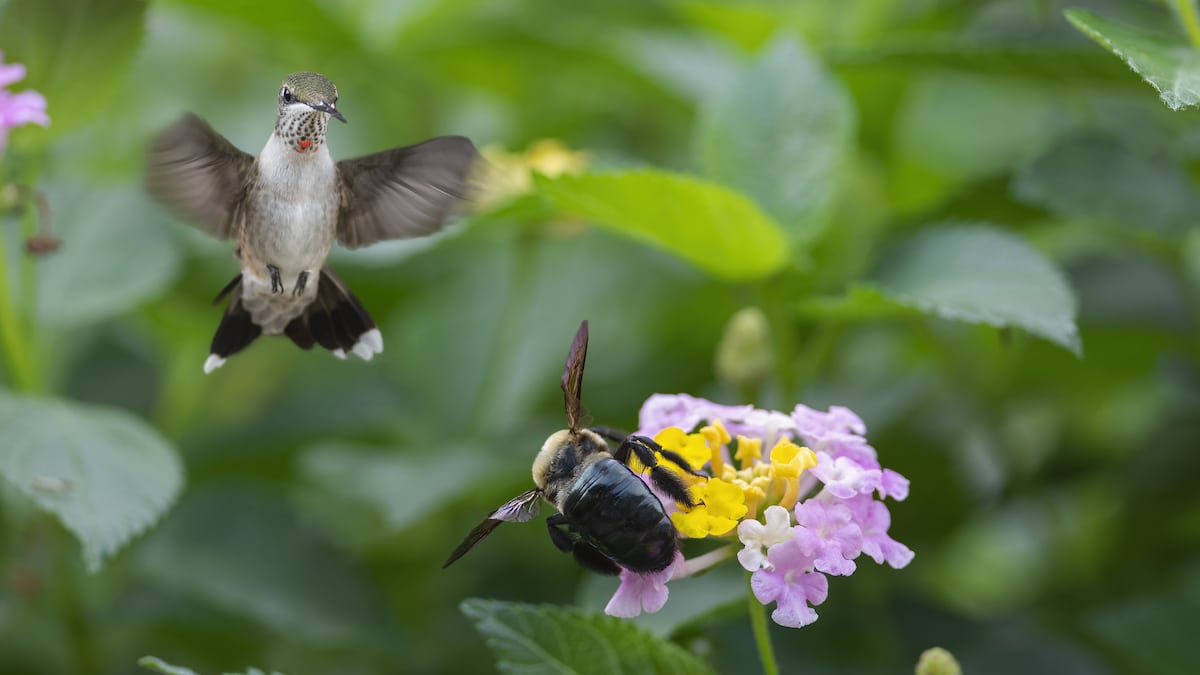
Birds and bees work together as pollinators. DansPhotoArt on flickr / Moment / Getty Images
For many people, one rich, pleasant smell signals the start of a new day more than any other: coffee. Different techniques have been used to get the best cup of the caffeine-rich liquid, from a French press to the pour-over method.
A unique new study has found that the secret to better coffee is really in control of the birds and the bees.
In the study, researchers found that when birds and bees joined forces to protect and pollinate coffee plants, the result was coffee beans that were bigger, more abundant and of better quality, reported the University of Vermont. Some of the flying assistants come from thousands of miles away, and without them the $26 billion coffee industry would see a 25 percent decrease in crop yields, or about $1,066 per hectare — a hectare equals almost two and a half acres — in coffee losses.
“Until now, researchers have typically calculated the benefits of nature separately, and then simply added them up,” said Alejandra Martínez-Salinas of the Tropical Agricultural Research and Higher Education Center (CATIE), who was the study’s lead author, the University of Vermont (UVM) reported. “But nature is an interacting system, full of important synergies and trade-offs. We show the ecological and economic importance of these interactions, in one of the first experiments at realistic scales in actual farms.”
For the study, the researchers from Latin America and the U.S. used the world’s most popular type of coffee, Coffea arabica, a self-pollinating crop. They used small lace bags and large nets to test four scenarios on 30 coffee farms in Costa Rica. These included bee pollination alone; pest control by birds alone; zero bee and bird activity; and “a natural environment” in which the bees and birds were free to work together, going about their pollinating activities and munching on insects like the damaging coffee berry borer, which affects worldwide coffee production.
“These results suggest that past assessments of individual ecological services… may actually underestimate the benefits biodiversity provides to agriculture and human wellbeing,” said Taylor Ricketts of the University of Vermont’s Gund Institute for Environment. “These positive interactions mean ecosystem services are more valuable together than separately.”
The study, “Interacting pest control and pollination services in coffee systems,” was published in the journal Proceedings of the National Academy of Sciences.
In the study, it was found that the birds and bees had combined positive effects on the overall weight, weight uniformity and set of the coffee fruit — which all affect the quality and price — that were more significant than each of their effects alone, the University of Vermont reported.
“One important reason we measure these contributions is to help protect and conserve the many species that we depend on, and sometimes take for granted,” Ph.D. candidate at UVM’s Gund Institute for Environment and Rubenstein School of Environment and Natural Resources Natalia Aristizábal said. “Birds, bees, and millions of other species support our lives and livelihoods, but face threats like habitat destruction and climate change.”
In a first, wind power is second-leading U.S. source of electricity in one day
David Knowles, Senior Editor – April 6, 2022
Power generated by wind turbines in the United States hit a milestone last week, becoming the second-highest source of electricity in the country for a 24-hour period, according to the Energy Information Administration.
Wind turbines generated more than 2,000 gigawatt-hours of electricity in the U.S. on Tuesday, March 29, more than was provided by nuclear and coal power plants that day. Wind power, which is renewable and does not release greenhouse gases into the atmosphere, still trailed the electricity produced by natural gas, but it was the first time in U.S. history that wind turbines outperformed nuclear and coal power.
On its website, the EIA notes, “The amount of wind electricity generation has grown significantly in the past 30 years. Advances in wind energy technology have decreased the cost of producing electricity from wind. Government requirements and financial incentives for renewable energy in the United States and in other countries have contributed to growth in wind power.”
In total, electricity generated from wind power has gone from roughly 6 billion kilowatt-hours in 2000 to 380 billion in 2021, EIA says. Wind turbines now account for roughly 9.2% of the U.S.’s total “utility-scale electricity generation,” according to the agency.
Power-generating Siemens 2.37-megawatt wind turbines are seen at the Ocotillo Wind Energy Facility in California. (Bing Guan/Reuters)
The rush toward wind energy has picked up steam as the country looks for ways to ween itself from oil and reduce greenhouse gas emissions that cause climate change. In 2020, 42% of new electricity generation capacity came from land-based wind energy, according to figures from the U.S. Department of Energy. Spurred on by federal tax incentives, wind turbines have been going up in states such as Illinois, Indiana, Iowa, Colorado, Kansas, Texas and Minnesota.
In an effort to help the U.S. reach net-zero greenhouse gas emissions by 2035, President Biden announced leases in January for nearly 500,000 acres off the coast of New York and New Jersey for the construction of offshore wind farms.
“This week’s offshore wind sale makes one thing clear: The enthusiasm for the clean energy economy is undeniable and it’s here to stay,” Interior Secretary Deb Haaland said in a written statement at the time. “The investments we are seeing today will play an important role in delivering on the Biden-Harris administration’s commitment to tackle the climate crisis and create thousands of good-paying, union jobs across the nation.”
In a report issued this week, the United Nations Intergovernmental Panel on Climate Change warned that in order to keep global temperatures from rising more than 1.5°C above pre-industrial levels, global greenhouse gas emissions have to start dropping in 2025 and go down 43% from current levels by 2030 — and 84% by 2050. To do so, experts say, wind power will need to ramp up significantly in the coming years.
‘A year-after-year disaster:’ The American West could face a ‘brutal’ century under climate change
Elizabeth Weise – April 2, 2022
SAN FRANCISCO – The West, once a beacon for all that was new and hopeful in America, could become an example of the grim, apocalyptic future the nation faces from climate change.
The last five years already have been harrowing.
Whole neighborhoods burned down to foundations. Children kept indoors because the air outside is too dangerous to play in. Killer mudslides of burned debris destroying towns. Blood-red skies that are so dark at midday, the streetlights come on and postal workers wear headlamps to deliver the mail.
And it’s going to get worse unless dramatic action is taken, two studies published this week forecast.
The first predicts the growth of wildfires could cause dangerous air quality levelsto increase during fire season by more than 50% over the next 30 years in the Pacific Northwest and parts of northern California.
A second showshow expected increases in wildfires and intense rain events could result in more devastatingflash floods and mudslides across a broad portion of the West.
“These studies reinforce the likelihood of a brutal future for the West,” said Jonathan Overpeck, a climate scientist and dean of the University of Michigan’s School for Environment and Sustainability.
“Even climate scientists are scared,” he said. If climate change isn’t curbed, a “dystopian” landscape could be the result.
El Dorado County firefighters battle a fire close to a home off of U.S. Highway 89 in the Christmas Valley community near Meyers, Calif., on Monday, Aug. 30, 2021.
Each study, based on evermore-precise climate modeling, follows previous research showing the recentred skies, torched forests and neighborhoods, and catastrophic flooding and mudslides could bethe new normal unless carbon emissions are halted soon.
“These papers echo an overwhelming trend,” said Rebecca Miller, who studies the impact of fire on the West at the University of Southern California. “Fires and their impacts are getting more severe and are projected to just get worse, becoming a year-after-year disaster.”
What this means for the West, home to 79 million people, is in some ways a return to the past.
“When you moved to the West a century ago, it was an inhospitable place. There was an underlying danger,” said Bruce Cain, director of the Bill Lane Center for the American West at Stanford University. “We’re returning to that.”
The dire consequences, however, may be an incentive for Americans to take meaningful climate action.
“It’s a kick in the pants to get stuff done,” Cain said.
Bad air days
Rising levels of dangerous particles in the air due to smoke from wildfires are a growing threat not just in the American West but across the country, the paper published Monday in the Proceedings of the National Academy of Science showed.
In just the last five years, the West saw a series of historically large and destructive fires that burned millions of acres, destroyed thousands of homes and killed hundreds of people. The annual area burned by forest fires in the region has increased tenfold over the past half-century.
The smoke from those fires turned skies red and was so pervasive that Pacific Coast cities from Los Angeles to Seattle kept children indoors during recess and canceled sporting events. Residents were advised not to go outside and to tightly close windows and doors. Sales of air filters skyrocketed.
Downtown Los Angeles and Dodger Stadium are shrouded, looking south from Elysian Fields through the smoke from the Bobcat and the El Dorado fires, Friday, Sept. 11, 2020.
By the end of the century, these kinds of dangerous, polluting firescould occur every three to five years across the Pacific Northwest and parts of northern California, the study by scientists at Princeton University and the National Oceanic and Atmospheric Administration found.
“These unhealthy particle pollution levels that occurred in the recent large fires may become the new norm in the late 21st century,” said Yuanyu Xie, a researcher in atmospheric and oceanic sciences at Princeton and one of the paper’s authors.
The scientists modeled several scenarios. In what’s known as the “middle of the road” climate change scenario, in which carbon emissions don’t start to fall before mid-century and don’t reach net-zero until 2100, the models show smoke pollution increasing by 100% to 150%.
In the “business as usual” scenario, in which society doesn’t make concerted efforts to cut greenhouse gases, smoke increases 130% to 260%.
The danger stretches across the United States. Wildfire smoke can travel hundreds and even thousands of miles. In July, smoke from Western wildfires triggered air quality alerts and caused smoky skies and red-orange haze in New York, Washington, Baltimore, Philadelphia and Boston.
Staten Island ferry commuters take in the view of the Statue of Liberty seen through the haze on July 20, 2021, in New York. Smoke from wildfires across the U.S. West, including Oregon’s Bootleg Fire, has wafted over large swaths of the eastern United States. New York City’s skies were hazy with smoke from fires thousands of miles away.
“It’s not simply a health threat to people who lives in Western states. We’re seeing impacts hundreds and sometimes thousands of miles away,” said the American Lung Association’s senior vice president for public policy Paul Billings.
The particles in smoke can penetrate deep into the lungs, creating and exacerbating multiple health issues.
“It can cause asthma attacks, strokes, heart attacks and increases in cardiovascular problems,” said Billings. There’s also evidence that smoke may impact pregnancy and birth outcomes.
Cloudbursts, floods and mudslides
A second paper, published Friday in the journal Science Advances, modeled two separate trends in the West – increasing “fire weather” and increased extreme rainfall events – that together spell trouble.
In the past, extreme rainfall was unlikely to follow a major wildfire, but the one-two punch is becoming more common and can be a dangerous combination.
Westerners have long lived with so-called fire weather, times of exceptional heat, dryness and wind that increase fire danger. The National Weather Service even produces fire weather forecasts. The researchers’ models show that these extreme events will increase in the coming decades.
At the same time, the frequency and intensity of extreme rain events are projected to also increase in much of the western United States, the study showed. By mid-century, midsized heavy rain events are expected to increase by more than 30%.
“It’s like rolling dice, you have your set of fire dice and your set of rain dice. Sometimes it comes up fire and rain in the same year,” said Samantha Stevenson, a climate modeler at the University of California, Santa Barbara, a co-author of the paper.
That poses an additional risk to anyone living downhill from charred areas. Fires destroy vegetation that holds soils in place and can sometimes harden the ground, lessening its ability to absorb water. Both contribute to the possibility of catastrophic flash floods and what scientists call debris flows.
“It’s a mixture of rocks, soil, vegetation and water that’s moving downhill at a rate you can’t outrun,” said Matthew Thomas, a research hydrologist with the U.S. Geological Survey. “A flood can inundate a home, but a debris flow can take it off its foundation.”
Models run by scientists predict that in the Pacific Northwest, more than 90% of fire weather days will be followed within six months by extreme rain events. Over five years, almost all fire weather will be followed by at least one extreme rainfall event – and it can take that long for scorched land to recover.
The findings were similar, though less extreme for California and Colorado.
The results surprised Danielle Touma, an environmental engineering researcher at the University of California, Santa Barbara, who co-authored the paper.
“Seeing the numbers on your screen, it’s quite shocking,” she said.
The phenomenon is already visible.
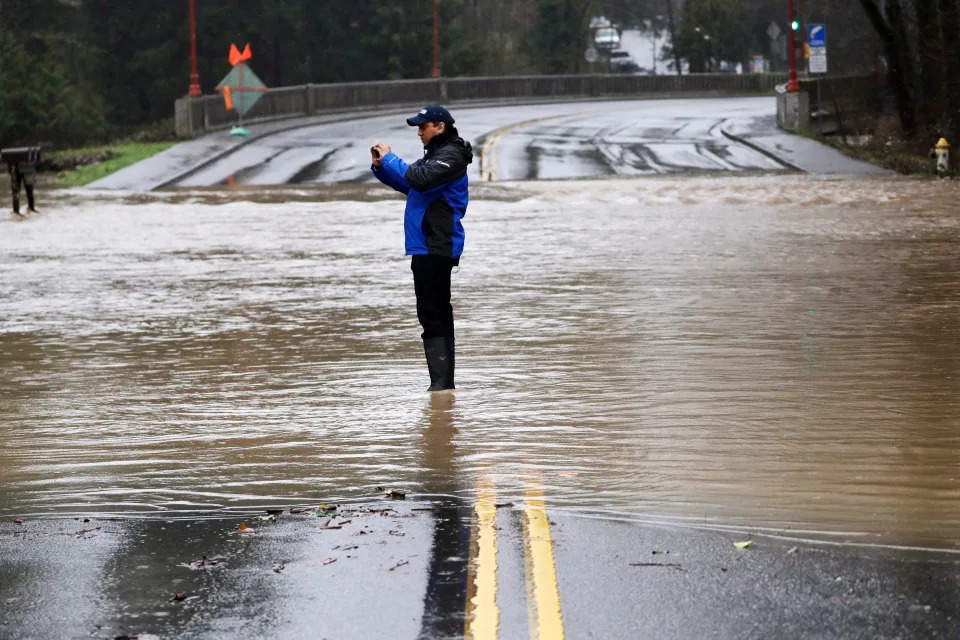
A man stands in a roadway flooded by Issaquah Creek and takes photos Thursday, Feb. 6, 2020, in Issaquah, Wash. Heavy rain sent the creek over a major roadway, under an apartment building east of Seattle and up to the foundations of homes as heavy rains pounded the region. A flood watch was in effect through Friday afternoon across most of western Washington.
A USA TODAY investigation last year found that between 2018 and 2021, fast-moving debris flows have damaged and destroyed hundreds of homes, closed major transportation routes across at least three states and caused more than $550 million in property damage. Close to 170 people have been injured and 28 people died since 2018.
Last year, flash floods in Colorado’s Poudre Canyon killed at least three people. It occurred in the burn scar left by the 2020 Cameron Peak Fire, the largest recorded fire in Colorado history.
In 2018 the Montecito mudslide killed 23 people near Santa Barbara, and properly loss claims totaled $421 million. It came just a month after the Thomas fire, one of the largest in state history, killed two people, destroyed at least 1,000 structures and cost $1.8 billion in property damages.
The speed at which wildfires have worsened across much of America has exceeded predictions by the scientific community, said Overpeck.
“If anything, the theory and the models were underestimating how hard and fast these impacts would accumulate,” he said. “Mother Nature is making that crystal clear.”
Contact Elizabeth Weise at eweise @usatoday.com
San Francisco’s Glen Park neighborhood at 9:55 am Pacific Daylight Time on Wednesday, September 9, 2020. Smoke from numerous wildfires over a layer of marine fog turned the sky an eerie orange color. Cars were using headlines and some street lights were still on.
Scientists Achieve Record Energy Efficiency for Thin Solar Panels
Paige Bennett – March 30, 2022
Scientists collaborated with AMOLF in Amsterdam to use solar panels one micrometer thick with a disordered honeycomb layer on top of the silicon panel. AMOLF
Scientists from the University of Surrey and Imperial College London have achieved an increase in energy absorption in ultra-thin solar panels by 25%, a record for panels of this size.
The team, which collaborated with AMOLF in Amsterdam, used solar panels just one micrometer thick with a disordered honeycomb layer on top of the silicon panel. The biophilic design draws inspiration from butterfly wings and bird eyes to absorb sunlight from every possible angle, making the panels more efficient.
The research led to a 25% increase in levels of energy absorption by the panels, making these solar panels more efficient than other one-micrometer-thick panels. They published their findings in the American Chemical Society’s journal, Photonics.
“One of the challenges of working with silicon is that nearly a third of light bounces straight off it without being absorbed and the energy harnessed,” said Marian Florescu from the University of Surrey’s Advanced Technology Institute (ATI) in a statement. “A textured layer across the silicon helps tackle this and our disordered, yet hyperuniform, honeycomb design is particularly successful.”
The panels in the study reached absorption levels of 26.3 mA/cm2, compared to a previous absorption record of 19.72 mA/cm2 from 2017.
Increasing the efficiency and absorption of ultra-thin panels is crucial to achieving low-cost photovoltaics.
“Micrometer-thick silicon photovoltaics (PV) promises to be the ultimate cost-effective, reliable, and environmentally friendly solution to harness solar power in urban areas and space, as it combines the low cost and maturity of crystalline silicon (c-Si) manufacturing with the low weight and mechanical flexibility of thin films,” the authors of the study explained.
The researchers expect that more design improvements will push the efficiency of macrometer-thin panels even higher, and they will be able to compete with existing commercial solar panels. Plus, these flexible panels could offer versatility in how they are used.
“There’s enormous potential for using ultra-thin photovoltaics. For example, given how light they are, they will be particularly useful in space and could make new extra-terrestrial projects viable,” Florescu said. “Since they use so much less silicon, we are hoping there will be cost savings here on Earth as well, plus there could be potential to bring more benefits from the Internet of Things and to create zero-energy buildings powered locally.”
Outside of photovoltaics, the research could also be useful for other industries, like photo-electrochemistry, solid-state light emission and photodetectors, that focus on light management.
Following the successful absorption rate increase of the ultra-thin panels in this study, the scientists plan to start looking for commercial partners and develop a plan for manufacturing.
50% of U.S. Lakes and Rivers Are Too Polluted for Swimming, Fishing, Drinking
Olivia Rosane – March 29, 2022
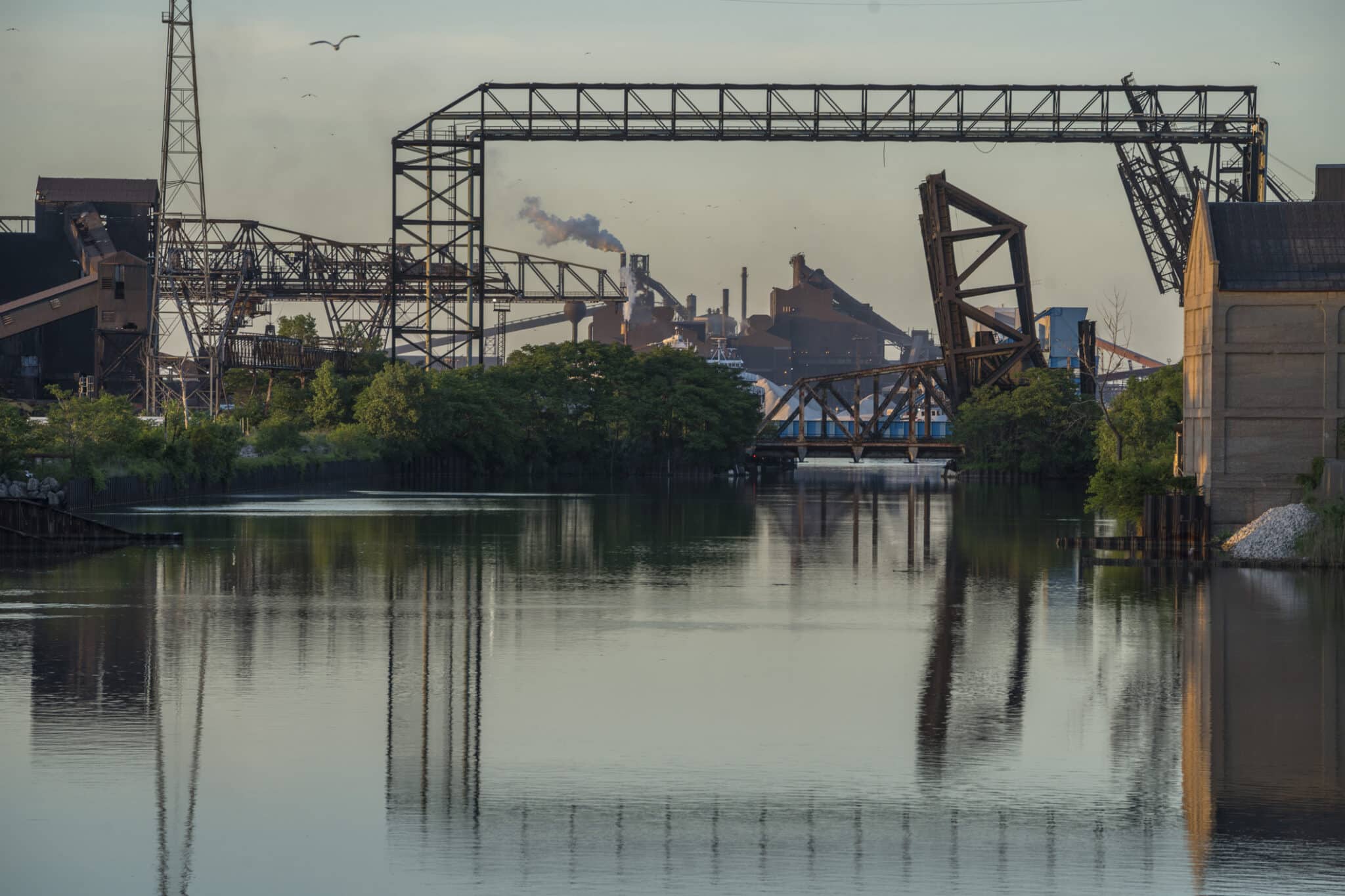
A steel mill on Indiana’s Grand Calumet River. Cavan Images / Getty Images
Fifty years ago, the U.S. passed the Clean Water Act with the goal of ensuring “fishable, swimmable” water across the U.S. by 1983.
Now, a new report from the Environmental Integrity Project (EIP) finds the country has fallen far short of that goal. In fact, about half of the nation’s lakes and rivers are too polluted for swimming, fishing or drinking.
“The Clean Water Act should be celebrated on its 50th birthday for making America’s waterways significantly cleaner,” EIP Executive Director Eric Schaeffer said in a press release announcing the report. “However, we need more funding, stronger enforcement, and better control of farm runoff to clean up waters that are still polluted after half a century. Let’s give EPA and states the tools they need to finish the job – we owe that much to our children and to future generations.”
The report was based on reports that states are required to submit under the Clean Water Act on the pollution levels of their rivers, streams, lakes and estuaries. According to the most recent reports, more than half of the lakes and rivers are considered “impaired,” meaning that they fall short of standards for fishing, swimming, aquatic life and drinking.
Specifically, around 51 percent of rivers and streams and 55 percent of lake acres are considered impaired, The Hill reported. Further, 26 percent of estuary miles are also impaired.
The Clean Water Act was a landmark legislative achievement when it was passed in 1972. It promised to end the discharge of all pollutants into navigable waters by 1985, according to the press release. However, it has fallen short of that goal for several reasons, according to the report.
The act has strong controls for pollution pumped directly into waterways from factories or sewage plants but not for indirect pollution such as agricultural runoff from factory farms.
The Environmental Protection Agency (EPA) has dragged its feet in updating industry-specific technology-based limits for water pollution control systems. By 2022, two-thirds of these industry-specific limits had not been updated in more than 30 years.
Budget cuts have hampered the ability of the EPA and state agencies to enforce the law.
Permit requirements are poorly enforced.
Total Maximum Daily Loads, a kind of pollution control plan, are insufficient.
There are problems effectively managing watersheds that cover two or more states.
The report also broke down pollution by state. Indiana has the most miles of rivers and streams too impaired for swimming and recreation.
“Indiana’s waters have benefited from the Clean Water Act, but unfortunately, they also illustrate some of the gaps in the law,” Dr. Indra Frank, Environmental Health & Water Policy Director for the Hoosier Environmental Council, said in the press release. “We have seen persistent, unresolved impairments, especially for E coli bacteria in our rivers and streams, in part from industrial agricultural runoff. And we have also seen examples of Clean Water Act permits used to send water contaminated with coal-ash into our rivers. We need to halt pollution like this.”
Florida, meanwhile, had the most lake acres impaired for swimming and aquatic life.
“Florida’s toxic-algae crisis is the direct result of lax enforcement of phosphorus and nitrogen pollution limits in cleanup plans required by the Clean Water Act,” Friends of the Everglades Executive Director Eve Samples said in the press release. “Because these limits rely on voluntary ‘best management practices’ and a presumption of compliance, agricultural polluters regularly exceed phosphorus runoff limits while dodging responsibility — leading to harmful algal blooms in Florida’s lakes, rivers, estuaries, and even on saltwater beaches.”
The report did propose several solutions that range from making sure that the EPA and other agencies carry out their duties under the existing law to strengthening the act with new legislation to control runoff pollution.
This last is particularly important because agricultural runoff and other indirect pollution sources are the leading causes of waterway pollution.
“Factory-style animal production has become an industry with a massive waste disposal problem and should be regulated like other large industries,” the study authors wrote.
Market giants Larry Fink and Howard Marks say the Ukraine conflict will end globalization. Here are 3 key takeaways for investors.
Harry Robertson – March 26, 2022
BlackRock boss Larry Fink thinks the end of globalization is here.Taylor Hill/Getty Images
BlackRock’s Larry Fink and Oaktree’s Howard Marks have predicted that globalization is coming to an end.
The Russia-Ukraine war and COVID-19 are making companies and countries rethink their reliance on others, they said.
Deglobalization would have dramatic consequences for the economy, and for investors used to a highly integrated world.
Globalization has shaped the world for the last 30 years, but it’s now coming to an end. That’s the view of two of the world’s best-known investors, BlackRock chief Larry Fink and Oaktree chair Howard Marks.
“The Russian invasion of Ukraine has put an end to the globalization we have experienced over the last three decades,” Fink wrote in his latest letter to shareholders last week.
A day earlier, Marks had shared a similar sentiment in one of his well-read memos. He said the war had made companies and governments realize how they’d become reliant on others.
“The recognition of these negative aspects of globalization has now caused the pendulum to swing back toward local sourcing,” he said.
But what exactly is globalization? Economists at the Peterson Institute define it as the growing interdependence of the world’s economies, people and cultures. It’s brought about by crossborder trade in goods and services, as well as by flows of investment, people and information.
An end to the process would have dramatic consequences, not least for investors, who have become used to a highly integrated world.
Here are three areas where the end of globalization — if it comes — could have a profound impact.
Global energy markets
Russia’s invasion of Ukraine has had a dramatic impact on the global economy and markets. No where is that more clear than in surging commodities prices. Brent crude oil, which stood at around $64 a barrel a year ago, is now trading at more than $110.
In Fink’s view, higher fossil-fuel prices will help drive the transition to green energy. That means the prospects for renewable energy companies could be bright in the medium term.
“More than ever, countries that don’t have their own energy sources will need to fund and develop them – which for many, will mean investing in wind and solar power,” Fink wrote.
Yet the BlackRock boss was less optimistic about the short term. A need to cut back on Russian oil has driven countries like the US to increase their own fossil-fuel production.
Many investors have pivoted toward energy companies and commodities, which plenty believe are set to keep rising over the next year as the war plays out.
Inflation
Closely linked to energy is the question of inflation. It’s above 5% in Europe and the UK, and has surged to a 40-year high in the US.
An end to globalization is likely to make things worse, Fink and Marks warned.
Marks highlighted how “offshoring” — in which companies use cheap foreign labor to produce their products — has led to a sharp fall in the cost of goods.
The end of that process could give working-class communities in the US and Europe a boost. But it could also drive up prices, simply because Western workers are more expensive.
“A large-scale reorientation of supply chains will inherently be inflationary,” Fink wrote. “Central banks must choose whether to live with higher inflation, or slow economic activity and employment to lower inflation quickly.”
Crypto and other opportunities
BlackRock’s Fink, who previously suggested bitcoin might be worthless, now thinks digital currencies may have a role to play in a deglobalizing world. He said the war will force countries to reconsider their currency dependency.
“A global digital-payment system, thoughtfully designed, can enhance the settlement of international transactions while reducing the risk of money laundering and corruption.”
Marks went into fewer specifics, but ended his memo on a hopeful note.
“After many decades of globalization and cost minimization, I think we’re about to find investment opportunities in the swing toward reliable supply,” he said.
Posted on FB by Rhae Ann Theriault – March 24, 2022
Dear Tucker Carlson:
Hey Tuck, I just finished watching a segment of your show. You know, the one where you suggest that there should be a camera in every classroom in order to root out… let me get this accurate…”civilization ending poison.”
I’m going to zig where you thought most teachers would zag. I welcome your Orwellian cameras in my classroom. Frankly, I don’t know many teachers who would object to having people watch what we do. As a matter of fact, I hate to tell you this Tucker Swanson McNear Carlson, but most of us spent the last year having video cameras in our classrooms.
See, I think you believe that your suggestion that people see what happens in our classrooms will somehow scare teachers. The truth of it is that we have been begging for years to have people, such as yourself, come into our classrooms. I somewhat famously asked Ms. DeVos to visit a public school before she became Secretary of Education (https://www.huffpost.com/…/an-introduction-from-public…). It’s unclear whether she has yet to set foot in an actual public school classroom, but I digress. I sense that you think you’ll see all of us pinko teachers speaking endlessly about Critical Race Theory leading to…and again, let me get this right, “civilization ending poison.” I’ve been in a lot of classrooms (more than you I am willing to bet) and think you’re going to be disappointed on that front. What happens in America’s classrooms is teaching and learning. Your “spy cameras” will see teachers and students working together to be better every day.
I’ll tell you what I saw on a tour of classrooms not that long ago. I saw a group of kindergartners trying to create bridges over running water with basic classroom supplies in a lesson about collaboration. I saw a high school literature class talking about the character development in The Glass Menagerie. I saw a middle school history class participating in group project where they had to solve problems in a fictional city, with specifics of how they would utilize resources and build public support for their projects. Anyone watching your cameras will see learning…all day every day. For those who watch your “nanny cams” carefully, they’ll see a lot of other things as well. They will see teachers working with students who have vastly different life experiences. They will see students who are fluent in multiple languages working with teachers to become proficient in yet one more language. They will see students who are hungry get their one solid meal a day in the cafeteria. They will see students itching for more fine arts, industrial technology, or world languages to be offered in their school. In my classroom, if we’re being honest, they’ll probably hear some sketchy intonation from my saxophones, and I promise we’re working on it. But for sure, they will see learning… all day every day.
To be honest, I’m fascinated by the logistics of your proposal. In a world where school districts are struggling to recruit and maintain teachers, who is going to man your “citizen review boards” (setting aside the fact that public school teachers already answer to publicly elected school boards)? For instance, in my school district I sense you would need well over 500 cameras going every day. Who watches those 500 screens 10 hours a day (I want you watching my 7 am jazz band and my after school lessons)? What qualifications would these “experts” need to know what they were watching for? What happens when they catch a teacher teaching… let me get this right… ”civilization ending poison?” Who do they report that to? I’m also curious who will pay for all of this incredible technology. Maybe I missed it, but can you point me to a K-12 institution where Critical Race Theory is being taught? Hell, can you define Critical Race Theory for all of us? I’m sure you’ve got answers to all of these questions.
Frankly, I’ve never been able to figure out, instead of dreaming up Orwellian plans to have Big Brother in all of our classrooms, why you don’t round up an army of bright young conservatives to actually step up and teach? Is it because teachers work hard, aren’t paid as much as those with similar educational backgrounds, don’t have support from our elected officials, constantly serve as punching bags for those who don’t understand public education, or is it just because it’s easier to throw rocks at a house than to build one?
Here’s the real deal Tuck, I grew up with my mom making me eat your family’s Salisbury Steaks once every couple of weeks (his family makes Swanson TV dinners) for many years. I struggle to take advice on teaching and learning from a guy who makes a steak that, on its best day, tastes like shoe leather that has been left out in a goat pasture for a few weeks. I get that Critical Race Theory is your latest attempt to scare your easily manipulated demographic, but let’s just admit that you don’t know what you’re talking about.
With all of that being said, count me on the cameras Tucky. Like many teachers, I’m in the early stages of understanding Critical Race Theory (most of us hadn’t heard about it until you and your people started crying about it), but if you find me teaching it, have one of the Tucker Youth watching your surveillance devices let me know. If Critical Race Theory involves talking honestly about American history, I’m probably doing that sometimes. I spent much of the last six years advocating for a way for teaching to become more transparent, and in the dumbest way possible, you are joining that crusade. Let’s make this happen TV Dinner Boy.
Sincerely, Patrick J. Kearney. Actual Teacher(Copied from Kim Larkin-Floria)
German farmers in Ukraine press ahead in defiance of war
Sophie Makris – March 25, 2022
German farmers Tim Nandelstädt (centre) and Torben Reelfs (right) push ahead with their crop planting in Ukraine despite Russia’s invasion (AFP/Tim NANDELSTAEDT)
War has come to Ukraine but German farmers Torben Reelfs and Tim Nandelstaedt are planting the first sugar beets of the season on their plot of land in western Ukraine (AFP/Tim NANDELSTAEDT)
Every year in early spring, German farmers Torben Reelfs and Tim Nandelstaedt turn the soil and plant the first sugar beets of the season on their plot of land in western Ukraine.
But this year, the ritual has taken on a new meaning.
“It’s very symbolic. When the machine turns over the land, it’s a different feeling than in previous years,” said Reelfs, 41, speaking to AFP by phone from the farm about 60 kilometres (37 miles) from Lviv.
When Russian troops invaded Ukraine on February 24, Reelfs and Nandelstaedt immediately fled to Germany to “get away from the missiles, to be on the territory of the EU, of NATO”, according to Nandelstaedt, 43.
“At first I thought that Russia would get to the Polish border very quickly,” he said.
But three weeks later, both of them were back in Derzhiv, their adopted home for the last 10 years.
“What we are seeing here, the solidarity on a military and a humanitarian level, is inspiring and gives you hope,” said Reelfs.
– ‘Poker game’ –
With the west of Ukraine so far largely spared from the deadly fighting raging in the south and east, the two men decided to go ahead and start sowing their crops.
The pair had already managed to secure the fuel, fertiliser and seeds they needed.
They began by sowing the sugar beets, which will be followed by corn in around two weeks’ time and soybeans in around two months.
It’s too early to tell whether the crops will ever be harvested, but for now, Reelfs is sure it was “the right decision”.
He also feels “a certain responsibility” to “reduce the risk of catastrophic famines” around the world as a result of the war.
Before the Russian invasion, Ukraine was the world’s fourth largest exporter of corn and was on its way to becoming the third largest exporter of wheat behind Russia and the United States.
Corn, wheat and sunflower oil prices have already soared in recent weeks and the situation looks set to worsen if the “breadbasket of Europe” is unable to keep up with the usual supplies.
The two German farmers know that going ahead with the harvest is a huge risk — a “poker game”, according to Reelfs.
“What will happen in six months, when we harvest, I honestly have no idea,” said Nandelstaedt. “Some farms have already been hit by missiles or attacked by ground troops. Fields are burning. If that happens here, it will be over.”
– ‘Adventure’ –
Reelfs and Nandelstaedt have spent the last decade building up their farm in Ukraine, which covers 1,900 hectares of land and employs 25 people.
The business partners, who have been friends for over a decade, were among a wave of farmers who took up leases on land in Ukraine after the fall of the Soviet Union, attracted by the cheap prices and fertile soil.
They liked the idea of an “adventure” and the chance to build everything from scratch, according to Reelfs.
Between 2008 and 2009, “we visited almost 50 villages and there was still available land everywhere”, he said.
“When we started out, you could rent a hectare of land for 17 euros ($18.70) and could even pay in kind, with wheat or sugar. Today, we pay well over 100 euros here and it is more than 200 euros in many regions.”
It’s a sign of how much Ukraine has changed over the years, he said: “Corruption has greatly decreased… and the standard of living has got better and better.”
Reelfs believes it has been a surprise to the Russian forces to see that “people are not at all unhappy with their government, they want to support the army and defend their country”.
During their stay in Germany, Reelfs and Nandelstaedt collected 130,000 euros in donations for Ukraine and helped to arrange accommodation for around about 170 people in villages around Berlin.
“Even though they all feel welcome there, they want to return to Ukraine as soon as possible,” said Reelfs.
Half of US adults exposed to harmful lead levels as kids
By Drew Costley – March 7, 2022
Over 170 million U.S.-born people who were adults in 2015 were exposed to harmful levels of lead as children, a new study estimates.
Researchers used blood-lead level, census and leaded gasoline consumption data to examine how widespread early childhood lead exposure was in the country between 1940 and 2015.
In a paper published in the Proceedings of the National Academy of Sciences on Monday, they estimated that half the U.S. adult population in 2015 had been exposed to lead levels surpassing five micrograms per deciliter — the Centers for Disease Control and Prevention threshold for harmful lead exposure at the time.
The scientists from Florida State University and Duke University also found that 90% of children born in the U.S. between 1950 and 1981 had blood-lead levels higher than the CDC threshold. And the researchers found significant impact on cognitive development: on average, early childhood exposure to lead resulted in a 2.6-point drop in IQ.
The researchers only examined lead exposure caused by leaded gasoline, the dominant form of exposure from the 1940s to the late 1980s, according to data from the U.S. Geological Survey. Leaded gasoline for on-road vehicles was phased out starting in the 1970s, then finally banned in 1996.
Video: Nearly 50% of bald eagles have chronic lead poisoning
Study lead author Michael McFarland, an associate professor of sociology at Florida State University, said the findings were “infuriating” because it was long known that lead exposure was harmful, based on anecdotal evidence of lead’s health impacts throughout history.
Though the U.S. has implemented tougher regulations to protect Americans from lead poisoning in recent decades, the public health impacts of exposure could last for several decades, experts told the Associated Press.
“Childhood lead exposure is not just here and now. It’s going to impact your lifelong health,” said Abheet Solomon, a senior program manager at the United Nations Children’s Fund.
Early childhood lead exposure is known to have many impacts on cognitive development, but it also increases risk for developing hypertension and heart disease, experts said.
“I think the connection to IQ is larger than we thought and it’s startlingly large,” said Ted Schwaba, a researcher at University of Texas-Austin who studies personality psychology and was not part of the new study.
Schwaba said the study’s use of an average to represent the cognitive impacts of lead exposure could result in an overestimation of impacts on some people and underestimation in others.
Previous research on the relationship between lead exposure and IQ found a similar impact, though over a shorter study period.
Bruce Lanphear, a health sciences professor at Simon Fraser University in Vancouver who has researched lead exposure and IQ, said his 2005 study found the initial exposure to lead was the most harmful when it comes to loss of cognitive ability as measured by IQ.
“The more tragic part is that we keep making the same … mistakes again,” Lanphear said. “First it was lead, then it was air pollution. … Now it’s PFAS chemicals and phthalates (chemicals used to make plastics more durable). And it keeps going on and on.
“And we can’t stop long enough to ask ourselves should we be regulating chemicals differently,” he said.
The Associated Press Health and Science Department receives support from the Howard Hughes Medical Institute’s Department of Science Education. The AP is solely responsible for all content.
John Oliver explains the U.S. power grid and the challenge of upgrading it for America’s electric future
Peter Weber, Senior editor – November 8, 2021
“Electricity is such an integral part of modern life it is hard to believe that we used to have to sell people on the idea of electric appliances,” John Oliver said on Sunday’s Last Week Tonight, showing a TV ad from 1959. “Specifically tonight we’re going to talk about the power grid, the system of generators that produce electricity and the vast latticework of wires that get it to our homes. The grid is probably something that you probably don’t think much about until it goes down — which, unfortunately, has been happening more and more in recent years.”
“While things are bad now, they could get a lot worse in the future, because the U.S. has a goal of net-zero carbon emissions by 2050 — which we absolutely must meet,” Oliver said. “But one study estimates that’s going to require a 40-60 percent in peak electricity consumption,” with the shift to electric cars and heating, and “all that electricity is going to have to come from somewhere.”
The U.S. power grids — 600,000 miles of transmission lines and 5.5 million miles of local distribution lines — have been called the “supreme engineering achievement of the 20th century,” Oliver said. But most power lines are long past their 50-year life expectancies, and climate change has made them more vulnerable.
Upgrading the grid will require lots of little changes, but “our shift to renewable energy is going to require a fundamental shift in what our grid looks like,” Oliver said. You can build coal plants near large coastal cities, but most wind farms will need to be in middle America, and it may be an “uphill battle” to convince “a Midwestern farmer ‘We need to build something in your backyard so someone in California can power their electric car.'” Luckily, “the physical generation of renewable energy isn’t really the problem here,” he said. “The key issue is the transmission of it.” And there are fixes for that, too, though not easy or cheap ones.
“For far too long, whenever we’ve experience blackouts, we’ve tended to think of it as the power grid failing,” Oliver said, “but the truth is, it’s not failing us — we are failing it by asking it to do something it was not designed to do in conditions that it was not designed to handle.” He ended his show with a bang, then a slight whimper.







 German farmers Tim Nandelstädt (centre) and Torben Reelfs (right) push ahead with their crop planting in Ukraine despite Russia’s invasion (AFP/Tim NANDELSTAEDT)
 War has come to Ukraine but German farmers Torben Reelfs and Tim Nandelstaedt are planting the first sugar beets of the season on their plot of land in western Ukraine (AFP/Tim NANDELSTAEDT)