Democrats Buoyed by Abortion and Trump, Times/Siena Poll Finds

The New York Times

Democrats Buoyed by Abortion and Trump, Times/Siena Poll Finds

Lisa Lerer and Nate Cohn – September 16, 2022

President Joe Biden speaks at the 45th Congressional Hispanic Caucus Institute Gala to kick-off the White House's celebration of Hispanic Heritage Month at the Walter Washington Convention Center, Thursday, Sept. 15, 2022, in Washington. (AP Photo/Alex Brandon)
President Joe Biden speaks at the 45th Congressional Hispanic Caucus Institute Gala to kick-off the White House’s celebration of Hispanic Heritage Month at the Walter Washington Convention Center, Thursday, Sept. 15, 2022, in Washington. (AP Photo/Alex Brandon)
Fury over abortion has helped mask deep Democratic vulnerabilities, according to a New York Times/Siena College poll. (Hannah Beier/The New York Times)

Even as they struggle to persuade voters that they should be trusted on the economy, Democrats remain unexpectedly competitive in the battle for Congress as the sprint to November’s midterm election begins, a New York Times/Siena College poll has found.

The surprising Democratic strength has been bolstered by falling gas prices and President Joe Biden’s success at breaking through legislative gridlock in Washington to pass his agenda. That shift in political momentum has helped boost, in just two months, the president’s approval rating by 9 percentage points and doubled the share of Americans who believe the country is on the right track.

But Democrats are also benefiting from factors over which they had little control: the public outcry in response to the Supreme Court’s overturning of federal abortion rights and the return of former President Donald Trump to an attention-commanding presence on the national stage.

Overall, 46% of registered voters say they back the Democratic candidate for Congress in their district, compared with 44% for Republicans — a difference well within the survey’s margin of error. The findings are similar to those from the last Times/Siena poll in July, when voters preferred, by just 1 percentage point, Democratic to Republican control of Congress.

Yet the fundamentals of the race — high inflation, an uncertain economy and an unpopular president — remain challenging for Democrats. The national mood, while brighter than earlier in the summer, remains gloomy. Republicans still score higher on some social issues, including illegal immigration. And the president’s approval rating is still just 42%— as weak as or weaker than the ratings of every president whose party went on to lose control of Congress in midterm elections, going back to 1978.

For now, the fury over abortion and the renewed spotlight on Trump have helped mask deep Democratic vulnerabilities that might ultimately make Republicans favored to retake Congress — if Republicans could refocus the electorate on the economy and inflation. Republicans would lead by 6 percentage points in the race for Congress, if they could merely win over voters who say they agree with the GOP most on the economy.

Marvin Mirsch, 64, a self-identified independent from suburban Minneapolis, said he agreed with the Republicans on economic issues but still planned to back Democrats in November. A biomedical engineer, he attributed his vote largely to one man: Trump.

“I think that every person in the nation should work hard to purge Donald Trump from the Republican Party in one way or another,” Mirsch said. “Because we need a healthy Republican Party, and it’s not right now — it’s sick.”

The survey underscored how Republicans have been weakened by Trump’s decision to play a vocal role in his party’s primaries. Voters said that the word “extreme” described the Republicans better than the Democrats by a 6-point margin, 43% to 37%. And, although they deemed economic issues most important, more voters said that Democrats were focused on the most important issues than those who said that Republicans were, by 40% to 38%.

While the poll did not directly ask voters how Trump weighed on their midterm vote, it found Biden leading Trump by 3 percentage points, 45% to 42%, in a hypothetical 2024 matchup — nearly identical to voter preferences in the race for Congress.

In contrast, voters trust the Republicans more on the economy by a 14-point margin, 52% to 38%. And they say that economic issues will matter more to their vote than do societal issues by an 18-point margin.

Yet 9% of the voters who trust Republicans more on economic issues and say that those issues are most important are voting for Democrats, anyway.

Jeanine Spanjers, 44, from Racine, Wisconsin, said that rising inflation had caused her to change her lifestyle, including driving less, skipping vacations and even abstaining from popcorn when she goes to the movies. A state employee, she also said she believed that Democrats were handing out too many government subsidies, pointing to relief payments distributed during the pandemic.

“What’s getting on my nerves is all this free stuff,” she said, criticizing how all the children at her son’s school received food stamp cards, including families who could afford to pay for lunch. “Republicans would never do something like that. It disincentivizes people to go out and do something. I’m starting to feel like people are being rewarded for not doing anything.”

Still, Spanjers said she planned to vote only for Democrats, saying abortion is her top issue. “I had made that choice once, and I have two sons,” she said. “There’s people who can’t afford kids and shouldn’t have kids, or just maybe it isn’t the right time in their life.”

The poll’s findings also suggest that Biden’s legislative successes have done relatively little to boost his or his party’s credibility on economic issues.

Only 36% of voters said they approved of a centerpiece of Biden’s legislative agenda, the health and climate spending bill passed by Congress last month known as the Inflation Reduction Act. More than one-quarter said they had never even heard of it. The country was divided over the administration’s student debt plan, with 49% saying they supported the cancellation of up to $20,000 worth of federal student loans, compared with 45% who say they opposed it.

Just 15% of voters said that Biden’s policies had helped them personally, while 37% said that his policies had hurt them. Nearly half said the president had not made much of a difference either way — including 59% of voters younger than 30.

“I’ve been working since I was 16, and I don’t have a high school diploma, so the costs of inflation are really affecting me,” said Mykie Bush, 19, who works at an auto dealership in rural Oregon. “I can barely leave my house right now because of inflation.”

Still, Bush said she planned to vote Democratic, saying her views on issues like abortion, immigration and LGBTQ rights outweighed her economic worries: “At the end of the day, we’re not fighting over politics. We’re fighting over our human rights.”

Democrats held an overwhelming 73%-18% lead among voters who said that “societal issues” like abortion or threats to democracy would be most important in their vote this November, rather than economic issues like jobs and the cost of living.

But on issues like immigration, crime and even gun policy that had appeared likely to dominate the midterm campaign before the Supreme Court’s decision to overturn Roe v. Wade, Republicans appear to hold important advantages. Despite a summer of mass shootings, voters by a narrow margin said they opposed a ban on semi-automatic weapons and high-capacity magazines.

Republican strength extends even to one of the most divisive elements of Trump’s agenda, with voters narrowly supporting a border wall. And, by a 14-point margin, voters said they agreed more with the Republican Party’s stance on illegal immigration.

The electorate remains deeply divided along the demographic fault lines of the last election, with Democrats leading among white college graduates, young voters and nonwhite voters; Republicans hold a commanding lead among white voters without a college degree. As in the July Times/Siena survey, Republicans show even greater strength among white voters without a degree than they did in 2020, with an overwhelming 61%-29% lead among that group.

Jason Anzaldua, a Republican from Jefferson County, Arkansas, who is a police lieutenant in rural Redfield, said that he could not afford the gas to transport his children to compete in rodeo events and had to sell some of his horses because the price of feed was too high. But he said he was equally frustrated with what he saw as Biden’s disrespect of those who supported Trump and the MAGA movement.

“I swore an oath to the Constitution to uphold it, to protect it, to protect the citizens here on America’s front lines,” Anzaldua said. “So for him to stand up and tell me that I’m part of the problem is a slap in the face as an American.”

Democrats and Republicans were nearly equally likely to say they intended to turn out this November, with 52% of Republicans and 51% of Democrats saying they were “almost certain” to vote.

Voters continue to believe that abortion should be mostly or always legal by around a 2-1 margin. However, the supporters of legal abortion rights enjoy an even larger enthusiasm edge: 52% of voters said they strongly opposed the Supreme Court’s ruling to overturn Roe v. Wade; just 19% said they strongly supported it.

“What has taken place is unacceptable to me,” said James Moran, 82, a registered Republican from New Rochelle, New York, who said that he planned to vote Democratic this year. “They’ve denied women the ability to control their own bodies. Should there be some limit on that? There’s limits on everything but everything within reason.”

Trump warns of ‘problems’ like ‘we’ve never seen’ if he’s indicted

Politico

Trump warns of ‘problems’ like ‘we’ve never seen’ if he’s indicted

Myah Ward and Andrew Desiderio – September 15, 2022

Mary Altaffer/AP Photo

Former President Donald Trump said Thursday the nation would face “problems … the likes of which perhaps we’ve never seen” if he is indicted over his handling of classified documents after leaving office, an apparent suggestion that such a move by the Justice Department could spark violence from Trump’s supporters.

The former president said an indictment wouldn’t stop him from running for the White House again and repeatedly said Americans “would not stand” for his prosecution.

“If a thing like that happened, I would have no prohibition against running,” Trump said in an interview with conservative talk radio host Hugh Hewitt. “I think if it happened, I think you’d have problems in this country the likes of which perhaps we’ve never seen before. I don’t think the people of the United States would stand for it.”

Hewitt asked Trump what he meant by “problems.”

“I think they’d have big problems. Big problems. I just don’t think they’d stand for it. They will not sit still and stand for this ultimate of hoaxes,” Trump said.

It’s not the first time Republicans have hinted at potential civil unrest if the DOJ indicts Trump. Republican Sen. Lindsey Graham made headlines last month when he said there would be “riots in the street” if “there is a prosecution of Donald Trump for mishandling classified information.” Graham’s comments were slammed as “irresponsible” and “shameful.” White House press secretary Karine Jean-Pierre, without naming the South Carolina senator, said these comments from “extreme Republicans” were “dangerous.”

Hewitt appeared to see Trump’s comments as a nod toward potential unrest, asking the former president how he would respond when the “legacy media” accuses him of inciting violence.

“That’s not inciting. I’m just saying what my opinion is,” Trump said. “I don’t think the people of this country would stand for it.”

On Capitol Hill, senior FBI and DHS officials briefed members of the Senate Judiciary and Homeland Security committees Thursday on the uptick in threats against federal law enforcement in the aftermath of the Mar-a-Lago search. Senators said the briefers didn’t specifically pinpoint a politician or political party when it comes to the threats, but they said the trend was clear.

“It was stunning the number of threats that have been cataloged since the Aug. 8 search of Mar-a-Lago,” Senate Judiciary Chair Dick Durbin (D-Ill.) said after the briefing, specifically mentioning the gunman who tried to enter an FBI building in Cincinnati, Ohio, in the days following the search. “It’s a much more dangerous environment because of the political statements made by some individuals since Aug. 8 — it’s alarming to me.”

Durbin said the threats ranged from explicit and specific to more generalized ones, most notably on social media. He also called out Trump for his rhetoric.

“Inviting a mob to return to the streets is exactly what happened here on Jan. 6, 2021. This president knew what he was doing…and we saw the results,” Durbin added. “His careless, inflammatory rhetoric has its consequences.”

Sen. Rick Scott (R-Fla.), a Trump ally and member of the Homeland Security Committee, said after the briefing that the Justice Department needed to be more transparent about the justification for the search in order to push back against “conspiracies.”

“You have to give people good information so these rumors don’t continue,” Scott said, condemning attacks on law enforcement. “I don’t know why they raided the former president’s house … They know the conspiracy theories that are out there. So convince people that they’re not true.”

The FBI search of Trump’s Mar-a-Lago residence in Florida sparked a political firestorm last month. According to a Justice Department court filing released in August, prosecutors obtained a search warrant for the estate after receiving evidence there was “likely” an effort to conceal classified documents at the residence in defiance of a grand jury subpoena. Agents recovered highly classified records mixed among personal items, in addition to dozens of empty folders with classified markings.

The DOJ and Trump’s lawyers are now in the midst of legal deliberations on an outside review of the seized documents.

Graham, one of Trump’s staunchest Capitol Hill allies, echoed concerns that the Justice Department may have overstepped in its dealings with the former president. But he left open the possibility that the department’s probe could uncover material that might justify an indictment.

“There’s a belief from many on the right that the DOJ and the FBI have been less than unbiased when it comes to Trump. But having said that, nobody’s above the law including the president, but the law’s gonna be about politics,” Graham said. “So let’s wait and see what they find. I’ve got an open mind about what they find, but they need to have something that would justify what I think is political escalation.”

Speaking with Hewitt on Thursday, Trump continued to use the defense that he “declassified” everything he took to Mar-a-Lago, a claim his legal team has thus far declined to make in court.

Rhetoric that could be seen as alluding to violence is not out of character for Trump. In his speech on Jan. 6, 2021, to supporters before rioters stormed the Capitol in an effort to block the certification of President Joe Biden’s Electoral College victory, the then-president told the crowd to “fight much harder” against “bad people” and to “show strength.” His comments that day have been a focal point of Jan. 6 select committee’s investigation into the president and his inner circle, with investigators using one of their summer hearings to make the case that Trump’s efforts to hold on to power resonated with extremist groups and brought them to the Capitol.

Nancy Vu contributed to this report.

Patagonia founder is giving away his billion dollar company and ensuring that all profits go towards fighting climate change

Insider

Patagonia founder is giving away his billion dollar company and ensuring that all profits go towards fighting climate change

Kelsey Vlamis and Lakshmi Varanasi – September 14, 2022

yvon chouinard tom brokaw
  • Yvon Chouinard announced Wednesday he is giving away his multi-billion dollar company, Patagonia.
  • Chouinard said instead of selling it or taking it public, Patagonia will be owned by a trust and nonprofit.
  • The trust is set up to ensure Patagonia’s profits go towards addressing climate change.

Patagonia founder Yvon Chouinard is giving away the company by transferring it to a newly established trust and nonprofit in order to ensure its profits go towards combatting the climate crisis.

Chouinard, the rock climber-turned-billionaire, announced the move in a statement on Wednesday.

“Instead of ‘going public,’ you could say we’re ‘going purpose.’ Instead of extracting value from nature and transforming it into wealth for investors, we’ll use the wealth Patagonia creates to protect the source of all wealth,” he wrote.

Chouinard, 83, said that he opted for the unique ownership model instead of selling the company to an owner that could potentially compromise Patagonia’s values, or going public and leaving the company beholden to shareholders first.

Instead, ownership of the outdoor apparel company, valued at around $3 billion, is being transferred to the Patagonia Purpose Trust and Holdfast Collective.

“It’s been nearly 50 years since we began our experiment in responsible business, and we are just getting started. If we have any hope of a thriving planet—much less a thriving business—50 years from now, it is going to take all of us doing what we can with the resources we have. This is another way we’ve found to do our part,” Chouinard said.

Patagonia said going forward all profits that are not reinvested back into the company will be distributed to Holdfast Collective to go towards environmental causes, according to an additional statement provided to Insider. The company estimates this amount will total about $100 million each year.

Founded by Chouinard nearly 50 years ago, Patagonia is well known for breaking with conventional business practices and for its commitment to sustainability

In an interview with The New York Times about the decision, Chouinard said he hopes the move will “influence a new form of capitalism that doesn’t end up with a few rich people and a bunch of poor people.”

“We are going to give away the maximum amount of money to people who are actively working on saving this planet,” he said.

Dan Mosley of merchant bank BDT & Co., who helped Patagonia structure the move, told The Times he’s never seen anything like it: “In my 30 plus years of estate planning, what the Chouinard family has done is really remarkable.”

“It’s irrevocably committed. They can’t take it back out again, and they don’t want to ever take it back out again,” Mosley said.

Chouinard and his family have given away most of their wealth throughout his lifetime, making them one of the most charitable families in the US.

Chouinard has also famously said that Patagonia’s decisions that were good for the planet have also been good for business.

“I didn’t know what to do with the company because I didn’t ever want a company,” Chouinard told The Times. “I didn’t want to be a businessman. Now I could die tomorrow and the company is going to continue doing the right thing for the next 50 years, and I don’t have to be around.”

You don’t need to walk 10,000 steps a day — walking faster is what counts to protect you from heart disease and cancer

Insider

You don’t need to walk 10,000 steps a day — walking faster is what counts to protect you from heart disease and cancer

Gabby Landsverk – September 14, 2022

a person with dark curly hair wearing black pants and a white T shirt, walking on a brightly lit sidewalk in front of a stone building during the day
Walking at least 3,800 steps a day may help prevent dementia, and hitting up to 9,800 steps at a brisk pace is ideal, according to a new study. 
  • There’s even more research that daily walking can help prevent early death and dementia. 
  • As few as 3,800 daily steps may stave off illness, with more benefits for every 2,000 extra steps you take.
  • Walking faster, at about 2.7 to 3 miles an hour, may be even better for health, according to data.  

Over 3 million people read Morning Brew  ; you should too!Email addressBy clicking ‘Sign up’, you agree to receive marketing emails from Insider as well as other partner offers and accept our Terms of Service and Privacy Policy.

Walking is a great way to improve your health and stave off cognitive decline and other age-related ailments, even if you only do a moderate amount each day, new research suggests. 

While 10,000 steps a day is considered the ideal to improve health, as few as 3,800 steps per day has benefits, and walking at a faster pace is even better for you, according to a study published September 6 in JAMA Neurology.

Researchers from the University of Sydney looked at data from 78,430 mostly white UK adults aged 40 to 70, comparing step counts, average speed, and health outcomes over about seven years of follow-up. 

They found that for every 2,000 steps participants took per day, on average, their risk of early death was 8-11 percent lower, up to 10,000 steps a day. 

But walking just 3,800 steps a day had benefits, specifically for brain health, reducing the risk of dementia by 25 percent, according to data. People who walked about 9,800 steps per day had a 50 percent lower risk of dementia. 

Walking pace and intensity also made a difference for health outcomes, with faster walkers showing greater benefits for cognitive health and prevention of illnesses like heart disease and cancer, according to data.

The optimal speed for a 30 minute walk was about 112 steps per minute, slightly faster than what previous research has identified as a healthy, brisk walking speed of 2.7 miles an hour, or 100 steps per minute.

Participants got more benefits in fewer steps if they were purposeful with their walking, and did it with the intention of exercising rather than simply moving from room to room during their day. Researchers found the ideal amount of purposeful walking was around 6,000 steps a day. 

The findings suggest that both walking distance and speed could be helpful tools for improving health and reducing risk of illness, according to the researchers. 

“The take-home message here is that for protective health benefits, people could not only ideally aim for 10,000 steps a day but also aim to walk faster,” Dr Matthew Ahmadi, co-lead author of the study and research fellow at the University of Sydney, said in a press release. 

Previous research supports the idea that vigorous walking is good for you, even if you get less than 10,000 steps

Earlier studies have also found a fast walking pace and shorter step count may have benefits. 

A 2022 study found a brisk walking pace, more than three miles an hour, was most effective for slowing signs of biological aging, potentially leading to a longer, healthier life by as much as 16 years

And one 2019 study found that walking seemed to reduce the risk of early death in as few as 4,400 steps per day.

The idea that walking 10,000 steps per day is optimal may be as much based in marketing as in science, Daniel Lieberman, a Harvard paleoanthropologist who has studied the evolution of exercise, previously told Insider.

The number was popularized by a Japanese company to help sell the first commercial pedometer, and 10,000 was chosen because it was both catchy and easy to remember. 

Aiming for 10,000 steps can be overly ambitious, since it’s a total of about five miles, but having a convenient goal may be helpful if it motivates you to be active. 

“We all have deep fundamental instincts to avoid unnecessary activity, so we need those nudges to help people get started,” he said.

Complaints about inaccurate credit reports are soaring

MoneyWatch

Complaints about inaccurate credit reports are soaring

Khristopher J. Brooks – September 14, 2022

Americans are on pace to set a record this year for the most complaints about credit report inaccuracies filed with the Consumer Financial Protection Bureau, according to Consumer Reports. 

Credit score concerns accounted for slightly more than half of all complaints sent to the federal agency in 2020 and 2021, the nonprofit consumer advocacy group found. But during the first half of this year, that number has ballooned to three-quarters of all complaints.

“Mistakes on credit reports are all too common and can have serious consequences, especially for those who are already struggling to make ends meet,” Consumer Reports policy analyst Syed Ejaz said in a statement. “No one should have to pay to access their own financial information.”

Consumer Reports urged the three major credit bureaus — Equifax, Experian and TransUnion — to take action to ensure that people’s credit reports are accurate. One way to accomplish this, it said, is to stop making consumers pay for their report. Equifax and TransUnion charge between $20 and $30 a month for unlimited access to personal credit reports. Experian’s reports are free.

Under the Fair and Accurate Credit Transactions Act, consumers can get a free, complete credit report once a year at the site annualcreditreport.com. Experian and TransUnion charge consumers for repeated access to their reports.

Free access

Seeing your credit report once a year isn’t enough, Ejaz said in a letter to the credit bureaus. Consumers need constant and free access to their report so they can quickly spot and dispute errors, he argued. “[C]onsumers should be able to access their credit reports securely and for free at any time, as frequently as they deem necessary,” Ejaz said.

Companies use credit scores for employment decisions, while landlords use them to assess new tenants, and insurance companies use them to set prices. So a person’s financial history shouldn’t be locked behind a paywall, Ejaz said. 

The push for unlimited free access to credit reports comes a few months after Equifax accidentally sent the wrong credit score out for hundreds of thousands of Americans. Equifax now faces a class-action lawsuit over the credit scores, which were sent out between March 17 and April 6. Federal lawmakers also have called on Equifax to explain what caused the error and how consumers will be compensated for the mistake. 

 Aside from free reports, said Ejaz in the letter, credit bureaus can also improve accuracy by:

  • Double-checking a consumer’s full name, date of birth and full Social Security number before placing a mark on someone’s credit report;
  • Letting a consumer dispute the investigation findings of a previously submitted inaccuracy dispute;
  • Mot locking a consumer out of their credit report if the person cannot answer identity questions.

Consumer Reports has launched an online petition further urging the credit bureaus to make their reports free always. 

Inaccurate credit reports have become a growing national problem in recent years, with many consumers reporting difficulty inn getting Equifax, Experian or TransUnion to delete mistakes from their file. 

An analysis from the CFPB found that the three credit bureaus collectively resolved less than 2% of credit report complaints they received in 2021, down sharply from 25% in 2019.  The number of complaints Americans sent to the CFPB about inaccurate credit reports more than doubled between 2018 and 2021, Consumer Reports said. 

UN sums up climate science: world heading in wrong direction

Associated Press

UN sums up climate science: world heading in wrong direction

September 13, 2022

FILE - Victims of heavy flooding from monsoon rains crowd carry relief aid through flood water in the Qambar Shahdadkot district of Sindh Province, Pakistan, Sept. 9, 2022. The United Nations says weather disasters costing $200 million a day and irreversible climate catastrophe looming show the world is “heading in the wrong direction.” (AP Photo/Fareed Khan, File)
Victims of heavy flooding from monsoon rains crowd carry relief aid through flood water in the Qambar Shahdadkot district of Sindh Province, Pakistan, Sept. 9, 2022. The United Nations says weather disasters costing $200 million a day and irreversible climate catastrophe looming show the world is “heading in the wrong direction.” (AP Photo/Fareed Khan, File)
Floating boat docks sit on dry ground as water levels have dropped near the Callville Bay Resort & Marina in the Lake Mead National Recreation Area, Tuesday, Aug. 30, 2022, near Boulder City, Nev. The United Nations says weather disasters costing $200 million a day and irreversible climate catastrophe looming show the world is “heading in the wrong direction.” (AP Photo/John Locher)
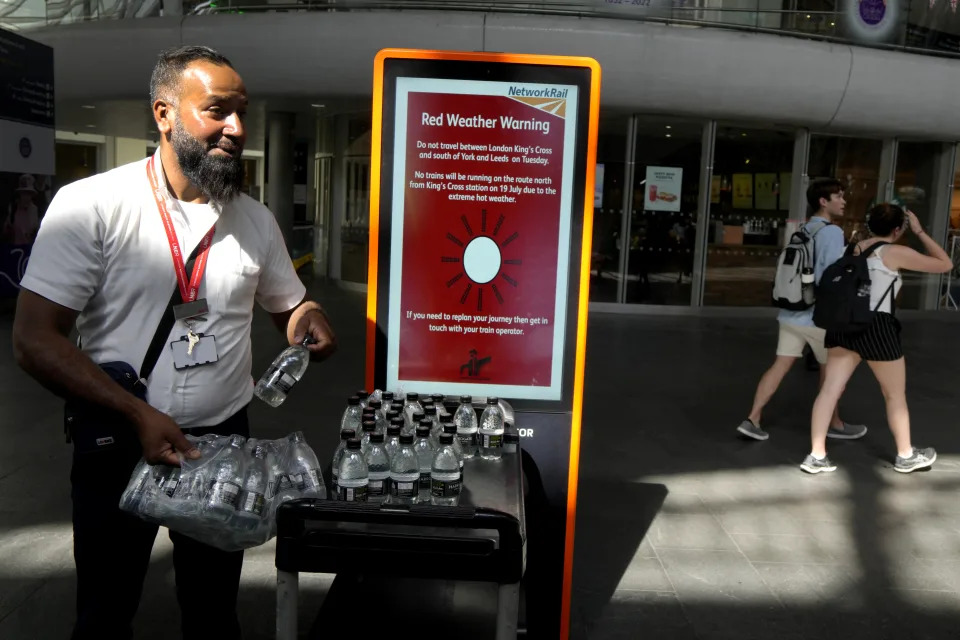
FILE - A railway worker hands out bottles of water to passengers at King's Cross railway station where there are train cancellations due to the heat in London, July 19, 2022, during a heat wave. The United Nations says weather disasters costing $200 million a day and irreversible climate catastrophe looming show the world is “heading in the wrong direction.” (AP Photo/Kirsty Wigglesworth, File)
A railway worker hands out bottles of water to passengers at King’s Cross railway station where there are train cancellations due to the heat in London, July 19, 2022, during a heat wave. The United Nations says weather disasters costing $200 million a day and irreversible climate catastrophe looming show the world is “heading in the wrong direction.” (AP Photo/Kirsty Wigglesworth, File)
FILE - A man wipes his forehead as he walks along the lower than normal bank of the Jialing River during a drought in southwestern China's Chongqing Municipality, Aug. 19, 2022. The United Nations says weather disasters costing $200 million a day and irreversible climate catastrophe looming show the world is “heading in the wrong direction.” (AP Photo/Mark Schiefelbein, File)
 A man wipes his forehead as he walks along the lower than normal bank of the Jialing River during a drought in southwestern China’s Chongqing Municipality, Aug. 19, 2022. The United Nations says weather disasters costing $200 million a day and irreversible climate catastrophe looming show the world is “heading in the wrong direction.” (AP Photo/Mark Schiefelbein, File)

GENEVA (AP) — With weather disasters costing $200 million a day and irreversible climate catastrophe looming, the world is “heading in the wrong direction,” the United Nations says in a new report that pulls together the latest science on climate change.

The World Meteorological Organization, in the latest stark warning about global warming, said weather-related disasters have increased fivefold over the last 50 years and are killing 115 per day on average – and the fallout is poised to worsen.

U.N. Secretary-General Antonio Guterres cited the floods in Pakistanheat waves in Europe, droughts in places such as China, the Horn of Africa, and the United States – and pointed the finger at fossil fuels.

“There is nothing natural about the new scale of these disasters. They are the price of humanity’s fossil fuel addiction,” he said. “This year’s United in Science report shows climate impacts heading into uncharted territories of destruction.”

“Yet each year we double-down on this fossil fuel addiction, even as the symptoms get rapidly worse,” he added.

The report, drawn from data compiled by several U.N. agencies and partners, cited a 48% chance that global temperature rise compared to pre-industrial times will reach 1.5 degree Celsius (2.7 Fahrenheit) in the next five years. There’s a 93% percent chance that one year in the next five will see record heat.

It comes amid fresh warnings from scientists last week that four climate “tipping points” will likely be triggered if that temperature threshold — set in the 2015 Paris climate accord — is passed.

Many governments are already trying to address the threat of more severe weather due to climate change, and data show that deaths from natural disasters are down in recent years. Yet the economic cost of climate-induced catastrophes is projected to rise sharply.

The U.N. report says such “losses and damages” can be limited by timely action to prevent further warming and adapt to the temperature increases that are now inevitable. Questions around compensation for the damage that poor nations suffer as a result of emissions produced by rich countries will play a major role at the upcoming U.N. climate talks in Egypt this fall.

Follow AP’s climate and environment coverage at https://apnews.com/hub/climate-and-environment

Associated Press climate and environmental coverage receives support from several private foundations. See more about AP’s climate initiative here. The AP is solely responsible for all content.

Inflation: Consumer prices rise 8.3% over last year in August, tanking stocks and clinching rate hikes

Yahoo! Finance

Inflation: Consumer prices rise 8.3% over last year in August, tanking stocks and clinching rate hikes

Alexandra Semenova, Reporter – September 13, 2022

Inflation rose more than expected in August even as prices moderated from four-decade highs reached earlier this year.

The Consumer Price Index (CPI) in August reflected an 8.3% increase over last year and a 0.1% increase over the prior month, the Bureau of Labor Statistics reported Tuesday. Economists had expected prices to rise 8.1% over last year and fall 0.1% over last month, according to estimates from Bloomberg.

On a “core” basis, which strips out the volatile food and energy components of the report, prices rose 6.3% over last year and 0.6% over the prior month in August.

Expectations were for a 6.1% annual increase and 0.3% monthly increase in core CPI.https://flo.uri.sh/visualisation/6180194/embed?auto=1

The unexpected rise in Tuesday’s headline figure came despite a 5% drop in energy prices over the month, driven by 10.6% plunge in the gasoline index.

Inflationary pressures remained strong across other components of the report, with declining gas and energy prices offset by increases in the costs of shelter, food, and medical care — the largest of many contributors to the broad-based monthly increase, per the Bureau of Labor Statistics.

August’s CPI report sent stocks tumbling. Shortly after the release, Nasdaq futures were down as much as 1.8%, S&P 500 futures sank 1.2%, and Dow futures fell 0.9%

The reading also likely affirms that Federal Reserve officials will raise interest rates by 75 basis points at their policy-setting meeting Sept. 20-21.

“Today’s inflation data cements a third consecutive 0.75% increase in the Fed funds rate next week,” Principal Global Investors Chief Global Strategist Seema Shah said in a note.

WASHINGTON, DC - MAY 23: (L-R) Vice Chair of the Federal Reserve Lael Brainard shakes hands with Jerome Powell after he took the oath of office for his second term as Chair of the Board of Governors of the Federal Reserve System at the William McChesney Martin Jr. Building of the Federal Reserve May 23, 2022 in Washington, DC.  Powell has served as Federal Reserve Board of Governors Chair since February of 2018. (Photo by Drew Angerer/Getty Images)
WASHINGTON, DC – MAY 23: (L-R) Vice Chair of the Federal Reserve Lael Brainard shakes hands with Jerome Powell after he took the oath of office for his second term as Chair of the Board of Governors of the Federal Reserve System at the William McChesney Martin Jr. Building of the Federal Reserve May 23, 2022 in Washington, DC. Powell has served as Federal Reserve Board of Governors Chair since February of 2018. (Photo by Drew Angerer/Getty Images)

“Headline inflation has peaked but, in a clear sign that the need to continue hiking rates is undiminished, core CPI is once again on the rise, confirming the very sticky nature of the US inflation problem,” Shah added, pointing out that 70% of the CPI basket logged an annual price rise of more than 4% month-on-month. “Until the Fed can tame that beast, there is simply no room for a discussion on pivots or pauses,” Shah said.

The higher-than-expected inflation print also comes after a round of more aggressive talk from central bank officials, notably Vice Chair Lael Brainard, who said last week: “While the moderation in monthly inflation is welcome, it will be necessary to see several months of low monthly inflation readings to be confident that inflation is moving back down to 2 percent.”

“Monetary policy will need to be restrictive for some time to provide confidence that inflation is moving down to target,” Brainard added, “We are in this for as long as it takes to get inflation down.

A person arranges groceries in El Progreso Market in the Mount Pleasant neighborhood of Washington, D.C., U.S., August 19, 2022. REUTERS/Sarah Silbiger

Among individual components of the report, the food index increased 0.8% in August, the smallest monthly increase since December 2021. Meanwhile, the food at home index rose 0.7% during the month, with all six major grocery store food group indexes rising.

Housing prices continued their climb, with the cost of shelter recording its largest increase month-on-month increase — 0.7% — since January 1991. Over the last year, the shelter index jumped 6.2%, accounting for roughly 40% of the broader index increase in all items excluding food and energy.

The cost of medical care notably rose 0.7% in August after a 0.4% increase in July, with major medical care component indexes climbing across the board.

(This post is breaking. More to come.)

Stressed Colorado River keeps California desert farms alive

Associated Press

Stressed Colorado River keeps California desert farms alive

Kathleen Ronaynet – September 13, 2022

  • Farmer Larry Cox walks in a field of Bermudagrass with his dog, Brodie, at his farm Monday, Aug. 15, 2022, near Brawley, Calif. The Cox family has been farming in California's Imperial Valley for generations. (AP Photo/Gregory Bull)Farmer Larry Cox walks in a field of Bermudagrass with his dog, Brodie, at his farm Monday, Aug. 15, 2022, near Brawley, Calif. The Cox family has been farming in California’s Imperial Valley for generations. (AP Photo/Gregory Bull)
  • Water flows along the All-American Canal Saturday, Aug. 13, 2022, near Winterhaven, Calif. The canal conveys water from the Colorado River into the Imperial Valley. (AP Photo/Gregory Bull)Water flows along the All-American Canal Saturday, Aug. 13, 2022, near Winterhaven, Calif. The canal conveys water from the Colorado River into the Imperial Valley. (AP Photo/Gregory Bull)
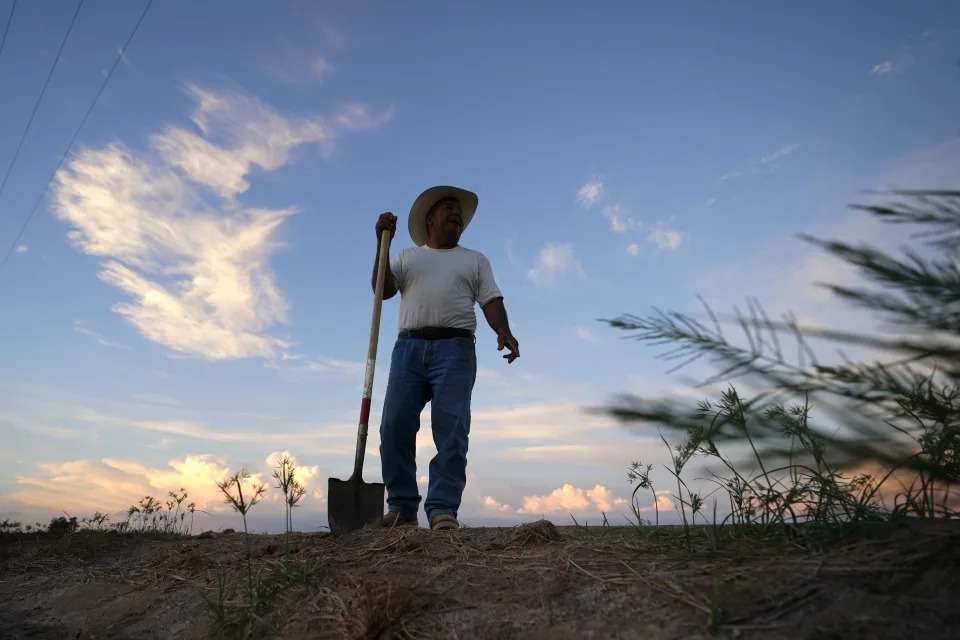
  • Irrigator Raul Quirarte, 56, pauses during work to prepare a field to receive water from the All-American Canal, Sunday, Aug. 14, 2022, near Brawley, Calif. Quirarte started as an irrigator at the age of 18, taught by his father, who also was an irrigator. (AP Photo/Gregory Bull)Irrigator Raul Quirarte, 56, pauses during work to prepare a field to receive water from the All-American Canal, Sunday, Aug. 14, 2022, near Brawley, Calif. Quirarte started as an irrigator at the age of 18, taught by his father, who also was an irrigator. (AP Photo/Gregory Bull)
  • Water flows along the All-American Canal Saturday, Aug. 13, 2022, near Winterhaven, Calif. The canal conveys water from the Colorado River into the Imperial Valley. (AP Photo/Gregory Bull)Water flows along the All-American Canal Saturday, Aug. 13, 2022, near Winterhaven, Calif. The canal conveys water from the Colorado River into the Imperial Valley. (AP Photo/Gregory Bull)
  • Farmer Larry Cox watches a tractor at work on a field at his farm Monday, Aug. 15, 2022, near Brawley, Calif. The Cox family has been farming in California's Imperial Valley for generations. (AP Photo/Gregory Bull)Farmer Larry Cox watches a tractor at work on a field at his farm Monday, Aug. 15, 2022, near Brawley, Calif. The Cox family has been farming in California’s Imperial Valley for generations. (AP Photo/Gregory Bull)
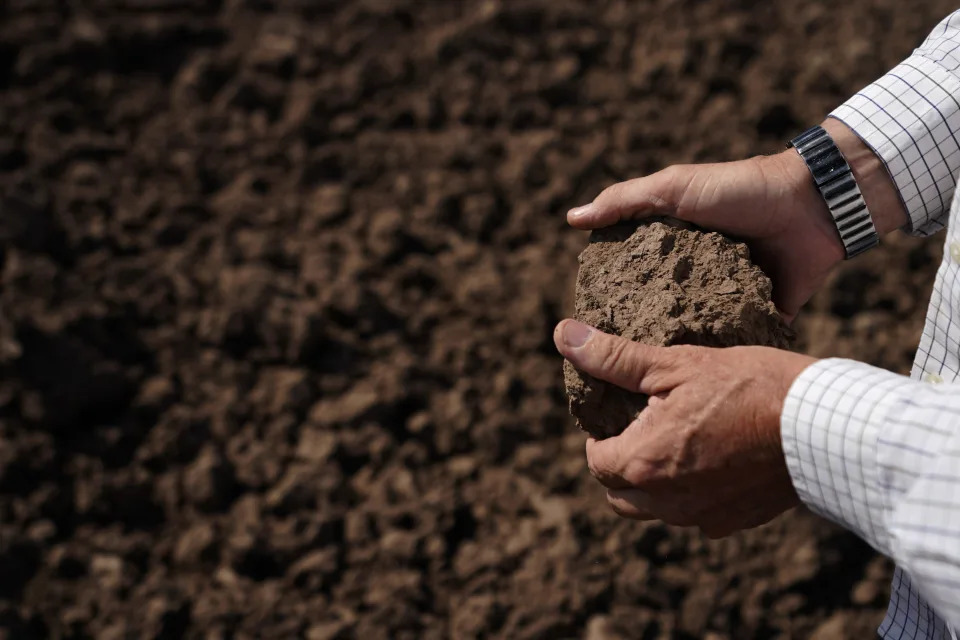
  • Farmer Larry Cox looks at soil on a field at his farm Monday, Aug. 15, 2022, near Brawley, Calif. The Cox family has been farming in California's Imperial Valley for generations. (AP Photo/Gregory Bull)Farmer Larry Cox looks at soil on a field at his farm Monday, Aug. 15, 2022, near Brawley, Calif. The Cox family has been farming in California’s Imperial Valley for generations. (AP Photo/Gregory Bull)
  • Farmer Larry Cox walks stands in a field of Bermudagrass at his farm Monday, Aug. 15, 2022, near Brawley, Calif. The Cox family has been farming in California's Imperial Valley for generations. (AP Photo/Gregory Bull)Farmer Larry Cox walks stands in a field of Bermudagrass at his farm Monday, Aug. 15, 2022, near Brawley, Calif. The Cox family has been farming in California’s Imperial Valley for generations. (AP Photo/Gregory Bull)
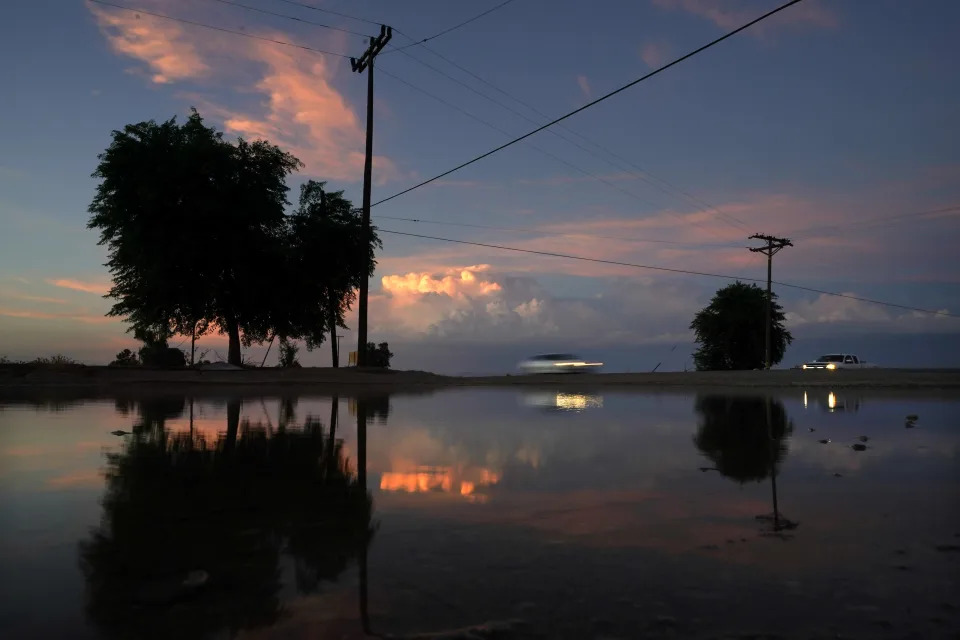
  • A small pond sits between a field irrigated with water from the All-American Canal and a highway, Sunday, Aug. 14, 2022, near Brawley, Calif. The canal conveys water from the Colorado River into the Imperial Valley. (AP Photo/Gregory Bull)Colorado River Compact California. A small pond sits between a field irrigated with water from the All-American Canal and a highway, Sunday, Aug. 14, 2022, near Brawley, Calif. The canal conveys water from the Colorado River into the Imperial Valley. (AP Photo/Gregory Bull)
  • Farmer Larry Cox walks to his truck as his dog, Brodie, soaks in a water canal at his farm Monday, Aug. 15, 2022, near Brawley, Calif. The Cox family has been farming in California's Imperial Valley for generations. (AP Photo/Gregory Bull)Farmer Larry Cox walks to his truck as his dog, Brodie, soaks in a water canal at his farm Monday, Aug. 15, 2022, near Brawley, Calif. The Cox family has been farming in California’s Imperial Valley for generations. (AP Photo/Gregory Bull)
  • A worker diverts water as a sprinkler system is installed for alfalfa at the Cox family farm Monday, Aug. 15, 2022, near Brawley, Calif. The Cox family has been farming in California's Imperial Valley for generations. (AP Photo/Gregory Bull)A worker diverts water as a sprinkler system is installed for alfalfa at the Cox family farm Monday, Aug. 15, 2022, near Brawley, Calif. The Cox family has been farming in California’s Imperial Valley for generations. (AP Photo/Gregory Bull)
  • Water from the All-American Canal flows in a canal alongside fields Saturday, Aug. 13, 2022, near El Centro, Calif. The canal conveys water from the Colorado River into the Imperial Valley. (AP Photo/Gregory Bull)Water from the All-American Canal flows in a canal alongside fields Saturday, Aug. 13, 2022, near El Centro, Calif. The canal conveys water from the Colorado River into the Imperial Valley. (AP Photo/Gregory Bull)
SACRAMENTO, Calif. (AP) — When Don Cox was looking for a reliable place to build a family farm in the 1950s, he settled on California’s Imperial Valley.

The desert region had high priority water rights, meaning its access to water was hard for anyone to take away.

“He had it on his mind that water rights were very, very important,” said his grandson, Thomas Cox, who now farms in the Valley.

He was right. Today the Imperial Valley, which provides many of the nation’s winter vegetables and cattle feed, has one of the strongest grips on water from the Colorado River, a critical but over-tapped supply for farms and cities across the West. In times of shortage, Arizona and Nevada must cut first.

But even California, the nation’s most populous state with 39 million people, may be forced to give something up in the coming years as hotter and drier weather causes the river’s main reservoirs to fall to dangerously low levels. If the river were to become unusable, Southern California would lose a third of its water supply and vast swaths of farmland in the state’s southeastern desert would go unplanted.

“Without it, the Imperial Valley shuts down,” said JB Hamby, a board member for the Imperial Irrigation District, which holds rights to the largest share of Colorado River water.

EDITOR’S NOTE: This is part of a collaborative series on the Colorado River as the 100th anniversary of the historic Colorado River Compact approaches. The Associated Press, The Colorado Sun, The Albuquerque Journal, The Salt Lake Tribune, The Arizona Daily Star and The Nevada Independent are working together to explore the pressures on the river in 2022.

A century ago, California and six other states — Arizona, Colorado, Nevada, New Mexico, Utah and Wyoming — created a compact that split the water into two basins and set rules for how much water each would get. A series of deals, laws and court cases that followed led California to get the most water and made it the last to lose in times of shortage.

Fear and frustration over California’s use of the river has driven the compact since its early days. In western water law, the first person who taps the source gets the highest right, and California cities and farmers have relied on the river for more than a century.

Other western states worried California would lay claim to all the river’s water before their own populations grew. The compact and the series of deals that followed attempted to find a balance to protect California’s supply while ensuring other states got some too. California, meanwhile, benefitted when the federal government began building the Hoover Dam to help control the river’s flow.

Today, the states are now gearing up for a 2026 deadline to renegotiate some of the terms to better deal with drought and protect two major reservoirs, Lake Powell and Lake Mead. But before that, the U.S. Bureau of Reclamation has demanded the states find a way to cut their use by roughly 15% to 30% to stave off a crisis. The states failed to meet a mid-August deadline to reach a deal, but negotiations are continuing and no new date for an agreement has been set.

All eyes are on California and its major water rights holders — namely the Imperial Irrigation District and Metropolitan Water District of Southern California — to see if they will give up some of their share. Both districts say they’re willing to use less water or pay others to do so — especially if cooperating means they can avoid challenges to their senior rights.

But they’re playing coy about what exactly they’re willing to give.

The river is the only water supply for the Imperial Irrigation District, whose farmers grow broccoli, onions, carrots and other winter vegetables as well as alfalfa and other feedstock. The limited water underneath the ground in the region, near California’s border with Arizona and Mexico, is not usable, and it does not have access to state water supplies.

The irrigation district was historically entitled to more water than either Arizona or Nevada, though it’s given some up over the years in exchange for payment from cities like San Diego and Los Angeles. In 2019, its board rejected a drought contingency plan signed by other water users in Arizona, Nevada and California.

This time around, officials say the district would be open to leaving fields unplanted to save water on a temporary, emergency basis. But neither Hamby nor board spokespeople would say how much.

State officials are looking to the $4 billion approved by Congress for the Colorado River as a possible source of money that could be used to pay the district and, in turn, farmers, to use less water.

The farmers aren’t privy to all of the district’s negotiating tactics, but are trying to organize among themselves to avoid having cuts foisted on them, Cox said. Many farmers have already installed drip irrigation lines that use less water, but they would be willing to adopt more conservation tactics if they’d be paid to do so.

Already, Cox said he’s making decisions about whether to plant on all of his vegetable fields this fall because he’s getting less water than normal under a new system adopted by the board.

“With water uncertainty, there’s going to be more uncertainty on food supply,” he said.

And it’s not just farmers who rely on the Imperial Irrigation District’s water. Runoff from the farms feeds the Salton Sea, a massive inland lake created in the early 1900s when the Colorado River flooded. It’s now rapidly drying up, exposing surrounding communities to toxic dust and killing the habitat that birds and fish rely on. The state and federal government are now looking for other ways to support the sea in the absence of river water, and its being eyed as a possible site for lithium extraction.

“We’re talking about a body of water surrounded by communities who have been marginalized for so (long), that don’t have the infrastructure or capacity to protect themselves from climate change, from less availability of water, from more dust,” said Silvia Paz, executive director for Alianza Coachella Valley, an organization fighting to improve the economy and health outcomes in the region.

Behind the irrigation district, the Metropolitan Water District is the state’s second largest user of the river’s water. The Colorado makes up about one-third of the water supply the district uses to provide water for drinking, bathing, landscaping and recreating to roughly half the state’s population. Los Angeles County, the nation’s largest, is one of the many areas in Southern California that relies on the river’s water.

It’s allowed to store some of the water it doesn’t use in Lake Mead, which California officials say has actually helped stave off a river crisis in recent years. But this year, short on other supplies, the district may actually try to pull some of that water out if needed, a move that would likely cause friction with other states in the basin.

The district also gets water from the Sacramento-San Joaquin River Delta, the state’s main source of water supplies. But the Delta is suffering from drought, too, and the state only approved 5% of requested supplies this year. As it looks to stabilize its water supply for the future, the district is spending billions on a water recycling plant and urging people to use less water for their lawns.

Still, ensuring the Colorado River is available in dry years when other supplies aren’t available is the district’s priority, said Bill Hasencamp, the district’s Colorado River manager.

Farm-heavy water districts in the Coachella Valley and Riverside County also get Colorado River water, which they use for crops like citrus, melons and barley. The Fort Mojave Indian Reservation and Colorado River Indian Reservation are among the tribes in California with river rights.

Looking to the future, both climate change and politics are at play as California’s water users debate what it will take to keep the river alive.

“What they really want is reliability and predictability,” said Michael Cohen, a Colorado River expert with the Pacific Institute. “What they don’t want is Arizona screaming that Phoenix and Tucson are dried up and California doesn’t take a drop of reductions.”

The Associated Press receives support from the Walton Family Foundation for coverage of water and environmental policy. The AP is solely responsible for all content. For all of AP’s environmental coverage, visit https://apnews.com/hub/climate-and-environment

GM’s self-driving car arm will take driverless cars to Texas and Arizona this year

Detroit Free Press

GM’s self-driving car arm will take driverless cars to Texas and Arizona this year

Jamie L. LaReau, Detroit Free Press – September 13, 2022

General Motors’ self-driving car subsidiary Cruise is expanding beyond San Francisco as it drives toward a goal of $1 billion in revenue by 2025.

In June, Cruise started operating its self-driving taxi service in San Francisco where it charges for rides in Chevrolet Bolt EVs that operate without a human safety driver. Cruise uses a fleet of 30 Bolts to ferry the paying passengers around parts of the city. Those Bolts are currently built at Orion Assembly plant in Orion Township.

General Motors and Cruise got approval on June 2, 2022 to start operating self-driving ride hail taxis like this one in San Francisco for a fare.

Now the San Francisco-based Cruise, of which GM owns an 80% stake, will bring a driverless taxi-fleet to Austin, Texas, and Phoenix, Arizona, in the next three months, Cruise CEO Kyle Vogt said Monday.

Initially, Cruise’s operations in Austin and Phoenix will be small to generate revenue, with a plan to scale up operations next year, Vogt told an audience at a Goldman Sachs conference Monday, where he also said Cruise aims to hit $1 billion in revenue by 2025, said Cruise spokeswoman Tiffany Testo.

Cruise has obtained the appropriate permits to use the driverless cars for ride-hailing and deliveries in Phoenix where it has been operating a self-driving delivery service with Walmart for some time, Testo said. Cruise started the pilot for that delivery service in 2020 and expanded it last year. In April, Walmart announced it had become an investor in Cruise.

“We’ve made over 10,000 deliveries there in the past few months,” Testo said. “We’re starting from zero footprint but believe the strong technical foundation we built in San Francisco will enable us to quickly and safely scale.”

Cruise was the first commercial driverless taxi system in a major U.S. city. But Waymo opened a fully autonomous commercial ride hail service to the public in October 2020 in suburban Chandler, Arizona.

On Thursday, GM subsidiary BrightDrop said it too plans to offer self-driving electric commercial delivery vehicles in the future. During a webcast presentation at the Evercore ISI 2nd Annual Technology Conference, BrightDrop CEO Travis Katz said the company is “actively” looking at how to apply autonomous driving technology to its commercial trucks. He said GM’s connection to Cruise will give BrightDrop a competitive advantage when the times comes to apply autonomous technology to the commercial delivery market.

More: GM’s joint venture considers location near Michigan border for 4th battery plant

More: GM reveals all-electric Blazer police pursuit vehicle designed with help from officers

California’s drought touches everyone, but water restrictions play out unevenly across communities

Los Angeles Times

California’s drought touches everyone, but water restrictions play out unevenly across communities

Soudi Jiménez – September 13, 2022

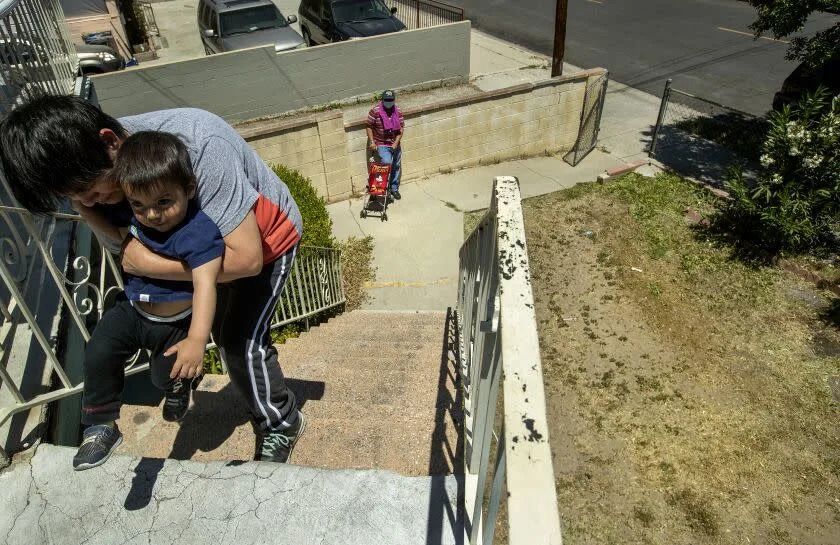
LINCOLN HEIGHTS, CA-MAY 11, 2022: Benita Perez, 55, teaches her grandson Nevaeh Perez, 1 and 1/2, how to walk at their apartment building on Thomas St. in Lincoln Heights. Area at right, below used to be all grass until a year ago, due to the drought. It's going to be a summer of brown grass and hard choices for Southern California lawn owners facing the Metropolitan Water District's one day a week watering restrictions starting June. 1. (Mel Melcon / Los Angeles Times)
Benita Perez teaches her grandson, Nevaeh Perez, 1, how to walk at their apartment building in Lincoln Heights. Area at right, below used to be all grass until a year ago, because of the drought. (Mel Melcon/Los Angeles Times)

Raúl Monterroso of San Fernando knows that he can do little to help the struggling garden patio in front of his house. After all, he takes the new water restrictions seriously.

“Here, everything is dry, we have the entire irrigation system closed, my poor wife is crying over her plants,” said the Guatemala native, who stopped watering the grass on June 1 when instructions to cut outdoor watering to once a week were issued.

Further restrictions went into effect Sept. 6, when a 15-day ban through Sept. 20 was mandated by an emergency repair that shut down the 36-mile Upper Feeder pipeline that brings water from the Colorado River to Southern California. The Metropolitan Water District of Southern California said that more than 4 million people are being affected by the shutdown across the region, including Beverly Hills and Malibu, Burbank and Glendale, Long Beach, the city of Inglewood and a large swathe of the South Bay, and other areas stretching as far east as Pomona.

Also under the ban is the city of San Fernando, at the northern edge of L.A.’s San Fernando Valley, 92% of whose 24,000 residents are Latino.

“The reality is that when they give you the alert, you have to be aware. The measures must be followed, there is no other option,” Monterroso said.

In Long Beach, an hour’s drive south of San Fernando, businesswoman Sandy Cajas said that urgent measures are needed to maintain a steady flow of water and find new sources of it.

“We are experiencing the worst drought in decades,” she said. “What is going to happen here is that we are going to have to recycle the water due to the scarcity that exists.”

That’s one item, among many, on the state capital’s agenda. Last month, a 16-page document released by Gov. Gavin Newsom, “California’s Water Supply Strategy — Adapting to a Hotter, Drier Future,” indicated that California’s water supply will shrink 10% by 2040.

Among other measures, the plan, backed by billions of dollars in investment, calls for recycling more wastewater and desalinating seawater and salty groundwater, as well as speeding up infrastructure development and pushing conservation, in hopes of providing enough water for more than 8.4 million homes by 2040.

According to Newsom, this “aggressive plan” will guarantee that future generations “continue to call California home in this hotter, drier climate.”

“The best science tells us that we need to act now to adapt to California’s water future. Climate change means drought won’t just stick around for two years at a time like it historically has — extreme weather is the new normal here in the American West and California will adapt to this new reality,” Newsom said in an Aug. 11 statement.

Yet the drought is playing out unevenly across different communities and among different households. Since June 1, about 6 million residents in Los Angeles, Ventura and San Bernardino counties have had to limit outdoor water use to once a week. But not everyone is complying.

Every day since 2003, Álex Guzmán has driven a truck for work from the San Fernando Valley to Beverly Hills. The Mexican immigrant labors for a landscaping company. His task is to maintain the trees and lawns of the mansions. But, above all, to water lots and lots of plants.

Hearing that additional restrictions on water use have been implemented, Guzmán just smiles.

“We have never stopped working in Beverly Hills, we have never stopped watering mansion gardens because of the restrictions,” he said.

“We are working normally, the bosses have not told us anything about lowering the use of water,” Guzmán added.

As reported by The Times, celebrities such as Sylvester Stallone, Dwyane Wade, Kevin Hart, Kim and Kourtney Kardashian are among the more than 2,000 customers who have received “notices of exceedance” for surpassing 150% of their monthly water budgets at least four times since the Las Virgenes Municipal Water District declared a drought emergency in late 2021.

That disparity in following restrictions shows up in many public spaces, said Patty López, a former Assemblywoman for District 39, pointing for example to the contrast between the independent city of San Fernando and Sylmar, which is part of the city of Los Angeles.

“If you look at the Veterans Memorial Community Regional Park in Sylmar it is completely green, but in the parks in our area the grass is dead,” said López, a San Fernando resident, lamenting that there is no clear, consistent application of policies, or rigorous follow-up and enforcement, throughout the region.

Under current conditions, if the use of water is not controlled, worse consequences won’t be long in coming.

Samuel Sandoval Solís, professor of water resources management at UC Davis, said that California has 30% of its water stored in dams, meaning that, because of the drought’s effects, 70% of its capacity is gone. Water level in the subsoil has dropped 25 feet since 2016.

“Everything is looking very bad,” said the academic, who has been researching, monitoring and teaching on the subject of water for 20 years.

According to a UC Berkeley study, as temperatures in California rose between 1960 and 1980, rainfall also diminished, based on climatological records and analyzing the cores of trees.

Given the current scarcities of water, and recent extreme heatwaves across the Golden State, even downpours in the upcoming rainy season wouldn’t be enough to compensate, Sandoval Solís said.

“It’s not enough to make it to the next year,” he said.

Sandoval Solís said that if Californians don’t do more to conserve water, the authorities will have to implement restrictions such as those imposed on some municipalities during a previous drought phase between 2014 and 2016. Those restrictions limited the amount of gallons per person to between 12 and 15 daily.

According to the California Dept. of Water Resources, the “current statewide median indoor residential water use is 48 gallons per capita per day, and that a quarter of California households already use less than 42 gallons per capita per day.” The U.S. Environmental Protection Agency website states that each American uses an average of 82 gallons per day at home, including consumption.

“We need to raise awareness that we must all enter this equally,” Sandoval Solís said, “regardless of whether you live in a luxury house or in an apartment, we all have to reduce water consumption.”