50-car train derailment causes big fire, evacuations in Ohio
February 4, 2023
In this photo provided by Melissa Smith, a train fire is seen from her farm in East Palestine, Ohio, Friday, Feb. 3, 2023. A train derailment and resulting large fire prompted an evacuation order in the Ohio village near the Pennsylvania state line on Friday night, covering the area in billows of smoke lit orange by the flames below. (Melissa Smith via AP)This photo taken with a drone shows portions of a Norfolk and Southern freight train that derailed Friday night in East Palestine, Ohio are still on fire at mid-day Saturday, Feb. 4, 2023. (AP Photo/Gene J. Puskar)In this photo provided by Melissa Smith, a train fire is seen from her farm in East Palestine, Ohio, Friday, Feb. 3, 2023. A train derailment and resulting large fire prompted an evacuation order in the Ohio village near the Pennsylvania state line on Friday night, covering the area in billows of smoke lit orange by the flames below. (Melissa Smith via AP) ASSOCIATED PRESS
EAST PALESTINE, Ohio (AP) — A freight train derailment in Ohio near the Pennsylvania state line left a mangled and charred mass of boxcars and flames Saturday as authorities launched a federal investigation and monitored air quality from the various hazardous chemicals in the train.
About 50 cars derailed in East Palestine at about 9 p.m. EST Friday as a train was carrying a variety of products from Madison, Illinois, to Conway, Pennsylvania, rail operator Norfolk Southern said Saturday. There was no immediate information about what caused the derailment. No injuries or damage to structures were reported.
“The post-derailment fire spanned about the length of the derailed train cars,” Michael Graham, a member of the National Transportation Safety Board, told reporters Saturday evening. “The fire has since reduced in intensity, but remains active and the two main tracks are still blocked.”
Norfolk Southern said 20 of the more than 100 cars were classified as carrying hazardous materials — defined as cargo that could pose any kind of danger “including flammables, combustibles, or environmental risks.” Graham said 14 cars carrying vinyl chloride were involved in the derailment “and have been exposed to fire,” and at least one “is intermittently releasing the contents of the car through a pressure release device as designed.”
“At this time we are working to verify which hazardous materials cars, if any, have been breached,” he said. The Environmental Protection Agency and Norfolk Southern were continuing to monitor air quality, and investigators would begin their on-scene work “once the scene is safe and secure,” he said.
Vinyl chloride, used to make the polyvinyl chloride hard plastic resin used in a variety of plastic products, is associated with increased risk of liver cancer and other cancers, according to the federal government’s National Cancer Institute. Federal officials said they were also concerned about other possibly hazardous materials.
Mayor Trent Conaway, who earlier declared a state of emergency citing the “train derailment with hazardous materials,” said air quality monitors throughout a one-mile zone ordered evacuated had shown no dangerous readings.
Fire Chief Keith Drabick said officials were most concerned about the vinyl chloride and referenced one car containing that chemical but said safety features on that car were still functioning. Emergency crews would keep their distance until Norfolk Southern officials told them it was safe to approach, Drabick said.
“When they say it’s time to go in and put the fire out, my guys will go in and put the fire out,” he said. He said there were also other chemicals in the cars and officials would seek a list from Norfolk Southern and federal authorities.
Graham said the safety board’s team would concentrate on gathering “perishable” information about the derailment of the train, which had 141 load cars, nine empty cars and three locomotives. State police had aerial footage and the locomotives had forward-facing image recorders as well as data recorders that could provide such information as train speed, throttle position and brake applications, he said. Train crew and other witnesses would also be interviewed, Graham said.
Firefighters were pulled from the immediate area and unmanned streams were used to protect some areas including businesses that might also have contained materials of concern, officials said. Freezing temperatures in the single digits complicated the response as trucks pumping water froze, Conaway said.
East Palestine officials said 68 agencies from three states and a number of counties responded to the derailment, which happened about 51 miles (82 kilometers) northwest of Pittsburgh and within 20 miles (32 kilometers) of the tip of West Virginia’s Northern Panhandle.
Conaway said surveillance from the air showed “an entanglement of cars” with fires still burning and heavy smoke continuing to billow from the scene as officials tried to determine what was in each car from the labels outside. The evacuation order and shelter-in-place warnings would remain in effect until further notice, officials said.
Village officials warned residents that they might hear explosions due to the fire. They said drinking water was safe despite discoloration due to the volume being pumped the fight the blaze. Some runoff had been detected in streams but rail officials were working to stem that and prevent it from going downstream, officials said.
Officials repeatedly urged people not to come to the scene, saying they were endangering not only themselves but emergency responders.
The evacuation area covered 1,500 to 2,000 of the town’s 4,800 to 4,900 residents, but it was unknown how many were actually affected, Conaway said. A high school and community center were opened, and the few dozen residents sheltering at the high school included Ann McAnlis, who said a neighbor had texted her about the crash.
“She took a picture of the glow in the sky from the front porch,” McAnlis told WFMJ-TV. “That’s when I knew how substantial this was.”
Norfolk Southern opened an assistance center in the village to take information from affected residents and also said it was “supporting the efforts of the American Red Cross and their temporary community shelters through a $25,000 donation.
Elizabeth Parker Sherry said her 19-year-old son was heading to Walmart to pick up a new TV in time for the Super Bowl when he called her outside to see the flames and black smoke billowing toward their home. She said she messaged her mother to get out of her home next to the tracks, but all three of them and her daughter then had to leave her own home as crews went door-to-door to tell people to leave the evacuation zone.
Jan. 6 panel witness Cassidy Hutchinson said Trump assaulted Secret Service agent
Antonio Fins, Palm Beach Post – February 4, 2023
A witness has testified that a furious President Donald Trump assaulted the head of his Secret Service detail in the presidential vehicle after being told he could not go to the U.S. Capitol amid a mushrooming riot on Jan. 6, 2021.
Cassidy Hutchinson, an aide to then-White House Chief of Staff Mark Meadows, related the account on Tuesday during her appearance before the U.S. House committee investigating the attack on the Capitol.
She said a top White House official, Tony Ornato, who served as White House deputy chief of staff, told her that story in the presence of the Secret Service agent, Robert Engel, with whom Trump had the altercation.
After Engel told Trump he could not go the Capitol due to security concerns, the then-president in a fit of anger was said to have reached for the steering wheel. When told to let it go, Trump then lunged at Engel, Hutchinson said Ornato told her.
Neither Ornato nor Engel ever told her the story was wrong, Hutchinson said during questioning.
That conversation, Hutchinson testified, took place moments after the president, his Secret Service detail and a group of aides, including Hutchinson, returned to the White House after Trump’s Jan. 6 rally speech.
Hutchinson also testified that Trump was irate before his speech because metal detectors were keeping armed rallygoers from entering the area closest to where he and others were speaking. Police reports, presented during the hearing, stated some attendees were carrying weapons, including AR-15s and “Glock-style pistols.”
But Hutchinson said Trump dismissed the obvious threat saying they were “not there to hurt me” and demanded that the metal detectors be taken away.
President Donald Trump passes supporters while traveling in his motorcade in West Palm Beach, Fla., on Wednesday, January 27, 2021 on his way to Mar-a-Lago in Palm Beach.
Hutchinson also said she received a call from GOP Minority Leader Kevin McCarthy who was angry that Trump had stated during his speech that he would march with rallygoers to the Capitol.
Another White House aide, lawyer Pat Cipollone, also warned that Trump’s plans to go to the Capitol would raise serious legal exposure and liability. And upon hearing of “hang Mike Pence chants” among Capitol rioters, Trump said: “Mike deserves it.”
Hutchinson also testified that she had helped a White House valet wipe ketchup stains after Trump threw a dish at a wall in anger. That followed Trump’s hearing that Attorney General William Barr had told the Associated Press on Dec. 1, 2020, that there was no evidence of massive electoral fraud.
Hutchinson offered the in-person testimony before the Select Committee investigating the Jan. 6, 2021, violence on Capitol Hill as well as allegations that Trump abused his powers to remain in office despite losing the November 2020 election.
In a statement on Truth Social, Trump said he “hardly” knew Hutchinson, but then described her as “a total phony and ‘leaker.’ ” He also said he personally “turned her request down” when Hutchinson asked to join his team in Florida. “She is bad news,” he wrote.
He then posted 11 more missives on the platform denying he was dismissive of the threat against Pence and saying her “made up” statements were evidence of “a social climber.”
And Trump also denied he “complained” about the crowd for his Jan. 6 rally speech, or that he wanted to “make room for people with guns to watch my speech.”
An image of a photo shown during the sixth hearing of the U.S. House committee investigating the Jan. 6 attack on the Capitol.
Antonio Fins is a politics and business editor at the Palm Beach Daily News, part of the USA TODAY Florida Network.
As suicide rate keeps rising in Wisconsin, concentration in rural areas raises alarm
Natalie Eilbert – February 2, 2023
If you or someone you know is dealing with suicidal thoughts, call the National Suicide Prevention Lifeline at 988 or text “Hopeline” to the National Crisis Text Line at 741-741.
Karen Endres knows that farming involves stress unlike other occupations.
Its main variables — weather, livestock, crops, sales — are largely beyond control. Physical demands and time commitment never ease. Family relationships, management practices and work-life balance all overlap. In how many jobs, after all, might three generations of a family work, live and plan for the future together?
And if that business isn’t going well, who do they talk to?
“We don’t have a community to connect with others about mental health and stressors,” said Endres, who operates a dairy farm with her husband, and works as the farmer wellness coordinator at Wisconsin Farm Center’s Farmer Wellness Program, part of the state Department of Agriculture, Trade and Consumer Protection. “It can lead us to very dangerous places.”
The most recent Suicide in Wisconsin report shows a 32% increase in suicides in Wisconsin from 2000 to 2020. Suicide is now the state’s 10th leading cause of death. Over the last three years combined, suicide rates were higher among rural residents than among urban residents. And overwhelmingly, the suicides were among men.
Some rural counties dwarf the state suicide rate.
According to the Wisconsin Violent Deaths Reporting System, Milwaukee County’s rate of suicide deaths was about 12 per every 100,000 people in 2018, the most recent year of comprehensive reporting. Nearly 300 miles north in Ashland County, the rate of suicide deaths was about 25 per every 100,000. Milwaukee County has a population of nearly 930,000. Ashland’s population: About 16,000.
“North of Green Bay, the population is very sparse and resources are very sparse. You have a high proportion of veterans living in those counties, higher proportions of firearm ownership in those counties, and so there’s just a number of factors that play into that,” said Sara Kohlbeck, an assistant professor in the Department of Psychiatry at the Medical College of Wisconsin.
Kohlbeck conducts research in suicide and suicide prevention across different communities in Wisconsin. In 14 years, Kohlbeck has analyzed the deaths of nearly 200 Wisconsin farmers who died by suicide.
One farmer ended his life the day after receiving a change of address card in the mail from his wife, who’d recently left him. Another died a week after being “disgusted” over not being able to cut his own toenails, a result of new physical limitations. Yet another had just finished a phone call with a loan company. Another had a disappointing crop, the latest in a string of bad years. Still, others had blood alcohol content many, many times the legal limit.
Over 70% of farmer suicides involved firearms.
Kohlbeck and her team divided the hardships faced by farmers into five categories: acute interpersonal loss (a wife leaving), rugged individualism (a man facing new limitations), financial stress (a phone call from a loan company), the pressure of providing (struggling with the crops) and the lethal combination of alcohol and firearms.
“They’re just in an untenable scenario of inescapable pain,” Kohlbeck said. “Physical health issues, substance abuse, not having access to care, not being able to put food on the table — a lot of what I see is basic needs-related issues … that lead them to wanting to escape the situation they’re in.”
Chris Frakes is the group director of the Southwestern Wisconsin Community Action Program, an anti-poverty agency. Every three years, it does a community needs assessment for the five counties it oversees. In 2017, Frakes had heard so many stories of farmers struggling to get by, she expected them to reach out for help. But few did.
The silence and the growing farm crisis led to the program getting creative about upstream prevention. In 2021, it received nearly $1 million from the Wisconsin Partnership Program at the University of Wisconsin School of Medicine and Public Health to target farmers’ mental health over a five-year period.
But Frakes is the first to admit that assessing the needs of farmers involves face-to-face interactions, ability to crack coded language and, above all things, development of trust. To do so requires people to understand the culture.
“We’re trying to really empower community members to not only recognize when somebody’s in a crisis, or when somebody’s struggling with thoughts of suicide but also to notice when somebody’s really stressed or struggling,” Frakes said.
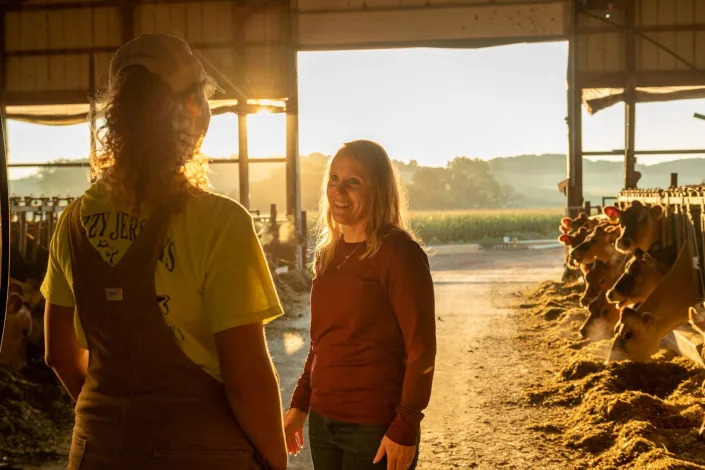
Karen Endres works as the farmer wellness coordinator at Wisconsin Farm Center’s Farmer Wellness Program, part of the Wisconsin Department of Agriculture, Trade and Consumer Protection. She frequently pays visits to fellow farmers to learn about their specific mental health needs.
Domino effects of self-blame in farmer culture
Brenda Statz, a cattle farmer in Loganville, lost her husband to suicide in 2018. Leon Statz had struggled with depression, and four months to the day after he made the decision to sell his dairy cows, he was rushed to the hospital following an overdose. It was his first suicide attempt.
But Statz found it hard to talk about his mental health. Instead, he talked about the torrential rainfall at the end of 2016 and throughout 2017 that left his hay perpetually damp. He talked about crops growing moldy, cows getting sick from mycotoxins in their feed, vet bills shooting through the roof, tractors running aground in the mud. He talked about corn left unharvested.
Something that will always stay with Brenda Statz is a conversation she had with a psychiatrist in Iowa who told her farmers are a specific breed of people who will “always find a way to blame themselves.” If milk price falls, they’ll berate themselves for not forward contracting. If the rainfall ruins the hay, they should have cut the hay earlier.
“They will always turn it around that it’s their fault that they did something wrong — whether this stuff is totally out of their control, they will still find a way to say they did something wrong, that they should have been paying attention,” Statz said. “That’s farming.”
Kohlbeck’s studies suggest that fewer than half of the people who die by suicide have a diagnosed mental health condition. In connection with self-blame and lost control, what has jumped out to her is a sense of having lost usefulness.
“When a farmer is stymied by physical health issues, an ability to care for the farm and for those relying on them is compromised—in fact, they may see themselves as ‘no good.’ Their identity as a strong, physically able hard worker may be shaken,” Kohlbeck wrote in a study published by The Journal of Rural Health.
Lethal combinations of firearms and substances
What makes Wisconsin’s farmer suicides stand out isn’t the number of deaths the state sees every year; those numbers are proportionate across Midwestern farmlands. It’s the fact that Wisconsin holds the troubling distinction of more binge drinkers than any other state in the United States, with 23.5% of its adult population drinking excessively, according to the Centers for Disease Control and Prevention.
“There’s a higher number of suicides here because we have three things: We’re readily accessible to guns, firearms, because people hunt; you can isolate out on your farm very easy and you don’t ever have to leave the farm; and another thing is, as a state, we’re known for drinking,” said Brenda Statz. “So, you mix those three things together and it could spell disaster for some.”
Brenda Statz, widow and the wife for 34 years to Leon Statz. Leon died by suicide after struggling to keep his farm solvent.
Kohlbeck noted that nearly 20% of the farmers who used a firearm in their suicides also had alcohol in their systems at the time of their death.
Statz knows all too well that farmers won’t go to doctors, even if they need to, partly because they’re “fixers, even when everything’s going wrong,” and partly because, she said, even if they’re on death’s door, “there’s always work to do on the farm,” she said.
“Many individuals use alcohol as a means for coping with the stress they encounter in their daily life,” Kohlbeck said. “And, unfortunately, alcohol alters your decision-making when you’re in a crisis.”
Self-medicating with alcohol and opioids, Endres said, is a big problem. Frakes, from Southwestern Wisconsin Community Action Program, said farmers keep what she calls a “rainy day” stock of opioids from previous injuries. At a time when opioids are reaching historic levels in the state, especially in rural areas, the combination leads to catastrophic outcomes for farmers, Frakes said.
In less than a decade, overdose deaths in Wisconsin have more than doubled, from 628 in 2014 to 1,427 in 2021, according to the state Department of Health Services. Hospitalizations for overdoses are rising as well, from 1,489 hospital visits in 2014 to 3,133 in 2021. It’s suspected that, in 2022, 8,622 ambulance runs within Wisconsin were the result of opioid overdose cases.
Largely rural counties — Menominee, Ashland, Forest, Douglas, Jackson and La Crosse counties — had suspected rates of opioid overdoses that far exceeded the state average, sometimes 100 times the state rate. Further, both deaths and misuse of opioids are higher in Wisconsin than the national average.
Finding a trustworthy doctor is a challenge
Since she lost her husband to suicide, Statz travels to churches across the state to promote mental health in farmers as part of her work with the Farmer Angel Network, a project out of the Wisconsin Farm Bureau Federation.
Part of the mindset for farmers is to work hard and work constantly. Farmers aren’t the type to ask for — or able to take even if they want it — time off and, instead, see it as a success when somebody works years without a break.
“Suicide doesn’t just impact that one person; it impacts the whole family,” says Brenda Statz, Sauk County Farm Bureau member who lost her husband Leon in 2018 following his third suicide attempt.
When she spoke as a representative of Farmer Angel Network with Reedsburg Area Medical Center, Statz explained to the staff there that farmers come to counseling because their spouses have “nagged them” or they’ve run out of other options.
That doesn’t mean they’re ready to talk, though.
“He’s going to come in your office and he’s going to talk about the weather, he’s going to talk about his dog, he’s going to talk about everything, except why he’s there,” Statz said. “You’re going need a little more time when a farmer comes in. They’re going to not be upfront right away, because they’re still checking you out to see how much they can trust you.”
Many farmers use small talk to gain trust, Frakes said. And they’re not prone to come out and say they’re struggling. Farmers can shoo terms like anxiety and depression away like flies, but when they start to talk about issues like crops failing, that’s the time to start paying attention, she said. Crop failure can mean livestock feed is short for the winter, which can interfere with farm operations.
“Instead of asking if a farmer is depressed, it’s better to ask them what’s keeping them up at night. Asking a slightly different set of questions to try and get at what’s really happening, plus small talk, is a way to build trust,” Frakes said.
The lack of access to counseling services — and an evergreen reluctance to seek care — means when a farmer does feel mental distress, it’s usually already an emergency. And for 21 Wisconsin counties, the closest option for residential crisis stabilization involves a trip across county lines.
Statz’s husband Leon attempted suicide three times in 2018. After Leon’s first attempt on April 21, it would be another six weeks before he could see a counselor. His second attempt happened in July.
He was dead by October.
Resources for farmers
Wisconsin Farm Center has a toll-free, 24/7 farmer wellness line for anyone experiencing depression or anxiety, or who just needs to talk, at (888) 901-2558.
The Farmer Wellness Program offers weekly support groups for farmers and farmer couples to share challenges and offer encouragement, comfort, and advice nine months out of the year (except between July and September). Zoom meetings take place either on the first Monday or the first Tuesday of every month at 8 p.m.
The Farmer Angel Network provides its members with access to mental health resources through educational programs, informational flyers and trained personnel. Summer months include all-expense paid ice cream socials, kid-friendly drive-in movies and more for over 50 farm families to enjoy a night off.
Farm Well Wisconsin partners with local experts to build on and connect existing community resources, gives community leaders the tools they need to support and intervene in crises, and improves knowledge of health providers serving rural populations.
Wisconsin Farmers Union is a member-driven organization committed to enhancing the quality of life for family farmers, rural communities and all people through educational opportunities, cooperative endeavors and civic engagement.
Valley fever could be spreading across the U.S. Here are the symptoms and what you need to know
L’Oreal Thompson Payton – January 31, 2023
Kateryna Kon—Science Photo Library/Getty Images
Valley fever, a fungal infection most notably found in the Southwestern United States, is now likely to spread east, throughout the Great Plains and even north to the Canadian border because of climate change, according to a study in GeoHealth.
“As the temperatures warm up, and the western half of the U.S. stays quite dry, our desert-like soils will kind of expand and these drier conditions could allow coccidioides to live in new places,” Morgan Gorris, who led the GeoHealth study while at the University of California, Irvine, told Today.com.
As the infection continues to be diagnosed outside the Southwest, here’s what you need to know about valley fever.
What is valley fever?
Valley fever, which commonly occurs in the Southwest due to the region’s hot, dry soil, is an infection caused by inhaling microscopic spores of the fungus coccidioides. About 20,000 cases of valley fever were reported in 2019, according to the Centers for Disease Control and Prevention, and 97% of cases were reported in Arizona and California. Rates are usually highest among people 60 years of age and older.
While most people who breathe in the spores don’t get sick, those who do typically feel better on their own within weeks or months; however, some will require antifungal medication.
What are the symptoms of valley fever?
Symptoms of valley fever may appear anywhere from one to three weeks after breathing in the fungal spores and typically last for a few weeks to a few months. About 5% to 10% of people who get valley fever will develop serious or long-term lung problems. Symptoms include:
Fatigue
Cough
Fever
Shortness of breath
Headache
Night sweats
Muscle aches or joint pain
Rash on upper body or legs
How is valley fever diagnosed?
Valley fever is most commonly diagnosed through a blood test; however, health care providers may also run imaging tests, such as chest X-rays or CT scans, to check for valley fever pneumonia.
Who is most likely to get valley fever?
People who are at higher risk for becoming severely ill, such as those with weakened immune systems, pregnant people, people with diabetes, and Black or Filipino people, are advised to avoid breathing in large amounts of dust if they live in or are traveling to places where valley fever is common.
Is valley fever contagious?
No. “The fungus that causes valley fever, coccidioides, can’t spread from the lungs between people or between people and animals,” according to the CDC. “However, in extremely rare instances, a wound infection with coccidioides can spread valley fever to someone else, or the infection can be spread through an organ transplant with an infected organ.”
How can I prevent valley fever?
While it’s nearly impossible to avoid breathing in the fungus coccidioides in places where it’s common, the CDC recommends avoiding spending time in dusty places as much as possible, especially for people who are at higher risk. You can also:
Wear a face mask, such as a N95 respirator
Stay inside during dust storms
Avoid outdoor activities, such as yard work and gardening, that require close contact with dirt or dust
Use air filtration systems while indoors
Clean skin injuries with soap and water
Take preventive antifungal medication as recommended by your doctor
Is there a cure or vaccine for valley fever?
Not yet. According to the CDC, scientists have been working on a vaccine to prevent valley fever since the 1960s. However, researchers at the University of Arizona College of Medicine in Tucson have created a two-dose vaccine that’s been proved effective in dogs.
“I’m really quite hopeful,” Dr. John Galgiani, director of the Valley Fever Center for Excellence at the University of Arizona College of Medicine, told Today. “In my view, right now, we do have a candidate that deserves to be evaluated and I think will probably be effective, and we’ll be using it.”
These jobs are most likely to be replaced by ChatGPT and AI
Megan Cerullo – February 1, 2023
Chatbots and artificial intelligence tools like ChatGPT that can almost instantly produce increasingly sophisticated written content are already being used to perform a variety of tasks, from writing high school assignments to generating legal documents and even authoring legislation.
As in every major cycle of technological innovation, some workers will be displaced, with artificial intelligence taking over their roles. At the same time, entirely new activities — and potential opportunities for employment — will emerge.
Read on to learn what experts say are the kinds of workplace tasks that are most vulnerable to being taken over by ChatGPT and other AI tools in the near term.
Computer programming
ChatGPT can write computer code to program applications and software. It can check human coders’ language for errors and convert ideas from plain English into programming language.
“In terms of jobs, I think it’s primarily an enhancer than full replacement of jobs,” Columbia Business School professor Oded Netzer told CBS MoneyWatch. “Coding and programming is a good example of that. It actually can write code quite well.”
That could mean performing basic programming work currently done by humans.
“If you are writing a code where really all you do is convert an idea to a code, the machine can do that. To the extent we would need fewer programmers, it could take away jobs. But it would also help those who program to find mistakes in codes and write code more efficiently,” Netzer said.
Basic email
Writing simple administrative or scheduling emails for things like setting up or canceling appointments could also easily be outsourced to a tool like ChatGPT, according to Netzer.
“There’s hardly any creativity involved, so why would we write the whole thing instead of saying to the machine, ‘I need to set a meeting on this date,'” he said.
Mid-level writing
David Autor, an MIT economist who specializes in labor, pointed to some mid-level white-collar jobs as functions that can be handled by AI, including work like writing human resources letters, producing advertising copy and drafting press releases.
“Bots will be much more in the realm of people who do a mixture of intuitive and mundane tasks like writing basic advertising copy, first drafts of legal documents. Those are expert skills, and there is no question that software will make them cheaper and therefore devalue human labor,” Autor said.
Media planning and buying
Creative industries are likely to be affected, too. Noted advertising executive Sir Martin Sorrell, founder of WPP, the world’s largest ad and PR group, said on a recent panel that he expects the way companies buy ad space will become automated “in a highly effective way” within five years.
“So you will not be dependent as a client on a 25-year old media planner or buyer, who has limited experience, but you’ll be able to pool the data. That’s the big change,” he said.
Legal functions
ChatGPT’s abilities translate well to the legal profession, according to AI experts as well as legal professionals. In fact, ChatGPT’s bot recently passed a law school exam and earned a passing grade after writing essays on topics ranging from constitutional law to taxation and torts.
“The dynamic that happens to lawyers now is there is way too much work to possibly get done, so they make an artificial distinction between what they will work on and what will be left to the wayside,” said Jason Boehmig, co-founder and CEO of Ironclad, a legal software company.
Common legal forms and documents including home lease agreements, wills and nondisclosure agreements are fairly standard and can be drafted by a an advanced bot.
“There are parts of a legal document that humans need to adapt to a particular situation, but 90% of the document is copy pasted,” Netzer of Columbia Business School said. “There is no reason why we would not have the machine write these kinds of legal documents. You may need to explain first in English the parameters, then the machine should be able to write it very well. The less creative you need to be, the more it should be replaced.”
“There aren’t enough lawyers to do all the legal work corporations have,” Boehmig added. “The way attorneys work will be dramatically different. If I had to put a stake down around jobs that won’t be there, I think it’s attorneys who don’t adapt to new ways of working over the next decade. There seem to be dividing lines around folks who don’t want to change and folks who realize they have to.”
U.S. woman detained in Russia after walking calf on Red Square
February 1, 2023
U.S. citizen Alicia Day, detained for walking a calf in Red Square, attends a court hearing in Moscow
(Reuters) – A U.S. woman was detained and fined by a Russian court on Wednesday for walking a calf on Moscow’s Red Square that she said she had bought to save from slaughter, Russian state media reported.
Alicia Day, 34, was fined 20,000 roubles ($285) for obstructing pedestrians in an unauthorised protest and sentenced to 13 days of “administrative arrest” on a separate charge of disobeying police orders.
“I bought the calf so that it wouldn’t be eaten,” TASS news agency quoted her as saying.
Video shared by state media showed Day explaining that she had got a driver to bring the calf to Red Square by car. “I wanted to show it a beautiful place in our beautiful country,” she said.
The U.S. embassy did not immediately comment when asked about the case.
Day had been living in a suburb of Moscow on a tourist visa, the RIA news agency said, and had carried out similar acts of protest before in other countries.
In 2019, the Daily Mail newspaper reported that she had “rescued” a pig she named Jixy Pixy from slaughter in western England, brought it to London by taxi and taken it for walks and restaurant meals, but had to hand it to an animal welfare charity after her landlord discovered she was keeping it in a small apartment.
($1 = 70.15 roubles)
(Reporting by Caleb Davis; Editing by Raissa Kasolowsky)
What is Valley fever? Fungal infection from the Southwest may spread with climate change.
Adrianna Rodriguez, USA TODAY – February 1, 2023
The HBO series “The Last of Us” has brought awareness to the growing threat of fungal infections. While there’s no known fungus that turns humans into sporous zombies, health experts say one pathogen may become more prevalent due to climate change.
Valley fever is an infection caused by coccidioides, a fungus that generally prefers warm, arid climates and predominately lives in soil in the southwestern United States, according to the Centers for Disease Control and Prevention.
The CDC reported about 20,000 cases of Valley fever in 2019. Although most cases are mild, the fungus spreads in a fraction of patients causing severe disease and death.
Studies show variable weather caused by climate change could spread the fungus to other parts of the country, said Dr. Paris Salazar-Hamm, a researcher at the University of New Mexico School of Medicine.
A 2019 study found Valley fever endemicity could spread from 12 to 17 states and the number of cases could increase by 50% by 2100 in a “high warming scenario.”
“Fungal pathogens are a group that get vastly overlooked and Valley fever is an interesting model because it’s associated with the climate,” Salazar-Hamm said.
Is Valley fever a serious disease? What is the survival rate?
The fungal infection is endemic in the southwest, with most people experiencing mild to no symptoms, said Dr. Manish Butte, professor and division chief of immunology, allergy and rheumatology in the department of pediatrics at the University of California, Los Angeles.
But there is a small subset of people where the fungus “spreads rapidly and destructively throughout the body,” eating flesh for nutrition, he said.
“If it spreads to the brain or spinal cord, about 40% of the people die,” he said. This process can take up to two weeks from exposure. About 200 people die from Valley fever each year, the CDC reports.
It’s unclear why only a fraction of people exposed to the fungal spores develop severe disease but Butte’s research suggests it may have something to do with an individual’s immune system.
“We still find a number of patients where we don’t have a good clue for them, and that’s where immunologists like me try to get involved and try to understand from genetic tests,” he said.
Most acute infections can be treated with antifungal medications, most commonly fluconazole, Butte said, but the tricky part is knowing when to use it.
Fungal infections are difficult to catch through simple x-rays, he said, and the only diagnostic testing available is a blood test that detects antibodies.
Some clinicians mistake fungal infections for a viral or bacterial infections and use antibiotics to treat patients, Salazar-Hamm said.
“You wipe out the bacterial flora (with the antibiotic), allowing the fungal infection to grow and it makes it worse,” she said.
Antifungal drugs are also “intense,” Salazar-Hamm said, and may have bad side effects. The Mayo Clinic says some rare side effects include:
Fever
Headache
Hives, chills
Chest tightness
Fast heartbeat, among others
“Fungi are more closely related to humans than they are to bacteria,” she said. “Targets for fungal drugs have negative side effects for human cells.”
About 1% of patients where the fungus spreads throughout the body are also given another antifungal called AmBisome, but Butte said many patients still die. His research focuses on how immunomodulation – or manipulating the immune system – could help these select patients fight the fungus.
Is Valley fever high contagious?
Multiple people in a household can get the fungal disease by inhaling the spores airborne in their environment, but Valley fever is not “contagious” in that it cannot be passed from person to person.
Health and patient safety coverage at USA TODAY is made possible in part by a grant from the Masimo Foundation for Ethics, Innovation and Competition in Healthcare. The Masimo Foundation does not provide editorial input.
Police Were Called on Black Girl For Spraying Lanternflies, Now Yale Celebrates Her Brilliance
Candace McDuffie– January 31, 2023
Photo: Andrew Hurley/Yale
Last October, Bobbi Wilson—a curious 9-year-old who wanted to preserve trees in her New Jersey neighborhood by spraying destructive lanternflies with a solution of water, apple cider vinegar and dish soap—had the cops called on her for no other reason than being Black. Now, she’s being honored by Yale.
The cops who questioned Wilson said they were answering a report from a neighbor (who was obviously a Karen) who called a non-emergency line to report a “little Black woman, walking, spraying stuff on the sidewalks and trees.” She said that she was “scared” of Wilson, who was allegedly donning a hood at the time.
Now Yale University is recognizing Wilson a few months after the racial profiling incident occurred. Better known as “Bobbi Wonder,” the young scientist was celebrated for eradicating spotted lanternflies in her hometown of Montclair.
Yale School of Public Health Assistant Professor Ijeoma Opara said: “Yale doesn’t normally do anything like this … this is something unique to Bobbi. We wanted to show her bravery and how inspiring she is, and we just want to make sure she continues to feel honored and loved by the Yale community.”
In a news release, Wilson’s mother Monique Joseph, thanked the institute for nurturing her daughter’s inquisitive mind. “You know, you hear about racism; you kind of experience it in your peripheral if you’re lucky in your life. It doesn’t come knocking on your door. That morning when it happened, my world stopped.”
Joseph also commented: “I am aware this happened for us, not to us. The reason that Bobbi is here, and we are not grieving, is because someone above wanted us to be a part of changing racism in our town. … It is because we have Bobbi that we are able to stand here and do something about it, to speak up for ourselves.”
The young child was also honored by police and police and Rep. Mikie Sherrill (D-N.J.) at an event in New Jersey.
Drenched by higher-than-normal rain, Lake Shasta water level rises 60 feet during January
Damon Arthur, Redding Record Searchlight – January 30, 2023
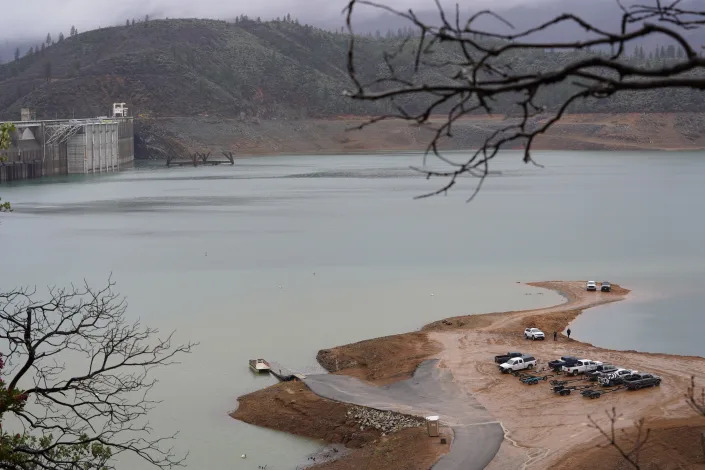
Lake Shasta rose 60 feet in January, due to higher-than-normal rainfall in the region. At the beginning of January parts of the head tower, used during construction of Shasta Dam, were visible above the water line, and the shoreline near the Centimudi Boat Launch extended well into the lake and was used for parking as a parking lot. The head tower and large swaths of shoreline have been submerged under the higher water level.
Higher-than-normal rainfall during the past month has dramatically changed Lake Shasta, with the water level of California’s largest reservoir rising 60 feet since the end of December.
Gone are vast areas of shoreline that became parking lots and campgrounds as the lake dried up and the water level dropped during the past several years of low rainfall in the North State.
By Monday, the lake was 56% full, an improvement over the 34% recorded Jan. 3. The California Department of Water Resources said the lake was 87% of normal as of Monday, compared to the 57% of normal at the beginning of January.
After three years of drought, “normal” was welcome, said Don Bader, area manager for the Bureau of Reclamation, which manages several North State dams, including Shasta.
“It was tremendously good news,” Bader said. “It puts us right back to normal storage right for this date, which is good. We were way behind on that curve. So now it all depends on what we’re going to get in the next four to five weeks for additional rain.”
At the beginning of the month, parts of the head tower could still be seen rising above the water level. The head tower was used during construction of Shasta Dam, but the structure was cut off near the base after the dam was completed in the early 1940s.
The remnants of the tower legs emerge when the lake level gets very low.
Mt. Shasta can be seen in the distance north of Lake Shasta, which rose 60 feet in January.
“When we get about 100 feet down, we start seeing the head tower and that means we’re having a bad year,” Bader said in 2021. “We don’t like seeing that head tower. That’s an indication we’re not doing well water-wise.”
The water level rising in Lake Shasta affects the entire state, as the reservoir’s water is distributed to agencies from Redding to Southern California.
The state’s drought got so bad last year that many agencies that depend on water from the reservoir received little to none of their allocation. Some North State water districts and cities that provide drinking water received only the minimum required for health and safety.
Large swaths of California have been downgraded to “moderate” drought, but Shasta County and much of the North State still remain in a “severe” drought, according to the Drought Monitor. The North State was still in an “extreme” drought at the start of January.
While January’s rains helped relieve the drought, more precipitation is needed over the next few months, Bader said.
The department of water resources measured about 18 inches of rain at Shasta Dam in January, while the National Weather Service recorded 9 inches of rainfall at the Redding Regional Airport. The average precipitation in Redding during January is 5.66 inches, according to the weather service.
No big storms are on the horizon for the rest of the week, with the weather service forecasting a chance of showers Thursday and Friday.
Vehicles park near the Centimudi Boat Launch on Lake Shasta near Shasta Dam on Sunday, Jan. 8, 2023.
Burned out by COVID, Chinese professionals take up nomadic life: ‘I wasted so much time’
Stephanie Yang – January 30, 2023
Chu Fei thought she was doing everything right in life.
At 30, she lived in Beijing and worked at one of the world’s largest tech firms. She had attended China’s top school, Peking University, and gotten a master’s degree at Stanford. She felt the same pressure as anyone else to work hard, buy a home and settle down.
But last year, the striving that came so instinctively suddenly lost its meaning. She was exhausted by 12-hour workdays and long commutes, then nightmarish pandemic lockdowns. None of it seemed worth the financial payoff, the promise of which dwindled as the economy worsened.
“It just felt like my plan wouldn’t work anymore,” she said.
Stuck at home, burned out, with murmurs of layoffs at her company growing, Chu began to realize that she didn’t really like her work-driven life. So she started dreaming of a different one. In October, she quit her job, sold most of her possessions and moved to a provincial village some 800 miles from Beijing.
The growing aversion to conventional expectations — build a career, get married, buy a home, have children — is discouraged by the ruling Communist Party, which prizes social stability.
But China’s economic slowdown, jarring after years of supercharged growth and exacerbated by harsh COVID restrictions, has forced many to put their lives on hold. Tech companies, once among the most reliable and coveted employers, have slashed jobs. Millions of college graduates are struggling to find work in the toughest labor market in decades.
Observers have noticed a growing malaise among a middle class weary of toiling in a hypercompetitive environment without much promise for material gain.
“The young generation has become more aware of the precarious situation that they are in,” said Zhan Yang, assistant professor of cultural anthropology at Hong Kong Polytechnic University. “They don’t want to just be stuck in one job forever, so they are experimenting with different ways of living. It’s like a small social experiment is taking place in China.”
Exact figures on how many people are living such lifestyles are elusive. But surveys show a growing interest in jobs that are more accommodating to different schedules and locations.
The number of flexible workers, such as part-timers or freelancers, in China nearly tripled to 200 million over the course of 2021, according to the National Bureau of Statistics. In a 2022 report by Peking University and Chinese recruitment platform Zhaopin, about 73% of respondents wanted to become digital nomads.
Even before the pandemic, backlash was growing over the punishing hours in China’s high-powered industries, a grind known as 996 — 9 a.m. to 9 p.m., six days a week. Employees endured because they believed with enough ambition and grit, anyone could make their fortune. But social mobility has stalled in recent years, undermining that premise.
“It’s kind of like an adrenaline rush, a boost that drives people to work 996. But now the boost is gone,” Chu said. “People are saying, Whatever you do, you’re not going to get rich, you’re not going to make a lot of money, you’re not going to be successful. So why not do something you like?”
For Chu, that means leisurely mornings and afternoons spent writing, making videos and selling goods online. With income from those new endeavors, she calculates she has enough savings to support herself for a few years in smaller, cheaper cities as she fleshes out her longer-term plan.
For now, she’s settled in a once-bustling tourist town nestled between mountains and the shore of West Lake, a 40-minute drive from the city of Hangzhou.
She rents space in a villa that had been used as a hotel before the pandemic, living among the owner and his family — who moved in after tourism dried up — and often joining them for home-cooked meals. Around the village, neighbors tend to their vegetable fields and tea farms.
It’s a far cry from her life in Beijing, where she was often overwhelmed by work messages and demands. Worries about COVID tests or securing deliveries during lockdown exacerbated that fatigue, and the days began to blur together.
“There’s kind of a feeling, like what have I done for all these years? I’ve wasted so much time,” she said. “I can say I went to some good universities and worked at some big companies, but it’s not something you want to write on your tombstone, you know?”
Still, Chu doesn’t want to fully embrace the trend of tangping, or lying flat, a rejection of the country’s rat race that gained popularity a few years ago. Disillusioned youth, tired of trying to fulfill societal expectations, relished the idea of giving up and just lying down. Others coined new variations, such as yangwoqizuo, or “sit-ups,” which describes a cycle between struggle and capitulation. Chu said that doesn’t quite fit her current attitude either.
“I’m not giving up on myself and doing nothing, but I’m not standing up or running. I’m just sitting here doing things — but that’s what I think real life should be.”
She’s put off telling her parents that she left her job, because she doesn’t want them to worry. But she thinks they might come to understand. They live in Wuhan and were among the first to witness the devastation wrought by the pandemic; Chu believes they have also started to prioritize quality of life over traditional success.
For some in China that means leaving demanding jobs, trying to monetize hobbies, or hopping from town to town. Remote work hubs have popped up around the country; China’s Instagram-like platform, Xiaohongshu, said searches for digital nomads surged 650% from January to August 2022. Social media users have begun documenting their transitory lifestyles — including stays in steeply discounted hotel rooms or tourist resorts left deserted during the pandemic.
Summer Li, who quit her job at an e-commerce startup early last year, used the proliferation of such posts to plan her own travels. In May, she moved to the southern tech hub of Shenzhen for one month before returning to Beijing. In August she spent another month in Kunming, the capital of the mountainous Yunnan province, followed by a brief sojourn in Jingdezhen, the “Porcelain Capital” of China, where she studied ceramics.
“I got this information because a lot of people are doing the same thing during COVID,” said Li, who has been running an online jewelry business while on the road. “I just realized, I think going to work is not for me.”
Chu had hesitated to give up her hard-earned job security, even as she watched friends quit work and travel. And when she first told her friends her plans to roam around China, many expressed concern, she said. After she started a video blog about her new life last month, friends and strangers reached out asking for tips on how to embark on similar journeys.
“In traditional Chinese society, many would think: People like you are not very good. They would say you are the unstable element of society,” Chu said. But lately, she has felt less pressure to settle down. “The good thing is that a lot of people are feeling the same way, that we don’t need to do the things that others want you to do.”
Last year, China’s population shrank for the first time in six decades, threatening a demographic crisis with insufficient young people to work and support the elderly. To boost birthrates, local governments have begun offering more supportive policies for families raising young children, and they’ve promoted incentives to buy real estate during the housing downturn.
Chinese President Xi Jinping has warned the country’s youth against “lying flat,” even as employment prospects have dimmed. “Work is most glorious, our happy lives are created through work. Becoming rich or famous overnight is not realistic,” Xi said during a university visit in Sichuan province in June, according to state media.
But neither incentives nor admonishments have mitigated the spreading ambivalence. Some Chinese became so despondent last year that many began researching how to emigrate, spawning a new movement known as runxue, or “run philosophy.”
Other countries, including Japan and South Korea, are experiencing similar struggles with a dejected younger generation, leading to low marriage and birth rates and putting pressure on governments to alleviate their citizens’ financial stress.
“It’s basically an economic problem,” said Terence Chong, associate economics professor at the Chinese University of Hong Kong. “Young people, they think they have no hope, housing prices are so expensive, so they just limit how hard they work.”
Chinese officials have begun walking back harsh policies in an effort to boost the economy.
Last month, China suddenly relaxed its stringent zero-COVID policy. Since then, the virus has spread rampant throughout the country, overwhelming hospitals and straining medical supplies. However, it has allowed somewhat of a resumption of normal life and work, buoying hopes for an economic recovery.
Officials have also effectively declared an end to a years-long crackdown on private enterprise that battered tech companies and the for-profit education industry.
Even if the economy recovers, Chu can’t imagine going back to Beijing, or her former life.
“I think COVID gave me a chance to really reflect on myself,” she said. “If there was this opportunity to make a lot of money and be rich overnight, would I still be living the lifestyle I’m living right now? I don’t know, probably not.”
These days, Chu feels so removed from the rest of the world that she barely noticed when China lifted all COVID restrictions, until local villagers began to get sick. Even then, the outbreak felt milder than what she was hearing and reading about Beijing.
“If I turn off my phone, this place is like paradise,” she said. “I just hope that this life can last longer.”
At night, she often takes long walks around the tranquil village. She doesn’t remember the air ever smelling quite so sweet.
David Shen of The Times’ Taipei bureau contributed to this report.