How Many Feet Are in a Mile? Here’s a Simple Trick To Remember the Exact Number
Beth Ann Mayer – April 15, 2023
Learn precisely how many feet are in a mile and more fun facts.
Your thoughts on the mile are likely all about perspective. If you’re driving, it’s likely a quick trip (barring massive traffic). You can probably leave a minute before you have to be there and arrive on time. Walking? That’s more of a slog. A marathon runner? No big. But if the only marathon you’ve ever participated in is one that involved watching Law & Order: SVU, running a mile can feel like a steep hill to climb, even if it’s a flat road. How many feet are in a mile, anyway?
You probably learned how many feet are in a mile sometime in school. But, like the difference between an isosceles and a trapezoid and scalene triangle, you likely forgot all about it (unless you’re a parent and your kid needs help with homework).
Here’s a refresher on how many feet there are in a mile, plus more fun facts worth remembering for your next water cooler chat.
How Many Feet Are in a Mile?
There are 5,280 feet in a mile. This distance is a British imperial unit and United States customary unit. It’s equivalent to 1,760 yards.
Where Did the Mile Originate?
The mile originated from the Roman mille passus, AKA “a thousand paces” or “5,000 Roman feet.” According to Merriam-Webster, a Roman pace was equal to five Roman feet or 4.85 English feet. It was “measured in pacing from the heel of one foot to the heel of the same foot when it next touches the ground.”
How Did It Become 5,280 Feet?
Sometime around 1500, the English divided the mile into eight furlongs. Each furlong was 625 feet long, making the mile 5,000 feet. The Statute of 1593, which came under Queen Elizabeth I, lengthened the furlong to 660 feet. That extra 35 feet per furlong added 280 total feet to the mile. The final tally? 5,280 feet.
What Distance Is a Furlong?
Initially, the furlong was 625 feet. But the Statute of 1593 under Queen Elizabeth I extended the length of a furlong to 660 feet.
What Distance Is a Country Mile?
A country mile isn’t an actual unit of measure—it’s a term used to describe a sneaky-long distance. Country roads usually aren’t a straight line like a highway—they can be winding from left to right and up and down. The shortest distance between two points is a straight line, so a winding dirt road can feel longer than it is.
How To Easily Remember How Many Feet Are in a Mile
To easily remember how many feet are in a mile, think of the phrase “five tomatoes.” It’s similar to the 5,280 feet in a mile. Think about it. “Five-to-may-toes” sounds sort of similar to “five-two-eight-oh.”
Gunmen storm Mexican resort, kill 7, including child
Daniel Becerril – April 15, 2023
MEXICO CITY (Reuters) – Armed men on Saturday killed a child and six others after storming a resort in the central Mexican state of Guanajuato, authorities said, in a region increasingly plagued by drug cartel violence.
Footage widely shared on social media showed the aftermath of the attack in a palm-studded resort in the small town of Cortazar, about 65 km (40 miles) south of the Guanajuato city.
It was not clear who was behind the shooting that killed the seven-year-old, three men and three women, Cortazar’s local security department said. One person was seriously injured in the La Palma resort.
But in recent years rival drug cartels have been waging brutal battles to control territory and trafficking routes through the state.
Video taken soon after the attack showed shocked adults and children walking past piles of dead bodies near a swimming pool.
“Heavily armed sicarios arrived and this is what happened,” said an unidentified man, using a word for hired assassins as he filmed at the resort in a video shared on the internet.
Reuters could not independently verify the contents of the video.
“After the attack, (the attackers) fled, but not before causing damage to the resort store and taking the security cameras and the monitor,” Cortazar’s security department said in a statement.
(Reporting by Daniel Becerril; Writing by Drazen Jorgic; Editing by William Mallard)
Where are all those tech workers going? A Silicon Valley exodus is shaking up the landscape.
Danielle Abril, The Washington Post – April 14, 2023
A beautiful view of residential area in San Francisco, California (Wirestock via Getty Images)
SAN FRANCISCO – As a computer science student in the Midwest, Alex Valaitis idolized Silicon Valley, drawn to the Bay Area like a theater major dreams of Broadway. But after five years of “soul-crushing” tech work, an exodus from San Francisco and rising crime in the city, Valaitis decamped in June 2021 for Austin.
“I like to bet on momentum, and Austin has it,” said Valaitis, 28, who runs a Web3 product studio and a newsletter about artificial intelligence. “More and more [tech] people seem to be flooding in every month.”
Silicon Valley has reigned for decades as America’s innovation capital, home to tech giants like Apple, Google and Facebook; unicorns like Uber, DoorDash and Instacart; and start-ups fueled by the venture capitalists that populate Sand Hill Road. But the region’s dominance has declined since the pandemic, as lenient remote work policies and a spate of layoffs have fueled the departures of workers and cleared the way for rising investment in other tech hubs across the United States, notably Austin and Miami.
Silicon Valley still ranked first last year in terms of venture-capital investments and the number of deals, according to data from PitchBook. But funding for companies in Miami has nearly quadrupled in the past three years, totaling $5.39 billion in 2022, while deal volume jumped 81 percent. Austin venture capital investments rose 77 percent to $4.95 billion with the number of deals jumping 23 percent. New York, Seattle, Philadelphia, Chicago, Denver and Houston also saw relatively large increases in investment and deals, data shows.
These regions still pale in comparison to Silicon Valley, which in 2022 drew $74.9 billion in investments across 3,206 deals. That’s about $45.36 billion and 1,058 deals more than New York, the second highest region for VC fundraising. The Silicon Valley region was also the home of 86 percent of start-ups, up from 53 percent last year, funded by famed start-up accelerator Y Combinator.
But Silicon Valley’s share of total value of venture capital investments in the United States last year was at its lowest since 2012. And nearly 250,000 people left the Silicon Valley region during the pandemic, according to census data from April 1, 2020, to July 1, 2022.
“There’s no doubt that [Silicon Valley’s] sort of exemplary, center-of-the-universe status has really absorbed some blows,” said Mark Muro, senior fellow at Brookings Institution.
Miami and Austin both benefited from fewer restrictions during the coronavirus pandemic. Early on, cryptocurrency and Web3 – a broad term for the next generation of the internet that would give people more control and ownership – were major drivers of Miami’s growth. Seattle benefited from having Amazon and Microsoft in its backyard, attracting more enterprise technology and also biotech, said Kyle Stanford, lead venture capital analyst at PitchBook.
“A redistribution [of funding] has definitely started. The pandemic, the fleeing of start-ups and remote work helped catalyze growth in those smaller markets,” he said.
Brianne Kimmel, founder of investment firm Worklife Ventures, has noticed a change in identity for the Silicon Valley region as many tech workers have moved out of San Francisco to other places like Austin or Seattle.
“That’s really created room for young, very technical, traditional hacker types to come to San Francisco,” she said. “It’s giving the city a personality it may have lost in years prior.”
She points to Cerebral Valley, an area in the Hayes Valley neighborhood where hacker houses filled with young start-up workers focused on AI are popping up. Kimmel compares the feeling to the Silicon Valley region during the early days of the internet, when people were huddling to work out of garages. She expects AI developments to accelerate people’s ability to work anywhere but also create concentrated areas of innovation across the United States that will draw workers.
But AI could ultimately change the industry and how many people are needed to operate those companies, said Muro, of Brookings. If AI innovations fundamentally change the industry’s structure, the biggest impact to workers could be in Silicon Valley, he said.
Tech workers desiring the quintessential start-up experience are still flocking to Silicon Valley, said partners at investment firm Index Ventures. But unlike the past, more start-ups are popping up in other places – like Seattle, which is producing start-ups focused on cloud infrastructure and developer tools, and New York, which has also been a hot bed for AI, said Bryan Offutt, partner at Index Ventures focused on investments in software infrastructure and AI.
“Five years ago, 90 percent of companies would’ve been founded in San Francisco,” he said. “Now it might be more like 70 percent, with others starting in places like Seattle and New York.”
And once companies mature, many are finding it useful to look for workers outside Silicon Valley as it widens the pool of prospective hires, said Erin Price-Wright, an Index partner focused on AI and machine learning investments.
“The need for talent to all be in the same place as they scale, we’ve sort of moved passed that,” she said. “It’s much more beneficial to branch out.”
Atli Thorkelsson, vice president of talent network at Redpoint Ventures, says Austin has grown as a hub for marketing, sales and customer teams for tech companies, and New York is capitalizing on a mixed bag of talent including those in financial tech, health tech and insurance tech.
“There is a way higher concentration of tech talent in New York than ever before,” he said. “The most prone [to move away from the Bay] seem to be those who are about five to 10 years into their career.”
The next generation of tech workers say the attractiveness of the region as a tech hub depends on their ambitions, as those seeking to build companies and find funding still want to go to Silicon Valley.
For Kai Koerber, a senior data science major at the University of California at Berkeley and founder of his start-up Koer A.I., Silicon Valley is still the place to be as he works on building his company. However, in a couple of years after he’s done some of the groundwork, the 22-year-old hopes to join some of his Gen Z tech peers by moving to New York.
“It’s great to be here and build your connections,” he said. “Then after that, live your life and have fun. I’m a young guy. I want to enjoy my 20s.”
Dylan Costinett, a senior data science major at Eastern Washington University, said that Silicon Valley region tech jobs have become less attractive in recent years. Instead, he’s planning to work for a third-party government software provider that will likely base him somewhere in the Northeast or Midwest.
“I got pretty worried about getting a job right out of college because I was seeing all the layoffs,” Costinett, 21, said, adding the high cost of living also plays into his feelings about Silicon Valley. “I’m not sure how stable Big Tech is right now.”
Airbnb was one of the first tech companies to allow permanent remote work. As a result, several workers at the company said they didn’t see the need to remain in Silicon Valley.
Airbnb tech employees Sofia Ruehle and Ian Demattei-Selby, who both moved from Silicon Valley region to Washington, said they believe the spread of employees leads to a diversification of ideas that allows the companies and workers to learn from different regions. And Rori Jones, Airbnb’s diversity and belonging business partner who moved to Denver during the pandemic, said six Silicon Valley friends have joined her since she left.
“Pre-pandemic, if you weren’t in San Francisco, in some ways you were at a disadvantage for opportunities and promotions,” she said. “But now, it doesn’t feel like you’re missing out on anything.”
After spending nearly 15 years in Silicon Valley, Duncan Cook, engineering manager at Yelp, traded his techie lifestyle for the nature-filled Portland suburb of Happy Valley in December 2021. Yelp had told its workers they could work from anywhere. That allowed Cook to get away from what appeared to him as a growing drug problem in the region and move into a bigger home with his wife and new son. He says he’s excited to see flexible work fuel a larger distribution of the tech industry.
“I don’t think San Francisco is going to self-destruct any time soon . . . but it’s less of a shining star,” he said.
Valaitis, the tech worker who moved to Austin, said people like him are coming to a new realization: “You don’t have to be in the Bay Area to have success in tech.”
“I think that’s part of the disruption and narrative people are slowly waking up to, ” he said.
18,000 cows killed in Texas explosion. Next: The massive, messy task of disposing of them
Rick Jervis, USA TODAY – April 14, 2023
The fire that killed 18,000 dairy cows in a West Texas farm has been extinguished and the staggering death count revealed.
Now, comes the messy, unprecedented task of disposing of them.
Typically, dead farm animals – even scores of them, such as those killed in the wake of hurricanes or blizzards – can be buried, hauled to landfills or even composted, said Saqib Mukhtar, an associate dean at the University of Florida’s Institute of Food and Agricultural Sciences Extension and a cattle disposal expert.
“I really don’t know, if [the cows] were all intact, how in the world you can manage this even within a month,” said Mukhtar, who previously worked at Texas A&M University and helped dispose of thousands of cattle drowned by Hurricane Ike in 2008.
Smoke fills the sky after an explosion and fire at the South Fork Dairy farm near Dimmitt, Texas, on Monday, April 10, 2023. The explosion critically injured one person and killed an estimated 18,000 cows.
Officials have not said what method of disposal they will use in the case of the South Fork farm disaster.
Video footage from local television stations showed front-loaders entering and exiting the pens where an estimated 18,000 cattle – a mix of Holstein and Jersey cows – perished during a fire Monday evening at the South Fork Dairy farm near Dimmitt, Texas, around 70 miles southwest of Amarillo.
A dairy worker was rescued from inside the facility and rushed to a hospital. She was in critical condition as of Tuesday.
While state fire investigators look into the cause of the blaze, officials with the Texas Commission on Environmental Quality and Texas A&M AgriLife Extension Service have descended onto the scene to advise and monitor the disposal of the animals.
In a statement, TCEQ said its Amarillo office “is providing assistance to South Fork Dairy to ensure that dead livestock and any other debris is disposed of in accordance with TCEQ rules and regulations,” including ensuring the animals are buried at least 50 feet from the nearest public water well and outside the 100-year floodplain.
On its website, TCEQ lists more than 13 rules surrounding the disposal of livestock carcasses, including making sure they’re buried in at least three feet of soil, and covered as soon as possible, “ideally the same day.”
The incident could also draw agents from the U.S. Department of Agriculture’s Animal and Plant Health Inspection Service, as well as scientists with the Environmental Protection Agency – all monitoring how the dead animals may contaminate soil, air or aquifers, said Andy Vestal, a retired professor and extension specialist at Texas A&M AgriLife Extension Service who has assisted in large-scale cattle disposal. The efforts are aimed at protecting both humans and livestock, he said.
“You have an element of human public health and livestock sustainability to deal with,” Vestal said.
The Castro County Sheriff’s Office was among several agencies to respond to a fire and explosion at a dairy farm near Dimmitt on Monday.
The fire was the deadliest involving cattle recorded by the Animal Welfare Institute since it began tracking barn and animal pen fires in 2013.
Overall, the group has tracked 6.5 million animals killed in fires in that span, with chickens making up more than 90% of the fatalities. This week, the number of cattle herd killed by fires jumped from 7,385 to 25,385, after the institute added the South Fork incident.
Who owned the Texas dairy company?
State records show the South Fork Dairy farm was owned by the Brand family. Frank Brand did not return several requests for comment. A neighbor told the industry publication Dairy Herd that the Brand family was “a great family and customer, and said the community supported them.
Dimmitt Mayor Roger Malone told USA TODAY the dairy had opened in the area just over three years ago and employed 50 to 60 people.
Rules about cattle, farm animals
The incident has drawn the ire from animal activists, who have lobbied for more fire regulations at large-scale farms such as the South Fork Dairy.
Farmers and cattle raisers are not required to abide by the same fire codes or animal welfare rules as zoos and aquariums, creating disparities in treatment, said Allie Granger, a policy associate with the Animal Welfare Institute.
“There’s a huge gap in protection when it comes to animals used for agriculture,” she said.
Though there are rules for disposing carcasses, having such a large number makes the job formidable, said Mukhtar, who co-wrote a widely-used handbook on cattle disposal.
A cowboy attempts to round up cattle from receding flood waters Sept. 15, 2008, Near High Island, Texas, after Hurricane Ike. Saqib Mukhtar, an academic and expert in cattle disposal, helped dispose of thousands of cattle drowned by Hurricane Ike in 2008.
The preferred method is often taking them to a landfill that accepts animal carcasses, which are often engineered to protect the environment from the waste. But hauling so many dead cows to landfalls would be time-consuming, costly and unrealistic, he said.
Burning the carcasses would take too long since you could only burn three or four cows at a time using mobile incinerators, Mukhtar said. And composting would require an unfathomable amount of organic material – such as hay mixed with manure — to cover all 18,000 animals.
Burying them on site, though the least-recommended option because of the risks of pollutants seeping into the soil and aquifer, is the most likely outcome in the South Fork farm case, he said. The main risk with this method is what’s known as “leachate,” or liquids that eventually seep out of the carcasses and into the surrounding soil.
Whatever method is chosen, owners and regulators will need to act fast: As they decompose, cow carcasses release gasses, such as hydrogen sulfide and ammonia, that – if leaked in large enough quantities – could pose air pollution risks, Mukhtar said.
But nothing about disposing of 18,000 carcasses promises to be fast.
“It’s a major, complex conundrum that they’re in,” he said.
Red tide lingering? Bloom continues to impact south Sarasota County beaches
Jesse Mendoza, Sarasota Herald-Tribune – April 14, 2023
South Sarasota County is one of the few areas along the coast still affected by bloom levels of red tide, despite improved conditions throughout most of the region.
Samples published this week by the Florida Fish and Wildlife Commission show red tide was either not found, or only found in low levels, near most of the Sarasota and Manatee shoreline. Samples do show medium concentrations of red tide in south Sarasota County near Manasota Beach on April 10 and Blind Pass Beach on April 6.
The Florida Department of Health in Sarasota County issued an update on Thursday notifying the public that elevated levels of red tide continue to be found near local beaches in that area — specifically highlighting Nokomis, North Jetty, Venice Beach, Service Club, Venice Fishing Pier, Brohard, Casperson, Manasota Key, and Blind Pass.
Red tide can cause short-lived respiratory symptoms such as eye, nose, and throat irritation like those associated with the common cold or seasonal sinus allergies. Red tide bloomed along the coastline at the end of October and came to a head in early March.
The bloom has largely cleared along most of Sarasota and Manatee since then, making for improved beach conditions during spring break and the Easter holiday weekend.
A map showing sample results for red tide published by the Florida Fish and Wildlife Conservation Commission for the week ending on April 13.
The bloom did persist to the south and north of the region and continues to affect the south Sarasota County area as of the latest information available this week.
There is a moderate risk of red tide-related respiratory irritation over the next 36 hours in Sarasota, Pinellas, and Charlotte counties, according to a forecast issued by the National Centers for Coastal and Ocean Science issued at 6 a.m. on Friday. Red tide is present in Collier, Lee, and Pasco counties at levels that could cause respiratory irritation as well.
Visit www.redtideforecast.com for the most up-to-date respiratory irritation forecast information.
Here’s the biggest hurdle facing America’s EV revolution
Shannon Osaka – April 13, 2023
A curbside PlugNYC Flo electric vehicle (EV) charger near Central Park West in New York, US, on Wednesday, Aug. 31, 2022. (Jeenah Moon/Bloomberg)
The Biden administration just unveiled some of the most aggressive auto climate rules in the world – the latest step for an administration that has gone all-in on EVs. But America’s EV transition could soon stumble: not because of high car costs or a lack of automaker support, but thanks to the country’s broken and dysfunctional public charging system.
Most electric vehicle drivers charge their vehicles at home. But as Americans buy EVs – to the tune of 7 percent of all new vehicle registrations in January – more and more people are finding that the public charging system is unreliable, inconvenient and simply confusing.
“I’ve seen people wait because there are only four chargers and two of them are out of service,” said Bill Ferro, the founder of EVSession, a software firm that tracks charger reliability. “Everything that I’ve seen shows that it’s driving away current and potential EV owners.”
Drivers might show up at a DC-fast charging station – which can fill a vehicle’s battery by 80 percent in about 20 minutes – to find that most of the chargers are broken. Or one might work, but only if the driver installs a particular app on their phone, creates an account, and loads money onto it.
Last year, in a preprint study conducted by researchers at the University of California, Berkeley, and the nonprofit Cool the Earth, researchers tested every single fast charging station in the San Francisco Bay Area. They found that more than a quarter of the 657 charging points didn’t function during a 2-minute charging test. Sometimes the charging cable couldn’t reach the vehicle’s charging port; other times the payment system wouldn’t work; sometimes the charger’s screen was broken or the network was down.
Some of the chargers had the option to pay by 1-800 number – but Carleen Cullen, the executive director of Cool the Earth and one of the authors of the study, said that’s not a good solution. “If we want mass market adoption, people are going to want to pay and move along and charge their vehicles,” she said.
Another survey, from the group J.D. Power and Associates, found that one in five EV owners who had recently visited a station where unable to charge – largely due to a system malfunction.
Tesla’s proprietary charging network usually gets the highest ratings from users. But the vast majority of stations are only open to Tesla drivers. The company has agreed to open a small fraction of its stations to non-Tesla drivers by 2024, beginning now with a few select locations around the country.
Ferro, who drives an electric vehicle himself, frequently has to take road trips of around 300 miles. He ended up buying a Tesla Model 3 largely to make use of the reliable charging network. “On any other network, I wouldn’t have trusted it,” he explained.
But there’s more to the problem than that. The decentralized nature of American charging is also confusing early adopters and turning off potential EV drivers. Public charging is currently managed by a hodgepodge of private companies, utilities, government spending, and automakers. There are private companies – like Electrify America, EVgo, or ChargePoint – which each have their own machines and ways of paying for charging. (A typical EV driver may have as many as eight phone apps and several RFID cards to manage all the possible chargers on the road.)
Then there are automakers, like Tesla or Rivian, that establish their own networks tailor-made for those who buy their products. Utilities are also trying to get into the game, building up their own fast-charging networks in states like Minnesota. The result is a mess for drivers who simply want to plug in – and a logistical nightmare for regulators.
“There are so many different players in this, and they all need to be singing the same song,” said Cullen.
There have been attempts to regulate chargers’ “uptime,” or the amount of time that they are functioning properly. The Biden administration has established rules for the $5 billion in funding for public chargers in the infrastructure bill, ordering that they have at least a 97 percent uptime and are accessible via a single payment method. But the federal rules also allow networks to self-report how often their chargers work – a decision that Ferro finds troubling. “It’s letting the fox in the henhouse,” he said.
And that’s only for the chargers that will receive federal funding; the vast majority of stations will not.
Unless the United States sorts out its public charging infrastructure, it’s hard to imagine EV sales growing as quickly as the Biden administration wants. The strictest version of the rules the Environmental Protection Agency proposed Wednesday would require a whopping two-thirds of all new passenger vehicle sales to be electric by 2032.
New federal subsidies, offered under the Inflation Reduction Act, are making electric vehicles more accessible to Americans. More EV drivers means more pressure on the existing malfunctioning stations, as well as more drivers who live in apartments or don’t have easy access to home charging.
While early adopters and EV enthusiasts might be happy to build in multiple contingency plans, mainstream EV adoption is going to require a more streamlined system. U.S. public charging also lags far behind other countries: According to S&P Global, China has 1.2 million charging points, Europe has 400,000 – and the United States only has 140,000.
“We’re not yet to the mass market phase,” said Ferro. “And if the infrastructure isn’t there, it will put a damper on everybody’s plans.”
Clarence Thomas’s luxury travel: A threat to the court’s legitimacy?
Mike Bebernes, Senior Editor – April 13, 2023
Scroll back up to restore default view.
What’s happening
Supreme Court Justice Clarence Thomas’s friendship with a billionaire real estate developer has come under intense scrutiny following a report last week by ProPublica that details luxury vacations Thomas took part in over the past two decades.
According to the report, Thomas and his wife, Ginni, have enjoyed lavish trips funded by Texas billionaire Harlan Crow “virtually every year,” including global travel on Crow’s superyacht and private jet as well as annual visits to his properties in the U.S. The justice did not report any of these trips in his annual financial disclosures.
Thomas, a staunch conservative who has played a critical role in the Supreme Court’s rightward tilt in his more than 30 years on the bench, released a statement asserting that the trips did not need to be disclosed because they fell under an exception that allows for “personal hospitality from close personal friends.” Legal experts disagree over whether Thomas’s failure to report his travels with Crow violated federal disclosure laws, with some arguing that until recently the rules were too ambiguous to clearly assert that he should have disclosed them.
The Supreme Court is generally left to police itself. Unlike officials on lower federal courts, the nine justices are not bound by a formal code of ethics. Because the country’s founders wanted members of the nation’s top court to be shielded from politics, the other branches of government have little power to influence the court — other than the drastic step of impeachment.
Thomas is no stranger to controversy. His confirmation hearings in 1991 became one of the most heated political fights of the era amid accusations he had sexually harassed a colleague named Anita Hill. He has been a key conservative vote in contentious rulings around equal rights, voting access and abortion. More recently, he faced fierce criticism for refusing to recuse himself from cases that related to his wife’s participation in efforts to overturn the 2020 presidential election.
Why there’s debate
Democrats and liberal commentators have roundly condemned Thomas for failing to disclose the extent of his relationship with Crow as well as his willingness to accept such lavish hospitality in the first place. Progressive Rep. Alexandria Ocasio-Cortez said the justice’s relationship with Crow, who has given millions to fund Republicans, represents an “almost cartoonish” level of corruption and called for Thomas to be impeached. Though there’s no direct evidence that Crow’s generosity influenced Thomas’s rulings, Senate Judiciary Chairman Dick Durbin, D-Ill., said his actions were “simply inconsistent with the ethical standards the American people expect of any public servant, let alone a justice on the Supreme Court.”
Most conservatives have rallied to defend Thomas, arguing that he followed ethics rules as they’re written and insisting that even Supreme Court justices are allowed to have close friends. They also sternly reject the implication that a billionaire could alter a justice’s decision making in key cases by taking him on vacation. Many have accused Democrats of using these trips as an excuse to try to discredit Thomas, who has provided a consistent conservative bulwark against their cause for three decades.
But others say Thomas’s actions, whether or not they constitute actual corruption, bolster the view that the Supreme Court has lost its legitimacy. The public’s faith in the court reached an all-time low last year in the months following its decision to overturn Roe v. Wade. Critics say Thomas’s actions, and the lack of any accountability for them, feed the perception that the conservative justices are merely an extension of the Republican political movement.
What’s next
Durbin said last week that the Senate Judiciary Committee will act in response to the ProPublica report. It’s unclear what steps he and any other members of Congress will take. The scandal has also revived calls for Congress to establish an official ethics code for the Supreme Court, but similar efforts in recent years have fizzled due to lack of bipartisan support.
Perspectives
This is exactly what real corruption looks like
“Corruption is much more than a cartoonish quid pro quo, where cash changes hands and the state is used for private gain. Corruption, more often than not, looks like an ordinary relationship, even a friendship. It is perks and benefits freely given to a powerful friend. It is expensive gifts and tokens of appreciation between those friends, except that one holds office and the other wants to influence its ideological course. It is being enmeshed in networks of patronage that look innocent from the inside but suspect to those who look with clearer eyes from the outside.” — Jamelle Bouie, New York Times
Justices can’t be expected to be lifelong hermits
“Supreme Court justices are allowed to have friends, even if a particular friend is rich and a particular justice is conservative. Clarence Thomas has written a lot of important Supreme Court opinions during his three decades on the bench. I recommend that we spend our time addressing those and leave his personal life to him.” — Scott Douglas Gerber, The Hill
Crow’s money gives him influence that regular people could never imagine
“Crow may not have bought Thomas’s vote, but he sure paid for hundreds of hours of face time. … If you’re a rich Republican friend of the Crows, you had an opportunity to plead your case to the justice. I didn’t. Women … didn’t. Parents of children who were murdered at school because of Thomas’s interpretation of the Second Amendment didn’t. Crow doesn’t invite those parents to his private resort when the justice is around.” — Elie Mystal, The Nation
Democrats want to dismantle the conservative court by any means available
“This non-bombshell has triggered breathless claims that the Court must be investigated, and that Justice Thomas must resign or be impeached. Those demands give away the real political game here.” — Editorial, Wall Street Journal
The country’s most powerful judges shouldn’t have lower ethical standards than regular workers
“While librarians and teachers and FDA inspectors and lawyers turn down water bottles and bagels, Thomas says yes to all this? Are those pesky ethics and rules just for the little people, too? It’s demoralizing, fuels cynicism, and corrodes trust in public institutions.” — Terri Gerstein, Slate
Partisanship makes it impossible to have a real conversation about the issues at play
“There is little doubt that interpretations of Thomas’s ethics fall quite neatly into red and blue camps. … If your guy does something, it’s unprecedented corruption. If my guy does it, it’s a trivial lapse. See: sex scandals of Bill Clinton and Donald Trump.” — Mona Charen, The Bulwark
Thomas’s actions represent a lapse in judgment, not a major scandal
“Thomas was wrong not to disclose apparently free, luxurious trips as a guest of Texas billionaire Harlan Crow. He should amend the record, apologize for the lack of disclosure, pledge to observe disclosure rules more scrupulously in the future — and then move on. Thomas’s nondisclosures are an ethical lapse. They are not, however, major sins.” — Quin Hillyer, Washington Examiner
The lack of any real guardrails for justices poses a threat to the court’s legitimacy
“Ultimately, what’s even more troubling than his behavior is the fact that the Supreme Court does not have its own code of conduct, even though there is one that applies to other federal judges. And if the high court doesn’t take the steps to adopt one on its own, Congress should act swiftly to pass legislation requiring justices to adhere to ethical standards.” — Julian Zelizer, CNN
The country’s legal system will collapse if the public doesn’t believe it’s legitimate
“The Supreme Court has no army or police department that can enforce its rulings outside its walls. … For the sake of the institution and its legitimacy, the justices need to display respect for the trust that should go with the lifetime appointments they have been given — or they will continue to see an erosion of public faith.” — Editorial, Washington Post
The myth of an independent judiciary is long dead
“The unspoken assumption is that, by definition, Supreme Court justices cannot be unethical, partisan cynics. It is an absurd, self-serving mythos propagated by legal elites who have earned the American people’s abhorrence. Thomas’s ethical quagmire exposes the Supreme Court’s self-mythology for the lie that it is.” — Max Moran, The American Prospect
The most worrying thing is that Republicans see nothing wrong
“One singularly unethical justice might be a containable problem. But Clarence Thomas is not seen by conservatives as an embarrassment they’re stuck with. To the contrary, they celebrate him as their moral beacon.” — Jonathan Chait, New York
Is there a topic you’d like to see covered in “The 360”? Send your suggestions to the360@yahoonews.com.
Photo illustration: Jack Forbes/Yahoo News; photos: Chris Goodney/Bloomberg via Getty Images , Alex Wong/Getty Images, Jabin Botsford/The Washington Post via Getty Images
Billionaire Harlan Crow Bought Property From Clarence Thomas. The Justice Didn’t Disclose the Deal.
Justin Elliott, Joshua Kaplan and Alex Mierjeski, ProPublica
April 13, 2023
This story was originally published by ProPublica.
In 2014, one of Texas billionaire Harlan Crow’s companies purchased a string of properties on a quiet residential street in Savannah, Georgia. It wasn’t a marquee acquisition for the real estate magnate, just an old single-story home and two vacant lots down the road. What made it noteworthy were the people on the other side of the deal: Supreme Court Justice Clarence Thomas and his relatives.
The transaction marks the first known instance of money flowing from the Republican megadonor to the Supreme Court justice. The Crow company bought the properties for $133,363 from three co-owners — Thomas, his mother and the family of Thomas’ late brother, according to a state tax document and a deed dated Oct. 15, 2014, filed at the Chatham County courthouse.
The purchase put Crow in an unusual position: He now owned the house where the justice’s elderly mother was living. Soon after the sale was completed, contractors began work on tens of thousands of dollars of improvements on the two-bedroom, one-bathroom home, which looks out onto a patch of orange trees. The renovations included a carport, a repaired roof and a new fence and gates, according to city permit records and blueprints.
A federal disclosure law passed after Watergate requires justices and other officials to disclose the details of most real estate sales over $1,000. Thomas never disclosed his sale of the Savannah properties. That appears to be a violation of the law, four ethics law experts told ProPublica.
The disclosure form Thomas filed for that year also had a space to report the identity of the buyer in any private transaction, such as a real estate deal. That space is blank.
“He needed to report his interest in the sale,” said Virginia Canter, a former government ethics lawyer now at the watchdog group CREW. “Given the role Crow has played in subsidizing the lifestyle of Thomas and his wife, you have to wonder if this was an effort to put cash in their pockets.”
Thomas did not respond to detailed questions for this story.
In a statement, Crow said he purchased Thomas’ mother’s house, where Thomas spent part of his childhood, to preserve it for posterity. “My intention is to one day create a public museum at the Thomas home dedicated to telling the story of our nation’s second black Supreme Court Justice,” he said. “I approached the Thomas family about my desire to maintain this historic site so future generations could learn about the inspiring life of one of our greatest Americans.”
Crow’s statement did not directly address why he also bought two vacant lots from Thomas down the street. But he wrote that “the other lots were later sold to a vetted builder who was committed to improving the quality of the neighborhood and preserving its historical integrity.”
ProPublica also asked Crow about the additions on Thomas’ mother’s house, like the new carport. “Improvements were also made to the Thomas property to preserve its long-term viability and accessibility to the public,” Crow said.
Ethics law experts said Crow’s intentions had no bearing on Thomas’ legal obligation to disclose the sale.
The justice’s failure to report the transaction suggests “Thomas was hiding a financial relationship with Crow,” said Kathleen Clark, a legal ethics expert at Washington University in St. Louis who reviewed years of Thomas’ disclosure filings.
There are a handful of carve-outs in the disclosure law. For example, if someone sells “property used solely as a personal residence of the reporting individual or the individual’s spouse,” they don’t need to report it. Experts said the exemptions clearly did not apply to Thomas’ sale.
The revelation of a direct financial transaction between Thomas and Crow casts their relationship in a new light. ProPublica reported last week that Thomas has accepted luxury travel from Crow virtually every year for decades, including private jet flights, international cruises on the businessman’s superyacht and regular stays at his private resort in the Adirondacks. Crow has long been influential in conservative politics and has spent millions on efforts to shape the law and the judiciary. The story prompted outcry and calls for investigations from Democratic lawmakers.
“Harlan and Kathy Crow are among our dearest friends,” Thomas wrote. “As friends do, we have joined them on a number of family trips.” Crow told ProPublica that his gifts to Thomas were “no different from the hospitality we have extended to our many other dear friends.”
It’s unclear if Crow paid fair market value for the Thomas properties. Crow also bought several other properties on the street and paid significantly less than his deal with the Thomases. One example: In 2013, he bought a pair of properties on the same block — a vacant lot and a small house — for a total of $40,000.
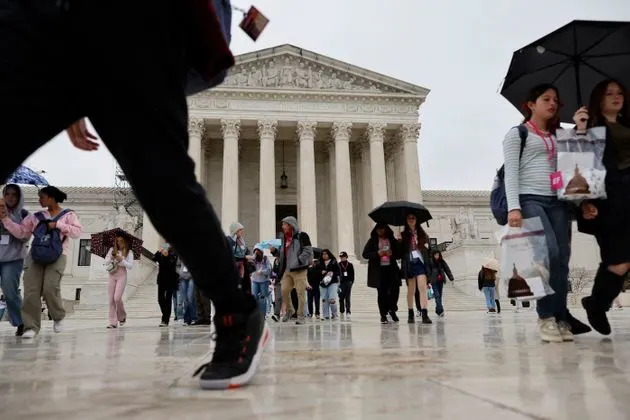
WASHINGTON, DC – APRIL 07: Tourists move through the plaza in front of the U.S. Supreme Court building April 07, 2023 in Washington, DC. According to a ProPublica report published Thursday, Supreme Court Associate Justice Clarence Thomas failed to include in his financial disclosures that for decades he was treated to luxury vacations by Texas real estate magnate and Republican mega-donor Harlan Crow. (Photo by Chip Somodevilla/Getty Images)
In his statement, Crow said his company purchased the properties “at market rate based on many factors including the size, quality, and livability of the dwellings.”
He did not respond to requests to provide documentation or details of how he arrived at the price.
Thomas was born in the coastal hamlet of Pin Point, outside Savannah. He later moved to the city, where he spent part of his childhood in his grandfather’s home on East 32nd Street.
“It had hardwood floors, handsome furniture, and an indoor bathroom, and we knew better than to touch anything,” Thomas wrote of the house in his memoir, “My Grandfather’s Son.”
He inherited his stake in that house and two other properties on the block following the death of his grandfather in 1983, according to records on file at the Chatham County courthouse. He shared ownership with his brother and his mother, Leola Williams. In the late 1980s, when Thomas was an official in the George H.W. Bush administration, he listed the addresses of the three properties in a disclosure filing. He reported that he had a one-third interest in them.
Thomas was confirmed to the Supreme Court in 1991. By the early 2000s, he had stopped listing specific addresses of property he owned in his disclosures. But he continued to report holding a one-third interest in what he described as “rental property at ## 1, 2, & 3” in Savannah. He valued his stake in the properties at $15,000 or less.
Two of the houses were torn down around 2010, according to property records and a footnote in Thomas’ annual disclosure archived by Free Law Project.
In 2014, the Thomas family sold the vacant lots and the remaining East 32nd Street house to one of Crow’s companies. The justice signed the paperwork personally. His signature was notarized by an administrator at the Supreme Court, Perry Thompson, who did not respond to a request for comment. (The deed was signed on the 23rd anniversary of Thomas’ Oct. 15 confirmation to the Supreme Court. Crow has a Senate roll call sheet from the confirmation vote in his private library.)
Thomas’ financial disclosure for that year is detailed, listing everything from a “stained glass medallion” he received from Yale to a life insurance policy. But he failed to report his sale to Crow.
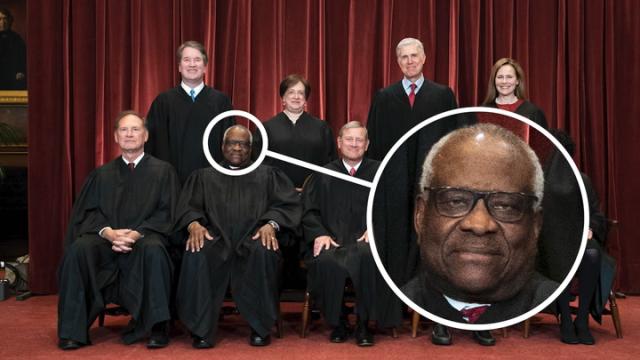
WASHINGTON, DC – OCTOBER 07: United States Supreme Court Associate Justice Clarence Thomas poses for an official portrait at the East Conference Room of the Supreme Court building on October 7, 2022 in Washington, DC. The Supreme Court has begun a new term after Associate Justice Ketanji Brown Jackson was officially added to the bench in September. (Photo by Alex Wong/Getty Images)
Crow purchased the properties through a recently formed Texas company called Savannah Historic Developments LLC. The company shares an address in Dallas with Crow Holdings, the centerpiece of his real estate empire. Its formation documents were signed by Crow Holdings’ general counsel. Business records filed with the Texas secretary of state say Savannah Historic Developments is managed by a Delaware LLC, HRC Family Branch GP, an umbrella company that also covers other Crow assets like his private jet. The Delaware company’s CEO is Harlan Crow.
A Crow Holdings company soon began paying the roughly $1,500 in annual property taxes on Thomas’ mother’s house, according to county tax records. The taxes had previously been paid by Clarence and Ginni Thomas.
Crow still owns Thomas’ mother’s home, which the now-94-year-old continued to live in through at least 2020, according to public records and social media. Two neighbors told ProPublica she still lives there. Crow did not respond to questions about whether he has charged her rent. Soon after Crow purchased the house, an award-winning local architecture firm received permits to begin $36,000 of improvements.
People hold signs decrying U.S. Supreme Court Justice Clarence Thomas in front of the Supreme Court Building in Washington, U.S. April 13, 2023. REUTERS/Jonathan Ernst
Crow’s purchases seem to have played a role in transforming the block. The billionaire eventually sold most of the other properties he bought to new owners who built upscale modern homes, including the two vacant lots he purchased from Thomas.
Crow also bought the house immediately next door to Thomas’ mother, which was owned by somebody else and had been known for parties and noise, according to property records and W. John Mitchell, former president of a nearby neighborhood association. Soon the house was torn down. “It was an eyesore,” Mitchell said. “One day miraculously all of them were put out of there and they scraped it off the earth.”
“The surrounding properties had fallen into disrepair and needed to be demolished for health and safety reasons,” Crow said in his statement. He added that his company built one new house on the block “and made it available to a local police officer.”
Today, the block is composed of a dwindling number of longtime elderly homeowners and a growing population of young newcomers. The vacant lots that the Thomas family once owned have been replaced by pristine two-story homes. An artisanal coffee shop and a Mediterranean bistro are within walking distance. Down the street, a multicolored pride flag blows in the wind.
The 6 things longevity expert Dr. Mark Hyman does each day to keep his brain sharp
Alexa Mikhail – April 13, 2023
Getty Images
Just as you can build muscle by lifting weights, you can strengthen the brain through specific behaviors. Prioritizing brain health can help you stay sharp, alert, and focused as you age, protecting you against cognitive decline and preventing or slowing the onset of dementia or Alzheimer’s.
Dr. Mark Hyman, renowned longevity expert and author of the new Young Forever: The Secrets to Living Your Longest, Healthiest Life, shared the six things he does daily for brain health in a recent Instagram post.
Here are Hyman’s six daily steps for optimal brain health:
Healthy fats
Prioritizing healthy fats each day can strengthen the brain. They contain omega-3 fatty acids which are the “building blocks” of the brain and can help bolster people’s memory and learning capabilities, according to the Ohio State Wexner Medical Center.
“My brain worked pretty well before, but embracing fat pushed my mental clarity through the roof,” Hyman writes in his post. He incorporates avocados, olives, olive oil, nuts, and seeds, among others, into his healthy fat rotation.
Protein
Eating a diet rich in protein was associated with a reduced risk of cognitive decline later in life, according to a 2022 study, and protein helps brain neurons communicate with each other.
While protein requirements vary by weight, age, and exercise regimen, the general recommendation for adults is 0.8 grams per kilogram of body weight (you can also multiply your weight in pounds by 0.36 to get a rough estimate). For those who are 40 and older, when muscle begins to atrophy, the protein recommendation rises to about 1 to 1.2 grams per kilogram of bodyweight, according to experts. Hyman, in his sixties, aims to eat 30 grams of protein at every meal to build muscle.
“When you lose muscle, you age faster, and your brain takes a huge hit!” Hyman writes in his post.
Start by incorporating protein shakes, nut butter, and fatty fish into your breakfast, according to Hyman.
Colorful plant foods
Colorful plant foods should take up the bulk of your plate, Hyman says. Eating a diverse array of plant foods provides your brain and body with many nutrients. This diversity strengthens the gut microbiome, which helps reduce inflammation. Whole plant-based foods like legumes and berries have antioxidant properties to provide sustained energy for the brain to focus.
“These colorful superfoods come loaded with brain-boosting stuff like phytonutrients,” Hyman says.
Avoid sugar and processed foods
Processed foods contain artificial flavorings and sweeteners that can cause brain fog and hurt memory. While these foods provide quick energy, they can also spike your blood sugar and lead to an energy crash shortly after.
Hyman suggests avoiding high-fructose corn syrup, trans fats, and food additives as much as you can each day.
Move daily
Recall the feeling of a runner’s high? Getting outside and moving have a positive impact on the brain. Exercising, riding a bike, or even taking a quick break to walk outside has been associated with improved brain function and can help reduce symptoms of anxiety and depression. Even one workout a month was associated with improved cognitive function for older adults.
It can allow people to be more productive during their workday and instill a sense of calm.
Relax and calm the mind
Lastly, Hyman recommends calming the mind and slowing down. It’s vital when bogged down with a slew of tasks each day, which can lead to a feeling of brain depletion.
“Learn how to actively relax,” he says in his post. “To engage the powerful forces of the mind on the body, you must do something.”
He suggests yoga, meditation, deep breathing, or tai chi.
Practicing the 4-7-8 technique, where you breathe in for four seconds, hold it for seven seconds, and breathe out for eight seconds is an accessible way to calm the mind and body. Journaling as a relaxation tool can also help reduce stress and improve confidence.
Incorporating mindfulness practices into your day—just for 10 minutes even on your way to work—can make a difference.
Why Republicans Are Overreaching So Hard in So Many States
Philip Elliott – April 11, 2023
US-NEWS-KY-ABORTION-BILLS-LX
Kentucky state Rep. Randy Bridges, a Republican, gives a thumbs down as protesters chant “Bans off our bodies” at the Kentucky state Capitol on April 13, 2022 Credit – Ryan C. Hermens—Lexington Herald-Leader/Tribune News Service via Getty Images
In state capitals across the country, Republicans seem to be overplaying their hand. The most obvious example is abortion, which poll after poll shows most Americans support in many, if not most, circumstances. In Iowa, a state policy to cover the costs of abortion and morning-after pills for rape victims is on hold as the Republican Attorney General reviews it. In Idaho, where abortion is already illegal in all cases, it is now a crime punishable by up to five years in prison for adults who help pregnant minors to cross state lines to obtain the procedure. In South Carolina, a bill categorizing abortion the same as homicide—punishable by the death penalty—has seemed to lose steam, but nonetheless remains in play.
And those are just some of the dozens and dozens of efforts undertaken with Republican guidance to further erode abortion rights in a post-Roe world. Look around at other culture-war-flavored topics running on parallel tracks inside the GOP, and it’s clear that their leaders are chasing broadly unpopular goals: banning books and targeting drag queens; making some of the most dangerous firearms even more accessible; blocking health care for transgender individuals; fighting corporations over “wokeness”; and engaging in the most brazen political retaliation.
All of these are polling clunkers—with the important exception of gender-affirming care for trans minors—and stand to leave the 44% of Americans who identify with neither party wondering just what is animating Republican lawmakers this session, be it in statehouses or here in Washington. Here’s the most basic answer: it’s what they need to do to survive.
Now, hear me out. A lot of my liberal friends predictably will retort that this is all part of some scary, hate-filled agenda meant to oppress non-white, female, and marginalized communities. My conservative pals will say these are simply efforts to roll back government’s reach. Both can be true, but if you get down to the realpolitik of the situation, this polarized agenda is merely the logical conclusion of what happens when the party in power looks around and sees there’s no one there to stop them from drawing legislative districts however they please. The extreme gerrymandering that results means red states get redder legislatures—and, to be fair, blue states turn deeper blue; there are just fewer of them—and the resulting policies move to the extremes with few consequences.
Few consequences, that is, until someone falls out of line. It’s really, really rare to lose re-nomination as an incumbent; just 14 of the 435 House seats saw that happen last year, and roughly half were victims of ex-President Donald Trump’s petty endorsement of a challenger. Moving to last year’s November ballot, a study of most of the races on most ballots found 94% of all incumbents won another term, with congressional incumbents posting a staggering 98% win rate and state-level incumbents notching a 96% record in the general election.
This job-for-life patina is not by accident. Incumbents know it’s statistically improbable that any newcomer can credibly boot them from power. Incumbency has huge advantages, including taxpayer-funded (official) travel, the power of the bully pulpit, and donors looking to stay in good graces. But you look at the few case studies about incumbents who didn’t win re-nomination, and there are warning signs. The folks who lose spectacularly often run afoul of orthodoxy inside the party’s most fervent crowds. Rep. Liz Cheney—who dared call Jan. 6, 2021, for what it was—is a prime example. (To be fair, Rep. Caroline Maloney, who had the misfortune of being matched with another longtime institution of New York Democratic politics, is not.)
Then there are the very carefully drawn and high-cost maps themselves. Chris Cillizza smartly noted in his newsletter last week that the Cook Political Report analysis of the current map shows a scant 82 House seats in play, and only 45 would be considered truly competitive. When Cook did this analysis back in 1999, the number of potentially competitive districts totalled 164—double what it is today. Which means this: the head-to-head, D-vs.-R voting isn’t the real race. The true competition is the one that transforms a candidate into a nominee in increasingly homogeneous communities where voters are picking real estate based not only on crime and tax rates, but also their prospective neighbors’ ideologies. Being seen as an oddball for a district—AKA collaborating across the aisle on legislation—is a death sentence in a lot of districts, which explains the steady polarization in Congress itself. The name of the game for incumbents is survival, and veering to an extreme can be a gilded path for another term, while trying for comity can mean a skid toward K Street.
So as you look at the seemingly out-of-touch agenda snaking its way through state legislatures and the Republican-led parts of Washington and think the plans are incompatible with the electorate, that’s only partially true. Broadly, yes, Americans are aghast at parts of this all-culture-wars-all-the-time agenda. Some 76% of Americans tell pollsters that they’re fine with schools teaching ideas that might make students uncomfortable. And a clear majority of all Americans—64%—think abortion should be legal in most or all cases. The same number of Americans say there should be laws protecting transgender individuals from discrimination.
Dig into the numbers a little, though, and it’s quickly apparent that the lawmakers chasing these divisive notions are not completely irrational, especially when you consider their district borders are drawn to foment hardcore policies. The dirty secret among political professionals is that all voters are not created equal. Take the question of whether schools can teach ideas that make students uncomfortable. Among voters who backed Biden in 2020, just 7% of Americans said they were fine with such a block; look at Trump 2020 voters, and that number gets to 36%, meaning a full third of the GOP universe for 2024 is OK with at least some measure of book bans, and that group is probably more likely to vote in the next primary. On abortion, among Republicans, polls find 58% support for the overturning of Roe, including 35% who said they strongly support it. And while 64% of all Americans favor non-discrimination policies toward trans individuals, 58% of them also say trans student athletes should play on the team that matches their gender at birth, regardless of how they identify. Among Republicans, that number spikes to 85%, an astronomical figure that almost demands action.
Put simply: the culture wars might be less about the fight and more about how the battlefields were drawn well before any of the officeholders even showed up.
That’s a small consolation for liberals in competitive states watching as increasingly conservative lawmakers rush ahead on an agenda mismatched to what constituents actually want. Democrats may be able to claw back some of that imbalance if they ever convince their base of the reality that securing the right handful of state legislature seats would have far more power in shaping national politics than throwing millions at longshot, feel-good candidates who become darlings on social media but are chasing votes that aren’t there. Nonetheless, most of these maps are locked in place until at least 2031. Republicans know it, too, which explains why so many of them are leaning into broadly unpopular—but parochially homerun—policies.




 Scroll back up to restore default view.