How Paramount buried a Vice documentary on Ron DeSantis at Guantanamo Bay

Semafor

How Paramount buried a Vice documentary on Ron DeSantis at Guantanamo Bay

Max Tani – July 20, 2023

The Scoop

Showtime slated “The Guantanamo Candidate,” a 30 minute-long episode of its Vice documentary series, for May 28.

The episode opens with a shot of the outside the US prison complex at the southern tip of Cuba, where Florida Gov. Ron DeSantis served as a lawyer from March 2006 to January 2007.

Vice reporters had secured on camera interviews with a former detainee, Mansoor Adayfi, and a guard at the prison, staff sergeant Joe Hickman. Both said they remembered seeing DeSantis at the prison during a controversial detainee hunger strike. The Vice crew traveled to Guantanamo Bay to attempt to try to speak to military staff, and made several attempts to ask DeSantis about the allegations directly, eventually confronting him at a press conference in Israel, according to a detailed description provided to Semafor.

But Showtime viewers who turned on their televisions May 28 never saw the episode. (They were treated to a re-run of the scripted drama Yellowjackets.)

Showtime and Vice cited “scheduling” in a statement after The Hollywood Reporter noticed the missing episode.

But in fact, two people familiar with the incident said, the Paramount-owned cable channel ditched the DeSantis episode over fears of the political consequences. One person briefed on the decision told Semafor that the company’s Washington lobbyist, DeDe Lea, raised concerns about the piece.

Showtime declined to comment on the decision to pull the episode.

“We not only stand behind our rigorous reporting but are proud of the incredible journalism showcased in this story,” a spokesperson for Vice, Elise Flick, told Semafor.

Know More

The politicized decision to kill the DeSantis episode came as Showtime’s parent company, Paramount, cut costs to reflect a gloomy streaming business. The company folded a diminished Showtime under the streaming umbrella Paramount+, and laid off a wave of staffers, including the executive who greenlit prestige unscripted shows and documentaries.

The new president Chris McCarthy, has a background in less expensive reality TV.

But the first sign of trouble for the DeSantis episode came on only Thursday, May 25 days before it was set to air.

The episode had already been vetted by Vice’s internal legal team, and returned by Showtime executives without any requests for changes. Both Showtime and Vice had already sent around promotional materials and screeners for the episode to reporters.

On Showtime’s site, the network said the episode contained allegations from “former detainees that he was present at force-feedings that were condemned as torture by the UN” raised the “role of Navy JAGs in the investigation of the detainee deaths.”

But just four days before the show was set to air, Vice received a note from Showtime’s post-production staff, which normally focuses on issues like color and sound. The production team told Vice “the broader network group teams are taking a deeper internal look at this Sunday’s episode, which will delay its premiere.”

Vice, which had just declared bankruptcy and was desperate to save anything it could, proceeded delicately. Subrata De, Vice’s EVP and global head of programming and documentary, and Vice’s showrunner Beverly Chase, sent a note to the production team at Showtime asking for more details. They told employees they would return to the DeSantis piece later in the season.

The new Showtime team didn’t respond to their inquiries, people familiar with the situation said. And Showtime quickly scrubbed promotion of the episode from its website.

When the Hollywood Reporter broke the news a week later that the episode had been shelved, Vice asked that the two sides work together to draft joint statements to give to reporters, and a spokesperson told reporters that “we are very much still in discussion about the scheduling of this episode. We are proud of our reporting and of our continuing partnership with Showtime.”

But within days, it became clear that Showtime was not still in discussion about the scheduling of the episode. Executives at the network stopped communicating with editorial employees at Vice including De and Chase. And immediately after the seventh episode aired, the company filed a motion in bankruptcy court to opt out of its contract to pay Vice.

Max’s view

Showtime’s decision to kill the DeSantis story has gotten lost amid the two companies’ other woes — Vice’s bankruptcy, Paramount’s scramble to cut expensive original programming.

But the episode is in fact a rare, and serious, glimpse at how a big media company killed a potentially controversial story. Perhaps they had reason to be fearful: DeSantis showed that he was willing to take on a much bigger and more influential media company, Disney.

And that kind of decision is made far more likely by the fragile state of the television business, where “the challenges are greater than I had anticipated,” as Disney CEO Bob Iger said earlier this month.

Both Vice and Paramount have spent the last several months sharply reducing costs, laying off staff and gutting the operations that produced critically-acclaimed work. And Vice’s bankruptcy presented a good opportunity for Showtime to claw back at least several million dollars at a moment when it is on a much tighter budgetary leash within Paramount.

When Vice was at the top of the world, Showtime executives may have thought twice about canceling an episode it didn’t particularly care for. Of course, Showtime wasn’t the distributor of the Vice docuseries at its peak. That would be HBO, which unceremoniously parted ways with the Vice weekly years ago when its parent company gave a similar edict: Trim the fat. And with it, the risk.

The View From Tallahassee

DeSantis has declined to discuss his time at Guantanamo recently, but the Washington Post reported that he discussed it in previous interviews. He had advised guards they could force-feed prisoners, he said.

He said in 2018 that he learned from the hunger strikes that detainees “are using things like detainee abuse offensively against us. It was a tactic, technique and procedure.”

Notable
  • “DeSantis had little authority to address these crises as a 27-year-old lieutenant at a notorious facility micromanaged from Washington. But it was a formative period for a career-minded officer who had enlisted hoping for a deployment to Guantánamo Bay, where he would come face to face with the realities of America’s least conventional war,” McClatchy reported.
  • DeSantis was present for the investigation of three apparent detainee suicides whose circumstances remain in dispute, The Guardian wrote.
  • “DeSantis was stationed at Guantanamo during a year marked by riots, hunger strikes and death,” according to the Independent.
  • Vice is now looking for a new home for the series, according to THR.

Donald Trump’s death wish for Hunter Biden

Salon

Donald Trump’s death wish for Hunter Biden

Chauncey DeVega – July 20, 2023

Donald Trump; Hunter Biden Photo illustration by Salon/Getty Images

Donald Trump continues to threaten death, murder, and other mayhem upon his “enemies” or any individual(s) or group(s) who dare to oppose him and the neofascist MAGA movement. Last week, in a post on his Truth Social disinformation platform, Trump wished death upon Hunter Biden because President Joe Biden’s son was able to enter a plea deal in response to minor federal tax crimes.

Weiss is a COWARD, a smaller version of Bill Barr, who never had the courage to do what everyone knows should have been done. He gave out a traffic ticket instead of a death sentence. Because of the two Democrat Senators in Delaware, they got to choose and/or approve him. Maybe the judge presiding will have the courage and intellect to break up this cesspool of crime. The collusion and corruption is beyond description. TWO TIERS OF JUSTICE!

Trump’s death wish for Hunter Biden comes several weeks after Trump shared what he believed to be the address of former President Barack Obama’s home in Washington D.C. on his Truth Social platform. Trump’s intent was obvious: he wanted one of his cultists to assassinate or otherwise commit acts of serious violence against Barack Obama and likely his family. Trump would (almost) get his wish, when one of his followers, who was armed with several guns and hundreds of rounds of ammunition, apparently attempted to gain access to Obama. The man, named Taylor Taranto, bragged online about his plans to assassinate Obama. Taranto was also a participant in the Jan. 6 coup attempt and attack on the Capitol. Fortunately, the Secret Service stopped the would-be assassin before he could follow through on his nefarious plans.

The accused assassin was arraigned in a D.C. court where a judge showed him much more mercy and empathy than he likely deserves. However, Judge Zia Faruqui was correct when he said, with regret, that Taranto was following Trump’s “orders” when he allegedly targeted Obama.

As a practical matter, why would Donald Trump stop making violent threats?

As FBI agent Clarice Starling says of the serial killer known as Buffalo Bill in the film “The Silence of the Lambs”, “He’s got a real taste for it now, and he’s getting better at his work.”

Until very recently, Trump has never been held seriously responsible for his decades-long public crime spree that includes sexual assault as confirmed in the E. Jean Carrol civil case and a panoply of other antisocial and antihuman behavior. Trump attempted a coup on Jan. 6 that involved a lethal assault by his followers on the Capitol. He has repeatedly bragged about being able to kill someone in broad daylight and get away with it because of his popularity. At his rallies and other events Trump repeatedly encouraged his followers to engage in acts of violence against journalists, the news media, Black Lives Matters protesters, “Antifa” and others deemed to be “the enemy” because they are “not real Americans” like his MAGA followers.

Trump has publicly threatened, both explicitly and implicitly, the lives and safety of President Biden, Hillary Clinton, Special Counsel Jack Smith, Attorney General Merrick Garland, and the prosecutors and law enforcement who are trying to hold him accountable for his crimes. Trump’s main 2024 presidential campaign message is a promise that if elected there will be a “final battle”, a reign of terror and revenge against the Democrats, liberals, progressives and any other Americans who oppose the neofascist MAGA movement.  

Of course, Trump’s violent and other pathological behavior has not disqualified or otherwise seriously hurt his quest to be the Republican Party’s 2024 presidential nominee. In fact, the party and its voters are ever more united behind Donald Trump where his criminality and other aberrant behavior has made him more popular and not less.

The mainstream American news media largely ignored Taranto’s attempt to assassinate Barack Obama. Predictably, the news media did much the same in response to Donald Trump’s wishing death upon Hunter Biden.

Earlier this week, the New York Times reported on Trump and his cabal’s plans to eliminate any and all opposition to the regime through the normal process of institutional checks and balances by civil servants, the rule of law, and other democratic institutions if he takes back the White House in the 2024 Election. Trump would in essence become an American dictator. If such a nightmare scenario were to materialize, then a man who has a demonstrated and proven attraction to and capacity to engage in violence and destruction would have almost free rein to follow through on his most dark and evil impulses.

Trump cannot achieve his revolutionary goal of destroying America’s multiracial, pluralistic democracy – and the Constitutional order more broadly – by himself. He needs a political party, a movement and other allies and forces to achieve such an outcome. On this, historian Heather Cox Richardson warns in a recent issue of her newsletter how the Republican Party “appears to have fully embraced the antidemocratic ideology advanced by authoritarian leaders like Russia’s president Vladimir Putin and Hungary’s prime minister Viktor Orbán”:

They claim that the tenets of democracy—equality before the law, free speech, academic freedom, a market-based economy, immigration, and so on—weaken a nation by destroying a “traditional” society based in patriarchy and Christianity.

Instead of democracy, they have called for “illiberal” or “Christian” democracy, which uses the government to enforce their beliefs in a Christian, patriarchal order.

Trump leads a fascist-authoritarian-fake right-wing populist cult of personality. As such, Trump exerts a powerful if not inexorable amount of influence and control over his followers which translates into his violent impulses and behavior spreading across American society like a plague.

New research by The Lincoln Democracy Institute on political polarization and violence in the Age of Trump and beyond reinforces how severe America’s democracy crisis really is:

The survey found that extremism is born out of increasing polarization and the normalizing of extremist rhetoric. The right and left deal with their competing worldviews by directing their anger at the “other side”. Long-standing generational divides further feed into this: the baby boomers are more likely to be extremist and have ideological divides than any other generation. Other divides include generational experiences such as the end of the Cold War, relationships with technology, and the propensity to embrace cultural change. 

This is all being fed by a new right wing media ecosystem that plays off the fears of its viewers and pushes them towards radicalization. Particularly troublesome is the new right extremist media that promotes election denialism and frequently pushes false narratives designed to anger their audience and the MAGA base.

“As the electorate is becoming more politically extremist, and some are radicalizing the threat of violence is growing exponentially,” said Trygve Olson, Survey author and Lincoln Democracy Institute Senior Advisor. “The lack of belief that a fair election is possible in 2024 is setting the stage for wholesale rejection of the results that could lead to violence during and after the election. This is a critical moment for democracy and it is imperative that the nation respond to the moment by supporting our democratic institutions and calling out bad actors.”

Donald Trump is 77 years old. He is not going to change. The greater concern in terms of American society and what happens in the years and decades to come – independent of Trump – is how the American people as a whole, the mainstream news media, and too many political elites have become so quickly used to and habituated to a former president, one of the most powerful people in the country, who routinely if not a daily basis threatens violence, death, mayhem and other harm upon his “enemies” in the rival political party and across society.

After the horrors of the Holocaust and World War II, social psychologists spent much time and energy trying to determine how an entire democratic and cosmopolitan society like Germany can quite literally go mad, intoxicated by violence and hatred in what would become a project of self-destruction.

One does not have to look to the past or abroad for answers: The Age of Trump and the rise of American neofascism is providing a direct and personal lesson in real-time for the American people in how such horrors unfold and become normalized.

In an attempt to find some clarity during these horrible years, I have repeatedly returned to Milton Mayer’s important book “They Thought They Were Free: The Germans 1933-45.” The following two passages have proven to be remarkably helpful:

“But the one great shocking occasion, when tens or hundreds or thousands will join with you, never comes. That’s the difficulty. If the last and worst act of the whole regime had come immediately after the first and smallest, thousands, yes, millions would have been sufficiently shocked—if, let us say, the gassing of the Jews in ’43 had come immediately after the ‘German Firm’ stickers on the windows of non-Jewish shops in ’33. But of course this isn’t the way it happens. In between come all the hundreds of little steps, some of them imperceptible, each of them preparing you not to be shocked by the next. Step C is not so much worse than Step B, and, if you did not make a stand at Step B, why should you at Step C? And so on to Step D….”

“In the body politic as in the body personal, nonresistance to the milder indulgences paves the way for nonresistance to the deadlier.”

The Trumpocene and what it birthed has done great harm to us as individuals, collectively, and as a society.

We the Americans are very sick right now and most don’t even realize it. This includes the many tens of millions of Americans in the MAGA movement, the Republican fascists, and the larger white right who are very sick but believe that they are in fact healthy. The human mind’s capacity for denial and delusion is that extreme.

Read more about Trump’s demagoguery:

Grocery prices are bringing many Florida residents to their wit’s end. What can we do?

Pensacola News Journal

Grocery prices are bringing many Florida residents to their wit’s end. What can we do?

Edward Bunch III, Pensacola News Journal – July 20, 2023

High food costs are stretching the budgets of consumers across Florida. In the face of inflation, housing issues and insurance crisis, many residents have enough on their plates before ringing up their usual groceries for more expensive receipts than they are accustomed to.

Residents of Pensacola are likely no stranger to the slow uptick on prices that inflation has created. Price fluctuation of gas, food and more commodities have been an issue so important that it’s become a mainstay in the policymaking platforms for local, state and national public official candidates. Across the state, Floridians are receiving the short end of the stick and scrambling to find solutions.

Wage problems and inflation: Pensacola’s wages lag behind national average as Florida becomes inflation hotspot

What is the inflation rate?

Inflation in the U.S. stood at 3% in June, its lowest point since early 2021 when the world was still reeling from the complications of the pandemic. Despite this, Florida’s inflation rate remains above its peers at 6.9% in the Miami, Fort Lauderdale and West Palm Beach areas. Data outside of these areas, including Pensacola, were not included in the report.

Data provided by the Joint Economic Committee of Congress indicates that Florida’s inflation rates surpassed the national average nearly two years ago in November 2021. The state has maintained its position relative to the rest of the country.

In May 2022, workers in the Pensacola area had an average hourly wage of $24.37 compared to the national average of $29.76, an 18% discrepancy.

How expensive are groceries in Florida?

Data from the Bureau of Labor Statistic’s 2020-21 consumer survey shows that the average Floridian spends nearly $7,000 on groceries, with meats, fruits and vegetables being the most expensive products bought from the store.

Floridians are also spending double the amount of money for groceries than they spend on food outside of their home. According to the same survey, food is the third-highest expense for Floridians behind costs for transportation and housing.

Despite food and groceries being the most crucial product for consumers everywhere, housing remains the biggest expense for Floridians and has likely become the highest priority.

Squatter’s rights? Many have vacated one Florida homeless camp, but may invoke squatter’s rights at another

How bad is the homeless problem in Florida?

Florida’s homeless population totaled at nearly 26,000 individuals last year, third-highest number in the nation according to the Annual Homelessness Assessment Report and the Department of Housing and Urban Development.

Research conducted for the U.S. Census determined that Florida had surpassed Idaho in 2022 to become the fastest-growing state in the nation, a distinction Florida hasn’t earned since 1957. Despite Florida’s population increasing by 1.9%, the costs of living and inflation rates across the state could suggest that many newcomers may struggle with maintaining their standard of life soon after arrival.

Much of Florida’s housing inventory was scooped up following the implementation of low-interest rates which allowed many to purchase their first home or refinance their existing one. This drove up home prices, another factor in the current housing crisis.

Considering the issues brought about by the insurance industry’s recent decisions regarding policy holders and their ability to remain insured while living in Florida, the implications of dealing with inflation on multiple fronts has the potential to be debilitating for residents.

Will grocery prices go down this year?

According the Bureau of Labor Statistics, grocery prices have risen by four percent since May 2022. Despite the livelihood of families being a priority for Florida’s government officials, it is unclear whether there will be meaningful reductions in the price of groceries across the state.

A recent protest was planned by truckers with a distaste for Gov. Ron DeSantis’ recent immigration bill SB1718 that could have crippled the state’s food distribution network. Although the protest bore little fruit due to many of the truckers needing the hours, some are questioning what state officials plan to do to combat the issue without fanning the flames.

How can I get affordable groceries?

Here are some ways shoppers can save on groceries:

  • Join reward programs for perks like cashback or member-exclusive deals. Chains like Publix and Target have free-to-join programs which allow you to clip digital coupons and eventually personalizes them to your needs and usual items.
  • Speaking of coupons, utilizing both digital and physical coupons can save you extra as well. Buy one, get one offers can help stock up your shelves for an extended period of time.
  • Check often for sales, either seasonal or markup, that can offer similar buy one, get one deals.
  • If possible, purchasing a membership at stores like Sam’s Club or BJ’s can save time and money intended for your next groceries trip. Buying in bulk can feel expensive upfront, but families can save in the long run even with the membership costs. Sam’s Club has two membership levels with varying perks that costs either $50 or $110 annually. BJ’s also has two membership options that cost $55 and $110 respectively. Both stores offer a credit card alongside its higher-priced membership option that rewards you with two percent cashback from purchases at the store and more helpful perks.
  • Freezing food is an effective way to store food for longer periods of time. If a sale or bulk purchase is more than one can handle at the moment, saving it for later is better than letting it spoil.
  • Buy fruits and vegetables while they’re in season, making them more nutritious and cheaper overall.
  • Take advantage of cheaper generic items, they often have the same ingredients as their name brand counterparts.
  • Comparing prices across stores can save you money at your preferred grocer with a price-matching system.
  • Re-grow vegetables like celery, potatoes and green/white onion at home and slowly take them off your grocery list.
  • Don’t buy food items that were prepared previously before being packaged. Not only are they more expensive, sometimes they are prepared due to being close to unsafe for sale. Items like meat, vegetables and cheese are cheaper before being prepared into something else.
  • Make a budget that you can reference or stick to in order to shop smarter.
  • If you’re not much of a chef, many restaurants and fast-food chains have implemented rewards systems for purchases that may save consumers some money in the long run.
What are Florida’s public officials doing about inflation?

DeSantis signed the ‘Live Local Act’ earlier this year to incentivize new housing development and assist more Floridians with getting access to housing in their communities.

U.S. Rep. Matt Gaetz, R-Florida, lays blame for inflation at the feet of the president. “With the Biden administration overspending, the principal mandate for Republicans is to curb inflation,” Gaetz said in an interview with NewsNation.

Bring manufacturing back to America’s safe heartland: Tornado damages Pfizer plant in North Carolina as scorching heat and floods sock other parts of US

Associated Press

Tornado damages Pfizer plant in North Carolina as scorching heat and floods sock other parts of US

Ben Finley and Hannah Schoenbaum – July 19, 2023

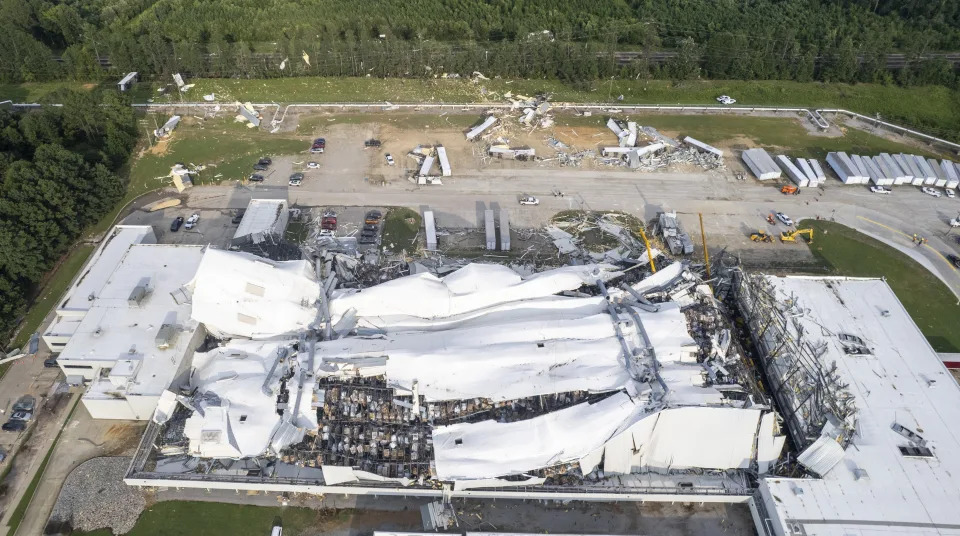
Debris is scattered around the Pfizer facility on Wednesday, July 19, 2023, in Rocky Mount, N.C., after damage from severe weather. (Travis Long/The News & Observer via AP)
Pessoas em situação de rua tentam se refrescar com água gelada diante do Centro Justa, um centro de convivência para pessoas sem teto acima de 55 anos de idade, sexta-feira, 14 de julho de 2023, no centro de Phoenix, EUA. (Foto AP/Matt York)
The Pfizer plant is damaged after severe weather passed the area on Wednesday, July 19, 2023 in Rocky Mount, N.C. (WTVD via AP)
A truck is overturned and the Pfizer plant is damaged after severe weather passed the area on Wednesday, July 19, 2023 in Rocky Mount, N.C. (WTVD via AP)
A patron tries to cool off at the Justa Center as temperatures are expected to hit 116-degrees Fahrenheit, Tuesday, July 18, 2023, in Phoenix. Tuesday marks a new record for the most consecutive days in a row over 110-degrees. (AP Photo/Ross D. Franklin)
Heat waves rise off the pavement as vehicles drive along a downtown street as temperatures are expected to hit 115-degrees Fahrenheit, Tuesday, July 18, 2023, in Phoenix. Tuesday marks a new record for the most consecutive days in a row over 110-degrees. (AP Photo/Ross D. Franklin)
A person tries to cool off in the shade as temperatures are expected to hit 116-degrees Fahrenheit, Tuesday, July 18, 2023, in Phoenix. The extreme heat scorching Phoenix set a record Tuesday, the 19th consecutive day temperatures hit at least 110 degrees Fahrenheit. (AP Photo/Ross D. Franklin)
A parking lot is flooded after heavy rain passed the area on Wednesday, July 19, 2023 in Paducah, Ky. The National Weather Service issued flash flood watches and warnings, estimating that as much as 10 inches (25 centimeters) of rain could fall in the area where Kentucky, Illinois and Missouri meet at the convergence of the Mississippi and Ohio rivers. (Courtesy of Marilyn Gabel via AP)
Workers cross roadway impacted by recent storms and flooding, Monday, July 17, 2023, in Belvidere, N.J. (AP Photo/Eduardo Munoz Alvarez)
Homes are damaged after severe weather passed the area on Wednesday, July 19, 2023 in Rocky Mount, N.C. (WTVD via AP)
The Pfizer plant is damaged after severe weather passed the area on Wednesday, July 19, 2023 in Rocky Mount, N.C. (WTVD via AP)
Homes are damaged after severe weather passed the area on Wednesday, July 19, 2023 in Rocky Mount, N.C. (WTVD via AP)
Transportation Secretary Pete Buttigieg, right, listens to Perry Hollyer, owner of the Inn by the River, describe flood waters, which destroyed his family's hotel, along the banks of the Lamoille River, Monday, July 17, 2023, in Hardwick, Vt. Last week's storms dumped up to two months' worth of rain in a couple of days in parts of Vermont and New York. (AP Photo/Charles Krupa)
A parking lot is flooded after heavy rain passed the area on Wednesday, July 19, 2023 in Paducah, Ky. The National Weather Service issued flash flood watches and warnings, estimating that as much as 10 inches (25 centimeters) of rain could fall in the area where Kentucky, Illinois and Missouri meet at the convergence of the Mississippi and Ohio rivers. (Courtesy of Marilyn Gabel via AP)
A senior swimmer clears his nose as he cools off in hot weather, Wednesday, July 19, 2023, in Pasadena, Calif. (AP Photo/Ryan Sun)
Utility wires cover a school bus after severe weather passed the area on Wednesday, July 19, 2023 in Rocky Mount, N.C. (WTVD via AP)
JP Lantin, owner of Total Refrigeration, works on a commerical air conditioning roof unit as temperatures are expected to hit 117-degrees, Wednesday, July 19, 2023, in Laveen, Ariz. (AP Photo/Ross D. Franklin)
A patron tries to cool off at the Justa Center as temperatures are expected to hit 116-degrees Fahrenheit, Tuesday, July 18, 2023, in Phoenix. The extreme heat scorching Phoenix set a record Tuesday, the 19th consecutive day temperatures hit at least 110 degrees Fahrenheit. (AP Photo/Ross D. Franklin)
JP Lantin, left, owner of Total Refrigeration, talks to a home owner on the repairs needed on her air conditioning unit as temperatures are expected to hit 117-degrees, Wednesday, July 19, 2023, in Laveen, Ariz. (AP Photo/Ross D. Franklin)
JP Lantin, left, owner of Total Refrigeration, and service tech Michael Villa, pick up their gear after replacing a fan motor on an air conditioning unit at a home as temperatures are expected to hit 117-degrees, Wednesday, July 19, 2023, in Laveen, Ariz. (AP Photo/Ross D. Franklin)
Michael Villa, a service tech at Total Refrigeration, works on a commercial air conditioning roof unit as temperatures are expected to hit 117-degrees, Wednesday, July 19, 2023, in Laveen, Ariz. (AP Photo/Ross D. Franklin)
After finishing up an air conditioning repair call, Michael Villa, a service tech with Total Refrigeration, takes a drink of water as temperatures are expected to hit 117-degrees Wednesday, July 19, 2023, in Laveen, Ariz. (AP Photo/Ross D. Franklin)
A billboard sign displays an unofficial temperature of 115-degrees Fahrenheit (46.1 Celsius) on Wednesday, July 19, 2023, in Phoenix. (AP Photo/Ross D. Franklin)
JP Lantin, right, owner of Total Refrigeration, and service tech Michael Villa, work on replacing a fan motor on an air conditioning unit as temperatures are expected to hit 117-degrees Wednesday, July 19, 2023, in Laveen, Ariz. (AP Photo/Ross D. Franklin)
A hiker passes a sign warning hikers of extreme heat at the start of the Golden Canyon trail on July 11, 2023, in Death Valley National Park, Calif. A 71-year-old Los Angeles-area man died at the trailhead on Tuesday, July 18, as temperatures reached 121 degrees (49 Celsius) or higher and rangers suspect heat was a factor, the National Park Service said in a statement Wednesday. (AP Photo/Ty ONeil)
Tourists hike the Golden Canyon trail on July 11, 2023, in Death Valley National Park, Calif. A 71-year-old Los Angeles-area man died at the trailhead on Tuesday, July 18, as temperatures reached 121 degrees (49 Celsius) or higher and rangers suspect heat was a factor, the National Park Service said in a statement Wednesday. (AP Photo/Ty ONeil)
A sign stands warning hikers of extreme heat at the start of the Golden Canyon trail on July 11, 2023, in Death Valley National Park, Calif. A 71-year-old Los Angeles-area man died at the trailhead on Tuesday, July 18, as temperatures reached 121 degrees (49 Celsius) or higher and rangers suspect heat was a factor, the National Park Service said in a statement Wednesday. (AP Photo/Ty ONeil)

RALEIGH, N.C. (AP) — A tornado heavily damaged a major Pfizer pharmaceutical plant in North Carolina on Wednesday, while torrential rain flooded communities in Kentucky and an area from California to South Florida endured more scorching heat.

Pfizer confirmed that the large manufacturing complex was damaged by a twister that touched down shortly after midday near Rocky Mount, but said in an email that it had no reports of serious injuries. A later company statement said all employees were safely evacuated and accounted for.

Parts of roofs were ripped open atop its massive buildings. The Pfizer plant stores large quantities of medicine that were tossed about, said Nash County Sheriff Keith Stone.

“I’ve got reports of 50,000 pallets of medicine that are strewn across the facility and damaged through the rain and the wind,” Stone said.

The plant produces anesthesia and other drugs as well as nearly 25% of all sterile injectable medications used in U.S. hospitals, Pfizer said on its website. Erin Fox, senior pharmacy director at University of Utah Health, said the damage “will likely lead to long-term shortages while Pfizer works to either move production to other sites or rebuilds.”

The National Weather Service said in a tweet that the damage was consistent with an EF3 tornado with wind speeds up to 150 mph (240 kph).

The Edgecombe County Sheriff’s Office, where part of Rocky Mount is located, said on Facebook that they had reports of three people injured in the tornado, and that two of them had life-threatening injuries.

A preliminary report from neighboring Nash County said 13 people were injured and 89 structures were damaged, WRAL-TV reported.

Three homes owned by Brian Varnell and his family members in the nearby Dortches area were damaged. He told the news outlet he is thankful they are all alive. His sister and her children hid in their home’s laundry room.

“They got where they needed to be within the house and it all worked out for the best,” Varnell said near a home that was missing exterior walls and a large chunk of the roof.

Elsewhere in the U.S., an onslaught of searing temperatures and rising floodwaters continued, with Phoenix breaking an all-time temperature record and rescuers pulling people from rain-swamped homes and vehicles in Kentucky.

Forecasters said little relief appears in sight from the heat and storms. For example, Miami has endured a heat index of 100 degrees Fahrenheit (37.8 degrees Celsius) or more for weeks, with temperatures expected to rise this weekend.

In Kentucky, meteorologists warned of a “life-threatening situation” in the communities of Mayfield and Wingo, which were inundated by flash flooding this week from thunderstorms. Kentucky Gov. Andy Beshear declared a state of emergency there Wednesday as more storms threatened.

Forecasters expect up to 10 inches (25 centimeters) of rain could yet fall on parts of Kentucky, Illinois and Missouri near where the Ohio and Mississippi rivers converge.

The storm system is forecast to move Thursday and Friday over New England, where the ground remains saturated after recent floods. In Connecticut, a mother and her 5-year-old daughter died after being swept down a swollen river Tuesday. In southeastern Pennsylvania, a search continued for two children caught in flash flooding Saturday night.

Meanwhile, Phoenix broke an all-time record Wednesday morning for a warm low temperature of 97 F (36.1 C), raising the threat of heat-related illness for residents unable to cool off adequately overnight. The previous record was 96 F (35.6 C) in 2003, the weather service reported.

Lindsay LaMont, who works at the Sweet Republic ice cream shop Phoenix, said business had been slow during the day with people sheltering inside to escape the heat. “But I’m definitely seeing a lot more people come in the evening to get their ice cream when things start cooling off,” LaMont said.

Heat-related deaths continue to rise in Maricopa County, where Phoenix is located. Public health officials Wednesday reported that six more heat-associated fatalities were confirmed last week, bringing the year’s total so far to 18. All six deaths didn’t necessarily occur last week as some may have happened weeks earlier but were confirmed as heat-related only after a thorough investigation.

By this time last year, there had been 29 confirmed heat-associated deaths in the county and another 193 under investigation.

Phoenix, a desert city of more than 1.6 million people, had set a separate record Tuesday among U.S. cities by marking 19 straight days of temperatures of 110 F (43.3 C) or more. It topped 110 again Wednesday.

National Weather Service meteorologist Matthew Hirsh said Phoenix’s 119 F (48.3 C) high Wednesday tied the fourth highest temperature recorded in the city ever. The highest temperature of all time was 122 F (50 C), set in 1990.

Across the country, Miami marked its 16th straight day of heat indexes in excess of 105 F (40.6 C). The previous record was five days in June 2019.

“And it’s only looking to increase as we head into the later part of the week and the weekend,” said Cameron Pine, a National Weather Service meteorologist.

The region has also seen 38 consecutive days with a heat index threshold of 100 F (37.8 C), and sea surface temperatures are reported to be several degrees warmer than normal.

“There really is no immediate relief in sight,” Pine said.

A 71-year-old Los Angeles-area man died at a trailhead in Death Valley National Park in eastern California on Tuesday afternoon as temperatures reached 121 F (49.4 C) or higher and rangers suspect heat was a factor, the National Park Service said in a statement Wednesday.

It is possibly the second heat-related fatality in Death Valley this summer. A 65-year-old man was found dead in a car on July 3.

Human-caused climate change and a newly formed El Nino are combining to shatter heat records worldwide, scientists say.

The entire globe has simmered to record heat both in June and July. Nearly every day this month, the global average temperature has been warmer than the unofficial hottest day recorded before 2023, according to University of Maine’s Climate Reanalyzer.

Atmospheric scientists say the global warming responsible for unrelenting heat in the Southwest also is making extreme rainfall a more frequent reality.

Finley reported from Norfolk, Virginia. Associated Press reporters Anita Snow in Phoenix, Freida Frisaro in Miami, JoNel Aleccia in Temecula, California, and Rebecca Reynolds in Louisville, Kentucky, contributed to this report.

Precious: Biden uses clips of Marjorie Taylor Greene speech for new campaign ad

CNN

Biden uses clips of Marjorie Taylor Greene speech for new campaign ad

Shania Shelton – July 19, 2023

Eva Marie Uzcategui/Bloomberg/Getty Images

President Joe Biden on Tuesday posted a campaign ad promoting his legislative wins by using clips from a recent speech GOP Rep. Marjorie Taylor Greene gave at the Turning Point Action Conference where she compared Biden to Franklin D. Roosevelt and Lyndon B. Johnson.

“Joe Biden had the largest public investment in social infrastructure and environmental programs, that is actually finishing what FDR started, that LBJ expanded on, and Joe Biden is attempting to complete,” Greene said in the video set to cheerful music.

The ad continues with another clip from the speech Greene gave over the weekend in which she explains the Biden administration’s investments. “Programs to address education, medical care, urban problems, rural poverty, transportation, Medicare, Medicaid labor unions, and he still is working on it,” Greene said.

In response to Greene’s speech, the White House tweeted on Monday: “Caught us. President Biden is working to make life easier for hardworking families.”

The congresswoman from Georgia – who was recently ejected from the House Freedom Caucus – tweeted on Tuesday, “This is really what Joe Biden approves,” in response to the campaign ad alongside a longer clip of her speech. In the new clip, she discusses economics in the country, explaining that “we are now $32 trillion in debt with record high homelessness, 40-year record inflation.”

The Biden administration has been promoting “Bidenomics” over the past few weeks – an economic theory which rejects the idea of “trickle-down” policies in favor of focusing on the middle class. It is expected to be a centerpiece of Biden’s 2024 reelection campaign.

The president first embraced the idea in June at a time when the administration was searching for a solution to Americans’ negative perception of the economy and a vehicle to take credit for an economy that is increasingly trending in the right direction.

In Florida, Swimmers Brave an Ocean That Feels Like Steamy Syrup

The New York Times

In Florida, Swimmers Brave an Ocean That Feels Like Steamy Syrup

Patricia Mazzei – July 19, 2023

Beachgoers at Key Biscayne Beach. (NYT)

The water temperature near Key Biscayne, a barrier island just east of Miami, had already passed 89 degrees Fahrenheit one morning this week. And though the ocean off South Florida was slightly cooler than the recent record highs that had stunned scientists and threatened marine life, it remained phenomenally hot.

But on this serene patch of the Atlantic Coast, it was still a summer day at the beach, when nothing satisfies quite like a dip — even when the ocean feels like a thick, simmering syrup. Almost gooey.

“I like it warm,” shrugged Niki Candela, 20, a Miami native, moments after a powerful siren warned of approaching lightning.

Few of the heat-dazed people on the largely empty beach paid it any mind. The shore, usually clogged this time of year with rotting clusters of seaweed, was pristine, no longer menaced by a huge sargassum blob that unexpectedly shrank last month in the Gulf of Mexico. The shallow water was a crystalline teal, rolling oh so gently, not a cresting wave in sight.

So the undeterred regulars, people who savor being hot and abhor the cold, came out to enjoy themselves.

“This is as close as America gets to paradise,” said Lauren Humphreys, 40, who is originally from England but splits her time between Miami and Los Angeles. There, she prefers hiking to swimming in the Pacific, which Tuesday reached about 72 degrees by the Santa Monica Pier.

Humphreys was making her second visit to Key Biscayne’s beaches that day, having come earlier to meditate. “There’s something quite special here,” she said. “It’s peaceful.”

Off the coast of neighboring Virginia Key, measurements from the National Oceanic and Atmospheric Administration showed that the water temperature peaked at 90.5 degrees on Monday, and the air temperature at 87.6 degrees. On Saturday, the water temperature at that location reached 92.5 degrees, a record.

The water in South Florida is always warm this time of year, but unusually so this year, with six record-high temperatures measured off Virginia Key this month. The sea surface hit 98 degrees in some areas of Florida Bay last week; the average ocean temperature in Miami in July is around 86.

Miami’s unrelenting heat this summer has meant 16 consecutive days with a heat index at or above 105 degrees, a record, according to Brian McNoldy, a senior research scientist at the University of Miami. The National Weather Service forecast a heat index of 110 degrees Sunday, issuing its first-ever extreme heat advisory for Miami-Dade County.

At the beach the next day, the scorching sand was to be avoided at all costs. “Talk to me here, so I don’t burn my feet,” Eduardo Valades, 51, told a reporter, beckoning toward the lapping water.

The water was “really hot,” he said, “but only as soon as you go in. Once you walk 50 yards out, it feels cooler.”

“I love it,” his wife, Jennifer Valades, 50, said.

The couple moved three years ago to Key Biscayne, an affluent village of about 14,000, from California. “Here, you can literally swim for hours,” she said, though she conceded that the beach was more pleasant — “perfect,” in fact — during the mild South Florida winter, when the water temperature is more likely to be in the mid-70s. Coastal temperatures are also more moderate than those inland.

Valades said she had recently spotted six or seven manatees. Valades showed a cellphone video he recorded last month of a large shark feeding right at the shore.

“We see one every three or four days,” he said, appearing far from worried about the sightings.

This week, toweling off seemed unnecessary: No one felt cold leaving the water.

“It feels like a Jacuzzi!” Sasha Mishenina told her two friends following a brief dip. They had declined to join her.

Yet going for a quick swim still felt refreshing, with the occasional cool current swirling by and little fish darting by people’s feet.

“I’m so happy, because they said we were going to have the sargassum,” Adriana Campuzano said of predictions this year, as she was gathering her stuff to leave before the looming thunderstorm. “It’s clearer than it’s been in years. Maybe in a decade.”

Candela had come to the beach with three friends. The ocean felt fine, she said, though she added that sometimes with such hot water, “you think, ‘What if someone’s peeing here?’”

She and her friends laid out their towels on beach chairs under an umbrella, put music on and waded in.

“It actually feels pretty cold,” said Taylor Dutil, 20, a fellow Floridian.

“It’s a good change,” said Benny Perez, 22, who is from Chicago, where Lake Michigan was far cooler that day.

The siren blared three more times, signaling the end of the lightning threat. Not a raindrop had fallen. The four friends stayed in the water, chatting and laughing.

‘Life or death’: Arizona heat wave poses lethal threat to homeless

AFP

‘Life or death’: Arizona heat wave poses lethal threat to homeless

Romain Fonsegrives – July 19, 2023

Hundreds of homeless people live in 'The Zone,' an encampment in Phoenix, the capital of the southwestern US state of Arizona (Patrick T. Fallon)
Hundreds of homeless people live in ‘The Zone,’ an encampment in Phoenix, the capital of the southwestern US state of Arizona (Patrick T. Fallon)

On a sidewalk in Arizona’s capital Phoenix, where a record-setting heat wave has prompted warnings for people to limit their time outside, Dana Page struggles to stay hydrated in her tarpaulin shelter.

The 49-year-old, surrounded by bottles of water, knows full well the dangers heat poses to the homeless population.

Days earlier, she watched emergency responders perform CPR on a fellow resident of “The Zone,” an encampment where hundreds live in tents and makeshift shelters, near downtown.

“He died just inches away from water,” she told AFP.

Phoenix, like much of the US southwest, is surrounded by desert, and its 1.6 million residents are used to brutal summer temperatures.

But this year’s heat wave is unprecedented in its length: it has already helped the city break its previous record of 18 straight days at or above 110 degrees Fahrenheit (43 degrees Celsius), with similar highs forecast into next week.

Page, a native of Phoenix, said she has had heatstroke three times in the past five years, describing it as a “secret killer” that sneaks up if not monitoring one’s water intake.

– Jump in heat-related deaths –

The absence of typical monsoon rains has also compounded the problem: no respite from searing heat during the day allows temperatures to remain dangerously elevated overnight.

“If this continues, we will see more heat-related deaths,” said Amy Schwabenlender, head of the Human Services Campus, a large facility near “The Zone” where 16 associations cooperate to provide social services, medical treatment and a shelter for those in need.

“It is a life-and-death situation,” she warned.

With its population growth among the highest in the United States, coupled with a lack of affordable housing, Arizona has seen the number of homeless people go up 23 percent in recent years.

And as global warming fuels more frequent extreme weather events, homeless people are increasingly vulnerable to the elements.

Maricopa County, which includes Phoenix and its suburbs, recorded a 25 percent increase last year in heat-related deaths, with 425 fatalities — many among the homeless population.

The National Weather Service warns that extreme heat is the top weather-related killer, and has recommended people in Phoenix “stay indoors and seek air-conditioned buildings” during the heat wave.

– ‘Enough resources to help everybody’ –

To deal with the emergency, the Human Services Campus is running at full speed. Its associations send out early morning patrols to distribute 2,000 bottles of water every day, as well as sunblock and hats.

Like some sixty other sites around the city, the facility also serves as a cooling center, where homeless people can find shade, misters and a vast air-conditioned cafeteria with film showings to pass the time.

Schwabenlender warns that scorching hot surfaces outside also pose a significant danger, especially for those with worn shoes or bare feet, as well as people who fall or lie on the ground.

“I saw a man who laid on something and all the side of his neck was burned,” she said.

Asphalt in the summer sun can climb to temperatures above 160F (71C).

A few days ago, former house painter Jose Itafranco collapsed on the sidewalk after consuming methamphetamine, but the 30-year-old said he was lucky to have his wife Alvira nearby to prop his body up.

“When you do meth… it really just makes you think that you’re tougher than you are… like you’re untouchable,” Itafranco told AFP.

“But what happens, really, is you get dehydrated.”

Schwabenlender argues the hundreds of heat-related deaths in Maricopa County could have been avoided with a more coordinated response, and calls for federal emergency action commensurate with other natural disasters.

The White House, for its part, outlined last week various federal initiatives related to “extreme heat fueled by the climate crisis,” including a forthcoming meeting with local officials to discuss preparedness, as well as the drafting of a “National Heat Strategy.”

“We have enough resources to help everybody, we just have to figure out how to put them all together,” Schwabenlender said.

Opinion: I’m a conservative who’s waiting for Republicans to come to their senses

CNN – Opinion

Opinion: I’m a conservative who’s waiting for Republicans to come to their senses

Yaffa Fredrick – July 19, 2023

Editor’s Note: Adam Kinzinger is a CNN senior political commentator and a former Republican congressman from Illinois. He served 10 years on the House foreign affairs committee. Kinzinger is also a lieutenant colonel and pilot in the Air National Guard. The opinions expressed in this commentary are his own. Read more opinion at CNN.

Traditionally committed to national security, global stability and law and order, my Republican Party — yes, I am still a Republican — is now weakening on all three fronts. In doing so, it is fulfilling the cliche that extremists on the right and left eventually come together, like a snake eating its tail.

Adam Kinzinger - CNN
Adam Kinzinger – CNN

That’s not only bad for America, but bad for the prospects of the GOP — particularly in light of the fact that the party’s leading 2024 presidential contender is currently under both federal and state indictment and facing further potential charges in Washington, DC, and Georgia (all of which he denies wrongdoing in).

The radical right has embraced positions on these bedrock Republican principles to try to lock in the support of the most fervent members of the base. But these stances will almost certainly doom them with the moderates and swing voters who turned out for President Joe Biden in 2020. In fact, it’s hard to imagine a better way to ensure that the GOP won’t win back the presidency.

Let’s start with the GOP’s decision to insert culture wars into a bill — the National Defense Authorization Act — that funds every function of the Defense Department, in a manner that all but guaranteed alienating a voting majority in America.

Among other maneuvers, the extreme conservatives in the House want to ban a Defense Department policy that covers travel costs for service members who must seek abortions out of state, extending an existing provision that provides funds to those who must get specialized care not available near their posts. The Pentagon put this extension in place when some states limited or banned abortion access after the Supreme Court ended the constitutional right to an abortion last year.

How do I know this amendment is politically toxic? First, over the last several years, there has been steady public support for abortion rights, which now includes more than one-third of all Republicans, according to Pew Research Center. Second, there’s the unseemly effort to stop funding for the military with an amendment that has nothing to do with defense. Granted, others try to attach similar off-topic amendments to bills. But they are not usually as likely to torpedo getting necessary funds to the Pentagon.

Thanks to overwhelming GOP support, the anti-abortion travel reimbursement amendment made it into the House bill. Republicans also added limits on transgender care and prohibitions on programs related to diversity. All three fit the extreme right movement’s so-called “anti-woke” agenda, which seeks to block the government from supporting various groups of Americans on the basis of race, sexual orientation and gender identity.

GOP presidential candidate and Florida Gov. Ron DeSantis has made anti-wokeness, opposition to abortion and criticism of rights for transgender people central to his appeal to primary voters, but there’s little evidence that his stand will win over people in a general election. And House members who cling to his message in an effort to win primary voters may very well suffer defeat in a general election.

Unfortunately, further extremist (and self-defeating) mischief is taking place in the Senate, where Republican Sen. Tommy Tuberville of Alabama has put a hold on military nominations. Under the Senate’s arcane rules, Tuberville has been blocking consideration of some 265 military officers for several months. His reason? The Defense Department’s travel support for service members seeking out-of-state abortion services.

Tuberville’s grandstanding won’t persuade the Senate to change the Pentagon policy, but as an Air National Guard lieutenant colonel, I can tell you that blocking promotions is bad for the smooth operation of the chain of command at the heart of America’s national security structure. It’s also bad for morale. And it’s personally insulting to the men and women who are willing to sacrifice so much for this country.

But these culture war issues aren’t the only threat this crowd of extremists is posing to global stability. Last week, they tried unsuccessfully to tie up the defense bill by trying to scale back US aid to Ukraine by hundreds of millions of dollars.

As much of the world understands, Ukraine is in a fight for its life against a Russian military that invaded in February 2022. The Russian attack was unprovoked and pitted the much larger country, run by the autocratic leader Vladimir Putin, against a democracy that has thus far been able to defend itself, thanks in large part to US aid.

The defense of democracy has long been a conservative ideal, and that includes standing with our allies under attack. It’s hard to see the opposition to aid as anything other than the betrayal of an ally and friend.

Although the House ultimately voted down the amendment to limit aid to Ukraine, the fact that it was even introduced shows just how out of step much of the Republican Party is with the public on the issue of Ukraine. According to a Reuters/Ipsos poll from last month, 65% of Americans support the US arming Ukraine — including 81% of Democrats, 56% of Republicans and 57% of independents. In that same poll, large majorities of Americans said they would support a US presidential candidate who would continue to provide strong military aid to Ukraine.

And then there’s the hostility these GOP extremists are directing at law enforcement, traditionally a wellspring of Republican support. This newfound animosity was on full view last week when FBI Director Christopher Wray appeared before the House Judiciary Committee.

Committee Chairman Jim Jordan of Ohio and several equally exercised Republicans members attacked a “weaponized” bureau for serving as an anti-conservative attack dog. Jordan and others have been using this word — “weaponization” — to argue, without solid evidence, that the federal government in general is pursuing an anti-conservative agenda. Echoing leftists who call for defunding the police, the House’s right-wing extremists want to slash the FBI’s budget.

The attacks on Wray revolved around hot-button campaign issues, including the investigations into former President Donald Trump’s handling of top-secret documents, the plea agreement in the case of Hunter Biden’s tax crimes and the FBI’s surveillance efforts. At one point, finger-pointing Republican Rep. Matt Gaetz of Florida said the FBI “deserves better than you” to Wray.

Following Trump’s example, Wray’s congressional interrogators treated him with the disrespect you might expect from members of the radical left in the 1960s. I’m certain that as they mimicked the former president, they were attempting to court his voters; but I saw House members leading their party into a political wilderness where moderate voices may just join Democrats to end the GOP’s control of the House.

It is a display of sheer political malpractice for any Republican to suggest cutting FBI funding. While the left-wing’s call to “defund” the police has been much derided, a Gallup poll from last October found rising public support for the FBI. The agency is now seen favorably by 79% of Democrats — and 50% of Americans overall.

As appalling and politically misguided as the far-right’s behavior has been, most Republicans in both the House and Senate have not been inclined to oppose it directly. They obviously fear losing the support of Trump and his followers. But I think this choice is short-sighted and may ultimately backfire.

Despite his lead in the polls, Trump does not have a lock on the 2024 presidential nomination. He did not win the presidency the last time he ran, and it’s clear that he has been a drag on GOP senators and representatives who have campaigned in the years since.

On this evidence, I’d say that the extremists are hurting, not helping, the national Republican Party. At some point, more and more normal Republicans will see the damage they are doing. In the meantime, conservatives like me will wait for our party to come to its senses.

Climate change and Florida’s home insurance crisis: Here’s what homeowners should know

Palm Beach Daily News

Climate change and Florida’s home insurance crisis: Here’s what homeowners should know

Lianna Norman, Palm Beach Post – July 19, 2023

There are many contributors to Florida’s insurance crisis. One of the biggest contributors are huge insurance payouts attached to yearly storm damage following hurricane season, exacerbated by climate change.

Over 100,000 Floridians are scrambling for homeowners insurance after a wave of insurers have stopped writing policies in the disaster-prone state.

Last week, Farmers Insurance became the most recent insurer to drop coverage of Florida, announcing that the “decision was necessary to effectively manage risk exposure.”

Here are four reasons why insurance rates are rising in Florida

Florida’s insurance crisis: Farmers Insurance is the 4th major insurer to leave Florida

How has climate change affected the insurance industry?

Hurricane Ian, the last major hurricane to seriously impact Florida homeowners in the fall of 2022, cost the National Flood Insurance Program more than $1.2 billion in payouts to policyholders recovering from damage.

“FEMA estimates Hurricane Ian could potentially result in NFIP claims losses between $3.7-$5.2 billion,” FEMA’s website says. “The losses include flood insurance claims received from five states, with the majority of claims coming from Florida.”

study led by researchers from the Pacific Northwest National Laboratory and published in a peer-reviewed journal found that Hurricanes impacting the U.S. could rise by one-third compared to what hurricane season looks like now, at the rate that the climate is currently changing.

Florida isn’t the only state affected. Some insurance policy providers have also hiked prices or dropped out of states like California, Colorado and Louisiana due to rising risk of insuring homes in flooding or wildfire-prone areas.

The cost of the insurance crisis: Homeowners’ insurance costs are going up amid climate change. Here’s how to lower yours.

Which insurance companies are dropping customers in Florida?

This month, Farmers Insurance joined Bankers Insurance and Lexington Insurance, a subsidiary of AIG, in dropping out of Florida’s insurance market.

AAA is still writing policies, but the company said this week they will not renew its package policies that combine home, automobile and optional umbrella coverage. AAA says a “small number” of customers will be affected.

The Florida Department of Financial Services has a list of 14 companies that are in liquidation. This means that the Office of Insurance Regulation determined that there are grounds for the Department of Financial Services to proceed with charging these companies for delinquency.

Here are the insurers from that list that offered property insurance:

  • American Capital Assurance Corp.
  • Avatar Property and Casualty Insurance Co.
  • FedNat Insurance Co.
  • Florida Specialty Insurance Co.
  • Gulfstream Property and Casualty Insurance Co.
  • Southern Fidelity Insurance Co.
  • St. Johns Insurance Co.
  • United Property and Casualty Insurance Co.
  • Weston Property & Casualty Insurance Co.

Insurance costs are rising in Florida: Does your Florida county rank in the state’s most expensive home insurance premiums?

What’s the average cost of homeowners insurance in Florida?

Floridians pay some of the highest prices for home insurance in the nation. Most are paying about $6,000 for their yearly home insurance premium, an increase of 42% compared with last year, a spokesperson for the Insurance Information Institute told USA TODAY.

With each year and each hurricane season, the cost for homeowners insurance in Florida increases exponentially faster than the national rate.

Lianna Norman covers trending news in Palm Beach County for The Palm Beach Post. 

Seniors are migrating to states that face America’s most extreme heat

The Washington Post

Seniors are migrating to states that face America’s most extreme heat

Joshua Partlow, Greg Morton, Scott Dance, Brianna Sacks – July 19, 2023

SUN CITY, Ariz. – It was 6:15 p.m., 110 degrees, the speakers were playing “Hot Blooded” by Foreigner and the seniors of suburban Phoenix were blissfully arm-pumping their way around the walking pool.

“Quite honestly, I’m good up to 110 now, you do acclimate,” said Bob Hirst, who decamped from northern Virginia two years ago with his wife, Vicky, to this 55-and-over community.

Despite the blistering evening, Ira Schneider was happily submerged in the hot tub, which was a relief of sorts at around 100 degrees. He’d lived in Phoenix for 22 years. To get him to return to his native New York, he said, “you’d have to scrape me off a cactus.”

Phoenix saw a record-breaking 19th consecutive day above 110 degrees on Tuesday. The extraordinary run of punishing heat poses a particular risk to the elderly, who are more likely to suffer from heart disease, diabetes and other health problems that make it harder to tolerate extreme heat. And while some retirees have the resources to cope with scorching temperatures, others remain much more vulnerable – even as demographic data shows that this group continues to gravitate to sunny and warm parts of the country that are in the crosshairs for extreme heat.

Phoenix first responders and medical personnel say they are worried about seniors who may be isolated and living without air-conditioning, or those who fall and can’t get up on days when the concrete and pavement can be so hot it’s deadly.

Many of the places that, in recent years, have become attractive destinations for seniors are among those most affected by the historic heat wave camped out over the southern United States, according to an analysis by The Washington Post of forecast data from the National Weather Service and migration data from the U.S. Census Bureau.

Between 2008 and 2021, Maricopa County, which includes Phoenix, has received more than 68,000 people age 65 or older – more elderly migrants than any county in the country, according to census data. For the past several weeks, Maricopa has also been one of the hottest counties in the United States. This weekend, its heat index – a measure of how hot it feels outside that includes temperature and humidity – averaged over 110 and is expected to climb as high as 117 this week.

Those trends converged in a particularly dangerous way on Sunday at an RV park for the elderly in Mesa, east of Phoenix. The power went out for dozens of homes at the Viewpoint RV and Golf Resort, according to residents, and stayed out for nearly 24 hours – a period when temperatures in the area reached 118 degrees.

Many who lost power moved to hotels or stayed with relatives as the temperatures inside their homes soared, residents said. Robert Steffen and his wife, Gretchen, took refuge at his son’s house in Chandler for the night. When they returned Monday morning, they said the temperature inside their home was in the mid-90s.

Some residents, including people in wheelchairs and with other health problems, spent the night in sweltering conditions, said Kathleen Noble, a homeowner in the community who is also a board member of the Arizona Association of Manufactured Home, RV & Park Model Owners.

“Park managers, especially for the elderly, need to have some kind of an emergency plan set up during these times of high heat,” she said.

The power came back on midday Monday, residents said. The park’s management office did not answer the phone and Equity LifeStyle Properties, which owns the RV park, did not respond to a request for comment.

The combination of rising electricity demand and surging heat could be disastrous. Recent research found that in a city such as Phoenix, blackouts during a heat wave could kill thousands of people.

Nationwide, extreme heat exposure among people age 69 and older could more than double by 2050, according to a study published in March. The research looked at the number of people who will experience heat waves as well as their frequency and intensity. It attributed the surge in exposure to a convergence of three factors: the population at large is aging; the population of older people is growing in the swath of southern states known as the Sun Belt; and average temperatures are increasing everywhere as Earth’s climate warms.

Those trends also mean many older people underestimate the threat of extreme heat, whether because they are new to a hotter region, or because heat is becoming more intense in parts of the country that have been traditionally cooler, said Deborah Carr, a sociology professor at Boston University and the study’s lead author.

Moreover, older people are more likely to have preexisting health conditions that make extreme heat harder to tolerate. Common medications for heart disease and high blood pressure are dehydrating and reduce the body’s ability to cool itself by sweating, something many people don’t take into account when considering their ability to withstand heat, Carr said.

“If someone has underlying conditions, it’s going to be worse,” she said.

Florida, another haven for snowbirds and seniors, is also broiling in the recent heat wave. Lee County, which includes Fort Myers, is home to more than 200,000 Americans 65 and older and is one of the most popular places for elderly migrants, recent census data shows. The heat index is expected to surpass 100 degrees this week in the county, driven in large part by extreme humidity.

Sitting barefoot in a chair with the front door of his motel room open on Saturday, Joseph Sull couldn’t ever remember being this hot. The 76-year-old has lived in southwest Florida for nearly 20 years, and is used to sweltering summers, but this year’s historic stretch of heavy humidity has been “brutal” and has prevented him from spending time outside, like he usually loves to do.

After Hurricane Ian totaled his mobile home last September, Sull has been living in a motel, along with a handful of other victims, most of whom are also elderly. For days on end, Sull has sat in his small, air-conditioned room, watching “nothing happening,” as he says.

This kind of oppressive heat has made his world much smaller, having made the few routines he has, like taking a walk, very uncomfortable to do.

“I can’t sit in here all day with the door closed. It drives me crazy,” he said. “I need the fresh air and want to look at something else besides these four walls. It’s hard.”

In Phoenix, doctors say they regularly see elderly patients who suffer from heat stroke and burns once temperatures surpass 100 degrees. Diabetic patients who suffer from neuropathy and can’t feel their feet sometimes walk out onto hot surfaces, suffering serious burns, they said. Nearly two-thirds of the 425 heat-associated deaths in Maricopa County last year were individuals age 50 or older.

Frank LoVecchio, an emergency medicine physician at Valleywise Health Medical Center in Phoenix, said he saw an elderly woman last week who had fallen from her wheelchair at her nursing home and couldn’t get off the hot patio.

“She was there for like five minutes maybe,” he said. “And she had third-degree burns.”

Phoenix firefighters who respond to heat distress cases say the elderly and the immunocompromised tend to be among the most vulnerable. They have responded to help elderly people whose homes get too hot because they won’t turn on air conditioning or don’t have any.

The health impacts of extreme heat are easier to discount than, say, the dangers of a tornado or hurricane because they aren’t as readily apparent, said Peter Howe, a professor at Utah State University. Authorities usually know soon after a storm how many injuries or deaths it caused, but it often takes much longer to determine the toll of a heat wave, he said.

“We can do retrospective studies several months to years later, but we don’t really have good real-time data,” Howe said.

Migration to the Sun Belt, which air conditioning helped enable over the past half century, is still increasing as people seek out milder winter weather, said Albert Saiz, director of MIT’s Urban Economics Lab. At the same time, high costs and housing scarcity are driving people away from the Northeast and other regions, he said.

“It’s both a pull and a push,” he said.

Scott Dudlicek, a claims manager for a technology company, left Chicago after 54 years and moved to Sun City outside Phoenix in the summer of 2019.

“I came down on a visit for a work conference and said, ‘I’m tired. I’m done with the snow and the cold,'” Dudlicek recalled. “It was 113 when we were down here. I loved it.”

When he returned to Chicago it was 90 percent humidity, he said, and he was soon drenched through his shirt.

He told his wife: “That’s it. We’re moving.”

“And we were down here a year later.”

Morton and Dance reported from Washington. Sacks reported from Iona, Fla. Caitlin O’Hara in Sun City contributed to this report.