Former RNC Chair Names The Chilling Lesson Donald Trump Has Learned For 2024
Lee Moran July 26, 2023
Donald Trump has learned a “very valuable lesson” from his failed efforts to overturn his 2020 election loss, Michael Steele warned on Tuesday.
The former president likely won’t let lawyers again thwart his attempt to subvert democracy if he becomes the GOP nominee in 2024, the former Republican National Committee chair told MSNBC’s Katie Phang.
Instead, Steele said next time around they will just tell Trump: “Yes, sir, how do you need this done? When does it need to be done? And how do we corral the forces across the country to make sure it sticks?”
Michael Steele warned that Donald Trump, pictured, has learned a
Michael Steele warned that Donald Trump, pictured, has learned a “very valuable lesson” from 2020.
Steele’s prediction came during a discussion about former senior Justice Department official Richard Donoghue, who this week revealed he’d been interviewed by special counsel Jack Smith’s office as part of the investigation into Trump’s attempts to overturn the election.
Donoghue, during testimony to the House last year, said he’d rejected Trump’s efforts to flip the result. Donoghue’s stance against Trump was important “to understand just how thin that line was for us in 2020 and why that line will be obliterated should he get reelected in ’24,” said Steele.
Trump won’t face such opposition next time around, Steele suggested.
Trump has already reportedly vowed to seize presidential authority “over every part of the federal government that now operates, by either law or tradition, with any measure of independence from political interference by the White House,” according to a New York Times article.
NBC News presidential historian Michael Beschloss this week warned it would mean Trump’s second term would be a “presidential dictatorship.”
Smith is reportedly close to indicting Trump, who last week said he’d received a target letter from the special counsel.
Whitmer signs bills impacting Michigan teachers and potentially bringing more to the state
Clara Hendrickson, Detroit Free Press – July 26, 2023
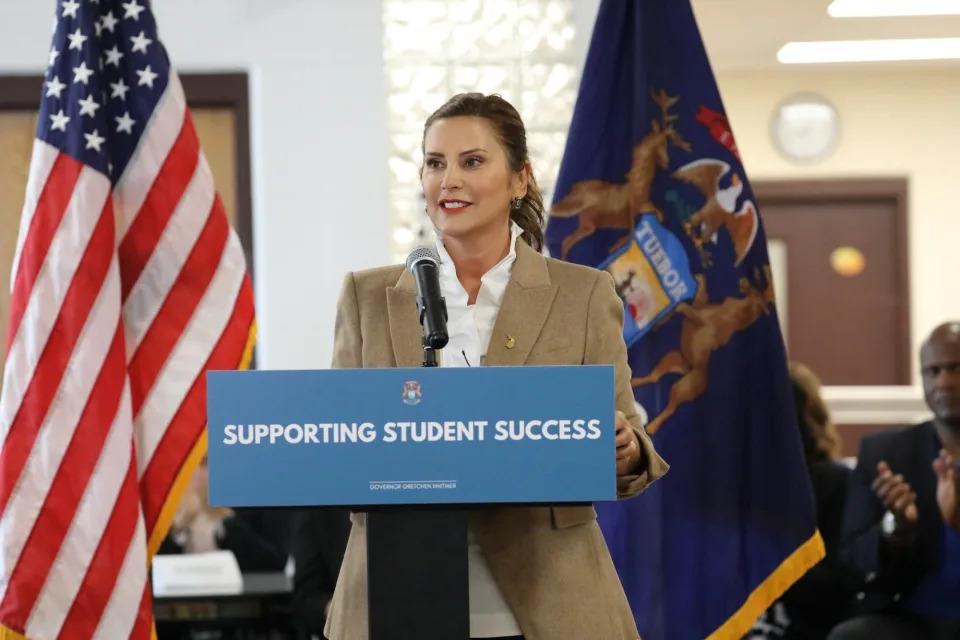
Gov. Gretchen Whitmer signed a series of bills Wednesday that expand bargaining power for teachers’ unions, make it easier for out-of-state teachers and counselors to move to Michigan and eliminate a restriction on setting teacher pay that only applies to Detroit educators.
“This legislation will build on our efforts to recruit and retain the talented educators that provide Michigan students with a phenomenal education,” Whitmer said in a statement.
The bills aren’t the only changes to education policy the governor has made recently. Earlier this month, she overhauled the state’s education department, announcing the creation of a new one that will consolidate early childhood and higher education programs currently spread across multiple state agencies. Last week, she signed an education budget that will provide free breakfast and lunch to all PreK-12 public school students and expand eligibility to enroll in Michigan’s state-funded preschool program.
Here’s a look at the other changes the bills signed by Whitmer will bring to Michigan’s classrooms.
Gov. Gretchen Whitmer speaks at a bill signing ceremony in Suttons Bay on July 20, 2023 before signing the education budget.
Whitmer signed House Bill 4354, which eliminates restrictions on teacher’s unions from bargaining with public schools about performance evaluation systems and teacher placements. House Bill 4820 signed by Whitmer also changes how seniority is considered in public schools’ personnel decisions. Currently, length of service generally cannot be factored into those decisions.
Whitmer also signed House Bill 4044, which repeals a ban on public employers paying higher wages and providing more generous benefits after a collective bargaining agreement expires. And Whitmer approved House Bill 4233 which eliminates a prohibition against public school employers from using school resources to help unions collect dues or fees from public school employees. Bill sponsor state Rep. Jaime Churches, D-Wyandotte, touted the legislation for enabling teachers to automatically have their union dues withdrawn from their paychecks.
House Minority Leader Matt Hall, R-Richland Township, blasted the legislation. “As they hand out favors and power to their union boss allies, Michigan Democrats are continuing to undermine public education and put the needs of students last,” he said in a statement. With the exception of House Bill 4233 which garnered the support of one GOP lawmaker − state Sen. Ed McBroom, R-Waucedah Township − Republicans opposed the package bills.
Senate Bill 359 signed by Whitmer eliminates the requirement that compensation for Detroit teachers and administrators be determined primarily on the basis of job performance. Instead, it allows teacher and administrator pay to take into account the number of years spent on the job and advanced degrees held by Detroit Public Schools Community District employees.
The bill has its origins in a 2016 Republican effort aimed at addressing financial challenges facing Detroit’s public school system which created a different process for determining teacher and staff compensation from the rest of the state.
Bill sponsor state Sen. Stephanie Chang, D-Detroit, said in a June statement that the ban on considering longevity and advanced degrees to determine Detroit teachers’ compensation was an “unfair prohibition” that has caused teachers to leave the district.
Lure out-of-state teachers and counselors to Michigan
Finally, Whitmer signed Senate Bills 161 and 162 aimed at making it easier for school teachers and counselors to move to Michigan. The pair of bills reduce the barriers both out-of-state teachers and school counselors face to work in Michigan’s schools by easing the state’s teacher and school counselor certification requirements.
Sheryl Kennedy, the legislative liaison for the Michigan Department of Education, said about a quarter of Michigan teachers moved in from out of state and the bills could make Michigan a destination for educators. “Michigan’s kind of really becoming a place where teachers really want to go from other states,” she said during a hearing on the legislation.
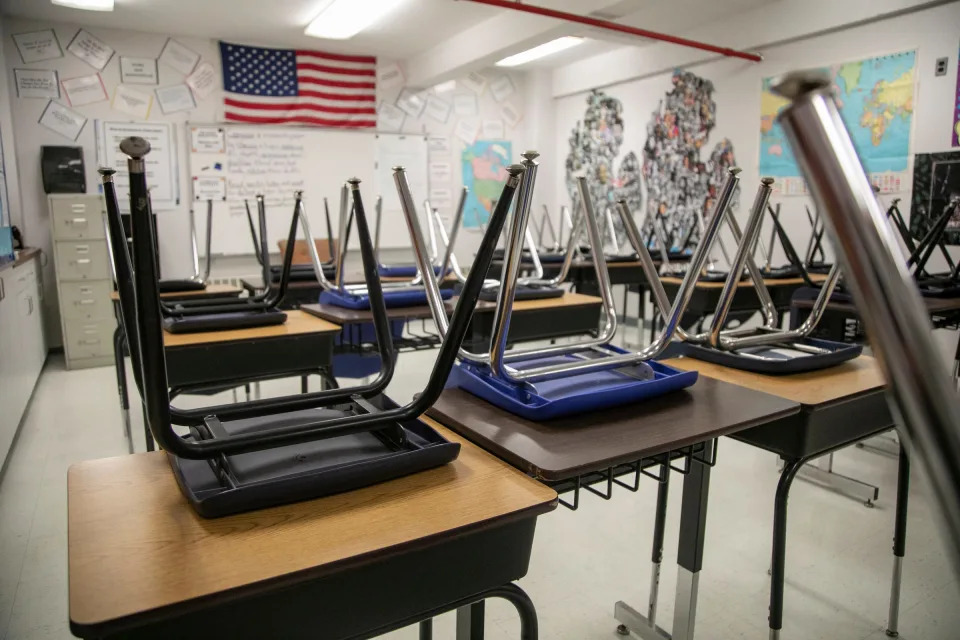
A classroom sits empty at the Cesar Chavez Academy High School in Detroit last March after the pandemic hit.
Senate Bill 161 enables those with a teaching credential from a federally recognized Indian tribe or another country to apply to the state superintendent of public instruction to receive a teaching certificate without needing to take teacher certification exams in Michigan. The bill also eases the criteria for those eyeing a move from another state to Michigan to teach. For example, it allows those with a teaching certification from another state, federally recognized Indian tribe or country to be eligible for a Michigan professional education certificate if they have successfully taught for at least three years in their prior jurisdiction.
Senate Bill 162 creates similar pathways for out-of-state school counselors.
Excess Deaths Among Republicans Skyrocketed After Covid Vaccine Became Available, Study Finds
Nikki Main – July 26, 2023
More Republicans died than Democrats after the Covid vaccine was released
As covid vaccines started to roll out in February 2021, misinformation and conspiracy theories surrounding the shot were on the rise—as were the deaths of Republican voters.
A new study from Yale University looked at 538,159 people in Ohio and Florida starting on May 1, 2021, and focused on counties that reported lower vaccination rates. In the first year of the pandemic, the number of covid-related deaths was evenly dispersed among both Democrats and Republicans, but that quickly changed within a month after the vaccine became available to all U.S. adults.
The study found the “excess mortality was significantly higher for Republican voters than Democratic voters after COVID-19 vaccines were available to all adults, but not before,” noting that the death rate for Republican voters was 43% higher than for Democratic voters after the vaccine was widely available. However, the study notes that the data did not include whether the individual was vaccinated or if their deaths were directly linked to covid-19, but researchers looked at the divide in political party-affiliated deaths between January 2018 and December 2021 and compared the pre-pandemic death rate to deaths recorded post-Covid vaccine.
“We’re not saying that if you took someone’s political party affiliation and were to change it from the Democratic Party to the Republican Party that they would be more likely to die from covid-19,” the study’s lead researcher Jacob Wallace told The Wall Street Journal.
This study is not the first to reflect an increase in deaths following the rollout of the Covid-19 vaccine, with KFF estimating in April of last year that at least 234,000 Covid deaths recorded between June 2021 and March 2022 could have been prevented if the individuals had received the vaccine. “These findings suggest that differences in vaccination attitudes and reported uptake between Republican and Democratic voters may have been factors in the severity and trajectory of the pandemic in the US,” the study says.
The higher rate of Republican deaths has been widely attributed to misinformation and mistrust in official sources of information surrounding both the vaccine and the pandemic. Liz Hamel, the vice president of public opinion and survey research at the Kaiser Family Foundation told NPR in 2021, “An unvaccinated person is three times as likely to lean Republican as they are to lean Democrat.” The NPR analysis found that people in counties that primarily voted for Donald Trump in the 2020 presidential election were three times as likely to die from covid-19 compared with those living in counties that leaned toward President Joe Biden.
Despite Wallace and his team’s findings, Florida Governor and presidential candidate Ron DeSantis continues to claim that Florida got it right when it came to its handling of the pandemic and filed a petition to investigate vaccine makers for fraud. He filed the petition to the Florida Supreme Court in December, alleging conspiracies about the scientific evidence that the vaccine is resistant to new variants. “It is impossible to imagine that so many influential individuals came to this view on their own,” he wrote. “Rather, it is likely that individuals and companies with an incentive to do so created these perceptions for financial gain.”
The rise in misinformation about Covid vaccines is still affecting the number of people who believe it is safe, with only 49% of Republicans reporting they are “very” or “somewhat” confident in the vaccine versus 88% of Democrats, according to a March study conducted by Stephen Neely at the University of South Florida.
Speaking on the Yale study, Neely told The Post the findings were important because they shed light on how a response to the Covid vaccine has shaped how the death toll played out. “It’s one of the most telling metrics I’ve seen in how the politicization of the pandemic has played out in the real world,” he said.
Watch Moment Amazon Driver Dives Fully Clothed Into Customer’s Swimming Pool to Cool Off
Kirsty Hatcher – July 26, 2023
Watch Moment Amazon Driver Dives Fully Clothed Into Customer’s Swimming Pool to Cool Off
The moment was captured on the Californian homeowner’s CCTV amid the soaring temperatures in the U.S.
Well, that’s one way to cool off!
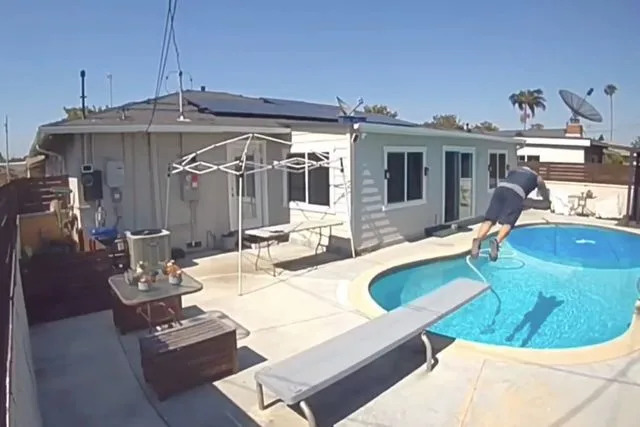
After making a delivery, an Amazon driver dived fully clothed into a customer’s swimming pool to beat the soaring temperatures.
The driver, who even kept his shoes and cap on, used the customer’s diving board to dive head-first into the pool of the home in Gardena, California.
The moment, which occurred on June 30, was captured on one of the home’s security cameras and has since gone viral.
According to ViralHog, the customer left a note in the delivery instructions that read, “If you want to go for a swim, you are welcome to.”
Mario Fermin via ViralHogAmazon driver dives fully-clothed into customer’s pool
In the video, the driver is seen leaving the customer’s parcel outside a door in the backyard. He then walks over to the diving board and takes a dip.
Parts of the U.S. have been experiencing a heatwave over the last few weeks. According to Reuters, Death Valley, Phoenix and Las Vegas were among some of the hottest places in the U.S. earlier this month.
And Fourth of July was reported to have been the hottest day ever recorded on Earth — and it broke the record set just one day before.
Mario Fermin via ViralHogAmazon driver dives fully-clothed into customer’s pool
On that day, the global average temperature hit 62.92 degrees Fahrenheit, according to the Climate Change Institute at the University of Maine. It was the hottest day recorded since temperatures began to be documented in 1979 with satellite stock recording — and it’s believed to have been one of the hottest days in at least 125,000 years, according to The Washington Post.
The day before, the global temperature average was 62.62 degrees Fahrenheit, making it until then the hottest day on record. Before that, the last highest recorded temperature average was 62.46 degrees in August 2016, per the Post.
Rising temperatures amid global climate change are “a death sentence for people and ecosystems,” Friederike Otto, a senior lecturer at the Grantham Institute for Climate Change and the Environment, told Bloomberg.
In a tweet, author and climate scientist Bill McGuire also wrote that the record-breaking July 4 heat was “totally unprecedented and terrifying.”
Last week, a 71-year-old man died at a trailhead in Death Valley National Park. Hours before his death, Steve Curry spoke to a reporter about braving the extreme heat.
Nearly 28,000 Iowans have been disenrolled from Medicaid. Here’s why:
Michaela Ramm, Des Moines Register – July 26, 2023
Nearly 28,000 Iowans have been disenrolled from Medicaid this year as part of Iowa’s redetermination process — a consequence of continuous coverage no longer being guaranteed.
The latest data from the state’s Health and Human Services Department shows 27,744 Iowans were disenrolled from the safety net health insurance program since April, when Iowa began “unwinding” expanded eligibility.
About 30% of those Iowans — 8,401 — were disenrolled for procedural reasons, including failing to return paperwork.
The remaining 19,343 were deemed ineligible for further coverage, state data shows.
Since April, the state has been reviewing the eligibility of 900,000 Iowans who receive Medicaid and CHIP (the Children’s Health Insurance Program) benefits to determine if they still qualify under pre-pandemic regulations.
Federal health officials and other advocates have raised alarms about the number of people disenrolled for procedural reasons, which refers to those who did not return their paperwork or otherwise failed to complete the renewal process.
They say people may not be aware they’re up for renewal or recently changed addresses and didn’t receive the paperwork.
“What we’re seeing across the country from the first two months is that whilst people have done a lot to prepare, at the same time there are a lot of people losing their coverage,” said Dan Tsai, director of the Center for Medicaid and CHIP Services. “A really high number of folks are losing coverage for what we call procedural reasons.”
State officials managing the redetermination process, however, say the current rate of disenrollment, including procedural drop-offs, was expected. Iowa Medicaid Director Liz Matney said the department’s data show the majority of those kicked off the program have health insurance coverage elsewhere.
“It’s not surprising. If somebody gets renewal paperwork and they say they don’t need Medicaid anymore, why would they submit paperwork?” Matney told the Des Moines Register. “So when the team has been looking at the individuals who are disenrolled for any reason, but particularly for those who are disenrolled for not returning their paperwork, we can tell in our system who has other health insurance.”
That data has not been made publicly available on the state’s dashboard.
Still, officials with the Centers for Medicare and Medicaid Services have called on Iowa and other states to simplify the process. In addition to keeping individuals who qualify on Medicaid, states also need to connect low-income residents with other coverage options, Tsai said.
“We’re looking for states to also do everything in their power, way beyond what the federal minimums are, to try to make it easier for eligible people to keep their coverage,” Tsai told the Register. “If you’re not eligible for Medicaid, we want you on your employer-sponsored coverage. We want you on the ACA plans. We don’t want you uninsured, and that’s the bottom-line focus for us from a federal standpoint.”
Typically, Iowans on Medicaid undergo a redetermination process every year to check their eligibility to see whether they still qualify.
But as part of the federal government’s response to the coronavirus pandemic starting in March 2020, states were required to maintain coverage for individuals on Medicaid, even if they no longer qualified. In exchange, states received enhanced federal funding to manage the health insurance program.
In Iowa, more than 168,000 individuals maintained coverage during the three-year pause on Medicaid redeterminations, state data shows.
That requirement to maintain continuous coverage ended in March 2023, when federal officials ended the national public health emergency.
As a result, the state’s health and human services department is checking the eligibility of hundreds of thousands of Iowans on Medicaid and CHIP, a massive undertaking that must be completed by May of 2024. Matney said state employees are processing close to 70,000 new applications every month, a “huge increase” from the typical redetermination process pre-pandemic.
Early estimates showed about 136,000 Iowans would be disenrolled from Iowa Medicaid, the state’s $7 billion privatized program, by the end of the 12-month unwinding period.
The state agency has worked to automate as much as possible and has launched a public messaging campaign to spread the word to members to turn in their paperwork. The managed care organizations that administer Medicaid benefits also have engaged in direct outreach to members, including knocking on the doors of some members to help them fill out their application, Matney said.
How many Iowans have renewed their coverage?
As of June, 854,791 people were enrolled in Iowa Medicaid and CHIP. That’s 39,053 fewer than in April.https://flo.uri.sh/visualisation/14502335/embed
In the first three months of the “unwinding” process, 105,401 enrollees renewed their coverage under the Iowa Medicaid program, according to state data.
Of those, about half — 51,940 — were renewed on an “ex parte basis” or automatically renewed based on information the state has on the enrollee. The remaining 53,461 enrollees who renewed their coverage filled out and returned the redetermination paperwork sent by the state.
Federal officials call on states to do more. What is Iowa saying?
As the redetermination process continues for the next several months, Matney said she expects the number of individuals disenrolled, including for procedural reasons, will level off.
State officials had flagged enrollees who were likely ineligible for continued coverage, and frontloaded their reviews early in the redetermination process. As a result, Matney said, the rate of procedural dropoffs from April through July will be higher than the remaining months of the unwinding process.
Matney said enrollee data shows as much as 85% of individuals disenrolled from Medicaid have insurance elsewhere, such as an employer-sponsored plan. It also shows most of those who were disenrolled are adults.
The remaining portion is likely still eligible for Medicaid, which is why the state implemented a 90-day grace period to allow members to reapply for coverage, even if they missed the deadline, Matney said.
“If they get their paperwork in within that 90 days, we’ll backdate to the date that they last covered, so there’s no gap,” Matney said.
Members will most likely find out they no longer have Medicaid coverage when they pick up prescriptions. Matney said a possible solution could come in the form of partnerships with pharmacies, allowing those providers to complete presumptive eligibility determinations and help members get back on Medicaid quickly.
However, she said many states are finding pharmacies are not signing on to help with that work.
CMS has recently taken steps to address the number of Americans kicked off Medicaid coverage during this process, even pausing redetermination efforts in some states that have violated federal regulations, according to a press briefing from last week. Federal officials did not list the states involved.
Tsai said CMS officials are continuing to call on states, especially those with higher rates of procedural dropoffs, to utilize federal waivers offered by CMS for states’ redetermination efforts. These temporary policy changes are structured to help ease the process for members and ensure the nation’s uninsured rate doesn’t spike.
Among those waivers is extending postpartum coverage for Medicaid recipients to a year, a policy that has not been adopted in Iowa. Currently, the state provides members with 60 days of postpartum coverage.
“Under that, there definitely is more room for Iowa to be able to take up more of those,” Tsai said.
Matney said at this stage in the unwinding process, she doesn’t see any need to use additional policies offered by federal health officials to ease the process.
“We’ve gone through the list and really done the analysis of what we’re already doing versus what would be more administratively complicated,” Matney said. “The juice isn’t worth the squeeze in some such situations, and so right now, we’re still in the same spot. But we’ll be evaluating that, and if we feel additional waivers are important and necessary to help ease the process for ourselves and for Medicaid members and Iowans in general, we’ll certainly pursue that.”
Michaela Ramm covers health care for the Des Moines Register.
What frightens me about the climate crisis is we don’t know how bad things really are
Roger Harrabin – July 25, 2023
As the barrage of bad news from places like Greece continues, all we can be certain of is there are many surprises lying ahead.
‘What is the use of a net zero policy if it relies in part on planting trees that may crackle in wildfire?’ Firefighters tackle wildfires on the Greek island of Rhodes, 25 July 2023. Photograph: Graeme Robertson/The Guardian
Over the past few decades, climate scientists have made huge strides in understanding the future climate. But after recent weeks of extreme heat and devastating floods it’s clear that, although climate models have provided good information about overall rising temperatures, they can’t be sure what level of destruction each notch on the thermometer will bring.
Climate modelling is extremely complex, but its fundamentals rely on basic physics – X tonnes of emissions will bring Y increase in temperature, with some error bars. Supercomputers have been able to factor inshifts in land use that will change the reflectivity of the Earth’s surface. Improved temperature records helped verify their findings.
But lately,leading researchers have made a painful confession: even their most sophisticated models can’t yet foresee exactly how Earth systems will respond to those higher temperatures.
The influential Intergovernmental Panel on Climate Change (IPCC) says cranking up global temperature by half a degree will bring much more extreme weather, and it can be more often, more intense, or extended in duration – but exactly how much more, it can’t precisely say.
So, for instance, we’ve already had a global temperature rise of about 1.2C: that’s in line with IPCC projections. Yet the panel couldn’t warn us about the appalling heat dome that’s been searing North America. I can’t find heat domes mentioned in the bible of climate change, the IPCC report. This periodic report inevitably lags behind new science and – under pressure from some governments and industries, as well as a desire not to scaremonger – its pronouncements tend to be conservative.
The models also couldn’t warn us accurately about the emergence of the heat trapped deep in the ocean, which soaks up 90% of the world’s excess warmth. In the 35 years I covered the environment for the BBC, I recall speculation that the warmth could stay deep for decades, perhaps centuries – not that some of it would suddenly burst up to the surface off the coast of northern Britain.
Major uncertainties remain, too, over rainfall. Good information about the future of monsoon rain would be a godsend for farmers who rely upon it – not just in India but in southern China. Unfortunately, good information on precipitation is proving a bit tricky to find.
The macro models also failed to project the effect of current elevated temperatures on ice at both poles. The former IPCC chief, Prof Bob Watson, told me: “I am very concerned. None of the observed changes so far (with a 1.2C temperature rise) are surprising. But they are more severe than we predicted 20 years ago, and more severe than the predictions of five years ago. We probably underestimated the consequences.”
This is a massive admission. He added: “Scientists are only now starting to understand the response of large ice sheets in Greenland and Antarctica – and it is very disturbing.”
Prof Jane Francis, director of the British Antarctic Survey, told me a few months ago the latest science on ice melt was “truly scary”.
‘The US has considered itself less vulnerable. But tell that to people in Phoenix trapped under that heat dome.’ Photograph: Matt York/AP
Watson said at current rates the world would almost certainly exceed the agreed maximum temperature rise of 1.5-2C. We would be lucky to get away with 2.5C, he said. More likely, we’re heading towards 3C.
That number positively frightens many climate scientists. But, as India starts stockpiling rice with a temperature rise of 1.2C, what useful advice can scientists offer for a 3C world? Just how bad will things be by then?
Should holidaymakers avoid buying homes in Greece? China is vulnerable to extremes – how should its economy adapt? The US has considered itself less vulnerable. But tell that to New Yorkers choking on wildfire smoke, or people in Phoenix trapped under that heat dome.
While immediate harm to people grabs the headlines, what’seven more destructive could be the impact of heat and humidity on food production for an expanding population. A global shift towards a plant-based diet could halve the land and water used for agriculture – and halve the carbon emissions – but politicians fear angeringvoters by recommending a dietary shift.
Facing all this gloom means we need imagineers as well as climatologists. Watson said civilization will still exist in the future, but with much worse living conditions. But what sort of a degraded civilization might that be? By then we may even have triggered some natural tipping points that could result in a massive release of trapped methane in the tundra – let’s hope not.
What we do know is that so far, the effects of heating the climate are sooner and worse than many scientists projected (in public at least). This has policy implications. The world has agreed to cut emissions to net zero by 2050, but the UN secretary general, António Guterres, says rich countries should be aiming to squeeze the timetable to 2040. But what is the use of a net zero policy if it relies in part on planting trees that may shrivel in future drought or crackle in wildfire?
To make matters worse, climate heating is one thing on a list of huge environmental problems – including pollution of the air and water, destruction of wildlife habitats, overfishing, insect population declines, loss of birds, plastic pollution, nitrates, soil loss and more.
Watson says we don’t know how these phenomena will interact with each other, but he urges politicians to err on the side of caution, as the stakes are so very high. Every 0.1C warming matters, scientists say: 1.5C is better than 1.6C. That in turn is less bad than 1.7C.
As the barrage of bad news continues, all we can be certain of is that there are many climate surprises lying ahead of us. Governments, companies and individuals need to urgently squeeze down emissions to insulate ourselves as far as possible from what we may face.
Roger Harrabin is an energy and environment analyst and a former BBC correspondent
I hope you appreciated this article. Before you move on, I was hoping you would consider taking the step of supporting the Guardian’s journalism.
From Elon Musk to Rupert Murdoch, a small number of billionaire owners have a powerful hold on so much of the information that reaches the public about what’s happening in the world. The Guardian is different. We have no billionaire owner or shareholders to consider. Our journalism is produced to serve the public interest – not profit motives.
And we avoid the trap that befalls much US media – the tendency, born of a desire to please all sides, to engage in false equivalence in the name of neutrality. While fairness guides everything we do, we know there is a right and a wrong position in the fight against racism and for reproductive justice. When we report on issues like the climate crisis, we’re not afraid to name who is responsible. And as a global news organization, we’re able to provide a fresh, outsider perspective on US politics – one so often missing from the insular American media bubble.
Around the world, readers can access the Guardian’s paywall-free journalism because of our unique reader-supported model. That’s because of people like you. Our readers keep us independent, beholden to no outside influence and accessible to everyone – whether they can afford to pay for news, or not.
If you can, please consider supporting us just once from $1, or better yet, support us every month with a little more. Thank you.
Trump’s downfall is coming: Now the Democrats must use his crimes to finish him
Chauncey DeVega – July 25, 2023
Donald Trump; Capitol Riot; January 6 Photo illustration by Salon/Getty Images
It now appears that Donald Trump, a criminal mastermind who has spent decades evading serious responsibility for his behavior, may finally have met his match. The doubly-indicted ex-president — with a third and fourth indictment likely to follow soon — now faces multiple felony trials and criminal investigations across the country for violations of the Espionage Act, financial fraud and other serious crimes connected with his attempts to overturn the 2020 election.
Last week Trump confirmed that the Department of Justice has sent him a “target letter” indicating that special counsel Jack Smith may soon charge him with defrauding the United States and “deprivation of rights under color of law” in connection with the Jan. 6 coup plot. Trump also faces potential charges related to tampering with witnesses and “obstruction of an official proceeding.”
Experts have noted that one statute cited in the target letter (Section 241 of Title 18) was created during Reconstruction in an attempt by federal authorities to protect the rights of newly freed Black Americans from the Ku Klux Klan and other Southern white terrorist groups.
Trump still has a vast war chest of money and considerable resources of other kinds, but those are being depleted by his growing legal expenses. In all probability, he will still be the 2024 Republican presidential nominee. But his latitude of action and his ability to escape the law appears, at least for now, to be diminishing. The “Trumpocene” era may be drawing to a close, but what may happen next in this truly unprecedented historical period remains unclear.
Are we truly witnessing Trump’s downfall — and if so, why did it take so long? Where would the country be now if Attorney General Merrick Garland had moved faster?
What about Trump’s tens of millions of MAGA followers, the largely subservient Republican Party, the right-wing news media and all the other tools he has at his disposal? Can those resources help him escape justice and accountability once again? In an attempt to make sense of the road ahead for Donald Trump and the fate of American democracy, I recently asked a range of experts to offer their thoughts and insights.
Rachel Bitecofer is a political analyst and election forecaster.
The idea that former President Trump and his co-conspirators might get away with their plain-sight crimes, as serious as attempting to seize permanent power via disrupting the transfer of power, has haunted many of us over the past two years. So it is a big relief to see we have moved past this corrupting idea that American presidents cannot be prosecuted, a concept I feel certain even the Federalists would have found horrifying.
Finding out that the FBI was actively involved with trying to prevent search and seizure in the Mar-a-Lago classified documents case, despite a year of theft, lies, and concealment of important national security documents — combined with reports that Garland and the Department of Justice remained inert on investigating the principals behind the Jan. 6 insurrection until the House select committee forced them into it — does not exactly inspire confidence in the system. The fact is, if the Department of Justice had led, and not followed, on the Jan. 6 investigation we would be living in a very different legal reality than we are now, where we are likely to see a criminally convicted Republican nominee running in the fall general election.
I would like to believe that Trump will be neutralized, and won’t be on the ballot in November of next year. But my experience and instincts tell me this crisis is far from over and that many twists and turns and dangers remain. The fact is, Trump continues to receive preferential treatment from the federal justice system, and that should concern every law abiding American. The “two-tiered system” of justice that Trump and his MAGA allies like Speaker McCarthy decry is actually this: There is one standard for someone like Jack Teixeira, a National Guardsman recently indicted for stealing classified intel who is being held in custody as a risk to national security, and another for Donald Trump, who despite allegedluy committing similar crimes, is free on bond. Few defendants facing charges of classified info disclosures receive bond, let alone release without any conditions or seizure of the defendant’s passport. So, the jury is still out, so to speak, as to whether our federal judicial system can meet this moment.
That said, my assumption is that as indictments stack up across multiple federal and state venues, less committed Republican voters who are currently inclined to vote for Trump will start to conside giving Joe Biden a second term.
Look for the Trump campaign and their allies to flood the zone on polls, as they did during the run-up to the 2022 midterms in an attempt to disguise the failure of their “red wave” to materialize. Keep in mind that the bulk of primary voters do not follow the daily news, and will not start doing so until this fall. I think that state-level “fake elector” charges that tap into the people who powered the conspiracy are likely as important as the prosecutions of Trump himself.
Much of Trump’s power hails from his “supporting cast” of MAGA Republicans, who to this day continue to perpetuate the lies at the heart of the criminal conspiracy. If there are criminal penalties for illegal actions taken by these people, we may start to see Trump’s echo chamber fracture. That is key to breaking the mass psychosis behind the MAGA movement.
Norm Ornstein is emeritus scholar at the American Enterprise Institute and contributing editor for the Atlantic. He is also co-author of the bestselling book “One Nation After Trump: A Guide for the Perplexed, the Disillusioned, the Desperate, and the Not-Yet Deported.”
It is frankly a relief that Trump now is finally going to be charged with the ultimate crimes: direct attempts to destroy American democracy and instigate a violent insurrection. Of course, I would have preferred that this had happened earlier — and I wish Jack Smith had been given the case much earlier to expedite it. But I also know that a case that was not complete and had not tied up every loose end might have ended with a dismissal or an acquittal — or at least with a hung jury because of one diehard Trumpist who would be fine with him shooting someone on Fifth Avenue in broad daylight. We will have to wait to see what the charges are, and who is cooperating. But I doubt that people like Mark Meadows or former Arizona Gov. Ducey would have been willing to cooperate if the ask had come a year or more ago.
The fact that other prosecutors, including Fani Willis, have not brought charges yet shows that this is a common feature of complex and highly charged cases, not simply Merrick Garland dragging his feet. To be sure, nothing would have altered the disgraceful reactions of the Kevin McCarthys and Elise Stefaniks.
The bad news is that even after charges are brought, it will take months before they result in a trial. Some of the delays will no doubt be driven by the bias of Judge Cannon in Florida, but cases involving a lot of classified material inevitably take longer. It is possible we will have one or more trials during the primary stage, or even later than that. And it remains true that none of this seems to be changing the Republican primary voters in their attachment to Trump. He may be a presidential nominee facing multiple criminal trials during the campaign and after the election. That’s nightmarish, to be sure. But what would be more nightmarish is if he were not held accountable for multiple offenses against the United States and all of us.
Cheri Jacobus is a former media spokesperson at the Republican National Committee and founder and president of the political consulting firm Capitol Strategies PR.
While a target letter implies indictments are coming, it’s well over a year late. Possibly too late. Merrick Garland has afforded Trump the luxury of time to build, fundraise, agitate, organize, propagandize, blackmail, brainwash, bribe, threaten, energize, incite, strengthen his hold on his base and possibly grow it. Trump’s appointed judge, Aileen Cannon, has set a trial date for the stolen classified documents case for May, 2024, likely ensuring further delay as the GOP primary will be underway and likely showing Trump as the presumptive nominee. This calendar is fraught with peril for justice and democracy. Had Garland not inexplicably sat on his hands for so long, we’d be in trial stage by now, and the GOP donors and candidates would have plenty of reason to move on from Trump and lead his cult followers away from the cliff.
The reality is that Trump will likely be the GOP nominee and has a very good chance of becoming president again. He can run and serve if he is indicted, prosecuted, found guilty and even if he is serving time in prison. There is nothing in our Constitution forbidding it.
It is becoming apparent that our only hope may be the 14th Amendment, which bars an insurrectionist from office. Section 3 of the amendment — the Disqualification Clause — bars any person from holding state or federal office who took an oath to support the Constitution as an “officer of any State” and then “engaged in insurrection or rebellion” or gave “aid and comfort” to insurrectionists. It would have to be brought to court in each state. A “test” case brought by CREW in New Mexico was successful, as an officeholder who was on the Capitol steps on Jan. 6 was removed from office by a judge. If Trump is properly convicted for his role in the insurrection, the path to keeping him off the ballot (at least in enough states) and out of the White House will be the 14th Amendment.
I’m pleased the walls look to be closing in, and that the special prosecutor appears to be pursuing this aggressively. Accountability here is desperately needed. No one who leads an insurrection against the peaceful transfer of power should be allowed to run for office again. If Garland had moved faster, we might have lived up to such a foundational and crucial principle. The delayed pursuit also sent a message across the country that undermined the seriousness of what happened. If you’re a less partisan voter trying to make sense of all the clamor and rhetoric about Jan. 6, the lack of early movement by the attorney general signaled that it must not have been that bad. That false narrative has shaped perceptions ever since, and will likely do so as any trial proceeds.
Trump will win the Republican primary, and I think Biden remains in a strong position to beat Trump in the general election. The extremism of the far right, made so real by the Dobbs decision and what’s happened since, continues to be the prime driver of voting behavior.
My primary anxiety is whether those on the side of democracy take advantage of this opportunity by competing and winning up and down the ballot, including state legislative races. With democracy in the balance, it’s no longer good enough to simply win federal races in a few swing states, leaving untouched most of the places where extremism is advancing and democracy undermined. To reverse the downward spiral, those fighting for democracy must widen and deepen their battle plan for both ’23 and ’24.
Rich Logis, a former member of the Republican Party and right-wing pundit, is the founder of Perfect Our Union, an organization dedicated to healing political traumatization, building diverse pro-democracy alliances and perfecting our union.
Irrefutably, Trump is partly responsible for the insurrection; the justification of politically motivated violence was one of the reasons I left behind the politically traumatic world of Trump/MAGA/GOP. Jack Smith’s Jan. 6 charges are going to be bad, and I will not be surprised if he charges Trump with seditious conspiracy or treason; Smith knows he must show evidence that Trump knows he lost the 2020 election, and I am certain Smith will provide such proof. We still really don’t know what Trump was doing for three hours, once the insurrectionists breached the Capitol. Privately, the GOP, as well as Trump’s primary opponents, are beyond ecstatic over Trump’s legal problems, but they are grossly incorrect in their likely assumption that such problems weaken Trump: The more he’s indicted, the stronger his support grows with the GOP’s primary voting base.
I fully appreciate that many are dissatisfied with the speed at which Attorney General Garland moved. In fairness, he is not only in an unenviable position but an unprecedented one. I am a staunch defender of Garland: He has never lost a case he has tried, is a man of granite integrity and would not have taken the job had he thought he’d be coaxed into doing anyone’s bidding; this was proven by his prosecution of Hunter Biden. If Trump committed crimes, Garland will win at trial. Holding Trump legally accountable is mandatory, if we, as a nation, are going to overcome the mistake of Trump’s election.
One immense benefit that Trump, DeSantis, etc., have is that most of the American electorate isn’t political; most only pay attention a month, or two, before an election. The Democratic Party needs to stop worrying about Biden’s age and the polls, and start worrying about how to reach the tens upon tens of millions of Americans who are apolitical.
Because of the Electoral College, Trump was much closer to winning in 2020 than the Democratic Party wants to acknowledge. Biden’s re-election is not guaranteed. America has survived one Trump presidency. But another? It is a risk we must not take. The most beneficial outcome for the country is to electorally mercy-kill the GOP. We must be patient in affliction, simultaneously bringing the good news of conserving democracy to the afflicted.
The target letter by Jack Smith reveals that Trump’s numerous criminal transgressions are at the very least catching up to him. Whether or not this will result in any form of accountability remains to be seen, but it is certainly a troubling development for the leading GOP presidential candidate, whose 2016 campaign included the chant, “Lock her up!” Karma, thanks to Merrick Garland and the Justice Department, was slow and late to respond, but this is certainly bad news for Trump and his MAGA minions. Over in Michigan, Attorney General Dana Nessel announced felony charges against 16 Michigan residents for their role in the alleged false electors scheme. This is in addition to the two existing indictments against Trump.
We still haven’t heard from District Attorney Fani Willis of Georgia, who has Trump dead to rights thanks to his phone call asking the secretary of state to “find” him the votes he needs. For normal people who aren’t protected by whiteness, wealth and the GOP, all of this would be enough to send a person to jail for years. However, everything is skewed to mollify the radicalized anger of white rage and MAGA, so I won’t hold my breath for Trump’s incarceration. I remain cynical, because he is a former president and I recall that Richard Nixon never spent a day of his life in jail and went on to a lucrative speaking and writing career. Still, we need more accountability, and this will only increase the pressure on Trump’s minions, such as Meadows and others, to play ball with law enforcement.
These people are brittle and weak porcelain dolls who won’t last a day in jail. They’ll sing like birds. None of this will dampen MAGA support for Trump, and we already see the GOP leadership rallying around him. Even Megyn Kelly, whom Trump mocked and ridiculed, has made amends with her former tormentor. Masochism is the price to pay when you’re in a political cult. I do believe this will weaken Trump and Republicans leading up to 2024, however, and build up the rich narrative of his awesome corruption and the GOP’s utter, craven complacency and complicity.
‘I Drank 8 Glasses of Water Instead of Only 3 Every Day for 2 Weeks—Here’s What I Noticed Right Away’
Beth Ann Mayer – July 25, 2023
The idea of staying hydrated throughout the day is nothing new, and the reminders become more prevalent as the temperatures rise each summer. And have they risen this summer or what? About one-third of Americans were under excessive heat warnings earlier this month. It’s so hot in Europe that they’re naming their latest heat wave after a character in Dante’s Inferno.
I’ve decided to pick this hot-as-hell (literally?) summer to get back into marathon running for the first time since 2018, the year before I got pregnant with my first of two sons. I’ve felt parched (normal) and dizzy (not normal) after running. I’ve also realized I probably finish one 24-ounce water bottle daily.
Part of this is because my second child considers my water bottle a toy (despite all the other real toys he has). So, I generally keep it out of his sight and mind, which means out of my reach. At 17 months, he nurses like a newborn—another reason I need to stay hydrated.
Between the weather and my training regimen, I knew this had to change for my health. So, I committed to drinking more water.
The standard recommendation is to drink eight 8-ounce glasses of water daily. The guidance likely stems from a 1945 Food and Nutrition Board recommendation to drink eight glasses of water per day. A few things got lost in the sauce in the decades since. The first was followed by, “Most of this quantity is contained in prepared foods.” Translation: Fruits and vegetables contain water that counts toward your daily intake. The second: the Nutrition Board advised people to consume 2.5 liters (84.5 ounces) daily, not eight 8-ounce glasses (64 ounces).
In the years since, researchers have debunked this recommendation as a myth. But The National Academies of Science, Engineering and Medicine recommends men drink 125 ounces (3.7 liters) and women drink 91 ounces (2.7 liters), which isn’t all that more than the 1945 recommendation.
I’ve also done numerous interviews with dietitians and doctors since starting my writing career nearly a decade ago. Regarding water, and without fail, multiple health professionals have told me that starting with a goal to drink 64 ounces of water daily is a good baseline.
It’s certainly better than 24 ounces. I had to start somewhere.
In theory, drinking more water is one of the simplest, lowest-cost ways to enhance your health. You truly don’t need much except access to clean, safe water (sadly, a luxury for some) and something to drink it out of. To help me stay on track, I decided to use a few tools:
My trusty 24-ounce water bottle. I’m a words person, not a numbers person. But 64 divided by 24 is 2.66, meaning just under three full water bottles would get me to 64 ounces.
Waterllama app. This app sends notifications to remind you to drink water and allows you to track consumption. When I was pregnant with my first, I actually tracked water using an app and found it helped me stay on track with nutrition. I figured the notifications would also help me remember to sip, even when juggling work and parenthood.
On the first day, I realized how little water I drank. By noon, I had consumed 12 ounces of water. Some may call that a water bottle half full, but it felt half empty to me. I had 12 hours left to drink a whopping 52 ounces of water to meet my goal. I gulped. And gulped. And gulped. I spent the rest of the day feeling like I had a stomach full of water and like I was pregnant again because I needed to pee every five seconds.
There had to be a better way that felt less like a pressure-filled fire drill. I decided to set small goals beginning on day two. I’d aim for 24 ounces by noon, 24 ounces by dinner and 16 ounces between dinner and bed. And, to make it feel like less of a hill to climb, I focused on referring to it as “one water bottle by lunch,” “one water bottle by dinner” and “two-thirds of a water bottle by bed.”
The method worked instantly. I received a notification every two hours to drink water, and I was able to do a quick water bottle check to ensure I was sipping enough. I always was and felt accomplished as I watched my water intake numbers go up in my app.
The biggest challenge on the second day was my three-mile morning run. It was already pushing 80 degrees at 7:30 a.m., and I was dehydrated by the end. On the third day, I consumed 12 ounces an hour before working out. It allowed me to use the facilities pre-workout but have enough left in my tank to complete an even longer run of five miles.
By day five, drinking 64 ounces of water felt way more manageable. I felt better during my workout and more hydrated throughout the day, but I still had dizzy spells and felt rather depleted by dinner.
Cleveland Clinic notes that several factors dictate how much water you should consume daily, including:
The weather is warmer than usual, and my physical activity is higher now because of my training. And, like I said, I’m nursing a toddler.
I decided to focus on drinking at least 64 ounces daily, but not considering that a maximum. Instead, my goal became to drink enough to feel good. On days seven and eight, I drank before I got thirsty and got up to 80 ounces. I felt better. However, during the second week, I realized that between 100 and 110 ounces was more of my sweet spot. I never felt dehydrated or dizzy and could run around and play with my kids. Not surprisingly, I needed more on days I did longer runs.
Because drinking more water is low-cost, it sounds like a super-simple way to boost your health. But it can be challenging, particularly if you’re super focused on your career and tend to put everyone else first (hello, parenthood). That was probably my biggest takeaway, so please be kind to yourself if you struggle to stay hydrated.
My other learnings include:
Eight 8-ounce glasses daily is a baseline. This recommendation—which was never the real recommendation—is a good starting point. However, it may not be your endgame.
Water intake is fluid. No pun intended. However, it’s perfectly normal to need extra water on one day when it’s really hot, or you did a more intense workout than you did on a rest day that you spent mainly in the blissful air conditioning.
Drink when you’re not thirsty. Don’t wait until you’re dehydrated or thirsty to drink—those are late-stage signs you need water, not early ones.
Water is pre-workout fuel. Sipping water about an hour before working out will help you feel more hydrated during your sweat session (minus the urge to pee one mile into a six-mile run).
Stop before bed. Try to limit water intake about an hour before bedtime to reduce the midnight bathroom run (rest is also essential to health). You may need to reduce consumption sooner or later, but I found 60 minutes worked for me.
Apps help. I’ll probably stop tracking now that I’m in a flow with my water intake. I found tracking can aid in accountability but become a bit obsessive for me, but it was an excellent tool to get me started. Play around with it and see if it helps you reach your hydration goals short and long-term.
Water is essential. Though eight glasses daily may be a misnomer, the benefits of staying hydrated can’t be understated. I felt so much better when I woke up in the morning, during workouts and throughout my day because I was more hydrated. I had more energy to chase my kids around and tackle my to-do list.
On the last point, I hesitate to call drinking water “self-care” because it’s something necessary (in the same way showering with the door closed or grocery shopping alone aren’t really “self-care” but get pinned in that way for busy moms).
But it’s also not something to sacrifice to care for your children or get work done. Fill your cups (or water bottles) so you’re not quite literally pouring from an empty one all day.
State grapples with rampant algae that can cause lung infections and neurological disorders: ‘A bullet in the chamber’
Stephen Proctor – July 25, 2023
Toxic algae is overtaking the largest freshwater lake in Florida, hampering the summer plans of thousands — and the situation is likely to worsen. While plans are underway to alleviate the problem going forward, some are skeptical.
What’s happening?
Lake Okeechobee in southern Florida is currently half full of bright green toxic algae, which is expected to increase throughout the summer.
“We’re looking at a bullet in the chamber here,” Eve Samples, executive director of the conservation group Friends of the Everglades, told The New York Times of the growing bloom.
A handful of conditions allow the dangerous algae to thrive. According to reporting, the severity of the algal bloom is largely due to our overheating planet, which has caused increased storms and rainfall that have stirred up phosphorus that the algae need to grow. The phosphorous has mostly been sourced by fertilizer runoff from rivers upstream that feed into the lake. Rising levels of carbon dioxide pollution, which the algae need, intensify the problem.
While blooms of algae aren’t uncommon for Florida in the summer months, blooms of this magnitude are, and they seem to be occurring more often.
In 2018, Lake Okeechobee experienced a similar bloom that leaked into surrounding canals and the Caloosahatchee River. That year, toxin-producing algae exploded in both fresh and saltwater ecosystems, leading to former Governor Rick Scott to declare a state of emergency.
Downstream algae outbreaks from Okeechobee’s outflows also significantly impacted coastal communities in 2013, 2016, and 2018, causing beaches to be closed and businesses to shut down. Some residents were evacuated as well.
Why toxic algae is concerning
The Florida Department of Health issued a health alert in June warning the public to exercise caution in and around the area of Lake Okeechobee. Those looking for summer fun in the lake were warned not to swim, wade, ski, or boat where there is a visible bloom. They were also told to keep pets away from the water, and for good reason.
The toxic algae overtaking Lake Okeechobee can cause major health issues for humans and animals, including lung infections, organ damage, and neurological disorders. The algae-contaminated water is so harmful that even boiling it will not eliminate the toxins, according to health officials.
What’s being done about the toxic algae
The Army Corps of Engineers is undertaking a massive project to combat the growing issue of toxic algae affecting not only Lake Okeechobee, but the surrounding area as well.
A 10,500-acre reservoir expected to be completed in 10 years or so will capture at least some of Okeechobee’s toxic outflows. This is in addition to the recently completed 6,500-acre artificial wetland designed to remove nutrient pollution before water flows out into the Everglades.
Some are skeptical, though, of the project’s impact, as the new reservoir will fill to capacity after draining only 6 inches of water from Lake Okeechobee, per The New York Times.
An earlier proposal for a 60,000-acre system was scrapped due to objections from the local agricultural community.
There’s enough blame to go around for Florida’s insurance crisis, but not where you think | Opinion
Robert Sanchez – July 24, 2023
There have been many good reasons to criticize Gov. Ron DeSantis, especially during his second term, but Florida’s property insurance crisis is not among them. It’s a problem that has festered for years and began long before DeSantis came along.
Even so, Florida’s increasingly desperate Democrats tried to blame him and his fellow Republicans last week after Farmers Insurance abruptly announced that it would be reducing its risks by scuttling thousands of policies.
The Farmers move occurred in a state where more than a dozen insurers have recently gone broke, and where others are selectively non-renewing some of their policies, especially for properties in high-risk areas such as barrier islands.
The burden of providing coverage has fallen upon Florida’s “insurer of last resort,” the state-owned Citizens Property Insurance. Now it’s being forced to raise its own rates lest it become insolvent after the next major natural disaster.
Seeing the insurance problems as a political opportunity, Democratic Party Chair Nikki Fried, noting the obvious that Florida’s insurance premiums are “through the roof,” declared that the situation is “totally unacceptable,” and complained that solutions proffered by legislative Democrats “have gone completely unheard.”
Meanwhile, one of Democrats’ legislative leaders had an especially far-fetched notion of what to do to fix the state’s otherwise intractable problems, which are contributing to premiums way above the national average: Her suggestion: Let the insurance commissioner be elected rather than appointed.
That was a solution suggested by House Minority Leader Fentrice Driskell, D-Tampa. She was a 19-year-old Harvard undergraduate back in 1998, when Florida voters resoundingly approved amending the state Constitution to shrink the elected Cabinet and, among other changes, have the insurance commissioner be appointed rather than elected.
It seems that voters had noticed that running a statewide political campaign in a state the size of Florida required tons of money. When candidates for insurance commissioner ran, lots of that money came from — surprise! — the insurance industry itself, including the companies, brokers and agents. Moreover, the successful candidates sometimes had more political skills than useful insights into insurance issues.
As for realistically addressing the underlying factors causing Florida’s property insurance crisis, some of them are — and will remain — beyond the capability of any governor, legislator or insurance commissioner to address.
For instance, to the extent that natural disasters are factors in Florida’s higher rates at a time when forecasters expect windstorms to be more frequent, intense and destructive, no public official — whether elected or appointed — can do much to change the geography of a peninsular state bounded by the warming (and rising) waters of the Atlantic and Gulf.
This has not escaped the attention of the global reinsurance companies, which provide insurance for insurance companies. As a result, they’re charging higher rates to the insurance companies, which pass them along to Florida’s property owners.
Another major factor contributing to the higher rates is inflation. The costs associated with repairing and/or replacing damaged properties have soared, arguably more so in Florida than in other states because Florida’s population surge has outpaced the housing supply, driving up property values.
This came atop generalized inflation throughout the economy as a factor in higher insurance rates. For that, President Biden and Gov. DeSantis could jointly take a bow.
Inflation surged worldwide in part because the Biden administration’s energy policies and profligate spending drove up prices, and Putin’s attack on Ukraine added to the problem.
DeSantis’ short-sighted stance on immigration is causing an exodus of some of the migrant workers who will be needed in the next rebuilding effort. The labor shortage will cause delays and inevitably increase costs after the next big storm.
So, if Florida can do little about the intractable insurance problems related to weather, the reinsurance market or inflation, is there anything left that the state could or should do?
Yes, and the 2023 Florida Legislature did it by enacting a law to end “assignment of benefits” and other kinds of abuses practiced by some of Florida’s politically powerful personal injury lawyers.
DeSantis signed the legislation into law, but just before it took effect the personal injury attorneys filed more than 70,000 lawsuits that will be handled under the former rules, which were favorable to the plaintiffs.
Therefore, this constructive step won’t have an immediate impact, and its long-term impact remains to be seen. Meanwhile, as Florida’s property owners and other residents warily monitor the approach of the busiest portion of the June 1-Nov. 30 hurricane season, they might try resorting to the tactics recommended after each mass shooting: thoughts and prayers.