Read About The Tarbaby Story under the Category: About the Tarbaby Blog

Stories of injustice and justice
October 16, 2018
Stephen Miller’s own uncle can no longer stay silent and is now publicly denouncing him
Stephen Miller's Own Uncle Calls BS On Him
Stephen Miller's own uncle can no longer stay silent and is now publicly denouncing him
Posted by NowThis Politics on Tuesday, October 16, 2018
 Last week, Sen. Susan Collins doubled down on white supremacy and patriarchy in America. Women and survivors of all genders will never forgive her for it.
In a 43-minute speech last Friday, Collins managed to dismiss survivors, argue in favor of a man accused of sexual assault, and advance Donald Trump’s white supremacist political agenda. While a lot of people had been holding out hope for her to vote against confirming Brett Kavanaugh to the Supreme Court, I wasn’t surprised.
Like many people of color, on a gut level, I expected this outcome. We’ve seen the system (and white women) fail us over and over again.
Collins complained that Kavanaugh was being sentenced by public opinion and denied due process — an argument with which I’m familiar. I’ve been working on the issue of automatic criminalization for a long time. I’ve spoken out, marched and organized against the lack of a presumption of innocence granted to Tamir Rice, Kalief Browder, Stephon Clark, Chikesia Clemons.
After listening to the senator’s speech, I joked about welcoming her into the movement. But of course she wouldn’t do anything like that. Because the people typically impacted by automatic criminalization are not white conservative men.
It’s time for white women who are outraged, marginalized and silenced to stand up and speak out for all of our rights.
If Kavanaugh’s confirmation hearing exposed anything besides his belligerence and questionable grasp of the truth, it was that the power white men take for granted is under threat. And there are white women who will stop at nothing to protect it.
Women of color have always known there is no justice for us under this current system. Many of our white sisters in the struggle woke up to that reality with the election of Trump. That awakening continues to this very day.
It’s time for the 47 percent who voted against Trump to collect their white sisters. We need them all to choose us, their fellow women, over the white men who hurt all of us, but who grant white women a little bit of power along the way.
White women are finally feeling the rage we have felt for the last 400 years. They are feeling the powerlessness we’ve wrestled with for generations. It’s time for them to stand with us — behind us — to ensure equity and justice for all women, for all people.
They don’t have to start from scratch. Women of color, particularly black women, have sacrificed for years, laying the groundwork in the process. Exhibit A: Anita Hill, who nearly three decades ago testified before an unsympathetic Judiciary Committee in a world that was nowhere near ready to hear her truth, opened the floodgates for women to speak out about sexual harassment and assault.
Dr. Hill faced many of the same threats as Dr. Christine Blasey Ford, but without a national Me Too movement seeing and supporting her. Like many women of color and unlike Dr. Ford, she wasn’t extended empathy or permitted any vulnerability. Her testimony before a group of white men (many of whom are still in elected office) who coldly questioned her credibility, marked one of the first times women openly challenged rape culture in America.
As Brittney Cooper has written, black women’s status at the absolute bottom of the American hierarchy, with no access to male or white privilege, has meant that we literally have nothing to lose and everything to potentially gain by putting our bodies on the line. We’ve done this time and again. We cannot keep doing it on our own.
In some ways, white women have more to lose by rejecting white male patriarchy. But they also have everything to gain. The treatment of Dr. Ford showed once and for all that whiteness is not enough to protect white women from patriarchy. It’s time for white women who are outraged, marginalized and silenced to stand up and speak out for all of our rights.
We need them to get comfortable with discomfort, to check their fellow white women when they prop up white supremacy and white male patriarchy, to sacrifice their bodies and support our work with their dollars as well as their voices. That means showing up, and showing out, but also centering and lifting up our voices and experiences. It means voting for women of color who will fight to end rape culture, white supremacy and patriarchy.

We’re revealing our deepest traumas no matter the consequences and we are no longer containing our fury. Instead, we’re using it. We will no longer accept the white, male death grip on power as a foregone conclusion.
In 2017, during the Women’s March on Washington ― which I helped organize and which was the largest single-day protest in U.S. history ― we came out in search of hope. But hope alone isn’t enough. In November, we will replace rape apologists with the women the march inspired to run against them. In January 2019, we’re coming back with an agenda to end rape culture, white supremacy and patriarchy in America.
Our pussy-grabbing president thinks we’ve given up. We haven’t. Over the last five weeks, we’ve rocked the foundation of the white male patriarchy. And judging from their tantrums, white men (and the white women who support them) are starting to understand that their time in power is coming to an end.
This is just the beginning of a women’s wave that will not stop until the country, its laws, its policies, its systems provide justice and equality for us all.
Tamika Mallory is an esteemed social justice leader, advocate and activist.
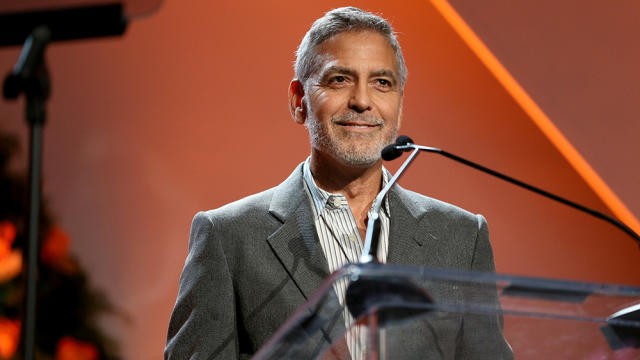 George Clooney didn’t shy away from criticizing the Trump administration’s culture of hate and disbelief while introducing Emma Gonzalez at Variety’s Power of Women event. But that doesn’t mean he’s given up hope.
After introducing himself as “Amal Clooney’s husband” (“I know, I know, I can read this room,” he joked), the actor called out the current administration’s work in creating “a time where fear is our stock in trade” before highlighting the numerous hateful stances it has taken toward people of different religions, races and genders.
“Fear of Muslims. Fear of immigrants. Fear of minorities. Fear of strong women,” he said. “And because our government needs us to be afraid, the question is, are we really scared of all the things that actually make America great? And if the answer is yes, then we’ll have history to answer to. Because these are the ideas that will define us for generations.”
Clooney warned that the government’s actions would have repercussions, especially with the upcoming midterm elections in November.
“When you call an entire religion your enemy, you might very well make an enemy out of an entire religion. When you tell a whole race of people that you value them less, you can’t be surprised when they question your values. When you tell women that coming forward to testify about their abuse is a joke, don’t be shocked when they’re standing on your lawn, laughing on Nov. 7,” Clooney said.
He continued, “After all the jokes, and insults, and reality show frenzy, what will be remembered, what will stand the test of time, is holding responsible these wolves in wolves’ clothing.”
Clooney praised Gonzalez for her tireless efforts to obtain more gun control regulation, while reminding the audience at the Beverly Wilshire Four Seasons in Beverly Hills, Calif., that trying times can also create inspirational leaders.
He highlighted Gonzalez’s speech at the March for Our Lives campaign in March, during which she stood in silence for six minutes and 20 seconds, the same amount of time a school shooter took to massacre 17 students at Marjory Stoneman Douglas High School in Parkland, Fla.
Gonzalez, Clooney said, became an overnight expert when it came to gun control, and it’s her heart that is one of the driving forces for change today.
“She made us listen to her heart,” Clooney said. “A heart that believes that we as a country can be so much better. A heart that called for adults to act like adults so children don’t have to.”
Fox 32 Chicago was live.
October 13, 2018
“MARCH TO THE POLLS” Live look over downtown Chicago where people are marching to early voting sites after an earlier rally in Grant Park. Women’s March Chicago put on the event in an effort to “use our voices and our votes to remove anti-female politicians from office.” bit.ly/2NBZRQc
March To The Polls in downtown Chicago
"MARCH TO THE POLLS" Live look over downtown Chicago where people are marching to early voting sites after an earlier rally in Grant Park. Women's March Chicago put on the event in an effort to "use our voices and our votes to remove anti-female politicians from office." bit.ly/2NBZRQc
Posted by Fox 32 Chicago on Saturday, October 13, 2018
The Mayor of Tallahassee (who’s running for governor of Florida) Took on the NRA, and Won
The Mayor of Tallahassee Took on the NRA, and Won
This candidate for Florida governor took on the NRA — and won
Posted by NowThis Election on Tuesday, October 2, 2018

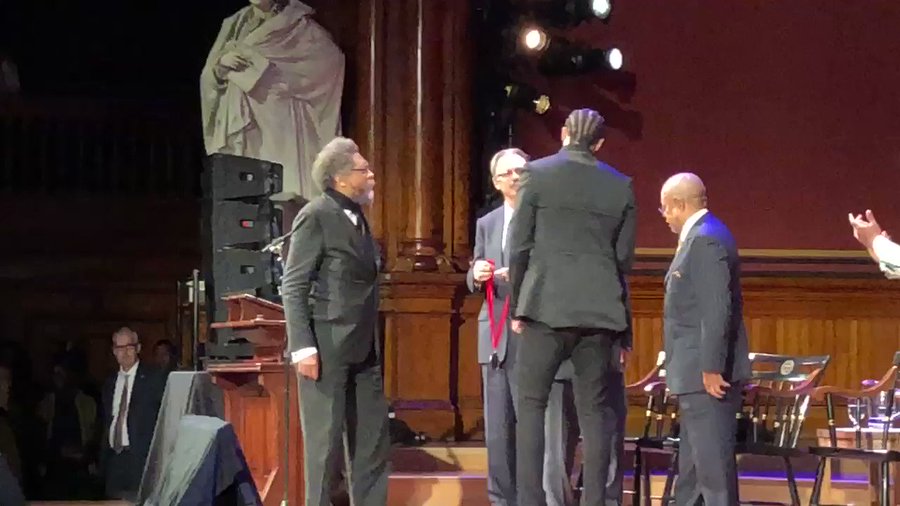
Colin Kaepernick was one of eight recipients of the W.E.B. Dubois Medal from Harvard on Thursday for his work in social justice.
Comedian Dave Chapelle and artist Kehinde Wiley were among the others awarded “Harvard’s highest honor in the field of African and African-American studies.”
After receiving a rousing ovation, Kaepernick appeared to scrap his prepared remarks for an off-the-cuff speech shared by WHDH Boston’s Eric Kane that addressed his recent Nike deal and the first time he took a knee in protest.
“I had a short speech written, but it just didn’t seem true to what it should’ve been with the authenticity and the passion and the inspiration that’s been in this room,” Kaepernick said to start a speech that he requested not be broadcast.
He went on to talk about the first time he took a knee and the response from Oakland’s Castlemont High football team, whose players took a knee the next week to support him. He visited the team on game day.
“One of the young brothers says ‘We don’t get to eat at home, so we’re going to eat on this field,’” Kaepernick said. “That moment has never left me.
“And I’ve carried that everywhere I went. And I think that’s the reality of what I’ve fought for, what so many of us have fought for. People live with this every single day.”

Kaepernick also addressed his Nike campaign and what sacrifice means to him.
“I go to what recently happened with the Nike campaign where, to believe in something even it it means sacrificing everything quote became huge,” Kaepernick said. “As I reflected on that, it made me think of if we all believe something, we won’t have to sacrifice everything.”
Kaepernick made a call to action for people in the room and people of privilege to stand up for those in need.
“I feel like it’s not only my responsibility, but all our responsibilities as people that are in positions of privilege, in positions of power, to continue to fight for them and uplift them, empower them,” Kapernick said. “Because if we don’t, we become complicit in the problem. It is our duty to fight for them, and we are going to continue to fight for them.”
He concluded by focusing on love, not divide being the driving force behind his protests.
“I go back to something I said in a speech previously, that love is at the root of our resistance, and it will continue to be, and it will fortify everything we do.”
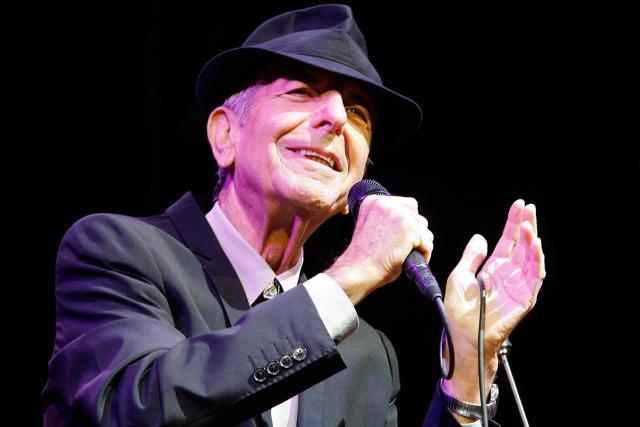
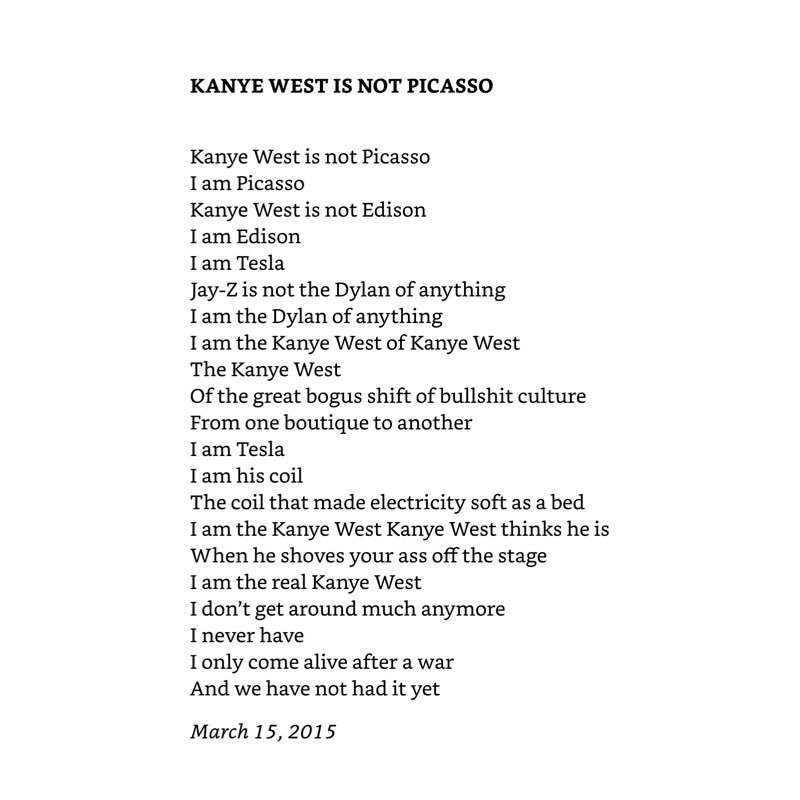
In 2015, a year before his death, Cohen composed the poem “Kanye West Is Not Picasso,” in which he wrote that he is the “real Kanye West.”
“I am the Kanye West of Kanye West/The Kanye West of the great bogus shift of bulls**t culture,” the poem reads.
Another line says: “I am the Kanye West Kanye West thinks he is.”
The full poem was shared to Twitter by Amanda Shires, where it’s received more than 3,000 likes.
“I really love that Cohen’s dissing him from beyond the grave,” one person wrote.
Prior to writing the poem, which is dated March 15, Cohen spoke admirably about the rapper in a 2014 interview with the Wall Street Journal, in which he described his “energy, resonance of truth, of person, of real experience.”
The appearance of the poem on Twitter coincided with Mr West’s visit to the White House on Thursday, where he met with Donald Trump to have a wide-ranging discussion covering everything from prison reform and mental health to the North Korean nuclear crisis.
You can purchase The Flame here.
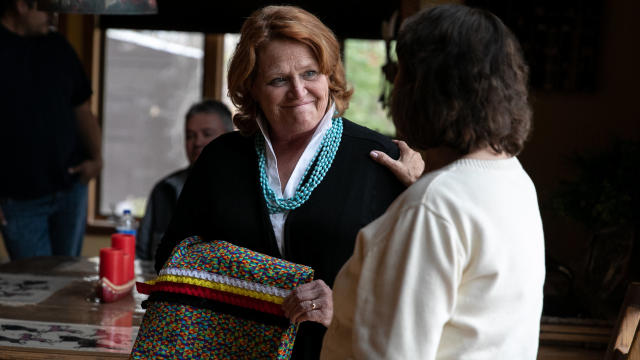
On this reservation near the Canadian border on Monday, far from the drama of Washington, the women of the Turtle Mountain Band of Chippewa Indians had a gift for the Democratic senator.
A ribbon skirt, decorated with the colors of the rainbow, was meant to tell her grey skies would soon pass.
“This is for everything you’ve done for us,” said tribal member Cathie Gladue, presenting her with the skirt as Heitkamp began to tear up. “And it’s especially for the stand you’ve recently taken. It was an honorable stand for all women, of all colors.”
The stand she took — choosing to believe Christine Blasey Ford, the woman who accused Brett Kavanaugh of sexually assaulting her when both were teenagers, and to dismiss the then-Supreme Court nominee’s angry denials — is one Heitkamp and almost all of her supporters acknowledge has put her political career in jeopardy.
Running for re-election against Republican GOP Rep. Kevin Cramer in a state President Donald Trump won by roughly 36 percentage points, Heitkamp already was seen by analysts as the senator most likely to lose re-election. And Republicans now crow that her vote last week against Kavanaugh’s confirmation signed her political death warrant.
Some public polling has shown her down double digits. Democrats insist the margin is much closer.
A Heitkamp loss harms an already tough path for Democrats to a Senate majority; it likely means they need to sweep GOP-held seats in Nevada, Arizona and Tennessee to have a chance of winning Congress’ upper chamber. In the wake of the battle over Kavanaugh, Republican Senate candidates in red-leaning territory are running on a backlash to the Me Too movement, hoping it can expand the GOP’s 51-49 majority in the Senate.
Heitkamp knows she’s an underdog. And so, in an frequently emotional 48 hours after she cast the vote, as she traveled to a farm-town parade, a small-dollar fundraiser near her hometown, a panel in front of energy executives in Bismarck and finally up to this reservation, her supporters worked relentlessly to buoy the senator’s spirits, as she simultaneously tried to defend and move past her vote against Kavanaugh.
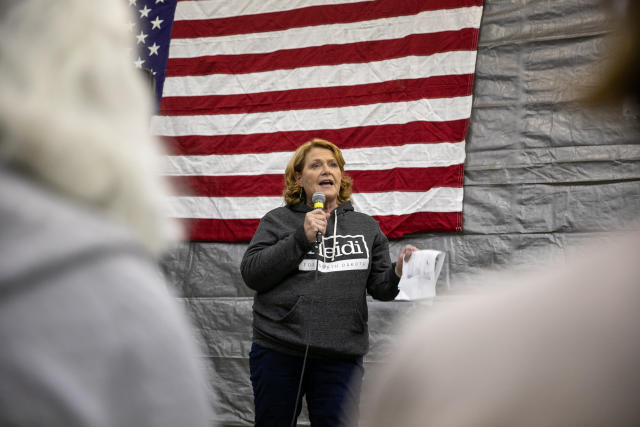
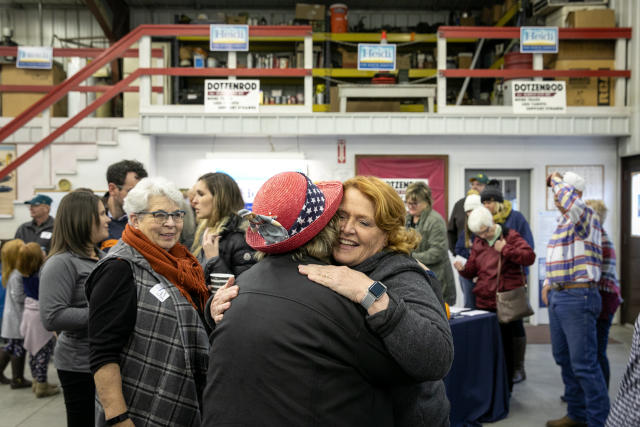
“First and foremost, I believed her,” Heitkamp told the crowd of about 250 who gathered at a garage to eat bratwursts, drink beer and snack on homemade desserts at the Oktoberfest-themed small-dollar fundraiser in Wyndmere. “And I think it was really, really important for our future that we believe her.”
“This has been a tough week for me,” Heitkamp said. “The political rhetoric is, ‘You can’t vote that way if you expect to come back.’ And I tell people, Ray and Doreen Heitkamp didn’t raise me to vote a certain way so that I could win. They raised me to vote the right way.”
The crowd responded with a standing ovation.
Asked if she was planning on supporting Kavanaugh before the Senate Judiciary Committee’s Sept. 27 hearing, Heitkamp delivered a one-word response: “Yep.” But she said supporting him after Ford’s testimony would’ve been a betrayal of her long-time supporters.
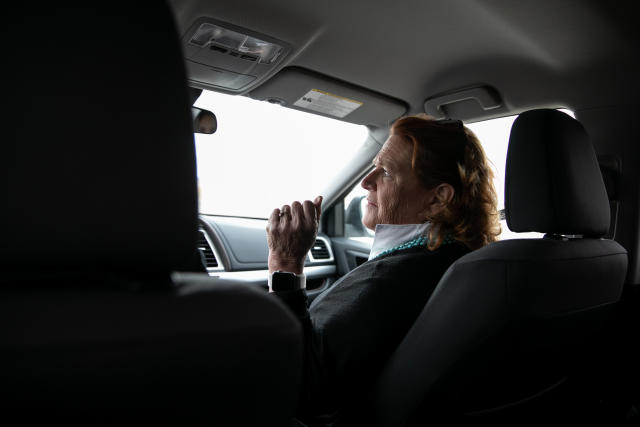
“It’s beyond Kavanaugh himself,” Heitkamp said in an interview in the back seat of a campaign staffer’s SUV. “It’s an affirmation of why they support me. People say politics is local. In North Dakota, politics is personal.”
That was on display Sunday night in Wyndmere, where Heitkamp seemed to know every attendee on a first-name basis. The crowd, filled with farmers furious over the Trump administration’s trade war, was hopeful but not optimistic the rest of the state’s voters would side with her.
Still, he hoped Heitkamp’s “middle of the road” style would appeal more to voters than Cramer’s loyalty to Trump. (The congressman once compared voting against Trump to sleeping with women other than his wife.)
“The commercials for her opponent keep trying to turn her into [Hillary Clinton]. Baloney!” he scoffed.
Friskan said he and other soybean farmers had lost tens of thousands of dollars because of the trade war, and were worried about losing customers in China and elsewhere permanently if it continued. Heitkamp’s fight against the trade war had been a key part of her message, but she’s now airing television ads defending her vote against Kavanaugh instead.
“I voted for Neil Gorsuch,” Heitkamp says in the 30-second spot, referring to Trump Supreme Court pick confirmed last year. “So I know there are plenty of other conservative judges who can fill this job without tearing this country apart.”
Heitkamp also has engaged in a mini-media blitz, appearing on CBS’ “60 Minutes” and CNN to explain her opposition to Kavanaugh and has become an unlikely online fundraising superstar, bringing in at least $1 million in the days following her vote.
The fight over Kavanaugh intensified the spotlight on her race — reporters from at least three national outlets were at the fundraiser in Wyndmere.
She admits a victory in the Nov. 6 election would be of the come-from-behind variety. To try to make that happen, she said her campaign is focused on identifying and turning out 150,000 to 160,000 supporters (she won her first term in 2012 with just over 161,000 votes).
Republicans, meanwhile, say no amount of money or campaigning can save Heitkamp.
“No matter how much she tries to run to the middle, she can’t escape the left-wing resisters and black-masked antifa activists that now define the Democrat Party to much of middle-America,” said Andrew Surabian, a GOP strategist and former Trump White House official. “The overreach from national Democrats during the Kavanaugh fight was simply the last straw. She is a walking dead candidate at this point.”
The 57-year-old Republican sought to keep the focus on Kavanugh, saying the newly minted Supreme Court justice would be good for energy production.
As Heitkamp traveled on to the Chippewa reservation, the Kavanaugh vote was far from her mind.
She met with tribal leaders at the Sky Dancer casinos, where the front doors were still plastered with fliers advertising a rally with Heitkamp that had been set for Saturday; it was canceled because she was still in Washington voting against Kavanaugh’s nomination. She visited the house of Twila Martin Kekahbah, a former tribal chief, and discussed the unemployment, housing, drug addiction and crime problems on the reservation.
She went to the local community college, where a group of tribal leaders was educating voters on how to grapple with a North Dakota law that requires voters to present IDs with residential street addresses. Many tribal members use P.O. boxes instead. Heitkamp and many other Democrats believe the law was passed in response to her 2012 win, when tribal members played a key role in propelling her to an upset over then-Rep. Rick Berg.
At the college, she delivered a modified version of her stump speech, tearing into Cramer as someone “with a fundamental lack of understanding on tribal issues.”
It’s part of a harsher line she’s taken on him in recent weeks, prompted in part by Cramer’s own questionable comments throughout the debate on Kavanaugh. Cramer, in a recent interview with The New York Times, seemed to disparage the Me Too movement that promotes solidarity among sexual assault victims. He called it a “movement toward victimization” that the female members of his own family can’t relate to.
His comments sparked an emotional response from Heitkamp, including her decision to reveal to the New York Times that her mother was a victim of sexual assault.
“It demonstrates someone who is not knowledgeable of what happens to a victim, it demonstrates a callousness, and it’s an approach with a certain level of arrogance,” she said. “He’s demonstrated a lack of knowledge, he’s demonstrated a lack of empathy.”
Cramer’s campaign didn’t respond to a HuffPost email requesting a comment, but a North Dakota GOP spokesman referred to the candidate’s comments on Tuesday to The Forum of Fargo-Moorhead. Cramer told that news outlet that Heitkamp’s response showed she was “unhinged” and that the Me Too movement had been “weaponized … for political purposes at the expense of victims.”
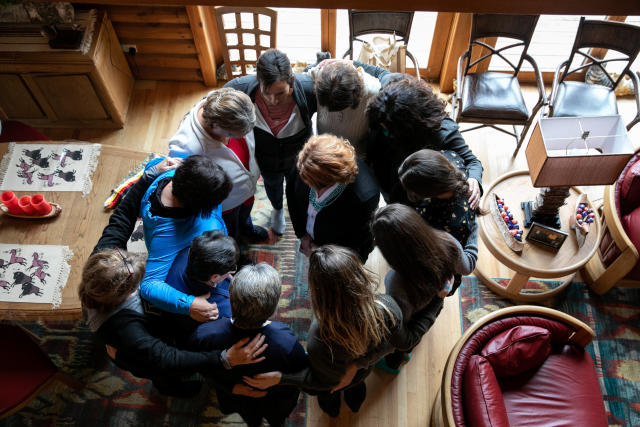
“We’ve lost the ability to be empathetic,” she said at Kekahbah’s house. “And our nation is divided.”
A few minutes later, the women at the gathering formed a circle around Heitkamp. “We’re going to just enclose her, and give her all the power we can,” Kekahbah said.
Then, she whispered a prayer.

In her Senate floor speech on Friday, Sen. Susan Collins (R-Maine) resolutely defended Supreme Court nominee Brett Kavanaugh both on his judicial philosophies and against sexual assault allegations, sounding no different than ring-wing GOP senators like Orrin Hatch of Utah or John Cornyn of Texas.
She validated and rewarded the Trumpian tactics of Senate Judiciary Committee chairman Chuck Grassley (R-Iowa), who stacked the deck against Christine Blasey Ford and the others who alleged sexual misconduct by Kavanaugh. Despite his clear and repeated lies, Collins lauded Kavanaugh’s “forceful” testimony to the committee denying all of the accusations,
Even after that, some in the Beltway media over the weekend were still locked in time, describing Collins, as they always have, as a “moderate.” One New York Times reporter actually characterized her speech as “reasoned [and] carefully researched.”
But these descriptions were fewer and far between compared to the past. And in Maine, where it matters, a Portland Press Herald editorial called the speech anything but reasoned and careful, clearly identifying what was either naivete or political spin:
Even in areas where experts in the field raised warnings, Collins put her judgment ahead of theirs… Only Collins appears to believe that Kavanaugh considered Roe v. Wade “settled law” or that he was deeply committed to preserving precedent, something legal scholars say is inconsistent with the way the Supreme Court works. It makes precedent when it wants to, and it takes only five votes to do it.
Similar to the characterizations of the late Sen. John McCain (R-Ariz.) despite facts to the contrary, Collins has consistently been described as a “moderate” or a “maverick” by many establishment Washington political reporters, treating her with kid gloves in discussing possible political motivations.
Often in a Washington bubble themselves, they’ve allowed Collins to perpetuate a myth that she’s a principled bridge-builder who rises above partisanship, so much so that she believes it herself and thinks she’s invincible. Collins appears to have no idea what she’s about to face if she’s seeking re-election in 2020 (and she implied she will in a CNN appearance on Sunday defending her support for Kavanaugh), drunk on the standing ovation she received from Republicans on the Senate floor and the accolades that no doubt came in from President Donald Trump’s base all across the country.
Yes, she voted to protect funding for Planned Parenthood, voted to end the ban on gays serving openly in the military and has defended the environment. These high-profile votes, in a GOP caucus that is so extreme, allowed her to distinguish herself ― and allowed some in the Washington press to distinguish her ― as someone who was anything but right-wing.
But this was always simplistic. Collins voted with Senate Majority Leader Mitch McConnell (R-Ky.) and the White House almost 90 percent of the time in the first year of the Trump administration. Her much-heralded vote against Obamacare repeal was negated by her vote for the GOP tax bill. She insisted that in backing that latter bill she got a promise from McConnell that the Senate would consider several fixes to Obamacare ― pledges that never materialized.
Collins refused to support marriage equality as that debate heated up in Maine over the years and as LGBTQ activists came under vicious verbal assault by extremists in the GOP. She finally came out for marriage equality in 2014, two years after the state became one of the few in which marriage equality was achieved via a ballot measure. Thus, she never actually lifted a finger to help Mainers get equality.
She announced her evolution just in time for her re-election bid in 2014, having garnered the endorsement of the Human Rights Campaign, the largest national LGBTQ group. That backing, along with endorsements of her from abortion rights groups, helped her thwart her Democratic challenger.
Collins has since voted to confirm a constant stream of stridently anti-choice, anti-LGBTQ judges nominated to the federal courts by Trump.
That includes Kyle Duncan, confirmed to the Fifth Circuit Court of Appeals, who wrote the amicus brief for Louisiana and 14 other states to uphold same-sex marriage bans and fought to uphold transgender bathroom restrictions. It includes backing Steve Grasz for the Eighth Circuit Court of Appeals, who received a unanimous “unqualified” rating from the American Bar Association. He’d called Roe v. Wade “moral bankruptcy” and sat on the board of a group that promotes “conversion therapy” for LGBTQ minors.
Collins voted to confirm Neil Gorsuch to the Supreme Court, who, like Kavanaugh, promised her and the world that he respected precedent, even calling the Obergefell marriage equality ruling “absolutely settled law.” Four months after joining the court Gorsuch wrote a vigorous dissent inviting states to challenge Obergefell.
Kavanaugh ― who was staff secretary in George W. Bush’s White House while it promoted a federal amendment banning same-sex marriage ― didn’t even go as far as Gorsuch in his hearings, simply saying that Obergefell is law and he “applies the law.”

Whether she is trying to avert a 2020 primary from the right that Trump could lead against her ― he has already threatened Sen. Murkowski (R-Alaska) with political retribution for voting against Kavanaugh ― or she truly believed what she was saying, Collins this time couldn’t keep her political machinations under the radar. The allegations against Kavanaugh ― and the outrage over him they sparked ― placed a glaring spotlight on her vote.
Nor could Collins even get cover from her good friends in the Senate ― Murkowski was joined by conservative Democratic Sen. Heidi Heitkamp of North Dakota in opposing Kavanaugh, even though the latter lawmaker conceded the vote could harm her re-election bid this year. So Collins stood as the sole so-called “moderate” woman in the Senate to have abandoned millions of women across the country and many others who will be hurt by the court’s likely lurch to the extreme right.
In this moment, the mask of moderation has been ripped off Collins. There will be those who say that she’s untouchable ― as they have said in the past ― and that Mainers who re-elected her before will do so again. They’ll tell you that she’ll have plenty of money from the Koch brothers and others, and she surely will.
But we’re in a different time, both nationally, with regard to the political energy of women and the Me Too movement, and in Maine. Already, people in Maine running a grassroots campaign have raised $3.5 million via crowdfunding to funnel to the Democratic opponent who takes on Collins in 2020. Several potential candidates have emerged in the past few days, as Democratic officials look to a deep pool of possible contenders in the state.
Polls in recent weeks found voters in Maine would be less likely to vote to re-elect Collins if she voted to confirm Kavanaugh. And in a Suffolk University poll in early August, she had only a 49 percent favorable rating, down from an impressive 67 percent in a Portland Press Herald 2016 poll.
University of New England political science professor Brian Duff told the Press Herald last week that voting against Kavanaugh “would be the more popular choice in Maine and easier for her to recover from, especially if she is able to vote for another conservative appointee later.” Two years, he said, is a long time in politics and “it’s hard to see a primary challenger emerging with any strength just because she voted ‘no’ on Brett Kavanaugh.”
Now that she’s voted yes, however, Collins can’t put her mask back on.
The Human Rights Campaign and several other national LGBTQ groups slammed her for backing Kavanaugh, as did Planned Parenthood and NARAL. It seems implausible that any of these groups would risk their members’ outrage by backing Collins in 2020.
And what does Collins do about Trump in her re-election year? In 2016, she announced in a scathing Op-Ed that she wasn’t voting for him that year, vocally distancing herself from his bigotry and recklessness as Hillary Clinton took Maine in the election. In 2020 Trump ― who tweeted accolades to Collins over the weekend ― presumably will be on the ballot with her. Will she dare endorse him ― or dare to not?
And as Kavanaugh rules with the far right of the court on issue after issue, as he undoubtedly will, Collins will sink even further, having taken full ownership of this Supreme Court nomination in the end.
Collins had a good gig, promoting herself as something she’s not. She’s now been fully exposed.