Business Leaders for Medicare for All shared a post.
When you’re facing a life-threatening illness, how to pay for treatment shouldn’t be a concern. We need Medicare for All!
February 28, 2019

Read About The Tarbaby Story under the Category: About the Tarbaby Blog

Stories of injustice and justice
When you’re facing a life-threatening illness, how to pay for treatment shouldn’t be a concern. We need Medicare for All!

North Korea accused the Trump Administration of being a billionaires’ club that harbors a “policy of racism” while exacerbating social inequalities and denying freedom of the press and health coverage to citizens.
The “White Paper on Human Rights Violations in the U.S. in 2017,” issued by the Institute of International Studies in the Democratic People’s Republic of Korea on Wednesday, claimed that human rights in the U.S. have deteriorated since President Donald Trump took office last year.
“Racial discrimination and misanthropy are serious maladies inherent to the social system of the U.S., and they have been aggravated since Trump took office,” the paper read. “The racial violence that took place in Charlottesville, Virginia, on August 12 is a typical example of the acme of the current administration’s policy of racism.”
The paper, which is being circulated by North Korean diplomats in Geneva, did not refer to the row between North Korea and the U.S. and its allies over Pyongyang’s nuclear and missile programs, nor to the international sanctions imposed against it.
A summary of the paper was released by the Korean Central News Agency (KCNA) on Wednesday.
The KCNA summary accused Trump of packing his cabinet with billionaires, including Secretary of State Rex Tillerson; former private equity investor Wilbur Ross, who is now Secretary of Commerce; ex–Goldman Sachs investor Steven Mnuchin, who is now Secretary of the Treasury; and Secretary of Defense James Mattis.
“The total assets of public servants at the level of deputy secretary and above of the current administration are worth $14 billion,” the paper said.
The North Korean paper then said that genuine freedoms of the press and of expression did not exist in the United States, and that crackdowns against the media had intensified in the past year.
The report summary also argued that an “absolute majority of the working masses, deprived of elementary rights to survival, are hovering in the abyss of nightmare,” citing unemployment statistics and homelessness as evidence.
Pyongyang released the White Paper shortly after Trump criticized North Korean human rights abuses during his State of the Union speech on Tuesday. During that speech, the president called Kim Jong Un “depraved” and told the world that North Korea’s pursuit of nuclear missiles could “soon threaten” the U.S. mainland.

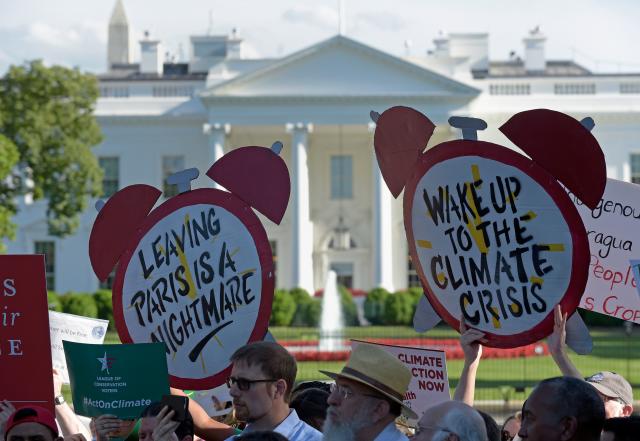
One emergency, the border wall, is fake, invented by a rogue president desperate for a political win no matter the price. Another, the climate crisis, is real, with tens of millions of citizen victims around the country. Guess which one got funded?
President Donald Trump is risking a constitutional crisis by declaring a false national emergency to fund a border wall that his own government experts say isn’t needed and won’t work, and of which he himself says, “I didn’t need to do this.”
Meanwhile, the bill Trump signed last week to keep the government open leaves out tens of billions of dollars of relief for American citizens who are victims of hurricanes, wildfires and other disasters made worse by climate change.
This should not be a shock to anyone paying close attention. Acting White House Chief of Staff Mick Mulvaney, reacting to earlier reports, last week pointedly denied that the administration would raid relief funds designated for victims of storms and wildfires to get money for Trump’s dubious border wall.
The president, who denies basic climate science and is rolling back key climate protections, would have been taking money from its victims to escape the consequences of his own manufactured government-shutdown crisis — all to build a wall that will be ineffective and even counterproductive in improving border security.
A firestorm of criticism prevented that. Yet here we are about a month later with much the same outcome.
Meanwhile, the costs of climate change in American lives and money are growing exponentially. They include more damaging hurricanes, bigger and more intense wildfires, sea-level rise and the spread of infectious disease.
Congress passed more than $130 billion in emergency spending related to climate change just between September 2017 and March 2018. That’s nearly a quarter of the annual non-defense discretionary budget of the entire U.S. government. Indeed, Trump’s own National Oceanic and Atmospheric Administration finds that the “cumulative cost of the 16 separate billion-dollar weather events in the U.S. in 2017 was $306.2 billion.”
Yet budget tricks keep these huge costs hidden from American taxpayers. Lawmakers and the president are not required to increase taxes to pay for emergency funding. Thus, Trump and other Republicans deny the climate crisis. Eventually, when they get around to it, they fund the recovery but hide the massive costs from public scrutiny.
Far worse is coming. Disasters exacerbated by climate change will cost trillions of dollars by the end of this century, according to budget experts. In November 2016, an Office of Management and Budget assessment warned of tens of billions in additional costs from wildfires, crop insurance, flood insurance, health care spending and other problems related to climate change.
But instead of acting to address the climate change crisis and its costs, Trump is actually rolling back key climate protections at every chance. He is overturning major rules to cut emissions from power plants, cars and trucks, oil and gas development and many other areas, purposefully making the problem worse. One wonders when the American people are going to tire of Trump risking their safety, the economy, the deficit and our long-term security for his own perceived political gain.
Trump’s responses to the record-breaking hurricanes that hit America in the past 18 months have been similarly cavalier. He directly lied about the deaths of thousands of U.S. citizens, ignoring studies showing that thousands died in Puerto Rico after Hurricane Maria in 2017 due to lost power at hospitals and elsewhere.
Infamously, Trump falsely blamed mismanagement of public lands and forests as the main reason for wildfires in California and much of the West. In fact, leading experts say climate change is a key reason U.S. wildfires are getting larger; a 2016 study found they had spread across double the area affected in 1984.
Major studies have also found that up to 20 inches of Hurricane Harvey’s record 52-inch rainfall was due to much warmer Gulf of Mexico temperatures caused by climate change, and that other recent hurricanes were also made more destructive because of underlying climate change. Yet why would the president let actual science and the safety of the American people get in the way of short-term politics?
Border security is important. Both Democrats and Republicans have said so and have serious plans to address it. But Trump’s dubious border wall isn’t about security, it’s an attempt to salvage a bogus campaign pledge.
Never mind that the actual climate crisis is harming average Americans every day — costing lives, undermining our public safety and hurting our economy. Trump only does fake emergencies.
Paul Bledsoe is a professorial lecturer at American University’s Center for Environmental Policy and a strategic adviser at the Progressive Policy Institute. He served on the staff of the White House Climate Change Task Force under President Bill Clinton.
February 26, 2019
Is Trump following through on his promise to lower drug prices? Seth checks in.
The Check In: Prescription Drug Prices
Is Trump following through on his promise to lower drug prices? Seth checks in.
Posted by Late Night with Seth Meyers on Tuesday, February 26, 2019
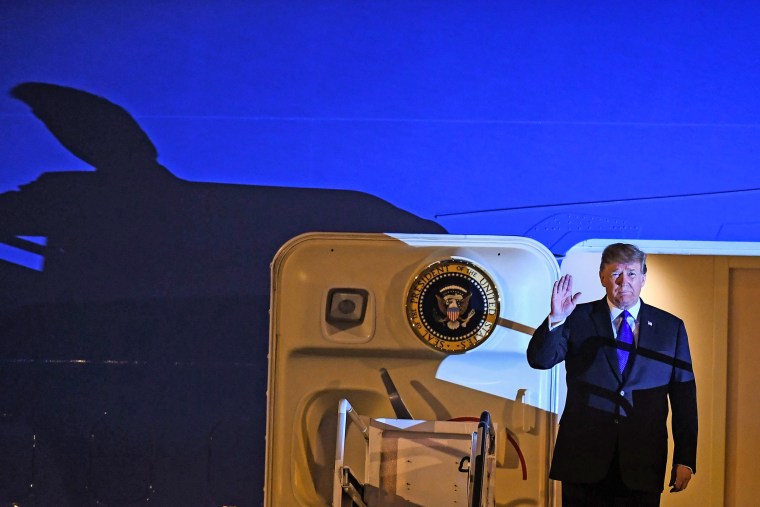
President Donald Trump disembarks from Air Force One at Noi Bai International Airport in Hanoi on upon his arrival in Vietnam on Tuesday evening. Manan Vatsyayana / AFP – Getty Images
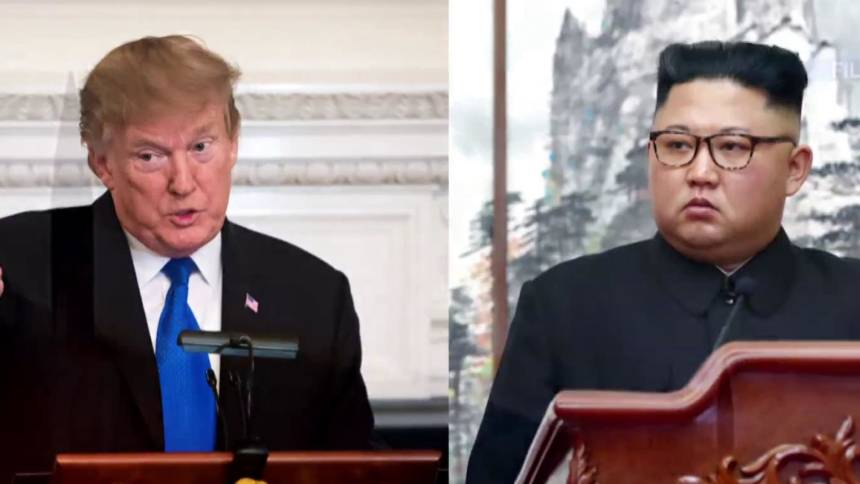
HANOI, Vietnam — President Donald Trump, who arrived here on Tuesday for a nuclear summit with North Korean leader Kim Jong Un, is desperate for a win.
At home, the fallout from special counsel Robert Mueller’s investigation into his campaign’s ties to Russia and possible obstruction of justice continues to spread. Trump’s domestic agenda is still suffering the aftereffects of a 35-day government shutdown. And he’s fighting Congress and more than a dozen states over his plan to transfer billions of federal dollars to build a wall on the U.S. border with Mexico.
It appears that Trump, who touched down on Air Force One at Hanoi’s Noi Bai International Airport shortly before 9 a.m. ET, is likely to be spared the indignity of Mueller’s final report being filed while he is abroad, but Michael Cohen, his former lawyer, is set to testify for three days, beginning Tuesday, on Capitol Hill about the president’s business dealings, his efforts to influence the 2016 election and his level of compliance with tax laws.
 Trump’s arrival was greeted with a red carpet, a 26-man Vietnamese honor cordon and a bouquet of flowers, which was handed to him by a Vietnamese woman.
The president shook hands with a delegation of Vietnamese and U.S. diplomatic officials, before giving a quick wave to the assembled media and ducking into his limousine — “The Beast” — for the ride to his hotel. He did not have any public events planned until Wednesday morning in Hanoi, where the time is 12 hours ahead of Washington.
In short, Trump needs to put some points on the board.
The president and Kim are set to have dinner Wednesday before their summit meeting Thursday. Both the dinner and the summit will take place at the Sofitel Legend Metropole Hanoi, White House Press Secretary Sarah Sanders said.
Trump’s political opponents say they’re worried that his domestic concerns may play a decisive role in Hanoi this week, pushing him into grasping for unwise bargains with North Korea.
“Given Trump’s aversion to briefings and policy papers, the Kim summit was always a dubious enterprise with high risks, but Trump’s disastrous last two months weaken his already unsteady hand at the negotiating table,” said Rep. Gerry Connolly, D-Va., a member of the House Foreign Affairs Committee. “Kim Jong Un knows how to exploit weakness when he sees it.”
And if the past is any guide, the president may find a way to declare victory — or simply to say that he’s struck another agreement with Kim — whether or not he emerges with a concrete plan to halt Pyongyang’s ongoing development of nuclear weapons.
There is concern in Washington foreign policy circles, among both Democrats and Republicans, that in his hunger to chalk up a public win, Trump — who has already boasted that his diplomatic efforts with regard to the regime have been Nobel Prize nomination-worthy— could give up too much and get too little in return.
“The administration should make clear to Pyongyang that the only way we will dismantle the U.S. and international sanctions regime is when Pyongyang completely dismantles every single nut and bolt of its illicit weapons programs — not a minute earlier,” he said.
The process this time has to move beyond the generalities of the Singapore summit, said Laura Rosenberger of the German Marshall Fund, a former foreign policy adviser to Hillary Clinton.
When he met with Kim in Singapore, Trump heralded an agreement to work toward denuclearization of the Korean Peninsula, but U.S. intelligence officials have said that while Pyongyang has taken steps to dismantle some of its nuclear capabilities, it has not demonstrated that it is willing to abandon its program.
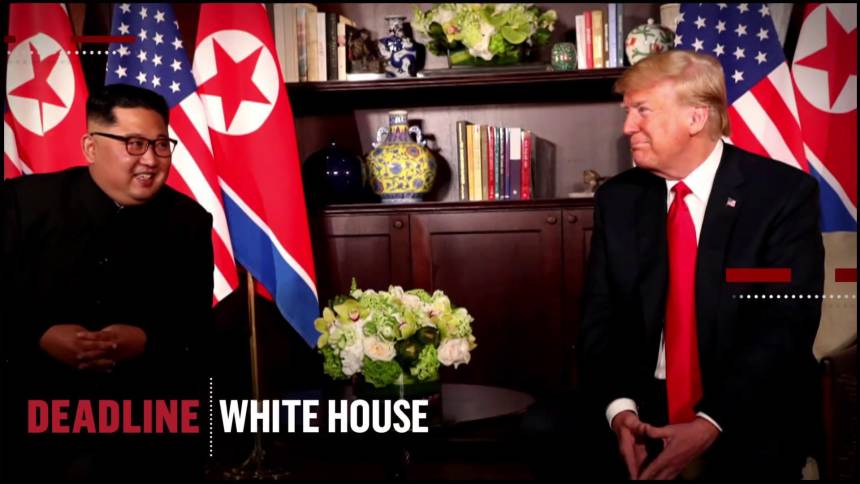
On Twitter, he countered Director of National Intelligence Dan Coats’s public assessment that “North Korea is unlikely to give up all of its nuclear weapons and production capabilities” by saying there’s a “decent chance” of denuclearization.
And in the run-up to the latest summit, Trump has appeared to lower the bar for claiming victory out of the event by tempering expectations for a quick and comprehensive deal on denuclearization, saying last week that he is in “no rush” to make that happen.
“I have no pressing time schedule,” he said.
North Korea’s wish list includes not just the removal of crippling U.S. and international economic sanctions — Trump has tried to sell Kim on the idea that his nation could one day be a Pacific Rim powerhouse — but also the removal of U.S. troops from South Korea. American forces have been stationed there since the unofficial end of the Korean War nearly 70 years ago.
Sen. Tim Kaine, D-Va., a member of the Foreign Relations Committee, told NBC News in response to emailed questions that he is supportive of diplomatic efforts to resolve the standoff with North Korea but has reservations about what the president’s track record means for this summit.
“I’m concerned that President Trump will again be quick to make concessions without getting anything in return,” he said, pointing to a decision to cancel joint military exercises with South Korea after June’s summit. “At Hanoi, the president needs to demand North Korea disclose details of its current stockpiles and capabilities, then agree on a clear, shared definition of denuclearization including benchmarks to show verifiable progress toward that goal.”
On that score — the idea that success means a real process for denuclearization rather than an announced deal that ends up allowing Pyongyang to continue to quietly develop its weapons program — Republicans and Democrats in Congress appear to be in agreement.
But the political calculation for Trump remains the same — which means that a declaration of victory, no matter the policy achievement, is far more likely than a decision to walk away from another detail-free offer. For a president facing both turmoil at home and pressure abroad born of his failure to extract concessions at the last Kim summit, failure — or, at least, the appearance of failure — may not be an option.
February 26, 2019
Senate Majority Leader Mitch McConnell needs a swift kick in the nads. Maybe several considering the millions of dollars he has made on a base salary of $174,000 a year as a U.S. Senator. He’s the next one who needs a special counsel.
 Senate Majority Leader Mitch McConnell says the budget deficit is “very disturbing.”
“It’s disappointing, but it’s not a Republican problem,” McConnell said Tuesday in an interview with Bloomberg News when asked about the rising deficits and debt. “It’s a bipartisan problem: unwillingness to address the real drivers of the debt by doing anything to adjust those programs to the demographics of America in the future.”
McConnell’s remarks came a day after the Treasury Department said the U.S. budget deficit grew to $779 billion in Donald Trump’s first full fiscal year as president, the result of the GOP’s tax cuts, bipartisan spending increases and rising interest payments on the national debt. That’s a 77 percent increase from the $439 billion deficit in fiscal 2015, when McConnell became majority leader.
McConnell said it would be “very difficult to do entitlement reform, and we’re talking about Medicare, Social Security and Medicaid,” with one party in charge of Congress and the White House.
“I think it’s pretty safe to say that entitlement changes, which is the real driver of the debt by any objective standard, may well be difficult if not impossible to achieve when you have unified government,” McConnell said.
Shrinking those popular programs — either by reducing benefits or raising the retirement age — without a bipartisan deal would risk a political backlash in the next election. Trump promised during his campaign that he wouldn’t cut Social Security, Medicare or Medicaid, even though his budget proposals have included trims to all three programs.
McConnell said he had many conversations on the issue with former President Barack Obama, a Democrat.
“He was a very smart guy, understood exactly what the problem was, understood divided government was the time to do it, but didn’t want to, because it was not part of his agenda,” McConnell said.
“I think it would be safe to say that the single biggest disappointment of my time in Congress has been our failure to address the entitlement issue, and it’s a shame, because now the Democrats are promising ‘Medicare for all,”’ he said. “I mean, my gosh, we can’t sustain the Medicare we have at the rate we’re going and that’s the height of irresponsibility.”
McConnell said the last major deal to overhaul entitlements occurred in the Reagan administration, when a Social Security package including an increase in the retirement age passed under divided government.
McConnell said he was the GOP Senate whip in 2005 when Republican President George W. Bush attempted a Social Security overhaul and couldn’t find any Democratic supporters.
“Their view was, you want to fix Social Security, you’ve got the presidency, you’ve got the White House, you’ve got the Senate, you go right ahead,” McConnell said. The effort collapsed.
The Office of Management and Budget has projected a deficit in the coming year of $1.085 trillion despite a healthy economy. And the Congressional Budget Office has forecast a return to trillion-dollar deficits by fiscal 2020.
During Trump’s presidency, Democrats and Republicans agreed to a sweeping deal to increase discretionary spending on defense and domestic programs, while his efforts to shrink spending on Obamacare mostly fell flat.
Republicans in December 2017 also passed a tax cut projected to add more than $1 trillion to the debt over a decade after leaders gave up on creating a plan that wouldn’t increase the debt under the Senate’s scoring rules.
At the time, McConnell told reporters, “I not only don’t think it will increase the deficit, I think it will be beyond revenue-neutral.” He added, “In other words, I think it will produce more than enough to fill that gap.”
Senate Minority Leader Chuck Schumer of New York responded Tuesday by saying McConnell and other Republicans “blew a $2 trillion hole in the federal deficit to fund a tax cut for the rich. To now suggest cutting earned middle-class programs like Medicare, Social Security and Medicaid as the only fiscally responsible solution to solve the debt problem is nothing short of gaslighting.”
House Minority Leader Nancy Pelosi of California said in a statement, “Under the GOP’s twisted agenda, we can afford tax cuts for billionaires, but not the benefits our seniors have earned.”
With assistance by Erik Wasson
February 26, 2019
“Regardless of what happens in Hanoi, the President will tweet afterwards that it was the greatest diplomatic achievement in human history … I am reluctant to predict that he will be disciplined in this setting.”
Tom Countryman, ex-Senior State Department official, on President Trump’s summit with North Korea’s Kim Jong Un.
Fmr. State Dept. official on Hanoi summit: I am reluctant to predict Trump will be disciplined
"Regardless of what happens in Hanoi, the President will tweet afterwards that it was the greatest diplomatic achievement in human history … I am reluctant to predict that he will be disciplined in this setting." Tom Countryman, ex-Senior State Department official, on President Trump's summit with North Korea's Kim Jong Un.https://cnn.it/2SpPSjf
Posted by CNN on Tuesday, February 26, 2019
February 24, 2019

February 24, 2019
Big pharma greed kills.
From the film DRUG$: The Price We Pay, a film produced by the AIDS Healthcare Foundation
Pharma Price Gouges Epipens So CEO Can Make Millions More
Big pharma greed kills.From the film DRUG$: The Price We Pay, a film produced by the AIDS Healthcare Foundation
Posted by Social Security Works on Sunday, February 24, 2019
How US military spending keeps rising even as the Pentagon flunks its audit.
On November 15, Ernst & Young and other private firms that were hired to audit the Pentagon announced that they could not complete the job. Congress had ordered an independent audit of the Department of Defense, the government’s largest discretionary cost center—the Pentagon receives 54 cents out of every dollar in federal appropriations—after the Pentagon failed for decades to audit itself. The firms concluded, however, that the DoD’s financial records were riddled with so many bookkeeping deficiencies, irregularities, and errors that a reliable audit was simply impossible.
Deputy Secretary of Defense Patrick Shanahan tried to put the best face on things, telling reporters, “We failed the audit, but we never expected to pass it.” Shanahan suggested that the DoD should get credit for attempting an audit, saying, “It was an audit on a $2.7 trillion organization, so the fact that we did the audit is substantial.” The truth, though, is that the DoD was dragged kicking and screaming to this audit by bipartisan frustration in Congress, and the result, had this been a major corporation, likely would have been a crashed stock.
As Republican Senator Charles Grassley of Iowa, a frequent critic of the DoD’s financial practices, said on the Senate floor in September 2017, the Pentagon’s long-standing failure to conduct a proper audit reflects “twenty-six years of hard-core foot-dragging” on the part of the DoD, where “internal resistance to auditing the books runs deep.” In 1990, Congress passed the Chief Financial Officers Act, which required all departments and agencies of the federal government to develop auditable accounting systems and submit to annual audits. Since then, every department and agency has come into compliance—except the Pentagon.
Now, a Nation investigation has uncovered an explanation for the Pentagon’s foot-dragging: For decades, the DoD’s leaders and accountants have been perpetrating a gigantic, unconstitutional accounting fraud, deliberately cooking the books to mislead the Congress and drive the DoD’s budgets ever higher, regardless of military necessity. DoD has literally been making up numbers in its annual financial reports to Congress—representing trillions of dollars’ worth of seemingly nonexistent transactions—knowing that Congress would rely on those misleading reports when deciding how much money to give the DoD the following year, according to government records and interviews with current and former DoD officials, congressional sources, and independent experts.
“If the DOD were being honest, they would go to Congress and say, ‘All these proposed budgets we’ve been presenting to you are a bunch of garbage,’ ” said Jack Armstrong, who spent more than five years in the Defense Department’s Office of Inspector General as a supervisory director of audits before retiring in 2011.
The fraud works like this. When the DoD submits its annual budget requests to Congress, it sends along the prior year’s financial reports, which contain fabricated numbers. The fabricated numbers disguise the fact that the DoD does not always spend all of the money Congress allocates in a given year. However, instead of returning such unspent funds to the US Treasury, as the law requires, the Pentagon sometimes launders and shifts such moneys to other parts of the DoD’s budget.
Veteran Pentagon staffers say that this practice violates Article I Section 9 of the US Constitution, which stipulates that:
No Money shall be drawn from the Treasury, but in Consequence of Appropriations made by Law; and a regular Statement and Account of the Receipts and Expenditures of all public Money shall be published from time to time.
Among the laundering tactics the Pentagon uses: So-called “one-year money”—funds that Congress intends to be spent in a single fiscal year—gets shifted into a pool of five-year money. This maneuver exploits the fact that federal law does not require the return of unspent “five-year money” during that five-year allocation period.
The phony numbers are referred to inside the Pentagon as “plugs,” as in plugging a hole, said current and former officials. “Nippering,” a reference to a sharp-nosed tool used to snip off bits of wire or metal, is Pentagon slang for shifting money from its congressionally authorized purpose to a different purpose. Such nippering can be repeated multiple times “until the funds become virtually untraceable,” says one Pentagon-budgeting veteran who insisted on anonymity in order to keep his job as a lobbyist at the Pentagon.
The plugs can be staggering in size. In fiscal year 2015, for example, Congress appropriated $122 billion for the US Army. Yet DoD financial records for the Army’s 2015 budget included a whopping $6.5 trillion (yes, trillion) in plugs. Most of these plugs “lack[ed] supporting documentation,” in the bland phrasing of the department’s internal watchdog, the Office of Inspector General. In other words, there were no ledger entries or receipts to back up how that $6.5 trillion supposedly was spent. Indeed, more than 16,000 records that might reveal either the source or the destination of some of that $6.5 trillion had been “removed,” the inspector general’s office reported.
In this way, the DoD propels US military spending higher year after year, even when the country is not fighting any major wars, says Franklin “Chuck” Spinney, a former Pentagon whistle-blower. Spinney’s revelations to Congress and the news media about wildly inflated Pentagon spending helped spark public outrage in the 1980’s. “They’re making up the numbers and then just asking for more money each year,” Spinney told The Nation. The funds the Pentagon has been amassing over the years through its bogus bookkeeping maneuvers “could easily be as much as $100 billion,” Spinney estimated.
Indeed, Congress appropriated a record amount—$716 billion—for the DoD in the current fiscal year of 2019. That was up $24 billion from fiscal year 2018’s $692 billion, which itself was up $6 billion from fiscal year 2017’s $686 billion. Such largesse is what drives US military spending higher than the next ten highest-spending countries combined, added Spinney. Meanwhile, the closest thing to a full-scale war the United States is currently fighting is in Afghanistan, where approximately 15,000 US troops are deployed—only 2.8 percent as many as were in Vietnam at the height of that war.
The DoD’s accounting practices appear to be an intentional effort to avoid accountability, says Armstrong. “A lot of the plugs—not all, but a substantial portion—are used to force general-ledger receipts to agree with the general budget reports, so what’s in the budget reports is basically left up to people’s imagination,” Armstrong says, adding, “Did the DoD improperly spend funds from one appropriated purpose on another? Who can tell?”
“The United States government collects trillions of dollars each year for the purpose of funding essential functions, including national-security efforts at the Defense Department,” Senator Grassley told The Nation. “When unelected bureaucrats misuse, mismanage and misallocate taxpayer funds, it not only takes resources away from vital government functions, it weakens citizens’ faith and trust in their government.”
This Pentagon accounting fraud is déjà vu all over again for Spinney. Back in the 1980’s, he and a handful of other reform-minded colleagues exposed how the DoD used a similar accounting trick to inflate Pentagon spending—and to accumulate money for “off-the-books” programs. “DoD routinely over-estimated inflation rates for weapons systems,” Spinney recalled. “When actual inflation turned out to be lower than the estimates, they did not return the excess funds to the Treasury, as required by law, but slipped them into something called a ‘Merged Surplus Account,’” he said.
“In that way, the Pentagon was able to build up a slush fund of almost $50 billion” (about $120 billion in today’s money), Spinney added. He believes that similar tricks are being used today to fund secret programs, possibly including US Special Forces activity in Niger. That program appears to have been undertaken without Congress’s knowledge of its true nature, which only came to light when a Special Forces unit was ambushed there last year, resulting in the deaths of four US soldiers.
“Because of the plugs, there is no auditable way to track Pentagon funding and spending,” explains Asif Khan of the Government Accountability Office, the Congress’s watchdog on the federal bureaucracy. “It’s crucial in auditing to have a reliable financial record for prior years in order to audit the books for a current year,” notes Khan, the head of the National Security Asset Management unit at GAO. Plugs and other irregularities help explain why the Pentagon has long been at or near the top of the GAO’s list of “high risk” agencies prone to significant fraud, waste, and abuse, he adds.
The Nation submitted detailed written questions and requested interviews with senior officials in the Defense Department before publishing this article. Only public-affairs staff would speak on the record. In an e-mailed response, Christopher Sherwood of the DoD’s Public Affairs office denied any accounting impropriety. Any transfer of funds between one budgetary account and another “requires a reprogramming action” by Congress, Sherwood wrote, adding that any such transfers amounting to more than 1 percent of the official DoD budget would require approval by “all four defense congressional committees.”
The scale and workings of the Pentagon’s accounting fraud began to be ferreted out last year by a dogged research team led by Mark Skidmore, a professor of economics specializing in state and local government finance at Michigan State University. Skidmore and two graduate students spent months poring over DoD financial statement reviews done by the department’s Office of Inspector General. Digging deep into the OIG’s report on the Army’s 2015 financial statement, the researchers found some peculiar information. Appendix C, page 27, reported that Congress had appropriated $122 billion for the US Army that year. But the appendix also seems to report that the Army had received a cash deposit from the US Treasury of $794.8 billion. That sum was more than six times larger than Congress had appropriated—indeed, it was larger than the entire Pentagon budget for the year. The same appendix showed that the Army had accounts payable (accounting lingo for bills due) totaling $929.3 billion.
“I wondered how you could possibly get those kinds of adjustments out of a $122 billion budget,” Skidmore recalled. “I thought, initially, ‘This is absurd!’ And yet all the [Office of Inspector General] seemed to do was say, ‘Here are these plugs.’ Then, nothing. Even though this kind of thing should be a red flag, it just died. So we decided to look further into it.”
To make sure that fiscal year 2015 was not an anomaly, Skidmore and his graduate students expanded their inquiry, examining OIG reports on Pentagon financial records stretching back to 1998. Time and again, they found that the amounts of money reported as having flowed into and out of the Defense Department were gargantuan, often dwarfing the amounts Congress had appropriated: $1.7 trillion in 1998, $2.3 trillion in 1999, $1.1 trillion in 2000, $1.1 trillion in 2007, $875 billion in 2010, and $1.7 trillion in 2012, plus amounts in the hundreds of billions in other years.
In all, at least a mind-boggling $21 trillion of Pentagon financial transactions between 1998 and 2015 could not be traced, documented, or explained, concluded Skidmore. To convey the vastness of that sum, $21 trillion is roughly five times more than the entire federal government spends in a year. It is greater than the US Gross National Product, the world’s largest at an estimated $18.8 trillion. And that $21 trillion includes only plugs that were disclosed in reports by the Office of Inspector General, which does not review all of the Pentagon’s spending.
To be clear, Skidmore, in a report coauthored with Catherine Austin Fitts, a former assistant secretary of the Department of Housing and Urban Development who complained about similar plugs in HUD financial statements, does not contend that all of this $21 trillion was secret or misused funding. And indeed, the plugs are found on both the positive and the negative sides of the ledger, thus potentially netting each other out. But the Pentagon’s bookkeeping is so obtuse, Skidmore and Fitts added, that it is impossible to trace the actual sources and destinations of the $21 trillion. The disappearance of thousands of records adds further uncertainty. The upshot is that no one can know for sure how much of that $21 trillion was, or was not, being spent legitimately.
That may even apply to the Pentagon’s senior leadership. A good example of this was Donald Rumsfeld, the notorious micromanaging secretary of defense during the Bush/Cheney administration. On September 10, 2001 Rumsfeld called a dramatic press conference at the Pentagon to make a startling announcement. Referring to the huge military budget that was his official responsibility, he said, “According to some estimates we cannot track $2.3 trillion in transactions.” This shocking news that an amount more than five times as large as the Pentagon’s FY 2001 budget of an estimated $313 billion was lost or even just “untrackable” was—at least for one 24-hour news cycle—a big national story, as was Secretary Rumsfeld’s comment that America’s adversary was not China or Russia, but rather was “closer to home: It’s the Pentagon bureaucracy.” Equally stunning was Rumsfeld’s warning that the tracking down of those missing transactions “could be…a matter of life and death.” No Pentagon leader had ever before said such a thing, nor has anyone done so since then. But Rumsfeld’s exposé died quickly as, the following morning on September 11, four hijacked commercial jet planes plowed full speed into the two World Trade Center towers, the Pentagon, and a field in Pennsylvania. Since that time, there has been no follow-up and no effort made to find the missing money, either.
Recalling his decades inside the Pentagon, Spinney emphasized that the slippery bookkeeping and resulting fraudulent financial statements are not a result of lazy DoD accountants. “You can’t look at this as an aberration,” he said. “It’s business as usual. The goal is to paralyze Congress.”
That has certainly been the effect. As one congressional staffer with long experience investigating Pentagon budgets, speaking on background because of the need to continue working with DoD officials, told The Nation, “We don’t know how the Pentagon’s money is being spent. We know what the total appropriated funding is for each year, but we don’t know how much of that funding gets spent on the intended programs, what things actually cost, whether payments are going to the proper accounts. If this kind of stuff were happening in the private sector, people would be fired and prosecuted.”
DoD officials have long insisted that their accounting and financial practices are proper. For example, the Office of Inspector General has attempted to explain away the absurdly huge plugs in DoD’s financial statements as being a common, widely accepted accounting practice in the private sector.
When this reporter asked Bridget Serchak, at the time a press spokesperson for the inspector general’s office, about the Army’s $6.5 trillion in plugs for fiscal year 2015, she replied, “Adjustments are made to the Army General Fund financial statement data…for various reasons such as correcting errors, reclassifying amounts and reconciling balances between systems…. For example, there was a net unsupported adjustment of $99.8 billion made to the $0.2 billion balance reported for Accounts Receivable.”
There is a grain of truth in Serchak’s explanation, but only a grain.
As an expert in government budgeting, Skidmore confirmed that it is accepted practice to insert adjustments into budget reports to make both sides of a ledger agree. Such adjustments can be deployed in cases where receipts have been lost—in a fire, for example—or where funds were incorrectly classified as belonging to one division within a company rather than another. “But those kinds of adjustments should be the exception, not the rule, and should amount to only a small percentage of the overall budget,” Skidmore said.
For its part, the inspector general’s office has blamed the fake numbers found in many DoD financial statements on the Defense Finance and Accounting Service (DFAS), a huge DoD accounting operation based in Indianapolis, Indiana. In review after review, the inspector general’s office has charged that DFAS has been making up “unsupported” figures to plug into DoD’s financial statements, inventing ledger entries to back up those invented numbers, and sometimes even “removing” transaction records that could document such entries. Nevertheless, the inspector general has never advocated punitive steps against DFAS officials—a failure that suggests DoD higher-ups tacitly approve of the deceptions.
Skidmore repeatedly requested explanations for these bookkeeping practices, he says, but the Pentagon response was stonewalling and concealment. Even the inspector general’s office, whose publicly available reports had been criticizing these practices for years, refused to answer the professor’s questions. Instead, that office began removing archived reports from its website. (Skidmore and his grad students, anticipating that possibility, had already downloaded the documents, which were eventually were restored to public access under different URLs.)
Nation inquiries have met with similar resistance. Case in point: A recent DoD OIG report on a US Navy financial statement for FY 2017. Although OIG audit reports in previous years were always made available online without restriction or censorship, this particular report suddenly appeared in heavily redacted form—not just the numbers it contained, but even its title! Only bureaucratic sloppiness enabled one to see that the report concerned Navy finances: Censors missed some of the references to the Navy in the body of the report, as shown in the passages reproduced here.
A request to the Office of Inspector General to have the document uncensored was met with the response: “It was the Navy’s decision to censor it, and we can’t do anything about that.” At The Nation’s request, Senator Grassley’s office also asked the OIG to uncensor the report. Again, the OIG refused. A Freedom Of Information Act request by The Nation to obtain the uncensored document awaits a response.
The GAO’s Khan was not surprised by the failure of this year’s independent audit of the Pentagon. Success, he points out, would have required “a good-faith effort from DoD officials, but to date that has not been forthcoming.” He added, “As a result of partial audits that were done in 2016, the Army, Navy, Air Force, and Marines have over 1,000 findings from auditors about things requiring remediation. The partial audits of the 2017 budget were pretty much a repeat. So far, hardly anything has been fixed.”
Let that sink in for a moment: As things stand, no one knows for sure how the biggest single-line item in the US federal budget is actually being spent. What’s more, Congress as a whole has shown little interest in investigating this epic scandal. The absurdly huge plugs never even get asked about at Armed Services and Budget Committee hearings.
One interested party has taken action—but it is action that’s likely to perpetuate the fraud. The normally obscure Federal Accounting Standards Advisory Board sets the accounting standards for all federal agencies. Earlier this year, the board proposed a new guideline saying that agencies that operate classified programs should be permitted to falsify figures in financial statements and shift the accounting of funds to conceal the agency’s classified operations. (No government agency operates more classified programs than the Department of Defense, which includes the National Security Agency.) The new guideline became effective on October 4, just in time for this year’s end-of-year financial statements.
So here’s the situation: We have a Pentagon budget that a former DOD internal-audit supervisor, Jack Armstrong, bluntly labels “garbage.” We have a Congress unable to evaluate each new fiscal year’s proposed Pentagon budget because it cannot know how much money was actually spent during prior years. And we have a Department of Defense that gives only lip service to fixing any of this. Why should it? The status quo has been generating ever-higher DoD budgets for decades, not to mention bigger profits for Boeing, Lockheed, and other military contractors.
The losers in this situation are everyone else. The Pentagon’s accounting fraud diverts many billions of dollars that could be devoted to other national needs: health care, education, job creation, climate action, infrastructure modernization, and more. Indeed, the Pentagon’s accounting fraud amounts to theft on a grand scale—theft not only from America’s taxpayers, but also from the nation’s well-being and its future.
As President Dwight D. Eisenhower, who retired from the military as a five-star general after leading Allied forces to victory in World War II, said in a 1953 speech, “Every gun that is made, every warship launched, every rocket fired signifies, in the final sense, a theft from those who hunger and are not fed, those who are cold and are not clothed.” What would Eisenhower say today about a Pentagon that deliberately misleads the people’s representatives in Congress in order to grab more money for itself while hunger, want, climate breakdown, and other ills increasingly afflict the nation?
Correction: An earlier version of this article included a mention of $6.5 billion in plugs in 2015. In fact, as cited elsewhere in the story, the correct figure is $6.5 trillion. The article also cited an inaccurate figure for the percentage of federal tax dollars received by the Pentagon. In fact, the Pentagon receives more than half of every dollar of federal discretionary spending, not two out of every three federal tax dollars. The text has been corrected.