Occupy Democrats
Right on Jim Carrey !

Read About The Tarbaby Story under the Category: About the Tarbaby Blog

Stories of injustice and justice
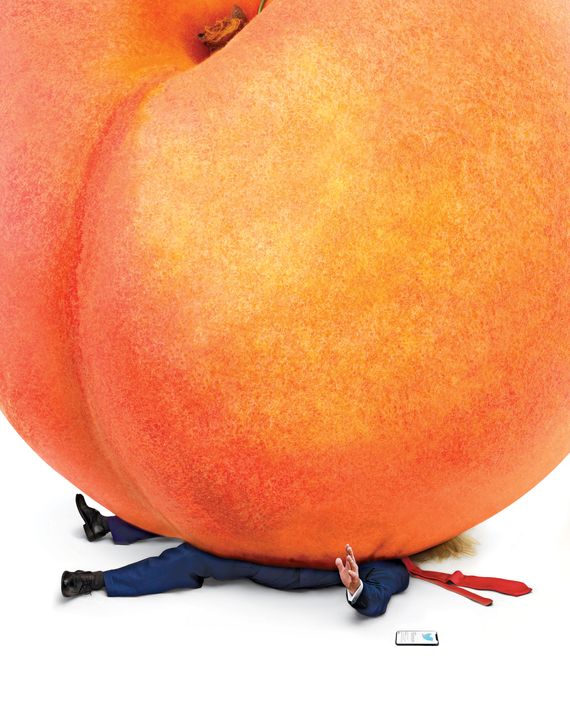
The crimes for which impeachment is the prescribed punishment are notoriously undefined. And that’s for a reason: Presidential powers are vast, and it’s impossible to design laws to cover every possible abuse of the office’s authority. House Democrats have calculated that an impeachment focused narrowly on the Ukraine scandal will make the strongest legal case against President Trump. But that’s not Trump’s only impeachable offense. A full accounting would include a wide array of dangerous and authoritarian acts — 82, to be precise. His violations fall into seven broad categories of potentially impeachable misconduct that should be weighed, if not by the House, then at least by history.
Explanation: The single most dangerous threat to any democratic system is that the ruling party will use its governing powers to entrench itself illegitimately.
Evidence: (1) The Ukraine scandal is fundamentally about the president abusing his authority by wielding his power over foreign policy as a cudgel against his domestic opponents. The president is both implicitly and explicitly trading the U.S. government’s favor for investigations intended to create adverse publicity for Americans whom Trump wishes to discredit. (2) During his campaign, he threatened to impose policies harmful to Amazon in retribution for critical coverage in the Washington Post. (“If I become president, oh do they have problems.”) He has since pushed the postmaster general to double rates on Amazon, and the Defense Department held up a $10 billion contract with Amazon, almost certainly at his behest. (3) He has ordered his officials to block the AT&T – Time Warner merger as punishment for CNN’s coverage of him. (4) He encouraged the NFL to blacklist Colin Kaepernick.
Explanation: As he does with many other laws, the president enjoys broad immunity from regulations on the proper handling of classified information, allowing him to take action that would result in felony convictions for other federal employees. President Trump’s mishandling of classified information is not merely careless but a danger to national security.
Evidence: (5) Trump has habitually communicated on a smartphone highly vulnerable to foreign espionage. (6–30) He has reversed 25 security-clearance denials (including for his son-in-law, who has conducted potentially compromising business with foreign interests). (31) He has turned Mar-a-Lago into an unsecured second White House and even once handled news of North Korea’s missile launch in public view. (32) He gave Russian officials sensitive Israeli intelligence that blew “the most valuable source of information on external plotting by [the] Islamic State,” the Wall Street Journal reported. (33) He tweeted a high-resolution satellite image of an Iranian launch site for the sake of boasting.
Explanation: President Trump has abused his authority either by distorting the intent of laws passed by Congress or by flouting them. He has directly ordered subordinates to violate the law and has promised pardons in advance, enabling him and his staff to operate with impunity. In these actions, he has undermined Congress’s constitutional authority to make laws.
Evidence: (34) Having failed to secure funding authority for a border wall, President Trump unilaterally ordered funds to be moved from other budget accounts. (35) He has undermined regulations on health insurance under the Affordable Care Act preventing insurers from charging higher rates to customers with more expensive risk profiles. (36) He has abused emergency powers to impose tariffs, intended to protect the supply chain in case of war, to seize from Congress its authority to negotiate international trade agreements. (37–38) He has ordered border agents to illegally block asylum seekers from entering the country and has ordered other aides to violate eminent-domain laws and contracting procedures in building the border wall, (39–40) both times promising immunity from lawbreaking through presidential pardons.
Explanation: The executive branch and Congress are co-equal, each intended to guard against usurpation of authority by the other. Trump has refused to acknowledge any legitimate oversight function of Congress, insisting that because Congress has political motivations, it is disqualified from it. His actions and rationale strike at the Constitution’s design of using the political ambitions of the elected branches to check one another.
Evidence: (41) Trump has refused to abide by a congressional demand to release his tax returns, despite an unambiguous law granting the House this authority. His lawyers have flouted the law on the spurious grounds that subpoenas for his tax returns “were issued to harass President Donald J. Trump, to rummage through every aspect of his personal finances, his businesses and the private information of the president and his family, and to ferret about for any material that might be used to cause him political damage.” Trump’s lawyers have argued that Congress cannot investigate potentially illegal behavior by the president because the authority to do so belongs to prosecutors. In other litigation, those lawyers have argued that prosecutors cannot investigate the president. These contradictory positions support an underlying stance that no authority can investigate his misconduct. (42) He has defended his refusal to accept oversight on the grounds that members of Congress “aren’t, like, impartial people. The Democrats are trying to win 2020.” (43) The president has also declared that impeachment is illegal and should be stopped in the courts (though, unlike with his other obstructive acts, he has not yet taken any legal action toward this end).
Explanation: By virtue of his control over the federal government’s investigative apparatus, the president (along with the attorney general) is uniquely well positioned to cover up his own misconduct. Impeachment is the sole available remedy for a president who uses his powers of office to hold himself immune from legal accountability. In particular, the pardon power gives the president almost unlimited authority to obstruct investigations by providing him with a means to induce the silence of co-conspirators.
Evidence: (44–53) The Mueller Report contains ten instances of President Trump engaging in obstructive acts. While none of those succeeded in stopping the probe, Trump dangled pardons and induced his co-conspirators to lie or withhold evidence from investigators. Former Trump lawyer Michael Cohen testified to Congress that Trump had directed him to lie to it about his negotiations with the Russian government during the campaign to secure a lucrative building contract in Moscow. And when Cohen stated his willingness to lie, Robert Costello, an attorney who had worked with Rudy Giuliani, emailed Cohen assuring him he could “sleep well tonight” because he had “friends in high places.” Trump has publicly praised witnesses in the Russia investigation for refusing to cooperate, and he sent a private message to former national-security adviser Michael Flynn urging him to “stay strong.” He has reinforced this signal by repeatedly denouncing witnesses who cooperate with investigators as “flippers.” (54–61) He has exercised his pardon power for a series of Republican loyalists, sending a message that at least some of his co-conspirators have received. The president’s pardon of conservative pundit Dinesh D’Souza “has to be a signal to Mike Flynn and Paul Manafort and even Robert S. Mueller III: Indict people for crimes that don’t pertain to Russian collusion and this is what could happen,” Roger Stone told the Washington Post. “The special counsel has awesome powers, as you know, but the president has even more awesome powers.”
Explanation: Federal employees must follow strict rules to prevent them from being influenced by any financial conflict. Conflict-of-interest rules are less clear for a sitting president because all presidential misconduct will be resolved by either reelection or impeachment. If Trump held any position in the federal government below the presidency, he would have been fired for his obvious conflicts. His violations are so gross and blatant they merit impeachment.
Evidence: (62) He has maintained a private business while holding office, (63) made decisions that influence that business, (64) and accepted payments from parties both domestic and foreign who have an interest in his policies. (65) He has openly signaled that these parties can gain his favor by doing so. (66) He has refused even to disclose his interests, which would at least make public which parties are paying him.
Explanation: One of the unspoken roles of the president is to serve as a symbolic head of state. Presidents have very wide latitude for their political rhetoric, but Trump has violated its bounds, exceeding in his viciousness the rhetoric of Andrew Johnson (who was impeached in part for the same offense).
Evidence: (67) Trump called for locking up his 2016 opponent after the election. (68–71) He has clamored for the deportation of four women of color who are congressional representatives of the opposite party. (72) He has described a wide array of domestic political opponents as treasonous, including the news media. (73–80) On at least eight occasions, he has encouraged his supporters — including members of the armed forces — to attack his political opponents. (“I have the support of the police, the support of the military, the support of the Bikers for Trump — I have the tough people, but they don’t play it tough until they go to a certain point, and then it would be very bad, very bad.”) (81) He has threatened journalists with violence if they fail to produce positive coverage. (“If the media would write correctly and write accurately and write fairly, you’d have a lot less violence in the country.”) (82) There have been 36 criminal cases nationwide in which the defendant invoked Trump’s name in connection with violence; 29 of these cited him as the inspiration for an attack.

On Friday, Attorney General William Barr spoke at Notre Dame’s law school and raised a few eyebrows by condemning societal ills on conspiring American secularists. As far as the nation’s chief law enforcement official was concerned, non-religious Americans – roughly a fifth of the population – are helping advance “social pathology” and “moral upheaval.” Barr added that these sinister secularists are responsible for “an unremitting assault” on “traditional values.”
One day later, Donald Trump spoke at a religious right gathering, where he told social conservative activists, “Forever and always, Americans will believe in the cause of freedom, the power of prayer, and the eternal glory of God.” Soon after, the president called into Fox News and insisted that there’s a Christian revival underway because “everybody” knows that “the Russian witch hunt was a faux, phony fraud. And we got rid of that. And then they came up with this Ukrainian story that was made up by Adam Schiff.”
And then, of course, there’s Secretary of State Mike Pompeo. USA Today reported late yesterday:
A recent speech about “Being a Christian Leader” by Secretary of State Mike Pompeo was promoted on the State Department’s homepage Monday, and has been met with criticism that it potentially violates the principle of separation of church and state enshrined in the Establishment Clause of the Constitution.
The speech was delivered at the America Association of Christian Counselors on Friday in Nashville, Tennessee. Pompeo touts Christianity throughout the remarks, describing how he applies his faith to his government work, referencing God and the Bible during the entirety of the speech.
If you visited the U.S. State Department’s website yesterday, its homepage featured a picture of Pompeo alongside text that read, “Being a Christian Leader.” (That text has since been replaced with content about Turkish sanctions.)
Taken together, Team Trump’s theological push isn’t exactly subtle. In a country that’s supposed to honor the constitutional principle of separation of church and state, it isn’t exactly healthy, either.
The New York Times’ Paul Krugman argued in his new column, “Pardon my cynicism, but I seriously doubt that Barr, whose boss must be the least godly man ever to occupy the White House, has suddenly realized to his horror that America is becoming more secular. No, this outburst of God-talk is surely a response to the way the walls are closing in on Trump, the high likelihood that he will be impeached for high crimes and misdemeanors.”
With Trump, Barr, and Pompeo each touting related theological messages over the course of a few days, as each of these men get caught up in an impeachment scandal, it’s hardly unreasonable to think there’s a larger strategy unfolding. And given the importance of evangelical Christians in the president’s base, the effort may even have the intended effect.
But I continue to marvel at Trump’s secularism and the inherent disconnect at the heart of the campaign. The president – a thrice-married former casino owner – claimed to go to a New York church that rarely saw him. Asked if he’s ever asked God for forgiveness, he said, “I don’t think so.” Asked whether he’s drawn more to the New or Old Testaments, Trump replied, “Both.”
And, of course, there was the whole “ Two Corinthians” incident.
The Republican has proceeded to lie repeatedly to leaders of the faith community about repealing the Johnson Amendment, which remains fully intact.
The irony of positioning Trump and his scandal-plagued team as heroes to the faithful is extraordinary.
The Rachel Maddow Show / The MaddowBlog
By Steve Benen October 14, 2019

There’s some disagreement among religious scholars over the phases of the Great Awakening, which are periods of Christian revival that began in the early 18th century. But according to Donald Trump, he may be responsible for helping usher in the latest phase.
“I was called by the great pastors of this country in a call about a week ago,” the president told Fox News’ Jeanine Pirro over the weekend, “and they said they have never seen electricity in the air, enthusiasm in the air. Churches are joining. People are joining the church.” Trump added this Christian revival is the result of “everybody” knowing that “the Russian witch hunt was a faux, phony fraud. And we got rid of that. And then they came up with this Ukrainian story that was made up by Adam Schiff.”
Evidently, this politically inspired Great Awakening is necessary, at least according to Attorney General William Barr, who spoke a day earlier at Notre Dame’s law school and condemned societal ills on conspiring American secularists.
“We see the growing ascendancy of secularism and the doctrine of moral relativism,” he said. “Basically every measure of this social pathology continues to gain ground.”
He described several social issues as “consequences of this moral upheaval.”
“Along with the wreckage of the family, we are seeing record levels of depression and mental illness, dispirited young people, soaring suicide rates, increasing numbers of angry and alienated young males, an increase in senseless violence and a deadly drug epidemic.”
Bill Barr, with a conspiratorial flare, added, “This is not decay. This is organized destruction. Secularists and their allies have marshaled all the forces of mass communication, popular culture, the entertainment industry and academia, in an unremitting assault on religion and traditional values.”
I can appreciate the fact that Barr is “neck-deep” in the scandal that’s likely to lead to the president’s impeachment, and perhaps his bizarre tirade against non-religious Americans was intended to solidify Team Trump’s support among Christian conservatives.
But that’s not much of an excuse for the attorney general’s offensive speech.
For one thing, it’s factually wrong. There are complex factors that contribute to problems such as drug abuse, gun violence, mental illness, and suicide, but to assume these issues would disappear in a more religious society is absurd. There are plenty of Western societies, for example, that are far more secular than the United States, and many of them are in better positions on these same social ills.
For that matter, if Barr is concerned about “the doctrine of moral relativism,” he may want to consider the broader relationship between his boss and his social-conservative followers – many of whom have decided to look the other way on Donald Trump’s moral failings because they approve of his political agenda.
But even putting aside these relevant details, it was the circumstances that were especially jarring: the nation’s chief law-enforcement officer delivered public remarks in which he alleged non-religious citizens of his own country are conspiring to advance a sinister “social pathology.”
Roughly one-in-five Americans considers themselves atheists, agnostics, or lacking in any specific faith affiliation. The idea that their attorney general sees them as part of a nefarious force, conspiring in the shadows to undermine morality, isn’t just ridiculous; it’s at odds with the country’s First Amendment principles.
Walter Shaub, the former director of the Office of Government Ethics, described Barr’s comments as “repugnant,” adding, “His job is to defend the First Amendment. But this immoral, unpatriotic, borderline monarchist and defender of corruption has other ideas.”

Beating Trump is high on the list of things Democrats want to do next year. In fact, it is at the very top of that list. But simply beating this madman won’t change the nature of the problems with the Republican Party, and could actually make them worse. Ring of Fire’s Farron Cousins discusses this.
🔥 Jake Tapper exposes HYPOCRISY of Pompeo, Graham and Giuliani on impeachment using their own words
Jake Tapper is a national treasure! 🔥🔥🔥Follow Occupy Democrats for more.
Posted by Occupy Democrats on Sunday, 13 October 2019
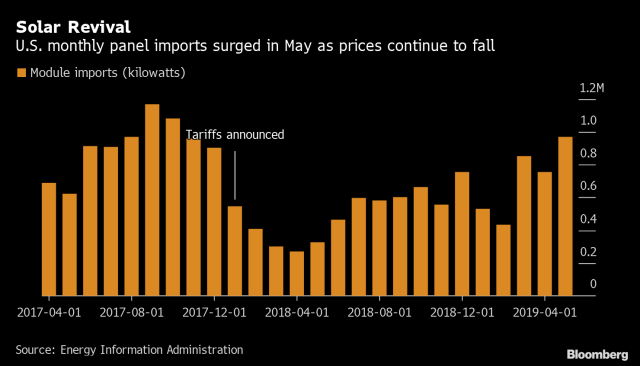
(Bloomberg) — The Trump administration dealt a fresh blow to renewable energy developers on Friday by stripping away an exemption the industry was counting on to weather the president’s tariffs on imported panels.
The U.S. Trade Representative said Friday it was eliminating a loophole granted about four months ago for bifacial solar panels, which generate electricity on both sides. They’ll now be subject to the duties Trump announced on imported equipment in early 2018, currently at 25%. The change takes effect Oct. 28.
The exclusion had been a reprieve for the solar industry, which lost thousands of jobs and put projects on ice as a result of the tariffs. Some panel manufacturers had already begun shifting supply chains to produce more bifacial panels. Stripping the exemption is a blow to developers who build big U.S. solar projects. American panel makers First Solar Inc. and SunPower Corp. will regain an edge on foreign competitors.
“The solar tariffs are back,” Tara Narayanan, an analyst at BloombergNEF, said in an interview Friday. “U.S. solar developers cannot buy products with lower costs and higher output as they briefly thought they could.”
First Solar, the largest U.S. solar panel maker, rose 0.5% to $59.60 at 5:16 p.m. SunPower gained 0.7% to $10.62.
What BloombergNEF Says
“The withdraw of tariff exemption for bifacial will cool down its popularity in the U.S. a little, but not stop the rise of the technology, which introduces improved economics even without tariff exemption.”– Xiaoting Wang, solar analyst
Developers that have used bifacial panels and stand to take a hit from ending the exclusion include Renewable Energy Systems Americas Inc.and Swinerton Inc.
While bifacial panels accounted for just 3% of the solar market last year, BloombergNEF had projected a swift ramp-up in production as manufacturers tried to insulate themselves from U.S. tariffs.
The trade group Solar Energy Industries Association fought to preserve the exemption, saying bifacial technology held “great promise for creating jobs, right here in America.”
“We’re obviously disappointed,” the group’s general counsel, John Smirnow, said Friday. “We look forward to making sure the bifacial exemption gets a fair hearing” during the solar tariff’s mid-term review process.
The U.S. Trade Representative said in its filing that “the exclusion will likely result in significant increases in imports of bifacial solar panels, and that such panels likely will compete with domestically produced” products.
SunPower, based in San Jose, California, opposed the exemption without a cap, saying that it would otherwise defeat the purpose of the tariffs. “It just means everyone is going to make a bifacial,” the company’s chief executive officer, Tom Werner, said in a Sept. 23 interview.
–With assistance from Joe Ryan and Ari Natter.
To contact the reporters on this story: Brian Eckhouse in New York at beckhouse@bloomberg.net;Christopher Martin in New York at cmartin11@bloomberg.net
To contact the editors responsible for this story: Lynn Doan at ldoan6@bloomberg.net, Joe Ryan, Pratish Narayanan
©2019 Bloomberg L.P.
The lobby of the CIA Headquarters building in McLean, Virginia.Larry Downing / Reuters file
WASHINGTON — Weeks before the whistleblower’s complaint became public, the CIA’s top lawyer made what she considered to be a criminal referral to the Justice Department about the whistleblower’s allegations that President Donald Trump abused his office in pressuring the Ukrainian president, U.S. officials familiar with the matter tell NBC News.
The move by the CIA’s general counsel, Trump appointee Courtney Simmons Elwood, meant she and other senior officials had concluded a potential crime had been committed, raising more questions about why the Justice Department later declined to open an investigation.
The phone call that Elwood considered to be a criminal referral is in addition to the referral later received as a letter from the Inspector General for the Intelligence Community regarding the whistleblower complaint.
Justice Department officials said they were unclear whether Elwood was making a criminal referral and followed up with her later to seek clarification but she remained vague.
In the days since an anonymous whistleblower complaint was made public accusing him of wrongdoing, trump has lashed out at his accuser and other insiders who provided the accuser with information, suggesting they were improperly spying on what was a “perfect” call between him and the Ukrainian president.
But a timeline provided by U.S. officials familiar with the matter shows that multiple senior government officials appointed by Trump found the whistleblower’s complaints credible, troubling, and worthy of further inquiry starting soon after the president’s July phone call.

While that timeline and the CIA general counsel’s contact with the DOJ has been previously disclosed, it has not been reported that the CIA’s top lawyer intended her call to be a criminal referral about the president’s conduct, acting under rules set forth in a memo governing how intelligence agencies should report allegations of federal crimes.
The fact that she and other top Trump administration political appointees saw potential misconduct in the whistleblower’s early account of alleged presidential abuses puts a new spotlight on the Justice Department’s later decision to decline to open a criminal investigation — a decision that the Justice Department said publicly was based purely on an analysis of whether the president committed a campaign finance law violation.
“They didn’t do any of the sort of bread-and-butter type investigatory steps that would flush out what potential crimes may have been committed,” said Berit Berger, a former federal prosecutor who heads the Center for the Advancement of Public Integrity at Columbia Law School. “I don’t understand the rationale for that and it’s just so contrary to how normal prosecutors work. We have started investigations on far less.”
Elwood, the CIA’s general counsel, first learned about the matter because the complainant, a CIA officer, passed his concerns about the president on to her through a colleague. On Aug. 14, she participated in a conference call with the top national security lawyer at the White House and the chief of the Justice Department’s National Security Division.
On that call, Elwood and John Eisenberg, the top legal adviser to the White House National Security Council, told the top Justice Department national security lawyer, John Demers, that the allegations merited examination by the DOJ, officials said.
According to the officials, Elwood was acting under rules that a report must occur if there is a reasonable basis to the allegations, defined as “facts and circumstances…that would cause a person of reasonable caution to believe that a crime has been, is being, or will be committed.”
A DOJ official said Attorney General William Barr was made aware of the conversation with Elwood and Eisenberg, and their concerns about the president’s behavior, in the days that followed.
Justice Department officials now say they didn’t consider the phone conversation a formal criminal referral because it was not in written form. A separate criminal referral came later from the Office of the Director of National Intelligence, which was based solely on the whistleblower’s official written complaint.
When Elwood and Eisenberg spoke with DOJ, no one on the phone had seen the whistleblower’s formal complaint to the inspector general of the intelligence community, which had been submitted two days before the call and was still a secret. The issue of campaign finance law was not part of their deliberations, the officials said.
It is illegal for Americans to solicit foreign contributions to political campaigns. Justice Department officials said they decided there was no criminal case after determining that Trump didn’t violate campaign finance law by asking the Ukrainian president to investigate his political rival, because such a request did not meet the test for a “thing of value” under the law.
Justice Department officials have said they only investigated the president’s Ukraine call for violations of campaign finance law because it was the only statute mentioned in the whistleblower’s complaint. Former federal prosecutors contend that the conduct could have fit other criminal statutes, including those involving extortion, bribery, conflict of interest or fraud, that might apply to the president or those close to him.
The decision not to open an investigation meant there was no FBI examination of documents or interviews of witnesses to the phone call, participants in the White House decision to withhold military funding from Ukraine, the president’s lawyer, Rudy Giuliani, and Ukrainian officials who were the target of Trump and Giuliani’s entreaties.
Text messages turned over to Congress Thursday night, in which diplomats appear to suggest there was a linkage between aid and Ukraine’s willingness to investigate a case involving Joe Biden, were not examined as part of the Justice Department’s review, officials said, adding that they conducted purely a legal analysis.
Justice Department spokeswoman Kerri Kupec told NBC News that the decision not to open an investigation was made by the head of the criminal division, Brian Benczkowski, in consultation with career lawyers at the public integrity section. She and other officials declined to say whether anyone dissented.

The operative DOJ standard that the president can’t be indicted while in office was not a factor, she said. Attorney General William Barr has said he believes the president can be investigated and prosecutors can make a determination whether he committed criminal conduct.
“Relying on established procedures set forth in the Justice Manual, the Department’s Criminal Division reviewed the official record of the call and determined, based on the facts and applicable law, that there was no campaign finance violation and that no further action was warranted,” said Kupec.
Kupec declined to comment on whether the Justice Department was investigating any other aspect of the Ukraine matter. There has been no public indication, however, of any such investigation.
Some legal experts are puzzled by Justice Department’s narrow approach.
“They are not by any stretch of the imagination limited to the referral,” said Chuck Rosenberg, an NBC News contributor and former U.S. Attorney. “They have the authority — in fact, they have the obligation — to look more deeply and more broadly and bring whatever charges are appropriate.”
Berger added, “When you get a criminal referral, you don’t go into it saying, ‘This is the criminal violation and now I’m going to see if the facts prove it.’ You start with the facts and the evidence and then you see what potential crimes those facts support. It seems backwards to say, ‘We are going to look at this just as a campaign finance violation and oops, we don’t see it — case closed.'”
In a case in which a government official is allegedly using his office for personal gain, and pressuring someone to extract a favor, the bribery and extortion statutes are usually considered, Berger said. The Foreign Corrupt Practices Act, which prohibits bribery of foreign officials, may also have been implicated, she said.
In his written complaint, the CIA officer who became the whistleblower framed his allegations this way: “I have received information from multiple U.S. government officials that the President of the United States is using the power of his office to solicit interference from a foreign country in the 2020 election.”
But when he first passed on his concerns, they were not so specific, officials said. He first complained at his own agency, sending word through a colleague to a CIA lawyer. The complaint eventually reached the spy agency’s top lawyer, Elwood, officials said.
She was told there were concerns about the president’s conduct on a call with a foreign leader, but not which leader, officials said.
She also was told that others at the National Security Council shared the concerns, so she called Eisenberg, the top NSC lawyer, officials said. He was already aware that people inside his agency believed something improper had occurred on the July 25 call with the Ukrainian president, officials said.
After consulting with others at their respective agencies and learning more details about the complaint, Elwood and Eisenberg alerted the DOJ’s Demers, during the Aug. 14 phone call, in what Elwood considered to be a criminal referral. Demers read the transcript of the July 25 call, officials said, on August 15.
What the DOJ did next is not entirely clear. A DOJ official said it was the department’s perspective that a phone call did not constitute a formal criminal referral that allowed them to consider an investigation, and that a referral needed to be in writing.
The whistleblower was already taking separate action. On Aug. 12, he filed a complaint with the inspector general of the intelligence community, after consulting with a staff member on the House Intelligence Committee, officials said.
At the end of August, the acting director of national intelligence, Joseph Maguire, sent the Justice Department his own criminal referral based on the whistleblower complaint, he has confirmed.
Kupec says career prosecutors in the Public Integrity Section, which works on corruption cases, were involved in deciding how to proceed, as was the national security division and the Office of Legal Counsel.
A senior DOJ lawyer who briefed reporters said the department had no basis on which to open a criminal investigation because Trump’s request of Ukrainian President Volodymyr Zelenskiy to investigate a case involving his political opponent couldn’t amount to a quantifiable “thing of value” under campaign finance law.
DOJ officials said they focused on campaign finance law because that was how the allegations were framed in the whistleblower complaint.
“All relevant components of the department agreed with this legal conclusion,” the DOJ’s Kupec said.
Paul Seamus Ryan, vice president of policy and litigation at Common Cause, is among those questioning even the narrow campaign finance analysis. Common Cause has filed a complaint with the Justice Department and the Federal Election Commission accusing Trump of violating campaign law.
It wouldn’t have been difficult for the government to determine how much money Ukraine would have spent in an investigation of Joe Biden and his son, he said,
“That would give them a dollar amount to show that Trump solicited ‘something of value,'” Ryan said.

There’s a striking simplicity to the scandal that will almost certainly lead to Donald Trump’s impeachment: he used his office to try to coerce a foreign government into helping his re-election campaign. The evidence is unambiguous. More information continues to come to light, but few fair-minded observers believe the president’s guilt is in doubt.
There’s been no explicit need for Trump’s detractors to prove that his scheme included a quid pro quo – the United States would trade something of value to a foreign country in exchange for its participation in the Republican’s gambit – since Trump’s effort was itself scandalous.
But as of this morning, the quid pro quo has nevertheless been established, thanks to a series of text messages that were released overnight. NBC News reported this morning:
Text messages given to Congress show U.S. ambassadors working to persuade Ukraine to publicly commit to investigating President Donald Trump’s political opponents and explicitly linking the inquiry to whether Ukraine’s president would be granted an official White House visit.
The two ambassadors, both Trump picks, went so far as to draft language for what Ukrainian President Volodymyr Zelenskiy should say, the texts indicate. The messages, released Thursday by House Democrats conducting an impeachment inquiry, show the ambassadors coordinating with both Trump’s personal attorney Rudy Giuliani and a top Zelenskiy aide.
One text shows Bill Taylor, the acting U.S. ambassador in Ukraine, asking, “Are we now saying that security assistance and WH meeting are conditioned on investigations?” Apparently reluctant to acknowledge criminal wrongdoing in print, U.S. Ambassador to the European Union Gordon Sondland replied, “Call me.”
In a subsequent message, Taylor added, “As I said on the phone, I think it’s crazy to withhold security assistance for help with a political campaign.”
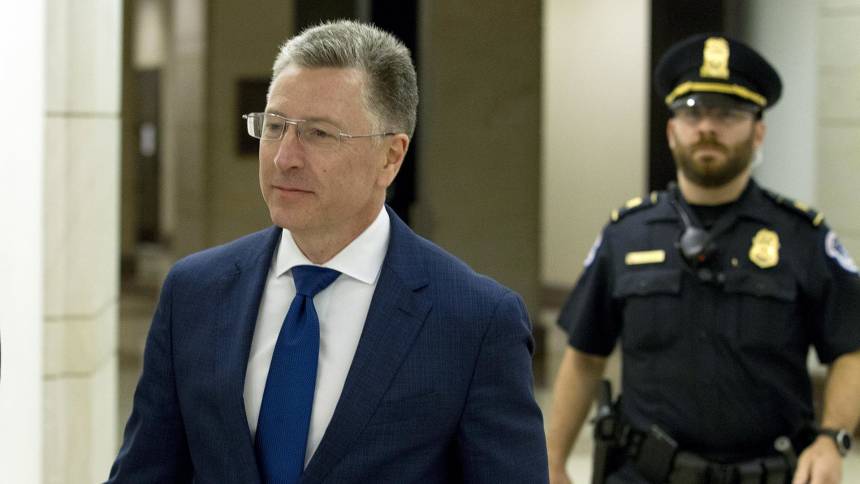
Just as astonishing was a message Kurt Volker, the former special U.S. envoy to Ukraine, sent to a Zelenskiy adviser shortly before the now-infamous Trump/Zelenskiy phone call. The message was clear about the White House’s political expectations, and how a presidential meeting was contingent on the Ukrainian president’s cooperation with the larger scheme.
“Heard from White House,” Volker wrote, “assuming President Z convinces trump he will investigate / ‘get to the bottom of what happened’ in 2016, we will nail down date for visit to Washington.”
The House Foreign Affairs Committee published the texts online here (pdf)
A Washington Post analysis added that the newly released messages not only document the quid-pro-quo element of the scandal, they also offer “a strong suggestion that military aid was used as leverage – and hints at an attempt to hide that.”
For two weeks, Trump’s Republican allies have argued that in order for this to be a real scandal, it would have to include a quid pro quo. That posture has long been wrong: the effort to coerce Ukraine was itself indefensible.
But what will these same GOP voices say now that the evidence has taken the scandal to the next level, meeting the one standard Republicans said had to be met?