Wildfires Across Northern California Devastate Farmers and Farmland

Wildfires Across Northern California Devastate Farmers and Farmland


Dozens of lightning-sparked wildfires have hit some of the Bay Area’s most beloved farming communities, destroying farm structures and razing crops, with little containment in sight.

A barn at Pie Ranch in Pescadero that burned during the 2020 California wildfires. (Photo credit: Jered Lawson)


On Tuesday night, Judith Redmond was alarmed by the thick brown smoke that clouded the air as she drove the 75 miles back from the Berkeley farmers’ market to Full Belly Farm in the Capay Valley. By Wednesday morning, she woke up to the ridge surrounding the valley engulfed by an inferno—part of what has become known as LNU Lightning Complex Fires—creeping dangerously close to the valley floor. Weathered by the 2018 County Fire, Redmond began to think logistics: how would she ensure the safety of her workers and neighbors with health conditions and animals that need to be moved?

Others, like rancher and organic cotton grower Sally Fox wouldn’t get the chance to ask themselves that question. Fox had to evacuate her farm and relocate her animals that same night.

And as the group of fires tore through nearby Pleasant Valley, the small farming community woke to abrupt knocks on their door giving them 10 minutes’ notice to leave. Alexis Koefoed of Soul Food Farm, whose farm was previously damaged in a 2009 fire, begged authorities for an extra 10 minutes to let out her livestock, certain they’d be gone by the morning if she did not.

Miraculously, they survived, though many of her neighbors weren’t that lucky. Girl on a Hill and Castle Rock Farm were just several of the farms that had their entire operations wiped out. As of Sunday evening, the LNU Lightning Complex Fires have burned more than 341,000 acres in Sonoma, Napa and Lake counties, impacting agriculture communities known for diverse family farms, destroyed 845 structures, and killed 4. The fire is just 17 percent contained, and ranks as the second-largest blaze in state history.

In the South Bay, the CZU Lightning Complex Fires have burned 67,000 acres and forced 77,000 people in San Mateo and Santa Cruz Counties to evacuate as of Sunday evening, including directors Jered Lawson and Nancy Vail of Pescadero’s Pie Ranch. The farm lost its historic 1863 farmhouse, which housed apprentices in its nonprofit training program.

The Molino Creek Farming Collective, an organic farm run by several families in Davenport, lost “everything but the tomatoes.” In a Facebook Post on Friday, a representative for the farm wrote, “All of our people are safe. The fire burnt some people’s homes and not others. Much of our infrastructure is intact but we lost most of our fence posts, some of our water tanks, lots of our orchard, some outbuildings, etc.”

Nearby, Swanton Berry Farm saw many of its long-time workers lose their housing, and TomKat Ranch also evacuated their animals and staff early on as a preventative measure.

Pie Ranch in Pescadero burns during the 2020 California wildfires. (Photo credit: Nancy Vail)Fire at Pie Ranch in Pescadero. (Photo credit: Jered Lawson)

Farmers who are lucky enough to be able to stay on their land find themselves responding to the fire while keeping up with essential daily farm duties. On Friday, Judith Redmond said she was keeping a close eye on the voluntary evacuation orders, while her crew has stayed on the farm, starting work early to evade scorching heat and ending early to limit working in the toxic smoke. It’s peak harvest season, and they have to keep produce moving.

“Farms are living entities, which means you can’t just turn them off and come back later when things have calmed down,” says Evan Wiig, director of communications at Community Alliance with Family Farmers (CAFF), a nonprofit organization that advocates for sustainable food and farm policy. The recent heat wave, which has brought 100-degree days to many California farms, makes the crops especially vulnerable, says Wiig. A single day of irrigation could mean catastrophic loss.

Farming is a precarious line of work even during normal times, with razor-thin margins and inconsistent weather patterns that are only becoming more extreme. Add to that a global pandemic that has forced farmers to reroute supply chains and put workers who live and work in close quarters at high risk of contracting the coronavirus. Now, the fires have made these ongoing pressures worse for many California farms, pushing many to the brink.

The LNU Lightning Complex wildfires burn in the Capay Valley. (Photo credit: Sally Fox)The LNU Lightning Complex Fire burns in the Capay Valley. (Photo credit: Sally Fox)

“Farmworkers and farmers are having to work in these conditions when they have been putting their health on the line with COVID,” says Anthony Chang, director of Kitchen Table Advisors, a nonprofit that helps small, sustainable farms develop business practices. The only upside? At least many farmworkers are already used to wearing masks.

Some rural farms have the advantage of being surrounded by vast expanses of wildlands that buffer structures from a raging blaze. But isolation can also put them at a disadvantage as unincorporated regions often rely on volunteer fire departments.

“The people that save the structures in the [Capay] Valley are the volunteers and the locals,” says Redmond. That’s especially true this year, with a delayed response from a beleaguered state fire agency, which has been battling nearly 600 blazes with a smaller crew than normal thanks to a COVID-driven shortage of inmate labor.

“The volunteer fire departments have been defunded and have not gotten their share of various monies that they should have had,” says Redmond, who also chairs a local committee to prevent fire in the Capay Valley. “It’s a problem that has been building and developing. . . . Climate change has a lot to do with it.” For these reasons, it took two days since the blaze erupted for the state level fire fighters to come to the valley, says Redmond. Compared to the rapid response with aircraft firefighting they saw two years ago, this year’s response has been notably different.

Dan McCloskey, a firefighter from the San Francisco Fire Department (SFFD) and part of a strike team of 20 SFFD firefighters on five engines sent to fight the LNU Lightning Complex Fires, told Civil Eats that 96 percent of Cal Fire personnel are already deployed to fight fires. He added that fire crews from up and down the West Coast—Washington, Los Angeles, and elsewhere—are present and more are arriving all the time to fight the nearly 600 fires that have started in the past week. But they’re still shorthanded due to the number and magnitude of fires burning in the state.

SFFD firefights in northern california pause for a photo between firesSan Francisco Fire Department deployed to Yolo County. Photo credit: Judy Starkman

Power outages swept the Capay Valley during the week and over the weekend, complicating an already challenging evacuation for many. Many rural farms depend on well water, which can only be pumped with electricity. Power outages mean no irrigation and no refrigeration for harvested produce and eggs.

Still, some farmers are worried about more than getting through this fire season. Will Holloway runs Blue Leg Farms, a 10-acre plot in western Santa Rosa, in the North Bay, that has been ravaged by major wildfires in recent years.

“As we do less and less to manage our wildlands, [fire risk gets] progressively worse,” says Holloway. “We saw it starting with Lake County for five years. And now here for five years. And absolutely nothing has changed in the way we’re managing our wildland.”

That reality hits hard for farmers planning for the future. Holloway plans his farm around summer harvest, but now that fire season comes every year, he plans to start introducing more early-harvest produce into the mix so that there’s less at stake in the dry season.

As we do less and less to manage our wildlands, our fire risk gets progressively worse.

“People act shocked when it happens earlier and earlier,” says Holloway. “These are like once-in-a-lifetime events, which are happening every year now.”

For many Indigenous peoples of California, the fires are wiping out entire harvest seasons, threatening their food security. Fire is an integral part of many Indigenous stewardship practices, but the intensity of fires greatly limits hunting and gathering opportunities. “California is a natural fire landscape,” says A-dae Romero-Briones, director of the Native Food and Agriculture Program at the First Nations Development Institute. “The Indigenous people who would go and gather right now are being affected because the fires are so intense because stewardship practices, like low-grade cultural burning, haven’t occurred in years.”

The importance of Indigenous practices is not lost on Pie Ranch’s Nancy Vail, who wrote in a Facebook post describing the devastation the fire wrought on her farm, “May this be the beginning of transformation, may we resolve to bring back Indigenous knowledge, heal the damage done since colonization, bring justice to the lands and the people, build resilient homes for all people, practice climate-friendly everything, feed people, love more.”

CAFF’s Wiig says the fires are forcing farmers to find new ways to be more ecologically and financially resilient. CAFF has been advocating for strategies farmers can take to prepare for fire season, including diversifying crops and clearing defensible space. Insurance is another important step, though many small farmers can hardly afford exorbitant insurance costs. Small as they are, Wiig underscores how important these steps are in the long run.

“What we do on our farms and how our food system operates ultimately affects the resilience of our communities in situations like this,” says Wiig.

Editor’s note: For readers who want to help, Central Valley community members are maintaining and sharing a list of crowdfunding pages for farms, families, and individuals who have been affected by the fires. CAFF has also launched a 2020 Fire Fund to support affected farmers and communities.

The Iowa Derecho Put Refugee Food Workers at Even Greater Risk

The hurricane-force winds that leveled Cedar Rapids have impacted hundreds of refugees who were considered ‘essential workers’ at meatpacking plants and supermarkets.

Pat Rynard at Iowa Starting Line.       


Over a week after a sudden, powerful storm brought hurricane-like winds across the plains of Iowa and wrought severe damage upon the city of Cedar Rapids, Patrick Safari stood with his wife and three children amid the ruins of his former home at the now-decimated Cedar Terrace Apartments.

A Congolese refugee who found a new home in Iowa’s second-largest city, Safari and his family have been displaced once again by the derecho storm, his former apartment among the more than 1,000 buildings made “unsafe to occupy” after being essentially annihilated by the high winds. Like many of the apartment complex’s former residents, the family stayed in a tent until they were able to move into a hotel on August 15, nearly a week after their home had been destroyed.

Safari works at a nearby Walmart in a position deemed “essential” throughout the pandemic; COVID-19 has killed more than 1,000 people in a state with a population of just over 3 million people. After dealing with coronavirus concerns, the sudden winds of destruction were just another blow in an already dangerous year.

“We have corona and then this also, that’s a bigger problem for us,” Safari said.

The derecho destroyed an estimated 43% of Iowa’s crops, half of Cedar Rapids’ tree canopy, and at least 64,000 people were without electricity at one point. More than 200 refugees—hailing from Pacific island nations, the Democratic Republic of Congo, and other African countries—were forced from their homes by the collapse of several apartment complexes.

While the city of Cedar Rapids attempted to crawl out from beneath the decimation and the state slowly responded, many of these refugees were forced to live grouped together in tents and makeshift shelters just outside of their former homes. Some were able to cook, barbecuing chicken wings and ribs over makeshift grills made from spare parts and biding time while waiting for the city and aid organizations to assist in temporary relocation. World Central Kitchen arrived and began serving meals to the displaced while they waited to see what would happen next. In the meantime, workers like Safari were expected to continue on at their jobs.

“It’s very difficult to go to work, with my family. But I try, I try,” he said.

Outside the Cedar Terrace apartments. (Photo by Aaron Calvin)

Photo by Aaron Calvin

The scene outside the Cedar Terrace Apartments was busy with front loaders digging into rubble while the complexes’ former residents milled about, salvaging what could be saved. Children played basketball with a hoop that was miraculously still standing. A fire burned in a barrel, filling the air with acrid smoke as a group of Congolese men stood commiserating among the wreckage. Gis Masimbolomba was among them.

Since his apartment had been made uninhabitable, Masimbolomba had been living at a nearby motel. Like many others, his car is now inoperable. Without it, he cannot consistently travel to his job at National Beef in Tama, a meat-processing plant about an hour away from Cedar Rapids that employs many African immigrants.

“I need my car fixed. I’m sleeping at this motel, my wife comes in the morning,” he said. “My son sleeps somewhere else. I need some help. I want to move to a new apartment. I don’t know how to find one. I need to get out of the motel, but I don’t know what to do.”

For Masimbolomba and other workers like him, the loss of basic essentials like housing and transportation comes after months of working and living in daily fear of contracting COVID-19 as a workplace hazard. In April, the National Beef meat-processing plant closed for a week after reporting 155 out of 500 employees had tested positive for the COVID-19.

Refugees from all over the world work in meat-processing plants, where conditions were often considered dangerous even before the pandemic. Advocates have decried the practices of companies that own these plants, many of which have sped up their lines, and keep workers from social distancing.

“We have been really concerned about these businesses’ failure to protect workers and we had these concerns even before the pandemic,” Grace Meng, a representative of Human Rights Watch, told Civil Eats. “It’s clear that a lot of the dangerous practices at work created an ideal opportunity for the virus to spread.”

“We’ve seen over and over again that corporate ag, and large meatpackers in particular, consider their profits more important than the people of Iowa,” said Emma Schmidt an Iowa-based organizer for the national advocacy group Food and Water Watch. “Big Ag prefers to garner favor among Iowans with negligible acts like giving away pork loins during the holidays or sending home dollar-off coupons with school children rather than taking meaningful action to support our communities.”

Since the coronavirus pandemic began, the Congolese community in particular has borne an outsized amount of the risk, often working at essential grocery jobs or in close quarters at meat processing plants.

Out of the 327 refugees living in Cedar Rapids, 255 of them are Congolese. Since the coronavirus pandemic began to spread through the state in March, the Congolese community in particular has borne an outsized amount of the risk, whether that’s because they’re working at essential grocery jobs or in the close-quarters conditions at meat processing plants like National Beef and Tyson Foods.

In May, Axel Kabeya, one of the pillars of the Congolese community in the town of Waterloo, an hour north of Cedar Rapids, died after contracting the coronavirus at the Tyson pork plant where he worked. Jose Ayala, another Congolese immigrant living in Waterloo, died later that month after contracting the virus at the same Tyson plant.

Traditional burial is important in the Congolese community, which can mean higher costs. EMBARC Iowa, an organization that primarily supports Burmese refugees resettled in Iowa but offers aid to a refugees from a variety of backgrounds, raise money in May for the burial of Wiuca Iddi Wiuca, a Congolese man living in Des Moines who died from the coronavirus.

Sylvain M’zuza, a Congolese pastor who has been working with the International Cultural Center in Iowa and the newly created Emerging Communities Crisis Coalition to provide aid to displaced refugees in Cedar Rapids, had been helping distribute masks and educate the refugee population about protecting themselves from COVID-19. Now, just as efforts to mitigate against the virus were starting to take hold, the same people are in sudden need of food, supplies, translation services, and long-term housing.

“One of the most important things we’re doing is helping with transportation, some of them need to go to work, and some of them need care for their children, right now they don’t have sitters,” M’zuza said.

While nearly the entirety of Cedar Rapids’ 133,000 residents have been reeling from storm damage, the local and state response has been strained and the news of the city’s destruction was slow to arrive nationally, partly due to the crippled information infrastructure.

“We are working closely with emergency officials and community partners on the ground to identify safe and secure housing for the refugees in Cedar Rapids,” a spokesperson for the Iowa Department of Human Services told Civil Eats.

And M’zuza is also focused on the immediate need for transportation to the plant. “We need to get them to one spot where they can take the bus to Tama. [The city of] Tama is also working with us and the needs for transportation.”

According to a spokesperson with the Center for Worker Justice of Eastern Iowa (CWJEI) this situation has complicated the transportation. Prior to the derecho, workers would meet at one spot near their homes and carpool to National Beef in cars of four to five people, which was already putting them at high risk of spreading the virus. Now, with workers placed in various temporary living situations, it’s more difficult for everyone to meet at a centralized location. Some workers are able to get to work or arrive late, but others are avoiding traveling in larger groups out of fear of contracting the coronavirus, and missing days of work.

“Most of these workers came from a refugee camp, and now the fear of living in a camp again is coming back. . . . Some of them are reliving life in the camps because they’ve lost everything and they’re not receiving the proper help.”

It’s unclear at this time what, if anything, National Beef is doing to assist these refugees, who make up a significant portion of their workforce. The company did not respond to Civil Eats’ request for comment. On August 20, Tyson Foods announced a partnership with the Salvation Army to give away frozen chicken breasts throughout Cedar Rapids.

“They rely on the workers, so they should be helping make it easier for them,” the CWJEI spokesperson said, who wants to see National Beef step up to provide transportation or temporary housing closer to the plant.

“Most of these workers came from a refugee camp, and now the fear of living in a camp again is coming back,” she added. “Some of them are still sleeping in their cars because they’re afraid. Some of them are reliving life in the camps because they’ve lost everything and they’re not receiving the proper help.”

Michael Cohen records campaign ads against Trump: Don’t ‘believe a word he utters’

NBC News

Michael Cohen records campaign ads against Trump: Don’t ‘believe a word he utters’

Dareh Gregorian, NBC News                     August 24, 2020
Michael Cohen records campaign ads against Trump: Don't 'believe a word he utters'

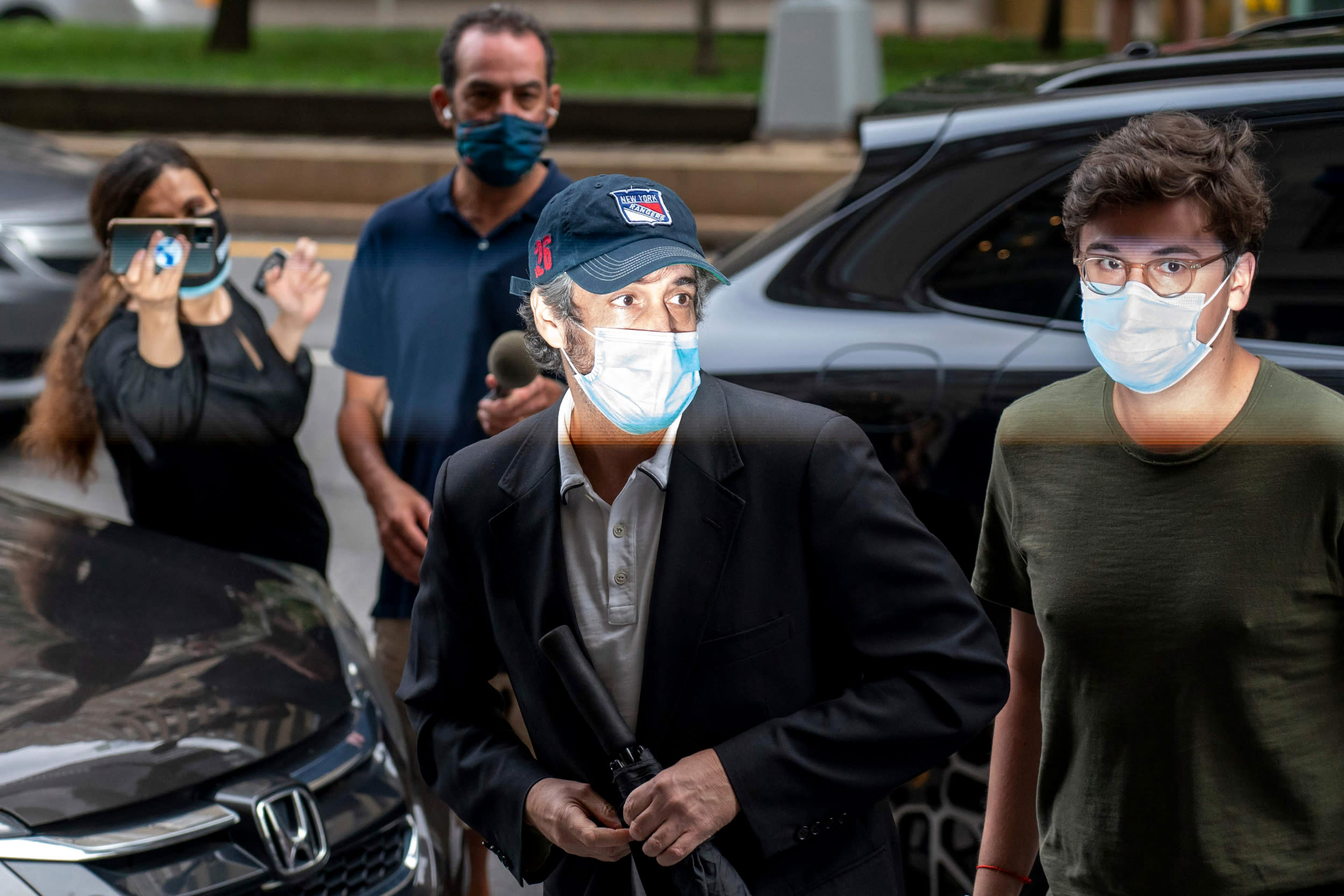
Michael Cohen, President Donald Trump’s former lawyer and fixer, has recorded a series of anti-Trump ads that are scheduled to run during the Republican National Convention painting his former boss as a fraud.

“Later this week, he’s going to stand up and blatantly lie to you. I’m here to tell you he can’t be trusted — and you shouldn’t believe a word he utters,” Cohen, who was convicted in 2018 of federal crimes, including making secret payments to women who claimed they had affairs with Trump, says in the ad revealed Monday night.

Cohen, who is serving his three-year sentence in home confinement because of the coronavirus pandemic, says convention viewers will hear Trump “talk about law and order.”

“That’s laughable,” he says. “Virtually everyone who worked for his campaign has been convicted of a crime or is under indictment. Myself included.

“So when the president gets in front of the cameras this week, remember that he thinks we are all gullible, a bunch of fools,” he says.

The ad campaign was made by the Democratic group American Bridge 21st Century, which said it will release digital and TV ads throughout the week.

Cohen, once one of Trump’s most trusted employees, was sentenced in December 2018 for what a judge called a “veritable smorgasbord” of criminal conduct, including financial crimes an lying to congress. He was released in May as part of a nationwide program allowing federal inmates to be transferred to other prisons or confined to their homes because of the pandemic.

He was locked back up about a week after he tweeted that he was writing a tell-all book about Trump. A judge found last month that the decision was “retaliatory” and ordered Cohen released to home confinement.

Brittany: How Can I Love God & Vote for Biden?

How Can I Love God & Vote for Biden?

By Brittany                 August 16th, 2020
Sharing is caring, babe!
Right. I don’t know how to gracefully do this, so let’s just get into it.

I see so many memes about how you can’t possibly be a Christian and support Joe Biden. That you can’t be a Catholic and vote Democrat. That it’s Trump who is the leader who espouses the faith we should be voting for.

I read them and I think… what the actual hell? 

It is my faith that leads me to vote Democrat. It is growing up in the teachings of Jesuit Priests that have filled me with compassion for the displaced and fleeing, welcoming them to my country as my neighbor.

It’s my faith that taught me that every person, no matter the background or bank account, deserves food, shelter, and safety.

My faith has filled me with the belief that it’s not the tax breaks that will get me into heaven, but truly giving a shit about someone else, through every stage of their lives.

I remember  sitting in Mass as a child and listening to a homily about how we should approach every person we meet wearing a blindfold, offering love and compassion first, sight unseen. We are not entitled to their story. We are not owed justification or explanation of their choices.  We just love and accept them. And it empowered my soul.

Every human has value. Every human is equal. No person is illegal. Love is not a sin.

It feels weird talking about this. Christian blogging isn’t really my style, and if you asked me to draw a line representing my brand of religion, it’d admittedly be a giant scribble.

I’m not Mother Teresa but if you need me to define my level of religious zealous, I’d say I’m an “Are You There God It’s Me Margaret” Catholic. I was raised in Catholic school, I go to Mass when I can, but me and God talk daily.

But, my religion is not my faith. My soul has room for both science and my belief in God, and I do not struggle to house both.

Listen. Churches are filled with a whole mess of “isms.” The history of harm there is deep, and it’s not a stranger to cloaking itself in Jesus stickers to hide its bouts of hate.

I see it on a global scale, playing out in acts of war and oppression. But more importantly, I see it in my own life.

The people sitting in the first pew of my church, nodding their heads with the priest asking them to love one another- without reservation- who then going home and post violence and hate on their walls. I see them with their Pray to End Abortion signs in their yards, as they vote against policies that would feed and care for the very “lives” they scream to protect.

We are taught to give someone the shirt from our back, yet bemoan the burden of the undocumented.

We are taught to love thy neighbor, yet our rose garden is used to list and threaten our enemies.

We are taught to wash the feet of the poor, yet vote to cut those in need off at the knee.

And abortion. The cornerstone of every political and religious argument. How do I rectify that with my vote? A few ways.

First, I believe in the quote that I will now butcher: your right to swing your fist ends where my nose begins.  Meaning I use my personal faith to guide me, not legislate you.

Second, my strong belief in science and viability aside, the truth is, I too, pray to end abortion.

I pray that we are provided with the means and education to make safe decisions. I pray that men no longer rape or commit sexual violence against women. I pray that women never feel they have to make a decision about their bodies based on fear or financial means. I pray that a woman’s value is not tied to being a vessel.  And I pray that no matter what decisions they make with their doctors, that they are met with the respect and compassion we have been taught to give, blindfold on.

Abortion has been the dangling carrot coaxing the faithful into the voting booth while hunger, poverty, and oppression is sold to us as self-created issues we are not responsible for shouldering.

I see all this, and it’s easy to think, maybe I’m not made for religion. That I’m too pissed and weary to fight to keep both my faith and my convictions.

But then I remember that I can because I’m able. And just because my comfort in that pew is cyclical, my faith is not.

Empathy. Inclusion. Justice. Kindness.

You ask me how can I believe in God and vote Biden, and I say to you, how could I not?

Another Giveaway to Polluters From the Trump EPA

Another Giveaway to Polluters From the Trump EPA

The Editors                       August 21, 2020

He didn’t use exactly those words, but it amounts to the same thing. EPA Administrator Andrew Wheeler, a former coal lobbyist, said he was freeing oil and gas companies from “burdensome and ineffective regulations.” By rolling back an Obama-era policy designed to curb gas leaks at pipelines and wells, the EPA administrator was essentially giving energy companies the go-ahead to release much more climate-warming methane into the atmosphere.

Methane is an invisible, odorless gas that can trap heat in the atmosphere 80 times more effectively than carbon dioxide. Leaking pipelines, wells and storage facilities are a major source of methane emissions, which is why the Obama administration, in 2016, pushed energy firms to find and fix those leaks. The Trump administration officially undid those requirements on Thursday.

Contrary to the EPA administrator’s claims, the Obama-era rules were neither ineffective nor especially burdensome. Indeed, many big energy firms — knowing a public-relations disaster when they see one — have joined environmentalists in protesting the rollback. Smaller firms with narrower profit margins will, it is true, benefit from reduced compliance costs. But there’s little sense in bailing them out if that imposes environmental costs on everyone else. Thanks to the rollback, some 400,000 tons of methane will leak into the atmosphere over the next decade, according to the EPA. That’s equivalent to burning another billion pounds of coal every year.

The EPA’s move will no doubt energize state-level efforts to limit emissions from oil and gas sites. In Pennsylvania, the country’s No. 2 gas-producing state, one such proposal from the Department of Environmental Protection has already gained vocal support. Regulators there can look to Colorado, which has long had standards surpassing those of the federal government.

On their own, though, states can only do so much. That’s why Senate Democrats have introduced a bill to that would hold energy firms responsible for methane leaks. It has little chance of passing the Republican-led chamber, but the outcome of the November elections might improve its prospects. And if Democrat Joe Biden wins the presidency, he could quickly reverse the EPA’s misguided decision.

When the EPA administrator made his announcement in a crucial swing state last week — fulsomely praising President Trump and slamming the “Obama-Biden administration” — November’s elections weren’t far from anyone’s mind. This partisan turn was disappointing, yet clarifying. Voters need to ask whether they want a new administration that takes science seriously and sets ambitious goals to cut greenhouse-gas emissions, or a president who offers giveaways to the fossil-fuel industry so irresponsible they make its biggest producers cringe.

Editorials are written by the Bloomberg Opinion editorial board.

Trump is opening Alaska’s wilderness to the oil business, but no one is buying

Quartz

Trump is opening Alaska’s wilderness to the oil business, but no one is buying

By Michael J. Coren, Climate reporter         August 20, 2020
REUTERS/U.S FISH AND WILDLIFE SERVICE. Prime drilling habitat?
The climate economy and the severity of the climate crisis has finally sunk in, and it’s inspiring individuals and industries to take action.


The Trump administration  announced this week it would issue decades-long leases in the massive Arctic National Wildlife Refuge (ANWR), potentially holding its first auctions by the end of the year.

It’s not clear anyone will take them up on the offer.

For quite some time, oil and gas companies (and their financiers) have been running in the other direction. Major banks have already refused to lend to projects that would drill in the 19.6-million-acre Alaskan preserve known as the  “last great wilderness.” Morgan Stanley, Goldman Sachs, JPMorgan Chase, and Wells Fargo had all sworn off financing oil development in the tundra’s refuge.

And few oil firms appear ready to take out loans, in any case. Last year, BP sold off its Alaska operations (including leasing rights in a private holding of ANWR). Anadarko, Pioneer Natural Resources, and Marathon Oil have hocked their holdings. Shell left Alaska without bothering to sell its assets. That’s left two companies, ConocoPhillips and Hilcorp, controlling 72% of Alaska’s oil production (the rest are owned by Exxon Mobil and a few smaller firms).

For all Donald Trump’s talk of “energy dominance,” the future of ANWR may be out of his hands. The hesitancy to drill new wells in Alaska’s Arctic is driven in part by a warming world: The state is heating up twice as fast as the rest of the nation, and its melting permafrost wreaks havoc on drilling infrastructure. But it has much more to do with the dire economics of drilling for expensive oil in remote locations.

Coronavirus has presented an existential crisis for the oil and gas industry, forcing every company to reckon with what it will take to survive.

Because of those high costs and low prices, the state’s oil production has declined 75% from its 2 million barrels per day peak in 1988. Alaska is predicting no growth in oil production for the rest of the decade.

“ANWR is a distraction,” said energy consultant Phil Verleger. If any leases do go up for auction, he predicts, “I doubt any company will bid.” Yet the refuge remains a battleground. The possibility of a billion-barrel oil discovery remains, and a few oil companies are holding out in hopes of hitting pay dirt one last time before the global economy shifts definitively away from fossil fuels.

Big Oil, no money

For decades, Republicans in the US have been trying to open up a critical strip of the refuge’s coastal plain to drilling. And until recently, legislators have been able to stall those efforts. Since 1980, more than 50 votes over ANWR drilling have gone before Congress. All have gone on to defeat—until 2017, when drilling was finally authorized as part of Republicans’ “Tax Cuts and Jobs Act.”

US EIA
The Arctic National Wildlife Refuge and trans-Alaska pipeline from the North Slope to Valdez, Alaska.

The decision came just late enough to be virtually irrelevant. Drilling in this region of Alaska might have made economic sense 10 or even five years ago. Today, it’s risky and out of reach for a diminished oil and gas industry that has seen its stock prices plunge along with the price of oil.

Energy companies’ share of the S&P500 has fallen from nearly 30% in 1980 to less than 5% today. “There is almost no rationale for Arctic exploration,” said Goldman Sachs analyst Michele Della Vigna on CNBC’s Squawk Box in 2017. “Immensely complex, expensive projects like the Arctic we think can move too high on the cost curve to be economically doable.”

Since then, it’s only gotten worse. Oil prices have hit historic lows, dropping to $45 this year, while breakeven prices to extract oil in Alaska’s rugged, remote terrain remain between $55 to $65 per barrel, estimates S&P Global Platts Analytics. In ANWR itself, the bar may be even higher:  $78 per barrel, according to the liberal think tank Center for American Progress.

This all comes on top of the logistical difficulties of building infrastructure in a place that is rapidly melting as a result of climate change. ConocoPhillips, one of the few major operators left in the region, is proposing a drilling project on Alaska’s North Slope. Expected to be approved by the federal Bureau of Land Management, it is so vulnerable to melting permafrost that the environmental impact statement proposes re-freezing the Alaskan tundra beneath its oil platforms (using gas-filled cylinders called thermosyphons), as well as constructing gravel roads built five to seven feet deep to prevent more thawing.

Oil production in ANWR is decades away, if it happens at all. With oil prices expected to fall along with demand as electric vehicle sales rise, it’s unclear if prices will rise again to the point where it makes economic sense to open ANWR.

As Obama explains what’s at stake, Trump fires rhetorical blanks

MSNBC – MaddowBlog

As Obama explains what’s at stake, Trump fires rhetorical blanks

By Steve Benen      August 20, 2020

Obama doesn’t think Trump puts individual policies or priorities in jeopardy; he thinks his successor puts everything in jeopardy.
Barack Obama during night 3 of the Democratic National Convention on Aug. 19, 2020.

Barack Obama during night 3 of the Democratic National Convention on Aug. 19, 2020.

The idea that former presidents refrain from criticizing their successors after leaving office is popular, but it’s largely a myth. Teddy Roosevelt was scathing in his criticisms of William Taft. Herbert Hoover blasted Franklin Roosevelt. Dwight Eisenhower had plenty of unkind words about John F. Kennedy.

But I was glad to see NBC News presidential historian Michael Beschloss observe last night what I was thinking: “No former President has ever attacked his incumbent successor at a convention like Barack Obama tonight, or even come close.”

It’s one thing for a former president to criticize a successor’s vision or agenda; it’s something else when a former president makes a compelling case that his successor is putting the nation’s future in severe jeopardy.

“For close to four years now, he’s shown no interest in putting in the work; no interest in finding common ground; no interest in using the awesome power of his office to help anyone but himself and his friends; no interest in treating the presidency as anything but one more reality show that he can use to get the attention he craves. Donald Trump hasn’t grown into the job because he can’t. And the consequences of that failure are severe: 170,000 Americans dead, millions of jobs gone while those at the top take in more than ever. Our worst impulses unleashed, our proud reputation around the world badly diminished and our democratic institutions threatened like never before.”

To be sure, much of Obama’s message emphasized his hopes and inspirations — the man is who he is — but there was an element of fear undergirding the former president’s prepared remarks.

Obama described an incumbent president as a corrupt narcissist, threatening the pillars that hold our country up. “This administration has shown it will tear our democracy down if that’s what it takes to win,” the Democrat said toward the end of his remarks.

That’s a rather extraordinary 17-word sentence. The assessment is rooted in truth, of course, and that’s what matters most, but no modern voter has heard a former president explain with such candor how dangerous his successor is. Obama added:

“[H]ere’s the point: this president and those in power — those who benefit from keeping things the way they are — they are counting on your cynicism. They know they can’t win you over with their policies. So they’re hoping to make it as hard as possible for you to vote, and to convince you that your vote doesn’t matter. That’s how they win. That’s how they get to keep making decisions that affect your life, and the lives of the people you love. That’s how the economy will keep getting skewed to the wealthy and well-connected, how our health systems will let more people fall through the cracks. That’s how a democracy withers, until it’s no democracy at all. We can’t let that happen. Do not let them take away your power. Don’t let them take away your democracy.”

Obama doesn’t see Trump as a Republican opponent; he sees him as an American menace. Obama doesn’t think Trump puts individual policies or priorities in jeopardy; he thinks his successor puts everything in jeopardy.

About halfway through the speech, the former president explained that Joe Biden and Kamala Harris “understand that political opponents aren’t ‘un-American’ just because they disagree with you; that a free press isn’t the ‘enemy’ but the way we hold officials accountable; that our ability to work together to solve big problems like a pandemic depends on a fidelity to facts and science and logic and not just making stuff up.”

And it was at roughly this same point that Donald Trump made stuff up, publishing his latest unhinged tweet: “HE SPIED ON MY CAMPAIGN, AND GOT CAUGHT!”

The Senate’s Russia Report Implicates More Than Trump’s Campaign

The Senate’s Russia Report Implicates More Than Trump’s Campaign

Eli Lake          August 18, 2020

(Bloomberg Opinion) — “This is what collusion looks like.”

That is how five Democratic senators, including vice presidential nominee Kamala Harris, view the fifth and final volume of the Senate Intelligence Committee’s report on Russian interference in the 2016 election.

Their argument rests on new evidence, which they say shows that Paul Manafort, former campaign manager for President Donald Trump, “was directly connected to the Russian meddling through his communications with an individual found to be a Russian intelligence officer.”

It’s a devastating claim. The report itself, however, paints a more nuanced picture, though no less horrifying.

Start with the Russian intelligence agent. He is a 50-year old man named Konstantin Kilimnik. The committee refers to him as a “Russian intelligence officer.” But Kilimnik does not have an official role in any Russian intelligence service. Instead, he “is part of a cadre of individuals ostensibly operating outside of the Russian government but who nonetheless implement Kremlin-directed influence operations.” Those initiatives are often funded by oligarchs close to Russian President Vladimir Putin.

Special Counsel Robert Mueller’s March 2019 report disclosed that Manafort funneled internal campaign polling and strategy documents to Kilimnik during the campaign. The Senate’s report fills in the blanks about their relationship.

Manafort has known Kilimnik since at least 2005, when Manafort began working as a consultant to former Ukrainian President Viktor Yanukovych. Kilimnik, in addition to being a kind of Russian spy, was also a close aide to Russian oligarch Oleg Deripaska. Manafort had numerous business dealings with Deripaska over more than a decade, including influence operations that targeted countries in Europe, Africa and other former Soviet republics such as Georgia.

By 2016, however, Manafort and Deripaska had had a falling out. Deripaska had sued Manafort for money he lost in a joint business venture. Instead of money — perhaps in lieu of payment — Manafort sent information to Deripaska, using Kilimnik as a go-between.

The Senate committee “was unable to reliably determine why Manafort shared sensitive internal polling data or Campaign strategy with Kilimnik,” the report says. It does say that Manafort and his deputy, Rick Gates, “both claimed that it was part of an effort to resolve past business disputes and obtain new work with their past Russian and Ukrainian clients.”

After Manafort resigned from the Trump campaign in August 2016, he kept up his relationship with both Kilimnik and some Trump campaign officials, such as the presidential son-in-law Jared Kushner. Kilimnik and Manafort schemed, for example cooking up a plan to persuade the president-elect to endorse a “peace plan” for Ukraine that would have cemented the gains won by Russia after its stealth invasion in 2014. Both men also communicated about how to counter the narrative that Russia sought to influence the 2016 election and discussed a communications strategy to pin the election interference on Ukraine.

The report does not conclude that Kilimnik was involved in the Russian intelligence operation to hack Democratic Party emails and then publicize them through Wikileaks and other Russian backed websites. Rather, it says it has “information suggesting Kilimnik may have been connected to the GRU’s hack and leak operation targeting the 2016 U.S. election.” It goes on to say: “While this information suggests that a channel for coordination on the GRU hack-and-leak operation may have existed through Kilimnik, the Committee had limited insight into Kilimnik’s communications with Manafort and [redacted], all of whom used sophisticated communications security practices.”

Regardless of whether Kilimnik was involved in the hacking and leaking of Democratic emails, the larger point is that Trump’s former campaign manager was so close to a Russian spy. That’s something both parties should condemn.

At the same time, the report raises some deeper questions. According to the report, Kilimnik worked for the International Republican Institute, a congressionally funded, nominally nonpartisan organization, from 1995 to 2005. He has claimed that he ended his work for the Russian government before joining. He was fired from his post in 2005, after the institute learned that he was working with Manafort.

Nonetheless, Kilimnik was in “regular contact” with personnel serving in the political section of the U.S. embassy in Kiev until late 2016. To be sure, many U.S. diplomats were wary of him. But he was able in January 2017 to secure a visa to the U.S., where he met with Manafort.

If Kilimnik was a Russian spy for this entire period — and the report gives evidence that indeed he was — then why didn’t the FBI or CIA do more to protect the U.S. embassy, or for that matter the International Republican Institute, from Kilimnik’s schemes?

A similar problem arises with Deripaska, the long-time associate of Manafort who the report accuses of masterminding political-influence campaigns from Cyprus to Montenegro. Between 2014 and 2016, the FBI tried to recruit him as a source. The bureau was rebuffed, and he reportedly told the Kremlin about the approach.

The new report finds that Christopher Steele, the former British spy who was contracted to produce the now-discredited dossier on the Trump campaign’s ties to the Kremlin, also had contracts with Deripaska — at the same time he was compiling his dossier on Trump. “The Committee found multiple links between Steele and Deripaska, including through two of Deripaska’s lawyers, and indications that Deripaska had early knowledge of Steele’s work,” the report says. “Steele had worked for Deripaska, likely beginning at least in 2012, and continued to work for him into 2017, providing a potential direct channel for Russian influence on the dossier.”

Steele’s dossier makes a number of allegations against Manafort that the FBI was never able to confirm. And yet it never mentions one damning and true fact about him: namely, Manafort’s longstanding ties to Deripaska.

Yet the FBI used that dossier to help obtain a surveillance warrant on a former Trump campaign adviser, Carter Page, and pressed to include its findings in the annex of the intelligence community’s assessment of Russian meddling in the 2016 election. After it became public in January 2017, the dossier also helped to shape the public narrative about Trump in the first two years of his presidency.

Finally: It’s worth noting that, for most of the last two decades, the two men most responsible for protecting America from Russian threats are Robert Mueller and James Comey, who together directed the FBI from 2001 to 2017. It’s a pity that the FBI only got around to doing something about people such as Kilimnik and Deripaska — not to mention opportunistic Americans like Paul Manafort — until after the 2016 election.

This column does not necessarily reflect the opinion of the editorial board or Bloomberg LP and its owners.

Eli Lake is a Bloomberg Opinion columnist covering national security and foreign policy. He was the senior national security correspondent for the Daily Beast and covered national security and intelligence for the Washington Times, the New York Sun and UPI.

Trump’s Ransacking of Alaska

Rolling Stone

Trump’s Ransacking of Alaska

Cassidy Randall                  August 19, 2020

On a bright July morning, in the tiny community of King Salmon on Alaska’s Bristol Bay, Nanci Morris Lyon bustles around her docked fishing boat. The water beneath is clear 15 feet down, like looking through glass. Up the slope behind Bear Trail Lodge, which Lyon has owned and operated for 11 years, the low-slung tundra unfolds for miles, stopped only by the snowy wall of mountains in the far distance.

It’s the height of the salmon run, and Lyon is readying the boat for her sport-fishing guests, who have to take a puddle-jumper plane for the hour-long flight from Anchorage — there are no roads to Bristol Bay. This season, tourists also have to abide by Alaska’s Covid-19 quarantine regulations for out-of-state travelers. But Lyon’s guests are willing to practice strict procedures; fishing in Bristol Bay represents an increasingly rare experience that’s worth the extra burdens.

Wild-salmon runs have taken a steep nosedive in Alaska and the Pacific Northwest in the past few decades, due to dams, fish hatcheries, the climate crisis, and other factors. Salmon are extinct across 40 percent of their historical range, and many of the remaining runs are threatened or endangered. But Bristol Bay, the biggest wild-salmon run on Earth, with a West Virginia-size watershed, remains a thriving refuge for all five species of Pacific salmon: Chinook, sockeye, coho, chum, and pink. From May through October, the tide pulses with walls of salmon returning to their birth rivers, a phenomenon called “red gold” for all the bounty it brings­ — $162 million in labor income alone, and more than half of the world’s annual sockeye catch. Eagles and bears flock to the water, thousands of commercial and sport fishermen descend on the bay, and indigenous people harvest the sea in a subsistence practice countless generations old.

But all of it is now at risk. In 2001, a small Canadian mining-exploration company called Northern Dynasty Minerals began plans for extracting the Pebble Mine, a massive store of copper, gold, and other minerals that lies underneath two of Bristol Bay’s most productive salmon streams. Following years of fighting led by Lyon and others, the EPA blocked the Pebble Mine in 2014 after scientists found it would result in “complete loss of fish habitat.” That decision has protected the bay, its salmon, and its people — until now.

On June 26th, 2019, Air Force One landed at Alaska’s Elmendorf Air Force Base for a refueling stop. Gov. Mike Dunleavy, a Republican of the Trumpist mold who had effectively already kissed the ring by promising to “Make Alaska Safe Again” when he took office in 2018, boarded and spoke with the president for 20 minutes. After emerging onto the tarmac, Dunleavy bragged that Trump agreed to do “everything he can to work with us on our mining concerns and our timber concerns.”

The day after the meeting, Trump ordered his administration to remove protections on Bristol Bay. And within two months he ordered protections removed from the Tongass National Forest, in southeast Alaska, the largest intact temperate rainforest on the planet, which scientists have called the “lungs of the country.” The Tongass absorbs more carbon than any other national forest, on par with the world’s most-dense terrestrial carbon sinks in Chile and Tasmania. The author of one 2019 study called preserving the Tongass “Alaska’s best and final shot at preparing for climate change.”

But even amid the pandemic, the Trump administration has been moving full speed on stripping Bristol Bay and the Tongass of protections. The government is expected to award a permit for the Pebble Mine any day now, and to lift restrictions on logging the Tongass by late summer or early fall. And this is on top of the move to open up 1.6 million acres of the Coastal Plain in the Arctic National Wildlife Refuge (ANWR) to oil and gas development — a plan that was officially approved on Monday.

“It was in line with Dunleavy and Trump to date to take the most brazen actions with no thought for the people, only making the rich richer and consequences be damned,” says Alanna Hurley, executive director of United Tribes of Bristol Bay (UTBB), which represents the 15 federally recognized tribes that make up 80 percent of the region’s population.

Alaska, a red state that Trump won by nearly 15 points, has a noted pro-development streak. Residents receive annual dividends from oil and gas revenues, and a majority of residents actually support the move to open up the Arctic National Wildlife Refuge to oil and gas development. But Bristol Bay and the Tongass Forest are a different story, and the people of southern Alaska have risen up in defense of these pristine ecosystems, which their livelihoods — and the planet — depend on.

“ANWR is far away, and the number of people who interact with it is tiny,” explains Tim Bristol, executive director of SalmonState, an Alaska-based advocacy group. “It’s a totally different setup in southern Alaska, with tens of thousands of people living and working in Bristol and the Tongass. In going after those, the administration woke a sleeping giant.”

When the residents around Bristol Bay first heard rumblings about a mine back in the early 2000s, they were romanced by the prospects for economic uplift. “The economy was depressed with the increased cost of living out here,” says Lyon. “A gallon of milk cost $10, just for perspective. But then we started hearing more about what the mine would actually look like.”

Northern Dynasty’s plan outlined what would be the largest open-pit mine in North America: a mine pit covering seven square miles, three-quarters of a mile deep, calling for an 86-mile private transportation route, and the supposed capacity to treat massive quantities of contaminated water in perpetuity after the mine’s eventual closure. Its construction would cross more than 200 streams and the Iliamna Lake headwaters; its dams and embankments would block critical salmon habitats; and it would destroy 81 miles of salmon streams and close to 3,500 acres of existing wetlands, lakes, and ponds.

“I never ran from a challenge,” says Lyon. Raised in Spokane, Washington, she moved to Alaska 35 years ago and became one of the first female fishing guides in the state. So when Northern Dynasty came for Bristol Bay, she turned herself into a self-taught political activist. “I have that personality, quadruple A. If you said I couldn’t do something, I would go and do it.”

She began making calls and writing letters to her state representatives and her U.S. senators. Alaskan organizations such as SalmonState and Save Bristol Bay caught wind of her activism, backed her with resources, and pointed big players like the Natural Resources Defense Council in her direction, who helped bring her to the U.S. Capitol to testify before Congress.

“Commercial, sport fisherman, and subsistence fisherman would never work all together on anything,” says Lyon. “But we’re at the same table with the same spear in our hand.”

“The tribes around Bristol have united on many other issues, like offshore drilling,” says Alannah Hurley of the UTBB, which was founded specifically to fight the mine. “But Pebble brought that unity to another level.”

For thousands of years, wild salmon have been the foundation of traditional Yup’ik, Dena’ina, and Alutiiq ways of life, for both subsistence and cultural identity. “For us to have our traditional life-ways threatened would be the extinction of our people as we know it,” Hurley says. “Our tribes weren’t going to trade our cultures based on our pristine ecosystem for short-term mining jobs.”

Hurley has been working in “the resistance,” as she calls it, since she graduated high school in 2004. She grew up in the tiny community of Dillingham. Her grandmother was born pre-statehood, one of the first to see non-native people arrive in the area. Like Lyon, Hurley taught herself how to advocate, speaking at shareholder meetings in London that helped result in major stakeholders walking away from the Pebble project, including giants Rio Tinto and Mitsubishi, leaving Northern Dynasty the solitary and woefully underfunded single owner of a project with near-unanimous regional opposition.

The UTBB is also directly responsible for the original EPA protections on Bristol Bay. In 2011, its tribes petitioned the EPA as sovereign nations to prohibit all large-scale mines in the region. In response, the EPA conducted the peer-reviewed studies of Northern Dynasty’s early plans that led to the agency blocking the mine in 2014, citing a provision in the Clean Water Act.

“Supporters in the lower 48 celebrated, thinking the door was closed,” says Lyon. “But we in the heart of it didn’t. We were fully aware that the 2014 decision didn’t remove the threat altogether.”

Sure enough, Northern Dynasty sued the EPA, reaching a settlement with the agency in 2017, and applied for a permit to initiate a federal environmental-review process. This time, the company called for a 1.4 billion-ton mine — nearly six times bigger than the 2014 scenario the EPA analyzed. A 2019 report by the Nature Conservancy found habitat losses could exceed the 2014 scenario by as much as 400 percent.

Northern Dynasty argues that the economic opportunity outweighs keeping Bristol Bay pristine. “There’s more to this story than just development versus environment,” says Mike Heatwole, Northern Dynasty’s vice president of public affairs. “What about looking at employment opportunities in a region that needs jobs? What about the copper the world needs to meet demand for moving away from fossil fuels? Wouldn’t we rather have that come from a country with strict environmental rules?”

But according to their own web site, Northern Dynasty promises only 750 to 1,000 direct jobs with the Pebble Mine, while the salmon run generates 14,000 jobs annually in addition to providing subsistence for the tribes.

And the world might demand copper, but even Republican experts agree that we shouldn’t be getting it from Bristol Bay. Last year, three former EPA administrators under four Republican presidential administrations wrote a joint public comment that concluded: “The question of whether to build a massive open pit copper and gold mine in the heart of the planet’s largest wild sockeye salmon fishery has a simple answer. The Pebble Mine is the wrong mine in absolutely the wrong place, and the answer is no.”

Even Donald Trump Jr., who Lyon took fishing in Bristol Bay in 2014, called on his father and the EPA to block the mine’s development, tweeting in early August that “the headwaters of Bristol Bay and the surrounding fishery are too unique and fragile to take any chances with.”

But on June 27th, 2019, the day after Trump and Dunleavy met on Air Force One, the EPA internally informed its staff scientists that the agency would be reversing its protections on Bristol Bay.

Lyon recalls the reaction back home as widespread panic. “I can’t tell you how many times my phone rang with people asking, ‘Nanci, what are we going to do?’ I don’t know. I’m a fishing guide, for God’s sake.”

Calls to their congressional delegation to intervene fell mostly on deaf ears. Sen. Lisa Murkowski has gone on record saying that “adverse impacts to Alaska’s world-class salmon fishery and to the ecosystem of Bristol Bay are unacceptable,” but she, Sen. Dan Sullivan, and the state’s sole representative in the House, Don Young, have all refused to take positions on the Pebble Mine, preferring to await the EPA’s final decision.

That decision was more or less finalized last month, when on July 24th, the Trump administration released its final environmental-impact statement, determining Northern Dynasty’s proposal for a 1.4 billion-ton mine to be the “least environmentally damaging” option for moving forward (out of options that included not developing a mine at all). All that’s left is for the EPA to publish the decision, which is set to happen by mid-August, and the mine will officially be green-lighted.

“We have not been heard,” says Lyon. “[Gov. Dunleavy] refuses to answer, respond or acknowledge anything any of us have said. It feels like we’re swinging on the end of a rope, and if we let go, the crocodiles will eat us. We’re at their mercy.”

Outside Kake, a tiny village on Kupreanof Island in the Tongass National Forest, Joel Jackson walks an old logging road. Skinny second-growth trees have muscled their way up on the surrounding slopes in the 40 years since Jackson built this road for his community-owned logging corporation.

“The forest all around used to be big beautiful trees,” he says, gesturing down to the sparse village on the seashore. Jackson, 63, is president of the Organized Village of Kake, home to the federally recognized Kake tribe of the Tlingit people. “When you walk into old growth, it’s like walking into a cathedral.”

At nearly 17 million acres, twice the size of Maryland, the Tongass is America’s biggest national forest, covering most of the southern Alaskan panhandle. In addition to the nearly 90,000 people who live in or just outside the forest’s borders (many in well-known hubs like Juneau, Skagway, and Ketchikan), the dripping green forest of old-growth hemlock, spruce, and cedar is a stronghold for brown bears, which have dwindled in the lower 48, and is home to the largest known concentration of bald eagles. The Tongass’ canopy, with some trees more than 800 years old, shades some of the world’s last productive salmon streams.

In the 1980’s, Kake decided that if anyone would log its old-growth surroundings, it would be its own operation, bringing jobs and income to its own people. “After the last tree fell, I looked up into these hills. It looked like a war zone,” Jackson says. “I asked myself, ‘What the hell did we just do?’”

Within months, the damage was obvious. Streams that “once held so many salmon you could walk across their backs,” says Jackson, slowly deteriorated — a devastating blow to a community that’s been dependent on salmon as the main food staple for millennia. The moose and deer the locals relied on for meat vanished, victim to increased predation by wolves that used the logging roads as hunting corridors. In a region where the cost of living is so expensive that subsistence off the landscape is crucial, food security became a serious issue. Young families moved away in search of work, and the community shrank by more than half, down to fewer than 500 people, with an 80 to 85 percent unemployment rate. Community members who remained were forced to cross 34 miles of open ocean to neighboring Admiralty Island to hunt.

The bottom fell out of the timber industry in southeast Alaska in the 1990s. “It was a typical boom-and-bust economy, and we busted,” says Jackson. “It used to be such a balance, with everything underneath the canopy. Berries, deer, bear, and the forest keeping our streams cool and pristine so the salmon could come back year after year. It was a beautiful time, and I miss those times.”

About half of the Tongass’ old-growth trees survive. They’ve been protected since 2001, when President Clinton, as one of his last acts in office, introduced the “roadless rule,” which barred the construction of roads in 58.5 million acres of undeveloped forest across the country, including more than half of the Tongass.

In 2018, Alaska’s then-Gov. Bill Walker initiated the lengthy process of making modest changes to the roadless rule to allow a few sections of the Tongass to be reopened to logging. But Dunleavy has promised to go much further. After his June 26th meeting with Trump, the president ordered the Department of Agriculture, which oversees the U.S. Forest Service (USFS), to wipe all roadless protections from the forest: a green light to begin logging its old growth again.

The move makes little sense in today’s timber economy. A recent report from the Center for Sustainable Economy documented taxpayer losses of nearly $2 billion a year from federal logging programs, largely due to the fact that demand for timber has been flagging nationally. Regardless, Trump signed an executive order in December 2018 to increase national-forest logging by 40 percent. “It’s nonsensical, but that’s the reality of what the Trump administration has brought us,” says Joel Reynolds, Western director for the Natural Resources Defense Council.  

Alaska’s federal delegation, however, joined Dunleavy in support of lifting the roadless rule, spinning it as “what Alaskans want” in op-eds, joint press releases, and statements that claim the rule was federal overreach and has for years restricted “needed access” for timber.

The communities of southeast Alaska disagree.

The Organized Village of Kake, along with several other tribes in the region, had been participating in stakeholder meetings with the USFS since late 2018. They were presented with six proposed plans, ranging from Alternative 1, leaving all protections in place for the Tongass, to Alternative 6, lifting all protections for the Tongass. In multiple meetings, the USFS focused only on Alternatives 1 to 5, says Jackson; the agency never discussed Alternative 6 in those meetings. It seemed that lifting all protections was never an option on the table.

Kake consistently advocated for no action, as did several other tribes. Communities from Ketchican and Petersburg, west to Sitka, and north to Skagway passed resolutions against lifting the roadless rule.

“The people have spoken,” says Tim Bristol of SalmonState. “We want protection for the most productive wild places left, we want a landscape that remains beautiful and allows for all these things that make living in southeast Alaska so great.”

Like Bristol Bay, southeast Alaska is home to all five species of Pacific salmon; a report from the American Fisheries Society quantified annual contributions of the Tongass and its neighboring forest, the Chugach, at 48 million salmon, with a value to commercial fisheries averaging $88 million. And thanks to its rich wildlife and pristine stretches of forest, the Tongass region hosts the highest number of tourism-related jobs in Alaska: 48 percent of the state’s total, generating $761 million annually in labor income.

But despite united local opposition to lifting the roadless rule and a national public comment period that yielded 96 percent national support for keeping protections in place, in October 2019, the USFS formally announced Alternative 6 as its preferred alternative for managing the Tongass. The Department of Agriculture is expected to issue its final decision late this summer or fall.

“I feel very disrespected by the whole process,” Jackson says. But his tribe and others are not backing down. On July 21st, nine southeast Alaska tribes submitted a petition to the Department of Agriculture to create a first-of-its-kind Traditional Homelands Conservation Rule “to save their ancestral lands in the Tongass National Forest from destruction at the hands of the agency itself.”

“All other avenues to protect our homelands have been exhausted, to little avail,” they wrote.

This new process could pause the agency’s actions on the roadless rule, as it would require identifying and protecting the “traditional use” areas of the forest. But the Department of Agriculture is not required to accept or even respond to the petition.

“They responded to the state of Alaska’s petition to lift the roadless rule in a matter of months,” says Marina Anderson, vice president of the Organized Village of Kassaan of the Haida tribe. “I hope that because this is a petition coming from nine nations, instead of one state, that they’re taking a big look at this and preparing for their response ahead of the final decision on the Tongass.”

Most experts agree that there’s slim chance the Trump administration’s final decisions on the Tongass and Bristol will reflect public will, much less any environmental protection. Some residents are hoping for a Biden administration to save the day. Some are hoping for at least a Senate flip to Democratic control, which would open new legislative strategies for protecting these places. And barring those, people are planning their last stands for the courtroom.

“I hate to say that dirty word, but litigation is all we’re left with,” says Jackson.

“We’re prepared to take legal action if necessary to protect Bristol Bay,” says Erin Whelan, staff attorney for Earthjustice, a national organization that’s been aiding local communities on the issue since 2004. To legally satisfy the Clean Water Act, she says, the environmental review has to find that the Pebble Mine as proposed won’t have unacceptable adverse effects on the fishery. “I don’t know how they could justify that when the 2014 EPA watershed assessment found that even a smaller and less destructive mine would have adverse effects.”

Lyon can barely put into words what would happen to Bristol Bay if the Pebble Mine were to go forward. It would be a slow death, she says. Mining roads would provide access to this remote place to forever change its character. The salmon would fade as the waters deteriorated, and all the people and animals that depend on them would start to disappear from the bay.

I ask how it would feel personally. Lyon pauses, for an interminable moment, and finally says, “I would feel like my guts had been ripped out. It’s my life. If you take it away, all I’ve held near and dear and protected …” She trails off, unable to finish the thought.

Hurley finishes it for her from across the bay in Dillingham. “We’ve been at it for a long time,” Hurley says. “We have not faltered. No matter what happens with this federal permit, we’re going to keep going. We don’t have a choice.”

The Country Lady, Mary McLeod Bethune, Bethune – Cookman School

The Country Lady

Image may contain: 1 person, sitting

She started a school for African-American girls with $1.50. The school bordered the town dump. Make-shift desks and chairs were made from discarded crates and boxes. There were five students at the time, and the students made ink for pens from elderberry juice and pencils from burned wood.
When the the local Ku Klux Klan heard about the school, they threatened to burn it down. There were reports that they waited outside the school, but she stood in the doorway, unwilling to back down or leave her school. Other stories say that she and her students started singing spirituals. The Ku Klux Klan eventually left.
Mary McLeod Bethune was born on July 10, 1875 in a log cabin on a cotton farm in South Carolina, the 15th of 17 children of former slaves. Most of her brothers and sisters were born into slavery; she was the first child born free. She started working in the fields by the age of 5.
One day, she accompanied her mother, delivering “white people’s” wash. When she was given permission to enter the white children’s nursery, she saw a book, which fascinated her. A white girl would quickly snatch the book from her hands, telling her she didn’t know how to read. That’s when Mary realized the only difference between white and black folk was the ability to read and write.
When she got the opportunity, McLeod attended a one-room black schoolhouse, walking five miles to and from the school. When she got home, she would teach her parents and siblings what she learned. She then got an opportunity to attend the Moody Bible Institute in 1895, becoming the first African American student to graduate from the school.
She decided then she would become a missionary, sharing what she learned. But, she would be informed that no one wanted or needed a black missionary.
Rather than give up her dreams, she decided more than ever that she would eventually teach.
Flash forward to 1904, when after moving to Florida, she started the Educational and Industrial Training School for Negro Girls, which initially had five girls aged six to twelve. With limited resources, she was determined to make the school a success, even when the Ku Klux Klan threatened her. But, eventually she received donations and support from the community, and the school grew to 30 girls by the end of the year.
Booker T. Washington would tell her of the importance of white benefactors to fund her school, so she started traveling and fundraising, receiving donations from John D. Rockefeller and establishing contacts with Franklin and Eleanor Roosevelt.
Her little school would become even more successful after it merged with a private institute for African-American boys and became known as the Bethune-Cookman School. She was president of the college from 1923 to 1942, and 1946 to 1947, becoming one of the few women in the world to serve as a college president at that time.
After she found that one of her students needing medical care was denied the care she needed and was placed on an outside porch of the local white hospital instead of a room with a bed, she used her funding sources and connections to open the first black hospital in Daytona, Florida.
According to the Turning Point Suffragist Memorial Association, McLeod became “one of the 20th century’s most powerful and celebrated advocates for civil rights and suffrage”, holding “prominent roles, including president, in the National Association of Colored Women (NACW). She also served as president of the Florida Federation of Colored Women’s Clubs, where she fought against school segregation and sought healthcare for black children. Under her leadership, the National Council of Negro Women (NCNW) was founded as a unifying voice for African American women’s organizations.”
As chapter president of the Florida chapter of the National Association of Colored Women, she would become so well known for her work registering black voters that once again she received threats from the Ku Klux Klan. And, like before, she did not back down.
With her friendship with the Roosevelts, she would become appointed as a national adviser to president Roosevelt, becoming part of what was known as his Black Cabinet and advising him on concerns of black people and would be called the “First Lady of the Struggle”.
When she passed away on May 18, 1955, she was recognized across the country. One newspaper suggested “the story of her life should be taught to every school child for generations to come” and The New York Times noted she was, “one of the most potent factors in the growth of interracial goodwill in America.”
In her own words before she died, she wrote:
“I leave you love. I leave you hope. I leave you the challenge of developing confidence in one another. I leave you a thirst for education. I leave you a respect for the use of power. I leave you faith. I leave you racial dignity. I leave you a desire to live harmoniously with your fellow men. I leave you a responsibility to our young people.”
“If I have a legacy to leave my people, it is my philosophy of living and serving. I think I have spent my life well. I pray now that my philosophy may be helpful to those who share my vision of a world of Peace, Progress, Brotherhood, and Love.”