What does Biden’s diverse Cabinet mean for a divided country

CNN

Analysis: What does Biden’s diverse Cabinet mean for a divided country

January 18, 2021


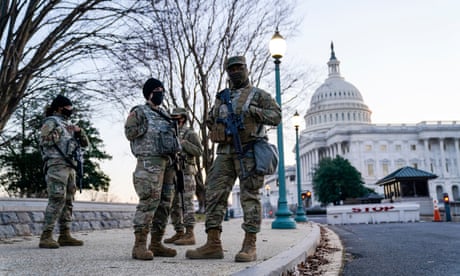
Americans are demanding leaders atone for the forces of White supremacy that motivated a mob to storm the US Capitol on January 6 in its refusal to accept President Donald Trump’s loss. And people of color, despite their rising political power, have been among the communities hardest hit by the Covid-19 pandemic and other disparities.
Biden has achieved a historic feat that observers hope will help begin the process of repairing a broken country. The President-elect has the most racially diverse presidential Cabinet in the history of the US. A CNN analysis found that 50% of nominees for Cabinet positions and Cabinet-level positions are people of color. That figure includes Vice President-elect Kamala Harris who will be the first Black and South Asian person and first woman to hold the position. Former President Barack Obama set the previous record for diversity with a Cabinet that was 42% people of color.
Civil rights leaders have praised Biden for keeping his promise of creating a Cabinet that better reflects the country’s changing demographics. However, this is only the first step and they are cautiously optimistic.
Biden’s administration will be expected to enact policies that lead to substantive change for communities of color. The Cabinet will be judged on whether it can end the Covid-19 pandemic and ensure vaccine access to underserved communities, support voting rights legislation, revive the economy, push police reform that addresses the fact that Black people are killed by police at higher rates, and reverse Trump’s anti-immigration policies. Civil rights activists will also be looking for Biden to consider people of color for deputy roles in the Cabinet as well as judges and US attorneys.
“We believe that Biden’s Cabinet appointments are just the starting point for a slate of demands that Black people and other people of color have,” said Arisha Hatch, vice president of Color of Change. “For us, diversity is just table stakes. It’s like the baseline thing that needs to happen.”
Diversity on a ‘new level’
Biden will be turning the tide of a majority White and male Trump administration that was only 16% people of color.
Trump garnered criticism for the lack of diversity in his Cabinet and his failure to address issues of concern to communities of color.
Throughout Trump’s presidency, he used offensive rhetoric to target Muslims, Mexicans, Syrian refugees, Africans, congresswomen of color, and Black athletes protesting racial inequality.
During an impeachment hearing for Trump on Wednesday, Rep. Cori Bush, a freshman Democrat from Missouri, called Trump a White supremacist.
“If we fail to remove a White supremacist President who incited a White supremacist insurrection, it’s communities like Missouri’s first district that suffer the most,” Bush said during her speech. “The 117th Congress must understand that we have a mandate to legislate in defense of Black lives. The first step in that process is to root out White supremacy starting with impeaching the White supremacist in chief.”
A 2019 study by the Pew Research Center found that 56% of Americans believed that Trump made race relations worse in the US.
The country experienced a reckoning on racism last summer when mass protests erupted after the controversial police killings of George Floyd, Breonna Taylor and other Black Americans. Covid-19 exacerbated already existing health disparities as people of color have died from the virus at higher rates than White people.
Inequality has now become a central focus for this country and many social justice advocates are looking for Biden to right the wrongs of the Trump administration.
In December, lawmakers and civil rights groups pressured Biden to appoint Black, Latino and Asian nominees to his Cabinet, citing the nation’s heightened alert on race and justice.
Douglas Brinkley, a CNN presidential historian, said Biden’s diverse Cabinet is taking the White House to a “new level” that past presidents haven’t been able to accomplish.
Former President Bill Clinton, Brinkley said, attempted to create a diverse Cabinet when he chose four Black and two Hispanic department heads.
Still, Clinton came under fire for passing the 1994 Crime Bill, which strengthened law enforcement across the country, provided federal money for new cops and prisons, and ordered mandatory life sentences for repeat offenders. Critics say the bill led to mass incarceration of Black people. Biden, who authored the bill, has defended aspects of it while also calling it a “mistake” and blaming its negative impacts on state governments.
Brinkley said Biden and his Cabinet have an opportunity to disprove critics who say Democrats rely on voters of color but don’t meet their expectations.
“This is coming at a time when the Republican party seems to be doubling down on being the party of White Americans only,” Brinkley said. “There’s a feeling here of a last gasp of particularly White male privilege going on here and Biden is trying to shatter that impression of America by making sure his Cabinet is very diverse and that should be applauded.”
Falling short with Asian Americans


While Black and Latino leaders say they are pleased with the Cabinet picks, Biden did not meet the expectations of the Congressional Asian Pacific American Caucus that asked for top-tier representation in the Cabinet.
Asian Americans are the fastest growing racial group in the nation and make up 6% of the US population.
Biden nominated two Asian people to Cabinet level positions. Neera Tanden will be the Office of Management and Budget Director and Katherine Tai was named US Trade Representative. Both will be the first Asian American women in their roles.
Congressional Asian Pacific American Caucus Chair and California Rep. Judy Chu called it “incredibly disheartening” that an Asian American Pacific Islander was not selected for a Cabinet secretary job for the first time since 2000.
“Despite the diversity amongst these Cabinets selections, we are deeply disappointed by the decision to exclude AAPIs from the 15 Cabinet Secretary positions who oversee executive departments in our government,” Chu said. “The glaring omission of an AAPI Cabinet Secretary in the self-declared ‘most diverse Cabinet in history’ is not lost on us and sends a demoralizing message to our nation’s fastest growing racial group and voting bloc that AAPIs do not need to be counted the same way as other key constituency groups.”
According to CNN exit polls, Asian Americans backed Biden at 61%.
Biden has promised to meet the concerns of AAPI’s including appointing them as judges and federal officials, protecting the Affordable Care Act to mitigate their barriers to healthcare access, fighting the rise in hate crimes against their community, and rescinding Trump’s Muslim ban.
A ‘milestone,’ but it’s only a first step


In December, Biden met with several Black civil rights leaders who pushed Biden to tap Black people for high level Cabinet roles and not just second-tier positions.
Many wanted Biden to pick a Black attorney general who would crack down on police violence in the Black community and voting rights. Biden ultimately selected Merrick Garland for the role.
Black Americans make up 12% of the US population and have faced oppression dating back to slavery and the Jim Crow era. Black people are also three times more likely than White people to be killed by police, according to the Harvard T.H. Chan School of Public Health.
Biden ultimately picked five Black people for his Cabinet including incoming Defense Secretary Lloyd Austin, who will be the first Black person to lead the Pentagon, and Ohio Rep. Marcia Fudge, who was named HUD secretary. Other Black nominees include incoming EPA Administrator Michael Regan, who will be the first Black man to head the department; Cecilia Rouse, incoming chair of the Council of Economic Advisers and the first Black person to hold the post; and Linda Thomas-Greenfield will be U.N. Ambassador.
Marc Morial, president of the National Urban League, was among the civil rights leaders who met with Biden and said the President-elect has achieved a “milestone” with this diverse Cabinet.
Morial said he believes their push for diversity was crucial to ensure Biden kept his word.
Now Biden will be charged with prioritizing equitable Covid-19 vaccine access, economic equality and increased funding for Black-owned businesses, voting rights and other issues affecting the Black community, Morial said.
“He has successfully gotten to first base,” Morial said. “I think for people who are fair minded and open minded, the truth is that the way people feel will very much be predicated on how they (Biden’s Cabinet) perform.”
Biden makes gains with Latinos
Latino leaders have also praised Biden for his Cabinet picks. Latinos hold the largest minority population in the country at 18%.
selected four Latino people for his Cabinet and three are Cabinet secretaries. The nominees include Xavier Becerra, for Secretary of Health and Human Services; Miguel Cardona for Secretary of Education, Alejandro Mayorkas for Secretary of Homeland Security; and Isabel Guzman who will be the Small Business Administrator. Becerra and Mayorkas will be the first Latinos to lead their departments.
Last week, the heads of UnidosUs, Hispanic Federation and other national groups met with Biden, Harris and their Hispanic Cabinet nominees to discuss the challenges facing the Latino community. Among the issues discussed were the devastating toll Covid-19 has had on Latino Americans, health care access, immigration, and jobs, the leaders said in a statement.
“The President-elect knows our people are hurting,” said Janet Murguía, UnidosUS President and CEO. “He wants to address the health and economic impact on the Latino community and understands the need to address systemic inequality by putting equity at the center of his economic and health care response. This feels like a new day, a huge change.”
Eric Rodriguez, senior vice president of UnidosUS, said he expects Biden to undo the Trump administration’s anti-immigration policies that he called “cruel and heartless and gutless.”
Rodriguez said having a diverse Cabinet will help Biden gain the trust of people of color.
“Having that cultural experience and background is just so important to being able to communicate and get information from those communities,” Rodriguez said.
Native Americans celebrate historic appointment
Biden was also lauded by Native Americans when he nominated Deb Haaland for secretary of the Interior, which will make her the first Native American to lead a Cabinet agency.
Crystal Echo Hawk, executive director of IllumiNative, said she now wants to see Biden’s Cabinet boost funding for Covid-19 relief in Native American communities and ensure vaccine access. Echo Hawk said Native Americans have been sickened or dying from Covid-19 at high rates because of the “deliberate and long-term under-funding” of their health care systems.
Native Americans are also asking Biden to undo the repeated attempts by the Trump administration to undermine tribal sovereignty over their lands and sacred sites, suspend Trump’s decision to lease drilling rights on the Arctic National Wildlife Refuge, and rebuild the relationship between tribal leaders and the federal government, Echo Hawk said.
“We are encouraged to see these strides toward political representation that looks like the United States and the constituents the Cabinet serves,” Echo Hawk said. “However, this must be accompanied by policies that transform the systems of power that have shutout Native, Black, Latinx, and other communities of color for generations.”
Billionaires backed Republicans who sought to reverse US election results

The Guardian

Billionaires backed Republicans who sought to reverse US election results

Guardian analysis shows Club for Growth has spent $20m supporting 42 rightwing lawmakers who voted to invalidate Biden victory.

Stephanie Kirchgaessner in Washington              January 15, 2021

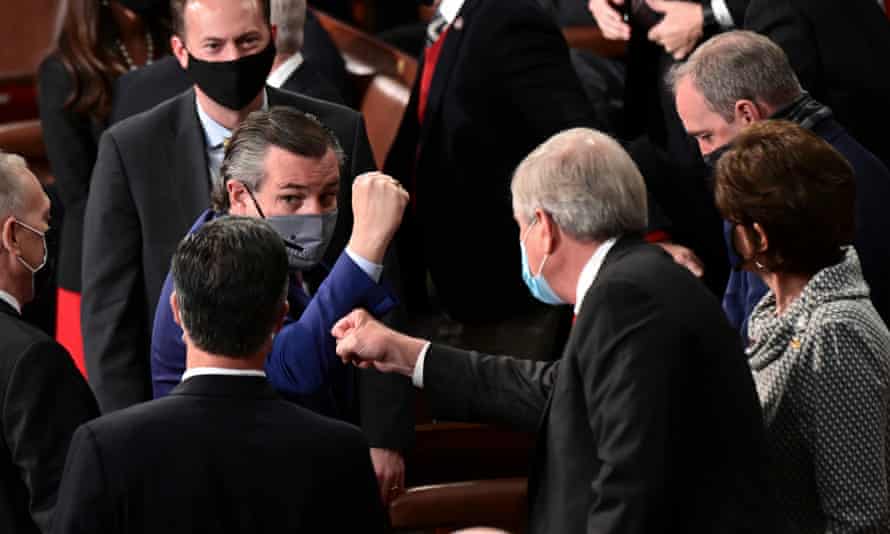
The Club for Growth’s biggest beneficiaries include Josh Hawley and Ted Cruz, above, the duo who led the effort to overturn the election result.

The Club for Growth’s biggest beneficiaries include Josh Hawley and Ted Cruz, above, the duo who led the effort to overturn the election result. Photograph: Erin Scott/EPA

An anti-tax group funded primarily by billionaires has emerged as one of the biggest backers of the Republican lawmakers who sought to overturn the US election results, according to an analysis by the Guardian.

The Club for Growth has supported the campaigns of 42 of the rightwing Republicans senators and members of the House of Representatives who voted last week to challenge US election results, doling out an estimated $ 20m to directly and indirectly support their campaigns in 2018 and 2020, according to data compiled by the Center for Responsive Politics.

About 30 of the Republican hardliners received more than $100,000 in indirect and direct support from the group.

The Club for Growth’s biggest beneficiaries include Josh Hawley and Ted Cruz, the two Republican senators who led the effort to invalidate Joe Biden’s electoral victory, and the newly elected far-right gun-rights activist Lauren Boebert, a QAnon conspiracy theorist. Boebert was criticized last week for tweeting about the House speaker Nancy Pelosi’s location during the attack on the Capitol, even after lawmakers were told not to do so by police.

Public records show the Club for Growth’s largest funders are the billionaire Richard Uihlein, the Republican co-founder of the Uline shipping supply company in Wisconsin, and Jeffrey Yass, the co-founder of Susquehanna International Group, an options trading group based in Philadelphia that also owns a sports betting company in Dublin.

While Uihlein and Yass have kept a lower profile than other billionaire donors such as Michael Bloomberg and the late Sheldon Adelson, their backing of the Club for Growth has helped to transform the organization from one traditionally known as an anti-regulatory and anti-tax pro-business pressure group to one that backs some of the most radical and anti-democratic Republican lawmakers in Congress.

“Here’s the thing about the hyper wealthy. They believe that their hyper-wealth grants them the ability to not be accountable. And that is not the case. If you’ve made billions of dollars, good on you. But that doesn’t make you any less accountable for funding anti-democratic or authoritarian candidates and movements,” said Reed Galen, a former Republican strategist who co-founded the Lincoln Project, the anti-Trump campaigners.

Galen said he believed groups such as the Club for Growth now served to cater to Republican donors’ own personal agenda, and not what used to be considered “conservative principles”.

The Lincoln Project has said it would devote resources to putting pressure not just on Hawley, which the group accused of committing sedition, but also on his donors.

The Club for Growth has so far escaped scrutiny for its role supporting the anti-democratic Republicans because it does not primarily make direct contributions to candidates. Instead, it uses its funds to make “outside” spending decisions, like attacking a candidate’s opponents.

The newly elected far-right gun-rights activist Lauren Boebert, a QAnon conspiracy theorist, is a beneficiary of the Club for Growth.
The newly elected far-right gun-rights activist Lauren Boebert, a QAnon conspiracy theorist, is a beneficiary of the Club for Growth. Photograph: Us House Of Representatives Handout/EPA


In 2018, Club for Growth spent nearly $3m attacking the Democratic senator Claire McCaskill in Missouri, a race that was ultimately won by Hawley, the 41-year-old Yale law graduate with presidential ambitions who has amplified Donald Trump’s baseless lies about election fraud.

That year, it also spent $1.2m to attack the Texas Democrat Beto O’Rourke, who challenged – and then narrowly lost – against Cruz.

Other legislators supported by Club for Growth include Matt Rosendale, who this week called for the resignation of fellow Republican Liz Cheney after she said she would support impeachment of the president, and Lance Gooden, who accused Pelosi of being just as responsible for last week’s riot as Trump.

Dozens of the Republicans supported by Club for Growth voted to challenge the election results even after insurrectionist stormed the Capitol, which led to five deaths, including the murder of a police officer.

Neither the Club for Growth nor McIntosh responded to requests for comment.

Public records show that Richard Uihlein, whose family founded Schlitz beer, donated $27m to the Club for Growth in 2020, and $6.7m in 2018. Uihlein and his wife, Liz, have been called “the most powerful conservative couple you’ve never heard of” by the New York Times. Richard Uihlein, the New York Times said, was known for underwriting “firebrand anti-establishment” candidates like Roy Moore, who Uihlein supported in a Senate race even after it was alleged he had sexually abused underage girls. Moore denied the allegations.

A spokesman for the Uihleins declined to comment.

Yass of Susquehanna International, who is listed on public documents as having donated $20.7m to the Club for Growth in 2020 and $3.8m in 2018, also declined to comment. Yass is one of six founders of Susquehanna, called a “crucial engine of the $5tn global exchange-traded fund market” in a 2018 Bloomberg News profile. The company was grounded on the basis of the six founders mutual love of poker and the notion that training for “probability-based” decisions could be useful in trading markets. Susquehanna’s Dublin-based company, Nellie Analytics, wagers on sports.

In a 2020 conference on the business of sports betting, Yass said sports betting was a $250bn industry globally, but that with “help” from legislators, it could become a trillion-dollar industry.

A 2009 profile of Yass in Philadelphia magazine described how secrecy pervades Susquehanna, and that people who know the company say “stealth” is a word often used to describe its modus operandi. The article suggested Yass was largely silent about his company because he does not like to share what he does and how, and that those who know him believe he is “very nervous” about his own security.

Yass, who is described in some media accounts as a libertarian, also donated to the Protect America Pac, an organization affiliated with Republican senator Rand Paul. The Pac’s website falsely claims that Democrats stole the 2020 election.

Since you’re here …

… we have a favor to ask. Millions are flocking to the Guardian for open, independent, quality news every day. Readers in all 50 states and in 180 countries around the world now support us financially.

As the inauguration approaches, America has the opportunity for a fresh start. Despite unprecedented threats to democracy and bitter divisions, there are also reasons for hope. In the coming months, the US will rejoin the Paris climate accord. And the new leadership has pledged to put science first in its fight against the pandemic. Also, America’s first female, first Black and first Asian vice-president will be sworn into office, taking the nation a step further toward building a more inclusive government.

The incoming administration has an opportunity to steer the nation toward a path of greater equality and justice. But every government needs to be invigilated. And this will be no different. The Guardian will do that. And we will continue to report on the corrosive forces that will continue to threaten US democracy, long after Donald Trump has left office – from a misinformation crisis to a surge in white nationalism to a crackdown on voting rights.

We believe everyone deserves access to information that’s grounded in science and truth, and analysis rooted in authority and integrity. That’s why we made a different choice: to keep our reporting open for all readers, regardless of where they live or what they can afford to pay. In these perilous times, an independent, global news organization like the Guardian is essential. We have no shareholders or billionaire owner, meaning our journalism is free from commercial and political influence.

If there were ever a time to join us, it is now. Your funding powers our journalism. Make a gift now from as little as $1. Thank you.

Editorial: Our disastrous president

Editorial: Our disastrous president

President Donald Trump stops to talk to reporters and members of the media as he walks to Marine One to depart from the South Lawn at the White House on Friday, March 22, 2019. MUST CREDIT: Washington Post photo by Jabin Botsford ** Usable by LA, BS, CT, DP, FL, HC, MC, OS, SD, CGT and CCT **
President Trump stops to talk to reporters as he walks to Marine One to depart from the South Lawn at the White House on March 22, 2019. (Jabin Botsford / Washington Post)


Having failed in his effort to thwart the voters’ will and hold on to power, Donald J. Trump will leave the White House under the cloud of a second impeachment and facing the humiliation of a trial in the Senate for inciting an insurrection. But the Trump administration didn’t just end badly; it was a disaster from the start.

The question of whether Trump has been the worst president in American history can be debated, but he clearly was one of the worst. He deserves that infamous description not primarily because of poor policy decisions — though there were plenty of those — but because of his defects of character and temperament.

Yes, there have been presidents with personal failings who nevertheless exercised strong leadership and respected democratic institutions. But from the time Trump took office he displayed a constellation of flaws — narcissism, mendacity, an exaggerated view of his own ability and a chilling lack of empathy — that infected his presidency and divided the nation.

Trump began his administration with a lie about the size of the crowd at his inauguration, and the fabrications kept coming. His presidency ends with Trump clinging to the fiction that the election that ousted him was “rigged” — the same fantasy that impelled his crazed followers to storm the Capitol on Jan. 6 in a siege that led to five deaths.

In 2017 this newspaper published a series of editorials under the title “Our Dishonest President,” in which we drew a connection between Trump’s contempt for the truth and other alarming features of his presidency, including his attacks on the news media (“fake news”) and his undermining of vital institutions, such as the federal judiciary and the electoral process.

In the last editorial in that series, we said that Trump was “reckless and unmanageable, a danger to the Constitution, a threat to our democratic institutions.” That was an accurate indictment of Trump in 2017, and it sadly proved prophetic about the way he has behaved since.

Take the outrageous abuse of power that led to Trump’s first impeachment: his attempt to pressure the president of Ukraine, a nation desperately dependent on U.S. security aid, to interfere in the U.S. election by investigating Joe Biden. That episode exposed Trump’s inability to distinguish his own interests from those of the nation, a blind spot that also has figured in his refusal to admit that he lost the 2020 election and in his contempt for Congress, the intelligence community and career diplomats.

Another character defect — lack of empathy — was evident in Trump’s casual bigotry toward immigrants and people of color. That attitude was reflected in a series of disastrous policies. They range from a ban on travel to the United States primarily directed at predominantly Muslim countries to the separation of children from their parents at the Mexican border to the attempt to exclude immigrants lacking documentation from the census count used to apportion seats in Congress.

Trump portrayed himself as a champion of Black Americans, bizarrely boasting that he had done more for them than any president with the possible exception of Abraham Lincoln. Some of his policies — such as his support for modest criminal justice initiatives, tax incentives for investment in economically distressed areas and funding for historically black colleges and universities — may have benefited some Black Americans. But they are utterly overshadowed by other words and acts, including his claim that Black Lives Matter was a symbol of hate and his racially freighted claim that a Biden victory would harm “suburban housewives” by destroying their neighborhoods with fair-housing policies.

You could argue that Trump is merely continuing the politics of racial dog-whistling that have animated some Republican candidates since at least Richard M. Nixon. It was that, but it also reflected how cruel and insensitive Trump’s words and deeds could be.

The most damaging outcome of Trump’s narcissism was his sabotaging of efforts to control the COVID-19 pandemic. Trump can legitimately take credit for his administration’s commitment to developing vaccines at “warp speed.” But he undermined the larger effort to contain the virus by minimizing its dangers, questioning the value of testing, promoting questionable treatments and mocking the wearing of masks. Long before he exhorted his followers to “fight like hell” at the U.S. Capitol, he urged opponents of COVID-19 safety measures to “liberate” their states and, in a foreshadowing of his friendly comments about the mob at the U.S. Capitol, expressed sympathy for armed demonstrators who occupied the Michigan Statehouse.

Even those who believe that Trump promised a positive new direction for the Republican Party — opposition to “endless wars” and free trade and support for government investment at home, budget deficits be damned — must recognize that he undermined his own agenda with his erratic behavior, inattention to detail and ego-driven insistence on settling personal scores.

The president’s defenders can argue that none of these failings prevented the Trump administration from achieving successes in domestic and foreign policy. Indeed, there were accomplishments.

Although Trump was wrong to boast that he presided over “the greatest economy in the history of America,” unemployment did decline significantly during his administration before soaring in the COVID-19 pandemic. With the cooperation of the Republican-controlled Senate, he placed three conservative justices on the Supreme Court and appointed more than 200 judges to lower federal courts.

Abroad, the administration successfully encouraged Israel and several Arab nations to normalize relations and rightly engaged the Taliban in negotiations designed to bring U.S. forces home from Afghanistan. But the president’s overconfidence in his own abilities led him to think that flattering Kim Jong Un was the way to make progress on controlling North Korea’s nuclear arsenal. And his repudiation of the Iran nuclear agreement, seemingly motivated more by a desire to overturn an Obama administration achievement than by a desire to prevent Iran more effectively from developing nuclear weapons, was a strategic failure that alienated U.S. allies.

Trump’s legacy will be defined primarily not by his occasional achievements — or even by his policy errors — but by the way this deeply flawed man debased his office, stoked divisions and brought a democracy to the brink of self-destruction, all for the greater glory of Donald J. Trump.

Biden to yank Keystone XL permit on first day of presidency

Biden to yank Keystone XL permit on first day of presidency

Lauren Gardner and Ben Lefebvre                     January 17, 2021
The Keystone XL Pipeline: Everything You Need To Know | NRDC

President-elect Joe Biden will rescind the cross-border permit for TC Energy’s Keystone XL pipeline on his first day in office, three sources confirm to POLITICO.

The move is billed as one of Biden’s Day One climate change actions, according to a presentation circulating among Washington trade groups and lobbyists, a portion of which was seen by POLITICO. The decision was not included in incoming chief of staff Ron Klain’s Saturday memo outlining Biden’s planned executive actions during the first days of his presidency.

Two lobbyists confirmed that Biden plans to yank the project’s permit on Inauguration Day, a development first reported by CBC News. It’s the latest development in a decade-long fight over the controversial pipeline and solidifies a campaign promise the Canadian government had hoped was negotiable.

“The only question has always been whether labor can stave off the death sentence,” said one oil and gas lobbyist who requested anonymity because he wasn’t authorized to speak to the press. “And they never had a chance.”

A Biden transition spokesperson declined to comment.

Canada’s ambassador to Washington Kirsten Hillman would not confirm reports. “The Government of Canada continues to support the Keystone XL project,” she said in a statement to POLITICO on Sunday evening. “Keystone XL fits within Canada’s climate plan. It will also contribute to U.S. energy security and economic competitiveness.”

Rescinding Keystone XL would negate one of President Donald Trump’s own first actions in office and kill a project that had become a political totem in the fight between climate activists and the oil industry. Despite many analysts saying the boom in U.S. shale oil made new sources of Canadian crude less important, TC Energy has fought years of legal challenges against it obtaining the needed state permits that would all it to build the pipeline.

The reaction: TC Energy announced Sunday that Keystone XL would achieve net-zero emissions across operations once it begins running in 2023. A spokesperson didn’t respond to a request for comment on Biden’s executive order plans.

Environmentalists applauded the decision. “President-elect Biden is showing courage and empathy to the farmers, ranchers and tribal nations who have dealt with an ongoing threat that disrupted their lives for over a decade,” said Jane Kleeb, founder of Bold Nebraska, a grassroots group focused on scuttling the project.

Canada-U.S. relations: TC Energy first proposed the $8 billion pipeline in 2008, saying the 1,200-mile project was crucial to deliver crude from Western Canada to refineries in the Midwest. The Obama administration in 2015 denied a cross-border permit for the pipeline, however, saying the oil it would deliver would exacerbate climate change.

Keystone XL was one of the few issues on which Trump and Canadian Prime Minister Justin Trudeau agreed. The Liberal government had planned to continue to advocate for the pipeline.

During a congratulatory call with Biden on November 9th, Trudeau told the incoming president he looked forward to joining forces to fight climate change while co-operating on energy projects like the Keystone XL.

Alberta Premier Jason Kenney bet Biden would not cancel a project already under construction when he announced in March that his government had taken a $1.1 billion stake in Keystone XL. Preliminary construction started last fall in Montana, Nebraska and South Dakota.

The provincial government openly mulled a legal intervention last year into a court case that had put pipeline construction on hold and reportedly hired American lobbyists to make its case in Washington.

Stef Feldman, a policy director for Biden’s campaign, told POLITICO in May that the Democrat would “proudly stand in the Roosevelt Room again as President and stop it for good.”

What’s next: In a statement Sunday night, Kenney vowed to work with TC Energy “to use all legal avenues available to protect” Alberta’s interest in the pipeline.

New Yorker reporter’s footage provides ‘clearest view yet’ of Capitol rioters inside Senate chamber

New Yorker reporter’s footage provides ‘clearest view yet’ of Capitol rioters inside Senate chamber

Tim O’Donnell                       January 17, 2021

Luke Mogelson, a veteran war correspondent and contributing writer for The New Yorker, captured what appears to be the “clearest” footage yet of the deadly riot at the United States Capitol earlier this month.

Mogelson attended (in a journalistic capacity) President Trump’s rally on Jan. 6, which preceded the pro-Trump mob’s march to and breach of the capitol. He followed the rioters into the building and filmed a group that entered the empty Senate chamber. They began taking photos of documents in the room as part of a self-declared “information operation.” One man said he was attempting to find something that he could “use against these scumbags,” while another said he thought Sen. Ted Cruz (R-Texas) “would want us to do this.”

In a later scene, Mogelson witnessed Jake Angeli, otherwise known as Q Shaman, sitting in Vice President Mike Pence’s chair, as a lone Capitol Police officer tried unsuccessfully to get him to move. He also gathered footage from outside the Capitol, including a large crowd aggressively forcing its way into the building, as well as a man telling people around him to “start making a list, put all those names down” and “start hunting them down one by one.”

The New Yorker notes that although the footage was “not originally intended for publication, it documents a historic event and serves as a visceral complement to Mogelson’s probing, illuminating” written feature. Read the full report here and watch the complete footage here.

Biden, labor secretary nominee vow to boost union membership

Reuters

Biden, labor secretary nominee vow to boost union membership

Kuttner-Labor Sec 111320.jpg

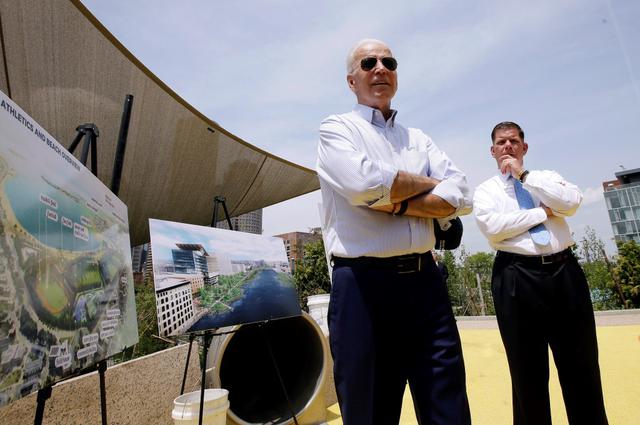
WASHINGTON (Reuters) -U.S. President-elect Joe Biden said his labor secretary nominee, Boston Mayor Marty Walsh, understands that unions built the American middle class and will encourage unionization.


“Marty understands, like I do, that the middle class built this country and unions built the middle class,” Biden said. “He sees how union workers have been holding this country together during this crisis.”

Biden said he had considered nominating former Democratic presidential rival Senator Bernie Sanders to the post but they both agreed it was important to maintain control of the U.S. Senate.

Walsh, 53, who was elected mayor of Boston in 2013, has backed both a $15 minimum wage and paid family leave.

A past president of the Laborers’ Union Local 223, which he joined at 21, and the Boston Metropolitan District Building Trades Council, Walsh told reporters he saw opportunities to expand workers’ rights and union membership.

“We can defend workers rights, we can strengthen collective bargaining. We can grow union membership. We can create millions of good paying jobs with investments in infrastructure, clean energy, and in high-tech manufacturing, along with the workforce training to help get those people into those good jobs,” he said.

Union membership in the United States has been declining for decades. The Bureau of Labor Statistics reported that 7.1 million employees in the public sector belonged to a union in 2019, compared with 7.5 million workers in the private sector. The union membership rate declined over the year in the private sector by 0.2 percentage point to 6.2%, compared to around 20% in 1983.

Shocking footage shows Serbian lake completely covered in garbage

Shocking footage shows Serbian lake completely covered in garbage

Isabella O’Malley                       January 12, 2021
Shocking footage shows Serbian lake completely covered in garbage

While pollution is an omnipresent issue that is impacting essentially every ecosystem on Earth, the problem is not always visible to the naked eye. However, footage of Serbia’s Potpecko Lake depicts a jarring scene — several thousand cubic metres of plastic containers floating on top of the water.

The footage was first published online on January 4, 2021 and environmental activist, Sinisa Lakovic, says that the extent of the plastic pollution is due to decades of accumulating trash at “unsanitary landfills,” as reported by Reuters. Marko Karadzic, a local resident, described the situation to Reuters as “an ecological disaster.”

Several landfills are located upstream from the lake along the Lim River. Potpecko Lake is connected to the waterbody that the dam at the Višegrad Hydroelectric Power Plant uses, and officials are concerned that it could become clogged with garbage.

Serbia’s Environment Minister, Irena Vujovic, said a clean-up would soon commence and stated that several landfalls that contributed to the pollution in Potpecko Lake have been invited to develop a solution that would have long-term benefits.

AQUATIC POLLUTION, NOT JUST AN OCEAN PROBLEM

Images of ocean animals entangled in plastic pollution are the most common impacts that many people think of when considering how the waste we generate impacts aquatic ecosystems. Given that oceans cover more than 70 per cent of Earth’s surface, it is understandable that the spotlight lands on these marine ecosystems, but some experts say that plastic pollution in freshwater lakes and rivers is a topic that is often neglected in research.

lake pollution Credit: Justin Wilkens via Unsplash
lake pollution Credit: Justin Wilkens via Unsplash.  A discarded beer can in Eagle Lake, Mississippi, USA. Credit: Justin Wilkens via Unsplash


A 2019 survey conducted by scientists Martín C. M. Blettler and Karl M. Wantzen reviewed 171 published studies that analyzed animal plastic entanglement and found that over 98 per cent focused solely on oceanic environments. Blettler and Wantzen stated while ocean plastic pollution remains a considerable concern, they emphasize the importance of the limited insight we have about freshwater pollution.

In freshwater environments, researchers have documented an increasing trend of plastic becoming part of birds’ nests, which can reduce the survival rates of both the parents and chicks. Microplastics are also being consumed by fish in growing amounts leading to adverse effects. The researchers say that the effects of plastic pollution in water bodies inland are important to study because the waste that is dumped in lakes and rivers ultimately travels to the oceans.

With files from Reuters

Where did COVID-19 come from?

Where did COVID-19 come from?

Elizabeth Weise and Karen Weintraub,         January 16, 2021


The coronavirus that conquered the world came from a thumb-sized bat tucked inside a remote Chinese cave. Of this much, scientists are convinced.

Exactly how and when it fled the bat to begin its devastating flight across the globe remain open questions.

In just one year, SARS-CoV-2, the virus that causes COVID-19, has infected 100 million people and killed 2 million, 400,000 of them in the U.S. Answers could stop such a calamity from happening again.

Researchers in China, under government scrutiny, have been investigating since January. This week, a World Health Organization delegation of scientists from 10 different nations finally was allowed in the country to explore the virus’ origins.

“This is important not just for COVID-19, but for the future of global health security and to manage emerging disease threats with pandemic potential,” Tedros Ghebreyesus, WHO’s director-general, said just after the team left for China.

A worker in protective coverings directs members of the World Health Organization (WHO) team on their arrival at the airport in Wuhan in central China's Hubei province on Thursday, Jan. 14, 2021. A global team of researchers came to the Chinese city where the coronavirus pandemic was first detected to conduct a politically sensitive investigation into its origins amid uncertainty about whether Beijing might try to prevent embarrassing discoveries.


It’s not clear how much evidence will remain a year later, and what the team will be able to learn. The Wuhan fish market, seen as a likely breeding ground for the virus, has been scrubbed and shuttered.

But the effort is worth it, infectious disease experts say. Understanding the journey of SARS-CoV-2 may provide insights into how the relationship between humans and animals led to the pandemic, as well as other disease outbreaks including Ebola, Zika and many strains of flu.

A member of the World Health Organization team is screened on arriving at the airport in Wuhan in central China's Hubei province on Thursday, Jan. 14, 2021. The global team of researchers arrived Thursday in the Chinese city where the coronavirus pandemic was first detected to conduct a politically sensitive investigation into its origins amid uncertainty about whether Beijing might try to prevent embarrassing discoveries.


“These are emerging diseases that breach the barrier between animals and humans and cause devastation in human populations,” the WHO’s Mike Ryan said at a Monday news conference. “It is an absolute requirement that we understand that interface and what is driving that dynamic and what specific issues resulted in diseases breaching that barrier.”

The international team is not looking to assign blame, said Ryan, executive director of WHO’s Health Emergencies Programme. If it were, there would be plenty to go around.

“We can blame climate change. We can blame policy decisions made 30 years ago regarding everything from urbanization to the way we exploit the forest,” he said. “You can find people to blame in every level of what we’re doing on this planet.”

Beginnings in a cave

The chain of events that led to the worst global pandemic in a century started with a tiny, insect-eating mammal with the mundane name, Intermediate Horseshoe bat.

The species is part of a family of bats that act as natural reservoirs for coronaviruses, notorious for how easily they mutate and how well they can be transmitted from species to species. The bats aren’t bothered by the viruses. The animals they pass them onto aren’t always so lucky.

Humans are one of those animals.

This happens all the time – a virus harmlessly infects one creature then finds its way to another, mutates and becomes something new. The newly mutated virus can be insignificant but annoying (think common colds, some of which are caused by coronaviruses) or devastating and deadly (think smallpox.)

SARS-CoV-2 is a little of both.

A Horseshoe bat hangs from a net inside an abandoned Israeli army outpost next to the Jordan River in the occupied West Bank, on July 7, 2019.


As many as 40% of those who test positive for COVID-19 have no symptoms at all but 2% of people who get sick die. It’s especially deadly in the elderly.  COVID-19 has killed 1 of every 66 Americans older than 85. Among those infected, some percentage — we don’t yet know how many — cope with crippling long-term symptoms that plague them for months. Future health impacts remain unknown.

The group of related coronaviruses giving rise to SARS-CoV-2 has existed for decades in bats and likely originated more than 40 years ago, said Dr. Charles Chiu, a professor and expert in viral genomics at the University of California, San Francisco.

SARS-CoV-2 shares 96% of its genetic material with a sample of coronavirus taken in 2013 in Intermediate Horseshoe bats from Yunnan province in China, which suggests the Yunnan virus is its ancestor. How the virus traveled the 1,200 miles from Yunnan to Wuhan remains unknown.

Because the 2013 sample is the only one available, scientists had to undertake genetic analysis to estimate when the bat strain and the strain now circulating among humans diverged. They put the split sometime in the 1960s or 1970s, said Maciej Boni, a professor of biology at Pennsylvania State University’s Center for Infectious Disease Dynamics, who spent almost a decade working in Asia.

“There’s really not a clear tree where we have forensic evidence to point to exactly where it came from,” said John Connor, a virologist at Boston University who studies emerging infectious diseases. “It looks like it’s a bat-derived virus, and there’s a big question mark after that.”

Scientists simply don’t do enough surveillance of bats and coronavirus to tell.

“We just don’t know because we don’t have any data — we weren’t looking,” said Boni. “Over the last 20 years we haven’t been doing enough sampling.”

Boni is among those who think the virus most likely came directly from bats, possibly infecting miners who work in bat-infested caves or people exposed to bat feces. Others say it more likely spent some time infecting another animal species before leaping to humans.

The original SARS virus, identified in China in 2003, is believed to have passed through civets – a type of nocturnal mammal native to Asia and Africa – though other animals may have been involved.

SARS underwent only a few genetic changes between bats and people, which made its animal roots easier to trace, while SARS-CoV-2 has changed a lot more, Connor said.

With SARS-CoV-2, a suspect is the frequently trafficked scaly anteater, also known as a pangolin. Other possibilities include civets or ferrets or even cats.

“SARS-CoV-2 may originate from live animal markets, but it may also have emerged from any setting in which people come into contact with animals, including farms, pets, or zoos,” Chiu said.

Whatever its path, sometime before November 2019 it became a virus that could easily – far too easily – infect humans.

Not Made in China

Despite a persistent conspiracy theory that SARS-CoV-2 was developed in a lab, perhaps an infectious disease lab in Wuhan, there’s no evidence to support the claim and plenty to counter it.

In March, a group of researchers found the virus most closely resembled existing bat viruses and was not man-made.

“Our analyses clearly show that SARS-CoV-2 is not a laboratory construct or a purposefully manipulated virus,” they wrote in the prestigious journal Nature.

No new details have emerged since to change the author minds, said Dr. W. Ian Lipkin, one of the co-authors and a professor at the Columbia University Mailman School of Public Health.

“Can we exclude the possibility that there was a virus that was present in this lab that somehow got out into either animals or people? No, we can’t do that,” he said. “The only thing we can say is that there’s no evidence that suggests it was deliberately engineered through some sort of gain-of-function experiments.”

Connor said he’s also dubious the virus originated in a lab rather than in nature.

The Wuhan Huanan Wholesale Seafood Market, where a number of people related to the market fell ill with a virus, sits closed in Wuhan, China, Tuesday, Jan. 21, 2020.


“What laboratory people are really good at doing is making viruses weaker,” said Connor, who is also an investigator at Boston University’s National Emerging Infectious Disease Laboratories.

Viruses, especially RNA viruses like coronaviruses, make tiny mistakes as they reproduce. One person’s nose might contain 10 to a 100,000 copies of the virus, and with so many replications and so many mistakes, it’s plausible chance mutations led to SARS-CoV-2, he said.

“I don’t think we need to look for man-made. I think we see the viruses that we know assaulting us all the time,” Connor said. “We look back to Zika. That wasn’t man-made. Neither was Ebola. Flu keeps coming after us.”

It’s possible to bioengineer a virus, but it’s extremely hard. Anyone doing so would have used a pre-existing virus as the template. The virus that’s now killing millions has novel mutations, many of them, said Chiu.

“We barely know how to manipulate even a few base pairs in a single viral gene,” he said. “The difference between Chinese bat coronaviruses and SARS-CoV-2 is more than 3,000 base pairs.”

In some ways, it doesn’t matter where the virus came from, said Stephen Morse, a professor of epidemiology at Columbia University’s Mailman School of Public Health. What matters is how we deal with the current situation, which is at a crisis state in the United States.

“When the house is burning down is not the time to start looking for where the matches were,” he said.

Investigation and prevention

If SARS-Cov-2 had been a type of bird flu instead of a coronavirus, the world would have been alerted within days of the first infections. A global surveillance system was established in the 1990s and has been expanded and strengthened, Boni said.

“If a single poultry farmer in Southeast Asia comes down with severe respiratory symptoms, samples are taken and sequenced. That week you know which avian influenza virus it is,” he said. “Farms in neighboring regions are immediately quarantined and the birds may be depopulated. It takes days.”

Setting up something similar for bats and coronaviruses would cost several billion a year globally, said Boni. “It’s not expensive for the benefit we’d get.”

To track SARS-COV-2 as it transferred among species requires analyzing blood collected from the animals, as well as samples from their airways.

Distinguishing between closely related viruses isn’t always so easy.

“We have a special test that can do this if we could get samples out of China,” said Lipkin. He’s been trying for months to do so, and when he attempted to send his own sampling tools into the country the U.S wouldn’t allow it.

“We now have obstruction on both sides,” said Lipkin, who’s been working to get into China himself since early in the outbreak. “I don’t know when that’s going to let up. I’m hoping the Biden administration will feel differently.”

Lipkin’s March paper explored key features of the new virus but nothing more has been learned since about SARS-CoV-2’s earliest days, he said.

Staff move bio-waste containers past the entrance of the Wuhan Medical Treatment Center, where some infected with a new virus are being treated, in Wuhan, China, Wednesday, Jan. 22, 2020.


“We still haven’t had a full post-mortem on what went wrong in China,” said Lipkin, who caught COVID-19 in March in New York and was recently vaccinated.

The U.S. has a very good system of reporting outbreaks, and rapidly publishes information in the CDC’s journal, Morbidity and Mortality Weekly. The Chinese are not as transparent at reporting their public health information.

Increased transparency is one of several changes Lipkin recommends to avoid a repeat of the 2020 disaster.

Wild animal markets and consumption of wildlife continue to pose dangers, he said.

And the world needs to have the ability to respond faster to novel viruses like SARS-CoV-2. Global surveillance would help, as would drugs that can treat a wide spectrum of viruses – maybe one that can address all coronaviruses and another to tackle influenzas.

“These drugs might not be ideal but we should think of them as a finger in the dike,” Lipkin said, so outbreaks won’t get out of hand, the way this one did.

Connor, at Boston University, agrees that effective and transparent public health systems around the world are essential for detecting and preventing outbreaks like COVID-19.

In this Tuesday, Jan. 28, 2020 file photo, people wearing face masks walk down a deserted street in Wuhan in central China's Hubei Province.
In this Tuesday, Jan. 28, 2020 file photo, people wearing face masks walk down a deserted street in Wuhan in central China’s Hubei Province.


While Wuhan may have had a good health care system, that was not the case in West Africa, where a 2014-2016 epidemic of Ebola infected more than 28,000, killed over 11,000 and terrified the world.

“It would be nice for all people to have good health care, not just because it would be nice for them … but for everybody else,” Connor said. “It would be nice to be able to identify: Oh, all of a sudden, five people in one area got sick with something we didn’t know what it was.”

Connor said it’s pointless to try to predict all the ways in which a virus now infecting animals could make the leap to humans. A much better approach, he said, is to focus on the viruses that do emerge.

“What matters is how good we are at responding quickly,” he said.

The race is now between the speed of mutations and the speed of vaccination, said Chiu.

Even for a typically slow Sunday afternoon Grand Central Terminal in New York City was quieter than usual March 15, 2020 as Coronavirus concerns kept travelers and tourists off the streets and away from popular destinations in the city.


Dr. Anthony Fauci, director of the National Institute of Allergy and Infectious Diseases, says it may take up to 85% of Americans being vaccinated to protect the population. Reaching those numbers will be challenging considering pervasive vaccine hesitancy and a slow, complicated roll out.

In the meantime, public health measures to stop the spread – masking, social distancing and handwashing – are essential, experts repeat.

“We have to reduce the number of infections before the virus has a chance to mutate in such a way that it can evade drugs and vaccines,” said Chiu. “That’s what keeps me up at night.”

Contact Elizabeth Weise at eweise@usatoday.com and Karen Weintraub at kweintraub@usatoday.com.

Health and patient safety coverage at USA TODAY is made possible in part by a grant from the Masimo Foundation for Ethics, Innovation and Competition in Healthcare. The Masimo Foundation does not provide editorial input.

Nearly 100 million Chinese people supplied drinking water with ‘unsafe’ levels of toxic chemicals

Nearly 100 million Chinese people supplied drinking water with ‘unsafe’ levels of toxic chemicals

Echo Xie                                 

Drinking water provided to nearly 100 million people in China has levels of toxic chemicals that exceed safe limits, researchers have found.

A team from Tsinghua University monitored the levels of per and polyfluoroalkyls (PFAS) – man-made chemicals used in everything from fabrics to pesticides – using data from previous studies.

By analyzing data from 526 drinking water samples across 66 cities with a total population of 450 million, the study found that the concentration of PFAS in more than 20 per cent of the studied cities – 16 in total – exceeded safe levels.

Get the latest insights and analysis from our Global Impact newsletter on the big stories originating in China.

China has no national safety standards, so the study used the US state of Vermont’s regulations as the benchmark.

A chemical factory is dismantled along the Yangtze River in Yichang City as part of an effort to reduce pollution in the area. Photo: Xinhua alt=A chemical factory is dismantled along the Yangtze River in Yichang City as part of an effort to reduce pollution in the area. Photo: Xinhua

The cities with high levels included Wuxi, Hangzhou and Suzhou in eastern China and Foshan in the southern province of Guangdong. Major cities including Beijing and Shanghai were under the limit.

The study was published in the journal Environmental Sciences Europe last Tuesday and was the first comprehensive study reviewing PFAS levels in Chinese drinking water.

In general, eastern, southern and southwest China had higher levels of PFAS compared with other regions.

The mean concentration of PFASs in eastern China was 2.6 times that of the country’s north, which the report’s authors attributed to intensive industrial activity and high population density.

Roland Weber, a co-author of the study and German consultant on persistent organic pollutants, said that some PFAS were more dangerous than others, especially the chemicals known as PFOA and PFOS, which have been linked to a variety of health risks.

“The European Food Safety Agency recently highlighted four PFAS – including PFOA and PFOS – as particularly problematic and set a low tolerable intake limit [the daily amount deemed safe] ,” he said.

The study found extremely high levels of PFOA and PFOS in three Chinese cities in the Yangtze River Basin – Zigong, Jiujiang and Lianyungang – which were attributed to the presence of fluoro-chemical plants and industries that use multiple PFAS, such as leather, textile and paper manufacturing.

Weber said more toxicity assessment needs to be done on the thousands of PFAS in use, because there are still many unknown risks and scientists suggest limiting them to essential uses.

The toxic chemicals can be found in everything from stain-resistant textiles, greaseproof food packaging, firefighting foam, personal care products, pharmaceuticals and pesticides.

“Many PFAS are water soluble and do not degrade possibly for centuries and longer and are therefore called ‘forever chemicals’. If you have contaminated ground water used for irrigation, it will go into your plant, your food and your cattle,” said Weber.

The two toxic chemicals – PFOA and PFOS – do not break down in the human body or environment and can accumulate over time, according to the US Environmental Protection Agency.

They were listed in the annex of the Stockholm Convention as persistent organic pollutants, or “forever chemicals”, since they are considered to be harmful to health and the environment.

China is now one of the largest manufacturers and consumers of PFAS but it has no guidelines for their presence in drinking water.

But it is a party to the Stockholm Convention, which aims to eliminate or restrict the production and use of persistent organic pollutants and is working to phase out the use of PFOS.

But Weber said PFOA had only been listed under the convention in 2019 – a decade after PFOS – and China has not yet ratified this section.

In plans released in June, the Ministry of Ecology and Environment vowed to step up the monitoring of new pollutants in surface water.

Weber added that China needs to analyze drinking water as well as groundwater and contaminated sites to understand the scale of the problem and then draw up plans to tackle it.

“Europe and the United States are facing large challenges with monitoring and controlling PFAS contaminated sites and I think it is now the right time that China is moving forward, making science based limits and then cleaning the drinking water and control emissions from industries and other uses,” he said.

This article originally appeared in the South China Morning Post (SCMP), the most authoritative voice reporting on China and Asia for more than a century.

President Trump’s wildly expensive border wall policy will leave a lasting legacy

President Trump’s wildly expensive border wall policy will leave a lasting legacy

President Trump vowed vowed to build 450 miles of border “wall” — which is more of a series of barriers erected by a succession of U.S. presidents, by the end of his first term.

Trump can say he fulfilled that promise, according to information provided to Yahoo Finance by Customs and Border Patrol (CBP), establishing one of the more expensive and permanent aspects of his legacy.

“As much as the Trump administration is able to construct is going to be the amount that’s there pretty permanently,” Jessica Bolter, an associate policy analyst for the Migration Policy Institute, told Yahoo Finance. “This is a serious permanent infrastructure project that’s going to remain. And while many of the other actions that Trump has taken on immigration can be rolled back through executive action, this is something that it looks like is not going to be rolled back anytime soon.”

US President Donald Trump tours a section of the border wall in Alamo, Texas, on January 12, 2021. (Photo by MANDEL NGAN / AFP) (Photo by MANDEL NGAN/AFP via Getty Images)
US President Donald Trump tours a section of the border wall in Alamo, Texas, on January 12, 2021. (Photo: MANDEL NGAN/AFP via Getty Images)


According to the latest CBP data, 453 miles of “new primary and secondary border wall system” were built during Trump’s term — though much of that construction involved replacing “dilapidated of outdate designs” as opposed to building wall where it had not been built previously. Another 211 miles are under construction while 74 miles are in the pre-construction phase.

Overall, the $15-billion initiative was a key promise of Trump’s 2016 presidential campaign and became a point of contention with Congress — a funding dispute over the border wall led to a 35-day government shutdown in 2018 — and landowners whose properties have been greatly impacted by the construction.

President-elect Joe Biden has vowed to freeze construction of the wall, a move that would save roughly $2.6 billion.

453 miles of wall have been completed so far. (Source: CBP)
‘It’s a gigantic waste of government resources’

Experts have argued the entire project was a waste of taxpayer money (in addition to being a magnet for alleged fraud).

“It’s a gigantic waste of government resources, taking billions of dollars away from other priorities and has zero benefit to the United States,” David Bier, an immigration policy analyst at the Cato Institute, a libertarian think tank, told Yahoo Finance. “The difference between the Trump law and the existing fences that he replaced is the Trump wall is more expensive and that’s pretty much it. It’s certainly more intrusive to the environment and to the landowners and to the residents of the areas in which the border wall is being built as well.”

The wall built under Trump has been incredibly costly, particularly compared to other presidencies.

Between 2007 and 2015, CBP spent a total of $2.4 billion constructing 535 miles of the border wall. Part of the reason for that, she explained, is because Trump’s wall is a taller, more fortified wall being constructed in a lot of areas. Bolter noted that fencing under the GWB administration cost an average of $3.9 million per mile. Under Trump, it averaged about $20 million per mile.

There are approximately 701 miles of primary barriers along the border. (Graphic: David Foster/Yahoo Finance)


Another reason for the exorbitant cost is that it’s “not clear that building a wall in all of these places was necessary,” Bolter said. “A report from the Department of Homeland Security inspector general found that when CBP was setting its border wall priorities, it didn’t consider alternatives.”

Ohio State University Professor Ken Madsen, who tracks border wall progress, noted that when we “see new fences or walls going in those very rugged areas, it seems to me it really is for show. It’s not really doing anything to stop anybody because very few people were crossing there in the first place.”

Gil Kerlikowske, who served as CBP commissioner during the final three years of the Obama administration, has argued that the money would be “much better invested in technology than barriers.” He noted that much of the cost for the barriers stems from maintenance and repair.

“I mean, it’s really significant,” Kerlikowske told Yahoo Finance. “You have flooding, you have other kinds of damage, people, of course, cutting them. So people shouldn’t look at this just as the cost of this fixed wall or barrier. They should look at the long-term costs. They are going to be replaced over the years, plus maintenance costs, so it’s incredibly expensive.”

U.S. President Donald Trump holds up a picture of border wall being installed along the U.S.-Mexico border as he participates in a roundtable briefing on border security at the U.S. Border Patrol Yuma Station in Yuma, Arizona, U.S., June 23, 2020. REUTERS/Carlos Barria


The former CBP leader suggested technological alternatives like integrated fixed towers, which have infrared and camera sensors. But according to Bier, the Cato analyst, it’s still just another form of wasted taxpayer money.

“It’s certainly better than taking people’s land but it’s another gigantic sinkhole of government money that you spent billions upon billions, spending more money on technology, whether it’s border journals or surveillance cameras,” Bier said. “Really at the end of the day, you have reports from the OIG, the GAO, the drones and balances are ineffective. That virtual fence they tried to build with the cameras and sensors was useless, a waste of taxpayer money. I don’t support any more money for this effort.”

Biden freezing construction of the wall is just one of the several necessary steps needed to fix this, Bier argued.

“A freeze is better than continuing to waste taxpayer money on something that we’re getting no benefit from,” he said. “But I think that we should go further than that and transfer that land and the structure as well — if the people who own the land want the structure, let them keep it, but it should really be their decision and not the decision of Border Patrol to foist a structure on somebody else’s property.”

New sections of the border wall are in process of being built in Hidalgo, Texas on January 11, 2021. - Chad Wolf, the acting secretary of the Department of Homeland Security, announced he was resigning January 11 as worries rose over more violence during President-elect Joe Biden's inauguration next week. Wolf's resignation came a day before Trump is to travel to the US-Mexico frontier near Alamo, Texas to inspect the border wall he has had built. (Photo by Mark Felix / AFP) (Photo by MARK FELIX/AFP /AFP via Getty Images)
New sections of the border wall are in process of being built in Hidalgo, Texas on January 11, 2021. (Photo by MARK FELIX/AFP /AFP via Getty Images)
‘New’ versus ‘old’ wall

Trump’s CBP claimed that 453 miles of border wall were built since January 2017, though less than 100 miles of the wall is actually new and not replacing outdated structures.

“[Former Acting Secretary of Homeland Security] Chad Wolf and CBP are counting anything as new that’s new construction,” Madsen told Yahoo Finance. “But most people are making a distinction between new versus replacement. There was a wall there before and yes there’s a new wall now, but it’s the same place that’s covered. But then you can even narrow that down more.”

Much of the construction is to replace existing barriers, many of which are old and/or dilapidated in quality.

“Once you distinguish new from replacement, then you have to distinguish if it’s a pedestrian barrier, or replacement pedestrian barrier,” Madsen said. “In other words, is it just a newer model that’s taller, more see-through, more durable, stronger foundation? And then there’s some places where they’re replacing vehicle barriers with pedestrian barriers.”

That makes sense since pedestrian barriers are much more effective at stopping people than vehicle barriers so “that’s quite an upgrade. That’s substantially changing the dynamic. And again, because it’s all new, it’s being counted by CBP as new. I’ve heard the vast majority is replacing barriers that are already there. That’s for sure. So most of what’s being constructed is just replacing what’s already there.”

U.S. President Donald Trump talks with U.S. Border Patrol Chief Rodney Scott as he tours a section of the U.S.-Mexico border wall in San Luis, Arizona, U.S., June 23, 2020. REUTERS/Carlos Barria     TPX IMAGES OF THE DAY
U.S. President Donald Trump talks with U.S. Border Patrol Chief Rodney Scott as he tours a section of the U.S.-Mexico border wall in San Luis, Arizona, U.S., June 23, 2020. REUTERS/Carlos Barria
‘Building a wall will do little to deter criminals’

President-elect Biden has been critical about the border wall, singling out Trump for the wall’s lack of efficiency.

“His obsession with building a wall does nothing to address security challenges while costing taxpayers billions of dollars,” Biden’s immigration plan states, noting that most illegal drugs come through legal points of entry, that asylum seekers are asking for refuge legally, and that nearly half of undocumented immigrants are in the U.S. because they overstayed their visas.

“Building a wall will do little to deter criminals and cartels seeking to exploit our borders,” his plan says. “Instead of stealing resources from schools for military children and recovery efforts in Puerto Rico, Biden will direct federal resources to smart border enforcement efforts, like investments in improving screening infrastructure at our ports of entry, that will actually keep America safer.”

JACUMBA, CA - DECEMBER 01: Construction crews work on the United States-Mexico border wall on December 1, 2020 in Jacumba, California. President-elect Joe Biden wants to stop construction of the border wall, but the departing Trump administration is rushing to complete as much wall as possible in its last weeks in power. (Photo by Sandy Huffaker/Getty Images)
Construction crews work on the United States-Mexico border wall on December 1, 2020 in Jacumba, California. (Photo by Sandy Huffaker/Getty Images)


Biden’s decision to halt construction of the wall will save billions of dollars, but could still cost roughly $700 million, according to the Washington Post. This is because withdrawing crew, materials, and equipment can be billed as “demobilization fees.”

But, it will come as a relief for those whose lands were seized by the government through eminent domain to be used as part of the border wall. According to the New York Times, the Trump administration brought 78 lawsuits against landowners along the southern border, with 30 of them in 2020.

Despite the havoc along the border soon coming to an end, the project still leaves behind a lasting legacy.

“I think that the border wall is one of the most permanent parts of President Trump’s legacy after he leaves the office,” Bolter said. “President-elect Biden has said that he’s not going to construct any additional border wall, but he’s also said that he’s not going to take down any of the wall that President Trump has built.”

Adriana Belmonte is a reporter and editor covering politics and health care policy for Yahoo Finance. You can follow her on Twitter @adrianambells and reach her at adriana@yahoofinance.com.