The Revenge of John Roberts

The Revenge of John Roberts

John Roberts,Dianne Feinstein,Lindsey Graham - Credit: J. Scott Applewhite/AP
John Roberts,Dianne Feinstein,Lindsey Graham – Credit: J. Scott Applewhite/AP


WASHINGTON — In the fall of 1981, a young conservative lawyer named John Roberts, fresh off a Supreme Court clerkship, arrived at the Justice Department at the start of Ronald Reagan’s presidency. Hired as a special assistant to the attorney general, Roberts focused on voting rights, and in particular the battle underway in Congress over the reauthorization of parts of the landmark Voting Rights Act of 1965. That included Section 2 of the law, which gave voters a tool to fight discriminatory voting laws and rules in the states.

As Roberts settled in at DOJ, a coalition of Democrats and Republicans in Congress wanted to reform Section 2. Under their plan, voters could strike down discriminatory voting laws by proving those laws caused discrimination, not that the people who made the laws had set out to discriminate. In other words, intent didn’t matter; outcomes did.

More from Rolling Stone

John Roberts helped lead the fight to stop this change. He drafted op-eds, talking points, and memos arguing that the proposed reforms gave the federal government too much power to influence state voting laws and would lead to a quota system for who held elected office.

Roberts and the Reagan DOJ failed. The Voting Rights Act reauthorization passed with bipartisan support in 1982, and the number of lawsuits about discriminatory voting laws brought under Section 2 went from three in 1981 to 175 in 1988, according to the book Give Us the Ballot by the journalist Ari Berman. But Roberts would get his revenge. He claimed the Supreme Court chief justice’s seat once held by his mentor, William Rehnquist, in 2005. In the ensuing years, Roberts has chiseled away, piece by piece, at the nation’s laws for voting rights, campaign spending, and other democracy issues. Today, voting-rights activists and election-law scholars say the Roberts court, having dismantled chunks of the post-Watergate ethics reforms and the Voting Rights Act, is one of the biggest impediments to democratic reform at a time when the country needs those reforms more than ever.

The final two opinions of the most recent Supreme Court term put this phenomenon on full display. In Americans for Prosperity Foundation v. Bonta, the court’s six conservative justices ruled that California’s requirement that charities disclose their biggest donors to state regulators was unconstitutional. Critics of anonymous political spending say the decision will fuel future challenges to transparency laws and empower anonymous donors at a time when American politics is awash in dark money from Democratic and Republican groups alike. “We are now on a clear path to enshrining a constitutional right to anonymous spending in our democracy, and securing an upper hand for dark-money influence in perpetuity,” Sen. Sheldon Whitehouse (D-R.I.) said in a statement reacting to the decision.

In the second decision, Brnovich v. DNC, the Roberts court knee-capped Section 2 of the Voting Rights Act. The Brnovich decision, legal experts say, will give greater leeway to state governments when they craft voting rules, and makes it much harder to prove that a voting law is discriminatory. “This is the rewrite of Section 2 that John Roberts couldn’t get in 1981,” Rick Hasen, an election-law expert at the University of California, Irvine, tells Rolling Stone. “I think it’s going to be extremely difficult now (to bring Section 2 challenges) except for the most egregious forms of voter discrimination.”

Combined, the AFPF and Brnovich decisions continue the Roberts court’s decade-plus track record of undermining the hard-fought voting laws enacted during the Civil Rights Movement and the anti-corruption reforms passed in the aftermath of the Watergate scandal. And with a six-vote conservative majority on the Supreme Court in place for years — if not decades — to come, that trend shows no sign of ending soon. “As long as there’s a strong conservative majority on the court, any hope that the courts will do anything to rein campaign spending or states’ efforts to restrict the vote or tilt the playing field is indeed a hollow hope,” says Lee Drutman, a senior fellow in the Political Reform program at New America.

In the face of the Roberts court’s agenda, reformers in Congress and in state legislatures as well as election-law scholars say the need for new policies tailored to survive the high court’s scrutiny. Coming at a time when Republican state governments are seeking to restrict access to the ballot box, the Supreme Court’s latest decisions are “yet another affront to Americans’ right to pick their elected officials and know who is working to influence the democratic process,” Sen. Amy Klobuchar (D-Minn.) tells Rolling Stone. “This further underscores the need for Congress to pass legislation to protect the freedom to vote and ensure that our democracy works for the people, not for special interests and billionaires.”

Before surveying the options under consideration by reformers, it’s worth better understanding how far-reaching and potentially damaging the Supreme Court’s last two decisions were.

In the AFPF case, the court struck down California’s requirement that large donors to charities must be disclosed to the state government so that the state can root out possible fraud related to those donors. The Americans for Prosperity Foundation, a Koch-backed group, and the Thomas More Law Center challenged that requirement, saying it violated the group’s freedom to associate in private. They also cited the risk of harassment if the private donor information became public (as had happened in the past when some donor information was leaked).

The case harkened back to the influential NAACP v. Alabama decision in 1958, when the Supreme Court ruled that the NAACP didn’t have to disclose members who feared facing retribution in the Jim Crow South. In AFPF, the NAACP Legal Defense Fund, ACLU, and other civil-rights groups invoked that earlier case in a friend-of-the-court brief that argued for the right to associate in private and urged the court to reach a narrow decision that would have struck down California’s rule without broader implications for transparency in civic and political life.

Instead, the majority’s opinion, written by Roberts, has broad implications for politics and activism. Before, the Supreme Court had made clear that disclosure was important enough to preserve even if it led to some nastiness or vitriol as a result. In his AFPF opinion, Roberts tossed that out the window. The mere possibility of a chilling effect on association was enough, he wrote in his opinion, to justify getting rid of certain disclosure requirements.

Roberts’ decision does more than wipe out California’s law, experts say. Under this reasoning, it opens the door to future challenges to longstanding laws on the disclosure of campaign donations put in place after Watergate, when untraceable money flooded into American elections and led to corruption. “Today’s analysis marks reporting and disclosure requirements with a bull’s-eye,” Justice Sonia Sotomayor wrote in her dissent in the AFPF case.

In Brnovich, the voting-rights case, the Roberts court took the opposite stance toward a state’s authority to set the rules. This time, in an opinion written by Justice Samuel Alito, the court deferred to the states to set their own voting rules and raised the bar almost impossibly high to challenge those laws for alleged discrimination, voting-rights advocates say. The majority’s opinion makes it so that a state can justify voting changes (cutting early voting, restricting absentee voting, reducing polling places) if it did so in the interest of preventing possible fraud, even if such fraud is vanishingly rare. The majority’s Brnovich ruling also takes as its benchmark the year 1982 — the year when Congress last passed major updates to the Voting Rights Act — for gauging the discriminatory nature (or not) of voting changes.

Rick Hasen, the election-law expert, describes the practical effect of the decision like this. Imagine that a state offered a week of early voting, he says, and there was evidence that a large number of African American voters used the Sunday before the election to do Souls to the Polls drives to get people to vote right after church. Then imagine that, post-Brnovich, the same state got rid of Sunday early voting and the evidence suggested the state did so to blunt African American turnout.

Under the Roberts court majority’s approach, Hasen says, this would likely not run afoul of Section 2. In his opinion, Alito says the benchmark for measuring whether a voting change is discriminatory is how it compares to the voting rules when the VRA was last reauthorized — in 1982. His test also implies that as long as a state can point to other voting opportunities, it can fairly justify cutting something like Sunday early voting. “For one reason, in 1982 there were very few early voting opportunities, so eliminating early voting can’t be a Section 2 violation because that wasn’t the norm in 1982,” Rick Hasen says. “For another thing, you have to look at the election system as a whole, so long as there are other ways to vote, then it’s not discriminatory under this court’s ruling.”

So what can — and what should — Congress do?

Lee Drutman, the New America political-reform expert, says the For the People Act, aka H.R. 1 and S. 1, contains a number of provisions that could repair some of the damage done by the Supreme Court’s two most recent decisions. That bill — which was recently filibustered in the Senate but Democrats have vowed to revive — would increase disclosure of dark-money donations, mandate paper ballots, and give the federal government more latitude to expand access to the ballot box.

But Drutman acknowledges that many of the most popular pieces of the For the People Act — which has a slim change of passing in the first place — will face challenges by conservative and libertarian legal groups. “Republicans are going to litigate the hell out of it,” he says.

As pressure builds inside the American democratic system because of hyper-partisanship, the nationalization of politics, and many other factors, what’s needed are release valves, Drutman says. He supports reforms that might break the “two-party doom loop,” as he puts it. Those include Alaska’s model of a top-four primary election and ranked-choice voting like in New York City but applied to, say, the U.S. Senate. “I think you’d see opportunities for more political parties and new coalitions forming,” he says. “You’d get the release valves.”

Rick Hasen says lawmakers should focus for now on the most immediate threat to American democracy: election subversion. He says the country narrowly avoided such a disaster in the 2020 election despite Trump’s attempts to pressure state and local election officials, like when he asked Georgia Secretary of State Brad Raffensperger to “find” 11,870 votes to give him the victory in Georgia. But with the Trumpist wing of the GOP in full control, and Republican state legislatures moving to pass laws that empower partisans to dictate how elections are run and counted, subversion remains a threat, whether it’s the prospect of a state legislature selecting a rival slate of electors, a president pressuring election workers to change the count, or members of Congress disrupting the certification process in Washington, D.C.

Hasen says the universal use of paper ballots, tougher penalties for anyone who interferes with the election-counting process, and reform of the antiquated Electoral Count Act could all help prevent a future attempt to overturn or change an election outcome. It’s also a more narrowly tailored solution that, he says, could win over 10 Senate Republicans.

“We may not know until January 2025, when Congress has counted the Electoral College votes of the states, whether those who support election integrity and the rule of law succeeded in preventing election subversion,” Hasen wrote this spring. “That may seem far away, but the time to act to prevent a democratic crisis is now.”

Editorial: Trumpification complete: The mess in Ohio is a terrible sign for America

Editorial: Trumpification complete: The mess in Ohio is a terrible sign for America


After losing the presidency and the Senate thanks to Donald Trump’s disastrous management of COVID, Republicans look determined to try to ascend again in Washington by parroting his stolen election lies. If you can’t snap out of a slumber, it seems, the second best thing is to dive back into the delusions of your dream.

Consider Ohio, where a recent two-term Republican governor named John Kasich spoke up with intelligence and strength against Trump, and where the current Republican governor, Mike DeWine, correctly diagnosed the Jan. 6 insurrection, saying that the ex-president ”has started a fire that has threatened to burn down our democracy.”

The Kasich-DeWine GOP is nowhere to be found among the current crop of Republicans vying to replace the retiring Sen. Rob Portman next year.

Jane Timken, former state GOP chair, has boasted of turning the party into “a well-oiled, pro-Trump machine.” Another Senate candidate, former state Treasurer Josh Mandel, called Rep. Anthony Gonzalez a “traitor,” the likes of whom should be “eradicated from the Republican Party,” after Gonzalez voted to impeach Trump.

Then there’s J.D. Vance, author of “Hillbilly Elegy.” The Republican golden boy who grew up poor in Appalachia, went to Iraq, then graduated from Yale Law School and became a venture capitalist is in the midst of a bout of self-flagellation for telling the truth about Trump in 2016. Back then, he tweeted that Trump was “reprehensible” for his views on “immigrants, Muslims, etc.” and told NPR, “I can’t stomach Trump.” In his desperate bid to get on the right side of the monster, Vance has deleted the offending tweets, saying “I regret being wrong about the guy.”

If the Republican Party in not-long-ago-swing-state Ohio has been swallowed whole by Trump, even as his free-fall dive off the deep end continues, even as he and his confidantes, buying into a clinically insane conspiracy theory, seem to think his return to the Oval Office could come as soon as August, what hope does the national GOP have?

Texas man who waited seven hours at polls is charged with voting illegally

Texas man who waited seven hours at polls is charged with voting illegally

<span>Photograph: Callaghan O’Hare/Reuters</span>
Photograph: Callaghan O’Hare/Reuters


A Texas man who became a national hero after he waited seven hours in line to vote in last year’s presidential primary has been arrested and charged with voting illegally.

Hervis Rogers, who is Black, became a symbol of a determination to have one’s voice heard.

“I wanted to get my vote in, voice my opinion,” he told a local ABC affiliate after his long wait to cast his ballot in the 2020 election. “I wasn’t going to let anything stop me, so I waited it out.”

But on Wednesday, according to Houston Public Media, he was arrested and charged with two counts of illegal voting.

Related: ‘Tragic’: Justice Elena Kagan’s scorching dissent on US voter suppression

The Texas attorney general, Ken Paxton, is reportedly bringing charges that allege Rogers voted while on parole for a 1995 conviction for burglary and intent to commit theft.

In Texas, it is illegal for anyone convicted of a felony to vote until they complete their sentence, including probation and parole. Rogers’ parole began in 2004 and was set to expire in June 2020. The Texas primaries were held in March.

Rogers cannot afford $100,000 bail and is being held in jail, said Thomas Buser-Clancy, an attorney with the Texas chapter of the American Civil Liberties Union, which is helping represent Rogers.

“The arrest and prosecution of Mr. Rogers should alarm all Texans. He waited in line for over six hours to vote to fulfill what he believed to be his civic duty, and is now locked up on a bail amount that most people could not afford,” said Andre Segura, the legal director of the Texas ACLU, in a statement. “He faces potentially decades in jail. Our laws should not intimidate people from voting by increasing the risk of prosecution for, at worst, innocent mistakes.”

Christopher Downey, a criminal defense attorney, told KPRC 2 Rogers’ two felony convictions meant he could face a more severe prison sentence on the illegal voting charges – potentially 25 years to life on each count.

Few prosecutors have pursued election-related crimes more than Paxton, a Republican himself under FBI investigation regarding allegations of bribery, which he denies, and who filed a long-shot lawsuit at the US supreme court trying to overturn Donald Trump’s defeat in 2020.

Even as Paxton publicly has touted the number of cases his office has been involved in, a 2019 HuffPost review found that most involved relatively minor infractions.

His office did not immediately respond to a request for comment about the Rogers case.

Rachel Hooper, a Republican precinct chair in Harris county, filed a formal complaint in March last year, saying Harris was ineligible to vote.

She obtained a copy of his voter registration application through a public records request and noted he had signed a statement indicating he had completed all punishment for a felony. The form only contains the warning in small print at the bottom of the application.

In an email to the Guardian last year, Hooper wrote: “As a former prosecutor, I want to give them the opportunity to investigate and take action. As a voter, I just felt a sense of obligation to file this complaint after learning that Mr Rogers was in violation of Texas election law.”

Hooper provided a copy of Rogers’ certificate of parole, from May 2004. The document contains a lengthy description of instructions for people on parole but does not say they cannot vote.

An estimated 5.2 million people cannot vote in the US because of felony convictions, according to an estimate by the Sentencing Project, a criminal justice non-profit.

Each US state has its own rules. Maine, Vermont and the District of Columbia allow people convicted of felonies to vote while they are in prison. Several other states allow people convicted of felonies to vote once they are released. Others, like Texas, require people with felonies to complete their entire sentence before they can vote.

Such a mix of systems makes it extremely confusing and difficult for anyone who has a felony to figure out if they are eligible to vote.

In 2017, a Texas prosecutor made headlines for bringing criminal charges against Crystal Mason, a Black woman in Fort Worth who cast a provisional ballot in 2016 while she was on supervised release for a federal tax fraud felony.

Mason was convicted of illegal voting and sentenced to five years in prison, a sentence many saw as overly harsh. Probation officials conceded they had never told Mason she couldn’t vote. Her provisional ballot ultimately went uncounted. The case is pending before Texas’s highest criminal appellate court.

Republicans in Texas and elsewhere have moved aggressively to implement new laws that make it harder to vote. The Texas legislature started a special session on Thursday in which it is expected to impose new requirements on mail-in voting and empower partisan poll watchers, among other measures.

Super rich’s wealth concentration surpasses Gilded Age levels

Super rich’s wealth concentration surpasses Gilded Age levels

Ethan Wolff – Mann, Senior Writer                     July 7, 2021
FILE - In this June 6, 2019, file photo Amazon CEO Jeff Bezos speaks at the the Amazon re:MARS convention in Las Vegas. The Amazon founder officially stepped down as CEO on Monday, July 5, 2021, handing over the reins as the company navigates the challenges of a world fighting to emerge from the coronavirus pandemic. Andy Jassy, the head of Amazon&#x002019;s cloud-computing business, replaced Bezos, a change the company had announced in February. (AP Photo/John Locher, File)

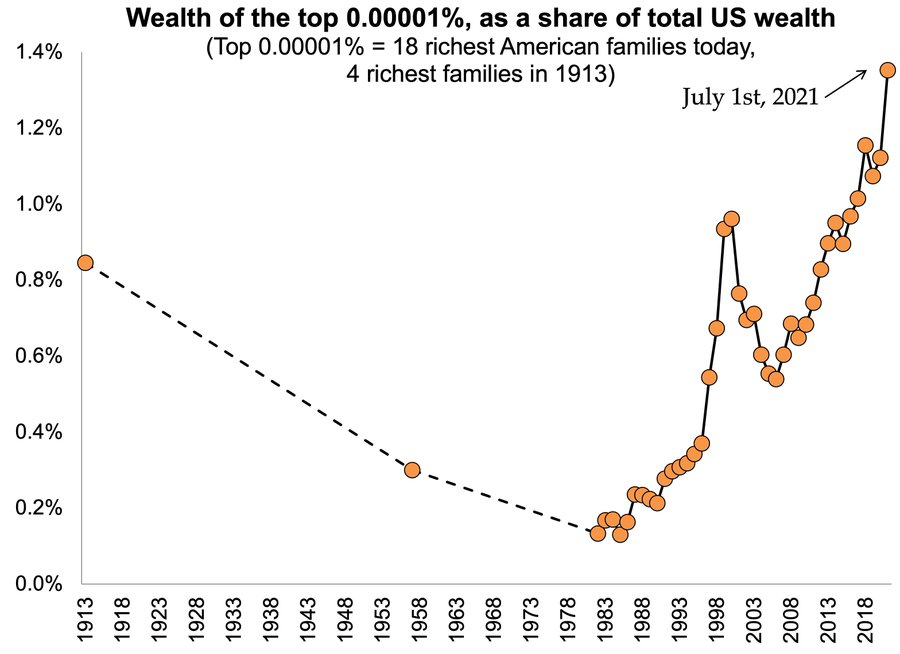
The wealth of the richest 0.00001% of the U.S. now exceeds that of the prior historical peak, which occurred in the Gilded Age, according to economist Gabriel Zucman.

In the late 19th century, the U.S. experienced rapid industrialization and economic growth, creating an inordinate amount of wealth for a handful of families. This era was also known for its severe inequality; and some have called the period that began around 1990 a “Second Gilded Age.” Back then, just four families represented the richest 0.00001% – today’s equivalent is 18 families.

Zucman, a French economist whose doctoral advisor was the historical economist Thomas Piketty, author of bestseller “Capital in the Twenty-First Century,” released data this week showing that as of July 1, the top 0.00001% richest people in the U.S. held 1.35% of the country’s total wealth. These 18 families include those of Jeff Bezos, Mark Zuckerberg and Bill Gates.

Image

Zucman used real-time data from Forbes for the calculations. In 1913, at the end of the Gilded Age, the Rockefeller, Frick, Carnegie, and Baker families – names all tied to monopolistic power – held 0.85% of the country’s total wealth.

The richest 0.01% — around 18,000 U.S. families — have also surpassed the wealth levels reached in the Gilded Age. These families hold 10% of the country’s wealth today, Zucman wrote. By comparison, in 1913, the top 0.01% held 9% of U.S. wealth, and a mere 2% in the late 1970s.

The increasing concentration of wealth comes as the ultra-rich face more scrutiny for the money they’re not paying in taxes. Recent reports have highlighted that because so much of their wealth consists of unrealized gains in stocks and real estate, they pay little or nothing in income tax. Many CEOs and founders take small salaries given their outsized stock holdings, as lower capital gains tax is preferable to a higher tax on ordinary income.

Seated portrait of John Davison Rockefeller (1839 - 1937), American oil magnate, early twentieth century. (Photo by Interim Archives/Getty Images)
Seated portrait of John Davison Rockefeller (1839 – 1937), American oil magnate, early 20th century. (Photo by Interim Archives/Getty Images)

Zucman gained fame in 2019 as an architect of then-presidential candidate Sen. Elizabeth Warren’s wealth tax plan, which aimed to address the fact that the extremely rich pay little in taxes compared to their net worth. The plan would have imposed a 2% tax on net wealth above $50 million and 6% above $1 billion.

Since the pandemic began, the stock market’s gains have widened the gap between the wealthy and non-wealthy because stock ownership is largely concentrated among wealthy people. The number of millionaires globally jumped 5.2 million to 56.1 million, according to Credit Suisse. Though the pandemic’s wealth gains largely benefitted the richest Americans, “most” Americans did fare well financially during the pandemic, according to the Federal Reserve. Around $13.5 trillion of wealth was added to all households. Still, while a large portion of the country got somewhat richer, the rich saw most of that, with the top 1% seeing a third of the $13.5 trillion and the top 20% seeing 70% of it.

Ethan Wolff – Mann is a writer at Yahoo Finance focusing on consumer issues, personal finance, retail, airlines, and more. 

This Texas family overcame hardship to buy a new home, but builder rips up the contract

This Texas family overcame hardship to buy a new home, but builder rips up the contract

After losing their home because of financial problems years ago, Gabriela Lopez and her husband worked hard to rebuild their credit, save money and buy a dream home.

The couple, who have five children and live in a two-bedroom home in the Runaway Bay area about 60 miles northwest of Fort Worth, finally prequalified for a loan. They signed a construction contract in January for a 1,947-square-foot, four-bedroom home to be built in the Wise County community of Boyd, closer to the Dallas-Fort Worth urbanized area.

Construction was slow, but everything seemed to be going OK until June 28, when the builder, Doug Parr Custom Homes, abruptly canceled the contract.

“It feels like they ripped the rug out from under our feet,” said Lopez, a long-time Wise County resident who works as a receptionist and assistant at a Southlake medical office. Her husband, Jose Juan Lopez, works at a rock-crushing operation in Wise County.

Officials from Doug Parr Custom Homes did not respond to messages left with a call taker at the company’s office in Boyd, as well as emails to the company and to Clinten Bailey, Doug Parr director of operations.

Rising construction costs drive trend

This setback for the Lopez family is the latest example of a trend in which North Texans sign contracts with new home builders, only to have the contracts ripped up while the house is under construction. In Lopez’s case and many other instances, the builders cite the rising cost of construction materials such as lumber.

“I’ve been doing this 20 years. I’ve never seen this,” Rick Shelhorse, branch manager of Synergy One Lending in Plano, said in an interview. He said his office has three clients, including the Lopez family, who have been told by a builder they will have to pay thousands of dollars more if they want to keep their home.

In Lopez’s case, she was notified June 25 that the price of her $320,000 home would be raised to about $384,400, and she could either pay the additional money or walk away from her contract. Three days later, before she had notified the builder of her decision, Lopez received a letter notifying her that it was no longer her decision, and the contract had been canceled by the builder.

“I think they’re just taking advantage of the market, and they can do that to people because they know somebody is going to pay it,” Shelhorse said.

In the June 28 letter, Bailey, the director of operations for Doug Parr, wrote to Lopez that the contract was being canceled because “it is clear that certain disputes and/or material misunderstandings between the parties have arisen concerning the Contract, including but not limited to, the escalation of material costs.”

But Lopez and her real estate agent, Ryan Barnes, said there were no such disputes or misunderstandings. Lopez said that when she spoke by phone with company owner Doug Parr on June 25, she expressed concern about whether she would still qualify for a loan that was nearly $65,000 higher than her original loan, but she never said yes or no to the higher price.

Barnes, who works with the Cassie Samons Team and JP & Associates in Justin, said he repeatedly asked the builder for evidence of the price increases, including the dates in which the builder purchased the materials, but was refused. He said he visited the builder’s office in person June 30, but was told to leave.

Lopez, who also holds a second job as a caregiver for an elderly client, said she isn’t sure what to do next. The family can stay at their home in the Runaway Bay area, but it is cramped for such a large family.

She said her children, who had been excited to move into their new, spacious bedrooms, are hurt and confused by the loss of the home.

Experts: Have lawyer review contracts

Prospective home buyers should read their contracts with builders carefully to make sure they are aware of any language that may make it possible for the builder to raise the sales price, several real estate finance and legal experts said. In new home construction, contracts are often drawn up with language that favors the builder — for example, making it difficult for the buyer to cancel the deal, but relatively easy for the seller.

It’s worth spending a few hundred dollars to have a lawyer look over the contract before signing, the experts said.

And, Lopez was even more frustrated to find out that another Doug Parr Custom Homes buyer on the same street is not being asked to pay higher prices because of construction costs. She knows this because her lender, Synergy Lending, also represents the other buyer.

“I assumed they were raising all the prices at the same time,” she said. “Why us?”

“I still don’t understand how you can sign a contract and not mean it,” she said.

Europe is becoming a right-wing continent

Europe is becoming a right-wing continent

Europe.
Europe. Illustrated | iStock


For a certain kind of American liberal, it’s almost a reflexive gesture to wish the United States were more like Europe. There, health care is provided on a more egalitarian basis and a university education is much cheaper, if not free; sexual mores are more relaxed and gun ownership is rare; religion is vestigial and militant nationalism is strictly taboo. Widespread European distress over the presidencies of George W. Bush and Donald Trump only confirmed what American liberals knew: that the Old Country was also the dreamland of their imagined liberal American future.

I wonder how it will feel when Europe becomes distinctly more right-wing than the United States.

It’s not an inconceivable prospect. The United Kingdom has a Tory government right now, and based on current polling their position looks increasingly secure. France’s centrist president Emmanuel Macron would likely be re-elected if the election were held today, but Marine Le Pen’s right-wing National Rally party polls considerably higher today in a one-on-one contest with Macron than it did in 2017. Italy’s fragile coalition could be followed by a right-wing coalition of Matteo Salvini’s Lega and the neofascist-derived Fratelli D’Italia.

Even in Germany, where the Christian Democrat Angela Merkel’s 16-year rule is coming to a close, the next government may once again be a coalition led by the CDU/CSU, if not with the center-left SDP, then in a “Jamaica coalition” with a reinvigorated center-right FDP joining the Greens by their side.

Of course polls can and do change, and one election does not imply a radical cultural shift. But the overall political climate in Europe has been trending rightward for some time. After the financial crisis, and the austerity that followed, the traditional left-wing parties began to collapse, and more nationalist and extreme-right alternatives to the mainstream — the AfD in Germany, National Rally in France, UKIP in England — began to arise. The surge in immigration that followed Syria’s and Libya’s collapse into civil war were further sources of fuel. These parties and movements — critical of the European Union, strongly opposed to immigration, frequently more friendly to Russia — were initially and in many cases still are opposed by all the mainstream parties, but that opposition did little to stem their growth. Eventually, in countries like Hungary and Poland, they began to win elections and assume the powers of government.

In Europe today, the most viable traditional parties are often mainstream right-wing parties that have sought to coopt the nationalist right’s issues — most notably Boris Johnson’s Tory Party, which eclipsed UKIP by adopting Brexit for itself — or parties self-consciously constituted around the technocratic center so as to unite the mainstream against the far right. True left-wing parties like Jean-Luc Mélenchon’s in France or Jeremy Corbyn’s Labour have largely fizzled. Meanwhile, the far right continues to produce new phenomena, most recently France’s Eric Zemmour, who has outflanked Le Pen on the right by being even more nationalist than she is.

If the result of all this ferment is a European political realignment that contains the far right by reviving a more inward-focused traditional conservatism, that would be good for Europe and, ultimately, for European relations with America. A Europe that was more oriented around national solidarity than global humanitarianism, open immigration, or free markets is a Europe America could readily live, work, and trade with. If by that means the continent achieved greater political stability and democratic accountability, most observers would consider it far preferable to either a lurch to the far right or a descent into civil strife.

But it might be startling for the American left to hear even centrist European politicians like Emmanuel Macron blame them for undermining national solidarity with their “woke” leftism. They might have to get used to it, though. Nothing is more useful for promoting national unity than a foreign threat. And while America’s foreign policy establishment would likely prefer that China be that threat, it makes far more sense for a Europe turning inward to decry pernicious American influence on their social fabric than China’s threats to Taiwan or its oppression of the Uyghur people.

The question then would be whether America’s left will take a lesson from the demise of their European cousins, and rethink their own approach to politics before they face a similar eclipse, and downgrade cultural questions in favor of bread and butter issues. Or, perhaps, whether Europe’s turn to the right will inspire America’s left to see unique promise once more in our own country’s distance from nationalism of the Old World, and redefine their own vision of a culturally egalitarian future not as a necessary redemption of our nation’s sinful history, but as a hoped-for fulfillment of distinctively American promise.

View Point: Drugs – Where we are at in Sault Ste. Marie

Sault Online

View Point: Drugs – Where we are at in Sault Ste. Marie

overdose

by Peter Chow

In 2020, Ontario saw 2,426 opioid-related deaths, a 60.0% increase from 1,517 deaths in 2019.

By age, the largest increases were among those aged 25 to 44 (61.4% increase from 83 to 134 deaths monthly) and those aged 45 to 64 years (119.5% increase from 41 to 90 deaths monthly).

The Algoma region saw 53 opioid deaths in 2020, up from 17 in 2019. So far, in 2021, we are on track for over 60 opioid overdose deaths.

Sudbury’s per capita deaths by opioid is the highest in Ontario, with over 50 per 100,000, with North Bay, Thunder Bay, Timmins and Sault Ste. Marie close to, or over 40 deaths per 100,000.

There was a rise in the number of overdose deaths with stimulants and benzodiazepines involved in 2020.

The percentage of opioid-related deaths associated with stimulants, such as Crystal Meth or Cocaine, as a contributing factor, increased from 52.0% in 2019 to 60.5% in 2020

Approximately one-third of deaths also involved a benzodiazepine, such as Valium or Xanax.

Of the people who died of overdose in 2020, that were employed at the time they died, 30% were construction workers, more prevalent in this industry than any other. The nature of the industry can lead its workers down the path of addiction.

With workplace injuries not uncommon, prescription painkillers can often lead to drug dependence. The trouble really starts when the doctor cuts off the prescriptions. The addicted worker can’t get the pain killers anymore and that’s when they go to the street.

For those unfortunate people addicted to opiates, there are medicines that work to reduce the effects of withdrawal and  reduce cravings  –  Suboxone, Methadone, and Naltrexone. These medications reduce mortality rates as they significantly reduce the chance of relapse and overdose. All three medicines substantially reduce the risk of dying from an overdose.

Until recently, Methadone was the primary drug prescribed for the treatment of opioid use disorder. However, the chance of an overdose with Methadone is 6 times higher than with Suboxone.

BC and Ontario have now made Suboxone (a combination of Buprenorphine and Naloxone), the primary recommended treatment for persons who have been abusing opioids for years, and it is on the provincial formularies, meaning those who qualify will receive the drug free of charge.

Other provinces will likely follow BC and Ontario.

Buprenorphine is a partial opiate agonist. It binds to the opioid receptors in the brain, relieving symptoms of withdrawal and cravings without producing a high.

The only purpose of the Naloxone in Suboxone is to prevent abuse of the drug by injection.

Suboxone is the safest of the opioid treatment medications. Suboxone is a pill (it goes under your tongue). It is now available as an injectable long-acting implant, but only in the US.

Methadone is used in the case of a severe addiction to opioids where Suboxone does not sufficiently relieve the symptoms of withdrawal. Methadone is a full opioid agonist, like Heroin. It binds to the opioid receptors in the brain, relieving symptoms of withdrawal and cravings.

In the most severe cases where persons on Methadone continue to relapse, pharmacy-grade Hydromorphone (Dilaudid) can be prescribed to  prevent withdrawal and cravings.

In persons motivated to choose abstinence, Naltrexone can be used to manage cravings. Naltrexone blocks the brain cells’ opioid receptors and thus the euphoria from abusing drugs.

Revia and Apo-Naltrexone are the pill form of Naltrexone and must be taken daily. Vivitrol is the injectable form of Naltrexone which lasts one month. Vivitrol is currently not available in Canada and costs about $1,000 per shot in the US. However, physicians may apply to get Vivitrol under Health Canada’s Special Access Program.

Due to a loss of tolerance to opiates from using Naltrexone, there is a high risk of overdose if Naltrexone is discontinued and there is a return to opioid use. Yet surprisingly, these medications are severely underused.

Fewer than 10% of those addicted to opioids are on Suboxone, Methadone or Naltrexone. Bureaucratic restrictions keep doctors from widely prescribing Suboxone.

The Ontario Drug Benefit codes for Suboxone state that prescribers should complete an accredited course on opioid addiction and Buprenorphine treatment before prescribing.

The requirement that Methadone be doled out in person remains, even though evidence shows that allowing it to be taken home reduces subsequent hospitalizations.

Skittishness among non-addiction-specialist doctors limits the use of these treatments, as does a shortage of addiction specialists, especially in rural areas. We don’t have an addiction specialist in the Soo.

Supervised Injection Sites are clean indoor environments where people can use pre-obtained drugs with trained health professionals present to ensure safe drug consumption methods, respond in the event of an overdose, provide counseling and referrals to vital social services and treatment options and test drugs for any trace of Fentanyl.

Extensive research has shown Supervised Injection Sites reduce overdose deaths, increase addiction treatment uptake, and reduce social nuisance.

Although Supervised Injection Sites are not the sole answer to the opioid crisis, they are being set up by Canadian cities as a way to fill an immense gap in the current system of care and engage a highly vulnerable and difficult to reach population – ultimately reducing the public health burden and saving lives.

But polls show that a Supervised Injection Site will likely face the familiar barrier of unfavorable public opinion in Sault Ste Marie, behind the times as usual. Supervised Injection Sites remain highly controversial and stigmatized.

The public and political concerns and fears are clear: that Supervised Injection Sites promote drug use, that they will bring drug users to the neighborhoods they are located in, that it is morally and legally wrong to encourage and allow drug use, and so on.

NIMBY.

This battle illuminates the societal impact of the war on drugs and a country that criminalizes addiction. Calls for “Heroin-Assisted Treatment”, as practised in some European countries, like Switzerland, are going nowhere.

Canada is still not Switzerland.

Even if Canada managed to build 100 Supervised Injection Sites, that might  cover only 1% of actual usage. It’s just not scalable.

Suboxone is scalable.  Needle exchanges are scalable.  Naloxone is scalable.  Anonymous drug testing is scalable.  That’s what public health should concentrate on.

Primary Care Providers (PCP), doctors and nurse practitioners, should be fully educated and trained on the treatment of Opioid Use Disorder with Suboxone, Methadone or Naltrexone.

Two measures alone, Anonymous Drug Testing (to screen for Fentanyl-tainted drugs) and increased access to Suboxone, would do more than anything else to immediately reduce harm and deaths from opioids.

The challenge now is that the nature of addiction has transformed into something deadlier in recent years—and not just because of potent synthetic opioids like Fentanyl and Carfentanil. (Carfentanil’s potency is 10,000 times that of Morphine and 100 times that of Fentanyl.)

It is because of the rising abuse of other types of drugs as well  –  stimulants (Meth and Cocaine) and “Benzos.”

In 2011, 19% of opioid drug users said that they also used Crystal Meth (Methamphetamine);  by 2019 that number had grown to 60%.

Opioids such as Heroin, Oxycodone and Fentanyl depress the nervous system and have a sedative effect.

Methamphetamines, on the other hand, are stimulants and have the opposite effect, making people euphoric and feeling like they have endless energy.

Like Cocaine, Crystal Meth makes a user high by releasing the neurotransmitter Dopamine into the brain. But with Crystal Meth, the effects are more pronounced, last longer and keep users awake for extended periods of time. In fact, people who are homeless, living in shelters or crowded, unsafe spaces, seek out Crystal Meth in particular.

To protect themselves and their belongings, they need to stay awake;  and in order to stay awake, they use Crystal Meth daily.

The availability and use of Crystal Meth is still increasing rapidly because Meth is so cheap, and people get such a quick and powerful rush of euphoria that can last for 12 hours or more.  A “hit” with what is almost 100% pure Meth can cost as little as $5..

According to the Ontario Provincial Police (OPP), the going street rate for Meth in Northern Ontario, as of 2020, was $10 to $30 a “point” (one-tenth of a gram). Dealers operate on the principle of supply and demand, so communities plagued by addiction — like Sault Ste Marie — are an attractive market in which to sell a cheap drug.

It is not confined to any particular socio-economic group, but found everywhere in every strata of society. Nor is it exclusively an urban issue. No community is immune to it, especially rural and First Nations communities.

One community struggling with the Crystal Meth epidemic is the Montreal Lake First Nation, where an estimated 60% of residents are addicted to the drug. Winnipeg, Calgary and Regina are in the grip of a Crystal Meth crisis that is only getting worse.

Meth is a key factor driving crime rates, both violent and property related.

In 2016, Crystal Meth hit with full force and crime rates — primarily thefts of items people were selling to feed their addiction — increased dramatically.

The Calgary police chief says;  “Fentanyl is a community health crisis, Crystal Meth is a crime and safety issue.”

Crystal Meth use makes treatment more complicated. There are no well-developed pharmaceutical therapeutics for addiction to Crystal Meth.

Doctors have started using Olanzapine, an antipsychotic drug, to try to provide immediate relief for patients suffering distressing symptoms from Meth use. “Olanzapine sort of gels their brain a bit,” one ER doctor said. “Their brain is firing all over the place, and if we can help just bring it together a little bit so that we can start working and talking through it, that’s helpful.” If that doesn’t work, and safety is a concern, patients sometimes have to be sedated further, or even physically restrained.

After the patient has settled down, there’s little more that healthcare workers can do.

The doctor said it’s upsetting to watch patients leave the emergency department knowing that their Meth-induced mood swings, paranoia and hallucinations can last for days — not to mention the “cravings that come afterwards.”

“All of that sets somebody up to use again very quickly.”

“The understanding of how to treat somebody who is interested in stopping Meth is very, very minimal,” she said.

Unlike opioid replacement therapy — which uses Suboxone or Methadone to relieve withdrawal symptoms — Meth has no pharmaceutical solution to reduce cravings. “It’s a whole other area of substance abuse and addiction that is so difficult.”

Deaths due to “Meth toxicity” (with no evidence of opiates) increased,  from 38 cases in 2015 to 54 in 2018, Dr. Dirk Huyer, Ontario’s chief coroner said. In those cases, a Meth-induced irregular heartbeat rhythm could be a possible cause of death.

84% of deaths involving Meth also involved an opioid in 2020.

Last year marked the first time Ontario has included stimulant-related deaths in its overdose-death data, which has typically counted only deaths caused by opioids. In total, there were at least 300 overdose deaths that involved both stimulants and opioids, every month in Ontario from May to October in 2020  –  the equivalent of 10 people dying every day.

Today, more people using Meth are at risk of dying from overdoses than ever before. Just as drug dealers have cut opioids like Heroin with Fentanyl or Carfentanil, they have also mixed them into other types of drugs, including Meth.

For one Meth user, life has become a seemingly unbreakable cycle, in which he commits crimes to feed his addiction, goes to jail, comes out sober and then relapses, starting all over again. Without a trace of resentment or self-pity, he acknowledges that jail has been the only place where he’s been drug-free for long stretches.

“As much as, like, nobody wants to go to jail, it’s really the only place where I can grow as a person,” he said.

Europe is becoming a right-wing continent

Europe is becoming a right-wing continent

For a certain kind of American liberal, it’s almost a reflexive gesture to wish the United States were more like Europe. There, health care is provided on a more egalitarian basis and a university education is much cheaper, if not free; sexual mores are more relaxed and gun ownership is rare; religion is vestigial and militant nationalism is strictly taboo. Widespread European distress over the presidencies of George W. Bush and Donald Trump only confirmed what American liberals knew: that the Old Country was also the dreamland of their imagined liberal American future.


I wonder how it will feel when Europe becomes distinctly more right-wing than the United States.

It’s not an inconceivable prospect. The United Kingdom has a Tory government right now, and based on current polling their position looks increasingly secure. France’s centrist president Emmanuel Macron would likely be re-elected if the election were held today, but Marine Le Pen’s right-wing National Rally party polls considerably higher today in a one-on-one contest with Macron than it did in 2017. Italy’s fragile coalition could be followed by a right-wing coalition of Matteo Salvini’s Lega and the neofascist-derived Fratelli D’Italia.

Even in Germany, where the Christian Democrat Angela Merkel’s 16-year rule is coming to a close, the next government may once again be a coalition led by the CDU/CSU, if not with the center-left SDP, then in a “Jamaica coalition” with a reinvigorated center-right FDP joining the Greens by their side.

Of course polls can and do change, and one election does not imply a radical cultural shift. But the overall political climate in Europe has been trending rightward for some time. After the financial crisis, and the austerity that followed, the traditional left-wing parties began to collapse, and more nationalist and extreme-right alternatives to the mainstream — the AfD in Germany, National Rally in France, UKIP in England — began to arise. The surge in immigration that followed Syria’s and Libya’s collapse into civil war were further sources of fuel. These parties and movements — critical of the European Union, strongly opposed to immigration, frequently more friendly to Russia — were initially and in many cases still are opposed by all the mainstream parties, but that opposition did little to stem their growth. Eventually, in countries like Hungary and Poland, they began to win elections and assume the powers of government.

In Europe today, the most viable traditional parties are often mainstream right-wing parties that have sought to coopt the nationalist right’s issues — most notably Boris Johnson’s Tory Party, which eclipsed UKIP by adopting Brexit for itself — or parties self-consciously constituted around the technocratic center so as to unite the mainstream against the far right. True left-wing parties like Jean-Luc Mélenchon’s in France or Jeremy Corbyn’s Labour have largely fizzled. Meanwhile, the far right continues to produce new phenomena, most recently France’s Eric Zemmour, who has outflanked Le Pen on the right by being even more nationalist than she is.

If the result of all this ferment is a European political realignment that contains the far right by reviving a more inward-focused traditional conservatism, that would be good for Europe and, ultimately, for European relations with America. A Europe that was more oriented around national solidarity than global humanitarianism, open immigration, or free markets is a Europe America could readily live, work, and trade with. If by that means the continent achieved greater political stability and democratic accountability, most observers would consider it far preferable to either a lurch to the far right or a descent into civil strife.

But it might be startling for the American left to hear even centrist European politicians like Emmanuel Macron blame them for undermining national solidarity with their “woke” leftism. They might have to get used to it, though. Nothing is more useful for promoting national unity than a foreign threat. And while America’s foreign policy establishment would likely prefer that China be that threat, it makes far more sense for a Europe turning inward to decry pernicious American influence on their social fabric than China’s threats to Taiwan or its oppression of the Uyghur people.

The question then would be whether America’s left will take a lesson from the demise of their European cousins, and rethink their own approach to politics before they face a similar eclipse, and downgrade cultural questions in favor of bread and butter issues. Or, perhaps, whether Europe’s turn to the right will inspire America’s left to see unique promise once more in our own country’s distance from nationalism of the Old World, and redefine their own vision of a culturally egalitarian future not as a necessary redemption of our nation’s sinful history, but as a hoped-for fulfillment of distinctively American promise.

The ‘Good’ Republicans Are Bad, and the Bad Ones Are Batshit

The ‘Good’ Republicans Are Bad, and the Bad Ones Are Batshit

Photo Illustration by The Daily Beast/Getty


Chip Roy from Texas’ 21st Congressional District didn’t vote to overturn the election of the 2020 election, which made him slightly better than 147 of his colleagues who voted to change the election results because they didn’t like them.

Roy released a statement with a small group of Republican reps who wanted to follow the law despite the fact that their guy lost, warning that trying to overturn the election would “strengthen the efforts of those on the left who are determined to eliminate it or render it irrelevant.” He even went as far as to challenge the seating of representatives from states where members of his party were challenging the results of the election—a pretty bold move considering one of the people who was challenging the results was his old boss Ted Cruz.

But what a difference six months makes. Roy is no longer Team Electoral College and the Constitution. He’s joined the rest of his party—with the exception of soon-to-be-purged Adam Kinzinger and Liz Cheney—on Team Own the Libs Even If It Means Killing Your Supporters.

GOP Rep: If Dems Win Senate, We’ll Be in ‘Full-Scale Hot Conflict’

This weekend he was sounding like a mini-Newt, telling a group in a recently surfaced video that “Honestly, right now, for the next 18 months, our job is to do everything we can to slow all of that down to get to December of 2022, and then get in there and lead.” When CNN followed up, “Roy responded to coverage of his earlier comments in a statement standing by his remarks, saying he plans to ‘oppose almost everything that Congress does,’ and pledging ‘to fight with every ounce of my being to stop the radical left—and weak Republicans.’” And then of course there was his weird anti-vaxxer tweet: “come inject it.” A great message when the most contagious delta variant is taking hold and new polling from the Washington Post-ABC shows that 47 percent of Republicans “aren’t likely to get vaccinated.”

This is the Republican brand now: death before decency. What Roy’s colleague Paul Gosar learned from Trumpism is that working with terrifying far-right extremists is totally cool. Gosar is now even more far-right than Steve King, who was censured for his white nationalist statements back when Republicans at least pretended to give a shit.

This Trump Wannabe Just Might Be the Worst of the Rotten Bunch

Now Gosar is being praised by white nationalist Nick Fuentes—and minority “Leader” Kevin McCarthy is fine with that, just like he’s fine with Marjorie Taylor Greene raving about the Jews and Matt Gaetz (R-Sex Creep) staying on the House Ethics Committee so that he could question the head of the FBI while continuing to be investigated by the FBI.

Meanwhile Stop the Steal speaker Mo Brooks is now running for Senate in Alabama. Brooks, who was a planner of the Jan. 6 rally, according to a deleted video from Ali Alexander, claims in a new civil filing that he only spoke at the rally-turned-riot because the White House told him to. That was in the same legal filing in which he said he believes that Trump still won the election (Trump did not).

Since no one in Trumpworld has been punished for anything, Republicans have learned that you do anything at all and no one will ever hold you accountable. Local Republicans continue trying to make it harder for the “wrong people” to vote, including Native Americans in Montana this week. It’s not about racism, they insist; it’s about stopping groups that back Democrats who oppose racism.

Trump taught Republicans that they can be as shitty as they want, and no one will stop them, as long as they don’t cross Trump. Just look at former Missouri Gov. Eric Greitens, who resigned after he was indicted on felony charges after cheating on his wife with a woman he blackmailed and abused. He’s running for Senate now, and a GOP mega-donor just gave him $2.5 million because allegations of sexual assault are no longer a barrier to entry in today’s GOP; they may even be the mark of a “real man.” Just ask Donald.

These people will continue to break rules and wreck our democracy until someone—are you listening, Merrick Garland?—holds them accountable.

If Chip Roy is the best of this rotten bunch, it’s time to toss the whole barrel. William Butler Yeats must have been writing about the Republicans when he wrote that “the best lack all conviction, while the worst / Are full of passionate intensity.”

Sen. Ron Johnson mouths to GOP group that climate change is ‘bullsh–‘ just weeks before deadly heat wave

Sen. Ron Johnson mouths to GOP group that climate change is ‘bullsh–‘ just weeks before deadly heat wave

Sen. Ron Johnson, a Wisconsin Republican.
Sen. Ron Johnson, a Wisconsin Republican. Samuel Corum/Getty Images 

  • Ron Johnson mouthed to a GOP luncheon that climate change is “bullsh–,” CNN reported.
  • His comments came weeks before a fatal heat wave in the Pacific Northwest that scientists attributed to climate change.
  • Johnson has a long record of rejecting facts or making comments at odds with science on climate change.

Republican Sen. Ron Johnson of Wisconsin called climate change “bullsh–” during a GOP luncheon in early June, just weeks before a heat wave claimed dozens of lives in the Pacific Northwest. Scientists have linked the historic high temperatures to climate change.

“I don’t know about you guys, but I think climate change is – as Lord Monckton said – bullsh–,” Johnson said during the Republican Women of Greater Wisconsin Luncheon at Alioto’s in Wauwatosa, Wisconsin, in comments caught on video and first reported by CNN. “By the way, it is.”

Johnson – who referred to Lord Christopher Monckton, a climate skeptic who has held positions in the British government and press – did not actually say “bullsh–” out loud, but mouthed the word.

The Wisconsin senator defended himself in comments to CNN, rejecting the notion that he’s a climate change denier.

“My statements are consistent. I am not a climate change denier, but I also am not a climate change alarmist. Climate is not static. It has always changed and always will change,” Johnson said.

The world’s top scientists say that climate change is real and caused by human activities. In short, Johnson’s comments are not backed up by science.

Johnson further defended himself on Twitter, writing, “I do not share Rep. Ocasio-Cortez view that the ‘world is going to end in 12 years if we don’t address climate change.’ Or POTUS saying the ‘greatest threat’ to U.S. security is climate change. I consider those to be extreme positions – to say the least.”

The Wisconsin Republican was referencing remarks made by Democratic Rep. Alexandria Ocasio-Cortez of New York in January 2019. Ocasio-Cortez has said she did not mean the world would literally end in 12 years, and was referencing a United Nations report that said humans only had a dozen years to change their behavior and avoid a climate change catastrophe.

Johnson also dismissed President Joe Biden’s comments on the national security threat posed by climate change, which have been backed up by Chairman of the Joint Chiefs of Staff Gen. Mark Milley.

“Climate change is going to impact natural resources, for example,” Milley said during a Senate Armed Services Committee hearing in June. “It’s going to impact increased instability in various parts of the world. It’s going to impact migrations, and so on.”

Johnson has a long record of making statements at odds with science and denying that climate change is a product of human activities. In 2010, for example, Johnson falsely said Greenland only recently froze and erroneously suggested it was named for its previously green landscapes.