New Poll Shows Pennsylvania Voters Want a ‘Crackdown’ on Fracking

DeSmog

New Poll Shows Pennsylvania Voters Want a ‘Crackdown’ on Fracking

As the promised benefits of fracking fail to materialize and the environmental costs mount, Pennsylvania voters of all demographics favor more regulation.
By Nick Cunningham                     August 5, 2021

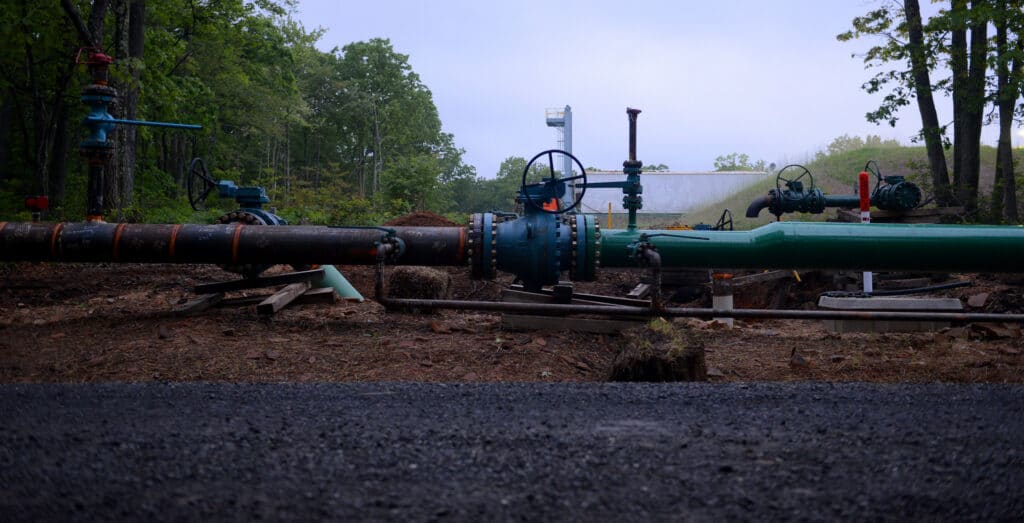
Pipeline construction alongside Pennsylvania state forest roads. Credit: Public Herald. (CC BY -NC 2.0).

Pennsylvania voters have become increasingly disillusioned with the fracking industry, with weak and declining support across all demographics, according to a new poll. By wide margins, voters in the Keystone State want “a serious crackdown on fracking operations.”

The poll, conducted by Data for Progress for the Ohio River Valley Institute (ORVI), an Appalachian-focused think tank, shows that large majorities of voters in Pennsylvania — including from large swathes of Republicans — are concerned about pollution from fracking, oppose subsidies to the industry, and support a range of new regulations.

The declining support for fracking is “an extension of trends that have been underway for some time,” Eric de Place, a research fellow at ORVI, told DeSmog. “Men, women, age groups, Republicans, Democrats, Independents … there is not a demographic that doesn’t support a crackdown on fracking,” he said.

In the poll of 647 voters, 61 percent of respondents agreed with a statement that said Pennsylvania “needs to do a better job of cracking down on fracking companies that do not comply with regulations,” compared to 30 percent that said the government “does not need to intervene and impose more bureaucratic regulations on fracking companies.” Of those favoring increased enforcement, 51 percent were Independents, and even 43 percent of Republicans agreed the state should be doing more.

On a long list of additional questions, large majorities favored more restrictions, more oversight, and less state support for the natural gas industry, which for years has enjoyed political backing at multiple levels despite signs of waning approval from Pennsylvania residents.

For example, by a 74 to 14 percent margin, respondents favored greater setback distances for fracking operations from homes, schools, hospitals, and other buildings. By a 79 to 9 percent margin, respondents favored mandatory disclosure of chemicals used in drilling, and the same margin supported a comprehensive health response from the state to address the effects of living near drilling sites.

Currently, Pennsylvania exempts fracking fluids from being classified as hazardous waste, a designation that would change how and where fracking waste is handled. Yet 69 percent of those polled support classifying fracking fluids in this way, compared to 21 percent that do not.

Wayne Township Landfill in McElhattan, PA. The landfill handled gas industry drill cuttings. Credit: Public Herald. (CC BY -NC 2.0). 


Questions about whether fracking has been an economic boon to the state were mixed, but only 30 percent supported tax breaks for drillers, while 59 percent opposed such support. At the same time, 86 percent agreed with a statement that fracking companies “should pay the full cost for the pollution they create.” Only 8 percent were opposed.

“There’s an overwhelming, shocking number of people who want the industry much more tightly regulated than it is now. That’s something that kind of everyone agrees on,” de Place said. “Whether you want [fracking] banned or you want it to continue … almost nobody wants it to continue as it is now.”

He said two things are likely going on. The benefits promised by the industry have been disappointing, and the negative impacts have become impossible to ignore. “People have heard and seen in their lives the horror stories. Kids getting a rare bone cancer possibly because of fracking waste nearby. A lot of stories about groundwater being contaminated. There’s people concerned about climate, of course. It goes on and on,” de Place said. “As the industry has had 10 years to operate, in some cases almost with free rein, there’s just more and more reasons to be concerned and more evidence piling up that the industry is really pretty dangerous.”

When asked about the poll, David Masur, executive director of advocacy group PennEnvironment said he was not surprised, given that the lofty promises from the industry that fracking would be an economic “gamechanger” have not played out.

“I think a lot of people said, ‘well, the economy feels no different than it did before except there’s air pollution and I see pictures of things exploding on TV,’” Masur said.

The poll results add to a growing body of evidence that in a state with a heavy drilling presence, the gas industry’s support is weakening. A 2014 Quinnipiac University poll, for instance, showed that 58 percent of respondents favored fracking.

Other polls also detail declining support for the industry over time. A Franklin & Marshall College poll from 2014 found that 40 percent of voters thought the economic benefits of fracking outweighed the environmental costs, while 37 percent believed the risks were too high. That same question was asked in 2020, and opinions had flipped, with respondents stating that the risks were too high by a 49 to 38 margin.

Injection well in Allegheny County, PA. Credit: Ted Auch, FracTracker. (CC BY -NC 2.0).


Perceptions match some of the substantive data of the industry’s impact. Separate research from ORVI from earlier this year found the fracking boom over the past decade has been an economic bust, with counties home to disproportionately high levels of drilling having showing comparatively weak job growth and declining populations relative to other parts of Appalachia and the country as a whole.

“Our recent research shows there is very little data to support the contention that the Appalachian natural gas boom has been or can be an engine for economic prosperity. In fact, in some cases, the industry may have the opposite effect. It follows, then, that this poll confirms what other polls have been finding: that public support for fracking in Pennsylvania is eroding precipitously,” said Joanne Kilgour, executive director of ORVI.

The Marcellus Shale Coalition, a gas industry trade group, did not respond to a request for comment.

The Political Myth of Fracking

The notion that fracking is popular in Pennsylvania has been a difficult myth to debunk, and it flies in the face of conventional media narratives, including from the 2020 Presidential election in which then-President Donald Trump tried to hammer candidate Joe Biden on the issue.

“To all the people of Pennsylvania, hear this warning,” President Trump said at a campaign rally in Erie, Pennsylvania, in October. “If Biden’s elected, he will wipe out your energy industry.”

“Only by voting for me,” Trump added, “can you save your fracking in Pennsylvania.”

At the time, national media outlets consistently reported that fracking was a political liability for Biden, adopting Trump’s framing of the issue that being an ally of the industry was good politics and favoring restrictions on drilling presented political risks.

Gas rig in Butler County, PA. Credit: WCN 24/7. (CC BY – NC 2.0)


But that has arguably been a misguided political trope for some time. Eric de Place pointed to Pennsylvania Attorney General Josh Shapiro, who has headed up a very public campaign opposing the industry.

In June 2020, Shapiro released a scorching grand jury report that capped off a two-year investigation into environmental crimes committed by gas drillers. The report also pointed blame at state environmental regulators for their cozy relationship with industry.

Shapiro “is about as close you can find to a one-person referendum on the politics of fracking in Pennsylvania,” de Place wrote in November 2020 shortly after the presidential election.

In 2020, Shapiro won reelection as Attorney General, garnering just barely more support across the state than Joe Biden did in the presidential election. But Shapiro did better than Biden by much larger margins in counties where fracking is concentrated. In fact, Shapiro outperformed Biden in nine out of the top ten fracking counties, according to ORVI. Given that Shapiro has cultivated a public reputation taking on the gas industry, his relatively strong performance in fracking counties undercuts the notion that regulating or opposing the industry is bad politics.

ORVI’s poll also shows that very large margins of voters favor Shapiro’s recommendations in his grand jury report. For example, by an 82 to 6 margin, respondents favor requiring safer transport of fracking waste, and a 63 to 19 percent margin favor allowing the Attorney General’s office to prosecute oil and gas companies.

Attorney General Shapiro, who is thought to be preparing a run for governor in 2022, must have come to the conclusion that it was “substantively valuable and politically valuable to call for these populist policies” against the fracking industry, betting that “there would be no blowback from the voters,” David Masur, told DeSmog.

“And it did play out that way,” Masur said.

“When fracking started, when I would go into the state capitol, I’d even have Democratic legislators going, ‘Oh my God, you can’t speak negatively about fracking. You’re going to be persona non grata in here,’” Masur told DeSmog. He said that is now changing.

But he added that increasing oversight or regulation of the industry was “an uphill battle” because of the role of money in politics. For example, Masur said that overwhelming majorities of the public favor classifying fracking fluids as hazardous waste, or favor mandatory disclosure of chemicals used in fracking, but even those extremely modest measures “can’t even get a hearing.”

“That’s a reflection of the power of money in politics, which allows a small group of special interests to have a chokehold on the decision-making,” Masur said. “Harrisburg and D.C. are so far behind the public partially because of the influence of money and access and power, [which] has them years behind where the polling shows the public is.”
Lake Powell dips to historic low amid drought

Associated Press

Lake Powell dips to historic low amid drought

The lake is facing a new set of challenges having reached a record low of 3,553 feet last week

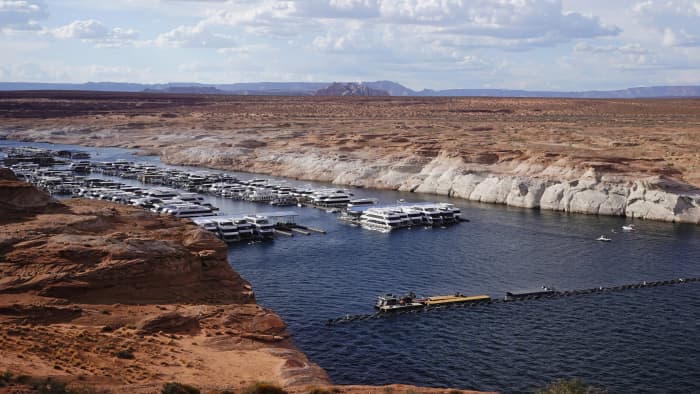
A white band of newly exposed rock is shown along the canyon walls at Lake Powell at Antelope Point Marina on Friday, July 30, 2021, near Page, Ariz. AP PHOTO/RICK BOWMER


It’s a stark reminder of how far the water level has fallen at the massive reservoir on the Utah-Arizona border. Just last year, it was more than 50 feet (15 meters) higher. Now, the level at the popular destination for houseboat vacations is at a historic low amid a climate change-fueled mega-drought engulfing the U.S. West.

At Lake Powell, tents are tucked along shorelines that haven’t seen water for years. Bright-colored jet skis fly across the water, passing kayakers, water skiers and fishermen under a blistering desert sun. Closed boat ramps have forced some houseboats off the lake, leaving tourists and businesses scrambling. One ramp is so far above the water, people have to carry kayaks and stand-up paddleboards down a steep cliff face to reach the surface.

Houseboat rental companies have had to cancel their bookings through August — one of their most popular months — after the National Park Service, which manages the lake, barred people from launching the vessels in mid-July.

At the popular main launch point on Wahweap Bay, the bottom of the concrete ramp has been extended with steel pipes so boats can still get on the lake, but that solution will only last another week or two, the park service said.

“It’s really sad that they’re allowing such a beautiful, beautiful place to fall apart,” said Bob Reed, who runs touring company Up Lake Adventures.

Lake Powell is the second-largest reservoir in the United States, right behind Nevada’s Lake Mead, which also stores water from the Colorado River. Both are shrinking faster than expected, a dire concern for a seven-state region that relies on the river to supply water to 40 million people and a $5 billion-a-year agricultural industry.

They are among several large bodies of water in the U.S. West that have hit record lows this summer, including the Great Salt Lake in Utah. Lake Oroville in California is expected to reach a historic low by late August, with the state’s more than 1,500 reservoirs 50% lower than they should be this time of year.

In 1983, Lake Powell’s water exceeded its maximum level of 3,700 feet and nearly overran Glen Canyon Dam. The lake is facing a new set of challenges having reached a record low of 3,553 feet last week.

Government officials had to begin releasing water from sources upstream last month to keep the lake’s level from dropping so low it would have threatened hydropower supplied by the dam.

It comes as less snowpack flows into the Colorado River and its tributaries, and hot temperatures parch soil and cause more river water to evaporate as it streams through the drought-plagued American West. Studies have linked the region’s more than 20-year megadrought to human-caused climate change.

Fluctuating water levels have long been a staple of Lake Powell, but National Park Service officials say the usual forecasts weren’t able to predict just how bad 2021 would be.

Finger-pointing has started as boaters, local officials and the park service debate what to do now.

“The park service has failed to plan,” area homeowner Bill Schneider said. “If it gets to the point where we’re so low that you can’t put boats in the water and you can’t come up with a solution to put boats in the water, why would you come to Lake Powell?”

The 53-year-old bought a retirement home in nearby Page, Arizona, after completing 25 years of military service in February. He wanted to return to Wahweap Bay where he spent most of his childhood and teen years fishing, waterskiing and working odd jobs around the lake. But after watching how the lake has been managed, Schneider says he’s starting to regret it.

Officials say they have solutions for families and boaters who sometimes plan years ahead to explore the glassy waters that extend into narrow red rock canyons and the tourism industry that depends on them.

Once the severity of the drought became clear, federal officials began looking for options to allow boat access at low water levels, said William Shott, superintendent of the Glen Canyon National Recreation Area, where Lake Powell is located. The park service discovered an old ramp on Wahweap Bay that will be built out to support houseboats and smaller motorboats.

Shott says he hopes the $3 million ramp can be completed by Labor Day weekend. The project is funded by the park service and lake concessionaire Aramark.

The agency and officials from the town of Page, which relies on lake tourism, plan to open another old asphalt ramp to provide access for smaller boats while the larger one is updated.

Tom Materna, who has been visiting Lake Powell for 20 years, launched his family’s 65-foot timeshare houseboat just hours before the main ramp closed but had to cut their vacation short as water levels dropped in mid-July.

“They said no more launching out of the Wahweap ramp, so we were glad we made it out,” the Los Angeles resident said. “Then the next day I think or two days later, they called us up and told us that all launch and retrieve houseboats had to be off the lake.”

Page Mayor Bill Diak said losing boat access to the lake could have devastating financial consequences for the city of 7,500.

He said local leaders were “slow” to address dropping water levels and limited boat access but that he’s been working closer with park officials and concessionaires on solutions.

“We could have been a little bit more proactive on planning … but we’re moving in the right direction now working together,” Diak said.

He stressed that the impact of climate change needs to be addressed, noting that the U.S. West could be facing far more pressing issues than lake access if the drought continues for another 20 years.

One silver lining, Shott says, is the park service can build boat ramps that are usable even during record drought years. Over $8 million in other low-water projects also are underway.

“Even if we did have a crystal ball and we saw that these lake levels were going to get this low, we couldn’t have prevented it anyways,” Shott said. “With that said, we’re taking advantage of the low water now.”

Troy Sherman, co-owner of a business renting environmentally friendly anchors to houseboats, said the marina housing Beach Bags Anchors shut down shortly after his company launched in spring 2020 because of the coronavirus pandemic. It relaunched this year but had to cancel 95% of its bookings in July when ramps closed to houseboats.

“Until there’s really access to a ramp again to put houseboats in, my business is kind of in a holding pattern,” Sherman said. “But we’ll totally persevere; it’s what you have to do.”

A Florida radio host who railed against Dr. Fauci and vaccines has died from COVID-19

A Florida radio host who railed against Dr. Fauci and vaccines has died from COVID-19

coronavirus hospital texas
Dr. Joseph Varon (right) speaks to a patient in the COVID-19 intensive care unit at the United Memorial Medical Center in Houston, Texas on December 29, 2020. Go Nakamura/Getty Images 

  • Longtime radio host Dick Farrel died from COVID-19 after railing against vaccines on Facebook.
  • “Why take a vax promoted by people who lied 2u all along about masks,” one of his posts read.
  • After contracting the virus, friends said Farrel texted them and urged them to get the vaccine.

A radio host from Florida who publicly bashed coronavirus vaccines has died from COVID-19.

Dick Farrel frequently advocated against the vaccine on his personal Facebook page.

“Why take a vax promoted by people who lied 2u all along about masks, where the virus came from and the death toll?” Farrel wrote on Facebook on July 3, with no additional context or clarification.

“Vaccine Bogus Bull Shid!, Two peeps I know, got vaxed, now have Corona, hospitalized critical,” he wrote on July 1. “Thank you Moderna, FOR NOTHING!”

His friend, Mike McCabe, said on Facebook that Farrel, 65, had been battling COVID-19 for three weeks before his death this week.

Farrel also railed against Dr. Anthony Fauci, the nation’s leading coronavirus expert, calling him a “power tripping lying freak.”

The longtime radio host was an ardent support of former President Donald Trump, Facebook posts show.

After contracting the virus, friends said Farrel texted them and urged them to get the vaccine, according to WPTV, an NBC News affiliate.

“He is the reason I took the shot,” said Amy Leigh Hair, Farrel’s close friend. “He texted me and told me to ‘Get it!’ He told me this virus is no joke and he said, “I wish I had gotten it!”

After his death, friends and former colleagues began to pour in tributes.

Lee Strasser, former market general manager for CBS Radio West Palm Beach, said Farrel was “flamboyant, outrageous at times, and willing to take on any and all comers,” WPTV reported.

“Was he right all the time? No,” Strasser added. “But he was “RIGHT” all the time, especially if you asked him. Did he stay out of trouble? Not always. Was he great with clients? Yes. Was he a pleasure in the building? Absolutely. Was he loyal? Unquestionably! Was he skilled? Yessir! His passing is a big loss. He was a kind-hearted person with a load of passion, and his memory will stand the test of time. We have all lost a friend in Farrel.”

“Colonizing the Atmosphere”: How Rich, Western Nations Drive the Climate Crisis

In These Times – Climate

“Colonizing the Atmosphere”: How Rich, Western Nations Drive the Climate Crisis

New analysis finds the Global North is responsible for 92% of all excess global carbon dioxide emissions, while the Global South bears the brunt of the devastation.

Sarah Lazare              Previously From September 14,


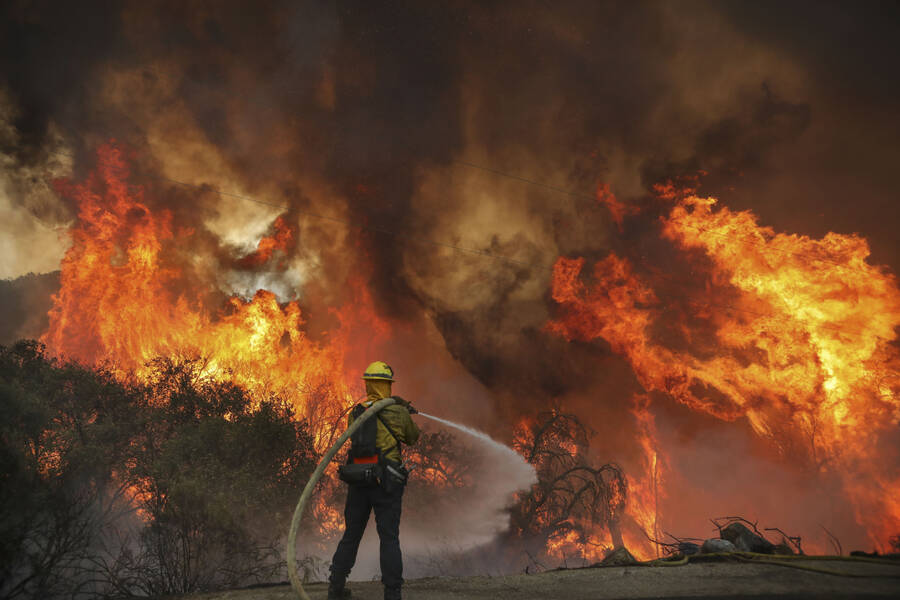
San Miguel County Firefighters battle a brush fire along Japatul Road during the Valley Fire in Jamul, California on September 6, 2020.SANDY HUFFAKER/AFP VIA GETTY IMAGES.


The climate disaster fueling unprecedented fires across the western United States, threatening to swallow the Marshall Islands into the ocean, and unleashing perennial hunger crises on South Sudan is a global catastrophe. But the global responsibility is not born equally. An analysis published in the September issue of The Lancet: Planetary Health shines new light on the outsized role of the United States, European Union and the Global North in creating a climate crisis that, while felt everywhere, is disproportionately harming the Global South.

As of 2015, the United States bore responsibility for 40% of ​excess global carbon dioxide emissions,” finds the analysis, authored by Jason Hickel, an economic anthropologist, author and a fellow of the Royal Society of Arts. The Group of Eight (the United States, the European Union, Russia, Japan and Canada) is responsible for 85% of such emissions. And the Global North (defined as the United States, Canada, Europe, Israel, Australia, New Zealand and Japan) is responsible for 92%.

In contrast, the Global South — which is by far bearing the brunt of climate droughts, floods, famines, storms, sea level rise and deaths — is responsible for just 8% of excess global carbon dioxide emissions.

While other researchers have calculated countries’ current annual emissions, as well as cumulative historic ones, Hickel tells In These Times ​none of this tells us how much nations have contributed to emissions in excess of the safe level.” His methodology starts from ​the position that the atmosphere is a common resource and that all people should have equal access to it within the safe planetary boundary (defined as 350 parts per million atmospheric concentration of CO2),” he says.

Hickel calculated the ​national fair shares of a safe global carbon budget.” Then he subtracted these fair shares from the historical emissions of countries — ​territorial emissions from 1850 to 1969, and consumption-based emissions from 1970 to 2015.” This calculation was then used to determine ​the extent to which each country has overshot or undershot its fair share,” states the analysis.

In other words,” says Hickel, ​this method allows us to answer the question: ​Who got us into this mess?’”

The analysis is meant to not only measure national responsibility for global emissions, but to identify those countries that are colonizing the atmosphere. ​The results show that the countries of the Global North have ​stolen’ a big chunk of the atmospheric fair-shares of poorer countries, and on top of that are responsible for the vast majority of excess emissions,” Hickel explains. ​In other words,” he adds, ​they have effectively colonized the global atmospheric commons for the sake of their own industrial growth, and for the sake of maintaining their own high levels of energy consumption.”

The study finds that, in contrast to Global North countries, ​most countries in the Global South were within their boundary fair shares, including India and China.” This is despite the fact that China, with more than four times the population of the United States, is presently the top overall emitter of greenhouse gases, although the United States is the top emitter per capita. According to the analysis, ​When it comes to climate change, however, what matters is stocks of carbon dioxide in the atmosphere, not annual flows; so responsibility must be measured in terms of each country’s contribution to cumulative historical emissions.” Yet, the study notes, ​given that China’s annual emissions are roughly 9 billion tons per year, it will soon overshoot its fair share.”

The fact that the United States and Global North bear disproportionate responsibility for driving the climate crisis does not let China off the hook for cutting emissions, says Hickel. ​If China does not reduce emissions, and fast, then we are all doomed,” he underscores. And indeed, climate activists have argued that in order to curb the climate crisis, the United States and China must overcome their confrontational footing and cooperate to dramatically cut emissions.

However, Hickel makes the moral argument that ​clearly the countries that have contributed the most to excess emissions must cut emissions fastest, with the United States and Europe leading the way. They have a responsibility to get to zero as soon as is physically possible — in a matter of years, not decades. This can be feasibly achieved, and we should all demand it.”

Other studies and analyses have pointed to the disproportionate responsibility of the Global North, and wealthy countries, for driving the climate crisis. A study released by Oxfam International in 2015 found that the poorest half of the world’s population — roughly 3.5 billion people — are to blame for just 10% of ​total global emissions attributed to individual consumption,” yet they ​live overwhelmingly in the countries most vulnerable to climate change.” In contrast, the richest 10% of people in the world are responsible for roughly 50% of global emissions.

2015 paper published in Scientific Reports identifies ​free rider” and ​forced rider” countries. It explains, “‘Free rid­er’ coun­tries con­tribute dis­pro­por­tion­ate­ly to glob­al [green­house gas] emis­sions with only lim­it­ed vul­ner­a­bil­i­ty to the effects of the result­ing cli­mate change, while ​’forced rid­er’ coun­tries are most vul­ner­a­ble to cli­mate change but have con­tributed lit­tle to its genesis.”

Yet, even as acute effects of the climate crisis are being felt in the United States, the Republican Party continues to embrace climate denial, and the leadership of the Democratic Party shows reluctance to curb the fossil fuel production driving the crisis — and hostility to radical solutions like the Green New Deal. The United States has contributed only $1 billion to the UN’s Green Climate Fund, meant to help ​developing countries reduce their greenhouse gas emissions and enhance their ability to respond to climate change” (former President Barack Obama pledged $3 billion, but President Trump later reneged on $2 billion of it).

Whatever horrific price U.S. residents in the direct path of harmful fires are forced to pay for politicians’ inaction, the costs to the Global South will be greater in scale. ​We know that the Global South suffers more than 90% of the costs of climate breakdown, and 98% of the deaths associated with climate breakdown, due to fires, floods, droughts, famine, disease, displacement and so on,” says Hickel. ​So, just like under colonialism, the North is benefitting at the expense of the South.”

Sarah Lazare is web editor and reporter for In These Times.

Homeland Security warns of ‘increasing but modest’ threat of violence from Trump conspiracy

Homeland Security warns of ‘increasing but modest’ threat of violence from Trump conspiracy


The Department of Homeland Security said Friday they have observed “an increasing but modest level of activity online” by people who are calling for violence in response to baseless claims of 2020 election fraud and related to the conspiracy theory that former President Donald Trump will be reinstated.

“Some conspiracy theories associated with reinstating former President Trump have included calls for violence if desired outcomes are not realized,” according to a DHS Office of Intelligence and Analysis bulletin obtained by ABC News.

There is no evidence that shows there was widespread voter fraud in the 2020 election.

“Over the last few days what has occurred is there’s been much more public visibility, meaning the discussions and these theories have migrated away from being contained within the conspiracy and extremist online communities, to where they’re being the topic of discussion on web forums, or more public web forums, and even within the sort of media ecosystem,” a senior DHS official explained.

DHS says in the bulletin they do not have specific evidence there is a plot imminent.

“As public visibility of the narratives increases, we are concerned about more calls to violence. Reporting indicates that the timing for these activities may occur during August 2021, although we lack information on specific plots or planned actions,” the bulletin sent to state and local partners reads.

PHOTO: Former President Donald Trump arrives at the Sarasota Fairgrounds to speak to his supporters during the Save America Rally in Sarasota, Fla., July 3, 2021. (Octavio Jones/Reuters, FILE)


The department “does not have the luxury of waiting till we uncover information with the level of specificity, regarding a potential location and the time of an attack” to act on potential threats due to the threat environment, the senior DHS official explained.

“Past circumstances have illustrated that calls for violence could expand rapidly in the public domain and may be occurring outside of publicly available channels. As such, lone offenders and small groups of individuals could mobilize to violence with little-to-no warning,” the bulletin says.

MORE: At 1st Jan. 6 committee hearing, police officers recount brutal, racist attack by Trump mob

The senior official said that one of the lessons learned from the Jan. 6 storming of the Capitol is “that information that may reflect a growing threat may be communicated on public forums.”

“The current threat environment is one which is fueled in large part by conspiracy theories and other false narratives that are spread online by foreign governments, by foreign terrorist groups and by domestic extremist thought leaders, and are consumed by individuals who are predisposed to engage in violence,” the official said.

PHOTO: A Department of Homeland Security seal hangs on a wall before a speech by Vice President Mike Pence at the agency headquarters in Washington, D.C., July 6, 2018. (Bloomberg via Getty Images, FILE)


The official pointed to the events of Jan. 6 and the attacks on the synagogues in Pittsburgh and Poway, California, as examples.

The senior DHS official also pointed to the balance DHS has to walk when putting out products.

“We don’t want to overreact, but we want to make sure that we are at the earliest stage possible providing awareness to law enforcement and other personnel who are responsible for security and are critical to mitigating risk,” the senior official said, adding the bulletin was done with civil rights and civil liberties in mind.

California drought forces shutdown of historic Hyatt hydropower plant

California drought forces shutdown of historic Hyatt hydropower plant


A large scale California hydropower plant was shut down on Thursday after ongoing drought conditions reduced water levels in Lake Oroville to historic lows, according to the Sacramento Bee.


Why it matters: It is the first time the Edward Hyatt hydroelectric power plant has ceased operations since it was constructed in 1967, at a time when California is warning about the potential for rolling blackouts.

  • The plant feeds from a reservoir at Lake Oroville in Butte County, the foothills of the Sierra Nevadas in Northern California, and has the capacity to power almost half a million households, according to the Bee.
  • But the lake is less than one-quarter full — surpassing its record lowest level set in 1977 — amid the state’s ongoing water crisis.

What they’re saying: “This is just one of many unprecedented impacts we are experiencing in California as a result of our climate-induced drought,” said Karla Nemeth, director of the California Department of Water Resources, in a statement.

  • “DWR anticipated this moment, and the state has planned for its loss in both water and grid management,” the statement adds.
  • “Falling reservoir levels are another example of why it is so critical that all Californians conserve water. We are calling on everyone to take action now to reduce water use by 15 percent, to preserve as much water supply in storage as possible should we experience another dry year. We are all in this together.”

Sooner or Later, Climate Change is Coming for Your Wallet

Barrons – Economy & Policy

Sooner or Later, Climate Change is Coming for Your Wallet

By Jennifer Marlon and Bianca Taylor                    August 6, 2021


Richard Van Der Spuy/Dreamstime.com


Last week Gary Gensler, the chair of the Securities and Exchange Commission, made what seemed like an uncontroversial statement: “I think we can bring greater clarity to climate risk disclosures.” The SEC, he said, will begin to consider requiring public companies to tell their investors how climate change could threaten their business. That’s an important step, because for as much as we know about how the climate crisis is changing our lives, we’re only starting to get our heads around what it will truly cost you and me.

The oil and gas industry is already pushing back. Industry groups are stepping up lobbying to avoid disclosing their emissions, according to the Financial Times. These short-sighted attempts will unfortunately hurt our economy.

According to a report released in April by SwissRe, the global reinsurance company, the U.S. economy stands to lose 10% of its economic value by 2050 under a worst case scenario, where average global temperatures rise 3°C compared to pre-industrial levels. The SwissRe “worst case” scenario, however, is our current reality—one in which temperatures remain on their current trajectory, and both the Paris Agreement and 2050 net-zero emissions targets are not met.

To some, SwissRe’s projection of a 10% loss in 30 years may not sound alarming. But that datapoint can otherwise be stated as: The U.S. will suffer natural disasters such that it is not expected our economy will be able to recover from them. The prospect of suffering damage so profound that we are unable to economically recover is alarming. And it is not a distant future.

Scientists had hoped that Covid-related disruptions would produce a large reduction in carbon emissions. But the reductions were less than expected. The world produced only 6% less carbon last year than the one before. This modest response to an unprecedented synchronous global shutdown of economic activity puts the scope and scale of current emissions into perspective. To quantify the challenge, the Intergovernmental Panel on Climate Change indicates that emission reduction ranges must be around 45% lower than present to meet a 1.5°C temperature goal.

Weather and climate disasters cost the U.S. economy $450 billion (2.1% of GDP) in 2020, the highest year on record. And we hold the No. 1 spot for the number of disasters year-to-date according to EM-DAT, a database that tracks disasters globally. We also know climate change has made most of these events worse than they would have otherwise been.

The mere 1°C temperature increase that has already occurred has contributed to new water shortages in towns across California, Nevada, Arizona, and New Mexico. Increasing evaporation has also reduced soil moisture, which helps explain the $7 billion to $13 billion cost to insurers from the 2020 wildfires. Costs that will inevitably translate into a higher price tag to you, the consumer.

The future costs of climate change on the U.S. economy are uncertain, but what is worse is that they may be underestimated. Underestimation occurs because projections are often made using an enumerative approach, where losses are valued sector by sector and then tallied to estimate the total impact on social welfare.

In other words, current approaches miss cascading risks, problems that exacerbate other disasters in unforeseen ways. Global supply-chain disruptions are an example of why cascading risks are difficult to model—because all industries can be affected when businesses of all sizes as well as national and subnational governments are interdependent. Economic disruptions from Covid-19 provide a case in point. The pandemic highlighted the vulnerabilities of complex supply chains that are now ubiquitous. As severe weather events continue to worsen, the U.S. economy will continue to suffer shortages — not only from domestic disruptions to products like orange juicecorn, and soy, but also from disasters abroad. The regions that produce most semiconductor chips and rare earth elements, critical in computers, smartphones, aerospace and defense, and medical appliances are concentrated in regions particularly vulnerable to climate hazards.

The economic consequences of climate change are countless. Under the last administration the U.S. Commodities and Futures Trade Commission released the first-ever assessment of the impact of climate change on the financial system. The 196-page report’s first sentence reads: “Climate change poses a major risk to the stability of the U.S. financial system and to its ability to sustain the American economy.”

The good news is that scientists, economists, and financial regulators agree on what needs to be done—even the oil and gas executives are on board. The key recommendation from the CFTC is that “The United States establishes a price on carbon. It must be a fair, economy-wide price… at a level that reflects the true social cost of those emissions.” The authors go further, stating that “a carbon price is the single most important step to manage climate risk and drive the appropriate allocation of capital.” The SEC’s moves toward mandatory climate risk disclosures are first steps on that path.

But if you’re not in a position to influence the risk calculus of public companies, there is something else you can do. You can buy insurance. The IMF’s researchers find that insurance penetration is a top factor in determining the resilience of a country to the impact of climate change. Yes, it might cost you a little more than you expected to spend this year. But climate change is coming for your wallet sooner or later.

Guest commentaries like this one are written by authors outside the Barron’s and MarketWatch newsroom. They reflect the perspective and opinions of the authors.

About the authors: Jennifer R. Marlon is a research scientist at Yale University’s School of the Environment. Bianca Taylor is founder of Tourmaline Group and a member of the Bretton Woods Committee. The two are public voices fellows of the OpEd Project and the Yale Program on Climate Change Communication.

‘Running out of options’: California resorts to water cutoffs as drought worsens

‘Running out of options’: California resorts to water cutoffs as drought worsens

EL DORADO HILLS, CALIFORNIA - MAY 10: Boat docks at the Browns Ravine Cove sit on dry earth at Folsom Lake on May 10, 2021 in El Dorado Hills, California. California Gov. Gavin Newsom declared a drought emergency in 41 of California's 58 counties, about 30 percent of the state's population. Folsom Lake is currently at 38 percent of normal capacity. (Photo by Justin Sullivan/Getty Images)
Boat docks at the Browns Ravine Cove sit on dry earth at Folsom Lake on May 10, when California Gov. Gavin Newsom declared a drought emergency in 41 of the state’s 58 counties. (Getty Images)


California water regulators took unprecedented action this week, passing an emergency regulation that will bar thousands of Californians from diverting stream and river water as the drought worsens.

The State Water Resources Control Board voted unanimously Tuesday to pass the “emergency curtailment” order for the Sacramento-San Joaquin Delta watershed. The watershed encompasses a wide swath of the state, from the Oregon border in northeastern California down into the Central Valley.

The regulation — which gives the state water board the authority to issue emergency curtailments and require reporting on water use — will go into effect about two weeks from now, subject to approval by the state Office of Administrative Law, with the issuing of formal curtailment orders to follow.

California’s complex water rights system is designed to allocate water use during times of shortage, and such curtailments, although rare, are not unheard of. But the scope of Tuesday’s order — which will apply to thousands of senior water rights across a wide swath of the state — goes beyond anything seen in prior droughts.

“The fact remains that water supplies are extremely limited, and we are running out of options,” Ernest A. Conant, Bureau of Reclamation California-Great Basin regional director, said during the meeting, expressing his agency’s support for the emergency regulations.

Some farmers strongly criticized the move, but regulators said it was necessary given the conditions.

Who is affected by the decision?

About 5,700 Northern California and Central Valley water rights holders — who collectively hold about 12,500 water rights — will be subject to the forthcoming curtailments, according to Erik Ekdahl, deputy director of the state water board’s Division of Water Rights. Once the regulation is in place, further curtailments in the delta watershed may be issued as the situation progresses.

“It really depends on compliance with this order, climate hydrology, and what water supply conditions evolve,” Ekdahl said.

The order will largely affect rights holders using water for agricultural irrigation purposes, though some municipal, industrial and commercial entities also will be affected. The regulation carves out an exemption for health and human safety purposes, meaning that water for drinking, bathing and domestic purposes won’t be subject to the curtailment.

The water board previously released a draft version of the proposed order in mid-July, following a notice of water unavailability — which urges, but does not order, people to stop diverting water. That was sent to many rights holders in mid-June.

The curtailments will create hardships for many growers, particularly those without access to well water. But the burden may be lessened by the time of year. Irrigation needs vary widely from farm to farm and crop to crop. Generally speaking, however, the biggest demands for agricultural irrigation in the delta watershed tend to be in the late spring and summer, meaning the bulk of water use for the year is likely behind many growers.

“It’s coming toward the end of the season here. As everything’s dwindling in a very dry year, the curtailments may not make a huge difference for a lot of crop types,” said Chris Scheuring, senior counsel for the California Farm Bureau.

Scheuring said the real question is what happens if drought conditions persist next year.

What prompted the decision?

The bottom line is there isn’t enough water to meet competing demands. The curtailments are necessary, according to the state water board’s finding of emergency, “to avoid catastrophic impacts to reservoir storage needed for human health and safety and other purposes.” Essentially, regulators need to drastically reduce the amount of water being diverted from rivers and streams to ensure that enough water remains for essential purposes and that those who are diverting are doing so legally.

“It’s pretty important for the integrity of the system to curtail water rights when there’s not enough water,” said Jay Lund, co-director of the Center for Watershed Sciences at UC Davis. “Otherwise, it’s just whoever gets their pump in first. And that’s not really a very fair way to do things.” In times of water shortage, rights holders are curtailed in order of seniority.

Drought conditions in the state rapidly worsened this spring, when expected snowpack runoff to the watershed decreased by almost 800,000 acre-feet — an amount nearly equivalent to the capacity of Folsom Reservoir — between April and May.

Gov. Gavin Newsom declared a drought emergency in 41 of California’s 58 counties on May 10. In that same month, many farmers were warned that they would receive little or nothing from two large allocation systems, the federal Central Valley Project and the State Water Project.

What happened to the snowpack?

“The simplest terms are the snow was kind of there and then it wasn’t,” said David Rizzardo, chief of the hydrology branch at the state’s Department of Water Resources.

Rizzardo said it’s not uncommon to lose 10%-20% of the snowpack to normal hydrological processes, particularly following a dry year. But losing just under 80% — let alone in such a short period of time?

“It’s beyond unprecedented,” Rizzardo said. The hydrologic conditions witnessed this year have been forecast in climate change models, but according to Rizzardo, such scenarios weren’t expected for decades from now.

Rizzardo characterized higher temperatures, drier soils and the effect of large-scale fires in the watershed as three of the primary factors driving the loss in projected runoff. (The effect of fires is two-fold, according to Rizzardo. The loss of tree cover and brush puts more direct sun radiation on the snow, which causes it to melt faster. Sooty debris from fires also creates dark surfaces, which absorb — rather than reflect — the sun’s radiation, causing even more melting.)

The delta itself is formed by the convergence of the Sacramento and San Joaquin rivers in the western Central Valley, but the sprawling delta watershed stretches all the way from the Oregon border in the northeastern corner of the state to just north of Fresno, encompassing much of the Sierra Nevada, as well as cities like Redding, Chico, Sacramento and Stockton.

Broadly speaking, runoff from the Sierra snowpack, which feeds major Northern California reservoirs and dozens of rivers, travels through the watershed and into the delta, which then connects to the San Francisco Bay. Water from the delta contributes to the water supply for more than two-thirds of Californians and is also used to irrigate millions of acres of farmland.

What about the rest of the state?

In July, Newsom urged all Californians to voluntarily cut their water usage by 15%, but what exactly does that mean for the average California household?

The governor made the request as he extended a regional drought emergency to 50 counties, which comprise about 42% of the state’s population. For many, the talk of water reductions reminded them of the shriveled lawns, attenuated showers and water-bucket toilet flushing of the last devastating drought.

If achieved, a voluntary 15% water reduction statewide would save roughly 850,000 acre-feet of water, which is enough to supply 1.7 million households for a year, according to the governor’s office.

In April 2015, then-Gov. Jerry Brown ordered cities and towns across California to cut water use by 25%, marking the first mandatory statewide water restrictions in state history. Californians came close to meeting the goal, with residents reducing the amount of water they used by 24.5%. Now, a handful of years after the last drought, per-capita residential water use remains about 16% below 2013 levels.

Newsom’s request is intended to bring California water production roughly back to where it dropped to in 2015 and 2016, said Marielle Pinheiro, research data specialist at the State Water Resources Control Board. Pinheiro said the number seemed feasible to the board because the state had been able to maintain those levels during the last drought.

Household water usage varies dramatically across the state based on a number of factors, but speaking in the broadest terms, Pinheiro said a 15% reduction would equate to a cut of roughly 14 gallons a day per person.

Newsom’s drought emergency declaration excludes almost all of Southern California, where the drought picture is much less dire. That’s because the region is mostly supplied by big federal and state water systems, rather than local precipitation.

The Metropolitan Water District of Southern California, which imports water from the Colorado River and the north, says it has sufficient reserves in regional reservoirs and groundwater banks — enough to carry it through this year.

Los Angeles, which is partly supplied by the MWD, similarly doesn’t expect any shortages, officials have said.

Federal judge sanctions lawyers who brought conspiracy theory-filled lawsuit trying to overturn the 2020 election, reap $160 billion in damages

Federal judge sanctions lawyers who brought conspiracy theory-filled lawsuit trying to overturn the 2020 election, reap $160 billion in damages

Melania Trump and Donald Trump
Former President Donald Trump. Drew Angerer/Getty Images

  • A federal judge in Colorado sanctioned two lawyers who challenged the 2020 election results.
  • He called their claims “fantastical” and “the stuff of which violent insurrections are made.”
  • The lawyers had asked for $160 billion in damages because Joe Biden won the presidential election.

A federal judge in Colorado has sanctioned attorneys who brought a lawsuit that challenged the results of the 2020 presidential election and sought $160 billion in damages, calling their conspiratorial claims “the stuff of which violent insurrections are made.”

The Wednesday ruling from US Magistrate Judge N. Reid Neureiter concludes that the lawsuit “was filed in bad faith” and orders the attorneys, Ernest J. Walker and Gary D. Fielder, to pay the opposing lawyers’ expenses and fees. The order does not bar them from practicing law.

“This lawsuit was filed with a woeful lack of investigation into the law and (under the circumstances) the facts,” Neureiter wrote. “The lawsuit put into or repeated into the public record highly inflammatory and damaging allegations that could have put individuals’ safety in danger. Doing so without a valid legal basis or serious independent personal investigation into the facts was the height of recklessness.”

The lawsuit was first filed on December 22, more than a month after then-President Donald Trump lost the 2020 election. Though it was filed in Colorado, the lawsuit named as defendants the governors and secretaries of state for swing states which Trump lost to now-President Joe Biden.

The plaintiffs – a smattering of Trump supporters who said in declarations that they believed the election results were rigged, were upset their Facebook posts were deleted, and didn’t want to get vaccinated against COVID-19 – also named Facebook, Mark Zuckerberg, Priscilla Chan, and Dominion Voting Systems as defendants.

Neureiter’s ruling criticized the attorneys in scathing terms for purporting to “represent 160 million American registered voters,” seeking to nullify “actions of multiple state legislatures, municipalities, and state courts,” and then demand a “nominal amount of $1,000 per registered voter” in damages, which would amount to “a figure is greater than the annual GDP of Hungary.”

“In short, this was no slip-and-fall at the local grocery store,” Neureiter wrote. “Albeit disorganized and fantastical, the Complaint’s allegations are extraordinarily serious and, if accepted as true by large numbers of people, are the stuff of which violent insurrections are made.”

The lawyers’ ‘massive cut-and-paste job’ recycled claims from other failed lawsuits

The judge noted that sanctions were warranted because the attorneys did not bring the lawsuit based on the claims of the people they represented.

“It must also be noted that this was not a client-driven lawsuit. As Plaintiffs’ counsel, Mr. Fielder, conceded at the July 16 hearing, the lawsuit was his idea,” Neureiter wrote. “Mr. Fielder and Mr. Walker were not relying on information from the named Plaintiffs to construct the suit or for any of the substantive factual allegations.”

Neureiter said Walker and Fielder acted improperly by failing to research any factual basis for their claims that the 2020 election results were rigged, and by bringing a claim in Colorado against state officials in Michigan, Pennsylvania, Georgia, and Wisconsin.

Neureiter also criticized the lawyers’ “massive cut-and-paste job.” They recycled claims in their lawsuit from Texas Attorney General Ken Paxton and Trump-affiliated lawyer Sidney Powell, both of whom failed in their own lawsuits challenging the election results.

sidney powell georgia
The lawyers recycled claims from Sidney Powell, who led several failed lawsuits seeking to overturn the election results. Associated Press


The judge also criticized them for uncritically including a false Trump tweet about “Dominion deleting 2.7 million trump votes nationwide.” Neureiter wrote that when asked in a hearing about including the claim, Fielder’s only justification was that Trump was the president.

“Under the circumstances of this case, with this election, with this insurrection, with the on-going threats to election officials and company employees, including in a federal filing as if it were true such an inflammatory and damaging allegation, without any attempt at verification, merely because the out-going President had said it, was reckless and did not represent a reasonable inquiry under the circumstances,” Neureiter wrote.

Donziger: Facing Prison for Fighting Chevron

Greg Palast – Investigative Journalism

Donziger: Facing Prison for Fighting Chevron

Rights Attorney Pays Price for Defending Indigenous in Ecuador Poisoned by Oil
Greg Palast                                


Look at his face. Emergildo Criollo, Chief of the Cofan people of the Amazon in Ecuador. Determined, dignified, in war paint, bare-chested.

Cofan Chief Emergildo Criollo, Ecuador

It was back in 2007, when I found him in his thatched stilt home in the rainforest. Criollo told me his 5-year-old son had jumped into a swimming hole, covered with an enticing shine. The shine was oil sludge, illegally dumped. His son came up vomiting blood, then dropped dead in the Chief’s arms.

I followed him to the courthouse in the dusty roustabout town of Lago Agrio (Bitter Lake) where, with a sheaf of papers, Criollo sought justice for his son.

Behind Criollo, the court clerks, in their white shirts and ties, were giggling and grinning at each other, nodding toward this “indio” painted up and half naked, thinking he can file a suit against a giant. A giant named Chevron.

In 2011, they stopped laughing. That’s when an Ecuadorian court ordered Chevron to pay Criollo and other indigenous co-plaintiffs $9.5 billion. The courts found that Chevron’s Texaco operation had illegally dumped 16 billion gallons of deadly oil waste.

Steven Donziger with Indigenous clients
(courtesy 
AmazonWatch)

What the gigglers didn’t know is that the Chief had a secret weapon: Steven Donziger, a US attorney, classmate of Barack Obama at Harvard law, who gave up everything — literally everything — to take on Criollo’s case.

It’s been a decade, and Chevron still hasn’t paid a dime. But Donziger has paid big time: For the last two years, he’s been under house arrest, longer than any American in history never convicted of a crime.

But weeks ago, he was convicted of contempt by a judge who denied him a jury. (The Constitution? Faggedaboudit.) And on October 8, this contemptible judge will sentence Donziger, and could put him behind bars.

Who was the prosecutor? Not the US government, but Chevron’s law firm. The first-ever criminal prosecution by a US corporation.

Say what?


On Friday, August 6 at 4pm Pacific, I will be speaking at the Free Donziger Rally at the Chevron Station on the corner of Laurel Canyon Blvd and Sunset Blvd. This is one of more than a dozen rallies on Friday from San Francisco to Tel Aviv. Check the list.


I can’t make this up.

Chevron set out to destroy Donziger, to make an example of a human rights lawyer that dares take on the petroleum pirates.

They filed suits against Donziger and the Cofan and found a former tobacco industry lawyer judge Lewis Kaplan to find Donziger in contempt for refusing to turn over his cell phone and computer to Chevron — an unprecedented attack on attorney-client privilege. To give Chevron the names of indigenous activists in South America can be a death sentence.

When Donziger said he’d appeal, the judge charged him with criminal contempt — that’s simply unprecedented. But a far more dangerous precedent was set. When federal prosecutors in New York laughed off and rejected Kaplan’s demand that they charge Donziger, the judge appointed Chevron’s lawyers, Gibson Dunn, to act as the prosecutors!

So far, 60 Nobel Laureates, several US Senators and Congresspeople, and a Who’s Who of human rights groups have publicly registered their horror at this new corporate prosecution. (Note: Gibson Dunn represented me. Never again. I’ve taken the trash to the curb.)

Chevron also went after journalists, in one case, filing a complaint against the BBC Television reporter that broke the story that Chevron had destroyed key evidence in the case. I was that reporter — and survived with my job after a year of hearings. But Chevron’s prosecution did a damn good job of scaring off other journalists.

Some were scared off; some bought off. PBS News Hour wouldn’t touch the death-by-oil story. The official chief sponsor of the PBS News Hour? Chevron.

Here’s the story, broadcast by BBC and, in the US, by Democracy Now!, the story you won’t find on the Petroleum Broadcast System.

****

Palast with oil sludge on stick Ecuador

I’ve gone way out of my way to get ChevronTexaco’s side of the story. I finally chased them down in Ecuador’s capital, Quito. I showed them a study of the epidemic of childhood leukemia centered on where their company dumped oil sludge. Here’s their reply:

And it’s the only case of cancer in the world? How many cases of children with cancer do you have in the States?

Texaco’s lawyer, Rodrigo Perez, was chuckling and snorting.

“Scientifically, nobody has proved that crude causes cancer.”

OK, then. But what about the epidemiological study about children with cancer in the Amazon traced to hydrocarbons?

The parents of the dead kids, he said, would have some big hurdles in court:

“If there is somebody with cancer there, they must prove it is caused by crude or by the petroleum industry. And, second, they have to prove that it is OUR crude.”

Perez leaned over with a huge grin.

“Which is absolutely impossible.”

He grinned even harder.

Maybe some guy eating monkeys in the jungle can’t prove it. And maybe that’s because the evidence of oil dumping was destroyed.

Deliberately, by Chevron.

Jaime Varela, Chevron Attorney, Quito, Ecuador

I passed the ChevronTexaco legal duo a document from their files labeled “Personal y confidential.” They read in silence. They stayed silent quite a while. Jaime Varela, Chevron’s lawyer, was wearing his tan golf pants and white shoes, an open shirt and bespoke blue blazer. He had a blow-dried bouffant hairdo much favored by the ruling elite of Latin America and skin whiter than mine, a color also favored by the elite.

Jaime had been grinning too. He read the memo. He stopped grinning. The key part says,

“Todos los informes previos deben ser sacados de las oficinas principales y las del campo, y ser destruidos.”

“. . . Reports . . . are to be removed from the division and field offices and be destroyed.”
It came from the company boss in the States, “R. C. Shields, Presidente de la Junta.”

Removed and destroyed. That smells an awful lot like an order to destroy evidence, which in this case means evidence of abandoned pits of deadly drilling residue. Destroying evidence that is part of a court action constitutes fraud.

In the United States, that would be a crime, a jail-time crime. OK, gents, you want to tell me about this document?

Can we have a copy of this?” Varela asked me, pretending he’d never seen it before in his life.
I’ll pretend with them, if that gets me information. “Sure. You’ve never seen this?”

The ritual of innocence continued as they asked a secretary to make copies. “We’re sure there’s an explanation,” Varela said. I’m sure there is. “We’ll get back to you as soon as we find out what it is.”

I’m still waiting.